JAXA Astronaut Activity Report, February, 2015
Last Updated: May 11, 2015
This is JAXA’s Japanese astronaut activity report for February, 2015.
Astronaut Kimiya Yui continues training for his upcoming long-duration ISS mission
Astronaut Kimiya Yui, who was assigned as a crew member for the Expedition 44/45 mission to the International Space Station (ISS), underwent training for this long-duration mission at the NASA Johnson Space Center (JSC) at the beginning of February, followed by training at the GCTC for the rest of the month.
At the JSC, training was held for Extravehicular Activity (EVA) and the Space Station Remote Manipulator System (SSRMS). During EVA training in the large pool in the Neutral Buoyancy Laboratory (NBL) where a mock-up of the H-II Transfer Vehicle (HTV) “KOUNOTORI” is submerged, Yui donned a submersible Extravehicular Mobility Unit (EMU) and dived into the water. Yui experienced a scenario where a payload loaded on the KOUNOTORI’s Exposed Pallet (EP) had to be removed by conducting unscheduled EVA.
Using a Virtual Reality (VR) system, Yui and his crewmate Kjell Lindgren also trained together to master how an EVA member and a SSRMS operations member tie up to proceed with EVA tasks. During the training, Yui was in charge of SSRMS operations and confirmed the procedure for supporting the crew’s EVA operations.

Yui and his crewmates training in the Soyuz simulator (Photo courtesy of JAXA and the GCTC)
The training in Russia was focused on flight simulation aboard the Soyuz spacecraft. Alongside Soyuz commander Oleg Kononenko and Astronaut Lindgren, Yui practiced each stage of operations ranging from launch and docking with the ISS, to returning to Earth after undocking from the ISS. They rehearsed operations in manual control mode that is used as backup in case automated control mode fails, as well as responses to sudden depressurization during a flight. For the ISS Russian segment, Yui’s training covered proper responses to such emergencies as an outbreak of fire and sudden depressurization.
Astronaut Takuya Onishi undergoes survival training in Russia
Astronaut Takuya Onishi, a crew member for the ISS Expedition 48/49 mission, underwent training at Russia’s Gagarin Cosmonaut Training Center (GCTC) during the first half of February, followed by training at the NASA Johnson Space Center (JSC) for the latter half of the month.
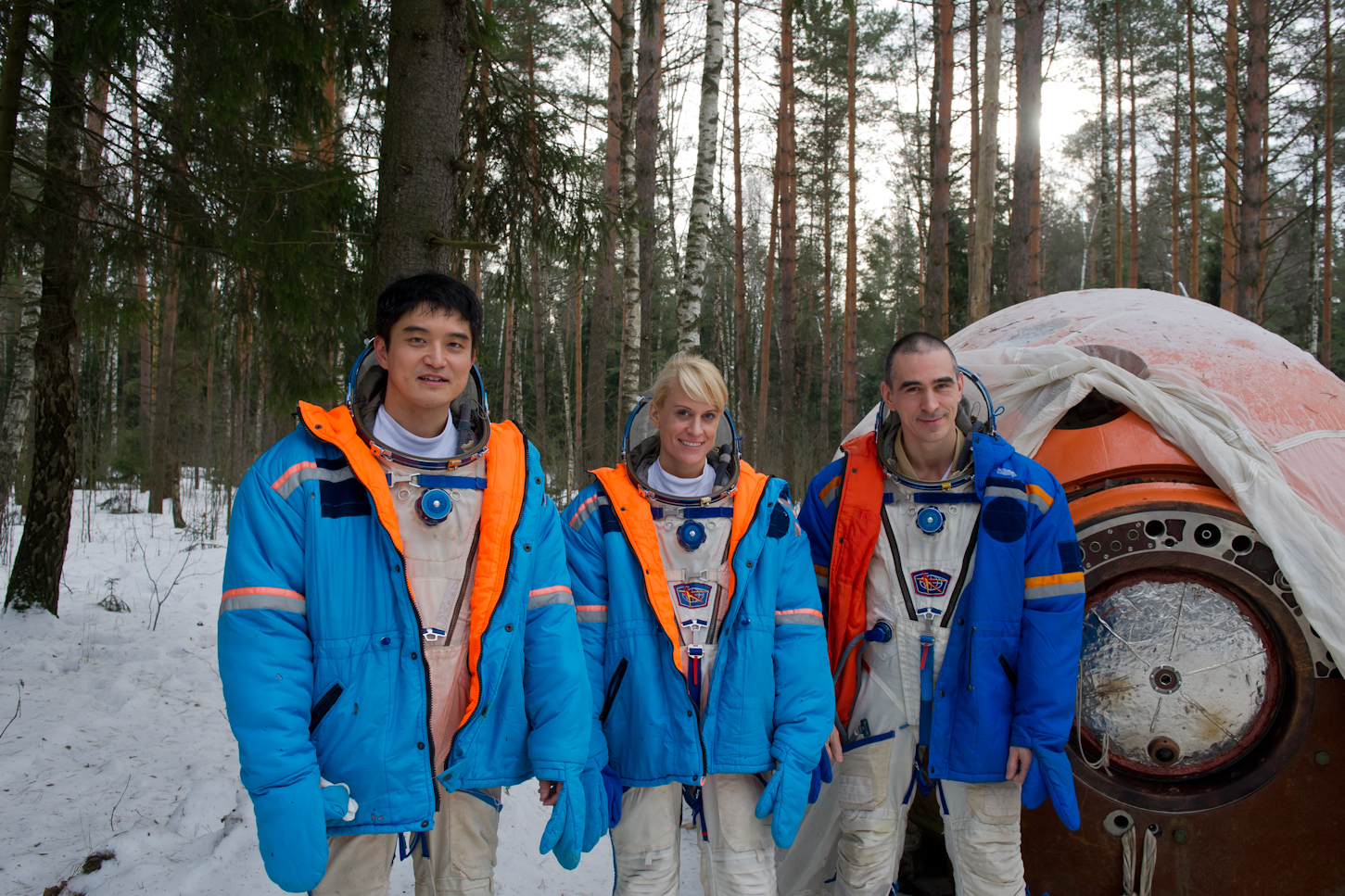
Survival training participants from left: Onishi, Rubins, and Ivanishin (Photo courtesy of JAXA and the GCTC)
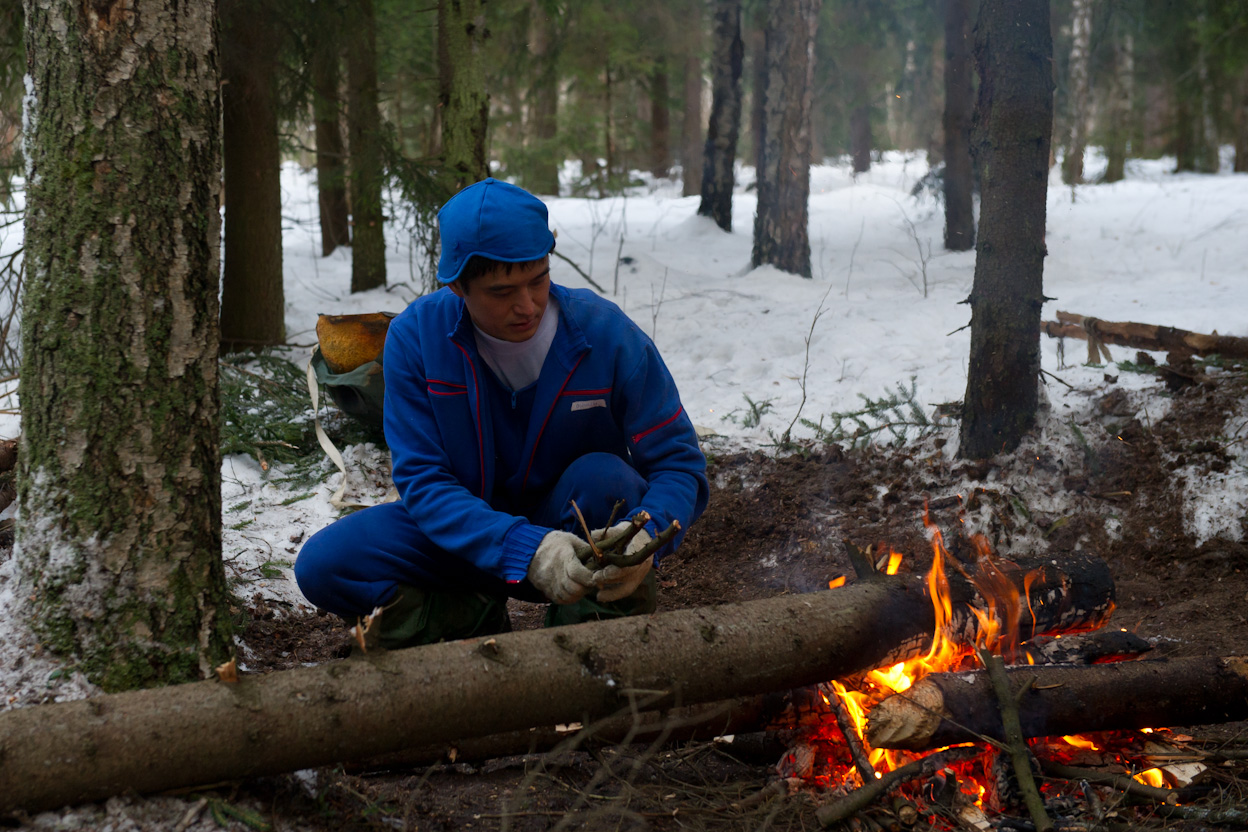
Onishi making a fire (Photo courtesy of JAXA and the GCTC)
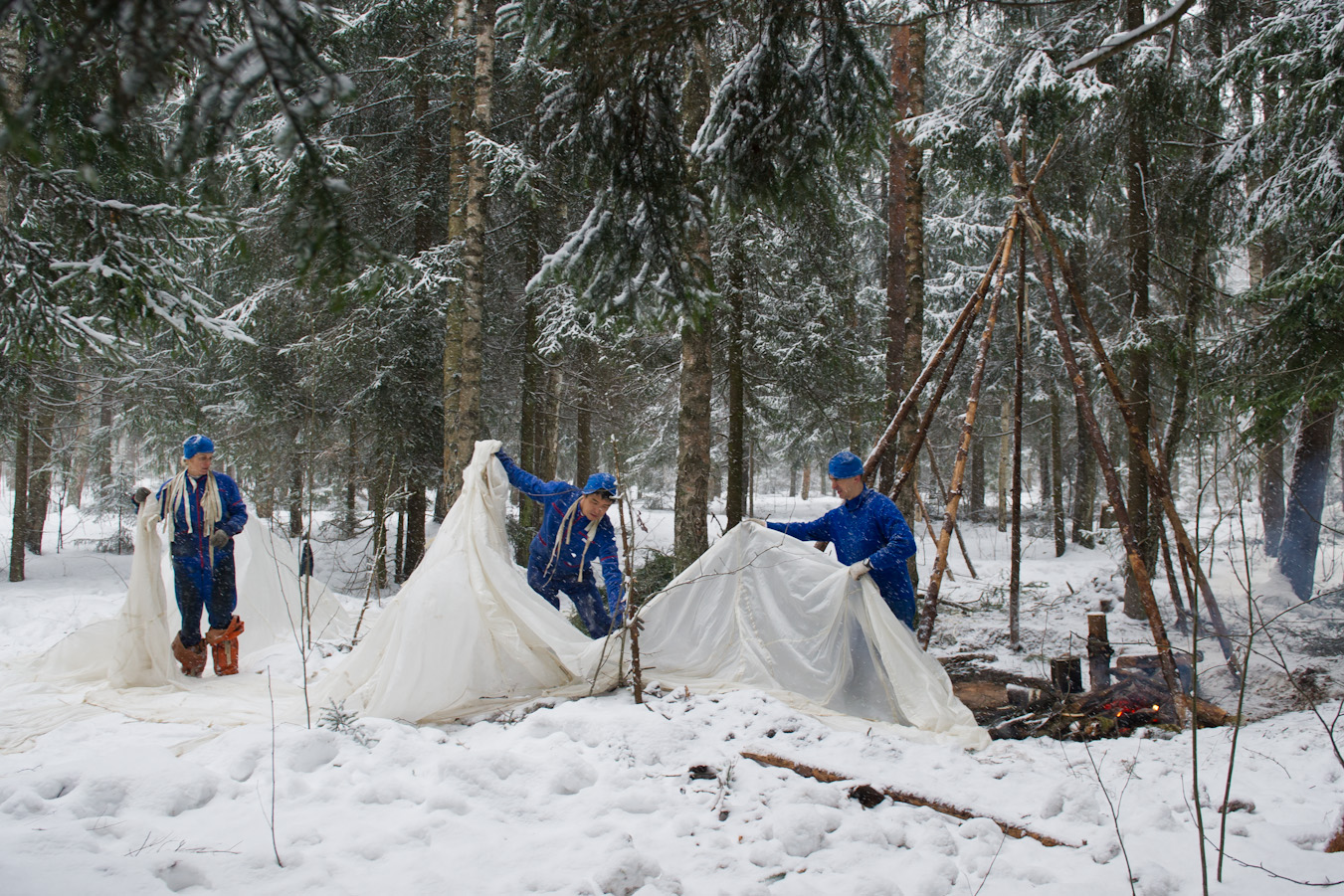
The trio setting up a shelter (Photo courtesy of JAXA and the GCTC)
In Russia, Onishi participated in survival training under an assumed case of the Soyuz spacecraft being forced to make an emergency landing on a snow-covered mountain or in a snowfield. This on-site training is intended to help participants learn survival skills by cooperating with each other. Onishi spent outdoor life in sub-zero temperatures with two other participants: Russian Cosmonaut Anatoly Ivanishin and NASA Astronaut Kathleen Rubins, who will fly together with Onishi aboard the Soyuz spacecraft.
The training was held for two nights and three days because two or three days may be required to conduct search and rescue operations in case the Soyuz spacecraft is forced to touch down at an unpredictable location. In the beginning, they changed from Sokol spacesuits to snowsuits aboard the Soyuz spacecraft. Then they selected a camping location and set up a shelter using the spacecraft’s parachute and hewn wood. The trio made a fire with the wood they collected, and then took turns tending the fire at night.
The training included a simulated case of one crew member being injured. They practiced how to treat the injured crew member. They also ignited flares to signal a rescue team by following the specified procedure.
In addition to undergoing survival training, the participants conducted simulated operations of the Soyuz spacecraft for the first time as a trio among all 46S crew members. Atmospheric reentry operations were also simulated under a hypergravity condition generated by a huge centrifuge accelerator, which recreated the gravity that Onishi would experience during this stage. For the Russian segment, Onishi confirmed the maintenance procedure of the Russian toilet as part of life support system training.
At the JSC, Onishi was trained for overall ISS operations. In the ISS mock-up, Onishi and the other two crew members participated in an emergency response simulation that included cases of fire, sudden depressurization, and air contamination, and responded to each scenario in accordance with the specified procedures.
Onishi also learned the duties of the Crew Medical Officer (CMO) to be performed in orbit, including medical-checkup and first-aid procedures.
Onishi’s other training included capturing the H-II Transfer Vehicle (HTV) “KOUNOTORI” by using the Space Station Remote Manipulator System (SSRMS), engaging in simulated daily tasks according to a normal daily schedule on the ISS, and practicing image and video management onboard the ISS.
Astronauts Soichi Noguchi and Akihiko Hoshide underwent flight piloting training
Astronauts Soichi Noguchi and Akihiko Hoshide underwent about one week of flight training at Oita airport aboard the Hawker Beechcraft Baron G58 owned by Honda Airways.
This training is intended to maintain and improve one’s multitasking ability–a qualification required of astronauts.
Before the flight, Noguchi and Hoshide used a flight simulator to familiarize themselves with flying, and attended lectures on meteorology and flight plans. They also confirmed the procedure for preflight inspection and actually inspected the plane to be flown.
During the flight training, Noguchi and Hoshide piloted the aircraft by only using the information shown on instrumentation to determine the aircraft’s attitude, height, position, and course, performed an aborted landing (go-around), and operated the aircraft in response to irregular conditions.
Astronaut Satoshi Furukawa undergoes robotic arm training

During SSRMS operations training, Furukawa was joined by Wakata at the JSC (Credit: JAXA/NASA)
Astronaut Satoshi Furukawa underwent robotic arm training from mid-January to February 6 at the NASA JSC, in order to refresh and further improve his skills.
Using a robotic arm simulator, Furukawa performed SSRMS operations to support the EVA crew and capture unmanned supply vehicles such as KOUNOTORI. During this training, Astronaut Koichi Wakata–a leading expert on robotic arm operations–took the opportunity to join Furukawa and give him advice.
JAXA astronauts participate in the opening event of Great Britain’s “Innovation is GREAT” campaign
On February 27, the opening event of the “Innovation is GREAT” campaign organized by the British embassy was held in Roppongi, Tokyo. This yearlong campaign conducted by Japan and Great Britain is intended to promote their bilateral partnership, which includes fostering cooperation in the field of space development. His Royal Highness Prince William, Duke of Cambridge, who was visiting Japan at the time, delivered the opening remarks.
For this campaign, Yui and British Astronaut Timothy Peake of the European Space Agency (ESA), who will stay on the ISS this year, each sent a video message.
In his video message, Yui discussed that along with Peake, he wished that activities on the ISS would lead to innovation. Yui and Peake are fellow astronauts who were both selected as astronaut candidates in 2009, and have undergone the 16th NASA Extreme Environment Mission Operations (NEEMO) together. Following the commencement of Yui’s ISS stay in May, Peake will begin his ISS stay from November. In the video, Yui also gave several words of encouragement to Peake and mentioned that he would securely hand over the baton of ISS operations.
Astronaut Soichi Noguchi had attended the event along with Prince William, and gave a Japanese traditional performance to celebrate the start of the campaign. During a talk session, they discussed the significance of the campaign. The event included a presentation given by British researchers and space industry representatives.
Astronaut Chiaki Mukai receives the Legion of Honour

At the Ceremony: Mukai (left) and French Ambassador Thierry Dana (right)
Astronaut Chiaki Mukai was conferred the National Order of the Legion of Honour (or Legion d’Honneur in French), Chevalier, from France. On February 3, French Ambassador Thierry Dana presented her with a decoration medal.
This entry passed through the Full-Text RSS service – if this is your content and you’re reading it on someone else’s site, please read the FAQ at fivefilters.org/content-only/faq.php#publishers.


