Tag: image

  • [Project Topics] AKATSUKI: Orbit successfully controlled

    Aug. 5, 2015 Updated

    AKATSUKI: Orbit successfully controlled

    AKATSUKI: Orbit successfully controlled

    JAXA performed an orbit control maneuver for the Venus Climate Orbiter “AKATSUKI” in late July in preparation for its re-injection into the Venus orbit scheduled for Dec. 7, 2015. According to the analysis of telemetry data acquired up to Aug. 2, the orbit control and correction was successfully conducted as scheduled by 5:30 p.m. on August 4. (All dates and time are Japan Standard Time.) …

    About Venus Climate Orbiter “AKATSUKI” (PLANET-C)

    (Courtesy of Akihiro Ikeshita)

    AKASTUKI will elucidate the mysteries of Venus, Earth’s twin sister.
    Japan will initiate the beginning of a new era of Venusian exploration.

    AKATSUKI (PLANET-C) is the next planetary exploration project for the Martian orbiter NOZOMI. Venus has long been referred to as Earth’s sister planet not only because its size and distance from the sun are similar to those of the Earth, but also because its birth formation is considered to be similar to that of the Earth at the genesis period of the solar system. However, Venus is actually very different from the Earth as it is veiled in high-temperature carbon dioxide and thick sulfuric-acid clouds. Also, above the surface of Venus, violent winds which reach some 400 kilometers per hour blow over. Clarification of the causes for such an environment will provide us with clues to understand why the Earth has become a peaceful and lively planet unlike Venus as well as to help understand climate change on Earth. Therefore, Venus is a very important subject for exploration to learn about the Earth’s environment.

    Launch date: May 21, 2010

    Re-entry plan to Venus orbit

    The AKATSUKI is expected to usher in a new era of Venusian exploration. It was launched aboard an H-IIA Launch Vehicle No. 17 in May 2010 (JST.) It smoothly flew and spurted out jets from its orbit control engine on Dec. 7, 2010. Unfortunately, the AKATSUKI failed to inject itself into the orbit of Venus. JAXA set up an investigation team not only to examine and study the causes of the failure and countermeasures, but also to see if it is possible to insert the AKATSUKI again into the orbit when it comes closer to Venus in about six years.

    Characteristics of Venus Climate Orbiter “AKATSUK” (PLANET-C)

    Infrared light enables more detailed investigation of Venus.

    The probe vehicle of AKATSUKI will enter an elliptical orbit, 300 to 80,000 km away from Venus’s surface. This wide variation in distance will enable comprehensive observations of the planet’s meteorological phenomena and of its surface, as well as observations of the atmospheric particles escaping from Venus into space. It will also be possible to take close-up photos of Venus, and to observe the storm winds that blow on the Venusian surface, at speeds that reach 100 m a second – 60 times the speed at which Venus rotates. This phenomenon remains the biggest mystery of Venus, as it cannot be explained meteorologically. AKATSUKI will employ infrared light to observe and elucidate the mysteries surrounding the atmosphere under the clouds and the conditions on the planet’s surface. In addition, it will confirm the presence of active volcanoes and thunder.

    Major Characteristics

    International Designation Code 2010-020D
    Launch Date 6:58, May 21, 2010 (JST)
    Launch Vehicle H-IIA Launch Vehicle No.17
    Location Tanegashima Space Center
    Shape Box shape with two wing-type solar array paddles
    Weight Mass at liftoff: about 500 kg
    Orbiter Venus elliptical orbit
    Altitude PeriVenus: 300 km
    ApoVenus: about 80,000 km
    Orbital Inclination Approx. 172 degrees
    Orbital Period Approx. 30 hours

    Mission talk by team leaders

    This entry passed through the Full-Text RSS service – if this is your content and you’re reading it on someone else’s site, please read the FAQ at fivefilters.org/content-only/faq.php#publishers.

  • Stormy Seas in Sagittarius

    Stormy Seas in Sagittarius

    This new NASA/ESA Hubble Space Telescope image shows the center of the Lagoon Nebula, an object with a deceptively tranquil name, in the constellation of Sagittarius. The region is filled with intense winds from hot stars, churning funnels of gas, and energetic star formation, all embedded within an intricate haze of gas and pitch-dark dust.

  • Celebrating a year at the comet

    ESA’s Rosetta mission today celebrates one year at Comet 67P/Churyumov–Gerasimenko, with its closest approach to the Sun now just one week away.

  • [Aeronautical Technology Directorate] [DREAMS] JAXA has conducted a usability survey of the "ALWIN" at Tokyo International Airport

    June 30, 2015

    JAXA has conducted a usability survey of the “ALWIN” at Tokyo International Airport

    JAXA has conducted a usability survey of the “Airport Low-level Wind INformation” (ALWIN) for airline’s flight crews and dispatchers in cooperation with Japan Airlines (JAL) at Tokyo International Airport (Haneda Airport) on March 2015.
    ALWIN provides strategic aircraft operational information on low-level wind which includes turbulence and windshear in the vicinity of the airport using an airport Doppler lidar. The wind information generation logic and display prototype of ALWIN has been jointly developed by JMA (the Japan Meteorological Agency) and JAXA.
    Flight crews are able to obtain ALWIN at any time on request by using an automatic ACARS (Aircraft Communications Addressing and Reporting System) *1 text uplink by using the ACARS text conversion function of ALWIN and data link server. On the other hand, dispatchers/airport-based operations officer are able to acquire graphical displays of ALWIN by internet web page.
    The airline usability survey results will reflect design specifications of ALWIN when integrating ALWIN to MetAir (JMA’s aviation weather information web page) in the future.

    Flight crew’s usability survey of ALWIN:


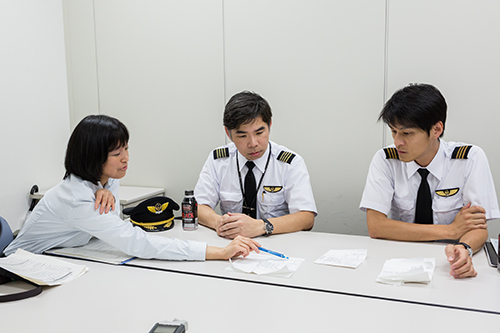
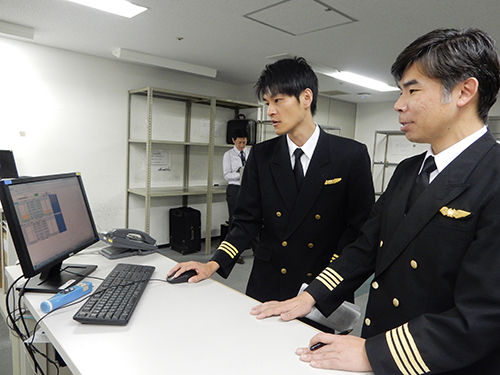
    The photograph on the left shows JAL’s Office of Haneda Airport.
    In the office, flight crews confirm weather conditions required for aircraft operational planning.
    To survey how flight crews use ALWIN in actual aircraft operation, a JAXA research engineer joined JAL’s flight crews during regularly scheduled flight from a preflight briefing to debriefing.

    Flight crews are able to check wind conditions on the flight by ALWIN web screen in preparation of take-off from Haneda airport. When there is severity information related to windshears or strong gusts exist on the flight path, the altitude band of the significant wind change is highlighted in amber color in headwind and crosswind graph of the ALWIN screen to enable intuitive understanding of the alert information. The ALWIN also can be utilized to briefing before takeoff.

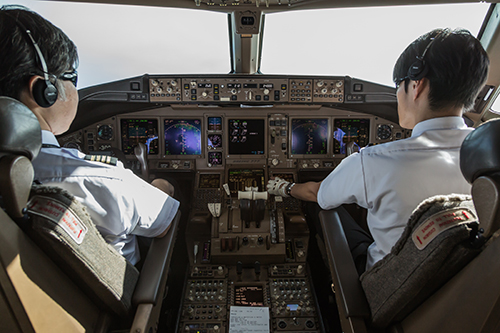
    In this flight crew’s usability survey, a JAXA research engineer carried out cockpit observation from on the jump seat of the Boeing 777 in domestic flights: Haneda-Chitose, Chitose-Haneda.

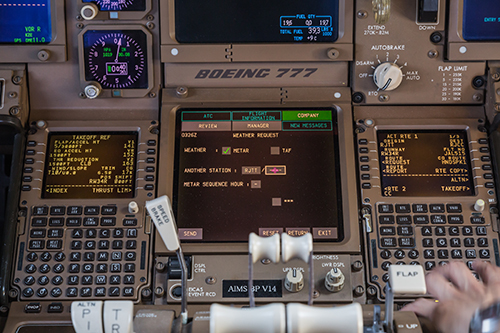
    During cockpit preparation before takeoff, the copilot clicks the function key for ACARS uplinks relating to ALWIN on the MFD (Multi-Function Display) by mouse to confirm wind condition of ALWIN.

    Cruise phase from Chitose to Haneda:
    Before the descent, the flight crew requests ALWIN-ACARS uplink to confirm wind conditions at Haneda Airport. Generally speaking, aircraft control for the approach / landing phase is said to be the most difficult for a pilot out of all aircraft controls. Especially when there is rapidly changing and low-level turbulence on a landing path, difficulty of aircraft control for landing increases. Such wind conditions occurring at low altitudes during takeoff or landing can lead to the risk of serious accidents. The frequent occurrence of the low-altitude turbulence known as a “hangar wave” *2 at Haneda Airport led to request for implementation of ALWIN at the airport.

    Close-up view of ALWIN:
    ACARS is not capable of sending graphical information to the cockpit, but is capable of sending the text messages. During the high workload approach flight phase, the flight crew’s intuitive understanding is highly important because a rapid but accurate situation assessment of wind disturbances is required. Considering this situation, JAXA has designed an ACARS message containing a spatial graph rendered as test as shown in the upper picture. The spatial graph shows headwind profile on the landing path below 500 ft in the ACARS message texts. Moreover, the message texts contain the headwind component, wind direction / speed and crosswind component per altitude.

    ALWIN printout:
    Although the flight crew is required to scroll the screen to see both headwind profile and crosswind profile on the MFD, the ALWIN printout enables flight crews to confirm headwind profile (upper) and crosswind profile (lower graph) on one page of paper. Essential wind information for approach/landing planning was selected due to layout limitation, because the number of characters which can be sent using ACARS is limited.

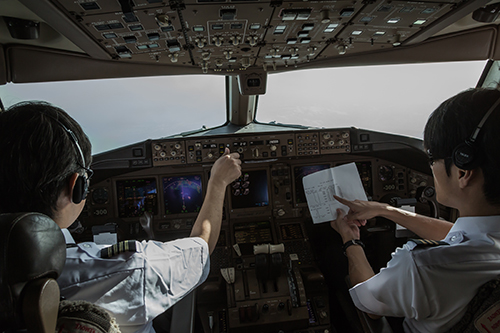
    The PM (Pilot Monitoring) explains wind situations by the ALWIN ACARS text message. Based on this information, the PF (Pilot Flying) makes approach/landing planning.
    The approach briefing by using ALWIN provides flight crews with common situational awareness relating to approach/landing planning which takes into accounts wind conditions.

    We are approaching to the Runway 23 (runway bearing of 230 degrees) at Haneda Airport for arrival.


    After landing, the JAXA research engineer conducted an interview with flight crews regarding the usability of ALWIN. Flight crews commented that ALWIN was helpful because it gave flight crews an intuitive understanding of no significant wind change below 500ft and common situational awareness during approach briefing.
    After returning to the Office, flight crews wrote questionnaire sheets prepared by JAXA. Although little severe wind conditions had been experienced on the today’s flights, flight crews indicated on the questionnaire that the ALWIN ACARS text message was useful. The reason for usefulness was stated as follows: “We could confirm in advance that no significant difference existed between wind conditions during the final approach and those on the ground.”

    We could obtain feedback from only a few flight crews by interviews. However, by using the survey in questionnaire format in writing, we will collect a large number of opinions on the usability of ALWIN from many flight crews. Therefore, the airline usability survey results will reflect future improvement of ALWIN design specifications for ALWIN implementation in cooperation with JMA.

    *Special permission was acquired for cockpit photography.

    Airline dispatcher’s usability survey of ALWIN:

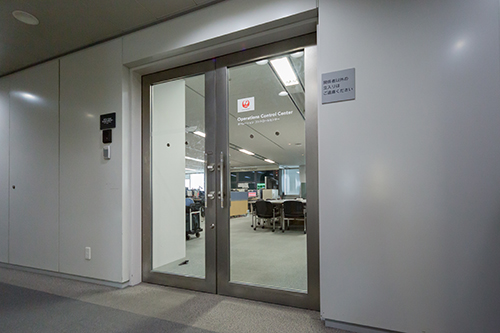
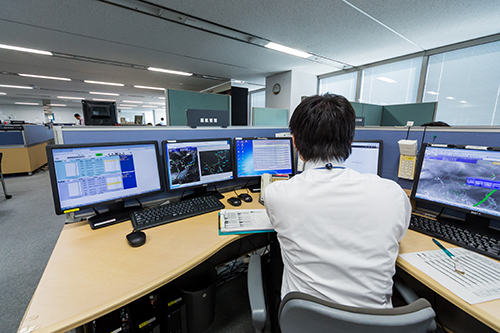
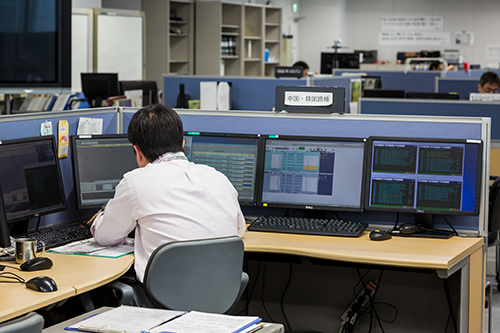
    The JAL’s domestic and international flights are centrally controlled by the JAL Operation Control Center (JAL OCC) at Haneda Airport. JAXA research engineer observed how airline dispatchers use ALWIN at the JAL OCC.


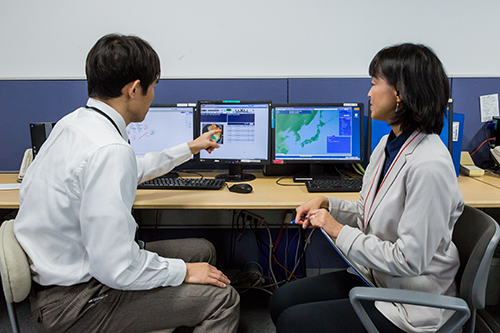
    The desks of airline dispatchers are divided into international flights and domestic flights. ALWIN is one of the screens shown in the photograph on the left.

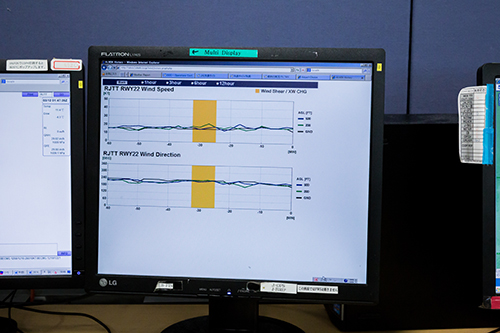
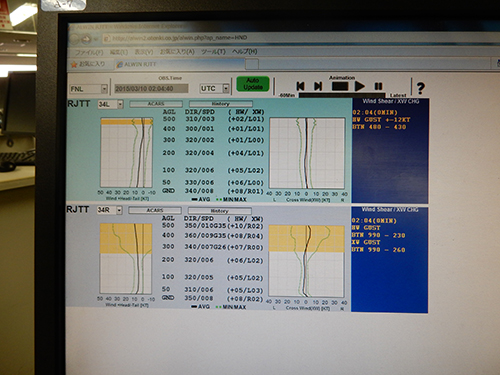
    The photo shows an example of past data display of ALWIN.
    For emphasizing the past data, the word “Past” is shown in large font at the top of the screen. This past data is from around 20:35 on March 1, 2015. The data shows a significant change in wind conditions at Haneda Airport (RJTT). The past data display is one of the favorable functions for airline’s users, because the users are able to utilize past data for flight critique or past wind conditions analysis.

    ALWIN can also present historical information for the previous several hours. The provision of history information is aimed to help to understand daily tendency of wind direction and speed, windshear and to accumulate knowledge for periodical wind situations.

    The JAXA research engineer conducted an interview with JAL’s dispatcher regarding the usability of ALWIN.
    Dispatchers commented that they use ALWIN to confirm current wind conditions and the altitude band of the significant wind change.

    At JAL, automatic ACARS uplink of ALWIN is possible at any time on the flight crew’s request. Therefore, there are almost no cases in which airline dispatchers check ALWIN and then advise to the cockpit by ACARS manual uplink or by radio communications. However, dispatchers indicated that ALWIN would be useful for understanding of wind conditions regardless of whether or not a go-around is anticipated.

    ※1: ACARS (Automatic Communications Addressing and Reporting System)
    A digital datalink system between aircraft and ground stations. Via the ARINC communication network, required flight information is automatically sent from aircraft to ground stations or from ground stations to aircraft.
    ※2: Hangar wave
    Refers to turbulence thought to occur when strong northeasterly or easterly winds pass over hangers located in the newly developed area on the southern side of Haneda Airport. The hangar wave affects aircraft taking off and landing at Runway A (34L) on the western side of the hangars.

    This entry passed through the Full-Text RSS service – if this is your content and you’re reading it on someone else’s site, please read the FAQ at fivefilters.org/content-only/faq.php#publishers.
  • First MSG-4 image


    Europe’s latest weather satellite images Earth today

  • Tracking downunder


    Human spaceflight and operations image of the week: ESA’s New Norcia deep-space tracking station illuminated against the Australian night sky

  • [Aeronautical Technology Directorate] [SafeAvio] Simulation for effect on passenger cabin when encountering turbulence

    July 13, 2015

    Simulation for effect on passenger cabin when encountering turbulence

    To determine turbulence effects on the passenger cabin, JAXA conducted simulations for the following two cases. Motion of aircraft, a cabin crew and service carts were simulated for both cases.

    The left-hand side of the video below simulates a case of severe turbulence when an aircraft experienced sudden change in altitude (maximum -0.7 G of vertical acceleration).

    The right-hand side, meanwhile, simulates a case where such vertical acceleration of aircraft is reduced by half with the gust alleviation technologies which we are developing under the SafeAvio initiative. The result shows that cutting turbulence shaking in half eliminates almost all risks of injury in the passenger cabin.

    This simulation data will be used in further research on gust alleviation technology, and for reviewing the operating procedures of cabin crews.

    This entry passed through the Full-Text RSS service – if this is your content and you’re reading it on someone else’s site, please read the FAQ at fivefilters.org/content-only/faq.php#publishers.
  • Blue Moon Over Washington

    Blue Moon Over Washington

    A second full moon for the month of July is seen next to the dome of the U.S. Capitol on Friday, July 31, 2015 in Washington.

  • Register to visit ESTEC


    Registration open for ESTEC Open Day on Sunday 4 October: your chance to visit ESA’s technical heart

  • Southern Bavaria


    Earth observation image of the week: a Sentinel-1 image of Germany’s state of Bavaria, also featured on the Earth from Space video programme

  • The Argo's hidden cargo


    Space science image of the week: Intricate dust lanes are revealed in this far-infrared view of the constellation Carina

  • Week In Images


    Our week through the lens:
    13-17 July 2015

  • Full launch coverage


    Watch the replay of the full MSG-4 launch coverage from Europe’s Spaceport in French Guiana on 15 July