Tag: image

  • 85 new subglacial lakes detected below Antarctica

    Antarctic subglacial lake inventory

    Hidden beneath the biggest ice mass on Earth, hundreds of subglacial lakes form a crucial part of Antarctica’s icy structure, affecting the movement and stability of glaciers, and consequentially influencing global sea level rise.

    Thanks to a decade of data from the European Space Agency’s CryoSat satellite, researchers have identified 85 previously unknown lakes several kilometres under the frozen surface surrounding the South Pole. This increases the number of known active subglacial lakes below Antarctica by more than half to 231.

  • Earth from Space: Komodo Island, Indonesia

    This Copernicus Sentinel-2 image captures a cloud-free view over the island of Komodo in southeastern Indonesia.
    Image:
    This Copernicus Sentinel-2 image captures a cloud-free view over the island of Komodo in southeastern Indonesia.

  • Milky Way Views

    Milky Way Views

    The Milky Way appears above Earth’s bright atmospheric glow in this photograph from the International Space Station as it soared 261 miles above southern Iran at approximately 12:54 a.m. local time on Aug. 23, 2025.

  • Space Station Science

    Space Station Science

    NASA astronaut Zena Cardman processes bone cell samples inside the Kibo laboratory module’s Life Science Glovebox on Aug. 28, 2025.

  • XRISM uncovers a mystery in the cosmic winds of change

    The X-Ray Imaging and Spectroscopy Mission (XRISM) has revealed an unexpected difference between the powerful winds launching from a disc around a neutron star and those from material circling supermassive black holes. The surprisingly dense wind blowing from the stellar system challenges our understanding of how such winds form and drive change in their surroundings.

  • An Eye-catching Star Cluster

    An Eye-catching Star Cluster

    Westerlund 1 is the biggest and closest “super” star cluster to Earth. Data from Chandra and other telescopes are helping astronomers delve deeper into this galactic factory where stars are vigorously being produced. Observations from Chandra have uncovered thousands of individual stars pumping out X-ray emission into the cluster.

  • Fly through Gaia’s 3D map of stellar nurseries

    Gaia sees stellar nurseries (animation still)

    Scientists created the most accurate three-dimensional map of star-formation regions in our Milky Way galaxy, based on data from the European Space Agency’s Gaia space telescope. This map will teach us more about these obscure cloudy areas, and the hot young stars that shape them.  

  • The most accurate 3D map of stellar nurseries in the Milky Way


    Video:
    00:02:28

    Scientists created the most accurate three-dimensional map of star-formation regions in our Milky Way galaxy, based on data from the European Space Agency’s Gaia space telescope. This map will teach us more about these obscure cloudy areas, and the hot young stars that shape them.

    It is notoriously difficult to map and study regions in space where stars form because they are usually hidden from view by thick clouds of gas and dust, whose distances cannot be directly measured.

    Gaia can’t see these clouds directly, but it can measure stellar positions and the so-called ‘extinction’ of stars. This means it can see how much light from stars is blocked by dust. From this, scientists can create 3D maps showing where the dust is, and use those maps to figure out how much ionised hydrogen gas is present – a telltale sign of star formation.

    The new 3D map of star-forming regions in the Milky Way is based on Gaia observations of 44 million ‘ordinary’ stars and 87 O-type stars. The map extends to a distance of 4000 light-years from us, with the Sun at the centre.

    Read more.

    Click here to download the animation flying around Gaia’s 3D map.

    Click here to download the animation flying through Gaia’s 3D map.

    Click here to download the animation showing the location of Gaia’s 3D map in the Milky Way.

  • Helicopter Training for Artemis Missions

    Helicopter Training for Artemis Missions

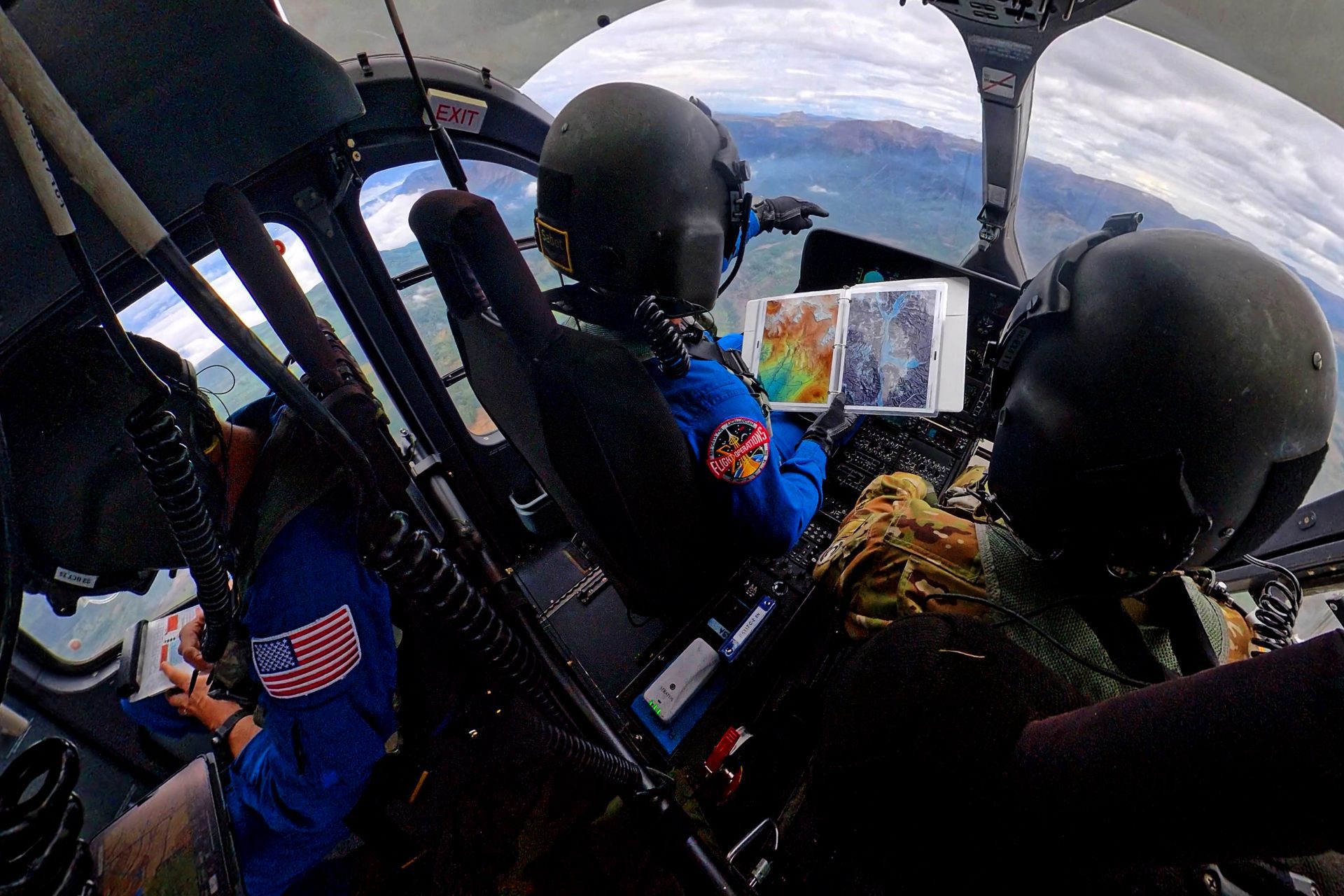
    NASA astronauts Matthew Dominick (left) and Mark Vande Hei (right) prepare to fly out to a landing zone in the Rocky Mountains as part of the certification run for the NASA Artemis course at the High-Altitude Army National Guard Aviation Training Site in Gypsum, Colorado, Aug. 26.

  • RISE: ESA’s mission extender in geostationary orbit


    Video:
    00:01:43

    An essential part of ESA’s Space Safety programme is dedicated to getting and keeping Earth’s orbits clean from space debris. In the long run, the Agency aspires to stimulate a true circular economy in space, minimising the impact of spaceflight on Earth and its resources where possible. As part of ESA’s Zero Debris approach, new ESA missions will be designed for safe operations and disposal to stop the creation of new debris by 2030.  

    ESA has now taken another important step on the road towards sustainability in space with its first in-orbit servicing mission RISE, planned for launch in 2029. 

    RISE is a commercial in-orbit servicing mission that will demonstrate that it can safely rendezvous and dock to a geostationary client satellite, extending the life of geostationary satellites that need support with attitude and orbit control, but are otherwise in working order.  

    After verifying that it meets all the performance standards in a first demonstration, prime contractor, operator and co-founder D-Orbit will start commercial life extension services for geostationary satellites. 

    ESA’s RISE mission marks a promising step towards enhancing in-orbit services and technologies, such as refuelling, refurbishment and assembling – all essential elements for creating a circular economy in space.   

    Watch with subtitles

  • First view of aerosols from MetOp-SG’s 3MI instrument

    First view of aerosols from MetOp Second Generation’s 3MI instrument
    Image:
    First view of aerosols from MetOp Second Generation’s 3MI instrument

  • A Brief Outburst

    A Brief Outburst

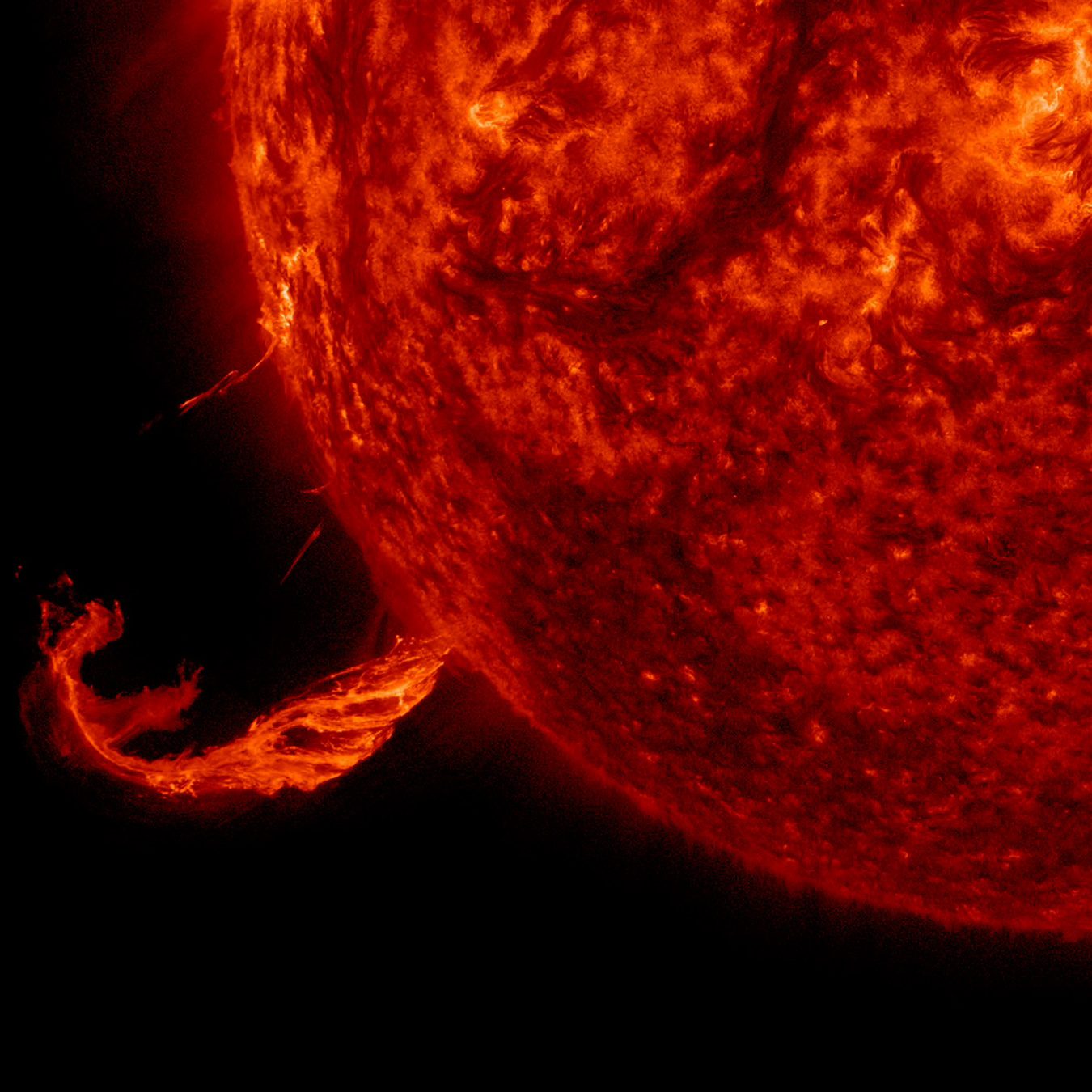
    The Sun blew out a coronal mass ejection along with part of a solar filament over a three-hour period on Feb. 24, 2015. While some of the strands fell back into the Sun, a substantial part raced into space in a bright cloud of particles (as observed by the NASA-ESA Solar and Heliospheric Observatory spacecraft). Because this occurred way over near the edge of the Sun, it was unlikely to have any effect on Earth.