Category: Kepler

http://www.nasa.gov/mission_pages/kepler/news/kepler-newsandfeatures-RSS.rss

  • NASA’s Europa Clipper Gets Set of Super-Size Solar Arrays

    5 min read

    Preparations for Next Moonwalk Simulations Underway (and Underwater)

    NASA’s Europa Clipper
    NASA’s Europa Clipper is seen here on Aug. 21 at the agency’s Kennedy Space Center in Florida. Engineers and technicians deployed and tested the giant solar arrays to be sure they will operate in flight.
    NASA/Frank Michaux

    The largest spacecraft NASA has ever built for planetary exploration just got its ‘wings’ — massive solar arrays to power it on the journey to Jupiter’s icy moon Europa.

    NASA’s Europa Clipper spacecraft recently got outfitted with a set of enormous solar arrays at the agency’s Kennedy Space Center in Florida. Each measuring about 46½ feet (14.2 meters) long and about 13½ feet (4.1 meters) high, the arrays are the biggest NASA has ever developed for a planetary mission. They have to be large so they can soak up as much sunlight as possible during the spacecraft’s investigation of Jupiter’s moon Europa, which is five times farther from the Sun than Earth is.

    The arrays have been folded up and secured against the spacecraft’s main body for launch, but when they’re deployed in space, Europa Clipper will span more than 100 feet (30.5 meters) — a few feet longer than a professional basketball court. The “wings,” as the engineers call them, are so big that they could only be opened one at a time in the clean room of Kennedy’s Payload Hazardous Servicing Facility, where teams are readying the spacecraft for its launch period, which opens Oct. 10. 

    Watch as engineers and technicians deploy and test Europa Clipper’s massive solar arrays in a clean room at Kennedy Space Center in Florida.
    Credit: NASA/JPL-Caltech/KSC/APL/Airbus

    Flying in Deep Space

    Meanwhile, engineers continue to assess tests conducted on the radiation hardiness of transistors on the spacecraft. Longevity is key, because the spacecraft will journey more than five years to arrive at the Jupiter system in 2030. As it orbits the gas giant, the probe will fly by Europa multiple times, using a suite of science instruments to find out whether the ocean underneath its ice shell has conditions that could support life.

    Powering those flybys in a region of the solar system that receives only 3% to 4% of the sunlight Earth gets, each solar array is composed of five panels. Designed and built at the Johns Hopkins Applied Physics Laboratory (APL) in Laurel, Maryland, and Airbus in Leiden, Netherlands, they are much more sensitive than the type of solar arrays used on homes, and the highly efficient spacecraft will make the most of the power they generate.

    At Jupiter, Europa Clipper’s arrays will together provide roughly 700 watts of electricity, about what a small microwave oven or a coffee maker needs to operate. On the spacecraft, batteries will store the power to run all of the electronics, a full payload of science instruments, communications equipment, the computer, and an entire propulsion system that includes 24 engines.

    NASA’s Europa Clipper
    NASA’s Europa Clipper is seen here on Aug. 21 in a clean room at Kennedy Space Center after engineers and technicians tested and stowed the spacecraft’s giant solar arrays.
    NASA/Frank Michaux

    While doing all of that, the arrays must operate in extreme cold. The hardware’s temperature will plunge to minus 400 degrees Fahrenheit (minus 240 degrees Celsius) when in Jupiter’s shadow. To ensure that the panels can operate in those extremes, engineers tested them in a specialized cryogenic chamber at Liège Space Center in Belgium.

    “The spacecraft is cozy. It has heaters and an active thermal loop, which keep it in a much more normal temperature range,” said APL’s Taejoo Lee, the solar array product delivery manager. “But the solar arrays are exposed to the vacuum of space without any heaters. They’re completely passive, so whatever the environment is, those are the temperatures they get.”

    About 90 minutes after launch, the arrays will unfurl from their folded position over the course of about 40 minutes. About two weeks later, six antennas affixed to the arrays will also deploy to their full size. The antennas belong to the radar instrument, which will search for water within and beneath the moon’s thick ice shell, and they are enormous, unfolding to a length of 57.7 feet (17.6 meters), perpendicular to the arrays.

    Artist’s concept depicts NASA’s Europa Clipper spacecraft in orbit around Jupiter
    This artist’s concept depicts NASA’s Europa Clipper spacecraft in orbit around Jupiter. The mission’s launch period opens Oct. 10.
    NASA/JPL-Caltech

    “At the beginning of the project, we really thought it would be nearly impossible to develop a solar array strong enough to hold these gigantic antennas,” Lee said. “It was difficult, but the team brought a lot of creativity to the challenge, and we figured it out.”

    More About the Mission

    Europa Clipper’s three main science objectives are to determine the thickness of the moon’s icy shell and its interactions with the ocean below, to investigate its composition, and to characterize its geology. The mission’s detailed exploration of Europa will help scientists better understand the astrobiological potential for habitable worlds beyond our planet.

    Managed by Caltech in Pasadena, California, NASA’s Jet Propulsion Laboratory leads the development of the Europa Clipper mission in partnership with APL for NASA’s Science Mission Directorate in Washington. APL designed the main spacecraft body in collaboration with JPL and NASA’s Goddard Space Flight Center in Greenbelt, Maryland, NASA’s Marshall Space Flight Center in Huntsville, Alabama, and Langley Research Center in Hampton, Virginia. The Planetary Missions Program Office at Marshall executes program management of the Europa Clipper mission.

    NASA’s Launch Services Program, based at Kennedy, manages the launch service for the Europa Clipper spacecraft, which will launch on a SpaceX Falcon Heavy rocket from Launch Complex 39A at Kennedy.

    Find more information about Europa here:

    europa.nasa.gov

    News Media Contacts

    Gretchen McCartney
    Jet Propulsion Laboratory, Pasadena, Calif.
    818-393-6215
    gretchen.p.mccartney@jpl.nasa.gov

    Karen Fox / Alana Johnson
    NASA Headquarters, Washington
    202-358-1600 / 202-358-1501
    karen.c.fox@nasa.gov / alana.r.johnson@nasa.gov

    2024-112

    This landscape of “mountains” and “valleys” speckled with glittering stars is actually the edge of a nearby, young, star-forming region called NGC 3324 in the Carina Nebula. Captured in infrared light by NASA’s new James Webb Space Telescope, this image reveals for the first time previously invisible areas of star birth.
    NASA, ESA, CSA, and STScI
    This landscape of “mountains” and “valleys” speckled with glittering stars is actually the edge of a nearby, young, star-forming region called NGC 3324 in the Carina Nebula. Captured in infrared light by NASA’s new James Webb Space Telescope, this image reveals for the first time previously invisible areas of star birth.
    NASA, ESA, CSA, and STScI
    This landscape of “mountains” and “valleys” speckled with glittering stars is actually the edge of a nearby, young, star-forming region called NGC 3324 in the Carina Nebula. Captured in infrared light by NASA’s new James Webb Space Telescope, this image reveals for the first time previously invisible areas of star birth.
    NASA, ESA, CSA, and STScI
  • NASA Invites Public Input on Low Earth Orbit Microgravity Strategy

    A waxing gibbous moon rises over the Indian Ocean as the International Space Station orbited 266 miles above.
    Credit: NASA

    As NASA and its partners continue to conduct groundbreaking research aboard the International Space Station, the agency announced Monday it is seeking U.S. industry, academia, international partners, and other stakeholders’ feedback on newly developed goals and objectives that will help guide the next generation of human presence in low Earth orbit.

    “From the very beginning, NASA’s flagship human spaceflight programs have built upon each other, expanding our knowledge and experience of humans living and working in space,” said NASA Deputy Administrator Pam Melroy. “As commercial industry is constructing new human-enabled platforms for low Earth orbit, NASA must answer the question: what should our goals and objectives be to advance our future science and exploration missions?”

    NASA published draft high-level goals and objectives outlining 42 key points in six main areas: science, exploration-enabling research and technology development, commercial low Earth orbit infrastructure, operations, international cooperation, and workforce and engagement.

    “Feedback is essential for shaping our long-term microgravity research and development activities,” said Ken Bowersox, associate administrator, Space Operations Mission Directorate at NASA Headquarters in Washington. “We are committed to refining our objectives with input from both within NASA and external partners, ensuring alignment with industry and international goals. After reviewing feedback, we will finalize our strategy later this year.”

    The agency will conduct two invite-only workshops in September to discuss feedback on the draft goals and objectives. The first workshop is with international partners, and the second will engage U.S. industry and academic representatives.

    NASA employees also are invited to provide input through internal agency channels. This approach reflects NASA’s commitment to harnessing diverse perspectives to navigate the rapidly evolving low Earth orbit environment.

    “Organizations are increasingly recognizing the transformative benefits of space, with both governments and commercial activities leveraging the International Space Station as a testbed,” said Robyn Gatens, International Space Station director and acting director of commercial spaceflight at NASA Headquarters. “By developing a comprehensive strategy, NASA is looking to the next chapter of U.S. human space exploration to help shape the agency’s future in microgravity for the benefit of all.”

    Stakeholders may submit comments by close of business on Friday, Sept. 27 to:

    https://www.leomicrogravitystrategy.org/

    -end-

    Amber Jacobson
    Headquarters, Washington
    202-358-1600
    amber.c.jacobson@nasa.gov

  • Sols 4284–4286: Environmental Science Extravaganza

    4 min read

    Sols 4284–4286: Environmental Science Extravaganza

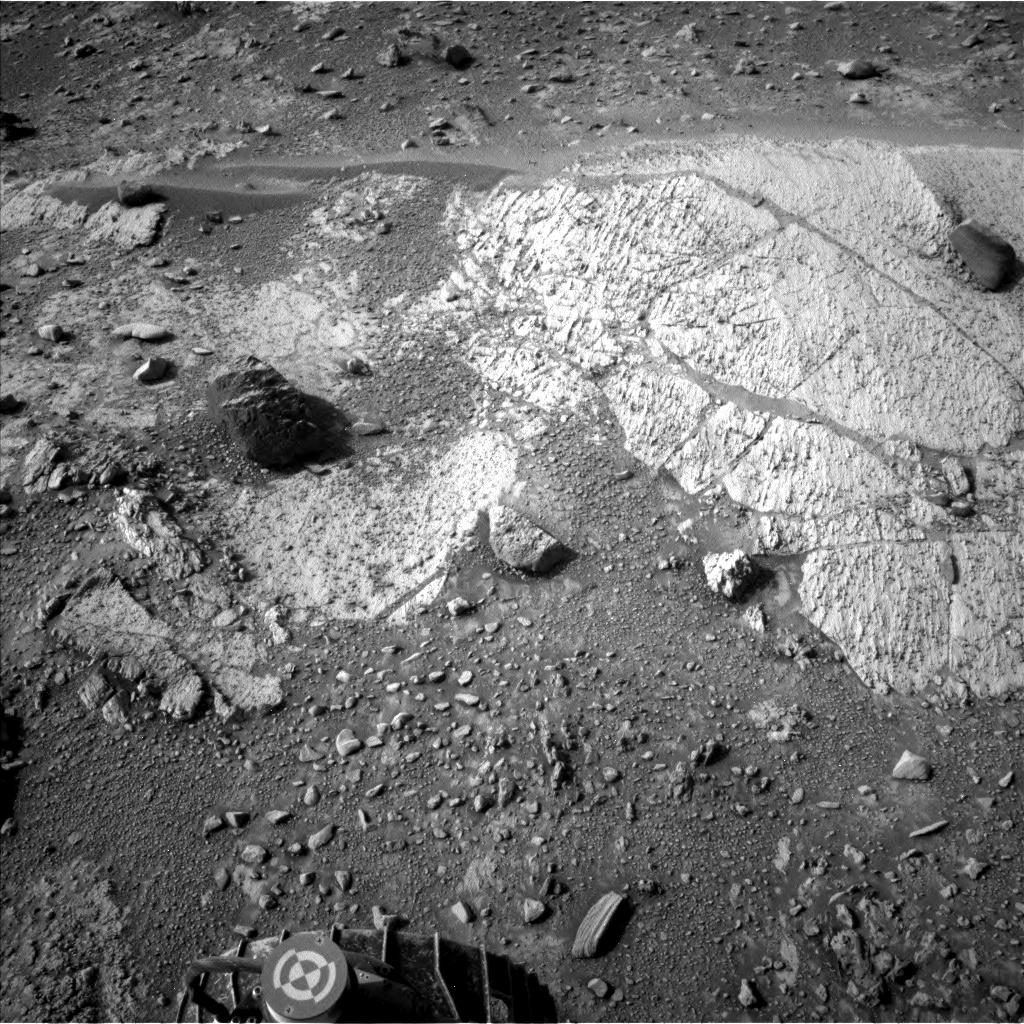
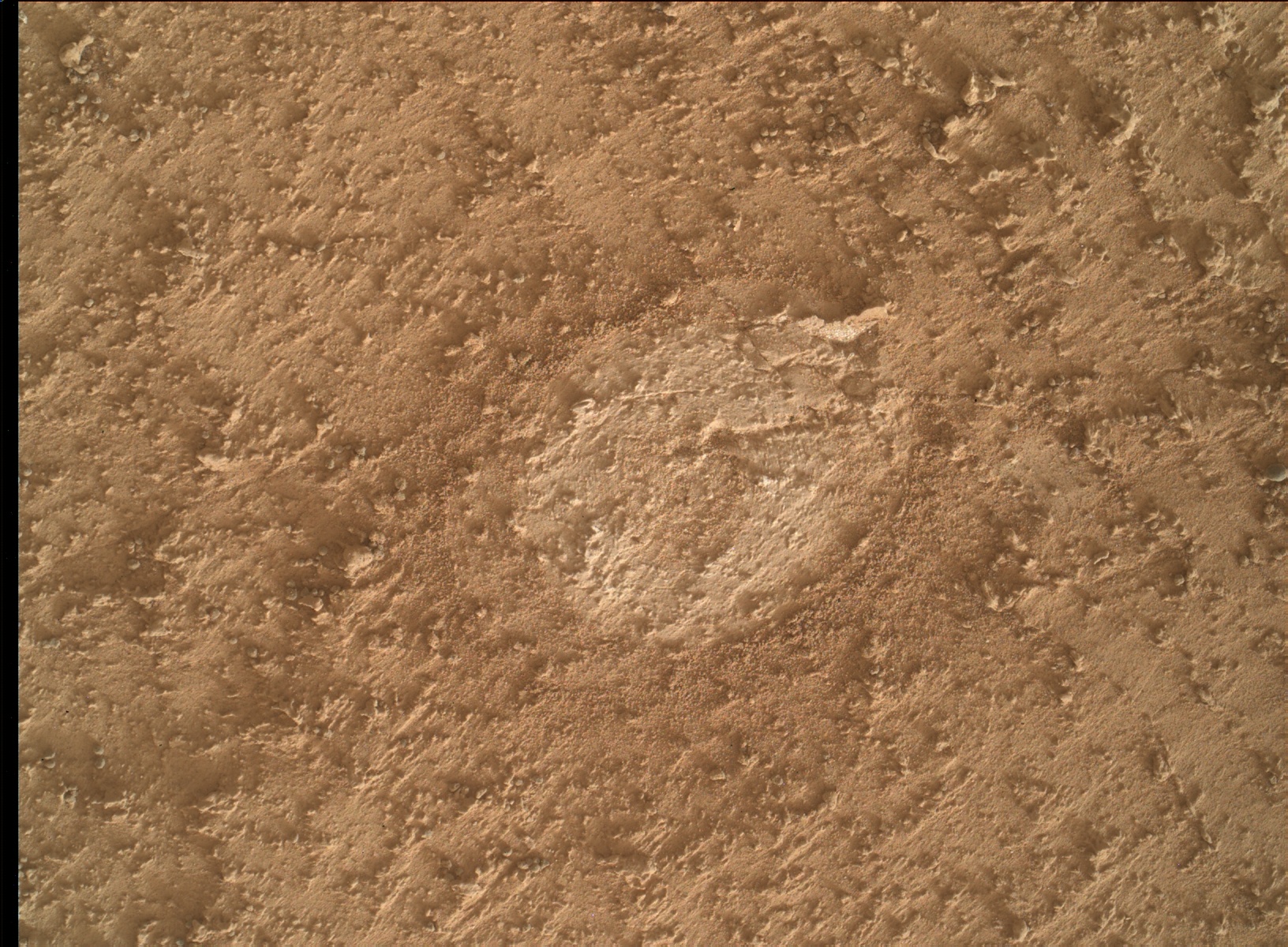
    This image was taken by Left Navigation Camera onboard NASA’s Mars rover Curiosity on Sol 4282 (2024-08-22 23:39:35 UTC).
    NASA/JPL-Caltech

    Earth planning date: Friday, Aug. 23, 2024

    One of the many challenges of operating a rover on another planet is that we don’t always know where we’re going to be located before planning starts each day. Although we do plan our drives in advance, Curiosity doesn’t blindly follow the orders that we deliver. If an unsafe situation is detected, such as if the wheels slip too much in the sand or if the rover tries to drive along too steep of a slope, it will end the drive early and wait for us back on Earth to assess the situation. Although we prefer for the rover to end up parked exactly where we told it to, safety is always the first priority.

    Coming into planning today, it looked like it was going to be smooth riding. Before planning began, we received an email from our localization team informing us that Monday’s short drive away from Kings Canyon appeared to have completed successfully, so everyone was ready to start poking around in our new workspace. It wasn’t long before we realized that we were facing a bit of an unusual situation. Although the drive completed, we were missing almost all of our post-drive imaging. When a drive completes, we take a set of Navcam, Mastcam, and Hazcam images of our new location that we then use to determine the targets that we want to perform contact science and remote sensing on and to plan our drives. Without those images, there are very few activities that we can plan. Fortunately, we did receive one Navcam image near our new workspace (which you can see in the cover image above), so the geology and mineralogy (GEO) team had something to work with, though their ability to select targets was still severely limited.

    For me, on the environmental science (ENV) team, this was great news. Almost all of our observations are completely untargeted, so we don’t really care where exactly the rover is located. As such, we were given an opportunity to make lemonade out of the lemons that the mission was handed today. In a reversal from our usual roles, GEO planned out their limited set of activities then passed the rest of the science time over to ENV. This was particularly exciting given that, as was noted on Wednesday, we’ve initiated a dust storm watch. The dust storm developing on the other side of Mars is likely the annual “C” storm. The last time a dust storm went global this late in the year was during the Viking era, so we expect that this storm will stay regional rather than becoming global. Still, because global dust storms happen so infrequently, we’ve initiated a storm watch so that we’re ready just in case the unexpected happens.

    Although GEO’s activities are limited in this plan, the team did the best with what little data they had available. These activities include ChemCam LIBS and Mastcam observations of “Lembert Dome” (some nodular light-toned bedrock), “Wilts Col” (a dark-toned float block that we got ChemCam passive spectra of back on sol 4259), and “Return Creek” (another float block). We’re also taking ChemCam passive spectra and Mastcam images of a dark-toned float block “Matlock Lake.” In preparation for planning on Monday, we’re also taking a Mastcam survey of the workspace. Because we had to pull our arm activities and the drive we had planned, the CheMin team was also able to fit in an empty cell analysis activity that they had been looking for time to execute.

    ENV’s activities are nothing unusual, but they are numerous. We were able to fit in about three-and-a-half hours of dust devil movies over these three sols, as well as about an hour-and-a-half of cloud movies, including some shortly before sunset when we rarely are able to take movies. In addition, we have a handful of Navcam line-of-sight and Mastcam tau observations to monitor the developing dust storm.

    In classic just-too-late form, the missing data finally appeared right as we were finalizing the plan. Not of any use to us today (though the views from our new location are as stunning as ever), but we’re set up for a return to normal operations on Monday.

    Written by Conor Hayes, Graduate Student at York University

    Details

    Last Updated

    Aug 26, 2024

    Related Terms

  • Sols 4282-4283: Bumping Away from Kings Canyon

    3 min read

    Sols 4282-4283: Bumping Away from Kings Canyon

    Sol 4280: Mars Hand Lens Imager (MAHLI)
    NASA’s Mars rover Curiosity acquired this image using its Mars Hand Lens Imager (MAHLI), located on the turret at the end of the rover’s robotic arm, on August 21, 2024, Sol 4280 of the Mars Science Laboratory Mission, at 00:18:12 UTC.
    NASA/JPL-Caltech/MSSS

    Earth planning date: Wednesday, Aug. 21, 2024

    Having stayed in place for quite a few sols during our Kings Canyon drill campaign, we’re looking forward to doing a bump (ie: a short drive) and accomplishing some science in a new region. I’m on the SA-SPaH (ie: robotic arm) downlink team, which assess and reports on the success of robotic arm and drilling activities, including being closely involved in drilling campaigns. For awhile there was talk of doing a second Kings Canyon drill, but ultimately our planners decided against it. Though I always love getting involved with drill campaigns, we’re excited about our bump, which will take us near the “Fourth Recess Lake” area.

    On sol 4282, we have some arm activities scheduled before a ~10 meter drive. During our first arm backbone, the rover will perform contact science on our “Marck Lake” target, including a DRT brushing and APXS integration. “Marck Lake” is a target just to the left of our existing Kings Canyon drill hole and supports our science studies for continuing to investigate this area’s lithology. We’ll also be doing some LIBS measurements on our drill tailings. This is to get extra data for supporting CheMin and SAM measurements. 

    After our arm activities, we’re taking advantage of a dust storm watch to do some extra environmental science. This watch comes because of a regional dust storm – visible even from the Earth – that has potential to evolve into a global dust storm. While it’s unusual to see global storms at this time of years, large planet encircling dust storms occur on Mars every three Mars years (about five and a half Earth years) on average. Even if they don’t turn into planet encircling events, regional dust storms on Mars can still grow quite large. The last regional dust storm on Mars occurred in early January of 2022 and had a surface area nearly twice the size of the United States. See this report from NASA for more information.

    Towards the end of 4282, we will execute a ~10 meter drive towards the “Fourth Recess Lake” region. This area has numerous bright-toned clasts we’re excited to investigate for evidence of excess sulfur. For sol 4283, we have planned a ChemCam AEGIS activity, allowing autonomous target selection for upcoming geochemical spectrometry. If you’re interested in learning more about ChemCam AEGIS, check out this article.

    Written by Remington Free, Operations Systems Engineer at NASA Jet Propulsion Laboratory

    Details

    Last Updated

    Aug 26, 2024

    Related Terms

  • NASA Shares Asteroid Bennu Sample in Exchange with JAXA

    As part of an asteroid sample exchange, NASA has transferred to JAXA (Japan Aerospace Exploration Agency) a portion of the asteroid Bennu sample collected by the agency’s OSIRIS-REx mission. The sample was officially handed over by NASA officials during a ceremony on Aug. 22 at JAXA’s Sagamihara, Japan, campus.

    A group of six individuals, consisting of three men and three women, are standing together holding signed documents. The men are on the left and center, wearing business suits, and the women are on the right.
    The signature exchange for the Bennu sample transfer took place on Aug. 22, 2024, at JAXA’s (Japan Aerospace Exploration Agency) Institute of Space and Astronautical Science, Sagamihara Campus.
    JAXA

    This asteroid sample transfer follows the November 2021 exchange where JAXA transferred to NASA a portion of the sample retrieved from asteroid Ryugu by its Hayabusa2 spacecraft. This agreement allows NASA and JAXA to share achievements and promote scientific and technological cooperation on asteroid sample return missions. The scientific goals of the two missions are to understand the origins and histories of primitive, organic-rich asteroids and what role they may have played in the formation of the planets.

    “We value our continued collaboration with JAXA on asteroid sample return missions to both increase our science return and reduce risk on these and other missions,” said Kathleen Vander Kaaden, chief scientist for astromaterials curation in the Science Mission Directorate at NASA Headquarters in Washington. “JAXA has extensive curation capabilities, and we look forward to what we will learn from the shared analysis of the OSIRIS-REx samples.”

    The Origins, Spectral Interpretation, Resource Identification, and Security-Regolith Explorer, or OSIRIS-REx, spacecraft delivered 4.29 ounces (121.6 grams) of material from Bennu, more than double the mission’s mass requirement, as well as 24 steel Velcro® pads containing dust from the contact with Bennu. As part of the agreement, the Astromaterials Research and Exploration Science Division at NASA’s Johnson Space Center in Houston transferred to JAXA 0.023 ounces (0.66 grams) of the Bennu sample, equaling 0.55% of the total sample mass, and one of the 24 contact pads.

    Hayabusa2 collected 0.19 ounces (5.4 grams) of Ryugu between two samples and, in 2021, JAXA provided NASA with 23 millimeter-sized grains plus aggregate sample material from Ryugu, enabling both countries to get the most out of the samples and share the responsibility of sample curation.

    Scientists inspect the Bennu sample during its arrival to JAXA’s Institute of Space and Astronautical Science.
    JAXA

    JAXA’s portion of the Bennu samples will be housed in the newly expanded clean rooms in the extraterrestrial sample curation center on the JAXA Sagamihara campus. The JAXA team received the samples enclosed in non-reactive nitrogen gas and will open them in similarly nitrogen-filled clean chambers, accessed with air-tight gloves. JAXA will now work to create an initial description of the sample, including weight measurements, imaging with both visible light and infrared light microscopes, and infrared spectroscopy. The sample will then be distributed through a competitively selected process for detailed analysis at other research institutes to study the differences and similarities between asteroids Bennu and Ryugu.

    “Thank you for safely bringing the precious asteroid samples from Bennu to Earth and then to Japan,” said Tomohiro Usui, Astromaterials Science Research Group Manager, Institute of Space and Astronautical Science, JAXA. “As fellow curators, we understand the tension and responsibility that accompany these tasks. Now, it is our turn at JAXA. We will go ahead with our plans to derive significant scientific outcomes from these valuable samples.”

    Asteroids are debris left over from the dawn of the solar system. The Sun and its planets formed from a cloud of dust and gas about 4.6 billion years ago, and asteroids are thought to date back to the first few million years of our solar system’s history. Sample return missions like OSIRIS-REx and Hayabusa2 help provide new data on how the solar system’s evolution unfolded.

    Initial analysis of the Bennu samples has revealed dust rich in carbon and nitrogen. Members of the OSIRIS-REx sample analysis team have also found evidence of organic molecules and minerals bearing phosphorous and water, which together could indicate the building blocks essential for life.

    Both the Bennu sample and the asteroid Ryugu sample delivered by JAXA’s Hayabusa2 mission appear to have come from an ancient parent object formed beyond the current orbit of Saturn that was broken up and transported into the inner solar system. The differences between these asteroids are emerging as the detailed chemistry is analyzed.

    NASA’s Goddard Space Flight Center in Greenbelt, Maryland, provided overall mission management, systems engineering, and the safety and mission assurance for OSIRIS-REx. Dante Lauretta of the University of Arizona, Tucson, is the principal investigator. The university leads the science team and the mission’s science observation planning and data processing. Lockheed Martin Space in Littleton, Colorado, built the spacecraft and provided flight operations. Goddard and KinetX Aerospace were responsible for navigating the OSIRIS-REx spacecraft. Curation for OSIRIS-REx takes place at NASA Johnson. International partnerships on this mission include the OSIRIS-REx Laser Altimeter instrument from CSA (Canadian Space Agency) and asteroid sample science collaboration with JAXA’s Hayabusa2 mission. OSIRIS-REx is the third mission in NASA’s New Frontiers Program, managed by NASA’s Marshall Space Flight Center in Huntsville, Alabama, for the agency’s Science Mission Directorate in Washington.

    Find more information about NASA’s OSIRIS-REx mission at:

    https://science.nasa.gov/mission/osiris-rex

    -end-

    News Media Contacts

    Wynn Scott
    NASA’s Johnson Space Center, Houston
    281-910-6835
    wynn.b.scott@nasa.gov  

    Karen Fox / Alana Johnson
    NASA Headquarters, Washington
    202-358-1600
    karen.c.fox@nasa.gov / alana.r.johnson@nasa.gov

  • NASA Astronauts Wilmore, Williams’ Space Station Science Highlights

    4 min read

    Preparations for Next Moonwalk Simulations Underway (and Underwater)

    Since the start of International Space Station operations more than two decades ago, crews have lived and worked in microgravity to conduct an array of research that benefits life on Earth and future space exploration missions, and perform operational tasks to keep the state-of-the-art scientific lab in its highest-operating condition.

    The space station has seen the arrival of more than 270 people. The latest visitors include NASA astronauts Butch Wilmore and Suni Williams, who arrived on June 6 as part of the agency’s Boeing Crew Flight Test.

    Both veterans of two previous spaceflights, Wilmore and Williams quickly immersed themselves in station life, living and working in low Earth orbit alongside the Expedition 71 crew. The pair has completed a host of science and operational tasks, including fluid physics research, plant facility maintenance, robotic operations, Earth observations, and more.

    Check out some highlights from Wilmore and Williams’ mission below.

    (From left) NASA astronauts Suni Williams and Butch Wilmore perform maintenance work on the Plant Water Management (PWM) system. The duo is investigating how fluid physics, such as surface tension, hydroponics, or air circulation, could overcome the lack of gravity when watering and nourishing plants grown in space. The PWM, located in the station’s Harmony module, uses facilities to promote space agricultural activities on spacecraft and space habitat.
    (From left) NASA astronauts Suni Williams and Butch Wilmore perform maintenance work on the Plant Water Management (PWM) system. The duo is investigating how fluid physics, such as surface tension, hydroponics, or air circulation, could overcome the lack of gravity when watering and nourishing plants grown in space. The PWM, located in the station’s Harmony module, uses facilities to promote space agricultural activities on spacecraft and space habitat.
    NASA

    Providing adequate water and nutrition to plants grown in space is critical as missions expand in low Earth orbit and beyond to the Moon and eventually Mars.

    Throughout their stay aboard the orbiting laboratory, Wilmore and Williams have tested how different techniques could benefit crop growth in space through the Plant Water Management investigation.

    This investigation uses the physical properties of fluids—surface tension, wetting, and system geometry—to overcome the lack of gravity and provide hydration to plants, which could advance the development of hydroponic systems for use during future space travel.

    NASA astronaut and Boeing's Crew Flight Test Commander Butch Wilmore installs a light meter inside the Veggie space botany facility to obtain light measurements and adjust the light settings inside the plant research device. Veggie is located aboard the International Space Station's Columbus laboratory module and has grown lettuce, tomatoes, zinnias, and more aboard the orbital outpost.
    NASA astronaut Butch Wilmore is pictured installing a light meter inside the Veggie facility to obtain light measurements and adjust the light settings inside the plant research device.
    NASA

    Another investigation taking a deeper look at growing plants in space is the Vegetable Production System, or Veggie. Crews living aboard the space station have used Veggie to grow fresh produce and even flowers, providing astronauts with nutritious fresh foods, boosting morale, and enhancing well-being.

    In preparation for upcoming work with Veggie, Wilmore installed a light meter inside the facility, which will help crew members obtain light measurements and adjust light settings in the future when they practice their green thumb in space.

    NASA astronaut and Boeing Crew Flight Test Pilot Suni Williams Suni Williams uses a HAM radio and talks to students from Banda Aceh, Indonesia, answering their questions about life in space and other space related subjects aboard the International Space Station.
    NASA astronaut Suni Williams speaks into the microphone during a HAM Radio session with students from Banda Aceh, Indonesia.
    NASA

    For more than two decades, astronauts aboard the space station have connected with students and hobbyists worldwide, sharing details about living and working in microgravity.

    In early August, Williams used the Ham Radio to connect with students from Banda Aceh, Indonesia, and answer questions about station research as the orbiting lab passed overhead.  

    These space-to-Earth calls inspire younger generations to pursue interests and careers in STEM and provide school communities with opportunities to learn about space technology and communications.

    NASA astronaut and Boeing's Crew Flight Test Pilot Suni Williams observes a pair of Astrobee robotic free-flying assistants demonstrating autonomous docking maneuvers inside the International Space Station's Kibo laboratory module. Williams was inside Kibo's logistics module which serves as a storage area that houses materials for experiments, maintenance tools, and crew supplies.
    NASA astronaut Suni Williams observes a pair of Astrobee free-flying robots as they demonstrate autonomous docking maneuvers inside the Kibo Laboratory Module.
    NASA

    Astrobee, a set of three free-flying robots, are often buzzing around the orbiting lab, demonstrating how technology could assist astronauts with various tasks such as routine chores and maintenance.

    Throughout the mission, Williams powered up and observed Astrobee operations as ground controllers remotely mapped the interior of the orbiting lab, practiced docking maneuvers, and tested how the robots carry out various tasks.


    (From top left) The Strait of Gibraltar separating Spain and Morocco, captured by NASA astronaut Butch Wilmore; Boeing’s Starliner spacecraft is seen docked to the Harmony module’s forward port. This long-duration, night time photo, shows light trails of civilization over the coast of Mumbai, India; Two Patagonian Lakes, Viedma and Argentino, are pictured as the station orbited 272 miles above; Wilmore is photographed inside the cupola while taking pictures of Earth.
    (From top left) The Strait of Gibraltar separating Spain and Morocco, captured by NASA astronaut Butch Wilmore; Boeing’s Starliner spacecraft is seen docked to the Harmony module’s forward port. This long-duration, nighttime photo, shows light trails of civilization over the coast of Mumbai, India; (From bottom left) Two Patagonian Lakes, Viedma and Argentino, are pictured as the station orbited 272 miles above; Wilmore is photographed inside the cupola while taking pictures of Earth.
    NASA

    Since the early days of human spaceflight, astronauts have been photographing Earth from space, capturing the wonder and environmental condition of our home planet.

    Orbiting 250 miles above, crew members often spend their free time shooting photos from the cupola, or “window to the world.” The space station’s unique vantage point provides a glimpse at how Earth has changed over time and gives scientists a better look at key data from the perspective of the orbital complex while also improving crews’ mental well-being.

    During their mission, the astronaut duo has captured hundreds of photographs of Earth, ranging from auroras, land, sea, orbital sunrises and sunsets, and more.

    Wilmore and Williams continue to support daily space station operations as NASA and Boeing evaluate possible return options. For the latest updates on NASA’s commercial crew activities, including the Boeing Crew Flight Test, visit the Commercial Crew Program blog.

    For daily space station updates and to learn more about the research being conducted in microgravity, visit the space station blog.

  • Preguntas frecuentes: Estado del retorno de la prueba de vuelo tripulado Boeing de la NASA

    10 min read

    Preparations for Next Moonwalk Simulations Underway (and Underwater)

    Read the article in English here.

    Los astronautas de la NASA Butch Wilmore y Suni Williams llegaron al laboratorio orbital el 6 de junio a bordo de la nave Boeing Starliner tras despegar el 5 de junio del Complejo de Lanzamiento Espacial-41 de la Estación Espacial de Cabo Cañaveral, en Florida.

    Durante el vuelo de Starliner a la estación espacial, los ingenieros observaron que algunos de los propulsores de la nave no funcionaban como se esperaba y también se observaron varias fugas en el sistema de helio de Starliner. Desde entonces, los equipos de ingeniería de la NASA y Boeing han llevado a cabo varias pruebas de los propulsores, así como revisiones exhaustivas de los datos para comprender mejor la nave espacial. Mientras los ingenieros se esfuerzan por resolver los problemas técnicos antes del regreso del Starliner a la Tierra, el dúo de astronautas ha estado trabajando con la tripulación de la Expedición 71, realizando investigaciones científicas y actividades de mantenimiento.

    La NASA tiene previsto llevar a cabo dos revisiones: una del junta de control del programa y una revisión del estado de preparación para el vuelo de la agencia, antes de decidir cómo regresará de manera segura a Wilmore y Williams de la estación. La NASA espera tomar una decisión sobre el curso a seguir a finales de agosto.

    He aquí algunas preguntas frecuentes sobre su misión.

    Boeing's Starliner spacecraft that launched NASA's Crew Flight Test astronauts Butch Wilmore and Suni Williams to the International Space Station is pictured docked to the Harmony module's forward port. This view is from a window on the SpaceX Dragon Endeavour spacecraft docked to the port adjacent to the Starliner.

    Sobre la misión y su retraso

    ¿Qué es la prueba de vuelo tripulado Boeing de la NASA?

    La prueba de vuelo tripulado Boeing de la NASA despegó el 5 de junio y es el primer vuelo con astronautas de la nave Starliner a la Estación Espacial Internacional. La prueba de vuelo tiene como objetivo demostrar que el sistema está preparado para misiones de rotación a la estación espacial. La NASA quiere que, además de las naves Soyuz de Roscosmos, haya dos naves estadounidenses capaces de transportar astronautas para garantizar una tripulación permanente a bordo del complejo orbital.

    ¿Cuáles son los objetivos de la prueba de vuelo tripulado?

    Esta prueba de vuelo tiene por objeto demostrar la aptitud del Starliner para ejecutar una misión de rotación de seis meses a la estación espacial. Los objetivos de la prueba de vuelo se desarrollaron para respaldar el proceso de certificación de la NASA y recopilar los datos de rendimiento necesarios para evaluar la preparación antes de los vuelos de larga duración.

    ¿Por qué la prueba de vuelo tripulado permanecerá más tiempo del previsto a bordo de la estación espacial?

    Durante el vuelo de Starliner a la estación espacial, algunos de los propulsores de la nave no funcionaron como se esperaba y se observaron varias fugas en el sistema de helio de Starliner. Aunque la duración inicial de la misión estaba prevista en torno a una semana, no hay prisa por traer de vuelta a casa a la tripulación, por lo que la NASA y Boeing se están tomando un tiempo extra para aprender sobre la nave espacial. Se trata de una lección aprendida del accidente del transbordador espacial Columbia. Nuestros equipos de la NASA y Boeing están estudiando minuciosamente los datos de las pruebas y análisis adicionales en el espacio y en tierra, proporcionando a los gestores de la misión datos para tomar la mejor y más segura decisión sobre cómo y cuándo traer de vuelta a casa a la tripulación.

    Si se diera una emergencia en la estación espacial, ¿cómo volverían Butch y Suni a casa?

    El Starliner sigue siendo la principal opción para Butch y Suni si se produjera una emergencia y tuvieran que abandonar rápidamente la estación. No existe una necesidad urgente de traerlos a casa, y la NASA está utilizando el tiempo extra para comprender los problemas técnicos de la nave espacial antes de decidir un plan de regreso.

    ¿Cuánto tiempo podrían permanecer Butch y Suni en la estación espacial si no regresan a bordo de Starliner?

    Si la NASA decidiera devolver la nave Starliner sin tripulación, Butch y Suni permanecerían a bordo de la estación hasta finales de febrero de 2025. La NASA replanificaría la misión SpaceX Crew-9, enviando solo dos tripulantes en lugar de cuatro a finales de septiembre. Butch y Suni regresarían a la Tierra tras el incremento programado para Crew-9 a principios del próximo año.

    ¿Se quedarán Butch y Suni en el espacio hasta 2025?

    No se ha tomado ninguna decisión. La NASA sigue evaluando todas las opciones a medida que aprende más sobre el sistema de propulsión de Starliner. Butch y Suni podrían regresar a bordo de Starliner, o podrían volver como parte de la misión SpaceX Crew-9 de la agencia a principios del año que viene.

    ¿Puede Starliner volar sin astronautas?

    Sí, Starliner puede desacoplarse y abandonar la órbita de forma autónoma, si la NASA decide que la nave regrese sin tripulación.

    ¿Podría la NASA enviar una nave SpaceX Dragon para traer de vuelta a Butch y Suni?

    Si la NASA decide que regresen a bordo de una nave SpaceX Dragon, la agencia replanificará su misión SpaceX Crew-9 enviando solo dos tripulantes a finales de septiembre en lugar de cuatro. Butch y Suni regresarían entonces a la Tierra después del incremento regular programado de Crew-9 a principios del próximo año.

    ¿Por qué necesita la NASA dos sistemas de transporte de tripulación?

    El principal objetivo del Programa de Tripulación Comercial de la agencia es contar con dos sistemas distintos de vuelos espaciales tripulados. En caso de que alguno de los sistemas tuviera algún problema, la NASA seguiría teniendo la capacidad de lanzar y traer de vuelta a tripulantes para garantizar la seguridad y que siga habiendo presencia de humanos a bordo de la Estación Espacial Internacional de manera continua.

    NASA's Boeing Crew Flight Test astronauts Suni Williams and Butch Wilmore (at center) pose with Expedition 71 Flight Engineers (far left) Mike Barratt and Tracy C. Dyson (far right), both NASA astronauts, in their spacesuits aboard the International Space Station's Quest airlock.

    Sobre los astronautas

    ¿Están Butch y Suni atrapados en la estación espacial?

    No, Butch y Suni están a salvo a bordo de la estación espacial, trabajando junto a la tripulación de la Expedición 71. También han participado activamente en las pruebas y reuniones técnicas del Starliner. Butch y Suni podrían volver a casa a bordo de la nave Starliner en caso de emergencia. La agencia también dispone de otras opciones de regreso, en caso necesario, tanto para la planificación de contingencias como para el regreso en condiciones normales.

    ¿Están preparados Suni y Butch para una estancia más larga en la estación?

    Butch y Suni ya han realizado dos estancias de larga duración a bordo de la estación. Los astronautas de la NASA se embarcan en misiones plenamente conscientes de los diversos escenarios que podrían materializarse. Esta misión no es diferente, y entendían las posibilidades e incógnitas de este vuelo de prueba, incluyendo la posibilidad de permanecer a bordo de la estación más tiempo del previsto.

    ¿Cuánto duraría una estancia prolongada de Butch y Suni en comparación con la duración de otras misiones en la estación espacial?

    Una estancia típica a bordo de la Estación Espacial Internacional es de unos seis meses, y algunos astronautas de la NASA han permanecido en la estación espacial durante misiones de mayor duración. Las misiones anteriores han proporcionado a la NASA gran cantidad de datos sobre los vuelos espaciales de larga duración y sus efectos en el cuerpo humano, que la agencia aplica a cualquier misión con tripulación.

    ¿Tienen los astronautas todo lo que necesitan (por ejemplo, comida, ropa, oxígeno, artículos personales, etc.)?

    Sí. La Estación Espacial Internacional está bien provista de todo lo que necesita la tripulación, incluidos alimentos, agua, ropa y oxígeno. Además, la NASA y sus socios de la estación espacial lanzan con frecuencia misiones de reabastecimiento al complejo orbital con suministros y carga adicionales.

    Recientemente, llegaron a la estación una nave espacial Cygnus de Northrop Grumman que transportaba 3.720 kilogramos (8.200 libras) de alimentos, combustible, suministros y material científico, y una nave espacial de reabastecimiento Progress que transportaba 2.721 kilogramos (6.000 libras) de carga. La NASA tiene previstas misiones adicionales de SpaceX de reabastecimiento durante lo que queda de 2024.

    ¿Qué están haciendo a bordo de la estación espacial?

    La tripulación sigue supervisando los sistemas de vuelo del Starliner y recopilando datos de rendimiento para la certificación de sistemas. La NASA también está aprovechando el tiempo extra de Butch y Suni a bordo del laboratorio orbital, donde han completado varios experimentos científicos, tareas de mantenimiento y han colaborado en los preparativos de las caminatas espaciales. Algunos de los experimentos científicos que han llevado a cabo recientemente incluyen nuevas formas de producir cables de fibra óptica y el cultivo de plantas a bordo del complejo orbital.

    ¿Pueden hablar con sus familiares y amigos?

    Butch y Suni disfrutan de muchas de las comodidades que tenemos aquí en la Tierra. Pueden enviar correos electrónicos, llamar por teléfono y hacer videoconferencias con sus familiares y amigos cuando tienen tiempo libre a bordo de la Estación Espacial Internacional.

    iss071e217183 (June 25, 2024) -- As the International Space Station orbited 263 miles above Earth, NASA astronaut Butch Wilmore captured this image of Spain and Morocco. The Strait of Gibraltar separates the two countries and connects the Atlantic Ocean to the Mediterranean Sea.

    Sobre el plan de regreso

    ¿Cuáles son las otras opciones para traer de vuelta a Butch y Suni?

    La NASA dispone de dos sistemas estadounidenses de transporte espacial capaces de transportar tripulación a la estación y de vuelta. Aunque no se ha tomado ninguna decisión, la NASA está considerando varias opciones para hacer regresar a Butch y Suni de la estación espacial, incluido su retorno a bordo de la nave Starliner, si se autoriza, o como parte de la misión SpaceX Crew-9 de la agencia en febrero de 2025.

    ¿Es más seguro traerlos a casa a bordo de una nave Dragon de SpaceX?

    Los vuelos de prueba tripulados son intrínsecamente arriesgados y, aunque las misiones de rotación puedan parecer rutinarias, tampoco están exentas de riesgos. Es competencia de la NASA evaluar ese riesgo antes de cada vuelo y determinar si es aceptable para la tripulación.

    ¿Qué otras medidas está tomando la NASA para traerlos a casa?

    La NASA ajustó el lanzamiento de la Tripulación-9 de SpaceX y el regreso de la Tripulación-8 de la agencia, lo que permite más tiempo para finalizar los planes de regreso de Starliner. La NASA también está examinando las asignaciones de tripulación para garantizar que Butch y Suni puedan regresar con Crew-9 si fuera necesario.

    Para consultar el blog de la NASA y obtener más información sobre la misión (en inglés), visita: https://www.nasa.gov/commercialcrew

  • Hubble Reaches a Lonely Light in the Dark

    2 min read

    Hubble Reaches a Lonely Light in the Dark

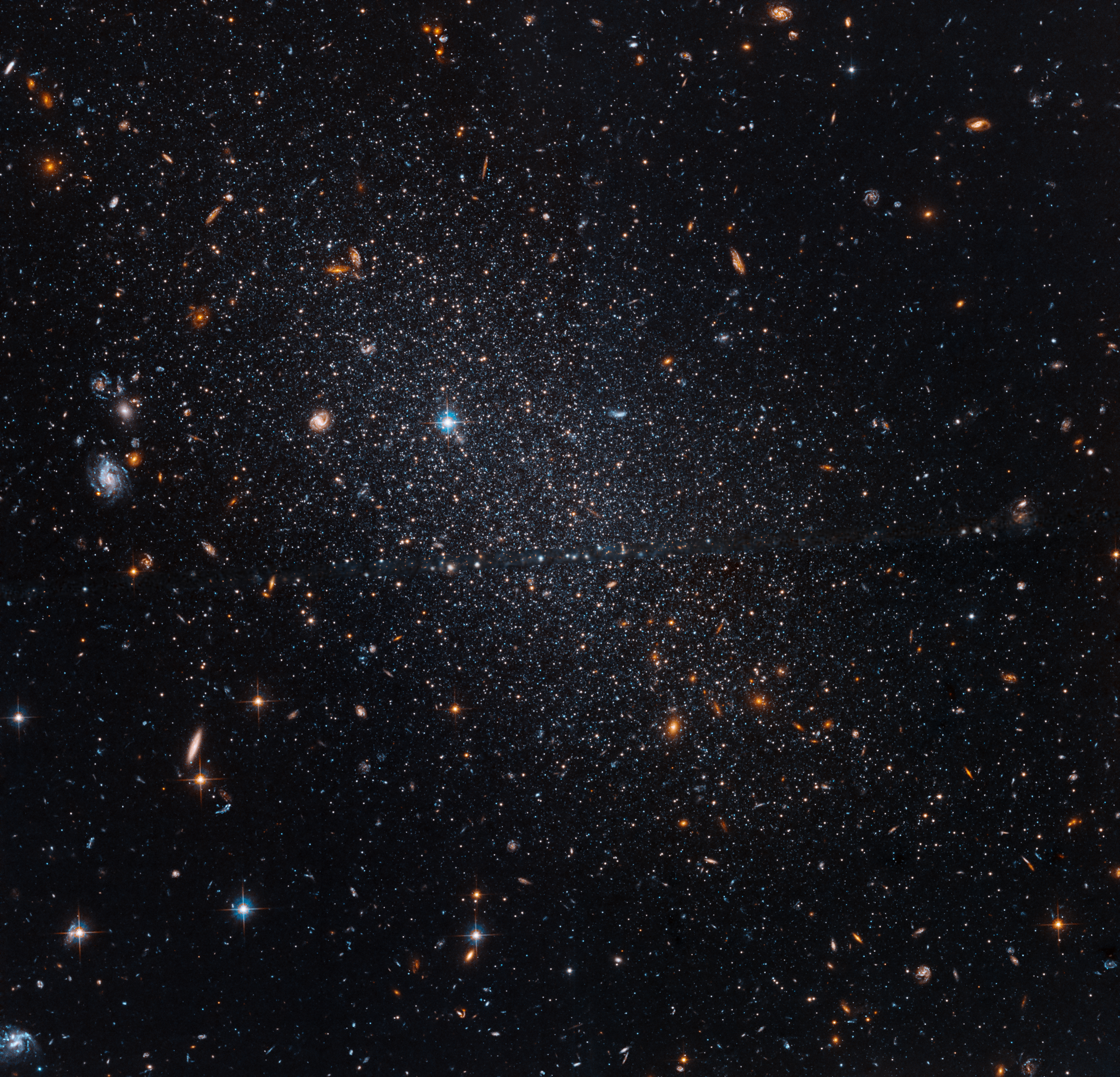
    More closely concentrated near the center, several stars shine against black space along with a few distant galaxies.
    NASA, ESA, C. Gallart (Instituto de Astrofisica de Canarias), A. del Pino Molina (Centro de Estudios de Fisica del Cosmos de Aragon), and R. van der Marel (Space Telescope Science Institute); Image Processing: Gladys Kober (NASA/Catholic University of America)

    A splatter of stars glows faintly at almost 3 million light-years away in this new image from NASA’s Hubble Space Telescope. Known as the Tucana Dwarf for lying in the constellation Tucana, this dwarf galaxy contains a loose bundle of aging stars at the far edge of the Local Group, an aggregation of galaxies including our Milky Way, bound together by gravity. The Tucana Dwarf was discovered in 1990 by R.J. Lavery, the same year Hubble launched.

    What makes the Tucana Dwarf distinct from other dwarf galaxies comes in two parts: its classification, and its isolation. As a dwarf spheroidal galaxy, it is much smaller and less luminous than most other dwarf galaxies. Dust is sparse and the stellar population skews towards the older range, giving them a dimmer look. Additionally, the Tucana Dwarf lies about 3.6 million light-years from the Local Group’s center of mass, far from the Milky Way and other galaxies. It is only one of two dwarf spheroidal galaxies in the Local Group to be this remote, making astronomers theorize that a close encounter with a larger galactic neighbor called Andromeda slingshotted it into the distance about 11 billion years ago.

    Having such pristine properties enables scientists to use the Tucana Dwarf as a cosmic fossil. Dwarf galaxies could be the early ingredients for larger galaxies, and with older stars residing in such an isolated environment, analyzing them can help trace galaxy formation back to the dawn of time. For that reason, Hubble reached far across the Local Group using the capabilities of the Advanced Camera for Surveys and Wide Field and Planetary Camera 2 to meet this distant, lonely galaxy. Examining its structure, composition, and star formation history sheds light on the epoch of reionization, when the first stars and galaxies arose from the dark billions of years ago.

    Explore More

    Media Contact:

    Claire Andreoli
    NASA’s Goddard Space Flight CenterGreenbelt, MD
    claire.andreoli@nasa.gov

    Details

    Last Updated

    Aug 23, 2024

    Editor
    Michelle Belleville

  • NASA Moves Artemis II Rocket Adapter, Prepares for Shipment

    Crews moved the cone-shaped launch vehicle stage adapter out of NASA Marshall’s Building 4708 to the agency’s Pegasus barge on August 21. The barge will ferry the adapter first to NASA’s Michoud Assembly Facility, where it will pick up additional SLS hardware for future Artemis missions, and then travel to NASA Kennedy. In Florida, teams with NASA’s Exploration Ground Systems will prepare the adapter for stacking and launch.
    Crews moved the cone-shaped launch vehicle stage adapter out of NASA Marshall’s Building 4708 to the agency’s Pegasus barge on August 21. The barge will ferry the adapter first to NASA’s Michoud Assembly Facility, where it will pick up additional SLS hardware for future Artemis missions, and then travel to NASA Kennedy. In Florida, teams with NASA’s Exploration Ground Systems will prepare the adapter for stacking and launch.
    NASA/Samuel Lott

    NASA rolled out a key piece of space flight hardware for the SLS (Space Launch System) rocket for the first crewed mission of NASA’s Artemis campaign from Marshall Space Flight Center in Huntsville, Alabama, on Wednesday, Aug. 21 for shipment to the agency’s Kennedy Space Center in Florida. The cone-shaped launch vehicle stage adapter connects the rocket’s core stage to the upper stage and helps protect the upper stage’s engine that will help propel the Artemis II test flight around the Moon, slated for 2025.

    “The launch vehicle stage adapter is the largest SLS component for Artemis II that is made at the center,” said Chris Calfee, SLS Spacecraft Payload Integration and Evolution element manager. “Both the adapters for the SLS rocket that will power the Artemis II and Artemis III missions are fully produced at NASA Marshall. Alabama plays a key role in returning astronauts to the Moon.”

    Crews moved the adapter out of NASA Marshall’s Building 4708 to the agency’s Pegasus barge Aug. 21. The barge will ferry the adapter first to NASA’s Michoud Assembly Facility in New Orleans, where crews will pick up additional SLS hardware for future Artemis missions, before traveling to NASA Kennedy. Once in Florida, the adapter will join the recently delivered core stage. There, teams with NASA’s Exploration Ground Systems will prepare the adapter for stacking and launch.

    Engineering teams at NASA Marshall are in the final phase of integration work on the launch vehicle stage adapter for Artemis III. The stage adapter is manufactured by prime contractor Teledyne Brown Engineering and the Jacobs Space Exploration Group’s ESSCA (Engineering Services and Science Capability Augmentation) contract using NASA Marshall’s self-reacting friction-stir robotic and vertical weld tools.

    Through the Artemis campaign, NASA will land the first woman, first person of color, and its first international partner astronaut on the Moon. The rocket is part of NASA’s deep space exploration plans, along with the Orion spacecraft, supporting ground systems, advanced spacesuits and rovers, Gateway in orbit around the Moon, and commercial human landing systems. NASA’s SLS is the only rocket that can send Orion, astronauts, and supplies to the Moon in a single launch.

    For more on SLS, visit: 

    https://www.nasa.gov/sls

    News Media Contact

    Jonathan Deal
    Marshall Space Flight Center, Huntsville, Ala. 
    256-544-0034  
    jonathan.e.deal@nasa.gov

  • Hubble Finds Structure in an Unstructured Galaxy

    2 min read

    Hubble Finds Structure in an Unstructured Galaxy

    A black background dotted with stars and distant galaxies. The distribution of stars increases toward image center, forming the loose oval shape of the irregular galaxy Leo A that stretches horizontally across the image. Three foreground stars shine brightly – one located at center-top, and two others in the lower-right quadrant of the image. Each holds four bright barbs (called diffraction spikes) that extend outward from the star.
    NASA, ESA, A. del Pino Molina (CEFCA), K. Gilbert and R. van der Marel (STScI), A. Cole (University of Tasmania); Image Processing: Gladys Kober (NASA/Catholic University of America)

    This NASA Hubble Space Telescope image features the nearby dwarf irregular galaxy Leo A, located some 2.6 million light-years away. The relatively open distribution of stars in this diminutive galaxy allows light from distant background galaxies to shine through.

    Astronomers study dwarf galaxies like Leo A because they are numerous and may offer clues to how galaxies grow and evolve. Dwarf galaxies are small and dim making the most distant members of this galaxy type difficult to study. As a result, astronomers point their telescopes toward those that are relatively near to our own Milky Way galaxy, like Leo A. 

    Leo A is one of the most isolated galaxies in our Local Group of galaxies. Its form appears as a roughly spherical, sparsely populated mass of stars with no obvious structural features like spiral arms. 

    The data that created this image come from four Hubble observing programs. Three of these looked at star formation histories of relatively nearby dwarf galaxies. The fourth sought to better determine the mass of our Local Group by looking at the motions of dwarf galaxies just outside of the Local Group. 

    The Hubble observations that looked at star formation found distinct structural differences in the age and distribution of stars in the galaxy. Most of the younger stars are located in the middle of the galaxy, while the number of older stars increases as you move outward from the center. Hubble observations also suggest that the galaxy’s halo of stars is about one-third larger than previous estimates. This distribution suggests that star formation in Leo A occurred from the outside-in, or that older stars efficiently migrated to the outskirts of Leo A in the early stages of its evolution.

    Explore More

    Media Contact:

    Claire Andreoli
    NASA’s Goddard Space Flight CenterGreenbelt, MD
    claire.andreoli@nasa.gov

    Details

    Last Updated

    Aug 22, 2024

    Editor
    Michelle Belleville
  • August 2024 Supermoon Rises Near NASA Marshall

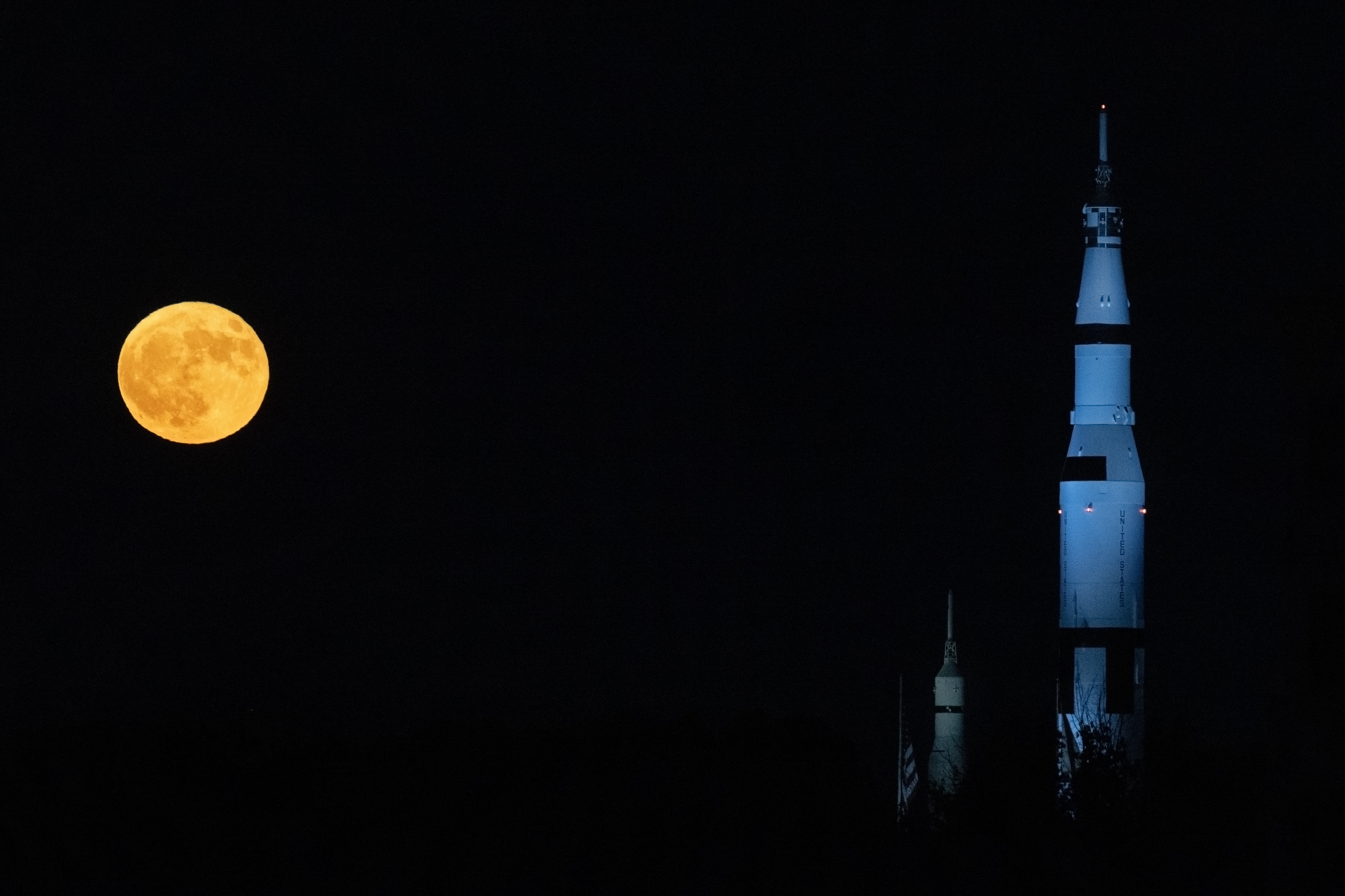
    A super blue moon is to the left of the replica Saturn V at the US Space and Rocket Center in Huntsville, Alabama.
    The Sturgeon Moon rises behind a replica Saturn V rocket at the U.S. Space & Rocket Center in Huntsville, Alabama on Monday, August 19, 2024. Over 99% full when it rose, the moon was a rare combination of a blue moon and a supermoon, a phenomenon that will not repeat until 2027.
    NASA/Michael DeMocker

    A super blue Moon rises over Huntsville, Alabama, home to NASA’s Marshall Space Flight Center and the U.S. Space and Rocket Center, Aug. 19. Visible through Wednesday, Aug. 21, the full Moon is both a supermoon and a Blue Moon. As the Moon reaches its closest approach to Earth, the Moon looks larger in the night sky with supermoons becoming the biggest and brightest full Moons of the year. While not blue in color, the third full Moon in a season with four full Moons is called a “Blue Moon.”

    Huntsville is known as the “Rocket City” because of its proximity to NASA Marshall, which manages vital propulsion systems and hardware, engineering technologies, cutting-edge science, and launch vehicles for Apollo, shuttle, and Artemis. (NASA/Michael DeMocker)

  • How Students Learn to Fly NASA’s IXPE Spacecraft

    5 min read

    How Students Learn to Fly NASA’s IXPE Spacecraft

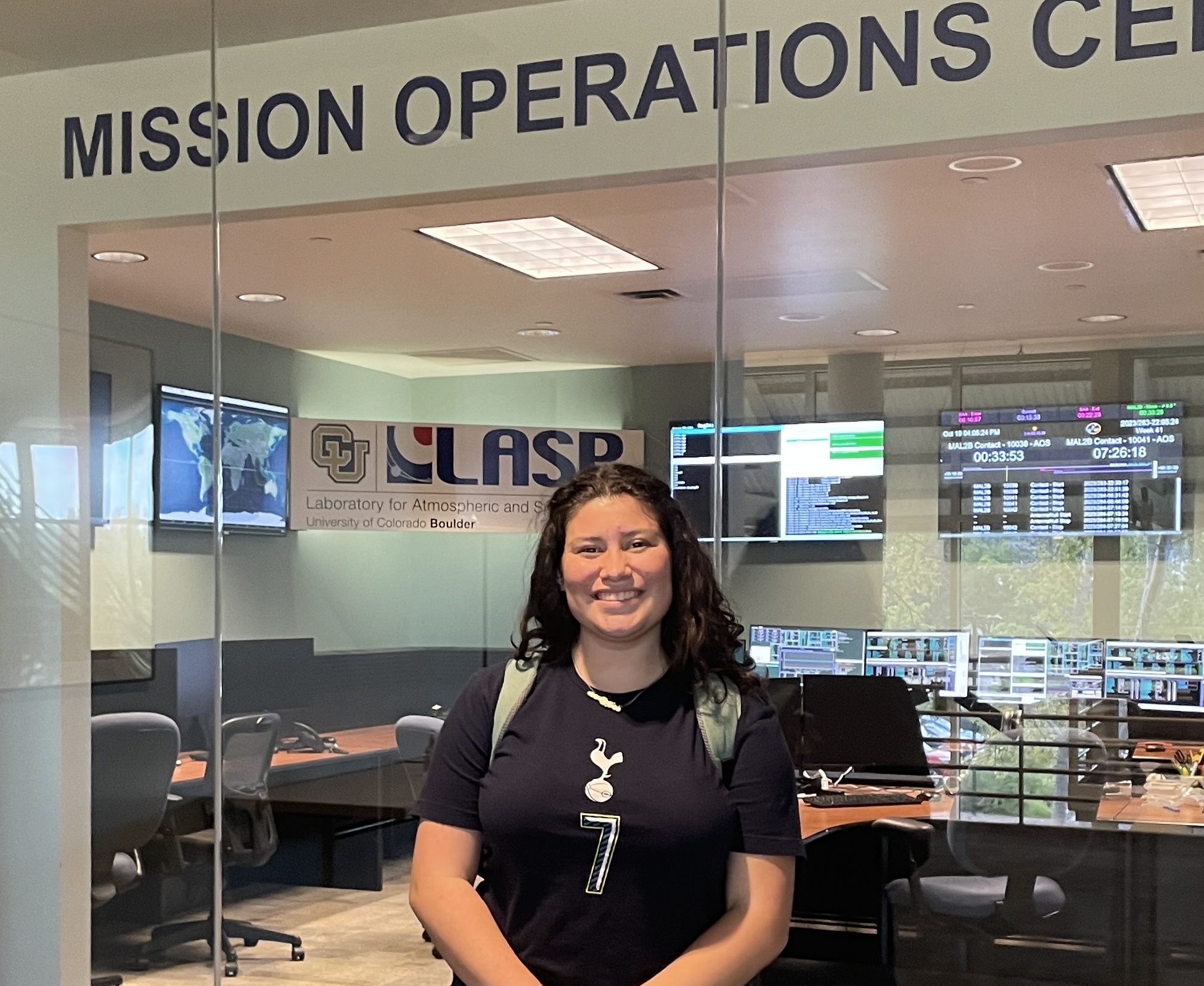
    Amelia “Mia” De Herrera-Schnering is an undergraduate student at the University of Colorado, Boulder, and command controller for NASA’s IXPE mission at LASP.

    The large wall monitor displaying a countdown shows 17 seconds when Amelia “Mia” De Herrera-Schnering tells her teammates “We have AOS,” meaning “acquisition of signal.”

    “Copy that, thank you,” Alexander Pichler replies. The two are now in contact with NASA’s IXPE (Imaging X-Ray Polarimeter Explorer) spacecraft, transmitting science data from IXPE to a ground station and making sure the download goes smoothly. That data will then go to the science team for further analysis.

    At LASP, the Laboratory for Atmospheric and Space Physics, students at the University of Colorado, Boulder, can train to become command controllers, working directly with spacecraft on pointing the satellites, calibrating instruments, and collecting data. De Herrera-Schnering recently completed her sophomore year, while Pichler had trained as a student and now, having graduated, works as a full-time professional at LASP.

    “The students are a key part in what we do,” said Stephanie Ruswick, IXPE flight director at LASP. “We professionals monitor the health and safety of the spacecraft, but so do the students, and they do a lot of analysis for us.”

    Students also put into motion IXPE’s instrument activity plans, which are provided by the Science Operations Center at NASA’s Marshall Space Flight Center in Huntsville, Alabama. The LASP student team schedules contacts with ground stations to downlink data, schedules observations of scientific and calibration targets, and generates the files necessary to translate the scientific operations into spacecraft actions. If IXPE experiences an anomaly, the LASP team will implement plans to remediate and resume normal operations as soon as possible.

    Exploring the high-energy universe

    The students take part in IXPE’s exploration of a wide variety of celestial targets. In October, for example, students monitored the transmission of data from IXPE’s observations of Swift J1727.8-1613, a bright black hole X-ray binary system. This cosmic object had been recently discovered in September 2023, when NASA’s Neil Gehrels Swift Observatory detected a gamma-ray burst. IXPE’s specialized instruments allow scientists to measure the polarization of X-rays, which contains information about the source of the X-rays as well as the organization of surrounding magnetic fields. IXPE’s follow-up of the Swift object exemplifies how multiple space missions often combine their individual strengths to paint a fuller scientific picture of distant phenomena.

    Team members also conduct individual projects. For example, students analyzed how IXPE would fare during both the annular eclipse on Oct. 14, 2023, and the total eclipse that moved across North America on April 8, to make sure that the spacecraft would have adequate power while the Moon partially blocked the Sun.

    While most of the students working on IXPE at LASP are engineering majors, some are physics or astrophysics majors. Some didn’t initially start their careers in STEM such as flight controller Kacie Davis, who previously studied art.

    Prospective command controllers go through a rigorous 12-week summer training program working 40 hours per week, learning “everything there is to know about mission operations and how to fly a spacecraft,” Ruswick said.

    Cole Writer, an aerospace engineering student, remembers this training as “nerve-wracking” because he felt intimidated by the flight controllers. But after practicing procedures on his own laptop, he felt more confident, and completed the program to become a command controller.

    “It’s nice to be trained by other students who are in the same boat as you and have gone through the same process,” said Adrienne Pickerill, a flight controller who started with the team as a student and earned a Master’s in aerospace engineering at the university in May .

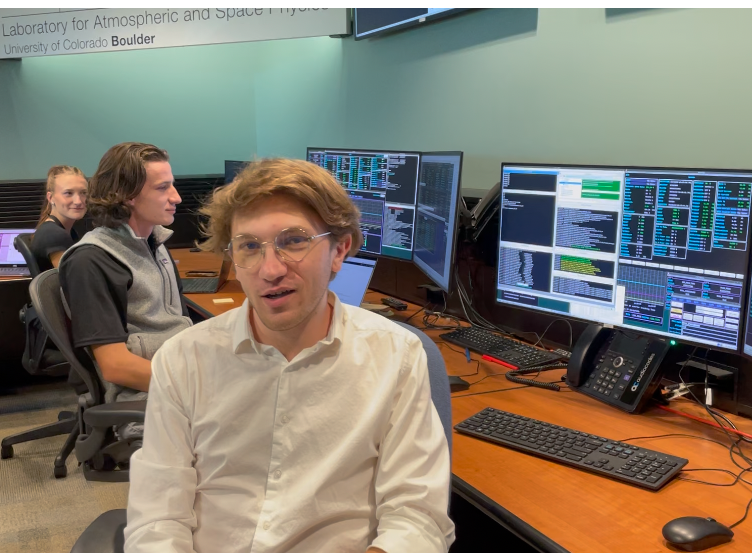
    A young man with blonde hair and glasses and a white shirt sits in a control room. He is Sam Lippincott.
    Sam Lippincott, right, a graduate student lead at LASP, trained as a command controller for NASA’s IXPE spacecraft as an undergraduate. In the background are flight controllers Adrienne Pickerill, left, and Alexander Pichler, who also trained as students.

    How they got here

    As a teenager Writer’s interests focused on flying planes, and he saved money to train for a pilot’s license, earning it the summer after high school graduation. Surprisingly, he has found many overlaps in skills for both activities – following checklists and preventing mistakes. “Definitely high stakes in both cases,” he said.

    Sam Lippincott, now a graduate student lead after serving as a command controller as an undergraduate, has been a lifelong sci-fi fan, but took a career in space more seriously his sophomore year of college. “For people that want to go into the aerospace or space operations industry, it’s always important to remember that you’ll never stop learning, and it’s important to remain humble in your abilities, and always be excited to learn more,” he said.

    De Herrera-Schnering got hooked on the idea of becoming a scientist the first time she saw the Milky Way. On a camping trip when she was 10 years old, she spotted the galaxy as she went to use the outhouse in the middle of the night. “I woke up my parents, and we just laid outside and we were just stargazing,” she said. “After that I knew I was set on what I wanted to do.”

    Rithik Gangopadhyay, who trained as an undergraduate command controller and continued at LASP as a graduate student lead, had been interested in puzzles and problem-solving as a kid and had a book about planets that fascinated him.. “There’s so much out there and so much we don’t know, and I think that’s what really pushed me to do aerospace and do this opportunity of being a command controller,” he said.

    Coding is key to mission operations, and much of it is done in the Python language. Sometimes the work of flying a spacecraft feels like any other kind of programming — but occasionally, team members step back and consider that they are part of the grand mission of exploring the universe.

    “If it’s your job for a couple of years, it starts to be like, ‘oh, let’s go ahead and do that, it’s just another Tuesday.’ But if you step back and think about it on a high-level basis, it’s really something special,” Pichler said. “It’s definitely profound.”

    Media Contact

    Elizabeth Landau
    Headquarters, Washington
    202-358-0845
    elandau@nasa.gov

  • Hubble Peers Into the Center of a Star-forming Powerhouse

    2 min read

    Hubble Peers Into the Center of a Star-forming Powerhouse

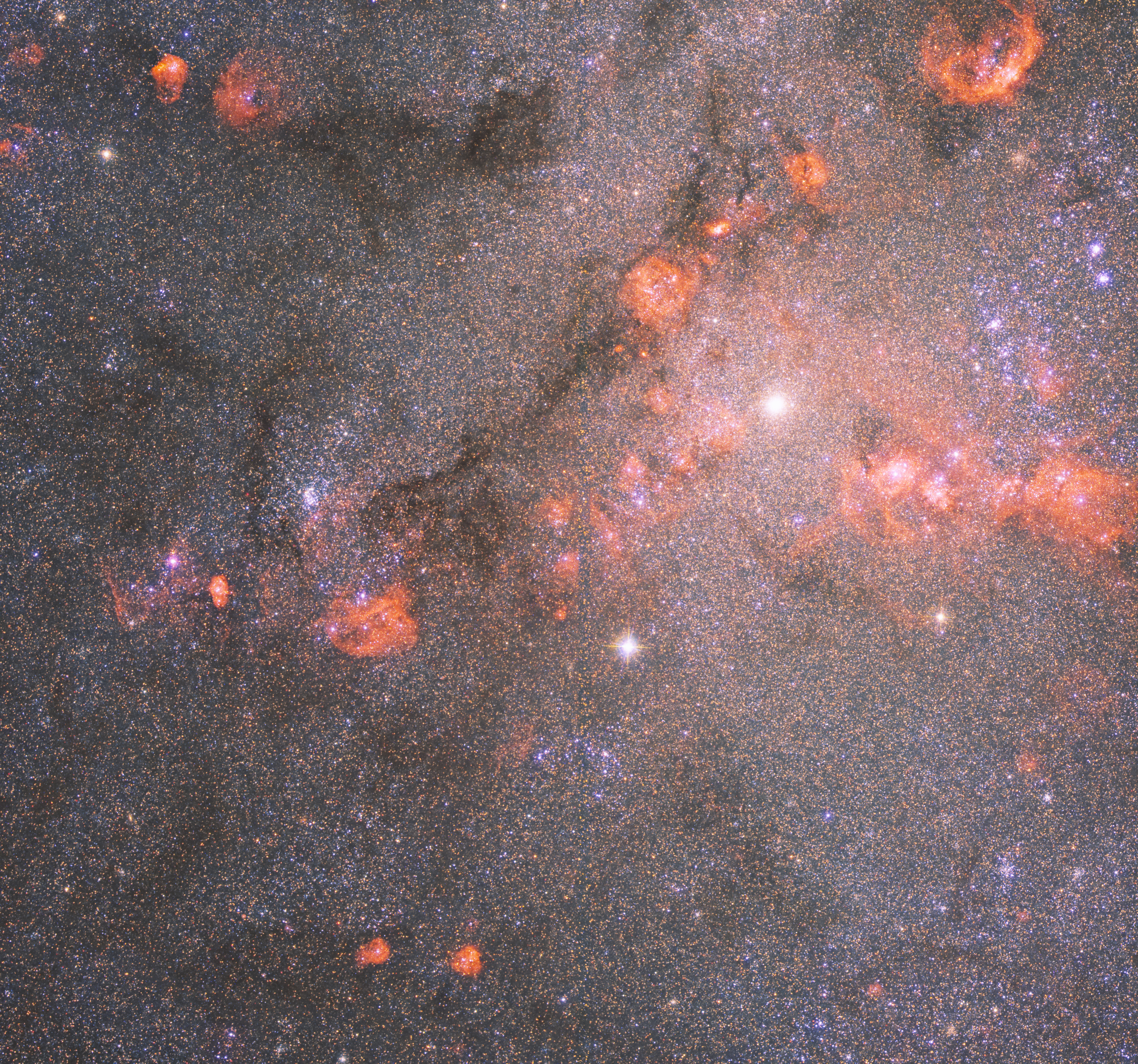
    Thousands of bright stars crowd the image, alongside bright pink and red regions of nebulosity.
    NASA, ESA, M. Boyer (STScI), and J. Dalcanton (University of Washington); Processing: Gladys Kober (NASA/Catholic University of America)

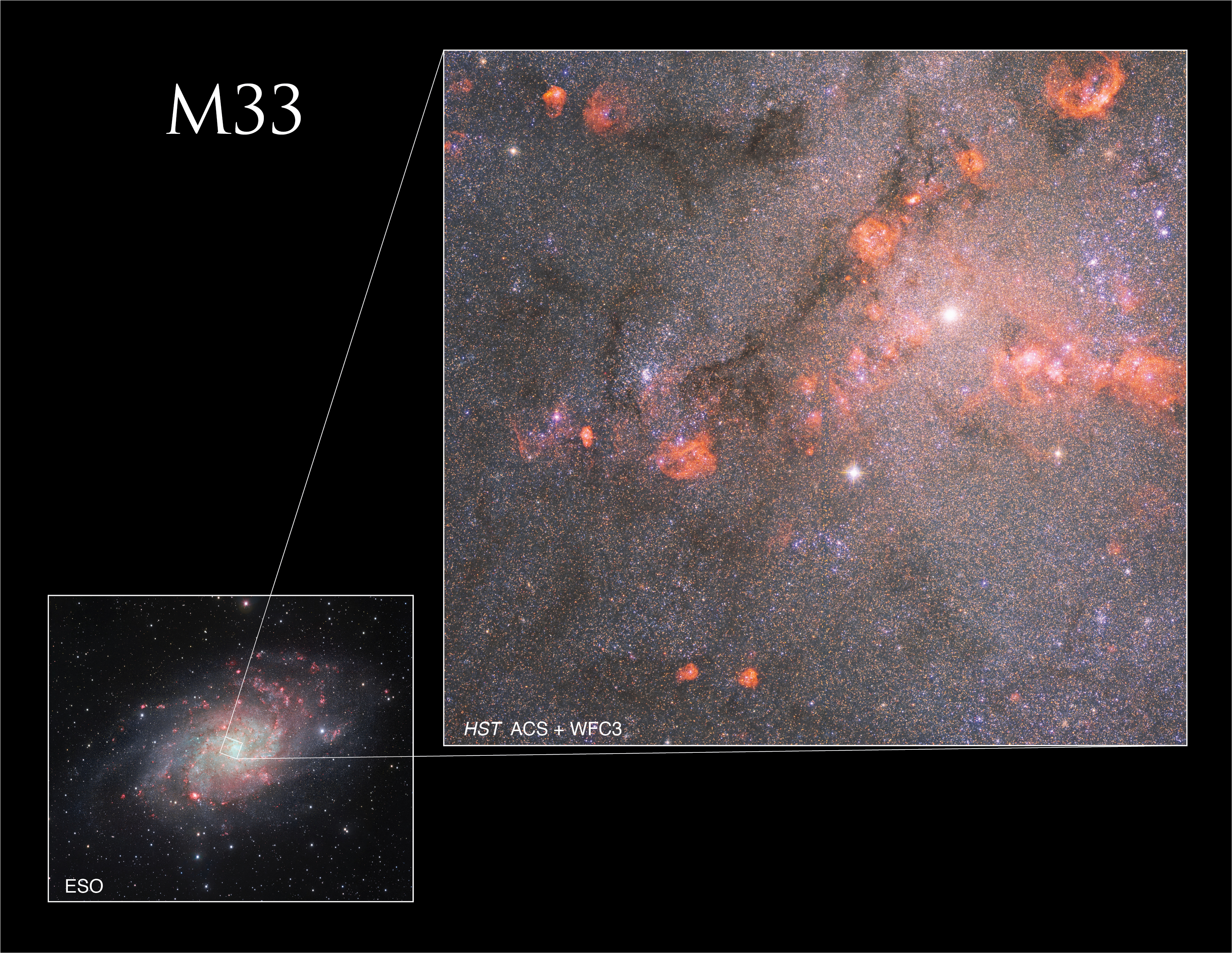
    This view from NASA’s Hubble Space Telescope plunges into the center of spiral galaxy Messier 33 (M33), also known as the Triangulum Galaxy. 

    Located within the triangle-shaped constellation Triangulum and about half the size of our Milky Way galaxy, M33 is the third-largest member of our Local Group of galaxies after the Andromeda galaxy (M31) and the Milky Way. 

    M33 is known to be a hotbed of starbirth, forming stars at a rate 10 times higher than the average of its neighbor, the Andromeda galaxy. Interestingly, M33’s neat, organized spiral arms indicate little interaction with other galaxies, so its rapid starbirth is not fueled by galactic collision, as in many other galaxies. The galaxy contains plenty of dust and gas for churning out stars, and numerous ionized hydrogen clouds, also called H-II regions, that give rise to tremendous star formation. Researchers have offered evidence that high-mass stars are forming in collisions between massive molecular clouds within M33.

    This image captures reddish clouds of ionized hydrogen interspersed with dark lanes of dust. The apparent graininess of the image is actually swarms of countless stars. M33 is one of less than 100 galaxies close enough for telescopes like Hubble to resolve individual stars, as evident here. 

    At the right, an image shows thousands of bright stars, alongside bright pink and red regions of nebulosity. It’s connected via white lines to a wider image to its lower left, showing a spiral galaxy with reddish tendrils throughout its arms. Text up top reads “M33” in white.
    NASA, ESA, M. Boyer (STScI), J. Dalcanton (University of Washington), and ESO; Processing: Gladys Kober (NASA/Catholic University of America)

    M33 is known to lack a central bulge, and there is no evidence of a supermassive black hole at its core ― strange since most spirals have a central bulge made up of densely concentrated stars and most large galaxies have supermassive black holes at their centers. Galaxies with this type of structure are called “pure disk galaxies,” and studies suggest they make up around 15-18 percent of galaxies in the universe. 

    M33 may lose its streamlined appearance and undisturbed status in a dramatic fashion ― it’s on a possible collision course with both the Andromeda galaxy and the Milky Way. This image was taken as part of a survey of M33 in an effort to help refine theories about such topics as the physics of the interstellar medium, star-formation processes, and stellar evolution.

    Explore More

    Media Contact:

    Claire Andreoli
    NASA’s Goddard Space Flight CenterGreenbelt, MD
    claire.andreoli@nasa.gov

    Details

    Last Updated

    Aug 21, 2024

    Editor
    Michelle Belleville