Behind the Scenes at the 2024 Mars 2020 Science Team Meeting
The Mars 2020 Perseverance Rover Science Team meets in person and online during the July 2024 team meeting in Pasadena, CA.
Credits: R. Hogg and J. Maki.
The Mars 2020 Science Team meets in Pasadena for 3 days of science synthesis
It has become a fun tradition for me to write a summary of our yearly in-person Science Team Meetings (2022 meeting and 2023 meeting). I’ve been particularly looking forward to this year’s update given the recent excitement on the team and in the public about Perseverance’s discovery of a potential biosignature, a feature that may have a biological origin but needs more data or further study before reaching a conclusion about the absence or presence of life.
This past July, ~160 members of the Mars 2020 Science Team met in-person in Pasadena—with another ~50 team members dialed in on-line—for three days of presentations, meetings, and team discussion. For a team that spends most of the year working remotely from around the world, we make the most of these rare opportunities for in-person discussion and synthesis of the rover’s latest science results.
We spent time discussing Perseverance’s most recent science campaign in the Margin unit, an exposure of carbonate-bearing rocks that occurs along the inner rim of Jezero crater. As part of an effort to synthesize what we’ve learned about the Margin unit over the past year, we heard presentations describing surface and subsurface observations collected from the rover’s entire payload. This was followed by a thought-provoking series of presentations that tackled the three hypotheses we’re carrying for the origin of this unit: sedimentary, volcanic (pyroclastic), or crystalline igneous.
Some of our liveliest discussion occurred during presentations about Neretva Vallis, Jezero’s inlet valley that once fed the sedimentary fan and lake system within the crater. Data from the RIMFAX instrument took center stage as we debated the origin and age relationship of the Bright Angel outcrop to other units we’ve studied in the crater.
This context is especially important because the Bright Angel outcrop is home to the Cheyava Falls rock, which contains intriguing features we’ve been calling “leopard spots,” small white spots with dark rims observed in red bedrock of Bright Angel. On the last day of the team meeting, data from our recent “Apollo Temple” abrasion at Cheyava Falls was just starting to arrive on Earth, and team members from the PIXL and SHERLOC teams were huddled in the hallway and at the back of the conference room trying to digest these new results in real time. We had special “pop-up” presentations during which SHERLOC reported compelling evidence for organics in the new abrasion, and PIXL showed interesting new data about the light-toned veins that crosscut this rock.
Between debates about the Margin unit, updates on recently published studies of the Jezero sedimentary fan sequence, and discussion of the newest rocks at Bright Angel, this team meeting was one of our most exciting yet. It also marked an important transition for the Mars 2020 science mission as we prepare to ascend the Jezero crater rim, leaving behind—at least for now—the rocks inside the crater. I can only imagine the interesting new discoveries we’ll make during the upcoming year, and I can’t wait to report back next summer!
Written by Katie Stack Morgan, Mars 2020 Deputy Project Scientist at NASA’s Jet Propulsion Laboratory
NASA, ESA Missions Help Scientists Uncover How Solar Wind Gets Energy
Since the 1960s, astronomers have wondered how the Sun’s supersonic “solar wind,” a stream of energetic particles that flows out into the solar system, continues to receive energy once it leaves the Sun. Now, thanks to a lucky lineup of a NASA and an ESA (European Space Agency)/NASA spacecraft both currently studying the Sun, they may have discovered the answer — knowledge that is a crucial piece of the puzzle to help scientists better forecast solar activity between the Sun and Earth.
A paper published in the Aug. 30, 2024, issue of the journal Science provides persuasive evidence that the fastest solar winds are powered by magnetic “switchbacks,” or large kinks in the magnetic field, near the Sun.
“Our study addresses a huge open question about how the solar wind is energized and helps us understand how the Sun affects its environment and, ultimately, the Earth,” said Yeimy Rivera, co-leader of the study and a postdoctoral fellow at the Smithsonian Astrophysical Observatory, part of Center for Astrophysics | Harvard & Smithsonian. “If this process happens in our local star, it’s highly likely that this powers winds from other stars across the Milky Way galaxy and beyond and could have implications for the habitability of exoplanets.”
This artist’s concept shows switchbacks, or large kinks in the Sun’s magnetic field.
NASA’s Goddard Space Flight Center/Conceptual Image Lab/Adriana Manrique Gutierrez
Previously, NASA’s Parker Solar Probe found that these switchbacks were common throughout the solar wind. Parker, which became the first craft to enter the Sun’s magnetic atmosphere in 2021, allowed scientists to determine that switchbacks become more distinct and more powerful close to the Sun. Up to now, however, scientists lacked experimental evidence that this interesting phenomenon actually deposits enough energy to be important in the solar wind.
“About three years ago, I was giving a talk about how fascinating these waves are,” said co-author Mike Stevens, astrophysicist at the Center for Astrophysics. “At the end, an astronomy professor stood up and said, ‘that’s neat, but do they actually matter?’”
To answer this, the team of scientists had to use two different spacecraft. Parker is built to fly through the Sun’s atmosphere, or “corona.” ESA’s and NASA’s Solar Orbiter mission is also on an orbit that takes it relatively close to the Sun, and it measures solar wind at larger distances.
The discovery was made possible because of a coincidental alignment in February 2022 that allowed both Parker Solar Probe and Solar Orbiter to measure the same solar wind stream within two days of each other. Solar Orbiter was almost halfway to the Sun while Parker was skirting the edge of the Sun’s magnetic atmosphere.
This conceptual image shows Parker Solar Probe about to enter the solar corona.
NASA/Johns Hopkins APL/Ben Smith
An artist’s concept shows Solar Orbiter near the Sun.
NASA’s Goddard Space Flight Center Conceptual Image Lab
“We didn’t initially realize that Parker and Solar Orbiter were measuring the same thing at all. Parker saw this slower plasma near the Sun that was full of switchback waves, and then Solar Orbiter recorded a fast stream which had received heat and with very little wave activity,” said Samuel Badman, astrophysicist at the Center for Astrophysics and the other co-lead of the study. “When we connected the two, that was a real eureka moment.”
Scientists have long known that energy is moved throughout the Sun‘s corona and the solar wind, at least in part, through what are known as “Alfvén waves.” These waves transport energy through a plasma, the superheated state of matter that makes up the solar wind.
However, how much the Alfvén waves evolve and interact with the solar wind between the Sun and Earth couldn’t be measured — until these two missions were sent closer to the Sun than ever before, at the same time. Now, scientists can directly determine how much energy is stored in the magnetic and velocity fluctuations of these waves near the corona, and how much less energy is carried by the waves farther from the Sun.
The new research shows that the Alfvén waves in the form of switchbacks provide enough energy to account for the heating and acceleration documented in the faster stream of the solar wind as it flows away from the Sun.
“It took over half a century to confirm that Alfvenic wave acceleration and heating are important processes, and they happen in approximately the way we think they do,” said John Belcher, emeritus professor from the Massachusetts Institute of Technology who co-discovered Alfvén waves in the solar wind but was not involved in this study.
In addition to helping scientists better forecast solar activity and space weather, such information helps us understand mysteries of the universe elsewhere and how Sun-like stars and stellar winds operate everywhere.
“This discovery is one of the key puzzle pieces to answer the 50-year-old question of how the solar wind is accelerated and heated in the innermost portions of the heliosphere, bringing us closer to closure to one of the main science objectives of the Parker Solar Probe mission,” said Adam Szabo, Parker Solar Probe mission science lead at NASA.
By Megan Watzke Center for Astrophysics | Harvard & Smithsonian
Preparations for Next Moonwalk Simulations Underway (and Underwater)
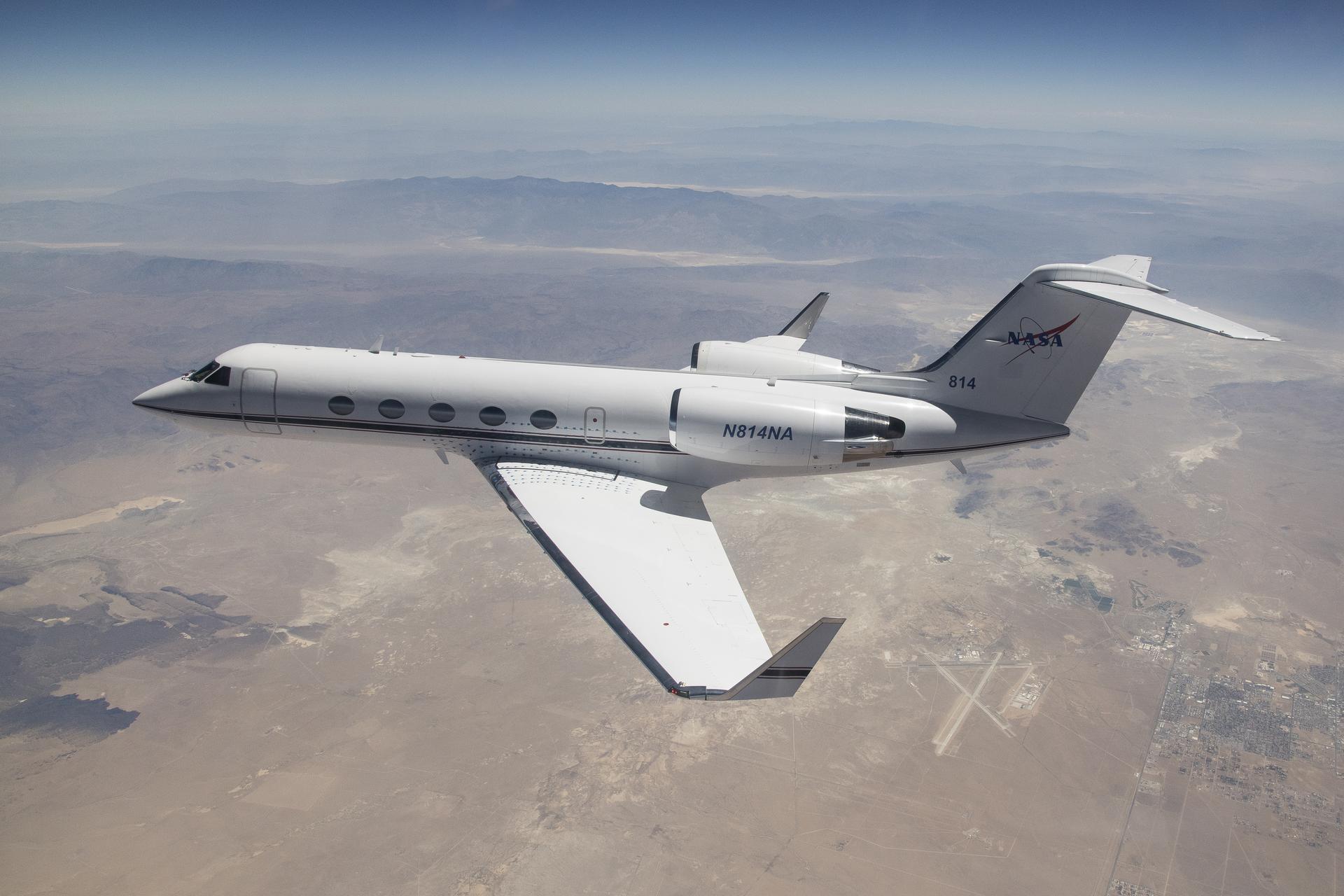
In a series of baseline flights beginning on June 24, 2024, the G-IV aircraft flew over the Antelope Valley to analyze aircraft performance. To accommodate a new radar instrument developed by JPL, NASA’s Airborne Science Program has selected the Gulfstream-IV aircraft to be modified and operated by Armstrong Flight Research Center in Edwards, California and will accommodate new instrumentation on board in support of the agency’s science mission directorate. Baseline flights began at NASA Armstrong in June 2024
NASA/Carla Thomas
In June 2024, a new tail number swept the sky above NASA’s Armstrong Flight Research Center in Edwards, California. Pilots conducted flights of a Gulfstream IV (G-IV) to evaluate its handling characteristics and to familiarize pilots with it before it begins structural modifications. The research plane is joining the center’s fleet serving NASA’s Airborne Science program.
The G-IV will carry the Next Generation Airborne Synthetic Aperture Radar (AIRSAR-NG), which sends and receives microwave signals to collect information about Earth’s topographic features and how they change over time. The goal for the team at NASA Armstrong is to modify the G-IV to accommodate three radars simultaneously.
“The AIRSAR-NG will be composed of three different Synthetic Aperture Radar antennas in one instrument to provide new insight into Earth’s surface more efficiently,” said Yunling Lou, principal investigator for the instrument at NASA’s Jet Propulsion Laboratory in Southern California. “The capabilities of this new instrument will facilitate new techniques, such as three-dimensional imaging, that will be useful for future space-borne missions.”
With those and other modifications being made, the G-IV will also be able to accommodate an increased load of science instruments, which could enable NASA to support more dynamic airborne science missions.
“This aircraft will aid Armstrong in continuing our long history of supporting airborne science for the agency and maintain the expertise in conducting successful science missions for years to come,” said Franzeska Becker, the G-IV project manager at NASA Armstrong.
Transferred in February from NASA’s Langley Research Center in Hampton, Virginia, the G-IV will undergo additional modifications overseen by NASA Armstrong’s team. Their goal is to enrich the agency’s airborne science program by outfitting the aircraft to function as a more capable and versatile research platform.
The knowledge and expertise of professionals at NASA centers like Armstrong (G-IV, ER-2, C-20) and Langley (777, G-III) will help enable the agency to produce a well-defined and airworthy platform for science instruments and airborne science missions.
NASA Earth Observatory image by Lauren Dauphin, using VIIRS data from NASA EOSDIS LANCE, GIBS/Worldview, and the Suomi National Polar-orbiting Partnership
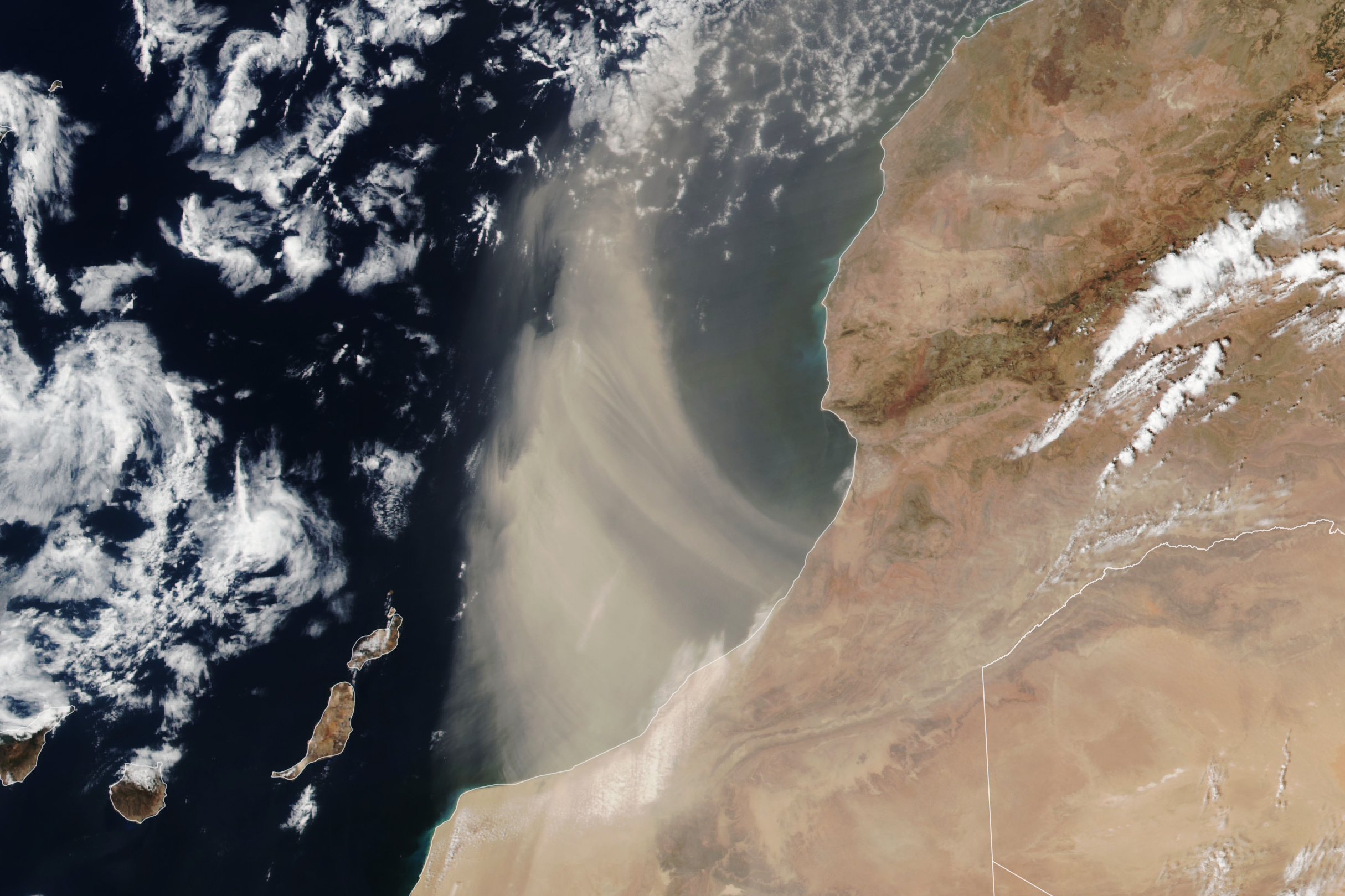
The Suomi NPP satellite acquired this image of a plume of Saharan dust as winds lofted it over the Atlantic Ocean on Aug. 24, 2024.
The Sahara Desert is Earth’s largest source of airborne dust, and the particles can travel for thousands of miles. From late spring to early fall, it is common for the dry, dusty Saharan Air Layer to carry the particles westward across the Atlantic Ocean high in the atmosphere. Saharan Air Layer activity subsides after mid-August, according to NOAA, making it less likely that the plume shown here is bound for a transoceanic journey. Instead, it arcs to the north after blowing out over the ocean. Earlier in the summer, however, several clouds of fine dust from the Sahara reached the United States, creating hazy skies over Texas.
The stars in the big Wyoming skies inspired Aaron Vigil as a child to dream big. Today, he’s a mechanical engineer working on the Solar Array Sun Shield (SASS) for the Nancy Grace Roman Space Telescope at Goddard.
Aaron Vigil is a mechanical engineer at Goddard Space Flight Center in Greenbelt, Md.
Photo courtesy of Aaron Vigil
What do you do and what is most interesting about your role here at Goddard? How do you help support Goddard’s mission?
I currently work on the Solar Array Sun Shield (SASS) for the Nancy Grace Roman Space Telescope. I support daily integration and testing tasks related to the SASS assembly. I spend a lot of my time working with Goddard mechanical technicians and other engineers to execute test plans and procedures to assemble, test, and integrate SASS hardware.
What interests you about space?
I grew up in rural Wyoming. I did a lot of hiking, hunting, fishing, and camping. We were on the mountains constantly. I remember being up at night, sitting around the campfire with my family, looking up at the stars.
I was fascinated and captivated! I wanted to learn more about space.
“I currently work on the Solar Array Sun Shield (SASS) for the Nancy Grace Roman Space Telescope,” said Aaron. “I support daily integration and testing tasks related to the SASS assembly.”
Photo credit: NASA/Chris Gunn
What brought you to Goddard?
In 2019, I began a B.S. in mechanical engineering at the University of Wyoming in Laramie.
In the spring of 2020, I reached out to an organization at the University of Wyoming looking for opportunities to further my education in the field of aerospace. They introduced me to the Wyoming Space Grand Consortium and, through their website, I learned of and applied to be a NASA Office of STEM Engagement intern in the spring of 2021. I received an offer and, in the summer of 2021, began working as a remote intern at Goddard on the 3D modeling and rendering of early spacecraft.
How did the Hispanic Advisory Committee for Employees (HACE) introduce you to the Pathways Program?
The summer of 2021, the different employee advisory committees at Goddard held presentations for the interns. I am Hispanic; I naturally gravitated towards HACE and fell in love with the extremely warm community they provided.
I attended their monthly meetings and I presented to the center at their end of the summer intern presentation. HACE introduced me to the Pathways Program, and the organization was instrumental in my becoming a Pathways student intern. This Pathways internship eventually led to my conversion to a fulltime employee and my current position in the Mechanical Engineering Branch here at Goddard.
What one piece of advice would you give to a new intern?
Never be afraid to ask questions and always seek out new connections. Goddard is a well of knowledge, you can learn and grow a lot from those around you.
Tell us about your mentorship at Goddard.
Jack Marshall is an aerospace engineer and the lead for SASS. When I was an intern, he showed me a glimpse into the world of engineering, providing perspective on all aspects of the project from administrative to technical. He continues to guide my engineering journey and has been instrumental in developing me into the engineer I am today. I am incredibly grateful to Jack for his welcome and his guidance.
What is the coolest part about your job?
The best parts about my job are the people I get to work with and the hardware we get to build. Whether we’re in a small lab in Goddard’s integration and testing facility or a large clean room, I get to spend most of my days working with incredible people to build, test, and integrate flight hardware. Every day there is something to be excited about and someone I get to work with who is likely to teach me something new. That excitement makes my work fun.
It’s also fun to work in facilities like the largest clean room at Goddard, where the James Webb Space Telescope was built. It was interesting getting used to being gowned up. You start with removing electronics and putting on a face mask, hair net, and shoe covers, before taking a quick air shower. Next comes the hood, coveralls, and boots, before taping your gloves and finally entering the clean room.
“Whether we’re in a small lab in Goddard’s integration and testing facility or a large clean room, I get to spend most of my days working with incredible people to build, test, and integrate flight hardware,” said Aaron. “Every day there is something to be excited about and someone I get to work with who is likely to teach me something new.”
Photo credit: NASA/Jolearra Tshiteya
What do you hope to be doing in five years?
I would hope to have the opportunity to continue learning and working here at Goddard. I love what I do, and I hope to help others interested, find a similar path to NASA.
What do you do fun?
I still love to go fishing and hiking any chance I get and have been looking forward to doing more here in Maryland. Since moving to the area, I have also been enjoying attending Nationals baseball games in D.C., and I have been looking for opportunities to continuing to play music since graduating college.
Aaron Vigil plays the sousaphone at the University of Wyoming in Laramie.
Photo courtesy of Aaron Vigil
Who inspires you?
My biggest inspirations have been my parents and grandparents, without them I would not be where I am today. I cannot thank them enough. They provided me my foundation and have supported me throughout my life, encouraging me to never give up. They have always had my back.
I also want to thank my Wyoming community where I grew up and my early mentors within that community.
What is your “six-word memoir”? A six-word memoir describes something in just six words.
Conversations With Goddard is a collection of Q&A profiles highlighting the breadth and depth of NASA’s Goddard Space Flight Center’s talented and diverse workforce. The Conversations have been published twice a month on average since May 2011. Read past editions on Goddard’s “Our People” webpage.
A prototype of a robot built to access underwater areas where Antarctic ice shelves meet land is lowered through the ice during a field test north of Alaska in March. JPL is developing the concept, called IceNode, to take melt-rate measurements that would improve the accuracy of sea level rise projections.
U.S. Navy/Scott Barnes
Conducted through the U.S. Navy Arctic Submarine Laboratory’s biennial Ice Camp, this field test marked IceNode’s first in a polar environment. The team hopes to one day deploy a fleet of the autonomous robots beneath Antarctic ice shelves.
U.S. Navy/Scott Barnes
Called IceNode, the project envisions a fleet of autonomous robots that would help determine the melt rate of ice shelves.
On a remote patch of the windy, frozen Beaufort Sea north of Alaska, engineers from NASA’s Jet Propulsion Laboratory in Southern California huddled together, peering down a narrow hole in a thick layer of sea ice. Below them, a cylindrical robot gathered test science data in the frigid ocean, connected by a tether to the tripod that had lowered it through the borehole.
This test gave engineers a chance to operate their prototype robot in the Arctic. It was also a step toward the ultimate vision for their project, called IceNode: a fleet of autonomous robots that would venture beneath Antarctic ice shelves to help scientists calculate how rapidly the frozen continent is losing ice — and how fast that melting could cause global sea levels to rise.
Warming Waters, Treacherous Terrain
If melted completely, Antarctica’s ice sheet would raise global sea levels by an estimated 200 feet (60 meters). Its fate represents one of the greatest uncertainties in projections of sea level rise. Just as warming air temperatures cause melting at the surface, ice also melts when in contact with warm ocean water circulating below. To improve computer models predicting sea level rise, scientists need more accurate melt rates, particularly beneath ice shelves — miles-long slabs of floating ice that extend from land. Although they don’t add to sea level rise directly, ice shelves crucially slow the flow of ice sheets toward the ocean.
A remote camera captured an IceNode prototype deployed below the frozen surface of Lake Superior, off Michigan’s Upper Peninsula, during a field test in 2022. The three thin legs of the robot’s “landing gear” affix the prototype to the icy ceiling.
NASA/JPL-Caltech
The challenge: The places where scientists want to measure melting are among Earth’s most inaccessible. Specifically, scientists want to target the underwater area known as the “grounding zone,” where floating ice shelves, ocean, and land meet — and to peer deep inside unmapped cavities where ice may be melting the fastest. The treacherous, ever-shifting landscape above is dangerous for humans, and satellites can’t see into these cavities, which are sometimes beneath a mile of ice. IceNode is designed to solve this problem.
“We’ve been pondering how to surmount these technological and logistical challenges for years, and we think we’ve found a way,” said Ian Fenty, a JPL climate scientist and IceNode’s science lead. “The goal is getting data directly at the ice-ocean melting interface, beneath the ice shelf.”
Floating Fleet
Harnessing their expertise in designing robots for space exploration, IceNode’s engineers are developing vehicles about 8 feet (2.4 meters) long and 10 inches (25 centimeters) in diameter, with three-legged “landing gear” that springs out from one end to attach the robot to the underside of the ice. The robots don’t feature any form of propulsion; instead, they would position themselves autonomously with the help of novel software that uses information from models of ocean currents.
JPL’s IceNode project is designed for one of Earth’s most inaccessible locations: underwater cavities deep beneath Antarctic ice shelves. The goal is getting melt-rate data directly at the ice-ocean interface in areas where ice may be melting the fastest. Credit: NASA/JPL-Caltech
Released from a borehole or a vessel in the open ocean, the robots would ride those currents on a long journey beneath an ice shelf. Upon reaching their targets, the robots would each drop their ballast and rise to affix themselves to the bottom of the ice. Their sensors would measure how fast warm, salty ocean water is circulating up to melt the ice, and how quickly colder, fresher meltwater is sinking.
The IceNode fleet would operate for up to a year, continuously capturing data, including seasonal fluctuations. Then the robots would detach themselves from the ice, drift back to the open ocean, and transmit their data via satellite.
“These robots are a platform to bring science instruments to the hardest-to-reach locations on Earth,” said Paul Glick, a JPL robotics engineer and IceNode’s principal investigator. “It’s meant to be a safe, comparatively low-cost solution to a difficult problem.”
Arctic Field Test
While there is additional development and testing ahead for IceNode, the work so far has been promising. After previous deployments in California’s Monterey Bay and below the frozen winter surface of Lake Superior, the Beaufort Sea trip in March 2024 offered the first polar test. Air temperatures of minus 50 degrees Fahrenheit (minus 45 Celsius) challenged humans and robotic hardware alike.
The test was conducted through the U.S. Navy Arctic Submarine Laboratory’s biennial Ice Camp, a three-week operation that provides researchers a temporary base camp from which to conduct field work in the Arctic environment.
As the prototype descended about 330 feet (100 meters) into the ocean, its instruments gathered salinity, temperature, and flow data. The team also conducted tests to determine adjustments needed to take the robot off-tether in future.
“We’re happy with the progress. The hope is to continue developing prototypes, get them back up to the Arctic for future tests below the sea ice, and eventually see the full fleet deployed underneath Antarctic ice shelves,” Glick said. “This is valuable data that scientists need. Anything that gets us closer to accomplishing that goal is exciting.”
IceNode has been funded through JPL’s internal research and technology development program and its Earth Science and Technology Directorate. JPL is managed for NASA by Caltech in Pasadena, California.
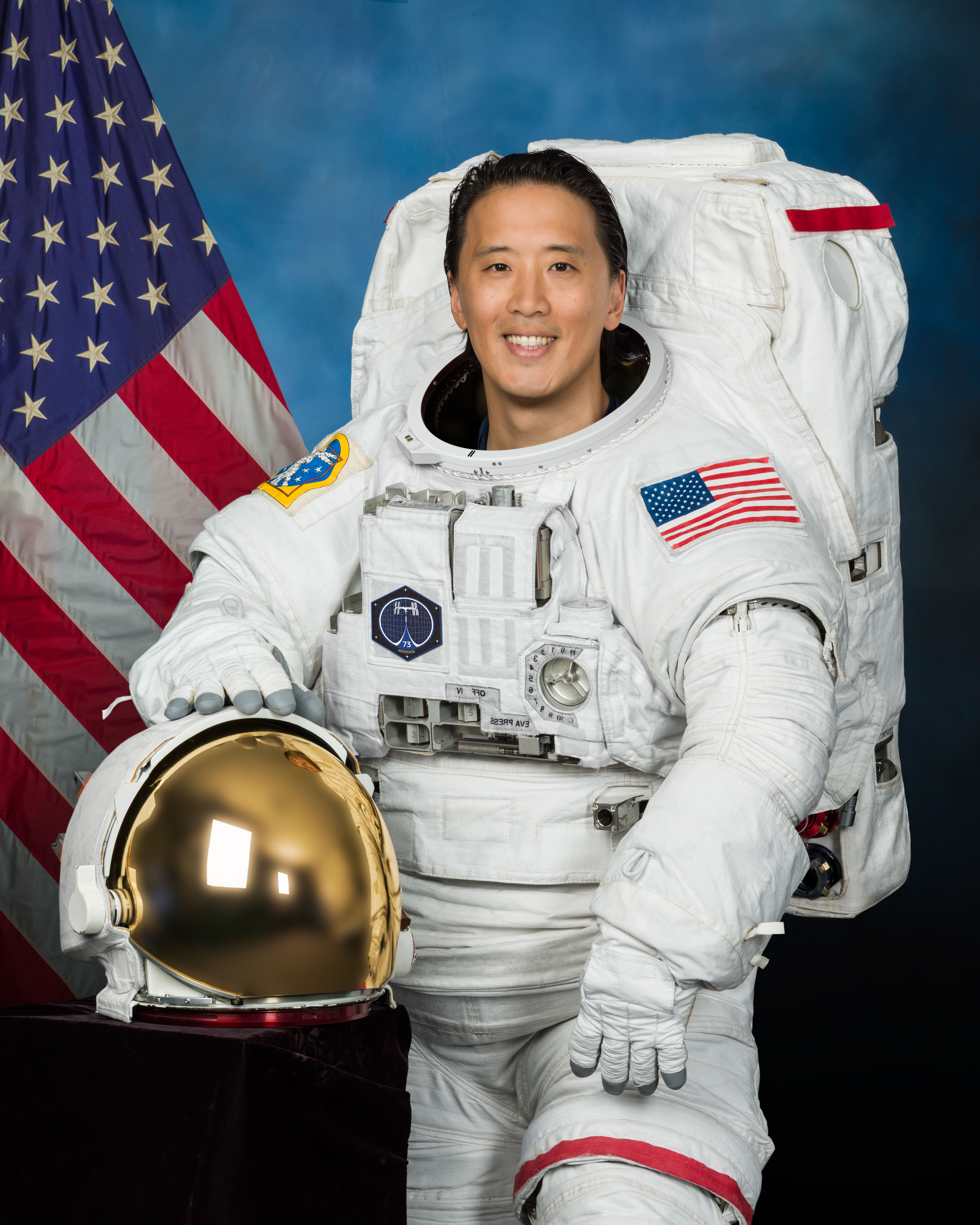
Official portrait of NASA astronaut Jonny Kim in an EMU suit.
Credit: NASA
During his first mission to the International Space Station, NASA astronaut Jonny Kim will serve as a flight engineer and member of the upcoming Expedition 72/73 crew.
Kim will launch on the Roscosmos Soyuz MS-27 spacecraft in March 2025, accompanied by Roscosmos cosmonauts Sergey Ryzhikov and Alexey Zubritsky. The trio will spend approximately eight months at the space station.
While aboard the orbiting laboratory, Kim will conduct scientific investigations and technology demonstrations to help prepare the crew for future space missions and provide benefits to people on Earth.
NASA selected Kim as an astronaut in 2017. After completing the initial astronaut candidate training, Kim supported mission and crew operations in various roles including the Expedition 65 lead operations officer, T-38 operations liaison, and space station capcom chief engineer.
A native of Los Angeles, Kim is a United States Navy lieutenant commander and dual designated naval aviator and flight surgeon. Kim also served as an enlisted Navy SEAL. He holds a bachelor’s degree in Mathematics from the University of San Diego and a medical degree from Harvard Medical School in Boston, and completed his internship with the Harvard Affiliated Emergency Medicine Residency at Massachusetts General Hospital and Brigham and Women’s Hospital.
For more than two decades, humans have lived and worked continuously aboard the International Space Station, advancing scientific knowledge, and making research breakthroughs not possible on Earth. The station is a critical testbed for NASA to understand and overcome the challenges of long-duration spaceflight and to expand commercial opportunities in low Earth orbit. As commercial companies focus on providing human space transportation services and destinations as part of a robust low Earth orbit economy, NASA is able to more fully focus its resources on deep space missions to the Moon and Mars.
Get breaking news, images and features from the space station on the station blog, Instagram, Facebook, and X.
Learn more about International Space Station research and operations at:
NASA Project in Puerto Rico Trains Students in Marine Biology
A forested green peninsula of Culebra Island juts into the blue waters of the Caribbean as a rain storm hits in the distance. The teal blue surrounding the island indicates shallow waters, home to the island’s famous coral reefs.
Credits: NASA Ames/Milan Loiacono
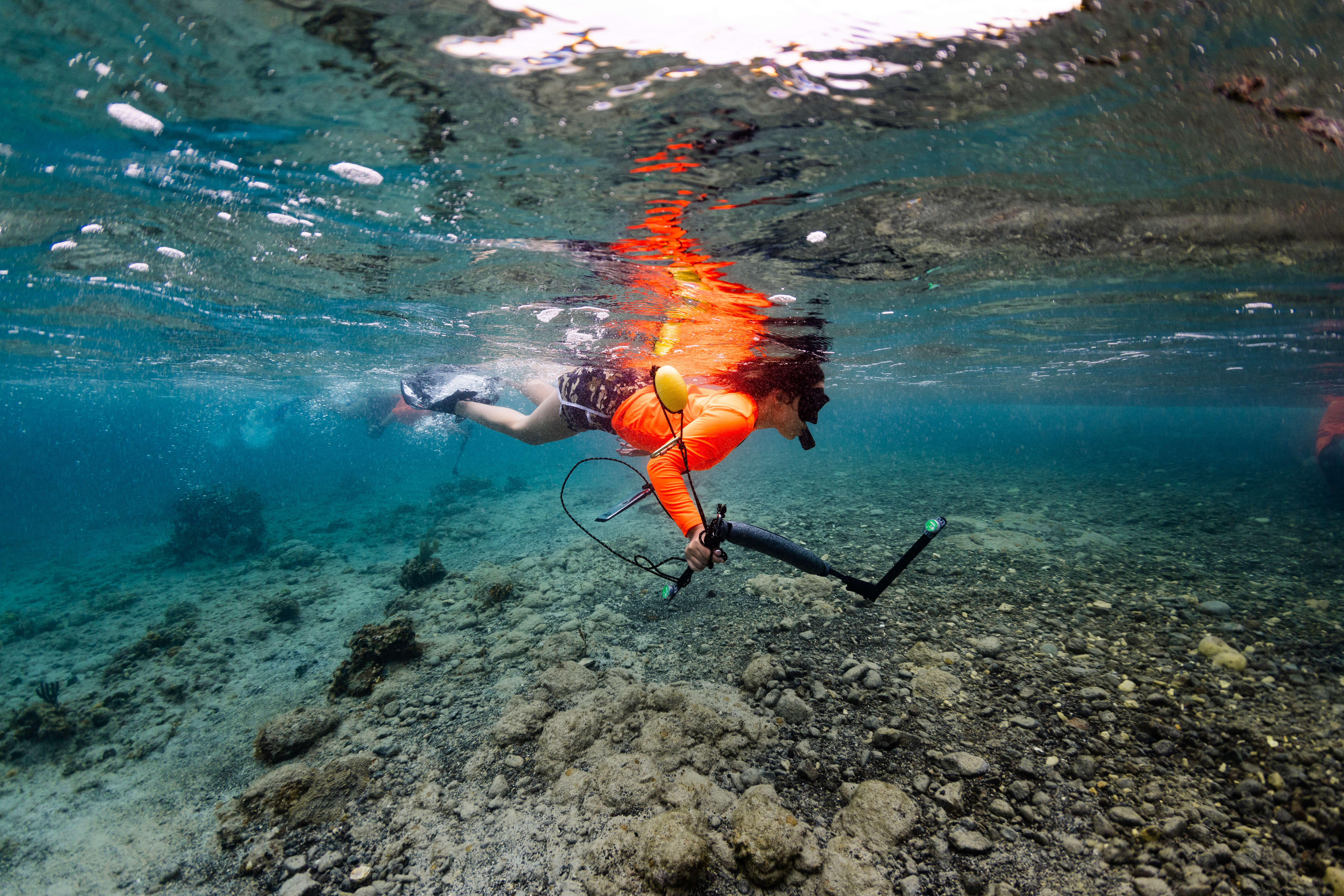
Tainaliz Marie Rodríguez Lugo took a deep breath, adjusted her snorkel mask, and plunged into the ocean, fins first. Three weeks earlier, Rodríguez Lugo couldn’t swim. Now the college student was gathering data on water quality and coral reefs for a NASA-led marine biology project in Puerto Rico, where she lives.
“There is so much life down there that I never knew about,” Rodríguez Lugo said. “And it’s beautiful.”
“There is so much life down there that I never knew about, and it’s beautiful.”
Tainaliz Marie Rodríguez Lugo
OCEANOS 2024 Intern
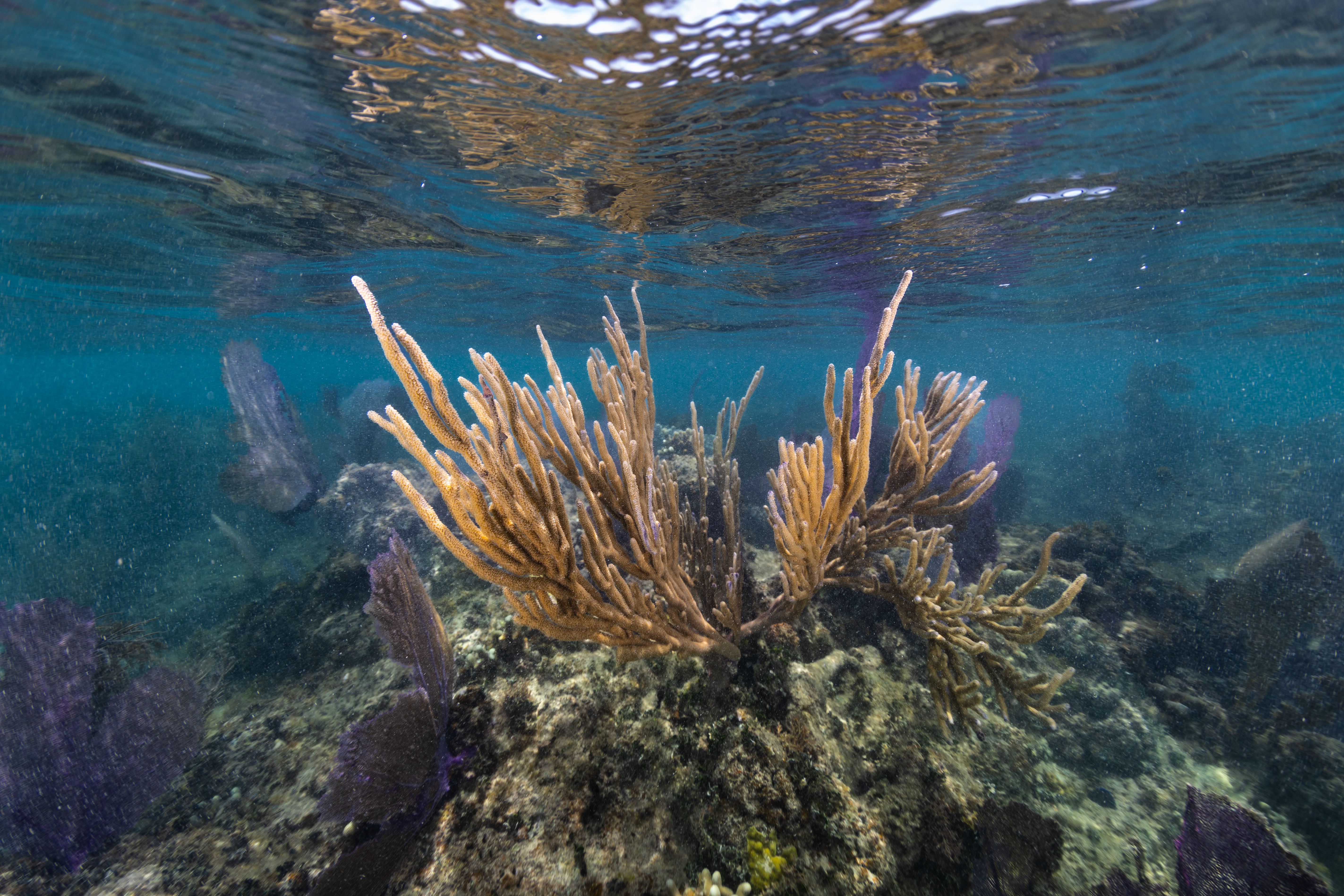
The sea whip and purple sea fans in the photo above are found off the coast of Playa Melones, Culebra, a small island off the east cost of Puerto Rico and a popular destination for snorkelers.
Puerto Rico is home to more than 1,300 square miles of coral reefs, which play a vital role in protecting the island from storms, waves, and hurricanes. Reef-related tourism provides nearly $2 billion in annual income for the island.
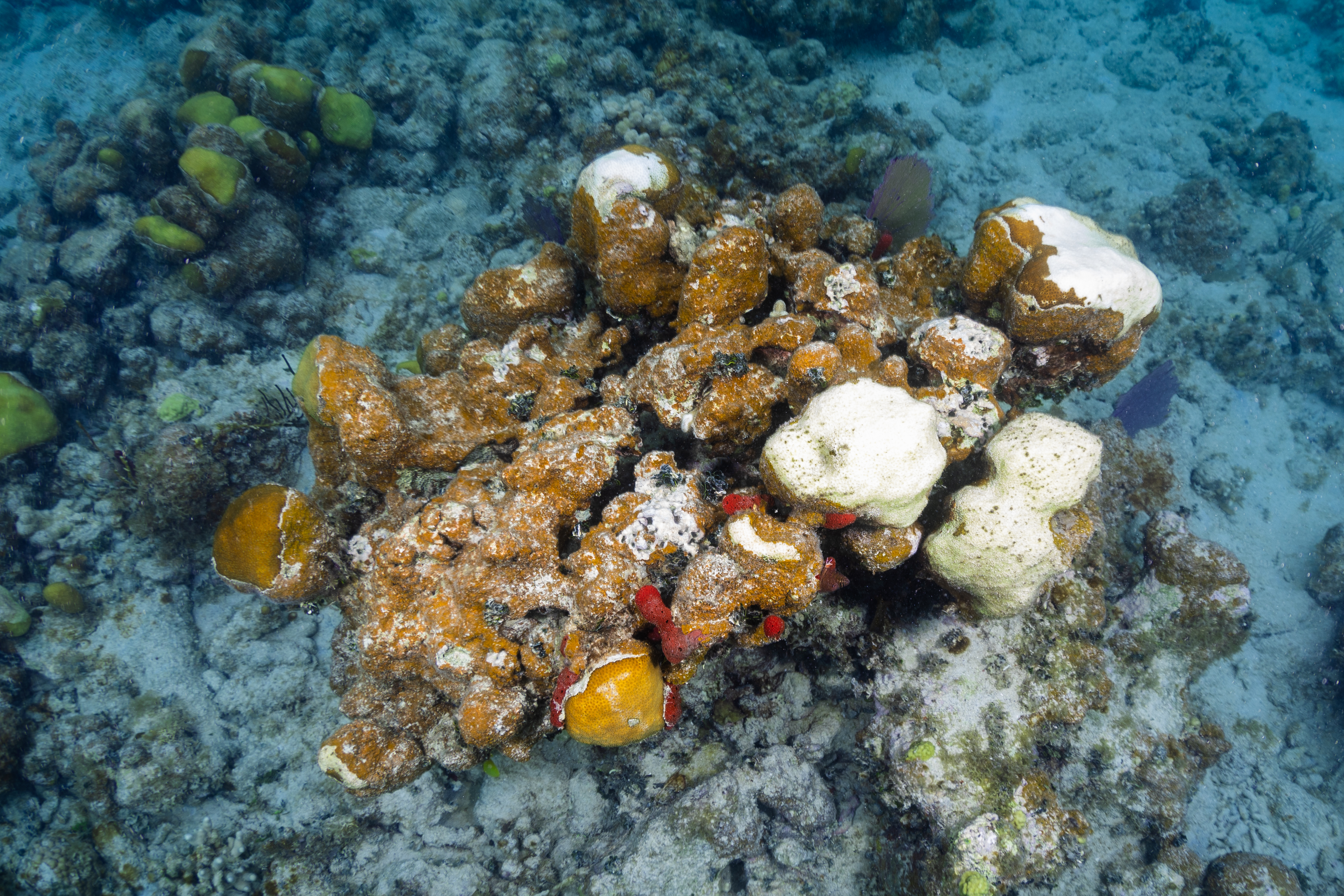
But coral reefs in Puerto Rico and around the world are experiencing more frequent and severe bleaching events. High ocean temperatures in regions around the globe have led to coral bleaching, which is when corals expel zooxanthellae – the colorful, symbiotic microscopic algae that live inside coral tissues and provide 80-90% of its nutrients. When stressors persist, the corals eventually starve and turn bone-white.
In April 2024, NOAA (National Oceanic and Atmospheric Administration) announced that the world was experiencing a global bleaching event, the fourth on record. You can see bleached spots in the lobed star coral pictured above, which is also colonized by Ramicrusta, an invasive, burnt orange algae that poses an additional threat to reefs.
Students Are Given Ocean Research Tools
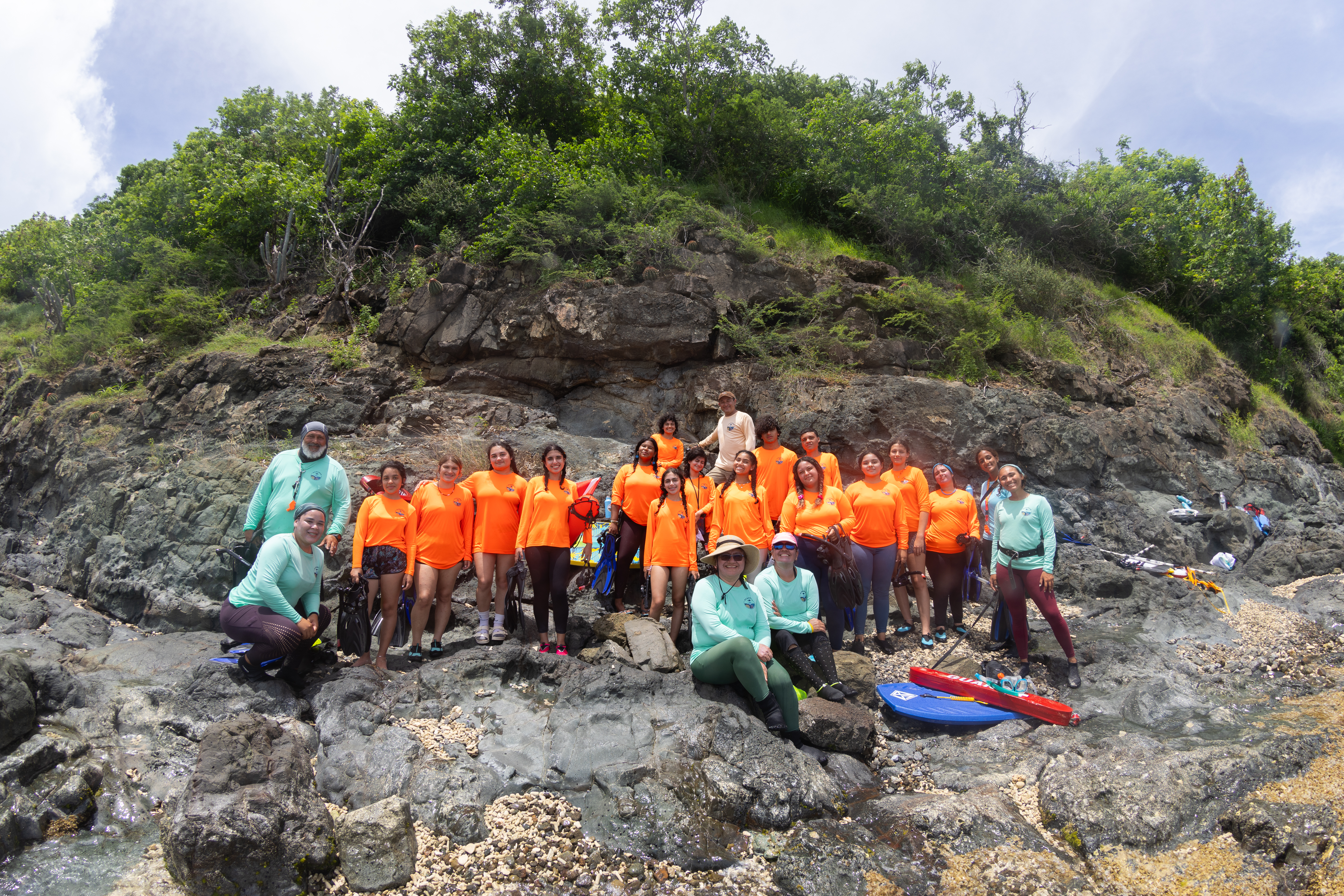
Beginning in June, the month-long program that Rodriguez and 29 other local students participated in is called the Ocean Community Engagement and Awareness using NASA Earth Observations and Science for Hispanic/Latino Students (OCEANOS). The goal of OCEANOS is twofold: to teach Puerto Rican students about marine ecology and conservation, and to train students through hands-on fieldwork how to use marine science tools to monitor the health of coral reefs.
The course included classroom instruction, scientific fieldwork, collecting and analyzing ocean data from La Parguera and Culebra Island, and a final presentation.
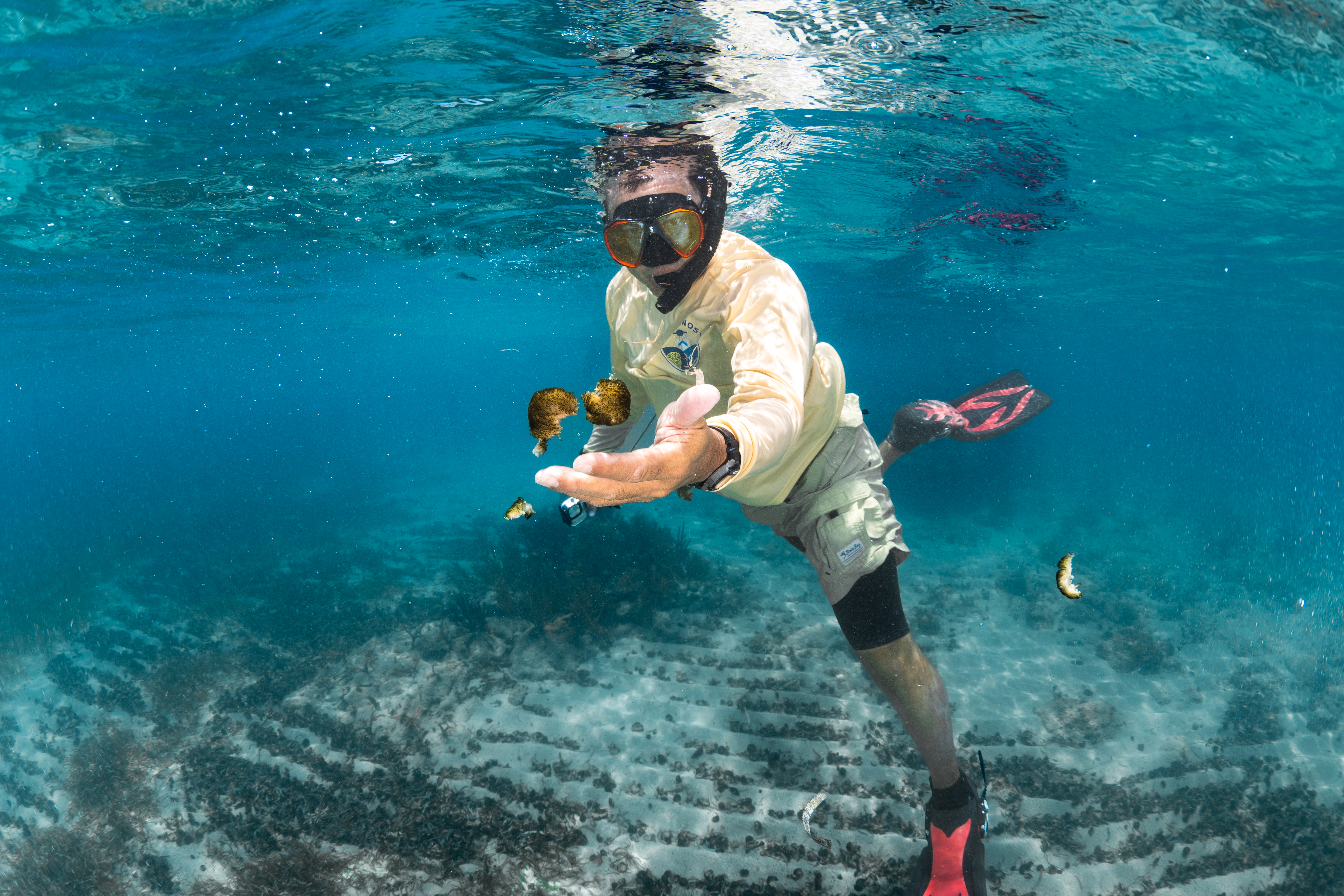
In the photo, OCEANOS instructor Samuel Suleiman shows a 3D-printed clump of staghorn coral to a group of students off the coast of Culebra. In areas where coral habitats have been damaged, conservationists use 3D-printed corals to attract and protect fish, algae, and other wildlife.
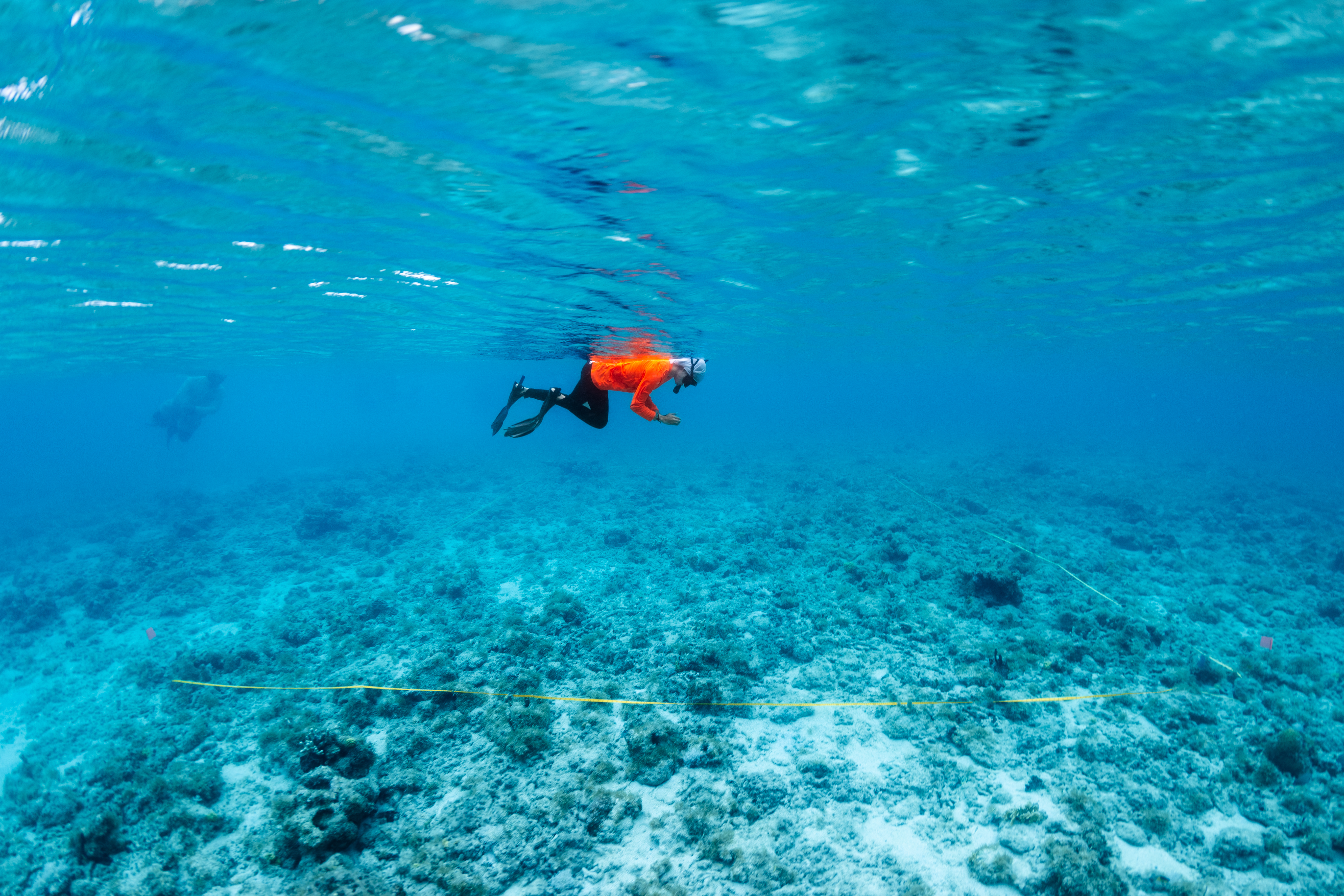
To practice coral surveying techniques and evaluate biodiversity,students used compact cameras to snap a photo every half second, recording seven-meter by seven-meter quadrants of the ocean floor. Back on land, the students stitched these images – roughly 600 images per quadrant – into high-resolution mosaics, which they then used to catalog the types and distributions of various coral species.
Low Light, Poor Water Quality, and Invasive Species Threaten Coral Reefs
Students also built their own low-cost instruments, with sensors on each end to measure temperature and light, to help assess water quality and characteristics.
The ideal temperature range for coral falls between 77- 82 degrees Fahrenheit (25-28 degrees Celsius). Water above or below this range is considered a potential stressor for coral and can impair growth. It can also increase the risk of disease, bleaching, and reproductive issues.
Coral relies on light for growth. Less light means less photosynthesis for the zooxanthellae that live inside the coral, which in turn means less food for the coral itself. Cloudy water due to excessive sediment or phytoplankton can dim or block sunlight.
Additional threats to coral include fishing equipment, boat groundings, chemical runoff, and invasive species.
In the photo above, OCEANOS instructor Juan Torres-Pérez holds two clumps of cyanobacteria, a type of bacteria that has choked a section of reef near Playa Melones. The exact cause of this excessive cyanobacteria growth is unclear, but it is likely due to land-based pollution leaching into nearby waters, he said. In the background, dark brown piles of cyanobacteria littering the ocean floor are visible.
Students Help Grow and Plant New Coral
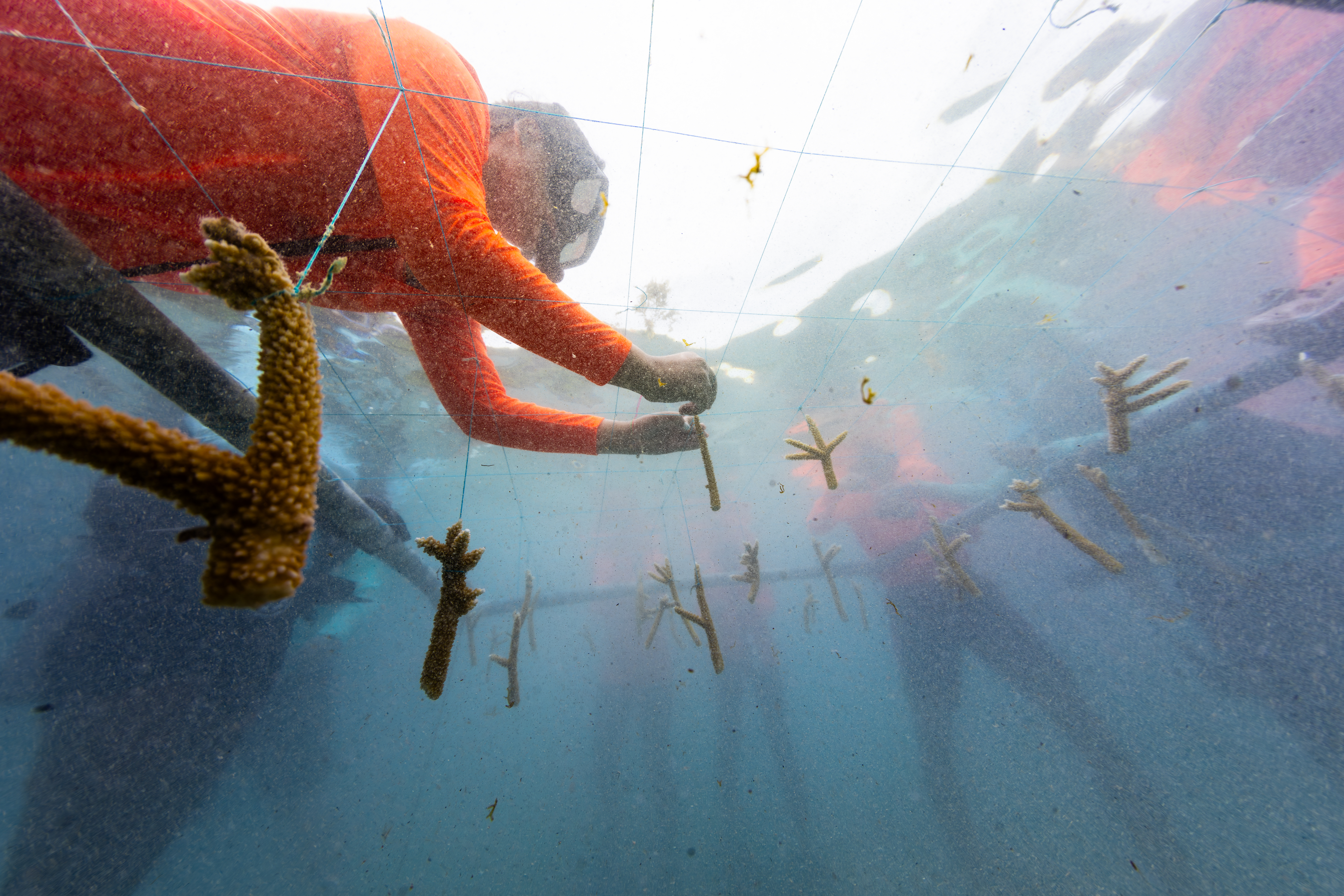
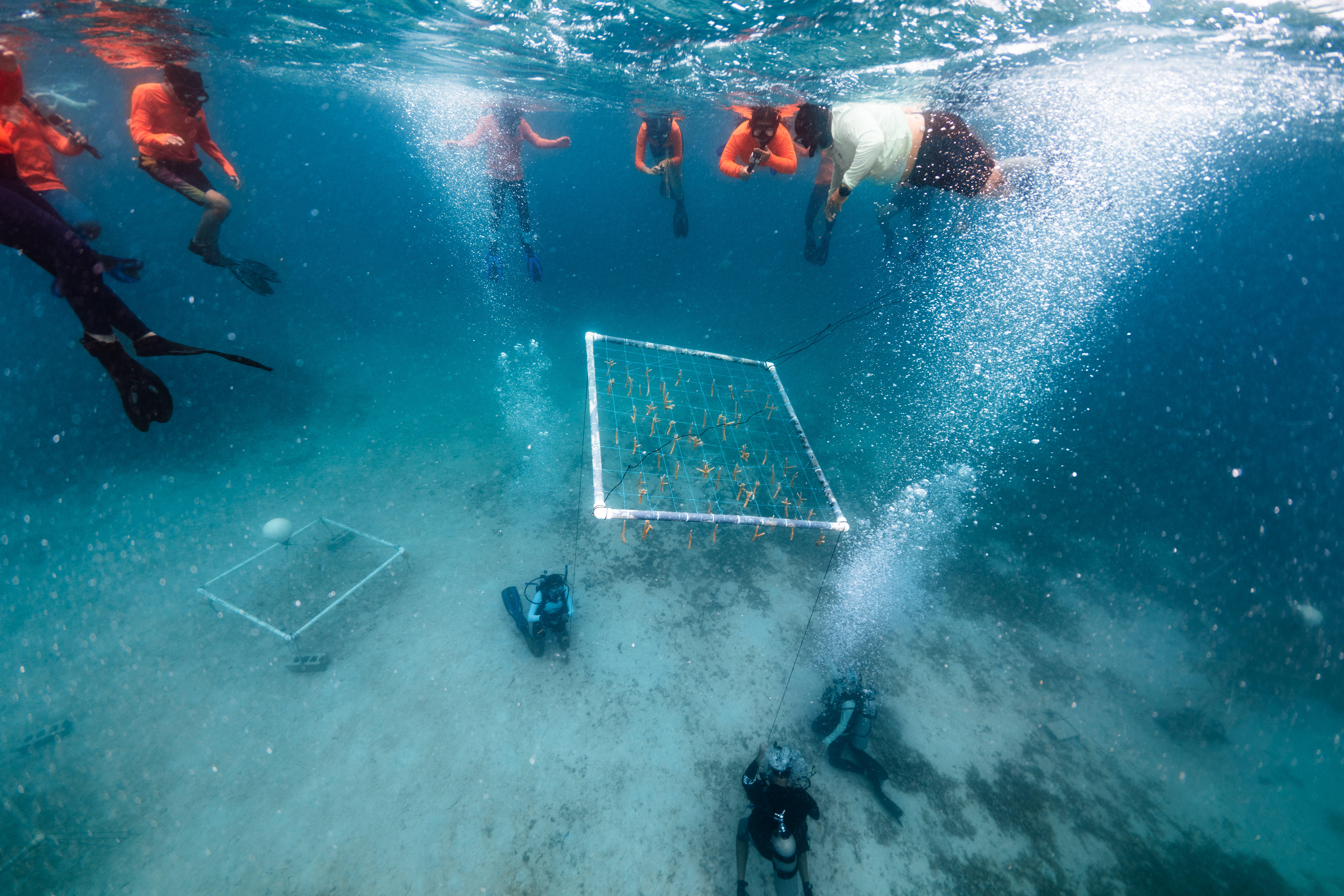
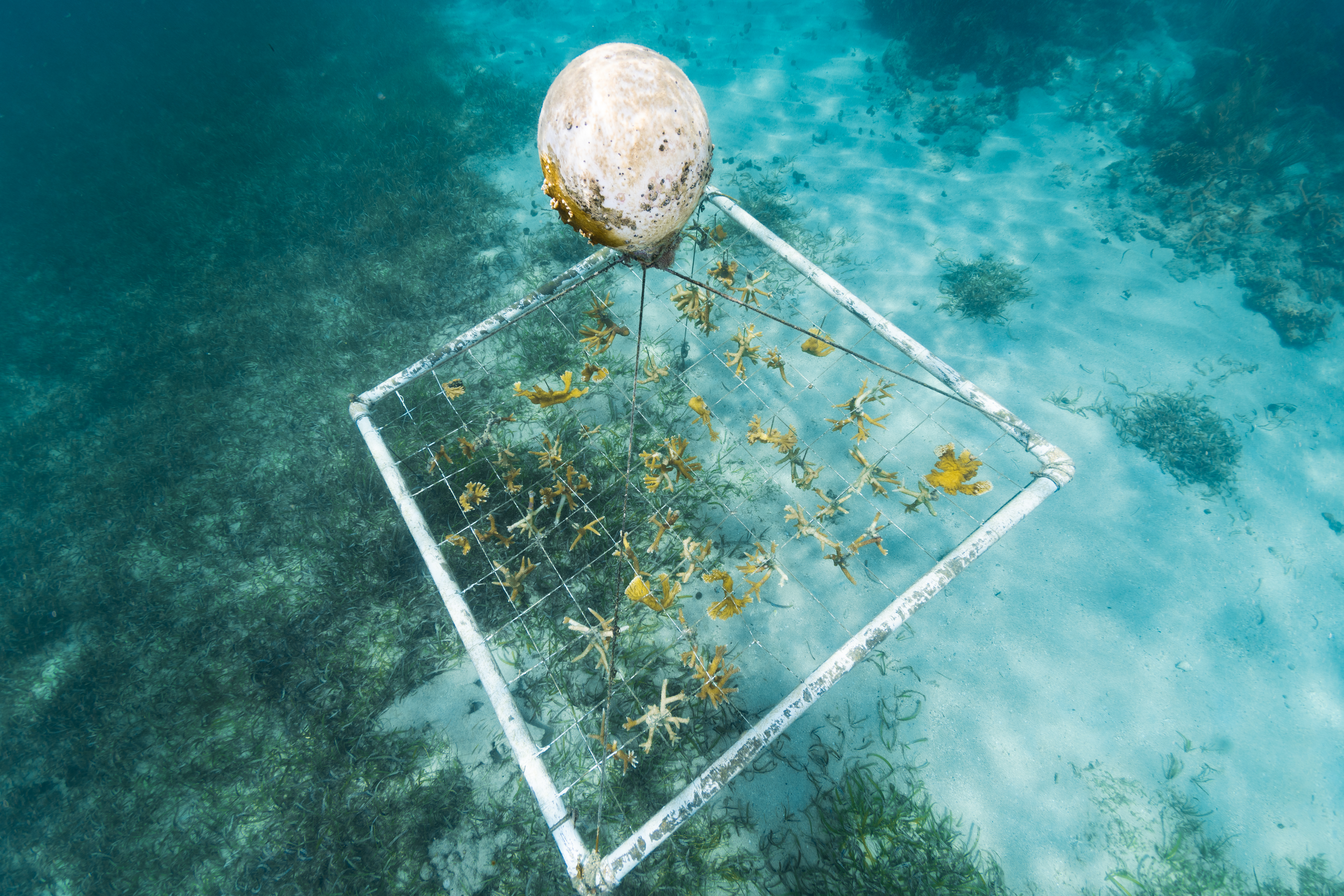
Suleiman walked students through the process of planting new coral, which involved tying loose staghorn and elkhorn corals into a square frame. Each frame holds about 100 individual pieces of coral. Suleiman leads a group called Sociedad Ambiente Marino (SAM), which has been working for more than 20 years to cultivate and plant more than 160,000 corals around Puerto Rico.
Divers anchored these frames to the ocean floor. Under ideal conditions, branching species like elkhorn and staghorn coral grow one centimeter per month, or about 12-13 centimeters per year, making them ideal candidates for coral reef restoration. By comparison, mountainous and boulder coral, also prevalent in the Caribbean Sea, grow an average of just one centimeter per year.
The frames will remain on the ocean floor for 10 to 14 months, until the corals have quadrupled in size. At any given time, SAM has about 45 of these frames in coral ‘farms’ around Culebra, totaling almost 4,500 corals.
Once the corals are ready to be planted, they will be added to various reefs to replace damaged or bleached corals, and shore up vulnerable habitats.
In the photo above, Suleiman gathers loose corals to place around an endangered coral species Dendrogyra cylindrus, more commonly referred to as Pillar Coral (front left). This underwater “garden,” as he called it, should attract fish and wildlife such as sea urchins, which will give the endangered coral — and the other species in this small reef — a better chance of survival.
A New Generation of Marine Scientists
From the 2023 OCEANOS class, roughly half of the undergraduate students went on to pursue marine science degrees, and many hope to continue with a post-graduate program. For a scientific field historically lacking diverse voices, this is a promising step.
Among the high school students in the 2023 class, three went on to change their degree plans to oceanography after participating in the OCEANOS program, while others are finding ways to incorporate marine science into their studies.
Francisco Méndez Negrón, a 2023 OCEANOS graduate, is now a computer science student at the University of Puerto Rico at Rio Piedras and wants to apply robotics to marine ecology. “My goal is to integrate computer science and oceanography to make something that can contribute to the problems marine ecosystems are facing, mostly originated by us humans,” Méndez Negrón said. He returned to the OCEANOS program to serve as a mentor for the 2024 class.
As for Tainaliz Marie Rodriguez Lugo, she managed to overcome her swim anxiety while discovering a love of the ocean. She credited the instructors who were patient, encouraging, and never left her side in the water.
“I was really scared going into this internship,” Rodríguez Lugo said. “I didn’t know how to swim, and I was starting a program literally called ‘Oceans.’ But now I love it: I could spend all day in the ocean.”
I was really scared going into this internship. I didn’t know how to swim, and I was starting a program literally called ‘Oceans.’ But now I love it: I could spend all day in the ocean.
Tainaliz Marie Rodríguez Lugo
OCEANOS 2024 Intern
When asked how she would describe coral to someone who has never seen one, Rodríguez Lugo just laughed. “I can’t. There are no words for it. I would just take them to the reefs.”
Earlier this month, nine small businesses received 2023 NASA Small Business Innovation Research (SBIR) Ignite Phase II awards to further develop technologies that may be used in the agency’s missions and in the commercial space industry.
The SBIR Ignite Phase II awardees, who will receive up to $850,000 to fund their projects, are developing technology capabilities in the detection of wildfires, support for water management in agriculture, in-space debris detection, mineral mining from lunar regolith, in-space production, and more. These capabilities are vital to supporting deep space exploration, low Earth orbit missions, and preserving life on our home planet for the benefit of all. The businesses initially were selected for Phase I awards in 2023 and provided six months and up to $150,000 to prove their concepts before competing for Phase II.
“We want to support innovators across the aerospace industry because their technologies have the potential to make a big impact in the commercial market. A rich and diverse marketplace creates more opportunity for us all. These Phase II awards illuminate a clear path for a unique range of technologies that we believe will positively influence the lives of all Americans.”
Jason L. Kessler
NASA SBIR/STTR Program Executive
The SBIR Ignite pilot initiative supports product-driven small businesses, startups, and entrepreneurs that have commercialization at the forefront of their innovation strategies and processes but that are not targeting NASA as a primary customer. The pilot initiative provides funding and other support to mitigate risk in technologies that have strong commercial potential by offering lower barriers to entry, a streamlined review and selection process, and accelerated technology development and awards as compared to the NASA SBIR program’s main solicitation. It also focuses on helping make participating companies more appealing to investors, customers, and partners, while fulfilling SBIR’s mission of increasing commercialization of innovations derived from federal research and development.
While the agency’s main Small Business Innovation Research and Small Business Technology Transfer solicitations focus on technologies with potential for infusion in both NASA missions and commercialization in the marketplace, the SBIR Ignite opportunity is less prescriptive and focuses on topics that are relevant to emerging commercial markets in aerospace, such as accelerating in-space production applications in low Earth orbit.
The awarded companies are:
Astral Forge, LLC, Palo Alto, California
Astrobotic Technology Inc., Pittsburgh
Benchmark Space Systems, Burlington, Vermont
Brayton Energy, LLC, Hampton, New Hampshire
Channel-Logistics LLC dba Space-Eyes, Miami
GeoVisual Analytics, Westminster, Colorado
Space Lab Technologies, LLC, Boulder, Colorado
Space Tango, Lexington, Kentucky
VerdeGo Aero, De Leon Springs, Florida
The third year of NASA Small Business Innovation Research (SBIR) Ignite is underway, as the 2024 SBIR Ignite Phase I solicitation closed on July 30, 2024. Those selections are expected to be announced Fall 2024.
NASA’s Small Business Innovation Research and Small Business Technology Transfer program is part of NASA’s Space Technology Mission Directorate and is managed by NASA’s Ames Research Center in Silicon Valley.
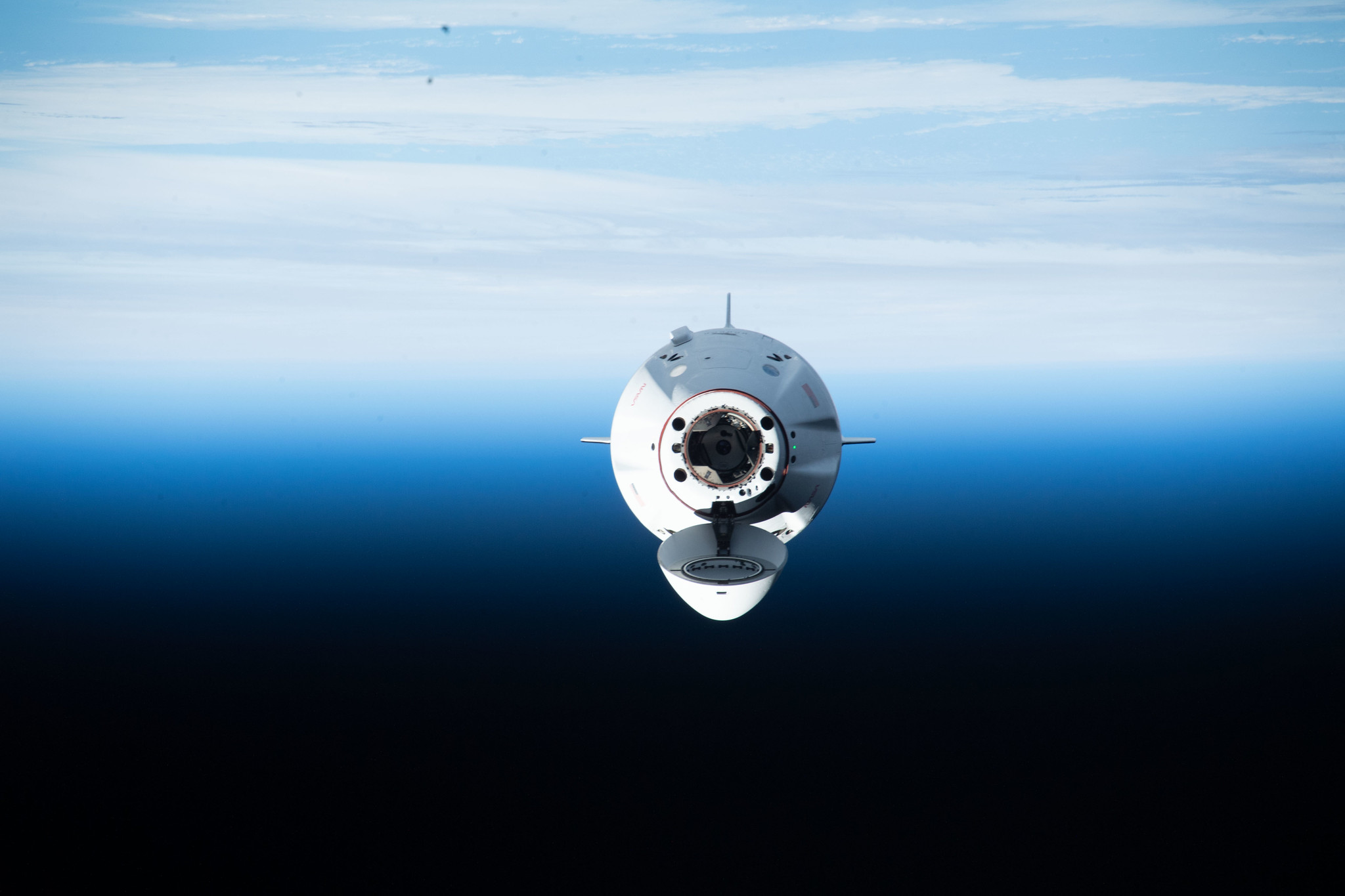
The SpaceX Dragon Endurance crew ship, carrying four Crew-5 members, approaches the International Space Station with the Earth’s horizon in the background. Credit: NASA/Kjell Lindgren
NASA is extending U.S. media accreditation for the launch of the agency’s ninth rotational mission of a SpaceX Falcon 9 rocket and Dragon spacecraft that will carry astronauts to the International Space Station. This mission is part of NASA’s Commercial Crew Program.
The application period for U.S. media and U.S. citizens representing international media organizations is extended until 11:59 p.m. EDT on Tuesday, Sept. 3. Media members who have already applied do not need to reapply. All new accreditation requests must be submitted online at:
Launch of NASA’s SpaceX Crew-9 mission, originally slated with four crew members, is targeted for no earlier than Tuesday, Sept. 24, from Space Launch Complex-40 at Cape Canaveral Space Force Station in Florida.
NASA announcedastronauts Butch Wilmore and Suni Williams will remain on station and return home in February 2025 aboard Dragon with two other crew members assigned to the Crew-9 mission, during a news conference on Aug. 24. The agency will share more information about the Crew-9 complement when details are finalized.
NASA and SpaceX currently are working on several items before launch, including reconfiguring seats on the Dragon and adjusting the manifest to carry additional cargo, personal effects, and Dragon-specific spacesuits for Wilmore and Williams.
NASA’s media accreditation policy is available online. For questions about accreditation or special logistical requests, email: ksc-media-accreditat@mail.nasa.gov. Requests for space for satellite trucks, tents, or electrical connections also are due by Sept. 3.
For other questions, please contact NASA Kennedy’s newsroom at: 321-867-2468.
Para obtener información sobre cobertura en español en el Centro Espacial Kennedy o si desea solicitar entrevistas en español, comuníquese con Antonia Jaramillo: 321-501-8425, o Messod Bendayan: 256-930-1371.
For launch coverage and more information about the mission, visit:
On Aug. 28, 2009, space shuttle Discovery began its 37th trip into space. The 17A mission to the International Space Station was the 30th shuttle flight to the orbiting lab. During the 14-day mission, the seven-member STS-128 crew worked with Expedition 20, the first six-person crew aboard the station, during nine days of docked operations. In addition to completing a one-for-one long-duration crew member exchange, they delivered more than seven tons of supplies, including three new payload racks and three systems to maintain a six-person crew aboard the space station. They completed three spacewalks to perform maintenance on the facility, prepare the station for the arrival of the next module, and retrieve two science experiments for return to Earth.
Left: The STS-128 crew patch. Middle: Official photograph of the STS-128 crew of José M. Hernández, left, Kevin A. Ford, John D. “Danny” Olivas, Nicole P. Stott, A. Christer Fuglesang of Sweden representing the European Space Agency, Frederick “Rick” W. Sturckow, and Patrick G. Forrester. Right: The 17A mission patch.
The seven-person STS-128 crew consisted of Commander Frederick “Rick” W. Sturckow, Pilot Kevin A. Ford, and Mission Specialists Patrick G. Forrester, José M. Hernández, John D. “Danny” Olivas, and A. Christer Fuglesang of Sweden representing the European Space Agency (ESA), and Nicole P. Stott. Primary objectives of the mission included the launch to the station of facilities required to maintain a permanent six-person crew and the exchange of Stott for Timothy L. Kopra who had been aboard the space station since July 2009 as a member of Expedition 20. The facilities, launched inside the Leonardo Multi-Purpose Logistics Module (MPLM), included an additional Crew Quarters, the T2 COLBERT treadmill, and an Air Revitalization System rack. Three payload racks – the Materials Science Research Rack, the Fluids Integrated Rack, and the second Minus Eighty-degree Laboratory Freezer for ISS – also rode inside the MPLM for transfer to the station to expand its research capabilities.
Left: The STS-128 crew at the conclusion of the Terminal Countdown Demonstration Test at NASA’s Kennedy Space Center in Florida. Middle: Space shuttle Discovery during the rollout to Launch Pad 39A. Right: The Leonardo Multi-Purpose Logistics Module in Discovery’s payload bay at Launch Pad 39A.
Discovery returned from its previous mission, STS-119, on March 28, 2009, and workers towed it to the Orbiter Processing Facility at NASA’s Kennedy Space Center (KSC). The orbiter rolled over to the Vehicle Assembly Building on July 26, and after mating with its external tank and twin solid rocket boosters, rolled out to Launch Pad 39A on Aug. 4, targeting Aug. 25 for launch. Three days later, the seven-member crew participated in the Terminal Countdown Demonstration Test, essentially a dress rehearsal of the actual countdown for launch, returned to Houston for final training. They arrived at KSC on Aug 19 to prepare for launch.
Left: Liftoff of space shuttle Discovery on STS-128. Right: Discovery streaks into the night sky.
Clouds and lighting in the launch area forced a scrub of the first launch attempt on Aug. 25, while a faulty valve indicator scrubbed the next day’s attempt. On Aug. 28, at 11:59 p.m. EDT, space shuttle Discovery lifted off from Launch Pad 39A to begin its 37th trip into space, carrying its seven-member crew on the 17A space station outfitting and resupply mission. Eight and a half minutes later, Discovery and its crew had reached orbit. This marked Sturckow’s fourth time in space, Forrester’s third, Olivas’ and Fuglesang’s second, while Ford, Hernández, and Stott enjoyed their first taste of weightlessness.
First time space flyers Kevin A. Ford, left, José M. Hernández, and Nicole P. Stott enjoying the first few minutes of weightlessness shortly after reaching orbit.
After reaching orbit, the crew opened the payload bay doors and deployed the shuttle’s radiators, and removed their bulky launch and entry suits, stowing them for the remainder of the flight. The astronauts spent five hours on their second day in space conducting a detailed inspection of Discovery’s nose cap and wing leading edges, with Ford, Forrester, and Hernández taking turns operating the Shuttle Remote Manipulator System (SRMS), or robotic arm, and the Orbiter Boom Sensor System (OBSS).
Left: Frederick “Rick” W. Sturckow, left, and Kevin A. Ford perform maneuvers for the rendezvous with the space station. Middle: Discovery as seen from the space station during the rendezvous. Right: The space station as seen from Discovery during the rendezvous.
On the mission’s third day, Sturckow assisted by his crewmates brought Discovery in for a docking with the space station. The docking occurred on the 25th anniversary of Discovery’s first launch on the STS-41D mission on Aug. 30, 1984. During the rendezvous, Sturckow stopped the approach at 600 feet and completed the Rendezvous Pitch Maneuver so astronauts aboard the station could photograph Discovery’s underside to look for any damage to the tiles. Shortly after docking, the crews opened the hatches between the two spacecraft and the six-person station crew welcomed the seven-member shuttle crew. After exchanging Soyuz spacesuits and seat liners, Stott joined the Expedition 20 crew and Kopra the STS-128 crew.
Left: Transfer of Timothy L. Kopra’s Soyuz seat liner and spacesuit from the space station to the space shuttle makes him an STS-128 crew member for return to Earth. Middle:Kevin A. Ford, left, and Michael R. Barratt operate the station’s robotic arm to transfer the Leonardo Multi-Purpose Logistics Module (MPLM) from the shuttle payload bay to the space station. Right: The MPLM approaches the Node 2 nadir berthing port.
Left: Frank DeWinne, left, and A. Christer Fuglesang, both of the European Space Agency, open the hatch to the Leonardo Multi-Purpose Logistics Module. Middle: José M. Hernández inside the MPLM to monitor transfer operations. Right: DeWinne, left, and Fuglesang begin the transfer of the T2 COLBERT treadmill from the MPLM to the space station.
The day after docking, Ford and Expedition 20 Flight Engineer Michael R. Barrrat used the space station’s robotic arm to grapple the MPLM in the shuttle’s payload bay. They transferred it to the station, berthing it at the Harmony Node 2 module’s nadir port. The crew activated the MPLM and Fuglesang and Expedition 20 Commander Frank L. DeWinne of Belgium representing ESA opened the hatches, enabling the start of cargo transfers.
Left: During the first spacewalk, John D. “Danny” Olivas, left, and Nicole P. Stott remove the EuTEF experiment from the Columbus module. Middle left: Stott rides the station robotic arm carrying the EuTEF experiment, with the removed Ammonia Tank Assembly attached to it. Middle right: An open MISSE container showing the various exposure samples. Right: Stott carrying one of the two closed MISSE containers.
During the mission’s first spacewalk on flight day five, Olivas and Stott first removed a used Ammonia Tank Assembly (ATA) from the P1 truss segment. With Ford and Expedition 20 Flight Engineer Robert B. Thirsk of the Canadian Space Agency operating the space station’s robotic arm, they moved Stott to the end of the Columbus module, where she and Olivas removed the European Technology Exposure Facility (EuTEF) science payload. Ford and Thirsk translated Stott to the shuttle’s payload bay where she and Olivas stowed it for return to Earth. The pair returned to Columbus to close and retrieve the two Materials on International Space Station Experiments (MISSE) and stowed them in the payload bay for return. This first spacewalk lasted 6 hours 35 minutes. Meanwhile, other crew members busied themselves with transferring racks and cargo from the MPLM to the space station.
Left: A. Christer Fugelsang of the European Space Agency shows off his installation of the Air Revitalization System rack in the Kibo module. Middle: Patrick G. Forrester with three bags during cargo transfer operations. Right: During handover operations, outgoing space station crew member Timothy L. Kopra, middle, shows incoming crew member Nicole P. Stott how to give a proper haircut in space.
Left: Frederick “Rick” W. Sturckow, left, and Patrick G. Forrester seen through an overhead window. Middle: During the mission’s second spacewalk, A. Christer Fuglesang carries both the old and the new Ammonia Tank Assemblies (ATA) on the end of the space station robotic arm. Right: Fuglesang stowing the old ATA in the shuttle’s payload bay.
Cargo transfers continued throughout flight day six, including the three payload racks. On flight day seven, Olivas and Fuglesang conducted the mission’s second spacewalk, lasting 6 hours 39 minutes. They completed the swap out of the ATA, with Fuglesang riding the station arm carrying both the old and the new units, before they installed the new unit on the P1 truss, and then returned with the old unit to stow it in the payload bay.
Left: John D. “Danny” Olivas works in the shuttle’s payload bay during the mission’s third spacewalk. Right: Olivas, left, and A. Christer Fuglesang work on the space station truss.
With cargo transfers continuing on flight day eight, the next day Olivas and Fuglesang stepped outside for the mission’s third and final spacewalk. They completed a variety of tasks, including routing cables to accommodate the Tranquility Node 3 module scheduled to arrive on a future space shuttle flight, and installing GPS antennas on the S0 truss. This spacewalk lasted 7 hours 1 minute, bringing the total spacewalking time for STS-128 to 20 hours 15 minutes. The crew enjoyed a well-deserved off-duty day on flight day 10.
Left: Astronauts robotically stow the Leonardo Multi-Purpose Logistics Module (MPLM) back in Discovery’s payload bay. Right: A. Christer Fuglesang, left, and Nicole P. Stott operate the space station’s robotic arm to stow the MPLM in the payload bay.
The astronauts completed the final transfers on Sept. 8, the mission’s 11th flight day, they deactivated the MPLM, and closed its hatch. Operating the space station’s robotic arm, Stott and Fuglesang transferred the MPLM from the station back to the shuttle’s payload bay. On Sept. 10, the next vehicle to occupy that port, the Japanese H-II Transfer Vehicle-1 (HTV-1), launched from the Tanegashima Space Center, arriving at the station one week later.
Left: The 13 members of Expedition 20, blue shirts, and STS-128, red shirts, pose for a final photograph before saying their farewells. Right: Four members of the astronaut class of 2000 in space together.
Left: Kevin A. Ford pilots Discovery for the undocking and flyaround. Right: The space station seen from Discovery during the flyaround.
That same day, they held a brief farewell ceremony, parted company, and closed the hatches between the two spacecraft. The next day, with Ford at the controls, Discovery undocked from the space station, having spent nine days as a single spacecraft. Ford completed a flyaround of the station, with the astronauts photographing it to document its condition. A final separation burn sent Discovery on its way. Ford, Forrester, and Hernández used the shuttle’s arm to pick up the OBSS and perform a late inspection of Discovery’s thermal protection system. On flight day 13, Sturckow and Ford tested Discovery’s reaction control system thrusters and flight control surfaces in preparation for the next day’s entry and landing. The entire crew busied themselves with stowing all unneeded equipment. Bad weather at KSC delayed the landing by a day, and more bad weather diverted the landing to Edwards Air Force Base in California.
Left: Discovery touches down at Edwards Air Force Base in California. Middle: The Crew Transport Vehicle has approached Discovery to enable the astronauts to exit the vehicle. Right: Discovery atop its Shuttle Carrier Aircraft departs Edwards for NASA’s Kennedy Space Center in Florida.
Left: Six of the STS-128 astronauts pose with Discovery on the runway at Edwards Air Force Base in California. Right: The welcome home ceremony for the STS-128 crew at Ellington Field in Houston.
On Sept. 11, the astronauts closed Discovery’s payload bay doors, donned their launch and entry suits, and strapped themselves into their seats, a special recumbent one for Kopra who had spent the last two months in weightlessness. Sturckow fired Discovery’s two Orbital Maneuvering System engines to bring them out of orbit and head for a landing half an orbit later. He guided Discovery to a smooth touchdown at Edwards, as it turned out the final space shuttle landing at the California facility. The landing capped off a very successful STS-128 mission of 13 days, 20 hours, 54 minutes. They orbited the planet 219 times. Kopra spent 58 days, 2 hours, 50 minutes in space, completing 920 orbits of the Earth. Workers placed Discovery atop a Shuttle Carrier Aircraft, a modified Boeing 747, to ferry it back to KSC where it landed on Sept. 21. Engineers began preparing it for its next flight, STS-131 in April 2010.
Enjoy the crew narrate a video about the STS-128 mission.
Preparations for Next Moonwalk Simulations Underway (and Underwater)
A mirror that was later installed inside the telescope for NASA’s Near-Earth Object Surveyor shows a reflection of principal optical engineer Brian Monacelli during an inspection of the mirror’s surface at the agency’s Jet Propulsion Laboratory on July 17.
NASA/JPL-Caltech
A technician operates articulating equipment to rotate NEO Surveyor’s aluminum optical bench — part of the spacecraft’s telescope — in a clean room at NASA’s Jet Propulsion Laboratory in Southern California on July 17.
NASA/JPL-Caltech
The mirrors for NASA’s Near-Earth Object Surveyor space telescope are being installed and aligned, and work on other spacecraft components is accelerating.
NASA’s new asteroid-hunting spacecraft is taking shape at NASA’s Jet Propulsion Laboratory in Southern California. Called NEO Surveyor (Near-Earth Object Surveyor), this cutting-edge infrared space telescope will seek out the hardest-to-find asteroids and comets that might pose a hazard to our planet. In fact, it is the agency’s first space telescope designed specifically for planetary defense.
Targeting launch in late 2027, the spacecraft will travel a million miles to a region of gravitational stability — called the L1 Lagrange point — between Earth and the Sun. From there, its large sunshade will block the glare and heat of sunlight, allowing the mission to discover and track near-Earth objects as they approach Earth from the direction of the Sun, which is difficult for other observatories to do. The space telescope also may reveal asteroids called Earth Trojans, which lead and trail our planet’s orbit and are difficult to see from the ground or from Earth orbit.
NEO Surveyor relies on cutting-edge detectors that observe two bands of infrared light, which is invisible to the human eye. Near-Earth objects, no matter how dark, glow brightly in infrared as the Sun heats them. Because of this, the telescope will be able to find dark asteroids and comets, which don’t reflect much visible light. It also will measure those objects, a challenging task for visible-light telescopes that have a hard time distinguishing between small, highly reflective objects and large, dark ones.
This artist’s concept depicts NASA’s NEO Surveyor in deep space. The black-paneled angular structure in the belly of the spacecraft is the instrument enclosure that is being built at JPL. The mission’s infrared telescope will be installed inside the enclosure.
NASA/JPL-Caltech
“NEO Surveyor is optimized to help us to do one specific thing: enable humanity to find the most hazardous asteroids and comets far enough in advance so we can do something about them,” said Amy Mainzer, principal investigator for NEO Surveyor and a professor at the University of California, Los Angeles. “We aim to build a spacecraft that can find, track, and characterize the objects with the greatest chance of hitting Earth. In the process, we will learn a lot about their origins and evolution.”
Coming Into Focus
The spacecraft’s only instrument is its telescope. About the size of a washer-and-dryer set, the telescope’s blocky aluminum body, called the optical bench, was built in a JPL clean room. Known as a three-mirror anastigmat telescope, it will rely on curved mirrors to focus light onto its infrared detectors in such a way that minimizes optical aberrations.
“We have been carefully managing the fabrication of the spacecraft’s telescope mirrors, all of which were received in the JPL clean room by July,” said Brian Monacelli, principal optical engineer at JPL. “Its mirrors were shaped and polished from solid aluminum using a diamond-turning machine. Each exceeds the mission’s performance requirements.”
Monacelli inspected the mirror surfaces for debris and damage, then JPL’s team of optomechanical technicians and engineers attached the mirrors to the telescope’s optical bench in August. Next, they will measure the telescope’s performance and align its mirrors.
Complementing the mirror assembly are the telescope’s mercury-cadmium-telluride detectors, which are similar to the detectors used by NASA’s recently retired NEOWISE (short for Near-Earth Object Wide-field Infrared Survey Explorer) mission. An advantage of these detectors is that they don’t necessarily require cryogenic coolers or cryogens to lower their operational temperatures in order to detect infrared wavelengths. Cryocoolers and cryogens can limit the lifespan of a spacecraft. NEO Surveyor will instead keep its cool by using its large sunshade to block sunlight from heating the telescope and by occupying an orbit beyond that of the Moon, minimizing heating from Earth.
The telescope will eventually be installed inside the spacecraft’s instrument enclosure, which is being assembled in JPL’s historic High Bay 1 clean room where NASA missions such as Voyager, Cassini, and Perseverance were constructed. Fabricated from dark composite material that allows heat to escape, the enclosure will help keep the telescope cool and prevent its own heat from obscuring observations.
Once it is completed in coming weeks, the enclosure will be tested to make sure it can withstand the rigors of space exploration. Then it will be mounted on the back of the sunshade and atop the electronic systems that will power and control the spacecraft.
“The entire team has been working hard for a long time to get to this point, and we are excited to see the hardware coming together with contributions from our institutional and industrial collaborators from across the country,” said Tom Hoffman, NEO Surveyor’s project manager at JPL. “From the panels and cables for the instrument enclosure to the detectors and mirrors for the telescope — as well as components to build the spacecraft — hardware is being fabricated, delivered, and assembled to build this incredible observatory.”
Assembly of NEO Surveyor can be viewed 24 hours a day, seven days a week, via JPL’s live cam.
More About NEO Surveyor
The NEO Surveyor mission marks a major step for NASA toward reaching its U.S. Congress-mandated goal to discover and characterize at least 90% of the near-Earth objects more than 460 feet (140 meters) across that come within 30 million miles (48 million kilometers) of our planet’s orbit. Objects of this size can cause significant regional damage, or worse, should they impact the Earth.
The mission is tasked by NASA’s Planetary Science Division within the Science Mission Directorate; program oversight is provided by the Planetary Defense Coordination Office, which was established in 2016 to manage the agency’s ongoing efforts in planetary defense. NASA’s Planetary Missions Program Office at the agency’s Marshall Space Flight Center provides program management for NEO Surveyor.
The project is being developed by JPL and is led by principal investigator Amy Mainzer at UCLA. Established aerospace and engineering companies have been contracted to build the spacecraft and its instrumentation, including BAE Systems, Space Dynamics Laboratory, and Teledyne. The Laboratory for Atmospheric and Space Physics at the University of Colorado, Boulder will support operations, and IPAC-Caltech in Pasadena, California, is responsible for processing survey data and producing the mission’s data products. Caltech manages JPL for NASA.
More information about NEO Surveyor is available at:
NASA is preparing space at the agency’s Kennedy Space Center in Florida for upcoming assembly activities of the SLS (Space Launch System) rocket core stage for future Artemis missions, beginning with Artemis III.
Teams are currently outfitting the assembly building’s High Bay 2 for future vertical assembly of the rocket stage that will help power NASA’s Artemis campaign to the Moon. During Apollo, High Bay 2, one of four high bays inside the Vehicle Assembly Building, was used to stack the Saturn V rocket. During the Space Shuttle Program, the high bay was used for external tank checkout and storage and as a contingency storage area for the shuttle.
Technicians are building tooling in High Bay 2 at NASA Kennedy that will allow NASA and Boeing, the SLS core stage lead contractor, to vertically integrate the core stage.
NASA
Michigan-based Futuramic is constructing the tooling that will hold the core stage in a vertical position, allowing NASA and Boeing, the SLS core stage lead contractor, to integrate the SLS rocket’s engine section and four RS-25 engines to finish assembly of the rocket stage. Vertical integration will streamline final production efforts, offering technicians 360-degree access to the stage both internally and externally.
“The High Bay 2 area at NASA Kennedy is critical for work as SLS transitions from a developmental to operational model,” said Chad Bryant, deputy manager of the SLS Stages Office. “While teams are stacking and preparing the SLS rocket for launch of one Artemis mission, the SLS core stage for another Artemis mission will be taking shape just across the aisleway.”
Under the new assembly model beginning with Artemis III, all the major structures for the SLS core stage will continue to be fully produced and manufactured at NASA’s Michoud Assembly Facility in New Orleans. Upon completion of manufacturing and thermal protection system application, the engine section will be shipped to NASA Kennedy for final outfitting. Later, the top sections of the core stage – the forward skirt, intertank, liquid oxygen tank, and liquid hydrogen tank – will be outfitted and joined at NASA Michoud and shipped to NASA Kennedy for final assembly.
The fully assembled core stage for Artemis II arrived at Kennedy on July 23. NASA’s Pegasus barge delivered the SLS engine section for Artemis III to Kennedy in December 2022. Teams at NASA Michoud are outfitting the remaining core stage elements and preparing to horizontally join them. The four RS-25 engines for the Artemis III mission are complete at NASA’s Stennis Space Center in Bay St. Louis, Mississippi, and will be transported to NASA Kennedy in 2025. Major core stage and exploration upper stage structures are in work at NASA Michoud for Artemis IV and beyond.
NASA is working to land the first woman, first person of color, and its first international partner astronaut on the Moon under Artemis. SLS is part of NASA’s backbone for deep space exploration, along with the Orion spacecraft, supporting ground systems, advanced spacesuits and rovers, the Gateway in orbit around the Moon, and commercial human landing systems. SLS is the only rocket that can send Orion, astronauts, and supplies to the Moon in a single launch.
News Media Contact
Jonathan Deal Marshall Space Flight Center Huntsville, Ala. 256-544-0034
This website uses cookies to improve your experience. We'll assume you're ok with this, but you can opt-out if you wish.AcceptRead More
Privacy & Cookies Policy
Privacy Overview
This website uses cookies to improve your experience while you navigate through the website. Out of these, the cookies that are categorized as necessary are stored on your browser as they are essential for the working of basic functionalities of the website. We also use third-party cookies that help us analyze and understand how you use this website. These cookies will be stored in your browser only with your consent. You also have the option to opt-out of these cookies. But opting out of some of these cookies may affect your browsing experience.
Necessary cookies are absolutely essential for the website to function properly. This category only includes cookies that ensures basic functionalities and security features of the website. These cookies do not store any personal information.
Any cookies that may not be particularly necessary for the website to function and is used specifically to collect user personal data via analytics, ads, other embedded contents are termed as non-necessary cookies. It is mandatory to procure user consent prior to running these cookies on your website.