Category: Kepler

http://www.nasa.gov/mission_pages/kepler/news/kepler-newsandfeatures-RSS.rss

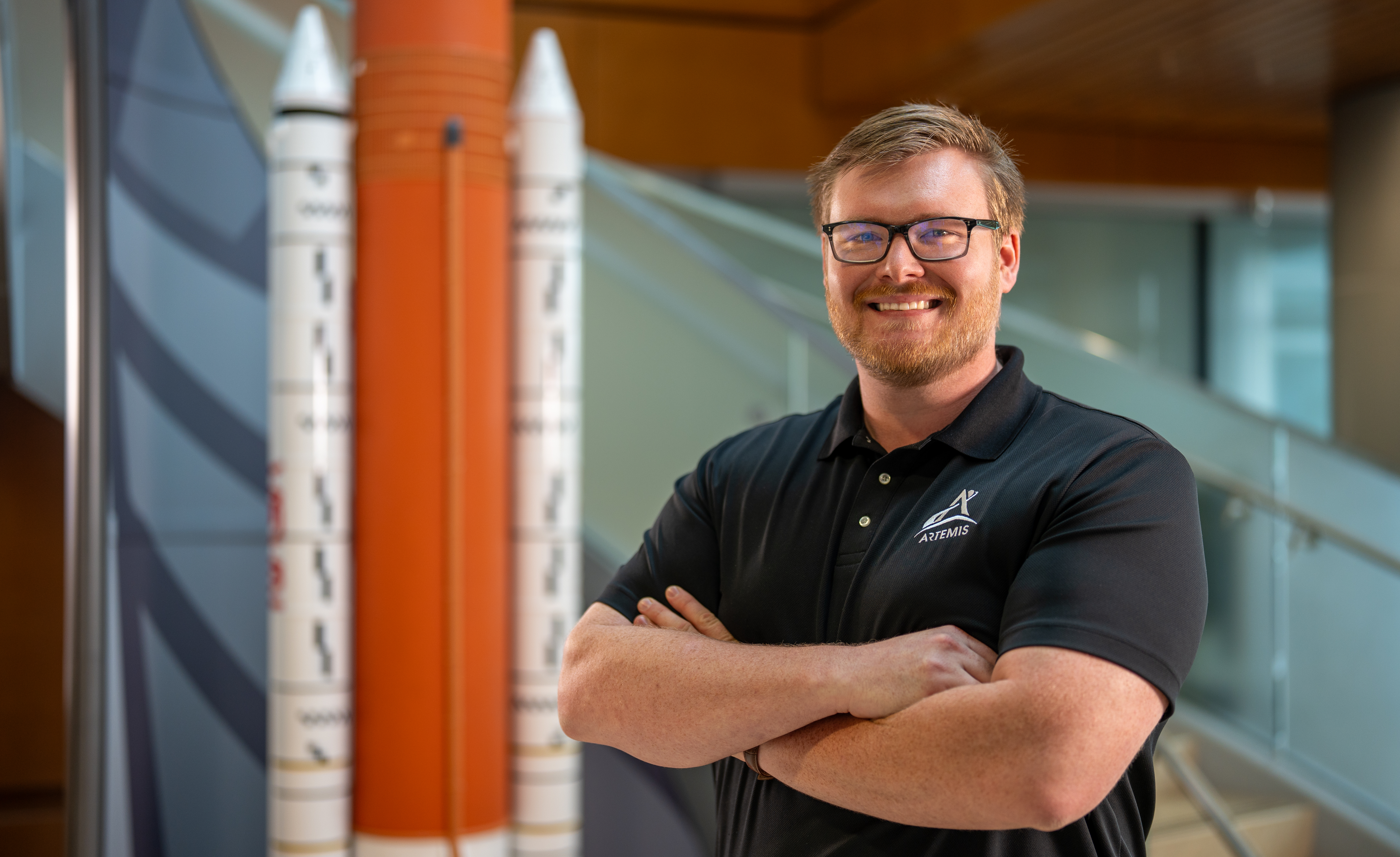
  • I Am Artemis: Patrick Junen

    Patrick Junen stands beside a model of the Space Launch System.
    NASA

    For some people, a passion for space is something that might develop over time, but for Patrick Junen, the desire was there from the beginning. With a father and grandfather who both worked for NASA, space exploration is not just a dream; it remains a family legacy.

    Now, as the stage assembly and structures subsystem manager at NASA’s Marshall Space Flight Center in Huntsville, Alabama, for the BOLE (Booster Obsolescence Life Extension) Program — an advanced solid rocket booster for NASA’s SLS (Space Launch System) heavy lift rocket — Junen is continuing that legacy.

    “My grandfather worked on the Apollo & Space Shuttle Programs. Then my dad went on to work for the Space Shuttle and SLS Programs,” Junen says. “I guess you could say engineering is in my blood.”

    In his role, he’s responsible for managing the Design, Development, Test, & Evaluation team for all unpressurized structural elements, such as the forward skirt, aft skirt, and the integration hardware that connects the boosters to the core stage. He also collaborates closely with NASA’s Exploration Ground Systems at Kennedy Space Center in Florida to coordinate any necessary modifications to ground facilities or the mobile launcher to support the new boosters.

    Junen enjoys the technical challenges of his role and said he feels fortunate to be in a position of leadership — but it takes a team of talented individuals to build the next generation of boosters. As a former offensive lineman for the University of Mississippi, he knows firsthand the power of teamwork and the importance of effective communication in guiding a coordinated effort.

    “I’ve always been drawn to team activities, and exploration is the ultimate team endeavor,” Junen says. “On the football field, it takes a strong team to be successful — and it’s really no different from what we’re doing as a team at NASA with our Northrop Grumman counterparts for the SLS rocket and Artemis missions.”

    As a kid, Junen often accompanied his dad to Space Shuttle launches and was inspired by some of the talented engineers that developed Shuttle. Years later, he’s still seeing some of those same faces — but now they’re teammates, working together toward a greater mission.

    “Growing up around Marshall Space Flight Center in Huntsville, Alabama, there was always this strong sense of family and dedication to the Misson. And that has always resonated with me,” Junen recalls.

    This philosophy of connecting family to the mission is a tradition Junen now continues with his own children. One of his fondest NASA memories is watching the successful launch of Artemis I on Nov. 16, 2022. Although he couldn’t attend in person, Junen and his family made the most of the moment — watching the launch live beneath the Saturn V rocket at Huntsville’s U.S. Space & Rocket Center. With his dad beside him and his daughter on his shoulders, three generations stood beneath the rocket Junen’s grandfather helped build, as a new era of space exploration began.

    In June, Junen witnessed the BOLE Demonstration Motor-1 perform a full-scale static test to demonstrate the ballistic performance for the evolved booster motor. This test isn’t just a technical milestone for Junen — it’s a continuation of a lifelong journey rooted in family and teamwork.

    As NASA explores the Moon and prepares for the journey to Mars through Artemis, Junen is helping shape the next chapter of human spaceflight. And just like the generations before him, he’s not only building rockets — he’s building a legacy.

    News Media Contact

    Jonathan Deal
    Marshall Space Flight Center, Huntsville, Ala. 
    256-544-0034 
    jonathan.e.deal@nasa.gov

  • Sparkling Andromeda

    A rosy pink spiral galaxy is positioned diagonally in this picture. The flat disk shape has spiraling arms, and at center, a bright core. All over the image are other galaxies that look like specks of multicolored glitter.
    X-ray: NASA/CXO/UMass/Z. Li & Q.D. Wang, ESA/XMM-Newton; Infrared: NASA/JPL-Caltech/WISE, Spitzer, NASA/JPL-Caltech/K. Gordon (U. Az), ESA/Herschel, ESA/Planck, NASA/IRAS, NASA/COBE; Radio: NSF/GBT/WSRT/IRAM/C. Clark (STScI); Ultraviolet: NASA/JPL-Caltech/GALEX; Optical: Andromeda, Unexpected © Marcel Drechsler, Xavier Strottner, Yann Sainty & J. Sahner, T. Kottary. Composite image processing: L. Frattare, K. Arcand, J.Major

    The Andromeda galaxy, also known as Messier 31 (M31), is a glittering beacon in this image released on June 25, 2025, in tribute to the groundbreaking legacy of astronomer Dr. Vera Rubin, whose observations transformed our understanding of the universe. In the 1960s, Rubin and her colleagues studied M31 and determined that there was some unseen matter in the galaxy that was affecting how the galaxy and its spiral arms rotated. This unknown material was named “dark matter.”

    M31 is the closest spiral galaxy to the Milky Way at a distance of about 2.5 million light-years. Astronomers use Andromeda to understand the structure and evolution of our own spiral, which is much harder to do since Earth is embedded inside the Milky Way.

    Learn more about this image and experience in sound, too.

    Image credit: X-ray: NASA/CXO/UMass/Z. Li & Q.D. Wang, ESA/XMM-Newton; Infrared: NASA/JPL-Caltech/WISE, Spitzer, NASA/JPL-Caltech/K. Gordon (U. Az), ESA/Herschel, ESA/Planck, NASA/IRAS, NASA/COBE; Radio: NSF/GBT/WSRT/IRAM/C. Clark (STScI); Ultraviolet: NASA/JPL-Caltech/GALEX; Optical: Andromeda, Unexpected © Marcel Drechsler, Xavier Strottner, Yann Sainty & J. Sahner, T. Kottary. Composite image processing: L. Frattare, K. Arcand, J.Major

  • NASA’s Chandra Shares a New View of Our Galactic Neighbor

    6 Min Read

    NASA’s Chandra Shares a New View of Our Galactic Neighbor

    The Andromeda Galaxy (M31) in Different Types of Light.

    The Andromeda galaxy, also known as Messier 31 (M31), is the closest spiral galaxy to the Milky Way at a distance of about 2.5 million light-years. Astronomers use Andromeda to understand the structure and evolution of our own spiral, which is much harder to do since Earth is embedded inside the Milky Way.

    The galaxy M31 has played an important role in many aspects of astrophysics, but particularly in the discovery of dark matter. In the 1960s, astronomer Vera Rubin and her colleagues studied M31 and determined that there was some unseen matter in the galaxy that was affecting how the galaxy and its spiral arms rotated. This unknown material was named “dark matter.” Its nature remains one of the biggest open questions in astrophysics today, one which NASA’s upcoming Nancy Grace Roman Space Telescope is designed to help answer.

    Astronomers study Andromeda (Messier 31, or M31) to understand the structure and evolution of our own spiral galaxy, the Milky Way. This new composite image contains data of M31 includes X-rays from Chandra and XMM-Newton, ultraviolet data from GALEX, optical data from astrophotographers using ground-based telescopes, infrared data from Spitzer, IRAS, COBE, Planck and Herschel, and radio data from the Westerbork Synthesis Radio Telescope. Each type of light reveals new information about this close galactic relative to the Milky Way.
    X-ray: NASA/CXO/UMass/Z. Li & Q.D. Wang, ESA/XMM-Newton; Infrared: NASA/JPL-Caltech/WISE, Spitzer, NASA/JPL-Caltech/K. Gordon (U. Az), ESA/Herschel, ESA/Planck, NASA/IRAS, NASA/COBE; Radio: NSF/GBT/WSRT/IRAM/C. Clark (STScI); Ultraviolet: NASA/JPL-Caltech/GALEX; Optical: Andromeda, Unexpected © Marcel Drechsler, Xavier Strottner, Yann Sainty & J. Sahner, T. Kottary. Composite image processing: L. Frattare, K. Arcand, J.Major

    This new composite image contains data of M31 taken by some of the world’s most powerful telescopes in different kinds of light. This image includes X-rays from NASA’s Chandra X-ray Observatory and ESA’s (European Space Agency’s) XMM-Newton (represented in red, green, and blue); ultraviolet data from NASA’s retired GALEX (blue); optical data from astrophotographers using ground based telescopes (Jakob Sahner and Tarun Kottary); infrared data from NASA’s retired Spitzer Space Telescope, the Infrared Astronomy Satellite, COBE, Planck, and Herschel (red, orange, and purple); and radio data from the Westerbork Synthesis Radio Telescope (red-orange).

    The Andromeda Galaxy (M31) in Different Types of Light.
    The Andromeda Galaxy (M31) in Different Types of Light.
    X-ray: NASA/CXO/UMass/Z. Li & Q.D. Wang, ESA/XMM-Newton; Infrared: NASA/JPL-Caltech/WISE, Spitzer, NASA/JPL-Caltech/K. Gordon (U. Az), ESA/Herschel, ESA/Planck, NASA/IRAS, NASA/COBE; Radio: NSF/GBT/WSRT/IRAM/C. Clark (STScI); Ultraviolet: NASA/JPL-Caltech/GALEX; Optical: Andromeda, Unexpected © Marcel Drechsler, Xavier Strottner, Yann Sainty & J. Sahner, T. Kottary. Composite image processing: L. Frattare, K. Arcand, J.Major

    Each type of light reveals new information about this close galactic relative to the Milky Way. For example, Chandra’s X-rays reveal the high-energy radiation around the supermassive black hole at the center of M31 as well as many other smaller compact and dense objects strewn across the galaxy. A recent paper about Chandra observations of M31 discusses the amount of X-rays produced by the supermassive black hole in the center of the galaxy over the last 15 years. One flare was observed in 2013, which appears to represent an amplification of the typical X-rays seen from the black hole.

    These multi-wavelength datasets are also being released as a sonification, which includes the same wavelengths of data in the new composite. In the sonification, the layer from each telescope has been separated out and rotated so that they stack on top of each other horizontally, beginning with X-rays at the top and then moving through ultraviolet, optical, infrared, and radio at the bottom. As the scan moves from left to right in the sonification, each type of light is mapped to a different range of notes, from lower-energy radio waves up through the high energy of X-rays. Meanwhile, the brightness of each source controls volume, and the vertical location dictates the pitch.

    In this sonification of M31, the layers from each telescope has been separated out and rotated so that they stack on top of each other horizontally beginning with X-rays at the top and then moving through ultraviolet, optical, infrared, and radio at the bottom. As the scan moves from left to right in the sonification, each type of light is mapped to a different range of notes ranging from lower-energy radio waves up through the high-energy of X-rays. Meanwhile, the brightness of each source controls volume and the vertical location dictates the pitch.
    NASA/CXC/SAO/K.Arcand, SYSTEM Sounds (M. Russo, A. Santaguida

    This new image of M31 is released in tribute to the groundbreaking legacy of Dr. Vera Rubin, whose observations transformed our understanding of the universe. Rubin’s meticulous measurements of Andromeda’s rotation curve provided some of the earliest and most convincing evidence that galaxies are embedded in massive halos of invisible material — what we now call dark matter. Her work challenged long-held assumptions and catalyzed a new era of research into the composition and dynamics of the cosmos. In recognition of her profound scientific contributions, the United States Mint has recently released a quarter in 2025 featuring Rubin as part of its American Women Quarters Program — making her the first astronomer honored in the series.

    NASA’s Marshall Space Flight Center in Huntsville, Alabama, manages the Chandra program. The Smithsonian Astrophysical Observatory’s Chandra X-ray Center controls science operations from Cambridge, Massachusetts, and flight operations from Burlington, Massachusetts.

    Learn more about the Chandra X-ray Observatory and its mission here:

    https://www.nasa.gov/chandra

    https://chandra.si.edu

    Visual Description

    This release features several images and a sonification video examining the Andromeda galaxy, our closest spiral galaxy neighbor. This collection helps astronomers understand the evolution of the Milky Way, our own spiral galaxy, and provides a fascinating insight into astronomical data gathering and presentation.

    Like all spiral galaxies viewed at this distance and angle, Andromeda appears relatively flat. Its spiraling arms circle around a bright core, creating a disk shape, like a large dinner plate. In most of the images in this collection, Andromeda’s flat surface is tilted to face our upper left.

    This collection features data from some of the world’s most powerful telescopes, each capturing light in a different spectrum. In each single-spectrum image, Andromeda has a similar shape and orientation, but the colors and details are dramatically different.

    In radio waves, the spiraling arms appear red and orange, like a burning, loosely coiled rope. The center appears black, with no core discernible. In infrared light, the outer arms are similarly fiery. Here, a white spiraling ring encircles a blue center with a small golden core. The optical image is hazy and grey, with spiraling arms like faded smoke rings. Here, the blackness of space is dotted with specks of light, and a small bright dot glows at the core of the galaxy. In ultraviolet light the spiraling arms are icy blue and white, with a hazy white ball at the core. No spiral arms are present in the X-ray image, making the bright golden core and nearby stars clear and easy to study.

    In this release, the single-spectrum images are presented side by side for easy comparison. They are also combined into a composite image. In the composite, Andromeda’s spiraling arms are the color of red wine near the outer edges, and lavender near the center. The core is large and bright, surrounded by a cluster of bright blue and green specks. Other small flecks in a variety of colors dot the galaxy, and the blackness of space surrounding it.

    This release also features a thirty second video, which sonifies the collected data. In the video, the single-spectrum images are stacked vertically, one atop the other. As the video plays, an activation line sweeps across the stacked images from left to right. Musical notes ring out when the line encounters light. The lower the wavelength energy, the lower the pitches of the notes. The brighter the source, the louder the volume.

    News Media Contact

    Megan Watzke
    Chandra X-ray Center
    Cambridge, Mass.
    617-496-7998
    mwatzke@cfa.harvard.edu

    Lane Figueroa
    Marshall Space Flight Center, Huntsville, Alabama
    256-544-0034
    lane.e.figueroa@nasa.gov

    Details

    Last Updated

    Jun 25, 2025

    Editor
    Lee Mohon
    Contact
    Lane Figueroa

  • NASA Astronauts to Answer Questions from Alabama Students

    NASA astronaut Nichole Ayers conducts research operations inside the Destiny laboratory module's Microgravity Science Glovebox aboard the International Space Station.
    NASA astronaut Nichole Ayers conducts research operations inside the Destiny laboratory module’s Microgravity Science Glovebox aboard the International Space Station.
    Credit: NASA

    Students attending the U.S. Space and Rocket Center Space Camp in Huntsville, Alabama, will have the chance to hear NASA astronauts aboard the International Space Station answer their prerecorded questions.

    At 12:40 p.m. EDT on Tuesday, July 1, NASA astronauts Anne McClain, Jonny Kim, and Nichole Ayers will answer student questions. Ayers is a space camp alumna.

    Watch the 20-minute Earth-to-space call on the NASA STEM YouTube Channel.

    The U.S. Space and Rocket Center will host the downlink while celebrating the 65th anniversary of NASA’s Marshall Space Flight Center. This event is open to the public.

    Media interested in covering the event must RSVP by 5 p.m., Friday, June 27, to Pat Ammons at: 256-721-5429 or pat.ammons@spacecamp.com.

    For nearly 25 years, astronauts have continuously lived and worked aboard the space station, testing technologies, performing science, and developing skills needed to explore farther from Earth. Astronauts aboard the orbiting laboratory communicate with NASA’s Mission Control Center in Houston 24 hours a day through SCaN’s (Space Communications and Navigation) Near Space Network.

    Important research and technology investigations taking place aboard the space station benefit people on Earth and lay the groundwork for other agency missions. As part of NASA’s Artemis campaign, the agency will send astronauts to the Moon to prepare for future human exploration of Mars; inspiring Golden Age explorers and ensuring the United States continues to lead in space exploration and discovery.

    See videos of astronauts aboard the space station at:

    https://www.nasa.gov/stemonstation

    -end-

    Gerelle Dodson
    Headquarters, Washington
    202-358-1600
    gerelle.q.dodson@nasa.gov

    Sandra Jones
    Johnson Space Center, Houston
    281-483-5111
    sandra.p.jones@nasa.gov

  • Waning Crescent Moon

    The Moon is a small gray circle with less than half of it visible. Below it, Earth's atmosphere is a brilliant blue haze making a diagonal line across the image.
    NASA/Bob Hines

    NASA astronaut Bob Hines took this picture of the waning crescent moon on May 8, 2022, as the International Space Station flew into an orbital sunrise 260 miles above the Atlantic Ocean off the northwest coast of the United States. Since the station became operational in November 2000, crew members have produced hundreds of thousands of images of our Moon and Earth through Crew Earth Observations.

    Image credit: NASA/Bob Hines

  • NASA-Assisted Scientists Get Bird’s-Eye View of Population Status

    4 min read

    NASA-Assisted Scientists Get Bird’s-Eye View of Population Status

    Through the eBird citizen scientist program, millions of birders have recorded their observations of different species and submitted checklists to the Cornell Lab of Ornithology. Through a partnership with NASA, the lab has now used this data to model and map bird population trends for nearly 500 North American species.

    Led by Alison Johnston of the University of St. Andrews in Scotland, the researchers reported that 75% of bird species in the study are declining at wide-range scales. And yet this study has some good news for birds. The results, published in Science in May, offer insights and projections that could shape the future conservation of the places where birds make their homes.

    “This project demonstrates the power of merging in situ data with NASA remote sensing to model biological phenomena that were previously impossible to document,” said Keith Gaddis, NASA’s Biological Diversity and Ecological Forecasting program manager at the agency’s headquarters in Washington, who was not involved in the study.  “This data provides not just insight into the Earth system but also provides actionable guidance to land managers to mitigate biodiversity loss.”

    Rock wren standing on a rock
    Rock wren in Joshua Tree National Park.
    National Park Service / Jane Gamble

    A team from Cornell, the University of St. Andrews, and the American Bird Conservancy used land imaging data from NASA’s Moderate Resolution Imaging Spectroradiometer (MODIS) instruments to distinguish among such specific bird habitats as open forests, dense shrublands, herbaceous croplands, and forest/cropland mosaics. They also drew on NASA weather information and water data that matched the dates and times when birders made their reports.

    When combined with a 14-year set of eBird checklists — 36 million sets of species observations and counts, keyed directly to habitats — the satellite data gave researchers almost a strong foundation to produce a clear picture of the health of bird populations. But there was one missing piece.

    Wrestling with Wren Data

    While some eBird checklists come from expert birders who’ve hiked deep into wildlife preserves, others are sent in by novices watching bird feeders and doing the dishes. This creates what Cornell statistician Daniel Fink described as “an unstructured, very noisy data set,” complete with gaps in the landscape that birders did not reach and, ultimately, some missing birds.

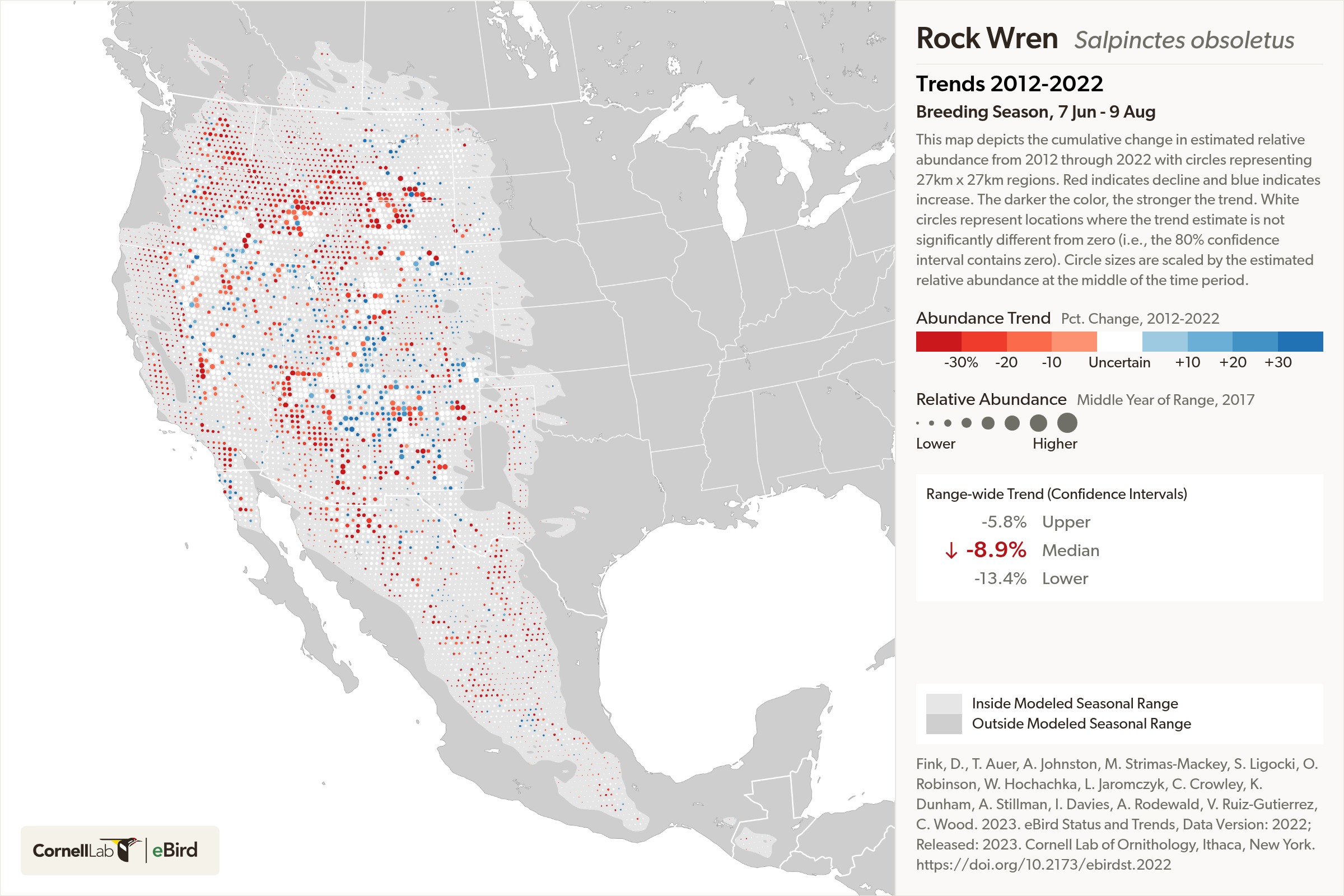
    To account for gaps where birds weren’t counted, the researchers trained machine learning models to fill in the maps based on the remote sensing data. “For every single species — say the rock wren — we’ve created a simulation that mimics the species and a variety of ways that it could respond to changes in the environment,” Johnston said. “Thousands of simulations underlie the results we showed.”

    A map of the western united states in grayscale with an overlay of red and blue dots representing rock wren population change. The map shows a majority red shade dots.
    CornellLab eBird

    The researchers achieved unprecedented resolution, zeroing in on areas 12 miles by 12 miles (27 km by 27 km), the same area as Portland, Oregon. This new population counting method can also be applied to eBird data from other locations, Fink said. “Now we’re using modeling to track bird populations — not seasonally through the year, but acrossthe years a major milestone,” he added.

    “We’ve been able to take citizen science data and, through machine learning methodology, put it on the same footing as traditionally structured surveys, in terms of the type of signal we can find,” said Cornell science product manager Tom Auer. “It will increase the credibility and confidence of people who use this information for precise conservation all over the globe.”

    The Up Side

    Since 1970, North America has lost one-quarter of its breeding birds, following a global trend of declines across species. The causes range from increased pollution and land development to changing climate and decreased food resources. Efforts to reverse this loss depend on identifying the areas where birds live at highest risk, assessing their populations, and pinpointing locations where conservation could help most.

    For 83% of the reported species in the new study, the decline was greatest in spots where populations had previously been most abundant — indicating problems with the habitat.

    “Even in species where populations are declining a lot, there are still places of hope, where the populations are going up,” Johnston said. The team found population increases in the maps of 97% of the reported species. “That demonstrates that there’s opportunity for those species.”

    “Birds face so many challenges,” said Cornell conservationist Amanda Rodewald. “This research will help us make strategic decisions about making changes that are precise, effective, and less costly. This is transformative. Now we can really drill in and know where specifically we’re going to be able to have the most positive impact in trying to stem bird declines.”

    By Karen Romano Young

    NASA Headquarters, Washington

    Details

    Last Updated

    Jun 25, 2025

  • What Are Asteroids? (Ages 14-18)

    5 Min Read

    What Are Asteroids? (Ages 14-18)

    An asteroid

    What are asteroids?

    Asteroids are rocky objects that orbit the Sun just like planets do. In fact, sometimes asteroids are called “minor planets.” These space rocks were left behind after our solar system formed about 4.6 billion years ago.

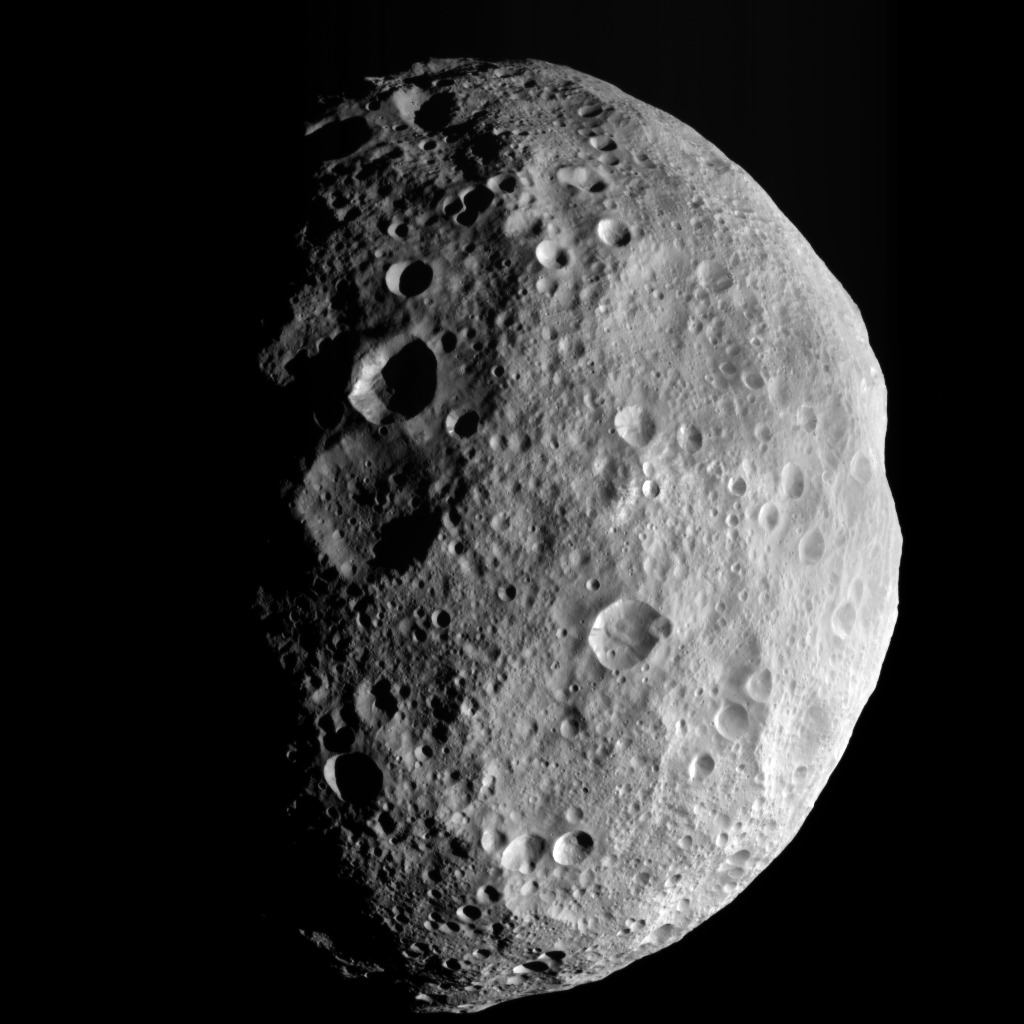
    Asteroids are found in a wide range of sizes. For example, one small asteroid, 2015 TC25, has a diameter of about 6 feet – about the size of a small car – while the asteroid Vesta is nearly 330 miles in diameter, almost as wide as the U.S. state of Arizona. Some asteroids even have enough gravity to have one or two small moons of their own.

    There are more than a million known asteroids. Many asteroids are given names. An organization called the International Astronomical Union is responsible for assigning names to objects like asteroids and comets.

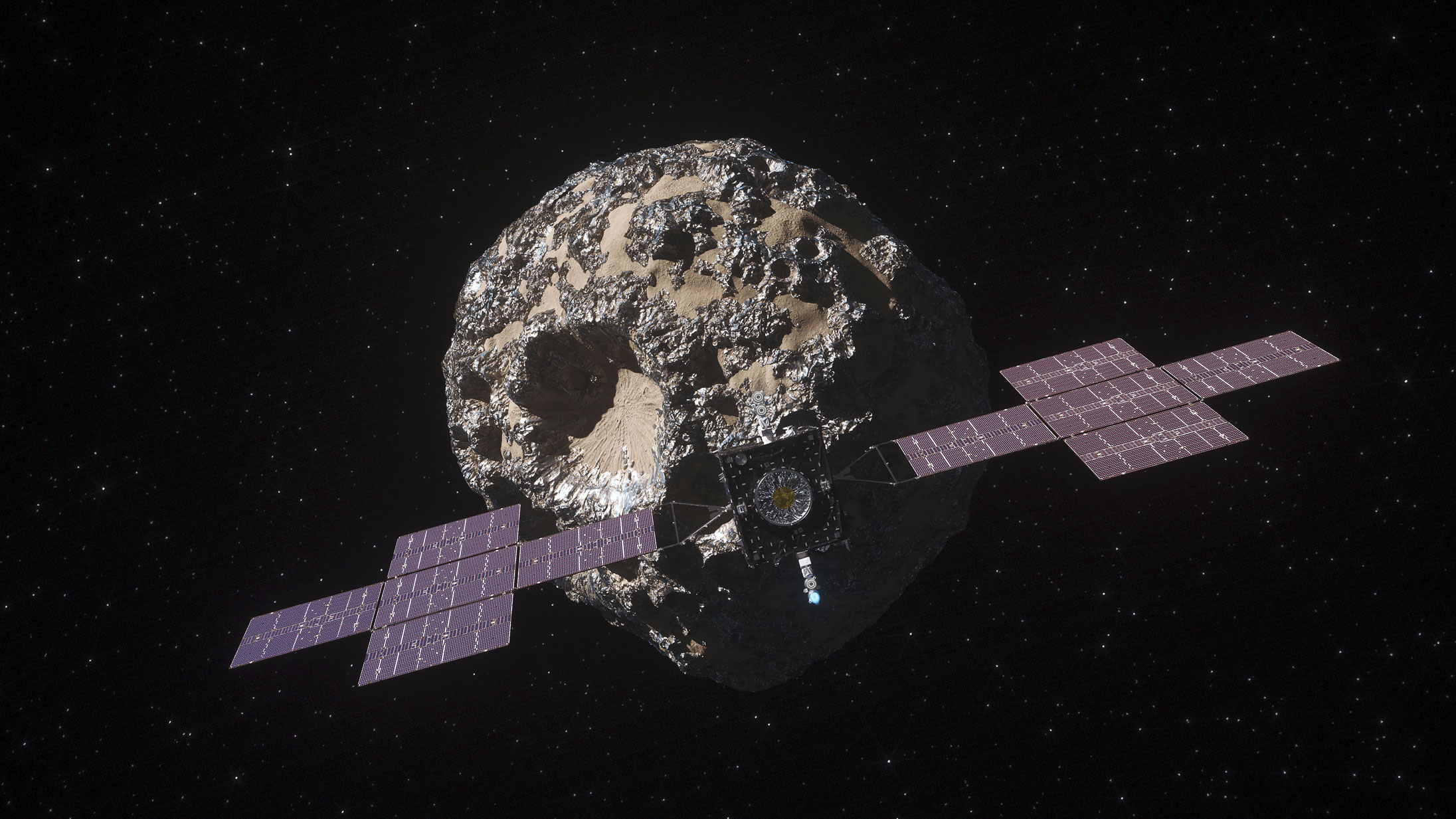
    This illustration depicts NASA's Psyche spacecraft as it approaches the asteroid Psyche.
    This illustration depicts NASA’s Psyche spacecraft as it approaches the asteroid Psyche. Once it arrives in 2029, the spacecraft will orbit the metal-rich asteroid for 26 months while it conducts its science investigation.
    NASA/JPL-Caltech/ASU

    What’s the difference between asteroids, meteors, and comets?

    Although all of these celestial bodies orbit the Sun, they are not the same. Unlike asteroids, which are rocky, comets are a mix of dust and ice. Meteors are small space rocks that get pulled close enough to enter Earth’s atmosphere, where they either burn up as a shooting star or land on the ground as a meteorite.

    What are asteroids made of?

    Different types of asteroids are composed of different mixes of materials. Most of them are made of chondrites, which are combinations of materials such as rocks and clay. These are called “C-type” asteroids. Some, called “S-type,” are made of stony materials, while “M-type” asteroids are composed of metallic elements.

    NASA’s Dawn spacecraft captured this image of Vesta as it left the giant asteroid’s orbit in 2012. The framing camera was looking down at the north pole, which is in the middle of the image.
    NASA/JPL-Caltech/UCLA/MPS/DLR/IDA

    How did the asteroids form?

    Asteroids formed around the same time and in the same way as the planets in our solar system. A massive, dense cloud of gas and dust collapsed into a spinning disk, and the gravity in the disk’s center pulled more and more material toward it. Over time, these pieces repeatedly collided with each other, sometimes resulting in smaller fragments and other times clumping together, resulting in much bigger objects.

    Objects with a lot of mass – like planets – produced enough gravity to pull themselves into spheres, but many smaller objects didn’t. These ended up becoming comets, small moons, and, yes, asteroids. Although some asteroids have a spherical shape, most have irregular shapes – sometimes oblong, bumpy, or jagged.

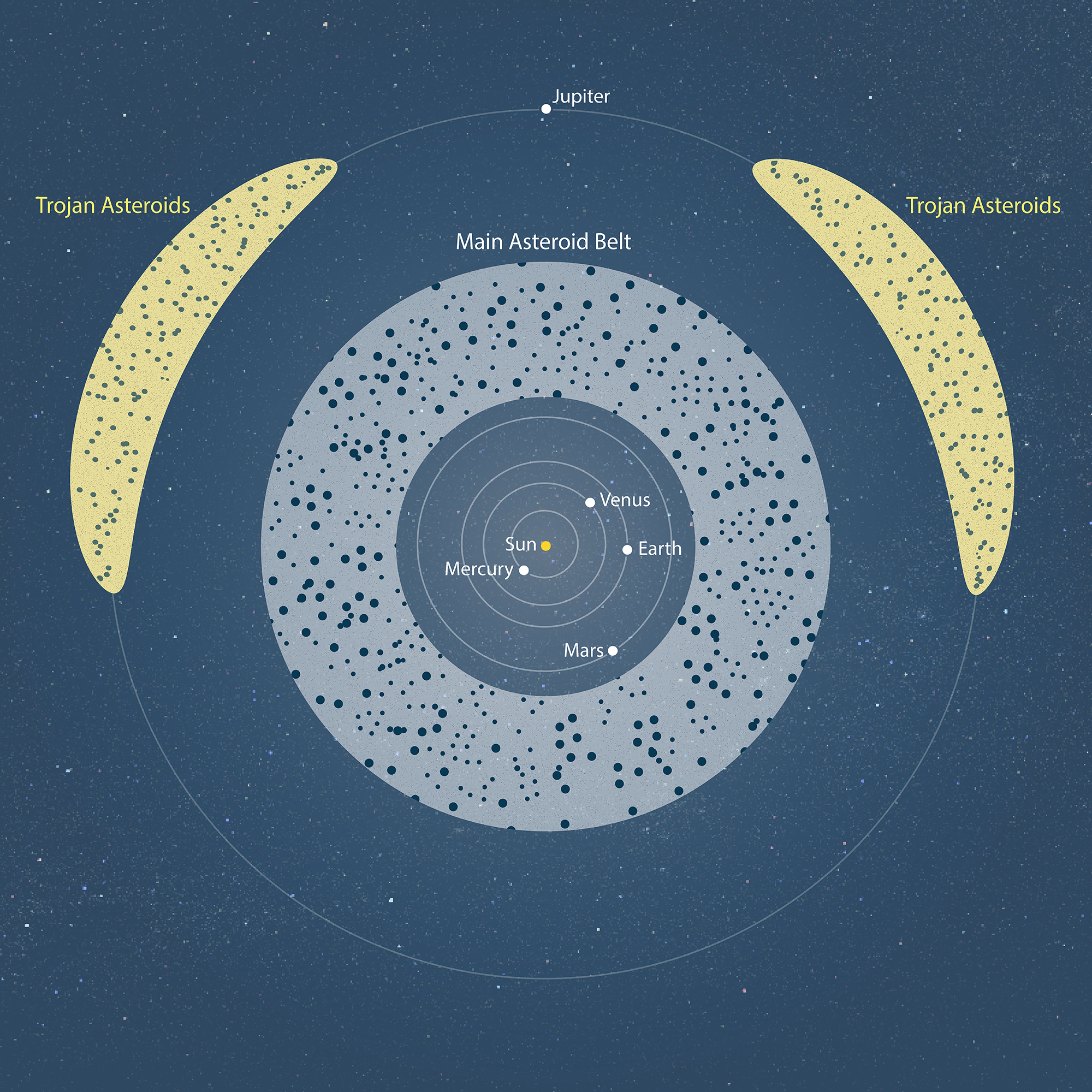
    illustration depicting groupings of asteroids in the solar sytsem
    The main asteroid belt lies between Mars and Jupiter, and Trojan asteroids both lead and follow Jupiter. Scientists now know that asteroids were the original “building blocks” of the inner planets. Those that remain are airless rocks that failed to adhere to one another to become larger bodies as the solar system was forming 4.6 billion years ago.
    Credits: NASA, ESA and J. Olmsted (STScI)

    Where are asteroids found?

    Most of the asteroids we know about are located in an area called the main asteroid belt, which is found in the space between Mars and Jupiter. But asteroids are found in other parts of the solar system, too.

    Trojan asteroids orbit the Sun on the same orbital path as a planet. They’re found at two specific points on the planetary orbit called Lagrange points. At these points, the gravitational pull of the planet and the Sun are in balance, making these points gravity-neutral and stable. Many planets have been found to have Trojan asteroids, including Earth.

    An asteroid’s location can also be influenced by the gravity of planets it passes and end up pushed or pulled onto a path that brings it close to Earth. When asteroids or comets are on an orbital path that comes within 30 million miles of Earth’s orbit, we call them near-Earth objects.

    Illustration of NASA’s DART spacecraft and the Italian Space Agency’s (ASI) LICIACube, with images of the asteroids Dimorphos and Didymos obtained by the DART spacecraft.
    Credit: NASA/Johns Hopkins APL/Joshua Diaz

    Could an asteroid come close enough to hit Earth?

    Yes! Throughout history, asteroids or pieces of asteroids have collided with Earth, our Moon, and the other planets, too. The effects of some of these impacts are still visible. For example, Chicxulub Crater was created 65 million years ago when a massive asteroid struck Mexico’s Yucatan Peninsula. The resulting cloud of dust and gas released into Earth’s atmosphere blocked sunlight, leading to a mass extinction that included the dinosaurs. More recently, in 2013, people in Chelyabinsk, Russia, witnessed an asteroid almost as wide as a tennis court explode in the atmosphere above them. That event produced a powerful shockwave that caused injuries and damaged structures.

    This is why NASA’s Planetary Defense Coordination Office keeps a watchful eye on near-Earth objects. The Planetary Defense team relies on telescopes and observatories on Earth and in space to detect and monitor objects like these that could stray too close to our planet.

    The agency is working on planetary defense strategies to use if an asteroid is discovered to be heading our way. For example, NASA’s DART (Double Asteroid Redirection Test) mission in 2022 was a first-of-its-kind test: an uncrewed spacecraft with an autonomous targeting system intentionally flew into the asteroid Dimorphos, successfully changing its orbit.

    A scientist in a white coat, mask, hair net, and purple gloves holds up a clear vial with a black substance inside near the camera.
    Jason Dworkin, OSIRIS-REx mission project scientist, holds up a vial containing part of the sample from asteroid Bennu in 2023.
    Credit: NASA/James Tralie

    How does NASA study asteroids?

     NASA detects and tracks asteroids using telescopes on the ground and in space, radar observations, and computer modeling. The agency also has launched several robotic explorers to learn more about asteroids. Some missions study asteroids from above, such as the Psyche mission, launched in 2023 to study the asteroid Psyche beginning in 2029. Other missions have actually made physical contact with asteroids. For example, the DART mission mentioned above impacted an asteroid to change its orbit, and the OSIRIS-REx (Origins, Spectral Interpretation, Resource Identification and Security – Regolith Explorer) spacecraft collected a sample of material from the surface of asteroid Bennu and delivered the sample to Earth in 2023 for scientists to study.

    Career Corner

    Want a career where you get to study asteroids? Here are some jobs at NASA that do just that:

    • Astronomer: These scientists observe and study planets, stars, and galaxies. Astronomers make discoveries that help us understand how the universe works and how it is changing. This job requires a strong educational background in science, math, and computer science.
    • Geologist: Asteroids are made of different types of rock, clay, or metallic materials. Geologists study the properties and composition of these materials to learn about the processes that have shaped Earth and other celestial bodies, like planets, moons, and asteroids.

    More About Asteroids

    Asteroid Facts
    Gallery: What’s That Space Rock?
    Center for Near Earth Object Studies
    Planetary Defense at NASA
    Asteroid Watch: Keeping an Eye on Near-Earth Objects

  • John Casani, Former Manager of Multiple NASA Missions, Dies

    6 min read

    Preparations for Next Moonwalk Simulations Underway (and Underwater)

    With Voyager 2 in the background, John Casani holds a small U.S. flag
    With Voyager 2 in the background, John Casani holds a small U.S. flag that was sewn into the spacecraft’s thermal blankets before its 1977 launch. Then Voyager’s project manager, Casani was first to envision the mission’s Golden Record, which lies before him with its cover at right.
    NASA/JPL-Caltech

    During his work on several historic missions, Casani rose through a series of technical and management positions, making an indelible mark on the nation’s space program.  

    John R. Casani, a visionary engineer who served a central role in many of NASA’s historic deep space missions, died on Thursday, June 19, 2025, at the age of 92. He was preceded in death by his wife of 39 years, Lynn Casani, in 2008 and is survived by five sons and their families.

    Casani started at the Jet Propulsion Laboratory in Southern California in 1956 and went on to work as an electronics engineer on some of the nation’s earliest spacecraft after NASA’s formation in 1958. Along with leading the design teams for both the Ranger and Mariner series of spacecraft, he held senior project positions on many of the Mariner missions to Mars and Venus, and was project manager for three trailblazing space missions: Voyager, Galileo, and Cassini.

    His work helped advance NASA spacecraft in areas including mechanical technology, system design and integration, software, and deep space communications. No less demanding were the management challenges of these multifaceted missions, which led to innovations still in use today.

    JPL's John Casani receives the National Air & Space Museum's Lifetime Achievement Award.
    JPL’s John Casani receives the National Air & Space Museum’s Lifetime Achievement Award.
    Carolyn Russo/NASM, National Air and Space Museum, Smithsonian Institution

    John had a major influence on the development of spacecraft that visited almost every planet in our solar system, as well as the people who helped build them,” said JPL director Dave Gallagher. “He played an essential role in America’s first attempts to reach space and then the Moon, and he was just as crucial to the Voyager spacecraft that marked humanity’s first foray into interplanetary — and later, interstellar — space. That Voyager is still exploring after nearly 50 years is a testament to John’s remarkable engineering talent and his leadership that enabled others to push the boundaries of possibility.”

    Born in Philadelphia in 1932, Casani studied electrical engineering at the University of Pennsylvania. After a short stint at an Air Force research lab, he moved to California in 1956 and was hired to work at JPL, a division of Caltech, on the guidance system for the U.S. Army Ballistic Missile Agency’s Jupiter-C and Sergeant missile programs.

    In 1957, the Soviet Union launched Sputnik 1, the first human-made Earth satellite, alarming America and changing the trajectory of both JPL and Casani’s career. With the 1958 launch of Explorer 1, America’s first satellite, the lab transitioned to concentrating on robotic space explorers, and Casani segued from missiles to spacecraft.

    One of his jobs as payload engineer on Pioneer 3 and 4, NASA’s first missions to the Moon, was to carry each of the 20-inch-long (51-cm-long) probes in a suitcase from JPL to the launch site at Cape Canaveral, Florida, where he installed them in the rocket’s nose cone.

    At the dawn of the 1960s, Casani served as spacecraft systems engineer for the agency’s first two Ranger missions to the Moon, then joined the Mariner project in 1965, earning a reputation for being meticulous. Four years later, he was Mariner project manager.

    Asked to share some of his wisdom in a 2009 NASA presentation, Casani said, “The thing that makes any of this work … is toughness. Toughness because this is a tough business, and it’s a very unforgiving business. You can do 1,000 things right, but if you don’t do everything right, it’ll come back and bite you.”

    Casani’s next role: project manager for NASA’s high-profile flagship mission to the outer planets and beyond — Voyager. He not only led the mission from clean room to space, he was first to envision attaching a message representing humanity to any alien civilization that might encounter humanity’s first interstellar emissaries. 

    “I approached Carl Sagan,” he said in a 2007 radio interview, “and asked him if he could come up with something that would be appropriate that we could put on our spacecraft in a way of sending a message to whoever might receive it.” Sagan took up the challenge, and what resulted was the Golden Record, a 12-inch gold-plated copper disk containing sounds and images selected to portray the diversity of life and culture on Earth.

    Once Voyager 1 and 2 and their Golden Records launched in 1977, JPL wasted no time in pointing their “engineer’s engineer” toward Galileo, which would become the first mission to orbit a gas giant planet. As the mission’s initial project manager, Casani led the effort from inception to assembly. Along the way, he had to navigate several congressional attempts to end the project, necessitating multiple visits to Washington. The 1986 loss of Space Shuttle Challenger, from which Galileo was to launch atop a Centaur upper-stage booster, led to mission redesign efforts before its 1989 launch.

    After 11 years leading Galileo, Casani became deputy assistant laboratory director for flight projects in 1988, received a promotion just over a year later and then, from 1990 to 1991, served as project manager of Cassini, NASA’s first flagship mission to orbit Saturn.

    Casani became JPL’s first chief engineer in 1994, retiring in 1999 and serving on several nationally prominent committees, including leading the investigation boards of both the Mars Climate Orbiter and the Mars Polar Lander failures, and also leading the James Webb Space Telescope Independent Comprehensive Review Panel.

    In early 2003, Casani returned to JPL to serve as project manager for NASA’s Project Prometheus, which would have been the nation’s first nuclear-powered, electric-propulsion spacecraft. In 2005, he became manager of the Institutional Special Projects Office at JPL, a position he held until retiring again in 2012.

    “Throughout his career, John reflected the true spirit of JPL: bold, innovative, visionary, and welcoming,” said Charles Elachi, JPL’s director from 2001 to 2016. “He was an undisputed leader with an upbeat, fun attitude and left an indelible mark on the laboratory and NASA. I am proud to have called him a friend.”

    Casani received many awards over his lifetime, including NASA’s Exceptional Achievement Medal, the Management Improvement Award from the President of the United States for the Mariner Venus Mercury mission, and the Air and Space Museum Trophy for Lifetime Achievement.

    News Media Contacts

    Matthew Segal / Veronica McGregor
    Jet Propulsion Laboratory, Pasadena, Calif.
    818-354-8307 / 818-354-9452
    matthew.j.segal@jpl.nasa.gov / veronica.c.mcgregor@jpl.nasa.gov
    Details

    Last Updated

    Jun 25, 2025

  • NASA Sets Coverage for Axiom Mission 4 Launch, Arrival at Station

    A white spacecraft faces the camera with its nose cone open, with Earth in the background.
    The SpaceX Dragon spacecraft carrying the Axiom Mission 3 crew is pictured approaching the International Space Station on Jan. 20, 2024.
    Credit: NASA

    NASA, Axiom Space, and SpaceX are targeting 2:31 a.m. EDT, Wednesday, June 25, for launch of the fourth private astronaut mission to the International Space Station, Axiom Mission 4.

    The mission will lift off from Launch Complex 39A at NASA’s Kennedy Space Center in Florida. The crew will travel to the orbiting laboratory on a new SpaceX Dragon spacecraft after launching on the company’s Falcon 9 rocket. The targeted docking time is approximately 7 a.m. Thursday, June 26.

    This launch opportunity comes after NASA and Roscosmos officials discussed the status of the recent repair work in the transfer tunnel at the aft (back) most segment of the orbital laboratory’s Zvezda service module. Based on the evaluations, NASA and Roscosmos agreed to further lower the pressure in the transfer tunnel to 100 millimeters of mercury, and teams will continue to evaluate going forward. Safety remains a top priority for NASA and Roscosmos.

    “NASA and Roscosmos have a long history of cooperation and collaboration on the International Space Station. This professional working relationship has allowed the agencies to arrive at a shared technical approach and now Axiom Mission 4 launch and docking will proceed,” said acting NASA Administrator Janet Petro. “We look forward to the launch with Axiom Space and SpaceX for this commercial international mission.”

    For this mission, NASA is responsible for integrated operations, which begins during the spacecraft’s approach to the space station, continues during the crew’s stay aboard the orbiting laboratory conducting science, education, and commercial activities, and concludes once the spacecraft departs the station.

    Live coverage of launch and arrival activities will stream on NASA+. Learn how to watch NASA content through a variety of platforms, including social media.

    Peggy Whitson, former NASA astronaut and director of human spaceflight at Axiom Space, will command the commercial mission, while ISRO (Indian Space Research Organisation) astronaut Shubhanshu Shukla will serve as pilot. The two mission specialists are ESA (European Space Agency) project astronaut Sławosz Uznański-Wiśniewski of Poland, and HUNOR (Hungarian to Orbit) astronaut Tibor Kapu of Hungary.

    Once docked, the private astronauts plan to spend about two weeks aboard the orbiting laboratory, conducting a mission comprised of science, outreach, and commercial activities.

    As part of a collaboration between NASA and ISRO, Axiom Mission 4 delivers on a commitment highlighted by President Donald Trump and Indian Prime Minister Narendra Modi to send the first ISRO astronaut to the station. The space agencies are participating in five joint science investigations and two in-orbit STEM (science, technology, engineering, and mathematics) demonstrations. NASA and ISRO have a long-standing relationship built on a shared vision to advance scientific knowledge and expand space collaboration.

    The private mission also carries the first astronauts from Poland and Hungary to stay aboard the International Space Station.

    NASA’s mission coverage is as follows (all times Eastern and subject to change based on real-time operations):

    Wednesday, June 25

    12:30 a.m. – Axiom Space and SpaceX launch coverage begins.

    1:40 a.m. – NASA joins the launch coverage on NASA+.

    2:31 a.m. – Launch

    NASA will end coverage following orbital insertion, which is approximately 15 minutes after launch. As it is a commercial launch, NASA will not provide a clean launch feed on its channels.

    Thursday, June 26

    5 a.m. – Arrival coverage begins on NASA+, Axiom Space, and SpaceX channels.

    7 a.m. – Targeted docking to the space-facing port of the station’s Harmony module.

    Arrival coverage will continue through hatch opening and welcome remarks.

    All times are estimates and could be adjusted based on real-time operations after launch. Follow the space station blog for the most up-to-date operations information.

    The International Space Station is a springboard for developing a low Earth economy. NASA’s goal is to achieve a strong economy off the Earth where the agency can purchase services as one of many customers to meet its science and research objectives in microgravity. NASA’s commercial strategy for low Earth orbit provides the government with reliable and safe services at a lower cost, enabling the agency to focus on Artemis missions to the Moon in preparation for Mars while also continuing to use low Earth orbit as a training and proving ground for those deep space missions.

    Learn more about NASA’s commercial space strategy at:

    https://www.nasa.gov/commercial-space

    -end-

    Joshua Finch
    Headquarters, Washington
    202-358-1100
    joshua.a.finch@nasa.gov

    Anna Schneider
    Johnson Space Center, Houston
    281-483-5111
    anna.c.schneider@nasa.gov
  • NASA Astronaut Zena Cardman

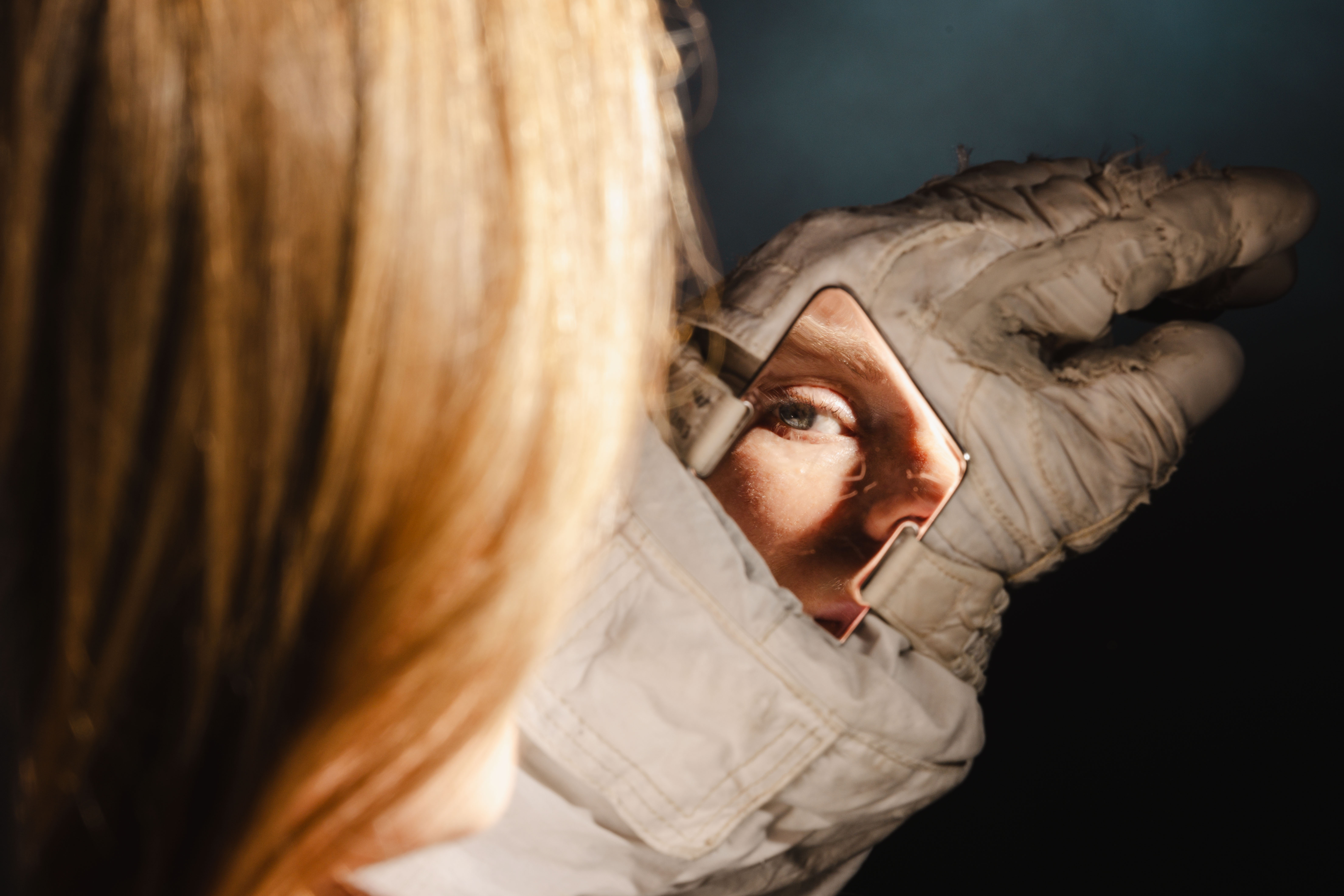
    A white woman's eye and nose are reflected in a diamond-shaped mirror attached to the wrist of her spacesuit. The mirror and white spacesuit glove are in focus, while the astronaut's blonde hair is in the foreground, out of focus.
    NASA/Josh Valcarcel

    NASA astronaut Zena Cardman inspects her spacesuit’s wrist mirror in this portrait taken at NASA’s Johnson Space Center in Houston on March 22, 2024. Cardman will launch to the International Space Station as part of NASA’s SpaceX Crew-11 mission. This will be her first spaceflight.

    Cardman was selected by NASA as a member of the 2017 “Turtles” Astronaut Class. The Virginia native holds a bachelor’s degree in biology and a master’s degree in marine sciences from the University of North Carolina, Chapel Hill. Her research focused primarily on geobiology and geochemical cycling in subsurface environments, from caves to deep sea sediments. Cardman’s experience includes multiple Antarctic expeditions. Since completing initial training, Cardman has supported real-time station operations and lunar surface exploration planning.

    This photo was one of the winners of NASA’s 2024 Photos of the Year.

  • Live or Fly a Plane in California? Help NASA Measure Ozone Pollution!

    Ozone high in the stratosphere protects us from the Sun’s ultraviolet light. But ozone near the ground is a pollutant that harms people and plants. The San Joaquin Valley has some of the most polluted air in the country, and NASA scientists with the new Ozone Where We Live (OWWL) project are working to measure ozone and other pollutants there. They need your help!  

    Do you live or work in Bakersfield, CA? Sign up to host an ozone sensor! It’s like a big lunch box that you place in your yard, but it’s not packed with tuna and crackers. It’s filled with sensors that measure temperature and humidity and sniff out dangerous gases like methane, carbon monoxide, carbon dioxide, and of course, ozone. 

    Can you fly a plane? Going to the San Joaquin Valley? Sign up to take an ozone sensor on your next flight! You can help measure ozone levels in layers of the atmosphere that are hard for satellites to investigate. Scientists will combine the data you take with data from NASA’s TEMPO satellite to improve air quality models and measurements within the region. Find out more here or email: Emma.l.yates@nasa.gov
    The Ozone Where We Live project logo, which shows a sunlit multi-story building with a small aircraft flying over it leaving a yellow contrail in a blue sky. In white letters on a blue field circling the image are the words “OWWL Ozone Where We Live.”
    Join the Ozone Where We Live (OWWL) project and help NASA scientists protect the people of the San Joaquin Valley!
    Credit: Emma Yates
  • NASA Tests New RS-25 Engine

    A row of bushes frame the photo as vapor clouds seen in the distance erupt towards the sky during an engine test on the Fred Haise Test Stand at NASA Stennis
    NASA tested RS-25 engine No. 20001 on June 20, at the Fred Haise Test Stand at NASA’s Stennis Space Center at Bay St. Louis, Mississippi. Test teams fired the engine for almost eight-and-a-half minutes (500 seconds), the same amount of time RS-25 engines fire during a launch of an SLS (Space Launch System) rocket on Artemis missions to the Moon.
    NASA

    NASA tested RS-25 engine No. 20001 on June 20, at the Fred Haise Test Stand at NASA’s Stennis Space Center at Bay St. Louis, Mississippi. Test teams fired the engine for almost eight-and-a-half minutes (500 seconds), the same amount of time RS-25 engines fire during a launch of an SLS (Space Launch System) rocket on Artemis missions to the Moon. The Artemis campaign will explore the Moon for scientific discovery, economic benefits, and to build the foundation for the first crewed missions to Mars – for the benefit of all.

    Four RS-25 engines, built by contractor L3Harris Technologies (formerly Aerojet Rocketdyne), help power each SLS launch, producing up to 2 million pounds of combined thrust. During the test, operators also fired engine No. 20001 up to the 111% power level, the same amount of thrust needed to launch an SLS rocket, carrying the Orion spacecraft, to orbit. The full-duration “hot fire” was the first test since NASA completed certification testing for new production RS-25 engines in 2024.

    All RS-25 engines are tested and proven flightworthy at NASA Stennis. The test was conducted by a team of operators from NASA, L3Harris, and Syncom Space Services, prime contractor for site facilities and operations.

  • Heather Cowardin Safeguards the Future of Space Exploration  

    5 Min Read

    Heather Cowardin Safeguards the Future of Space Exploration  

    As branch chief of the Hypervelocity Impact and Orbital Debris Office at NASA’s Johnson Space Center in Houston, Dr. Heather Cowardin leads a team tasked with a critical mission: characterizing and mitigating orbital debris—space junk that poses a growing risk to satellites, spacecraft, and human spaceflight. 

    Long before Cowardin was a scientist safeguarding NASA’s mission, she was a young girl near Johnson dreaming of becoming an astronaut.  

    “I remember driving down Space Center Boulevard with my mom and seeing people running on the trails,” she said. “I told her, ‘That will be me one day—I promise!’ And she always said, ‘I know, honey—I know you will.’” 

    A woman in a cream blouse and black T-shirt poses in front of a NASA meatball logo (right) and the U.S. flag.
    Official portrait of Heather Cowardin.
    NASA/James Blai

    I was committed to working at NASA—no matter what it took.

    Heather Cowardin

    Heather Cowardin

    Hypervelocity Impact and Orbital Debris Branch Chief

    Today, that childhood vision has evolved into a leadership role at the heart of NASA’s orbital debris research. Cowardin oversees an interdisciplinary team within the Astromaterials Research and Exploration Science Division, or ARES. She supports measurements, modeling, risk assessments, and mitigation strategies to ensure the efficiency of space operations.  

    With more than two decades of experience, Cowardin brings expertise and unwavering dedication to one of the agency’s most vital safety initiatives. 

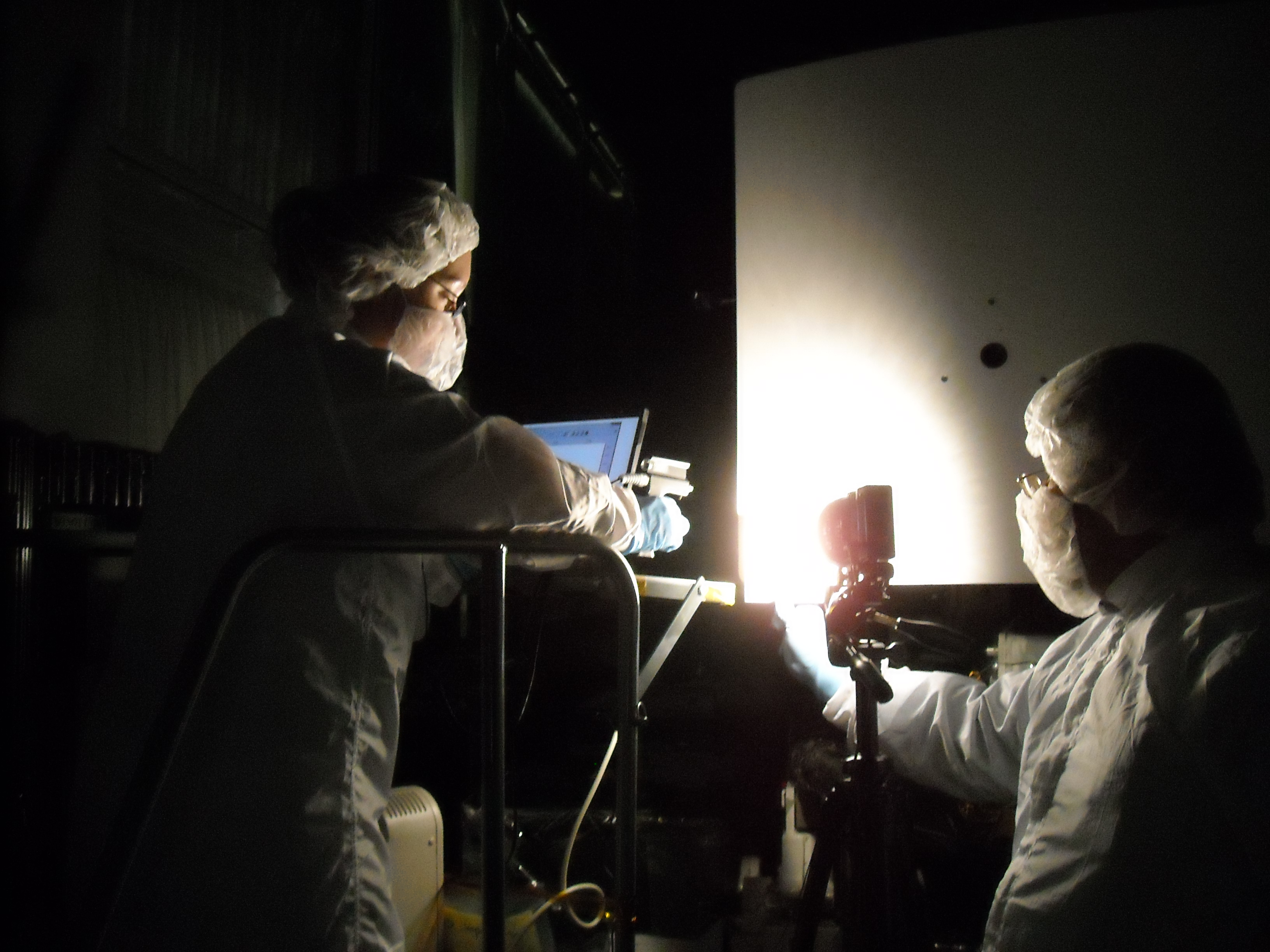
    Her work focuses on characterizing Earth-orbiting objects using optical and near-infrared telescopic and laboratory data. She helped establish and lead the Optical Measurement Center, a specialized facility at Johnson that replicates space-like lighting conditions and telescope orientations to identify debris materials and shapes, and evaluate potential risk. 

    Cowardin supports a range of research efforts, from ground-based and in-situ, or in position, observations to space-based experiments. She has contributed to more than 100 scientific publications and presentations and serves as co-lead on Materials International Space Station Experiment missions, which test the durability of materials on the exterior of the orbiting laboratory. 

    She is also an active member of the Inter-Agency Space Debris Coordination Committee, an international forum with the goal of minimizing and mitigating the risks posed by space debris.  

    Heather Cowardin, left, holds a spectrometer optical feed as she prepares to take a spectral measurement acquisition on the returned Wide Field Planetary Camera 2 radiator. It was inspected by the Orbital Debris Program Office team for micrometeoroid and orbital debris impacts at NASA’s Goddard Space Flight Center in Greenbelt, Maryland, in 2009, and later studied for space weathering effects on its painted surface.

    Her passion was fueled further by a mentor, Dr. James R. Benbrook, a University of Houston space physics professor and radar scientist supporting the Orbital Debris Program Office. “He was a hard-core Texas cowboy and a brilliant physicist,” she said. “He brought me on as a NASA fellow to study orbital debris using optical imaging. After that, I was committed to working at NASA—no matter what it took.” 

    After completing her fellowship, Cowardin began graduate studies at the University of Houston while working full time. Within a year, she accepted a contract position at Johnson, where she helped develop the Optical Measurement Center and supported optical analyses of geosynchronous orbital debris. She soon advanced to optical lead, later serving as a contract project manager and section manager. 

    Heather Cowardin inspects targets to study the shapes of orbital debris using the Optical Measurement Center at NASA’s Johnson Space Center in Houston.

    What we do at NASA takes new thinking, new skills, and hard work—but I believe the next generation will raise the bar and lead us beyond low Earth orbit.

    Heather Cowardin

    Heather Cowardin

    Hypervelocity Impact and Orbital Debris Branch Chief

    Building on her growing expertise, Cowardin became the laboratory and in-situ measurements lead for the Orbital Debris Program Office, a program within the Office of Safety and Mission Assurance at NASA Headquarters. She led efforts to characterize debris and deliver direct measurement data to support orbital debris engineering models, such as NASA’s Orbital Debris Engineering Model and NASA’s Standard Satellite Breakup Model, while also overseeing major projects like DebriSat.  

    Cowardin was selected as the Orbital Debris and Hypervelocity Integration portfolio scientist, where she facilitated collaboration within the Hypervelocity Impact and Orbital Debris Office—both internally and externally with stakeholders and customers. These efforts laid the foundation for her current role as branch chief. 

    “I’ve really enjoyed reflecting on the path I’ve traveled and looking forward to the challenges and successes that lie ahead with this great team,” she said.  

    One of Cowardin’s proudest accomplishments was earning her doctorate while working full time and in her final trimester of pregnancy. 

    “Nothing speaks to multitasking and time management like that achievement,” Cowardin said. “I use that story to mentor others—it’s proof that you can do both. Now I’m a mom of two boys who inspire me every day. They are my motivation to work harder and show them that dedication and perseverance always pay off.” 

    From left to right: Heather Cowardin, her youngest child Jamie, her husband Grady, and her oldest child Trystan. The family celebrates Jamie’s achievement of earning a black belt.

    Throughout her career, Cowardin said one lesson has remained constant: never underestimate yourself. 

    “It’s easy to think, ‘I’m not ready,’ or ‘Someone else will ask the question,’” she said. “But speak up. Every role I’ve taken on felt like a leap, but I embraced it and each time I’ve learned and grown.” 

    She has also learned the value of self-awareness. “It’s scary to ask for feedback, but it’s the best way to identify growth opportunities,” she said. “The next generation will build on today’s work. That’s why we must capture lessons learned and share them. It’s vital to safe and successful operations.” 

    Twelve people pose in business suits at a conference center.
    Heather Cowardin, fifth from left, stands with fellow NASA delegates at the 2024 Inter-Agency Space Debris Coordination Committee meeting hosted by the Indian Space Research Organisation in Bengaluru, India. The U.S. delegation included representatives from NASA, the Department of Defense, the Federal Aviation Administration, and the Federal Communications Commission.

    To the Artemis Generation, she hopes to pass on a sense of purpose. 

    “Commitment to a mission leads to success,” she said. “Even if your contributions aren’t immediately visible, they matter. What we do at NASA takes new thinking, new skills, and hard work—but I believe the next generation will raise the bar and lead us beyond low Earth orbit.” 

    When she is not watching over orbital debris, she is lacing up her running shoes. 

    “I’ve completed five half-marathons and I’m training for the 2026 Rock ‘n’ Roll half-marathon in Nashville,” she said. “Running helps me decompress—and yes, I often role-play technical briefings or prep conference talks while I’m out on a jog. Makes for interesting moments when I pass people in the neighborhood!” 

    About the Author

    Sumer Loggins

    Sumer Loggins