Tag: space

  • [ISS / Japanese Experiment Module (KIBO)] KOUNOTORI5 Leaves the ISS

    KOUNOTORI5 Leaves the ISS

    Last Updated: September 29, 2015

    photo

    KOUNOTORI5 being released by the ISS robotic arm
    (Credit: JAXA/NASA)

    KOUNOTORI5 (HTV5) was unberthed from the nadir port of Harmony (node 2) by the Space Station Remote Manipulator System (SSRMS) at 8:12 p.m., September 28 (11:12 a.m., September 28 UTC).

    Captured by the SSRMS, KOUNOTORI5 (HTV5) was moved to the releasing point below the station and released into orbit at 1:53 a.m., September 29 (4:53 p.m., September 28 UTC).

    KOUNOTORI5 will perform three deorbit maneuvers and is scheduled to reenter into the atmosphere at 5:33 a.m., September 30 (8:33 p.m., September 29 UTC).

    Click to enlarge

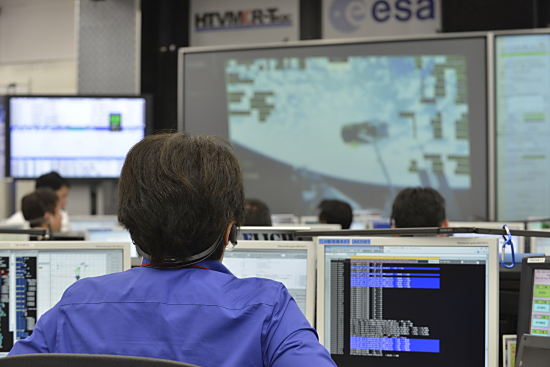
    HTV Mission Control Room during the HTV5 unberthing operations (Credit: JAXA)

    Click to enlarge

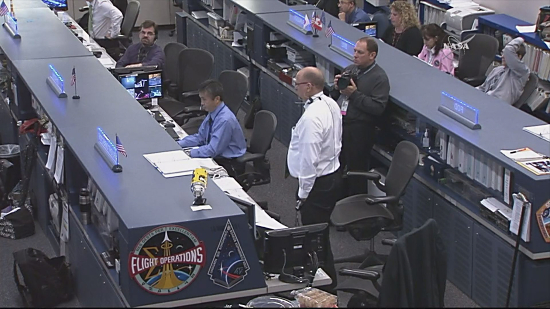
    Astronaut Koichi Wakata serving as lead HTV5 CAPCOM at the NASA Flight Control Center (Credit: JAXA/NASA)

    *All times are Japan Standard Time (JST)

    This entry passed through the Full-Text RSS service – if this is your content and you’re reading it on someone else’s site, please read the FAQ at fivefilters.org/content-only/faq.php#publishers.

  • Mars Gets More Habitable with Water Discovery, Scientists Say

    Dark Streaks Indicate Water on Mars
    Dark streaks painting the side of Martian hills were likely formed by saltwater, scientists announced today (Sept. 28). What does the presence of liquid water imply for life on the Red Planet?
    Credit: NASA/JPL/University of Arizona

    The discovery of liquid (albeit very salty) water on Mars may suggest that the Red Planet is more habitable than previously thought, according to scientists.

    Strange, dark streaks that run down the sides of hills on the surface of Mars are formed partly by the presence of liquid water, scientists announced today (Sept. 28). Using NASA’s Mars Reconnaissance Orbiter (MRO), the researchers say they now have strong evidence that salty water soaks the planet’s surface soil, perhaps even flows down the slopes, and creates the dark streaks.

    “Water, as I’m sure many of you have heard us say on multiple occasions, is an essential ingredient for life,” said Mary Beth Wilhelm, a planetary science researcher at the NASA Ames Research Center, in a NASA briefing earlier today (Sept. 28). “Our results may point to more habitable conditions on the near surface of Mars than previously thought.” [Flowing Water on Mars: The Discovery in Pictures]

    The surface of Mars is, for the most part, extremely inhospitable to life. But life on Earth has proven again and again to be incredibly tenacious. There are life-forms that can survive incredibly hot and cold temperatures, extreme doses of radiation, and highly salty pools of water. But the authors of the new study, which was published online today (Sept. 28) in the journal Nature Geoscience, said they can’t yet make any direct comparisons between the saltwater found on Mars and environments on Earth.

    “The potential habitability by Earth-like microbes is unclear,” said Wilhelm, who is one of the authors on the paper announcing the new finding. “To assess habitability, we would first need to determine how cold and how concentrated the brine is.”

    The dark streaks of saltwater found on Mars are technically referred to as “recurring slope linea,” or RSLs. Michael Meyer, lead scientist for the Mars exploration program at NASA, noted during the briefing that similar-looking streaks have been observed in Antarctica.

    “The difficulty is that something that looks the same doesn’t mean it is the same, so we don’t know if it’s the same mechanism [causing the streaks],” Meyer said. “But at least we have something that looks similar, so that’s being studied.”

    The question of whether life can survive in the Martian brines is further complicated because most of the brines are seasonal. They appear in the early Martian spring but then disappear in the Martian autumn and winter months, said Alfred McEwen, principal investigator for the High Resolution Imaging Science Experiment (HiRISE) aboard MRO, who also spoke during the NASA briefing.

    RSLs at the equator of Mars can be observed year-round, McEwen said, but they move with the sun throughout the year (so they appear on the slopes that get the most sunlight). Because the RSLs don’t constitute a permanent feature, any life-forms they might support would have to find a way to survive when the water disappears (there are life forms on Earth that can go into hibernation during periods of drought).

    Do you think life exists on Mars today?

    loading poll

    Another relevant question in the search for life in these RSLs is the source of the water. The authors of the new research said their leading hypothesis is that the water is absorbed from the Martian atmosphere. MRO detected a type of salt called a perchlorate, which can suck water out of the air — a process called deliquescence. But, the scientists noted that it’s possible that the water is coming from subsurface supplies.

    “If I were a microbe on Mars, I would probably not live near one of these RSLs,” said John Grunsfeld, associate administrator for NASA’s Science Mission Directorate. “I would want to live further north or south, at higher latitudes, quite far under the surface, where there’s a freshwater glacier. We only suspect those places exist, and we have some scientific evidence that they do. And that’s a subject of future exploration, when we can find subsurface ice that’s a few meters or deeper below the surface and that’s fresh water. And I think that’s going to be a very exciting area of exploration in the future.”

    Grunsfeld noted that these RSLs would likely receive attention in future Mars rover missions and other studies of the Red Planet.

    “I can’t imagine that it won’t be a high priority for the scientific community to send something … to go to these areas, and may have a life-detection capability to see if there’s life there that’s similar to [life on] Earth,” he said.

    Follow Calla Cofield @callacofieldFollow us @Spacedotcom, Facebook and Google+. Original article on Space.com.

  • Will We Ever Colonize Mars? (Op-Ed)

    Matt Damon in 'The Martian'
    Matt Damon appears as a stranded astronaut on Mars in ‘The Martian’ motion picture, coming to theaters in November 2015.
    Credit: Twentieth Century Fox Film Corporation

    Paul Sutter is a research fellow at the Astronomical Observatory of Trieste and visiting scholar at the Ohio State University’s Center for Cosmology and Astro-Particle Physics (CCAPP). Sutter is also host of the podcasts Ask a Spaceman and RealSpace, and the YouTube series Space In Your Face. He contributed this article to Space.com’s Expert Voices: Op-Ed & Insights.

    Ah, Mars. The place that dreams are made of. As long as those dreams involve a poisonous, tenuous atmosphere, inhospitable cold and lots and lots of red. Still, people seem to want to go there. But will we ever make it?

    “Yes,” if you ask Elon Musk. I agree, but it probably won’t be as easy as you might think, even if you think it’s going to be really really hard.

    Gravity doesn’t know when to give up

    What’s the problem? Pick up the nearest object and throw it. I don’t care if there are people around you. Do it. This is an experiment. This is science. Note how far the object goes before it hits the ground. Now pick it up and throw it harder. It went further, didn’t it? 

    Part of the reason you didn’t throw it as far as your ego thought you would was air resistance. Plowing through the atmosphere like a bull in a molecular china shop, the object quickly loses speed. But the actual “hitting the ground” part is due to gravity. If you took away all the air, your thrown object would still eventually hit the ground.

    In an airless world, no matter how hard you throw the object, it will reach the ground in the same amount of time. That’s because gravity only works in the “down” direction, not the “over” direction, so for all gravity cares, you might as well have just lazily dropped it. But the harder you throw it, the more speed it will have, and the farther it will go before inevitably hitting the ground.

    Or maybe not so inevitably. Imagine throwing something so hard that in the few seconds before it hits the ground, it reached the other side of a house. Or maybe a street. Throw it harder and you could get it across town. Across the country. Even faster: across an ocean. 

    Imagine throwing it so fast that by the time gravity gets around to doing its thing, the Earth has curved away from it. Gravity keeps on tugging at the object, but it frustratingly keeps missing the ground.

    Ta-da: orbit!

    How fast is orbital fast? Around 18,000 miles per hour (or 11 kilometers per second), give or take. There is, after all, an actual atmosphere to deal with.

    You can certainly go slower and still visit space. Just make sure you packed a heat shield, because you’re coming back down. You can also go even faster than orbital speed and escape the jealous clutches of Earth’s gravity altogether, which is what it takes to get to Mars.

    Getting away from it all

    And that’s the fundamental challenge. There just aren’t many ways of pushing stuff that fast. Our best method so far involves blowing up stuff in a tube, and making sure to leave a hole in one side. Newton’s laws do the rest. It seems primitive, but the engineers tell me these “rockets” are actually quite complicated.

    We can easily send robots to Mars, because their feelings don’t get hurt if you forget to pack the oxygen and food. But people are a different … well, animal, altogether. Humans are heavy. Humans need to carry little bubbles of the Earth ecosystem with them everywhere they go. Humans need room to stretch. Humans want to bring human-centric niceties, like hammers and toothpaste and lima beans.

    Oh, yeah, and we need to bring them back home, I suppose. So pack the spare rockets and extra fuel.

    Let this sink in: at the time of this writing, we don’t have the capacity to send humans beyond Low Earth Orbit, the very edge of space, let alone Mars. Getting to Mars is hard, folks, and it requires a lot of new technology.

    And that’s just enough stuff for a handful of hominids to poke around the place for a bit. A colony? Look around the city you’re in, and marvel at all the junk it takes to get you through the day. Think of all the layers of civilization and organization (spontaneous or otherwise) it takes to get you dinner. Made of food. Cooked. On a plate. That you will clean up with water … eventually. In a house. On a street. And on and on.

    A city is a massively complicated thing. Sure, we’ve built them from the ground up before, but colonies on Earth have a few advantages, namely, a) breathable air, b) liquid water, c) dirt and d) proximity to other Earth-based cities. Even the U.S. National Science Foundation’s Amundsen-Scott South Pole Station — the closest to a Mars colony you can get while keeping two feet on the Earth — enjoys most of these advantages, and is still a nightmare to keep alive.

    Don’t get zapped

    And did I mention the cosmic rays? No? Well, now’s a good time — cosmic rays are high-energy protons (and some heavier nuclei) zipping through the universe, generated in…well, we’re not exactly sure, but probably supernovae and other cataclysmic events. The universe is swimming in them, and they cut through DNA like a hot knife through butter. The butter is you in this metaphor, just to be clear. On Earth the atmosphere makes for nice insulation, catching most of the deadliest cosmic rays, but some still make it through, possibly giving everyone — especially airline crews — a slightly elevated risk of cancer. [Radiation Fears Shouldn’t Hold Back Mars Colonization (Op-Ed )]

    But a two-year journey to Mars? Exposure on the surface? Better make sure your transports and habitats are well-shielded or buried underground — or at least make sure you have some talented oncologists on staff.

    Despite these challenges and more, it’s not impossible to get people to Mars and start a viable colony. It’s not like there’s any physics-based reason preventing the escapades. It’s just a question of engineering. And money.

    Lots and lots of money.

    The high cost of Martian real estate

    SpaceX has an ambitious plan to get a colony on Mars through private investment in ever-larger, cheap, reusable rockets that could deliver a steady stream of people and supplies to slowly build up a colony over decades. It just takes lots of money.

    NASA has an ambitious plan to build the Space Launch System, the biggest, most hard-core rocket ever made. With that kind of fire, you could send all sorts of stuff into space, including a crew to Mars. It just takes lots of money.

    If you’re a topical expert — researcher, business leader, author or innovator — and would like to contribute an op-ed piece, email us here.
    Credit: SPACE.com

    There are other ideas, such as Mars One (“I know, just leave everybody there, then we don’t have to pay for a return ticket!”) and Mars Direct, but in the end it takes time. And lots of money.

    So eventually, we’ll do it. Humans will go to Mars . Babies will be born there. Civilization will flourish — or flounder — on the Red Planet. It’s just a matter of when, and of how much money we’re willing to spend. Did I mention the money part?

    Sure, if one day everyone decided that we don’t need socks anymore, we could use the leftover savings to fast-track a Martian colony. Full of chaffed feet, but a colony nonetheless. We’re certainly at the civilizational stage where sending humans to Mars is feasible, which is a huge first step. A hundred years ago, not only did we lack the technology, but also the economic wherewithal to entertain such a wacky notion.

    That’s the trick to getting to Mars: either we need to be so wealthy as a society that a trip is so economically insignificant that nobody cares, or there needs to be a large political (if led by NASA) or economic (if led by a company) incentive to do it. One or both of those scenarios is bound to happen, sooner or later.

    Hopefully sooner.

    Learn more by listening to the episode “Will we colonize Mars?” on the Ask A Spaceman podcast, available on iTunes and on the Web at http://www.askaspaceman.com. Thanks to Ann Fisher for the question that led to this episode! Ask your own question on Twitter using #AskASpaceman or by following Paul @PaulMattSutter and facebook.com/PaulMattSutter.

    Follow all of the Expert Voices issues and debates — and become part of the discussion — on Facebook, Twitter and Google+. The views expressed are those of the author and do not necessarily reflect the views of the publisher. This version of the article was originally published on Space.com.

  • Blood Red Supermoon Stunning in Dark Skies of New U.S. Park (Photo)

    Blood red superman lunar eclipse
    The blood red 2015 “supermoon” eclipse was stunning in the night sky on September 27.
    Credit: Bob Wick, U.S. Bureau of Land Management

    Robert Wick, photographer for the BLM, contributed these images to Space.com’s Expert Voices: Op-Ed & Insights.

    The 2015 “supermoon” eclipse was stunning from the dark skies of the Berryessa-Snow Mountain National Monument on the early evening of September 27.

    The monument, created in 2015 and managed by the BLM and U.S. Forest Service, hosts some of the most scenic and biologically diverse landscapes in northern California. They range from rolling, oak-studded hillsides to steep creek canyons and a 7,000-foot (2,100-meter) peak with expansive views. The national monument is within easy driving distance for residents of the San Francisco Bay Area and the Sacramento Metropolitan region. 

    2015 supermoon at Berryessa-Snow Mountain National Monument

    The 2015 “supermoon” eclipse captured at the Berryessa-Snow Mountain National Monument, managed by the U.S. Bureau of Land Management.
    Credit: Bob Wick, U.S. Bureau of Land Management

    Visitors can explore monument lands by hiking on trails or rafting in the Cache Creek Wilderness. These photos were taken along the Cache Creek Ridge Trail. The trees in the foreground of several of the images are blue oaks, which dot the ridges in this part of the national monument.

    2015 supermoon at Berryessa-Snow Mountain National Monument

    The 2015 “supermoon” eclipse appears between blue oaks in the new Berryessa-Snow Mountain National Monument, managed by the U.S. Bureau of Land Management.
    Credit: Bob Wick, U.S. Bureau of Land Management

    A closer look at these public lands will reveal an intricate world of plants, animals and insects that have adapted to thrive in harsh and rocky serpentine soils. These greenish-gray soils lack essential nutrients needed by most plants. To survive these soils, plants must tolerate drought, exposure to heavy metals and full sun. For years, scientists have studied conditions within the Berryessa Snow Mountain National Monument to improve their understanding of these habitats and the specially adapted plants.

    For more beautiful images from Bob Wick, see:

    Watch the Milky Way Shine Over California’s King Range in This Awesome Video

    Stunning Night-Sky Images from the American Desert (Photos )

    Perseid Meteor Shower Still Stunning This Weekend

    Follow all of the Expert Voices issues and debates — and become part of the discussion — on Facebook, Twitter and Google+. The views expressed are those of the author and do not necessarily reflect the views of the publisher. This version of the article was originally published on Space.com.
  • Strong Solar Flare Triggers Brief Radio Blackout | Video

    Credit: NASA/SDO

  • Streaks On Mars Reveal Salty Water | Orbiter Imagery + Animation

    Credit: NASA/JPL-Caltech

  • The AstroCritic: What 'The Martian' Gets Right About Astronauts

    Red Planet Vehicle in 'The Martian'
    The Red Planet vehicle used by NASA astronaut Mark Watney (played by Matt Damon) in the upcoming film “The Martian.”
    Credit: 20th Century FOX

    Leroy Chiao, AstroCritic, is a former NASA astronaut and commander of the International Space Station. During his 15-year flying career, he performed six spacewalks and spent nearly 230 days in space. Chiao is the special adviser for human spaceflight to the Space Foundation and the Houston Association for Space and Science Education. He also holds appointments at Baylor College of Medicine and Rice University. Chiao contributed this article to Space.com’s Expert Voices: Op-Ed & Insights.

    Some time ago, I participated in a remote panel discussion via streaming video that included Andy Weir, author of “The Martian” (Crown, 2014). The topic of course, was Mars and what it might be like to be an astronaut there. I must admit that I was unaware of Weir’s book at the time. But I came to hear that it was a well-written, good story and that he didn’t take too many technical liberties. So, it was with some anticipation that I watched the Houston preview of “The Martian,” the movie version of the book, out in theaters next month.

    The film begins on the surface of Mars , where an international crew of astronauts is partway through its mission. A large storm approaches, and the crew retreats to its Mars Ascent Vehicle (MAV) to ride out the bad weather, and abort to orbit if conditions get beyond limits. 

    After the storm hits, mission commander Melissa Lewis (Jessica Chastain) leads an extra-vehicular activity (EVA) sortie back outside (for somewhat unclear reasons). During the EVA, a piece of flying debris strikes astronaut Mark Watney (Matt Damon ) and he disappears from view. Telemetry from his suit, being monitored inside the spacecraft, indicates that his suit pressure integrity has been breached. However, no biomedical data are received, leaving doubt as to his condition. Lewis orders the rest of the EVA crew back to the vehicle, while she searches for Watney. 

    The storm worsens, and the crew must abort before the winds topple the MAV. Lewis reluctantly returns and gives the order to abort, leaving Watney, presumed dead, behind.

    Lost in space

    Matt Damon in 'The Martian'

    Matt Damon appears as a stranded astronaut on Mars in ‘The Martian’ motion picture, coming to theaters in November 2015.
    Credit: Twentieth Century Fox Film Corporation

    After the storm passes, the audience sees Watney lying face down. His suit is beeping, with a voice alarm warning him of low remaining oxygen. His suit is leaking, but not too badly. He wakes up, realizes his situation and stumbles into the habitation module of the Mars base. After collecting himself and taking stock of the situation, he comes to understand that while he is safe for the moment, he has only enough food for a little more than 30 days. The life-support systems are working, but he has no communication with the crew or mission control back on Earth. 

    It would appear that he has survived his injuries and near suffocation, only to face starvation. 

    The movie portrays the operational side of things pretty well. Astronauts and NASA think through every scenario as thoroughly as possible, and plan for every reasonable contingency. Still, we sometimes get surprised. In those cases, it is up to individual and collective creativity to solve the problem and try for a good outcome. The movie holds up on this account.

    At this point in the film, Watney must figure out how to let NASA know that he is alive, and how to extend his resources, so he can survive until a rescue mission can be mounted. This seems true to life. 

    Astronauts have a deep sense of mission, and a strong will to survive. It is in our nature to want to achieve or exceed mission objectives. This is how we are evaluated, but more importantly, this is how we evaluate ourselves. 

    During the assembly phase of the International Space Station (ISS), each assembly mission had to succeed in order for the following mission to work. When I was the EVA leader of the second major ISS-assembly Space Shuttle mission, it became almost my obsession to make sure we had thought through and practiced for every little thing that could go wrong during our EVAs. 

    During survival training, new astronaut candidates are drilled in never giving up. A big part of ISS training involves drills in isolating leaks and toxic-chemical release, as well as fighting and retreating from fire. You have to believe that you are going to survive, and practice how you are going to do it.

    Space that’s believable

    Matt Damon in 'The Martian'

    Matt Damon appears as a stranded astronaut on Mars in ‘The Martian’ motion picture, coming to theaters in November 2015.
    Credit: Twentieth Century Fox Film Corporation.

    Not just the mission, but also several aspects of the physical reality of the movie are convincing. From a technical perspective, the hardware depicted in the film looks pretty good. Of course, the spacesuits look much cooler than the real ones I used. And having been an EVA specialist myself, I drooled over the film’s expansive airlock that astronauts walk into, with ample room to spare! The movie glosses over certain things, like the “oxygenator,” which presumably converts something into oxygen (maybe water). Surprisingly, there really weren’t any “cool” sci-fi gadgets, which actually made the film ring true. 

    A few minor errors caused me some irritation, like depicting zero-G EVA without the use of safety tethers, and the pronunciation of the name of the mother ship, “Hermes.” Everyone in the movie calls it “her-meez.” Geez, wasn’t there anyone involved in the making of this film willing to correct them (should be pronounced “air-mez”)?

    The movie takes a few major technical/operational liberties, but only two really bothered me. In my view, they were unnecessary. Yes, they increased the drama of the moment, but they were not believable and I think the film would have been just as exciting without them. I won’t describe these liberties in detail here — so as not to give the film away — but, you will know them when you see them: During the attempt to rescue Watney, more thrust is needed (shades of Star Trek’s “More power, Scotty!”); the two solutions attempted were not credible.

    Also, the depictions of NASA and international relations, especially with China, are somewhat simplified. But the message is one that resonates. When NASA started working with the Russians in the early 1990s, I was a skeptic (I grew up during the Cold War). I quickly came to see the bigger picture, that working together was a positive. In the immediate aftermath of the collapse of the Soviet Union, when resources in Russia were scarce, it was the Space Shuttle saved the Russian Mir station program. After the Space Shuttle Columbia accident, the Russians stepped up and kept Americans aboard ISS. 

    The fact is, international cooperation in civil space programs has improved relations between partner nations. Although relations today between the United States and Russia could be better, I argue that they would be worse if we didn’t have this highly visible ISS program together. We can and should go down the same path with other countries, like China.

    The heart of space

    One scene struck home for me emotionally. At that point in the film, things are not looking good for Watney, and he records a message for his parents (he has no other family), which he hopes will be found if he doesn’t make it. 

    If you’re a topical expert — researcher, business leader, author or innovator — and would like to contribute an op-ed piece, email us here.
    Credit: SPACE.com

    In preparing for spaceflight, most astronauts think through the contingency of dying. Before each of my missions, I updated my will, put all of my affairs in order and assembled a package, to be opened only if I was killed. 

    Included in the package were very personal letters to each of my loved ones. Fortunately for me, my packages were never needed. I burned each one by myself, after my mission.

    As one might expect, the film takes the viewer through ups and downs, highs and lows, hope and despair. But, it works. It is a good story and worth a viewing.

    AstroCritic rating: 4 out of 5 stars

    Follow all of the Expert Voices issues and debates — and become part of the discussion — on Facebook, Twitter and Google+. The views expressed are those of the author and do not necessarily reflect the views of the publisher. This version of the article was originally published on Space.com.

  • Flowing Water on Mars: The Discovery in Pictures

    Planetary scientists have determined that recurring slope lineae flowing downhill on Mars formed by the action of contemporary liquid water. See the discovery…Read More » in this gallery. HERE:These dark, narrow, 100 meter-long streaks (called recurring slope lineae) are flowing downhill on Mars, and are inferred to have been formed by contemporary flowing water. Recently, planetary scientists detected hydrated salts on these slopes at Hale crater, corroborating their original hypothesis that the streaks are indeed formed by liquid water. The blue color seen upslope of the dark streaks are thought not to be related to their formation, but instead are from the presence of the mineral pyroxene. [See full story.]   Less «

  • Salty Water Flows on Mars Today, Boosting Odds for Life

    Mysterious Dark Streaks on Mars
    Dark narrow streaks called recurring slope lineae (RSL) emanate from the walls of Mars’ Garni crater in this image by NASA’s Mars Reconnaissance Orbiter. These RSL are up to a few hundred meters in length. They are thought to be formed by the flow of salty liquid water.

    Credit: NASA/JPL/University of Arizona

    Liquid water flows on Mars today, boosting the odds that life could exist on the Red Planet, a new study suggests.

    The enigmatic dark streaks on Mars  called recurring slope lineae (RSL) — that appear seasonally on steep, relatively warm Martian slopes are caused by salty liquid water, researchers said. 

    “Liquid water is a key requirement for life on Earth,” study lead author Lujendra Ojha, of the Georgia Institute of Technology in Atlanta, told Space.com via email. “The presence of liquid water on Mars’ present-day surface therefore points to environment[s] that are more habitable than previously thought.” [Flowing Water on Mars: The Discovery in Pictures ]

    Ojha was part of the team that first discovered RSL in 2011, by studying images captured by the High Resolution Imaging Science Experiment (HiRISE) camera aboard NASA’s Mars Reconnaissance Orbiter (MRO).

    These dark, narrow, 100 meter-long streaks (called recurring slope lineae) are flowing downhill on Mars, and are inferred to have been formed by contemporary flowing water. Recently, planetary scientists detected hydrated salts on these slopes at Hale crater, corroborating their original hypothesis that the streaks are indeed formed by liquid water. The blue color seen upslope of the dark streaks are thought not to be related to their formation, but instead are from the presence of the mineral pyroxene.
    Credit: NASA/JPL/University of Arizona

    RSL occur in many different locations on Mars, from equatorial regions up to the planet’s middle latitudes. These streaks are just 1.6 feet to 16 feet (0.5 to 5 meters) wide, but they can extend for hundreds of meters downslope.

    RSL appear during warm weather but fade away when temperatures drop, leading many researchers to speculate that liquid water is involved in their formation. The new study, which was published online today (Sept. 28) in the journal Nature Geoscience, strongly supports that hypothesis, team members said.

    Ojha and his colleagues scrutinized data gathered about four different RSL locations by another MRO instrument, the Compact Reconnaissance Imaging Spectrometer for Mars (CRISM).

    “Using this instrument, we can deduce the mineralogical makeup of surface materials on Mars,” Ojha said. “What we found was that at times and places when we see biggest RSL on the surface of Mars, we also found spectral evidence for hydrated salts on the slopes where RSL form.”

    Hydrated salts precipitate from liquid water, so detecting them is a big deal — especially since circumstances make it unlikely that CRISM could spot RSL water directly. (CRISM observes the Red Planet at the driest time of the Martian day, about 3 p.m., when any liquid surface water would likely have evaporated, Ojha said.)

    Mars Myths & Misconceptions: Quiz

    No planet is more steeped in myth and misconception than Mars. This quiz will reveal how much you really know about some of the goofiest claims about the red planet.

    The original 'Face on Mars' image taken by NASA's Viking 1 orbiter, in grey scale, on July, 25 1976. Image shows a remnant massif located in the Cydonia region.

    0 of 10 questions complete

    Mars Myths & Misconceptions: Quiz

    No planet is more steeped in myth and misconception than Mars. This quiz will reveal how much you really know about some of the goofiest claims about the red planet.

    Start Quiz
    The original 'Face on Mars' image taken by NASA's Viking 1 orbiter, in grey scale, on July, 25 1976. Image shows a remnant massif located in the Cydonia region.

    0 of questions complete

    “Due to that, I do not think we will ever find the RSL still in their liquid form at 3:00 p.m., so I think this hydrated signature of the salts is definitely a ‘smoking gun,’” he said.

    A previous study of RSL in Mars’ huge Valles Marineris canyon system suggests that the features aren’t exactly burbling streams, said study co-author Alfred McEwen of the University of Arizona.

    “What we’re dealing with is wet soil, thin layers of wet soil, not standing water,” McEwen said today during a NASA press conference about the new discovery.

    The RSL-associated salts appear to be perchlorates, a class of chlorine-containing substances that are widespread on Mars. These salts lower the freezing point of water from 32 degrees Fahrenheit (0 degrees Celsius) to minus 94 F (minus 70 C), Ojha said.

    “This property vastly increases the stability of brine [salty water] on Mars,” he said.

    Perchlorates can absorb atmospheric water, Ojha said. But it’s unclear if Mars’ air is the source of the water in the brine flows. Other possibilities include melting of surface or near-surface ice or discharges of local aquifers.

    “It is conceivable that RSL are forming in different parts of Mars through different formation mechanisms,” the study team writes in the new paper.

    Observations by NASA’s Curiosity rover and other spacecraft have shown that, billions of years ago, the Red Planet was a relatively warm and wet world that could have supported microbial life, at least in some regions.

    Mars is extremely cold and dry today, which is why the discovery of RSL sites has generated so much excitement over the past four years: The features point to the possibility that simple life-forms could exist on the planet’s surface now.

    But the new results don’t imply that life thrives on Mars today, or even that this is a likely proposition, Ojha stressed. Perchlorate brines have a very low “water activity,” he said, meaning that the water within them is not easily available for potential use by organisms.

    “If RSL are perchlorate-saturated brines, then life as we know [it] on Earth could not survive in such low water activity,” Ojha said.

    The RSL discovery also has implications for the future human exploration of Mars, researchers said. NASA plans to put boots on the Red Planet by the end of the 2030s, and the presence of liquid water — even very salty water — on the surface could aid that ambitious effort.

    Indigenous water “may decrease the cost and increase the resilience of human activity on the Red Planet,” study co-author Mary Beth Wilhelm, of NASA’s Ames Research Center in Moffett Field, California, said during today’s press conference. “Looking forward, it is imperative for us to further understand the source of the water for these features, as well as the amount.”

    This story was updated at 1 p.m. EDT.

    Follow Mike Wall on Twitter @michaeldwall and Google+. Follow us @Spacedotcom, Facebook or Google+. Originally published on Space.com.

  • NASA Confirms Evidence That Liquid Water Flows on Today’s Mars

    New findings from NASA’s Mars Reconnaissance Orbiter (MRO) provide the strongest evidence yet that liquid water flows intermittently on present-day Mars.

  • NASA Confirms Evidence That Liquid Water Flows on Today’s Mars

    New findings from NASA’s Mars Reconnaissance Orbiter (MRO) provide the strongest evidence yet that liquid water flows intermittently on present-day Mars.

  • How Rosetta’s comet got its shape

    Two comets collided at low speed in the early Solar System to give rise to the distinctive ‘rubber duck’ shape of Comet 67P/Churyumov–Gerasimenko, say Rosetta scientists.

  • When black holes collide


    Space science image of the week: A simulation of gravitational radiation rippling away from a pair of colliding black holes