Tag: solar system

  • Life Encapsulated: Inside NASA’s Orion for Artemis II Moon Mission

    5 min read

    Life Encapsulated: Inside NASA’s Orion for Artemis II Moon Mission
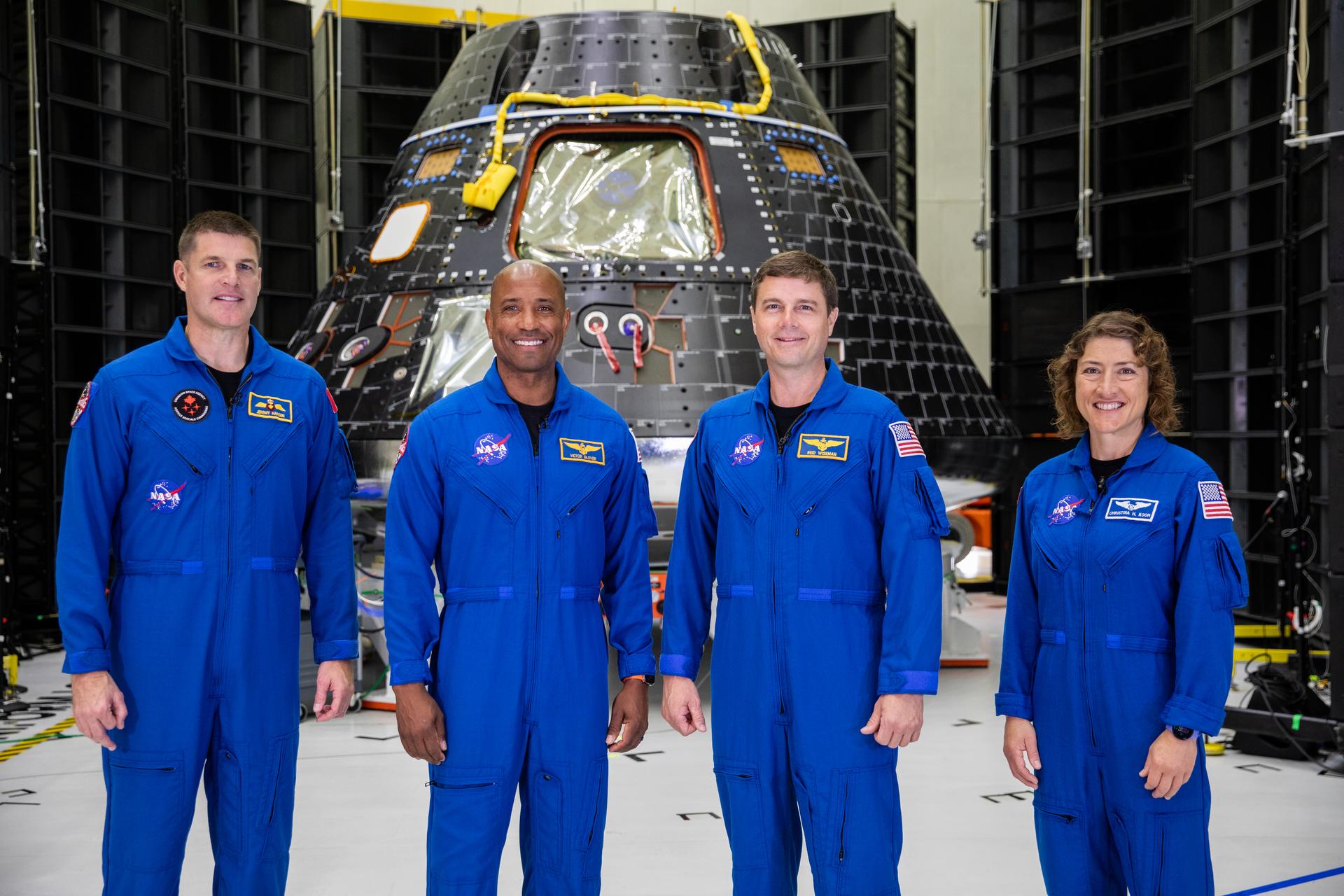
    Artemis II crew members, shown inside the Neil Armstrong Operations and Checkout Building at NASA’s Kennedy Space Center in Florida, stand in front of their Orion crew module on Aug. 8, 2023. From left are: Jeremy Hansen, mission specialist; Victor Glover, pilot; Reid Wiseman, commander; and Christina Hammock Koch, mission specialist.

    On NASA’s upcoming Artemis II mission, four astronauts will fly inside the Orion spacecraft and venture around the Moon, becoming the first to lay their eyes on our celestial neighbor at a relatively close distance in more than 50 years.

    Orion will be home for NASA astronauts Reid Wiseman, Victor Glover, and Christina Koch, and Canadian Space Agency (CSA) astronaut Jeremy Hansen during their 600,000-mile, nearly 10-day journey. They will live and work in Orion’s crew module while its service module provides the essential commodities astronauts need to stay alive, including potable water and nitrogen and oxygen to breathe.

    As the first time astronauts will fly aboard Orion, Artemis II will include several objectives to check out many of the spacecraft’s life support systems operating in space for the first time. The crew will provide valuable feedback for future Artemis missions to the Moon.
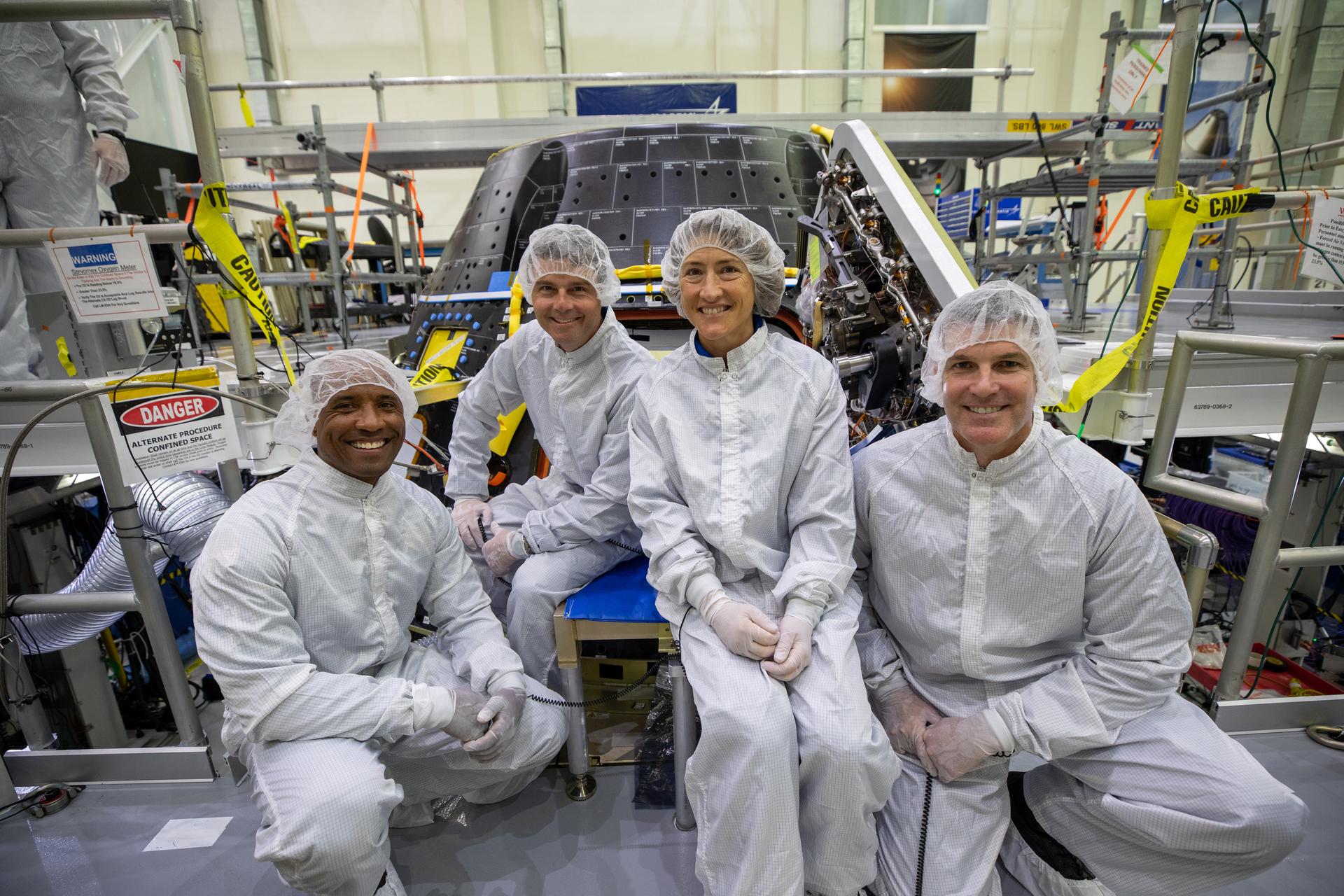
    Artemis II crew members inspect their Orion crew module inside the high bay of the Neil A. Armstrong Operations and Checkout Building at NASA’s Kennedy Space Center in Florida, on Aug. 7, 2023.

    Spacecraft Life

    Orion’s cabin has a habitable volume of 330 cubic feet, giving the crew about as much living space as two minivans. After their ride to space atop NASA’s SLS (Space Launch System) rocket, the crew will stow Koch and Hansen’s seats until the day of return, giving them more room to move around during the flight. The backs of Wiseman and Glover’s seats, as commander and pilot respectively, will remain out but their foot pans will be stowed. Orion has nearly 60 percent more space than the Apollo command module’s 210 cubic feet.
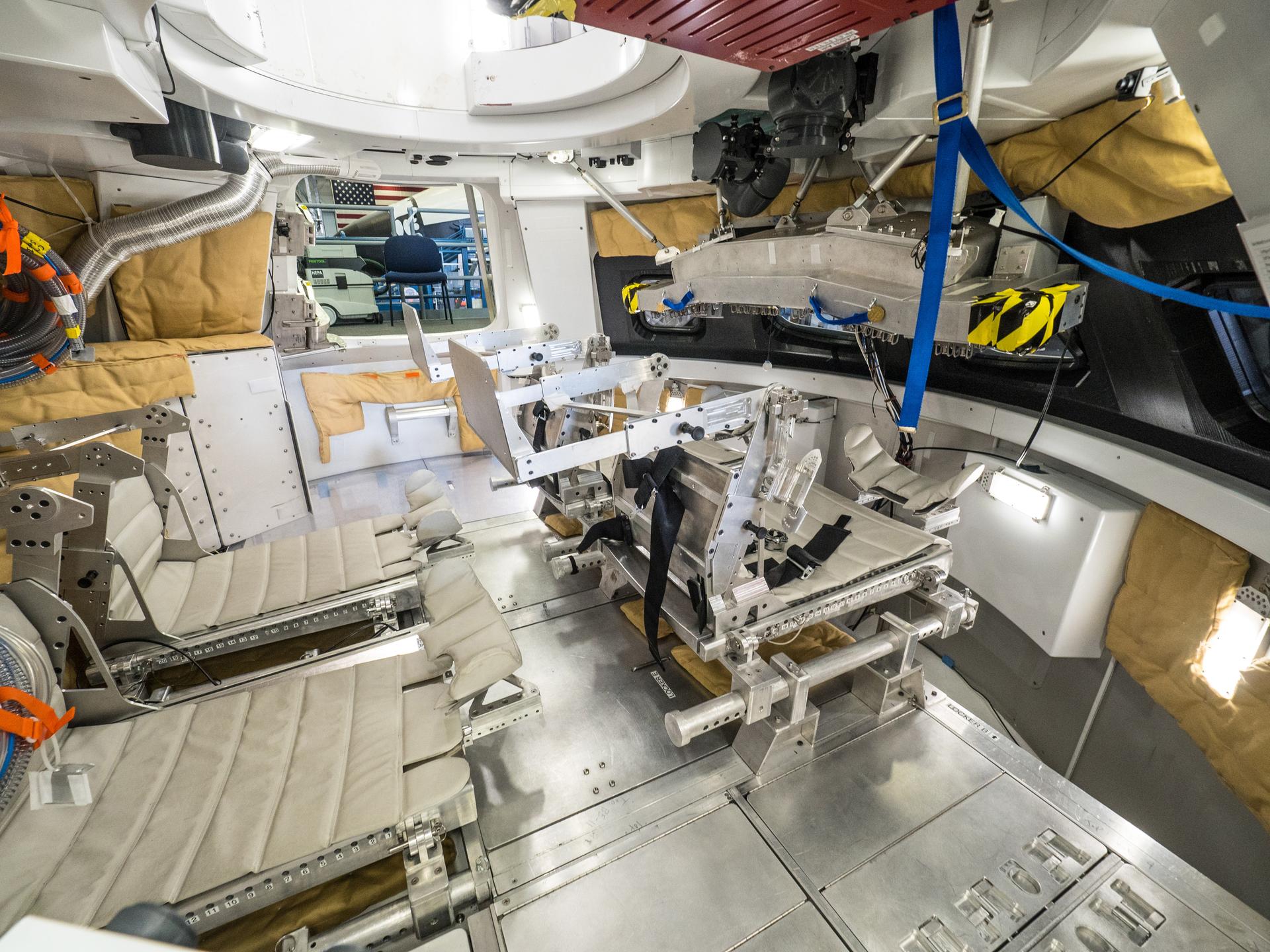
    A view of the interior of the Orion spacecraft medium-fidelity mockup used for astronaut training and systems familiarization at NASA’s Johnson Space Center in Houston.

    What’s on the Menu?

    Food scientists in the Space Food Systems Laboratory at the agency’s Johnson Space Center in Houston are working with the crew to pre-select their meals long before departing Earth. While they won’t have the day-to-day options that a space station crew has during their expeditions, the Artemis II astronauts will have a set menu based on their personal preferences and nutritional needs. Orion is outfitted with a water dispenser and food warmer to rehydrate and heat food, and the crew will have dedicated meal times in their schedule to refuel.

    Artemis II crew members undergo food testing in the Space Food Systems Laboratory at NASA’s Johnson Space Center, where they rate and choose foods that they want to bring with them on their journey around the Moon.
    NASA/James Blair

    Fit for Flight

    Each astronaut will dedicate 30 minutes daily to exercise, minimizing the muscle and bone loss that occurs without gravity. Orion is equipped with a flywheel, a small device installed directly below the side hatch used to enter and exit Orion and will conveniently be used as a step when the crew get inside Orion on launch day. The flywheel is a simple cable-based device for aerobic exercises like rowing and resistance workouts like squats and deadlifts. It works like a yo-yo, giving astronauts as much load as they put into it, maxing out at 400 pounds.

    On the International Space Station, astronauts have several exercise machines that collectively weigh more than 4,000 pounds and occupy about 850 cubic feet. While effective for space station crew members, Orion’s exercise equipment must accommodate more stringent mass and volume constraints. The flywheel weighs approximately 30 pounds and is slightly smaller than a carry-on suitcase.  

    The Artemis II crew will exercise on Orion using a flywheel, a simple cable-based device for aerobic exercises like rowing and resistance workouts like squats and deadlifts. It works like a yo-yo, giving astronauts as much load as they put into it, maxing out at 400 pounds.

    Keeping it Clean

    The hygiene bay includes doors for privacy, a toilet, and space for the crew to bring in their personal hygiene kits. The kits typically include items like a hairbrush, toothbrush and toothpaste, soap, and shaving supplies. Astronauts can’t shower in space but use liquid soap, water, and rinseless shampoo to remain clean.

    When nature inevitably comes calling, crew members will use Orion’s toilet, the Universal Waste Management System, a feature Apollo crews did not have. Nearly identical to a version flying on  NASA’s space station, the system collects urine and feces separately. Urine will be vented overboard while feces are collected in a can and safely stowed for disposal upon return.

    Should the toilet malfunction, the crew will be able to use collapsible contingency urinals, a system that collects urine in a bag and interfaces with the venting system to send the urine overboard. With two different styles designed to accommodate both females and males, the bags hold about a liter of urine each. Should the UWMS fail, the crew will still use the toilet for fecal collection, only without the fan that helps with fecal separation.
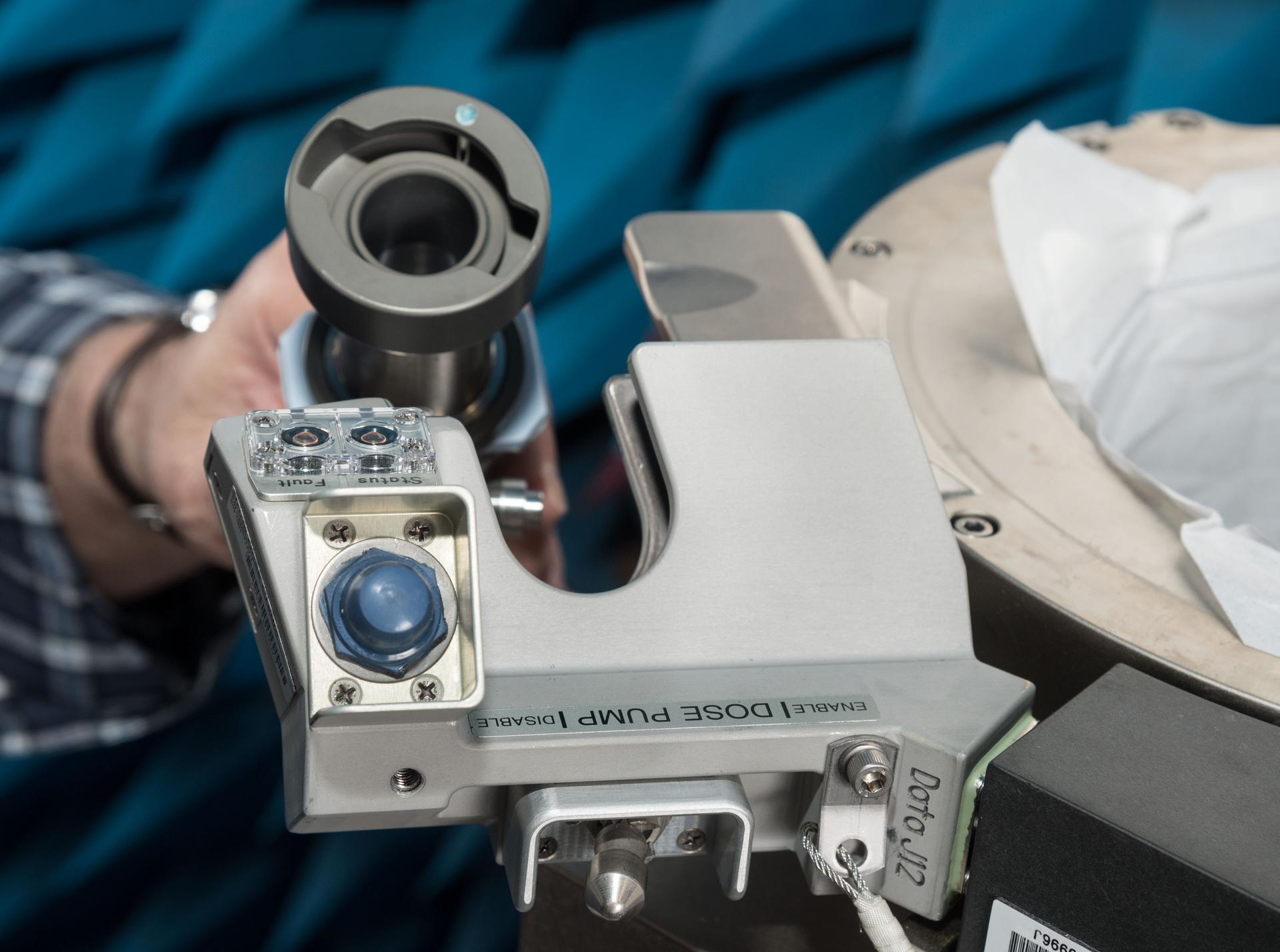
    A team member at Johnson Space Center in Houston demonstrates lifting the urine hose of the Universal Waste Management System out of its cradled position like a crew member would for use. A funnel (not shown) is attached to the open end of this hose and can then be easily replaced or removed for disinfection. 

    Medical Care

    In case of minor medical needs during the mission, Orion will have a medical kit on board that includes everything from basic first aid items to diagnostic tools, such as a stethoscope and an electrocardiogram, that can be used to provide data to physicians on the ground. The crew will also have regular private medical conferences with flight surgeons in mission control to discuss their health and well-being.

    Catching Some Shuteye

    With a jam-packed schedule, the Artemis II crew will have a full eight hours of sleep built into their schedule to ensure they’re well rested and can make the most of their mission. For most of the mission, all four crew will sleep at the same time, attaching sleeping bags to Orion’s walls for some shuteye.

    Artemis II crew sleeping bag configurations are tested in the Orion spacecraft medium-fidelity mockup at NASA’s Johnson Space Center in Houston, used for astronaut training and systems familiarization.

    Keeping in Touch

    Inside Orion, the astronauts will use a handheld microphone and speaker or wear a headset to communicate with mission controllers, conduct medical checks with flight physicians, and catch up with their families. The crew will also have tablets and laptops they can use to review procedures and load entertainment onto before launch.

    Artemis II will confirm all Orion’s systems operate as designed with crew aboard in the actual environment of deep space. The mission will pave the way for future lunar surface missions, including by the first woman and first person of color, establishing long-term lunar science and exploration capabilities, and inspire the next generation of explorers – The Artemis Generation.

    About the Author

    Erika Peters

    Erika Peters

  • NASA’s Perseverance Captures Dust-Filled Martian Whirlwind

    3 min read

    NASA’s Perseverance Captures Dust-Filled Martian Whirlwind

    NASA’s Perseverance rover captured this Martian dust devil moving east to west
    NASA’s Perseverance rover captured this Martian dust devil moving east to west at a clip of about 12 mph (19 kph) along “Thorofare Ridge” on Aug. 30. The video, which was sped up 20 times, is composed of 21 frames taken four seconds apart. It was enhanced in order to show maximal detail.
    NASA/JPL-Caltech

    The six-wheeled geologist spotted the twister as part of an atmospheric exploration of Jezero Crater.

    The lower portion of a Martian dust devil was captured moving along the western rim of Mars’ Jezero Crater by NASA’s Perseverance rover on Aug. 30, 2023, the 899th Martian day, or sol, of the mission. The video, which was sped up 20 times, is composed of 21 frames taken four seconds apart by one of the rover’s Navcams.

    Much weaker and generally smaller than Earth’s tornadoes, dust devils are one of the mechanisms that move and redistribute dust around Mars. Scientists study them to better understand the Martian atmosphere and improve their weather models.

    Using data from the imagery, mission scientists determined that this particular dust devil was about 2.5 miles (4 kilometers) away, at a location nicknamed “Thorofare Ridge,” and moving east to west at about 12 mph (19 kph). They calculated its width to be about 200 feet (60 meters). And while only the bottom 387 feet (118 meters) of the swirling vortex are visible in the camera frame, the scientists could also estimate its full height.

    “We don’t see the top of the dust devil, but the shadow it throws gives us a good indication of its height,” said Mark Lemmon, a planetary scientist at the Space Science Institute in Boulder, Colorado, and a member of the Perseverance science team. “Most are vertical columns. If this dust devil were configured that way, its shadow would indicate it is about 1.2 miles (2 kilometers) in height.”

    Dust devils, which occur on Earth as well, form when rising cells of warm air mix with descending columns of cooler air. The Martian versions can grow to be much larger than those found on Earth. And while they are most prominent during the spring and summer months (Mars’ northern hemisphere, where Perseverance is located, is currently in summer), scientists can’t predict when they’ll appear at a specific location. So Perseverance and its fellow NASA Mars rover Curiosity routinely monitor in all directions for them, taking images in black-and-white to reduce the amount of data sent to Earth.

    More About the Mission

    A key objective for Perseverance’s mission on Mars is astrobiology, including the search for signs of ancient microbial life. The rover will characterize the planet’s geology and past climate, pave the way for human exploration of the Red Planet, and be the first mission to collect and cache Martian rock and regolith (broken rock and dust).

    Subsequent NASA missions, in cooperation with ESA (European Space Agency), would send spacecraft to Mars to collect these sealed samples from the surface and return them to Earth for in-depth analysis.

    The Mars 2020 Perseverance mission is part of NASA’s Moon to Mars exploration approach, which includes Artemis missions to the Moon that will help prepare for human exploration of the Red Planet.

    JPL, which is managed for NASA by Caltech in Pasadena, California, built and manages operations of the Perseverance rover.

    For more about Perseverance:

    mars.nasa.gov/mars2020/

    DC Agle
    Jet Propulsion Laboratory, Pasadena, Calif.
    818-393-9011
    agle@jpl.nasa.gov

    Karen Fox / Alana Johnson
    NASA Headquarters, Washington
    202-358-0668 / 202-672-4780
    alana.r.johnson@nasa.gov / karen.c.fox@nasa.gov

    2023-138

  • Huntsville Symphony String Quartet Performs at Marshall

    1 min read

    Huntsville Symphony String Quartet Performs at Marshall

    By Jessica Barnett 

    NASA Marshall Space Flight Center team members were treated to a special 30-minute performance by musicians from the Huntsville Symphony Orchestra inside Activities Building 4316 on Sept. 21.

    The string quartet included two violinists, a violist, and a cellist performing several recognizable classical compositions, including Gershwin’s “Summertime” and Mouret’s “Rondeau.”

    A string quartet of musicians from the Huntsville Symphony Orchestra performs in Marshalls Activities Building 4316 on Sept. 21. The musicians are, from left, Jennifer Whittle, Joe Lester, Charles Hogue, and Ariana Arcu.
    A string quartet of musicians from the Huntsville Symphony Orchestra performs in Marshall’s Activities Building 4316 on Sept. 21. The musicians are, from left, Jennifer Whittle, Joe Lester, Charles Hogue, and Ariana Arcu. 
    Credits: NASA/Christopher Blair

    The performance was part of “Symphony in the City,” an educational and outreach campaign providing free live performances throughout North Alabama. The string quartet performed earlier that afternoon inside the Java Café for Redstone Arsenal personnel.

    The Huntsville Symphony Orchestra originally began performing in 1955 and today serves as a 501(c)(3) nonprofit organization offering concerts, educational programs and more with leading musicians from around the world. 

    Barnett, a Media Fusion employee, supports the Marshall Office of Communications.

    Details

    Last Updated

    Sep 29, 2023

    Related Terms

  • NASA’s First Asteroid Sample Has Landed, Now Secure in Clean Room

    After years of anticipation and hard work by NASA’s OSIRIS-REx (Origins, Spectral Interpretation, Resource Identification and Security – Regolith Explorer) team, a capsule of rocks and dust collected from asteroid Bennu finally is on Earth. It landed at 8:52 a.m. MDT (10:52 a.m. EDT) on Sunday, in a targeted area of the Department of Defense’s Uta

  • NASA Scientists to Discuss Oct. 14 'Ring of Fire' Solar Eclipse

    NASA will host a media teleconference at 4 p.m. EDT on Tuesday, Sept. 26, to discuss the upcoming annular solar eclipse. The annular eclipse will cross the U.S. from Oregon to Texas on Saturday, Oct. 14, with a partial solar eclipse visible throughout the contiguous U.S.

  • Public Invited to NASA’s Goddard Visitor Center to Celebrate Historic Asteroid Sample Delivery

    The public is invited to a watch party at NASA’s Goddard Visitor Center, Greenbelt, Maryland to celebrate the first U.S. mission, OSIRIS-REx, to collect a sample from an asteroid and deliver it to Earth on Sept. 24, 2023.

  • NASA to Reveal Asteroid Sample Grabbed in Space, Delivered to Earth

    The first asteroid sample collected in space and brought to Earth by the United States will be unveiled at NASA’s Johnson Space Center in Houston on Wednesday, Oct. 11, and media accreditation is now open.

  • NASA Completes Last OSIRIS-REx Test Before Asteroid Sample Delivery

    A team led by NASA in Utah’s West Desert is in the final stages of preparing for the arrival of the first U.S. asteroid sample – slated to land on Earth in September.

  • La NASA invita a los medios al lanzamiento de Psyche

    Ya está abierto el proceso de acreditación de los medios de comunicación para el próximo lanzamiento de la nave espacial Psyche de la NASA en su misión a un asteroide único y rico en metales que orbita alrededor del Sol, entre Marte y Júpiter.

  • NASA Invites Media to Psyche Launch, Mission will Study an Asteroid

    Media accreditation is now open for the upcoming launch of NASA’s Psyche spacecraft, for a mission to a unique metal-rich asteroid orbiting the Sun between Mars and Jupiter.

  • NASA to Host Media for Asteroid Capsule Drop Test Briefing in Utah

    Media are invited to Utah’s western desert on Wednesday, Aug. 30, to learn about NASA preparations and readiness to receive America’s first asteroid sample collected in space.

  • Join NASA to Celebrate Webb Space Telescope’s First Year of Science

    NASA is commemorating the first year of science and discoveries from the agency’s James Webb Space Telescope, the largest, most powerful, and most complex space telescope ever built. To celebrate the anniversary, multiple events will take place online and live across the U.S.

  • NASA Hosts OSIRIS-REx Sample Lab Media Day in Houston

    Ahead of the first asteroid sample collected by the U.S. arriving on Earth in September, media are invited on Monday, July 24, to see NASA’s newly-built OSIRIS-REx Sample Curation Laboratory where the agency will study the sample at its Johnson Space Center in Houston.