Help Improve Federal Agency Forecasts of Procurement Opportunities
Help Improve Federal Agency Forecasts of Procurement Opportunities
The Office of Federal Procurement Policy in the Office of Management & Budget, Executive Office of the President, is hosting a three-week crowdsourcing campaign to seek feedback and preview changes under consideration for agency forecasts of procurement opportunities.
All are welcome to participate. We are especially interested in private sector input, including feedback from current and prospective vendors, to understand:
How well do the changes that the Federal Government is considering for agency forecasts of procurement opportunities resonate with your business needs?
Participate in the campaign any time October 3 – 31, 2023 to share your feedback on the changes under consideration.
Your contributions will help shape plans and activities to ensure that Federal agency forecasts of procurement opportunities are strategic tools for business success.
Thank you and we look forward to your feedback!
Christine Harada
Senior Advisor Office of Federal Procurement Policy Office of Management & Budget Executive Office of the President
NASA will open its gates to the public Saturday, Oct. 14, celebrating the agency’s 65th anniversary, the International Space Station’s 25th anniversary, and upcoming Artemis missions to the Moon.
Media interested in participating in the event at NASA’s Johnson Space Center in Houston must request credentials from the Johnson newsroom at 281-483-5111 or jsccommu@mail.nasa.gov, no later than 12 p.m. Friday, Oct. 13. Media must check in upon arrival at the Johnson newsroom in Building 2N, where additional background materials will be available, and interviews may be requested.
To help ensure an enjoyable visit for everyone when they drive through the center’s main gate from 9 a.m. to 2:30 p.m. CDT, NASA Johnson is asking visitors to abide by the following guidelines:
No backpacks, drones, coolers, food, or beverages (including alcohol) are permitted
No pets (unless certified service dog)
No firearms, weapons, or ammunition (includes license to carry)
Motorcycle helmets are required on NASA property
Entry into, continued presence on, or exit from the facility is contingent upon your consent to inspection of person or property
Download the NASA SAFE app for information on parking, entry process, policies, maps, frequently asked questions, and emergency response
During the open house, visitors will get a free, behind-the-scenes look at some of the agency’s most historic accomplishments, and the exciting work happening right now as NASA returns humans to the Moon and ultimately prepares for exploration of Mars. The incoming gate will close at 2:30 p.m. and visitors will be allowed to remain on site until 3 p.m.
See a full list of what will be open and a map that includes parking, at:
Visitors will have access to a variety of exhibits and hardware, ranging from Moon rocks collected during the Apollo missions, to full-size mockups of the International Space Station, NASA’s Orion spacecraft, and Gateway lunar space station. Guests also will have opportunities to meet astronauts and learn more about how human spaceflight missions are managed from Mission Control, Houston.
Guests may also take advantage of an exciting opportunity to view an annular eclipse — also known as a “ring of fire” eclipse — of the Sun.
In addition to facilities and exhibits, the center’s Teague Auditorium will feature programs and speakers from 9:30 a.m. through 3 p.m.
NASA opened for business Oct. 1, 1958, following the signing of the agency’s founding legislation on July 29, 1958. After four decades that saw dozens of short-duration missions to the Moon and low Earth orbit, NASA and its international partners launched the first element of the International Space Station on Nov. 20, 1998, setting the stage for continuous human presence in space, which began in 2000.
Visitors are welcomed year-round through Johnson’s official visitor center, Space Center Houston, which provides tram tours and visits inside several key facilities. However, this open house will allow visitors to have access to several locations not accessible during visitor center tours.
Connect with Johnson Space Center on social media at:
iss070e00391 (Sept. 28, 2023) — NASA astronaut and Expedition 70 Flight Engineer Loral O’Hara removes space physics research hardware from inside the Destiny laboratory module’s Microgravity Science Glovebox aboard the International Space Station.
iss070e000500 (Sept. 29, 2023) — ESA (European Space Agency) astronaut and Expedition 70 Commander Andreas Mogensen works on a spacesuit with his nation’s flag patch (Mogensen is from Denmark) inside the Quest airlock aboard the International Space Station.
iss070e000501 (Sept. 29, 2023) — NASA astronaut and Expedition 70 Flight Engineer Loral O’Hara sets up an exercise cycle for a workout session inside the Destiny laboratory module aboard the International Space Station.
OSIRIS-REx Asteroid Sample Return lid opening at Building 31 Astromaterials Curation Facility.
NASA
Following a public unveiling of the United States’ first asteroid sample at 11 a.m. EDT Wednesday, Oct. 11, NASA will host a media teleconference and separate in-person interviews in English and Spanish with experts from the agency and the University of Arizona.
The OSIRIS-REx (Origins, Spectral Interpretation, Resource Identification and Security – Regolith Explorer) spacecraft capped its seven-year mission on Sunday, Sept. 24, with the delivery of a pristine sample of surface material from asteroid Bennu.
The unveiling event at NASA’s Johnson Space Center in Houston will air live on NASA TV, the NASA app, and the agency’s website.
The media teleconference will begin at 2:30 pm EDT and include members of the OSIRIS-REx science team. Audio of the call will stream live at:
In addition, subject matter experts are available for interviews beginning at 2:30 p.m. CDT (3:30 p.m. EDT), Oct. 11, in-person and remotely:
Maritza Montoya, OSIRIS-REx sample processor, NASA Johnson (Spanish speaker)
Ann Nguyen, OSIRIS-REx scientist, NASA Johnson
Kimberly Allums, OSIRIS-REx Jacobs Engineering project lead, NASA Johnson
Salvador Martinez III, OSIRIS-REx lead technology development engineer, NASA Johnson (Spanish speaker)
Daniel Glavin, senior scientist, NASA’s Goddard Space Flight Center
Dante Lauretta, OSIRIS-REx principal investigator, University of Arizona
The following morning, subject matter experts also will be available for interviews beginning at 5:30 a.m. CDT (6:30 a.m. EDT) Oct. 12:
Lindsay Keller, OSIRIS-REx scientist, NASA Johnson
Maritza Montoya, OSIRIS-REx sample processor, NASA Johnson (Spanish speaker)
Daniel Glavin, senior scientist, NASA Goddard
Salvador Martinez III, OSIRIS-REx lead technology development engineer, NASA Johnson (Spanish speaker)
Kathleen Vander Kaaden, NASA’s Science Mission Directorate chief scientist for astromaterials curation, NASA Headquarters
Please contact the NASA Johnson newsroom for any of these opportunities at 281-483-5111 or jsccommu@mail.nasa.gov. Media interested in participating in the call must request participation no later than two hours prior to the start time, and are asked to dial-in 15 minutes early as well. The deadline to request in-person or remote one-on-one interviews is Friday, Oct. 6.
In between the OSIRIS-REx media events on Oct. 11, the agency also will host a prelaunch news conference at 1 p.m. to discuss its upcoming Psyche mission to a metal-rich asteroid. That event will air live on NASA TV, the NASA app, and the agency’s website.
NASA Johnson houses the world’s largest collection of astromaterials from the solar system under one roof, including samples from asteroids, comets, Mars, the Moon, Sun, and dust from other stars. Scientists use world-class laboratories to perform research on planetary materials and the space environment to investigate the origin and evolution of our solar system and beyond.
Goddard Earth Science Projects Featured at the American Geophysical Union
Welcome to the 2022 AGU
It felt like the first day at a new school – scrambling out of the car in the carpool lane, backpacks swinging over our shoulders, then facing the large entryway of the new and daunting building. For a week in December, nearly 23,000 people roam the large Chicago convention center where the 2022 American Geophysical Union (AGU) Fall Meeting conference was held.
I was one of those several thousand people. As a young professional who only recently graduated from college, this was my first conference, and an impressive one to start out on at that. I’ve always yearned for knowledge and had a desire to learn. AGU is one of the places where new information is never in short supply.
That’s me, Erica, in the middle. And those other excited people are my work friends (also NASA communications folks).
AGU is a hub for Earth science research presentations. Scientists from ranges of backgrounds gather at the conference annually to share, discuss, and disseminate information on a wide variety of topics all relating back to one thing we all have in common – Earth. Topics span from global environmental change and natural hazards to atmospheric sciences and ocean sciences, and much more.
To research those topics, scientists need data. So much of that data about Earth comes from satellites that are way up in space, looking back at the planet where they were made. And that’s where my job comes in.
I’m the staff writer for the Earth Science Projects Division at NASA’s Goddard Space Flight Center. I have the unique privilege of working with the people who design and build many of those spacecraft and instruments that are up in space, delivering crucial data. Eventually, those data get pulled into intense geoscience research, and for many of those researchers, the AGU conference is the pinnacle of platforms.
Dr. Tom Neumann, Deputy Director of the Earth Sciences Division at NASA Goddard Space Flight Center speaks at the AGU 2022
After it was confirmed that I was going, both excitement and nerves fell into place. Colleagues who had attended the conference before me offered their thoughts and recommendations, and almost every person acknowledged a key feature to the conference: its size. “It’s huge!” “It’s massive!” “There’s so much happening, and you’ll want to see it all – you won’t know where to start!”
I always nodded and accepted their statements, but truly all I could think was that they must be exaggerating. How big could this conference really be?
As I walked through the doors into the convention center, all notions of exaggeration fell away immediately. The hall was indeed massive and even though the conference had scarcely begun, there were crowds of people navigating the corridors just like I was. For as large as the hall was, it was filled to the brim with a feeling of excitement and a buzz of knowledge – so much so it was almost palpable.
Walking though the poster hall, I was blown away by how many presentations shared the NASA symbol on their poster boards, and it brought me a sense of both humility and joy knowing that the work that I do is somehow connected to these scientists around me. Not only were there NASA scientists in attendance, but also student scientists who utilize Goddard data for their research.
Dr. Doug Morton, chief of the Biospheric Sciences Laboratory at NASA’s Goddard Space Flight Center.
Dr. Doug Morton, chief of the Biospheric Sciences Laboratory at NASA’s Goddard Space Flight Center.
The Landsat series
Landsat 9, the latest of the series, was developed at Goddard and launched in September 2021. With over 50 years of Landsat data and imagery available, the long timeline becomes a beneficial asset to many types of research. Nicole Abib, Ph.D. candidate at the University of Oregon, used the expanse of Landsat data for her research on the properties of ice mélange – dense packs of icebergs and sea ice – in Greenland’s fjords. With the time series of Landsat data, Abib relayed that she was able to visualize the ice mélange in the fjords, an important step in understanding how its properties vary around the ice sheet, and how this has or has not changed over time.
Landsat data made frequent appearances in the rows of poster presentations in the cavernous hall. One poster easily caught the eyes of curious spectators, as well as my own, with the beautiful background imagery of snow. Chase Mueller, remote sensing data scientist and contractor to the U.S. Geological Survey, explained to onlookers about how Landsat data is an essential tool in learning about snowmelt runoff and its effects. The large timeline of data is valuable in creating models to help with the prediction of the phenomena.
“This work aims to improve access to snow runoff modeling through the utilization of a commercial cloud compute environment while leveraging the higher resolution of Landsat data,” Mueller said. “It will help users better characterize the role of high mountain snowpacks on regional water supplies.”
Ice, Cloud, and land Elevation Satellite-2
Across the convention center (an actual 10-minute walk away yet all in the same building, just another reminder of how huge this conference is), another mission with an impressive timeline shares how its data has been used in variation for different topics of research. The four-plus years of elevation data from the Ice, Cloud, and land Elevation Satellite-2 (ICESat-2) mission have provided an extensive amount of data – the latitude, longitude, and height for every laser photon sent down to Earth and received back by the satellite.
Nicole Abib, Ph.D. candidate at the University of Oregon.
“The real power of this data is the aggregation of data over space and time,” said Tom Neumann, project scientist for ICESat-2 at Goddard, said during a town hall on the mission.
With the limitations of time being the only reason why the town hall didn’t last hours to discuss all the research using ICESat-2 data, a few examples were presented to the group. The data helped reveal results on a range of topics, including sea ice thickness and a new record low for Antarctic Sea ice extent in February 2022. Spanning farther than just ice, ICESat-2 data also helped scientists understand canopy heights of the forests of Texas and Alabama, which are used to assess forest degradation and habitat suitability.
As ICESat-2 continues orbiting and collecting data, the masses of data points will become even more accessible as it is transferred into the cloud.
“With all the ICESat-2 data as well as many other satellite data now at your fingertips, we are approaching a new era of doing science,” said Thorsten Markus, cryosphere program scientist at NASA Headquarters in Washington, DC.
As I absorbed as much information as possible walking around the convention center, I couldn’t help but to think about where this data originated, and what the future will look like as new and different satellites continue to collect more data. Missions that are just in the beginning stages – either being meticulously constructed by engineering teams or are even just a thought in the minds of scientists and engineers – will one day have presentations like these, and viewers like me ready to learn.
Some researchers and data users are looking to future orbiting observatories for even more precise measurements, such as the Plankton, Aerosol, Cloud, and ocean Ecosystem (PACE) mission, scheduled to launch in January 2024.
Noah Sienkiewicz, Ph.D. candidate at the University of Maryland, Baltimore County.
Shana Mattoo, a senior programmer at NASA Goddard, shared how she and her colleagues used a combination of Visible Infrared Imaging Radiometer Suite and Tropospheric Monitoring Instrument data to help prepare an algorithm for PACE’s Ocean Color Instrument, which will singlehandedly measure the full expanse of light wavelengths that that previously required a combination of datasets. Similarly, Noah Sienkiewicz, Ph.D. candidate at the University of Maryland, Baltimore County, explained to the audience how he used previous versions of the Hyper-Angular Rainbow Polarimeter (HARP) to help calibrate another PACE instrument, the new HARP2.
Shana Mattoo, senior programmer at NASA Goddard Space Flight Center.
Atmosphere Observing System
A bit further into the future is the Atmosphere Observing System (AOS), part of the Earth System Observatory, a set of satellites all aiming to view Earth from different perspectives. AOS, though still early in its planning stages, will look to measure the aerosols, clouds, atmospheric convection, and precipitation in Earth’s atmosphere. The measurements will ultimately help the understanding of weather and climate.
I only was able to glimpse what this conference had to offer, and though I tried to take in as much of it as possible, there is so much more out there for me to learn, and I am eager to do so. Though the conference itself was expansive, there’s a whole world out there to cover, and each of these presentations, posters, or sessions highlighted details of our home planet and the universe beyond. The understanding of the planet grows as more research is completed, and the information provided by Goddard Earth science projects is essential to that growth.
NASA’s Hubble Finds Bizarre Explosion in Unexpected Place
This is an artist’s concept of one of brightest explosions ever seen in space. Called a Luminous Fast Blue Optical Transient (LFBOT), it shines intensely in blue light and evolves rapidly, reaching peak brightness and fading again in a matter of days, unlike supernovae which take weeks or months to dim. Only a handful of previous LFBOTs have been discovered since 2018. And they all happen inside galaxies where stars are being born. But this illustration shows that Hubble discovered the LFBOT flash seen in 2023 happened between galaxies. This only compounds the mystery of what these transient events are. Because astronomers don’t know the underling process behind LFBOTs, the explosion shown here is purely conjecture based on some known transient phenomenon.
NASA, ESA, NSF’s NOIRLab, Mark Garlick , Mahdi Zamani
A very rare, strange burst of extraordinarily bright light in the universe just got even stranger – thanks to the eagle-eye of NASA’s Hubble Space Telescope.
The phenomenon, called a Luminous Fast Blue Optical Transient (LFBOT), flashed onto the scene where it wasn’t expected to be found, far away from any host galaxy. Only Hubble could pinpoint its location. And, the results are leaving astronomers even more confounded. To start with, they don’t know what LFBOTs are. The Hubble results suggest they know even less by ruling out some possible theories.
LFBOTs are among the brightest known visible-light events in the universe – going off unexpectedly like camera flashbulbs. Only a handful have been found since the first discovery in 2018 – an event located about 200 million light-years away that was nicknamed “the Cow.” Presently, LFBOTs are detected once per year.
After its initial detection, the latest LFBOT was observed by multiple telescopes across the electromagnetic spectrum, from X-rays to radio waves. Designated AT2023fhn and nicknamed “the Finch,” the transitory event showed all the tell-tale characteristics of an LFBOT. It shined intensely in blue light and evolved rapidly, reaching peak brightness and fading again in a matter of days, unlike supernovae, which take weeks or months to dim.
But unlike any other LFBOT seen before, Hubble found that the Finch is located between two neighboring galaxies – about 50,000 light-years from a nearby spiral galaxy and about 15,000 light-years from a smaller galaxy.
“The Hubble observations were really the crucial thing. They made us realize that this was unusual compared to the other ones like that, because without the Hubble data we would not have known,” said Ashley Chrimes, lead author of the Hubble paper reporting the discovery in an upcoming issue of the Monthly Notices of the Royal Astronomical Society (MNRAS). He is also a European Space Agency Research Fellow, formerly of Radboud University, Nijmegen, Netherlands.
A NASA Hubble Space Telescope image of a Luminous Fast Blue Optical Transient (LFBOT) designated AT 2023fhn, indicated by pointers. It shines intensely in blue light and evolves rapidly, reaching peak brightness and fading again in a matter of days, unlike supernovae which take weeks or months to dim. Only a handful of previous LFBOTs have been discovered since 2018. The surprise is that this latest transient, seen in 2023, lies at a large offset from both the barred spiral galaxy at right and the dwarf galaxy to the upper left. Only Hubble could pinpoint its location. And, the results are leaving astronomers even more confounded because all prevous LFBOTs have been found in star-formig regions in the spiral arms of galaxy. It’s not clear what astronomical event would trigger such a blast far outside of a galaxy.
NASA, ESA, STScI, Ashley Chrimes (ESA-ESTEC/Radboud University)
While these awesome explosions have been assumed to be a rare type of supernova called core-collapse supernovae, the gargantuan stars that turn into supernovae are short-lived by stellar standards. Therefore, the massive progenitor stars don’t have time to travel very far from their birthing place – a cluster of newborn stars – before exploding. All previous LFBOTs have been found in the spiral arms of galaxies where star birth is ongoing, but the Finch is not in any galaxy.
“The more we learn about LFBOTs, the more they surprise us,” said Chrimes. “We’ve now shown that LFBOTs can occur a long way from the center of the nearest galaxy, and the location of the Finch is not what we expect for any kind of supernova.”
The Zwicky Transient Facility – an extremely wide-angle ground-based camera that scans the entire northern sky every two days – first alerted astronomers to the Finch on April 10, 2023. Once it was spotted, the researchers triggered a pre-planned program of observations that had been on standby, ready to quickly turn their attention to any potential LFBOT candidates that arose.
Spectroscopic measurements made with the Gemini South telescope in Chile found that the Finch is a scorching 36,000 degrees Fahrenheit. Gemini also helped determine its distance from Earth so its luminosity could be calculated. Together with data from other observatories including NASA’s Chandra X-ray Observatory and the National Science Foundation’s ground-based Very Large Array radio telescopes, these findings confirmed the explosion was indeed an LFBOT.
The LFBOTs could be the result of stars being torn apart by an intermediate-mass black hole (between 100 to 1,000 solar masses). NASA’s James Webb Space Telescope‘s high resolution and infrared sensitivity might eventually be used to find that the Finch exploded inside a globular star cluster in the outer halo of one of the two neighboring galaxies. A globular star cluster is the most likely place an intermediate-mass black hole could be found.
To explain the unusual location of the Finch, the researchers are considering the possibility that it is the result of a collision of two neutron stars, travelling far outside their host galaxy, that have been spiraling toward each other for billions of years. Such collisions produce a kilonova – an explosion 1,000 times more powerful than a standard supernova. However, one very speculative theory is that if one of the neutron stars is highly magnetized – a magnetar – it could greatly amplify the power of the explosion even further to 100 times the brightness of a normal supernova.
“The discovery poses many more questions than it answers,” said Chrimes. “More work is needed to figure out which of the many possible explanations is the right one.”
Because astronomical transients can pop up anywhere and at any time, and are relatively fleeting in astronomical terms, researchers rely on wide-field surveys that can continuously monitor large areas of the sky to detect them and alert other observatories like Hubble to do follow-up observations.
A larger sample is needed to converge on a better understanding of the phenomenon, say researchers. Upcoming all-sky survey telescopes, such as the ground-based Vera C. Rubin Observatory, may be able to detect more, depending on the underlying astrophysics.
The Hubble Space Telescope is a project of international cooperation between NASA and ESA. NASA’s Goddard Space Flight Center in Greenbelt, Maryland, manages the telescope. The Space Telescope Science Institute (STScI) in Baltimore, Maryland, conducts Hubble and Webb science operations. STScI is operated for NASA by the Association of Universities for Research in Astronomy, in Washington, D.C.
NASA astronaut Woody Hoburg examines a recently unpacked Astrobee free-flying robot aboard the International Space Station. The Astrobee system is a research platform exploring how robots can maintain spacecraft.
NASA
The International Space Station is abuzz with the return of one of NASA’s Astrobee smart robots. The yellow Honey Astrobee, one of three free-flying robots, was unboxed in space after spending nearly a year at its home base, NASA’s Ames Research Center in California’s Silicon Valley. Honey had returned to Earth in September 2022 for maintenance and repairs.
NASA astronaut Woody Hoburg helped unpack Honey from its flight container and verified the robot was ready to get back to work. After initial checks, Honey was able to independently disengage from its docking station, maneuver through the space station’s Japanese Experiment Module (JEM), and re-dock successfully without crew supervision.
The Astrobee Facility provides the orbiting laboratory with a robotic system for research and STEM (Science, Technology, Engineering, and Mathematics) outreach. Astrobee consists of three cubed-shaped robots, software, and a docking station used for recharging. The robots, which use electric fans as propulsion in the microgravity of the space station, aim to help manage routine spacecraft tasks so that astronauts can focus on jobs that only humans can perform. The project provides payload opportunities as well as guidance to users from academia, private industry, NASA, and other government agencies in the execution of approved research and STEM objectives.
Astrobee was funded by NASA’s Game Changing Development Program, part of the Space Technology Mission Directorate. Ongoing funding is provided by NASA’s International Space Station Utilization Office.
The Mars Reconnaissance Orbiter (MRO) captured this bit of ursine pareidolia on Dec. 12, 2022. While it resembles a bear we might see on Earth, this is actually a hill on Mars with a peculiar shape. A V-shaped collapse structure makes the nose, two craters form the eyes, and a circular fracture pattern shapes the head. The circular fracture pattern might be due to the settling of a deposit over a buried impact crater.
6 Things to Know About NASA’s Asteroid-Exploring Psyche Mission
This illustration depicts NASA’s Psyche spacecraft as it approaches the asteroid Psyche. Once it arrives in 2029, the spacecraft will orbit the metal-rich asteroid for 26 months while it conducts its science investigation.
NASA/JPL-Caltech/ASU
The first-ever mission to study a metal-rich asteroid, Psyche aims to help scientists learn more about the formation of rocky bodies in our solar system.
With a launch readiness date set for Thursday, Oct. 12, NASA’s Psyche spacecraft will travel 2.2 billion miles from NASA’s Kennedy Space Center in Florida to a metal-rich asteroid in the far reaches of the main asteroid belt between Mars and Jupiter. Trailing a blue glow from its thrusters and powered by a pair of massive solar arrays, the orbiter will use its payload of science instruments to learn more about the asteroid Psyche.
Here are six things to know about the mission:
1. Learning more about the asteroid Psyche could tell us more about the origins of our solar system.
Based on data obtained by Earth-based radar and optical telescopes, scientists hypothesize that the asteroid Psyche could be part of the metal-rich interior of a planetesimal, a building block of a rocky planet that never formed. Psyche may have collided with other large bodies during its early formation and lost its outer rocky shell. Humans can’t bore a path to Earth’s metal core, so visiting Psyche could provide a one-of-a-kind window into the history of violent collisions and accumulation of matter that created planets like our own.
Scientists hypothesize that the asteroid Psyche could be part of a building block of the rocky planets in our solar system. Studying it up close could help us understand how rocky planets formed. Join us on the journey to the first metal-rich asteroid humankind has ever visited. Credit: NASA/JPL-Caltech/ASU
2. The asteroid could also suggest a different story of how solar system objects formed.
While rocks on Mars, Venus, and Earth are flush with iron oxides, Psyche’s surface doesn’t seem to feature much of these chemical compounds. This suggests that Psyche’s history differs from standard stories of planetary formation.
If the asteroid proves to be leftover core material from a planetary building block, scientists will learn how its history resembles and diverges from that of the rocky planets. And if scientists discover that Psyche is not an exposed core, it may prove to be a never-before-seen kind of primordial solar system object.
3. Three science instruments and a gravity science investigation will help sort out these solar system origin stories and more.
The spacecraft’s magnetometer will look for evidence of an ancient magnetic field at the asteroid Psyche. A residual magnetic field would be strong evidence the asteroid formed from the core of a planetary body.
The orbiter’s gamma-ray and neutron spectrometer will help scientists determine the chemical elements that make up the asteroid – and better understand how it formed.
The spacecraft’s multispectral imager will provide information about the mineral composition of Psyche as well as its topography.
The mission’s science team will harness the telecommunications system to conduct gravity science. By analyzing the radio waves the spacecraft communicates with, scientists can measure how the asteroid Psyche affects the spacecraft’s orbit. That information will help them determine the asteroid’s rotation, mass, and gravity field, offering additional insights into the composition and structure of the asteroid’s interior.
4. The spacecraft will use a very efficient propulsion system for the first time beyond the Moon.
Powered by Hall-effect thrusters, Psyche’s solar electric propulsion system harnesses energy from large solar arrays to create electric and magnetic fields. These, in turn, accelerate and expel charged atoms, or ions, of a propellant called xenon (a neutral gas used in car headlights and plasma TVs) at such high speed, it creates thrust. The ionized gas, will emit a sci-fi-like blue glow as it trails behind Psyche in space. Each of Psyche’s four thrusters, which will operate one at a time, exert the same amount of force that you would feel holding three quarters in the palm of your hand. In the frictionless void of space, the spacecraft will slowly and continuously accelerate.
This propulsion system builds on similar technologies used by NASA’s Dawn mission, but Psyche will be the agency’s first mission to use Hall-effect thrusters in deep space.
5. Psyche is a collaboration.
The mission draws on resources and know-how from NASA, universities, and industry. The principal investigator, Lindy Elkins-Tanton, is based at Arizona State University. By enabling collaboration with students nationwide, the partnership offers opportunities to train future instrument and mission leads in science and engineering, and to inspire student projects involving art, entrepreneurship, and innovation. Over a dozen other universities and research institutions are represented on the mission team.
NASA’s Jet Propulsion Laboratory in Southern California manages the mission for the agency’s Science Mission Directorate in Washington. Managed for NASA by Caltech in Pasadena, JPL is also responsible for system engineering, integration and test, and mission operations.
NASA’s Launch Services Program at Kennedy Space Center manages launch operations and procured the SpaceX Falcon Heavy rocket.
Maxar Technologies’ team in Palo Alto, California, delivered the solar electric propulsion chassis – the main body of the spacecraft – and most of its engineering hardware systems.
6. The Psyche mission wants you to be part of the journey, too.
Space exploration is for everyone. The mission’s “get involved” webpage highlights activities and opportunities, including an annual internship for college students to interpret the mission through artistic and other creative works, as well as classroom lessons, craft projects, and videos. Information on how to participate in a virtual launch experience is at nasa.gov/specials/virtualguest/.
The mission websites nasa.gov/psyche and psyche.asu.edu will post official news about the spacecraft’s journey. NASA and ASU will also post regular social media updates on Facebook, Instagram, and X.
NASA’s Eyes on the Solar System, a free web-based 3D visualization tool, will track the location of the spacecraft in real time. Visit go.nasa.gov/45k0OVY to see where Psyche is in the solar system.
About two months after launch, as the team performs an initial checkout of the spacecraft and science instruments, the mission expects to receive its first images. Once the team confirms the imager is functioning as expected, a webpage will feature the unprocessed, or raw, images flowing straight from the spacecraft.
A technology demonstration called Deep Space Optical Communications (DSOC) will fly on Psyche in order to test high-data-rate laser communications that could be used by future NASA missions. JPL manages DSOC for the Technology Demonstration Missions program within NASA’s Space Technology Mission Directorate and the Space Communications and Navigation program within the Space Operations Mission Directorate.
Psyche is the 14th mission selected as part of NASA’s Discovery Program, managed by the agency’s Marshall Space Flight Center in Huntsville, Alabama.
The Sun and Moon will work together to put on a celestial show in the skies above North America during two solar eclipses in the months to come. On Saturday, Oct. 14, the Moon will nearly cover the Sun during what’s called an annular solar eclipse, and on April 8, 2024, the Moon will completely block out the Sun during a total solar eclipse. Get ready to make the most of these rare events with this curated list of NASA STEM learning resources and related content, including activities, citizen science opportunities, and more.
Safety First!
First things first! It’s important never to look directly at the Sun, even during a solar eclipse. Protect your eyes with specialized solar viewers, such as eclipse glasses or view the event with a pinhole projector check out these video instructions on how to make your own. You can learn more about eclipse viewing safety here.
What You’ll See
During the annular solar eclipse on Oct. 14, the Moon will appear smaller when it slips in front of the Sun’s disk, leaving a ring of sunlight visible for people on the main path of the eclipse. During the total solar eclipse in April, the Moon will fully block the Sun for a brief time for people on the main path of this eclipse. For both eclipses, people in most of the U.S. can see a partial solar eclipse, even if you’re not on the eclipse’s main path.
Wondering how much of the Sun will be blocked by the Moon where you are? Use this map to find out what the view will be like in your area, since the eclipses will take different paths as they cross the United States.
Anyone can become a citizen scientist and contribute their eclipse observations! Here are two exciting opportunities:
Eclipse Soundscapes: Share your multi-sensory observations and recorded sound data during the upcoming eclipses to help NASA better understand how these events impact ecosystems across the U.S. Learn more about the different options to get involved.
GLOBE Eclipse: Only available when a solar eclipse is happening somewhere in the world, the GLOBE Eclipse tool will prompt users to record air temperature measurements in addition to observations of sky conditions and vegetation at the data collection site. You’ll need to download the GLOBE App to get started.
For the latest fun activities, learning resources, and opportunities to engage with NASA, visit NASA’s Office of STEM Engagement online at: https://stem.nasa.gov
La seguridad es fundamental para la movilidad aérea avanzada
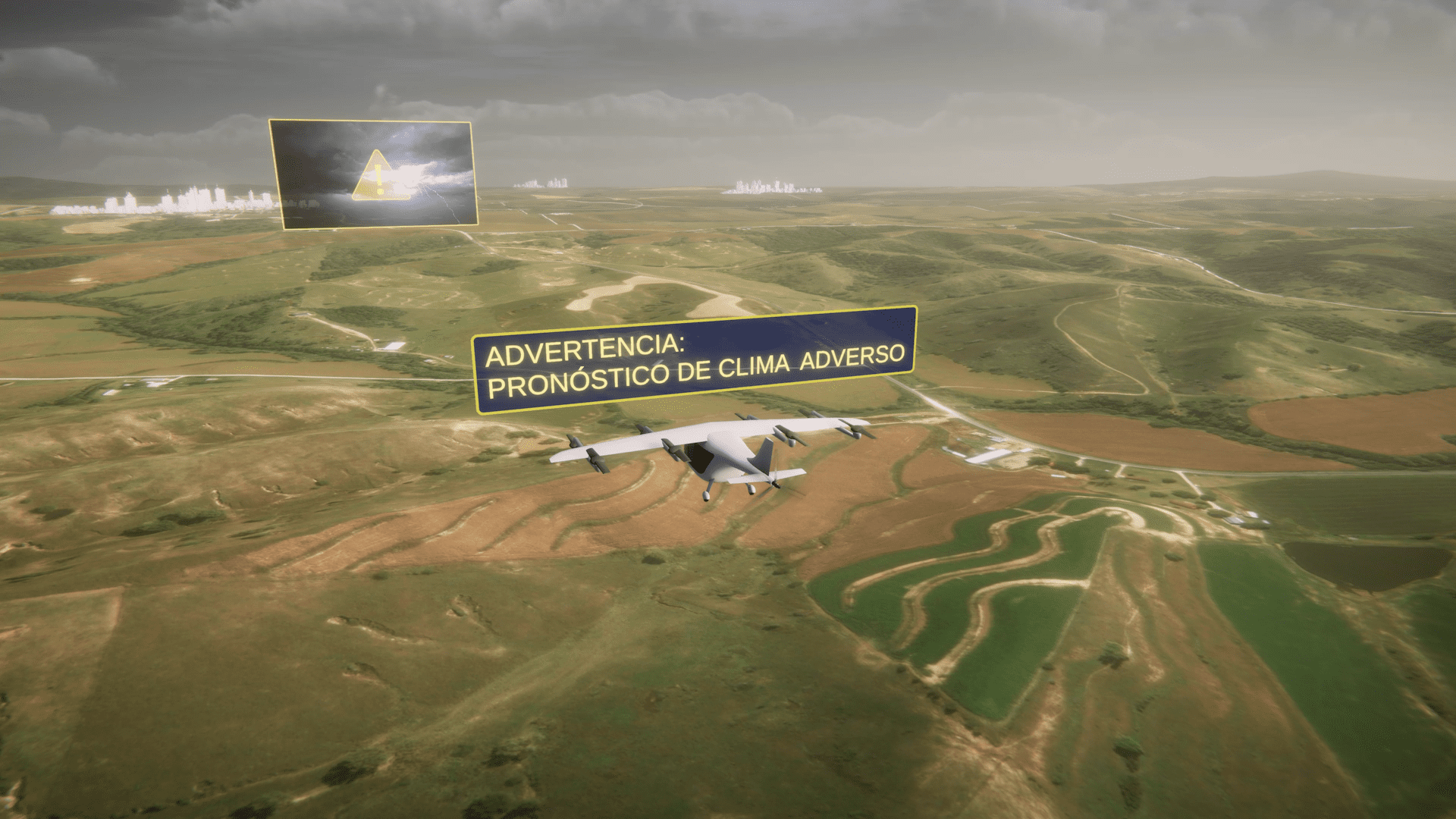
La misión de Movilidad Aérea Avanzada de la NASA contribuye a garantizar la seguridad operativa de esta nueva clase de aviones que está desarrollando la industria. Este arte conceptual representa cómo podría ayudar la incorporación de tecnologías automatizadas a la aeronave, como la evitación de peligros.
Empresas de todo el mundo están creando nuevos e innovadores diseños de aeronaves, como los aviones eléctricos de despegue y aterrizaje vertical (eVTOLs por sus siglas en inglés), y otros conceptos de aeronaves para su uso en la respuesta a emergencias y la entrega de paquetes y carga. Sin embargo, estas aeronaves sólo asomarán por los cielos de Estados Unidos cuando la Administración Federal de Aviación garantice que son seguras para transportar pasajeros o sobrevolar comunidades.
La misión de Movilidad Aérea Avanzada (AAM por sus siglas en inglés) de la NASA está utilizando el intercambio de información, simulaciones, modelado y pruebas de vuelo, para ayudar a la industria a evaluar cómo la automatización, el diseño y las operaciones de los vehículos y otras áreas de investigación pueden integrarse para garantizar que esta nueva clase de vehículos sea segura de operar. Una de las ramas de investigación de esta misión es el proyecto de Sistema de Seguridad Integro de la NASA.
El proyecto de Sistema de Seguridad Integro evalúa cómo la industria aeroespacial y la modernización de las aeronaves afectan a la seguridad. Este enfoque integrado utiliza la tecnología más avanzada para abordar los posibles riesgos operativos y de diseño. Los aviones AAM estarán sumamente automatizados, con sistemas que tomarán decisiones críticas para la seguridad de forma regular. Estas decisiones podrían incluir la percepción y evitación de peligros, así como funciones de manejo de la trayectoria de vuelo que permitan a los vehículos operar sin piloto. O, en el caso de las aeronaves pilotadas, pueden aumentar la seguridad.
El proyecto Sistema de Seguridad Integro está desarrollando una nueva tecnología denominada Sistema de Manejo de Seguridad Aérea Puntual (IASMS por sus siglas en inglés), que automatizará las funciones del manejo de riesgos y seguridad que hoy se realizan manualmente. El IASMS vigilaría continuamente el Espacio Aéreo Nacional, recogiendo datos sobre las aeronaves en vuelo, el manejo del tráfico aéreo, los aeropuertos, las condiciones del terreno y el clima para evaluar los riesgos potenciales. Estos sistemas harían recomendaciones de actuación a controladores aéreos y pilotos, o automáticamente integrarían acciones planificadas. La importancia de la investigación del IASMS aumentará a medida que los eVTOL AAM sumamente automatizados ingresen al espacio aéreo. Se espera que el IASMS proporcione parámetros de rendimiento para vehículos eVTOL, vertipuertos y a los controladores de tráfico aéreo y mejore el conocimiento de la situación para garantizar la seguridad en el aire y en tierra.
El Sistema de Seguridad Integro es sólo un aspecto de la misión AAM de la NASA, que complementa la investigación en automatización, ruido, vertipuertos y diseño de vehículos, así como la integración y el diseño del espacio aéreo para mantener a todos seguros mientras vuelan juntos en el cielo.
This website uses cookies to improve your experience. We'll assume you're ok with this, but you can opt-out if you wish.AcceptRead More
Privacy & Cookies Policy
Privacy Overview
This website uses cookies to improve your experience while you navigate through the website. Out of these, the cookies that are categorized as necessary are stored on your browser as they are essential for the working of basic functionalities of the website. We also use third-party cookies that help us analyze and understand how you use this website. These cookies will be stored in your browser only with your consent. You also have the option to opt-out of these cookies. But opting out of some of these cookies may affect your browsing experience.
Necessary cookies are absolutely essential for the website to function properly. This category only includes cookies that ensures basic functionalities and security features of the website. These cookies do not store any personal information.
Any cookies that may not be particularly necessary for the website to function and is used specifically to collect user personal data via analytics, ads, other embedded contents are termed as non-necessary cookies. It is mandatory to procure user consent prior to running these cookies on your website.