Public Invited to International Observe the Moon Night Oct. 21
NASA
NASA’s Planetary Mission’s Program Office is hosting an International Observe the Moon Night event Saturday, Oct. 21, from 5:30 – 8 p.m. at the U.S. Space & Rocket Center’s Davidson Center for Space Exploration in Huntsville, Alabama. The event is free and open to the public.
This family-friendly event will feature Moon and solar system exhibits along with a variety of hands-on activities for children and adults. The Von Braun Astronomical Society will be outside with telescopes, providing guided tours of the Moon, planets, and other celestial objects for visitors after sunset. Mister Bond & the Science Guys of Nashville will lead space science experiments and Janet Ivey, host of the PBS series “Janet’s Planet,” will give a talk on lunar landers. Other highlights include a LED mirror robot show, face painting, a photo booth, and DJ dance party.
Guests should enter the Davidson Center through the doors facing the parking lot beginning at 5:30 p.m.
International Observe the Moon Night is a worldwide public event that encourages understanding of the Moon and NASA’s mission of exploration and scientific discovery. The U.S. Space & Rocket Center is the official visitor center of NASA’s Marshall Space Flight Center. Marshall manages the Planetary Missions Program Office for the agency’s Science Mission Directorate in Washington.
To participate in International Observe the Moon Night from wherever you may be, check out our official NASA TV broadcast at 7- 8 p.m. EDT here:
On October 14, 2023, the Moon aligned with the Sun and Earth to produce an annular solar eclipse. The spectacle bathed millions of Americans in a lunar shadow as the Moon blocked the Sun’s rays. The above image was acquired during the eclipse by NASA’s Earth Polychromatic Imaging Camera imager aboard the Deep Space Climate Observatory, a joint NASA, NOAA, and U.S. Air Force satellite.
NASA
NASA’s Earth Polychromatic Imaging Camera aboard the Deep Space Climate Observatory (DSCOVR) captured the lunar shadow during the Oct. 14 annular solar eclipse. The sensor provides frequent global views of Earth from its position at Lagrange Point 1, a gravitationally stable point between the Sun and Earth about 1.5 million kilometers from Earth.
DSCOVR is a space weather station that monitors changes in the solar wind, providing space weather alerts and forecasts for geomagnetic storms that could disrupt power grids, satellites, telecommunications, aviation and GPS.
NASA’s Innovative Rocket Nozzle Paves Way for Deep Space Missions
The RAMFIRE nozzle performs a hot fire test at Marshall’s East test area stand 115. The nozzle, made of the novel aluminum alloy 6061-RAM2, experiences huge temperature gradients. As hot gasses approach 6000 degrees Fahrenheit and undergo combustion, icicles are forming on the outside of the engine nozzle.
Credits: NASA
By Ray Osorio
NASA recently built and tested an additively-manufactured – or 3D printed – rocket engine nozzle made of aluminum, making it lighter than conventional nozzles and setting the course for deep space flights that can carry more payloads.
Under the agency’s Announcement of Collaborative Opportunity, engineers from NASA’s Marshall Space Flight Center in Huntsville, Alabama, partnered with Elementum 3D, in Erie, Colorado, to create a weldable type of aluminum that is heat resistant enough for use on rocket engines. Compared to other metals, aluminum is lower density and allows for high-strength, lightweight components.
However, due to its low tolerance to extreme heat and its tendency to crack during welding, aluminum is not typically used for additive manufacturing of rocket engine parts – until now.
Meet NASA’s latest development under the Reactive Additive Manufacturing for the Fourth Industrial Revolution, or RAMFIRE, project. Funded under NASA’s Space Technology Mission Directorate (STMD), RAMFIRE focuses on advancing lightweight, additively manufactured aluminum rocket nozzles. The nozzles are designed with small internal channels that keep the nozzle cool enough to prevent melting.
At the RPM Innovation (RPMI) facility in Rapid City, South Dakota, manufacturing for a large-scale aerospike demonstration nozzle with integral channels is underway. The laser powder directed energy deposition (LP-DED) process creates a melt pool using a laser and blows powder into the melt pool to deposit material layer by layer. NASA engineers will use the nozzle as a proof of concept to inform future component designs.
RPM Innovation
With conventional manufacturing methods, a nozzle may require as many as thousand individually joined parts. The RAMFIRE nozzle is built as a single piece, requiring far fewer bonds and significantly reduced manufacturing time.
NASA and Elementum 3D first developed the novel aluminum variant known as A6061-RAM2 to build the nozzle and modify the powder used with laser powder directed energy deposition (LP-DED) technology. Another commercial partner, RPM Innovations (RPMI) in Rapid City, South Dakota, used the newly invented aluminum and specialized powder to build the RAMFIRE nozzles using their LP-DED process.
“Industry partnerships with specialty manufacturing vendors aid in advancing the supply base and help make additive manufacturing more accessible for NASA missions and the broader commercial and aerospace industry,” Paul Gradl, RAMFIRE principal investigator at NASA Marshall, said.
We’ve reduced the steps involved in the manufacturing process, allowing us to make large-scale engine components as a single build in a matter of days.
Paul Gradl
RAMFIRE Principal Investigator
NASA’s Moon to Mars objectives require the capability to send more cargo to deep space destinations. The novel alloy could play an instrumental role in this by enabling the manufacturing of lightweight rocket components capable of withstanding high structural loads.
Seen here at the Marshall Space Flight Center in Huntsville, Alabama, and developed with the same 6061-RAM2 aluminum material used under the RAMFIRE project, is a vacuum jacket manufacturing demonstrator tank. The component, made for cryogenic fluid application, is designed with a series of integral cooling channels that have a wall thickness of about 0.06 inches.
NASA
“Mass is critical for NASA’s future deep space missions,” said John Vickers, principal technologist for STMD advanced manufacturing. “Projects like this mature additive manufacturing along with advanced materials, and will help evolve new propulsion systems, in-space manufacturing, and infrastructure needed for NASA’s ambitious missions to the Moon, Mars, and beyond.”
Earlier this summer at Marshall’s East Test Area, two RAMFIRE nozzles completed multiple hot-fire tests using liquid oxygen and liquid hydrogen, as well as liquid oxygen and liquid methane fuel configurations. With pressure chambers in excess of 825 pounds per square inch (psi) – more than anticipated testing pressures – the nozzles successfully accumulated 22 starts and 579 seconds, or nearly 10 minutes, of run time. This event demonstrates the nozzles can operate in the most demanding deep-space environments.
NASA Engineers, Tessa Fedotowsky and Ben Williams, from Marshall Space Flight Center in Huntsville, Alabama, inspect the RAMFIRE nozzle following successful hot-fire testing.
NASA
“This test series marks a significant milestone for the nozzle,” Gradl said. “After putting the nozzle through the paces of a demanding hot-fire test series, we’ve demonstrated the nozzle can survive the thermal, structural, and pressure loads for a lunar lander scale engine.”
In addition to successfully building and testing the rocket engine nozzles, the RAMFIRE project has used the RAMFIRE aluminum material and additive manufacturing process to construct other advanced large components for demonstration purposes. These include a 36-inch diameter aerospike nozzle with complex integral coolant channels and a vacuum-jacketed tank for cryogenic fluid applications.
NASA and industry partners are working to share the data and process with commercial stakeholders and academia. Various aerospace companies are evaluating the novel alloy and the LP-DED additive manufacturing process and looking for ways it can be used to make components for satellites and other applications.
NASA astronaut Jasmin Moghbeli (center) assists astronauts Andreas Mogensen (left) from ESA (European Space Agency) and Loral O’Hara (right) from NASA as they try on their spacesuits and test the suits’ components aboard the International Space Station’s Quest airlock in preparation for an upcoming spacewalk.
NASA
Two NASA astronauts aboard the International Space Station will conduct a spacewalk Monday, Oct. 30, to complete maintenance activities at the orbital complex.
Live coverage of the spacewalk begins at 6:30 a.m. EDT on NASA Television, the NASA app, and the agency’s website. The spacewalk is scheduled to begin about 8:05 a.m., and last about six-and-a-half hours.
NASA astronauts Jasmin Moghbeli and Loral O’Hara will exit the station’s Quest airlock to remove an electronics box called the Radio Frequency Group from a communications antenna on station. They also will replace one of 12 trundle bearing assemblies on a solar alpha rotary joint. The bearings enable the station’s solar arrays to rotate properly to track the Sun as the station orbits the Earth. When looking at the space station, the antenna is on the starboard (right side) truss, and the rotary joint is on the port, or left side.
U.S. spacewalk 89 will be the first for both Moghbeli and O’Hara. Moghbeli will serve as extravehicular activity crew member 1 and will wear a suit with red stripes. O’Hara will serve as extravehicular crew member 2 and will wear an unmarked suit.
Station managers continue planning for another spacewalk with O’Hara, as well as ESA (European Space Agency) astronaut Andreas Mogensen, to collect samples for analysis to see whether microorganisms may exist on the exterior of the orbital complex. That spacewalk, which now is U.S. spacewalk 90, has been postponed to no earlier than December.
Get breaking news, images and features from the space station on the station blog, Instagram, Facebook, and X.
Learn more about International Space Station research and operations at:
As another inspiring Hispanic Heritage Month concludes, we wanted to take the moment to highlight one of our own, Tracy Hudspeth. Tracy Hudspeth is the Communication Specialist at NASA Office of Small Business Programs. She plays a pivotal role in shaping the organization’s public image and ensuring effective communication internally and externally.
National Hispanic Heritage Month celebrates the contributions of Hispanic and Latino Americans to the United States. How do you feel about being part of this celebration, especially in the context of your work with NASA?
I’m honored to be recognized in this celebration as an Afro-Latina working for NASA. In this position, I have the pleasure of planning our monthly Learning Series and quarterly Outreach Events. I take pride in the fact that we create events that provide resources and help to promote the growth and development of Hispanic-owned businesses in the United States. This is personal to me because several members of my family, including my mom, utilized available programs and resources to start their businesses.
Can you share an exciting project you recently worked on?
All of my projects have been exciting but if I had to choose, I would say the NASA Small Business Opportunities and Resources Networking Conference which took place on Wednesday, October 11th!
Who inspires you?
All the women in my family. I come from a long line of strong women. Their traits include being self-confident, productive, optimistic, caring, fearless women who stand up for what they believe in and unbothered by what others say or think. They have always inspired me to be true to myself and a go-getter!
Do you have a favorite memory where you most strongly felt a sense of community?
I recently attended a block party in my old neighborhood. This event is special to me because my son who was 5 at the time came up with the idea of having an “outside party” after having a conversation with an original homeowner who had been living there since the 1960’s. With the assistance of our neighbors, my son’s dream of bringing the block party back to life came true and they have continued the tradition ever since. It was wonderful to attend this year to see the community come together to celebrate and fellowship.
Editor: Maliya Malik, NASA Office Of Small Business Programs Intern
The SLA provides information about roles, responsibilities, rates, and service level indicators for all NASA Centers. The SLA is negotiated on an annual basis in line with the fiscal year. A single SLA is shared by all NASA Centers and signed by the Associate Administrator, Chief Financial Officer, Chief Information Officer, and the Office of Inspector General. The SLA provides for the delivery of specific services from the NSSC to NASA Centers and Headquarters Operations in the areas of:
Financial Management
Procurement
Human Resources
Information Technology
Agency Business Services
Customer Satisfaction Surveys
The NSSC is fundamentally changing the way NASA does business. In order to maintain customer loyalty and satisfaction, we must not only deliver a higher level of service, but also be customer focused. Executive Summary of Broad-Based Survey Results for 2016 Executive Summary of Broad-Based Survey Results for 2013
NSSC Bill (Formerly know as Performance and Utilization Report (PUR))
*** On-Line Course Management and Training Purchases have been realigned to the OLC &Training Purchases section of the bill in accordance with the realignment of training funds. Center Special Projects have been consolidated into one Special Projects bill with the funding Center identified for each project.***
Narrow jet stream near equator has winds traveling 320 miles per hour
NASA’s James Webb Space Telescope has discovered a new, never-before-seen feature in Jupiter’s atmosphere. The high-speed jet stream, which spans more than 3,000 miles (4,800 kilometers) wide, sits over Jupiter’s equator above the main cloud decks. The discovery of this jet is giving insights into how the layers of Jupiter’s famously turbulent atmosphere interact with each other, and how Webb is uniquely capable of tracking those features.
Image: Webb’s View of Jupiter
This image of Jupiter from NASA’s James Webb Space Telescope’s NIRCam (Near-Infrared Camera) shows stunning details of the majestic planet in infrared light. In this image, brightness indicates high altitude. The numerous bright white ‘spots’ and ‘streaks’ are likely very high-altitude cloud tops of condensed convective storms. Auroras, appearing in red in this image, extend to higher altitudes above both the northern and southern poles of the planet. By contrast, dark ribbons north of the equatorial region have little cloud cover.
Image: NASA, ESA, CSA, STScI, R. Hueso (University of the Basque Country), I. de Pater (University of California, Berkeley), T. Fouchet (Observatory of Paris), L. Fletcher (University of Leicester), M. Wong (University of California, Berkeley), J. DePasquale (STScI)
“This is something that totally surprised us,” said Ricardo Hueso of the University of the Basque Country in Bilbao, Spain, lead author on the paper describing the findings. “What we have always seen as blurred hazes in Jupiter’s atmosphere now appear as crisp features that we can track along with the planet’s fast rotation.”
The research team analyzed data from Webb’s NIRCam (Near-Infrared Camera) captured in July 2022. The Early Release Science program – jointly led by Imke de Pater from the University of California, Berkeley and Thierry Fouchet from the Observatory of Paris – was designed to take images of Jupiter 10 hours apart, or one Jupiter day, in four different filters, each uniquely able to detect changes in small features at different altitudes of Jupiter’s atmosphere.
“Even though various ground-based telescopes, spacecraft like NASA’s Juno and Cassini, and NASA’s Hubble Space Telescope have observed the Jovian system’s changing weather patterns, Webb has already provided new findings on Jupiter’s rings, satellites, and its atmosphere,” de Pater noted.
While Jupiter is different from Earth in many ways – Jupiter is a gas giant, Earth is a rocky, temperate world – both planets have layered atmospheres. Infrared, visible, radio, and ultraviolet light wavelengths observed by these other missions detect the lower, deeper layers of the planet’s atmosphere – where gigantic storms and ammonia ice clouds reside.
Image: Jupiter’s Equatorial Jet Stream
This image of Jupiter from NASA’s James Webb Space Telescope’s NIRCam (Near-Infrared Camera) shows stunning details of the majestic planet in infrared light. In this image, brightness indicates high altitude. The numerous bright white ‘spots’ and ‘streaks’ are likely very high-altitude cloud tops of condensed convective storms. Auroras, appearing in red in this image, extend to higher altitudes above both the northern and southern poles of the planet. By contrast, dark ribbons north of the equatorial region have little cloud cover. In Webb’s images of Jupiter from July 2022, researchers recently discovered a narrow jet stream traveling 320 miles per hour (515 kilometers per hour) sitting over Jupiter’s equator above the main cloud decks.
Image: NASA, ESA, CSA, STScI, R. Hueso (University of the Basque Country), I. de Pater (University of California, Berkeley), T. Fouchet (Observatory of Paris), L. Fletcher (University of Leicester), M. Wong (University of California, Berkeley), J. DePasquale (STScI)
On the other hand, Webb’s look farther into the near-infrared than before is sensitive to the higher-altitude layers of the atmosphere, around 15-30 miles (25-50 kilometers) above Jupiter’s cloud tops. In near-infrared imaging, high-altitude hazes typically appear blurry, with enhanced brightness over the equatorial region. With Webb, finer details are resolved within the bright hazy band.
The newly discovered jet stream travels at about 320 miles per hour (515 kilometers per hour), twice the sustained winds of a Category 5 hurricane here on Earth. It is located around 25 miles (40 kilometers) above the clouds, in Jupiter’s lower stratosphere.
By comparing the winds observed by Webb at high altitudes, to the winds observed at deeper layers from Hubble, the team could measure how fast the winds change with altitude and generate wind shears.
Image: Jupiter’s Winds
Researchers using NASA’s James Webb Space Telescope’s NIRCam (Near-Infrared Camera) have discovered a high-speed jet stream sitting over Jupiter’s equator, above the main cloud decks. At a wavelength of 2.12 microns, which observes between altitudes of about 12-21 miles (20-35 kilometers) above Jupiter’s cloud tops, researchers spotted several wind shears, or areas where wind speeds change with height or with distance, which enabled them to track the jet. This image highlights several of the features around Jupiter’s equatorial zone that, between one rotation of the planet (10 hours), are very clearly disturbed by the motion of the jet stream.
Image : NASA, ESA, CSA, STScI, Image: NASA, ESA, CSA, STScI, R. Hueso (University of the Basque Country), I. de Pater (University of California, Berkeley), T. Fouchet (Observatory of Paris), L. Fletcher (University of Leicester), M. Wong (University of California, Berkeley), A. James (STScI)
While Webb’s exquisite resolution and wavelength coverage allowed for the detection of small cloud features used to track the jet, the complementary observations from Hubble taken one day after the Webb observations were also crucial to determine the base state of Jupiter’s equatorial atmosphere and observe the development of convective storms in Jupiter’s equator not connected to the jet.
“We knew the different wavelengths of Webb and Hubble would reveal the three-dimensional structure of storm clouds, but we were also able to use the timing of the data to see how rapidly storms develop,” added team member Michael Wong of the University of California, Berkeley, who led the associated Hubble observations.
The researchers are looking forward to additional observations of Jupiter with Webb to determine if the jet’s speed and altitude change over time.
Image: Zoom in on Webb’s View of Jupiter
A zoomed in view of Webb’s Jupiter image.
Image: NASA, ESA, CSA, STScI, R. Hueso (University of the Basque Country), I. de Pater (University of California, Berkeley), T. Fouchet (Observatory of Paris), L. Fletcher (University of Leicester), M. Wong (University of California, Berkeley), J. DePasquale (STScI)
“Jupiter has a complicated but repeatable pattern of winds and temperatures in its equatorial stratosphere, high above the winds in the clouds and hazes measured at these wavelengths,” explained team member Leigh Fletcher of the University of Leicester in the United Kingdom. “If the strength of this new jet is connected to this oscillating stratospheric pattern, we might expect the jet to vary considerably over the next 2 to 4 years – it’ll be really exciting to test this theory in the years to come.”
“It’s amazing to me that, after years of tracking Jupiter’s clouds and winds from numerous observatories, we still have more to learn about Jupiter, and features like this jet can remain hidden from view until these new NIRCam images were taken in 2022,” continued Fletcher.
The James Webb Space Telescope is the world’s premier space science observatory. Webb is solving mysteries in our solar system, looking beyond to distant worlds around other stars, and probing the mysterious structures and origins of our universe and our place in it. Webb is an international program led by NASA with its partners, ESA (European Space Agency) and the Canadian Space Agency.
Media Contacts
Laura Betz – laura.e.betz@nasa.gov NASA’s Goddard Space Flight Center, Greenbelt, Md.
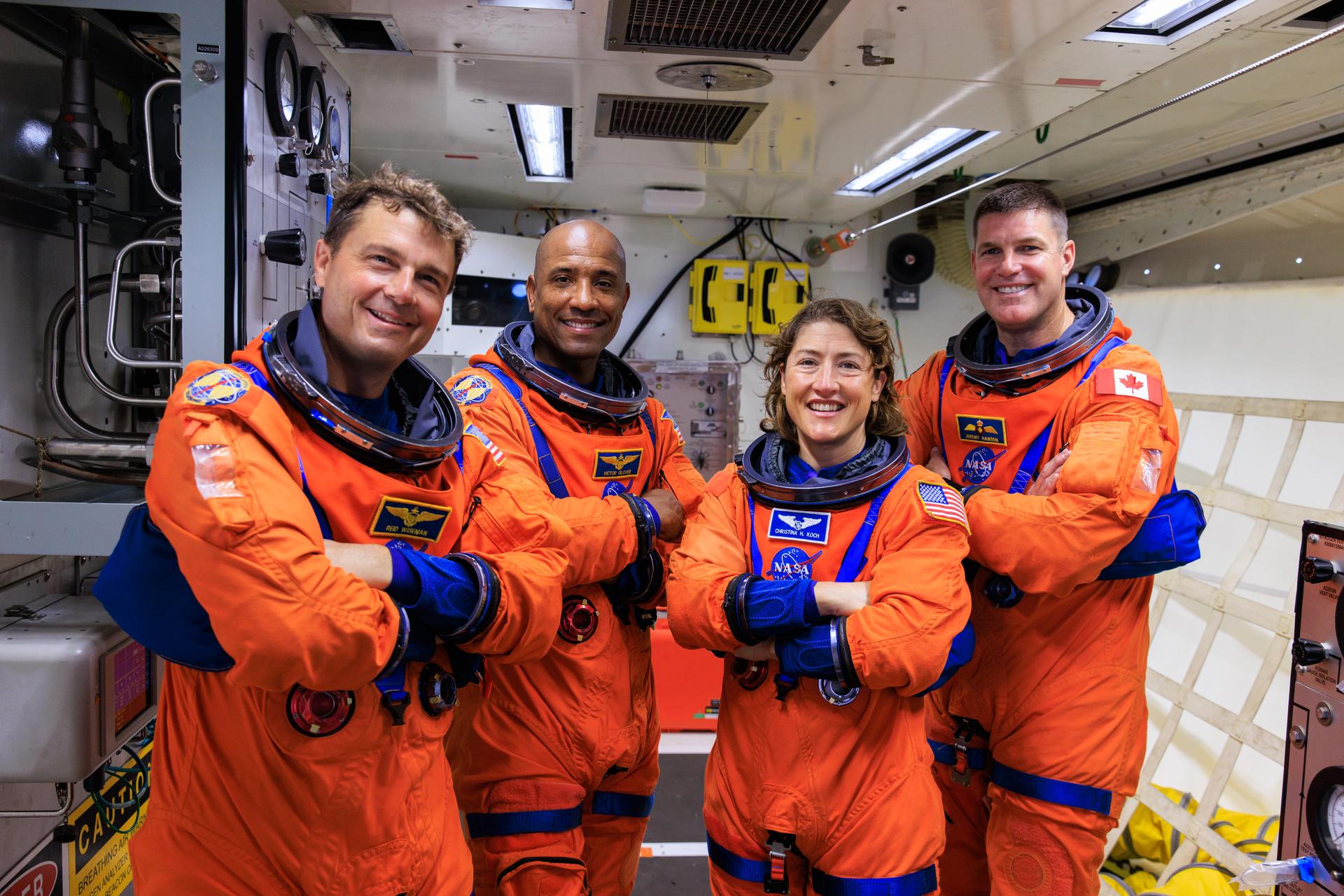
Four astronauts are busy training for Artemis II, the first mission to carry humans on NASA’s powerful SLS (Space Launch System) rocket and Orion spacecraft, testing systems to support life in deep space on future Moon missions and expanding the space frontier beyond Earth orbit.
In August, the crew – NASA astronauts Reid Wiseman, Victor Glover, and Christina Koch, and CSA (Canadian Space Agency) astronaut Jeremy Hansen – finished the first part of their training known as fundamentals, establishing a foundational knowledge of all SLS and Orion systems.
The quartet began the process of learning every inch of their Orion crew module’s interior, which will serve as their home for the approximately 10-day flight test. They reviewed the building blocks for navigating the spacecraft’s displays and executing the procedures they will use to fly and monitor Orion. While some training activities included all four crew members together, other activities involved one-on-one sessions with trainers.
“The crew is making incredible progress getting ready for their flight as the first people to fly inside NASA’s newest spacecraft built for deep space,” said Jacki Mahaffey, chief training officer for Artemis II, based at NASA’s Johnson Space Center in Houston. “Their training is preparing them to do everything from planned mission tasks and daily operations, to how to recognize and deal with unexpected situations.”
Artemis II crew members Reid Wiseman (foreground) and Jeremy Hansen participate in training in the Orion simulator at NASA’s Johnson Space Center in Houston.
(Credit: NASA/James Blair)
In September, Koch and Hansen, alongside several other astronauts, took part in geology training in the remote Mistastin Crater in Canada, an area in Newfoundland scientists have identified as one of the sites on Earth that’s most analogous to the Moon. While there, Koch and Hansen worked on identifying instruments and techniques for exploring the lunar surface, demonstrated sampling techniques, and practiced identifying and photographing geological features. While Hansen and Koch will not walk on the Moon during Artemis II, the training helped prepare them for key lunar observations during their mission and will pave the way for future Artemis crews as they train for surface science and discovery.
CSA astronaut Jeremy Hansen and NASA astronaut Christina Koch sample rocks using rock hammers during a field geology training expedition in northern Labrador in Canada. (Credit: CSA)
The full crew also took part in the first dry run for launch day operations at NASA’s Kennedy Space Center in Florida. The test gave the Exploration Ground Systems Program team an opportunity to share and demonstrate the steps involved in preparing the crew to get to their rocket and spacecraft on launch day, including donning their spacesuits, traveling to the launch pad, taking the elevator up the mobile launcher, and walking the crew access arm to the white room, where technicians will help them take their spacecraft seats and check out their systems atop the giant rocket.
“Our training has been very smooth so far and we have enjoyed meeting the men and women around the globe working to bring Artemis missions to reality,” said NASA astronaut Reid Wiseman, the mission commander. “From the crew side, Victor, Christina, Jeremy, and I have developed a strong interpersonal chemistry that will be crucial as we work together to learn more about the Artemis II mission.”
Artemis II NASA astronauts (left to right) Reid Wiseman, Victor Glover, and Christina Koch, and CSA (Canadian Space Agency) astronaut Jeremy Hansen stand in the white room on the crew access arm of the mobile launcher at Launch Pad 39B as part of an integrated ground systems test at Kennedy Space Center in Florida on Wednesday, Sept. 20, 2023. The test ensures the ground systems team is ready to support the crew timeline on launch day.
(Credit: NASA)
This month, the crew is beginning orbit operations training, including practicing operations in the Orion mission simulator at Johnson. They also are learning details about how to use cameras inside Orion to take photos of their activities inside the spacecraft, and document views of Earth and the Moon through the spacecraft’s four primary windows. Medical training will prepare the crew to handle potential medical situations that could arise during their mission. In the coming months, they also will delve deeper into training for the last leg of the mission, their return to Earth and recovery by a combined NASA and U.S. Navy team, They’ll prepare for both normal and emergency exits from their spacecraft in the ocean.
With Artemis missions, NASA is collaborating with commercial and international partners to explore the Moon for scientific discovery and technology advancement and establish the first long-term presence on the Moon. The Moon missions will serve as training for how to live and work on another world as NASA prepares for human exploration of Mars.
Students from Alabama A&M University near Huntsville, Alabama, pilot their vehicle through the obstacle course at the U.S. Space & Rocket Center during NASA’s Human Exploration Rover Challenge event on April 22, 2023. Credits: NASA
Credits: NASA
Marshall Managers Win Top Federal Award for DART Asteroid Deflection Mission
By Rick Smith
Brian Key and Scott Bellamy of NASA’s Marshall Space Flight Center accepted the Samuel J. Heyman Service to America Medals, presented by Partnership for Public Service Oct. 17 during a ceremony at the John F. Kennedy Center for Performing Arts in Washington.
The awards program for career federal employees, known as the Sammies, aims to highlight key accomplishments that benefit the nation, seeks to build trust in government, and inspire people to consider careers in public service.
Scott Bellamy, left, and Brian Key, right, pictured moments after receiving the Samuel J. Heyman Service to America Medals, known as the Sammies. Bellamy and Key accepted the prestigious awards on behalf of the entire DART (Double Asteroid Redirection Test) team during a ceremony on Oct. 17 at the John F. Kennedy Center for Performing Arts in Washington
Partnership for Public Service/Allison Shelley
Key and Bellamy led NASA’s DART (Double Asteroid Redirection Test) team, which successfully altered the orbit of an asteroid in September 2022, providing the first-ever planetary defense test capable of protecting Earth from celestial threats.
As part of the PMPO (Planetary Missions Program Office) at Marshall, Key and Bellamy served as program manager and mission manager, respectively, for DART. For their work on the mission, the duo was honored in the Science, Technology, and Environment category of the Sammie awards.
“DART was a first-of-its-kind mission that marked a watershed moment for planetary defense. The DART team members are some of the very best of NASA, and we are so excited to see Brian Key and Scott Bellamy recognized for their contributions and leadership,” NASA Administrator Bill Nelson said. “Brian, Scott, and the entire DART team have shaped the course of human space exploration, inspiring people around the world through innovation. Thanks to their dedication and hard work, NASA is better prepared to defend our home planet, and will be ready for whatever the universe throws at us.”
In his role on DART, Key maintained budget, staff, and schedule oversight for the mission and worked directly with DART spacecraft developers at Johns Hopkins University Applied Physics Laboratory in Laurel, Maryland.
“I’m elated to see our team honored with this award, and hope it will bring more attention to the valuable work NASA does to protect our home world,” said Key, who as program manager oversees NASA’s science exploration portfolio spanning the Discovery Program, the New Horizons Program, and the Solar System Exploration Program, which covers the full range of large and small science missions exploring the solar system, planets, and other targets of interest.
Bellamy was tasked with keeping the team on track to launch and execute the mission – echoed Key’s praise for the entire DART team.
“We’re just the managers,” he said. “Our role has been to serve the team, keeping things moving forward as smoothly as possible to enable them to do the actual hands-on, pencil-to-hardware that brought this mission from concept to reality.”
That mission could not have gone more flawlessly, they agreed. Launched in November 2021, the DART spacecraft traveled to more than 6.8 million miles from Earth with one simple goal: to intentionally impact into Dimorphos, a 492-foot-diameter asteroid, at roughly 14,000 miles per hour, thus altering its orbit around its much larger parent asteroid, Didymos. DART’s collision with Dimorphos altered the asteroid’s roughly 12-hour orbit period around its parent by about a half-hour.
An illustration of the DART spacecraft.
NASA
“I don’t even have the words to describe the release of emotion in the control room when we got confirmation that DART had impacted,” Bellamy said. “The whole team went from nail-biting suspense to unbelievable excitement in a matter of seconds.”
Neither Key, Bellamy, nor the Planetary Missions Program Office is resting on these newly acquired laurels.
Key continues to serve as program manager on NASA’s Juno mission, which since its arrival at Jupiter in 2016 has sought new clues about the gas giant’s evolution and role in the formation of our solar system. He’s also program manager for NASA’s Psyche mission, launched Oct. 13 to begin a six-year journey to study a metal-rich asteroid of the same name in solar orbit between Mars and Jupiter.
Bellamy, meanwhile, is mission manager for NASA’s Lucy mission, which over a 12-year period will tour the asteroid belt between Mars and Jupiter and closely study seven Jovian asteroids. Launched in 2021, Lucy will be the first spacecraft ever to return to Earth from the outer solar system. Bellamy also leads development of NASA’s Europa Clipper mission, which could launch in late 2024 to fly to Jupiter’s moon and conduct an intensive survey of the potentially life-sustaining seas beneath Europa’s icy surface.
As for future planetary defense activities, NASA and its partners will build on DART’s success. A follow-up mission by ESA (European Space Agency), called Hera, is scheduled to launch in 2024 to further assess DART’s impact on Dimorphos. NASA also is developing the NEO Surveyor mission, which is designed to accelerate the rate at which the agency can discovery potentially hazardous near-Earth objects, asteroids and comets which can come close to Earth and could pose an impact risk.
“Even small asteroids could do a tremendous amount of damage to a city or metropolitan area,” Key said. “We need to be more aware of the very real threat they pose and develop the means to avoid calamity.”
Johns Hopkins Applied Physics Laboratory managed the DART mission for NASA’s Planetary Defense Coordination Office. The agency provided support for the mission from several centers, including the Jet Propulsion Laboratory, Goddard Space Flight Center, Johnson Space Center, Glenn Research Center, and Langley Research Center.
Created in 2002, the Samuel J. Heyman Service to America Medals, named for the organization’s late founder, recognize excellence and leadership in the federal government. Presented annually by the nonprofit Partnership for Public Service, the awards honor public servants whose significant achievements help the nation innovate, engage globally, and deliver vital services to the public. Learn more about the awards.
Smith, a Manufacturing Technical Solutions employee, supports Marshall’s Office of Communications.
Mission Success is in Our Hands to Showcase New Look at Oct. 19 Event
By Wayne Smith
An initiative highlighting mission success and the safety culture at NASA’s Marshall Space Flight Center will showcase a new look at its Oct. 19 event.
Mission Success is in Our Hands is a safety initiative collaboration between NASA’s Marshall Space Flight Center and Jacobs Engineering. As part of the final Shared Experiences Forum of the year, the Mission Success committee will display eight new testimonial banners featuring Marshall team members as part of its rebranding. The banners will be placed across the center.
Garrett Harencak, Jacobs Engineering vice president and president of Mission Support and Test Services LLC, will be the Mission Success is in Our Hands Shared Experiences Forum speaker Oct. 19. The forum is available to the public virtually through Teams.
Garrett Harencak, Jacobs Engineering vice president and president of Mission Support and Test Services LLC, will be the Mission Success is in Our Hands hybrid Shared Experiences Forum speaker from 11:30 a.m. to 1 p.m. Oct. 19. Marshall team members are encouraged to attend the meeting in Building 4203, Room 1201. Light refreshments will be served. The forum is available to NASA employees and the public virtually via Teams.
Harencak will share his experiences in working and leading nuclear safety, high hazard projects, and conducting operations in the nuclear and national security industries.
“The Mission Success is in Our Hands initiative brings awareness to our workforce of the importance of their individual contributions to the overall success of the NASA and Marshall missions,” said Bill Hill, director of the Safety and Mission Assurance Directorate at Marshall. “Through our banners, the Golden Eagle award, and the Shared Experience Forum, we highlight the risk environment in which we work and in which our launch vehicles and spacecraft operate. Many Shared Experiences Forum events bring in risk practitioners from other industries to provide a comparison and illuminate lessons learned that we could gain from in our everyday activities and missions.”
Hill said Marshall has a strong safety culture. The new banners feature team members expressing that message to the workforce and they will be featured with individual profiles in upcoming editions of the Marshall Star..
“The Mission Success is in Our Hands initiative is one of the few tools that we employ at Marshall to keep Safety and Mission Success in the forefront of everyone’s mind,” Hill said. “It is important that we keep people safe at work and allow all to go home at night healthy and safe. Our Incident and Injury Free workshops, which we are soon to begin in-person sessions, offer our employees the opportunity to learn how to identify risky or unsafe behaviors and situations, and how to have those critical conversations to mitigate or eliminate those behaviors among colleagues before an incident or injury occurs.”
Eight NASA Marshall Flight Center team members will be featured in new testimonial banners that will be placed around the center as part of the Mission Success is in Our Hands initiative The banners will feature, from left, Matthew Pruitt, Human Landing System schedule lead; Brandon Reeves, Integrated Avionics Test Facilities deputy manager; Dr. Greg Drayer, Jacobs/Aerodyne Modeling & Simulation technical fellow; Dr. Chelsi Cassilly, Jacobs Planetary Protection microbiologist; Jeramie Broadway, strategy lead; Dr. Baraka Truss, Avionics & Software Branch chief; Ashley Marlar, Jacobs Operations Support team lead; and Dr. Amit Patel, Jacobs Solid Rocket Motor design engineer.
NASA/Charles Beason
Jeff Haars, Jacobs vice president and program manager for Jacobs Space Exploration Group, said team members working on NASA missions must not lose sight of the hazards present in the workplace or the risks of crewed spaceflight.
“The Shared Experiences Forum is probably our most impactful initiative,” Haars said. “Leaders from across NASA and industry share their personal experiences around safety and mission success. The forum provides an opportunity for learning and applying lessons and best practices from personal experiences. Ultimately, our goal is to help team members keep safety and mission assurance in their day to day decision making.”
Since 2015, the Golden Eagle Award has been presented by Mission Success is in Our Hands. The award promotes awareness and appreciation for flight safety, as demonstrated through the connections between employees’ everyday work, the success of NASA and Marshall’s missions, and the safety of NASA astronauts. The award recognizes individuals who have made significant contributions to flight safety and mission assurance above and beyond their normal work requirements. Management or peers can nominate any team member for the award. Honorees are typically recognized at quarterly Shared Experiences forums.
Smith, a Media Fusion employee and the Marshall Star editor, supports the Marshall Office of Communications.
Alabama Doctors Praise ‘Unique’ NASA Panel on Aerospace Psychiatry
By Jessica Barnett
Medical professionals from across the U.S. gathered for a different kind of panel discussion during the annual Alabama Psychiatric Physicians Association’s Fall Conference held Oct. 12 at The Westin Huntsville.
The Alabama Psychiatric Physicians Association is a district branch of the American Psychiatric Association and the only association exclusively representing psychiatrists in the state of Alabama.
Ian Maddox, a systems engineer at NASA’s Marshall Space Flight Center, discussing future Artemis missions during a panel at the Alabama Psychiatric Physicians Association’s Fall Conference held Oct. 12 at The Westin Huntsville. Joining him onstage are Erin Hayward, an engineer on the Marshall Space Environmental Effects team, and Julie Mason, a space propulsion and thermal engineer working on NASA’s Space Launch System with Boeing.
NASA/Christopher Blair
Psychiatrists were treated to a panel of NASA experts who shared insight from their work supporting human spaceflight research and habitation design for extended duration missions on the lunar and Martian surfaces. Panelists included Ian Maddox, a systems engineer supporting Artemis at NASA’s Marshall Space Flight Center; Erin Hayward, an engineer on the Marshall Space Environmental Effects team; and Julie Mason, a space propulsion and thermal engineer working on NASA’s Space Launch System with Boeing.
During the panel, Hayward and Mason shared their experiences serving as crew members in multiple NASA analog missions, including HERA (Human Exploration Research Analog) and Desert RATS. Both involve space habitat design, isolation, and confinement studies, as well as identifying if certain stressors could affect astronauts during off-world missions. Such stressors include changes to sleep patterns, food intake, gravity, exercise routines, and more.
Maddox explained that it’s part of NASA’s ongoing work to prepare for longer missions to the Moon and beyond. “Humanity has always explored, and NASA is really the organization responsible for making sure that continues to happen safely and peacefully,” he said.
Maddox, Hayward, and Mason share a laugh with the audience during the Q&A portion of their panel at the Alabama Psychiatric Physicians Association’s Fall Conference held Oct. 12 at The Westin Huntsville.
NASA/Jessica Barnett
Audience members were particularly interested in the analog missions, with several taking part in the Q&A portion of the panel. Many thanked the experts for presenting such a unique and fascinating topic, while some expressed interest in hosting similar discussions at future conferences across the nation.
Panelists answered questions about the crew selection process, explaining NASA’s careful screening procedures for identifying candidates to serve together for weeks or months in confined spaces and with very limited access to the outside world. Hayward and Mason also answered questions about their day-to-day lives inside the habitats, from smells and privacy concerns to handling downtime, and how it felt returning to their families and jobs after their campaigns.
“It took me a while to turn my phone notifications back on, just to ease back into the world,” Mason said. “I learned to be present and have more gratitude for the little things, like getting to feel the humidity, especially after 45 days without weather.”
The three NASA panelists encouraged audience members to submit a research proposal or even consider applying to participate in a future analog.
Barnett, a Media Fusion employee, supports the Marshall Office of Communications.
Dozens of Student Teams Worldwide to Compete in NASA Rover Challenge
NASA has selected 72 student teams to begin an engineering design challenge to build human-powered rovers that will compete next April at the U.S. Space & Rocket Center in Huntsville, near the agency’s Marshall Space Flight Center.
Celebrating its 30th anniversary in 2024, the Human Exploration Rover Challenge tasks high school, college, and university students to design, build, and test lightweight, human-powered rovers on an obstacle course simulating lunar and Martian terrain, all while completing mission-focused science tasks.
Students from Alabama A&M University near Huntsville, Alabama, pilot their vehicle through the obstacle course at the U.S. Space & Rocket Center during NASA’s Human Exploration Rover Challenge event on April 22, 2023. Credits: NASA
NASA
Participating teams represent 42 colleges and universities and 30 high schools from 24 states, the District of Columbia, Puerto Rico, and 13 other nations from around the world. NASA’s handbook has complete proposal guidelines and task challenges.
“Throughout this authentic learning challenge, NASA encourages students to improve their understanding of collaboration, inquiry, and problem-solving strategies,” said Vemitra Alexander, rover challenge activity lead, Office of STEM Engagement at NASA Marshall. “Improving these critical real-world skills will benefit our students throughout their academic and professional careers.”
Throughout the nine-month challenge, students will complete design and safety reviews to mirror the process used by NASA engineers and scientists. The agency also incorporates vehicle weight and size requirements encouraging students to consider lightweight construction materials and stowage efficiency to be replicate similar payload restrictions of NASA launch operations.
Teams earn points throughout the year by successfully completing design reviews and fabricating a rover capable of meeting all criteria while completing course obstacles and mission tasks. The teams with the highest number of points accumulated throughout the project year will win their respective divisions. The challenge will conclude with an event April 19 and April 20, 2024, at the U.S. Rocket and Space Center.
This competition is one of nine Artemis Student Challenges and reflects the goals of NASA’s Artemis program, which includes landing the first woman and first person of color on the Moon. It is managed by NASA’s Southeast Regional Office of STEM Engagement at Marshall. NASA uses challenges and competitions to further the agency’s goal of encouraging students to pursue degrees and careers in science, technology, engineering, and mathematics.
NASA Prepares Artemis II Moon Rocket Core Stage for Final Assembly Phase
By Megan Carter
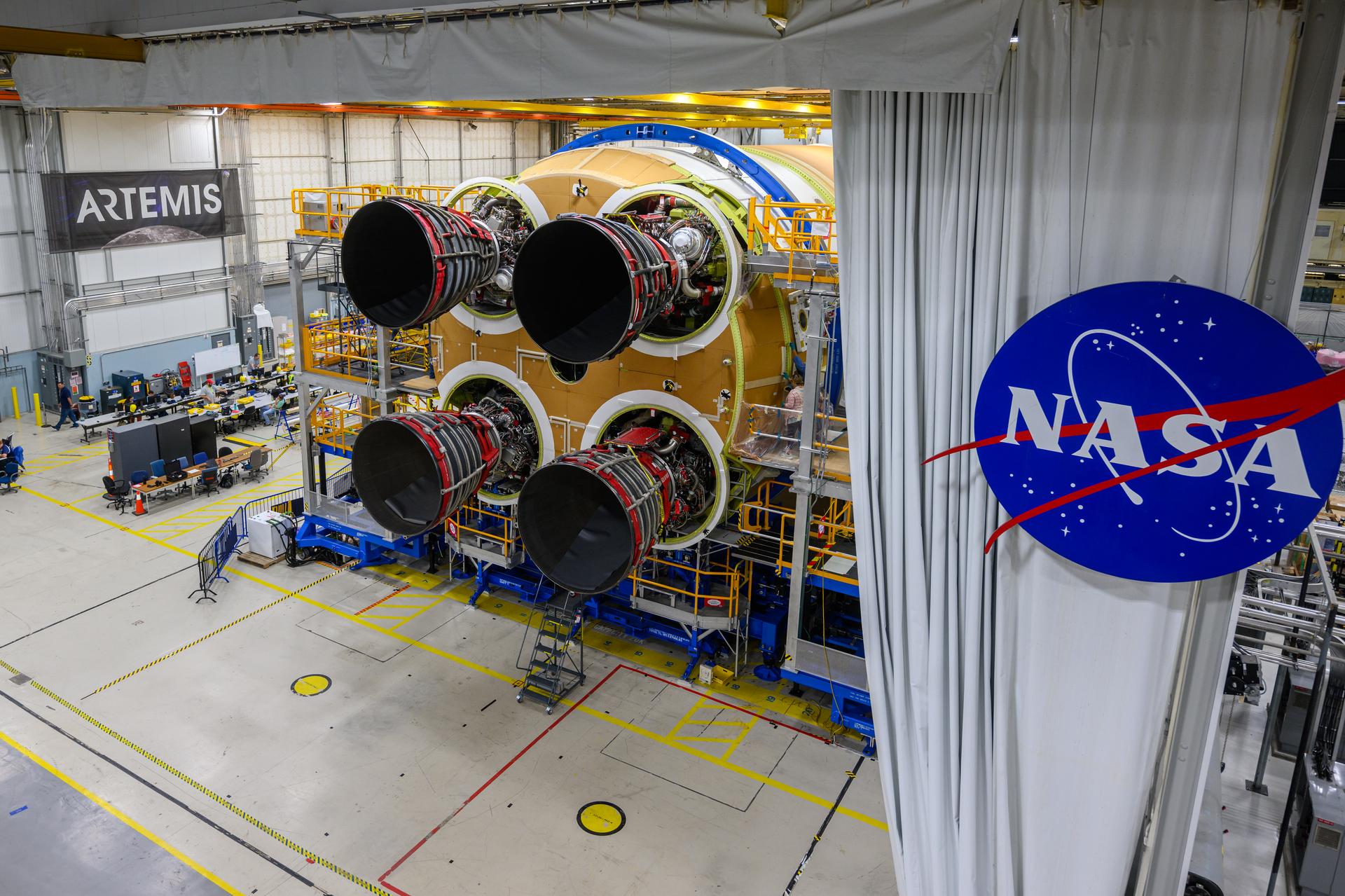
NASA and its partners have fully secured the four RS-25 engines onto the core stage of the agency’s SLS (Space Launch System) rocket for the Artemis II flight test. The core stage, and its engines, is the backbone of the SLS mega rocket that will power the flight test, the first crewed mission to the Moon under Artemis.
Engineers have begun final integration testing at NASA’s Michoud Assembly Facility, in preparation for acceptance ahead of shipment of the stage to Kennedy Space Center in the coming months.
These photos and videos show how technicians at NASA’s Michoud Assembly Facility in New Orleans installed the third and fourth RS-25 engines onto the core stage for the agency’s SLS (Space Launch System) rocket that will help power NASA’s first crewed Artemis mission to the Moon. Technicians added the first engine to the SLS core stage Sept. 11. The second engine was installed onto the stage Sept. 15 with the third and fourth engines following Sept. 19 and Sept. 20. Engineers consider the engines to be “soft” mated to the rocket stage. Technicians with NASA, Aerojet Rocketdyne, an L3Harris Technologies company and the RS-25 engines lead contractor, along with Boeing, the core stage lead contractor, will now focus efforts on the complex tax of fully securing the engines to the stage and integrating the propulsion and electrical systems within the structure. NASA is working to land the first woman and first person of color on the Moon under Artemis. SLS is part of NASA’s backbone for deep space exploration, along with Orion and the Gateway in orbit around the Moon. SLS is the only rocket that can send Orion, astronauts, and supplies to the Moon in a single mission.
Credits: NASA
The 212-foot-tall core stage includes two massive liquid propellant tanks and four RS-25 engines at its base. For Artemis II, the core stage and its engines act as the powerhouse of the rocket, providing more than two million pounds of thrust for the first eight minutes of flight to send the crew of four astronauts inside NASA’s Orion spacecraft on an approximately 10-day mission around the Moon.
NASA, Aerojet Rocketdyne, an L3Harris Technologies company and the RS-25 engines lead contractor, along with Boeing, the core stage lead contractor, secured the engines to the maze of propulsion and avionics systems within the core stage Oct. 6. In the coming weeks, engineers will perform testing on the entire stage and its avionics and electrical systems, which act as the “brains” of the rocket to help control it during flight.
Once testing of the stage is complete and the hardware passes its acceptance review, the core stage will be readied for shipping to Kennedy via the agency’s Pegasus barge, based at Michoud.
As teams prepare the core stage for Artemis II, rocket hardware is also under construction on our factory floor for Artemis III, IV, and V that will help send the future Artemis astronauts to the lunar South Pole.
The engines were first soft mated one by one onto the stage beginning in early September. The last RS-25 engine was structurally installed onto the stage Sept. 20. Installing the four engines is a multi-step, collaborative process for NASA, Boeing, and Aerojet Rocketdyne.
Following the initial structural connections of the individual engines, securing and outfitting all four engines to the stage is the lengthiest part of the engine assembly process and includes securing the thrust vector control actuators, ancillary interfaces, and remaining bolts before multiple tests and checkouts.
All major hardware elements for the SLS rocket that will launch Artemis II are either complete or in progress. The major components for the rocket’s two solid rocket boosters are at Kennedy. The rocket’s two adapters, produced at NASA’s Marshall Space Flight Center, along with the rocket’s upper stage, currently at lead contractor United Launch Alliance’s facility in Florida near Kennedy, will be prepared for shipment in the spring. Marshall manages the SLS Program.
NASA is working to land the first woman and first person of color on the Moon under Artemis. SLS is part of NASA’s backbone for deep space exploration, along with Orion and the Gateway in orbit around the Moon, and commercial human landing systems. SLS is the only rocket that can send Orion, astronauts, and supplies to the Moon in a single mission.
Carter, a Media Fusion employee, supports the Marshall Office of Communications.
NASA Conducts 1st Hot Fire of New RS-25 Certification Test Series
NASA conducted the first hot fire of a new RS-25 test series Oct. 17, beginning the final round of certification testing ahead of production of an updated set of the engines for the SLS (Space Launch System) rocket. The engines will help power future Artemis missions to the Moon and beyond.
NASA completed a full duration, 550-second hot fire of the RS-25 certification engine Oct. 17, beginning a critical test series to support future SLS (Space Launch System) missions to deep space as NASA explores the secrets of the universe for the benefit of all.
NASA / Danny Nowlin
Operators fired the RS-25 engine for more than nine minutes (550 seconds), longer than the 500 seconds engines must fire during an actual mission, on the Fred Haise Test Stand at NASA’s Stennis Space Center. Operators also fired the engine up to the 111% power level needed during an SLS launch. The hot fire marked the first in a series of 12 tests scheduled to stretch into 2024. The tests are a key step for lead SLS engines contractor Aerojet Rocketdyne, an L3Harris Technologies company, to produce engines that will help power the SLS rocket, beginning with Artemis V.
The test series will collect data on the performance of several new key engine components, including a nozzle, hydraulic actuators, flex ducts, and turbopumps. The components match design features of those used during the initial certification test series completed at the south Mississippi site in June. Aerojet Rocketdyne is using advanced manufacturing techniques, such as 3D printing, to reduce the cost and time needed to build the new engines. Four RS-25 engines help power SLS at launch, including on its Artemis missions to the Moon.
Through Artemis, NASA is returning humans, including the first woman and the first person of color, to the Moon to explore the lunar surface and prepare for flights to Mars. SLS is the only rocket capable of sending the agency’s Orion spacecraft, astronauts, and supplies to the Moon in a single mission.
NASA’s Psyche launched aboard a SpaceX Falcon Heavy from the agency’s Kennedy Space Center on Oct. 13. The mission is featured in “This Week @ NASA,” a weekly video program broadcast on NASA-TV and posted online.
Psyche is on its way to a metal-rich asteroid of the same name. The mission could teach us more about how rocky planets like Earth formed.
Managed by the Planetary Missions Program Office at NASA’s Marshall Space Flight Center, Psyche is the 14th planetary exploration mission in NASA’s Discovery program, which is also managed for the agency by Marshall. Read more about Marshall’s role in Psyche.
Lucy Spacecraft Continues Approach to Asteroid Dinkinesh
Since NASA’s Lucy spacecraft first imaged the asteroid Dinkinesh on Sept. 3, Lucy has traveled over 33 million miles and is now 4.7 million miles away from the small asteroid. However, as Dinkinesh continues on its orbit around the Sun, Lucy still has another almost 16 million miles to travel to its meet-up with the asteroid on Nov. 1.
This data visualization overlays some of the images taken by the Lucy spacecraft’s L’LORRI from Sept. 3 to Oct. 3 on the Lucy trajectory (red) and the orbit of the asteroid Dinkinesh (gold). These images were taken as part of the optical navigation program in advance of the encounter on Nov. 1. The stars indicate the locations at closest approach on Nov. 1. (NASA/SwRI/APL)
Over the last month, the spacecraft team has seen the target asteroid generally brightening as Lucy approaches it and has also seen a subtle brightness variation consistent with the previously observed 52.7-hour rotation period. Since Lucy first observed the asteroid on Sept. 3, the team has used images collected by the spacecraft’s high-resolution camera, L’LORRI, to refine their knowledge of the relative positions of the spacecraft and asteroid, optically navigating Lucy towards the encounter. Using this information, on Sept. 29 the spacecraft carried out a small trajectory correction maneuver, changing the spacecraft’s speed by just 6 cm/s (around 0.1 mph). This nudge is predicted to send the spacecraft on a path that will pass within 265 miles of the asteroid. In late October the team will have another opportunity to adjust the trajectory if necessary.
On Oct. 6, the spacecraft passed behind the Sun as viewed from Earth, beginning a planned communications blackout. The spacecraft has continued to image the asteroid and will return these images to Earth once communications resume after the end of the solar conjunction period in mid-October.
Lucy’s principal investigator, Hal Levison, is based out of the Boulder, Colorado, branch of Southwest Research Institute, headquartered in San Antonio, Texas. NASA’s Goddard Space Flight Center provides overall mission management, systems engineering, and safety and mission assurance. Lockheed Martin Space in Littleton, Colorado, built the spacecraft. Lucy is the 13th mission in NASA’s Discovery Program. NASA’s Marshall Space Flight Center manages the Discovery Program for the Science Mission Directorate at NASA Headquarters.
Webb Detects Tiny Quartz Crystals in the Clouds of a Hot Gas Giant
Researchers using NASA’s James Webb Space Telescope have detected evidence for quartz nanocrystals in the high-altitude clouds of WASP-17 b, a hot Jupiter exoplanet 1,300 light-years from Earth. The detection, which was uniquely possible with MIRI (Webb’s Mid-Infrared Instrument), marks the first time that silica (SiO2) particles have been spotted in an exoplanet atmosphere.
“We were thrilled!” said David Grant, a researcher at the University of Bristol in the UK and first author on a paper published in the Astrophysical Journal Letters. “We knew from Hubble observations that there must be aerosols – tiny particles making up clouds or haze – in WASP-17 b’s atmosphere, but we didn’t expect them to be made of quartz.”
This artist concept shows what the exoplanet WASP-17 b could look like.
NASA, ESA, CSA, and R. Crawford (STScI)Science: Nikole Lewis (Cornell University), David Grant (University of Bristol), Hannah Wakeford (University of Bristol) Crawford (STScI)
Silicates (minerals rich in silicon and oxygen) make up the bulk of Earth and the Moon as well as other rocky objects in our solar system, and are extremely common across the galaxy. But the silicate grains previously detected in the atmospheres of exoplanets and brown dwarfs appear to be made of magnesium-rich silicates like olivine and pyroxene, not quartz alone – which is pure SiO2.
The result from this team, which also includes researchers from NASA’s Ames Research Center and NASA’s Goddard Space Flight Center, puts a new spin on our understanding of how exoplanet clouds form and evolve. “We fully expected to see magnesium silicates,” said co-author Hannah Wakeford, also from the University of Bristol. “But what we’re seeing instead are likely the building blocks of those, the tiny ‘seed’ particles needed to form the larger silicate grains we detect in cooler exoplanets and brown dwarfs.”
With a volume more than seven times that of Jupiter and a mass less than one-half Jupiter, WASP-17 b is one of the largest and puffiest known exoplanets. This, along with its short orbital period of just 3.7 Earth-days, makes the planet ideal for transmission spectroscopy : a technique that involves measuring the filtering and scattering effects of a planet’s atmosphere on starlight.
Webb observed the WASP-17 system for nearly 10 hours, collecting more than 1,275 brightness measurements of 5- to 12-micron mid-infrared light as the planet crossed its star. By subtracting the brightness of individual wavelengths of light that reached the telescope when the planet was in front of the star from those of the star on its own, the team was able to calculate the amount of each wavelength blocked by the planet’s atmosphere.
What emerged was an unexpected “bump” at 8.6 microns, a feature that would not be expected if the clouds were made of magnesium silicates or other possible high temperature aerosols like aluminum oxide, but which makes perfect sense if they are made of quartz.
While these crystals are probably similar in shape to the pointy hexagonal prisms found in geodes and gem shops on Earth, each one is only about 10 nanometers across – one-millionth of one centimeter.
“Hubble data actually played a key role in constraining the size of these particles,” explained co-author Nikole Lewis of Cornell University, who leads the Webb GTO (Guaranteed Time Observation) program designed to help build a three-dimensional view of a hot Jupiter atmosphere. “We know there is silica from Webb’s MIRI data alone, but we needed the visible and near-infrared observations from Hubble for context, to figure out how large the crystals are.”
Unlike mineral particles found in clouds on Earth, the quartz crystals detected in the clouds of WASP-17 b are not swept up from a rocky surface. Instead, they originate in the atmosphere itself. “WASP-17 b is extremely hot – around 1,500 degrees Celsius (2,700°F) – and the pressure where they form high in the atmosphere is only about one-thousandth of what we experience on Earth’s surface,” explained Grant. “In these conditions, solid crystals can form directly from gas, without going through a liquid phase first.”
Understanding what the clouds are made of is crucial for understanding the planet as a whole. Hot Jupiters like WASP-17 b are made primarily of hydrogen and helium, with small amounts of other gases like water vapor (H2O) and carbon dioxide (CO2). “If we only consider the oxygen that is in these gases, and neglect to include all of the oxygen locked up in minerals like quartz (SiO2), we will significantly underestimate the total abundance,” explained Wakeford. “These beautiful silica crystals tell us about the inventory of different materials and how they all come together to shape the environment of this planet.”
Exactly how much quartz there is, and how pervasive the clouds are, is hard to determine. “The clouds are likely present along the day/night transition (the terminator), which is the region that our observations probe,” said Grant. Given that the planet is tidally locked with a very hot day side and cooler night side, it is likely that the clouds circulate around the planet, but vaporize when they reach the hotter day side. “The winds could be moving these tiny glassy particles around at thousands of miles per hour.”
WASP-17 b is one of three planets targeted by the JWST-Telescope Scientist Team’s DREAMS (Deep Reconnaissance of Exoplanet Atmospheres using Multi-instrument Spectroscopy) investigations, which are designed to gather a comprehensive set of observations of one representative from each key class of exoplanets: a hot Jupiter, a warm Neptune, and a temperate rocky planet. The MIRI observations of hot Jupiter WASP-17 b were made as part of GTO program 1353.
The James Webb Space Telescope is the world’s premier space science observatory. Webb is solving mysteries in our solar system, looking beyond to distant worlds around other stars, and probing the mysterious structures and origins of our universe and our place in it. Webb is an international program led by NASA with its partners, ESA (European Space Agency) and the Canadian Space Agency. Several NASA centers contributed to the project, including NASA’s Marshall Space Flight Center.
Thale cress plants from the Plant Habitat-03 investigation just before a harvest.
NASA
As NASA plans missions to the Moon and Mars, a key factor is figuring out how to feed crew members during their weeks, months, and even years in space.
Astronauts on the International Space Station primarily eat prepackaged food, which requires regular resupply and can degrade in quality and nutrition. Researchers are exploring the idea of crews growing some of their food during a mission, testing various crops and equipment to figure out how to do this without a lot of extra hardware or power.
Picking the right plants
The first step in this research is identifying which plants to test. NASA started a project in 2015 with the Fairchild Botanical Garden in Miami called “Growing Beyond Earth.” The program has recruited hundreds of middle and high school science classes across the U.S. to grow different seeds in a habitat similar to one on the space station. Seeds that grow well in the classrooms are then tested in a chamber at NASA’s Kennedy Space Center. Ones that do well there are sent to the station to test how they grow in microgravity.
Gardens in space
NASA also has tested facilities to host future microgravity gardens. One is the Vegetable Production System, or Veggie, a simple, low-power chamber that can hold six plants. Seeds are grown in small fabric “pillows” that crew members look after and water by hand, similar to caring for a window garden on Earth.
Another system, the Passive Orbital Nutrient Delivery System, or Veggie PONDS, works with the Veggie platform but replaces seed pillows with a holder that automatically feeds and waters the plants. The Advanced Plant Habitat is a fully automated device designed to study growing plants in ways that require only minimal crew attention.
Mark Vande Hei harvests for the Veggie PONDS investigation.
NASA
The right light and food
A series of experiments aboard the space station known as Veg-04A, Veg-04B, and Veg-05 grew Mizuna mustard, a leafy green crop, under different light conditions and compared plant yield, nutritional composition, and microbial levels. The investigation also compared the space-grown plants to ones grown on Earth, and had crew members rate the flavor, texture, and other characteristics of the produce.
Plant Habitat-04 analyzed plant-microbe interactions and assessed the flavor and texture of chile peppers. The first crop, harvested on Oct. 29, 2021, was eaten by the crew and 12 peppers from the second harvest were returned to Earth for analysis. This experiment demonstrated that research about space crop production is on the right path and researchers plan to apply lessons learned to testing other plants.
NASA astronauts Mark Vande Hei and Shane Kimbrough, JAXA astronaut Akihiko Hoshide, and NASA astronaut Megan McArthur with chile peppers grown for Plant Habitat-04.
NASA
The influence of gravity
An early experiment, PESTO, found that microgravity alters leaf development, plant cells, and the chloroplasts used in photosynthesis, but did not harm the plants overall. In fact, wheat plants grew 10% taller compared to those on Earth.
The Seedling Growth investigations showed that seedlings can acclimate to microgravity by modulating expression of some genes related to the stressors of space, a discovery that adds to knowledge about how microgravity affects plant physiology [1].
One way that plants sense gravity is via changes to calcium within their cells. Plant Gravity Sensing, a JAXA (Japan Aerospace Exploration Agency) investigation, measured how microgravity affects calcium levels, which could help scientists design better ways to grow food in space.
ADVASC, an investigation that grew two generations of mustard plants using the Advanced Astroculture chamber, showed that seeds were smaller but germination rates near normal in microgravity [2].
Close-up view of Apogee Wheat Plants grown as part of the PESTO experiment during Expedition 4.
NASA
Water delivery
One significant challenge for growing plants in microgravity is providing enough water to keep them healthy without drowning them in too much water. Plant Water Management demonstrated a hydroponic (water-based) method for providing water and air to plant roots. The XROOTS study tested using both hydroponic and aeroponic (air-based) techniques to grow plants rather than traditional soil. These techniques could enable large-scale crop production for future space exploration.
NASA astronauts Jessica Watkins and Bob Hines work on the XROOTS investigation.
NASA
Transplanting veggies
During a series of investigations called VEG-03, which cultivated Extra Dwarf Pak Choi, Amara Mustard, and Red Romaine Lettuce, NASA astronaut Mike Hopkins noticed some of the plants were struggling. Hopkins conducted the first plant transplant in space, moving extra sprouts from thriving plant pillows into two of the struggling pillows in Veggie. The transplants survived and grew, opening new possibilities for future plant growth.
Plant genetics
Plants exposed to spaceflight undergo changes that involve the addition of extra information to their DNA, affecting how genes turn on or off without changing the sequence of the DNA itself. This process is known as epigenetic change. Plant Habitat-03 assesses whether such adaptations in one generation of plants grown in space can transfer to the next generation.
The long-term goal is to understand how epigenetics contribute to adaptive strategies that plants use in space and, ultimately, develop plants better suited for providing food and other services on future missions. Results also could support the development of strategies for adapting crops and other economically important plants for growth in marginal and reclaimed habitats on Earth.
The human effect
Gardens need tending, of course. The Veg-04A, Veg-04B, and Veg-05 investigations also looked at how tending plants contributed to the well-being of astronauts. Many astronauts reported they found caring for plants an enjoyable and relaxing activity – another important contribution to future long-duration missions.
NASA astronauts Shannon Walker and Michael Hopkins collect leaf samples from plants growing inside the European Columbus laboratory for the Veg-03 experiment during Expedition 64.
NASA
Citations:
1 Medina F, Manzano A, Herranz R, Kiss JZ. Red Light Enhances Plant Adaptation to Spaceflight and Mars g-Levels. Life. 2022, 12(10), 1484; https://doi.org/10.3390/life12101484
2 Link BM, Busse JS, Stankovic B. Seed-to-Seed-to-Seed Growth and Development of Arabidopsis in Microgravity. Astrobiology. 2014 October; 14(10): 866-875. DOI: 10.1089/ast.2014.1184.PMID: 25317938
NASA’s “Spacey Casey” welcomes visitors to NASA Langley Research Center.
NASA
2 min read
News Media Invited to NASA Langley’s Open House
HAMPTON, Virginia – Members of the media are invited to cover the Open House at NASA’s Langley Research Center in Hampton, Virginia. The event takes place 9 a.m. to 4 p.m. Saturday, Oct. 21, 2023.
Media will have photo, video, and interview opportunities. Center Director Clayton Turner and NASA astronaut Victor Glover will be available to answer media questions at 9 a.m. on Saturday.
This is the first time since 2017 Langley has opened its gates and doors to the public, inviting them to learn more about the center’s innovative aerospace research.
Please note! In order to cover the event and have access to parking on center, media outlets must RSVP with Brittny McGraw at 757-769-3763 or brittny.v.mcgraw@nasa.gov no later than 2 p.m. Friday, Oct. 20. Media who attempt to come to the center without an RSVP will not have vehicle access.
Media interested in interviewing Clayton Turner and Victor Glover should follow the procedures listed above, but must arrive no later than 8:30 a.m. on Saturday, Oct. 21.
The Space Life Sciences Training Program (SLSTP) provides undergraduate students entering their junior or senior years, and entering graduate students, with professional experience in space life science disciplines. This challenging ten-week summer program is hosted by NASA’s Ames Research Center in the heart of California’s Silicon Valley. The primary goal of the program is to train the next generation of scientists and engineers, enabling NASA to meet future research and development challenges in the space life sciences.
Summer 2023 SLSTP students present their projects during midterm.
NASA / Stephanie Perreau Rainey
The SLSTP Experience In this rigorous program, students work closely with renowned NASA scientists and engineers on cutting-edge research, benefitting from the concentration of bioscience expertise at Ames. In addition to conducting hands-on research, SLSTP students attend technical lectures given by experts on a wide range of topics and tour NASA research facilities.
This program provides opportunities for students to develop professional skills. These include technical and professional development training, presenting their scientific work and submitting an abstract to a professional scientific organization (e.g. the American Society for Gravitational and Space Research.)
SLSTP participants are exposed to a broad scope of space biosciences research performed by NASA scientists. While learning about the tools and methodology that enable biological experiments to be conducted in flight, students acquire skills and knowledge required for the design and execution of life science research conducted in microgravity.
Participants in the program receive a stipend and may be eligible to attend a scientific conference to formally present their research.
Research Areas Students in SLSTP undertake research projects in multiple areas, including:
The effects of spaceflight on living systems, conducted both on the ground and also in space aboard the International Space Station and other spacecraft.
The development and operation of specialized research facilities to support investigations in microgravity, partial gravity, and hypergravity.
Research and development of advanced biotechnologies that enable NASA’s exploration of distant destinations.
Information for Applicants The SLSTP is an equal opportunity program. Admission is by competitive application process. Past student participants were selected for their outstanding merit, passion for space, and desire to study space life science. Applicants must fulfill the following requirements: be a US citizen, age 18 or older in high academic standing (GPA of 3.2 or greater). Applicants should be junior or senior undergraduate student next Fall or a senior graduating in 2024 and entering graduate school for Fall 2024.
How to Apply: Applications for the summer 2024 program will be opening soon in late 2023. Applications will be open in the NASA Internships Gateway portal.
SLSTP Mailing List To subscribe to our mailing list and to receive e-mail announcements about the program and application process, please send an email to arc-slstp@mail.nasa.gov with “subscribe” in the subject to be added to our mailing list.
Program Support The SLSTP is funded by NASA’s Space Biology Program, which is part of the Biological and Physical Sciences Division of NASA. The SLSTP is managed by the Space Biology Project within the Science Directorate at Ames Research Center.
NASA astronaut Joe Acaba with one of the Microbial Air Samplers, devices that monitor microbes in the air of the space station.
NASA
Wherever there are humans, there are microbes, too. Bacteria and fungi live all around us, in our homes, offices, industrial areas, the outdoors – even in space. People literally could not live without these tiny organisms, many of which are beneficial.
The trick is limiting potentially harmful ones, particularly in a contained environment such as a spacecraft. So from the launch of the very first module of the International Space Station, NASA has monitored its microbial community.
Because the station is an enclosed system, the only way that microbes get there is hitching a ride on the contents of resupply spacecraft from Earth and on arriving astronauts. The NASA Johnson Space Center Microbiology Laboratory puts a lot of effort into knowing which microbes ride along.
“We can’t sterilize everything we send into space, and don’t want to, but we do a lot to limit potential pathogens from making their way to the station,” says NASA microbiologist Sarah Wallace, Ph.D. “At launch, the cargo, food, vehicles, and crew members each have their own microbiome, or suite of microbes. When everything gets to the station, these microbiomes become part of the space station microbiome.”
The lab uses the traditional method of culturing a sample in a growth medium, similar to Petri dishes from high school science class, to sample a portion of everything during packing for launch and the launch vehicles themselves. This sampling confirms that contamination control plans are working properly – essentially making sure the numbers of microbes remain low and that those present are the ones normally expected.
Astronauts sample a surface on the International Space Station for this microbial culture slide.
NASA
Then the lab continues monitoring after the vehicle, cargo, and crew arrive at the station. Crew members sample and culture microbes from the air, surfaces, and water on the station.
“It’s kind of a spot check to see how well housekeeping procedures are being implemented and how well the water system and the air filters are working,” Wallace says.
She calls the station’s water processing system “a phenomenal piece of engineering” that produces water much cleaner than most of us drink on Earth. In addition, the station itself is remarkably clean thanks to HEPA filters for the air and housekeeping practices for surfaces. “What microbes we see are really what we’d see if we looked at your home. In fact, we’ve done several studies comparing the station to a typical home and it is similar but usually cleaner,” she adds.
This monitoring over the lifetime of the orbiting lab has created a unique, long-term database that helps microbiologists know what to expect.
“Our requirements are two-fold, how much is there and what is there,” Wallace says. For years, the scientists didn’t know the ‘what’ until samples came back to ground. Now the equipment exists to perform direct swab-to-sequencer identification, eliminating the need to culture samples and return them to Earth. That equipment includes the miniPCR, a device that amplifies or makes many copies of a DNA strand using a process called polymerase chain reaction (PCR), and the MinION, a portable DNA sequencer. The Genes in Space 3 collaboration between Boeing and NASA paired these two platforms together, which led to the first identification of unknown bacteria off Earth.
NASA’s lab then conducted tests and confirmed that microbe identifications from the inflight process matched those determined on the ground down to the species level1.
“For the first time ever, we identified unknown microbes collected and cultured off Earth,” says Wallace. “We followed that up with the swab-to-sequencer, which lets us move away from culturing completely. We can swab a surface and sequence whatever is there.”
Plates for culturing samples collected by the Microbial Air Samplers on the space station.
NASA
Subsequent work advanced the use of sequencing in space and later tests found that the culture-independent method showed the same microbial distributions as the standard culture-dependent method2. The swab-and-sequence method has been streamlined so that crew members can easily complete it in an extreme environment.
That is a critical capability for future missions to the Moon and Mars, both to continue to protect crew health and safety and to make sure that we do not contaminate other worlds. If explorers detect microbial life on another planet, they need to know whether it was already there or came from Earth.
Researchers also use the space station to conduct long-term microbial studies. The Microbial Tracking series studied what kinds of microbes are on the space station, both in the environment and in the astronauts’ bodies.
In addition to surveying the types of microbes present on the station, the lab studies whether those microbes could be harmful, as microgravity and radiation in space can render innocuous microorganisms potentially harmful and microbial behavior can change as the organisms adapt to the spaceflight environment.
So far, microbial issues on Earth far exceed any seen in space, Wallace says. “In addition to all the preflight monitoring, crew members are quarantined prior to launch. These steps were started back during Apollo missions and still are effective toward keeping our crews healthy.”
Because where people go, scientists want to know what microbes follow.
Citations
1 Burton AS, Stahl-Rommel SE, John KK, Jain M, Juul S, Turner DJ, Harrington ED, Stoddart D, Paten B, Akeson M, Castro-Wallace SL. Off Earth Identification of Bacterial Populations Using 16S rDNA Nanopore Sequencing. Genes. 2020 January 9; 76(11): 76 (https://www.mdpi.com/2073-4425/11/1/76)
2 Stahl-Rommel S, Jain M, Nguyen HN, Arnold RR, Aunon-Chancellor SM, Sharp GM, Castro CL, John KK, Juul S, Turner DJ, et al. Real-Time Culture-Independent Microbial Profiling Onboard the International Space Station Using Nanopore Sequencing. Genes. 2021; 12(1):106. (https://www.mdpi.com/2073-4425/12/1/106)
This website uses cookies to improve your experience. We'll assume you're ok with this, but you can opt-out if you wish.AcceptRead More
Privacy & Cookies Policy
Privacy Overview
This website uses cookies to improve your experience while you navigate through the website. Out of these, the cookies that are categorized as necessary are stored on your browser as they are essential for the working of basic functionalities of the website. We also use third-party cookies that help us analyze and understand how you use this website. These cookies will be stored in your browser only with your consent. You also have the option to opt-out of these cookies. But opting out of some of these cookies may affect your browsing experience.
Necessary cookies are absolutely essential for the website to function properly. This category only includes cookies that ensures basic functionalities and security features of the website. These cookies do not store any personal information.
Any cookies that may not be particularly necessary for the website to function and is used specifically to collect user personal data via analytics, ads, other embedded contents are termed as non-necessary cookies. It is mandatory to procure user consent prior to running these cookies on your website.