Tag: NASA

  • NASA Mission Monitoring Air Quality from Space Extended 

    4 min read

    Preparations for Next Moonwalk Simulations Underway (and Underwater)

    Since launching in 2023, NASA’s Tropospheric Emissions: Monitoring of Pollution mission, or TEMPO, has been measuring the quality of the air we breathe from 22,000 miles above the ground. June 19 marked the successful completion of TEMPO’s 20-month-long initial prime mission, and based on the quality of measurements to date, the mission has been extended through at least September 2026. The TEMPO mission is NASA’s first to use a spectrometer to gather hourly air quality data continuously over North America during daytime hours. It can see details down to just a few square miles, a significant advancement over previous satellites.

    “NASA satellites have a long history of missions lasting well beyond the primary mission timeline. While TEMPO has completed its primary mission, the life for TEMPO is far from over,” said Laura Judd, research physical scientist and TEMPO science team member at NASA’s Langley Research Center in Hampton, Virginia. “It is a big jump going from once-daily images prior to this mission to hourly data. We are continually learning how to use this data to interpret how emissions change over time and how to track anomalous events, such as smoggy days in cities or the transport of wildfire smoke.” 

    By measuring nitrogen dioxide (NO2) and formaldehyde (HCHO), TEMPO can derive the presence of near-surface ozone. On Aug. 2, 2024 over Houston, TEMPO observed exceptionally high ozone levels in the area. On the left, NO2 builds up in the atmosphere over the city and over the Houston Ship Channel. On the right, formaldehyde levels are seen reaching a peak in the early afternoon. Formaldehyde is largely formed through the oxidation of hydrocarbons, an ingredient of ozone production, such as those that can be emitted by petrochemical facilities found in the Houston Ship Channel.
    Trent Schindler/NASA’s Scientific Visualization Studio

    When air quality is altered by smog, wildfire smoke, dust, or emissions from vehicle traffic and power plants, TEMPO detects the trace gases that come with those effects. These include nitrogen dioxide, ozone, and formaldehyde in the troposphere, the lowest layer of Earth’s atmosphere.

    “A major breakthrough during the primary mission has been the successful test of data delivery in under three hours with the help of NASA’s Satellite Needs Working Group. This information empowers decision-makers and first responders to issue timely air quality warnings and help the public reduce outdoor exposure during times of higher pollution,” said Hazem Mahmoud, lead data scientist at NASA’s Atmospheric Science Data Center located at Langley Research Center.

    …the substantial demand for TEMPO’s data underscores its critical role…

    hazem mahmoud

    hazem mahmoud

    NASA Data Scientist

    TEMPO data is archived and distributed freely through the Atmospheric Science Data Center. “The TEMPO mission has set a groundbreaking record as the first mission to surpass two petabytes, or 2 million gigabytes, of data downloads within a single year,” said Mahmoud. “With over 800 unique users, the substantial demand for TEMPO’s data underscores its critical role and the immense value it provides to the scientific community and beyond.” Air quality forecasters, atmospheric scientists, and health researchers make up the bulk of the data users so far.

    On April 14, strong winds triggered the formation of a huge dust storm in the U.S. central plains and fueled the ignition of grassland fires in Oklahoma. On the left, the NO2 plumes originating from the grassland fires are tracked hour-by-hour by TEMPO. Smoke can be discerned from dust as a source since dust is not a source of NO2. The animation on the right shows the ultraviolet (UV) aerosol index, which indicates particulates in the atmosphere that absorb UV light, such as dust and smoke.
    Trent Schindler/NASA’s Scientific Visualization Studio

    The TEMPO mission is a collaboration between NASA and the Smithsonian Astrophysical Observatory, whose Center for Astrophysics Harvard & Smithsonian oversees daily operations of the TEMPO instrument and produces data products through its Instrument Operations Center.

    Datasets from TEMPO will be expanded through collaborations with partner agencies like the National Oceanic and Atmospheric Administration (NOAA), which is deriving aerosol products that can distinguish between smoke and dust particles and offer insights into their altitude and concentration.

    On May 5, TEMPO measured NO2 emissions over the Twin Cities in the center of Minnesota during morning rush hour. The NO2 increases seen mid-day through the early evening hours are illustrated by the red and black shaded areas at the Red River Valley along the North Dakota state line. These levels are driven by emissions from the soils in agriculturally rich areas. Agricultural soil emissions are influenced by environmental factors like temperature and moisture as well as fertilizer application. Small fires and enhancements from mining activities can also be seen popping up across the region through the afternoon.
    Trent Schindler/NASA’s Scientific Visualization Studio

    “These datasets are being used to inform the public of rush-hour pollution, air quality alerts, and the movement of smoke from forest fires,” said Xiong Liu, TEMPO’s principal investigator at the Center for Astrophysics Harvard & Smithsonian. “The library will soon grow with the important addition of aerosol products. Users will be able to use these expanded TEMPO products for air quality monitoring, improving forecast models, deriving pollutant amounts in emissions and many other science applications.”
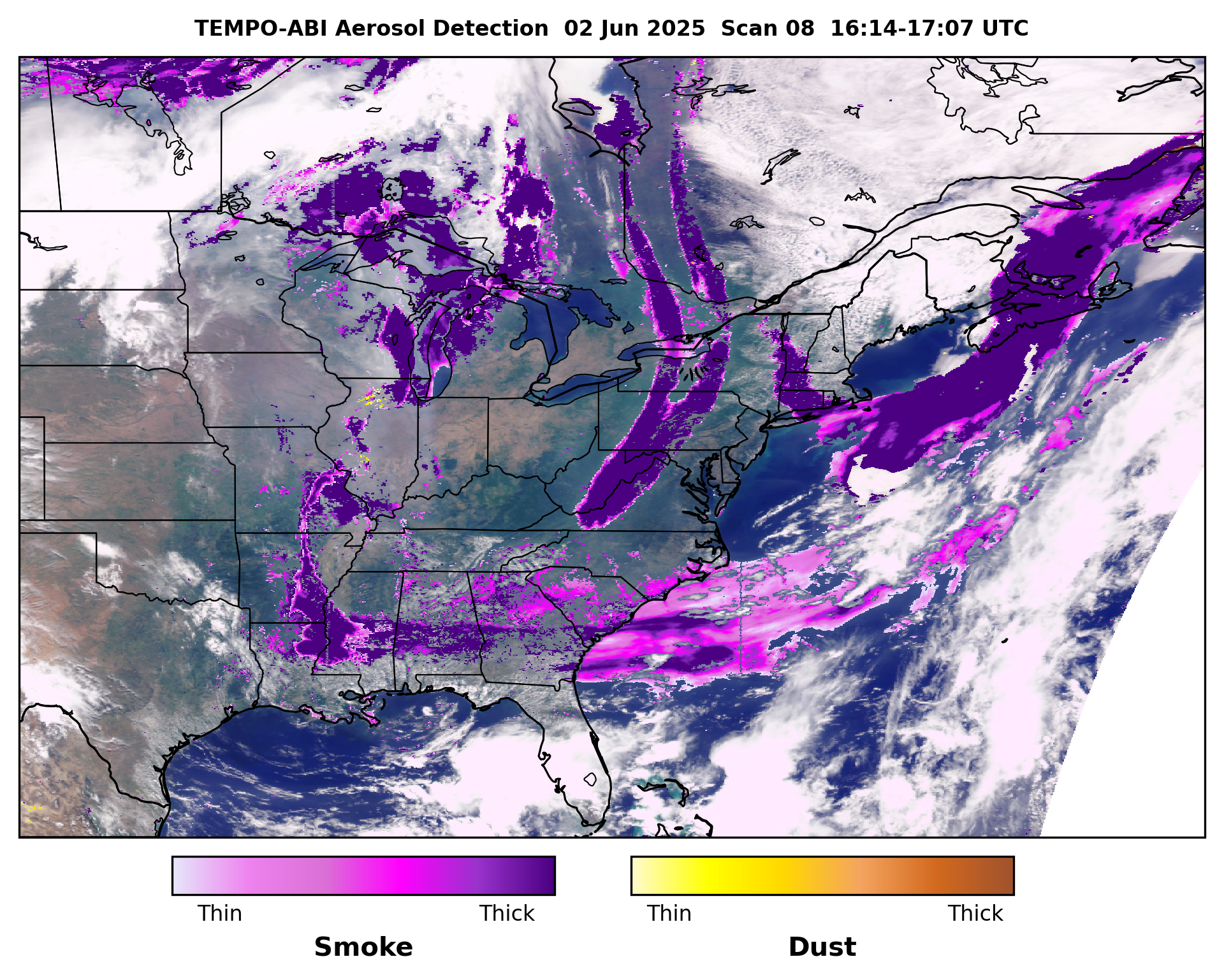
    A map of North America shows several wide swaths of purple illustrating smoke in the atmosphere as measured by NASA's TEMPO instrument during wildfires in Manitoba from June 2, 2025.
    The TEMPO mission detects and highlights movement of smoke originating from fires burning in Manitoba on June 2. Seen in purple hues are observations made by TEMPO in the ultraviolet spectrum compared to Advanced Baseline Imagers (ABIs) on NOAA’s GOES-R series of weather satellites that do not have the needed spectral coverage. The NOAA GOES-R data paired with NASA’s TEMPO data enhance state and local agencies’ ability to provide near-real-time smoke and dust impacts in local air quality forecasts.
    NOAA/NESDIS/Center for Satellite Applications and Research

    “The TEMPO data validation has truly been a community effort with over 20 agencies at the federal and international level, as well as a community of over 200 scientists at research and academic institutions,” Judd added. “I look forward to seeing how TEMPO data will help close knowledge gaps about the timing, sources, and evolution of air pollution from this unprecedented space-based view.”

    An agency review will take place in the fall to assess TEMPO’s achievements and extended mission goals and identify lessons learned that can be applied to future missions.

    The TEMPO mission is part of NASA’s Earth Venture Instrument program, which includes small, targeted science investigations designed to complement NASA’s larger research missions. The instrument also forms part of a virtual constellation of air quality monitors for the Northern Hemisphere which includes South Korea’s Geostationary Environment Monitoring Spectrometer and ESA’s (European Space Agency) Sentinel-4 satellite. TEMPO was built by BAE Systems Inc., Space & Mission Systems (formerly Ball Aerospace). It flies onboard the Intelsat 40e satellite built by Maxar Technologies. The TEMPO Instrument Operations Center and the Science Data Processing Center are operated by the Smithsonian Astrophysical Observatory, part of the Center for Astrophysics | Harvard & Smithsonian in Cambridge.

    For more information about the TEMPO instrument and mission, visit:

    https://science.nasa.gov/mission/tempo/

    About the Author

    Charles G. Hatfield

    Charles G. Hatfield

    Science Public Affairs Officer, NASA Langley Research Center

  • Hubble Observations Give “Missing” Globular Cluster Time to Shine

    2 min read

    Hubble Observations Give “Missing” Globular Cluster Time to Shine

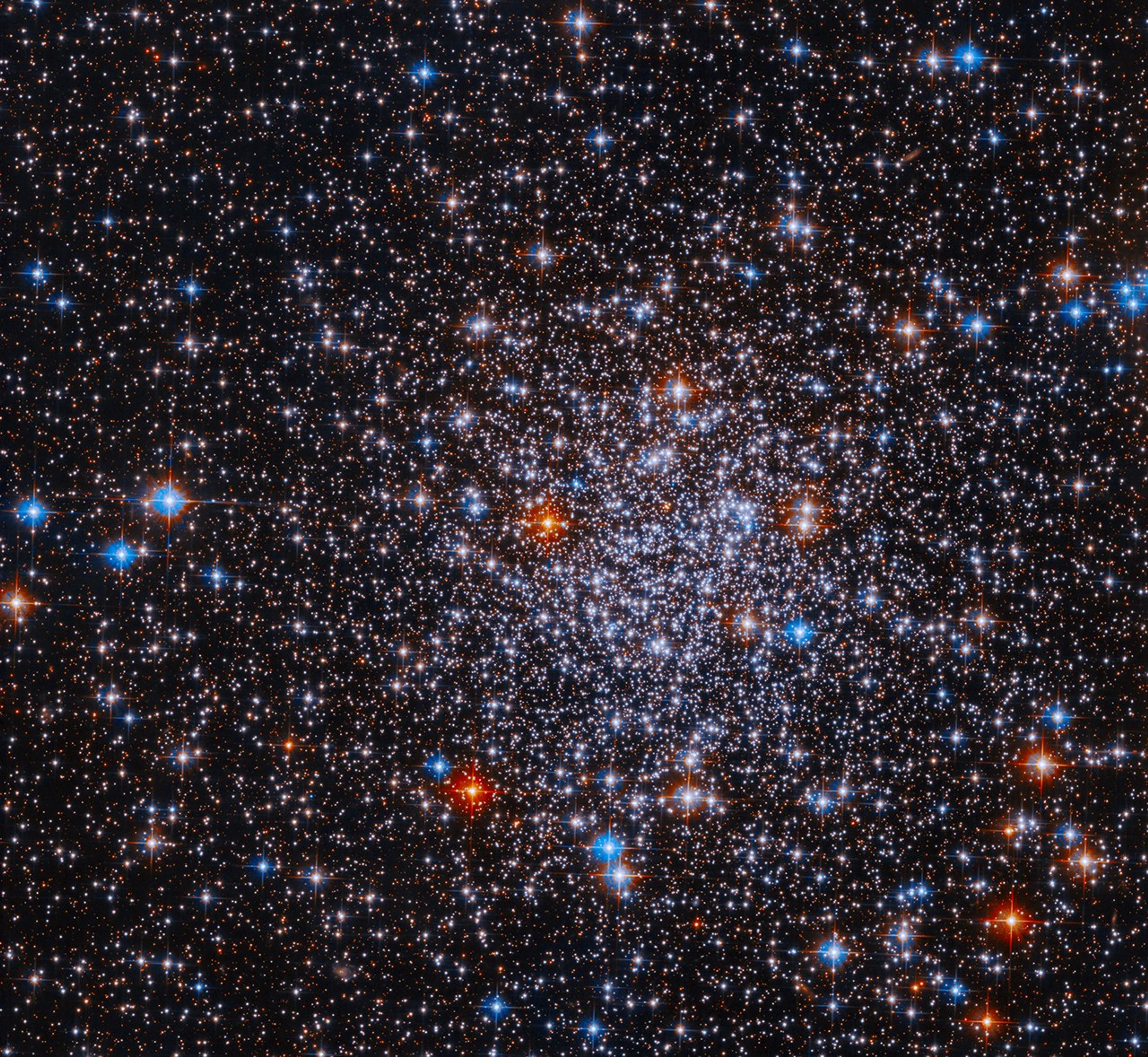
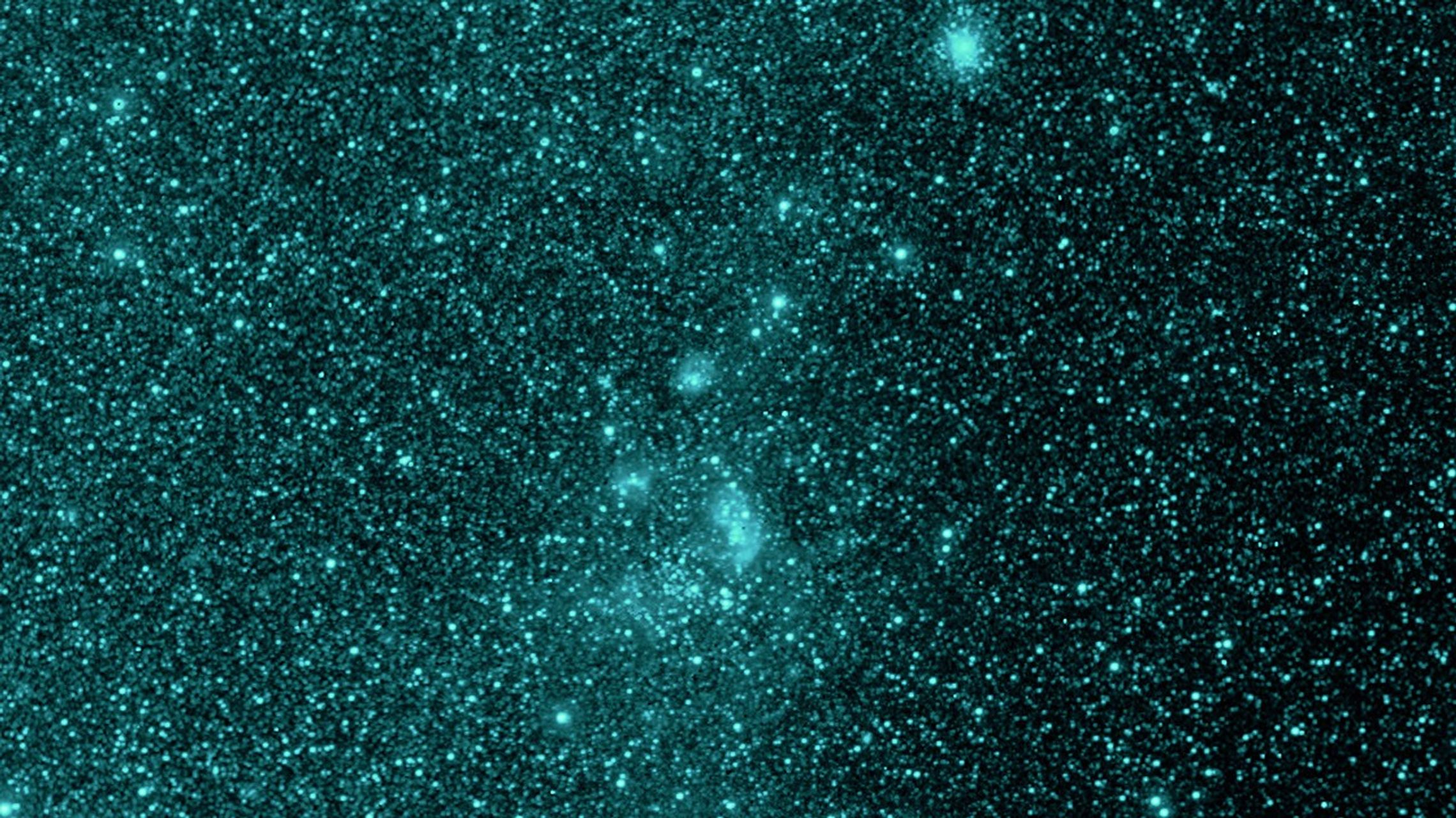
    Bright stars cluster against a black background. The stars are more densely concentrated in the center of the image. The stars appear mostly white, but bright red and blue stars are also visible sprinkled throughout the image.
    This NASA Hubble Space Telescope image features a dense and dazzling array of blazing stars that form globular cluster ESO 591-12.
    NASA, ESA, and D. Massari (INAF — Osservatorio di Astrofisica e Scienza dello Spazio); Processing: Gladys Kober (NASA/Catholic University of America)

    A previously unexplored globular cluster glitters with multicolored stars in this NASA Hubble Space Telescope image. Globular clusters like this one, called ESO 591-12 or Palomar 8, are spherical collections of tens of thousands to millions of stars tightly bound together by gravity. Globular clusters generally form early in the galaxies’ histories in regions rich in gas and dust. Since the stars form from the same cloud of gas as it collapses, they typically hover around the same age. Strewn across this image of ESO 591-12 are a number of red and blue stars. The colors indicate their temperatures; red stars are cooler, while the blue stars are hotter.

    Hubble captured the data used to create this image of ESO 591-12 as part of a study intended to resolve individual stars of the entire globular cluster system of the Milky Way. Hubble revolutionized the study of globular clusters since earthbound telescopes are unable to distinguish individual stars in the compact clusters. The study is part of the Hubble Missing Globular Clusters Survey, which targets 34 confirmed Milky Way globular clusters that Hubble has yet to observe.

    The program aims to provide complete observations of ages and distances for all of the Milky Way’s globular clusters and investigate fundamental properties of still-unexplored clusters in the galactic bulge or halo. The observations will provide key information on the early stages of our galaxy, when globular clusters formed.

    Explore More

    Media Contact:

    Claire Andreoli
    NASA’s Goddard Space Flight CenterGreenbelt, MD
    claire.andreoli@nasa.gov

  • NASA Advances Pressure Sensitive Paint Research Capability

    5 min read

    Preparations for Next Moonwalk Simulations Underway (and Underwater)

    A model of a blended wing aircraft glows pink inside a wind tunnel.
    The Swept Wing Flow Test model, known as SWiFT, with pressure sensitive paint applied, sports a pink glow under ultraviolet lights while tested during 2023 in a NASA wind tunnel at Langley Research Center in Virginia.
    NASA / Dave Bowman

    Many of us grew up using paint-by-number sets to create beautiful color pictures.

    For years now, NASA engineers studying aircraft and rocket designs in wind tunnels have flipped that childhood pastime, using computers to generate images from “numbers-by-paint” – pressure sensitive paint (PSP), that is.

    Now, advances in the use of high-speed cameras, supercomputers, and even more sensitive PSP have made this numbers-by-paint process 10,000 times faster while creating engineering visuals with 1,000 times higher resolution.

    So, what’s the big difference exactly between the “old” capability in use at NASA for more than a decade and the “new?”

    “The key is found by adding a single word in front of PSP, namely ‘unsteady’ pressure sensitive paint, or uPSP,” said E. Lara Lash, an aerospace engineer from NASA’s Ames Research Center in California’s Silicon Valley.

    With PSP, NASA researchers study the large-scale effects of relatively smooth air flowing over the wings and body of aircraft. Now with uPSP, they are able to see in finer detail what happens when more turbulent air is present – faster and better than ever before.

    In some cases with the new capability, researchers can get their hands on the wind tunnel data they’re looking for within 20 minutes. That’s quick enough to allow engineers to adjust their testing in real time.

    Usually, researchers record wind tunnel data and then take it back to their labs to decipher days or weeks later. If they find they need more data, it can take additional weeks or even months to wait in line for another turn in the wind tunnel.

    “The result of these improvements provides a data product that is immediately useful to aerodynamic engineers, structural engineers, or engineers from other disciplines,” Lash said.

    Robert Pearce, NASA’s associate administrator for aeronautics, who recently saw a demonstration of uPSP-generated data displayed at Ames, hailed the new tool as a national asset that will be available to researchers all over the country.

    “It’s a unique NASA innovation that isn’t offered anywhere else,” Pearce said. “It will help us maintain NASA’s world leadership in wind tunnel capabilities.”

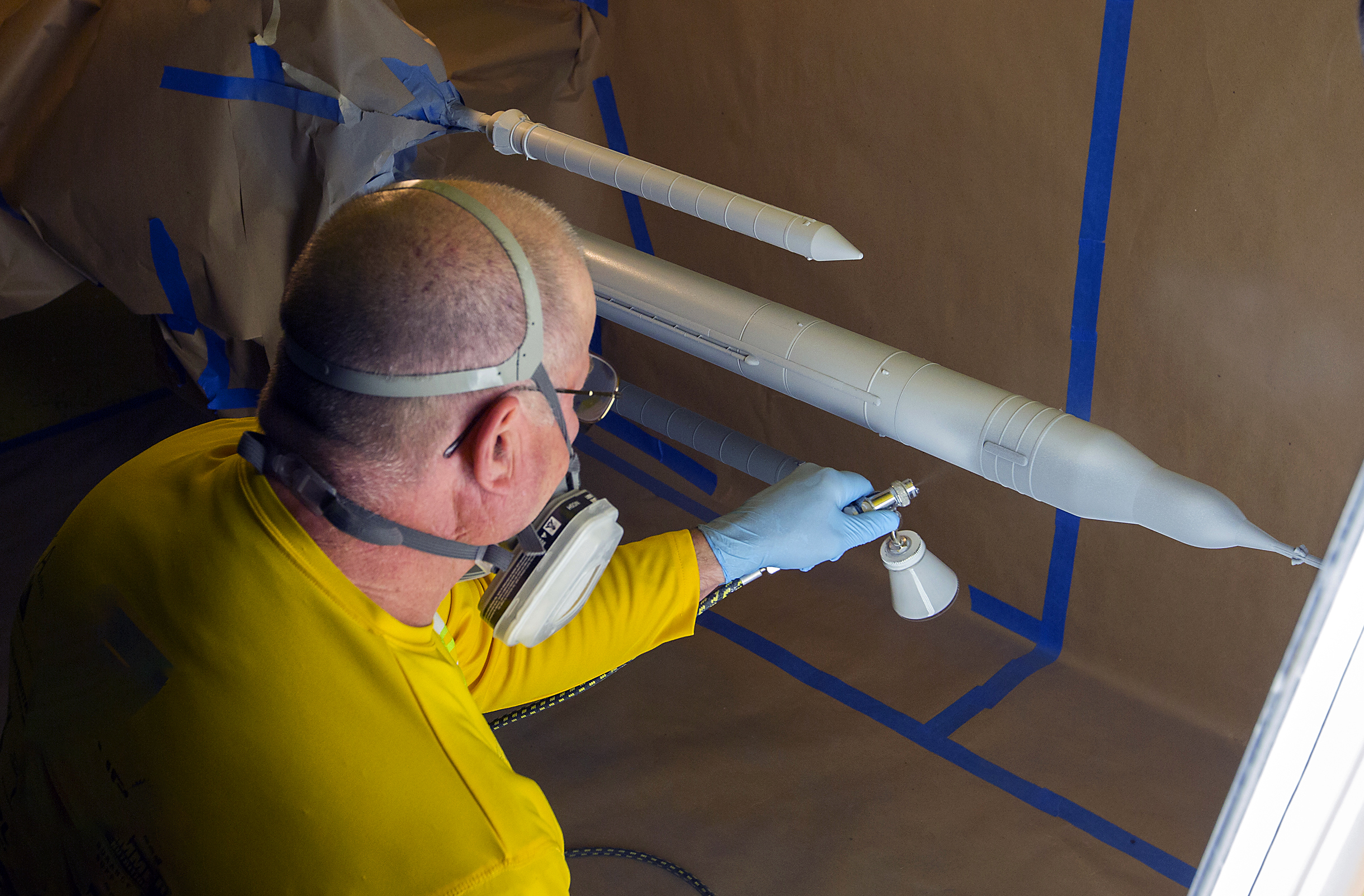
    A technician sprays pressure sensitive paint onto a small model of the Space Launch System rocket.
    A technician sprays unsteady pressure sensitive paint onto the surface of a small model of the Space Launch System in preparation for testing in a NASA wind tunnel.
    NASA / Dave Bowman

    How it Works

    With both PSP and uPSP, a unique paint is applied to scale models of aircraft or rockets, which are mounted in wind tunnels equipped with specific types of lights and cameras.

    When illuminated during tests, the paint’s color brightness changes depending on the levels of pressure the model experiences as currents of air rush by. Darker shades mean higher pressure; lighter shades mean lower pressure.

    Cameras capture the brightness intensity and a supercomputer turns that information into a set of numbers representing pressure values, which are made available to engineers to study and glean what truths they can about the vehicle design’s structural integrity.

    “Aerodynamic forces can vibrate different parts of the vehicle to different degrees,” Lash said. “Vibrations could damage what the vehicle is carrying or can even lead to the vehicle tearing itself apart. The data we get through this process can help us prevent that.”

    Traditionally, pressure readings are taken using sensors connected to little plastic tubes strung through a model’s interior and poking up through small holes in key places, such as along the surface of a wing or the fuselage. 

    Each point provides a single pressure reading. Engineers must use mathematical models to estimate the pressure values between the individual sensors.

    With PSP, there is no need to estimate the numbers. Because the paint covers the entire model, its brightness as seen by the cameras reveals the pressure values over the whole surface.

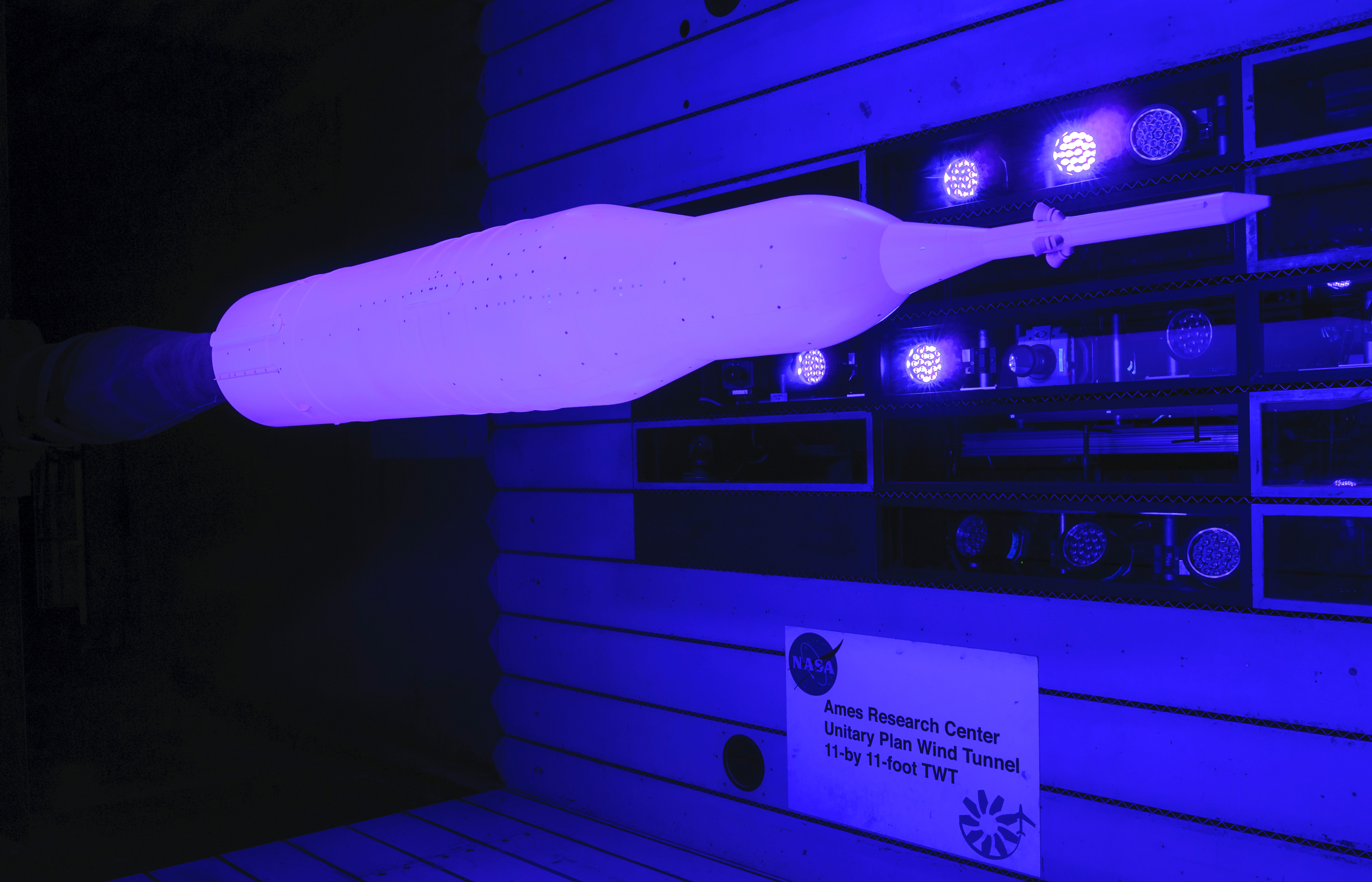
    A rocket glows pink from the use of Pressure Sensitive Paint inside a NASA wind tunnel.
    A four-percent scale model of the Space Launch System rocket is tested in 2017 using unsteady Pressure Sensitive Paint inside the 11-foot by 11-foot Unitary Plan Wind Tunnel at NASA’s Ames Research Center in California.
    NASA / Dominic Hart

    Making it Better

    The introduction, testing, and availability of uPSP is the result of a successful five-year-long effort, begun in 2019, in which researchers challenged themselves to significantly improve the PSP’s capability with its associated cameras and computers.

    The NASA team’s desire was to develop and demonstrate a better process of acquiring, processing, and visualizing data using a properly equipped wind tunnel and supercomputer, then make the tool available at NASA wind tunnels across the country.

    The focus during a capability challenge was on NASA’s Unitary Plan Facility’s 11-foot transonic wind tunnel, which the team connected to the nearby NASA Advanced Supercomputing Facility, both located at Ames.

    Inside the wind tunnel, a scale model of NASA’s Space Launch System rocket served as the primary test subject during the challenge period.

    Now that the agency has completed its Artemis I uncrewed lunar flight test mission, researchers can match the flight-recorded data with the wind tunnel data to see how well reality and predictions compare.

    With the capability challenge officially completed at the end of 2024, the uPSP team is planning to deploy it to other wind tunnels and engage with potential users with interests in aeronautics or spaceflight.

    “This is a NASA capability that we have, not only for use within the agency, but one that we can offer industry, academia, and other government agencies to come in and do research using these new tools,” Lash said.

    NASA’s Aerosciences Evaluation and Test Capabilities portfolio office, an organization managed under the agency’s Aeronautics Research Mission Directorate, oversaw the development of the uPSP capability.

    Watch this uPSP Video

    About the Author

    Jim Banke

    Jim Banke

    Managing Editor/Senior Writer

    Jim Banke is a veteran aviation and aerospace communicator with more than 40 years of experience as a writer, producer, consultant, and project manager based at Cape Canaveral, Florida. He is part of NASA Aeronautics’ Strategic Communications Team and is Managing Editor for the Aeronautics topic on the NASA website.

  • Old Glory on the Red Planet

    Old Glory on the Red Planet

    This close-up view of the United States flag plate on NASA’s Perseverance was acquired on June 28, 2025 (the 1,548th day, or sol, of its mission to Mars), by the WATSON (Wide Angle Topographic Sensor for Operations and eNgineering) imager on the turret at the end of the rover’s Mars robotic arm.

  • Old Glory on the Red Planet

    A small metal American flag attached to the Mars Perceverance rover's mast. The mast is white with silver metal pieces attached to it. There is red dust all over the mast. The image appears in a vignette that looks like a rectangle rotated diagonally; the rest of the image is dark.
    NASA/JPL-Caltech/MSSS

    The United States flag adorns an aluminum plate mounted at the base of the mast, or “head,” of NASA’s Perseverance Mars rover. This image of the plate was taken on June 28, 2025 (the 1,548th day, or sol, of the mission), by the WATSON (Wide Angle Topographic Sensor for Operations and eNgineering) camera on the end of the rover’s robotic arm.

    WATSON, part of an instrument called SHERLOC (Scanning Habitable Environments with Raman & Luminescence for Organics & Chemicals), was built by Malin Space Science Systems (MSSS) in San Diego and is operated jointly by MSSS and NASA’s Jet Propulsion Laboratory in Southern California. JPL, which is managed for the agency by Caltech, built and manages operations of the Perseverance rover.

    Learn more about Perseverance’s latest science.

  • Discovery Alert: Scientists Spot a Planetary Carousel

    This artist’s concept animation shows the orbital dynamics of KOI-134 system which, in 2025, a paper revealed to have two planets: KOI-134 b and KOI-134 c.
    NASA/JPL-Caltech/K. Miller (Caltech/IPAC)

    The Planets

    KOI-134 b and KOI-134 c 

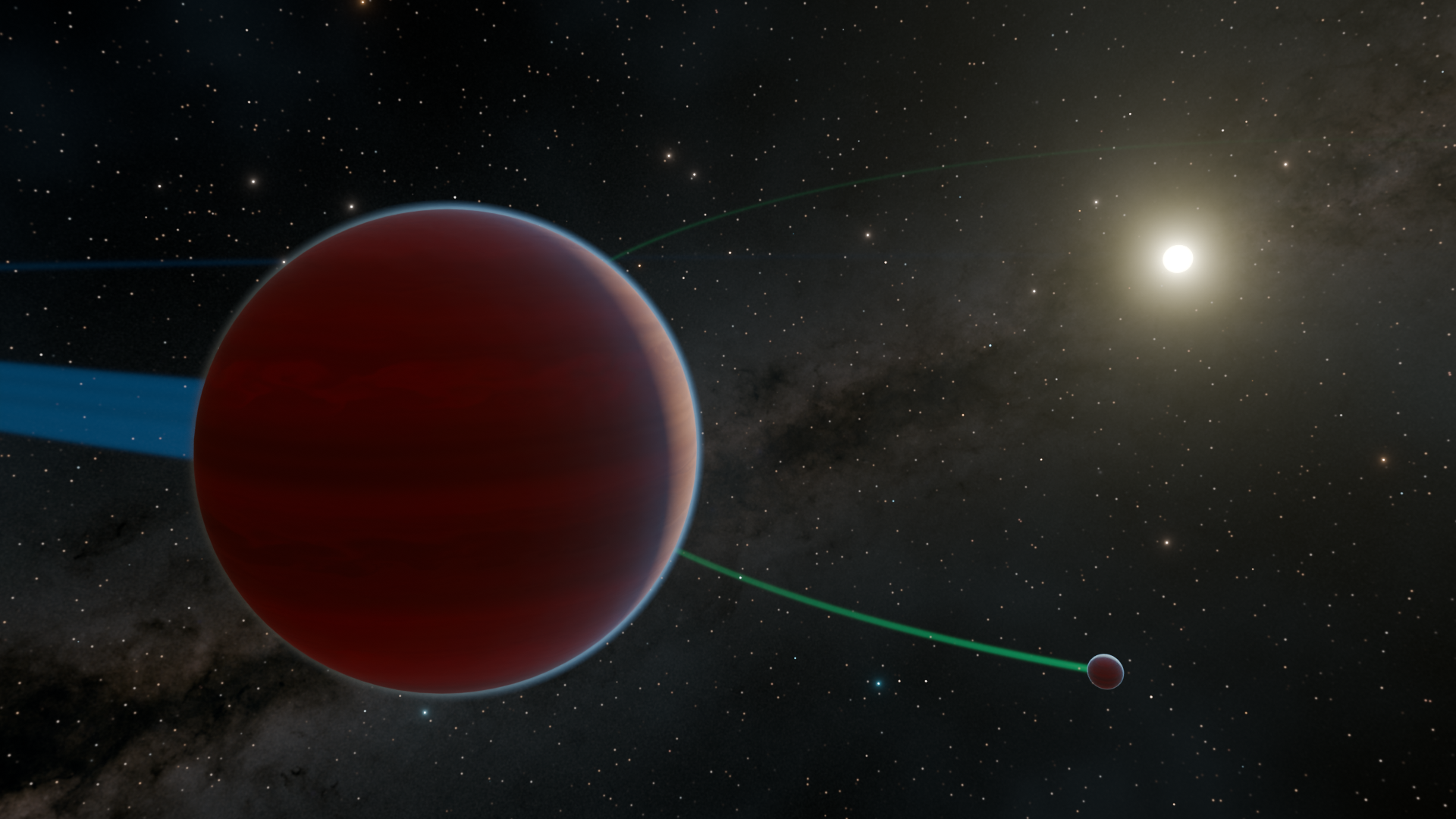
    This artist's concept shows a star in the upper right-hand corner, a large planet across screen on the left side with a blue trail indicating its orbital path behind it and a smaller planet is seen on the lower right-hand side with a green trail behind it indicating its orbital path.
    This artist’s concept shows the KOI-134 system which, in 2025, a paper revealed to have two planets: KOI-134 b and KOI-134 c.
    NASA/JPL-Caltech/K. Miller (Caltech/IPAC)

    The Discovery

    A new investigation into old Kepler data has revealed that a planetary system once thought to house zero planets actually has two planets which orbit their star in a unique style, like an old-fashioned merry-go-round. 

    Key Facts

    The KOI-134 system contains two planets which orbit their star in a peculiar fashion on two different orbital planes, with one planet exhibiting significant variation in transit times. This is the first-discovered system of its kind. 

    Details 

    Over a decade ago, scientists used NASA’s Kepler Space Telescope to observe the KOI-134 system and thought that it might have a planet orbiting, but they deemed this planet candidate to be a false positive, because its transits (or passes in front of its star) were not lining up as expected. These transits were so abnormal that the planet was actually weeded out through an automated system as a false positive before it could be analyzed further. 

    However, NASA’s commitment to openly sharing scientific data means that researchers can constantly revisit old observations to make new discoveries. In this new study, researchers re-analyzed this Kepler data on KOI-134 and confirmed that not only is the “false positive” actually a real planet, but the system has two planets and some really interesting orbital dynamics! 

    First, the “false positive” planet, named KOI-134 b, was confirmed to be a warm Jupiter (or a warm planet of a similar size to Jupiter). Through this analysis, researchers uncovered that the reason this planet eluded confirmation previously is because it experiences what are called transit timing variations (TTVs), or small differences in a planet’s transit across its star that can make its transit “early” or “late” because the planet is being pushed or pulled by the gravity from another planet which was also revealed in this study. Researchers estimate that KOI-134 b transits across its star as much as 20 hours “late” or “early,” which is a significant variation. In fact, it was so significant that it’s the reason why the planet wasn’t confirmed in initial observations. 

    As these TTVs are caused by the gravitational interaction with another planet, this discovery also revealed a planetary sibling: KOI-134 c. Through studying this system in simulations that include these TTVs, the team found that KOI-134 c is a planet slightly smaller than Saturn and closer to its star than KOI-134 b. 

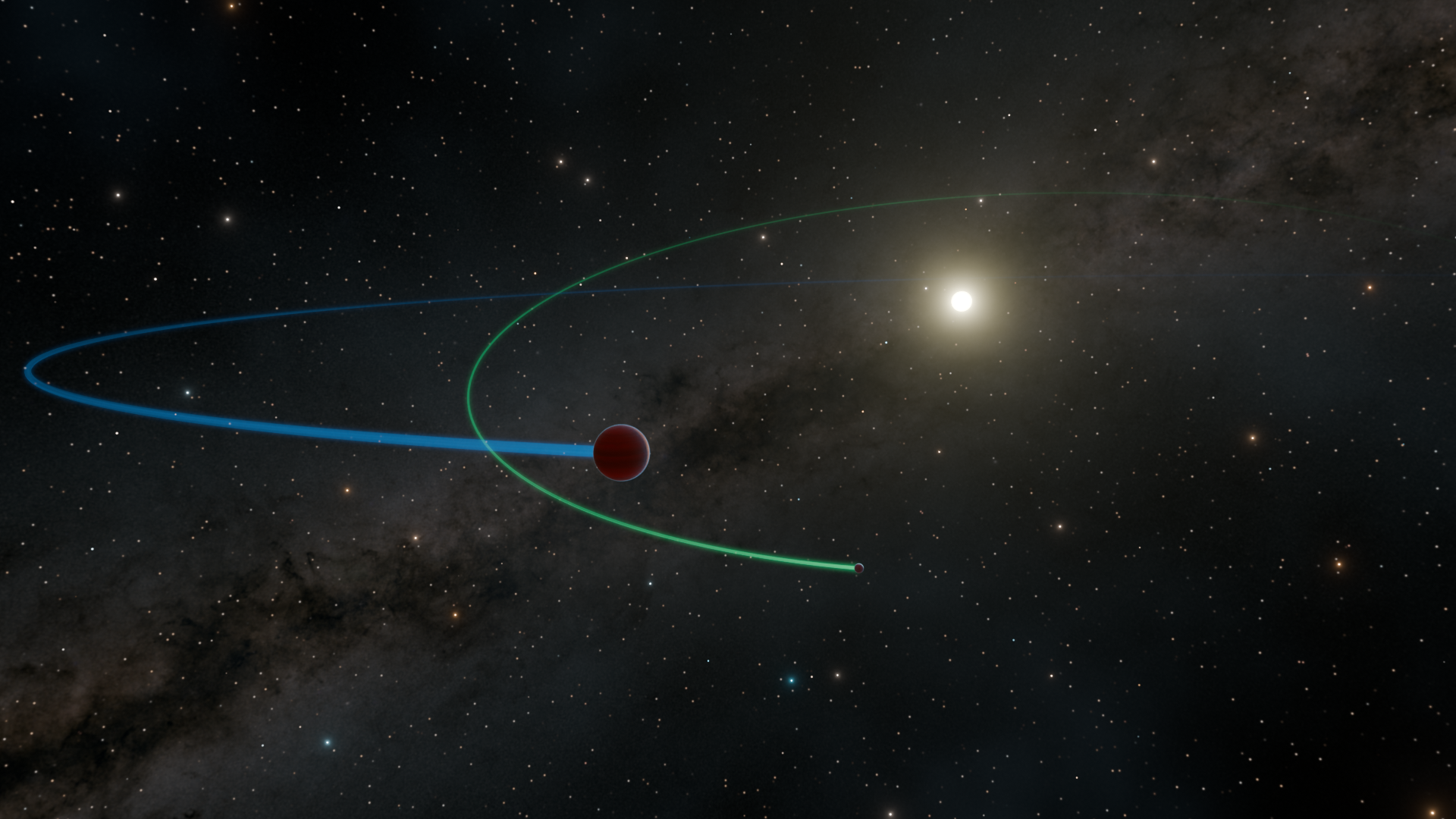
    This artist's concept shows a star in the upper right-hand corner, a planet across screen on the left side with a blue trail indicating its orbital path behind it and a smaller planet is seen on the lower right-hand side with a green trail behind it indicating its orbital path.
    This artist’s concept shows the KOI-134 system which, in 2025, a paper revealed to have two planets: KOI-134 b and KOI-134 c.
    NASA/JPL-Caltech/K. Miller (Caltech/IPAC)

    KOI-134 c previously eluded observation because it orbits on a tilted orbital plane, a different plane from KOI-134 b, and this tilted orbit prevents the planet from transiting its star. The two orbital planes of these planets are about 15 degrees different from one another, also known as a mutual inclination of 15 degrees, which is significant. Due to the gravitational push and pull between these two planets, their orbital planes also tilt back and forth. 

    Another interesting feature of this planetary system is something called resonance. These two planets have a 2 to 1 resonance, meaning within the same time that one planet completes one orbit, the other completes two orbits. In this case, KOI-134 b has an orbital period (the time it takes a planet to complete one orbit) of about 67 days, which is twice the orbital period of KOI-134 c, which orbits every 33-34 days. 

    Between the separate orbital planes tilting back and forth, the TTVs, and the resonance, the two planets orbit their star in a pattern that resembles two wooden ponies bobbing up and down as they circle around on an old-fashioned merry go round. 

    Fun Facts

    While this system started as a false positive with Kepler, this re-analysis of the data reveals a vibrant system with two planets. In fact, this is the first-ever discovered compact, multiplanetary system that isn’t flat, has such a significant TTV, and experiences orbital planes tilting back and forth. 

    Also, most planetary systems do not have high mutual inclinations between close planet pairs. In addition to being a rarity, mutual inclinations like this are also not often measured because of challenges within the observation process. So, having measurements like this of a significant mutual inclination in a system, as well as measurements of resonance and TTVs, provides a clear picture of dynamics within a planetary system which we are not always able to see. 

    The Discoverers

    A team of scientists led by Emma Nabbie of the University of Southern Queensland published a paper on June 27 on their discovery, “A high mutual inclination system around KOI-134 revealed by transit timing variations,” in the journal “Nature Astronomy.” The observations described in this paper and used in simulations in this paper were made by NASA’s Kepler Space Telescope and the paper included collaboration and contributions from institutions including the University of Geneva, University of La Laguna, Purple Mountain Observatory, the Harvard-Smithsonian Center for Astrophysics, the Georgia Institute of Technology, the University of Southern Queensland, and NASA’s retired Kepler Space Telescope.

  • NASA Sets Briefings for SpaceX Crew-11 Mission to Space Station

    The four crew members of NASA’s SpaceX Crew-11 mission to the International Space Station train inside a SpaceX Dragon spacecraft in Hawthorne, California. From left to right: Roscosmos cosmonaut Oleg Platonov, NASA astronauts Mike Fincke and Zena Cardman, and JAXA astronaut Kimiya Yui.
    Credit: SpaceX

    NASA and its partners will discuss the upcoming crew rotation to the International Space Station during a pair of news conferences on Thursday, July 10, from the agency’s Johnson Space Center in Houston.

    First is an overview news conference at 12 p.m. EDT with mission leadership discussing final launch and mission preparations on the agency’s YouTube channel.

    Next, crew will participate in a news conference at 2 p.m. on NASA’s YouTube channel, followed by individual astronaut interviews at 3 p.m. This is the final media opportunity with Crew-11 before they travel to NASA’s Kennedy Space Center in Florida for launch.

    The Crew-11 mission, targeted to launch in late July/early August, will carry NASA astronauts Zena Cardman and Mike Fincke, JAXA (Japan Aerospace Exploration Agency) astronaut Kimiya Yui, and Roscosmos cosmonaut Oleg Platonov to the orbiting laboratory. The crew will launch aboard a SpaceX Dragon spacecraft on the company’s Falcon 9 rocket from Launch Complex 39A.

    United States-based media seeking to attend in person must contact the NASA Johnson newsroom no later than 5 p.m. on Monday, July 7, at 281-483-5111 or jsccommu@mail.nasa.gov. A copy of NASA’s media accreditation policy is available online.

    Any media interested in participating in the news conferences by phone must contact the Johnson newsroom by 9:45 a.m. the day of the event. Media seeking virtual interviews with the crew must submit requests to the Johnson newsroom by 5 p.m. on Monday, July 7.

    Briefing participants are as follows (all times Eastern and subject to change based on real-time operations):

    12 p.m.: Mission Overview News Conference

    • Steve Stich, manager, Commercial Crew Program, NASA Kennedy
    • Bill Spetch, operations integration manager, International Space Station Program, NASA Johnson
    • NASA’s Space Operations Mission Directorate representative
    • Sarah Walker, director, Dragon Mission Management, SpaceX
    • Mayumi Matsuura, vice president and director general, Human Spaceflight Technology Directorate, JAXA

    2 p.m.: Crew News Conference

    • Zena Cardman, Crew-11 commander, NASA
    • Mike Fincke, Crew-11 pilot, NASA
    • Kimiya Yui, Crew-11 mission specialist, JAXA
    • Oleg Platonov, Crew-11 mission specialist, Roscosmos

    3 p.m.: Crew Individual Interview Opportunities

    • Crew-11 members available for a limited number of interviews

    Selected as a NASA astronaut in 2017, Cardman will conduct her first spaceflight. The Williamsburg, Virginia, native holds a bachelor’s degree in Biology and a master’s in Marine Sciences from the University of North Carolina at Chapel Hill. At the time of selection, she was pursuing a doctorate in geosciences. Cardman’s geobiology and geochemical cycling research focused on subsurface environments, from caves to deep sea sediments. Since completing initial training, Cardman has supported real-time station operations and lunar surface exploration planning. Follow @zenanaut on X and @zenanaut on Instagram.

    This will be Fincke’s fourth trip to the space station, having logged 382 days in space and nine spacewalks during Expedition 9 in 2004, Expedition 18 in 2008, and STS-134 in 2011, the final flight of space shuttle Endeavour. Throughout the past decade, Fincke has applied his expertise to NASA’s Commercial Crew Program, advancing the development and testing of the SpaceX Dragon spacecraft and Boeing Starliner spacecraft toward operational certification. The Emsworth, Pennsylvania, native is a graduate of the United States Air Force Test Pilot School and holds bachelors’ degrees from the Massachusetts Institute of Technology, Cambridge, in both aeronautics and astronautics, as well as Earth, atmospheric and planetary sciences. He also has a master’s degree in aeronautics and astronautics from Stanford University in California. Fincke is a retired U.S. Air Force colonel with more than 2,000 flight hours in over 30 different aircraft. Follow @AstroIronMike on X and Instagram.

    With 142 days in space, this will be Yui’s second trip to the space station. After his selection as a JAXA astronaut in 2009, Yui flew as a flight engineer for Expedition 44/45 and became the first Japanese astronaut to capture JAXA’s H-II Transfer Vehicle using the station’s robotic arm. In addition to constructing a new experimental environment aboard Kibo, he conducted a total of 21 experiments for JAXA. In November 2016, Yui was assigned as chief of the JAXA Astronaut Group. He graduated from the School of Science and Engineering at the National Defense Academy of Japan in 1992. He later joined the Air Self-Defense Force at the Japan Defense Agency (currently the Ministry of Defense). In 2008, Yui joined the Air Staff Office at the Ministry of Defense as a lieutenant colonel. Follow @astro_kimiya on X.

    The Crew-11 mission also will be Platonov’s first spaceflight. Before his selection as a cosmonaut in 2018, Platonov earned a degree in engineering from Krasnodar Air Force Academy in aircraft operations and air traffic management. He also earned a bachelor’s degree in state and municipal management in 2016 from the Far Eastern Federal University in Vladivostok, Russia. Assigned as a test cosmonaut in 2021, he has experience in piloting aircraft, zero gravity training, scuba diving, and wilderness survival.

    For more information about the mission, visit:

    https://www.nasa.gov/commercialcrew

    -end-

    Claire O’Shea / Joshua Finch
    Headquarters, Washington
    202-358-1100
    claire.a.o’shea@nasa.gov / joshua.a.finch@nasa.gov

    Sandra Jones / Joseph Zakrzewski
    Johnson Space Center, Houston
    281-483-5111
    sandra.p.jones@nasa.gov / Joseph.a.zakrzewski@nasa.gov

  • NASA Awards Simulation and Advanced Software Services II Contract

    The letters NASA on a blue circle with red and white detail, all surrounded by a black background
    Credit: NASA

    NASA has awarded a contract to MacLean Engineering & Applied Technologies, LLC of Houston to provide simulation and advanced software services to the agency.

    The Simulation and Advanced Software Services II (SASS II) contract includes services from Oct. 1, 2025, through Sept. 30, 2030, with a maximum potential value not to exceed $150 million. The contract is a single award, indefinite-delivery/indefinite-quality contract with the capability to issue cost-plus-fixed-fee task orders and firm-fixed-price task orders.

    Under the five-year SASS II contract, the awardee is tasked to provide simulation and software services for space-based vehicle models and robotic manipulator systems; human biomechanical representations for analysis and development of countermeasures devices; guidance, navigation, and control of space-based vehicles for all flight phases; and space-based vehicle on-board computer systems simulations of flight software systems. Responsibilities also include astronomical object surface interaction simulation of space-based vehicles, graphics support for simulation visualization and engineering analysis, and ground-based and onboarding systems to support human-in-the-loop training.

    Major subcontractors include Tietronix Software Inc. in Houston and VEDO Systems, LLC, in League City, Texas.

    For information about NASA and agency programs, visit:

    https://www.nasa.gov/

    -end-

    Tiernan Doyle
    Headquarters, Washington
    202-358-1600
    tiernan.doyle@nasa.gov

    Chelsey Ballarte
    Johnson Space Center, Houston
    281-483-5111
    Chelsey.n.ballarte@nasa.gov

    Details

    Last Updated

    Jul 02, 2025

  • How NASA’s SPHEREx Mission Will Share Its All-Sky Map With the World 

    5 min read

    How NASA’s SPHEREx Mission Will Share Its All-Sky Map With the World 

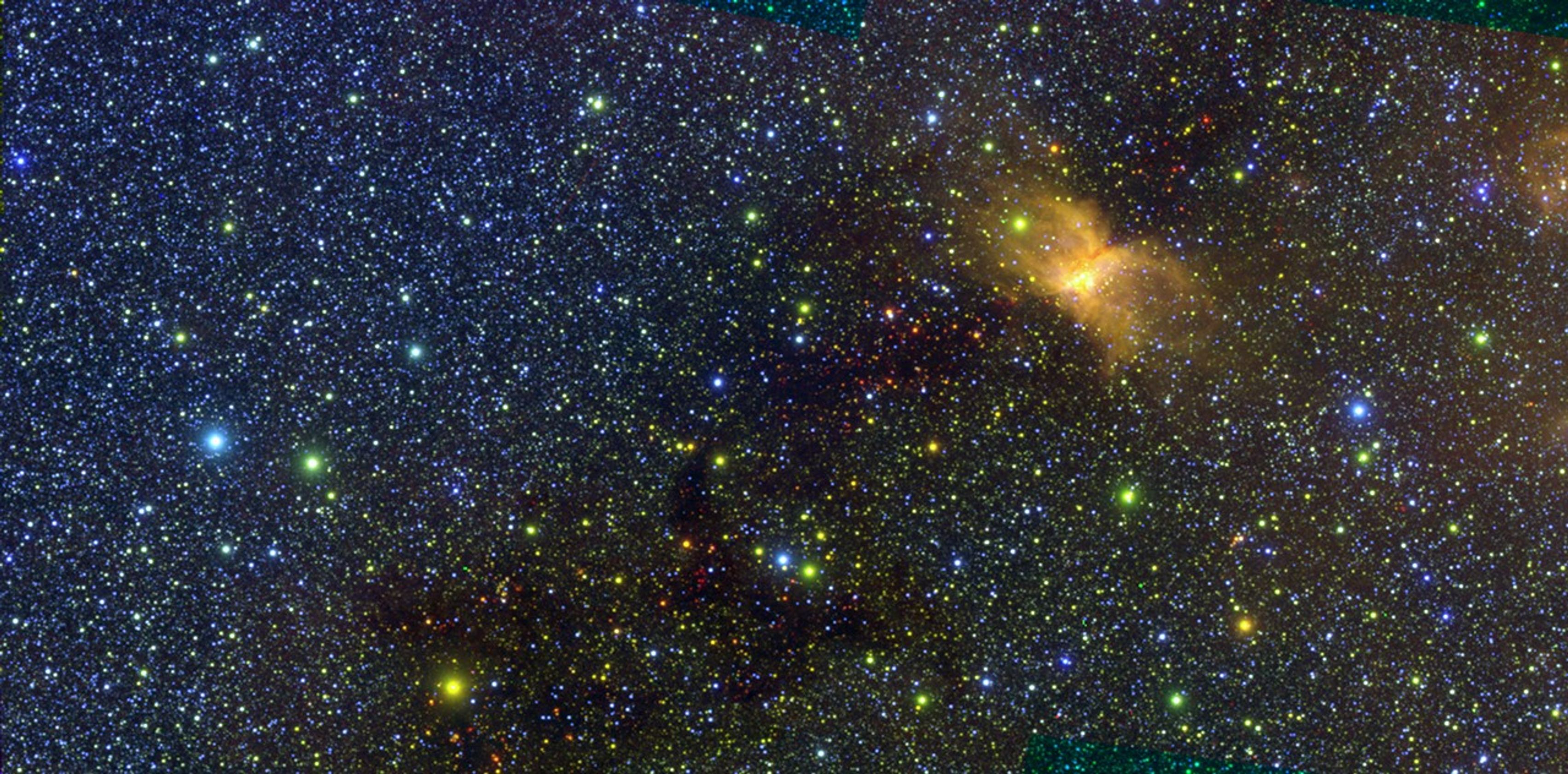
    This infrared image of the Vela Molecular Ridge was captured by SPHEREx and is part of the mission’s first ever public data release. The thousands of stars in the image are mostly represented in shades of blue and green. The yellow patch on the right side of the image is a cloud of interstellar gas and dust that glows in some infrared colors due to radiation from nearby stars.
    NASA’s SPHEREx mission will map the entire sky in 102 different wavelengths, or colors, of infrared light. This image of the Vela Molecular Ridge was captured by SPHEREx and is part of the mission’s first ever public data release. The yellow patch on the right side of the image is a cloud of interstellar gas and dust that glows in some infrared colors due to radiation from nearby stars.
    NASA/JPL-Caltech

    NASA’s newest astrophysics space telescope launched in March on a mission to create an all-sky map of the universe. Now settled into low-Earth orbit, SPHEREx (Spectro-Photometer for the History of the Universe, Epoch of Reionization, and Ices Explorer) has begun delivering its sky survey data to a public archive on a weekly basis, allowing anyone to use the data to probe the secrets of the cosmos.

    “Because we’re looking at everything in the whole sky, almost every area of astronomy can be addressed by SPHEREx data,” said Rachel Akeson, the lead for the SPHEREx Science Data Center at IPAC. IPAC is a science and data center for astrophysics and planetary science at Caltech in Pasadena, California.

    Almost every area of astronomy can be addressed by SPHEREx data.

    Rachel Akeson

    Rachel Akeson

    SPHEREx Science Data Center Lead

    Other missions, like NASA’s now-retired WISE (Wide-field Infrared Survey Explorer), have also mapped the entire sky. SPHEREx builds on this legacy by observing in 102 infrared wavelengths, compared to WISE’s four wavelength bands.
    By putting the many wavelength bands of SPHEREx data together, scientists can identify the signatures of specific molecules with a technique known as spectroscopy. The mission’s science team will use this method to study the distribution of frozen water and organic molecules — the “building blocks of life” — in the Milky Way.

    This animation shows how NASA’s SPHEREx observatory will map the entire sky — a process it will complete four times over its two-year mission. The telescope will observe every point in the sky in 102 different infrared wavelengths, more than any other all-sky survey. SPHEREx’s openly available data will enable a wide variety of astronomical studies. Credit: NASA/JPL-Caltech

    The SPHEREx science team will also use the mission’s data to study the physics that drove the universe’s expansion following the big bang, and to measure the amount of light emitted by all the galaxies in the universe over time. Releasing SPHEREx data in a public archive encourages far more astronomical studies than the team could do on their own.

    “By making the data public, we enable the whole astronomy community to use SPHEREx data to work on all these other areas of science,” Akeson said.

    NASA is committed to the sharing of scientific data, promoting transparency and efficiency in scientific research. In line with this commitment, data from SPHEREx appears in the public archive within 60 days after the telescope collects each observation. The short delay allows the SPHEREx team to process the raw data to remove or flag artifacts, account for detector effects, and align the images to the correct astronomical coordinates.

    The team publishes the procedures they used to process the data alongside the actual data products. “We want enough information in those files that people can do their own research,” Akeson said.

    During its two-year prime mission, SPHEREx will survey the entire sky twice a year, creating four all-sky maps. After the mission reaches the one-year mark, the team plans to release a map of the whole sky at all 102 wavelengths.

    In addition to the science enabled by SPHEREx itself, the telescope unlocks an even greater range of astronomical studies when paired with other missions. Data from SPHEREx can be used to identify interesting targets for further study by NASA’s James Webb Space Telescope, refine exoplanet parameters collected from NASA’s TESS (Transiting Exoplanet Survey Satellite), and study the properties of dark matter and dark energy along with ESA’s (European Space Agency’s) Euclid mission and NASA’s upcoming Nancy Grace Roman Space Telescope.

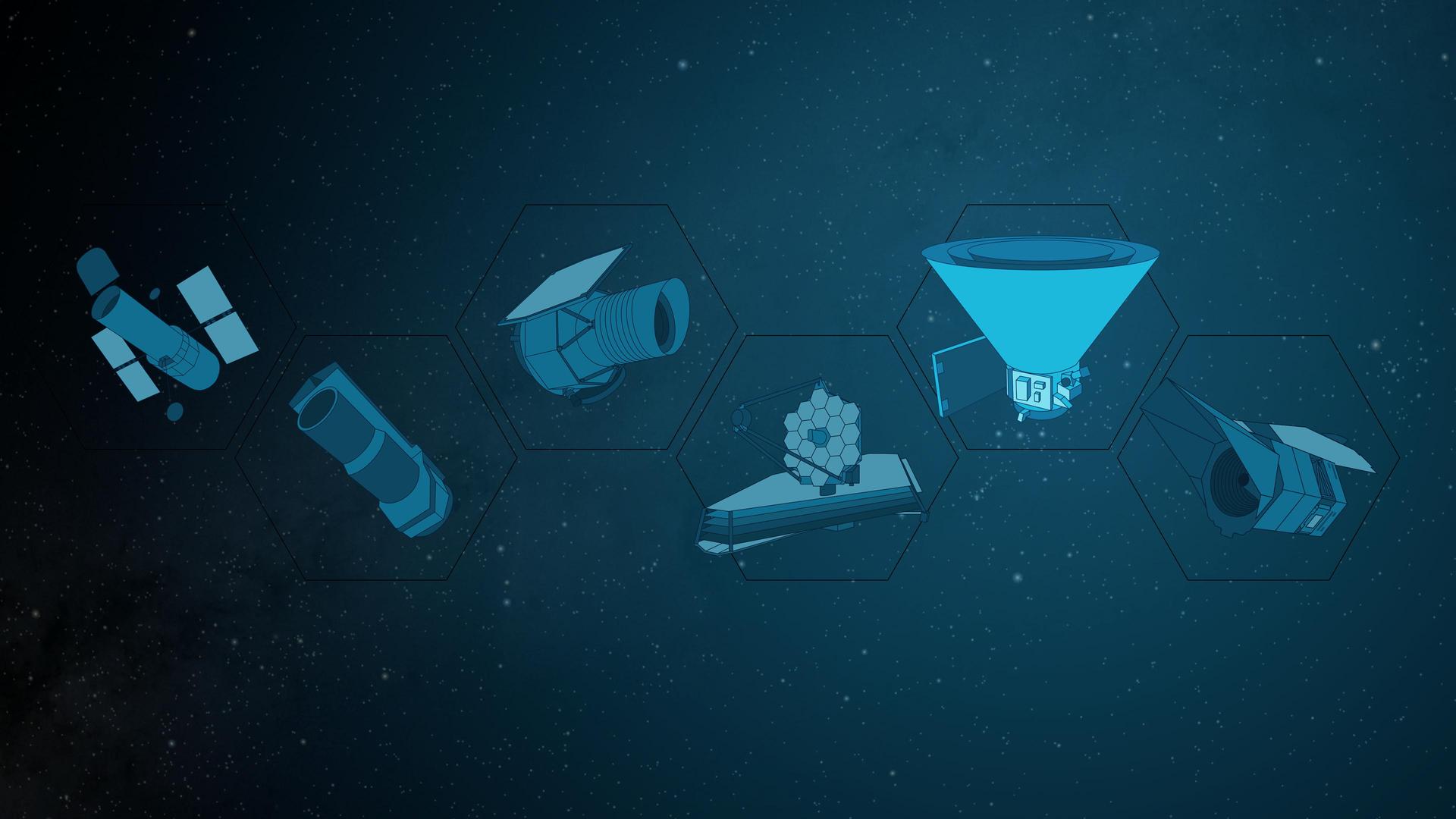
    In this illustration, NASA's SPHEREx mission is highlighted among a line of other NASA space telescopes.
    The SPHEREx mission’s all-sky survey will complement data from other NASA space telescopes. SPHEREx is illustrated second from the right. The other telescope illustrations are, from left to right: the Hubble Space Telescope, the retired Spitzer Space Telescope, the retired WISE/NEOWISE mission, the James Webb Space Telescope, and the upcoming Nancy Grace Roman Space Telescope.
    NASA/JPL-Caltech

    The IPAC archive that hosts SPHEREx data, IRSA (NASA/IPAC Infrared Science Archive), also hosts pointed observations and all-sky maps at a variety of wavelengths from previous missions. The large amount of data available through IRSA gives users a comprehensive view of the astronomical objects they want to study.

    “SPHEREx is part of the entire legacy of NASA space surveys,” said IRSA Science Lead Vandana Desai. “People are going to use the data in all kinds of ways that we can’t imagine.”

    NASA’s Office of the Chief Science Data Officer leads open science efforts for the agency. Public sharing of scientific data, tools, research, and software maximizes the impact of NASA’s science missions. To learn more about NASA’s commitment to transparency and reproducibility of scientific research, visit science.nasa.gov/open-science. To get more stories about the impact of NASA’s science data delivered directly to your inbox, sign up for the NASA Open Science newsletter.

    By Lauren Leese
    Web Content Strategist for the Office of the Chief Science Data Officer 

    More About SPHEREx

    The SPHEREx mission is managed by NASA’s Jet Propulsion Laboratory for the agency’s Astrophysics Division within the Science Mission Directorate at NASA Headquarters. BAE Systems in Boulder, Colorado, built the telescope and the spacecraft bus. The science analysis of the SPHEREx data will be conducted by a team of scientists located at 10 institutions in the U.S., two in South Korea, and one in Taiwan. Caltech in Pasadena managed and integrated the instrument. The mission’s principal investigator is based at Caltech with a joint JPL appointment. Data will be processed and archived at IPAC at Caltech. The SPHEREx dataset will be publicly available at the NASA-IPAC Infrared Science Archive. Caltech manages JPL for NASA.

    To learn more about SPHEREx, visit:

    https://nasa.gov/SPHEREx

    Media Contacts

    Calla Cofield
    Jet Propulsion Laboratory, Pasadena, Calif.
    626-808-2469
    calla.e.cofield@jpl.nasa.gov

    Amanda Adams
    Office of the Chief Science Data Officer
    256-683-6661
    amanda.m.adams@nasa.gov

  • What’s Up: July 2025 Skywatching Tips from NASA

    A.M./P.M. Planet Watching, Plus the Eagle Constellation

    Mars shines in the evening, and is joined briefly by Mercury. Jupiter joins Venus as the month goes on. And all month, look for Aquila the eagle.

    Skywatching Highlights

    All Month – Planet Visibility:

    • Venus: Shines brightly in the east each morning during the couple of hours before sunrise, with the Pleiades and bright stars Aldebaran and Capella.
    • Mars: Sits in the west, about 20 degrees above the horizon as twilight fades. Sets a couple of hours after dark.
    • Jupiter: Starts to become visible low in the east in the hour before sunrise after mid-month. You’ll notice it rises a bit higher each day through August, quickly approaching closer to Venus each morning.
    • Mercury: Visible very low in the west (10 degrees or lower) the first week or so in July. Find it for a short time before it sets, beginning 30-45 minutes after sunset.
    • Saturn: Rises around midnight and climbs to a point high in the south as dawn approaches.

    Daily Highlights:

    July 1 – 7 – Mercury is relatively bright and easy to spot without a telescope, beginning about 30-45 minutes after sunset for the first week or so of July. You will need an unobstructed view toward the horizon, and note that it sets within an hour after the Sun.

    July 21 & 22 – Moon, Venus, & Jupiter – Look toward the east this morning to find a lovely scene, with the crescent Moon and Venus, plus several bright stars. And if you have a clear view toward the horizon, Jupiter is there too, low in the sky.

    July 28 – Moon & Mars – The crescent Moon appears right next to Mars this evening after sunset.

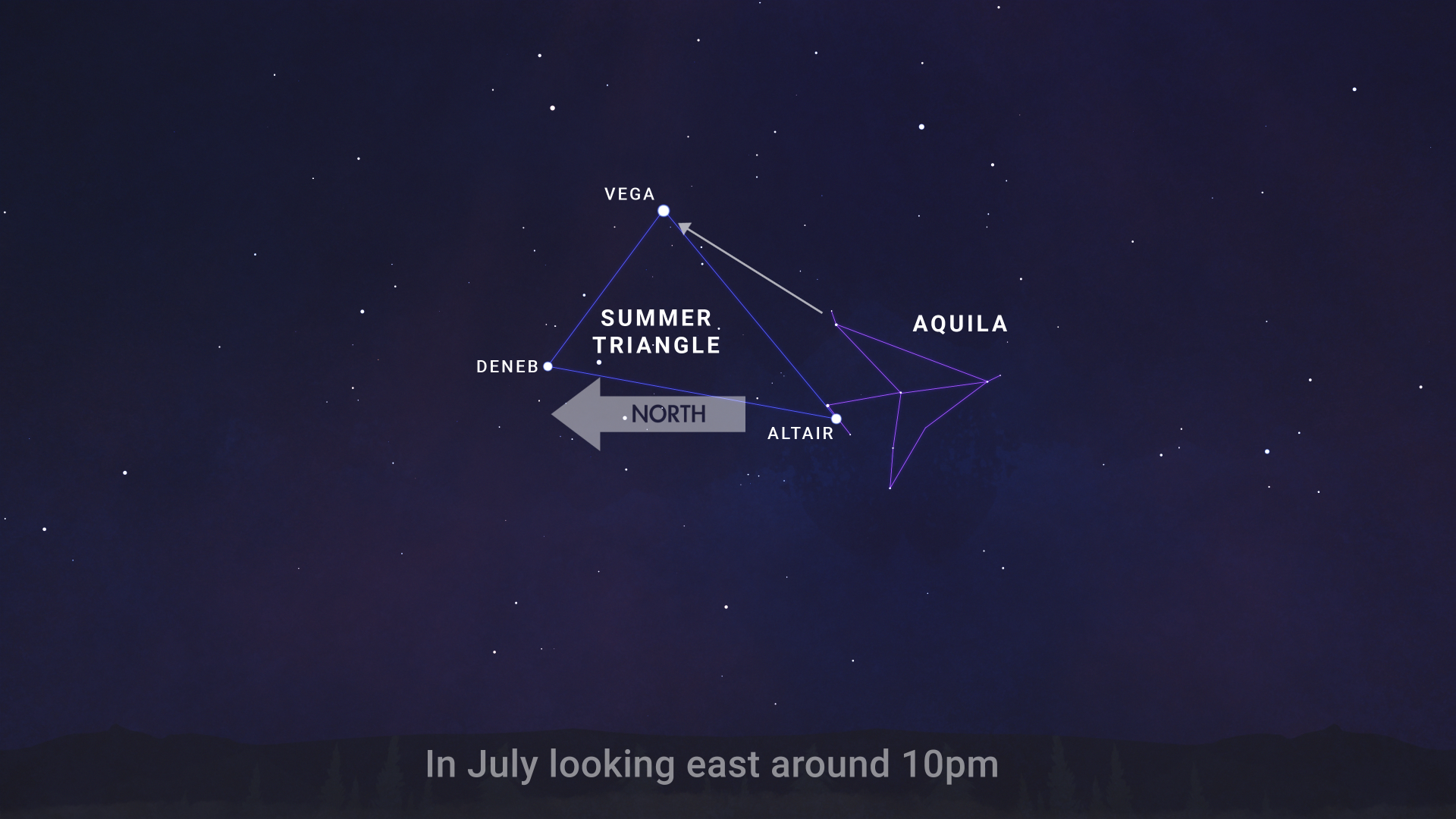
    All month – Constellation: Aquila – The Eagle constellation, Aquila, appears in the eastern part of the sky during the first half of the night. Its brightest star, Altair, is the southernmost star in the Summer Triangle, which is an easy-to-locate star pattern in Northern Hemisphere summer skies.

    Transcript

    What’s Up for July? Mars shines in the evening sky, sixty years after its first close-up, Venus brightens your mornings, and the eagle soars overhead.

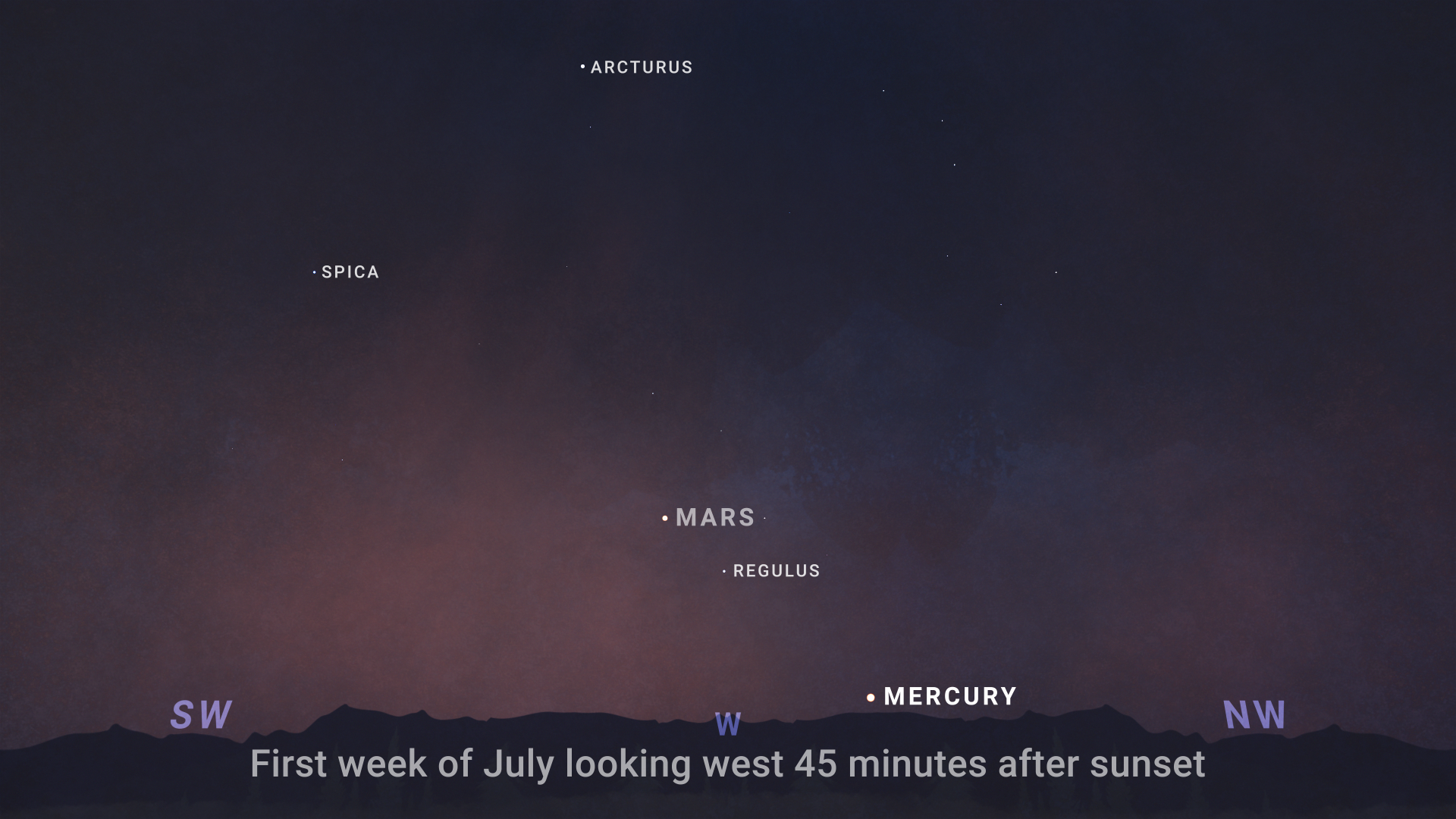
    First up, Mercury is visible for a brief time following sunset for the first week of July. Look for it very low in the west 30 to 45 minutes after sundown. It sets within the hour after that, so be on the ball if you want to catch it!

    Mars is visible for the first hour or two after it gets dark. You’ll find it sinking lower in the sky each day and looking a bit dimmer over the course of the month, as our two planets’ orbits carry them farther apart. The crescent Moon appears right next to Mars on the 28th.

    Sky chart showing Mercury and Mars in the western sky following sunset in early July.
    NASA/JPL-Caltech

    July is the 60th anniversary of the first successful flyby of Mars, by NASA’s Mariner 4 spacecraft in 1965. Mariner 4 sent back the first photos of another planet from deep space, along with the discovery that the Red Planet has only a very thin, cold atmosphere.

    Next, Saturn is rising late in the evening, and by dawn it’s high overhead to the south.

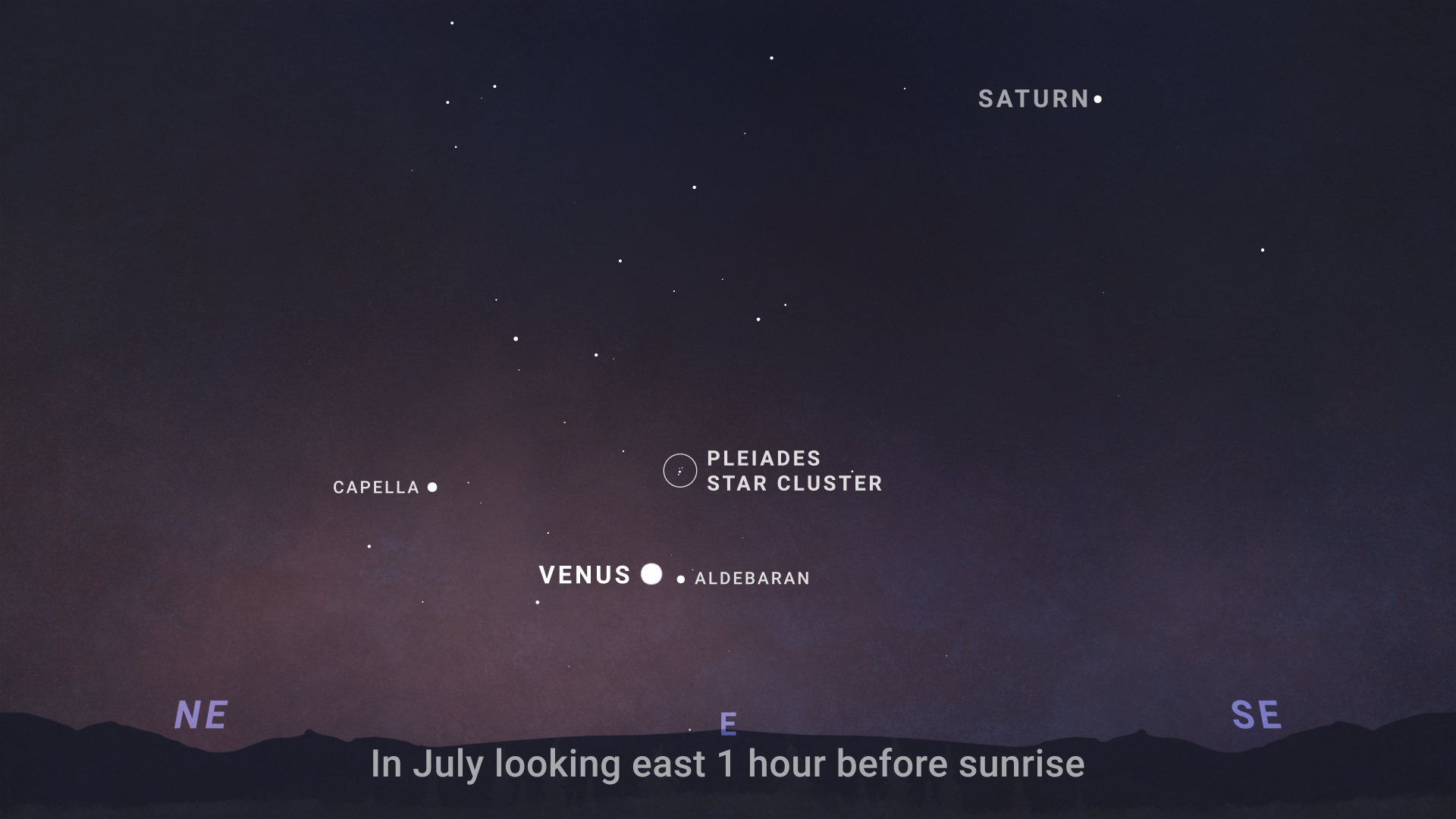
    Looking to the morning sky, Venus shines brightly all month. You’ll find it in the east during the couple of hours before sunrise, with the Pleiades and bright stars Aldebaran and Capella. And as the month goes on, Jupiter makes its morning sky debut, rising in the hour before sunrise and appearing a little higher each day.

    Sky chart showing Venus in the morning sky in July.
    NASA/JPL-Caltech

    By the end of the month, early risers will have the two brightest planets there greeting them each morning. They’re headed for a super-close meetup in mid-August, and the pair will be a fixture of the a.m. sky through late this year. Look for them together with the crescent moon on the 21st and 22nd.

    Aquila, The Eagle

    From July and into August, is a great time to observe the constellation Aquila, the eagle.

    An illustrated sky chart shows a view of the eastern sky around 10pm in July. The scene features a dark, nighttime background with faint stars. Near center are two shapes — patterns of stars, connected by faint purple lines. At center is the Summer Triangle, with its three bright stars, Vega, Altair, and Deneb, labeled. On its left side is the Aquila constellation. Altair is its brightest star and the eagle's right with points upward, toward Vega. Finally, an arrow points toward the left, indicating the direction of north on the sky. The eagle appears to be flying toward the north.
    Sky chart showing the shape and orientation of the constellation Aquila in the July evening sky. Aquila’s brightest star, Altair, is part of the Summer Triangle star pattern.
    NASA/JPL-Caltech

    This time of year, it soars high into the sky in the first half of the night. Aquila represents the mythical eagle that was a powerful servant and messenger of the Greek god Zeus. The eagle carried his lightning bolts and was a symbol of his power as king of the gods.

    To find Aquila in the sky, start by locating its brightest star, Altair. It’s one the three bright stars in the Summer Triangle, which is super easy to pick out during summer months in the Northern Hemisphere. Altair is the second brightest of the three, and sits at the southernmost corner of the triangle.

    The other stars in Aquila aren’t as bright as Altair, which can make observing the constellation challenging if you live in an area with a lot of light pollution. It’s easier, though, if you know how the eagle is oriented on the sky. Imagine it’s flying toward the north with its wings spread wide, its right wing pointed toward Vega. If you can find Altair, and Aquila’s next brightest star, you can usually trace out the rest of the spread-eagle shape from there. ​​The second half of July is the best time of the month to observe Aquila, as the Moon doesn’t rise until later then, making it easier to pick out the constellation’s fainter stars.

    Observing the constellation Aquila makes for a worthy challenge in the July night sky. And once you’re familiar with its shape, it’s hard not to see the mythical eagle soaring overhead among the summertime stars.

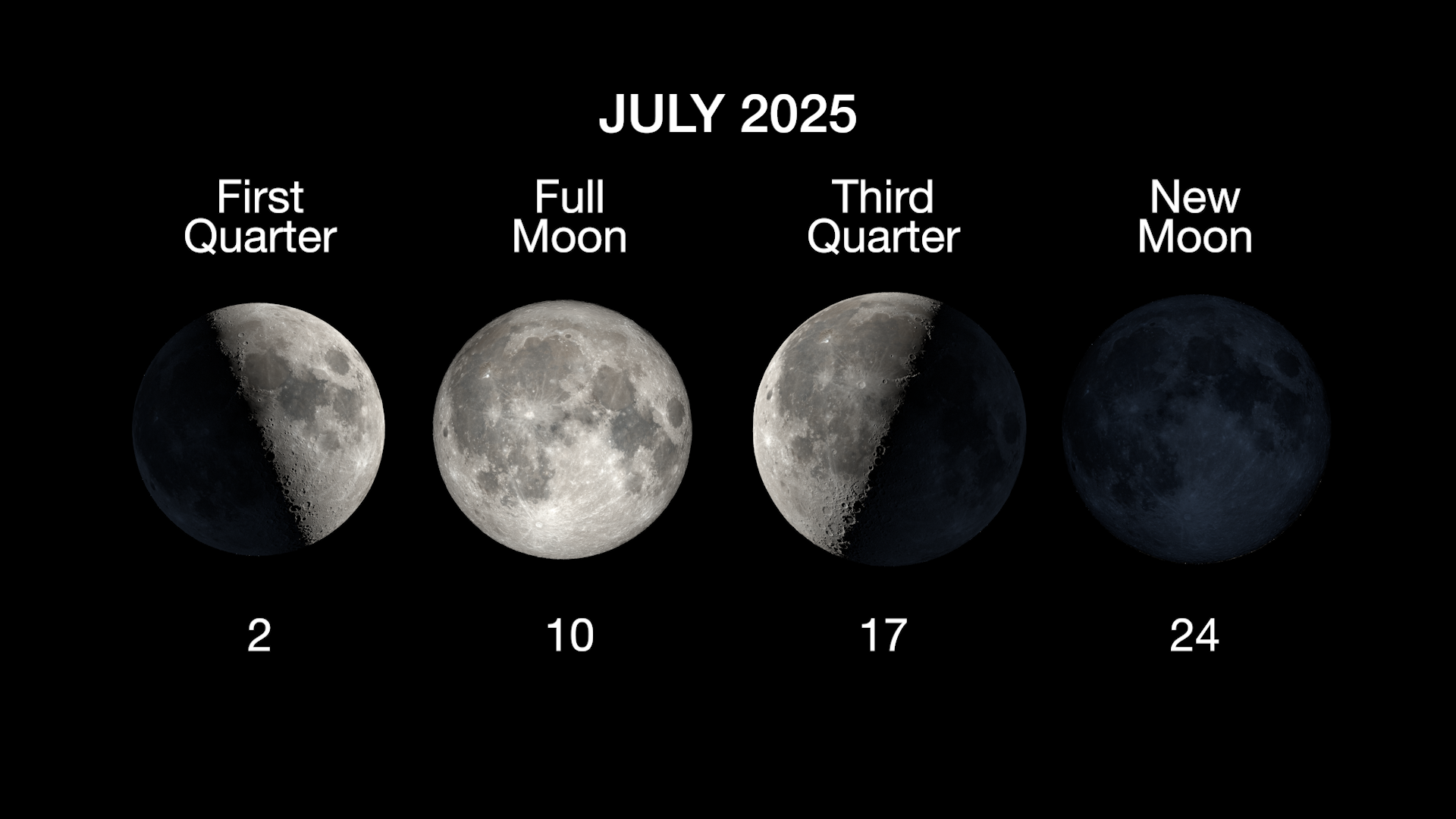
    Here are the phases of the Moon for July.

    The main phases of the Moon are illustrated in a horizontal row, with the first quarter moon on July 2, full moon on July 10, third quarter on July 17, and the new moon on July 24.
    The phases of the Moon for July 2025.
    NASA/JPL-Caltech

    You can stay up to date on all of NASA’s missions exploring the solar system and beyond at science.nasa.gov. I’m Preston Dyches from NASA’s Jet Propulsion Laboratory, and that’s What’s Up for this month.

  • To the Spacemobile!

    To the Spacemobile!

    Three members of NASA’s Lewis Research Center’s (now NASA’s Glenn Research Center) Educational Services Office pose with one of the center’s Spacemobile space science demonstration units on Nov. 1, 1964.

  • To the Spacemobile!

    One man sits in the driver seat of a light blue van, while two other men stand and crouch near him on the outside. They are all wearing dark suits. The van door has white writing on it that reads
    NASA

    In this Nov. 1, 1964, image, three members of NASA’s Lewis Research Center’s (now NASA’s Glenn Research Center in Cleveland) Educational Services Office pose with one of the center’s Spacemobile space science demonstration units. Once the NACA (National Advisory Committee for Aeronautics) became NASA, public outreach became one of the agency’s core tenets. Lewis, which had previously been a closed laboratory, began hosting open houses and elaborate space fairs in the early 1960s.

    In addition, the center initiated educational programs that worked with local schools and a robust speaker’s bureau that explained NASA activities to the community. One aspect of these efforts was the Spacemobile Program. These vehicles included a delegated speaker, exhibits, models, and other resources. The Spacemobiles, which made forays across the Midwest, were extremely active throughout the 1960s.

    Image credit: NASA

  • Discovery Alert: Flaring Star, Toasted Planet

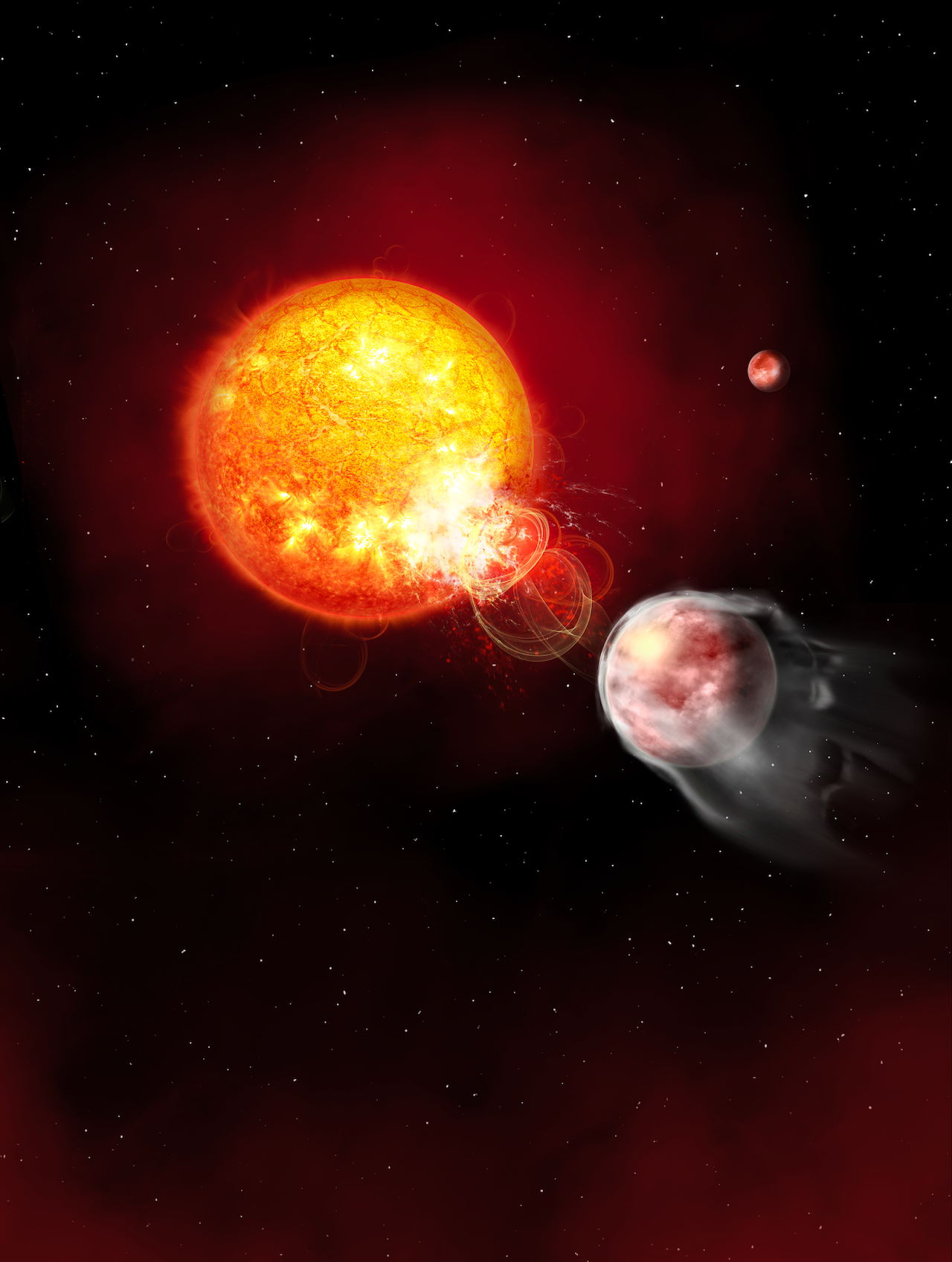
    In the upper left quadrant of a vertical image, against a black background, a large orange-yellow star is shown with tendrils of gas – a stellar flare – streaming out from the star at about the 4 o'clock position. The flare is  streaming toward a bluish planet, smaller than the star, at the center right of the image; streaks of grayish white streaming from the planet toward the lower right indicate dissipation of the planet's atmosphere in response to the flare. A second planet, much smaller because farther away, can be seen to the right of the star and above the foreground planet.
    Artist’s concept of the star HIP 67522 with a flare erupting toward an orbiting planet, HIP 67522 b. A second planet, HIP 67522 c, is shown in the background.
    Janine Fohlmeister, Leibniz Institute for Astrophysics Potsdam

    The Discovery

    A giant planet some 400 light-years away, HIP 67522 b, orbits its parent star so tightly that it appears to cause frequent flares from the star’s surface, heating and inflating the planet’s atmosphere.

    Key Facts

    On planet Earth, “space weather” caused by solar flares might disrupt radio communications, or even damage satellites. But Earth’s atmosphere protects us from truly harmful effects, and we orbit the Sun at a respectable distance, out of reach of the flares themselves.

    Not so for planet HIP 67522 b. A gas giant in a young star system – just 17 million years old – the planet takes only seven days to complete one orbit around its star. A “year,” in other words, lasts barely as long as a week on Earth. That places the planet perilously close to the star. Worse, the star is of a type known to flare – especially in their youth.

    In this case, the proximity of the planet appears to result in fairly frequent flaring.

    Details

    The star and the planet form a powerful but likely a destructive bond. In a manner not yet fully understood, the planet hooks into the star’s magnetic field, triggering flares on the star’s surface; the flares whiplash energy back to the planet. Combined with other high-energy radiation from the star, the flare-induced heating appears to have increased the already steep inflation of the planet’s atmosphere, giving HIP 67522 b a diameter comparable to our own planet Jupiter despite having just 5% of Jupiter’s mass.

    This might well mean that the planet won’t stay in the Jupiter size-range for long. One effect of being continually pummeled with intense radiation could be a loss of atmosphere over time. In another 100 million years, that could shrink the planet to the status of a “hot Neptune,” or, with a more radical loss of atmosphere, even a “sub-Neptune,” a planet type smaller than Neptune that is common in our galaxy but lacking in our solar system.

    Fun Facts

    Four hundred light-years is much too far away to capture images of stellar flares striking orbiting planets. So how did a science team led by Netherlands astronomer Ekaterina Ilin discover this was happening? They used space-borne telescopes, NASA’s TESS (Transiting Exoplanet Survey Satellite) and the European Space Agency’s CHEOPS (CHaracterising ExoPlanets Telescope), to track flares on the star, and also to trace the path of the planet’s orbit.

    Both telescopes use the “transit” method to determine the diameter of a planet and the time it takes to orbit its star. The transit is a kind of mini-eclipse. As the planet crosses the star’s face, it causes a tiny dip in starlight reaching the telescope. But the same observation method also picks up sudden stabs of brightness from the star – the stellar flares. Combining these observations over five years’ time and applying rigorous statistical analysis, the science team revealed that the planet is zapped with six times more flares than it would be without that magnetic connection.   

    The Discoverers

    A team of scientists from the Netherlands, Germany, Sweden, and Switzerland, led by Ekaterina Ilin of the Netherlands Institute for Radio Astronomy, published their paper on the planet-star connection, “Close-in planet induces flares on its host star,” in the journal Nature on July 2, 2025.

    Keep Exploring

    Discover More Topics From NASA