Tag: NASA

  • NASA Invites Media to SpaceX’s 33rd Resupply Launch to Space Station

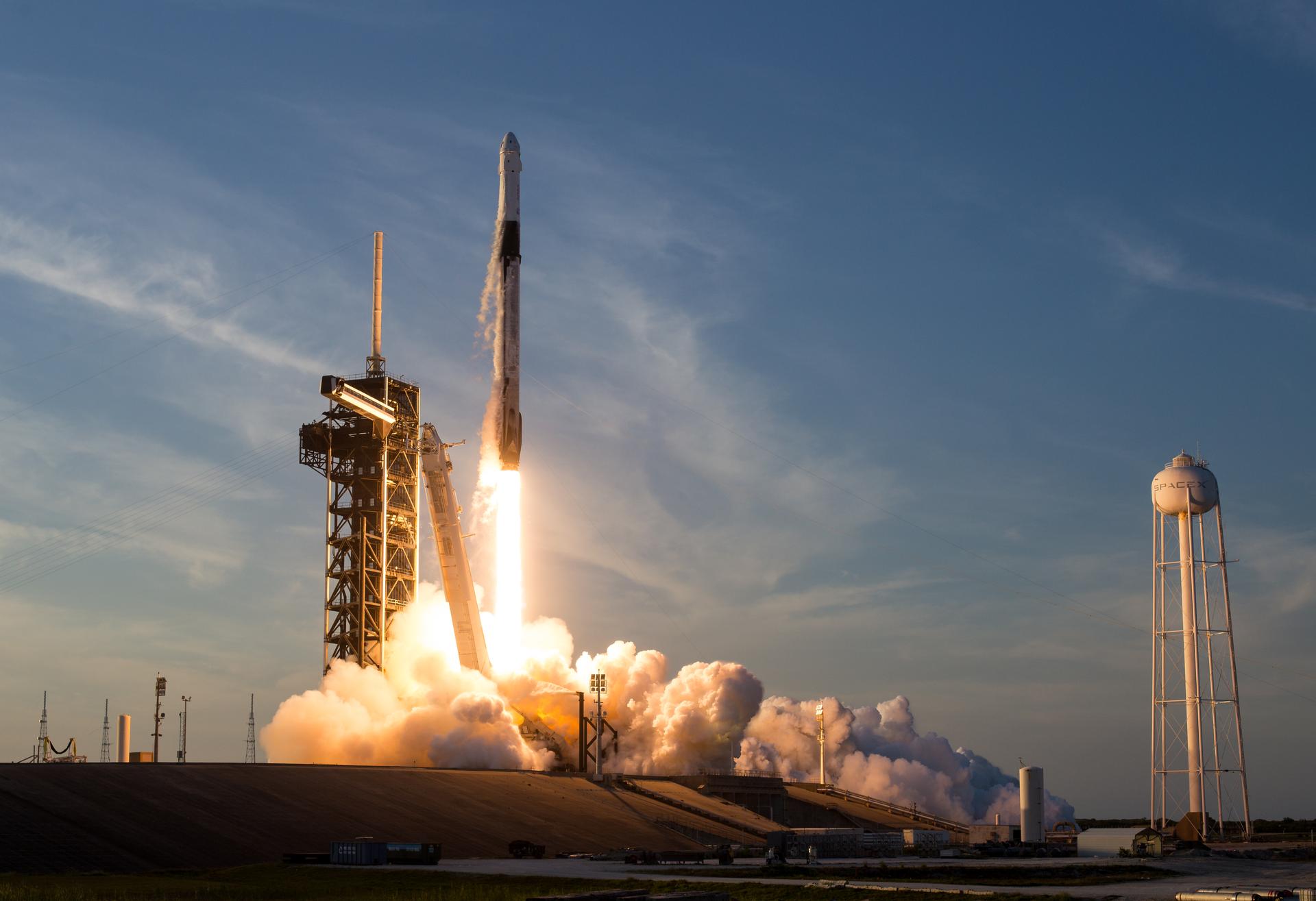
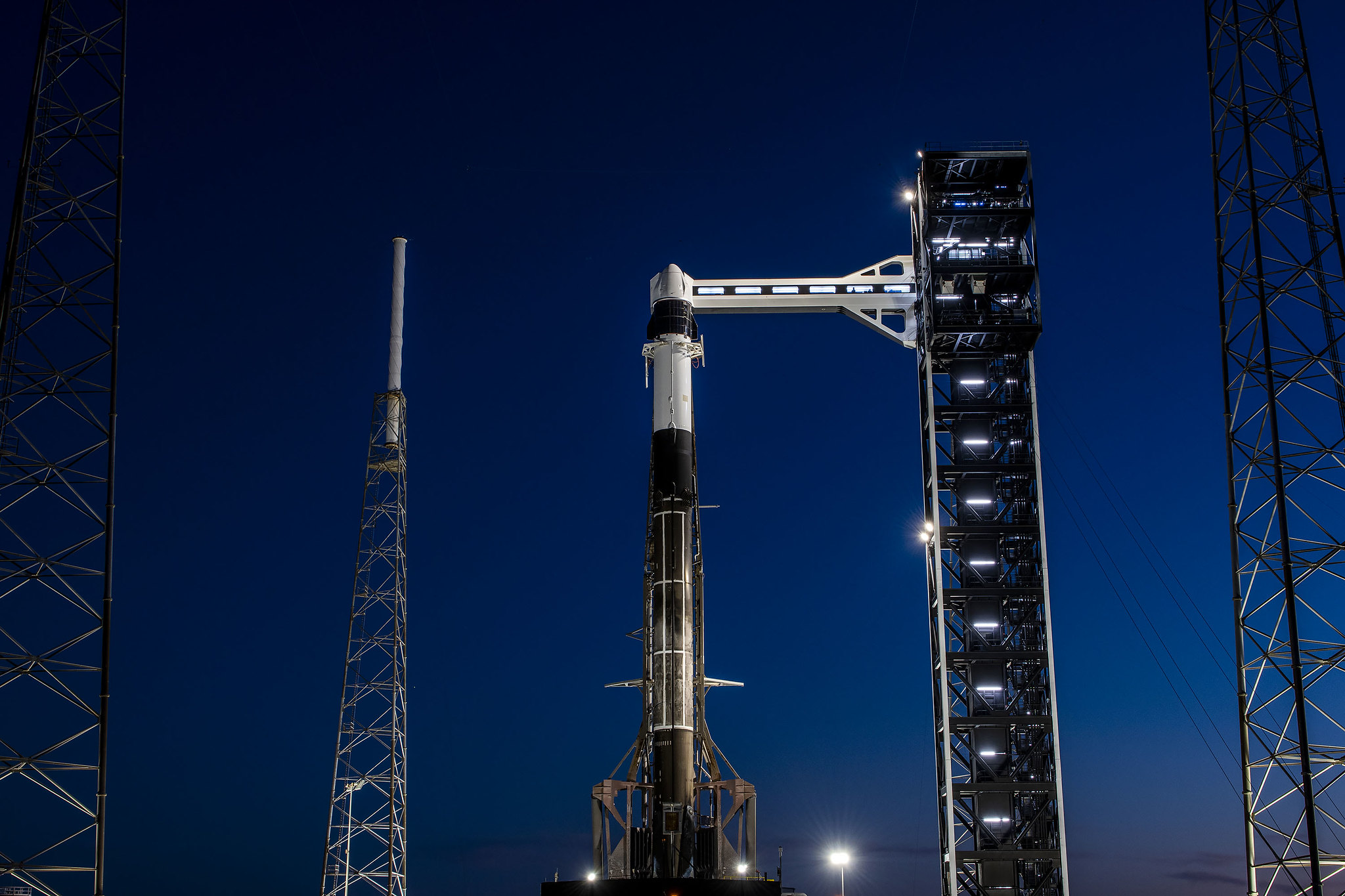
    A SpaceX Falcon 9 rocket, with the company’s Dragon spacecraft, stands in a vertical position at Space Launch Complex 40 at Cape Canaveral Space Force Station in Florida on Tuesday, March 19, 2024
    A SpaceX Falcon 9 rocket, with the company’s Dragon spacecraft, stands in a vertical position at Space Launch Complex 40 at Cape Canaveral Space Force Station in Florida on Tuesday, March 19, 2024.
    SpaceX

    Media accreditation is open for the next launch to deliver NASA science investigations, supplies, and equipment to the International Space Station. This launch is the 33rd SpaceX commercial resupply services mission to the orbital laboratory for NASA and will liftoff on the company’s Falcon 9 rocket.

    NASA and SpaceX are targeting no earlier than Thursday, Aug. 21, to launch the SpaceX Dragon spacecraft from Space Launch Complex-40 at Cape Canaveral Space Force Station in Florida.

    Credentialing to cover prelaunch and launch activities is open to U.S. media. The application deadline for U.S. citizens is 11:59 p.m. EDT, Sunday, Aug. 3. All accreditation requests must be submitted online at:

    https://media.ksc.nasa.gov

    Credentialed media will receive a confirmation email upon approval. NASA’s media accreditation policy is available online. For questions about accreditation, or to request special logistical support, email: ksc-media-accreditat@mail.nasa.gov. For other questions, please contact NASA’s Kennedy Space Center newsroom at: 321-867-2468.

    Para obtener información sobre cobertura en español en el Centro Espacial Kennedy o si desea solicitor entrevistas en español, comuníquese con Antonia Jaramillo o Messod Bendayan a: antonia.jaramillobotero@nasa.gov o messod.c.bendayan@nasa.gov.

    Each resupply mission to the station delivers scientific investigations in the areas of biology and biotechnology, Earth and space science, physical sciences, and technology development and demonstrations. Cargo resupply from U.S. companies ensures a national capability to deliver scientific research to the space station, significantly increasing NASA’s ability to conduct new investigations aboard humanity’s laboratory in space.

    In addition to food, supplies, and equipment for the crew, Dragon will deliver several new experiments, including bone-forming stem cells for studying bone loss prevention and materials to 3D print medical implants that could advance treatments for nerve damage on Earth. Dragon also delivers bioprinted liver tissue to study blood vessel development in microgravity and supplies to 3D print metal cubes in space.

    For almost 25 years, humans have continuously lived and worked aboard the International Space Station, advancing scientific knowledge and demonstrating new technologies that enable us to prepare for human exploration of the Moon as we prepare for Mars.

    Learn more about NASA’s commercial resupply missions at:

    https://www.nasa.gov/station

    -end-

    Claire O’Shea
    Headquarters, Washington
    202-358-1100
    claire.a.o’shea@nasa.gov

    Stephanie Plucinsky / Steven Siceloff / Danielle Sempsrott
    Kennedy Space Center, Fla.
    321-876-2468
    stephanie.n.plucinsky@nasa.gov / steven.p.siceloff@nasa.gov / danielle.c.sempsrott@nasa.gov

    Sandra Jones
    Johnson Space Center, Houston
    281-483-5111
    sandra.p.jones@nasa.gov

    Details

    Last Updated

    Jul 25, 2025

  • NASA Rehearses How to Measure X-59’s Noise Levels

    3 min read

    Preparations for Next Moonwalk Simulations Underway (and Underwater)

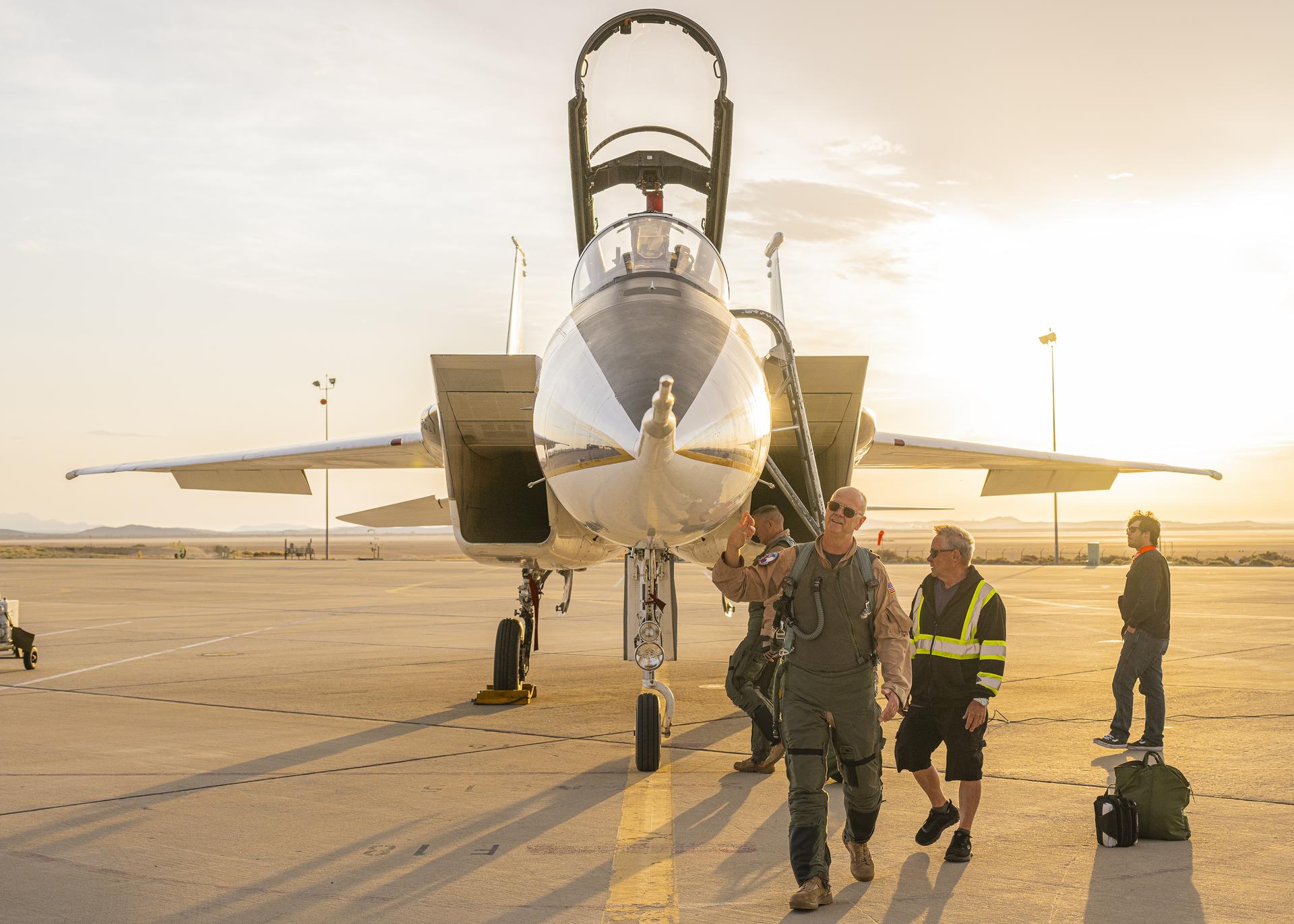
    NASA test pilot Nils Larson walks around an F-15B aircraft at NASA’s Armstrong Flight Research Center in Edwards, California. He wears a green G-suit over his tan flight suit and looks up at the nose of the aircraft. The F-15 canopy is open, and support crew stand near the aircraft as the pilots walks around. The aircraft sits higher than the pilot, allowing a partial view of the area on the opposite side.
    NASA test pilot Nils Larson walks around an F-15B research aircraft for a rehearsal flight supporting the agency’s Quesst mission at NASA’s Armstrong Flight Research Center in Edwards, California. The flight was part of a full-scale dress rehearsal for Phase 2 of the mission, which will eventually measure quiet sonic thumps generated by the X-59. The flight series helped NASA teams refine procedures and practice data collection ahead of future X-59 flights.
    NASA/Christopher LC Clark

    In a stretch of California’s Mojave Desert, NASA conducted a full-scale “dress rehearsal” to prepare how it will measure the noise generated by the X-59 quiet supersonic research aircraft.

    The team behind the successful test flight series operates under NASA’s Commercial Supersonic Technology project. Beginning June 3 and concluding this week, researchers conducted a dry run for Phase 2 of NASA’s Quesst mission, when it will capture audio of the sonic thumps the X-59 will produce, rather than loud sonic booms associated with supersonic flight.

    “The dress rehearsal was critical for us,” said Larry Cliatt, sub-project manager for the Quesst acoustic validation phase, who is based at NASA’s Armstrong Flight Research Center in Edwards, California. “It gave us the opportunity to run through every aspect of our operation, from flight planning to data collection. In between those activities, we practiced aircraft operations, setting up the Ground Recording Systems, meteorological data collecting, and refining control room procedures. We were able to fine-tune our timelines, improve communication across teams, and ensure that when we perform these test with the X-59 aircraft, everything will run smoothly.”

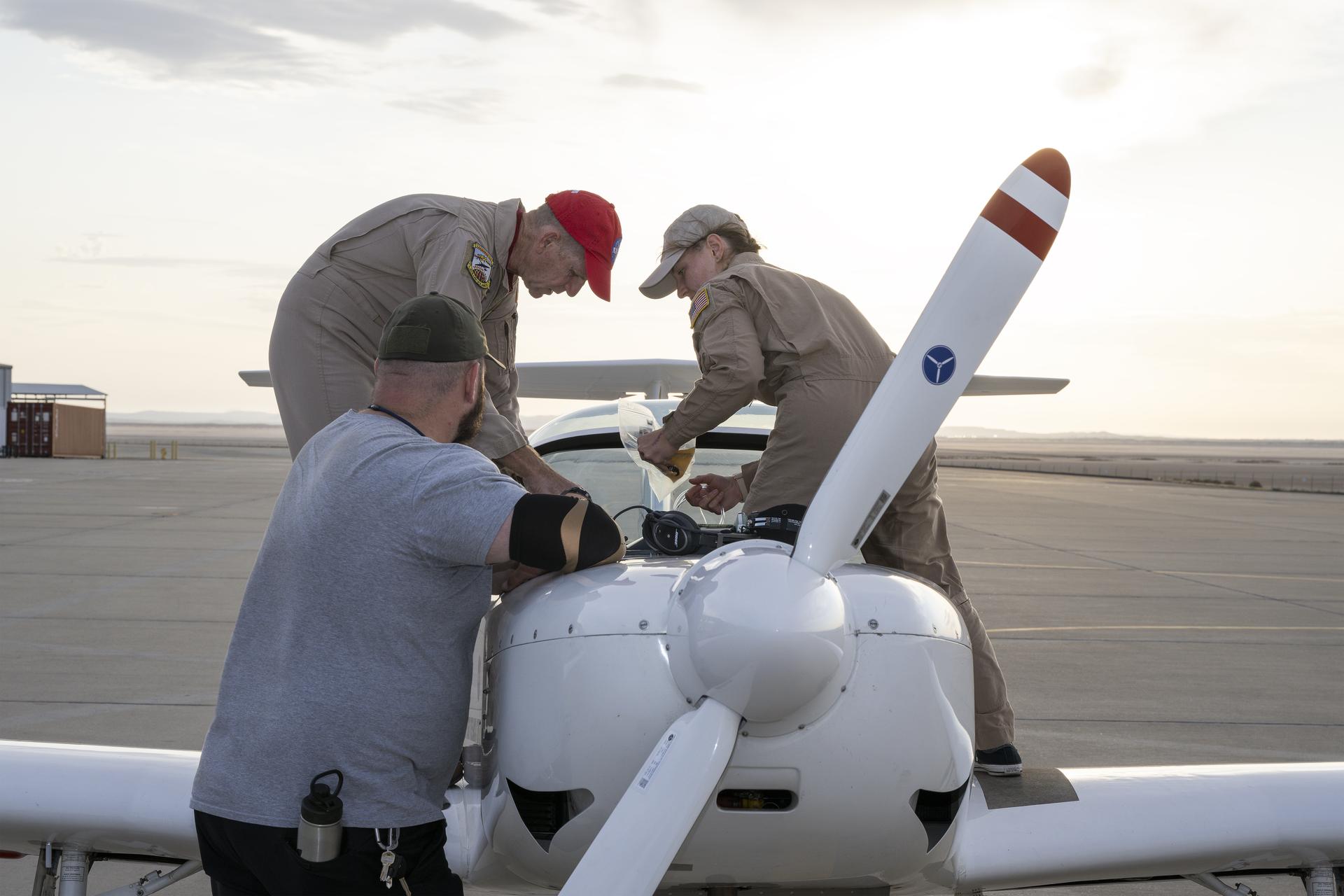
    A NASA TG-14 glider aircraft sits on the ramp at NASA’s Armstrong Flight Research Center in Edwards, California. Two pilots stand over the cockpit with the canopy open while the crew chief watches them work. The white glider has red accents on the nose, and the NASA logo is visible on the propeller. The aircraft is parked on a wide, open ramp with desert hills in the distance under a pale sky.
    A NASA TG-14 glider aircraft is prepared for flight at NASA’s Armstrong Flight Research Center in Edwards, California, in support of the agency’s Quesst mission. The aircraft is equipped with onboard microphones to capture sonic boom noise generated during rehearsal flights, helping researchers measure the acoustic signature of supersonic aircraft closer to the ground.
    NASA/Jim Ross

    During the tests, at NASA Armstrong, an F-15B aircraft served as a stand-in for the X-59, flying faster than the speed of sound and making multiple passes over the Mojave sands. While it flew, researchers captured acoustic data using a linear array of ground recording systems spaced across miles of open desert, recorded weather readings, and measured the shock waves it generated.

    For a supersonic aircraft like the F-15B, shock waves typically result in loud sonic booms, but the X-59 is designed to diffuse them in a way that will dramatically limit noise.

    NASA’s Quesst mission aims to enable quiet supersonic flight over land using data from the X-59. The experimental aircraft will begin making its first flights this year – the first phase of Quesst.

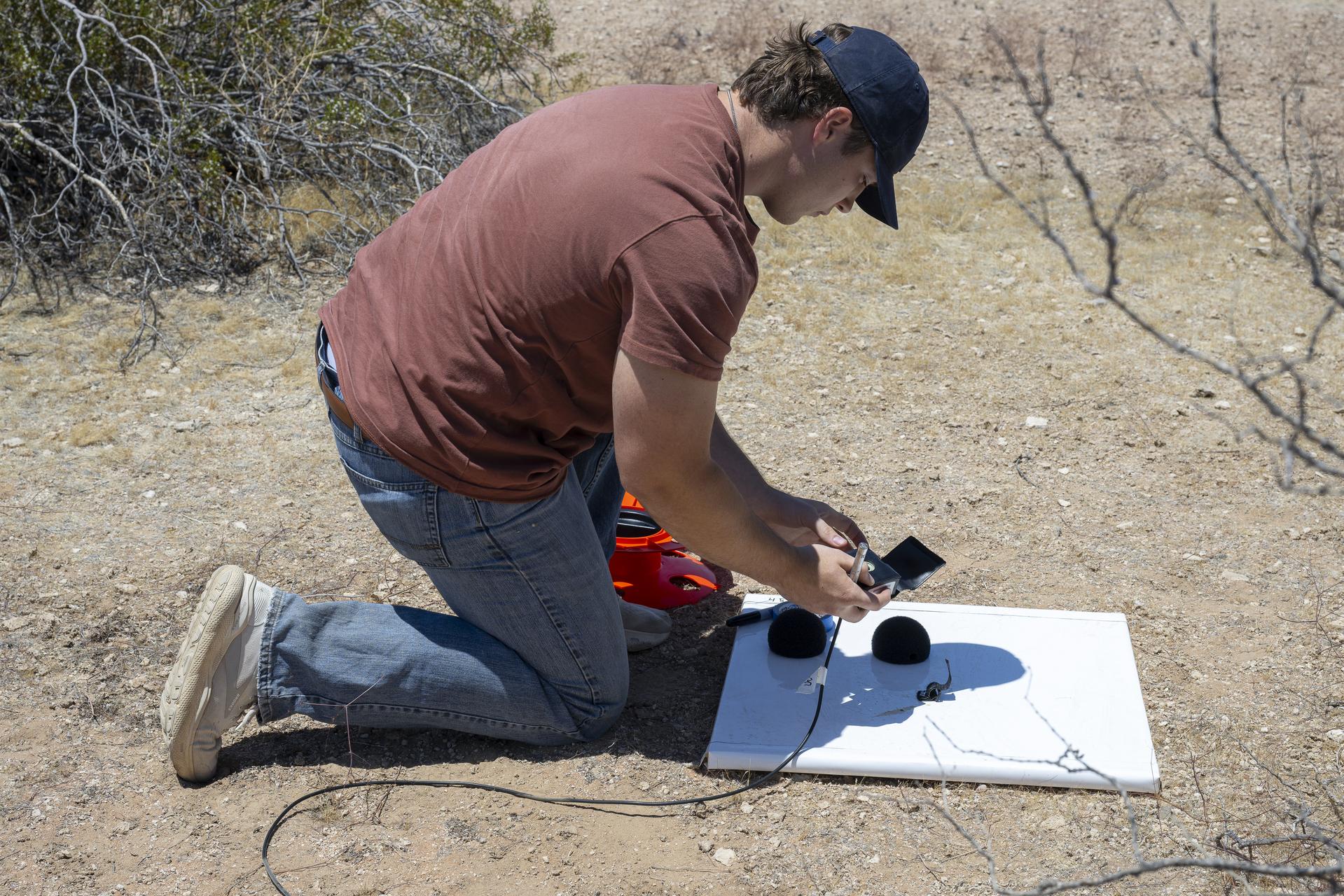
    A NASA intern kneels on the desert floor, positioning a microphone on a white platform as part of a ground recording system (GRS) setup. He wears a maroon shirt, jeans, and a dark ballcap. Desert shrubs and dry terrain stretch into the background under bright sunlight. The GRS equipment includes a microphone, foam windshields, and cables for data collection.
    A NASA intern sets up ground recording system (GRS) units in California’s Mojave Desert during a Phase 2 rehearsal of the agency’s Quesst mission. The GRS units were placed across miles of desert terrain to capture the acoustic signature of supersonic aircraft during rehearsal flights and in preparation for the start of the actual tests.
    NASA/Christopher LC Clark

    But even before it takes to the air, the mission began its preparations for Phase 2 with the dry run, which focused on practicing under realistic test conditions and identifying issues before the official campaign begins, not collecting data from the F-15B.

    Through Quesst’s development of the X-59, NASA will deliver design tools and technology for quiet supersonic airliners that will achieve the high speeds desired by commercial operators without disturbing people on the ground. NASA will also validate design tools through ground and flight testing, providing aircraft manufacturers the ability to explore new quiet supersonic concepts and have confidence that their resulting designs will meet requirements for quiet flight.

    Most importantly, Quesst will gather data to understand community response to sounds generated during flight – key knowledge for a quiet supersonic future.

  • NASA Invites Virtual Guests to SpaceX Crew-11 Mission Launch

    A SpaceX Falcon 9 rocket carrying the company’s Dragon spacecraft launches NASA’s SpaceX Crew-10 mission to the International Space Station on Friday, March 14, 2025, from NASA’s Kennedy Space Center in Florida.
    NASA/Aubrey Gemignani

    NASA invites the public to participate as virtual guests in the launch of the agency’s SpaceX Crew-11 mission to the International Space Station.

    NASA astronauts Zena Cardman and Mike Fincke, JAXA (Japan Aerospace Exploration Agency) astronaut Kimiya Yui, and Roscosmos cosmonaut Oleg Platonov will launch aboard a SpaceX Dragon spacecraft to the orbiting laboratory. This is the first spaceflight for Cardman and Platonov, the fourth for Fincke, and the second for Yui.

    NASA and SpaceX are targeting no earlier than 12:09 p.m. EDT, Thursday, July 31, for launch on the company’s Falcon 9 rocket from Launch Complex 39A at the agency’s Kennedy Space Center in Florida.

    Members of the public can register to attend the launch virtually. Virtual guests will receive curated resources, interactive opportunities, mission updates, and a mission-specific collectible stamp for their virtual guest passport after liftoff.

    Discover an exciting new way to collect and share passport stamps. Print one for your virtual guest passport and get an extra one, perfect for sharing or digital collecting. Don’t have a passport yet? Print one from the agency’s website and add Crew-11 to your collection.

    For more information about the Crew-11 mission, visit:

    https://www.nasa.gov/commercialcrew

  • Hubble Spies Swirling Spiral

    2 min read

    Hubble Spies Swirling Spiral

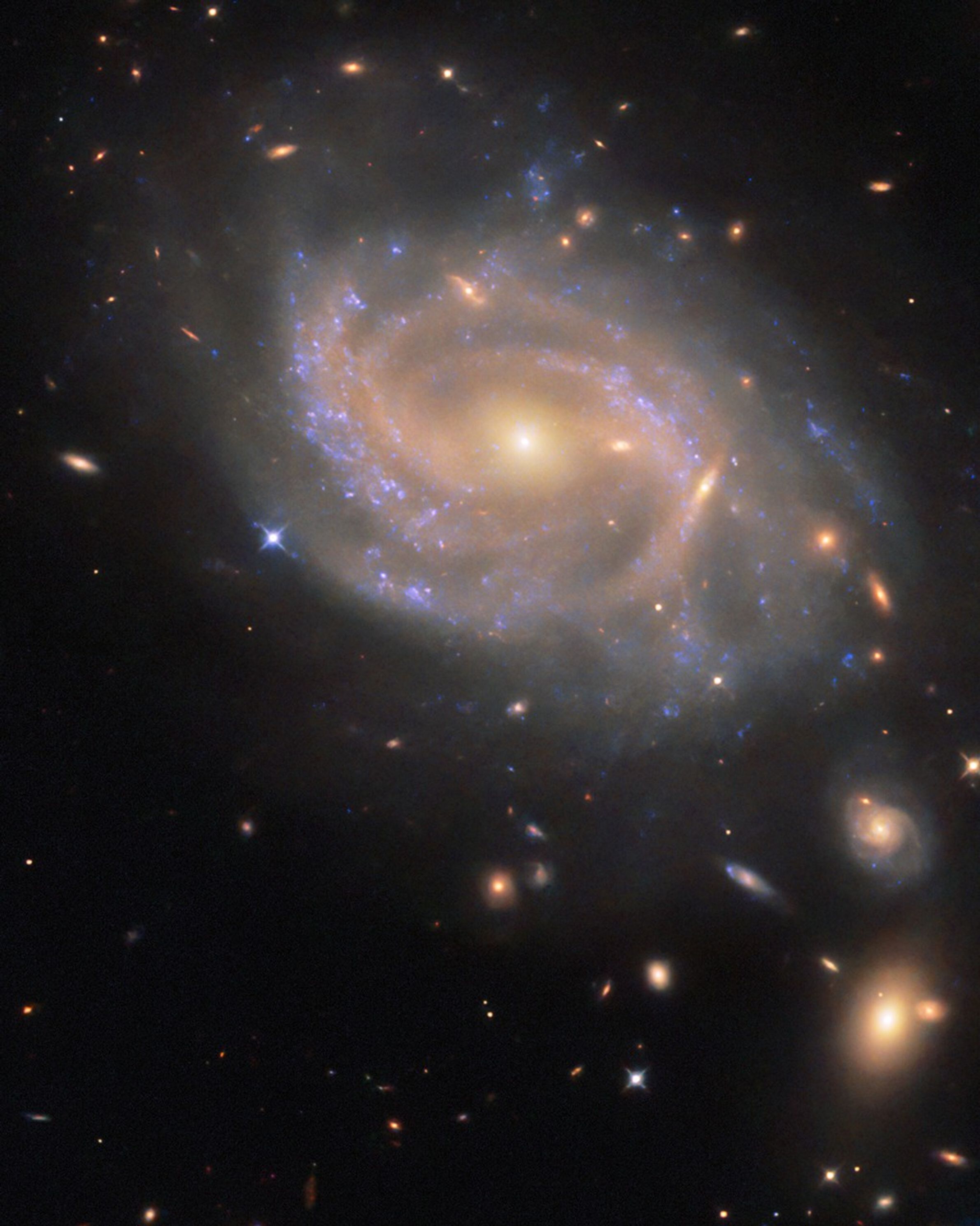
    A spiral galaxy with a disk made of several swirling arms. Patchy blue clouds of gas speckle the disk where stars are forming and lighting the gas around them. The core of the galaxy is large and shines brightly gold, while the spiral arms are a paler and faint reddish color. Neighboring galaxies – from small, elongated spots to larger swirling spirals – are visible across the black background.
    The NASA/ESA Hubble Space Telescope image features the spiral galaxy NGC 3285B, a member of the Hydra I cluster of galaxies.
    ESA/Hubble & NASA, R. J. Foley (UC Santa Cruz)

    The swirling spiral galaxy in this NASA/ESA Hubble Space Telescope image is NGC 3285B, which resides 137 million light-years away in the constellation Hydra (the Water Snake). Hydra has the largest area of the 88 constellations that cover the entire sky in a celestial patchwork. It’s also the longest constellation, stretching 100 degrees across the sky. It would take nearly 200 full Moons, placed side by side, to reach from one side of the constellation to the other.

    NGC 3285B is a member of the Hydra I cluster, one of the largest galaxy clusters in the nearby universe. Galaxy clusters are collections of hundreds to thousands of galaxies bound to one another by gravity. The Hydra I cluster is anchored by two giant elliptical galaxies at its center. Each of these galaxies is about 150,000 light-years across, making them about 50% larger than our home galaxy, the Milky Way.

    NGC 3285B sits on the outskirts of its home cluster, far from the massive galaxies at the center. This galaxy drew Hubble’s attention because it hosted a Type Ia supernova in 2023. Type Ia supernovae happen when a type of condensed stellar core called a white dwarf detonates, igniting a sudden burst of nuclear fusion that briefly shines about 5 billion times brighter than the Sun. The supernova, named SN 2023xqm, is visible here as a blueish dot on the left edge of the galaxy’s disk.

    Hubble observed NGC 3285B as part of an observing program that targeted 100 Type Ia supernovae. By viewing each of these supernovae in ultraviolet, optical, and near-infrared light, researchers aim to disentangle the effects of distance and dust, both of which can make a supernova appear redder than it actually is. This program will help refine cosmic distance measurements that rely on observations of Type Ia supernovae.

    Text Credit: ESA/Hubble

    Media Contact:

    Claire Andreoli (claire.andreoli@nasa.gov)
    NASA’s Goddard Space Flight CenterGreenbelt, MD

  • NASA Welcomes Senegal as Newest Artemis Accords Signatory

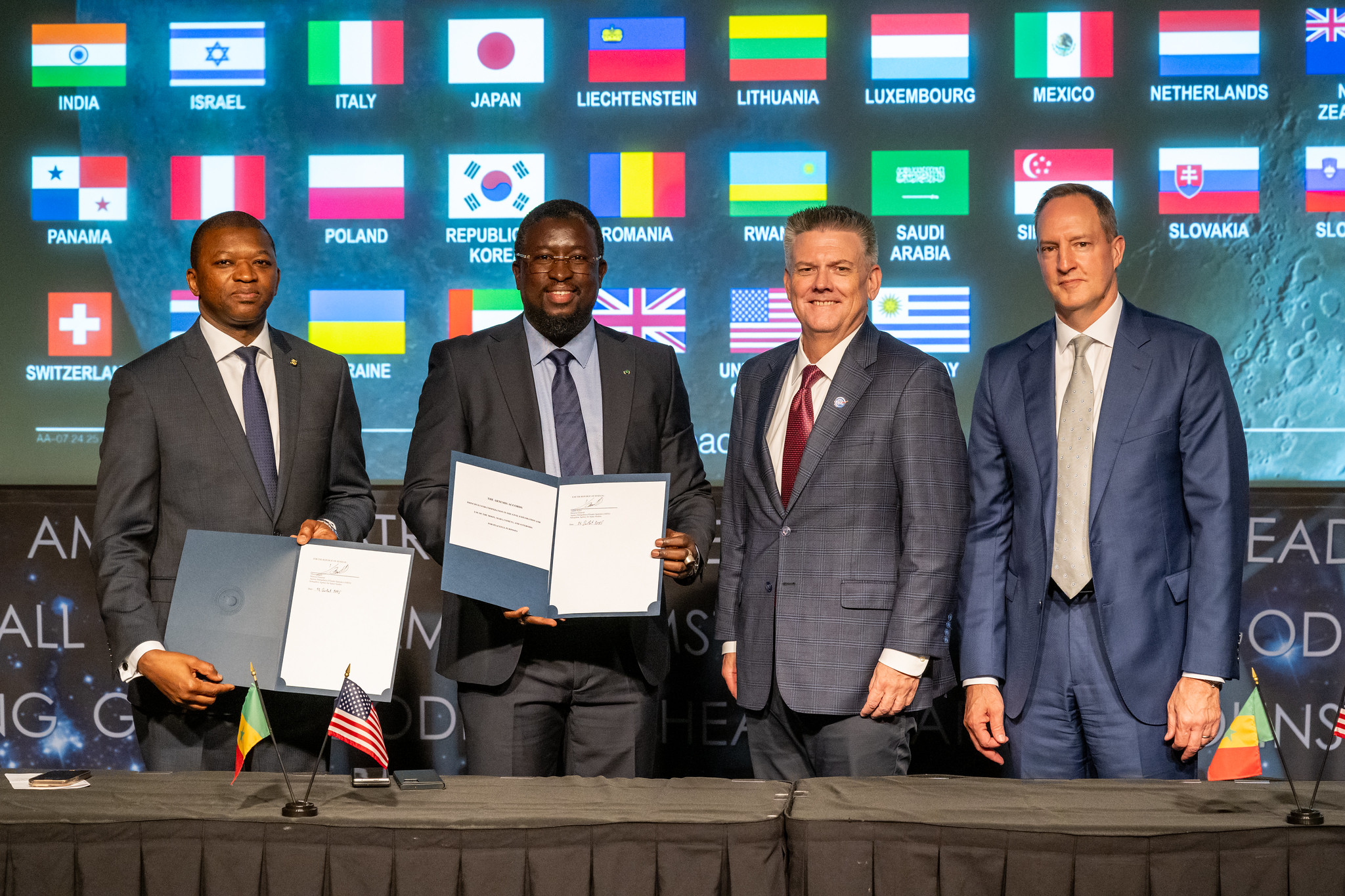
    From left to right, Ambassador of Senegal to the United States Abdoul Wahab Haidara, Director General of the Senegalese space agency (ASES) Maram Kairé, NASA Chief of Staff Brian Hughes, and Department of State Bureau of African Affairs Senior Bureau Official Jonathan Pratt pose for a photo during an Artemis Accords signing ceremony Thursday, July 24, 2025, at the Mary W. Jackson NASA Headquarters building in Washington. Senegal is the 56th country to sign the Artemis Accords, which establish a practical set of principles to guide space exploration cooperation among nations participating in NASA’s Artemis program.
    Credit: NASA/Keegan Barber

    Senegal signed the Artemis Accords Thursday during a ceremony hosted by NASA at the agency’s headquarters in Washington, becoming the latest nation to commit to the responsible exploration of space for all humanity.

    “Following a meeting between Senegal President Faye and President Trump, today, NASA built upon the strong relations between our two nations as the Senegalese Agency for Space Studies signed the Artemis Accords,” said acting NASA Administrator Sean Duffy. “With Senegal as the 56th signatory, I am proud to further President Trump’s strong legacy of global cooperation in space.”

    Director General of the Senegalese space agency (ASES) Maram Kairé signed the Artemis Accords on behalf of Senegal. Jonathan Pratt, senior bureau official for African Affairs at the U.S. Department of State, and Abdoul Wahab Haidara, ambassador of Senegal to the United States, also participated in the event.

    “Senegal’s adherence to the Artemis Accords reflects our commitment to a multilateral, responsible, and transparent approach to space,” said Kairé. “This signature marks a meaningful step in our space diplomacy and in our ambition to contribute to the peaceful exploration of outer space.”

    The Artemis Accords signing ceremony took place two weeks after President Trump’s meeting in Washington with Senegal’s President Bassirou Diomaye Faye and other countries of Africa focused on U.S.-Africa engagement.

    Astronomers from Senegal have supported NASA missions by participating in multiple observations when asteroids or planets pass in front of stars, casting shadows on Earth. In 2021, NASA also collaborated with Kairé and a group of astronomers for a ground observation campaign in Senegal. As the asteroid Orus passed in front of a star, they positioned telescopes along the path of the asteroid’s shadow to estimate its shape and size. NASA’s Lucy spacecraft will approach Orus in 2028, as part of its mission to explore Jupiter’s Trojan asteroids.

    In 2020, during the first Trump Administration, the United States, led by NASA and the U.S. Department of State, joined with seven other founding nations to establish the Artemis Accords, responding to the growing interest in lunar activities by both governments and private companies.

    The accords introduced the first set of practical principles aimed at enhancing the safety, transparency, and coordination of civil space exploration on the Moon, Mars, and beyond.

    Signing the Artemis Accords means to explore peaceably and transparently, to render aid to those in need, to ensure unrestricted access to scientific data that all of humanity can learn from, to ensure activities do not interfere with those of others, to preserve historically significant sites and artifacts, and to develop best practices for how to conduct space exploration activities for the benefit of all.

    More countries are expected to sign the Artemis Accords in the months and years ahead, as NASA continues its work to establish a safe, peaceful, and prosperous future in space.

    Learn more about the Artemis Accords at:

    https://www.nasa.gov/artemis-accords

    -end-

    Bethany Stevens / Elizabeth Shaw
    Headquarters, Washington
    202-358-1600
    bethany.c.stevens@nasa.gov / elizabeth.a.shaw@nasa.gov

  • NASA Sets Coverage for Agency’s SpaceX Crew-11 Launch, Docking

    The crew of NASA’s SpaceX Crew-11 mission to the International Space Station pictured during a training session at SpaceX facilities in Florida.
    The crew of NASA’s SpaceX Crew-11 mission to the International Space Station pictured during a training session at SpaceX facilities in Florida.
    Credit: SpaceX

    NASA will provide coverage of the upcoming prelaunch and launch activities for the agency’s SpaceX Crew-11 mission to the International Space Station.

    Liftoff is targeted for 12:09 p.m. EDT, Thursday, July 31, from Launch Complex 39A at NASA’s Kennedy Space Center in Florida. The targeted docking time is approximately 3 a.m., Saturday, Aug. 2.

    Watch agency launch coverage on NASA+, Netflix, Amazon Prime and more. Learn how to watch NASA content through a variety of platforms, including social media.

    The SpaceX Dragon spacecraft will carry NASA astronauts Zena Cardman and Mike Fincke, JAXA (Japan Aerospace Exploration Agency) astronaut Kimiya Yui, and Roscosmos cosmonaut Oleg Platonov to the orbiting laboratory for a science mission. This is the 11th crew rotation mission and the 12th human spaceflight mission for NASA to the space station supported by the Dragon spacecraft since 2020 as part of the agency’s Commercial Crew Program.

    The deadline for media accreditation for in person coverage of this launch has passed. The agency’s media credentialing policy is available online. For questions about media accreditation, please email: ksc-media-accreditat@mail.nasa.gov.

    Media who need access to NASA live video feeds may subscribe to the agency’s media resources distribution list to receive daily updates and links.

    NASA’s mission coverage is as follows (all times Eastern and subject to change based on real-time operations):

    Saturday, July 26

    1 p.m. – Crew-11 arrival media event at NASA Kennedy with the following participants:

    • Zena Cardman, spacecraft commander, NASA
    • Mike Fincke, pilot, NASA
    • Kimiya Yui, mission specialist, JAXA
    • Oleg Platonov, mission specialist, Roscosmos

    Watch live coverage of the crew arrival media event on the NASA Kennedy’s social media accounts.

    This event is open to in person media only previously credentialed for this event. Follow @NASAKennedy on X for the latest arrival updates.

    Wednesday, July 30

    5:30 p.m. – Prelaunch news conference with the following participants:

    • Ken Bowersox, associate administrator, NASA’s Space Operations Mission Directorate
    • Steve Stich, manager, NASA’s Commercial Crew Program
    • Dana Weigel, manager, NASA’s International Space Station Program
    • William Gerstenmaier, vice president, Build and Flight Reliability, SpaceX
    • Sergei Krikalev, deputy director general, Manned and Automated Complexes, Roscosmos
    • Naoki Nagai, program manager, International Space Station, Human Spaceflight Technology Directorate, JAXA

    NASA will provide live coverage of the news conference on the agency’s YouTube channel.

    Media may ask questions in person and via phone. For the dial-in number and passcode, media should contact the Kennedy newsroom no later than one hour prior to the beginning of the news conference at: ksc-newsroom@mail.nasa.gov.

    Thursday, July 31

    8 a.m. – Launch coverage begins on NASA+, Netflix, and Amazon Prime.

    12:09 p.m. – Launch

    Following the conclusion of launch coverage, NASA will distribute audio-only discussions between Crew-11, the space station, and flight controllers during Dragon’s transit to the orbital complex. NASA+ coverage resumes at the start of rendezvous and docking and continues through hatch opening and the welcoming remarks. 

    1:30 p.m. – Postlaunch news conference with the following participants:

    • Ken Bowersox, associate administrator, NASA’s Space Operations Mission Directorate
    • Steve Stich, manager, NASA’s Commercial Crew Program
    • Dana Weigel, manager, NASA’s International Space Station Program
    • Sergei Krikalev, deputy director general, Manned and Automated Complexes, Roscosmos
    • Kazuyoshi Kawasaki, associate director general, Space Exploration Center/Space Exploration Innovation Hub Center, JAXA
    • Sarah Walker, director, Dragon Mission Management, SpaceX

    NASA will provide live coverage of the postlaunch news conference on the agency’s YouTube channel.

    Media may ask questions in person and via phone. Limited auditorium space will be available for in person participation. For the dial-in number and passcode, please contact the Kennedy newsroom no later than one hour prior to the beginning of the news conference at ksc-newsroom@mail.nasa.gov.

    Saturday, Aug. 2

    1 a.m. – Arrival coverage begins on NASA+.

    3 a.m. – Targeted docking to the space-facing port of the station’s Harmony module.

    4:45 a.m. – Hatch opening

    5:30 a.m. – Welcome ceremony

    All times are estimates and could be adjusted based on real-time operations after launch. Follow the space station blog for the most up-to-date operations information.

    Live Video Coverage Prior to Launch

    NASA will provide a live video feed of Launch Complex 39A approximately six hours prior to the planned liftoff of the Crew-11 mission. Pending unlikely technical issues, the feed will be uninterrupted until the prelaunch broadcast begins on NASA+, approximately four hours prior to launch. Once the feed is live, find it online at: http://youtube.com/kscnewsroom.

    NASA Website Launch Coverage

    Launch day coverage of the mission will be available on the NASA website. Coverage will include livestreaming and blog updates beginning no earlier than 8 a.m., July 31, as the countdown milestones occur. On-demand streaming video on NASA+ and photos of the launch will be available shortly after liftoff. For questions about countdown coverage, contact the NASA Kennedy newsroom at 321-867-2468. Follow countdown coverage on the commercial crew or Crew-11 blog.

    Attend Launch Virtually

    Members of the public may register to attend this launch virtually. NASA’s virtual guest program for this mission also includes curated launch resources, notifications about related opportunities or changes, and a stamp for the NASA virtual guest passport following launch.

    Audio Only Coverage

    Launch audio also will be available on Launch Information Service and Amateur Television System’s VHF radio frequency 146.940 MHz and KSC Amateur Radio Club’s UHF radio frequency 444.925 MHz, FM mode, heard within Brevard County on the Space Coast.

    Watch, Engage on Social Media

    Let people know you’re following the mission on X, Facebook, and Instagram by using the hashtags #Crew11 and #NASASocial. You may also stay connected by following and tagging these accounts:

    X: @NASA, @NASAKennedy, @Space_Station, @ISS National Lab, @SpaceX

    Facebook: NASA, NASAKennedy, ISS, ISS National Lab

    Instagram: @NASA, @NASAKennedy, @ISS, @ISSNationalLab, @SpaceX

    Coverage en Espanol

    Did you know NASA has a Spanish section called NASA en Espanol? Check out NASA en Espanol on X, Instagram, Facebook, and YouTube for additional mission coverage.

    Para obtener información sobre cobertura en español en el Centro Espacial Kennedy o si desea solicitar entrevistas en español, comuníquese con Antonia Jaramillo: 321-501-8425; antonia.jaramillobotero@nasa.gov; o Messod Bendayan: 256-930-1371; messod.c.bendayan@nasa.gov.

    NASA’s Commercial Crew Program has delivered on its goal of safe, reliable, and cost-effective transportation to and from the International Space Station from the United States through a partnership with American private industry. This partnership is opening access to low Earth orbit and the International Space Station to more people, more science, and more commercial opportunities. For almost 25 years, humans have continuously lived and worked aboard the International Space Station, advancing scientific knowledge and demonstrating new technologies that enable us to prepare for human exploration of the Moon as we prepare for Mars.

    For more information about the mission, visit:

    https://www.nasa.gov/commercialcrew

    -end-

    Joshua Finch / Claire O’Shea
    Headquarters, Washington
    202-358-1100
    joshua.a.finch@nasa.gov / claire.a.o’shea@nasa.gov

    Steven Siceloff / Stephanie Plucinsky
    Kennedy Space Center, Florida
    321-867-2468
    steven.p.siceloff@nasa.gov / stephanie.n.plucinsky@nasa.gov

    Joseph Zakrzewski
    Johnson Space Center, Houston
    281-483-5111
    joseph.a.zakrzewski@nasa.gov
  • First Rocket Launch from Cape Canaveral

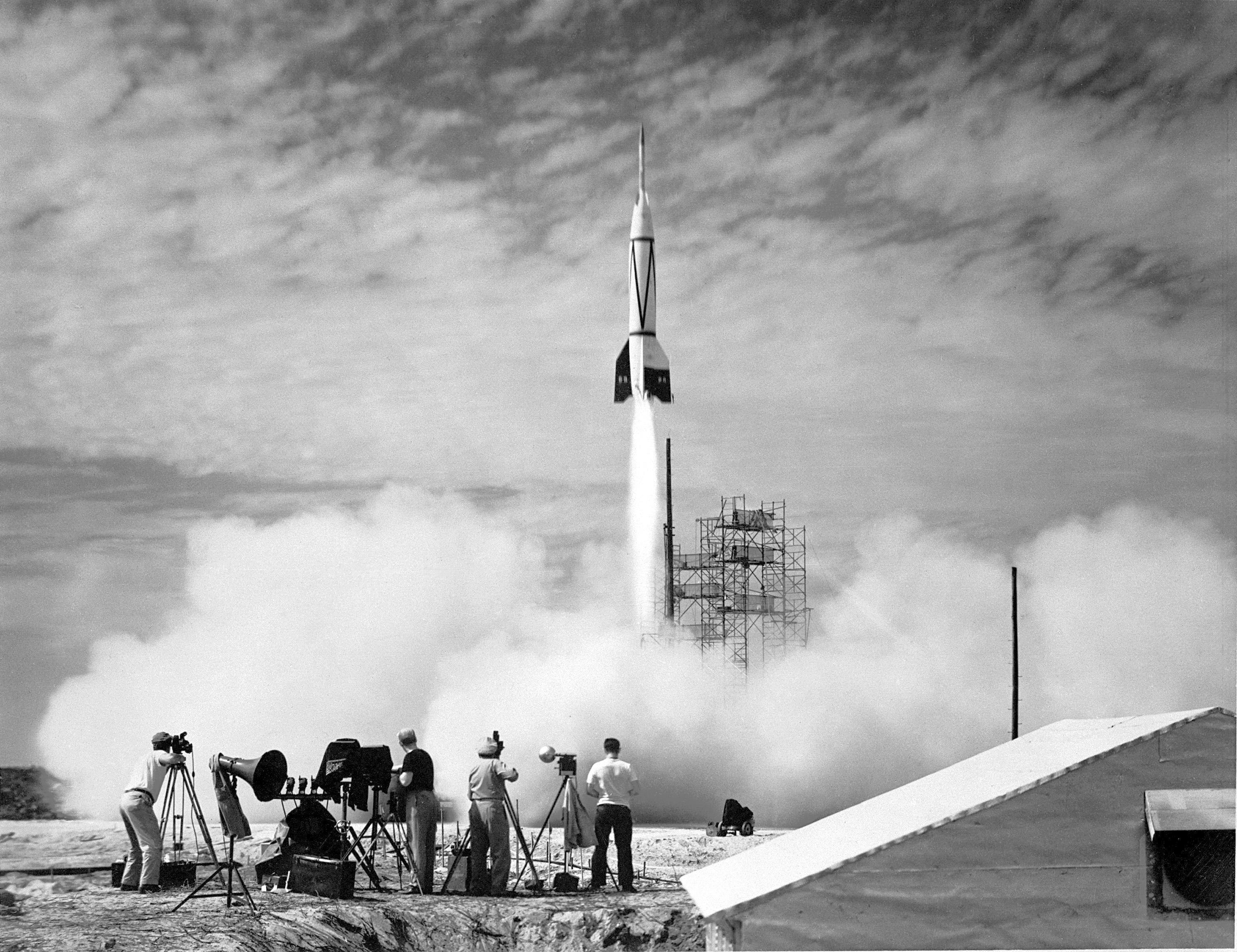
    First Rocket Launch from Cape Canaveral

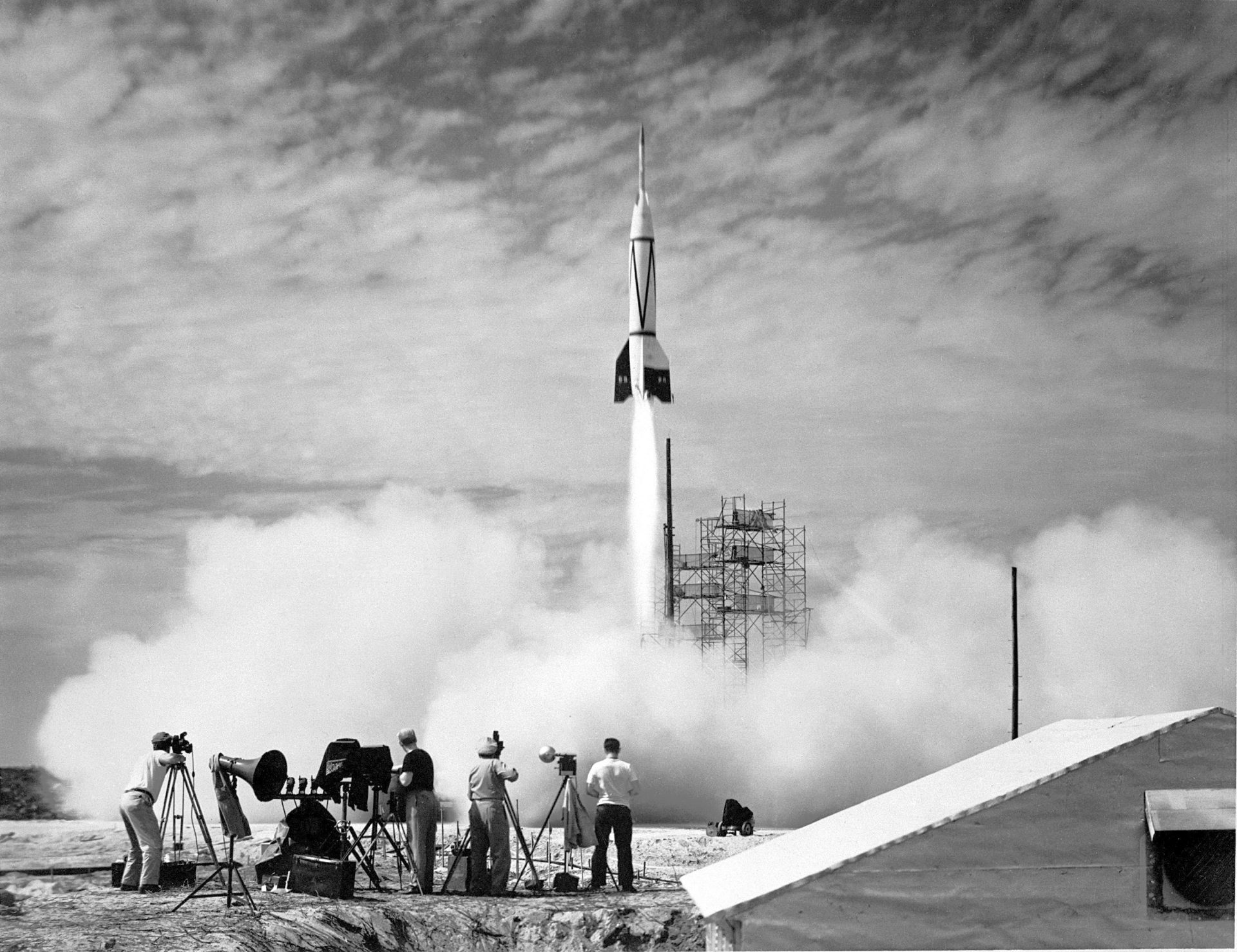
    The Bumper V-2 launches from Cape Canaveral in this July 24, 1950, photo.

  • First Rocket Launch from Cape Canaveral

    In the foreground, four people stand outside near equipment as a white rocket launches in front of them. White vapor clouds cover the ground and much of the scaffolding at the launch site. The photo is black and white.
    NASA

    The Bumper V-2 launches from Cape Canaveral in this July 24, 1950, photo. In the 75 years since this milestone, this facility has seen thousands of rockets take to the skies, destined for Earth orbit, the Moon, planets, and even beyond. From Cape Canaveral and from NASA’s Kennedy Space Center in Florida nearby, astronauts launched on the first pioneering crewed missions, headed for Moon landings, and helped to build the International Space Station.

    NASA Kennedy, a premier multi-user spaceport with about 100 private-sector partners and nearly 250 partnership agreements, is still the agency’s main launch site. NASA’s SpaceX Crew-11 mission, part of the agency’s Commercial Crew Program, will launch from NASA Kennedy no earlier than 12:09 p.m. EDT, Thursday, July 31. The Crew-11 mission members – NASA astronauts Zena Cardman and Mike Fincke, JAXA (Japan Aerospace Exploration Agency) astronaut Kimiya Yui, and Roscosmos cosmonaut Oleg Platonov – are in crew quarantine before their voyage to the orbital laboratory.

    Image credit: NASA

  • How NASA Is Testing AI to Make Earth-Observing Satellites Smarter

    5 min read

    Preparations for Next Moonwalk Simulations Underway (and Underwater)

    Cloud cover image taken above earth
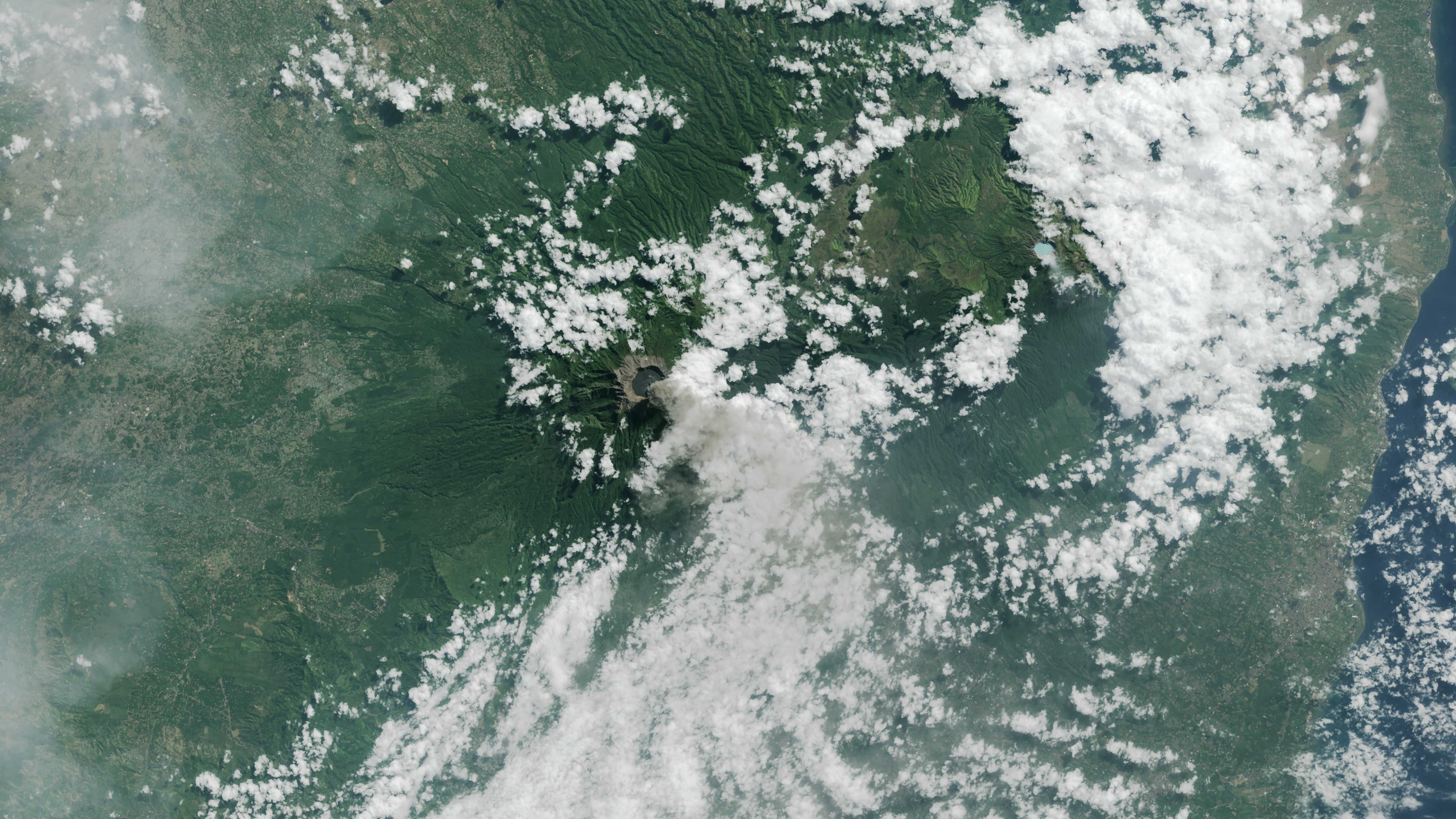
    Cloud cover can keep optical instruments on satellites from clearly capturing Earth’s surface. Still in testing, JPL’s Dynamic Targeting uses AI to avoid imaging clouds, yielding a higher proportion of usable data, and to focus on phenomena like this 2015 volcanic eruption in Indonesia Landsat 8 captured.
    NASA/USGS

    A technology called Dynamic Targeting could enable spacecraft to decide, autonomously and within seconds, where to best make science observations from orbit.

    In a recent test, NASA showed how artificial intelligence-based technology could help orbiting spacecraft provide more targeted and valuable science data. The technology enabled an Earth-observing satellite for the first time to look ahead along its orbital path, rapidly process and analyze imagery with onboard AI, and determine where to point an instrument. The whole process took less than 90 seconds, without any human involvement.

    Called Dynamic Targeting, the concept has been in development for more than a decade at NASA’s Jet Propulsion Laboratory in Southern California. The first of a series of flight tests occurred aboard a commercial satellite in mid-July. The goal: to show the potential of Dynamic Targeting to enable orbiters to improve ground imaging by avoiding clouds and also to autonomously hunt for specific, short-lived phenomena like wildfires, volcanic eruptions, and rare storms.

    This graphic shows how JPL’s Dynamic Targeting uses a lookahead sensor
    This graphic shows how JPL’s Dynamic Targeting uses a lookahead sensor to see what’s on a satellite’s upcoming path. Onboard algorithms process the sensor’s data, identifying clouds to avoid and targets of interest for closer observation as the satellite passes overhead.
    NASA/JPL-Caltech

    “The idea is to make the spacecraft act more like a human: Instead of just seeing data, it’s thinking about what the data shows and how to respond,” says Steve Chien, a technical fellow in AI at JPL and principal investigator for the Dynamic Targeting project. “When a human sees a picture of trees burning, they understand it may indicate a forest fire, not just a collection of red and orange pixels. We’re trying to make the spacecraft have the ability to say, ‘That’s a fire,’ and then focus its sensors on the fire.”

    Avoiding Clouds for Better Science

    This first flight test for Dynamic Targeting wasn’t hunting specific phenomena like fires — that will come later. Instead, the point was avoiding an omnipresent phenomenon: clouds.

    Most science instruments on orbiting spacecraft look down at whatever is beneath them. However, for Earth-observing satellites with optical sensors, clouds can get in the way as much as two-thirds of the time, blocking views of the surface. To overcome this, Dynamic Targeting looks 300 miles (500 kilometers) ahead and has the ability to distinguish between clouds and clear sky. If the scene is clear, the spacecraft images the surface when passing overhead. If it’s cloudy, the spacecraft cancels the imaging activity to save data storage for another target.

    “If you can be smart about what you’re taking pictures of, then you only image the ground and skip the clouds. That way, you’re not storing, processing, and downloading all this imagery researchers really can’t use,” said Ben Smith of JPL, an associate with NASA’s Earth Science Technology Office, which funds the Dynamic Targeting work. “This technology will help scientists get a much higher proportion of usable data.”

    How Dynamic Targeting Works

    The testing is taking place on CogniSAT-6, a briefcase-size CubeSat that launched in March 2024. The satellite — designed, built, and operated by Open Cosmos — hosts a payload designed and developed by Ubotica featuring a commercially available AI processor. While working with Ubotica in 2022, Chien’s team conducted tests aboard the International Space Station running algorithms similar to those in Dynamic Targeting on the same type of processor. The results showed the combination could work for space-based remote sensing.

    Since CogniSAT-6 lacks an imager dedicated to looking ahead, the spacecraft tilts forward 40 to 50 degrees to point its optical sensor, a camera that sees both visible and near-infrared light. Once look-ahead imagery has been acquired, Dynamic Targeting’s advanced algorithm, trained to identify clouds, analyzes it. Based on that analysis, the Dynamic Targeting planning software determines where to point the sensor for cloud-free views. Meanwhile, the satellite tilts back toward nadir (looking directly below the spacecraft) and snaps the planned imagery, capturing only the ground.

    This all takes place in 60 to 90 seconds, depending on the original look-ahead angle, as the spacecraft speeds in low Earth orbit at nearly 17,000 mph (7.5 kilometers per second).

    What’s Next

    With the cloud-avoidance capability now proven, the next test will be hunting for storms and severe weather — essentially targeting clouds instead of avoiding them. Another test will be to search for thermal anomalies like wildfires and volcanic eruptions. The JPL team developed unique algorithms for each application.

    “This initial deployment of Dynamic Targeting is a hugely important step,” Chien said. “The end goal is operational use on a science mission, making for a very agile instrument taking novel measurements.”

    There are multiple visions for how that could happen — possibly even on spacecraft exploring the solar system. In fact, Chien and his JPL colleagues drew some inspiration for their Dynamic Targeting work from another project they had also worked on: using data from ESA’s (the European Space Agency’s) Rosetta orbiter to demonstrate the feasibility of autonomously detecting and imaging plumes emitted by comet 67P/Churyumov-Gerasimenko.

    On Earth, adapting Dynamic Targeting for use with radar could allow scientists to study dangerous extreme winter weather events called deep convective ice storms, which are too rare and short-lived to closely observe with existing technologies. Specialized algorithms would identify these dense storm formations with a satellite’s look-ahead instrument. Then a powerful, focused radar would pivot to keep the ice clouds in view, “staring” at them as the spacecraft speeds by overhead and gathers a bounty of data over six to eight minutes.

    Some ideas involve using Dynamic Targeting on multiple spacecraft: The results of onboard image analysis from a leading satellite could be rapidly communicated to a trailing satellite, which could be tasked with targeting specific phenomena. The data could even be fed to a constellation of dozens of orbiting spacecraft. Chien is leading a test of that concept, called Federated Autonomous MEasurement, beginning later this year.

    News Media Contact

    Melissa Pamer
    Jet Propulsion Laboratory, Pasadena, Calif.
    626-314-4928
    melissa.pamer@jpl.nasa.gov

    2025-094

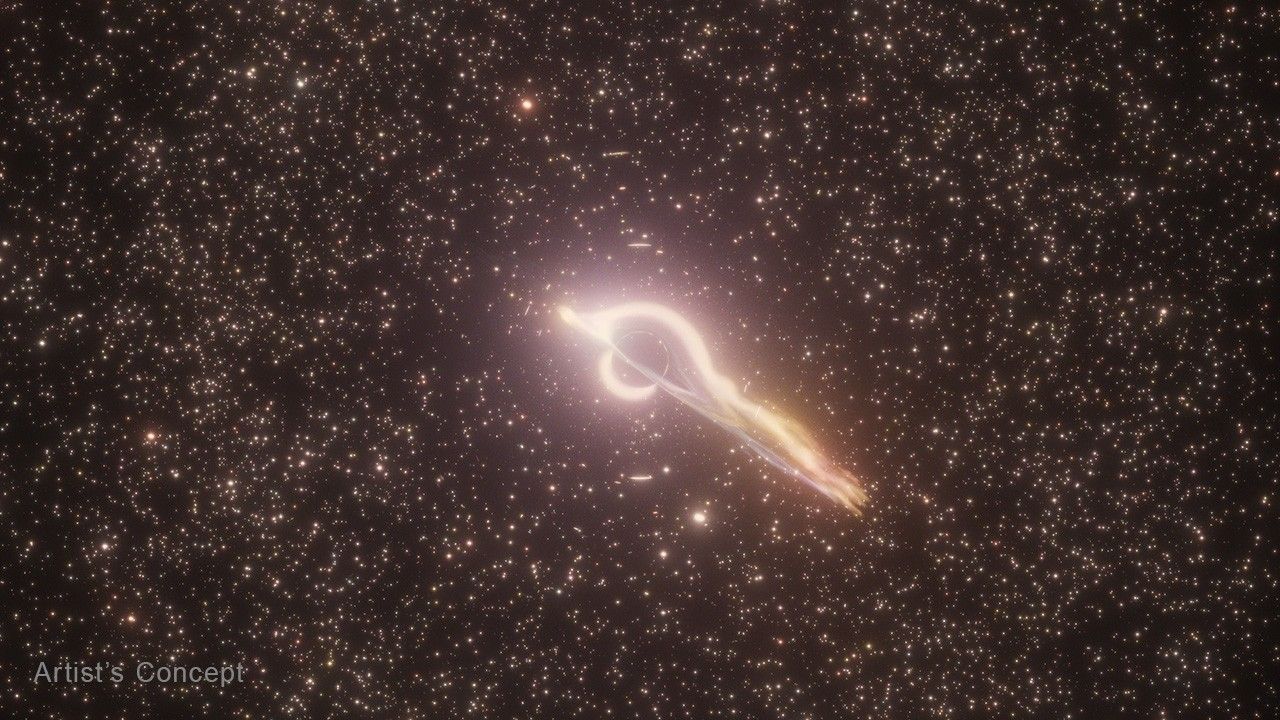
  • NASA’s Hubble, Chandra Spot Rare Type of Black Hole Eating a Star

    6 Min Read

    NASA’s Hubble, Chandra Spot Rare Type of Black Hole Eating a Star

    2 Elliptical galaxies appear as fuzzy white oval. At right is a smaller fuzzy purple blob. The background of space is black, speckled with tiny white dots.

    NASA’s Hubble Space Telescope and NASA’s Chandra X-ray Observatory team up to identify a possible intermediate-mass black hole.

    Credits:
    NASA, ESA, CXC, Yi-Chi Chang (National Tsing Hua University); Image Processing: Joseph DePasquale (STScI)

    NASA’s Hubble Space Telescope and NASA’s Chandra X-ray Observatory have teamed up to identify a new possible example of a rare class of black holes. Called NGC 6099 HLX-1, this bright X-ray source seems to reside in a compact star cluster in a giant elliptical galaxy.

    Just a few years after its 1990 launch, Hubble discovered that galaxies throughout the universe can contain supermassive black holes at their centers weighing millions or billions of times the mass of our Sun. In addition, galaxies also contain as many as millions of small black holes weighing less than 100 times the mass of the Sun. These form when massive stars reach the end of their lives.

    Far more elusive are intermediate-mass black holes (IMBHs), weighing between a few hundred to a few 100,000 times the mass of our Sun. This not-too-big, not-too-small category of black holes is often invisible to us because IMBHs don’t gobble as much gas and stars as the supermassive ones, which would emit powerful radiation. They have to be caught in the act of foraging in order to be found. When they occasionally devour a hapless bypassing star — in what astronomers call a tidal disruption event— they pour out a gusher of radiation.

    The newest probable IMBH, caught snacking in telescope data, is located on the galaxy NGC 6099’s outskirts at approximately 40,000 light-years from the galaxy’s center, as described in a new study in the Astrophysical Journal. The galaxy is located about 450 million light-years away in the constellation Hercules.

    Two elliptical galaxies at upper right and lower left appear as fuzzy white ovals. At bottom center is a fuzzy purple blob outlined by a white box. White lines angle outward from the corners of the box to a blow-up of the purple blob. At the center is a white dot labeled HLX-1. The main image also has two bright stars with prominent diffraction spikes. The background of space is black, and is speckled with tiny white dots.
    A Hubble Space Telescope image of a pair of galaxies: NGC 6099 (lower left) and NGC 6098 (upper right). The purple blob depicts X-ray emission from a compact star cluster. The X-rays are produced by an intermediate-mass black hole tearing apart a star.
    Science: NASA, ESA, CXC, Yi-Chi Chang (National Tsing Hua University); Image Processing: Joseph DePasquale (STScI)

    Astronomers first saw an unusual source of X-rays in an image taken by Chandra in 2009. They then followed its evolution with ESA’s XMM-Newton space observatory.

    “X-ray sources with such extreme luminosity are rare outside galaxy nuclei and can serve as a key probe for identifying elusive IMBHs. They represent a crucial missing link in black hole evolution between stellar mass and supermassive black holes,” said lead author Yi-Chi Chang of the National Tsing Hua University, Hsinchu, Taiwan.

    X-ray emission coming from NGC 6099 HLX-1 has a temperature of 3 million degrees, consistent with a tidal disruption event. Hubble found evidence for a small cluster of stars around the black hole. This cluster would give the black hole a lot to feast on, because the stars are so closely crammed together that they are just a few light-months apart (about 500 billion miles).

    The suspected IMBH reached maximum brightness in 2012 and then continued declining to 2023. The optical and X-ray observations over the period do not overlap, so this complicates the interpretation. The black hole may have ripped apart a captured star, creating a plasma disk that displays variability, or it may have formed a disk that flickers as gas plummets toward the black hole.

    “If the IMBH is eating a star, how long does it take to swallow the star’s gas? In 2009, HLX-1 was fairly bright. Then in 2012, it was about 100 times brighter. And then it went down again,” said study co-author Roberto Soria of the Italian National Institute for Astrophysics (INAF). “So now we need to wait and see if it’s flaring multiple times, or there was a beginning, there was peak, and now it’s just going to go down all the way until it disappears.”

    The IMBH is on the outskirts of the host galaxy, NGC 6099, about 40,000 light-years from the galaxy’s center. There is presumably a supermassive black hole at the galaxy’s core, which is currently quiescent and not devouring a star.

    Black Hole Building Blocks

    The team emphasizes that doing a survey of IMBHs can reveal how the larger supermassive black holes form in the first place. There are two alternative theories. One is that IMBHs are the seeds for building up even larger black holes by coalescing together, since big galaxies grow by taking in smaller galaxies. The black hole in the middle of a galaxy grows as well during these mergers. Hubble observations uncovered a proportional relationship: the more massive the galaxy, the bigger the black hole. The emerging picture with this new discovery is that galaxies could have “satellite IMBHs” that orbit in a galaxy’s halo but don’t always fall to the center.

    Another theory is that the gas clouds in the middle of dark-matter halos in the early universe don’t make stars first, but just collapse directly into a supermassive black hole. NASA’s James Webb Space Telescope’s discovery of very distant black holes being disproportionately more massive relative to their host galaxy tends to support this idea.

    However, there could be an observational bias toward the detection of extremely massive black holes in the distant universe, because those of smaller size are too faint to be seen. In reality, there could be more variety out there in how our dynamic universe constructs black holes. Supermassive black holes collapsing inside dark-matter halos might simply grow in a different way from those living in dwarf galaxies where black-hole accretion might be the favored growth mechanism.

    “So if we are lucky, we’re going to find more free-floating black holes suddenly becoming X-ray bright because of a tidal disruption event. If we can do a statistical study, this will tell us how many of these IMBHs there are, how often they disrupt a star, how bigger galaxies have grown by assembling smaller galaxies.” said Soria.

    The challenge is that Chandra and XMM-Newton only look at a small fraction of the sky, so they don’t often find new tidal disruption events, in which black holes are consuming stars. The Vera C. Rubin Observatory in Chile, an all-sky survey telescope from the U.S. National Science Foundation and the Department of Energy, could detect these events in optical light as far as hundreds of millions of light-years away. Follow-up observations with Hubble and Webb can reveal the star cluster around the black hole.

    The Hubble Space Telescope has been operating for more than three decades and continues to make ground-breaking discoveries that shape our fundamental understanding of the universe. Hubble is a project of international cooperation between NASA and ESA (European Space Agency). NASA’s Goddard Space Flight Center in Greenbelt, Maryland, manages the telescope and mission operations. Lockheed Martin Space, based in Denver, also supports mission operations at Goddard. The Space Telescope Science Institute in Baltimore, which is operated by the Association of Universities for Research in Astronomy, conducts Hubble science operations for NASA.

    Details

    Last Updated

    Jul 24, 2025

    Editor
    Andrea Gianopoulos
    Contact

    Media

    Claire Andreoli
    NASA’s Goddard Space Flight Center
    Greenbelt, Maryland
    claire.andreoli@nasa.gov

    Ray Villard
    Space Telescope Science Institute
    Baltimore, Maryland

  • NASA Launches Mission to Study Earth’s Magnetic Shield

    NASA’s TRACERS (Tandem Reconnection and Cusp Electrodynamics Reconnaissance Satellites) mission launched at 2:13 p.m. EDT atop a SpaceX Falcon 9 rocket at Space Launch Complex 4 East at Vandenberg Space Force Base in California.
    Credit: SpaceX

    NASA’s newest mission, TRACERS, soon will begin studying how Earth’s magnetic shield protects our planet from the effects of space weather. Short for Tandem Reconnection and Cusp Electrodynamics Reconnaissance Satellites, the twin TRACERS spacecraft lifted off at 11:13 a.m. PDT (2:13 p.m. EDT) Wednesday aboard a SpaceX Falcon 9 rocket from Space Launch Complex 4 East at Vandenberg Space Force Base in California.

    “NASA is proud to launch TRACERS to demonstrate and expand American preeminence in space science research and technology,” said acting NASA Administrator Sean Duffy. “The TRACERS satellites will move us forward in decoding space weather and further our understanding of the connection between Earth and the Sun. This mission will yield breakthroughs that will advance our pursuit of the Moon, and subsequently, Mars.”

    The twin satellites will fly one behind the other — following as closely as 10 seconds apart over the same location — and will take a record-breaking 3,000 measurements in one year to build a step-by-step picture of how magnetic reconnection changes over time.

    Riding along with TRACERS aboard the Falcon 9 were NASA’s Athena EPIC (Economical Payload Integration Cost), PExT (Polylingual Experimental Terminal), and REAL (Relativistic Electron Atmospheric Loss) missions — three small satellites to demonstrate new technologies and gather scientific data. These three missions were successfully deployed, and mission controllers will work to contact them over the coming hours and days.

    Ground controllers for the TRACERS mission established communications with the second of the two spacecraft at 3:43 p.m. PDT (6:43 p.m. EDT), about 3 hours after it separated from the rocket. During the next four weeks, TRACERS will undergo a commissioning period during which mission controllers will check out their instruments and systems.

    Once cleared, the twin satellites will begin their 12-month prime mission to study a process called magnetic reconnection, answering key questions about how it shapes the impacts of the Sun and space weather on our daily lives.

    “NASA’s heliophysics fleet helps to safeguard humanity’s home in space and understand the influence of our closest star, the Sun,” said Joe Westlake, heliophysics division director at NASA Headquarters in Washington. “By adding TRACERS to that fleet, we will gain a better understanding of those impacts right here at Earth.”

    The two TRACERS spacecraft will orbit through an open region in Earth’s magnetic field near the North Pole, called the polar cusp. Here, TRACERS will investigate explosive magnetic events that happen when the Sun’s magnetic field — carried through space in a stream of solar material called the solar wind — collides with Earth’s magnetic field. This collision creates a buildup of energy that causes magnetic reconnection, when magnetic field lines snap and explosively realign, flinging away nearby particles at high speeds.

    Flying through the polar cusp allows the TRACERS satellites to study the results of these magnetic explosions, measuring charged particles that race down into Earth’s atmosphere and collide with atmospheric gases — giving scientist the tools to reconstruct exactly how changes in the incoming solar wind affect how, and how quickly, energy and particles are coupled into near-Earth space.

    “The successful launch of TRACERS is a tribute to many years of work by an excellent team,” said David Miles, TRACERS principal investigator at the University of Iowa. “TRACERS is set to transform our understanding of Earth’s magnetosphere. We’re excited to explore the dynamic processes driving space weather.”

    Small Satellites Along for Ride

    Athena EPIC is a pathfinder mission that will demonstrate NASA’s use of an innovative and configurable commercial SmallSat architecture to improve flexibility of payload designs, reduce launch schedule, and reduce overall costs in future missions, as well as the benefits of working collaboratively with federal partners. In addition to this demonstration for NASA, once the Athena EPIC satellite completes its two-week commissioning period, the mission will spend the next 12 months taking measurements of outgoing longwave radiation from Earth.

    The PExT demonstration will test interoperability between commercial and government communication networks for the first time by demonstrating a wideband polylingual terminal in low Earth orbit. This terminal will use software-defined radios to jump between government and commercial networks, similar to cell phones roaming between providers on Earth. These terminals could allow future missions to switch seamlessly between networks and access new commercial services throughout its lifecycle in space.

    The REAL mission is a CubeSat that will investigate how energetic electrons are scattered out of the Van Allen radiation belts and into Earth’s atmosphere. Shaped like concentric rings high above Earth’s equator, the Van Allen belts are composed of a mix of high-energy electrons and protons that are trapped in place by Earth’s magnetic field. Studying electrons and their interactions, REAL aims to improve our understanding of these energetic particles that can damage spacecraft and imperil astronauts who pass through them. 

    The TRACERS mission is led by David Miles at the University of Iowa with support from the Southwest Research Institute in San Antonio, Texas. NASA’s Heliophysics Explorers Program Office at the agency’s Goddard Space Flight Center in Greenbelt, Maryland, manages the mission for the Heliophysics Division at NASA Headquarters in Washington. The University of Iowa, Southwest Research Institute, University of California, Los Angeles, and the University of California, Berkeley, all lead instruments on TRACERS.

    The Athena EPIC mission is led by NASA’s Langley Research Center in Hampton, Virginia, and is a partnership between National Oceanic and Atmospheric Administration, U.S. Space Force, and NovaWurks. Athena EPIC’s launch is supported by launch integrator SEOPS. The PExT demonstration is managed by NASA’s SCaN (Space Communications and Navigation) program in partnership with Johns Hopkins Applied Physics Laboratory, with launch support by York Space Systems. The REAL project is led by Dartmouth College in Hanover, New Hampshire, and is a partnership between Johns Hopkins Applied Physics Laboratory, Montana State University, and Boston University. Sponsored by NASA’s Heliophysics Division and CubeSat Launch Initiative, it was included through launch integrator Maverick Space Systems.

    NASA’s Launch Services Program, based at the agency’s Kennedy Space Center in Florida, manages the VADR (Venture-class Acquisition of Dedicated and Rideshare) contract.

    To learn more about TRACERS, visit:

    https://nasa.gov/tracers

    -end-

    Abbey Interrante / Karen Fox
    Headquarters, Washington
    301-201-0124 / 202-358-1600
    abbey.a.interrante@nasa.gov / karen.c.fox@nasa.gov

    Sarah Frazier
    Goddard Space Flight Center, Greenbelt, Maryland
    202-853-7191
    sarah.frazier@nasa.gov
    Details

    Last Updated

    Jul 24, 2025

  • NASA Sets Launch Coverage for Earth-Tracking NISAR Satellite

    An artist's concept of the NISAR mission. The NISAR Satellite is seen operating in orbit above Earth.
    A collaboration between NASA and the Indian Space Research Organisation, NISAR will use synthetic aperture radar to monitor nearly all the planet’s land- and ice-covered surfaces twice every 12 days.
    Credit: NASA/JPL-Caltech

    NASA will provide live coverage of launch activities for NISAR (NASA-ISRO Synthetic Aperture Radar), which is set to lift off at 8:10 a.m. EDT (5:40 p.m. IST), Wednesday, July 30, from Satish Dhawan Space Centre on India’s southeastern coast.

    A collaboration between NASA and the Indian Space Research Organisation (ISRO), the first-of-its-kind satellite will lift off aboard an ISRO Geosynchronous Satellite Launch Vehicle on a mission to scan nearly all the Earth’s land and ice surfaces twice every 12 days.

    Watch live coverage of the launch on NASA+ and the agency’s YouTube channel. Learn how to watch NASA content through a variety of platforms, including social media.

    With its two radar instruments — an S-band system provided by ISRO and an L-band system provided by NASA — the NISAR mission will provide high-resolution data to help decision-makers, communities, and scientists monitor major infrastructure, agricultural fields, and movement of land and ice surfaces.

    Hailed as a critical part of a pioneering year for United States – India civil space cooperation by President Trump and Prime Minister Modi during their visit in Washington in February, the NISAR launch will advance U.S. – India cooperation and benefit the U.S. in areas such as agriculture and preparation and response to disasters like hurricanes, floods, and volcanic eruptions.

    NASA’s mission coverage is as follows (all times Eastern and subject to change based on real-time operations):

    Monday, July 28  

    12 p.m. – Prelaunch teleconference with the following participants:

    • Karen St. Germain, director of Earth science, NASA Headquarters
    • Gerald Bawden, NISAR program scientist, NASA Headquarters
    • Shanna McClain, Disasters program manager, NASA Headquarters
    • Phil Barela, NISAR project manager, NASA Jet Propulsion Laboratory (JPL)
    • Marco Lavalle, NISAR deputy project scientist, NASA JPL

    The teleconference will stream on JPL’s YouTube Channel.

    Members of the media may ask questions via phone during the teleconference. To register, media must provide their name and affiliation by 4 p.m. on Sunday, July 27, to Rexana Vizza at: rexana.v.vizza@jpl.nasa.gov. Questions may also be asked via social media with the hashtag #AskNISAR.

    Wednesday, July 30

    7 a.m. – Launch coverage begins on NASA+ and YouTube.

    The launch broadcast begins from NASA’s Jet Propulsion Laboratory in Southern California, where the U.S. portion of the mission is managed.

    Follow launch events on NASA’s NISAR blog

    Watch, Engage on Social Media

    You can also stay connected by following and tagging these accounts:

    X: @NASA, @NASAEarth, @NASAJPL

    Facebook: NASA, NASA Earth, NASA JPL

    Instagram: @NASA, @NASAEarth, @NASAJPL

    Additional Resources

    The NISAR press kit features deeper dives into the mission as well as its science and technology.

    Explore NISAR videos as well as NISAR animations and b-roll media reel.

    The NISAR mission is the first joint satellite mission between NASA and ISRO, marking a new chapter in the growing collaboration between the two space agencies. The launch of NISAR, years in the making, builds on a strong heritage of successful programs, including Chandrayaan-1 and the recent Axiom Mission-4, which saw ISRO and NASA astronauts living and working together aboard the International Space Station for the first time.

    Learn more about the mission at:

    https://science.nasa.gov/mission/nisar

    -end-

    Elizabeth Vlock / Karen Fox
    Headquarters, Washington
    202-358-1600
    elizabeth.a.vlock@nasa.gov / karen.c.fox@nasa.gov
    Andrew Wang / Jane J. Lee 
    Jet Propulsion Laboratory, Pasadena, Calif.
    626-379-6874 / 818-354-0307 
    andrew.wang@jpl.nasa.gov / jane.j.lee@jpl.nasa.gov

  • NASA Scientist Finds Predicted Companion Star to Betelgeuse

    4 min read

    Preparations for Next Moonwalk Simulations Underway (and Underwater)

    An image of Betelgeuse, the yellow-red star, and the signature of its close companion, the faint blue object.
    Data: NASA/JPL/NOIRlab. Visualization: NOIRLAB.

    A century-old hypothesis that Betelgeuse, the 10th brightest star in our night sky, is orbited by a very close companion star was proved true by a team of astrophysicists led by a scientist at NASA’s Ames Research Center in California’s Silicon Valley.

    The research published in The Astrophysical Journal Letters in the paper “Probable Direct Imaging Discovery of the Stellar Companion to Betelgeuse.”

    Fluctuations in the brightness and measured velocity of Betelgeuse, the closest red supergiant star to Earth, had long presented clues that it may have a partner, but the bigger star’s intense glow made direct observations of any fainter neighbors nearly impossible.

    Two recent studies by other teams of astronomers reignited the companion star hypothesis by using more than 100 years of Betelgeuse observations to provide predictions of the companion’s location and brightness.

    If the smaller star did exist, the location predictions suggested that scientists had a window of just a few months to observe the companion star at its widest separation from Betelgeuse, as it orbited near the visible edge of the supergiant. After that, they would have to wait another three years for it to orbit to the other side and again leave the overpowering glow of its larger companion.

    Searches for the companion were initially made using space-based telescopes, because observing through Earth’s atmosphere can blur images of astronomical objects. But these efforts did not detect the companion.

    Steve Howell, a senior research scientist at Ames, recognized the ground-based Gemini North telescope in Hawai’i, one of the largest in the world, paired with a special, high-resolution camera built by NASA, had the potential to directly observe the close companion to Betelgeuse, despite the atmospheric blurring.

    Officially called the ‘Alopeke speckle instrument, the advanced imaging camera let them obtain many thousands of short exposures to measure the atmospheric interference in their data and remove it with detailed image processing, providing an image of Betelgeuse and its companion.

    Howell’s team detected the very faint companion star right where it was predicted to be, orbiting very close to the outer edge of Betelgeuse.

    “I hope our discovery excites other astrophysicists about the robust power of ground-based telescopes and speckle imagers – a key to opening new observational windows,” said Howell. “This can help unlock the great mysteries in our universe.”

    To start, this discovery of a close companion to Betelgeuse may explain why other similar red supergiant stars undergo periodic changes in their brightness on the scale of many years.

    Howell plans to continue observations of Betelgeuse’s stellar companion to better understand its nature. The companion star will again return to its greatest separation from Betelgeuse in November 2027, a time when it will be easiest to detect.

    Having found the long-anticipated companion star, Howell turned to giving it a name. The traditional star name “Betelgeuse” derives from Arabic, meaning “the hand of al-Jawza’,” a female figure in old Arabian legend. Fittingly, Howell’s team named the orbiting companion “Siwarha,” meaning “her bracelet.”

    Photo of the constellation Orion, showing the location of Betelgeuse – and its newfound companion star.
    NOIRLab/Eckhard Slawik

    The NASA–National Science Foundation Exoplanet Observational Research Program (NN-EXPLORE) is a joint initiative to advance U.S. exoplanet science by providing the community with access to cutting-edge, ground-based observational facilities. Managed by NASA’s Exoplanet Exploration Program, NN-EXPLORE supports and enhances the scientific return of space missions such as Kepler, TESS (Transiting Exoplanet Survey Satellite), Hubble Space Telescope, and James Webb Space Telescope by enabling essential follow-up observations from the ground—creating strong synergies between space-based discoveries and ground-based characterization. NASA’s Exoplanet Exploration Program is located at the agency’s Jet Propulsion Laboratory.

    To learn more about NN-EXPLORE, visit:

    https://exoplanets.nasa.gov/exep/NNExplore/overview