Tag: NASA

  • NASA’s Europa Clipper Radar Instrument Proves Itself at Mars

    5 min read

    Preparations for Next Moonwalk Simulations Underway (and Underwater)

    Europa Clipper’s radar instrument received echoes of its very-high-frequency radar signals that bounced off Mars
    Europa Clipper’s radar instrument received echoes of its very-high-frequency radar signals that bounced off Mars and were processed to develop this radargram. What looks like a skyline is the outline of the topography beneath the spacecraft.
    NASA/JPL-Caltech/UT-Austin

    The agency’s largest interplanetary probe tested its radar during a Mars flyby. The results include a detailed image and bode well for the mission at Jupiter’s moon Europa.

    As it soared past Mars in March, NASA’s Europa Clipper conducted a critical radar test that had been impossible to accomplish on Earth. Now that mission scientists have studied the full stream of data, they can declare success: The radar performed just as expected, bouncing and receiving signals off the region around Mars’ equator without a hitch.

    Called REASON (Radar for Europa Assessment and Sounding: Ocean to Near-surface), the radar instrument will “see” into Europa’s icy shell, which may have pockets of water inside. The radar may even be able to detect the ocean beneath the shell of Jupiter’s fourth-largest moon.

    “We got everything out of the flyby that we dreamed,” said Don Blankenship, principal investigator of the radar instrument, of the University of Texas at Austin. “The goal was to determine the radar’s readiness for the Europa mission, and it worked. Every part of the instrument proved itself to do exactly what we intended.”
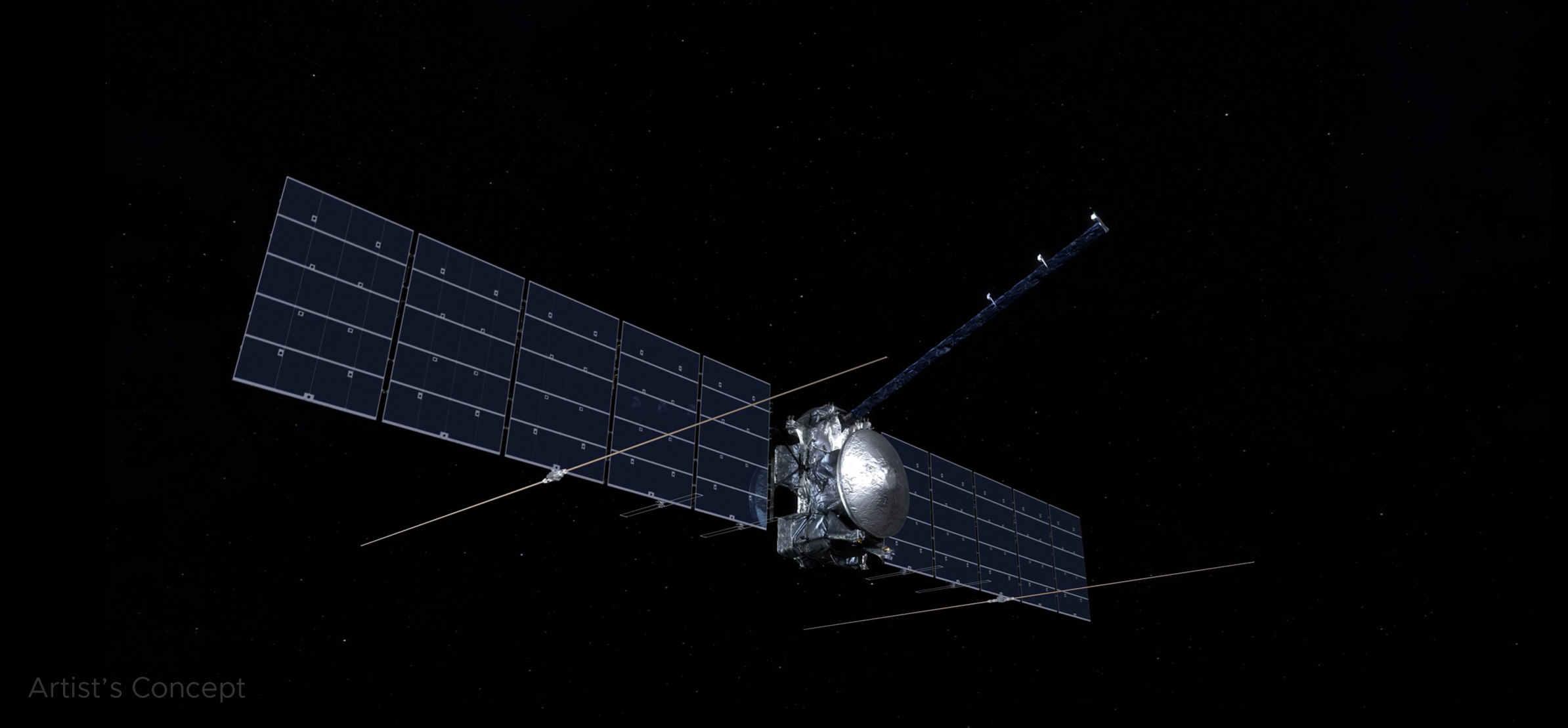
    In this artist’s concept, Europa Clipper’s radar antennas
    In this artist’s concept, Europa Clipper’s radar antennas — seen at the lower edge of the solar panels — are fully deployed. The antennas are key components of the spacecraft’s radar instrument, called REASON.
    NASA/JPL-Caltech

    The radar will help scientists understand how the ice may capture materials from the ocean and transfer them to the surface of the moon. Above ground, the instrument will help to study elements of Europa’s topography, such as ridges, so scientists can examine how they relate to features that REASON images beneath the surface.

    Limits of Earth

    Europa Clipper has an unusual radar setup for an interplanetary spacecraft: REASON uses two pairs of slender antennas that jut out from the solar arrays, spanning a distance of about 58 feet (17.6 meters). Those arrays themselves are huge — from tip to tip, the size of a basketball court — so they can catch as much light as possible at Europa, which gets about 1/25th the sunlight as Earth.

    The instrument team conducted all the testing that was possible prior to the spacecraft’s launch from NASA’s Kennedy Space Center in Florida on Oct. 14, 2024. During development, engineers at the agency’s Jet Propulsion Laboratory in Southern California even took the work outdoors, using open-air towers on a plateau above JPL to stretch out and test engineering models of the instrument’s spindly high-frequency and more compact very-high-frequency antennas.

    But once the actual flight hardware was built, it needed to be kept sterile and could be tested only in an enclosed area. Engineers used the giant High Bay 1 clean room at JPL, where the spacecraft was assembled, to test the instrument piece by piece. To test the “echo,” or the bounceback of REASON’s signals, however, they’d have needed a chamber about 250 feet (76 meters) long — nearly three-quarters the length of a football field.

    Enter Mars

    The mission’s primary goal in flying by Mars on March 1, less than five months after launch, was to use the planet’s gravitational pull to reshape the spacecraft’s trajectory. But it also presented opportunities to calibrate the spacecraft’s infrared camera and perform a dry run of the radar instrument over terrain NASA scientists have been studying for decades.

    As Europa Clipper zipped by the volcanic plains of the Red Planet — starting at 3,100 miles (5,000 kilometers) down to 550 miles (884 kilometers) above the surface — REASON sent and received radio waves for about 40 minutes. In comparison, at Europa the instrument will operate as close as 16 miles (25 kilometers) from the moon’s surface.

    All told, engineers were able to collect 60 gigabytes of rich data from the instrument. Almost immediately, they could tell REASON was working well. The flight team scheduled the full dataset to download, starting in mid-May. Scientists relished the opportunity over the next couple of months to examine the information in detail and compare notes. 

    “The engineers were excited that their test worked so perfectly,” said JPL’s Trina Ray, Europa Clipper deputy science manager. “All of us who had worked so hard to make this test happen — and the scientists seeing the data for the first time — were ecstatic, saying, ‘Oh, look at this! Oh, look at that!’ Now, the science team is getting a head start on learning how to process the data and understand the instrument’s behavior compared to models. They are exercising those muscles just like they will out at Europa.” 

    Europa Clipper’s total journey to reach the icy moon will be about 1.8 billion miles (2.9 billion kilometers) and includes one more gravity assist — using Earth — in 2026. The spacecraft is currently about 280 million miles (450 million kilometers) from Earth.

    More About Europa Clipper

    Europa Clipper’s three main science objectives are to determine the thickness of the moon’s icy shell and its interactions with the ocean below, to investigate its composition, and to characterize its geology. The mission’s detailed exploration of Europa will help scientists better understand the astrobiological potential for habitable worlds beyond our planet.

    Managed by Caltech in Pasadena, California, NASA’s Jet Propulsion Laboratory in Southern California leads the development of the Europa Clipper mission in partnership with the Johns Hopkins Applied Physics Laboratory in Laurel, Maryland, for NASA’s Science Mission Directorate in Washington. APL designed the main spacecraft body in collaboration with JPL and NASA’s Goddard Space Flight Center in Greenbelt, Maryland, NASA’s Marshall Space Flight Center in Huntsville, Alabama, and Langley Research Center in Hampton, Virginia. The Planetary Missions Program Office at NASA Marshall executes program management of the Europa Clipper mission. NASA’s Launch Services Program, based at NASA Kennedy, managed the launch service for the Europa Clipper spacecraft. The REASON radar investigation is led by the University of Texas at Austin.

    Find more information about Europa Clipper here:

    https://science.nasa.gov/mission/europa-clipper/

    News Media Contacts

    Gretchen McCartney
    Jet Propulsion Laboratory, Pasadena, Calif.
    818-287-4115
    gretchen.p.mccartney@jpl.nasa.gov 

    Karen Fox / Molly Wasser
    NASA Headquarters, Washington
    202-358-1600
    karen.c.fox@nasa.gov / molly.l.wasser@nasa.govt

    2025-097

    Details

    Last Updated

    Aug 01, 2025

  • What’s Up: August 2025 Skywatching Tips from NASA

    Venus-Jupiter Conjunction and Meteor Mojo

    Jupiter and Venus shine brightly in the mornings as they appear to graze each other in the sky on the 11th and 12th. The Perseids are washed out by the Moon.

    Skywatching Highlights

    All Month – Planet Visibility:

    • Mercury: Pops up above the horizon during the second half of August. Appears very low, below 10 degrees altitude.
    • Venus: Shines very brightly in the east each morning before sunrise, about 20 to 30 degrees above the horizon.
    • Mars: Can be observed low in the west during the hour after sunset, appearing about as bright as the brightest stars in the Big Dipper.
    • Jupiter: Appears in the east each morning, together with Venus, but much less bright.
    • Saturn: Observable late night to dawn. Rises around 10:30 p.m. early in the month, and around 8:30 p.m. by the end of the month. Find it high in the south as sunrise approaches.

    Skywatching Highlights:

    August 11 & 12 – Venus-Jupiter Conjunction – The two brightest planets have a close meetup over several days, appearing closest over two days on the 11th and 12th, at just a degree apart.

    August 19 & 20 – Moon with Jupiter & Venus – A slim lunar crescent joins Jupiter and Venus — still relatively close in the sky after their conjunction. They appear in the east in the several hours preceding sunrise.

    August 12th-13th – Perseids Peak – The celebrated annual meteor shower will be hampered by an 84%-full Moon on the peak night. A few bright meteors may still be seen in the pre-dawn hours, but viewing conditions are not ideal this year.

    All month – The Dumbbell Nebula (M27) – One of the easiest planetary nebulas to observe, M27 appears within the Summer Triangle star pattern, high overhead in the first half of the night.

    Transcript

    What’s Up for August? Jupiter and Venus have a morning meetup, we check out this year’s Perseid meteor shower, and peek into the future of our own Sun.

    Mars is the lone planet in the early evening sky this month, visible low in the west for about an hour after the sky starts to darken. It’s now only about 60% as bright as it appeared back in May. 

    Saturn is rising by about 10 pm, and you’ll see it showing up a bit earlier each evening as the month goes on. You’ll find it in the east after dark with the constellations Cassiopeia and Andromeda. The Ringed Planet makes its way over to the western part of the sky by dawn, where early risers will find it on August mornings.

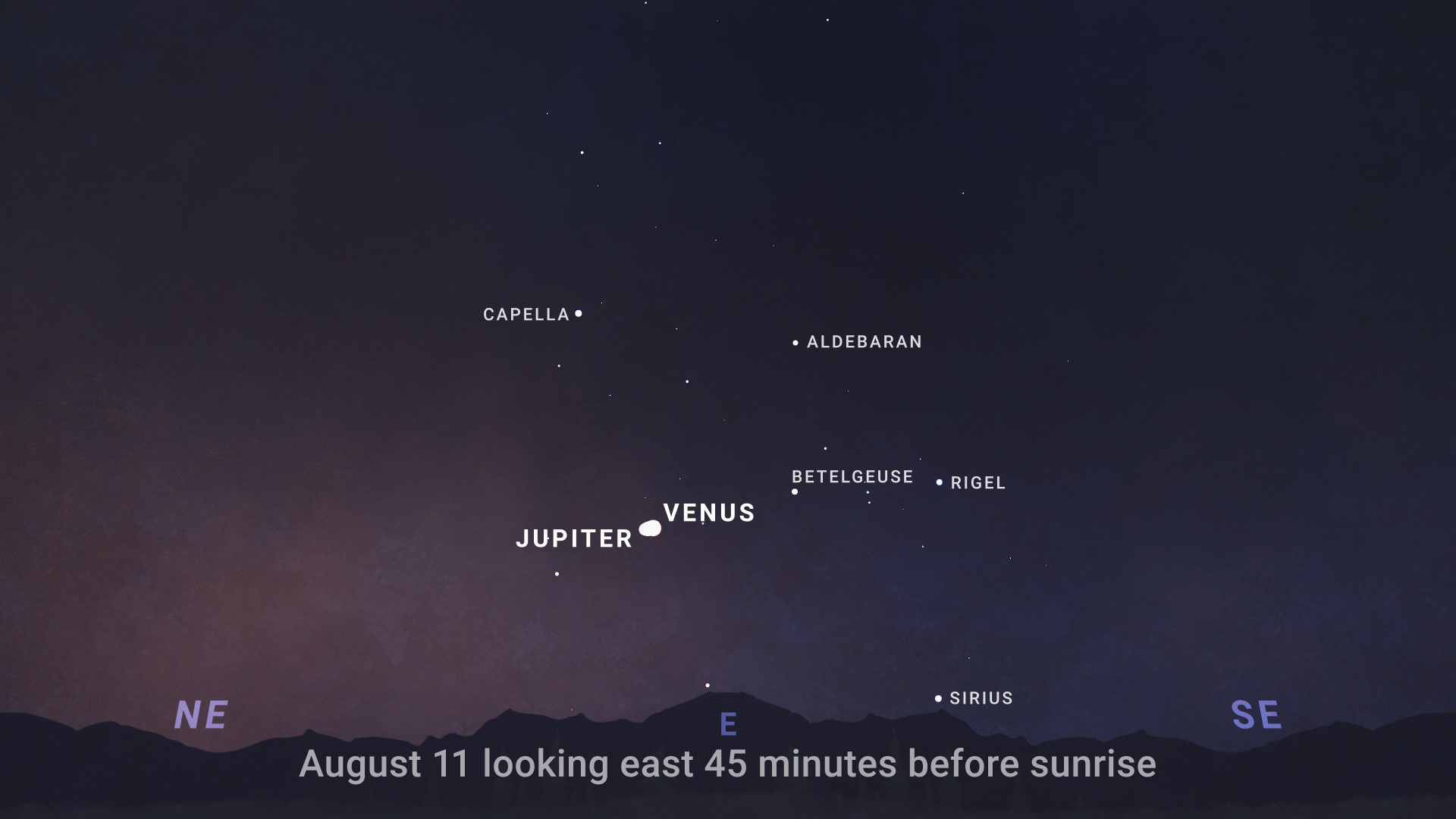
    The real highlight of August is the close approach of Jupiter and Venus. They shine brightly in the east before sunrise throughout the month. The pair begin the month farther apart, but quickly approach each other in the sky. They appear at their closest on the 11th and 12th — only about a degree apart. Their rendezvous happens against a backdrop of bright stars including Orion, Taurus, Gemini, and Sirius. A slim crescent Moon joins the pair of planets after they separate again, on the mornings of the 19th and 20th.

    An illustrated sky chart shows a predawn sky, facing east on August 11th. Several bright stars are labeled: Capella, Aldebaran, Rigel, Betegeuse, and Sirus. Just left of center is a pair of very bright objects in the sky, Jupiter and Venus. The bright pair are so close in the sky that they almost appear as a single object.
    Sky chart showing the eastern sky before sunrise on August 11th, with Venus and Jupiter only a degree apart.
    NASA/JPL-Caltech

    One of the best annual meteor showers, the Perseids, peaks overnight on August 12th and into the 13th. Unfortunately, this year the Moon is nearly full on the peak night, and its glare will wash out all but the brightest meteors. While that’s not so great for Perseid watchers, the good news is that another favorite annual meteor shower, the Geminids, is poised for Moon-free viewing in December.

    August is a great time to see one of the easiest-to-observe nebulas in the sky. 

    The Dumbbell Nebula, also known as M27, is high overhead on August nights. It’s a type of nebula called a “planetary nebula.” 

    A nebula is a giant cloud of gas and dust in space, and planetary nebulas are produced by stars like our Sun when they become old and nuclear fusion ceases inside them. They blow off their outer layers, leaving behind a small, hot remnant called a white dwarf. The white dwarf produces lots of bright ultraviolet light that illuminates the nebula from the inside, as the expanding shell of gas absorbs the UV light and re-radiates it as visible light. 

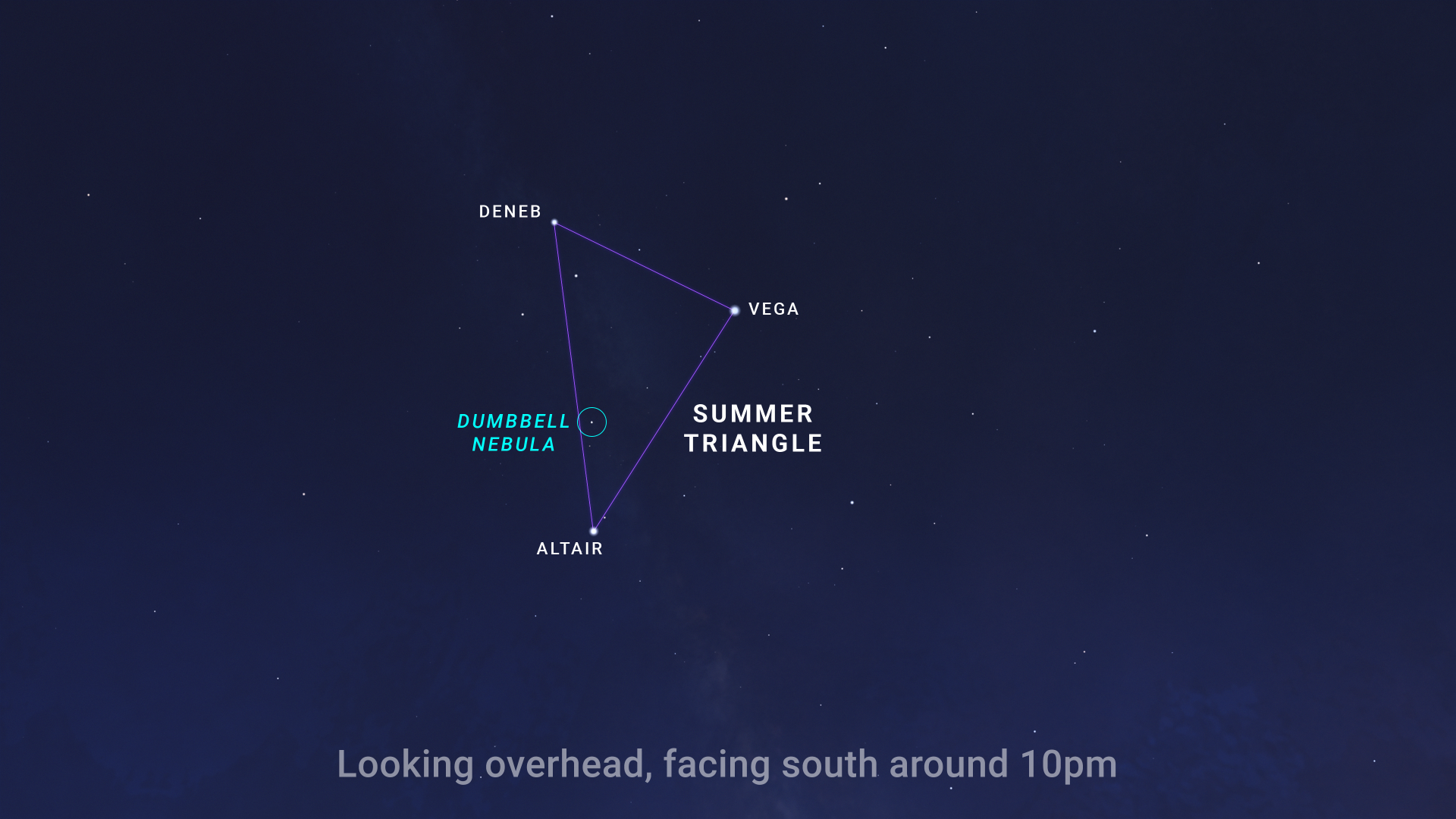
    The Dumbbell Nebula, nicknamed for its dumbbell-like shape, appears as a small, faint patch of light about a quarter of the width of the full moon in binoculars or a small telescope. It lies within the Summer Triangle, a pattern of stars that’s easy to find overhead in the August sky. You’ll find the nebula about a third of the way between its bright stars Altair and Deneb.

    An illustrated sky chart shows a dark, nighttime sky with stars scattered as points of light. Three bright stars are labeled and form a triangle shape: Vega, Deneb, and Altair. A circle between Deneb and Altair indicates the location of the Dumbbell Nebula.
    Sky chart showing the Summer Triangle asterism, with the location of the Dumbbell Nebula (M27) indicated.
    NASA/JPL-Caltech

    Here’s hoping you get a chance to observe this glimpse into the future that awaits our Sun about 5 billion years from now. It’s part of a cycle that seeds the galaxy with the ingredients for new generations of stars and planets — perhaps even some not too different from our own.

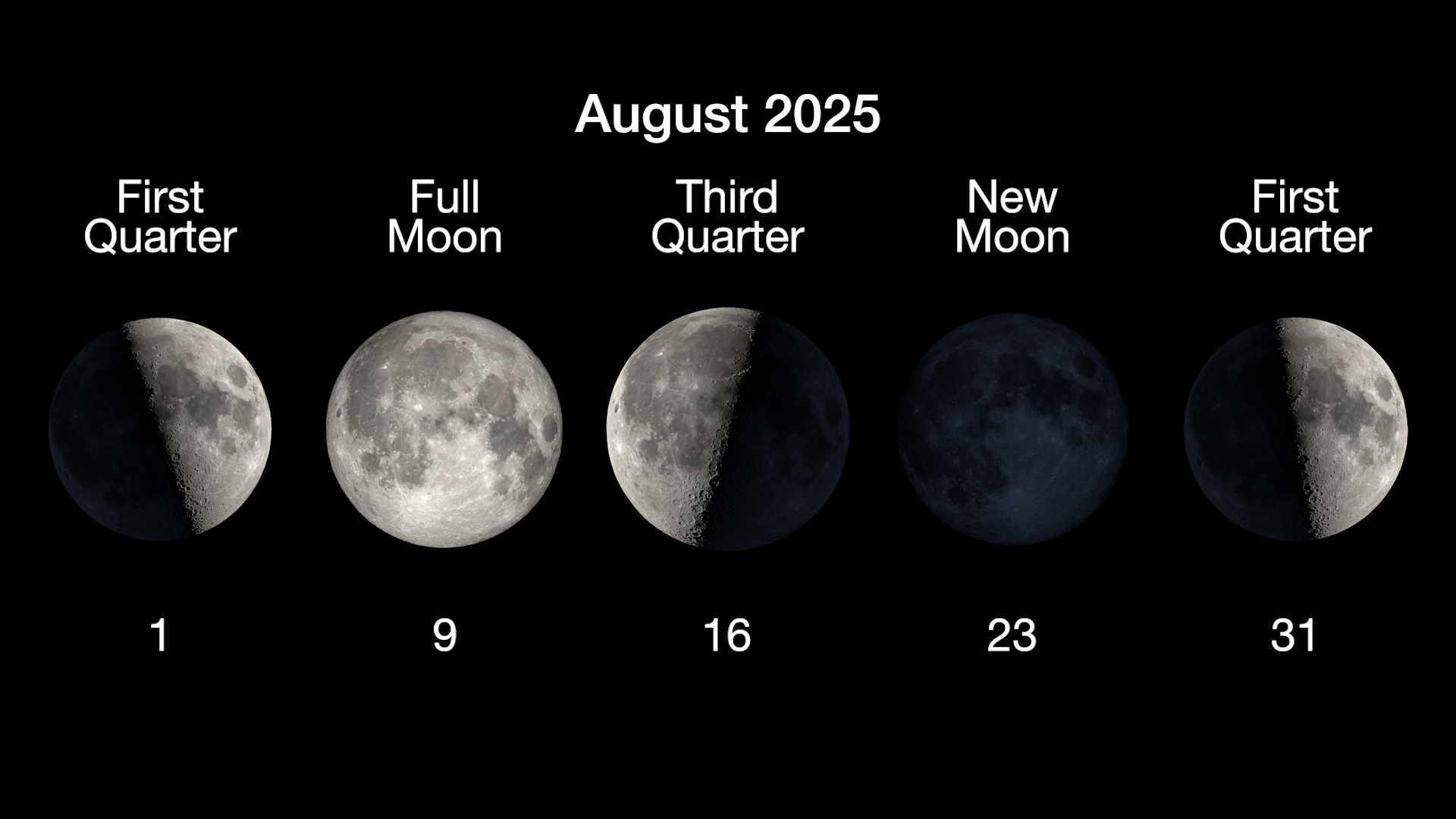
    Here are the phases of the Moon for August.

    The main phases of the Moon are illustrated in a horizontal row, with the first quarter moon on August 1, full moon on August 9, third quarter on August 16, new moon on August 23, and a second first quarter moon on August 31.
    The phases of the Moon for August 2025.
    NASA/JPL-Caltech

    You can stay up to date on all of NASA’s missions exploring the solar system and beyond at science.nasa.gov. I’m Chelsea Gohd from NASA’s Jet Propulsion Laboratory, and that’s What’s Up for this month.

  • NASA’s SpaceX Crew-11 Launches to International Space Station

    A SpaceX Falcon 9 rocket carrying the company’s Dragon spacecraft is launched on NASA’s SpaceX Crew-11 mission to the International Space Station with NASA astronauts Zena Cardman, Mike Fincke, JAXA (Japan Aerospace Exploration Agency) astronaut Kimiya Yui, and Roscosmos cosmonaut Oleg Platonov onboard, Friday, Aug. 1, 2025, from NASA’s Kennedy Space Center in Florida. NASA’s SpaceX Crew-11 mission is the eleventh crew rotation mission of the SpaceX Dragon spacecraft and Falcon 9 rocket to the International Space Station as part of the agency’s Commercial Crew Program. Cardman, Fincke, Yui, Platonov launched at 11:43 a.m. EDT from Launch Complex 39A at the NASA’s Kennedy Space Center to begin a six month mission aboard the orbital outpost.
    Credit: NASA/Aubrey Gemignani

    Four crew members of NASA’s SpaceX Crew-11 mission launched at 11:43 a.m. EDT Friday from Launch Complex 39A at the agency’s Kennedy Space Center in Florida for a science expedition aboard the International Space Station.

    A SpaceX Falcon 9 rocket propelled the Dragon spacecraft into orbit carrying NASA astronauts Zena Cardman and Mike Fincke, JAXA (Japan Aerospace Exploration Agency) astronaut Kimiya Yui, and Roscosmos cosmonaut Oleg Platonov. The spacecraft will dock autonomously to the space-facing port of the station’s Harmony module at approximately 3 a.m. on Saturday, Aug. 2.

    “Thanks to the bold leadership of President Donald J. Trump, NASA is back! The agency’s SpaceX Crew-11 mission to the space station is the first step toward our permanent presence on the Moon. NASA, in conjunction with great American companies, continues the mission with Artemis in 2026. This Moon mission will ensure America wins the space race – critical to national security – and leads in the emerging, exciting and highly profitable private sector commercial space business,” said acting NASA Administrator Sean Duffy. “The Commercial Crew Program and Artemis missions prove what American ingenuity, and cutting-edge American manufacturing can achieve. We’re going to the Moon…to stay! After that, we go to Mars! Welcome to the Golden Age of exploration!”

    During Dragon’s flight, SpaceX will monitor a series of automatic spacecraft maneuvers from its mission control center in Hawthorne, California. NASA will monitor space station operations throughout the flight from the Mission Control Center at the agency’s Johnson Space Center in Houston.

    NASA’s live coverage resumes at 1 a.m., Aug. 2, on NASA+ with rendezvous, docking, and hatch opening. After docking, the crew will change out of their spacesuits and prepare cargo for offload before opening the hatch between Dragon and the space station’s Harmony module around 4:45 a.m. Once the new crew is aboard the orbital outpost, NASA will provide coverage of the welcome ceremony beginning at approximately 5:45 a.m.

    Learn how to watch NASA content through a variety of platforms, including social media.

    The number of crew aboard the space station will increase to 11 for a short time as Crew-11 joins NASA astronauts Anne McClain, Nichole Ayers, and Jonny Kim, JAXA astronaut Takuya Onishi, and Roscosmos cosmonauts Kirill Peskov, Sergey Ryzhikov, and Alexey Zubritsky.

    NASA’s SpaceX Crew-10 will depart the space station after the arrival of Crew-11 and a handover period. Ahead of Crew-10’s return, mission teams will review weather conditions at the splashdown sites off the coast of California prior to departure from station.

    During their mission, Crew-11 will conduct scientific research to prepare for human exploration beyond low Earth orbit and benefit humanity on Earth. Participating crew members will simulate lunar landings, test strategies to safeguard vision, and advance other human spaceflight studies led by NASA’s Human Research Program. The crew also will study plant cell division and microgravity’s effects on bacteria-killing viruses, as well as perform experiments to produce a higher volume of human stem cells and generate on-demand nutrients.

    The mission is part of NASA’s Commercial Crew Program, which provides reliable access to space, maximizing the use of the station for research and development and supporting future missions beyond low Earth orbit by partnering with private companies to transport astronauts to and from the space station.
    Learn more about the agency’s Commercial Crew Program at:

    https://www.nasa.gov/commercialcrew

    -end-

    Josh Finch / Claire O’Shea
    Headquarters, Washington
    202-358-1100
    joshua.a.finch@nasa.gov / claire.a.o’shea@nasa.gov

    Steven Siceloff
    Kennedy Space Center, Florida
    321-867-2468
    steven.p.siceloff@nasa.gov

    Sandra Jones
    Johnson Space Center, Houston
    281-483-5111
    sandra.p.jones@nasa.gov

  • How Joint NASA-ESA Sea Level Mission Will Help Hurricane Forecasts

    6 min read

    Preparations for Next Moonwalk Simulations Underway (and Underwater)

    Hurricane Elena
    Sea surface height can tell meteorologists a lot about extreme storms like hurricanes, including whether they will intensify within a day. This kind of information can help communities better prepare if a hurricane is headed their way. Hurricane Elena is seen here from the space shuttle Discovery in 1985.
    NASA

    Sentinel-6B will measure sea surface height for nearly all of the world’s ocean, providing important data for information products, including weather and hurricane forecasts.

    NASA has a long record of monitoring Earth’s sea surface height, information critical not only for tracking how the ocean changes over time but also for hurricane forecasting. These extreme storms can cost the United States billions of dollars each year, wreaking havoc on lives and property. Meteorologists have worked to improve forecasts for a hurricane’s path, or track, as well as its intensity, measured as surface wind speed. Sentinel-6B, the U.S.-European satellite launching later this year, will help in that effort.

    The satellite is the second of two spacecraft that constitute the Sentinel-6/Jason-CS (Continuity of Service) mission, a collaboration between NASA, ESA (European Space Agency), EUMETSAT (the European Organisation for the Exploitation of Meteorological Satellites), and the U.S. National Oceanic and Atmospheric Administration (NOAA). With its launch planned for no earlier than Nov. 16, 2025, Sentinel-6B will take over from its twin, Sentinel-6 Michael Freilich, which launched in November 2020 as part of a long line of U.S.-European missions that have monitored sea levels since 1992.

    “Sentinel-6 will track global changes in Earth’s ocean — height, heat, and movement — and will improve forecasts of local extremes like floods and hurricanes, linking planetary trends to real-world risks for communities,” said Nadya Vinogradova Shiffer, Sentinel-6 program scientist at NASA Headquarters in Washington.


    before
    after

    Hurricane Milton

    Hurricane Milton

    Hurricane Milton
    Hurricane Milton

    before

    after

    Before and After

    Hurricane Milton


    These illustrations show ocean heat on Oct. 7, 2024, left, and Oct. 9, right, as Hurricane Milton passed over very warm seawater and rapidly grew. Red and yellow indicate more heat; blue and green are cooler. A satellite image of the hurricane shows the storm’s position as it moves toward Florida’s west coast. Credit: NOAA

    The decades-long, U.S.-European ocean dataset has been key to helping researchers advance hurricane intensity forecasting. Warm water fuels hurricanes. And since water expands as it warms, sea surface height can tell researchers which regions of the ocean are warm enough to supercharge a hurricane.

    “A deep layer of warm seawater is literally taller than a shallow layer of warm water,” said Josh Willis, Sentinel-6B project scientist at NASA’s Jet Propulsion Laboratory in Southern California. So sea surface height can be used as a proxy for the amount of heat in the ocean.

    Fueling Hurricanes

    There are two main ways that forecasters use sea level measurements, said Mark DeMaria, a senior research scientist at Colorado State University in Fort Collins. One way is to help set the proper ocean conditions in ocean-atmosphere hurricane forecast models utilized by the National Hurricane Center.

    The second way is by feeding sea level data into machine learning models that forecasters use to predict whether a hurricane will undergo rapid intensification, where its wind speeds increase by 35 mph (56 kph) or more within 24 hours. Meteorologists include both water temperature measurements from sensors drifting in the ocean and sea surface height data collected by Sentinel-6 Michael Freilich as well as other satellites.

    Hurricanes churn the ocean as they pass overhead, mixing the top layers of seawater. If the storm encounters a shallow pool of warm seawater, its winds can stir things up, pulling cooler waters from the depths to the surface. This can hinder rapid intensification. But if the warm pool of seawater extends deep into the ocean, those winds will only stir up more warm water, potentially resulting in the hurricane’s rapid intensification.

    “Hurricane Milton is a perfect example of this,” said DeMaria, who was previously a branch chief at the National Hurricane Center in Miami and helped to develop hurricane intensity forecast models. Milton experienced an intense period of rapid intensification — an event that was forecast using a model fed partly with data from Sentinel-6 Michael Freilich. From Oct. 6 to Oct. 7, 2024, Milton exploded from a Category 1 hurricane to a Category 5, producing wind speeds as high as 180 mph (289 kph). The storm weakened to a Category 3 — still a major hurricane — by the time it made landfall near Sarasota, Florida, on Oct. 9.

    Forecast Improvements

    While the U.S.-European series of sea level satellites began collecting measurements in 1992, it wasn’t until the early 2000s that meteorologists started working with data from satellites in operational hurricane intensity forecasts such as the ones used by the National Hurricane Center. Before then, forecasts relied on models and ocean surface temperature measurements that weren’t always able to identify warm, deep pools of seawater that could induce rapid intensification in a hurricane.

    Improvement efforts got a boost when the U.S. federal government started a program in 2007 aimed at advancing these types of forecasts. Since then, the program has helped move improvements made in the research realm — such as in hurricane forecast reliability and accuracy, extensions in the lead time for predictions, and reduced forecast uncertainty — into operational use.

    The investment has been money well spent, said Renato Molina, an economist at the University of Miami who has analyzed the economic impact of improving hurricane forecasts. An accurate, timely forecast can give communities time to prepare, such as by boarding up homes and businesses or evacuating an area. The monetary savings can reach into the billions, he added.

    While a host of atmospheric and oceanic characteristics go into hurricane forecasts, the inclusion of sea level data from satellites like Sentinel-6 Michael Freilich and, soon, Sentinel-6B has been an important addition. “We need data from sensors in the ocean as well as satellite data — they go hand-in-hand,” said DeMaria. “It would be impossible to do what we do without the satellites.”

    More About Sentinel-6B

    Sentinel-6/Jason-CS was jointly developed by ESA, EUMETSAT, NASA, and NOAA, with funding support from the European Commission and technical support from France’s space agency CNES (Centre National d’Études Spatiales).

    NASA JPL, a division of Caltech in Pasadena, contributed three science instruments for each Sentinel-6 satellite: the Advanced Microwave Radiometer, the Global Navigation Satellite System – Radio Occultation, and the Laser Retroreflector Array. NASA is also contributing launch services, ground systems supporting operation of the NASA science instruments, the science data processors for two of these instruments, and support for the U.S. members of the international Ocean Surface Topography Science Team.

    For more about Sentinel-6/Jason-CS, visit:

    https://sealevel.jpl.nasa.gov/missions/jason-cs-sentinel-6

    News Media Contacts

    Jane J. Lee / Andrew Wang
    Jet Propulsion Laboratory, Pasadena, Calif.
    626-491-1943 / 626-379-6874
    jane.j.lee@jpl.nasa.gov / andrew.wang@jpl.nasa.gov

    2025-096

  • Hubble Surveys Supernova-Rich Spiral

    2 min read

    Hubble Surveys Supernova-Rich Spiral

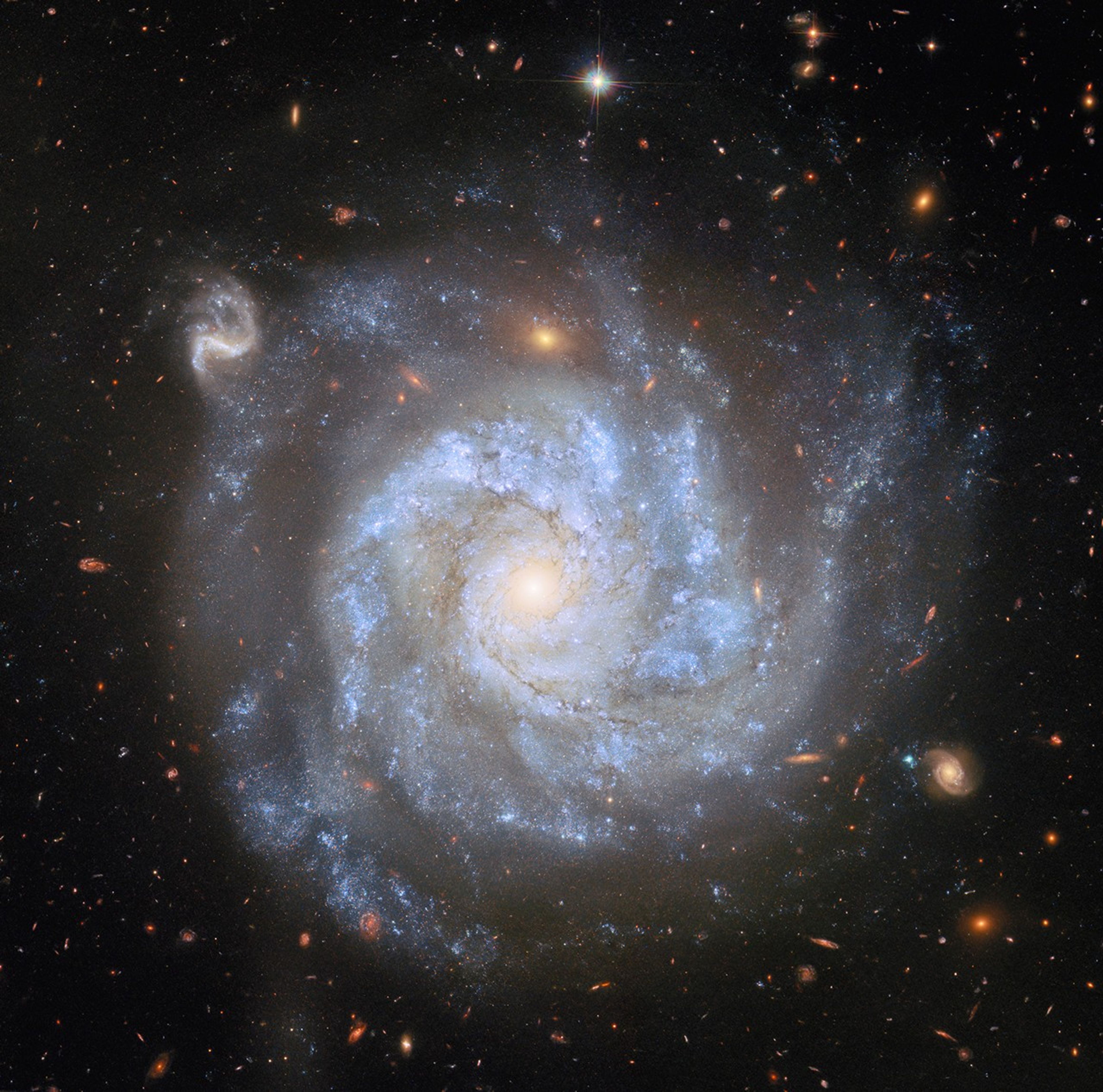
    A top-down view of a spiral galaxy, showing its brightly-shining center, its broad spiral arms, and the faint halo around its disk, as well as distant galaxies and stars on a dark background. Large blue clouds of gas speckled with small stars and strands of dark dust swirl around the galaxy’s disk. A couple of the background galaxies are large enough that their own swirling spiral arms are visible.
    This NASA/ESA Hubble Space Telescope image features the face-on spiral galaxy NGC 1309.
    ESA/Hubble & NASA, L. Galbany, S. Jha, K. Noll, A. Riess

    Rich with detail, the spiral galaxy NGC 1309 shines in this NASA/ESA Hubble Space Telescope image. NGC 1309 is about 100 million light-years away in the constellation Eridanus.

    This stunning Hubble image encompasses NGC 1309’s bluish stars, dark brown gas clouds, and pearly-white core, as well as hundreds of distant background galaxies. Nearly every smudge, streak, and blob of light in this image is an individual galaxy, some shining through less dense regions of NGC 1309 itself. The only exception to this extragalactic ensemble is a star near the top of the frame identified by its diffraction spikes. The star is positively neighborly at just a few thousand light-years away in the Milky Way galaxy.

    Hubble turned its attention toward NGC 1309 several times; previous Hubble images of this galaxy were released in 2006 and 2014. Much of NGC 1309’s scientific interest derives from two supernovae, SN 2002fk in 2002 and SN 2012Z in 2012. SN 2002fk was a perfect example of a Type Ia supernova, which happens when the stripped-down core of a dead star (a white dwarf) explodes.

    SN 2012Z, on the other hand, was a bit of a renegade. It was classified as a Type Iax supernova: while its spectrum resembled that of a Type Ia supernova, the explosion wasn’t as bright as expected. Hubble observations showed that in this case, the supernova did not destroy the white dwarf completely, leaving behind a ‘zombie star’ that shone even brighter than it did before the explosion. Hubble observations of NGC 1309 taken across several years also made this the first time astronomers spotted a star system that later produced an unusual supernova explosion of a white dwarf.

    Text Credit: ESA/Hubble

    Media Contact:

    Claire Andreoli (claire.andreoli@nasa.gov)
    NASA’s Goddard Space Flight CenterGreenbelt, MD

  • Sunrise on Crew-11 Launch Attempt

    In the distance, the Sun rises, casting an orange glow over the surrounding sky. It is also reflected in the water below it, where it looks like a column of orange light. The outlines of several structures are visible in the middle ground. At the top of the photo are white clouds that look like streaks of paint. At the bottom of the photo, those clouds are partially reflected in the water (at right) and some foliage peeks in (at left).
    NASA/Cory S. Huston

    The Sun rises on the morning of July 31, 2025, ahead of NASA’s SpaceX Crew-11 mission launch from NASA’s Kennedy Space Center in Florida. The launch was postponed due to an unfavorable weather forecast. Teams are now targeting 11:43 a.m. EDT Friday, Aug. 1.

    NASA astronauts Zena Cardman and Mike Fincke, JAXA (Japan Aerospace Exploration Agency) astronaut Kimiya Yui, and Roscosmos cosmonaut Oleg Platonov will launch to the International Space Station, where they will perform research, technology demonstrations, and maintenance activities.

    Image credit: NASA/Cory S. Huston

  • Sunrise on Crew-11 Launch Attempt

    Sunrise on Crew-11 Launch Attempt

    A NASA photographer captured the sunrise on July 31, 2025, ahead of NASA’s SpaceX Crew-11 launch attempt. The Crew-11 mission will send NASA astronauts Zena Cardman and Mike Fincke, along with JAXA (Japan Aerospace Exploration Agency) astronaut Kimiya Yui and Roscosmos cosmonaut Oleg Platonov, to the International Space Station aboard SpaceX’s Dragon spacecraft and Falcon 9.

  • NASA Installs Key ‘Sunblock’ Shield on Roman Space Telescope

    Technicians have successfully installed two sunshields onto NASA’s Nancy Grace Roman Space Telescope’s inner segment. Along with the observatory’s Solar Array Sun Shield and Deployable Aperture Cover, the panels (together called the Lower Instrument Sun Shade), will play a critical role in keeping Roman’s instruments cool and stable as the mission explores the infrared universe.

    This video shows technicians installing two sunshields onto NASA’s nearly complete Nancy Grace Roman Space Telescope on July 17. The large yet lightweight panels will block sunlight, keeping Roman’s instruments cool and stable as the mission explores the infrared universe.
    Credit: NASA/Sophia Roberts

    The team is on track to join Roman’s outer and inner assemblies this fall to complete the full observatory, which can then undergo further prelaunch testing.

    “This shield is like an extremely strong sunblock for Roman’s sensitive instruments, protecting them from heat and light from the Sun that would otherwise overwhelm our ability to detect faint signals from space,” said Matthew Stephens, an aerospace engineer at NASA’s Goddard Space Flight Center in Greenbelt, Maryland.

    The sunshade, which was designed and engineered at NASA Goddard, is essentially an extension of Roman’s solar panels, except without solar cells. Each sunshade flap is roughly the size of a garage door — about 7 by 7 feet (2.1 by 2.1 meters) — and 3 inches (7.6 centimeters) thick.

    “They’re basically giant aluminum sandwiches, with metal sheets as thin as a credit card on the top and bottom and the central portion made up of a honeycomb structure,” said Conrad Mason, an aerospace engineer at NASA Goddard.

    This design makes the panels lightweight yet stiff, and the material helps limit heat transfer from the side facing the Sun to the back—no small feat considering the front will be hot enough to boil water (up to 216 degrees Fahrenheit, or 102 degrees Celsius) while the back will be much colder than Antarctica’s harshest winter (minus 211 Fahrenheit, or minus 135 Celsius). A specialized polymer film blanket will wrap around each panel to temper the heat, with 17 layers on the Sun side and one on the shaded side.

    The sunshade will be stowed and gently deploy around an hour after launch.

    In this time-lapse video, technicians manually deploy the Lower Instrument Sun Shield for NASA’s Nancy Grace Roman Space Telescope. The test helps verify the panels will operate as designed in space.
    NASA/Sophia Roberts

    “The deploying mechanisms have dampers that work like soft-close hinges for drawers or cabinets, so the panels won’t slam open and rattle the observatory,” Stephens said. “They each take about two minutes to move into their final positions. This is the very first system that Roman will deploy in space after the spacecraft separates from the launch vehicle.”

    Now completely assembled, Roman’s inner segment is slated to undergo a 70-day thermal vacuum test next. Engineers and scientists will test the full functionality of the spacecraft, telescope, and instruments under simulated space conditions. Following the test, the sunshade will be temporarily removed while the team joins Roman’s outer and inner assemblies, and then reattached to complete the observatory. The mission remains on track for launch no later than May 2027 with the team aiming for as early as fall 2026.

    Download high-resolution video and images from NASA’s Scientific Visualization Studio

    The Nancy Grace Roman Space Telescope is managed at NASA’s Goddard Space Flight Center in Greenbelt, Maryland, with participation by NASA’s Jet Propulsion Laboratory in Southern California; Caltech/IPAC in Pasadena, California; the Space Telescope Science Institute in Baltimore; and a science team comprising scientists from various research institutions. The primary industrial partners are BAE Systems Inc. in Boulder, Colorado; L3Harris Technologies in Rochester, New York; and Teledyne Scientific & Imaging in Thousand Oaks, California.

    By Ashley Balzer
    NASA’s Goddard Space Flight Center, Greenbelt, Md.

    Details

    Last Updated

    Jul 31, 2025

    Editor
    Ashley Balzer
    Contact
    Ashley Balzer
    Location
    Goddard Space Flight Center

  • NASA Invites Proposals to Lease Aircraft Hangar in Cleveland

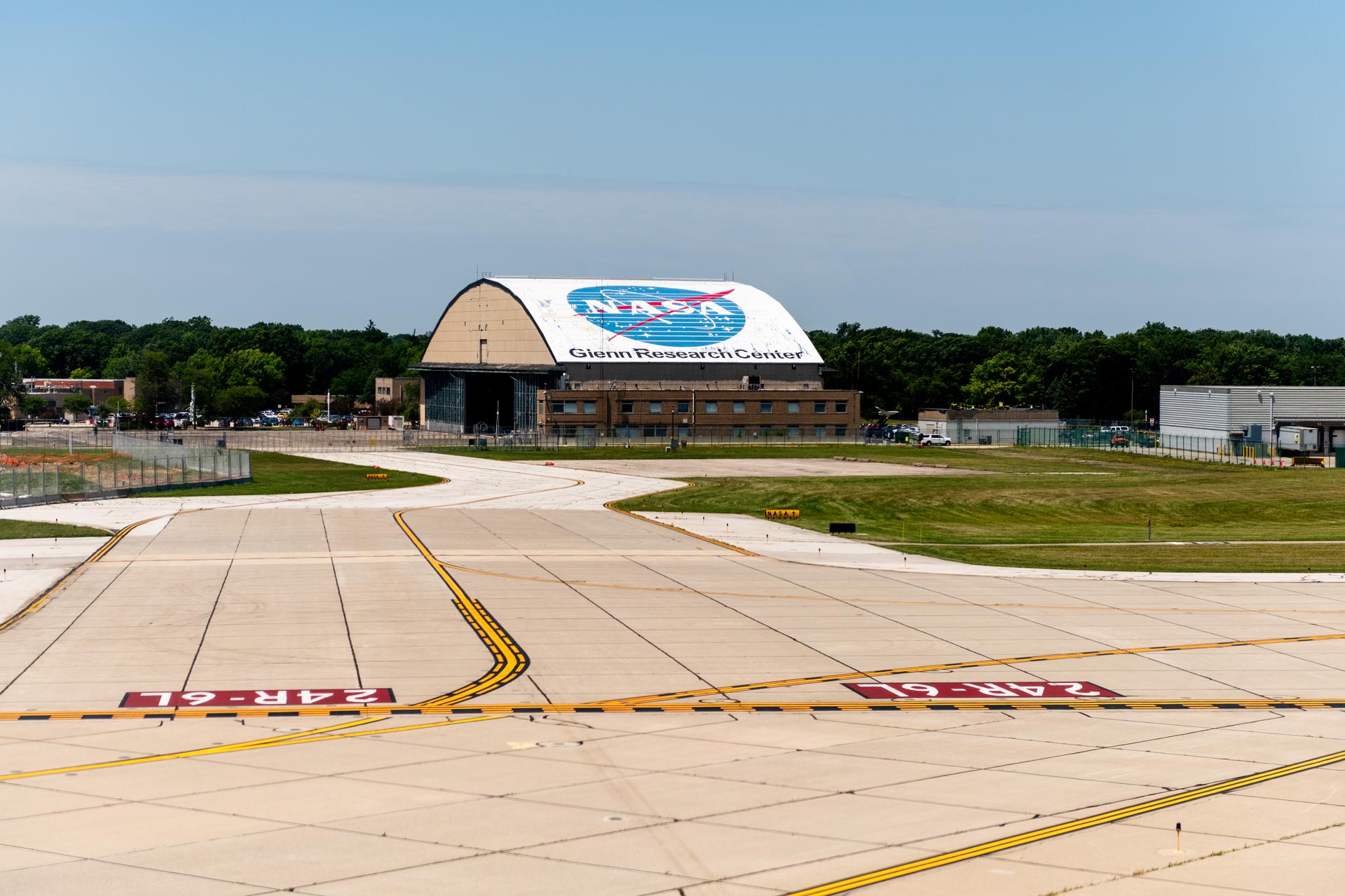
    The large blue, red, and white NASA “meatball” logo appears prominently on the roof of the NASA Glenn aircraft hangar under a clear blue sky. Cleveland Hopkins International Airport runway 24R-6L is in the foreground, and a lush green tree line shows in the background.
    View of the NASA Glenn Research Center hangar from the Cleveland Hopkins International Airport runway during a testing flight on Thursday, June 13, 2024. The Operations and Integration Building sits to the hangar’s right.
    Credit: NASA/Sara Lowthian Hanna

    NASA’s Glenn Research Center in Cleveland is seeking proposals for the use of its historic aircraft hangar, along with a parking lot, tarmac, and a small neighboring office building. Proposals are due by 1 p.m. EDT on Nov. 28.  

    The hangar, formally known as the Flight Research Building, is available for lease by signing a National Historic Preservation Act agreement for a 10-year base period and two optional five-year extensions.

    NASA first announced plans to lease the Flight Research Building and other facilities in May 2024 under the government’s Enhanced Use Lease authority. These lease agreements allow space, aeronautics, and other related industries to use agency land and facilities, reducing NASA’s maintenance costs while fostering strategic partnerships that spur innovation.

    “Glenn is making great progress as we modernize our Cleveland and Sandusky campuses to support NASA’s future missions,” said Dr. Jimmy Kenyon, Glenn’s center director. “Through Enhanced Use Leases, we’re ensuring full use of land and facilities while preserving an iconic, historic building and creating regional economic opportunities.”

    The property available for lease includes up to 6.7 acres of land, which contains the heated aircraft hangar, Operations and Integration Building, parking lot, and tarmac. The hangar is 160 feet by 280 feet, and the Operations and Integration Building is 5,947 square feet. Proceeds from this lease will be used to maintain Glenn facilities and infrastructure. 

    Visible from Brookpark Road and Cleveland Hopkins International Airport, Glenn’s hangar was the first building completed after the center was established in 1941. It has sheltered many unique aircraft used to perform vital research. From studying ice accumulation on aircraft wings to the first use of laser communications to stream 4K video from an aircraft to the International Space Station, Glenn flight research has contributed to aviation safety, atmospheric studies, and cutting-edge technology development.

    Interested parties should contact both Carlos Flores at carlos.a.flores-1@nasa.gov and Diana Munro at diana.c.munro@nasa.gov to sign up for a walk-through from Monday, Sept. 8, to Friday, Sept. 12, or the week of Oct. 6.  

    For a 360-degree virtual tour of the Flight Research Building, visit:

    https://www3.nasa.gov/specials/hangar360/

    -end-

    Jan Wittry
    Glenn Research Center, Cleveland
    216-433-5466
    jan.m.wittry-1@nasa.gov

    Details

    Last Updated

    Jul 31, 2025

  • NASA Releases Opportunity to Boost Commercial Space Tech Development

    5 min read

    Preparations for Next Moonwalk Simulations Underway (and Underwater)

    NASA meatball logo

    NASA has released a new proposal opportunity for industry to tap into agency know-how, resources, and expertise. The Announcement of Collaboration Opportunity (ACO), managed by the Space Technology Mission Directorate, enables valuable collaboration without financial exchanges between NASA and industry partners. Instead, companies leverage NASA subject matter experts, facilities, software, and hardware to accelerate their technologies and prepare them for future commercial and government use. 

    On Wednesday, NASA issued a standing ACO announcement for partnership proposals which will be available for five years and will serve as the umbrella opportunity for topic-specific appendix releases. NASA intends to issue appendices every six to 12 months to address evolving space technology needs. The 2025 ACO appendix is open for proposals until Sept. 24.  

    NASA will host an informational webinar about the opportunity and appendix at 2 p.m. EDT on Wednesday, Aug. 6. Interested proposers are encouraged to submit questions which will be answered during the webinar and will be available online after the webinar.   

    NASA teaming with industry isn’t new – decades of partnerships have resulted in ambitious missions that benefit all of humanity. But in recent years, NASA has also played a key role as a technology enabler, providing one-of-a-kind tools, resources, and infrastructure to help commercial aerospace companies achieve their goals.  

    Since 2015, NASA has collaborated with industry on approximately 80 ACO projects. Here are some ways the collaborations have advanced space technology: 

    Lunar lander systems 

    Blue Origin and NASA worked together on several ACOs to mature the company’s lunar lander design. NASA provided technical reports and assessments and conducted tests at multiple centers to help Blue Origin advance a stacked fuel cell system for a lander’s primary power source. Other Blue Origin ACO projects evaluated high-temperature engine materials and advanced a landing navigation and guidance system. 

    Blue Origin’s Blue Moon Mark 1 (MK1) lander is delivering NASA science and technology to the Moon through the agency’s Commercial Lunar Payload Services initiative. In 2023, NASA selected Blue Origin as a Human Landing System provider to develop its Blue Moon MK2 lander for future crewed lunar exploration. 

    Artist concept of Blue Origin’s Blue Moon Mark 1 (MK1) lander.
    Blue Origin

    Blue Origin’s Blue Moon Mark 1 (MK1) lander is delivering NASA science and technology to the Moon through the agency’s Commercial Lunar Payload Services initiative. In 2023, NASA selected Blue Origin as a Human Landing System provider to develop its Blue Moon MK2 lander for future crewed lunar exploration. 

    Cryogenic fluid transfer 

    Throughout a year-long ACO, NASA and SpaceX engineers worked together to perform in-depth computational fluid analysis of proposed propellant transfer methods between two SpaceX Starship spacecraft in low-Earth orbit. The SpaceX-specific analysis utilized Starship flight data and data from previous NASA research and development to identify potential risks and help mitigate them during the early stages of commercial development. NASA also provided inputs as SpaceX developed an initial concept of operations for its orbital propellant transfer missions. 

    Artist’s concept of Starship propellant transfer in space with Earth above.
    Artist’s concept of Starship propellant transfer in space.
    SpaceX

    SpaceX used the ACO analyses to inform the design of its Starship Human Landing System, which NASA selected in 2021 to put the first Artemis astronauts on the Moon. 

    Autonomous spacecraft navigation solution 

    Advanced Space and NASA partnered to advance the company’s Cislunar Autonomous Positioning System – software that allows lunar spacecraft to determine their location without relying exclusively on tracking from Earth.  

    Dylan Schmidt, CAPSTONE assembly integration and test lead, installs solar panels onto the CAPSTONE spacecraft at Tyvak Nano-Satellite Systems, Inc., in Irvine, California.
    NASA/Dominic Hart

    The CAPSTONE (Cislunar Autonomous Positioning System Technology Operations and Navigation Experiment) spacecraft launched to the Moon in 2022 and continues to operate and collect critical data to refine the software. Under the ACO, Advanced Space was able to use NASA’s Lunar Reconnaissance Orbiter to conduct crosslink experiments with CAPSTONE, helping mature the navigation solution for future missions. The mission’s Cislunar Autonomous Positioning System technology was initially supported through the NASA Small Business Innovation Research program. 

    Multi-purpose laser sensing system 

    Sensuron and NASA matured a miniature, rugged fiber optic sensing system capable of taking thermal and shape measurements for multiple applications. Throughout the ACO, Sensuron benefitted from NASA’s expertise in fiber optics and electrical, mechanical, and system testing engineering to design, fabricate, and “shake and bake” its prototype laser. 

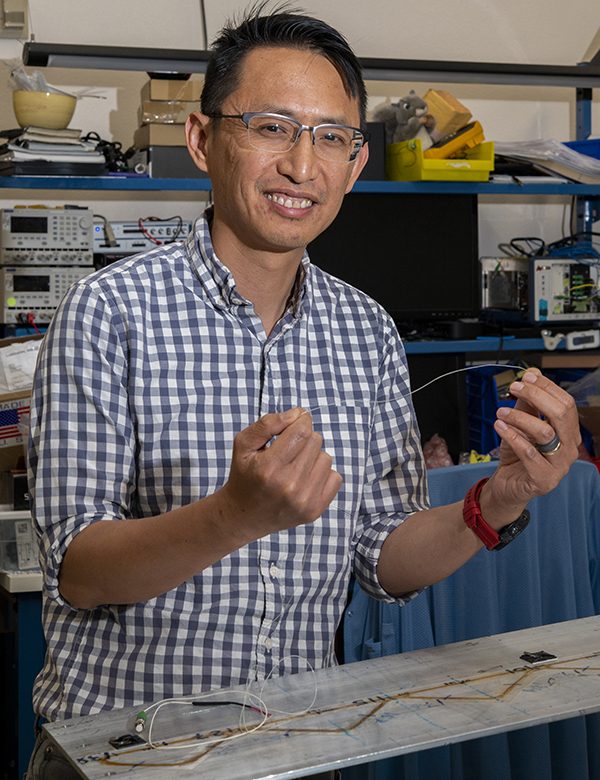
    NASA’s Armstrong Flight Research Center’s FOSS, Fiber Optic Sensing System, recently supported tests of a system designed to turn oxygen into liquid oxygen, a component of rocket fuel. Patrick Chan, electronics engineer, and NASA Armstrong’s FOSS portfolio project manager, shows fiber like that used in the testing.
    NASA/Genaro Vavuris

    Space missions could use the technology to monitor cryogenic propellant levels and determine a fuel tank’s structural integrity throughout an extended mission. The laser technology also has medical applications on Earth, which ultimately resulted in the Sensuron spinoff company, The Shape Sensing Company. 

    Flexible lunar tires 

    In 2023, Venturi Astrolab began work with NASA under an ACO to test its flexible lunar tire design. The company tapped into testing capabilities unique to NASA, including heat transfer to cold lunar soil, traction, and life testing. The data validated the performance of tire prototypes, helping ready the design to support future NASA missions. 

    In 2024, NASA selected three companies, including Venturi Astrolab, to advance capabilities for a lunar terrain vehicle that astronauts could use to travel around the lunar surface, conducting scientific research on the Moon and preparing for human missions to Mars. 

    Artist rendition of the flex venturi wheel
    Venturi Lab designed and developed a durable, robust, and hyper-deformable lunar wheel.
    Venturi Lab

    The Announcement of Collaboration Opportunity (ACO) is one of many ways NASA enables commercial industry to develop, build, own, and eventually operate space systems. To learn more about these technology projects and more, visit: https://techport.nasa.gov/.

  • NASA Tests Epic Solution for Supersonic Parachute Deliveries

    2 min read

    Preparations for Next Moonwalk Simulations Underway (and Underwater)

    NASA/Lori Losey

    The best way to solve a mystery is by gathering evidence and building a case. That’s exactly what NASA researchers are doing with a series of research flights aimed at advancing a sensor for supersonic parachutes. The clues they find could help make these parachutes more reliable and safer for delivering scientific instruments and payloads to Mars.

    These investigative research flights are led by the EPIC (Enhancing Parachutes by Instrumenting the Canopy) team at NASA’s Armstrong Fight Research Center in Edwards, California. During a June flight test, a quadrotor aircraft, or drone, air-launched a capsule that deployed a parachute equipped with a sensor. The flexible, strain-measuring sensor attached to the parachute did not interfere with the canopy material, just as the EPIC team had predicted. The sensors also provided data, a bonus for planning upcoming tests.

    “Reviewing the research flights will help inform our next steps,” said Matt Kearns, project manager for EPIC at NASA Armstrong. “We are speaking with potential partners to come up with a framework to obtain the data that they are interested in pursuing. Our team members are developing methods for temperature testing the flexible sensors, data analysis, and looking into instrumentation for future tests.”

    The flight tests were a first step toward filling gaps in computer models to improve supersonic parachutes. This work could also open the door to future partnerships, including with the aerospace and auto racing industries.

    NASA’s Space Technology Mission Directorate (STMD) funds the EPIC work through its Entry Systems Modeling project at NASA’s Ames Research Center in California’s Silicon Valley. The capsule and parachute system were developed by NASA’s Langley Research Center in Hampton, Virginia. NASA Armstrong interns worked with Langley to build and integrate a similar system for testing at NASA Armstrong. An earlier phase of the work focused on finding commercially available flexible strain sensors and developing a bonding method as part of an STMD Early Career Initiative project.

    One man secures a cannister containing a parachute to a system that will be carried by an Alta X drone, while another man assists.
    NASA researchers Paul Bean, center, and Mark Hagiwara, right, attach the capsule with parachute system to the Enhancing Parachutes by Instrumenting the Canopy test experiment on June 4, 2025, at NASA’s Armstong Flight Research Center in Edwards, California. NASA researchers are developing technology to make supersonic parachutes safer and more reliable for delivering science instruments and payloads to Mars.
    NASA/Christopher LC Clark
    Two men attached a science experiment to a drone for a research flight.
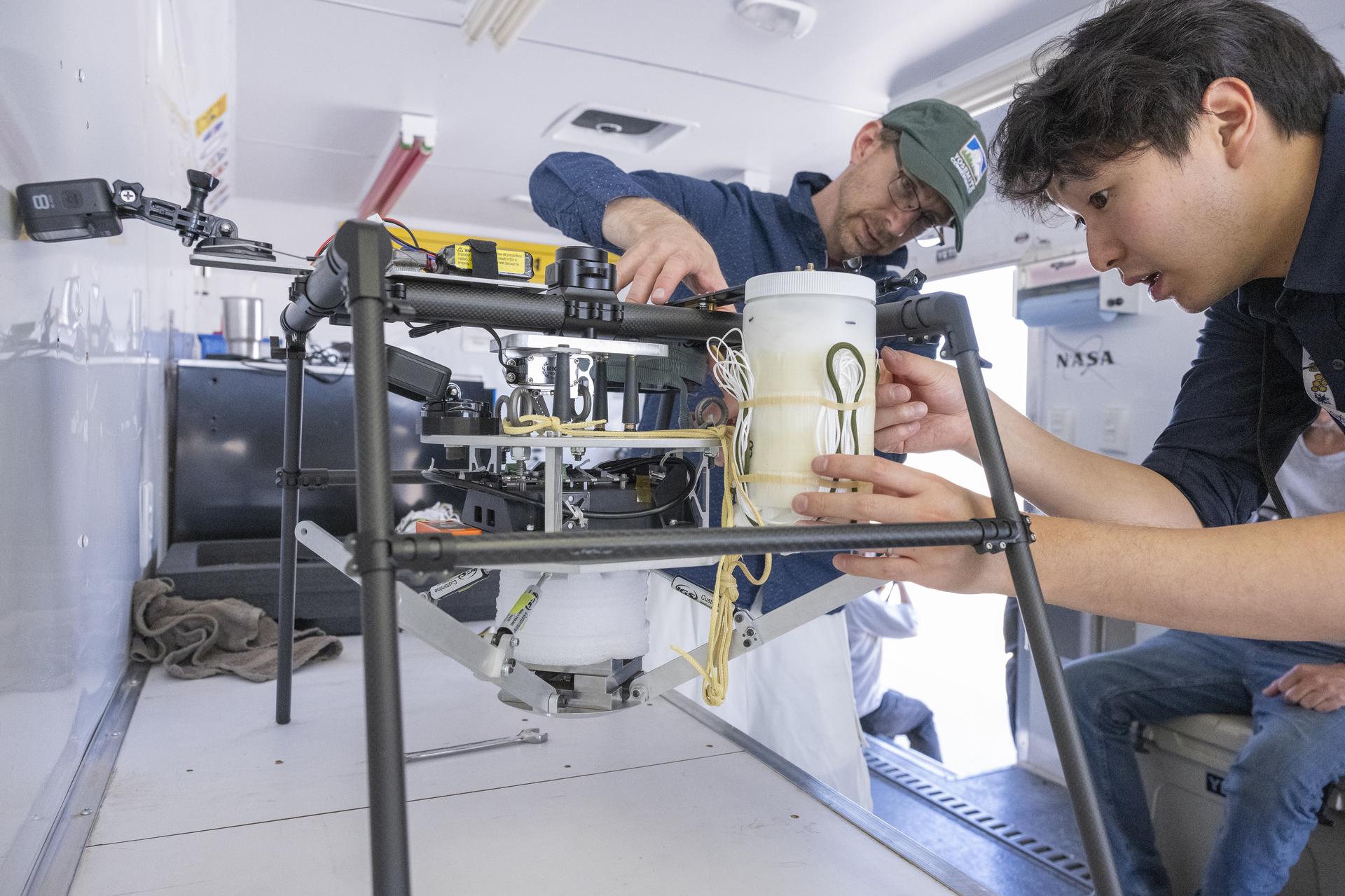
    Derek Abramson, left, and Justin Link, right, attach an Alta X drone to the Enhancing Parachutes by Instrumenting the Canopy test experiment on June 4, 2025, at NASA’s Armstong Flight Research Center in Edwards, California. Abramson is NASA chief engineer at the center’s Dale Reed Subscale Flight Research Laboratory, where Link also works as a pilot for small uncrewed aircraft systems. NASA researchers are developing technology to make supersonic parachutes safer and more reliable for delivering science instruments and payloads to Mars.
    NASA/Christopher LC Clark
    A drone with four rotors hoovers against a canvas of deep blue sky prior to releasing the experiment it carries high above the desert floor.
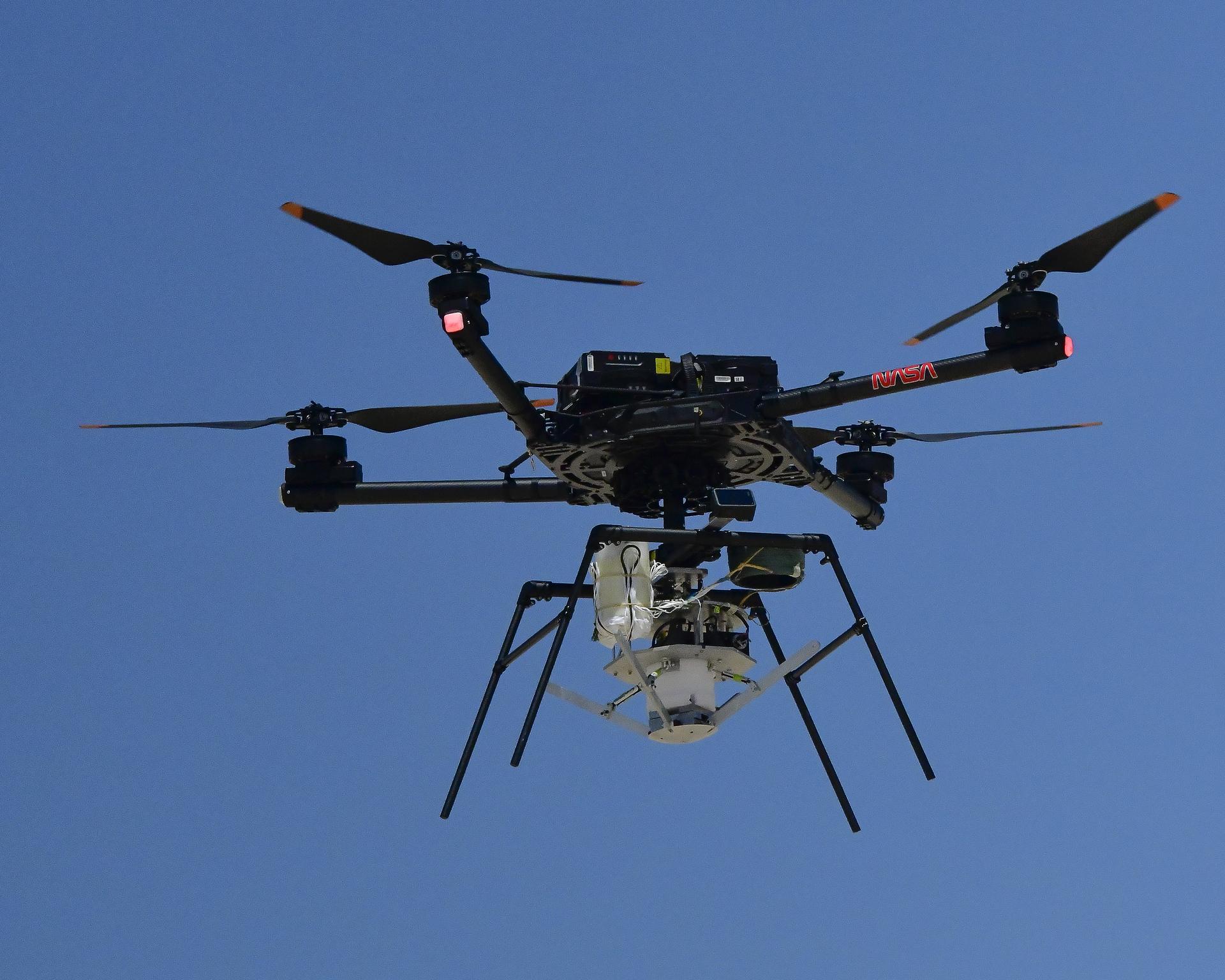
    An Alta X drone is positioned at altitude for an air launch of the Enhancing Parachutes by Instrumenting the Canopy test experiment on June 4, 2025, at NASA’s Armstong Flight Research Center in Edwards, California. NASA researchers are developing technology to make supersonic parachutes safer and more reliable for delivering science instruments and payloads to Mars.
    NASA/Christopher LC Clark
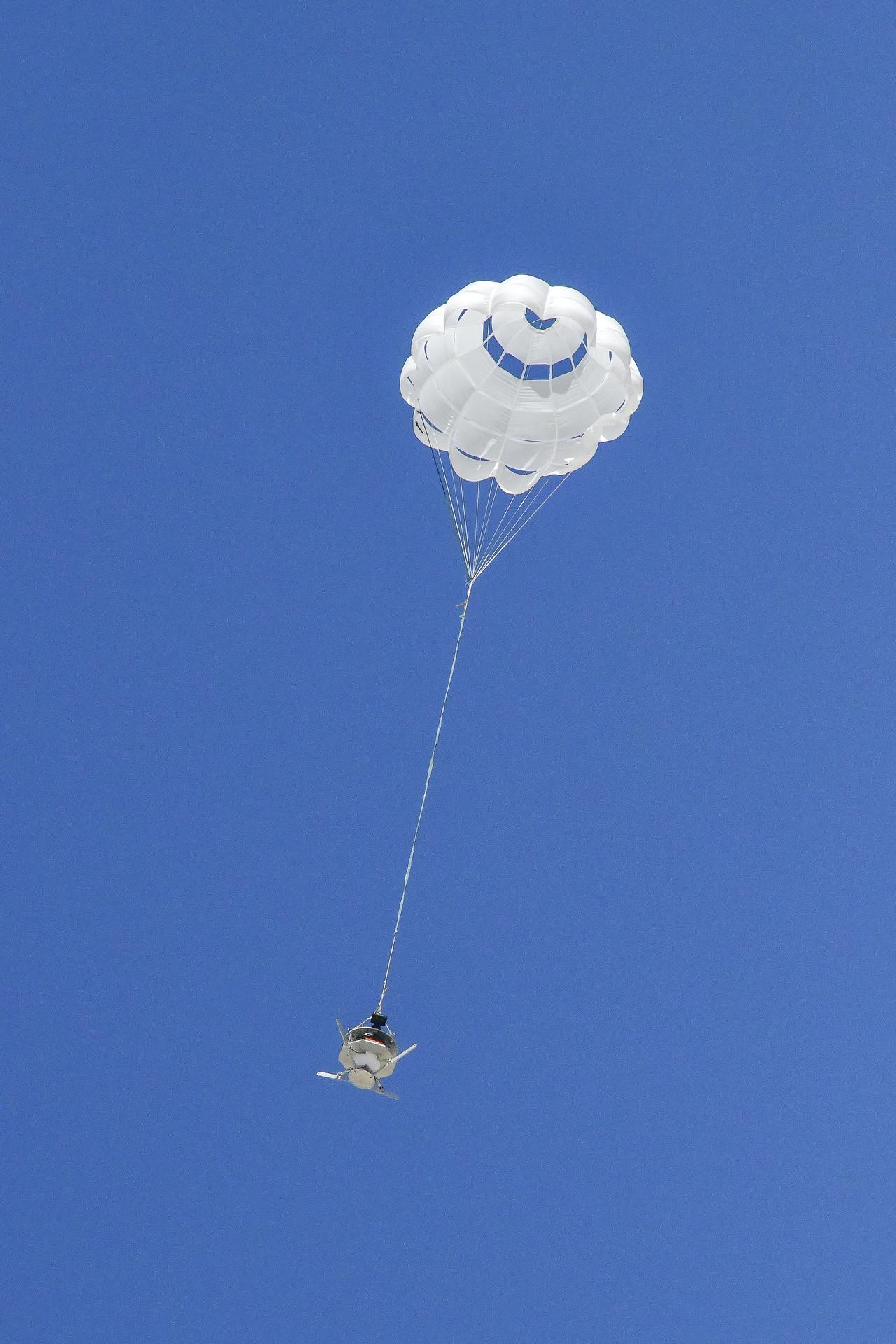
    A parachute carrying a capsule is fully open against a canvas of deep blue sky.
    The parachute of the Enhancing Parachutes by Instrumenting the Canopy test experiment deploys following an air launch from an Alta X drone on June 4, 2025, at NASA’s Armstong Flight Research Center in Edwards, California. NASA researchers are developing technology to make supersonic parachutes safer and more reliable for delivering science instruments and payloads to Mars.
    NASA/Christopher LC Clark
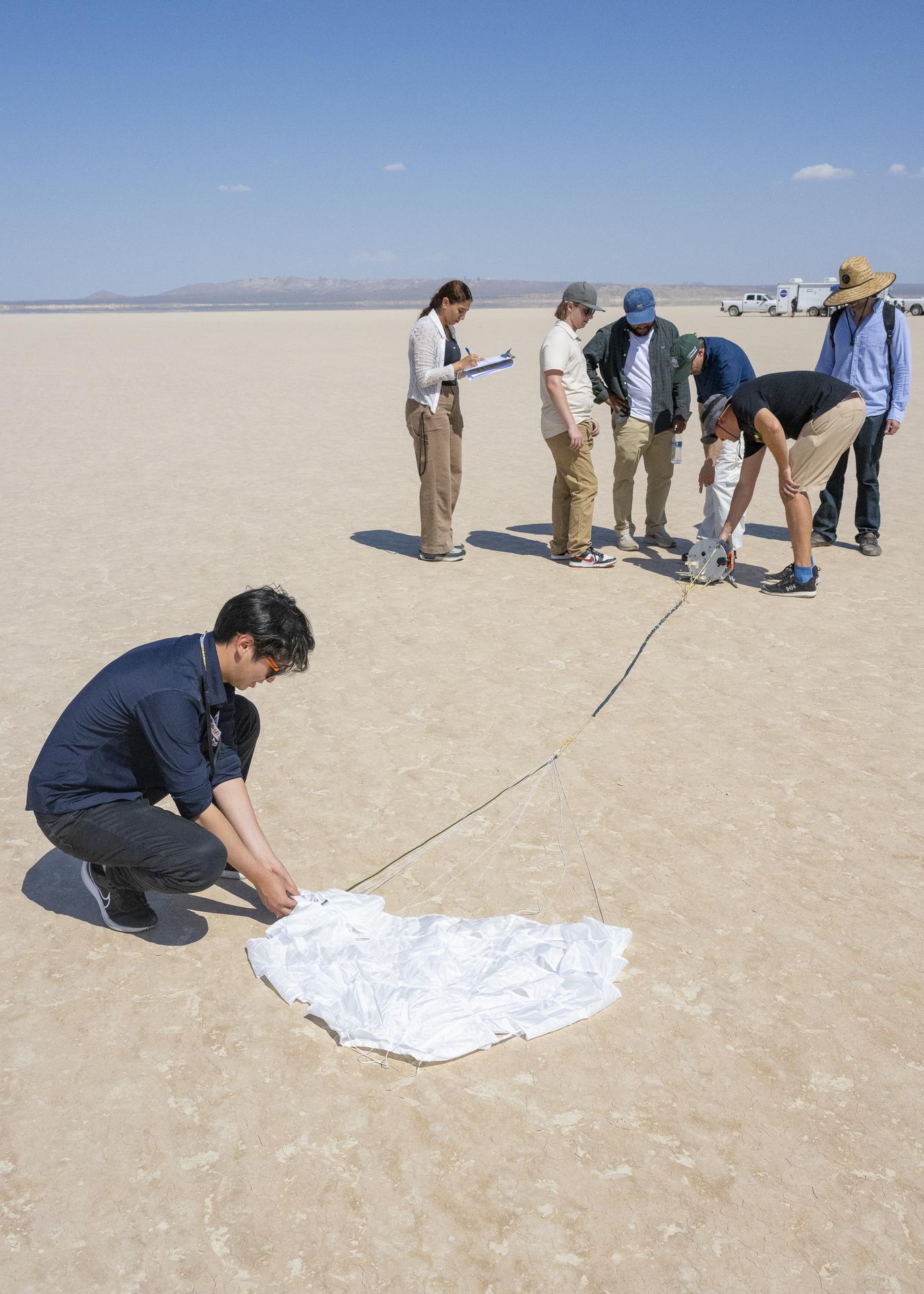
    A group of researchers on a barren dry lake examine a capsule after it was released from a drone and carried by an instrumented parachute.
    The Enhancing Parachutes by Instrumenting the Canopy project team examines a capsule and parachute following an air launch from an Alta X drone on June 4, 2025, at NASA’s Armstong Flight Research Center in Edwards, California. NASA researchers are developing technology to make supersonic parachutes safer and more reliable for delivering science instruments and payloads to Mars.
    NASA/Christopher LC Clark
  • NASA-ISRO Satellite Lifts Off to Track Earth’s Changing Surfaces

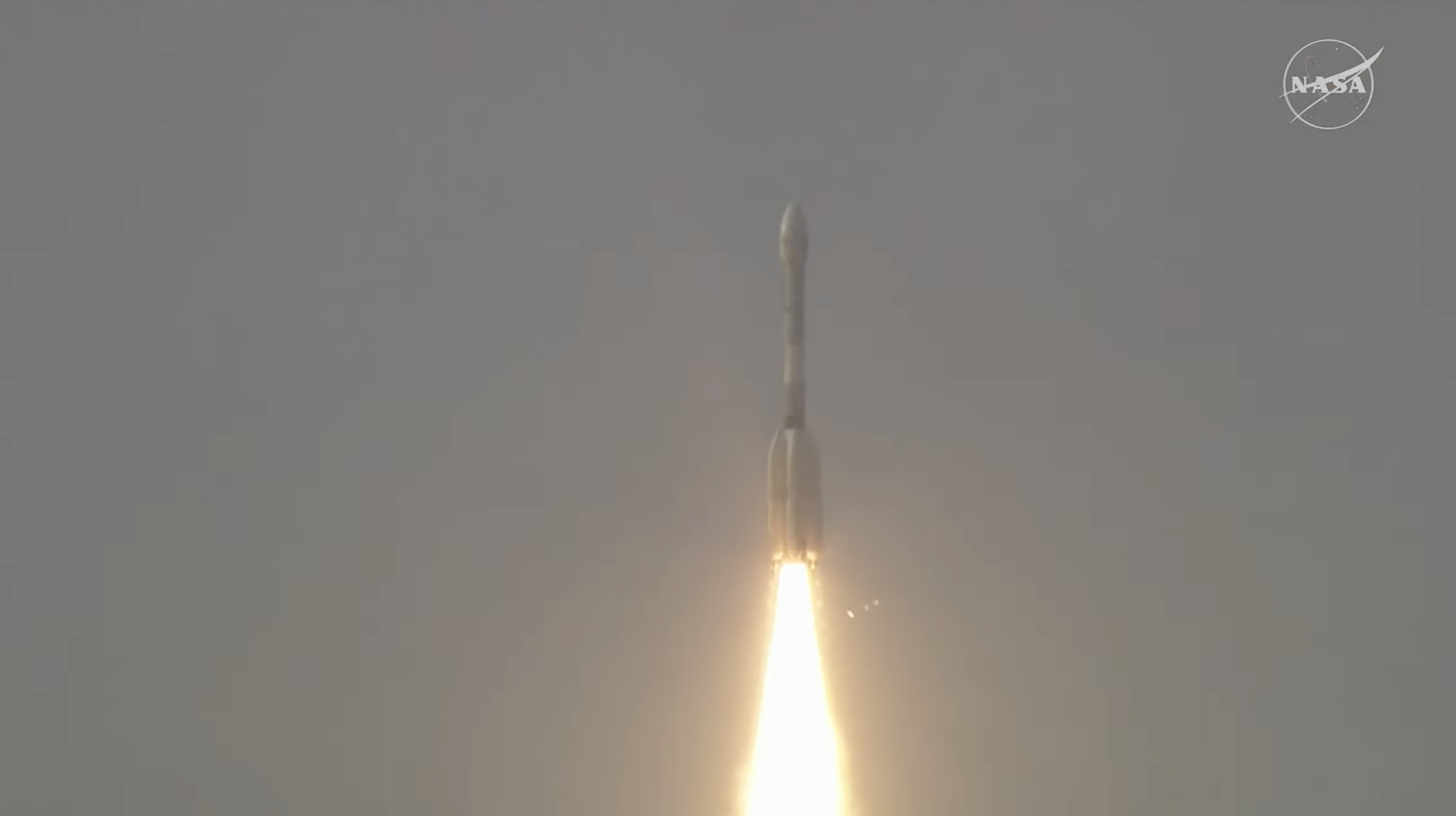
    A large white rocket with a fiery trail launches through a cloudy sky above India.
    The Indian Space Research Organisation’s Geosynchronous Satellite Launch Vehicle lifts off from Satish Dhawan Space Centre on India’s southeastern coast at 5:40 p.m. IST (8:10 a.m. EDT), July 30, 2025.
    Credit: ISRO

    Editor’s Note: This release was edited on July 30, 2025, to correct the mission launch time in the IST time zone.

    Carrying an advanced radar system that will produce a dynamic, three-dimensional view of Earth in unprecedented detail, the NISAR (NASA-ISRO Synthetic Aperture Radar) satellite has launched from Satish Dhawan Space Centre in Sriharikota, Andhra Pradesh, India.

    Jointly developed by NASA and the Indian Space Research Organisation (ISRO), and a critical part of the United States – India civil-space cooperation highlighted by President Trump and Prime Minister Modi earlier this year, the satellite can detect the movement of land and ice surfaces down to the centimeter. The mission will help protect communities by providing unique, actionable information to decision-makers in a diverse range of areas, including disaster response, infrastructure monitoring, and agricultural management. 

    The satellite lifted off aboard an ISRO Geosynchronous Satellite Launch Vehicle (GSLV) rocket at 5:40 p.m. IST (8:10 a.m. EDT), Wednesday. The ISRO ground controllers began communicating with NISAR about 20 minutes after launch, at just after 8:29 a.m. EDT, and confirmed it is operating as expected.

    “Congratulations to the entire NISAR mission team on a successful launch that spanned across multiple time zones and continents in the first-ever partnership between NASA and ISRO on a mission of this sheer magnitude,” said Nicky Fox, associate administrator, Science Mission Directorate at NASA Headquarters in Washington. “Where moments are most critical, NISAR’s data will help ensure the health and safety of those impacted on Earth, as well as the infrastructure that supports them, for the benefit of all.”

    From 464 miles (747 kilometers) above Earth, NISAR will use two advanced radar instruments to track changes in Earth’s forests and wetland ecosystems, monitor deformation and motion of the planet’s frozen surfaces, and detect the movement of Earth’s crust down to fractions of an inch — a key measurement in understanding how the land surface moves before, during, and after earthquakes, volcanic eruptions, and landslides.

    “ISRO’s GSLV has precisely injected NISAR satellite into the intended orbit, 747 kilometers. I am happy to inform that this is GSLV’s first mission to Sun-synchronous polar orbit. With this successful launch, we are at the threshold of fulfilling the immense scientific potential NASA and ISRO envisioned for the NISAR mission more than 10 years ago,” said ISRO Chairman V Narayanan. “The powerful capability of this radar mission will help us study Earth’s dynamic land and ice surfaces in greater detail than ever before.”

    The mission’s two radars will monitor nearly all the planet’s land- and ice-covered surfaces twice every 12 days, including areas of the polar Southern Hemisphere rarely covered by other Earth-observing radar satellites. The data NISAR collects also can help researchers assess how forests, wetlands, agricultural areas, and permafrost change over time.

    “Observations from NISAR will provide new knowledge and tangible benefits for communities both in the U.S. and around the world,” said Karen St. Germain, director, Earth Science division at NASA Headquarters. “This launch marks the beginning of a new way of seeing the surface of our planet so that we can understand and foresee natural disasters and other changes in our Earth system that affect lives and property.”

    The NISAR satellite is the first free-flying space mission to feature two radar instruments — an L-band system and an S-band system. Each system is sensitive to features of different sizes and specializes in detecting certain attributes. The L-band radar excels at measuring soil moisture, forest biomass, and motion of land and ice surfaces, while S-band radar excels at monitoring agriculture, grassland ecosystems, and infrastructure movement.

    Together, the radar instruments will enhance all of the satellite’s observations, making NISAR more capable than previous synthetic aperture radar missions. Unlike optical sensors, NISAR will be able to “see” through clouds, making it possible to monitor the surface during storms, as well as in darkness and light.

    NASA’s Jet Propulsion Laboratory in Southern California provided the L-band radar, and ISRO’s Space Applications Centre in Ahmedabad developed the S-band radar. The NISAR mission marks the first time the two agencies have co-developed hardware for an Earth-observing mission.

    “We’re proud of the international team behind this remarkable satellite. The mission’s measurements will be global but its applications deeply local, as people everywhere will use its data to plan for a resilient future,” said Dave Gallagher, director, NASA JPL, which manages the U.S. portion of the mission for NASA. “At its core is synthetic aperture radar, a technology pioneered at NASA JPL that enables us to study Earth night and day, through all kinds of weather.”

    Including L-band and S-band radars on one satellite is an evolution in SAR airborne and space-based missions that, for NASA, started in 1978 with the launch of Seasat. In 2012, ISRO began launching SAR missions starting with Radar Imaging Satellite (RISAT-1), followed by RISAT-1A in 2022, to support a wide range of applications in India.

    In the coming weeks, the spacecraft will begin a roughly 90-day commissioning phase during which it will deploy its 39-foot (12-meter) radar antenna reflector. This reflector will direct and receive microwave signals from the two radars. By interpreting the differences between the two, researchers can discern characteristics about the surface below. As NISAR passes over the same locations twice every 12 days, scientists can evaluate how those characteristics have changed over time to reveal new insights about Earth’s dynamic surfaces.

    The NISAR mission is an equal collaboration between NASA and ISRO. Managed for the agency by Caltech, NASA JPL leads the U.S. component of the project and is providing the mission’s L-band SAR. NASA also is providing the radar reflector antenna, the deployable boom, a high-rate communication subsystem for science data, GPS receivers, a solid-state recorder, and payload data subsystem.

    Space Applications Centre Ahmedabad, ISRO’s lead center for payload development, is providing the mission’s S-band SAR instrument and is responsible for its calibration, data processing, and development of science algorithms to address the scientific goals of the mission. U R Rao Satellite Centre in Bengaluru, which leads the ISRO components of the mission, is providing the spacecraft bus. The launch vehicle is from ISRO’s Vikram Sarabhai Space Centre, launch services are through ISRO’s Satish Dhawan Space Centre, and satellite operations are by ISRO Telemetry Tracking and Command Network. National Remote Sensing Centre in Hyderabad is responsible for S-band data reception, operational products generation, and dissemination.

    To learn more about NISAR, visit:

    https://nisar.jpl.nasa.gov

    -end-

    Karen Fox / Elizabeth Vlock
    Headquarters, Washington
    202-358-1600
    karen.c.fox@nasa.gov / elizabeth.a.vlock@nasa.gov

    Andrew Wang / Jane J. Lee
    Jet Propulsion Laboratory, Pasadena, Calif.
    626-379-6874 / 818-354-0307
    andrew.wang@jpl.nasa.gov / jane.j.lee@jpl.nasa.gov

  • NASA’s Webb Traces Details of Complex Planetary Nebula

    5 Min Read

    NASA’s Webb Traces Details of Complex Planetary Nebula

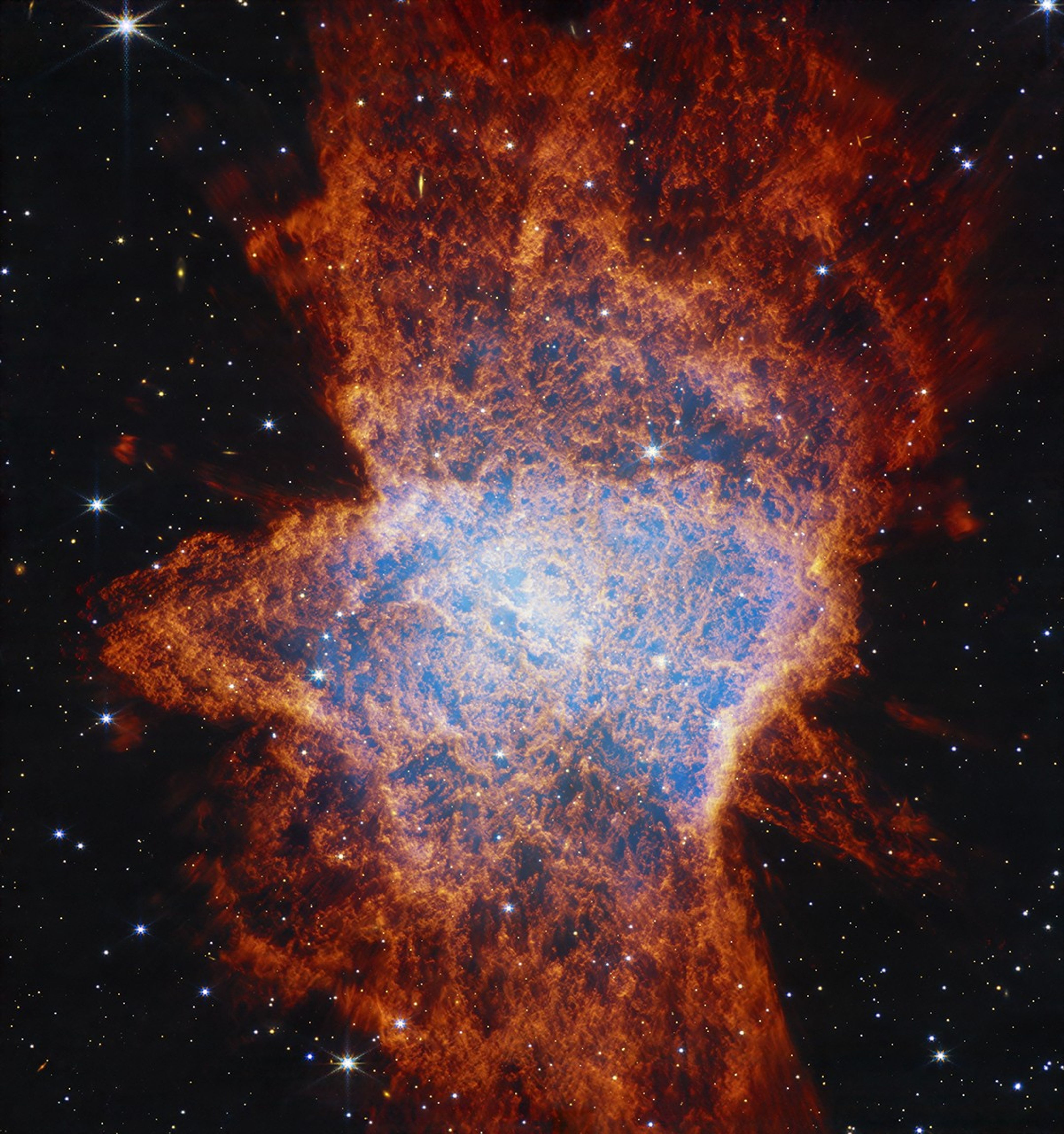
    Colorful, mostly red glowing cloud with a distorted, asymmetrical shape that is illuminated from within by a bright central star. The asymmetrical shape resembles a large squished bug on the ground. In the center, a light blue glow appears over areas of dark pockets that look dark blue and are traced with orange material. It has a clumpy appearance. Shells of gas and dust appear as lobes stretching from roughly 11 to 5 o’clock, another from 1 to 7 o’clock, and possibly a third from 12 to 6 o’clock. The shells become a deeper red with distance from the center. These outflows push gas toward the equatorial plane, forming a disk that appears to span from 9 to 3 o’clock. The background of space is black and speckled with tiny bright stars and distant galaxies.

    NASA’s James Webb Space Telescope’s view of planetary nebula NGC 6072 in the near-infrared shows a complex scene of multiple outflows expanding out at different angles from a dying star at the center of the scene. In this image, the red areas represent cool molecular gas, for example, molecular hydrogen. Full image below.

    Credits:
    NASA, ESA, CSA, STScI

    Since their discovery in the late 1700s, astronomers have learned that planetary nebulae, or the expanding shell of glowing gas expelled by a low-intermediate mass star late in its life, can come in all shapes and sizes. Most planetary nebula present as circular, elliptical, or bi-polar, but some stray from the norm, as seen in new high-resolution images of planetary nebulae by NASA’s James Webb Space Telescope.

    Webb’s newest look at planetary nebula NGC 6072 in the near- and mid-infrared shows what may appear as a very messy scene resembling splattered paint. However, the unusual, asymmetrical appearance hints at more complicated mechanisms underway, as the star central to the scene approaches the very final stages of its life and expels shells of material, losing up to 80 percent of its mass. Astronomers are using Webb to study planetary nebulae to learn more about the full life cycle of stars and how they impact their surrounding environments.

    Image A: NGC 6072 (NIRCam Image)

    Colorful, mostly red glowing cloud with a distorted, asymmetrical shape that is illuminated from within by a bright central star. The asymmetrical shape resembles a large squished bug on the ground. In the center, a light blue glow appears over areas of dark pockets that look dark blue and are traced with orange material. It has a clumpy appearance. Shells of gas and dust appear as lobes stretching from roughly 11 to 5 o’clock, another from 1 to 7 o’clock, and possibly a third from 12 to 6 o’clock. The shells become a deeper red with distance from the center. These outflows push gas toward the equatorial plane, forming a disk that appears to span from 9 to 3 o’clock. The background of space is black and speckled with tiny bright stars and distant galaxies.
    NASA’s James Webb Space Telescope’s view of planetary nebula NGC 6072 in the near-infrared shows a complex scene of multiple outflows expanding out at different angles from a dying star at the center of the scene. In this image, the red areas represent cool molecular gas, for example, molecular hydrogen.
    NASA, ESA, CSA, STScI

    First, taking a look at the image from Webb’s NIRCam (Near-Infrared Camera), it’s readily apparent that this nebula is multi-polar. This means there are several different elliptical outflows jetting out either way from the center, one from 11 o’clock to 5 o’clock, another from 1 o’clock to 7 o’clock, and possibly a third from 12 o’clock to 6 o’clock. The outflows may compress material as they go, resulting in a disk seen perpendicular to it.

    Astronomers say this is evidence that there are likely at least two stars at the center of this scene. Specifically, a companion star is interacting with an aging star that had already begun to shed some of its outer layers of gas and dust.

    The central region of the planetary nebula glows from the hot stellar core, seen as a light blue hue in near-infrared light. The dark orange material, which is made up of gas and dust, follows pockets or open areas that appear dark blue. This clumpiness could be created when dense molecular clouds formed while being shielded from hot radiation from the central star. There could also be a time element at play. Over thousands of years, inner fast winds could be ploughing through the halo cast off from the main star when it first started to lose mass.

    Image B: NGC 6072 (MIRI Image)

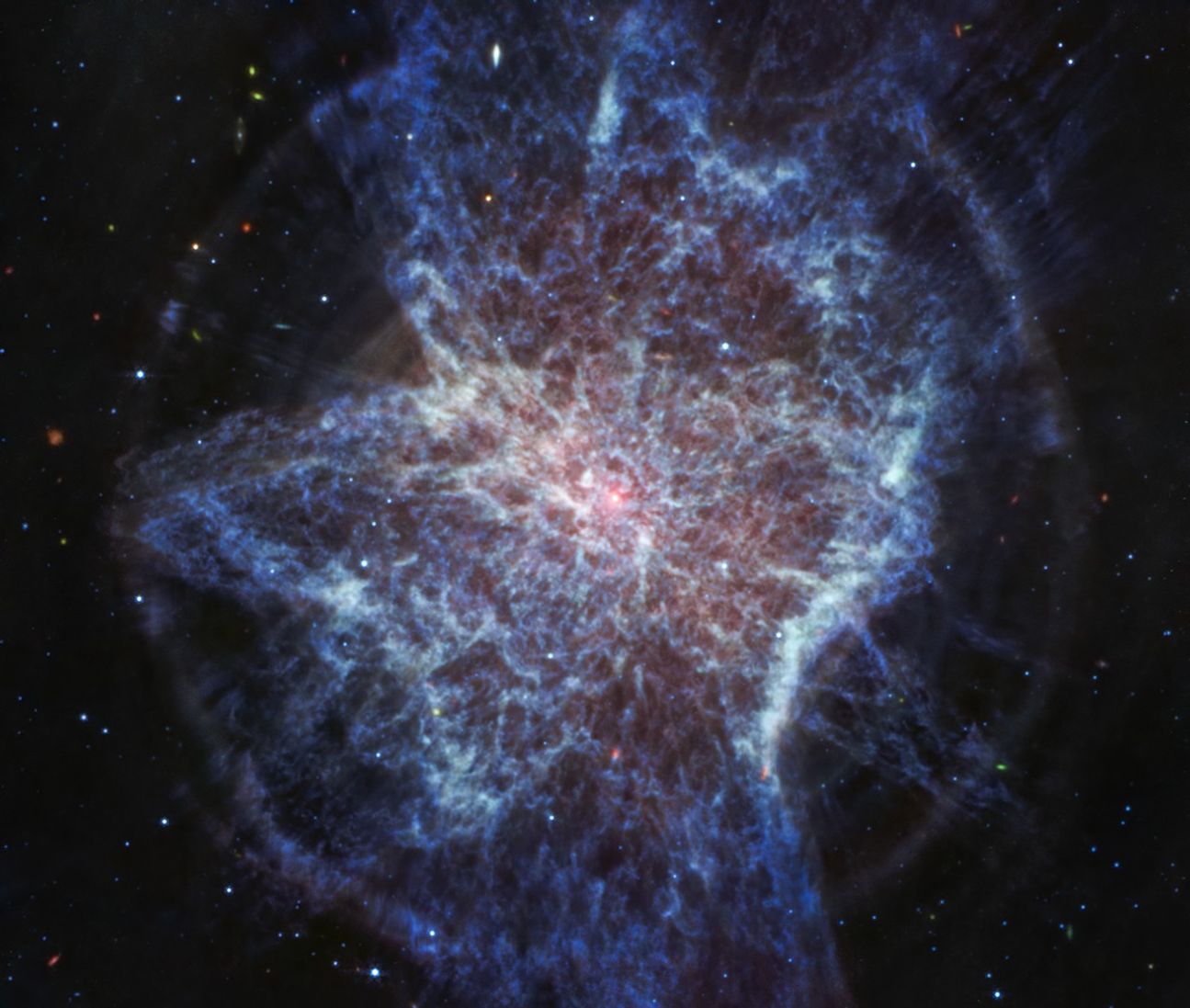
    Colorful, mostly blue image of mid-infrared light from a glowing cloud with a distorted, asymmetrical shape. A star at the center of the image is a small point of pinkish-white light. The asymmetrical shape of the expanding cloud of gas and dust resembles paint splattered on the ground. The filaments of the expanding shells are wispy, and mostly white and blue. The shells appear as lobes stretching from roughly 11 to 5 o’clock, another from 1 to 7 o’clock, and possibly a third from 12 to 6 o’clock. These outflows push gas toward the equatorial plane, forming a disk that appears to span from 9 to 3 o’clock. A perfect circle of whitish blue dust traces the outer edges of the shells. The background of the image is black and speckled with tiny bright stars and distant galaxies.
    The mid-infrared view of planetary nebula NGC 6072 from NASA’s James Webb Space Telescope show expanding circular shells around the outflows from the dying central star. In this image, the blue represents cool molecular gas seen in red in the image from Webb’s NIRCam (Near-Infrared Camera) due to color mapping.
    NASA, ESA, CSA, STScI

    The longer wavelengths captured by Webb’s MIRI (Mid-Infrared Instrument) are highlighting dust, revealing the star researchers suspect could be central to this scene. It appears as a small pinkish-whitish dot in this image.

    Webb’s look in the mid-infrared wavelengths also reveals concentric rings expanding from the central region, the most obvious circling just past the edges of the lobes.

    This may be additional evidence of a secondary star at the center of the scene hidden from our view. The secondary star, as it circles repeatedly around the original star, could have carved out rings of material in a bullseye pattern as the main star was expelling mass during an earlier stage of its life.

    The rings may also hint at some kind of pulsation that resulted in gas or dust being expelled uniformly in all directions separated by say, thousands of years.

    The red areas in NIRCam and blue areas in MIRI both trace cool molecular gas (likely molecular hydrogen) while central regions trace hot ionized gas.

    As the star at the center of a planetary nebula cools and fades, the nebula will gradually dissipate into the interstellar medium — contributing enriched material that helps form new stars and planetary systems, now containing those heavier elements.

    Webb’s imaging of NGC 6072 opens the door to studying how the planetary nebulae with more complex shapes contribute to this process.

    The James Webb Space Telescope is the world’s premier space science observatory. Webb is solving mysteries in our solar system, looking beyond to distant worlds around other stars, and probing the mysterious structures and origins of our universe and our place in it. Webb is an international program led by NASA with its partners, ESA (European Space Agency) and CSA (Canadian Space Agency).

    To learn more about Webb, visit:

    https://science.nasa.gov/webb

    Downloads

    View/Download all image products at all resolutions for this article from the Space Telescope Science Institute.

    Media Contacts

    Laura Betz – laura.e.betz@nasa.gov
    NASA’s Goddard Space Flight Center, Greenbelt, Md.

    Hannah Braunhbraun@stsci.edu
    Space Telescope Science Institute, Baltimore, Md.

    View more Webb planetary nebula images

    Learn more about planetary nebula

    Interactive: Explore the Helix Nebula planetary nebula

    Watch ViewSpace videos about planetary nebulas

    More Webb News

    More Webb Images

    Webb Science Themes

    Webb Mission Page

    What is the Webb Telescope?

    SpacePlace for Kids

    En Español

    Ciencia de la NASA

    NASA en español 

    Space Place para niños