Tag: NASA

  • Wade Sisler: Aficionado of Wonder Serving the Cosmos

    Across 42 years at NASA, Wade Sisler — executive producer at NASA’s Goddard Space Flight Center in Greenbelt, Maryland—watched the edge of human knowledge progress. During that time, the tools for visualizing and communicating those discoveries evolved just as rapidly.

    A selfie of Wade Sisler
    Executive Producer Wade Sisler has worked at NASA for 42 years, starting at the agency’s Ames Research Center in California’s Silicon Valley, and now at Goddard Space Flight Center in Greenbelt, Md.
    Credit: Courtesy of Wade Sisler

    “I’ve spent my career surrounded by people with amazing curiosity and intellect, pursuing questions that could change the way we see the universe, both literally and metaphorically,” Sisler said.

    From his start as a student photographer at NASA’s Ames Research Center in California’s Silicon Valley, Sisler ultimately became a creative force behind some of NASA’s most iconic science storytelling. He transitioned to videography when he realized the wonder and understanding the medium could convey.

    Gif of photos by Wade Sisler
    Photos taken by Sisler between 1985 and 1992 that showcase emerging NASA technologies.
    Credit: NASA/Wade Sisler

    “The fidelity of the story you could tell with pictures through video was so impactful,” he said. “It was just pure awe. So I gave up my Hasselblads, trading the sheer beauty of imagery for the much more powerful storytelling tools that came with the emerging field of video — specifically the ability to take the audience with you to experience the mission.”

    From Space Frogs to the Eagle Nebula 

    In the 1980s and ’90s, Sisler worked as a producer on a wide range of projects, translating complex research into short documentaries and educational broadcasts.

    “We were helping people see things that had never been seen before, and showing them relationships that they never knew existed,” he said.

    In one of his favorite early assignments, Sisler worked with astronaut Mae Jemison for a video project on space frogs. Jemison was studying how frog embryos develop in microgravity on the space shuttle. Sisler also had a hand in early virtual reality systems, producing one of the first videos depicting how VR could work.

    Photo of a young Wade Sisler with three coworkers
    Sisler (left) stands alongside coworkers Marty Curry, Eric James, and branch chief Roland Michealis — fellow members of the photography team at NASA Ames.
    Credit: Courtesy of Wade Sisler

    Sisler eventually moved from NASA Ames to NASA Headquarters in Washington. There, he helped modernize NASA TV.

    “They were shifting it from just mission-oriented content to a television news feed, exploring ideas to align with national news interests,” he said.

    In one of his pilot stories, he produced a video and story news package about the Hubble Space Telescope’s observations of the Eagle Nebula.

    “They handed me a 16-by-20-inch print of the Eagle Nebula right after Hubble imaged it,” he said. His team used a robotic camera to pan around the image while narration explained what viewers were seeing. “We wondered if we put that little microcosm of a story into a news feed, would anybody use it? And it ended up being used thousands and thousands of times, validating the NASA TV model with a bona fide science story and giving me a glimpse of the exciting stuff I could do.”

    While at NASA Headquarters, Sisler also negotiated an IMAX agreement that led to new 3D films (including ones Sisler worked on, like the 1997 “Mission to Mir” and 2002 “Space Station 3D”). After a few years, he moved on to NASA’s Goddard Space Flight Center in Greenbelt, Maryland, in 1997 as an executive producer. Goddard’s communications team was small and had little experience in visual storytelling, so he joined the team to nurture its growth.

    Wade and two coworkers stand in an immersive exhibit
    Sisler stands alongside Office of Communications collaborators Laura Betz and Thaddeus Cesari at the immersive “Beyond the Light” exhibit of James Webb Space Telescope imagery at ARTECHOUSE in Washington, D.C.
    Credit: Courtesy of Wade Sisler

    Science for the Senses 

    In the late ’90s, Wade teamed up with NASA’s Scientific Visualization Studio (based at NASA Goddard) and lead visualizer Horace Mitchell to explore a new frontier in science storytelling. While NASA was already known for its iconic space imagery, much of its data deals with invisible phenomena or abstract processes that aren’t inherently visual. By bringing together scientists, artists, and producers, Sisler helped transform data into visualizations and animations for broader audiences.

    “We had to invent ways of visualizing the invisible so meaning was more easily conveyed,” he said. “The result was stories that were not just newsworthy—they were often stunningly beautiful and showed the connections and workings of the Earth and universe in ways we had never seen before.”

    The team had a breakout hit in 1998 with an El Niño visualization, which helped drive public understanding of the phenomenon. Sisler also helped launch a NASA Goddard program to link scientific experts with news stations around the world.

    “We wanted to put the authentic voices of scientists in the chair to convey their sense of awe while telling people scientifically why it matters,” he said. “Pairing their voices with great visualizations was an unbeatable combination and that became the fundamental way we tell science stories.”

    Sisler’s storytelling journey evolved into increasingly ambitious creative partnerships that brought NASA science to new cultural spaces. With “Cosmic Cycles,” a collaboration with the National Philharmonic, Wade helped create a program that paired music from a live symphony with high-resolution NASA imagery, inviting viewers to experience the celestial scenery emotionally, not just intellectually.

    Instead of the NASA Goddard team creating a video to go along with music, “The composer drew inspiration from video produced by Goddard,” Sisler said. “It’s one of the best examples of science and art in mutual orbit.”

    A photo of Wade and collaborators on stage for a Cosmic Cycles panel discussion
    From left: Multimedia Producer Scott Wiessinger of NASA Goddard, Sisler, maestro Piotr Gajewski of the National Philharmonic, and composer Henry Dehlinger participate in a panel discussion about “Cosmic Cycles: A Space Symphony,” a collaboration between NASA Goddard and the National Philharmonic.
    Credit: NASA/Joel Kowsky

    That blending of science and artistic expression reached a new scale in “Beyond the Light,” an art show developed with ARTECHOUSE and James Webb Space Telescope communications lead Laura Betz. Sisler linked artists with NASA scientists to turn cutting-edge astrophysics into a gallery-scale sensory experience. Most recently, Sisler championed a major documentary on Webb called “Cosmic Dawn.” The 1.5-hour film brings viewers on an unprecedented journey through Webb’s delicate assembly, rigorous testing, and triumphant launch.

    Many of NASA’s flagship communication programs trace their roots to small teams that Sisler helped assemble and guide. He took a builder’s approach, rolling up his sleeves, testing ideas, and empowering others to scale them. From science storytelling and satellite media tours to the rise of NASA’s audio storytelling, Spanish-language content, Conceptual Image Laboratory animations, social media presence, and live broadcast programming, Sisler played a key role in turning bright ideas into enduring agency assets.

    For each of these projects, Sisler worked behind the scenes as a creative force and a connector, bringing together filmmakers, animators, composers, scientists, engineers, astronauts, museum curators, data visualizers, and educators.

    Lighting the Way

    Despite many accolades, Sisler said his proudest accomplishment is the success of the internship program he has led for NASA Goddard’s Office of Communications.

    Wade and a student and another coworker at a poster session
    Sisler has served as a mentor for many interns over the years, including students like Talya Lerner, center, standing next to Ed Campion, then-Goddard news chief. Sisler has referred to his own career as “the internship that never ended” because he had so many opportunities to explore different areas of communications. 
    Credit: NASA/Bill Hrybyk

    “The thing that stays with me most is seeing where our former interns have landed,” he said. Many now lead their own programs within NASA, shaping the next generation of science storytelling from inside the agency. Others have taken their skills beyond NASA, contributing to science and technology literacy through media, education, and public engagement. “It’s been a privilege to help launch so many of these careers. I’ve always believed that when you combine mentorship, meaningful work, and a little creative freedom, you create a ripple effect that lasts for decades.”

    Sisler’s own NASA journey began with a Pathways internship at NASA Ames while he was studying journalism at Baylor University in Texas. His work there drew him into visual storytelling, which led him to pursue photography, video, and science photography at the Rochester Institute of Technology in New York. As he alternated semesters between school and NASA Ames, he refined both his interests and his skills.

    Sisler’s goal as an internship program coordinator was to help give the next generation of science communicators the same opportunity. He developed a communication “boot camp” to help interns develop their storytelling chops in many areas and figure out which were their favorites.

    “All the interesting stuff happens at the intersections of people’s passions,” he said. “The best, most powerful thing I think I’ve done in my time at NASA is to help guide the next wave of science communicators. Seeing their success is the gift that keeps on giving.”

    By Ashley Balzer
    NASA’s Goddard Space Flight Center, Greenbelt, Md.
    Details

    Last Updated

    Aug 07, 2025

    Editor
    Ashley Balzer
    Contact
    Ashley Balzer
    Location
    Goddard Space Flight Center

  • Curiosity Blog, Sols 4622-4623: Kicking Off (Earth) Year 14 With an Investigation of Veins

    3 min read

    Curiosity Blog, Sols 4622-4623: Kicking Off (Earth) Year 14 With an Investigation of Veins

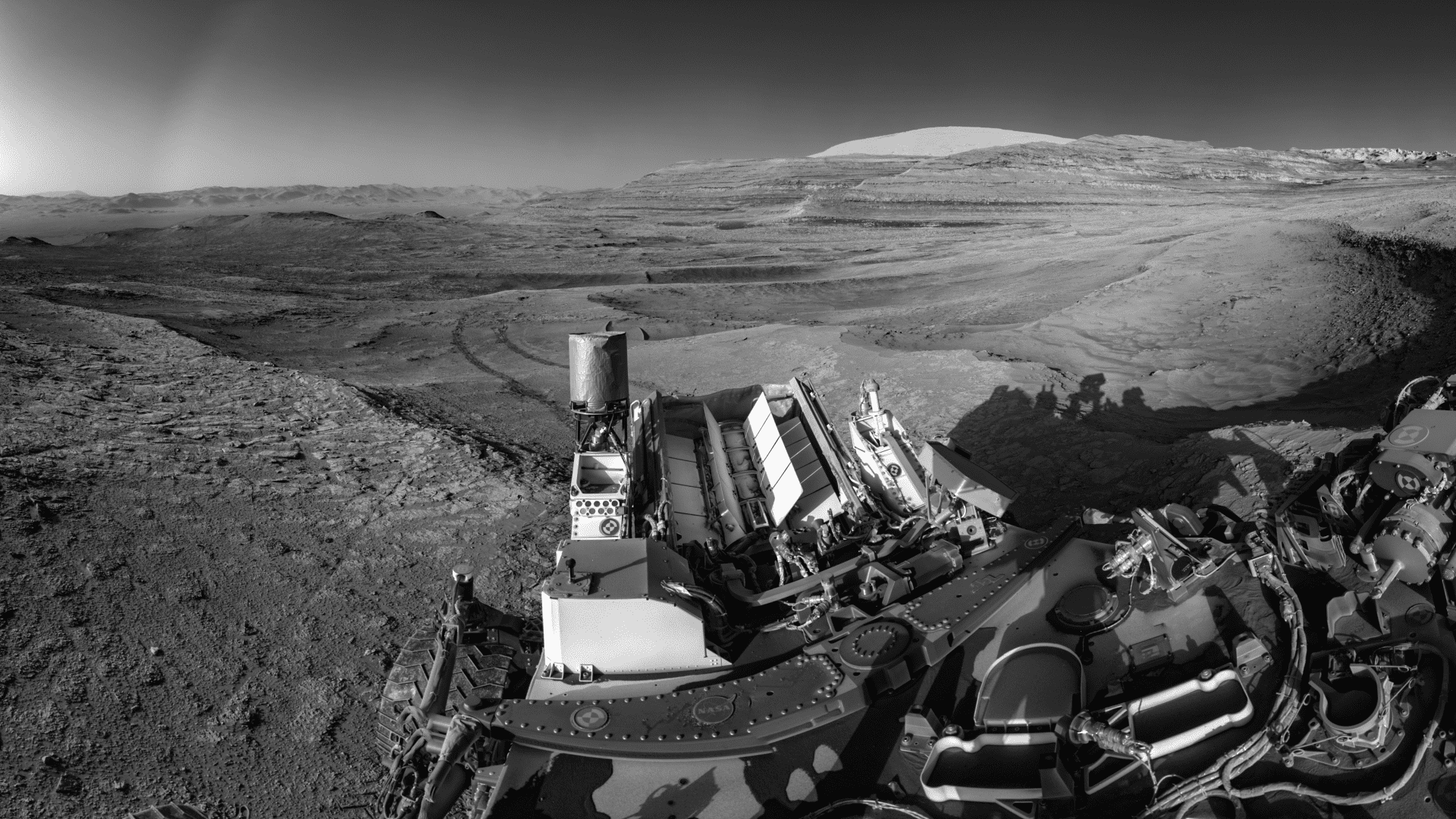
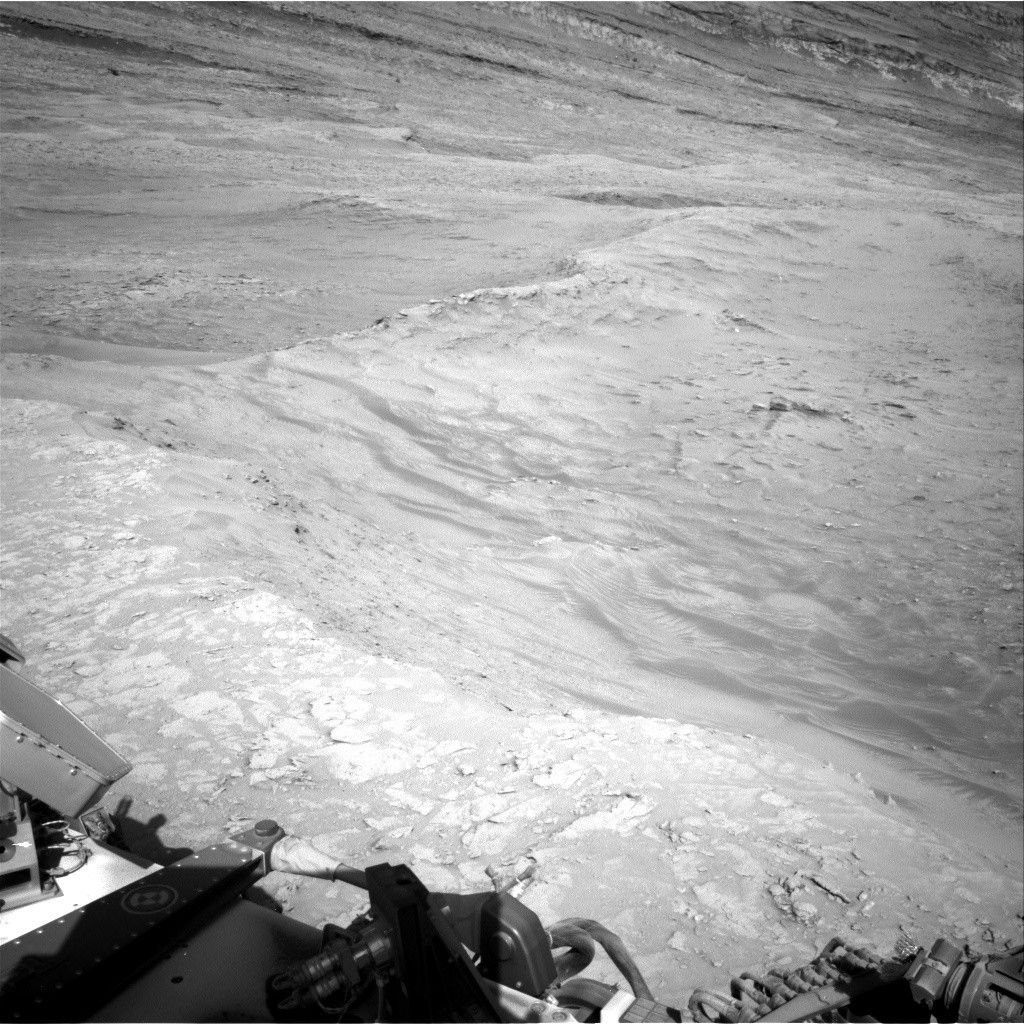
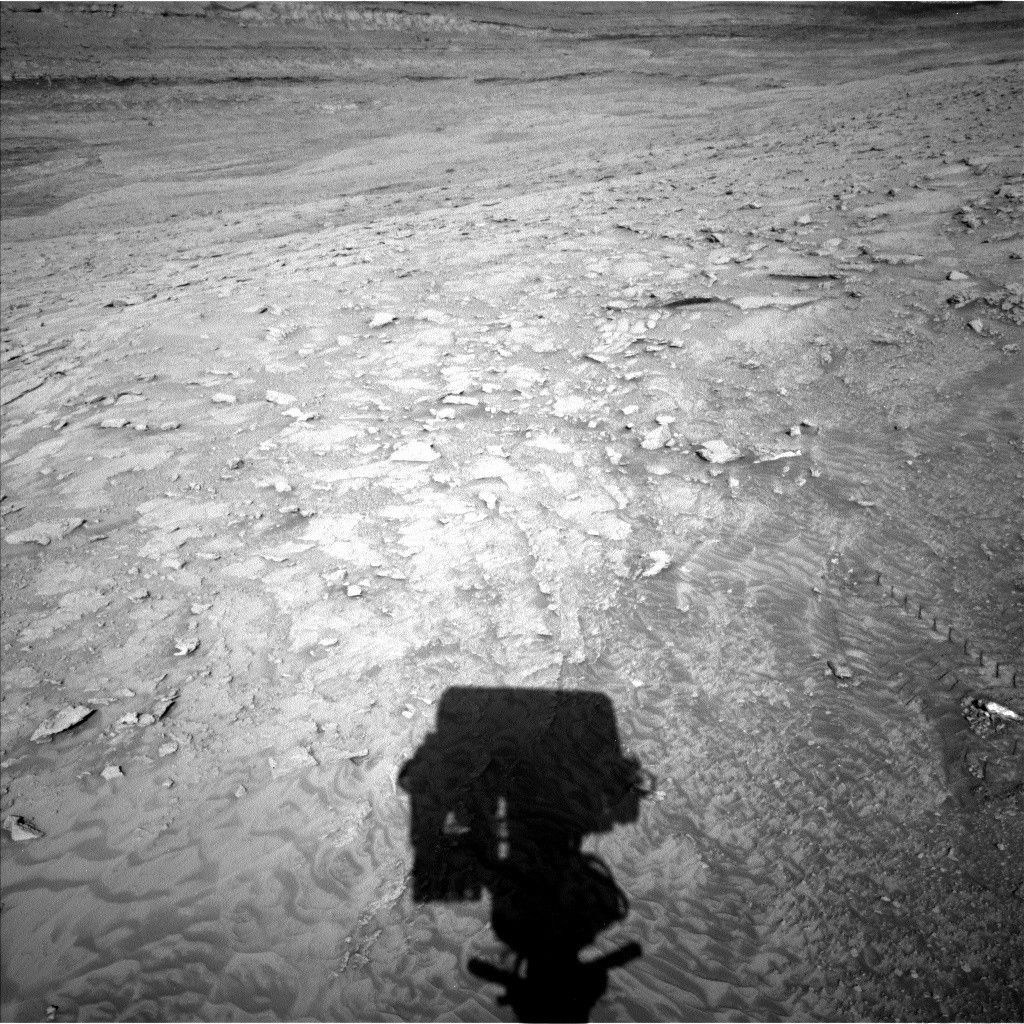
    A grayscale photo from the Martian surface shows a rough, rocky landscape in medium gray, with a shadow of the Curiosity rover’s boxy masthead showing at the bottom center of the frame.
    NASA’s Mars rover Curiosity, using its Left Navigation Camera, caught the shadow of the rover’s mast looking ahead to new terrain as the mission started its 14th Earth year on Mars. Curiosity acquired this image on Aug. 6, 2025 — Sol 4621, or Martian day 4,621 of the Mars Science Laboratory mission — at 06:24:09 UTC.
    NASA/JPL-Caltech

    Written by Abigail Fraeman, Deputy Project Scientist at NASA’s Jet Propulsion Laboratory

    Earth planning date: Wednesday, Aug. 6, 2025.

    Today was a very special day for Curiosity as the rover celebrated the start of a 14th year on Mars. Curiosity is currently exploring the mysterious boxwork formations. On Monday, the rover positioned itself at the side of one of the ridges, where the team had spotted tantalizing hints of a complex network of razor-thin veins that may give insight into what is holding the ridges up, compared to the surrounding hollows

    In this plan, the team will use the instruments on Curiosity’s arm and mast to investigate the geometry and composition of these veins to learn more about them. APXS and MAHLI will both observe “Repechón,” a loose block with dark-toned, mottled material exposed on top, as well as “Lago Poopó,” a bright, relatively clean vein network. MAHLI will also collect a side view of “Repechón.” ChemCam will use its laser to analyze two targets, “Vicguna,” a protruding vein edge with nodular texture, and “Ibare,” which has some exposed light-toned veins. Outside of the vein investigation, ChemCam’s telescopic RMI camera will observe layering in a nearby butte and the Mishe Mokwa feature, while Mastcam will take mosaics on “Cachiniba,” a broken block, “Yapacani,” the side of another large boxwork ridge, and “Llullaillaco,” a faraway feature that we imaged from a slightly different location in a previous plan. Additional environmental monitoring observations will round out the plan, followed by a straight-line drive to the east, to an area where several large boxwork ridges intersect that the team has been informally calling “the peace sign” because of its shape.

    I usually get nostalgic around landing anniversaries, or “landiversaries,” and this year, I found myself looking back through pictures of landing night. One of my favorites shows me standing next to science team member Kirsten Siebach right after we received the first images from Curiosity. The two of us have the biggest, most excited grins on our faces. We were both graduate students at the time, and both of us were writing thesis chapters analyzing orbital data over regions we hoped to explore with Curiosity one day. I was studying a layer in Mount Sharp that contained hematite, and the team named this feature “Vera Rubin ridge” when Curiosity reached it in 2017. Kirsten, who is now a professor at Rice University, was focused on the boxwork structures, pondering how they formed and hypothesizing what they might tell us about the history of Martian habitability when we reached them.

    Thirteen years later, I had another big grin on my face today, as I listened to Kirsten and our incredible science team members excitedly discussing Curiosity’s new images of these same boxwork structures. I was also filled with gratitude for the thousands of people it took to get us to this moment. It was the absolute best way to spend a landiversary.

    Details

    Last Updated

    Aug 07, 2025

    Related Terms

  • NASA to Provide Live Coverage of Crew-10 Return, Splashdown

    NASA's SpaceX Crew-10 members Kirill Peskov of Roscosmos, NASA astronauts Nichole Ayers and Anne McClain, and JAXA (Japan Aerospace Exploration Agency) astronaut Takuya Onishi share a light moment during a group portrait inside the International Space Station's Kibo laboratory module.
    From left, NASA’s SpaceX Crew-10 members Kirill Peskov of Roscosmos, NASA astronauts Nichole Ayers and Anne McClain, and JAXA (Japan Aerospace Exploration Agency) astronaut Takuya Onishi share a light moment during a group portrait inside the International Space Station’s Kibo laboratory module.
    Credit: NASA

    Editor’s Note: This advisory was updated Aug. 7, 2025, to reflect changes in the targeted undocking and splashdown dates.

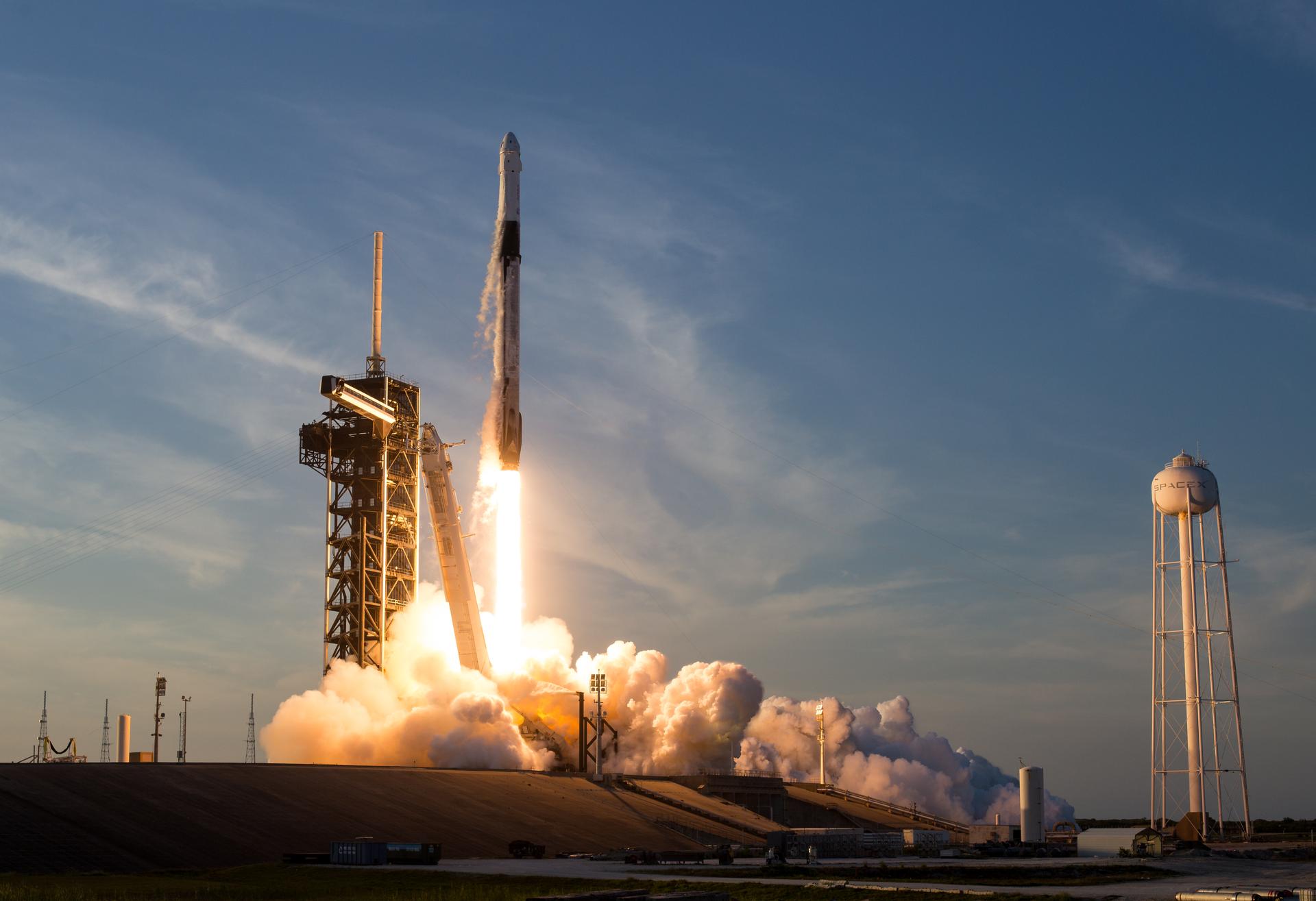
    NASA and SpaceX are targeting no earlier than 6:05 p.m. EDT, Friday, Aug. 8, for the undocking of the agency’s SpaceX Crew-10 mission from the International Space Station. Pending weather conditions, splashdown is targeted at 11:33 a.m., Saturday, Aug. 9. Crew-10 will be the first mission to splash down off the California coast for NASA’s Commercial Crew Program.

    NASA astronauts Anne McClain and Nichole Ayers, JAXA (Japan Aerospace Exploration Agency) astronaut Takuya Onishi, and Roscosmos cosmonaut Kirill Peskov are completing a five-month science expedition aboard the orbiting laboratory and will return time-sensitive research to Earth.

    Mission managers continue monitoring weather conditions in the area, as undocking of the SpaceX Dragon depends on spacecraft readiness, recovery team readiness, weather, sea states, and other factors. NASA and SpaceX will select a specific splashdown time and location closer to the Crew-10 spacecraft undocking.

    NASA’s live coverage of return and related activities will stream on NASA+, Amazon Prime, and more. Learn how to stream NASA content through a variety of platforms.

    NASA’s coverage is as follows (all times Eastern and subject to changed based on real-time operations):

    Friday, Aug. 8

    3:45 p.m. – Hatch closure coverage begins on NASA+ and Amazon Prime.

    4:20 p.m. – Hatch closing

    5:45 p.m. – Undocking coverage begins on NASA+ and Amazon Prime.

    6:05 p.m. – Undocking

    Following the conclusion of undocking coverage, NASA will distribute audio-only discussions between Crew-10, the space station, and flight controllers during Dragon’s transit away from the orbital complex.

    Saturday, Aug. 9

    10:15 a.m. – Return coverage begins on NASA+ and Amazon Prime.

    10:39 a.m. – Deorbit burn

    11:33 a.m. – Splashdown

    1 p.m. – Return to Earth media teleconference will stream live on the agency’s YouTube channel, with the following participants:

    • Steve Stich, manager, NASA’s Commercial Crew Program
    • Dina Contella, deputy manager, NASA’s International Space Station Program
    • Sarah Walker, director, Dragon Mission Management, SpaceX
    • Kazuyoshi Kawasaki, associate director general, Space Exploration Center/Space Exploration Innovation Hub Center, JAXA

    To participate in the teleconference, media must contact the NASA Johnson newsroom by 5 p.m., Aug. 7, at: jsccommu@mail.nasa.gov or 281-483-5111. To ask questions, media must dial in no later than 10 minutes before the start of the call. The agency’s media credentialing policy is available online.

    Find full mission coverage, NASA’s commercial crew blog, and more information about the Crew-10 mission at:

    https://www.nasa.gov/commercialcrew

    -end-

    Joshua Finch
    Headquarters, Washington
    202-358-1100
    joshua.a.finch@nasa.gov

    Sandra Jones / Joseph Zakrzewski
    Johnson Space Center, Houston
    281-483-5111
    sandra.p.jones@nasa.gov / joseph.a.zakrzewski@nasa.gov

    Steve Siceloff / Stephanie Plucinsky
    Kennedy Space Center, Florida
    321-867-2468
    steven.p.siceloff@nasa.gov / stephanie.n.plucinsky@nasa.gov

  • Snapshot Wisconsin Celebrates 10 Years and 100 Million Photos Collected!

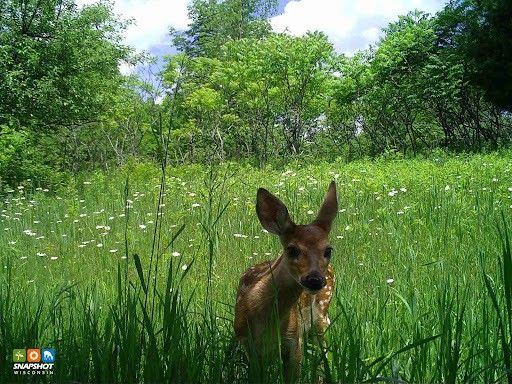
    A young deer stands in a lush green meadow surrounded by wildflowers and trees, captured by a Snapshot Wisconsin trail camera.
    A white-tailed deer fawn photographed on a Snapshot Wisconsin trail camera in Vernon County, WI
    Credit: WI DNR

    The Snapshot Wisconsin project recently collected their 100 millionth trail camera photo! What’s more, this milestone coincides with the project’s 10-year anniversary. Congratulations to the team and everyone who’s participated!

    Snapshot Wisconsin utilizes a statewide network of volunteer-managed trail cameras to monitor and better understand the state’s diverse wildlife from white-tailed deer to snowshoe hares, whooping cranes, and much more.

    “It’s been amazing to get a glimpse of our wild treasures via the Snapshot lens,” said volunteer Matt Dettlaff from Adams County, Wisconsin. “Satisfying to help advance wildlife research in the digital age.”

    Snapshot Wisconsin was launched in 2013 with help from a NASA grant, and is overseen by the Wisconsin Department of Natural Resources. It recently won a new grant from NASA’s Citizen Science for Earth Systems Program.

    Volunteer classifications of the species present in trail camera photos have fueled many different scientific investigations over the years. You, too, can get involved in the merriment by visiting the project’s site on the Zooniverse crowdsourcing platform and helping classify their latest photo season today!

    Details

    Last Updated

    Aug 07, 2025

  • Curiosity Looks Back Toward Its Landing Site

    Curiosity Looks Back Toward Its Landing Site

    This view of tracks trailing NASA’s Curiosity rover was captured July 26, 2025, as the rover simultaneously relayed data to a Mars orbiter.

  • Curiosity Blog, Sols 4618-4619: The Boxwork Structures Continue to Call to Us

    3 min read

    Curiosity Blog, Sols 4618-4619: The Boxwork Structures Continue to Call to Us

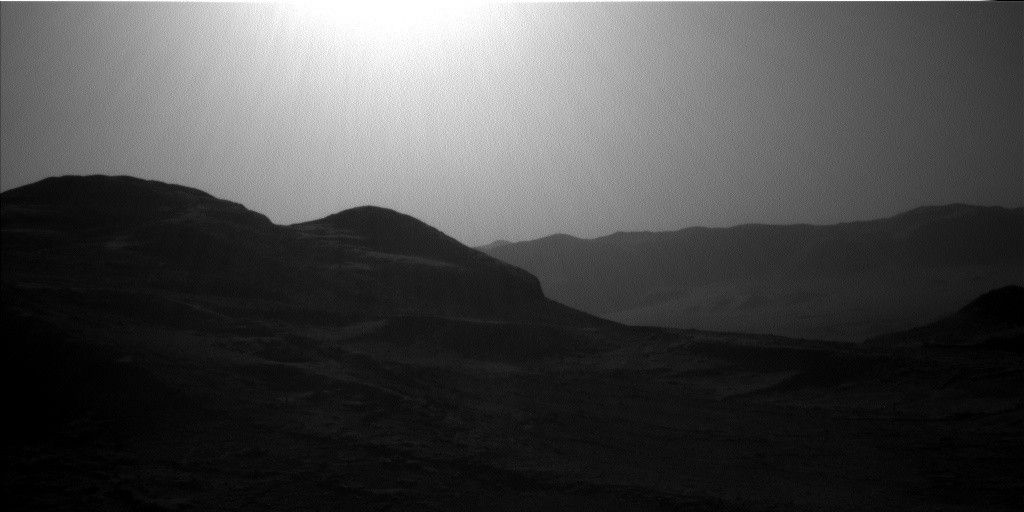
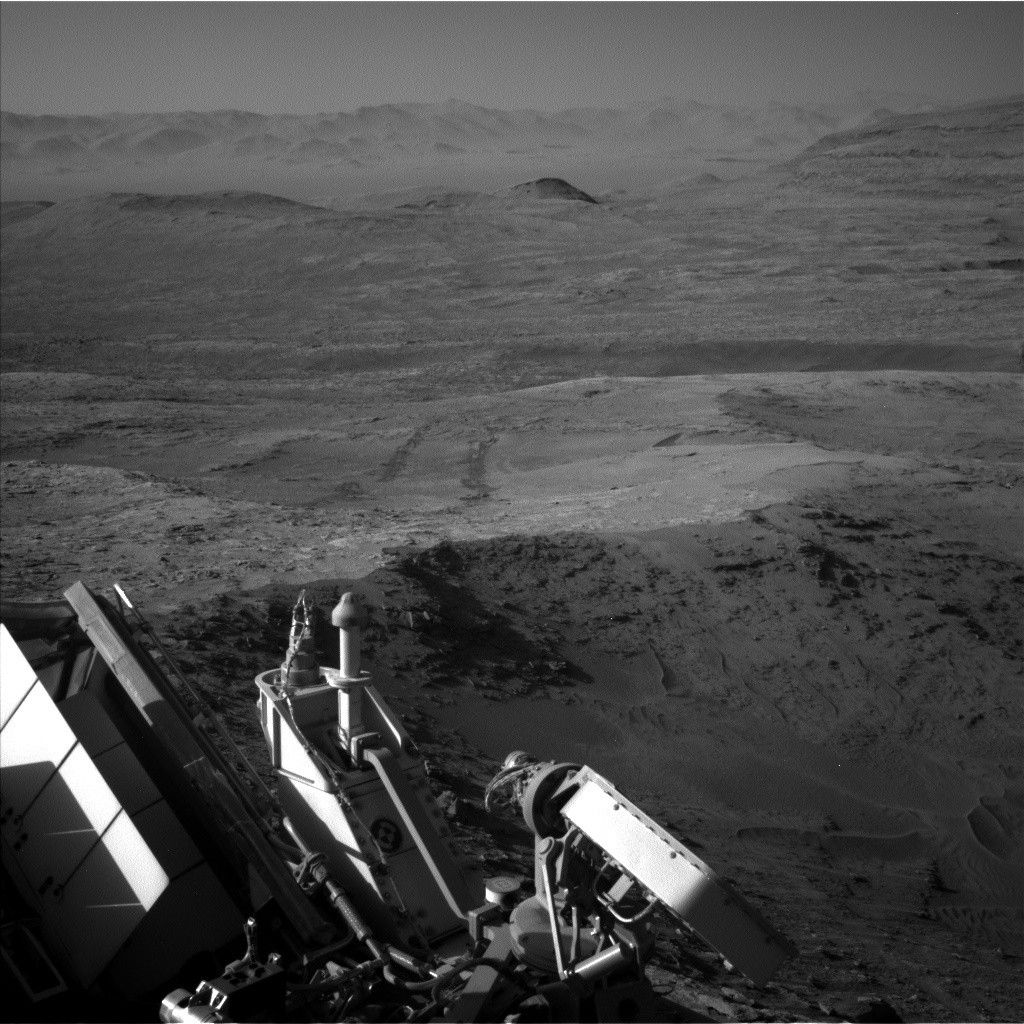
    A grayscale photo from the Martian surface shows a backlit, hilly landscape. In the foreground a pair of peaks on the left side of the image — shadowed and nearly black — descend gently toward the right side, where the ground rises again slightly at the edge of the frame. Beyond that on the right side, a ridge of very dark gray terrain is topped by a wavy line of small peaks, creating a horizon line that disappears behind the foreground hills. The sky is a uniform lighter gray, with a blinding sun visible at the top center of the frame.
    NASA’s Mars rover Curiosity acquired this image using its Left Navigation Camera on Aug. 1, 2025 — Sol 4616, or Martian day 4,616 of the Mars Science Laboratory mission — at 03:36:56 UTC.
    NASA/JPL-Caltech

    Written by Ashley Stroupe, Mission Operations Engineer and Rover Planner at NASA’s Jet Propulsion Laboratory

    Earth planning date: Friday, Aug. 1, 2025.

    Now that we have reached August, our “landiversary” (anniversary of landing — Aug. 5 PDT) is less than a week away! The team is looking forward to being able to celebrate the milestone of our rover becoming a teenager at 13. Today’s image is a beautiful back-lit late afternoon image of the nearby mountains and the distant crater rim. These views make working on Mars never get old!

    The first sol of today’s plan is very busy because we will only have data from the first sol down in time for planning on Monday. Today I was working as a Rover Planner, supporting both arm and drive activities. We start first thing with arm activities; we DRT brush and do APXS integration on the target “San Cristóbal,” which is a bedrock target, and the only place in the workspace smooth and flat enough for us to brush. 

    After a brief nap, we have an extensive imaging campaign. We take Mastcam images of the AEGIS target from the previous plan and two potential vein targets “Rio Satja” and “Río Ichilo.”  We then take Mastcam stereo mosaics of boxwork targets “Pontezuelo” and “Catedrales de Tara.”  Additionally we have stereo mosaics of “Llanos de Challe,” a transition between the bedrock in the boxwork hollow and the boxwork ridge, a nearby light-toned exposure, and some additional troughs and ridges. ChemCam then takes a LIBS observation of “Airport Domes,” which is another hollow in the boxworks. Finally, we take a ChemCam RMI and a Mastcam of Pontezuelo.

    After finishing all the imaging, we continue with the rest of the arm activities. We split the arm activities to accommodate conflicting constraints — both APXS and ChemCam both need to be as early as possible. In this set of arm activities, we begin with MAHLI imaging of the two targets, San Cristóbal and “Salar de Agua Amara,” which consists of delicate branching structures likely made by groundwater. 

    After another short nap, we do a small adjustment in our position to get another interesting piece of bedrock ridge in our workspace. In order to approach it at a good angle, we first drive parallel to the ridge to be lined up with the target, and then we turn and drive straight to it. Due to constraints on how we like to park at targets, sometimes these shorter drives can be more complicated than longer ones — but today it was simpler. After completing the drive, we unstow the arm to get a clear view of our workspace for Monday’s planning as well as our standard post-drive imaging and then Curiosity goes to sleep for the night. 

    The second sol of the plan is a bit more leisurely. Around midday, Curiosity will be taking some atmospheric observations, including a Navcam dust-devil survey and a south-facing suprahorizon movie, followed by an AEGIS activity where the rover gets to pick targets and observe them herself. Then, early the next morning, Curiosity will wake up to take some additional atmospheric observations, including Navcam zenith and suprahorizon movies, Navcam line-of-sight toward the crater rim, and a Mastcam solar tau to measure dust in the atmosphere. Finally, she’ll get a short nap before waking up to start the next plan.

    Details

    Last Updated

    Aug 05, 2025

    Related Terms

  • NASA Selects Six Companies to Provide Orbital Transfer Vehicle Studies

    NASA has selected six companies to produce studies focused on lower-cost ways to launch and deliver spacecraft of various sizes and forms to multiple, difficult-to-reach orbits.

    The firm-fixed-price awards comprise nine studies with a maximum total value of approximately $1.4 million. The awardees are:

    • Arrow Science and Technology LLC, Webster, Texas
    • Blue Origin LLC, Merritt Island, Florida
    • Firefly Aerospace Inc., Cedar Park, Texas
    • Impulse Space Inc., Redondo Beach, California
    • Rocket Lab, Long Beach, California
    • United Launch Services LLC, Centennial, Colorado

    “With the increasing maturity of commercial space delivery capabilities, we’re asking companies to demonstrate how they can meet NASA’s need for multi-spacecraft and multi-orbit delivery to difficult-to-reach orbits beyond current launch service offerings,” said Joe Dant, orbital transfer vehicle strategic initiative owner for the Launch Services Program at NASA’s Kennedy Space Center in Florida. “This will increase unique science capability and lower the agency’s overall mission costs.”

    Each of the six companies will deliver studies exploring future application of orbital transfer vehicles for NASA missions:

    Arrow will partner with Quantum Space for its study. Quantum’s Ranger provides payload delivery service as a multi-mission spacecraft engineered for rapid maneuverability and adaptability, enabling multi-destination delivery for missions from low Earth orbit to lunar orbit.

    Blue Origin will produce two studies, including one for Blue Ring, a large, high-mobility space platform providing full-service payload delivery, on-board edge computing, hosting, and end-to-end mission operations. It uses hybrid solar-electric and chemical propulsion capability to reach geostationary, cislunar, Mars, and interplanetary destinations. The second is a New Glenn upper stage study.

    Firefly’s line of Elytra orbital vehicles offers on-demand payload delivery, imaging, long-haul communications, and domain awareness across cislunar space. Firefly’s Elytra Dark is equipped to serve as a transfer vehicle and enable ongoing operations in lunar orbit for more than five years.

    Impulse Space will produce two studies. The company provides in-space mobility with two vehicles, Mira and Helios. Mira is a high-thrust, highly maneuverable spacecraft for payload hosting and deployment, while Helios is a high-energy kick stage to rapidly deliver payloads from low Earth to medium Earth orbits, geostationary orbits and beyond.
    Rocket Lab’s two studies will feature the upper stage of the company’s Neutron rocket, as well as a long-life orbital transfer vehicle based on its Explorer spacecraft. Both vehicles are equipped with their own propulsion systems and other subsystems for missions to medium Earth and geosynchronous orbit and deep space destinations like the Moon, Mars, and near-Earth asteroids.
    United Launch Alliance will assess the cislunar mission capabilities of an extended-duration Centaur V upper stage. Centaur would be capable of directly delivering multiple rideshare spacecraft to two different orbital destinations in cislunar space, avoiding the need for an additional rocket stage or orbital transfer vehicle.

    The studies will be complete by mid-September. NASA will use the findings to inform mission design, planning, and commercial launch acquisition strategies for risk-tolerant payloads, with a possibility of expanding delivery services to larger-sized payloads and to less risk-tolerant missions in the future.

    NASA’s Launch Services Program selected providers through the agency’s VADR (Venture-Class Acquisition of Dedicated and Rideshare Launch Services) contract, which helps foster growth of the U.S. commercial launch market, enabling greater access to space at a lower cost for science and technology missions.

    For more information about NASA’s Launch Services Program, visit:

    https://www.nasa.gov/launch-services-program

    -end-

    Josh Finch
    Headquarters, Washington
    202-358-1100
    joshua.a.finch@nasa.gov

    Leejay Lockhart
    Kennedy Space Center, Florida
    321-747-8310
    leejay.lockhart@nasa.gov

    Details

    Last Updated

    Aug 05, 2025

    Location
    Kennedy Space Center

  • NASA’s SpaceX Crew-10 Looks Back at Science Mission

    7 Min Read

    NASA’s SpaceX Crew-10 Looks Back at Science Mission

    From left, NASA's SpaceX Crew-10 members Kirill Peskov of Roscosmos, NASA astronauts Nichole Ayers and Anne McClain, and JAXA (Japan Aerospace Exploration Agency) astronaut Takuya Onishi share a light moment during a group portrait inside the International Space Station's Kibo laboratory module.

    NASA’s SpaceX Crew-10 Looks Back at Science Mission

    NASA’s SpaceX Crew-10 mission with agency astronauts Anne McClain and Nichole Ayers, JAXA (Japan Aerospace Exploration Agency) astronaut Takuya Onishi, and Roscosmos cosmonaut Kirill Peskov is preparing to return to Earth in early August after a long-duration mission aboard the International Space Station. During their stay, McClain, Ayers, and Onishi completed dozens of experiments and technology demonstrations, helping push the boundaries of scientific discovery aboard the orbiting laboratory.

    Here’s a look at some scientific milestones accomplished during the Crew-10 mission:

    Orbital effects on plants

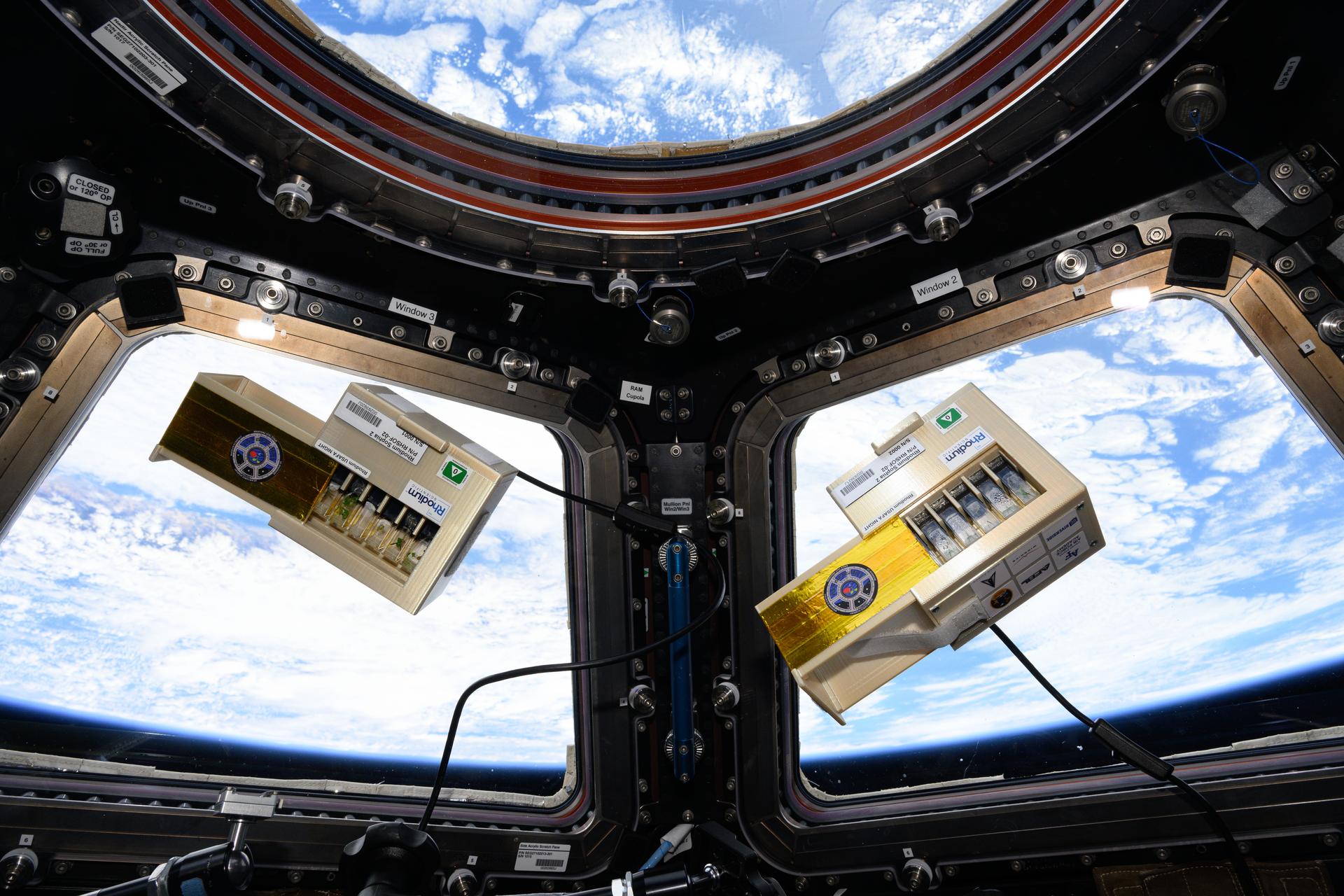
    Two gold box-shaped canisters, about the size of a large tissue box, have sections slid open, revealing five clear tubes containing small green plants. There are condensation droplets inside the tubes. The canisters are floating in front of the space station’s cupola windows with Earth’s blue, cloud-covered surface filling the background.
    NASA

    The canisters floating in the cupola of the International Space Station contain wild-type and genetically-modified thale cress plants for the Rhodium Plant LIFE experiment. The investigation studies how radiation and gravity environments at different orbital altitudes affect plant growth by comparing Crew-10 data with plants flown aboard the Polaris Dawn mission, which flew deeper into space. Studies have shown microgravity affects growth rates, and a better understanding of the mechanisms behind this could improve plant growth techniques in space and on Earth.

    Solar spacewalk

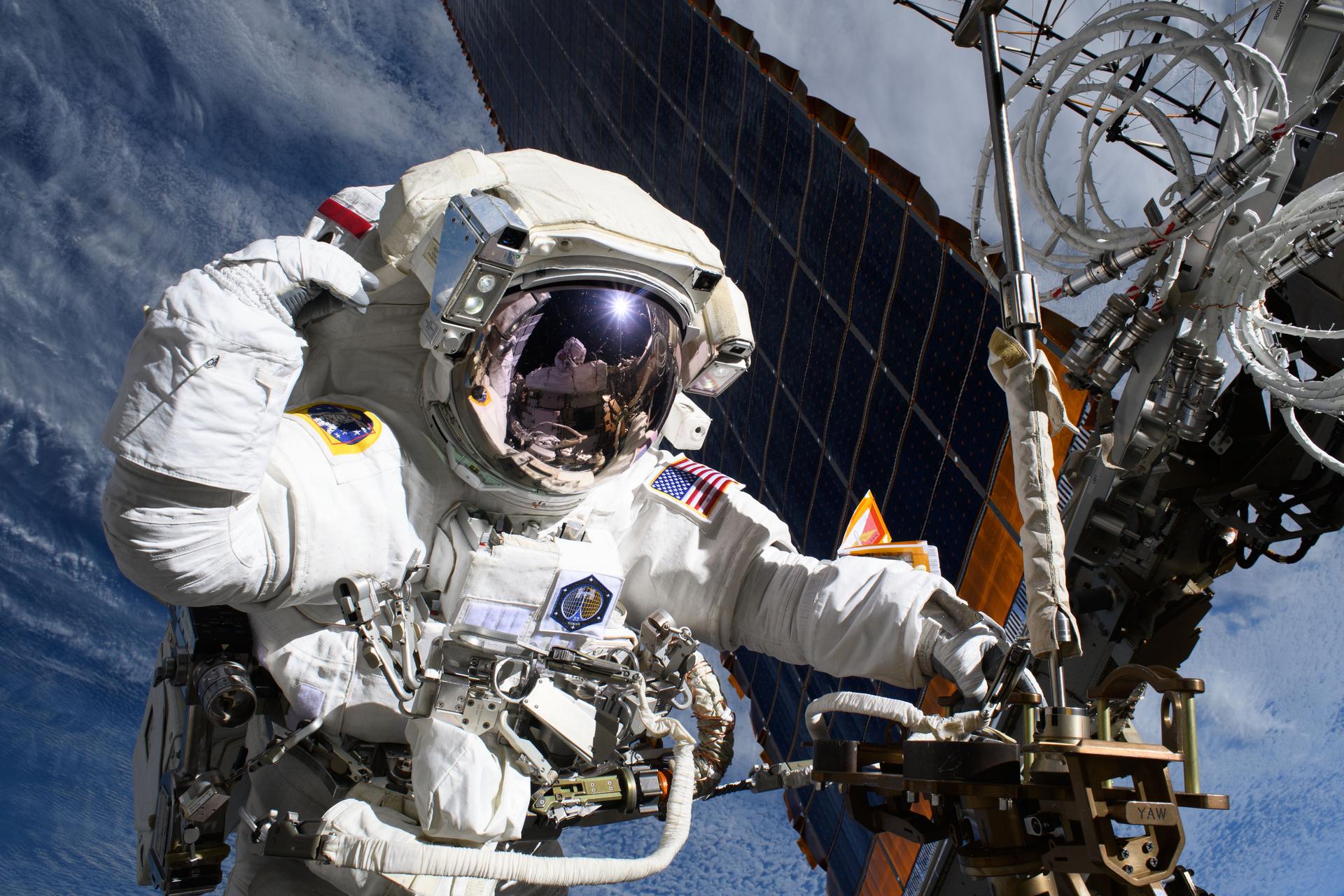
    McClain, wearing a white spacesuit with a U.S. flag on the left arm and an Expedition 73 patch on the chest, reaches over her right shoulder. A reflective helmet visor obscures her face. Behind her, a solar array extends from the space station, with Earth’s blue, cloud-covered surface filling the background.
    NASA

    NASA astronaut Anne McClain conducts a spacewalk to upgrade the International Space Station’s power generation systems, which include main solar arrays like the one visible behind her. McClain is installing hardware to support an IROSA (International Space Station Roll-Out Solar Array), a type of array that is more compact and produces more power than the station’s original ones. The IROSAs were first demonstrated aboard the orbiting laboratory in June 2017, and eight have been installed to augment the power available for scientific research and other activities.

    Microalgae on the menu

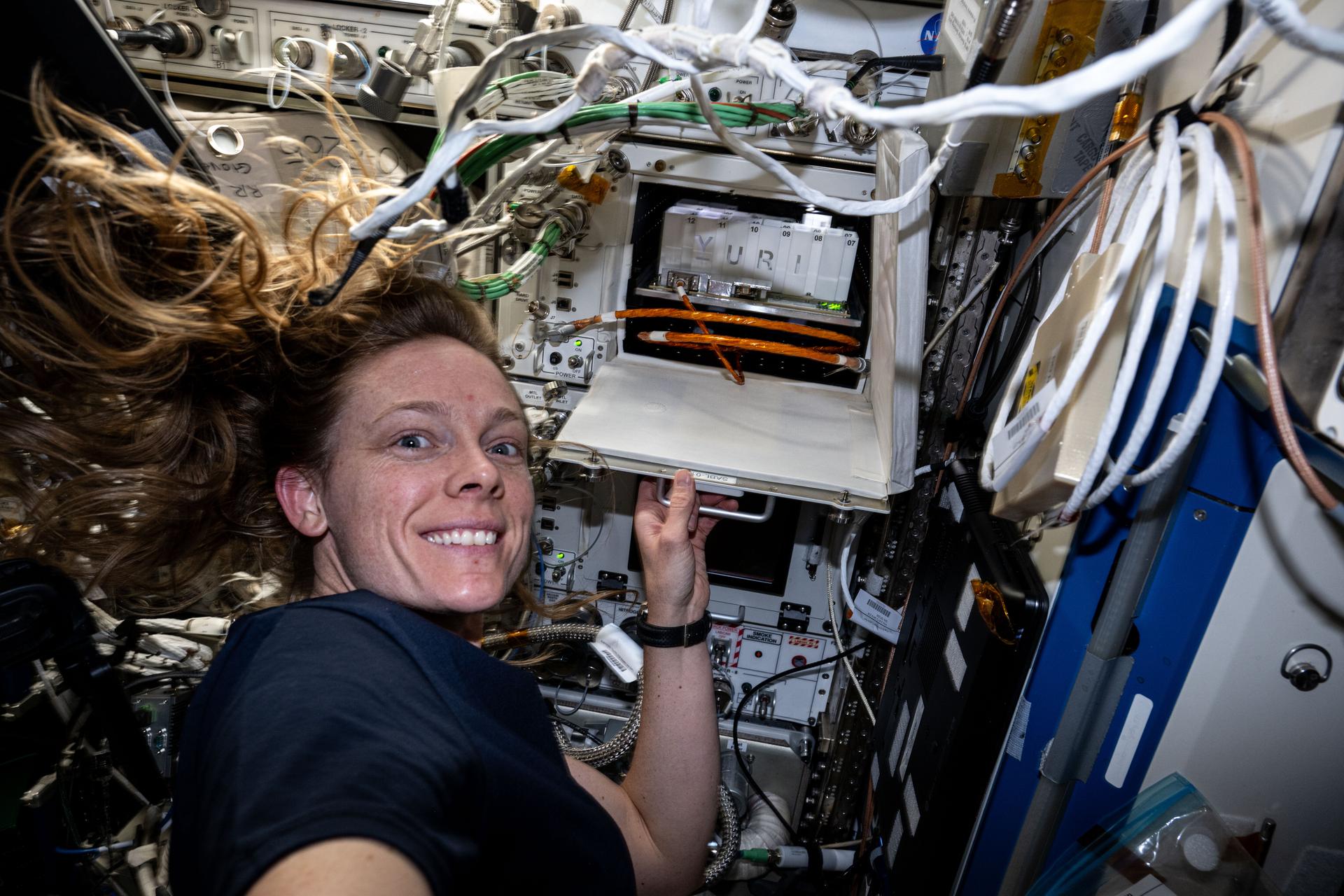
    Ayers, wearing a black T-shirt, is smiling at the camera. With her left hand, she is holding the bioproduct laboratory door open. A white box mounted to the wall of the space station has a row of smaller white square containers and a few orange cords along the bottom.
    NASA

    NASA astronaut Nichole Ayers uses the International Space Station’s Space Automated Bioproduct Laboratory to process samples for SOPHONSTER, a study of microgravity’s effects on the protein yield of microalgae. These organisms are highly nutritious, producing amino acids, fatty acids, B vitamins, iron, and fiber. The microalgae could provide sustainable meat and dairy alternatives during long-duration space missions. It also could be used to make biofuels and bioactive compounds in medicines in space and on Earth.

    Looking down on lightning

    Two intense thundercloud tops are illuminated with circles of bright white lightning flashes against a black night sky.
    NASA

    The International Space Station orbits more than 250 miles above Earth, giving astronauts a unique view of their home planet, where they can photograph familiar places and interesting phenomena. While passing over a stormy night, NASA astronaut Nichole Ayers captured this image of simultaneous lightning at the top of two thunderstorms. Scientists use instruments installed on the space station to study lightning and other weather conditions in Earth’s upper atmosphere. This research helps protect communication systems and aircraft while improving atmospheric models and weather predictions.

    Testing the tips of DNA

    NASA

    In this time-lapse video, JAXA (Japan Aerospace Exploration Agency) astronaut Takuya Onishi and NASA astronaut Nichole Ayers harvest samples for the APEX-12 investigation, which examines how space radiation affects telomere activity in thale cress plants. Telomeres, which are repetitive DNA sequences that protect the ends of chromosomes, become shorter each time a cell divides and indicate cell aging. The APEX-12 investigation could clarify the role of telomeres in aging and diseases and help scientists equip plants and other organisms for the stress of long-duration spaceflight.

    Microscopic motion

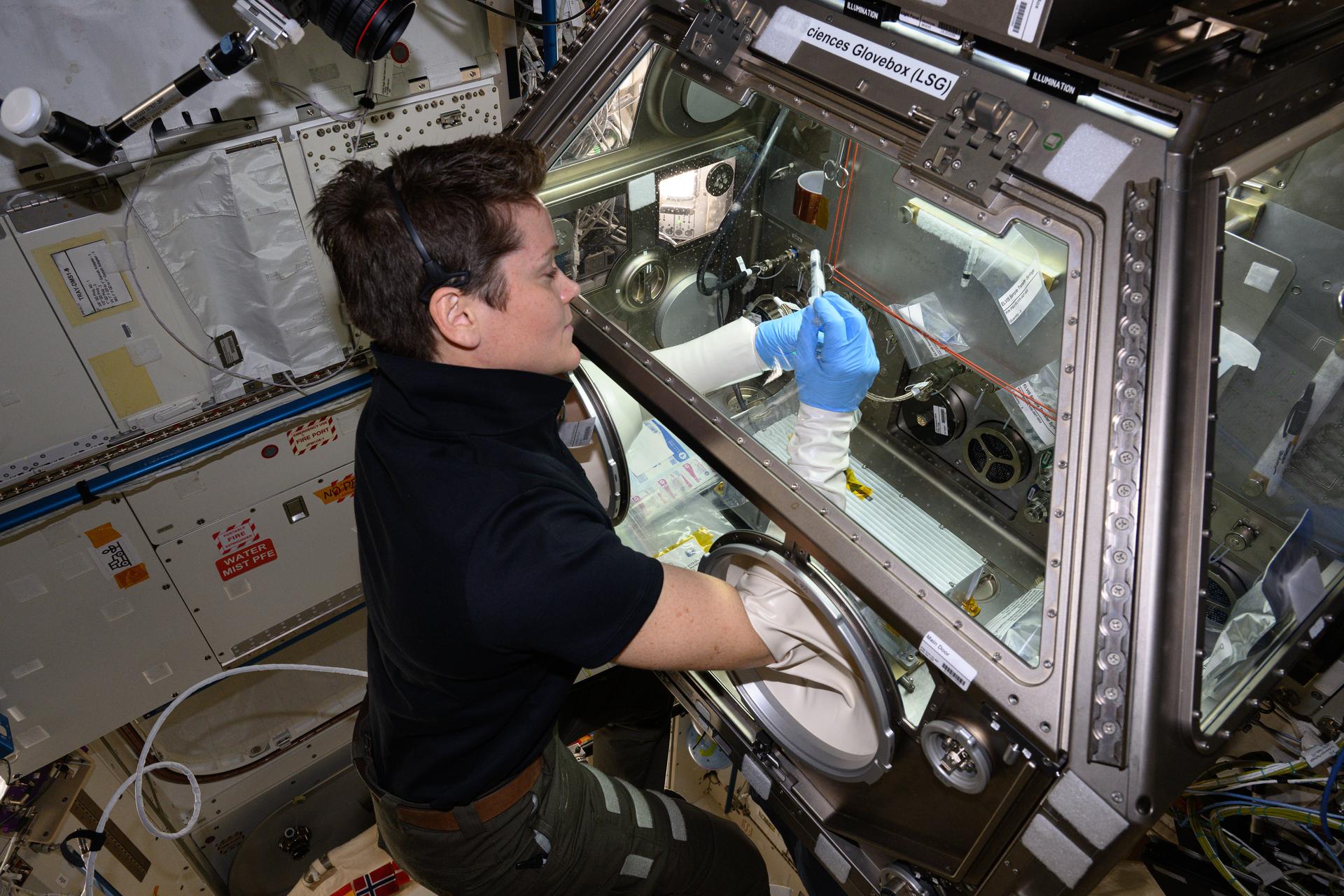
    McClain, wearing a black polo and dark green khaki pants, has her arms inside the glove sleeves of the space station’s life sciences glovebox. She is holding a large syringe in her right hand and looking intently at it.
    NASA

    A fluorescent microscope, known as ELVIS, captures the motion of microscopic algae and bacteria in 3D, a new capability aboard the International Space Station. The technology could be helpful in various applications in space and on Earth, such as monitoring water quality and detecting potentially infectious organisms. NASA astronaut Anne McClain prepares bacterial samples for viewing with the microscope.

    How cells sense gravity

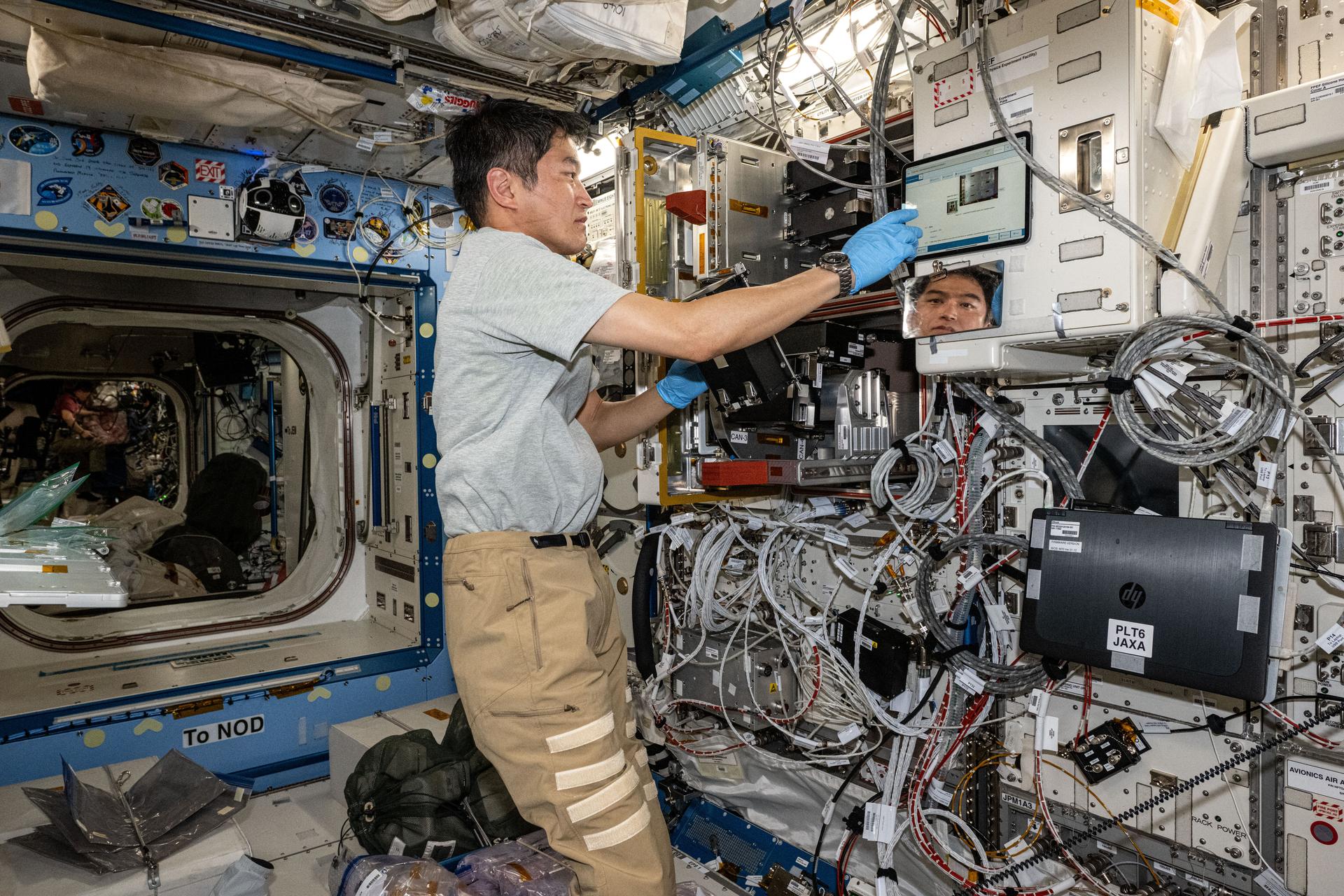
    Onishi, wearing a gray T-shirt, khaki pants, and blue latex gloves, is facing a piece of equipment that is pulled out from the space station’s wall. On it sits a black circular metal sample canister. He is reaching out to touch a screen with his right hand, and a mirror below the screen reflects his face.
    NASA

    Individual cells in our bodies can respond to the effects of gravity, but how they do this is largely unknown. The Cell Gravisensing investigation is an effort to observe the mechanism that enables cells to sense gravity and could lead to therapies to treat muscle and bone conditions, like muscle atrophy during long-duration spaceflight and osteoporosis on Earth. JAXA (Japan Aerospace Exploration Agency) astronaut Takuya Onishi processes research samples in the International Space Station’s Kibo laboratory module.

    Water works

    At the top of the image, Ayers is smiling at the camera and wearing a green T-shirt. She is holding onto a square white equipment box with her left hand. The box, which has multiple connections, ports, switches, and vents, is slightly pulled out from the space station’s wall. In the center of the image, McClain is floating upside down, smiling at the camera. She is wearing a black T-shirt and green pants and is holding onto the same equipment box with both hands.
    NASA

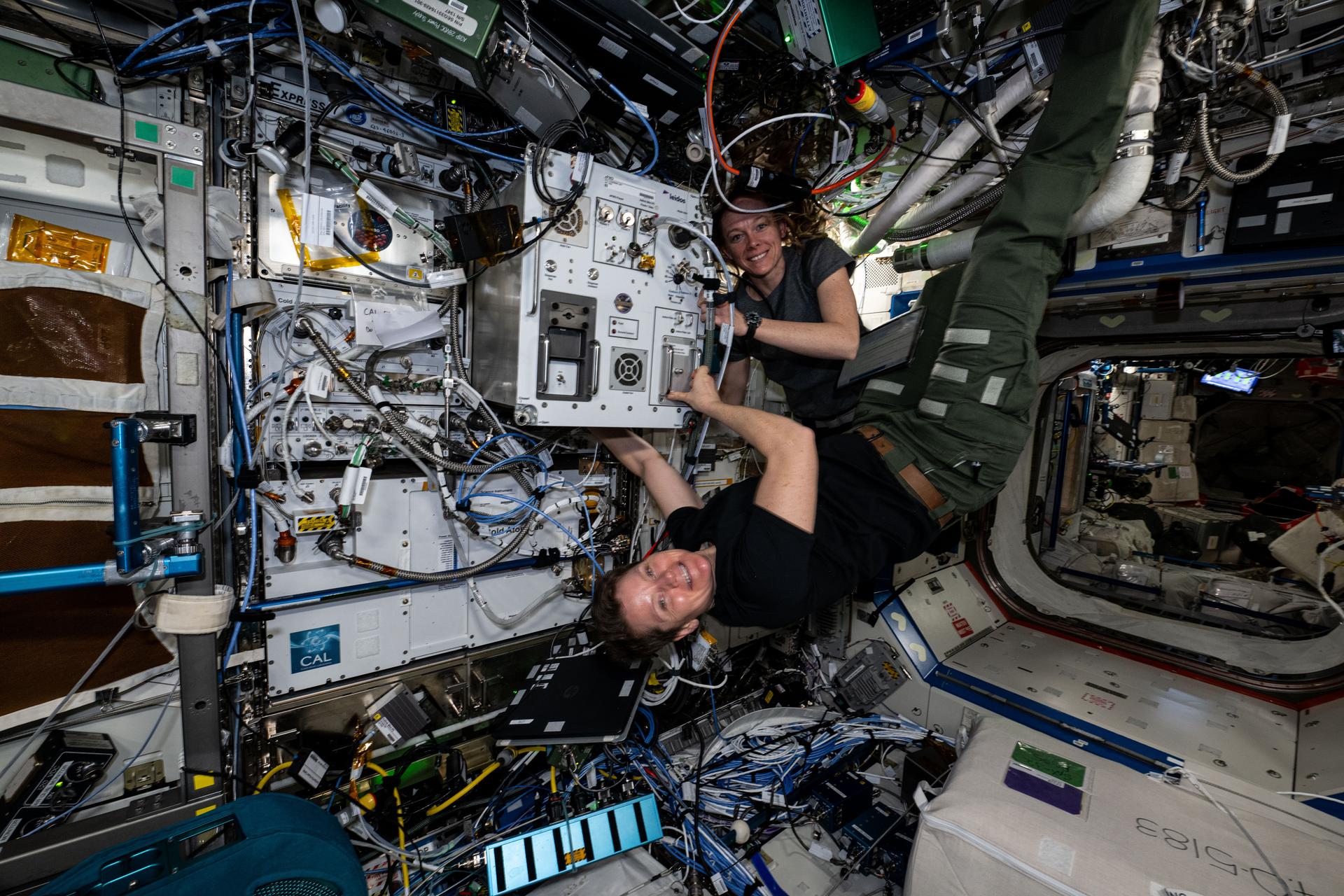
    NASA astronauts Nichole Ayers and Anne McClain work on installing hardware for the International Space Station’s Exploration Potable Water Dispenser. Scientists are evaluating the device’s water sanitization and microbial growth reduction technology. The dispenser provides room temperature and hot water for crew consumption and food preparation. This technology could be adopted for future exploration missions.

    Free-flying camera

    Onishi is wearing a long-sleeved, two-toned blue shirt and khaki pants and holding a tablet with both hands. A black-and-white robot, about the size of a soccer ball, with two round, blue lights that resemble eyes, floats in front of him. Onishi is looking at the robot and smiling.
    NASA

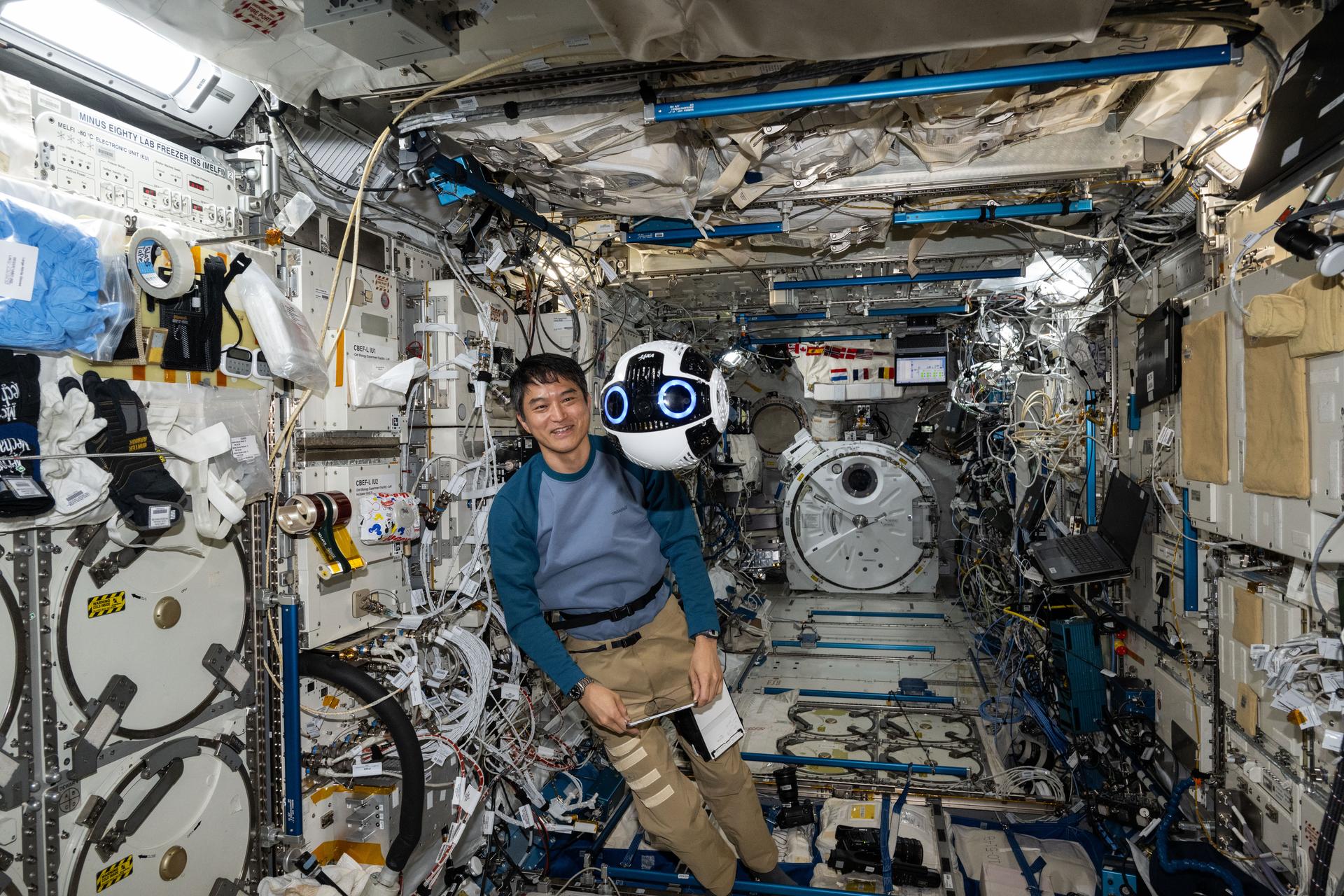
    Astronaut Takuya Onishi of JAXA (Japan Aerospace Exploration Agency) monitors the JEM Internal Ball Camera 2 as it floats through the International Space Station. The free-flying, rechargeable camera provides a visual field outside the other cameras installed aboard the space station. JAXA is testing the robot’s ability to capture video and imagery of scientific experiments and other activities, which could free up crew time for research and other duties.

    Two rings to pin them all

    Ayers is wearing a black T-shirt and green pants, with her hair floating around her head. She has both hands on a connection port on the front of a white panel with a row of black buttons. A thick silver cord floats next to her left arm. A bank of lights is above the equipment, and a tablet is mounted in front of the lights.
    NASA

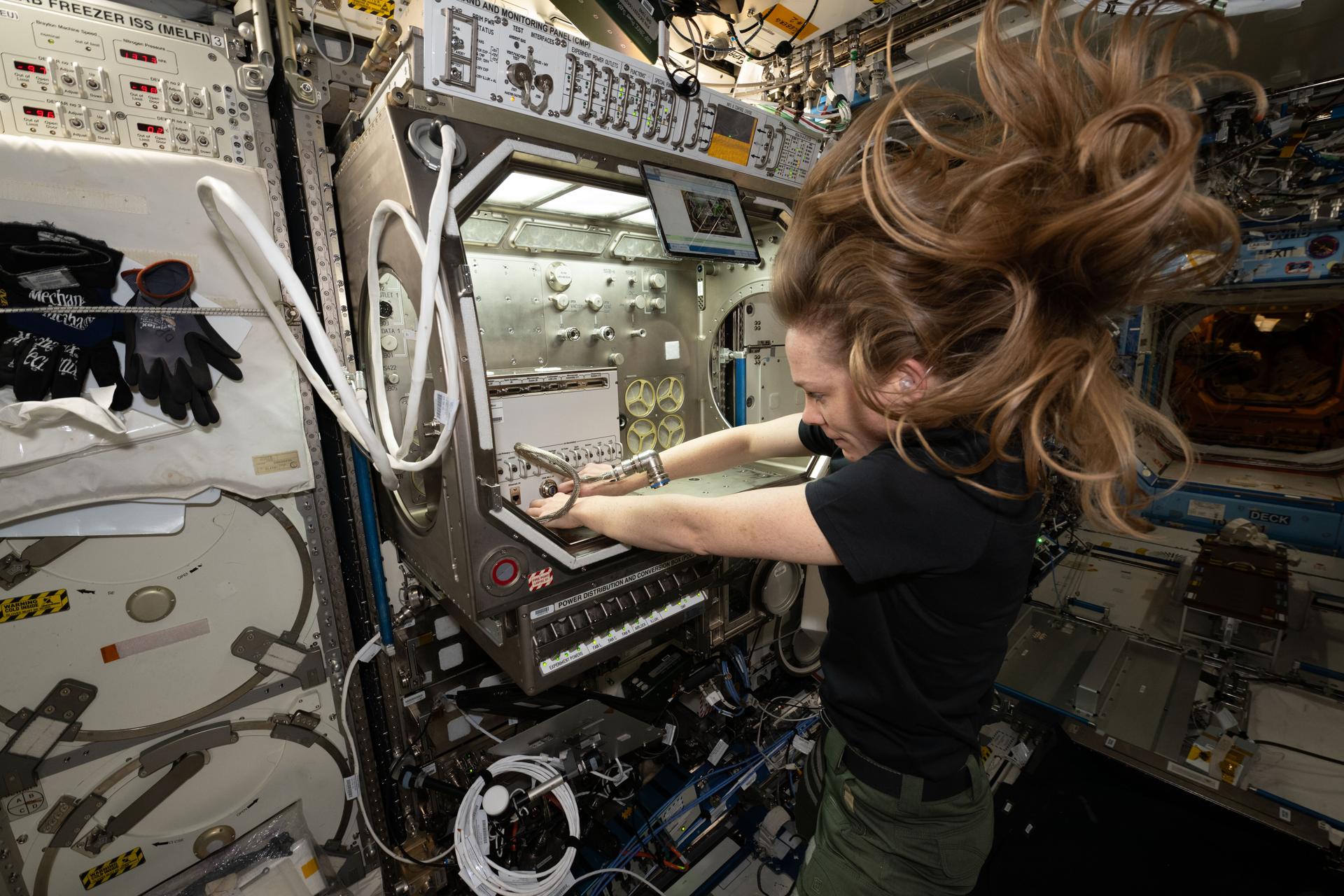
    NASA astronaut Nichole Ayers sets up the space station’s Ring Sheared Drop device, which uses surface tension to pin a drop of liquid between two rings. The device makes it possible to study liquid proteins without a solid container, eliminating interactions between the solutions and container walls that can affect results. The Ring Sheared Drop-IBP-2 experiment studies the behavior of protein fluids in microgravity and tests predictive computer models. Better models could help advance manufacturing processes in space and on Earth for next-generation medicines to treat cancers and other diseases.

    Crystallization research

    McClain, wearing a black t-shirt and green pants, examines an open gray box on a blue workbench. She reaches into the box with both hands, adjusting the hardware inside. The box lid lies on the bench. Inside the box is a cylindrical black device with a gold screw plate and multiple attached wires.
    NASA

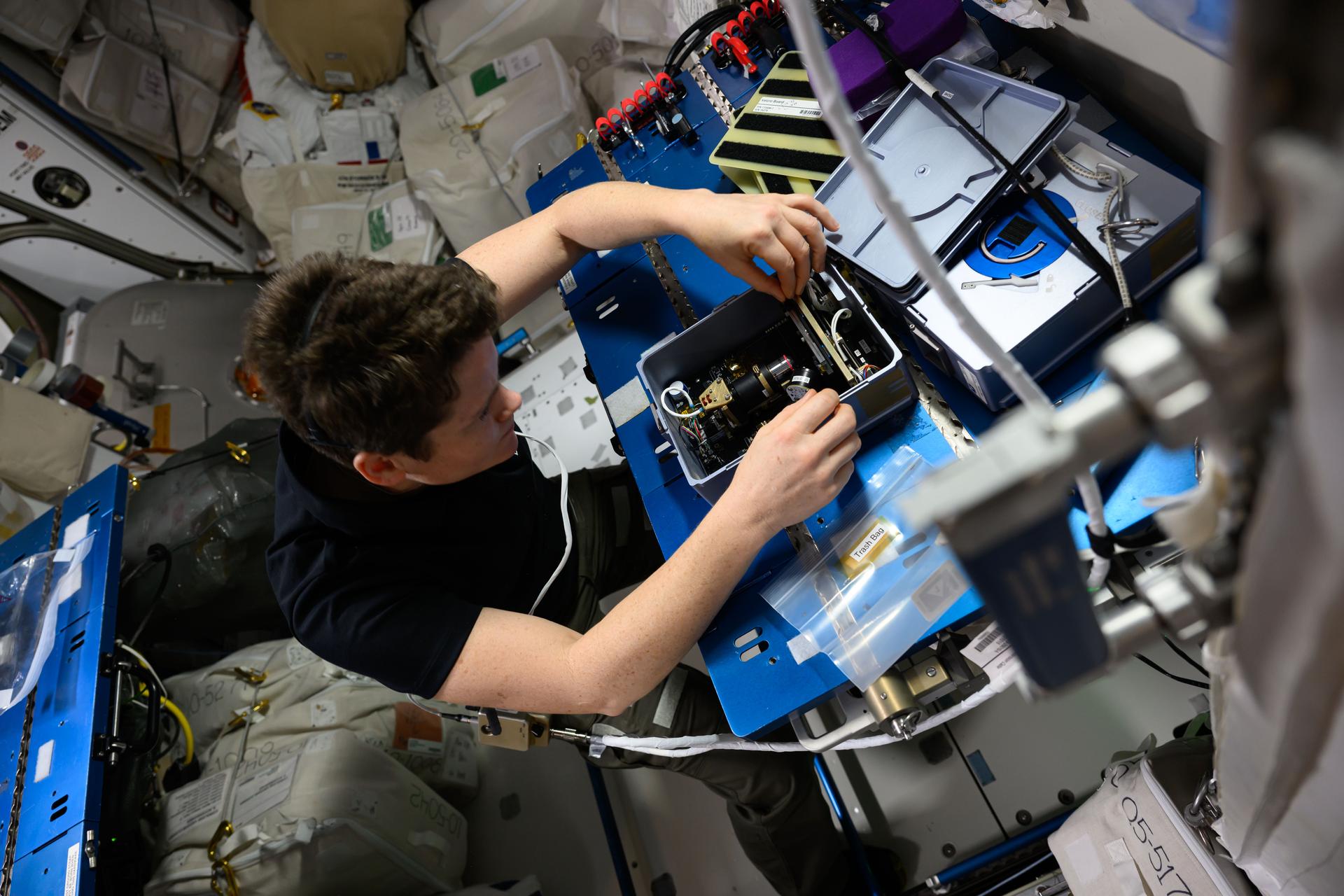
    NASA astronaut Anne McClain swaps out hardware in the International Space Station’s Advanced Space Experiment Processor-4, which enables physical science and crystallization research. A current investigation uses the processor to demonstrate technology that may be able to produce medications during deep space missions and improve pharmaceutical manufacturing on Earth.

    Monitoring astronaut health

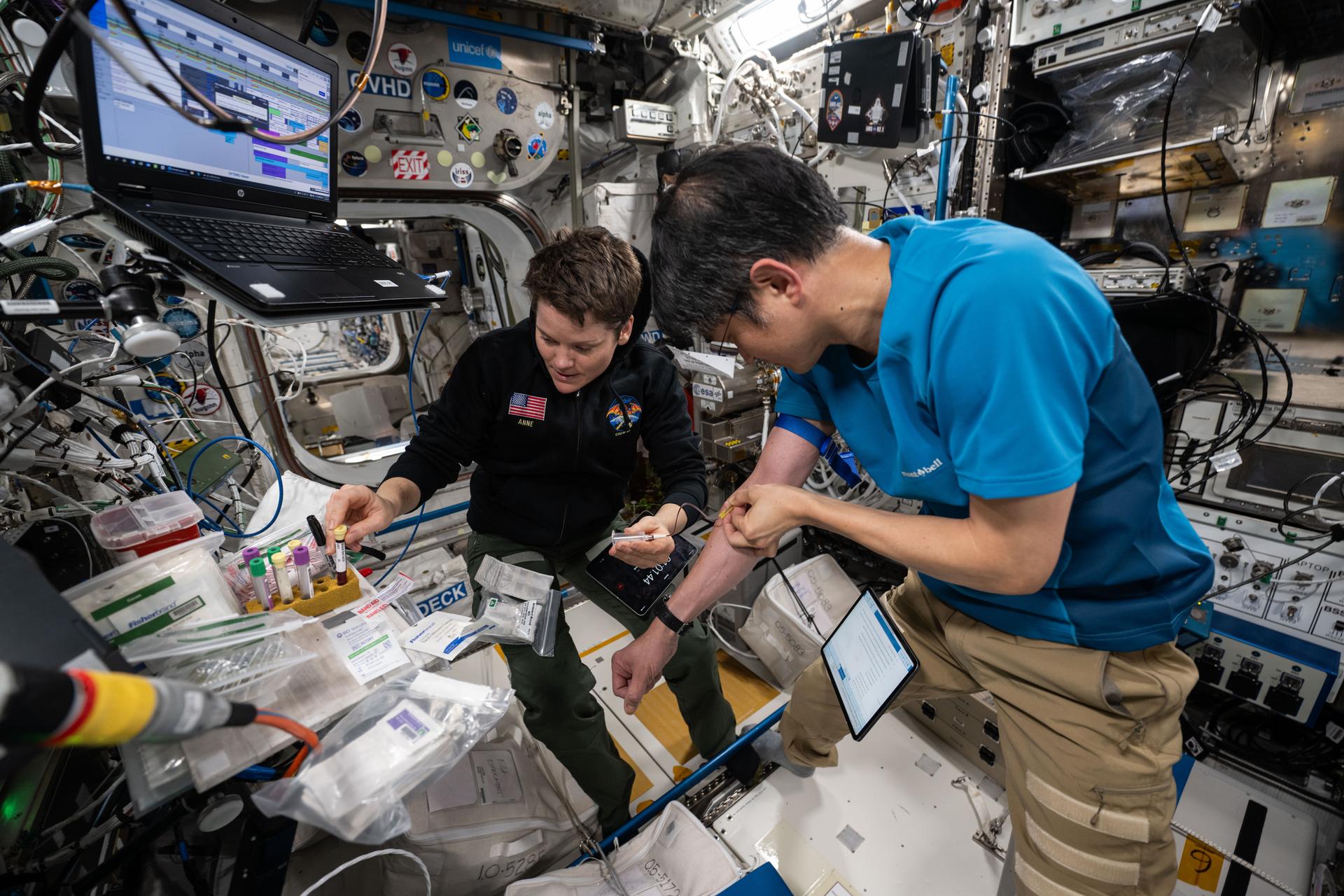
    Onishi, wearing a blue shirt and khaki pants with a tablet attached to his right leg, inserts a needle into his right arm. A tube connects the needle to a syringe held by McClain, who wears green pants, a black jacket with an American flag and Crew 10 patch, and she also has a tablet on her leg. With her right hand, she places a vial into a rack holding six other vials and a marker.
    NASA

    NASA astronaut Anne McClain helps JAXA (Japan Aerospace Exploration Agency) astronaut Takuya Onishi collect a sample of his blood. Analysis of blood samples is one tool NASA uses to continuously monitor crew health, including cardiovascular and immune system functions, bone and muscle mass changes, nutritional and metabolic status, and mental well-being. Crew members aboard the International Space Station also participate in various ongoing studies to better understand how different body systems adapt to weightlessness.

    Catching a corona

    The lower right corner of this image is a black arc, which is a portion of the Sun with its light blocked. A thin blue line marks the edge of the arc, and above it is a swath of light green interspersed with red and yellow blotches. The green and yellow extend up and down into a band of blue above, marked at the top by a thin purple line.
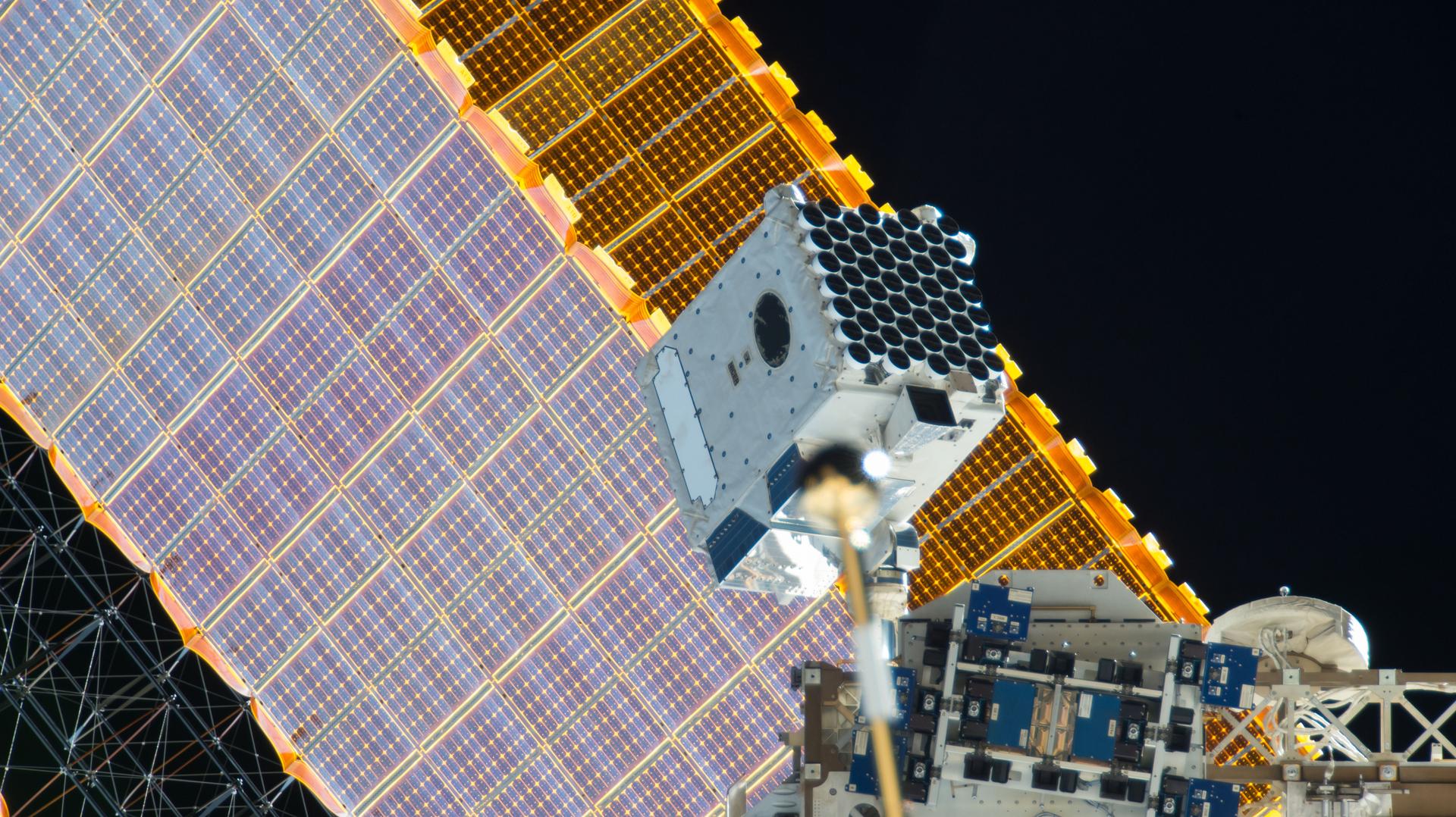
    NASA/KASI/INAF/CODEX

    This animated, color-coded heat map shows temperature changes in the Sun’s outer atmosphere, or corona, over several days, with red indicating hotter regions and purple showing cooler ones. Scientists can observe these changes thanks to the International Space Station’s CODEX, which collected data during the Crew-10 mission. The instrument uses a coronagraph to block out sunlight and reveal details in the Sun’s corona. Data from this investigation could help scientists understand the energy source of the solar wind, a flow of charged particles from the Sun that constantly bombards Earth.

    Expanding in-space crystallization

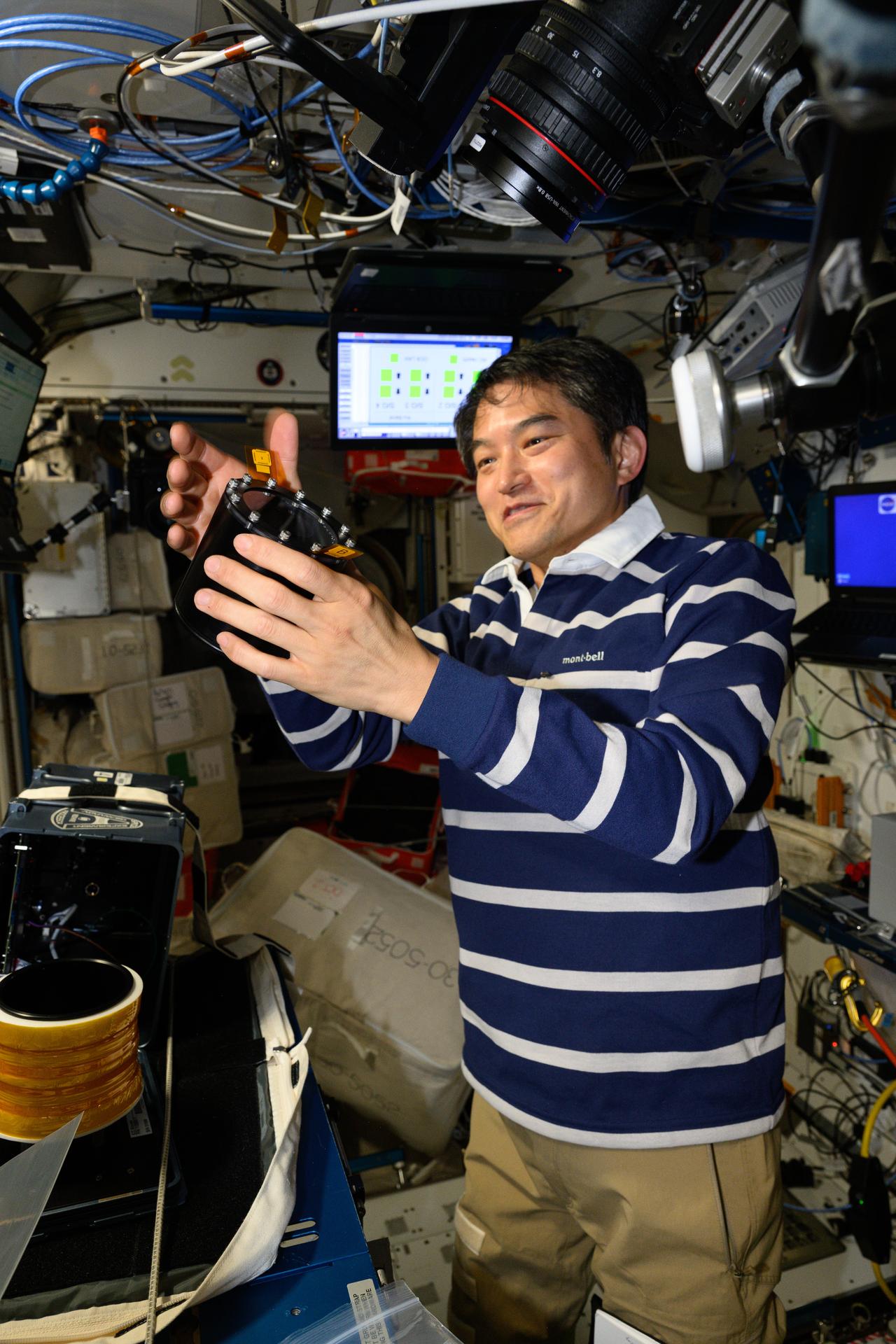
    Onishi wears a long-sleeved blue-and-white striped shirt and khaki pants. He is looking at a piece of equipment in his hands and smiling. The equipment is a black cylinder slightly larger than a soup can, with 12 metal screw caps around its top edge.
    NASA

    Astronaut Takuya Onishi of JAXA (Japan Aerospace Exploration Agency) services the International Space Station’s Advanced Space Experiment Processor-4 in preparation for ADSEP-Industrial Crystallization Cassette. This investigation tests new hardware that scales up research and could enable in-space production of pharmaceuticals and other materials for commercial space applications.

    Sowing seeds in space

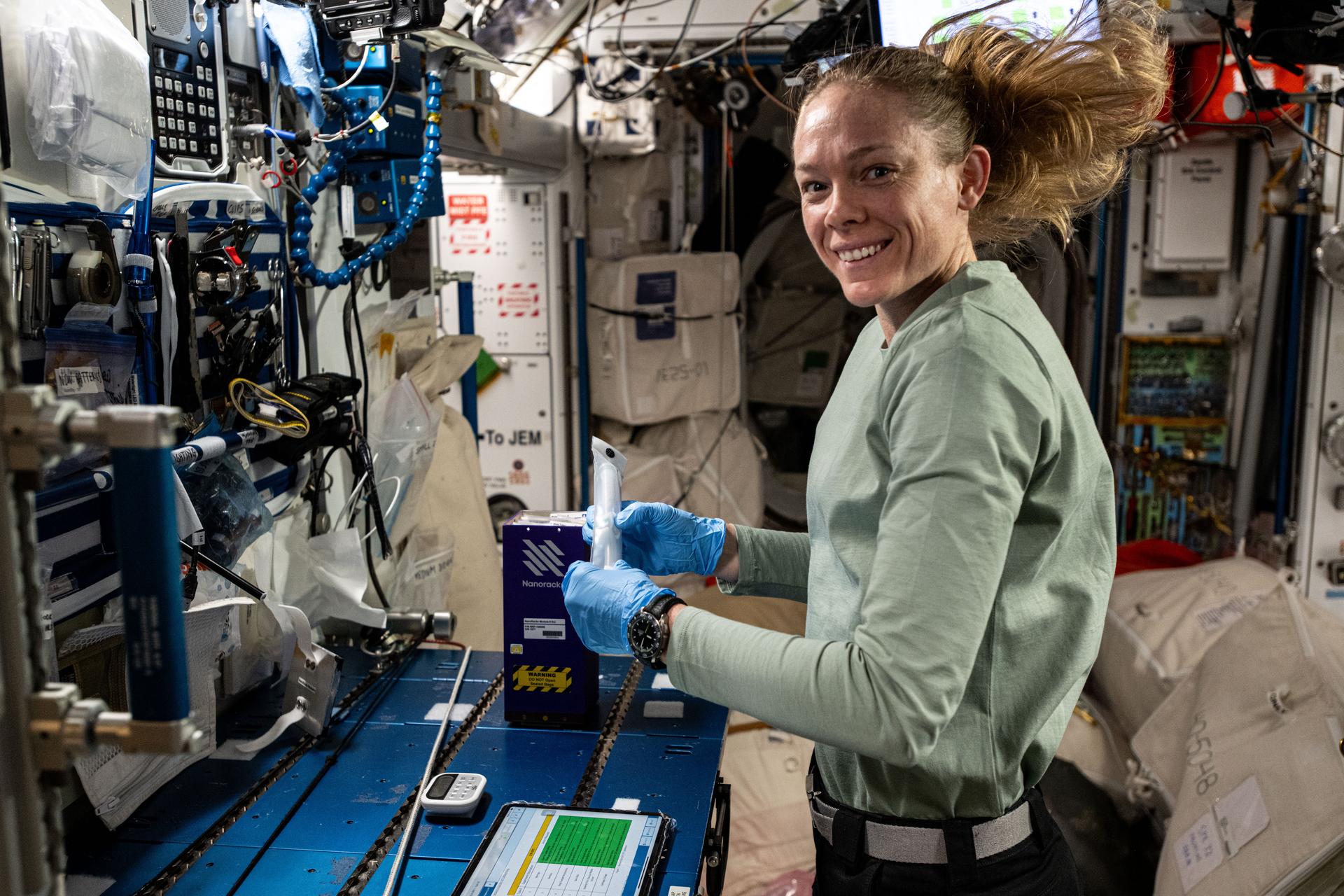
    Ayers is wearing a long-sleeved light green shirt and blue latex gloves. Her hair is in a ponytail. She floats in front of a blue workbench, smiling at the camera over her left shoulder. She is holding a packaged mixture tube in both hands.
    NASA

    NASA astronaut Nichole Ayers prepares mixture tubes containing samples for Nanoracks Module-9 Swiss Chard. This student-designed experiment examines whether the size, shape, color, and nutritional content of Swiss chard seeds germinated in space differ from those grown on Earth. The International Space Station hosts ongoing plant research as a source of food and other benefits, including contributing to astronaut well-being, for future long-duration missions.

    Protecting astronaut vision

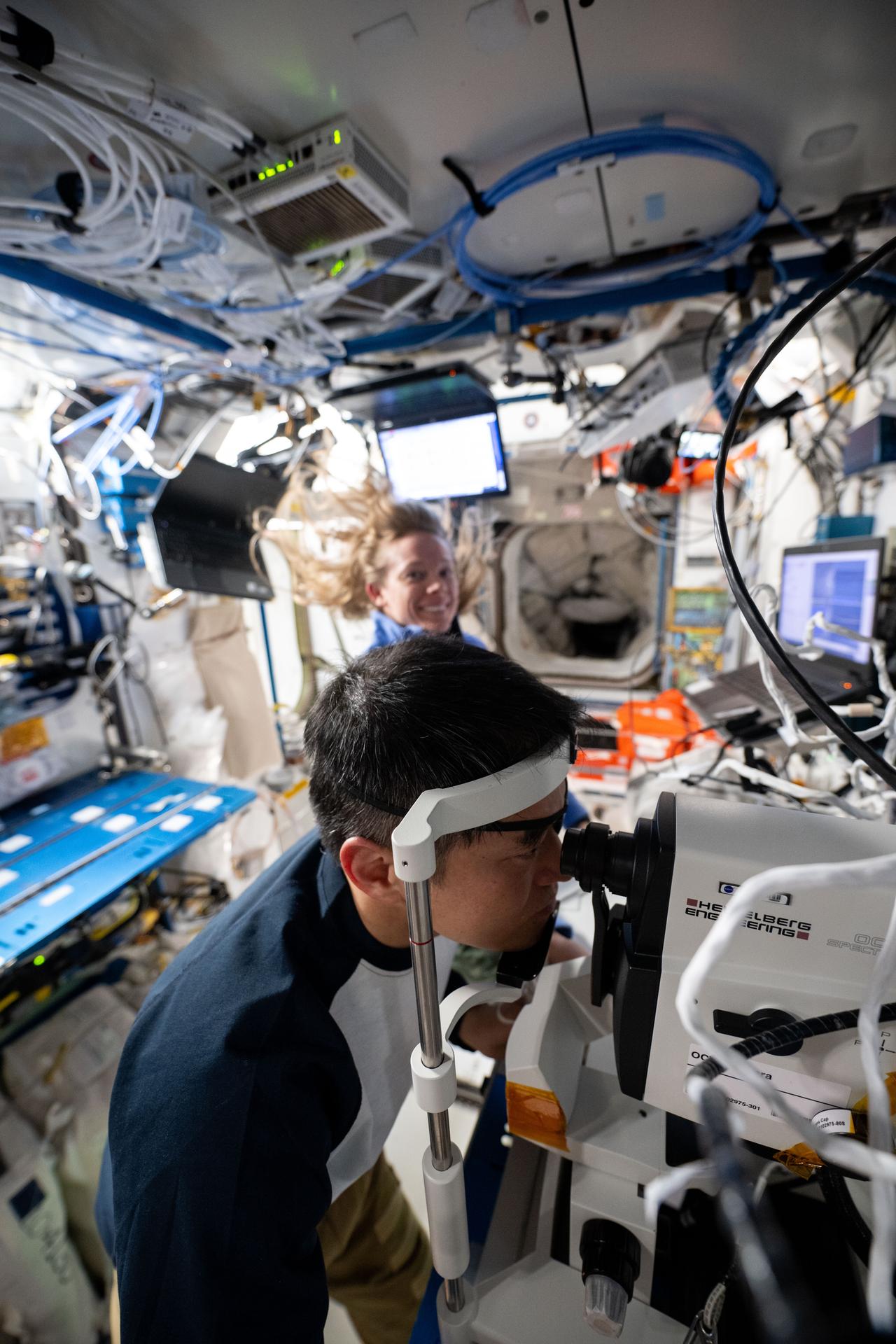
    Onishi, wearing a long-sleeved dark blue and white shirt, is facing the eye exam equipment, which is a white box about the size of a shoebox with a black eyepiece extending from the front. He is looking into the device with his forehead against a white bar and his chin on a black chin rest. Ayers is behind him, smiling but slightly out of focus.
    NASA

    Spaceflight can cause changes to eye structure and vision, so crew members monitor eye health throughout their missions. Astronaut Takuya Onishi of JAXA (Japan Aerospace Exploration Agency), assisted by NASA astronaut Nichole Ayers, conducts an eye exam aboard the International Space Station using optical coherence tomography. This technology uses reflected light to produce 3D images of the retina, nerve fibers, and other eye structures and layers.

    Details

    Last Updated

    Aug 05, 2025

  • NASA Science Activation Teams Unite to Support Neurodiverse Learners with Public Libraries

    3 min read

    NASA Science Activation Teams Unite to Support Neurodiverse Learners with Public Libraries

    On July 16, 2025, more than 400 public library staff from across the United States joined a powerful webinar, Serving Neurodiverse Library Patrons and Colleagues, hosted by two NASA Science Activation program teams: NASA@ My Library and NASA’s Neurodiversity Network (N3). The event brought together researchers, library professionals, and individuals with lived experience of neurodiversity to share insights and best practices for creating more inclusive and supportive environments in libraries.

    Designed to equip library staff with tools and awareness, this interactive webinar explored how libraries can better serve neurodiverse patrons, such as those with autism, attention deficit hyperactivity disorder (ADHD), dyslexia, and other cognitive variations, while also supporting neurodiverse colleagues. Breakout rooms allowed participants to dive deeper into specific topics, including accessible program facilitation, supporting neurodiverse colleagues, and an “Ask Me Anything” space that encouraged open dialogue and learning.

    Library staff everywhere are invited to watch the recorded webinar on YouTube and learn more about serving neurodiverse patrons and colleagues.

    The collaboration between NASA@ My Library (led by the Space Science Institute), and NASA’s Neurodiversity Network (N3) (led by Sonoma State University), reflects a shared commitment to broadening participation in STEM (Science, Technology, Engineering, and Mathematics). NASA@ My Library works with public libraries nationwide to engage diverse communities in NASA science and discoveries. N3 focuses on empowering neurodiverse learners – particularly those in high school – with opportunities to engage with NASA science and explore potential STEM career pathways.

    Participants left inspired, and the demand for more is clear: attendees and speakers alike expressed interest in continuing the conversation, requesting additional training, and expressing interest in organizing a future conference centered on neurodiversity and inclusion in libraries.

    Youth Services Librarian and webinar panelist Molly Creveling shared, “This was such a great opportunity, and I’m extremely proud to have been able to contribute to it, I wish I was able to attend everyone’s break out room!” And participant Jason Wood expressed in the chat, “Really, really appreciate this webinar. This is one of those days I am extra proud to be a librarian. Thank you all.” Another enthusiast participant said, “This was the best webinar I’ve attended in years…more of this!”

    Watch the recorded webinar.

    As NASA continues to reach for the stars, it’s equally committed to ensuring that the journey is accessible to all – especially those whose unique ways of thinking and learning bring fresh perspectives to science, exploration, and discovery.

    NASA@ My Library and N3, supported by NASA under cooperative agreement award numbers NNX16AE30A and  80NSSC21M0004, are part of NASA’s Science Activation Portfolio. Learn more about how Science Activation connects NASA science experts, real content, and experiences with community leaders to do science in ways that activate minds and promote deeper understanding of our world and beyond: https://science.nasa.gov/learn

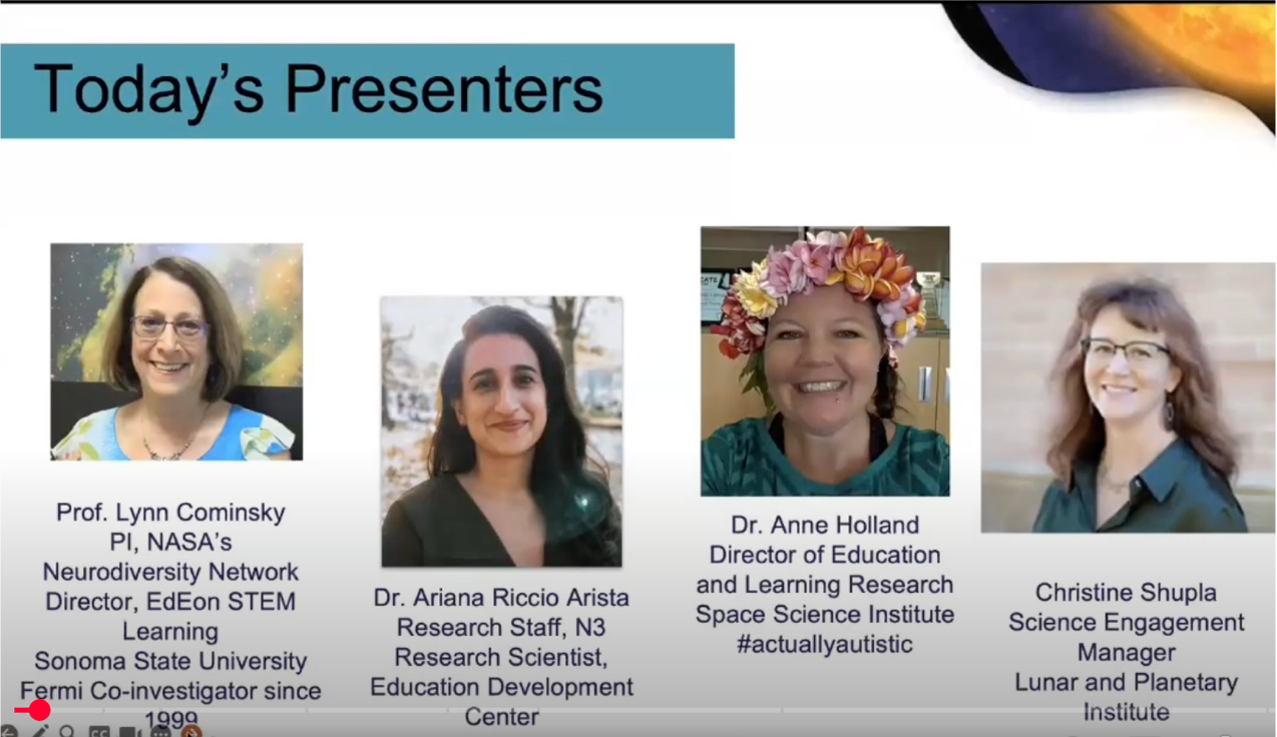
    Presentation slide showing photos of webinar presenters.
    Presenters included staff from NASA’s Neurodiversity Network, NASA@ My Library, Education Development Center, and the Lunar and Planetary Institute.

    Details

    Last Updated

    Aug 05, 2025

    Editor
    NASA Science Editorial Team

  • What is NASA’s Distributed Spacecraft Autonomy?

    Software designed to give spacecraft more autonomy could support a future where swarms of satellites navigate and complete scientific objectives with limited human intervention.

    A man stands in front of a computer server and gestures towards the racks and cables.
    Caleb Adams, Distributed Spacecraft Autonomy project manager, monitors testing alongside the test racks containing 100 spacecraft computers at NASA’s Ames Research Center in California’s Silicon Valley. The DSA project develops and demonstrates software to enhance multi-spacecraft mission adaptability, efficiently allocate tasks between spacecraft using ad-hoc networking, and enable human-swarm commanding of distributed space missions.
    Credit: NASA/Brandon Torres Navarrete

    Astronauts living and working on the Moon and Mars will rely on satellites to provide services like navigation, weather, and communications relays. While managing complex missions, automating satellite communications will allow explorers to focus on critical tasks instead of manually operating satellites.  

    Long duration space missions will require teaming between systems on Earth and other planets. Satellites orbiting the Moon, Mars, or other distant areas face communications delays with ground operators which could limit the efficiency of their missions.  

    The solution lies within the Distributed Spacecraft Autonomy (DSA) project, led by NASA’s Ames Research Center in California’s Silicon Valley, which tests how shared autonomy across distributed spacecraft missions makes spacecraft swarms more capable of self-sufficient research and maintenance by making decisions and adapting to changes with less human intervention. 

    Adding autonomy to satellites makes them capable of providing services without waiting for commands from ground operators. Distributing the autonomy across multiple satellites, operating like a swarm, gives the spacecraft a “shared brain” to accomplish goals they couldn’t achieve alone. 

    The DSA software, built by NASA researchers, provides the swarm with a task list, and shares each spacecraft’s distinct perspective – what it can observe, what its priorities are – and integrates those perspectives into the best plan of action for the whole swarm. That plan is supported by decision trees and mathematical models that help the swarm decide what action to take after a command is completed, how to respond to a change, or address a problem. 

    Sharing the Workload

    The first in-space demonstration of DSA began onboard the Starling spacecraft swarm, a group of four small satellites, demonstrating various swarm technologies. Operating since July 2023, the Starling mission continues providing a testing and validation platform for autonomous swarm operations. The swarm first used DSA to optimize scientific observations, deciding what to observe without pre-programmed instructions. These autonomous observations led to measurements that could have been missed if an operator had to individually instruct each satellite. 

    The Starling swarm measured the electron content of plasma between each spacecraft and GPS satellites to capture rapidly changing phenomena in Earth’s ionosphere – where Earth’s atmosphere meets space. The DSA software allowed the swarm to independently decide what to study and how to spread the workload across the four spacecraft. 

    Because each Starling spacecraft operates as an independent member within the swarm, if one swarm member was unable to accomplish its work, the other three swarm members could react and complete the mission’s goals. 

    The Starling 1.0 demonstration achieved several firsts, including the first fully distributed autonomous operation of multiple spacecraft, the first use of space-to-space communications to autonomously share status information between multiple spacecraft, the first demonstration of fully distributed reactive operations onboard multiple spacecraft, the first use of a general-purpose automated reasoning system onboard a spacecraft, and the first use of fully distributed automated planning onboard multiple spacecraft. These achievements laid the groundwork for Starling 1.5+, an ongoing continuation of the satellite swarm’s mission using DSA.  

    Illustrated image of four satellites orbiting Earth as the sun rises over the planet's horizon.
    Advanced testing of DSA onboard Starling shows that distributed autonomy in spacecraft swarms can improve efficiencies while reducing the workload on human operators.
    Credit: NASA/Daniel Rutter

    A Helping Hand in Orbit 

    After DSA’s successful demonstration on Starling 1.0, the team began exploring additional opportunities to use the software to support satellite swarm health and efficiency. Continued testing of DSA on Starling’s extended mission included PLEXIL (Plan Execution Interchange Language), a NASA-developed programming language designed for reliable and flexible automation of complex spacecraft operations. 

    Onboard Starling, the PLEXIL application demonstrated autonomous maintenance, allowing the swarm to manage normal spacecraft operations, correct issues, or distribute software updates across individual spacecraft.  

    Enhanced autonomy makes swarm operation in deep space feasible – instead of requiring spacecraft to communicate back and forth between their distant location and Earth, which can take minutes or hours depending on distance, the PLEXIL-enabled DSA software gives the swarm the ability to make decisions collaboratively to optimize their mission and reduce workloads. 

    Simulated Lunar Swarming 

    To understand the scalability of DSA, the team used ground-based flight computers to simulate a lunar swarm of virtual small spacecraft. The computers simulated a swarm that provides position, navigation, and timing services on the Moon, similar to GPS services on Earth, which rely on a network of satellites to pinpoint locations. 

    The DSA team ran nearly one hundred tests over two years, demonstrating swarms of different sizes at high and low lunar orbits. The lessons learned from those early tests laid the groundwork for additional scalability studies. The second round of testing, set to begin in 2026, will demonstrate even larger swarms, using flight computers that could later go into orbit with DSA software onboard. 

    The Future of Spacecraft Swarms 

    Orbital and simulated tests of DSA are a launchpad to increased use of distributed autonomy across spacecraft swarms. Developing and proving these technologies increases efficiency, decreases costs, and enhances NASA’s capabilities opening the door to autonomous spacecraft swarms supporting missions to the Moon, Mars, and beyond.  

    Milestones:

    • October 2018: DSA project development begins.
    • April 2020: Lunar position, navigation, and timing (LPNT) simulation demonstration development begins.
    • July 2023: DSA launches onboard the Starling spacecraft swarm.
    • March 2024: DSA experiments onboard Starling reach the necessary criteria for success.
    • July 2024: DSA software development begins for the Starling 1.5+ mission extension.
    • September 2024: LPNT simulation demonstration concludes successfully.
    • October 2024: DSA’s extended mission as part of Starling 1.5+ begins.

    Partners:

    NASA Ames leads the Distributed Spacecraft Autonomy and Starling projects. NASA’s Game Changing Development program within the agency’s Space Technology Mission Directorate provided funding for the DSA experiment. NASA’s Small Spacecraft Technology program within the Space Technology Mission Directorate funds and manages the Starling mission and the DSA project.  

    Learn More:

    For researchers:

    For media:

    Members of the news media interested in covering this topic should reach out to the NASA Ames newsroom.

  • Second Lady Usha Vance, NASA Astronaut Suni Williams Celebrate Reading

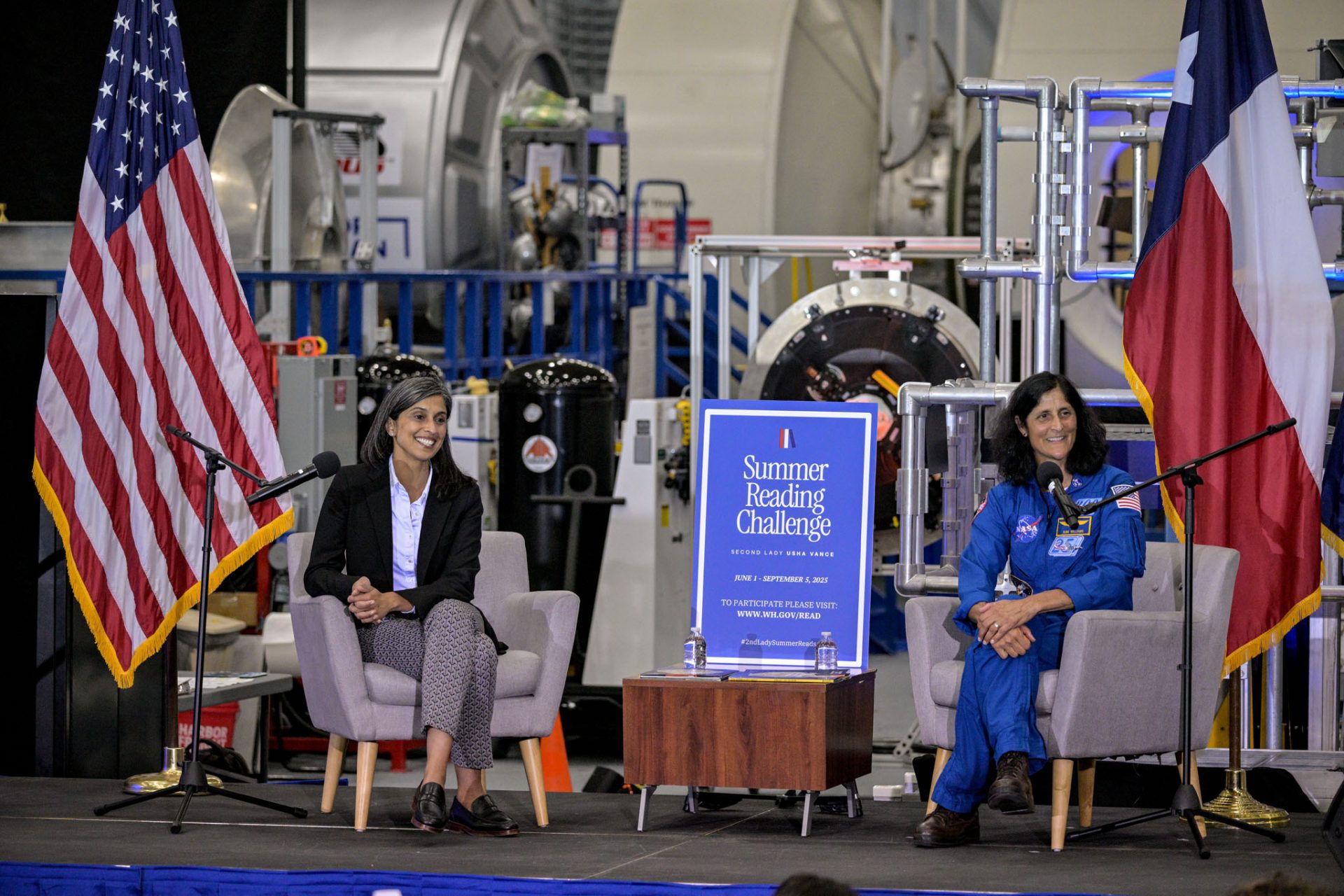
    Second Lady Usha Vance and astronaut Suni Williams sit in gray chairs on a stage. They are both smiling as they listen. The U.S. flag, the state flag of Texas, and a flag with the NASA seal are on the podium alongside them. There is a blue poster board with a white border promoting the Summer Reading Challenge between them.
    NASA/Robert Markowitz

    Second Lady Usha Vance and NASA astronaut Suni Williams listen to the audience in this image from Aug. 4, 2025. Ms. Vance joined Williams at NASA’s Johnson Space Center in Houston for a summer reading challenge event, through which the Second Lady encourages youth to seek adventure, imagination, and discovery between the pages of a book.

    Image credit: NASA/Robert Markowitz

  • Second Lady Usha Vance, NASA Astronaut Suni Williams Celebrate Reading

    Second Lady Usha Vance, NASA Astronaut Suni Williams Celebrate Reading

    Second Lady Usha Vance hosted a special Summer Reading Challenge event at NASA’s Johnson Space Center in Houston on Aug. 4, 2025. She was joined by NASA astronaut Suni Williams to read a space-themed book to children in grades K-8 as part of her initiative to promote literacy.

  • Curiosity Blog, Sols 4616-4617: Standing Tall on the Ridge

    4 min read

    Curiosity Blog, Sols 4616-4617: Standing Tall on the Ridge

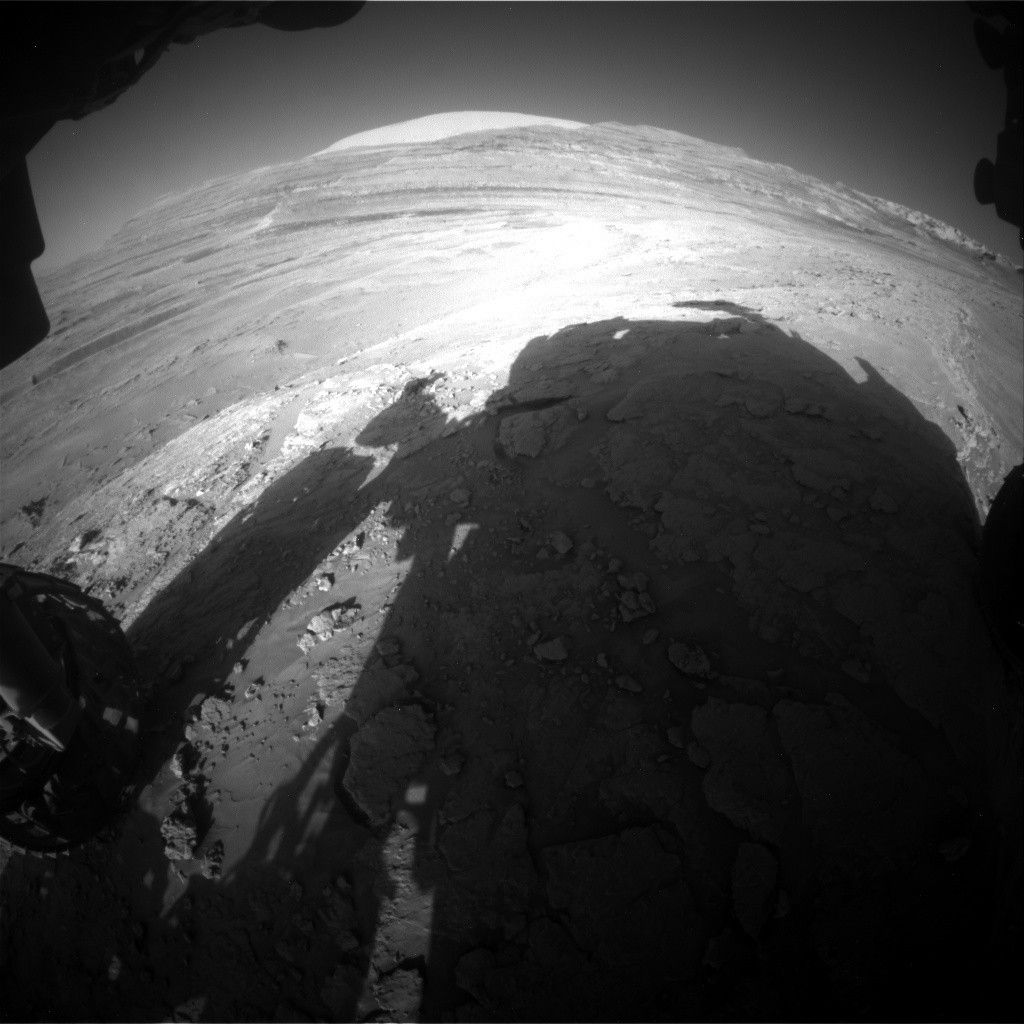
    An extreme wide-angle, grayscale photo from the Mars surface shows uneven terrain ahead of the rover, covered in numerous small to medium-sized rocks, all light gray and illuminated by sunlight. Impressions in the middle ground ahead form swooping backward Cs, and in the far distance a mountain rises from the ground, but looks very broad and squat, because of the distortion from the wide-angle lens. Parts of the rover are visible around the sides and bottom of the image, and its shadow fills much of the foreground.
    NASA’s Mars rover Curiosity acquired this image, showing the impressive landscape it is currently navigating. The rover is standing tall on the ridge, its shadow casting forward, and Mount Sharp towers over the scene in the distance. Curiosity captured this image with its Front Hazard Avoidance Camera (Front Hazcam) on July 30, 2025 — Sol 4614, or Martian day 4,614 of the Mars Science Laboratory mission — at 02:24:02 UTC.
    NASA/JPL-Caltech

    Written by Susanne P. Schwenzer, Professor of Planetary Mineralogy at The Open University, UK

    Earth planning date: Wednesday, July 30, 2025

    The day started with a little celebration of NISAR, a new Earth observation satellite that made it successfully into orbit a few hours before our planning started. We joined in by saying “GO NISAR, NASA, JPL, and ISRO” (the Indian Space Research Organisation, NASA’s mission partner, which launched NISAR). Learn more at the NISAR mission hub. Although our team studies Mars, Earth is a planet, too, and we are very happy for our colleagues’ successful launch!

    On Mars, it’s still winter and the topic of every planning is how to maximize the science we can do given the increased power needs for heating our rover at this time of the year. Curiosity is parked on top of the main ridge, nicknamed the “autobahn.” It turned out to be not as smooth as its terrestrial namesake, as you can see in the image above. To arrive at this parking position, our rover drivers decided to take a small detour down into a flatter area and back up onto the ridge for safe off-road driving. The rover’s parking position allows for beautiful views around us, laying out the land of hollows and ridges perfectly to plan our next steps and to admire Mount Sharp in the distance.

    Standing tall on the ridge, we got several investigations of the ridge-forming materials into today’s plan. APXS, MAHLI, and ChemCam are all teaming up to investigate the target “El Salto.” This is a target that could get us a glimpse into what formed the central line that is running along the big ridge. If you look closely at the images there are subtle differences in color and texture, and we are all curious whether that translates to chemical differences, too.

    Of course, it’s not all about chemistry. Mastcam is busy documenting a small mound, and its context with veins and the hollow surrounding it, at the target “Llullaillaco.” The target “Cementerio De Tortugas” will capture sand ripples within a trough area, there is an extension of the workspace imaging in the plan for more context of today’s observations, and finally the ridge intersection is of interest at the target “Villa Abecia.” Of course, Mastcam didn’t forget the documentation of the ChemCam target “El Salto” and the AEGIS target from the last plan. Speaking of ChemCam: It’s using its imaging capabilities to document the side of the ridge to give finer details of the sedimentary structures of the target “Llullaillaco.”

    Atmospheric observations are also of highest interest at this time of the day. We continue our atmospheric monitoring by looking for dust devils as well as up toward the clouds in a joint observation with the CASSIS instrument, which is aboard the European Space Agency’s Trace Gas Orbiter. In addition, Curiosity continues to monitor wind and temperature throughout the plan, and the DAN (dynamic albedo of neutrons) instrument observes the rocks underneath the rover for their water content.

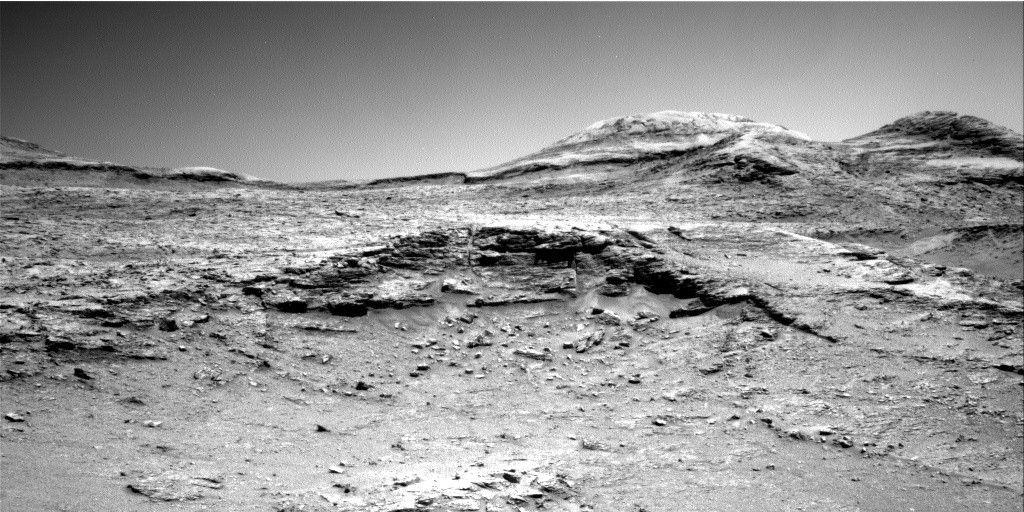
    After completing the observations at the current parking location, Curiosity will be driving off the ridge again, but this time to stay within the hollow, so we can make observations of the material that forms those hollows. Let’s see if we can find any chemical differences between those materials that might explain why one is standing up tall and the other one is weathering out. If you want to get a better impression of what I am talking about when I say ridges and troughs, have a look at this recent navigation camera mosaic.

    Details

    Last Updated

    Aug 04, 2025

    Related Terms