Waves and their Applications in Technologies for Information Transfer (MS-PS4)
Grades 5-8. Students strengthen their understanding of the electromagnetic spectrum, specifically lasers and their applications, through a series of math, writing, and graphing challenges. This series of activities can be completed together or in parts.
Since the inception of the technology in the 1970s, White Sands Test Facility (WSTF) has been at the forefront of NASA’s testing and evaluation of composite pressure components, building on unique strengths in Oxygen Systems, Propellants and Aerospace Fluids, Hypervelocity Impact Testing, and Materials Flight Acceptance testing.
Our team of experts continues to lead the way by studying damage tolerance and stress rupture while developing life extension protocols for NASA, industry partners, the Air Force, and government agencies.
WSTF technical advancements in composites are shared through dozens of test standards distributed by ANSI/AIAA, ASTM International, and research reports published for the NASA Engineering and Safety Center and NASA NDE Development Program.
iss070e002415 (Oct. 4, 2023) — ESA (European Space Agency) astronaut and Expedition 70 Commander Andreas Mogensen is pictured trying on his spacesuit and testing its components aboard the International Space Station’s Quest airlock in preparation for an upcoming spacewalk.
iss070e002869 (Oct. 11, 2023) — (From left) Expedition 70 Commander Andreas Mogensen of ESA (European Space Agency); and Flight Engineers Loral O’Hara and Jasmin Moghbeli, both from NASA; and Satoshi Furukawa of JAXA (Japan Aerospace Exploration Agency), pose for a portrait aboard the International Space Station’s Destiny laboratory module. The quartet is showing off crew active dosimeters that monitor the amount of radiation astronauts are exposed to in the microgravity environment.
iss070e002889 (Oct. 9, 2023) — NASA astronaut and Expedition 70 Flight Engineer Loral O’Hara is pictured trying on her spacesuit and testing its components aboard the International Space Station’s Quest airlock in preparation for an upcoming spacewalk.
iss070e003139 (Oct. 12, 2023) — Expedition 70 Commander Andreas Mogensen of ESA (European Space Agency) demonstrates collecting air samples to analyze and quantify trace contaminants in the International Space Station’s atmosphere. The Analyzing Interferometer for Ambient Air-2, or ANITA-2, serves as a technology demonstration in support of human exploration missions beyond low-Earth orbit.
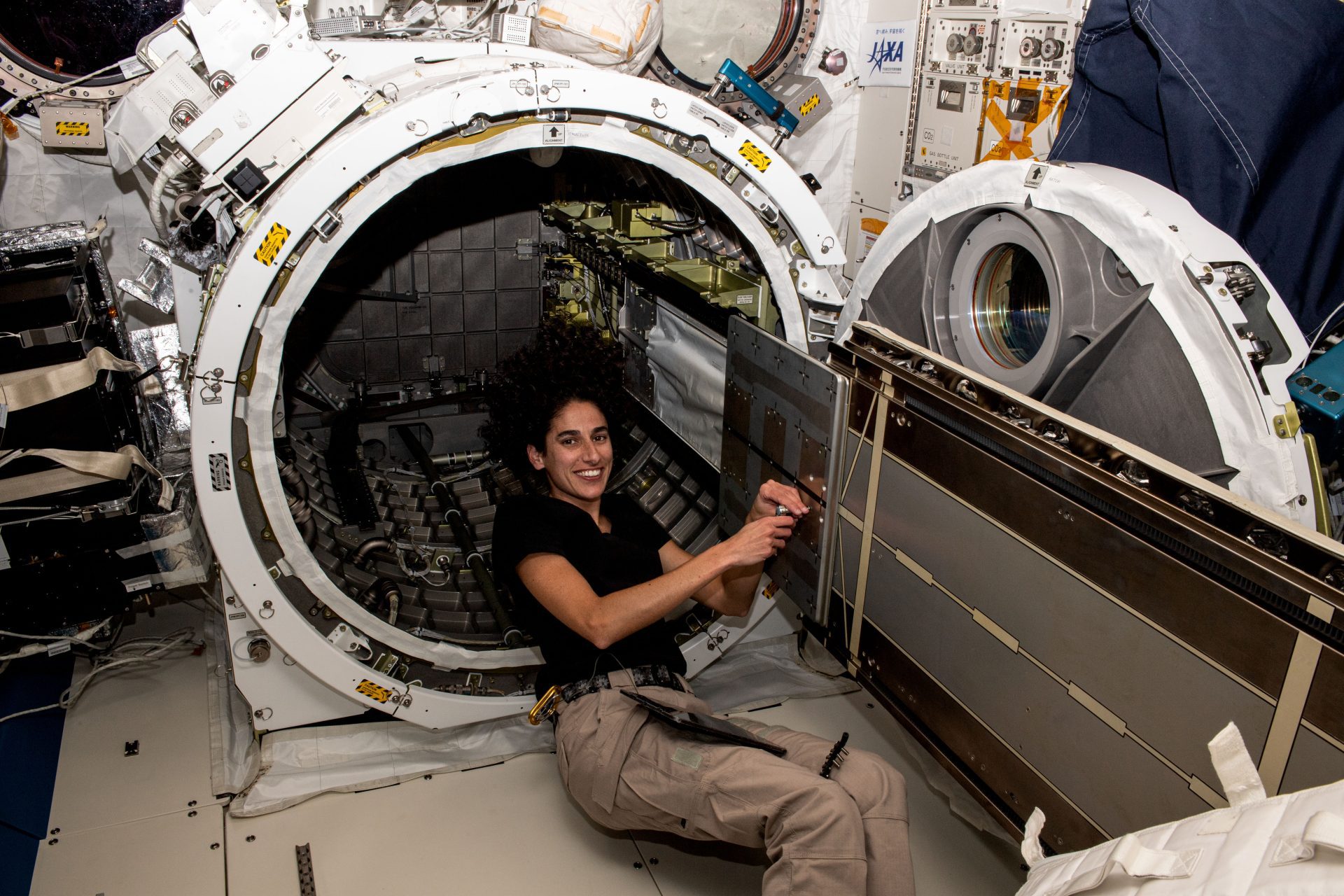
iss070e000559 (Sept. 29, 2023) — NASA astronaut and Expedition 70 Flight Engineer Jasmin Moghbeli prepares external hardware for retraction inside the Kibo laboratory module’s airlock aboard the International Space Station.
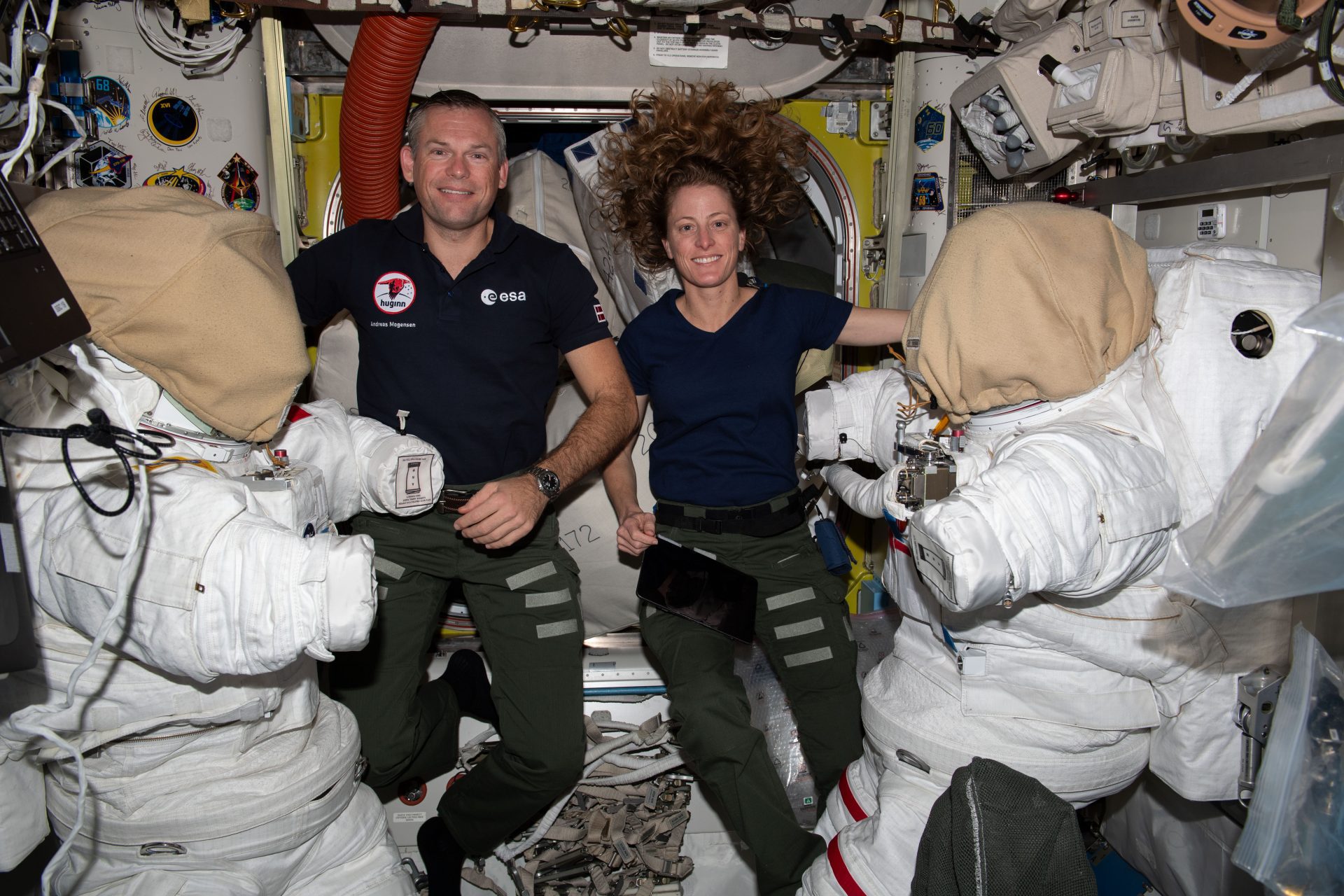
iss070e001172 (Oct. 2, 2023) — Astronauts Andreas Mogensen of ESA (European Space Agency) and Loral O’Hara of NASA service spacesuits inside the Quest airlock. The duo took turns cleaning cooling loops inside the suits ahead of a spacewalk planned for Oct. 12 to collect microbe samples from specific areas outside of the International Space Station. Scientists want to analyze the types of microbes that may be able to survive the harsh environment of outer space.
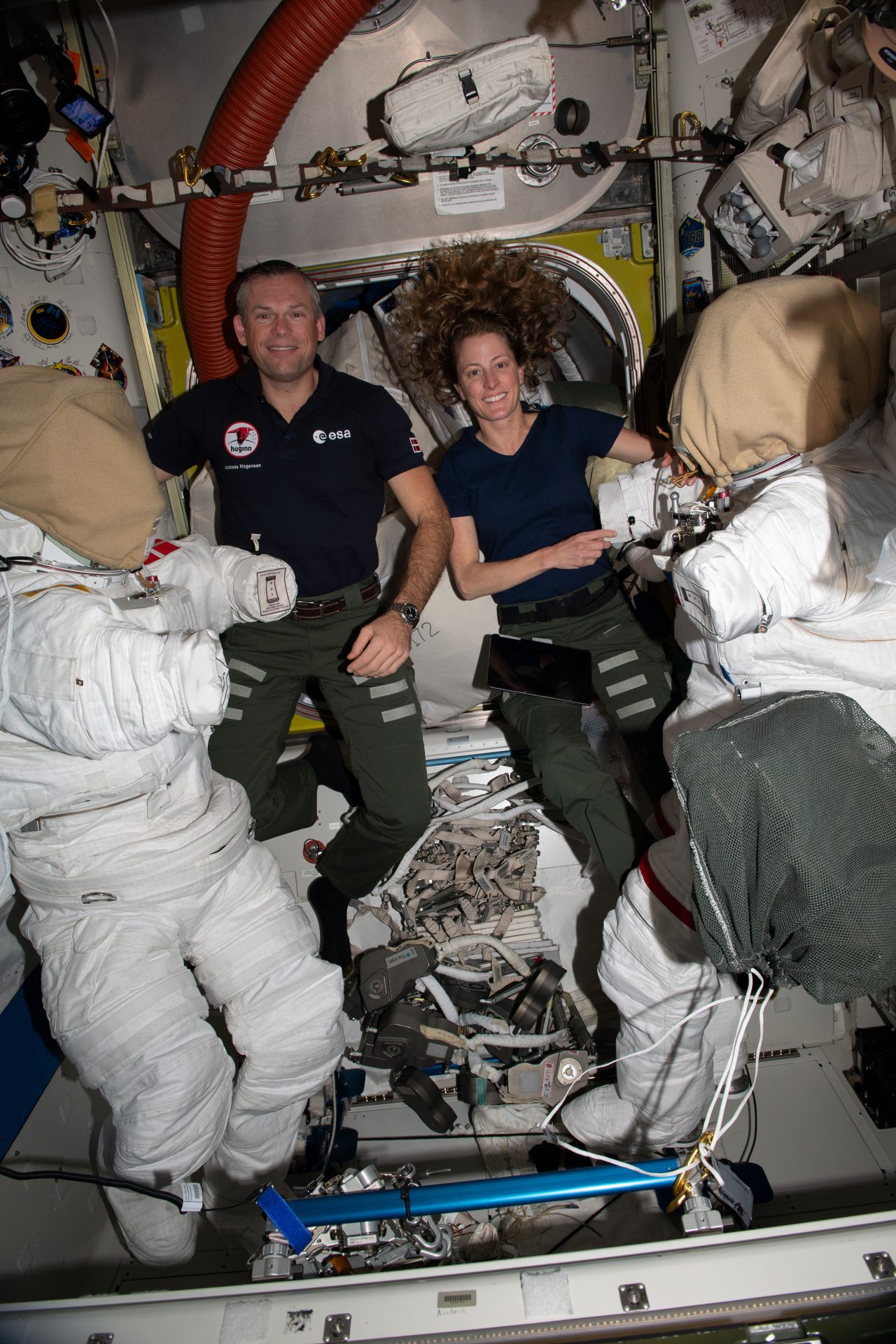
iss070e001174 (Oct. 2, 2023) — Astronauts Andreas Mogensen of ESA (European Space Agency) and Loral O’Hara of NASA service spacesuits inside the Quest airlock. The duo took turns cleaning cooling loops inside the suits ahead of a spacewalk planned for Oct. 12 to collect microbe samples from specific areas outside of the International Space Station. Scientists want to analyze the types of microbes that may be able to survive the harsh environment of outer space.
iss070e001546 (Sept. 30, 2023) — Two lakes in Turkey, the larger Van Lake and the smaller Erçek Lake, are pictured from the International Space Station as it orbited 259 miles above the Eurasian region near the Caspian Sea.
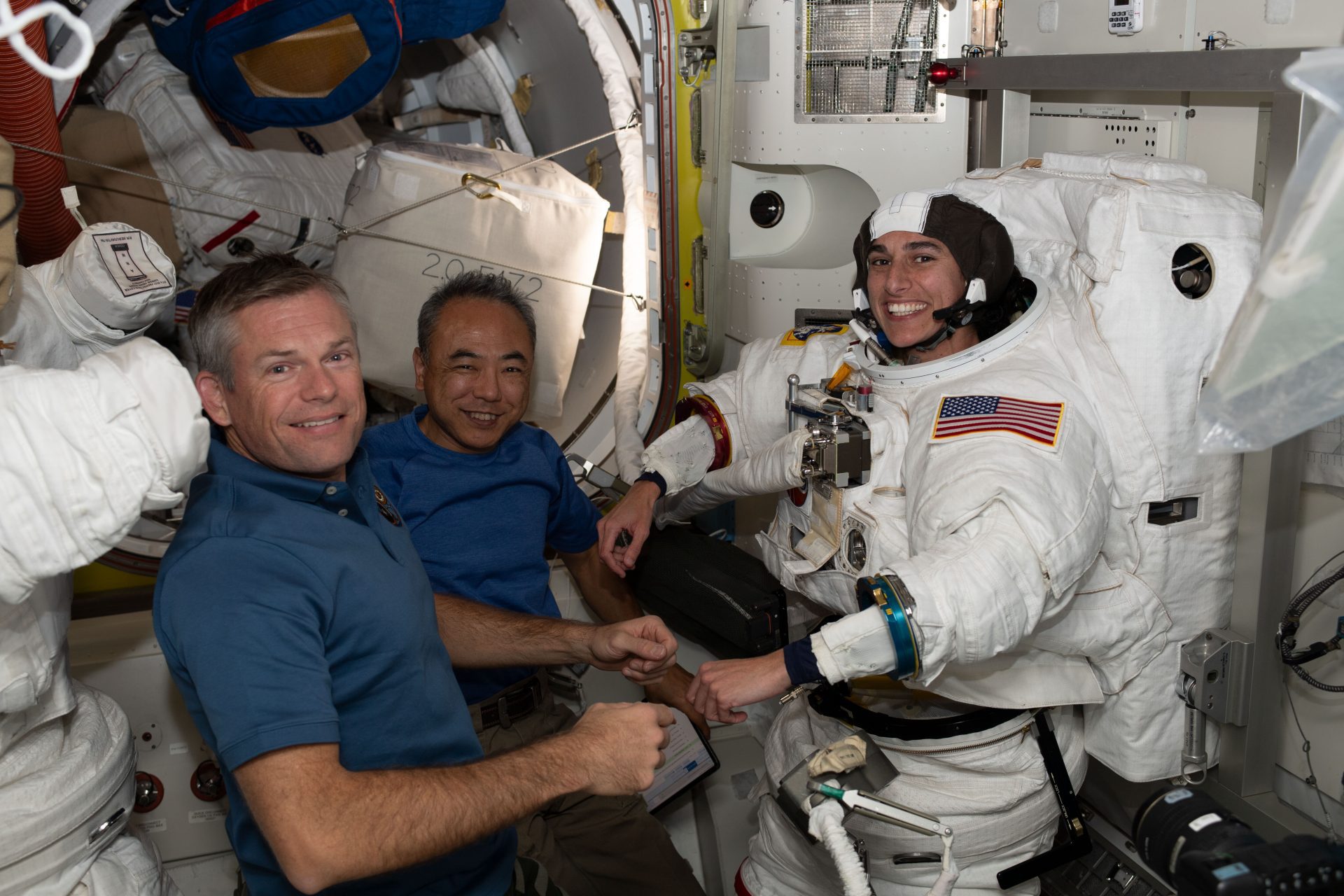
iss070e0017505 (Oct. 3, 2023) — (From left) Astronauts Andreas Mogensen from ESA (European Space Agency) and Satoshi Furukawa from JAXA (Japan Aerospace Exploration Agency) assist NASA astronaut Jasmin Moghbeli as she tries on her spacesuit and tests its components aboard the International Space Station’s Quest airlock in preparation for an upcoming spacewalk.
iss070e0017543 (Oct. 3, 2023) — Expedition 70 Commander Andreas Mogensen from ESA (European Space Agency) assists NASA astronaut Jasmin Moghbeli as she tries on her spacesuit and tests its components aboard the International Space Station’s Quest airlock in preparation for an upcoming spacewalk.
El astronauta Frank Rubio, de la Expedición 69 de la NASA, es visto fuera de la nave espacial Soyuz MS-23 tras aterrizar junto a los cosmonautas de Roscosmos Sergey Prokopyev y Dmitri Petelin en una zona remota cerca de la ciudad de Zhezkazgan, Kazajstán, el miércoles 27 de septiembre de 2023. El trío regresó a la Tierra tras pasar 371 días en el espacio como miembros de las Expediciones 68-69 a bordo de la Estación Espacial Internacional. Para Rubio, su misión es el vuelo espacial más largo realizado por un astronauta estadounidense en la historia.
NASA/Bill Ingalls
El astronauta de la NASA Frank Rubio, de regreso a la Tierra tras batir el récord del vuelo espacial individual más largo de la historia realizado por un estadounidense, participará en una rueda de prensa el viernes 13 de octubre a las 2 p.m. EDT (hora de verano del Este), en el Centro Espacial Johnson de la agencia en Houston.
La conferencia de prensa (en inglés) se retransmitirá en directo por NASA Television, la aplicación de la NASA y el sitio web de la agencia. Síguelo en línea en:
La misión extendida de Rubio a bordo de la Estación Espacial Internacional sumó un total de 371 días en el espacio. Las misiones prolongadas brindan a la comunidad científica la oportunidad de observar mejor los efectos de los vuelos espaciales de larga duración en los astronautas, ahora que la agencia vuelve a la Luna mediante las misiones Artemis y se prepara para la exploración de Marte con seres humanos.
Los medios de comunicación interesados en participar en persona en esta rueda de prensa deben ponerse en contacto con la sala de prensa de la NASA en Johnson antes de las 5 p.m. EDT del jueves 12 de octubre, llamando al 281-483-5111 o enviando un correo electrónico a: jsccommu@mail.nasa.gov. Los medios de comunicación que deseen participar virtualmente deberán ponerse en contacto con la sala de prensa a más tardar dos horas antes del comienzo del acto. La política de acreditación para medios de comunicación de la NASA está disponible en línea. También se pueden enviar preguntas a través de las redes sociales utilizando #AskNASA.
Rubio despegó el 21 de septiembre de 2022 junto con los cosmonautas de Roscosmos Sergey Prokopyev y Dmitri Petelin. El trío regresó a la Tierra el 27 de septiembre. La misión de 371 días de Rubio es el vuelo espacial más largo realizado por un astronauta estadounidense, récord que hasta ahora ostentaba el astronauta de la NASA Mark Vande Hei, con 355 días.
Rubio completó aproximadamente 5.936 órbitas de la Tierra y un viaje de más de 157 millones de millas durante este vuelo espacial (el primero para él), aproximadamente el equivalente a 328 viajes de ida y vuelta a la Luna. Fue testigo de la llegada de 15 naves espaciales y de la partida de tras 14 astronaves en misiones de carga tripuladas y no tripuladas.
Durante su misión récord, Rubio dedicó muchas horas a actividades científicas a bordo de la estación espacial, realizando tareas variadas que iban desde investigaciones sobre la salud humana a investigaciones con plantas. Un estudio evaluó el manejo de múltiples robots autónomos desde el espacio y los retos que podría plantear el hacer funcionar remotamente a robots en órbita desde tierra. También cultivó tomates espaciales para poner a prueba técnicas de crecimiento hidropónico (a base de agua) y aeropónico (a base de aire) en lugar de tierra u otros medios de crecimiento tradicionales, con el fin de ayudar a identificar formas de producir cultivos a mayor escala para futuras misiones espaciales.
Aprende más sobre las actividades de la estación espacial siguiendo las cuentas en inglés de X @space_station y @ISS_Research, o la cuenta en español @NASA_ES, así como las cuentas en inglés de Facebook e Instagram de la estación, o las cuentas en español de Facebook e Instagram de la NASA.
Para más información (en inglés) sobre la Estación Espacial Internacional, su investigación y su tripulación, visita:
This website uses cookies to improve your experience. We'll assume you're ok with this, but you can opt-out if you wish.AcceptRead More
Privacy & Cookies Policy
Privacy Overview
This website uses cookies to improve your experience while you navigate through the website. Out of these, the cookies that are categorized as necessary are stored on your browser as they are essential for the working of basic functionalities of the website. We also use third-party cookies that help us analyze and understand how you use this website. These cookies will be stored in your browser only with your consent. You also have the option to opt-out of these cookies. But opting out of some of these cookies may affect your browsing experience.
Necessary cookies are absolutely essential for the website to function properly. This category only includes cookies that ensures basic functionalities and security features of the website. These cookies do not store any personal information.
Any cookies that may not be particularly necessary for the website to function and is used specifically to collect user personal data via analytics, ads, other embedded contents are termed as non-necessary cookies. It is mandatory to procure user consent prior to running these cookies on your website.