Tag: Kepler

  • 3D Bioprinting

    Science in Space: December 2023

    Imagine someone needs a heart transplant and scientists take cells from that person to create an entire new heart for them. Research on the International Space Station is helping to bring that dream closer to reality.

    The process of 3D printing (also known as additive manufacturing) enables the design and production of one-of-a-kind items made of plastic, metal, and other materials, including tools, equipment, and even buildings. Biological printing or bioprinting uses living cells, proteins, and nutrients as raw materials and has the potential to produce human tissues for treating injury and disease and to create entire organs for transplants.

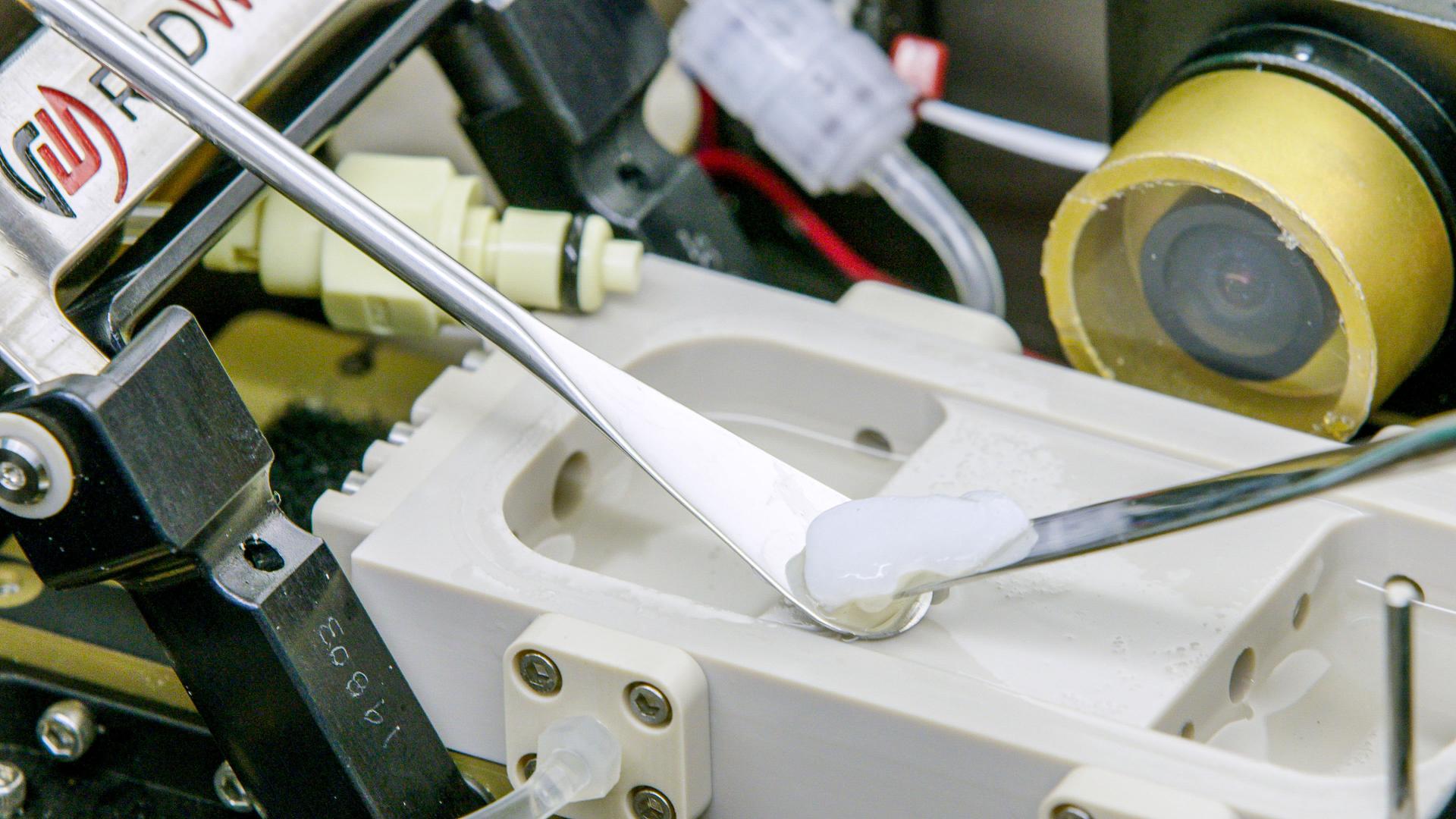
    In Earth’s gravity, bioprinting requires a scaffold or other type of structure to support tissues, but in the near-weightlessness of the space station’s orbit, tissues grow in three dimensions without such support. Redwire Corporation developed the BioFabrication Facility (BFF) as a part of the larger goal of using microgravity to bioprint human organs. Popular Science magazine recently awarded the BFF a 2023 Best of What’s New Award in the Health Category. These awards, handed out since 1988, recognize “groundbreaking innovations changing our world,” according to Popular Science, and “radical ideas that are improving our everyday lives and our futures.”
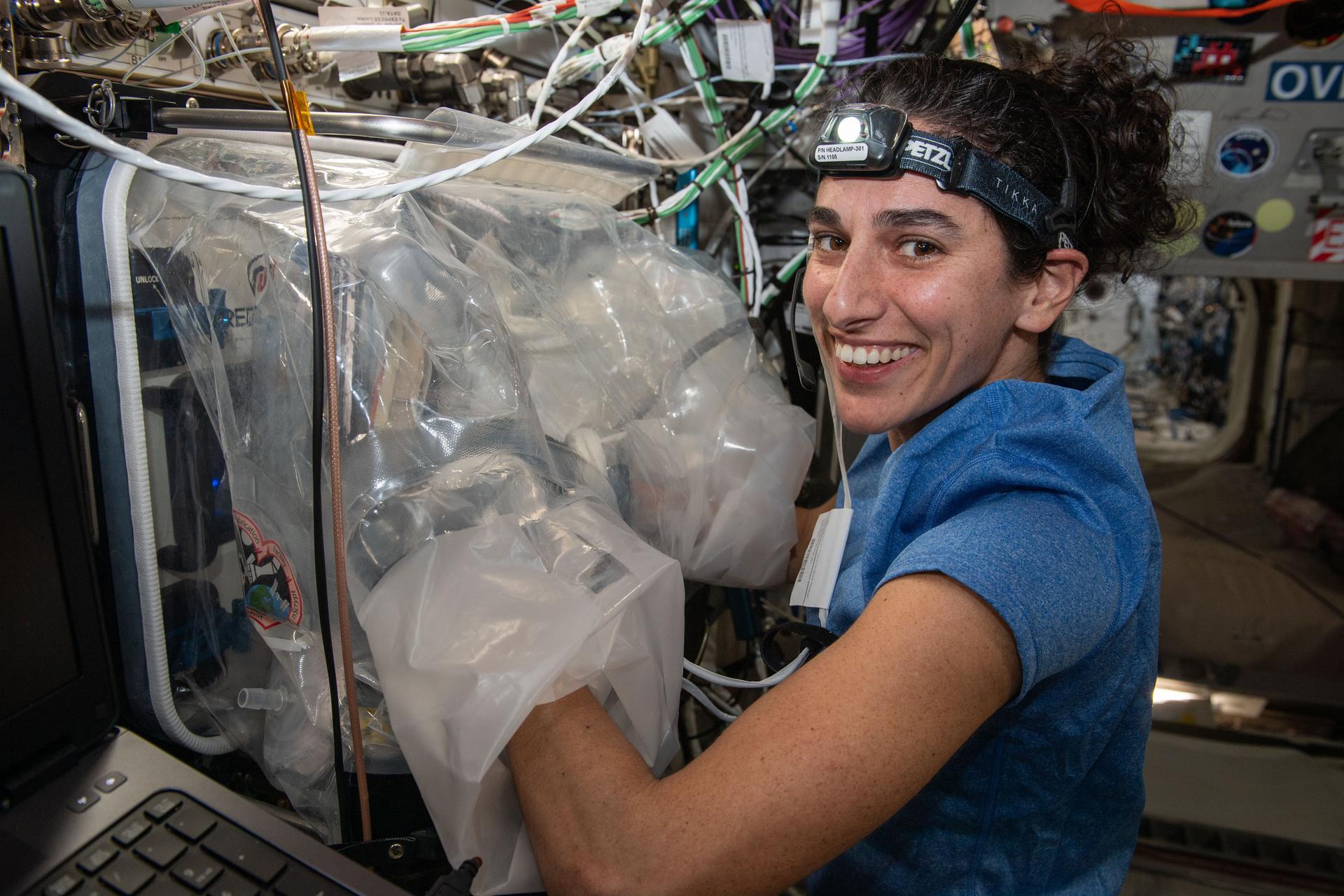
    NASA astronaut Jasmin Moghbeli swaps components inside the BioFabrication Facility (BFF).
    NASA

    A current investigation, BFF-Cardiac, uses the BFF to evaluate the printing and processing of cardiac tissue samples. Cardiovascular disease is the number one cause of death in the United States. Adult heart tissue is unable to regenerate, so damaged heart tissue is mostly replaced with scar tissue, which can block electrical signals and prevent proper cardiac contractions. This investigation could support the development of patches to replace damaged tissue – and eventually the creation of replacement hearts. The work represents a big step toward addressing the significant gap between the number of transplant organs needed and available donors.
    The first human knee meniscus successfully 3D bioprinted in orbit using the BioFabrication Facility.
    NASA

    The BFF-Meniscus investigation and the follow-up BFF-Meniscus-2 investigation resulted in the first successful bioprinting of a human knee meniscus in orbit using the space station’s BioFabrication Facility, announced in September 2023. Musculoskeletal injuries, including tears in the meniscus, are one of the most common injuries for the U.S. military and this milestone is a step toward developing improved treatments on the ground and for crew members who experience musculoskeletal injuries on future space missions. After initial printing and a period of growth in microgravity, the tissues returned to Earth for additional analysis and testing.

    The Russian state space agency ROSCOSMOS launched equipment in 2018, 3D MBP, that included a magnetic printer called Organ.Aut. A series of experiments from 2018 through 2020 showed that this approach could create tissue constructs, helping to pave the way for additional research on producing artificial organs.

    Bioprinting technology also could create artificial retinas to help restore sight for the 30 million people worldwide who suffer from degenerative retinal diseases. One way to manufacture artificial retinas is a technique that alternates layers of a light-activated protein and a binder on a film. On Earth, gravity affects the quality of these films, but researchers suspected that films created in microgravity would be more stable and have higher optical clarity. Protein-Based Artificial Retina Manufacturing is one of several investigations by LambdaVision Inc. in partnership with developer Space Tango Inc. to develop and validate space-based manufacturing methods for artificial retinas. The company has consistently manufactured multiple 200-layer artificial retina films in microgravity and now is working to commercialize its hardware and strategies for development of other therapies and drugs.

    A silver box the size of a small suitcase with a white label saying “LambdaVision” and “Space Tango” floats in the space station. Wires and tubes are visible behind it.
    The Protein-Based Artificial Retina Manufacturing experiment hardware on the space station.
    NASA

    Bioprint FirstAid, a study from ESA (European Space Agency) and the German Space Agency (DLR), demonstrated the function of a prototype for a portable handheld bioprinter that creates a patch from a patient’s own skin cells. Space causes changes in the wound healing process, and such customized bandages could accelerate healing on future missions to the Moon and Mars. Using cultured cells from the patient reduces the risk of rejection by the immune system, and the device offers greater flexibility to address wound size and position. Because the device is small and portable, health care workers could take it almost anywhere on Earth. The investigation showed that the device works as intended in microgravity, and researchers are studying the space-printed patches and comparing them with samples printed on the ground before taking the next step.

    Two white patches the size of a small envelope, labeled “Foil Patch 1A” and “Foil Patch 2A,” are stuck to an astronaut’s blue pants just above the knee. The astronaut’s hand is resting next to the patches.
    Sample patches printed using simulant inks and the hand-held tool for Bioprint FirstAid.
    NASA

    Bioprinting in microgravity also could make it possible to produce food and medicine on demand on future space missions. Such capabilities would reduce the mass and cost of materials needed at launch and help maintain the health and safety of crew members throughout a mission.

    The 3D Printing In Zero-G investigation, which started in 2014, demonstrated that the process of 3D printing with inorganic materials such as plastic worked normally in microgravity.1 3D printing could reduce the need to pack costly spare parts on future long-term missions and help solve the problem of trying to predict every tool or object that might be needed on a mission. With the addition of bioprinting capabilities, crews eventually may be able to 3D print almost anything they need – from a replacement screwdriver to a replacement knee.

    John Love, ISS Research Planning Integration Scientist

    Expedition 70

    Search this database of scientific experiments to learn more about those mentioned above.

    Citations:

    1 Prater TJ, Bean QA, Werkheiser N, Grguel R, Beshears RD, Rolin TD, Huff T, Ryan RM, Ledbetter III FE, Ordonez EA. Analysis of specimens from phase I of the 3D Printing in Zero G Technology demonstration mission. Rapid Prototyping Journal. 2017 October 6; 23(6): 1212-1225. DOI: 10.1108/RPJ-09-2016-0142.

  • NASA Sets Coverage for White House National Space Council Meeting

    Vice President Kamala Harris delivers opening remarks at the first meeting of the National Space Council, Wednesday, Dec. 1, 2021, at the United States Institute of Peace in Washington. Chaired by Vice President Harris, the council’s role is to advise the President regarding national space policy and strategy, and ensuring the United States capitalizes on the opportunities presented by the country’s space activities.
    NASA/Joel Kowsky

    NASA is participating in a meeting of the National Space Council on Wednesday, Dec. 20, in Washington. The meeting, chaired by Vice President Kamala Harris, will focus on international partnerships and is the third council meeting held by the Biden-Harris Administration.

    NASA Deputy Administrator Pam Melroy and Artemis II and CSA (Canadian Space Agency) astronaut Jeremy Hansen will represent the agency at the meeting, which also includes other federal government agencies.

    NASA will provide coverage of the meeting at 2 p.m. EST on the NASA+ streaming service via the web or NASA app. Coverage also will air live on NASA Television, the NASA app, YouTube, and the agency’s website. Learn how to stream NASA TV through a variety of platforms including social media.

    Deputy Administrator Melroy will provide remarks that will focus on the societal benefits of NASA’s space exploration, including the agency’s Earth science missions that provide open and transparent climate data for all people. Melroy also will discuss NASA’s space exploration with international partners to build a responsible and sustainable human presence in space.

    For more information on the National Space Council visit:

    https://www.whitehouse.gov/spacecouncil/

    -end-

    Amber Jacobson / Jennifer Dooren
    Headquarters, Washington
    202-358-1600
    amber.c.jacobson@nasa.gov / jennifer.m.dooren@nasa.gov

    Details

    Last Updated

    Dec 20, 2023

  • NASA’s Hubble Presents a Holiday Globe of Stars

    2 min read

    NASA’s Hubble Presents a Holiday Globe of Stars

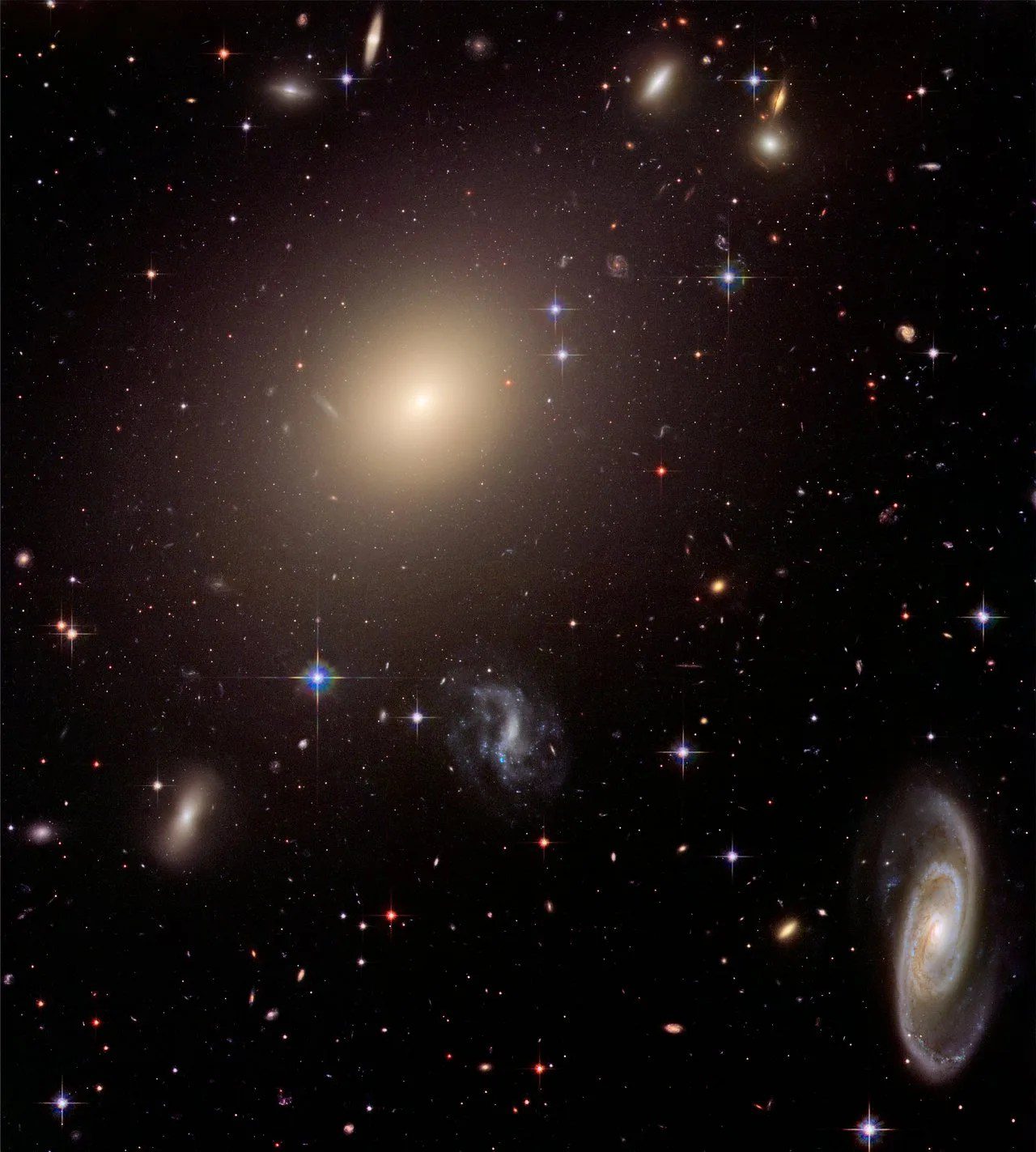
    A field of galaxies. UGC 8091 is at the top and center of the image. It appears as a haze of stars through which more distant galaxies are visible. Two
    This image of the dwarf irregular galaxy, UGC 8091, was created using data from the Wide Field Camera 3 and the Advanced Camera for Surveys on NASA’s Hubble Space Telescope.
    ESA/Hubble, NASA, ESA, Yumi Choi (NSF’s NOIRLab), Karoline Gilbert (STScI), Julianne Dalcanton (Center for Computational Astrophysics/Flatiron Inst., UWashington)

    The billion stars in galaxy UGC 8091 resemble a sparkling snow globe in this festive Hubble Space Telescope image from NASA and ESA (European Space Agency).

    The dwarf galaxy is approximately 7 million light-years from Earth in the constellation Virgo. It is considered an “irregular galaxy” because it does not have an orderly spiral or elliptical appearance. Instead, the stars that make up this celestial gathering look more like a brightly shining tangle of string lights than a galaxy.

    Some irregular galaxies may have become tangled by tumultuous internal activity, while others have formed by interactions with neighboring galaxies. The result is a class of galaxies with a diverse array of sizes and shapes, including the diffuse scatter of stars that is this galaxy.

    Twelve camera filters were combined to produce this image, with light from the mid-ultraviolet through to the red end of the visible spectrum. The red patches are likely interstellar hydrogen molecules that are glowing because they have been excited by the light from hot, energetic stars. The other sparkles on show in this image are a mix of older stars. An array of distant, diverse galaxies appear in the background, captured by Hubble’s sharp view.

    The data used in this image were taken by Hubble’s Wide Field Camera 3 and the Advanced Camera for Surveys from 2006 to 2021.

    Among other things, the observing programs involved in this image sought to investigate the role that dwarf galaxies many billions of years ago had in re-heating the hydrogen that had cooled as the universe expanded after the big bang.

    Astronomers are also investigating the composition of dwarf galaxies and their stars to uncover the evolutionary links between these ancient galaxies and more modern galaxies like our own.

    The Hubble Space Telescope is a project of international cooperation between NASA and ESA. NASA’s Goddard Space Flight Center in Greenbelt, Maryland, manages the telescope. The Space Telescope Science Institute (STScI) in Baltimore, Maryland, conducts Hubble and Webb science operations. STScI is operated for NASA by the Association of Universities for Research in Astronomy, in Washington, D.C.

    Media Contacts:

    Claire Andreoli
    NASA’s Goddard Space Flight CenterGreenbelt, MD
    claire.andreoli@nasa.gov

    Ray Villard
    Space Telescope Science Institute, Baltimore, MD

    Bethany Downer
    ESA/Hubble

    Details

    Last Updated

    Dec 19, 2023

    Editor

    Andrea Gianopoulos

  • NASA Invites Public to Share Excitement of Astrobotic, ULA Robotic Artemis Moon Launch

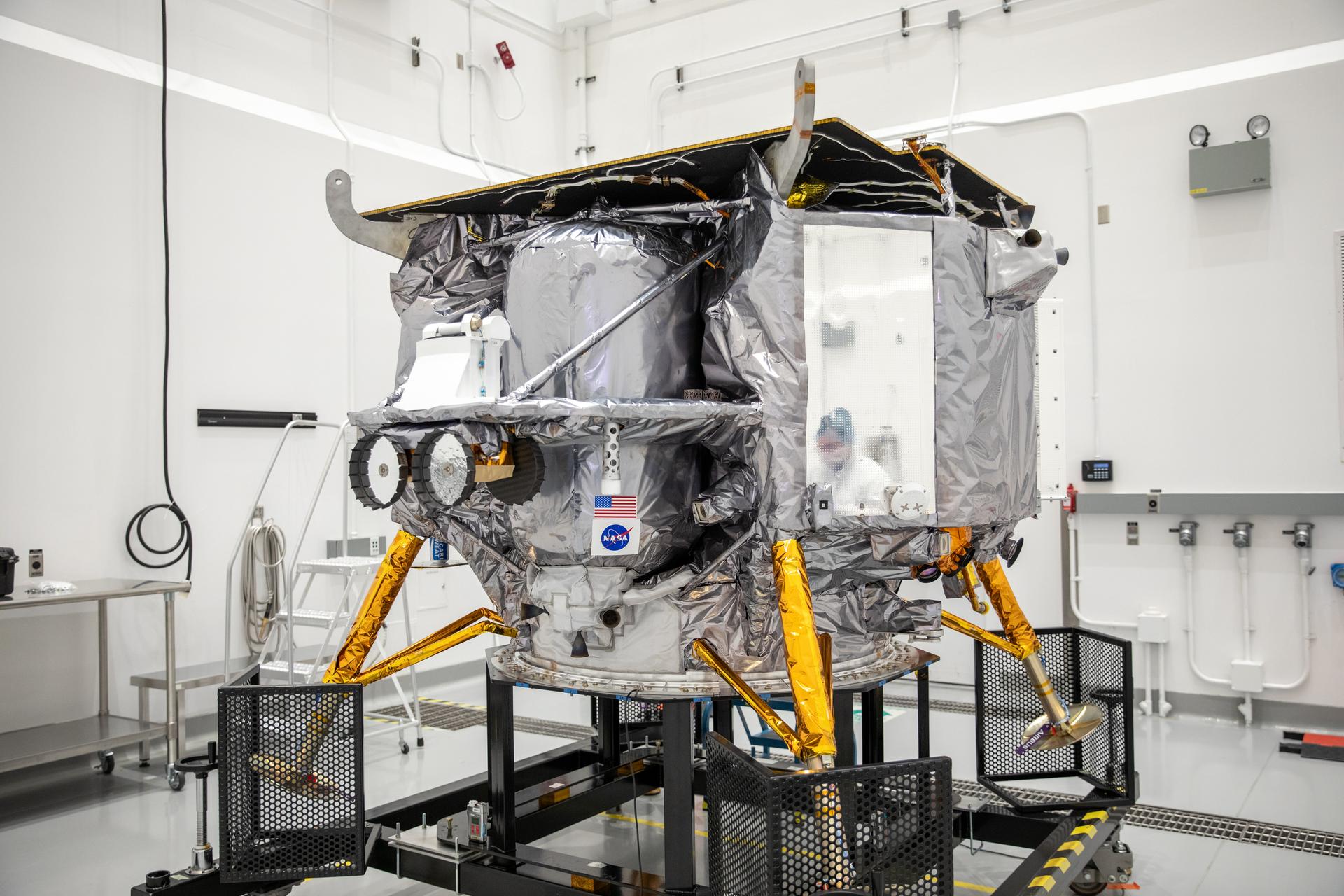
    Teams with Astrobotic install the NASA meatball decal on Astrobotic’s Peregrine lunar lander on Tuesday, Nov. 14, 2023, at the Astrotech Space Operations Facility near the agency’s Kennedy Space Center in Florida.
    NASA/Isaac Watson

    NASA is inviting the public to take part in virtual activities ahead of Astrobotic’s Peregrine Mission One, launching on a United Launch Alliance (ULA) Vulcan rocket as part of NASA’s Commercial Lunar Payload Services (CLPS) initiative. The mission is slated to be one of the first United States commercial robotic landers launching to the Moon’s surface as part of the agency’s Artemis program.

    Carrying NASA and commercial payloads, the Peregrine lander is scheduled to lift off no earlier than Monday, Jan. 8, from Space Launch Complex 41 at the Cape Canaveral Space Force Station in Florida.

    Members of the public can register to attend the launch virtually. As a virtual guest, you have access to curated resources, schedule changes, and mission-specific information delivered straight to your inbox. Following each activity, virtual guests will receive a commemorative stamp for their virtual guest passport.

    The live launch broadcast will air on Monday, Jan. 8, and will air on NASA+, NASA Television, the NASA app, and the agency’s website. Learn how to stream NASA TV through a variety of platforms including social media.

    For more information about CLPS activities, follow the CLPS blog.

  • Lagniappe

    7 Min Read

    Lagniappe

    Dawn Davis facilitates a booth at the 2023 Bayou Classic

    Explore the December 2023 edition to learn about a major milestone NASA Stennis achieved, how two test conductors shared the stage on test day, along with the NASA Stennis Year-in-Review, and much more! 

    Explore the December 2023 edition featuring:

    • NASA Tests In-Flight Capability of Artemis Moon Rocket Engine
    • NASA Delivers Inclusion Message to Annual Bayou Classic Participants
    • Year-in-Review: NASA Stennis Celebrates 2023

    Gator Speaks

    Gator in a Christmas elf costume
    Gator Speaks

    When planning for the holiday season, it is critical to have one’s ducks in a row… or gators in a line. Among other things, having something to talk about when friends or family visit is crucial. The sentiment rings true whether you are a human, or a gator, and I have the perfect conversation activity this holiday season thanks to the final RS-25 engine test in November at NASA Stennis.

    The 650-second test is likely the longest of the 12-test series. It involved a technique known as gimbaling, where the engine is pivoted throughout the hot fire. When the four RS-25 engines gimbal during launch of the SLS (Space Launch System) rocket, gimbaling helps stabilize the rocket as it reaches orbit.

    To better understand how this works, think about hula hooping, which involves using body movements to twirl a plastic hoop that spins around one’s waist, neck, arm, or leg. Typically, younger folks participate in this activity, but I have learned you are never too old to give it a go. Maybe you cannot teach an old dog new tricks, but an old gator is another story. Ack!

    Much like gimbaling an RS-25 engine, hula hooping can involve technical motions, although it is more about freestyle movement. As one might expect, an RS-25 engine test has a detailed plan with a list of objectives. Test operators pivot the engine in precise motions, on a circular basis or back-and-forth in a sort of sawtooth manner. The focus is ensuring the engine can move as needed to direct and stabilize the rocket during flight.

    NASA is continuing the current RS-25 test series into 2024, which means more hot fires to come. I may bring my newly discovered hula hooping skills into the new year also. It will be perfect timing to shape up for a new, exciting year.

    I have practiced through and through, so I expect everyone to be very impressed. If nothing else, it will be about a great source of amusement and laughter.

    While I do not have footage of my hula hoop practice, I do have video of the engine gimbaling at NASA Stennis. When you watch it, imagine your favorite gator hula hooping.

    Happy holidays, all!

    NASA Stennis Top News

    NASA Tests In-Flight Capability of Artemis Moon Rocket Engine

    NASA conducted the third RS-25 engine hot fire in a critical 12-test certification series Nov. 29, demonstrating a key capability necessary for flight of the SLS (Space Launch System) rocket during Artemis missions to the Moon and beyond.

    NASA Delivers Inclusion Message to Annual Bayou Classic Participants

    NASA was on full display during the 50th Annual Bayou Classic Fan Fest activity in New Orleans on Nov. 25, hosting an informational booth and interacting with event participants to deliver a clear message – There’s Space for Everybody at NASA.

    NASA Stennis Engineers Share the Stage on Test Day

    The last Wednesday in November proved to be a full-circle moment for two engineers at NASA’s Stennis Space Center near Bay St. Louis, Mississippi.

    NASA Stennis Continues Preparations for Future Artemis Testing

    Crews at NASA’s Stennis Space Center cleared a milestone Dec. 11, installing a key component in preparation for future Green Run testing of NASA’s new Exploration Upper Stage (EUS) vehicle for use on the SLS (Space Launch System) rocket.

    Year-in-Review: NASA Stennis Celebrates 2023

    NASA’s Stennis Space Center celebrated accomplishments in a number of areas in 2023, including propulsion testing, commercial aerospace activities, community engagement, autonomous systems, strategic planning, and more.

    Center Activities

    Year-in-Review Snapshots: 2023 “Year that Was”

    NASA’s Stennis Space Center steadily moved forward in 2023, while positioning itself to go even further in 2024. Check out the “year that was” by looking at 23 snapshots from 2023.

    People Behind the Work at NASA Stennis

    NASA’s Stennis Space Center brings together people from all backgrounds to support NASA’s mission to explore the secrets of the universe for the benefit of all and inspire the world through discovery.

    NASA in the News

    Employee Profile

    Anita Wilson
    NASA budget analyst Anita Wilson is pictured at NASA’s Stennis Space Center near Bay St. Louis, Mississippi, where she supports commercial test projects, helping NASA inspire the world through discovery.
    NASA/Danny Nowlin

    Anita Wilson could not hold back the tears as she reflected on the journey from her earliest space memory to now working at NASA’s Stennis Space Center near Bay St. Louis, Mississippi.

    Looking Back

    A family standing in front of street sign
    Jerry Hlass, the first manager and director at NASA Stennis, is accompanied by family during a visit to the south Mississippi NASA center on Nov. 22.
    NASA/Danny Nowlin

    Hlass Celebrates Birthday with Visit to NASA Stennis

    It was fitting that the first director of NASA’s Stennis Space Center chose to celebrate his 96th birthday by visiting the south Mississippi site with his family on Nov. 22. After all, Jerry Hlass had a lot to do with the “birth” of the modern propulsion test site.

    NASA built what was then called the Mississippi Test Facility in the early 1960s to test Saturn V rocket stages that would carry humans to the Moon for the first time. When the Apollo Program ended in the early 1970s, the future of the test site seemed bleak.

    Hlass was familiar with the south Mississippi facility. He had supervised facilities nationwide for NASA during the 1960s when the Mississippi site was under construction. In that capacity, Hlass made many trips to the site as he monitored the construction project. 

    Now, the site was the focal point of Hlass’ master’s thesis, titled “Search for a Role for a Large Government Facility,” at George Washington University. At the time, NASA was seeking a location to test engines for its planned space shuttle vehicle, and Hlass saw it as a perfect use of the Mississippi Test Facility.

    When asked his opinion by the Site Evaluation Board, Hlass gave his case for the election of the Mississippi location for the test campaign. On March 1, 1971, the Mississippi Test Facility subsequently was selected for the sea-level testing of the rocket engines to power the space shuttle.

    Several years later, on Sept. 1, 1976, Hlass was named manager of the very same site, by then known as the National Space Technology Laboratories. Before Hlass accepted the assignment of taking over the reins of the NSTL in 1976, NASA Headquarters had considered withdrawing the NASA management team from the installation. The small NASA onsite management team was responsible for providing support services to about 18 federal and state agencies and providing technical support to NASA’s Marshall Space Flight Center in Huntsville, Alabama, for the space shuttle test program. The Earth Resources Laboratory (ERL) was at the site, but it answered to NASA’s Johnson Space Center in Houston, and the Space Shuttle Test Complex was under Marshall management.

    Hlass believed that NASA should be far more influential in the center’s management role. During his years as manager and director of the installation, Hlass was able to bring the ERL under site management and assume a much more direct and meaningful part in supporting the Space Shuttle Program. Through his efforts, Hlass gained the confidence of officials from NASA Headquarters and the respect of the Marshall test team and many other agencies in residence. As a result, the work accomplished by Hlass has been said to have resulted in the “reNASAfication” of the installation. Hlass retired as site leader in 1989. In honor of his leadership and significant contributions to NASA, the center unveiled a street sign designating Jerry Hlass Road onsite in 2015.

    Additional Resources

    Subscription Info

    Lagniappe is published monthly by the Office of Communications at NASA’s Stennis Space Center. The NASA Stennis office may be contacted by at 228-688-3333 (phone); ssc-office-of-communications@mail.nasa.gov (email); or NASA OFFICE OF COMMUNICATIONS, Attn: LAGNIAPPE, Mail code IA00, Building 1111 Room 173, Stennis Space Center, MS 39529 (mail).

    The Lagniappe staff includes: Managing Editor Lacy Thompson, Editor Bo Black, and photographer Danny Nowlin.

    To subscribe to the monthly publication, please email the following to ssc-office-of-communications@mail.nasa.gov – name, location (city/state), email address.

  • Mighty MURI brings the heat to test new longwave infrared radiometer

    3 Min Read

    Mighty MURI brings the heat to test new longwave infrared radiometer

    Credits:
    Leonardo Diagnostic/Retrieval Systems

    PROJECT

    Multiband Uncooled Radiometer Instrument (MURI)

    SNAPSHOT

    NASA’s new Multiband Uncooled Radiometer Instrument (MURI) features a novel bolometer that detects infrared radiation without a cryogenic cooler, greatly reducing the cost and complexity of dispatching infrared radiometers into low-Earth orbit.

    First-light data from NASA’s new Multiband Uncooled Radiometer Instrument (MURI) shows its novel, uncooled microbolometer is operational, setting the stage for future space missions dedicated to observing Earth’s surface temperature with a cost-effective instrument. 

    MURI, which was launched into low-Earth orbit in January 2023, is not NASA’s first space-based infrared radiometer, but it is one of NASA’s smallest. MURI flies through space at roughly seven kilometers per second as a hosted payload on Loft Orbital’s YAM5 platform.

    During its technology validation mission, MURI will demonstrate a state-of-the-art microbolometer thermal imager that functions without a cryogenic cooler. This unique technology could become the foundation of future science missions dedicated to observing phenomena like volcanic activity.

    Bolometers detect infrared radiation in the form of heat and do not require cryogenic operation. These components are extremely sensitive to changes in temperature.

    Traditional space-based thermal sensors rely on bulky cryogenic coolers to remain at a constant temperature of about -300 degrees Fahrenheit. Cryogenic coolers add a lot of mass to space instruments. For example, the Moderate Resolution Imaging Spectroradiometer (MODIS), a space-based infrared radiometer serving aboard NASA’s Aqua and Terra satellites, weighs more than 500 pounds.

    By contrast, MURI only weighs only about 12 pounds. While its microbolometer still needs to be held at a constant temperature to maintain accuracy in space, that temperature can be room temperature.

    In airborne and laboratory tests, MURI achieved an absolute radiometric accuracy of around 1%, which is considered world-class for longwave infrared radiometers of any size, and first-light data suggests the instrument performs just as well within the rigors of space. 

    A box-shaped instrument above a circular lens focusing on a white land mass and blue ocean area.
    As depicted in this image, MURI underwent flight testing over the California coast in 2022, prior to its launch in into low-Earth orbit in January 2023. Weighing just 12 pounds, MURI will be capable of gathering infrared data with high precision.
    Credit: Leonardo Diagnostic/Retrieval Systems

    MURI’s initial observations suggest the instrument can measure the Earth surface temperature at a sensitivity as low as 123 millikelvin, which is comparable to existing Landsat instruments.

    Creating an instrument so accurate and yet so compact required some innovative engineering. Philip Ely, Senior Director of Engineering at Leonardo Diagnostic/Retrieval Systems (DRS) and Principal Investigator for MURI, was especially concerned with image smear, a common issue with space-based remote sensors that collect high-resolution data.

    “Our approach to solving this problem was to mount the bolometer focal plane array on a piezo stage, and then move the stage at the same velocity as the image to effectively stabilize the image on the focal plane array,” said Ely.

    Through its Earth Science Technology Office, NASA worked with Leonardo DRS to transform MURI from an airborne instrument prototype to a spaceborne instrument in just 18 months.

    Partnering with private companies to develop and demonstrate space-based instruments helps NASA reduce the amount of time and resources necessary to produce cutting-edge science.

    Ely and his team presented a more detailed report describing MURI’s initial test results at the 2023 International Geoscience and Remote Sensing Symposium (IGARSS) conference in Pasadena, CA.

    PROJECT LEAD

    Philip Ely, Director of Engineering, Leonardo DRS

    SPONSORING ORGANIZATION

    Earth Science Division’s In-Space Validation of Earth Science Technologies (InVEST) Program; ESD’s Instrument Incubation Program (IIP)

    Details

    Last Updated

    Dec 19, 2023

  • NASA’s Webb Rings in Holidays With Ringed Planet Uranus

    4 Min Read

    NASA’s Webb Rings in Holidays With Ringed Planet Uranus

    alt=

    A slice of the most recent Wide-field image of Uranus from NIRCam (Near-Infrared Camera) on NASA’s James Webb Space Telescope

    Credits:
    NASA, ESA, CSA, STScI

    NASA’s James Webb Space Telescope recently trained its sights on unusual and enigmatic Uranus, an ice giant that spins on its side. Webb captured this dynamic world with rings, moons, storms, and other atmospheric features – including a seasonal polar cap. The image expands upon a two-color version released earlier this year, adding additional wavelength coverage for a more detailed look.

    With its exquisite sensitivity, Webb captured Uranus’ dim inner and outer rings, including the elusive Zeta ring – the extremely faint and diffuse ring closest to the planet. It also imaged many of the planet’s 27 known moons, even seeing some small moons within the rings.

    Image: Uranus and its rings

    The planet Uranus on a black background. The planet appears blue with a large, white patch taking up the right half. The patch is whitest at the center, then fades into blue at it expands from right to left. A thin outline of Uranus is also white. Around the planet is a system of nested rings. The outermost ring is the brightest while the innermost ring is the faintest. Unlike Saturn’s horizontal rings, the rings of Uranus are vertical and so they appear to surround the planet in an oval shape. There are 9 blueish white dots scattered around the rings.
    This image of Uranus from NIRCam (Near-Infrared Camera) on NASA’s James Webb Space Telescope exquisitely captures Uranus’s seasonal north polar cap and dim inner and outer rings. This Webb image also shows 9 of the planet’s 27 moons – clockwise starting at 2 o’clock, they are: Rosalind, Puck, Belinda, Desdemona, Cressida, Bianca, Portia, Juliet, and Perdita.
    NASA, ESA, CSA, STScI

    In visible wavelengths as seen by Voyager 2 in the 1980s, Uranus appeared as a placid, solid blue ball. In infrared wavelengths, Webb is revealing a strange and dynamic ice world filled with exciting atmospheric features.

    One of the most striking of these is the planet’s seasonal north polar cloud cap. Compared to the Webb image from earlier this year, some details of the cap are easier to see in these newer images. These include the bright, white, inner cap and the dark lane in the bottom of the polar cap, toward the lower latitudes.

    Several bright storms can also be seen near and below the southern border of the polar cap. The number of these storms, and how frequently and where they appear in Uranus’s atmosphere, might be due to a combination of seasonal and meteorological effects.

    The polar cap appears to become more prominent when the planet’s pole begins to point toward the Sun, as it approaches solstice and receives more sunlight. Uranus reaches its next solstice in 2028, and astronomers are eager to watch any possible changes in the structure of these features. Webb will help disentangle the seasonal and meteorological effects that influence Uranus’s storms, which is critical to help astronomers understand the planet’s complex atmosphere.

    Image: Uranus Wide-Field

    alt=
    This wide-field image of Uranus from NIRCam (Near-Infrared Camera) on NASA’s James Webb Space Telescope shows the planet amid a smattering of distant background galaxies. This image also includes 14 of the planet’s 27 moons: Oberon, Titania, Umbriel, Juliet, Perdita, Rosalind, Puck, Belinda, Desdemona, Cressida, Ariel, Miranda, Bianca, and Portia.
    NASA, ESA, CSA, STScI

    Because Uranus spins on its side at a tilt of about 98 degrees, it has the most extreme seasons in the solar system. For nearly a quarter of each Uranian year, the Sun shines over one pole, plunging the other half of the planet into a dark, 21-year-long winter.

    With Webb’s unparalleled infrared resolution and sensitivity, astronomers now see Uranus and its unique features with groundbreaking new clarity. These details, especially of the close-in Zeta ring, will be invaluable to planning any future missions to Uranus.

    Uranus can also serve as a proxy for studying the nearly 2,000 similarly sized exoplanets that have been discovered in the last few decades. This “exoplanet in our backyard” can help astronomers understand how planets of this size work, what their meteorology is like, and how they formed. This can in turn help us understand our own solar system as a whole by placing it in a larger context.

    Image: Uranus’ Moons Labelled

    An image titled James Webb Space Telescope, Uranus, September 4, 2023. An image with a black background, a glowing orb near the center surrounded by rings. There are smudges that are background galaxies scattered throughout the image and several bright blue point sources that are the planet’s moons. At the bottom left are compass arrows indicating the orientation of the image on the sky. The north arrow points in the 12 o’clock direction. The east arrow points toward 6 o’clock. Below the image is a color key showing which filters were used to create the image and which visible-light color is assigned to each infrared-light filter. From left to right, Webb NIRCam filters are F140M (blue), F210M (cyan), F300M (yellow), and F460M (orange). A scale bar at the lower right of the image is about one-seventh the total width of the image, and text below it reads 16 arcseconds.
    Annotated wide-field compass image of Uranus with some of its 27 moons and a few prominent stars (with characteristic diffraction spikes) labelled.
    NASA, ESA, CSA, STScI

    The James Webb Space Telescope is the world’s premier space science observatory. Webb is solving mysteries in our solar system, looking beyond to distant worlds around other stars, and probing the mysterious structures and origins of our universe and our place in it. Webb is an international program led by NASA with its partners, ESA (European Space Agency) and the Canadian Space Agency.

    Downloads

    Download full resolution images for this article from the Space Telescope Science Institute.

    Right click the images in this article to open a larger version in a new tab/window.

    Media Contacts

    Laura Betzlaura.e.betz@nasa.gov, Rob Gutrorob.gutro@nasa.gov
    NASA’s  Goddard Space Flight Center, Greenbelt, Md.

    Ann Jenkins- jenkins@stsci.edu, Christine Pulliamcpulliam@stsci.edu
    Space Telescope Science Institute, Baltimore, Md.

    Related Information

    Uranus

    Uranus in a 3d Solar System

    Uranus Facts

    Uranus Moons

    Our Solar System

    More Webb News – https://science.nasa.gov/mission/webb/latestnews/

    More Webb Images – https://science.nasa.gov/mission/webb/multimedia/images/

    Webb Mission Page – https://science.nasa.gov/mission/webb/

    Related For Kids

    Uranus

    How many moons does each planet have?

    Our Solar System

    What is the Webb Telescope?

    SpacePlace for Kids

    En Español

    Ciencia de la NASA

    NASA en español 

    Space Place para niños

    Details

    Last Updated

    Dec 18, 2023

    Editor
    Steve Sabia
    Contact
    Laura Betz

  • NASA Geologist Paves the Way for Building on the Moon

    5 min read

    Preparations for Next Moonwalk Simulations Underway (and Underwater)

    By Jessica Barnett

    For many at NASA’s Marshall Space Flight Center in Huntsville, Alabama, a love – be it for space, science, or something else – drew them to the career they’re in today. For geologist Jennifer Edmunson, there were multiple reasons.

    Her love for geology dates back to her childhood in Arizona, playing in the mud, fascinated by the green river rocks she would find and how they fit together. As she grew older, her love for astronomy led her to study the regolith and geology of the Moon and Mars in graduate school.

    A blonde woman with a black jacket poses in for a headshot in front of a blue background.
    Jennifer Edmunson, geologist and MMPACT project manager at NASA’s Marshall Space Flight Center.
    NASA

    That, in turn, led her to Marshall for her post-doctorate, where she studied how shock processes from meteorite impacts potentially affect scientists’ work to determine the age of rocks using different radioisotope systems. On her first day, she needed help from the center’s IT department, which is how she met Joel Miller, the man she now calls her husband.

    “I met him on April Fools’ Day, and he asked me out on Friday the 13th,” Edmunson recalled. “I knew I needed to get a stable job, so I got a job as the junior geologist on the simulant team here at Marshall. That was back in 2009.”

    Fourteen years later, they still work at Marshall. He’s now the center’s acting spectrum manager, and she manages the MMPACT (Moon-to-Mars Planetary Autonomous Construction Technology) project. Through MMPACT, Marshall is working with commercial partners and academia to develop and test robotic technology that will one day use lunar soil and 3-D printing technology to build structures on the Moon.

    “It’s phenomenal to see the development of the different materials we’ve been working on,” Edmunson said. “We started with this whole array of materials, and now we’re like, ‘OK, what’s the best one for our proof of concept?’”

    NASA aims for a proof-of-concept mission to validate the technology and capability by the end of this decade. This mission would involve traveling to the Moon to create a representative element of a landing pad.

    A group of people, some wearing sunglasses, all wearing blue shirts stand on a gravel lot outside with a blue sky and green trees behind them.
    Marshall geologist and MMPACT project manager Jennifer Edmunson, fourth from right, joined several other scientists for a trip to Stillwater, Montana, earlier this year. Stillwater is known to have rocks like those found on the Moon.

    MMPACT aims to build lunar infrastructure using the materials readily available on the Moon. This process, known as in-situ resource utilization, allows NASA engineers to use lunar regolith, fine-grained silicate minerals thought to be available in a layer between 10 to 70 feet deep on the lunar surface, to build different structures and infrastructure elements.

    However, regolith can’t be used like cement here on Earth, as it wouldn’t solidify in the low-pressure environment. So, Edmunson and her team are now looking at microwaves and laser technology to heat the regolith to create solid building materials.

    After successfully building a full-scale landing pad on the Moon, MMPACT will likely focus on a vertical structure, like a garage, habitat, or safe haven for astronauts.

    “The possibilities are endless,” she said. “There is so much potential for using different materials for different applications. There’s just a wealth of opportunity for anyone who wants to play in the field, really.”

    Edmunson hopes to get more lunar regolith first, as NASA is still working with samples from the Apollo missions and simulants based on those samples. She’s also looking forward to Artemis bringing back samples from different parts of the lunar surface because it will provide her team with a wider pool of regolith samples to analyze.

    “We want to learn more about different locations on the Moon,” she said. “We have to understand the differences and how that might affect our processes.”

    Knowing this will make it easier not just to build landing pads and habitats but to build roadways and the start of a lunar economy, Edmunson said.

    “I want there to be sufficient structures there to make things safe for crew, so if we want to build a hotel on the Moon, we could,” she said. “We could have tourists going there, mining districts pulling rare Earth elements from the Moon. We could do that and get a lot of resources that way.

    A gloved hand holds a handful of white looking synthetic minerals over a orange bucket.
    Some minerals are rare on Earth but abundant on the Moon. To study how those minerals could be used for building, scientists rely on simulants, like the synthetic anorthite pictured here.
    NASA

    “I want science to progress, things like building a radio telescope on the far side of the Moon. I want more information on more of the different sites around the Moon, so we can get a better understanding of how the Moon formed and the history of the Moon. We’ve only scratched the surface there.”

    There are parts of the Moon that can only be explored in detail by visiting in person, Edmunson explained, and she’s excited to be working at Marshall as that exploration is made possible.

    “It’s awesome to be part of this. Honestly, it’s the reason I get out of bed in the morning,” she said. “I was born in ’77, so I missed the Apollo lunar landings. I would love to see humans on the Moon in my lifetime, and on Mars would just be amazing.”

    Her advice is simple to anyone considering a career like hers: Just go for it.

    “A lot of it comes down to passion and tenacity,” she said. “If you really love what you do and you get to do it every day, you find more enjoyment in your career. I feel like I’m making a difference, and with surface construction at such an infant kind of stage right now, I feel like it’s a contribution that will last for a very long time.”

    Ramon J. Osorio
    Marshall Space Flight Center, Huntsville, Alabama
    256-544-0034
    ramon.j.osorio@nasa.gov

    Details

    Last Updated

    Dec 13, 2023

    Editor
    Beth Ridgeway

  • Pioneer 10 Crosses the Asteroid Belt

    In this illustration, the Pioneer 10 spacecraft flies through the asteroid belt between Mars and Jupiter. The spacecraft is shown to the right of Jupiter (right), dwarfed by the planet's size. The white line representing Pioneer 10's path curls around Earth and past Jupiter. At the center, the Sun is represented in bright, luminous white and orange, while streaks of red, orange, purple, and black represent space. The image is dotted with spots of purple, blue, yellow, and white.
    If spacecraft are to visit the outer solar system, they must cross the asteroid belt between Mars and Jupiter. The Pioneer mission was faced with the question of just how dangerous this asteroid belt would be to a spacecraft passing through it.
    NASA

    This illustration made on Nov. 26, 1974, by Rick Giudice shows the Pioneer 10 spacecraft traveling through the asteroid belt between Mars and Jupiter, the largest planet in the solar system. At the time, it was uncertain whether it would traverse it safely since the density of particles large enough to damage the craft was not yet known, but Pioneer 10 became the first satellite to enter and pass through the asteroid belt.

    The mission’s primary goal was to explore Jupiter, its satellites, its magnetic field, and trapped radiation belts. On Nov. 6, 1973, while still 16 million miles from Jupiter, Pioneer 10 began to image the giant planet with its photopolarimeter, and shortly thereafter began to take measurements with its other instruments as well. Twenty days later, the spacecraft passed the front of Jupiter’s bowshock, where the solar wind clashed with the planet’s magnetosphere. By Dec. 1, the spacecraft was returning images of the planet exceeding the best pictures from Earth. Pioneer 10 sent its last signal on Jan. 23, 2003, when it was 7.6 billion miles (12.23 billion kilometers) away from Earth.

    Learn about Pioneer and other planetary exploration and scientific satellite research planned for the 1970s in the Seeds of Discovery documentary on NASA+.

    Image Credit: NASA

  • Artificial Intelligence Plus Your Cell Phone Means Better Maps of Earth!

    1 min read

    Artificial Intelligence Plus Your Cell Phone Means Better Maps of Earth!

    A grid of 28 small landscape images
    GLOBE Observer data from various locations showing four directional views: west, north, south, and east. 
    Credit: Huang et al. 2023, International Journal of Applied Earth Observation and Geoinformation, Volume 122, 103382

    In 2019, the GLOBE Land Cover project began asking volunteers to help map planet Earth by taking photos of their surroundings facing multiple directions, including north, south, east and west. Now, a new paper by Huang et al. demonstrates how to combine these images using Artificial Intelligence (AI).  The paper compares this “multi-view” approach with the old single-view approach–and finds that the multi-view capabilities of the GLOBE Observer app, processed with AI, enable much more accurate mapping. 

    “We are thrilled about our recent discovery! We’ve observed that the current AI model is increasingly exhibiting human-like behavior, adept at integrating multiple perspectives, synthesizing them, and striving to derive meaning from these views.”

    Xiao Huang

    Xiao Huang

    The paper’s lead author

    “We are thrilled about our recent discovery!” said Xiao Huang, the paper’s lead author.  “We’ve observed that the current AI model is increasingly exhibiting human-like behavior, adept at integrating multiple perspectives, synthesizing them, and striving to derive meaning from these views.”

    The most detailed satellite-based maps of our whole planet still can’t show details smaller than hundreds of meters [about 330 feet]. That means that a park in a city may be too small to show up on the global map. When you use the GLOBE Observer: Land Cover app, you help scientists fill in local gaps and contribute to consistent, detailed global maps that should us how our world is changing. 

    Grab your smartphone and join the project!

    Details

    Last Updated

    Dec 04, 2023

  • NASA’s Dragonfly to Proceed with Final Mission Design Work

    3 min read

    NASA’s Dragonfly to Proceed with Final Mission Design Work

    Artist’s Impression. Dragonfly Departs Dragonfly heads off toward its next landing spot on Titan.
    Artist’s Impression: Dragonfly Departs and heads off toward its next landing spot on Titan.
    Image credit: NASA/Johns Hopkins APL/Steve Gribben

    NASA’s Dragonfly mission has been authorized to proceed with work on final mission design and fabrication – known as Phase C – during fiscal year (FY) 2024. The agency is postponing formal confirmation of the mission (including its total cost and schedule) until mid-2024, following the release of the FY 2025 President’s Budget Request.

    Earlier this year, Dragonfly – a mission to send a rotorcraft to explore Saturn’s moon Titan – passed all the success criteria of its Preliminary Design Review. The Dragonfly team conducted a re-plan of the mission based on expected funding available in FY 2024 and estimate a revised launch readiness date of July 2028. The Agency will officially assess the mission’s launch readiness date in mid-2024 at the Agency Program Management Council.

    “The Dragonfly team has successfully overcome a number of technical and programmatic challenges in this daring endeavor to gather new science on Titan,” said Nicola Fox, associate administrator of NASA’s Science Mission Directorate at NASA headquarters in Washington. “I am proud of this team and their ability to keep all aspects of the mission moving toward confirmation.”

    Dragonfly takes a novel approach to planetary exploration, for the first time employing a rotorcraft-lander to travel between and sample diverse sites on Titan. Dragonfly’s goal is to characterize the habitability of the moon’s environment, investigate the progression of prebiotic chemistry in an environment where carbon-rich material and liquid water may have mixed for an extended period, and even search for chemical indications of whether water-based or hydrocarbon-based life once existed on Titan.

    Dragonfly is being designed and built under the direction of the Johns Hopkins Applied Physics Laboratory in Laurel, Maryland, which manages the mission for NASA. The team includes key partners at NASA’s Goddard Space Flight Center in Greenbelt, Maryland; Lockheed Martin Space in Littleton, Colorado; Sikorsky, a Lockheed Martin company; NASA’s Ames Research Center in Silicon Valley, California; NASA’s Langley Research Center in Hampton, Virginia; Penn State University in State College, Pennsylvania; Malin Space Science Systems in San Diego, California; Honeybee Robotics in Pasadena, California; NASA’s Jet Propulsion Laboratory in Southern California; CNES (Centre National d’Etudes Spatiales), the French space agency, in Paris, France; DLR (German Aerospace Center) in Cologne, Germany; and JAXA (Japan Aerospace Exploration Agency) in Tokyo, Japan. Dragonfly is the fourth mission in NASA’s New Frontiers Program, managed by NASA’s Marshall Space Flight Center in Huntsville, Alabama, for the Science Mission Directorate.

  • Cassini 10 Years at Saturn Top Images

  • Cassini
 

1 min read

Cassini 10 Years at Saturn Top Images

The Cassini team is proud to celebrate 10 years since arriving at Saurn with this collection of images selected by members of the team.

Enceladus North Pole Montage

Peering Through Titan’s Haze

Water World

Created with GIMP

Enceladus Up-Close

Saturnian Snowman

A Fractured Pole

Imminent Approach to Dione

Red Arcs on Tethys

Spongy Surface

Serene Saturn

Simulations of the Tendrils

Keep Exploring

Discover More Topics From NASA

  • Cassini Top 10 Images – 2015

  • Cassini
  •  

    1 min read

    Cassini Top 10 Images – 2015

    As the Cassini science team members look forward to a great 2016 and beyond, here’s a look back at their top 10 images of 2015.

    Enceladus North Pole Montage

    Peering Through Titan’s Haze

    Water World

    Created with GIMP

    Enceladus Up-Close

    Saturnian Snowman

    A Fractured Pole

    Imminent Approach to Dione

    Red Arcs on Tethys

    Spongy Surface

    Serene Saturn

    Simulations of the Tendrils

    Keep Exploring

    Discover More Topics From NASA