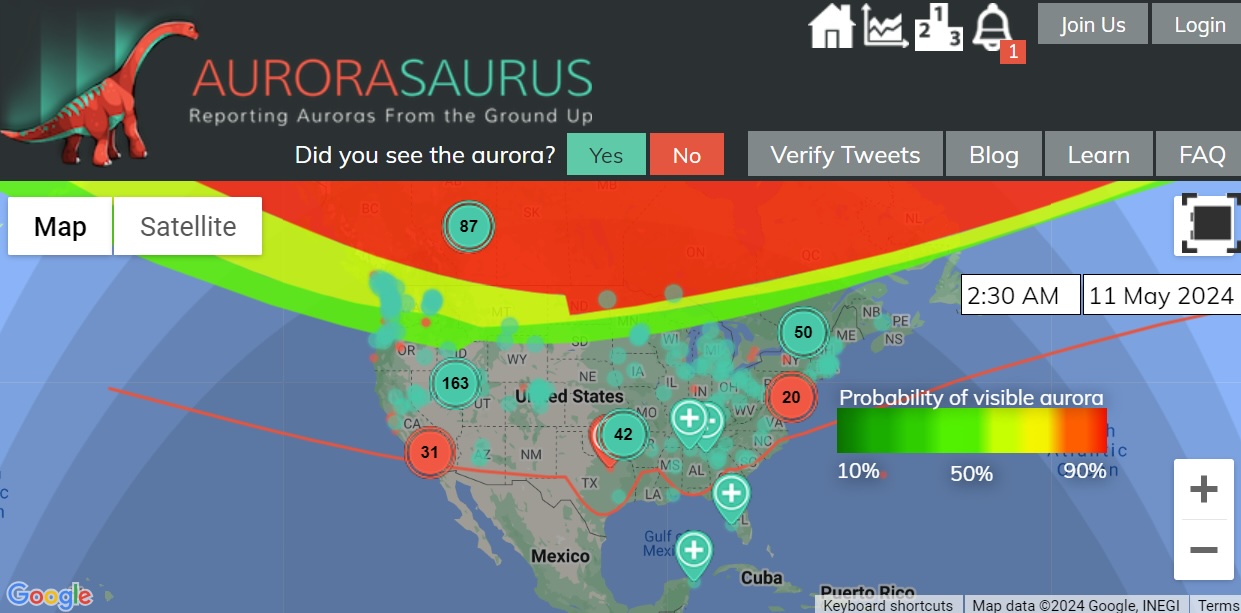
“Aurorasaurus made all the difference for me,” said volunteer Damon Tighe. “I was able to see it in Oakland, CA and knew it was coming based upon user data in Reno.”
At Aurorasaurus.org you’ll see the latest model predictions for where the aurora is visible. Then you can submit your own report, helping scientists test and improve the models and characterize what is seen. When people report seeing the aurora beyond where the model predicts the system adapts in real time and puts out volunteer-generated alerts in those areas. During the May 10-12 extreme event, auroras visible as far south as Texas and Alabama triggered those special alerts.
Thank you to everyone who submitted data! During the last major solar storm, back in 2003, digital cameras were not widespread and cell phones didn’t even have cameras. But during this current solar maximum, the data you’re collecting has incredible scientific value.
It’s not too late to help document this historic event. You can submit back-dated reports at our website and help do NASA Science. While you’re there, sign up for your own alerts and don’t miss out on the next spectacular storm!
NASA astronauts Jasmin Moghbeli and Loral O’Hara along with JAXA astronuat Satoshi Furukawa and ESA astronaut Andreas Mogensen
NASA
Expedition 70 Astronauts to Share Mission in NASA Welcome Home Event
Four astronauts will participate in a welcome home ceremony at Space Center Houston after recently returning from a mission aboard the International Space Station.
NASA astronauts Jasmin Moghbeli and Loral O’Hara, along with JAXA (Japan Aerospace Exploration Agency) astronaut Satoshi Furukawa, and ESA (European Space Agency) astronaut Andreas Mogensen, will share highlights from their mission beginning at 5:30 p.m. CDT Thursday, May 16 during a free, public event at NASA Johnson Space Center’s visitor center. The crew will also recognize key contributors to its mission success in an awards ceremony following their presentation.
The astronauts will be available for media interviews immediately before the event. Reporters may request an in-person interview no later than 5 p.m. May 16 by emailing Dana Davis at dana.l.davis@nasa.gov.
Moghbeli, Mogensen, Furukawa, and Roscosmos cosmonaut Konstantin Borisov launched as part of NASA’s SpaceX Crew-7 mission, lifting off Aug. 26, 2023. The crew spent 199 days in space, completing hundreds of scientific experiments and maintaining the orbiting laboratory. Mogensen served as commander for Expedition 70. Mogensen and Furukawa have logged 209 and 366 days in space respectively over the course of their careers. It was the first spaceflight for Moghbeli and Borisov. Crew-7 returned to Earth on March 12.
O’Hara flew with an international crew, launching aboard the Soyuz MS-24 spacecraft on Sept. 15, 2023. The six-month research mission was the first spaceflight of her career, and she logged 204 days in space across Expedition 69 and 70. She conducted one spacewalk alongside Moghbeli, spending 6 hours, 42 minutes, suited up outside of the space station. She saw the arrival of eight visiting vehicles and the departure of seven over the course of her mission. She returned to Earth on April 6.
Members of the Expedition 70 crew participated in the CIPHER (Complement of Integrated Protocols for Human Exploration Research on Varying Mission Durations) investigation. It examines physiological and psychological changes that humans undergo during spaceflight. The crew also tended to tomato plants grown for the Plant Habitat-06 investigation to see how spaceflight affects plant immune function and production. Expedition 70 also saw the release of two small satellites called CubeSats from the space station. Both were created by students in Japan.
Preparations for Next Moonwalk Simulations Underway (and Underwater)
NASA’s DC-8 aircraft – the world’s largest flying science laboratory – began its science missions in 1987 and since then, has flown in service of the science community over places like Antarctica, Greenland, and Thailand. Aircraft like the DC-8 have enabled scientists to ask questions about life on Earth and explore them in a way that only NASA’s Airborne Science program can make happen. After 37 years, the DC-8 will retire to Idaho State University, where it will serve as an educational tool for students.
As the DC-8 approaches its retirement, we highlight five of the women who have made the aircraft and program a success.
Kirsten Boogaard, Nicki Reid, Carrie Worth, Erin Waggoner, and WendyBereda of NASA’s Armstrong Flight Research Center in Edwards, California, are building the legacy of women who are helping pave the way for the next generation.
Kirsten Boogaard, Deputy Project Manager for the DC-8 aircraft, leads and manages project planning, integration and resources for airborne science missions since 2020.
NASA/Ken Ulbrich
Kirsten Boogaard
Deputy Project Manager
Kirsten Boogaard wears many hats for the DC-8 program, including deputy project manager, mission manager, and assistant mission director.
Since 2020, she has served as the deputy project manager on the DC-8 Airborne Science laboratory, leading and managing project planning, integration, and resources. She is one of three women qualified in the mission director role for the flying laboratory.
“I am really proud of what I accomplish at work,” Boogaard said. “And I am most proud of being able to work full-time and support numerous deployments while having a child.”
Nickelle Reid
Operations Engineer
As operations engineer, Nicki Reid authorizes the airworthiness for the aircraft by ensuring that the science instruments added onboard sustain the aircraft’s safety. She also serves as the mission director, where she manages communications with the cabin and cockpit crews.
“It takes a lot of practice to get used to hearing all the different conversations and weeding out what’s important, staying focused, and staying on top of all the action that’s happening,” Reid said.
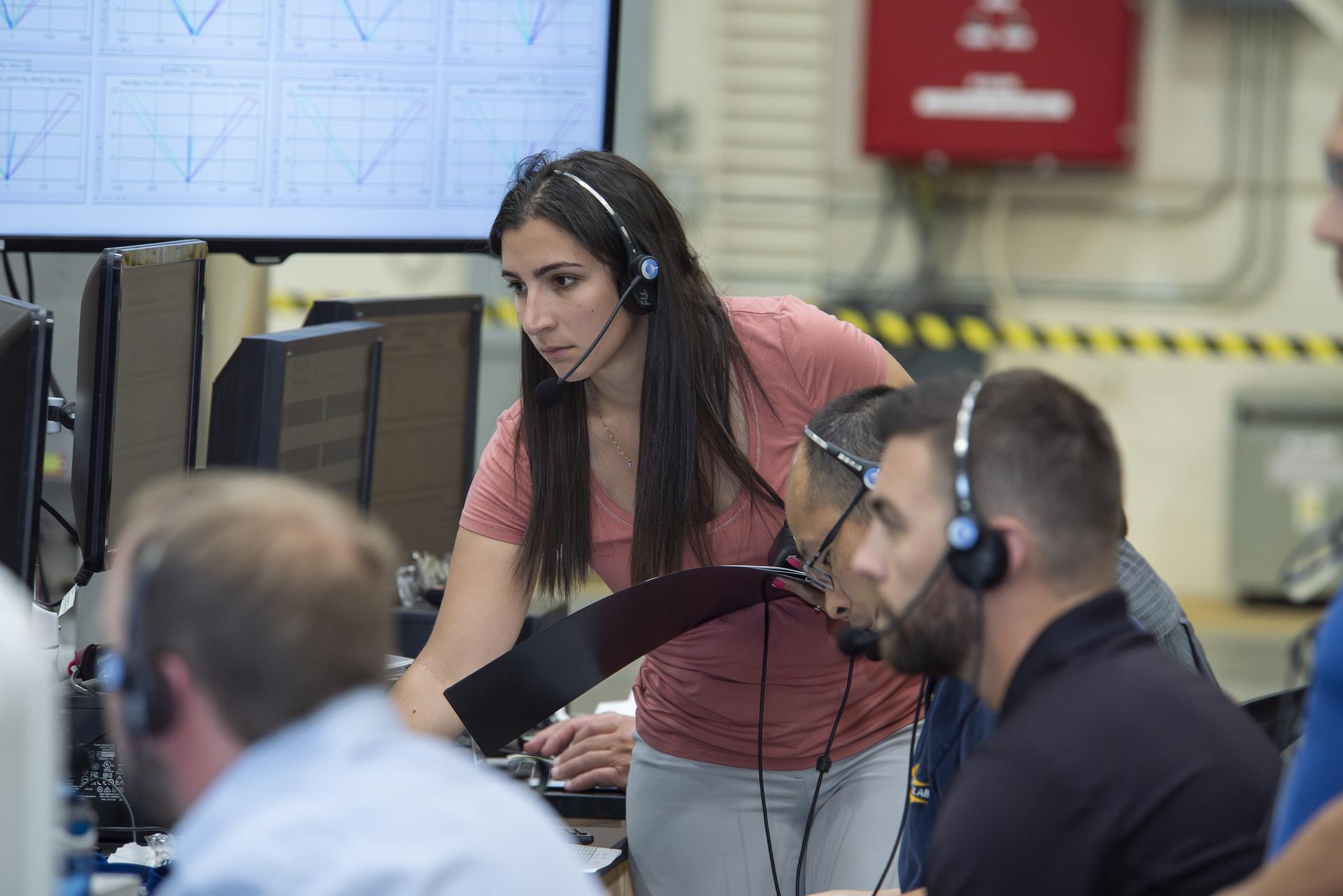
For a science mission project, that focus is essential to maintaining efficient communication between scientists and pilots. Reid has been honing that skill since she started as an intern at NASA Armstrong.
Airborne science missions are not for the faint of heart! Pilot Carrie Worth and Operations Engineer Nicki Reid are all smiles after landing from a successful science flight.
Photo courtesy of Carrie Worth
Carrie Worth
Pilot
Carrie Worth is part of a team uniquely qualified to fly the DC-8. Her journey to her career as a pilot began as a child.
“When I was a little kid, I saw Patty Wagstaff perform aeronautical stunts at the airshow in Oshkosh, Wisconsin,” Carrie Worth, NASA DC-8 pilot, said. “I decided then and there that I wanted to be a pilot.”
Before joining NASA, Worth served 21 years in the U.S. Air Force as a special operations and search and rescue pilot, and then worked as a 747 pilot for United Parcel Service in Anchorage, Alaska. As a woman working in a male-majority industry, Worth is grateful for the supportive work environment at NASA and the DC-8 program.
“I feel incredibly lucky for the support I have and have had from my male peers,” she said. “I have seen a significant improvement in the [aviation] culture, but there’s still work to be done.”
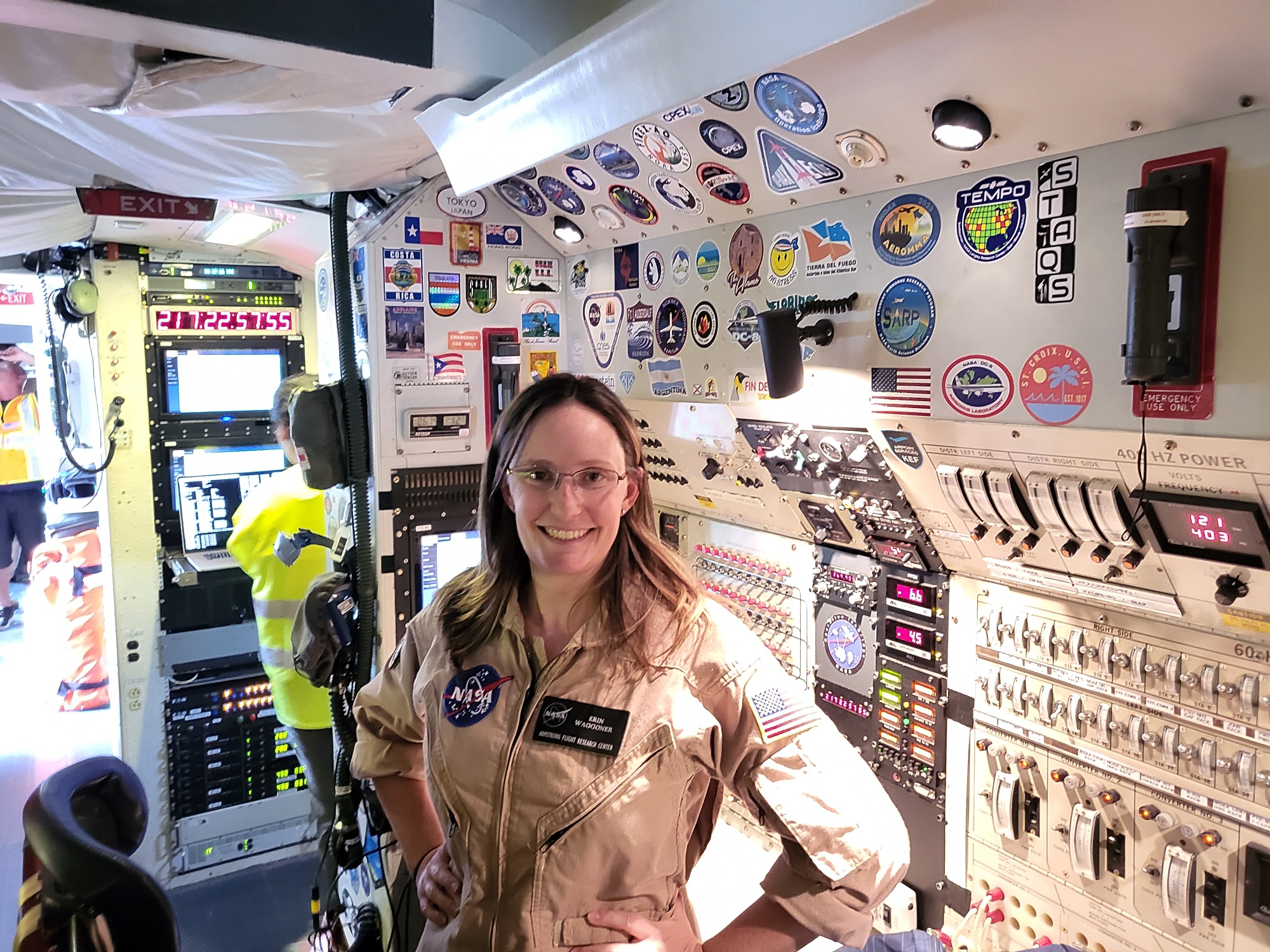
Branch Chief of the Research Aerodynamics and Propulsion Branch, Erin Waggoner is all smiles onboard the DC-8 during an airborne science mission deployment.
Photo courtesy of Erin Waggoner
Erin Waggoner
Research Aerodynamics and Propulsion Branch Chief
In 2011, Erin Wagonner joined the Research Aerodynamics and Propulsion Branch at NASA Armstrong to support sonic boom research. Today, she is the branch chief.
“I’m thankful for all the mentorship I’ve received throughout my career,” Waggoner said. “Everyone from the maintenance crew to the researchers are very welcoming, willing to share their expertise, and mission-focused.”
Waggoner’s experience with the DC-8 program inspired her to recognize the value of a team spirit in a successful project.
“I’ve learned a lot about team dynamics from my time on the DC-8, like how to integrate new members into an existing team,” Waggoner said. “I love being able to encourage young women interested in NASA and aviation, and learning from the women who blazed the trails ahead of me.”
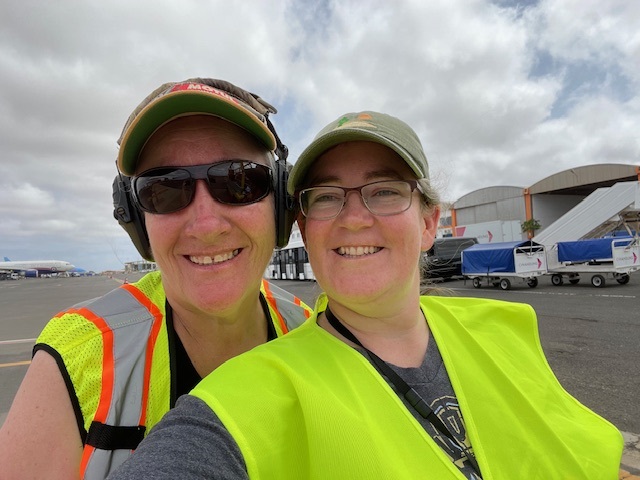
Keeping things running: Wendy Bereda finds a moment to smile with Operations Engineer Nicki Reid on a maintenance day for the DC-8. She has served the DC-8 program for 25 years.
Photo courtesy of Wendy Bereda
Wendy Bereda
Site Supervisor
Wendy Bereda started working on the DC-8 aircraft in 1999, first as a logistics clerk, later as a project support supply tech. She is now the site supervisor for the maintenance contract at NASA Armstrong.
“Through the years, I’ve received different accolades, but the one that meant the most to me was given to me by Headquarters for my administrative excellence in finding parts and keeping the DC-8 flying.”
As a science-driven platform, the DC-8 project is composed of a team driven to provide the best customer service.
“Our team has so much love for the DC-8,” Bereda said. “We live and breathe to make things happen. This is why I’m proud to have been a big part of the DC-8 life at Armstrong.”
Experts like the women above enrich NASA’s legacy of innovation and exploration, and make programs like the DC-8 a success.
Preparations for Next Moonwalk Simulations Underway (and Underwater)
Jim Gentes wearing the Jiro Prolight bicycle helmet.
Credit: Jiro
Before the U.S. Cycling Federation adopted a requirement for all bike racers to wear helmets in 1986, most people rode without one. The only helmet options at the time drew rider complaints for being too hot and heavy. But, with a bit inspiration from a NASA aircraft wing design used during World War II, more than 20,000 competitive biker racers would soon have a lighter-weight option to protect their heads.
Jim Gentes, an industrial designer, and bicycling enthusiast developing an aerodynamic bike helmet, saw the new rule as an opportunity. He started Giro Sport Design Inc., now based in Irvine, California, to provide bike racers a speed and safety advantage. Then came the Giro Prolight, a lightweight racing helmet that was cool and aerodynamic, drawing upon a NASA-developed aircraft wing technology.
The National Advisory Committee for Aeronautics (NACA), NASA’s predecessor, developed the NACA 6-series airfoil during World War II to reduce drag in fighter aircraft. Raymond Hicks, an aerodynamicist at NASA’s Ames Research Center in California’s Silicon Valley, helped Gentes adapt that wing design to improve airflow over the helmet, reducing drag. Compared with bareheaded racing, wind tunnel tests confirmed that the reduced drag could save one second in a little over half a mile.
To keep it lightweight, the Prolight used expanded polystyrene foam with a removable Lycra cover. Vents in the front and rear of the helmet let air flow through, using the vacuum created by the rear vents to pull air into the helmet. The vent design also smoothed airflow, reducing turbulence and drag.
In 1986, Gentes added a foam model called the Aerohead. The Hammerhead, a Prolight with a thin shell, came next, followed by the newer, streamlined Aerohead. When Gentes’ friend Greg LeMond won the 1989 Tour de France wearing the Aerohead, worldwide acclaim followed.
Giro has changed hands several times since the 1980s and today, the brand continues to offer bike helmets and other sporting equipment and apparel.
Preparations for Next Moonwalk Simulations Underway (and Underwater)

A small team of participants in the Geology 101 field training gather on a large pile of rocks from a lava flow.
NASA/Robert Markowitz
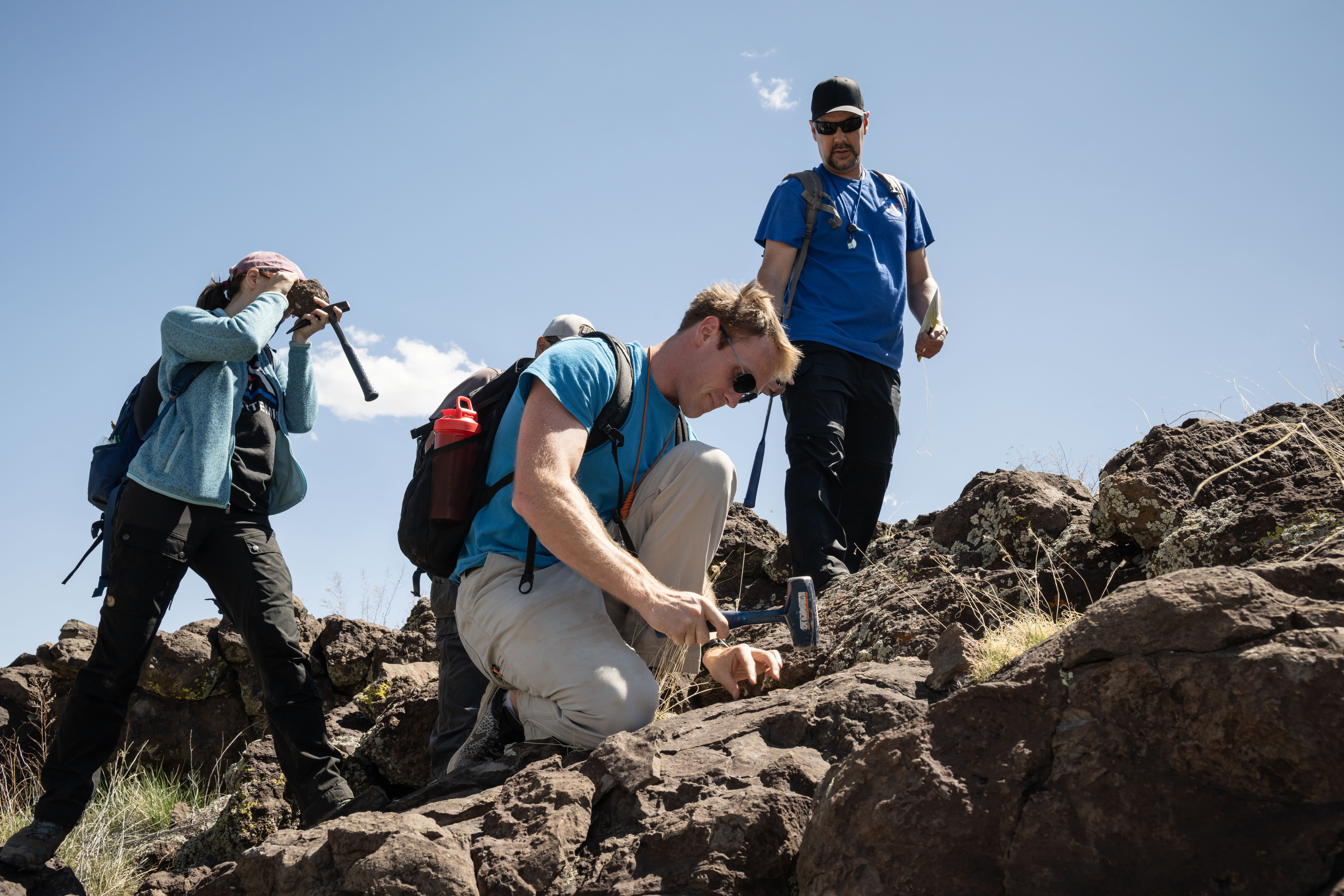
NASA engineers, managers, and flight directors recently traded their cubicles and conference rooms for an ancient volcanic field in the northern Arizona desert to participate in a field geology course aimed at arming them with first-hand experience in what Artemis astronauts will do when they explore the Moon.
The two-and-a-half-day exercise for Artemis mission support teams was a condensed version of the rigorous training astronauts receive to prepare for Artemis missions to the lunar South Pole region, but shares an important purpose.
“We are building a common language and a common understanding of what it will be like to do field geology on the surface of the Moon,” said Cindy Evans, Artemis geology training lead at NASA’s Johnson Space Center in Houston. “This is so the people who are building spacesuits, building tools, building software systems, the people who will be flight controllers, and the managers who direct and fund all of this, can all understand the interlocking parts of surface exploration.”
We are building a common language and a common understanding of what it will be like to do field geology on the surface of the Moon.
Cindy Evans
Artemis Geology Training Lead at NASA’s Johnson Space Center
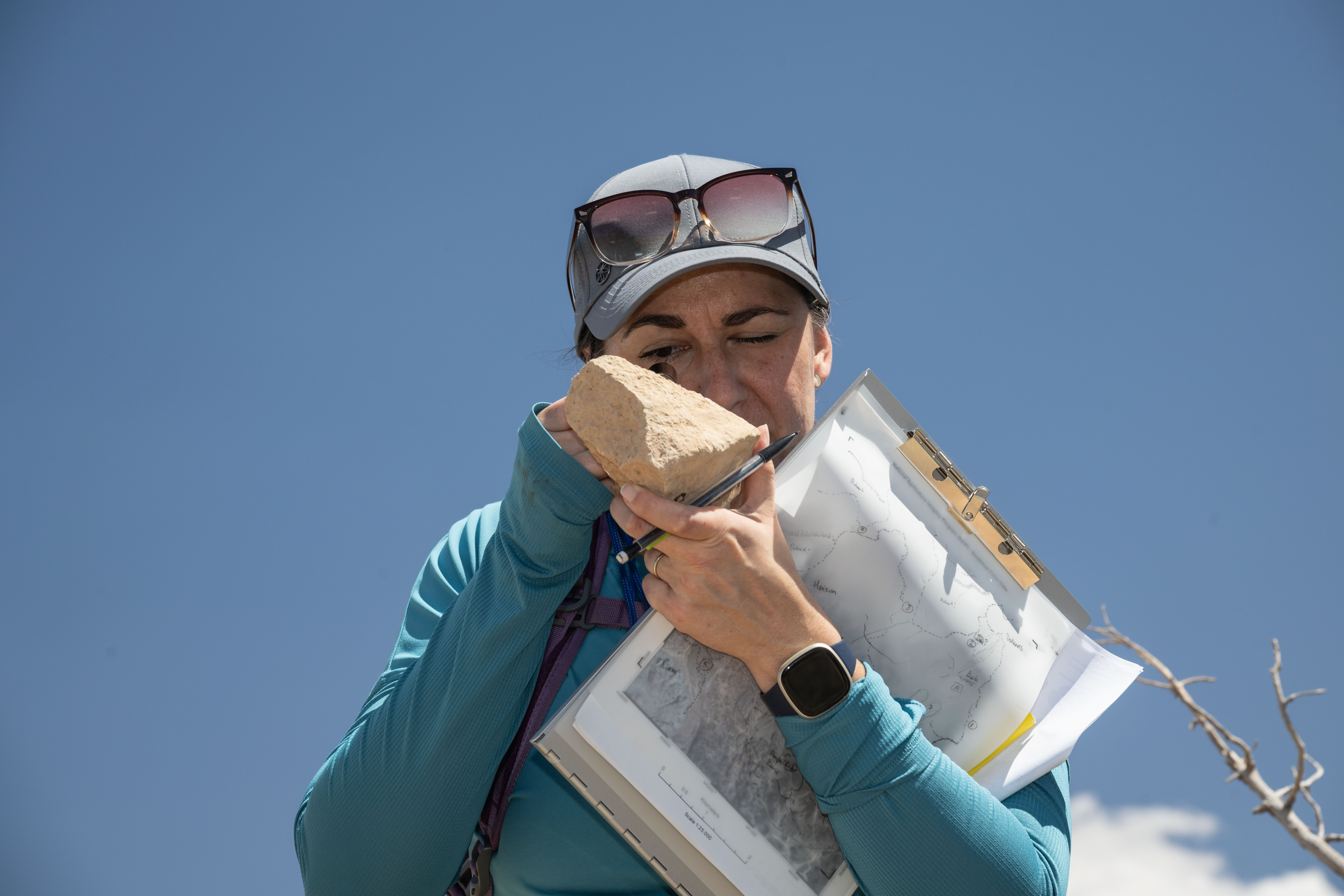
Small teams led by geology experts from NASA, the USGS (U.S. Geological Survey), and academia studied maps, built hypotheses about the geologic history of the area, and trekked for miles to test whether those hypotheses match reality. This field test required smashing rocks with hammers to study their mineral makeup, and carefully selecting a few to examine further after returning from the field in the same way Artemis astronauts will return samples from the Moon.
Geology studies help uncover the rich physical history of an area. Each rock type represents a process and the order of layering of those rocks reveals a story that could unlock a planet’s secrets, offering clues for how it was formed and evolved over time.
“The Moon doesn’t have an atmosphere or flowing water like we have here on Earth, and doesn’t have plate tectonics, which are processes that erase a lot of the evidence from the early Earth,” said Jacob Bleacher, chief exploration scientist in the Exploration Systems Development Mission directorate at NASA Headquarters in Washington. “The Moon still has that evidence, so we can go to the Moon and learn lessons about our home planet that we can’t learn here on the Earth.”
Artemis curation lead Juliane Gross, left, NASA flight controller Grant Harman, center, and imagery scientist Marco Lozano collect and examine samples during the Geology 101 field course.
NASA/Robert Markowitz
In the desert, as the mission support team members practiced the fundamental methods used by geologists to study an environment, they pieced together the story of the region. The planned walking paths, known as traverses, frequently changed based on what they were finding. Teams embraced the principle of “flexecution” – or flexible execution – a practice that could come into play as astronauts explore the lunar surface and report findings to a backroom of scientists supporting the mission in the Mission Control Center at Johnson, referred to as the science evaluation room.
“The geologists will be the science evaluation room during Artemis missions, assimilating real-time mission data to understand the observations, tracking the samples, going back to the maps that they’ve built trying to understand how all those pieces fit together on a day-by-day and traverse-by-traverse basis,” said Evans. “When the astronauts return home with the samples and with their full observations, the scientists can hit the ground running to address key science questions.”
With Artemis, NASA will study the history of the Moon and its relationship with Earth and build a blueprint for deeper space exploration.
NASA Flight Director Diane Dailey examines a rock at the Geology 101 field training for Artemis mission support teams in the northern Arizona desert.
NASA/Robert Markowitz
“What we’re doing now is laying the groundwork for long-term exploration at the Moon,” Bleacher said. “Laying that groundwork will then help us explore other destinations like Mars. The Moon is a part of everything that we understand here on the Earth. It’s also an anchor point to help us understand how to interpret everything else in the solar system.”
NASA conducts field tests in locations on Earth that have lunar-like landscapes to test a variety of operations and procedures, as well as new technologies, before leaving Earth for Artemis missions on the Moon. In addition to this geology training to build a foundation for mission support teams, another team will conduct simulated moonwalks in the Arizona desert this spring with mockup spacesuits to test hardware and new capabilities, like a heads-up display using augmented reality, for future Artemis missions.
Through Artemis, NASA will send astronauts – including the first woman, first person of color, and its first international partner astronaut – to explore more of the lunar surface than ever before prepare for human missions to Mars for the benefit of all.
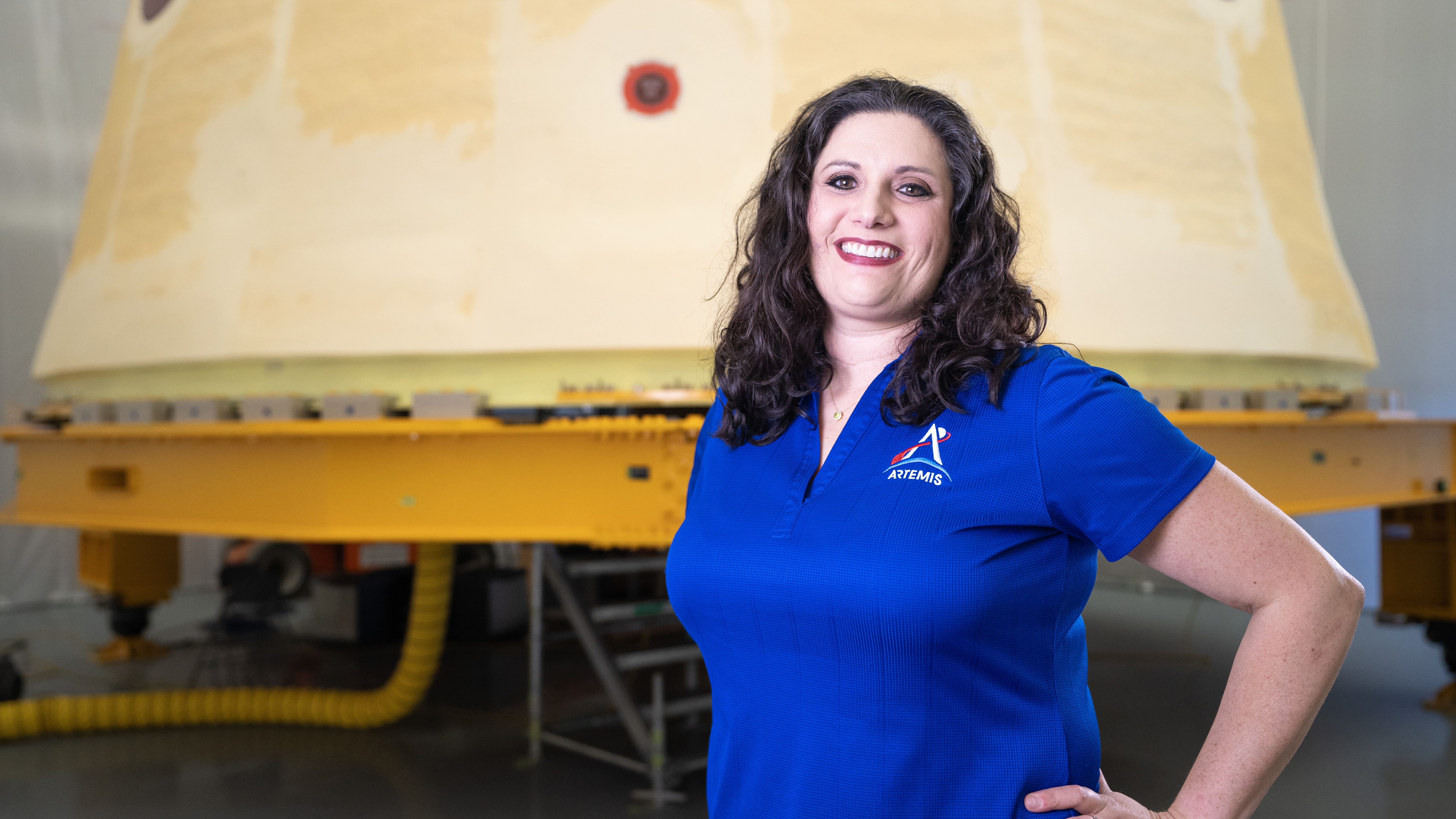
Fisher stands in front of the launch vehicle stage adapter for NASA’s SLS (Space Launch System) rocket. The hardware will be used for the agency’s Artemis III mission that will land astronauts on the lunar surface. Fisher works with a number of teams across the agency and believes her background in music education has been an asset to her work as an engineer: “Teaching skills help you look at things from a different perspective and helps with understanding how others might approach a situation – all very helpful when I’m working with teams.”
Not many music majors get to be hands-on with building a Moon rocket, but Lauren Fisher has always enjoyed the unusual.
Now a structural materials engineer at NASA’s Marshall Space Flight Center in Huntsville, Alabama, Fisher works on a key adapter for NASA’s SLS (Space Launch System) rocket for the first crewed missions of NASA’s Artemis campaign.
Manufactured at Marshall by NASA, lead contractor Teledyne Brown Engineering, and the Jacobs Space Exploration Group’s ESSCA contract, the cone-shaped launch vehicle stage adapter partially encloses the rocket’s interim cryogenic propulsion stage and connects it to the core stage below and the Orion stage adapter above. The launch vehicle stage adapter also protects avionics and electrical devices from extreme vibration and acoustic conditions during launch and ascent.
Fisher and the thermal protection system team develop and apply the spray-on foam that acts as insulation and protects the adapter and all its systems from the extreme pressures and temperatures it’ll face during flight. The thermal protection system for the component, unlike other parts of the rocket, is applied by hand using a spray gun. When first applied, the insulation is yellow, but after time and exposure to the Sun, it turns orange.
“We’re taking the same stuff someone might use to insulate their attic, except making it for cryogenic atmospheres, and spraying it all over a giant piece of hardware that will help launch us to the Moon,” Fisher said. “With my work for NASA’s Space Launch System rocket, I get to play with foam and glue. I like to call it arts and crafts engineering!”
Although engineering runs in her family, Fisher initially graduated from University of Southern Mississippi with a Bachelor of Arts in music performance and an interest in music education. She developed an interest in carbon-based polymers, and decided to go back to school, completing a chemical engineering degree with a polymeric materials track from the University of Alabama in Huntsville. Her new degree led to an opportunity to work for the thermal protection system team at Marshall.
When Fisher isn’t in the office, she likes travelling to unusual places and checking items off her self-described “Bizarre Bucket List.” Recently, she went to Punxsutawney, Pennsylvania, to watch the famous groundhog predict an early spring.
Being part of the Artemis Generation is incredibly inspiring for Fisher, who takes pride in her work supporting the first three Artemis missions, including Artemis II, the first crewed mission under Artemis, in 2025.
“I’m literally building the hardware that will send the first woman to deep space,” Fisher says. “Watching our rocket take shape, I’m like ‘you see that thing? I did that; that’s mine. See that one? My team did that one. We did that, and see this?’” She beams with pride. “You can do that, too. Just being a part of the generation that’s changing the workforce and changing the space program — it gives me goosebumps.”
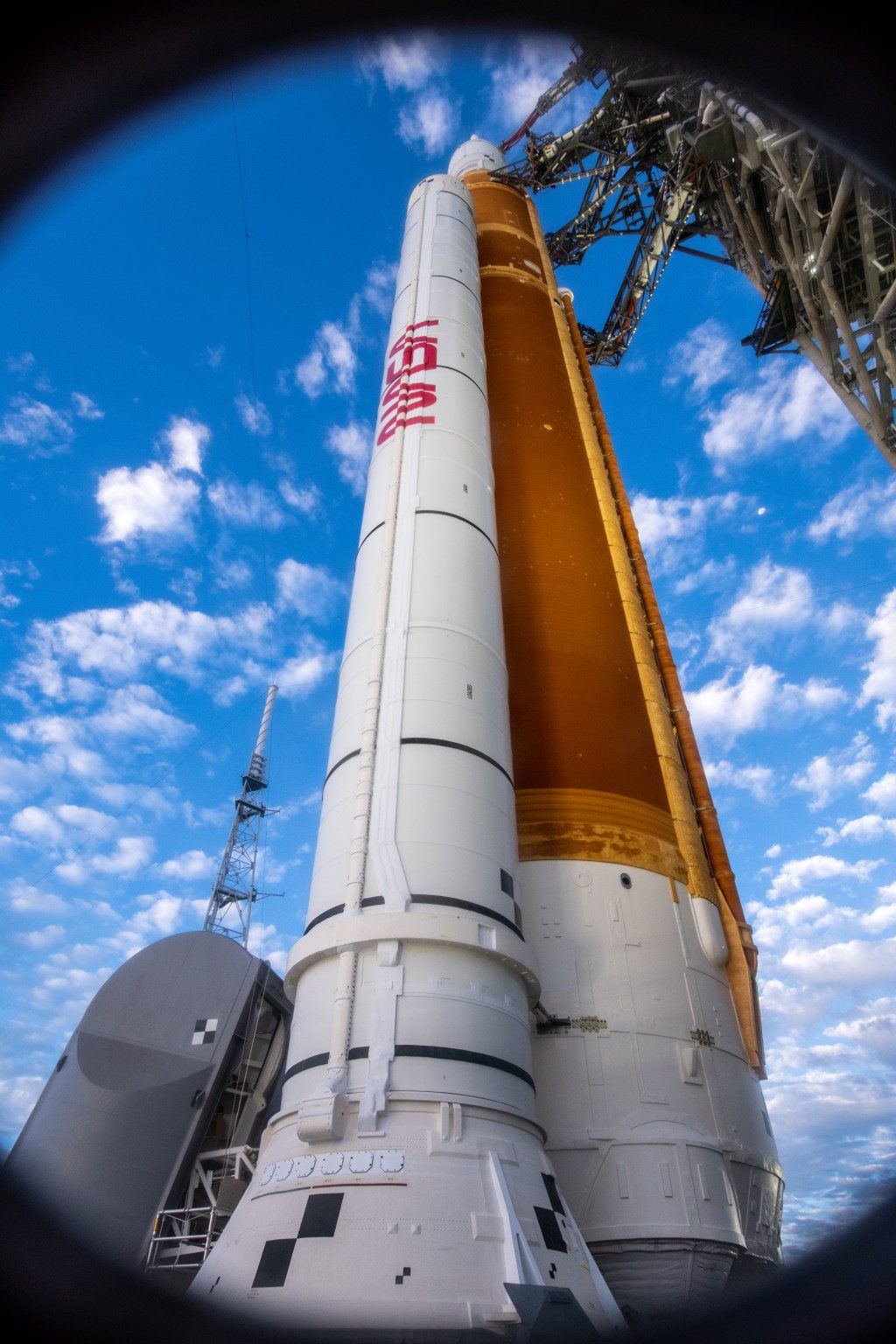
NASA is working to land the first woman, first person of color, and its first international partner astronaut on the Moon under Artemis. SLS is part of NASA’s backbone for deep space exploration, along with the Orion spacecraft and Gateway in orbit around the Moon and commercial human landing systems, next-generational spacesuits, and rovers on the lunar surface. SLS is the only rocket that can send Orion, astronauts, and supplies to the Moon in a single launch.
New Flag is in the Stars for Marshall’s Huntsville Operations Support Center
By Wayne Smith
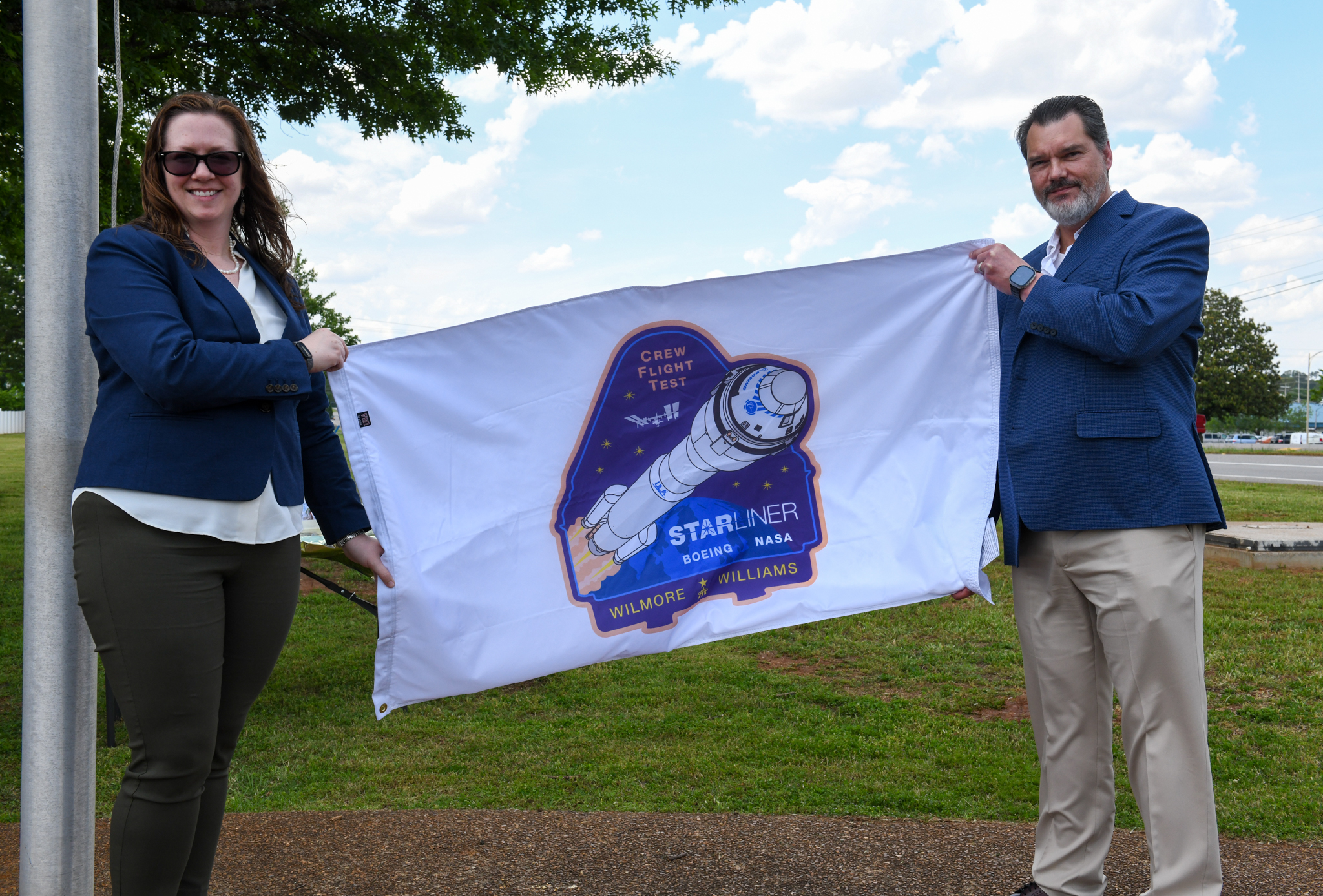
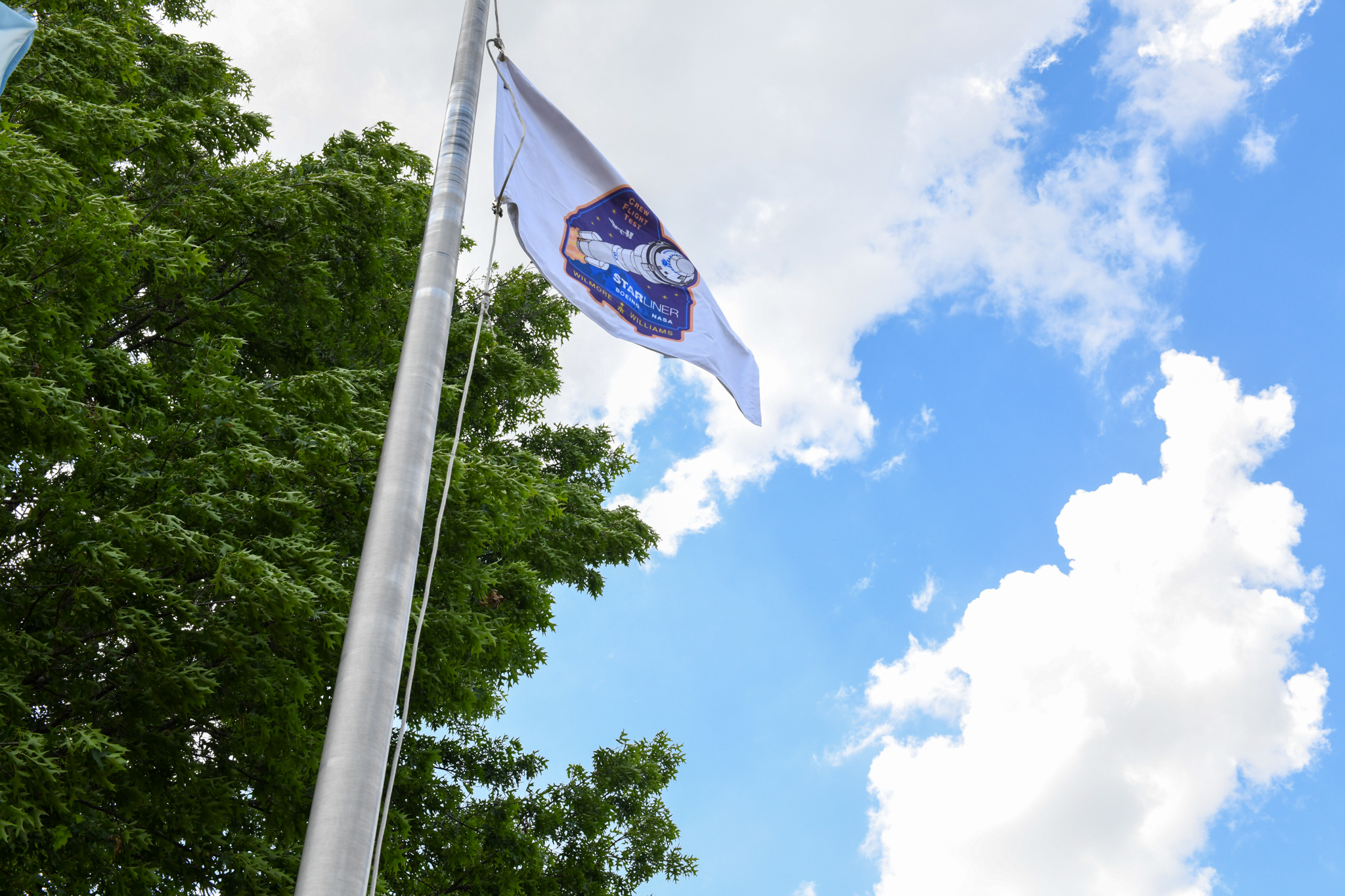
A new flag is flying closer to the stars outside the Huntsville Operations Support Center at NASA’s Marshall Space Flight Center following a May 2 ceremony.
The white flag features a blue logo of Boeing’s Starliner spacecraft and marks contributions from center team members toward the launch of NASA’s Boeing Crew Flight Test, now targeted to launch no earlier than 5:16 p.m. CDT May 17. The flag-raising ceremony was held ahead of the planned launch of the spacecraft atop a United Launch Alliance Atlas V rocket from Space Launch Complex 41 at Cape Canaveral Space Force Station.
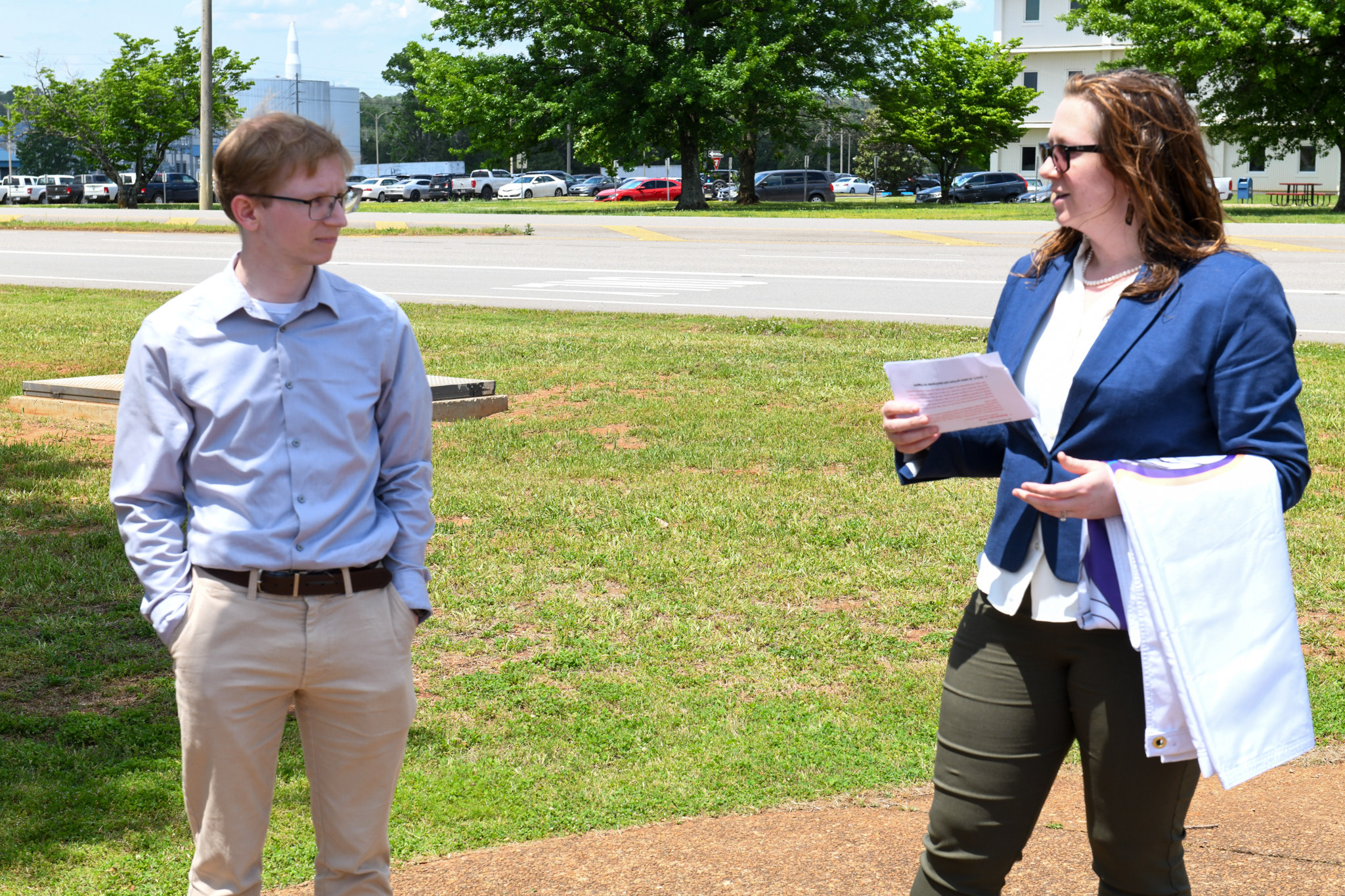
Chris Chiesa, left, listens as Lisa McCollum, deputy manager of the Exploration & Transportation Development Office, talks about Chiesa’s recognition as part of the Commercial Crew Program at NASA’s Marshall Space Flight Center during the Starliner flag-raising ceremony May 2.
NASA/Tyson Eason
The flight test will carry NASA astronauts Butch Wilmore and Suni Williams to the International Space Station for about a week to test the Starliner spacecraft and its subsystems before NASA certifies the transportation system for rotational missions to the orbiting laboratory for the agency’s Commercial Crew Program.
The flag raising has been a tradition for missions supported at Marshall’s Huntsville Operations Support Center, or HOSC, as well as a tradition within the Commercial Crew Program to celebrate the successful conclusion of NASA’s Agency Flight Readiness Review prior to launch. The ceremony was a joint effort between the Payload and Mission Operations Division (PMOD) and Commercial Crew Program team.
“The ceremony is special because it symbolizes the successful conclusion of NASA’s Flight Readiness Review, bringing us that much closer to flight,” said Maggie Freeman, a program analyst supporting the Launch Vehicle Systems Office within the Commercial Crew Program at Marshall. “It’s also a privilege to be able to honor some of our Marshall team members who have supported the mission.”
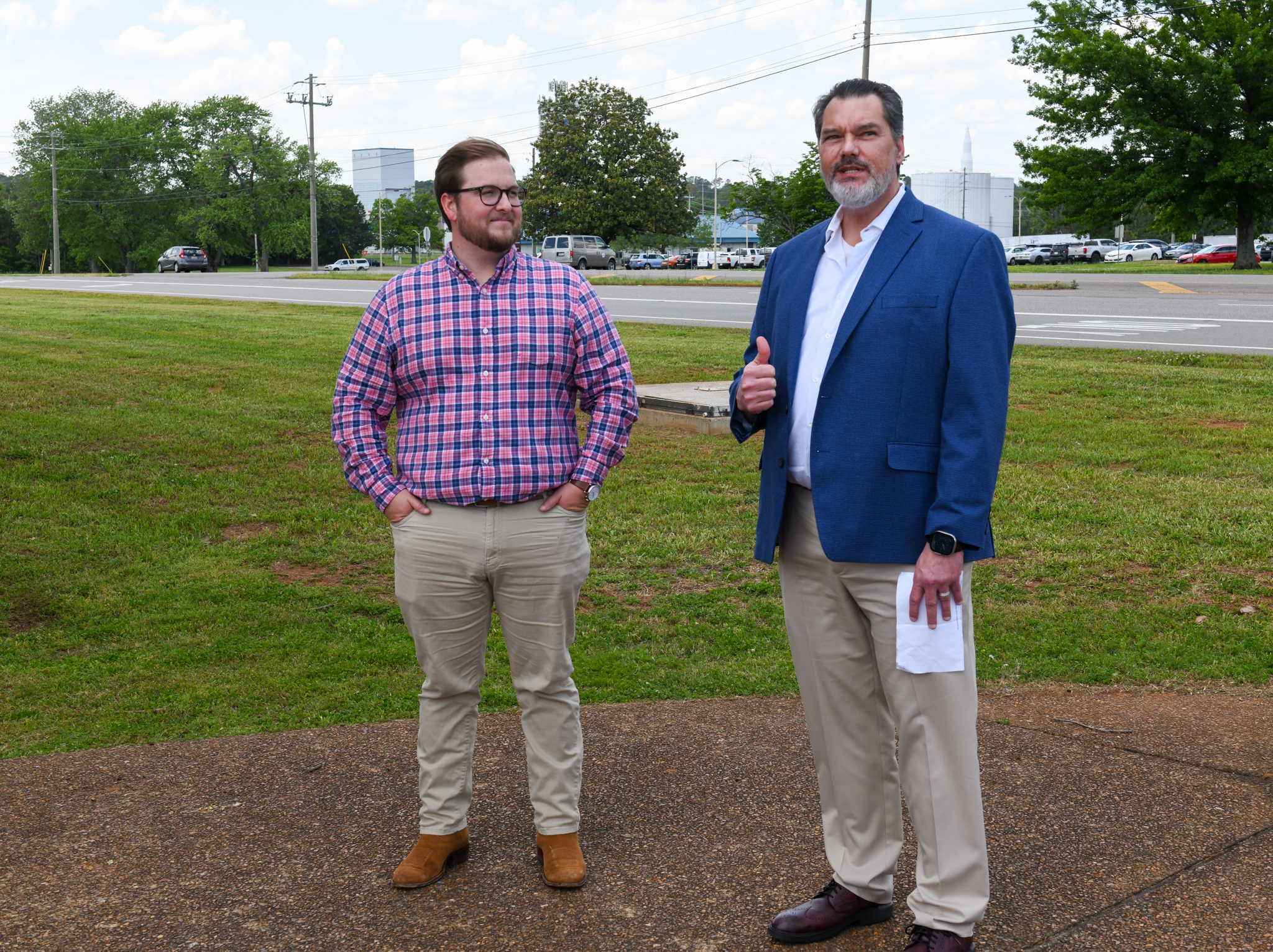
Brandyn Rolling, left, of the Payload Missions Operation Division at Marshall, listens as George Norris, deputy manager of the Payload & Mission Operations Division, talks about Rolling’s recognition during the Starliner flag-raising ceremony outside the Huntsville Operations Support Center on May 2.
NASA/Tyson Eason
Chris Chiesa and Brandyn Rolling were honored during the ceremony and raised the Starliner flag after being introduced by Lisa McCollum, deputy manager for the Exploration & Transportation Development Office, and George Norris, deputy manager for the Payload & Mission Operations Division.
“We look for team members who have displayed excellence within their fields, demonstrating their commitment to the goals of the mission,” Freeman said. “Chris and Brandyn both are phenomenal examples of that sustained commitment to excellence.”
Chiesa is the NASA engine lead for the Starliner spacecraft for the Commercial Crew Program. Rolling represented PMOD and manages all of the HOSC’s visiting vehicle ground interfaces for NASA.
McCollum and Norris display the Starliner flag before it was raised outside the Huntsville Operations Support Center.
NASA/Tyson Eason
“I feel tremendously fortunate to be surrounded by such an incredible team and to have the support of so many amazing engineers and managers across Marshall, Kennedy, and Johnson (space flight centers),” Chiesa said.
Said Rolling, “I am incredibly honored to be a part of this amazing PMOD team and am excited for the future of Boeing’s crewed flights with Starliner.”
The HOSC provides engineering and mission operations support for the space station, the Commercial Crew Program, and Artemis missions, as well as science and technology demonstration missions. The Payload Operations Integration Center within HOSC operates, plans, and coordinates the science experiments onboard the space station 365 days a year, 24 hours a day.
The Starliner flag flies outside the Huntsville Operations Support Center.
NASA/Tyson Eason
The Commercial Crew Program support team at Marshall provides crucial programmatic, engineering, and safety and mission assurance expertise for launch vehicles, spacecraft propulsion, and integrated vehicle performance.
Smith, a Media Fusion employee and the Marshall Star editor, supports the Marshall Office of Communications.
NASA’s Boeing Crew Flight Test Targets New Launch Date
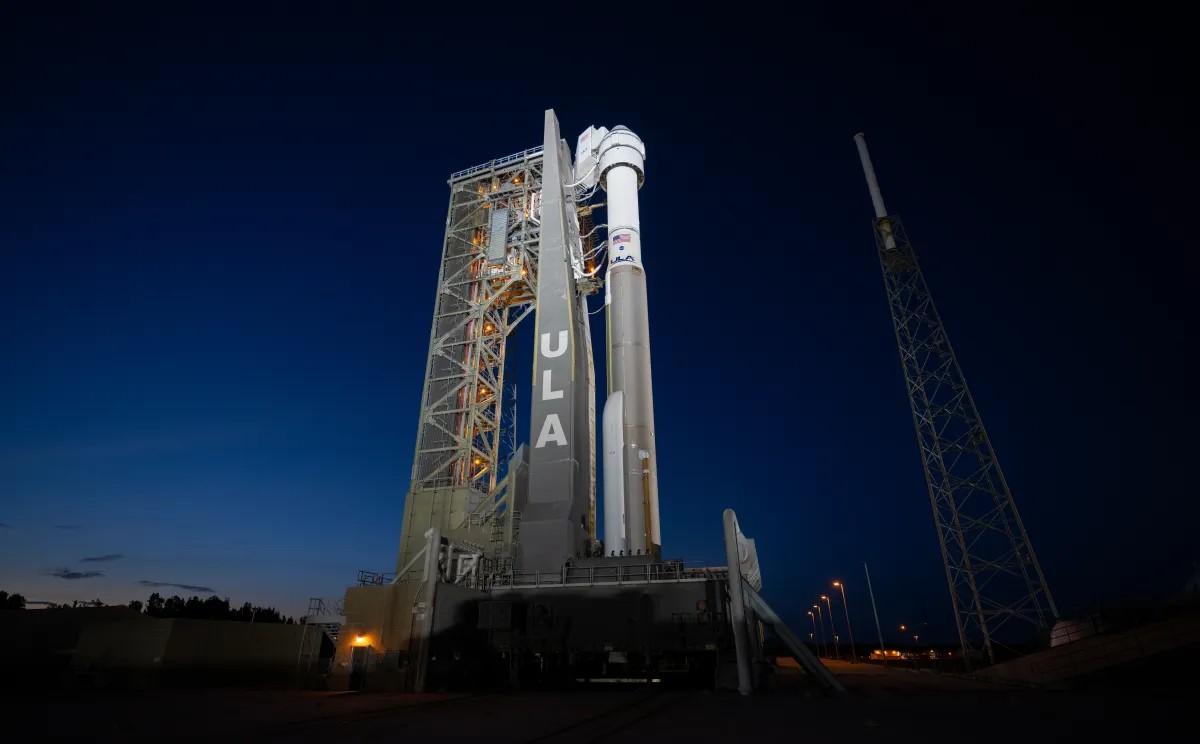
NASA’s Boeing Crew Flight Test is now targeted to launch no earlier than 5:16 p.m. CDT May 17 to the International Space Station. Following a thorough data review completed May 7, ULA (United Launch Alliance) decided to replace a pressure regulation valve on the liquid oxygen tank on the Atlas V rocket’s Centaur upper stage.
A United Launch Alliance Atlas V rocket with Boeing’s Starliner spacecraft atop illuminated by spotlights sits on the launch pad of Space Launch Complex 41 at Cape Canaveral Space Force Station ahead of NASA’s Boeing Crew Flight Test. It is the first Starliner mission to send astronauts to the International Space Station as part of the agency’s Commercial Crew Program.
NASA/Joel Kowsky
ULA planned to roll the rocket, with Boeing’s Starliner spacecraft, back to its Vertical Integration Facility at Cape Canaveral Space Force Station on May 8 to begin the replacement. The ULA team will perform leak checks and functional checkouts in support of the next launch attempt.
The oscillating behavior of the valve during prelaunch operations, ultimately resulted in mission teams calling a launch scrub May 6. After the ground crews and astronauts Butch Wilmore and Suni Williams safely exited from Space Launch Complex-41, the ULA team successfully commanded the valve closed and the oscillations were temporarily dampened. The oscillations then re-occurred twice during fuel removal operations. After evaluating the valve history, data signatures from the launch attempt, and assessing the risks relative to continued use, the ULA team determined the valve exceeded its qualification and mission managers agreed to remove and replace the valve.
Mission managers discussed the details leading to the decision to scrub the May 6 launch opportunity during a news conference shortly after the scrub call at NASA’s Kennedy Space Center.
Wilmore and Williams will remain in crew quarters at Kennedy in quarantine until the next launch opportunity. The duo will be the first to launch aboard Starliner to the space station as part of the agency’s Commercial Crew Program.
Hi-C Rocket Experiment Achieves Never-Before-Seen Look at Solar Flares
By Jessica Barnett
After months of preparation and years since its last flight, the upgraded High Resolution Coronal Imager Flare mission – Hi-C Flare, for short – took to the skies for a never-before-seen view of a solar flare.
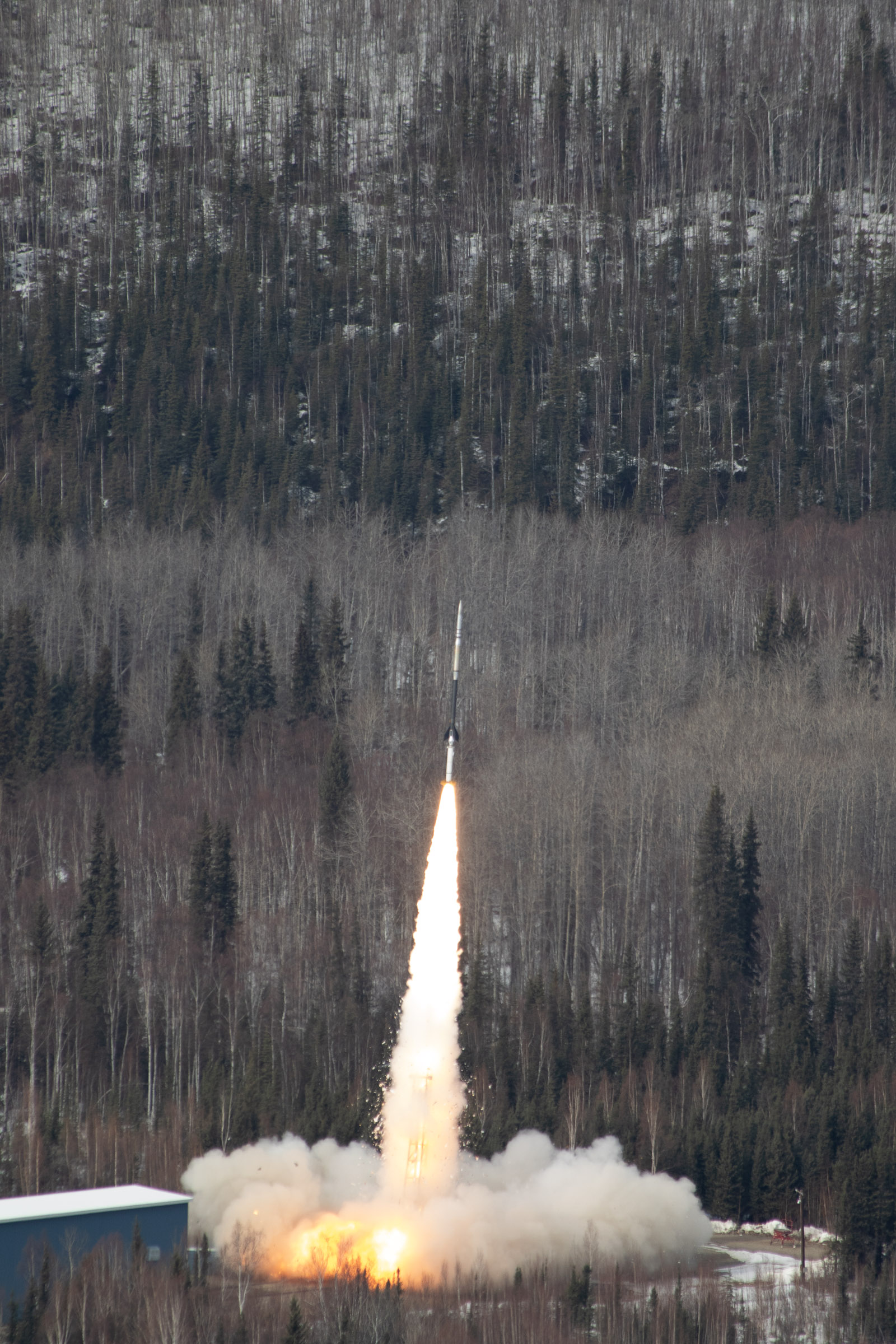
The low-noise cameras – built at NASA’s Marshall Space Flight Center – are part of a suite of state-of-the-art instruments on board the Black Brant IX sounding rocket that launched April 17 from Poker Flat Research Range in Alaska. Using the new technology, investigators hoped to study the extreme energies involved with solar flares. The Hi-C Flare experiment mission was led by Marshall.
The High-Resolution Coronal Imager, or Hi-C, launches aboard a Black Brant IX sounding rocket April 17 at Poker Flat Research Range in Fairbanks, Alaska.
NASA
“This is a pioneering campaign,” said Sabrina Savage, principal investigator at Marshall for Hi-C Flare. “Launching sounding rockets to observe the Sun to test new technologies optimized for flare observations has not even been an option until now.”
It was the third iteration of the Hi-C instrument to take flight, but its first flight with ride along instruments, including the COOL-AID (Coronal OverLapagram – Ancillary Imaging Diagnostics), CAPRI-SUN (high-CAdence low-energy Passband x-Ray detector with Integrated full-SUN field of view), and SSAXI (Swift Solar Activity X-ray Imager). Following a month of payload integration and testing in White Sands, New Mexico, investigators completed final launch site integration at the Poker Flat Research Range in Alaska.
Each morning of the two-week launch campaign window, the team spent about five hours preparing the experiment for launch, followed by up to four hours of monitoring solar data for a flare that registers as C5-class or higher with duration longer than the rocket flight. The launch finally occurred on the penultimate day of the campaign window.
“The Sun was unusually quiet throughout the campaign despite numerous active regions,” Savage said. “Both teams were getting nervous that we would not launch, but we finally got a nice long-duration M-class flare right before the window closed.”
The Hi-C Flare mission launched at 2:14 p.m. AKDT, just one minute after the FOXSI-4 (Focusing Optics X-ray Solar Imager) mission led by the University of Minnesota. Once in air, sensors on the Hi-C Flare rocket pointed cameras toward the Sun and stabilized instrumentation. Then, a shutter door opened to allow the cameras to gather about five minutes of data before the door closed and the rocket fell back to Earth.
The rocket landed in the Alaskan tundra, where it remained until conditions were safe enough for the team to retrieve it and begin processing the collected data.
“For launches into the tundra, we have to wait a few days for the instrument to get back to us and then to be dried out enough to turn on,” Savage said. “It was an anxious few days, but the data are beautiful and were worth the wait.”
From left, Austin Bumbalough, Ken Kobayashi, Harlan Haight, Sabrina Savage, William Hogue, Jim Cecil, and Adam Kobelski, members of the Hi-C Flare team, gather after the payload was recovered and brought to Poker Flat Research Range in Alaska. Hi-C Flare, equipped with Hi-C 3, COOL-AID, CAPRI-SUN, and SSAXI, launched into a solar flare as part of the first-ever solar flare sounding rocket campaign.
NASA
Investigators weren’t just testing new technology, either. They also used a new algorithm to predict the behavior of a solar flare, allowing them to launch the rocket at the ideal time.
“To catch a flare in action is really hard, because you can’t predict them,” said Genevieve Vigil, technical and camera lead for Hi-C 3 and COOL-AID at Marshall. “We had to wait around for a solar flare to start going, then launch as it’s happening. No one has tried to do that before.”
Fortunately, their method was a success.
“We are still processing the data from all four instruments, but the data from Hi-C 3 and COOL-AID already look fantastic,” Savage said.
“The COOL-AID data is the first spectrally pure image in a hot spectral line that we know of,” said Amy Winebarger, project scientist at Marshall for Hi-C Flare.
The Hi-C experiment is led by Marshall in partnership with the Smithsonian Astrophysical Observatory in Cambridge, Massachusetts, and Montana State University in Bozeman, Montana. Launch support is provided at Poker Flat Research Range in Alaska by NASA’s Sounding Rocket Program at the agency’s Wallops Flight Facility, which is managed by NASA’s Goddard Space Flight Center. NASA’s Heliophysics Division manages the sounding-rocket program for the agency.
Barnett, a Media Fusion employee, supports the Marshall Office of Communications.
NASA Technology Grants to Advance Moon to Mars Space Exploration
By Jessica Barnett
NASA has awarded nearly $1.5 million to academic, non-profit, and business organizations to advance state-of-the-art technology that will play a key role in the agency’s return to the Moon under Artemis, as well as future missions to Mars.
Twenty-four projects from 21 organizations have been awarded under NASA’s Dual-Use Technology Development Cooperative Agreement Notices, or CANs. The awardees also will receive assistance from propulsion, space transportation, and science experts at NASA’s Marshall Space Flight Center.
Brandon Aguiar, a graduate student at Florida International University, works to prepare a slurry containing a lunar regolith simulant, graphene nanoplatelets, and base resin for use in FIU’s ongoing study of the enhanced electrical conductivity of additively manufactured lunar regolith components involving graphene nanoplatelets.
Credit: Florida International University
“The Dual-Use Technology Development Cooperative Agreement Notice enables NASA to collaboratively work with U.S. industry and academia to develop needed technologies,” said Daniel O’Neil, manager, NASA Marshall’s Technology Development Dual-Use CAN Program. “Products from these cooperative agreements support the closure of identified technology gaps and enable the development of components and systems for NASA’s Moon to Mars architecture.”
These innovative projects include ways to use lunar regolith for construction on the Moon’s surface, using smartphone video guidance sensors to fly robots on the International Space Station, identifying new battery materials, and improving a neutrino particle detector.
The following is a complete list of awardees:
Auburn University in Alabama
Florida Institute of Technology in Melbourne, Florida
Florida International University in Miami
Fronius USA in Portage, Indiana
Gloyer-Taylor Laboratories in Tullahoma, Tennessee
Louisiana State University in Baton Rouge
Morgan State University in Baltimore
Nanoracks (Voyager Space) in Houston
Northwestern University in Chicago
Purdue University in West Lafayette, Indiana
Southwest Research Institute in San Antonio
Tethon 3D in Omaha, Nebraska
University of Alabama in Huntsville
University of California in Irvine
University of Florida in Gainesville
University of Illinois in Chicago
University of North Texas in Denton
University of Tennessee in Knoxville
University of Tennessee Space Institute
Victory Solutions in Huntsville, Alabama
Wichita State University in Kansas
The Florida Institute of Technology, Northwestern University, and the University of Alabama were awarded funding for two projects each.
Funding was available for organizations focused on supporting entrepreneurial research and innovation ideas that could advance the commercial space sector and benefit future NASA missions.
Applications are now open for the 2024 solicitation cycle.
Barnett, a Media Fusion employee, supports the Marshall Office of Communications.
IXPE General Observer Program Opens Doors to Global X-ray Astronomy
By Rick Smith
Launched in late 2021, the science activities for NASA’s IXPE (Imaging X-ray Polarimetry Explorer) mission were directed by researchers at NASA and the Italian Space Agency through February 2024. Now, during the General Observer phase of the mission, IXPE’s observation program primarily is guided by the broader scientific community.
“We’re in the process of turning X-ray polarization into a standard part of the toolkit for X-ray astronomers around the globe,” said Philip Kaaret, IXPE principal investigator at NASA’s Marshall Space Flight Center. “The response across the high-energy astrophysics community has been tremendous.”
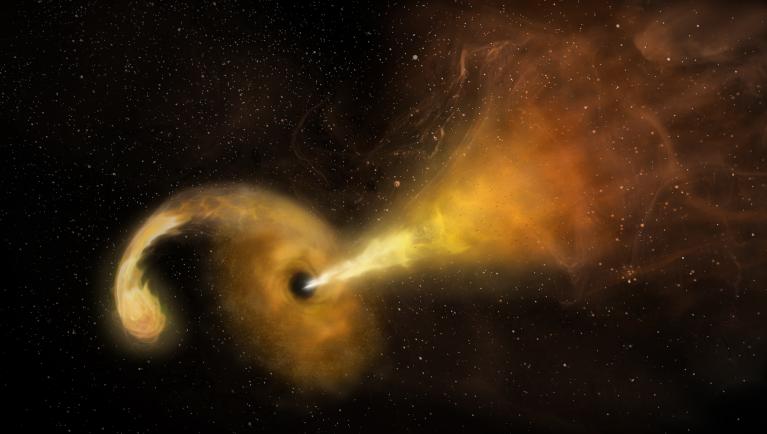
IXPE will help researchers gain new understanding of the forces involved in a tidal disruption event, as seen in this artist’s illustration depicting what happens when a star passes fatally close to a supermassive black hole.
NRAO/AUI/NSF/NASA
The General Observer Program, which officially began in February, invites astrophysicists and space scientists around the world to propose exciting new investigations of black holes, neutron stars, active galactic nuclei, and other high-energy X-ray sources using the IXPE telescope.
In the spacecraft’s first two years of operation, NASA’s research partners included more than 175 scientists in 13 countries – and interest continues to swell. Proposed investigations submitted to date to the General Observer Program involve more than 1,400 researchers at 174 unique institutions in 30 countries.
“Our chief goal to enable every interested party to use, analyze, and interpret IXPE data,” said Kavitha Arur, program lead at NASA’s Goddard Space Flight Center. “We want to maximize science outputs and cover the widest possible range of targets.”
In June 2023, NASA issued an open invitation to researchers to propose new IXPE missions and targets of observation. By the October 2023 deadline, the General Observer Program team had received 135 proposals for Cycle 1, covering the first year of the program. Each proposal was exhaustively peer-reviewed by NASA astrophysicists and associated experts in the field.
Researchers proposed studies based on the number of seconds of IXPE target observation they estimated they would need to obtain the data necessary to verify a hypothesis or model.
For Cycle 1, the team selected 39 proposals, totaling about 15 million seconds of total observation time. That figure will include some overlap among selected targets – and the targets selected included a few surprises.
“Some of the selected proposals were for types of targets we hadn’t previously considered, such as tidal disruption events,” Kaaret said. A tidal disruption event is when a star is pulled into a supermassive black hole and torn apart.
Cycle 1 researchers also will, for the first time, use IXPE to study a white dwarf, a stellar core remnant roughly the size of Earth but with a mass comparable to that of our Sun. That white dwarf is part of the binary system T Coronae Borealis, roughly 3,000 light years from our solar system. “T CrB,” as it’s known to astronomers, also includes an ancient red giant which emits a nova eruption every 80 years or so. It was last seen in 1946, and astronomers anticipate another eruption between now and September 2024. For stargazers on Earth, this nova will appear to be a star that wasn’t there before.
That wide window of time makes T CrB a “target of opportunity” for IXPE – an unpredictable wrinkle in the meticulously plotted Cycle 1 schedule. Such an event requires quick reaction on the part of the team to enable IXPE to point at it without a lot of advanced scheduling.
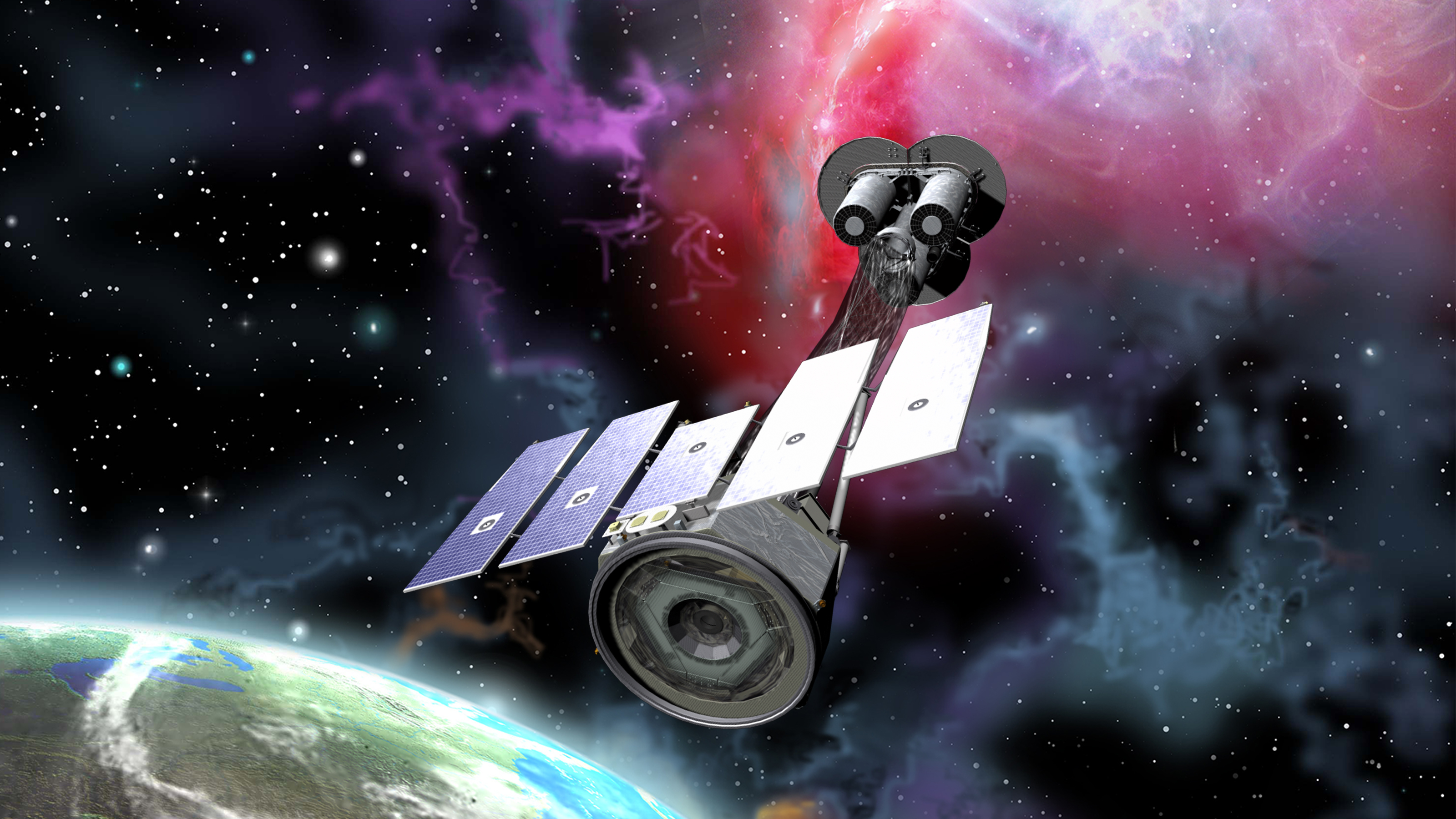
An artist’s illustration of the IXPE spacecraft in orbit, studying high-energy phenomena light-years from Earth.
NASA
Allyn Tennant, who heads IXPE’s science operations center at Marshall, is tasked with mapping out IXPE’s timetable. He factors in the precise duration of each observation, the time needed to download its findings, and the necessary repositioning time between targets.
What does it take to execute such a complex plan? “A certain amount of thought, a certain amount of swearing, and a whole lot of replanning,” Tennant said.
“We started the program the first week of February and by late April, Allyn had already rescheduled the plan seven times,” Kaaret added. “It makes for some stressful weekends, but a lot of really exciting results come from these unanticipated events.”
IXPE spends about a week on each target, on average, so it’s not hard to schedule roughly 40 targets in a 52-week window, Tennant said – until one encounters those targets of opportunity. There’s also the challenge of managing the inflow of data from each observation. The brighter the target, the bigger the volume of incoming data that must be captured, verified, and distributed to the investigators.
The spacecraft’s busy schedule also factors in joint astronomical observations with other NASA instruments conducting their own orbiting science missions. Those joint efforts further extend the value of data gathered during IXPE’s General Observer Program studies but add another level of complexity when targets of opportunity call for reshuffling the schedule.
During Cycle 1 and Cycle 2, IXPE is teaming with NASA’s NICER (Neutron Star Interior Composition Explorer) X-ray observatory, which studies neutron stars, black holes, and other phenomena from its permanent vantage point aboard the International Space Station. In Cycle 2, beginning in February 2025, the program also will partner with NASA’s orbiting Swift and NuSTAR (Nuclear Spectroscopic Telescope Array) imagers, which monitor gamma-ray bursts and high-energy cosmic X-ray events, respectively.
The growing interest in IXPE’s success led USRA’s Science and Technology Institute to announce the first IXPO (International X-ray Polarimetry Symposium), to be held in Huntsville on Sept. 16-19. Astronomers, engineers, and X-ray technologists are encouraged to attend.
IXPE, led by NASA Marshall, is a collaboration between NASA and the Italian Space Agency. The Space & Mission Systems division of BAE Systems Inc., in Broomfield, Colorado, manages spacecraft operations together with the University of Colorado’s Laboratory for Atmospheric and Space Physics in Boulder.
Smith, a Manufacturing Technical Solutions Inc. employee, supports the Marshall Office of Communications.
NASA Selects Students for Europa Clipper Intern Program
NASA has selected 40 undergraduate students for the first year of its Europa ICONS (Inspiring Clipper: Opportunities for Next-generation Scientists) internship program, supporting the agency’s Europa Clipper mission. Europa ICONS matches students with mentors from the mission’s science team for a 10-week program to conduct original scientific research on topics related to the mission to Jupiter’s moon Europa.
The program is planned to run every year until Europa Clipper completes its prime mission in 2034 and is open to applications from all U.S. undergraduate STEM majors, with preference given to students from non-high research activity universities and underserved institutions.
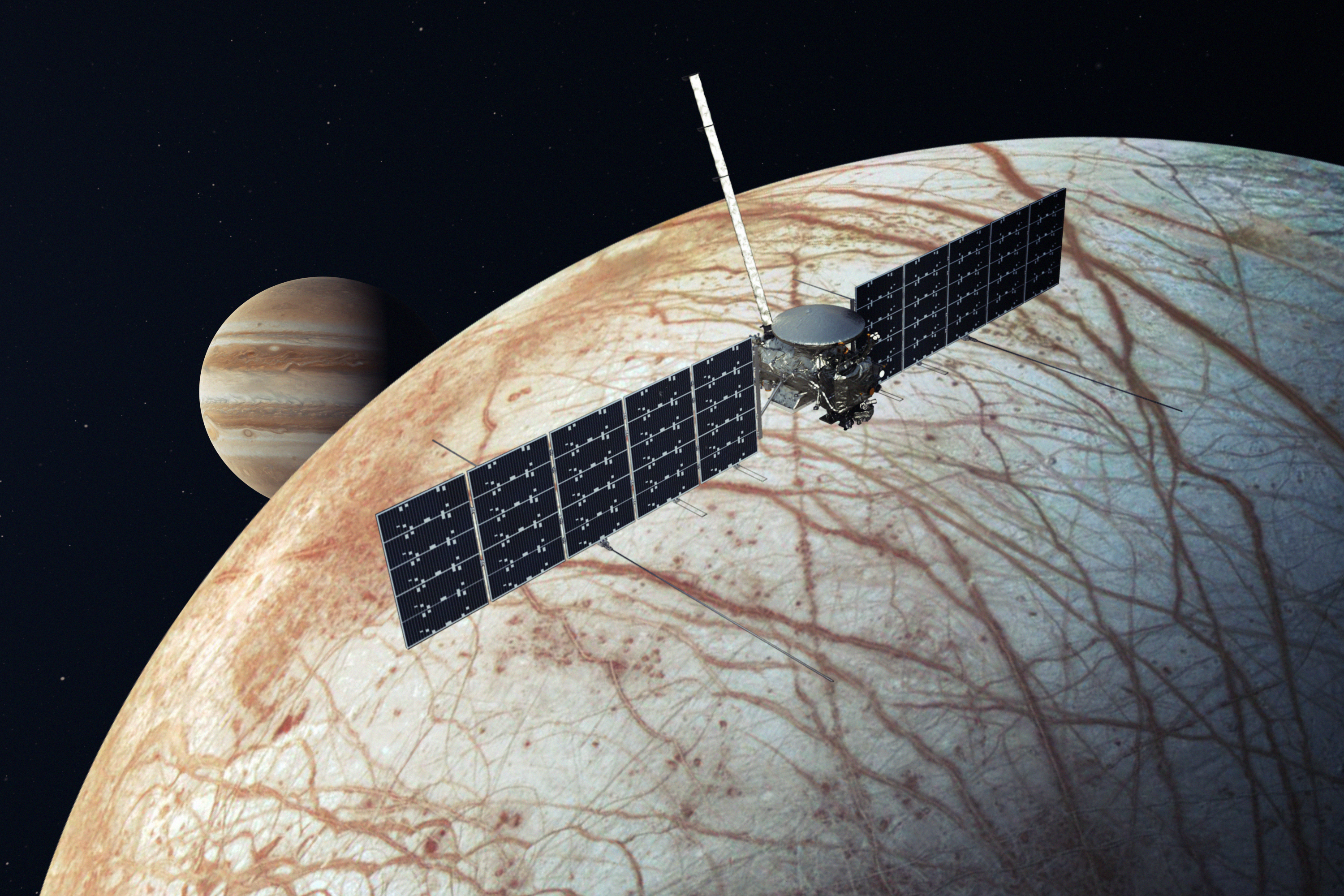
Artist’s rendering of NASA’s Europa Clipper spacecraft.
NASA/JPL-Caltech
ICONS internships may be in-person at the mentor’s institution, virtual, or hybrid, depending on the research project and needs of the mentor and intern. As part of the program, students and mentors will convene for a two-day meeting at NASA’s Jet Propulsion Laboratory (JPL). The first Europa ICONS internship will run June 3 through Aug. 9.
The students selected for the Europa ICONS program in 2024 are:
Sarah Ruetschle, John Carroll University in University Heights, Ohio
Cole Anderson, University of California, Santa Cruz
Hamza Ouriour, Wentworth Institute of Technology in Boston
Ethan Piacenti, Olivet Nazarene University in Bourbonnais, Illinois
Jared Bouck, Northern Arizona University in Flagstaff, Arizona
Kayla Blair, Northern Arizona University
Carly Davis, McNeese State University in Lake Charles, Louisiana
Matthew Perkins, Red Rocks Community College in Lakewood, Colorado
Angela Zhang, Cornell University in Ithaca, New York
Arianna Rodriguez Ortiz, University of Puerto Rico–Mayaguez
Beverly Malugin Ayala, University of Puerto Rico–Mayaguez
Jeansel Johnson-Ayala, University of Puerto Rico–Rio Piedras
Akemi Takeuchi, University of Maryland, College Park
Sofia Merchant-Dest, University of Maryland–University College in Adelphi
Gradon Robbins, University of Florida in Gainesville
Jason Sioeng, California State Polytechnic University, Pomona
Tyler Yuen, San Jose State University in San Jose, California
Dallin Nelson, Southern Utah University in Cedar City
Eric Stinemetz, University of Houston–Downtown
Lucas Nerbonne, Middlebury College in Middlebury, Vermont
Hope Jerris, Middlebury College
Jacob Dietrich, Indiana University, Southeast in New Albany
Jocelyn Mateo, Lorain County Community College in Elyria, Ohio
Samuel Brown, San Diego Mesa College in San Diego
Madison Stanford, Loyola Marymount University in Los Angeles
Bryce McGimsey, Solano Community College in Fairfield, California
Noah Alayon, CUNY LaGuardia Community College in Queens, New York
Trevor Erwin, University of Texas at Austin
Ava Frost, Mount Holyoke College in South Hadley, Massachusetts
Brianna Casey, Rensselaer Polytechnic Institute in Troy, New York
Fatima Mendoza, Texas Tech University in Lubbock
Daniel Voyles, Harvey Mudd College in Claremont, California
Swaroop Sathyanarayanan, Georgia Institute of Technology in Atlanta
Jay Patel, Louisiana State University College of Engineering in Baton Rouge
Juliane Keiper, Amherst College in Amherst, Massachusetts
Emori Long, Florida Agricultural and Mechanical University in Tallahassee
Scott Chang, University of Wisconsin–Madison
Hayden Ferrell, Arizona State University in Tempe
Isabella Musto, Denison University in Granville, Ohio
Elizabeth Kirby, College of Charleston in Charleston, South Carolina
The Europa Clipper mission’s three main science objectives are to determine the thickness of the moon’s icy shell and its surface interactions with the ocean below, to investigate its composition, and to characterize its geology. The mission’s detailed exploration of Europa will help scientists better understand the astrobiological potential for habitable worlds beyond our planet.
The Europa ICONS program is managed by the Planetary Science Division within NASA’s Science Mission Directorate and is part of a larger effort known as Clipper Next Gen, a decade-long strategy using the Europa Clipper mission to train and diversify the next generation of planetary scientists.
Managed by Caltech in Pasadena, California, JPL leads the development of the Europa Clipper mission in partnership with the Johns Hopkins Applied Physics Laboratory (APL) in Laurel, Maryland, for NASA’s Science Mission Directorate. APL designed the main spacecraft body in collaboration with JPL and NASA’s Goddard Space Flight Center. The Planetary Missions Program Office at NASA’s Marshall Space Flight Center executes program management of the Europa Clipper mission.
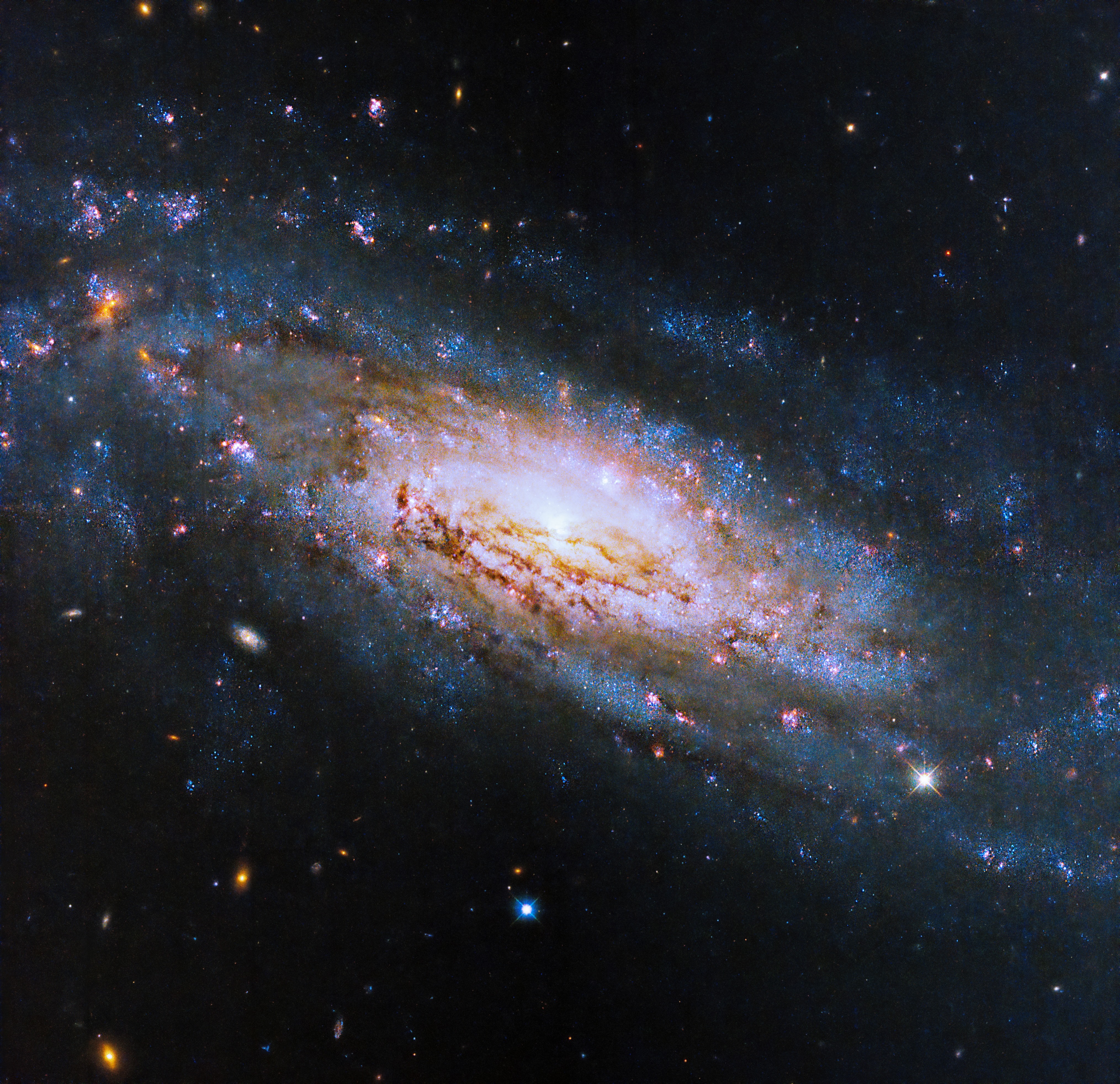
Bright, starry spiral arms surround an active galactic center in a new NASA Hubble Space Telescope image of the galaxy NGC 4951.
Located in the Virgo constellation, NGC 4951 is located roughly 50 million light-years away from Earth. It’s classified as a Seyfert galaxy, which means that it’s an extremely energetic type of galaxy with an active galactic nucleus (AGN). However, Seyfert galaxies are unique from other sorts of AGNs because the galaxy itself can still be clearly seen – different types of AGNs are so bright that it’s nearly impossible to observe the actual galaxy that they reside within.
Bright, starry spiral arms surround an active galactic center in this new NASA Hubble Space Telescope image of the galaxy NGC 4951.
NASA, ESA, and D. Thilker (The Johns Hopkins University); Image Processing: Gladys Kober (NASA/Catholic University of America)
AGNs like NGC 4951 are powered by supermassive black holes. As matter whirls into the black hole, it generates radiation across the entire electromagnetic spectrum, making the AGN shine brightly.
Hubble helped prove that supermassive black holes exist at the core of almost every galaxy in our universe. Before the telescope launched into low-Earth orbit in 1990, astronomers only theorized about their existence. The mission verified their existence by observing the undeniable effects of black holes, like jets of material ejecting from black holes and disks of gas and dust revolving around those black holes at very high speeds.
These observations of NGC 4951 were taken to provide valuable data for astronomers studying how galaxies evolve, with a particular focus on the star formation process. Hubble gathered this information, which is being combined with observations with the James Webb Space Telescope (JWST) to support a JWST Treasury program. Treasury programs collect observations that focus on the potential to solve multiple scientific problems with a single, coherent dataset and enable a variety of compelling scientific investigations.
NASA’s Marshall Space Flight Center was the lead field center for the design, development, and construction of the space telescope.

NASA’s Boeing Crew Flight Test astronaut Suni Williams gives a thumbs up during a mission dress rehearsal on Friday, April 26, 2024, at the agency’s Kennedy Space Center in Florida. Williams was selected as an astronaut by NASA in 1998 and has been aboard the International Space Station twice. She is set to return to the space station for a third time, traveling aboard Boeing’s Starliner spacecraft as pilot. NASA astronaut Butch Wilmore will also be aboard as commander. Starliner is scheduled to liftoff atop a United Launch Alliance Atlas V rocket from Space Launch Complex-41 at nearby Cape Canaveral Space Force Station at 10:34 p.m. ET Monday, May 6. NASA’s Boeing Crew Flight Test is one of the final flight tests for Starliner on its road to certification.
Medals of Freedom are displayed Thursday, July 7, 2022, before a ceremony at the White House. (Official White House Photo by Cameron Smith)
President Joe Biden will present Dr. Ellen Ochoa, former center director and astronaut at the agency’s Johnson Space Center in Houston, and Dr. Jane Rigby, senior project scientist for NASA’s James Webb Space Telescope, each with the Presidential Medal of Freedom Friday in a ceremony at the White House in Washington.
The Presidential Medal of Freedom is the nation’s highest civilian honor award, and these two NASA recipients are among the 19 awardees announced May 3. Ochoa is recognized for her leadership at NASA Johnson and as the first Hispanic woman in space, and Rigby is recognized for her work on leading NASA’s transformational space telescope.
“I am proud Ellen and Jane are recognized for their incredible roles in NASA missions, for sharing the power of science with humanity, and inspiring the Artemis Generation to look to the stars,” said NASA Administrator Bill Nelson. “Among her many accomplishments as a veteran astronaut and leader, Ellen served as the second female director of Johnson, flew in space four times, and logged nearly 1,000 hours in orbit. Jane is one of the many wizards at NASA who work every day to make the impossible, possible. The James Webb Space Telescope represents the very best of scientific discovery that will continue to unfold the secrets of our universe. We appreciate Ellen and Jane for their service to NASA, and our country.”
Dr. Ellen Ochoa
Portrait of retired NASA Johnson Space Center Director Ellen Ochoa seated in the Flight Control Room 1 viewing area in the Christopher C. Kraft Jr. Mission Control Center in Houston, Texas. Photo Credit: NASA/Bill Stafford and Allison Bills
Ochoa retired from NASA in 2018 after more than 30 years with the agency. In addition to being an astronaut, she served a variety of positions over the years, including the 11th director of NASA Johnson, Johnson deputy center director, and director of Flight Crew Operations.
She joined the agency in 1988 as a research engineer at NASA’s Ames Research Center in Silicon Valley, California, and moved to NASA Johnson in 1990 when she was selected as an astronaut. Ochoa became the first Hispanic woman to go to space when she served on the nine-day STS-56 mission aboard the space shuttle Discovery in 1993. She flew in space four times, including STS-66, STS-96 and STS-110.
Born in California, Ochoa earned a bachelor’s degree in Physics from San Diego State University and a master’s degree and doctorate in Electrical Engineering from Stanford University. As a research engineer at Sandia National Laboratories and NASA Ames Research Center, Ochoa investigated optical systems for performing information processing. She is a co-inventor on three patents and author of several technical papers.
“Wow, what an unexpected and amazing honor! I’m so grateful for all my amazing NASA colleagues who shared my career journey with me,” said Ochoa upon hearing the news of her Presidential Medal of Freedom award.
During her career, Ochoa also received NASA’s highest award, the Distinguished Service Medal, and the Presidential Distinguished Rank Award for senior executives in the federal government. She has received many other awards and is especially honored to have seven schools named for her.
Ochoa also is a member of the National Academy of Engineering, and formerly chaired both the National Science Board and the Nomination Evaluation Committee for the National Medal of Technology and Innovation.
Dr. Jane Rigby
NASA James Webb Space Telescope Operations Project Scientist Jane Rigby answers a question from a member of the media during a briefing following the release of the first full-color images from NASA’s James Webb Space Telescope, Tuesday, July 12, 2022, at NASA’s Goddard Space Flight Center in Greenbelt, Md. Photo Credit: (NASA/Bill Ingalls)
Rigby, who was born and raised in Delaware, is honored with the Medal of Freedom for her role in the success of NASA’s Webb mission – the largest, most powerful space telescope launched on Dec. 25, 2021 – as well as her longtime support of diversity and inclusion in science.
She is an astrophysicist at NASA’s Goddard Space Flight Center in Greenbelt, Maryland. She provides scientific leadership for Webb, which has made pioneering discoveries about the secrets of our universe and inspired the world in its first two years of science operations. Rigby worked on the development of Webb for many years, and subsequently led the characterization of Webb’s science performance, which now is exceeding expectations, and frequently shares the progress of Webb science with the public.
“Webb has become a symbol not only of technical excellence and scientific discovery, but also of how much humanity can accomplish when we all work together,” Rigby said. “I’m so proud and grateful to lead the amazing Webb team.”
Rigby is an active researcher, developing new techniques to better understand how galaxies evolve over time and form stars. She has published 160 peer-reviewed publications and has been recognized with awards such as NASA’s Exceptional Scientific Achievement Medal, the Fred Kavli Prize Plenary Lecture from the American Astronomical Society (AAS), and the 2022 LGBTQ+ Scientist of the Year from Out to Innovate.
“Thousands of people around the world came together to build Webb,” said Rigby. “The engineers who built and deployed Webb were critical to Webb’s success, and now thousands of scientists around the world are using Webb to make discovery after discovery.” To represent those contributions, in addition to inviting her family to the Medal of Freedom ceremony, Rigby invited her colleague Mike Menzel, Webb lead mission systems engineer at NASA Goddard, and Dr. Kelsey Johnson, president of the American Astronomical Society.
Rigby also serves as a trustee of the AAS and was a founding member of the AAS Committee for Sexual-Orientation and Gender Minorities in Astronomy. She holds a doctorate in Astronomy from the University of Arizona, as well as a bachelor’s degree in Physics, as well as another in Astronomy and Astrophysics from Penn State University.
NASA’s James Webb Space Telescope is the world’s premier space science observatory. Webb is solving mysteries in our solar system, looking beyond to distant worlds around other stars, and probing the mysterious structures and origins of our universe and our place in it. Webb is an international program led by NASA with its partners, ESA (European Space Agency) and CSA (Canadian Space Agency).
Preparations for Next Moonwalk Simulations Underway (and Underwater)
Synthetic cell development could lead researchers to new developments in food and medical sciences and a better understanding of the origins of life on Earth.
NIH/Rhoda Baer
Cells are the fundamental units of life, forming the variety of all living things on Earth as individual cells and multi-cellular organisms. To better understand how cells perform the essential functions of life, scientists have begun developing synthetic cells – non-living bits of cellular biochemistry wrapped in a membrane that mimic specific biological processes.
The development of synthetic cells could one day hold the answers to developing new ways to fight disease, supporting long-duration human spaceflight, and better understanding the origins of life on Earth.
In a paper published recently in ACS Synthetic Biology, researchers outline the potential opportunities that synthetic cell development could unlock and what challenges lie ahead in this groundbreaking research. They also present a roadmap to inspire and guide innovation in this intriguing field.
“The potential for this field is incredible,” said Lynn Rothschild, the lead author of the paper and an astrobiologist at NASA’s Ames Research Center in California’s Silicon Valley. “It’s a privilege to have led this group in forming what we envision will be a founding document, a resource that will spur this field on.”
Synthetic cell development could have wide ranging benefits to humanity. Analyzing the intricacies that go in to building a cell could guide researchers to better understand how cells first evolved or open the door to creating new forms of life more capable of withstanding harsh environments like radiation or freezing temperatures.
These innovations could also lead to advancements in food and medical sciences – creating efficiencies in food production, detecting contaminants in manufacturing, or developing novel cellular functions that act as new therapies for chronic diseases and even synthetic organ transplantation.
Building synthetic cells could also answer some of NASA’s biggest questions about the possibility of life beyond Earth.
“The challenge of creating synthetic cells informs whether we’re alone in the universe,” said Rothschild. “We’re starting to develop the skills to not just create synthetic analogs of life as it may have happened on Earth but to consider pathways to life that could form on other planets.”
As research continues on synthetic cell development, Rothschild sees opportunities where it could expand our understanding of the complexities of natural life.
“Life is an amazing thing. We use the capabilities of cells all the time – we build houses with wood, we use leather in our shoes, we breathe oxygen. Life has amazing precision, and if you can harness it, it’s unbelievable what we could accomplish.”
For news media:
Members of the news media interested in covering this topic should reach out to the NASA Ames newsroom.
Preparations for Next Moonwalk Simulations Underway (and Underwater)
The High-Resolution Coronal Imager, or Hi-C, launches aboard a Black Brant IX sounding rocket April 17 at Poker Flat Research Range in Fairbanks, Alaska.
NASA
By Jessica Barnett
After months of preparation and years since its last flight, the upgraded High Resolution Coronal Imager Flare mission – Hi-C Flare, for short – took to the skies for a never-before-seen view of a solar flare.
The low-noise cameras – built at NASA’s Marshall Space Flight Center in Huntsville, Alabama – are part of a suite of state-of-the-art instruments on board the Black Brant IX sounding rocket that launched April 17 from Poker Flat Research Range in Alaska. Using the new technology, investigators hoped to study the extreme energies involved with solar flares. The Hi-C Flare experiment mission was led by Marshall.
“This is a pioneering campaign,” said Sabrina Savage, principal investigator at Marshall for Hi-C Flare. “Launching sounding rockets to observe the Sun to test new technologies optimized for flare observations has not even been an option until now.”
It was the third iteration of the Hi-C instrument to take flight, but its first flight with ride along instruments, including the COOL-AID (Coronal OverLapagram – Ancillary Imaging Diagnostics), CAPRI-SUN (high-CAdence low-energy Passband x-Ray detector with Integrated full-SUN field of view), and SSAXI (Swift Solar Activity X-ray Imager). Following a month of payload integration and testing in White Sands, New Mexico, investigators completed final launch site integration at the Poker Flat Research Range in Alaska.
Each morning of the two-week launch campaign window, the team spent about five hours preparing the experiment for launch, followed by up to four hours of monitoring solar data for a flare that registers as C5-class or higher with duration longer than the rocket flight. The launch finally occurred on the penultimate day of the campaign window.
“The Sun was unusually quiet throughout the campaign despite numerous active regions,” said Savage. “Both teams were getting nervous that we would not launch, but we finally got a nice long-duration M-class flare right before the window closed.”
The Hi-C Flare mission launched at 2:14 p.m. AKDT, just one minute after the FOXSI-4 (Focusing Optics X-ray Solar Imager) mission led by the University of Minnesota. Once in air, sensors on the Hi-C Flare rocket pointed cameras toward the Sun and stabilized instrumentation. Then, a shutter door opened to allow the cameras to gather about five minutes of data before the door closed and the rocket fell back to Earth.
From left, Austin Bumbalough, Ken Kobayashi, Harlan Haight, Sabrina Savage, William Hogue, Jim Cecil, and Adam Kobelski, members of the Hi-C Flare team, gather after the payload was recovered and brought to Poker Flat Research Range in Alaska. Hi-C Flare, equipped with Hi-C 3, COOL-AID, CAPRI-SUN, and SSAXI, launched into a solar flare as part of the first-ever solar flare sounding rocket campaign.
NASA
The rocket landed in the Alaskan tundra, where it remained until conditions were safe enough for the team to retrieve it and begin processing the collected data.
“For launches into the tundra, we have to wait a few days for the instrument to get back to us and then to be dried out enough to turn on,” said Savage. “It was an anxious few days, but the data are beautiful and were worth the wait.”
Investigators weren’t just testing new technology, either. They also used a new algorithm to predict the behavior of a solar flare, allowing them to launch the rocket at the ideal time.
“To catch a flare in action is really hard, because you can’t predict them,” said Genevieve Vigil, technical and camera lead for Hi-C 3 and COOL-AID at Marshall. “We had to wait around for a solar flare to start going, then launch as it’s happening. No one has tried to do that before.”
Fortunately, their method was a success.
“We are still processing the data from all four instruments, but the data from Hi-C 3 and COOL-AID already look fantastic,” said Savage.
“The COOL-AID data is the first spectrally pure image in a hot spectral line that we know of,” said Amy Winebarger, project scientist at Marshall for Hi-C Flare.
The Hi-C experiment is led by Marshall Space Flight Center in partnership with the Smithsonian Astrophysical Observatory in Cambridge, Massachusetts, and Montana State University in Bozeman, Montana. Launch support is provided at Poker Flat Research Range in Alaska by NASA’s Sounding Rocket Program at the agency’s Wallops Flight Facility on Wallops Island, Virginia, which is managed by NASA’s Goddard Space Flight Center in Greenbelt, Maryland. NASA’s Heliophysics Division manages the sounding-rocket program for the agency.
Jonathan Deal Marshall Space Flight Center, Huntsville, Ala. 256.544.0034 Jonathan.e.deal@nasa.gov
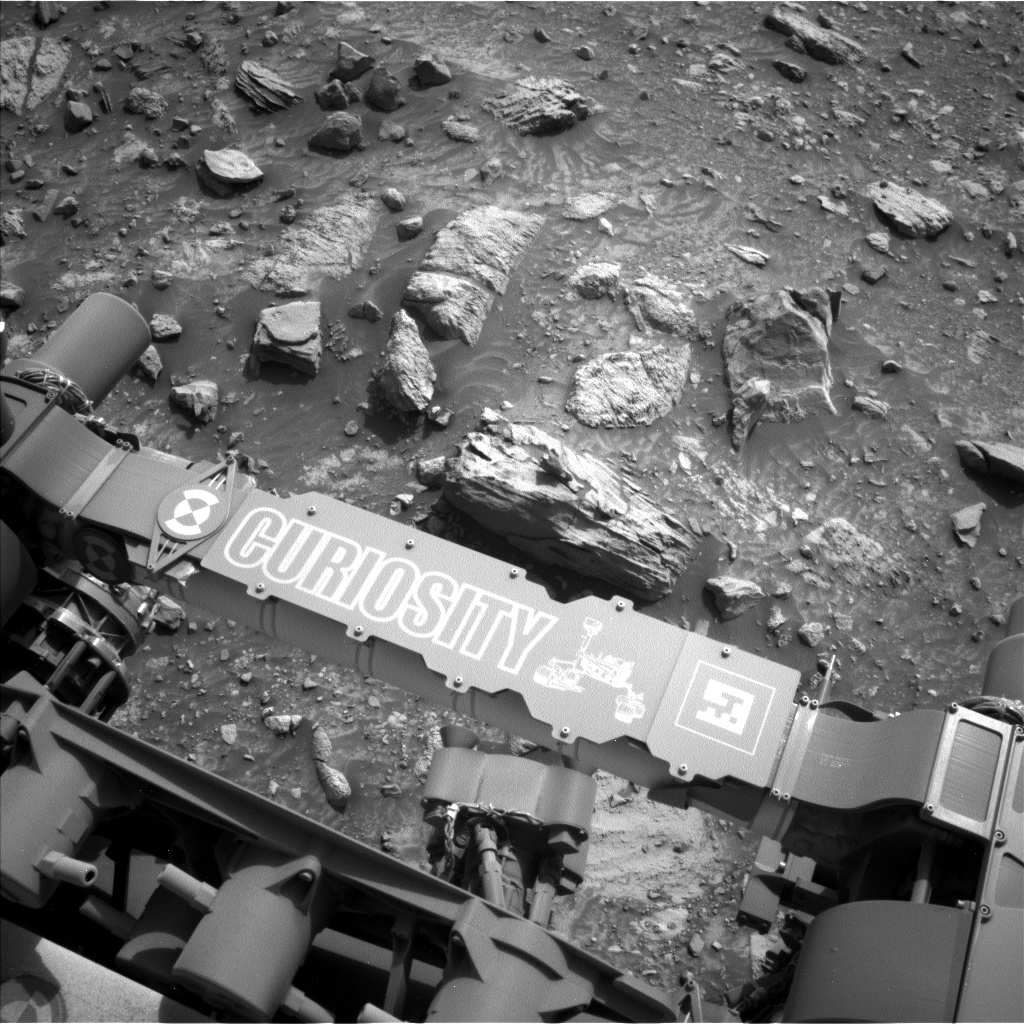
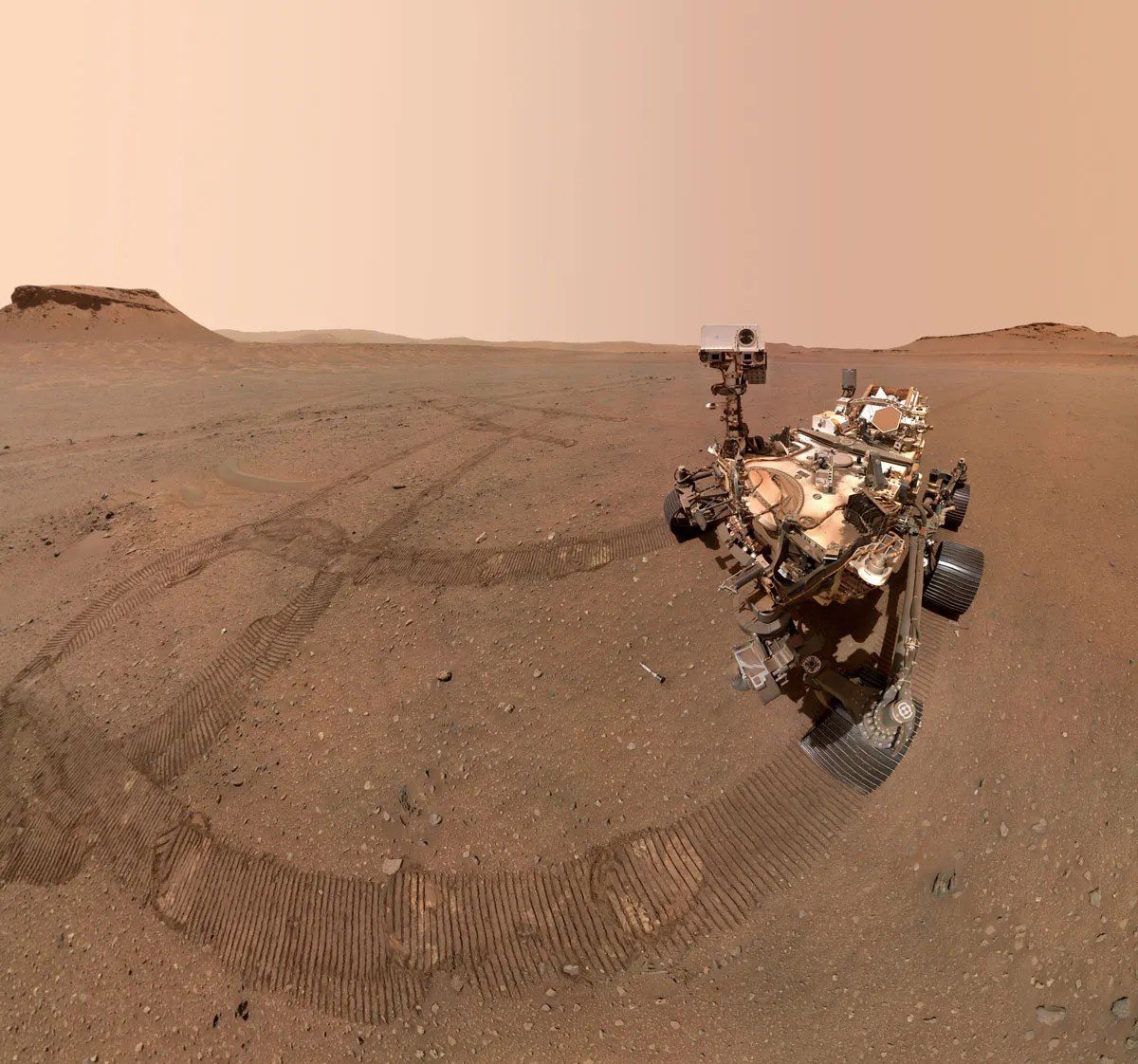
This image was taken by Left Navigation Camera onboard NASA’s Mars rover Curiosity on Sol 4171 (2024-04-30 19:41:16 UTC).
NASA/JPL-Caltech
Earth planning date: Wednesday, May 1, 2024
Today’s planning was a little out of the ordinary. Not in terms of the plan itself, Curiosity’s team built an exciting plan utilizing much of its science toolkit. Today’s plan was unusual rather due to my role as APXS PUDL Reverse Shadow (PUDL = Payload Uplink/Downlink Lead). While I normally staff the APXS PUDL role, the person on-shift responsible for APXS downlink assessment and uplink planning, operating as a “Reverse Shadow” meant I took a backseat to another APXS team member who was completing the final phases of their training for the role. They handled their duties with great aplomb, leaving me to reflect on my first few shifts in the same role.
As I’m typing this, given how long it has been since that time, I can’t shake the comedy of narrating this section of the blog in the distinct and rapid-paced tone of 1940s or 1950s radio and TV. It was around a month after landing, September 10th 2012, to be specific. I was on shift for the first time as APXS PUDL and was not expecting much in the way of workload given the notional plan. Curiosity, on the other hand, had a different idea. As event logs of the sol prior were received, the intended plan was scrapped and there was an opportunity to propose an activity. My mentor at the time encouraged my input. We were conducting operations at JPL then and walked down the hall to present our request to other members of the team before the sol’s uplink planning meetings officially kicked off (I am correcting myself here as I originally typed “days” instead of “sols” but Mars time meant shifts at this time occurred throughout the night in California). The proposal was accepted, and the proposed activity ultimately went according to plan. I can remember driving back to my hotel as the sun was coming up. It was then that it hit me: I had just influenced something that happened on another planet. It was a very surreal experience. What I didn’t realize then, however, was how important these data acquired on my first shift as lead APXS PUDL would be, given they now serve as a baseline from which we assess APXS performance vs. temperature over time.
Today’s APXS PUDL had a more typical experience. There are two APXS targets in the plan: “Emerald Peak” and “Franklin Lakes.” These targets are both on the same block (the rectangular one just slightly left and above the middle of this blog’s image), with Emerald Peak targeting the visibly altered rim near the lower portion of the block and Franklin Lakes more centrally located. MAHLI will acquire images of both of these targets, including a three-position rotational stereo set on Emerald Peak. A number of other targets were captured by ChemCam and/or Mastcam, including “Grizzly Falls,” “Liberty Cap,” “Pavilion Dome,” “Triple Divide Peak,” and “Haystack Peak.” As Curiosity is not driving in this plan, ChemCam and Mastcam are also used for targeted observations on the second sol, focusing primarily on “The Minarets” and “Pinnacle Ridge,” alongside long-distance observations of “Kukenan.” DAN observations as well as a number of environmental monitoring activities by REMS, Navcam, and Mastcam round out the two-sol plan.
Written by Scott VanBommel, Planetary Scientist at Washington University
NASA Is Helping Protect Tigers, Jaguars, and Elephants. Here’s How.
NASA satellites are helping track tiger habitat, offering new insights for conservation as these predators face the consequences of habitat loss.
Credits: Wildlife Conservation Society / Dale Miquelle
As human populations grow, habitat loss threatens many creatures. Mapping wildlife habitat using satellites is a rapidly expanding area of ecology, and NASA satellites play a crucial role in these efforts. Tigers, jaguars, and elephants are a few of the vulnerable animals whose habitats NASA is helping track from space.
“Satellites observe vast areas of Earth’s surface on daily to weekly schedules,” said Keith Gaddis, ecological conservation program manager at NASA Headquarters in Washington. “That helps scientists monitor habitats that would be logistically challenging and time-consuming to survey from the ground — crucial for animals like tigers that roam large territories.”
Here’s how NASA and its partners help protect three of Earth’s most iconic species:
Trouble (and Hope) for Tigers
Tigers have lost at least 93% of their historical range, which once spanned Eurasia. Roughly 3,700 to 5,500 wild tigers remain, up from an estimated low of 3,200 in 2010.
In a recent study, researchers reviewed over 500 studies that contained data on tigers and their habitat across Asia. The team found that the area where the big cats are known to live declined 11%, from about 396,000 square miles in 2001 to about 352,000 square miles in 2020.
The researchers mapped large stretches of “empty forests” without recent tiger presence. Because these areas were suitable habitat and are still big enough to support tigers, they are potential landscapes for restoration, assuming there is enough food. If tigers could reach those areas, either through natural dispersal or active reintroduction, it could “increase the land base for tigers by 50%,” the scientists reported.
“There’s still a lot more room for tigers in the world than even tiger experts thought,” said lead author Eric Sanderson, formerly a senior conservation ecologist at WCS and now vice president of urban conservation at the New York Botanical Garden. “We were only able to figure that out because we brought together all of this data from NASA and integrated it with information from the field.”
Where the Jaguars Are
Jaguars once roamed from the U.S. Southwest to Argentina. But in the past century, they have lost about 50% of their range, according to the International Union for Conservation of Nature (IUCN). Like tigers, jaguars must contend with poaching and the loss of food sources. Wild jaguars number between 64,000 and 173,000 individuals, and IUCN classifies them as near-threatened.
In Gran Chaco, South America’s second largest woodland, jaguars and other animals live in an especially threatened ecosystem. The dry lowland forest stretches from northern Argentina into Bolivia, Paraguay, and Brazil, and has experienced severe deforestation.
Image Before/After
Jaguars in Argentina’s Chaco may number in the hundreds. Using data on land use and infrastructure, plus Earth observations from MODIS and Landsat, NASA-funded researchers mapped priority conservation areas for jaguars and other important animals. About 36% of the priority areas in Argentina’s Chaco are currently “low-protection” zones, where deforestation is allowed.
“Managers and conservationists could use the new spatial information to see where current forest zoning is protecting key animals, and where it may need re-evaluation,” said lead author Sebastian Martinuzzi of the University of Wisconsin–Madison.
Elephants Seek Out Forest Havens
African savanna elephants now occupy an estimated 15% of their historical range, and their numbers have declined. One study surveyed about 90% of the elephants’ range and estimated that their numbers dropped by 144,000 elephants from 2007 to 2014, leaving approximately 352,000 individuals. In 2021, the IUCN updated the elephants’ status to endangered.
A recent study used NASA satellite-derived vegetation indices and other data to study elephants in Kenya’s Maasai Mara National Reserve, and in nearby semi-protected and unprotected zones. Researchers found that, especially in the unprotected areas, the elephants preferred dense canopy forest, particularly along streams, and avoided open areas like grasslands, especially when more people are present. Human development, such as tourism lodges, is often built in such forests.
Prioritizing elephants’ access to forests in unprotected areas should be of utmost importance for land managers, the researchers said. Because the elephants avoided grasslands, some of those areas could be used for development or livestock — balancing need for economic development and elephant habitat.
The IUCN likewise classifies Asian elephants as endangered. In southern Bhutan, crop depredation and wildlife approaching human settlements is escalating conflicts between people and elephants. In 2020–2021, Bhutanese scholars studying in the United States were selected to participate in the NASA Capacity Building Program’s DEVELOP program. Partnering with the Bhutan Foundation, Bhutan Tiger Center, and Bhutan Ecological Society, the teams used NASA Earth observations, elephant occurrence data, and other information to model current habitat suitability and map wildlife pathways between habitats, aiding strategies that reduce the risk of conflict.
This website uses cookies to improve your experience. We'll assume you're ok with this, but you can opt-out if you wish.AcceptRead More
Privacy & Cookies Policy
Privacy Overview
This website uses cookies to improve your experience while you navigate through the website. Out of these, the cookies that are categorized as necessary are stored on your browser as they are essential for the working of basic functionalities of the website. We also use third-party cookies that help us analyze and understand how you use this website. These cookies will be stored in your browser only with your consent. You also have the option to opt-out of these cookies. But opting out of some of these cookies may affect your browsing experience.
Necessary cookies are absolutely essential for the website to function properly. This category only includes cookies that ensures basic functionalities and security features of the website. These cookies do not store any personal information.
Any cookies that may not be particularly necessary for the website to function and is used specifically to collect user personal data via analytics, ads, other embedded contents are termed as non-necessary cookies. It is mandatory to procure user consent prior to running these cookies on your website.