Tag: Kepler

  • 55 Years Ago: Apollo 11 Astronauts End Quarantine, Feted from Coast to Coast

    On Aug. 10, 1969, Apollo 11 astronauts Neil A. Armstrong, Michael Collins, and Edwin E. “Buzz” Aldrin completed their 21-day quarantine after returning from the Moon. The historic nature of their mission resulted in a very busy postflight schedule for Armstrong, Collins, and Aldrin, starting with celebrations in New York, Chicago, Los Angeles, and Houston. Scientists continued to examine the lunar samples the Apollo 11 astronauts returned from the Sea of Tranquility. NASA set its sights on additional lunar landing missions, announcing plans for a pinpoint landing by Apollo 12 in November 1969 that also included visiting the robotic Surveyor 3 that landed on the Moon in 1967. The agency announced the crews for the Apollo 13 and 14 missions planned for 1970. Including prime and backup crews, NASA had 18 astronauts training for lunar landing missions. Support astronauts brought that number to 32.

    Apollo 11

    Following their return from the Moon, Armstrong, Collins, and Aldrin completed their 21-day quarantine in the Lunar Receiving Laboratory (LRL) at the Manned Spacecraft Center (MSC), now NASA’s Johnson Space Center in Houston. During their stay in the LRL, they worked on their pilot reports, conducted postflight debriefs including with the Apollo 12 crew, and Armstrong celebrated his 39th birthday. On the evening of Aug. 10, they left the relative quiet of the LRL for a very hectic next few months. After spending a day reuniting with their families, the three reported back to their offices and held their postflight press conference on Aug. 12. The next day, they flew first to New York for a massive ticker tape parade, then on to Chicago for another big parade, ending the day in Los Angeles with a state dinner hosted by President Richard M. Nixon and attended by most active astronauts, members of Congress, 44 state governors, and 83 foreign ambassadors. They returned to Houston for a welcome home parade on Aug. 16, ending the day with a barbecue party and a tribute to the entire NASA team in the Astrodome, emceed by Frank Sinatra. Meanwhile, on Aug. 14, engineers shipped the Command Module Columbia to its manufacturer, the North American Rockwell plant in Downey, California, for postflight inspections. Scientists in the LRL eagerly continued their examinations of the 48 pounds of lunar material the Apollo 11 astronauts returned from the Sea of Tranquility.

    In the Lunar Receiving Laboratory (LRL) at the Manned Spacecraft Center, now NASA’s Johnson Space Center in Houston, Apollo 11 astronauts Neil A. Armstrong, left, Michael Collins, and Edwin E. “Buzz” Aldrin line up for food in the LRL’s dining area Buzz, left, Mike, and Neil enjoy a meal together in the LRL’s dining room Neil celebrates his 39th birthday in the LRL
    Left: In the Lunar Receiving Laboratory (LRL) at the Manned Spacecraft Center, now NASA’s Johnson Space Center in Houston, Apollo 11 astronauts Neil A. Armstrong, left, Michael Collins, and Edwin E. “Buzz” Aldrin line up for food in the LRL’s dining area. Middle: Buzz, left, Mike, and Neil enjoy a meal together in the LRL’s dining room. Right: Neil celebrates his 39th birthday in the LRL.

    NASA engineer John K. Hirasaki opens the hatch to the Apollo 11 Command Module Columbia for the first time in the Lunar Receiving Laboratory (LRL) at the Manned Spacecraft Center, now NASA’s Johnson Space Center in Houston Mike Collins sits in Columbia’s hatch in the LRL While still aboard the U.S.S. Hornet, Mike wrote this inscription inside Columbia
    Left: NASA engineer John K. Hirasaki opens the hatch to the Apollo 11 Command Module Columbia for the first time in the Lunar Receiving Laboratory (LRL) at the Manned Spacecraft Center, now NASA’s Johnson Space Center in Houston. Middle: Mike Collins sits in Columbia’s hatch in the LRL. Right: While still aboard the U.S.S. Hornet, Mike wrote this inscription inside Columbia.

    Collins’ inscription inside Columbia, first written while aboard the U.S.S. Hornet, and retraced in the LRL:
    Spacecraft 107, alias Apollo 11, alias “Columbia”
    The Best Ship to Come Down the Line
    God Bless Her.
    Michael Collins CMP

    Aug. 5, 1969. In the Lunar Receiving Laboratory, scientists open the second Apollo 11 Lunar Sample Return Container and begin to examine the rock and soil samples Aug. 5, 1969. In the Lunar Receiving Laboratory, scientists open the second Apollo 11 Lunar Sample Return Container and begin to examine the rock and soil samples Aug. 5, 1969. In the Lunar Receiving Laboratory, scientists open the second Apollo 11 Lunar Sample Return Container and begin to examine the rock and soil samples
    Aug. 5, 1969. In the Lunar Receiving Laboratory, scientists open the second Apollo 11 Lunar Sample Return Container and begin to examine the rock and soil samples.

    On Aug. 10, 1969, Buzz, left, Mike, and Neil exit the Lunar Receiving Laboratory at the Manned Spacecraft Center (MSC Morning of Aug. 12, Neil reports to work at his office in MSC’s Building 4 Afternoon of Aug. 12, Buzz, left, Neil, and Mike meet the press in MSC’s auditorium
    Left: On Aug. 10, 1969, Buzz, left, Mike, and Neil exit the Lunar Receiving Laboratory at the Manned Spacecraft Center (MSC), now NASA’s Johnson Space Center in Houston, ending their 21-day quarantine. Middle: Morning of Aug. 12, Neil reports to work at his office in MSC’s Building 4. Right: Afternoon of Aug. 12, Buzz, left, Neil, and Mike meet the press in MSC’s auditorium.

    Armstrong’s comments to open the press conference:

    “It was our pleasure to participate in one great adventure. It’s an adventure that took place, not just in the month of July, but rather one that took place in the last decade. We … had the opportunity to share that adventure over its developing and unfolding in the past months and years. It’s our privilege today to share with you some of the details of that final month of July that was certainly the highlight, for the three of us, of that decade.”

    An estimated four million people attend the ticker tape parade in New York City for the Apollo 11 astronauts The ticker tape parade in Chicago drew two million people The Apollo 11 astronauts and their wives at the official state dinner in Los Angeles, hosted by President Richard M. Nixon
    Aug. 13, 1969. Left: An estimated four million people attend the ticker tape parade in New York City for the Apollo 11 astronauts. Middle: The ticker tape parade in Chicago drew two million people. Right: The Apollo 11 astronauts and their wives at the official state dinner in Los Angeles, hosted by President Richard M. Nixon.

    Aug. 14, 1969. NASA Administrator Thomas O. Paine, left, accompanies Buzz, Mike, and Neil on the plane back to Houston Aug. 16. Ticker tape parade in downtown Houston attended by 250,000 people Aug. 16. Buzz, left, Neil, and Mike with emcee Frank Sinatra during the barbecue party in the Houston Astrodome
    Left: Aug. 14, 1969. NASA Administrator Thomas O. Paine, left, accompanies Buzz, Mike, and Neil on the plane back to Houston. Middle: Aug. 16. Ticker tape parade in downtown Houston attended by 250,000 people. Right: Aug. 16. Buzz, left, Neil, and Mike with emcee Frank Sinatra during the barbecue party in the Houston Astrodome.

    Workers load the Apollo 11 Command Module Columbia into a Super Guppy for transport to the North American Rockwell plant in Downey, California Workers in Downey inspect Columbia on Aug. 19 Workers prepare to place Columbia in a chamber to bakeout any residual moisture to ready it for public display
    Left: On Aug. 14, at Houston’s Ellington Air Force Base, workers load the Apollo 11 Command Module Columbia into a Super Guppy for transport to the North American Rockwell plant in Downey, California. Middle: Workers in Downey inspect Columbia on Aug. 19. Right: Workers prepare to place Columbia in a chamber to bakeout any residual moisture to ready it for public display.

    Neil rolled up the Solar Wind Composition experiment at the end of the spacewalk and placed it inside the Apollo Lunar Sample Return Container that arrived in the Lunar Receiving Laboratory on July 26, 1969 Astronomers sent the first successful beam to the Laser Ranging Retroreflector on Aug. 1, 1969, and it remains available for use to this day The Passive Seismic Experiment returned useful data for three weeks but stopped responding to commands on Aug. 24, 1969, most likely due to overheating in the lunar Sun
    Apollo 11 science experiments. Left: Neil rolled up the Solar Wind Composition experiment at the end of the spacewalk and placed it inside the Apollo Lunar Sample Return Container that arrived in the Lunar Receiving Laboratory on July 26, 1969. Middle: Astronomers sent the first successful beam to the Laser Ranging Retroreflector on Aug. 1, 1969, and it remains available for use to this day. Right: The Passive Seismic Experiment returned useful data for three weeks but stopped responding to commands on Aug. 24, 1969, most likely due to overheating in the lunar Sun.

    Apollo 12

    At the time Apollo 11 returned from its historic journey, NASA had plans for nine more Apollo Moon landing missions. On July 29, Apollo Program Director Samuel C. Phillips at NASA Headquarters in Washington, D.C., announced the launch date, Nov. 14, 1969, and the landing site, in the Ocean of Storms, for Apollo 12. The main goals of this second lunar landing included a precision touchdown near the Surveyor 3 spacecraft that landed there in April 1967, and an expanded science program conducted during two spacewalks, including the deployment of the first Apollo Lunar Surface Experiment Package (ALSEP), a suite of science instruments. The Apollo 12 prime crew of Commander Charles “Pete” Conrad, Command Module Pilot (CMP) Richard F. Gordon, and Lunar Module Pilot (LMP) Alan L. Bean and their backups David R. Scott, Alfred M. Worden, and James B. Irwin, began training after their assignment in April. In addition to rehearsing aspects of their flight in mission simulators, they practiced for the descent and precision landing, for the two spacewalks planned during their 31.5-hour lunar surface stay, including visiting and examining Surveyor 3, and for the expanded geology exploration. The latter included a three-day geology field trip to Hawaii with simulated lunar traverses. At NASA’s Jet Propulsion Laboratory in Pasadena, California, the astronauts received a detailed briefing on the Surveyor spacecraft. At NASA’s Kennedy Space Center (KSC) in Florida, workers had already assembled their Saturn V rocket, with rollout to Launch Pad 39A planned for early September. The U.S. Navy chose the U.S.S. Hornet (CVS-12), the carrier that successfully recovered Apollo 11, to reprise its role as prime recovery ship for Apollo 12.

    Lunar front side showing the landing sites for Apollo 11 and 12 Surveyor 3 took this panorama of its landing site in April 1967, also the targeted site for Apollo 12
    Left: Lunar front side showing the landing sites for Apollo 11 and 12. Right: Surveyor 3 took this panorama of its landing site in April 1967, also the targeted site for Apollo 12.

    Apollo 12 astronauts Charles “Pete” Conrad, left, and Alan L. Bean at the Lunar Landing Research Facility (LLRF) at NASA’s Langley Research Center in Hampton, Virginia Apollo 12 backup astronaut David R. Scott at the LLRF Conrad, left, and Bean during the Aug. 9-11 geology field trip to Hawaii Conrad practices opening an Apollo Lunar Sample Return Container during simulated one-sixth gravity aboard a KC-135 aircraft
    Left: Apollo 12 astronauts Charles “Pete” Conrad, left, and Alan L. Bean at the Lunar Landing Research Facility (LLRF) at NASA’s Langley Research Center in Hampton, Virginia. Middle left: Apollo 12 backup astronaut David R. Scott at the LLRF. Middle right: Conrad, left, and Bean during the Aug. 9-11 geology field trip to Hawaii. Right: Conrad practices opening an Apollo Lunar Sample Return Container during simulated one-sixth gravity aboard a KC-135 aircraft.

    Apollo 13 and 14

    On Aug. 6, 1969, NASA announced the crews for Apollo 13 and 14, the third and fourth Moon landing missions. At the time of the announcement, Apollo 13 had a planned launch date in March 1970 and a proposed landing site at the Fra Mauro region in the lunar highlands, the first landing site not in the relatively flat lunar maria. Apollo 14 aimed for a July 1970 mission with the Crater Censorinus area in the lunar highlands to the southeast of the Sea of Tranquility as a tentative landing site. Plans for both missions called for two lunar surface excursions totaling about six hours with a lunar stay duration of 35 hours. As on Apollo 12, the crews planned to deploy an ALSEP suite of science instruments, in addition to conducting the geology field work of documenting and collecting rock and soil samples for return to scientists on Earth for analysis. 

    James A. Lovell Thomas K. “Ken” Mattingly Fred W. Haise
    The Apollo 13 crew of James A. Lovell, left, Thomas K. “Ken” Mattingly, and Fred W. Haise.

    The prime crew for Apollo 13 consisted of Commander James A. Lovell, CMP Thomas K. “Ken” Mattingly, and LMP Fred W. Haise. Lovell would make his fourth space mission aboard Apollo 13, having flown on Gemini VII and XII as well as orbiting the Moon during Apollo 8 – making him the first person to travel to the Moon twice. Neither Mattingly nor Haise had flown in space before, although Haise had served with Lovell on the Apollo 11 backup crew. The Apollo 13 backup crew consisted of John W. Young, John L. Swigert, and Charles M. Duke. Young had flown three previous missions, Gemini 3 and X and more recently aboard Apollo 10, the Moon landing dress rehearsal flight. Swigert and Duke had no spaceflight experience, although Duke served as capsule communicator during Apollo 10 as well as during the Apollo 11 Moon landing.

    The Saturn V for Apollo 13 rolls out of the Vehicle Assembly Building (VAB) at NASA’s Kennedy Space Center in Florida to relocate it from High Bay 2 to High Bay 1 The Apollo 13 Saturn V rolls back in to High Bay 1 of the VAB
    Left: The Saturn V for Apollo 13 rolls out of the Vehicle Assembly Building (VAB) at NASA’s Kennedy Space Center in Florida to relocate it from High Bay 2 to High Bay 1. Right: The Apollo 13 Saturn V rolls back in to High Bay 1 of the VAB.

    Flight hardware for Apollo 13 had already arrived at KSC. Workers in the Vehicle Assembly Building (VAB) completed stacking of the three Saturn V rocket stages in High Bay 2 on July 31. They added a boilerplate Apollo spacecraft to the top of the rocket, and in a roll-around maneuver on Aug. 8, the stack left the VAB, crawled to the other side of the building, and rolled back inside to High Bay 1. North American Rockwell delivered the Command and Service Modules to KSC on June 26, where workers in the Manned Spacecraft Operations Building (MSOB) mated the two modules four days later in preparation for preflight testing in altitude chambers. The Lunar Module (LM) ascent and descent stages arrived at KSC on June 27 and 28, respectively, from their manufacturer, the Grumman Aircraft Corporation in Bethpage, New York. Following a docking test between the CM and LM, workers in the MSOB mated the two stages of the LM on July 15.

    Alan B. Shepard Stuart A. Roosa Edgar D. Mitchell
    The Apollo 14 crew of Alan B. Shepard, left, Stuart A. Roosa, and Edgar D. Mitchell.

    NASA designated Commander Alan B. Shepard, CMP Stuart A. Roosa, and LMP Edgar D. Mitchell as the prime crew for Apollo 14. Shepard, the first American in space when he launched aboard his Freedom 7 spacecraft in May 1961, recently returned to flight status after a surgical intervention cured his Ménière’s disease, an inner ear disorder. Neither Roosa nor Mitchell had spaceflight experience. The backup crew consisted of Eugene A. Cernan, Ronald E. Evans, and Joe H. Engle. Cernan had flown in space twice before, on Gemini IX and more recently on Apollo 10. Evans and Engle had not flown in space before, although Engle earned astronaut wings as a pilot with the U.S. Air Force flying the X-15 rocket plane above the 50-mile altitude required to qualify as an astronaut on three of his 16 flights.

    Apollo 14 astronauts Alan B. Shepard, center, and Edgar D. Mitchell, in baseball cap, during the Idaho geology field trip Apollo 14 backup crew members Eugene A. Cernan, left, and Joe H. Engle during the Idaho geology field trip
    Left: Apollo 14 astronauts Alan B. Shepard, center, and Edgar D. Mitchell, in baseball cap, during the Idaho geology field trip. Right: Apollo 14 backup crew members Eugene A. Cernan, left, and Joe H. Engle during the Idaho geology field trip.

    The Apollo 14 astronauts jumped right into their geology training. On Aug. 14, Shepard, Mitchell, and Engle spent the day at the United States Geological Service’s (USGS) Crater Field near Flagstaff, Arizona, including getting a geologist’s lecture on the mechanisms of crater formation. On Aug. 22 and 23, Cernan joined them on a geology field trip to Idaho, where they visited Craters of the Moon National Monument, Butte Crater lava tubes, Ammon pumice quarries, and the Wapi volcanic fields. Geologists chose these sites for training because at the time Apollo 14 planned to visit a presumed volcanic area on the Moon.

    NASA management changes

    Samuel C. Phillips, Apollo Program Director at NASA Headquarters in Washington, D.C., Rocco A. Petrone, director of launch operations at KSC, seen here at the Apollo 11 rollout, succeeded Phillips George S. Trimble, left, deputy director of the Manned Spacecraft Center (MSC) Christopher C. Kraft, director of flight operations at MSC
    Left: Samuel C. Phillips, Apollo Program Director at NASA Headquarters in Washington, D.C., during the Apollo 11 launch in the Launch Control Center at NASA’s Kennedy Space Center (KSC) in Florida. Middle left: Rocco A. Petrone, director of launch operations at KSC, seen here at the Apollo 11 rollout, succeeded Phillips. Middle right: George S. Trimble, left, deputy director of the Manned Spacecraft Center (MSC), now NASA’s Johnson Space Center in Houston, with MSC Director Robert R. Gilruth in 1967. Right: Christopher C. Kraft, director of flight operations at MSC, seen here in Mission Control following the Apollo 11 splashdown, succeeded Trimble.

    Several changes in senior NASA leadership took place following Apollo 11. At NASA Headquarters in Washington, D.C., Phillips retired as Apollo Program Director, having served in that position since 1964, and returned to the U.S. Air Force. Rocco A. Petrone, director of launch operations at KSC since 1966, succeeded him. George S. Trimble announced his retirement as MSC deputy director effective Sept. 30, having served in that role since October 1967. In November 1969, MSC Director Robert R. Gilruth named Christopher C. Kraft to succeed Trimble as his deputy.

    To be continued …

    News from around the world in August 1969:

    August 2 – President Nixon the first sitting U.S. president to visit a communist capital when he meets with Romanian President Nicolai Ceausescu in Bucharest.

    August 5 – Mariner 7 returns close-up images during its fly-by of Mars.

    August 14 – NASA accepts seven pilots from the U.S. Air Force’s canceled Manned Orbiting Laboratory as its Group 7 astronauts.

    August 15-18 – Three-day Woodstock music festival in Bethel, New York, draws nearly half a million attendees.

    August 21 – The first GAP store opens in San Francisco.

  • Sols 4280-4281: Last Call at Kings Canyon

    2 min read

    Sols 4280-4281: Last Call at Kings Canyon

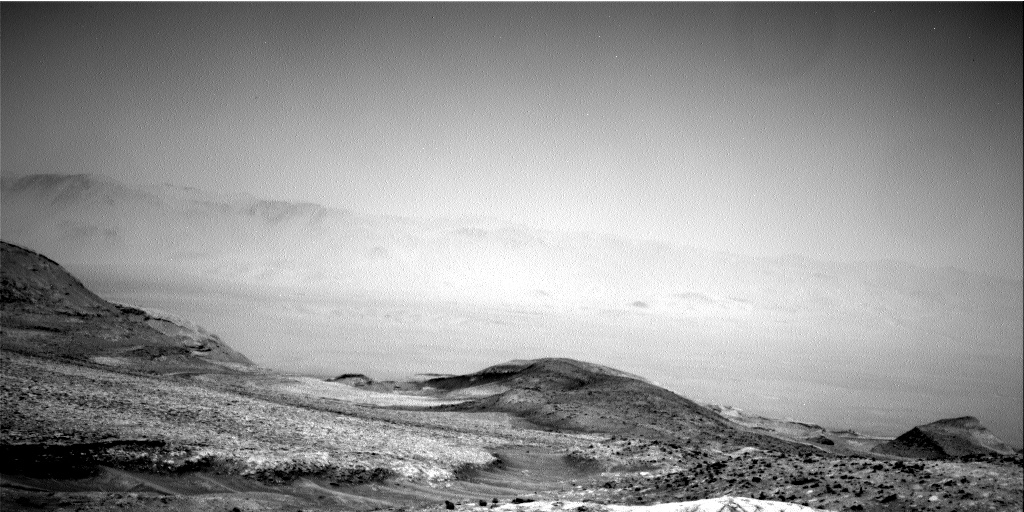
    Black and white image of Mars at the Gediz Vallis channel.
    This image was taken by Right Navigation Camera onboard NASA’s Mars rover Curiosity on Sol 4278 (2024-08-18 16:30:04 UTC).
    NASA/JPL-Caltech

    Earth planning date: Monday, Aug. 19, 2024

    Curiosity successfully completed the drill sequence at the Kings Canyon site within the Gediz Vallis channel. Today was a smooth planning day as we decided to stay put for sols 4280 and 4281 to obtain APXS data of the drill tailings (the crushed rock removed from the drill hole) before we reposition the rover nearby for our next set of observations. The science team is eagerly plotting the rover’s next move and is looking forward to all the interesting targets along the route ahead! 

    ChemCam had a very busy day with multiple activities in the plan. ChemCam LIBS will examine the chemistry of rocks at nearby “Cathedral Lake” and “Royce Lakes” to analyze the fresh surfaces that were recently broken by the weight of the rover driving over them. Mastcam will provide their standard documentation images of these locations after the LIBS instrument zaps each target.  ChemCam planned two long distance RMI images and one passive RMI image to get a closer view of the diversity of rocks at Milestone Peak and the upper channel and the yardang unit – a white, wind-sculped rock that caps the mound in Gale crater. 

    In our current workspace, we planned a MAHLI image and will use the dust removal tool (DRT) to characterize the grain size of the light-toned rock near our drill location at “Gabbot Pass.” Mastam has amassed a beautiful collection of mosaics at our current location and therefore included only one small Mastcam mosaic of the nearby Texoli butte that will provide context for a recently acquired ChemCam LD RMI image. The environmental theme group planned surveys to search for dust devils as well as measurements to observe the amount of dust in the atmosphere. 

    Looking ahead, we will reposition the rover slightly to access “Fourth Recess Lake” to quantify its chemistry for comparison to past and future observations within the Gediz Vallis channel. And after that, it’s McDonald Pass or bust!

    Written by Sharon Wilson Purdy, Planetary Geologist at the Smithsonian National Air and Space Museum

    Details

    Last Updated

    Aug 20, 2024

    Related Terms

  • Entrepreneurs Challenge Prize Winner Uses Artificial Intelligence to Identify Methane Emissions

    The NASA Science Mission Directorate (SMD) instituted the Entrepreneurs Challenge to identify innovative ideas and technologies from small business start-ups with the potential to advance the agency’s science goals. Geolabe—a prize winner in the latest Entrepreneurs Challenge—has developed a way to use artificial intelligence to identify global methane emissions. Methane is a greenhouse gas that significantly contributes to global warming, and this promising new technology could provide data to help decision makers develop strategies to mitigate climate change.

    SMD sponsored Entrepreneurs Challenge events in 2020, 2021, and 2023. Challenge winners were awarded prize money—in 2023 the total Entrepreneurs Challenge prize value was $1M. To help leverage external funding sources for the development of innovative technologies of interest to NASA, SMD involved the venture capital community in Entrepreneurs Challenge events. Numerous challenge winners have subsequently received funding from both NASA and external sources (e.g., other government agencies or the venture capital community) to further develop their technologies.

    Each Entrepreneurs Challenge solicited submissions in specific focus areas such as mass spectrometry technology, quantum sensors, metamaterials-based sensor technologies, and more. The focus areas of the latest 2023 challenge included lunar surface payloads and climate science.

    A recent Entrepreneurs Challenge success story involves 2023 challenge winner Geolabe—a startup founded by Dr. Claudia Hulbert and Dr. Bertrand Rouet-Leduc in 2020 in Los Alamos, New Mexico. The Geolabe team developed a method that uses artificial intelligence (AI) to automatically detect methane emissions on a global scale.

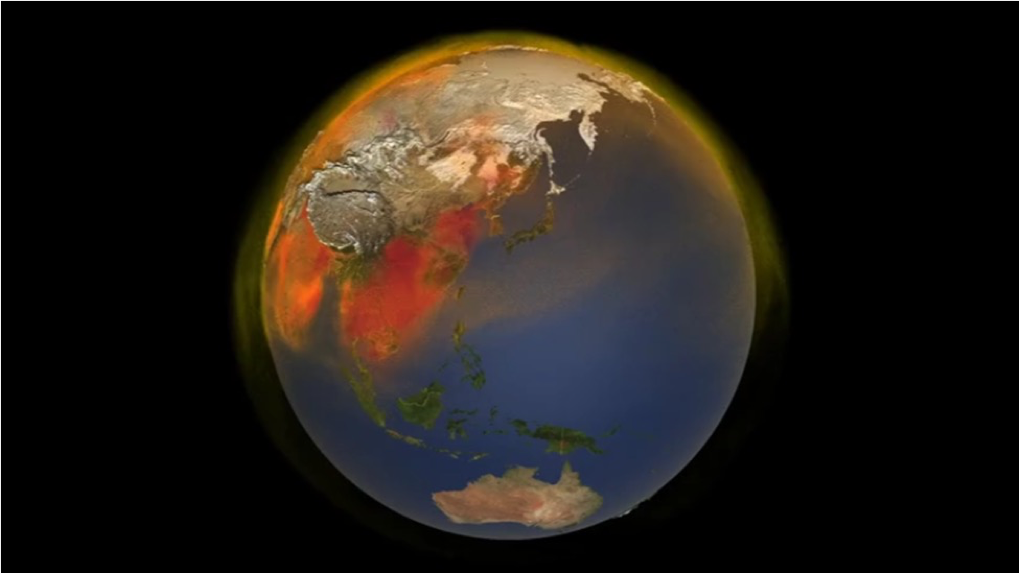
    This image taken from a NASA visualization shows the complex patterns of methane emissions around the globe in 2018, based on data from satellites, inventories of human activities, and NASA global computer models.
    Credit: NASA’s Scientific Visualization Studio

    As global temperatures rise to record highs, the pressure to curb greenhouse gas emissions has intensified. Limiting methane emissions is particularly important since methane is the second largest contributor to global warming, and is estimated to account for approximately a third of global warming to date. Moreover, because methane stays in the atmosphere for a shorter amount of time compared to CO2, curbing methane emissions is widely considered to be one of the fastest ways to slow down the rate of global warming.

    However, monitoring methane emissions and determining their quantities has been challenging due to the limitations of existing detection methods. Methane plumes are invisible and odorless, so they are typically detected with specialized equipment such as infrared cameras. The difficulty in finding these leaks from space is akin to finding a needle in a haystack. Leaks are distributed around the globe, and most of the methane plumes are relatively small, making them easy to miss in satellite data.

    Multispectral satellite imagery has emerged as a viable methane detection tool in recent years, enabling routine measurements of methane plumes at a global scale every few days. However, with respect to methane, these measurements suffer from very poor signal to noise ratio, which has thus far allowed detection of only very large emissions (2-3 tons/hour) using manual methods.

    Anthropogenic methane plumes mostly come from oil and gas infrastructure, landfills, coal mines, and farming facilities. Because they are invisible and odorless, methane emissions—especially emissions in poorly instrumented areas—are very hard to detect at large scale
    Credit: NASA

    The Geolabe team has developed a deep learning architecture that automatically identifies methane signatures in existing open-source spectral satellite data and deconvolves the signal from the noise. This AI method enables automatic detection of methane leaks at 200kg/hour and above, which account for over 85% of the methane emissions in well-studied, large oil and gas basins. Information gained using this new technique could help inform efforts to mitigate methane emissions on Earth and automatically validate their effects. This Geolabe project was featured in Nature Communications on May 14, 2024.

    SPONSORING ORGANIZATION

    NASA Science Mission Directorate

  • Hubble Examines a Possible Relic

    1 min read

    Hubble Examines a Possible Relic

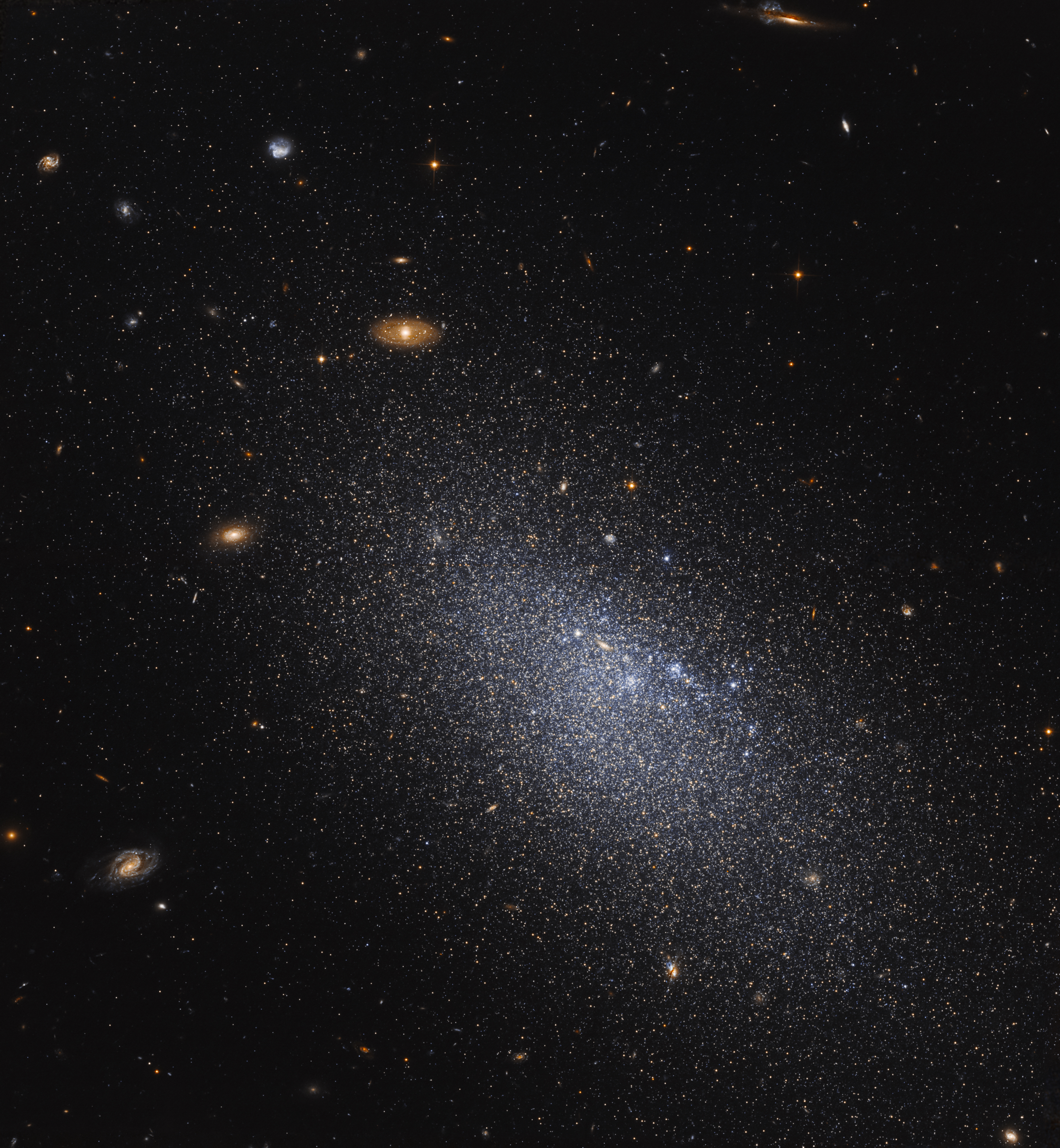
    An oblong smudge of stars stretches diagonally across the image from upper-left to lower-right. It holds stars in blue, orange, yellow, and white. The highest concentration of stars is near the image center and toward the lower-right. This region also holds bright, light-blue clumps of stars. Star densities taper off in all directions as you move away from the core. A number of bright, distant galaxies dot the scene, with a few shining through UGC 4879.
    NASA, ESA, K. Chiboucas (NOIRLab – Gemini North (HI), and M. Monelli (Instituto de Astrofisica de Canarias); Image Processing: Gladys Kober (NASA/Catholic University of America)

    This NASA Hubble Space Telescope image captures the dwarf irregular galaxy UGC 4879 or VV124. As this image illustrates, Hubble’s high resolution can detect individual stars, even in the densest parts of the galaxy. This allows astronomers to better determine the galaxy’s distance, and the composition and age of its stars.

    UGC 4879 is an isolated dwarf galaxy, lying just beyond our own Local Group of galaxies some four million light-years away. Because of its isolation, astronomers are studying UGC 4879 to determine if it is a relatively undisturbed, old galaxy. Theories suggest that the lowest mass dwarf galaxies may have been the first galaxies to form. If UGC 4879 is a relic of the early universe, it could provide clues to the hierarchical structure and evolution of galaxies, galaxy clusters, and even the universe itself. 

    The image combines data from two Hubble observing programs, both focused on learning more about dwarf galaxies: how they form and evolve.

    Explore More

    Media Contact:

    Claire Andreoli
    NASA’s Goddard Space Flight CenterGreenbelt, MD
    claire.andreoli@nasa.gov

    Details

    Last Updated

    Aug 20, 2024

    Editor
    Michelle Belleville
  • Hubble Spots Billowing Bubbles of Stellar Floss

    2 min read

    Hubble Spots Billowing Bubbles of Stellar Floss

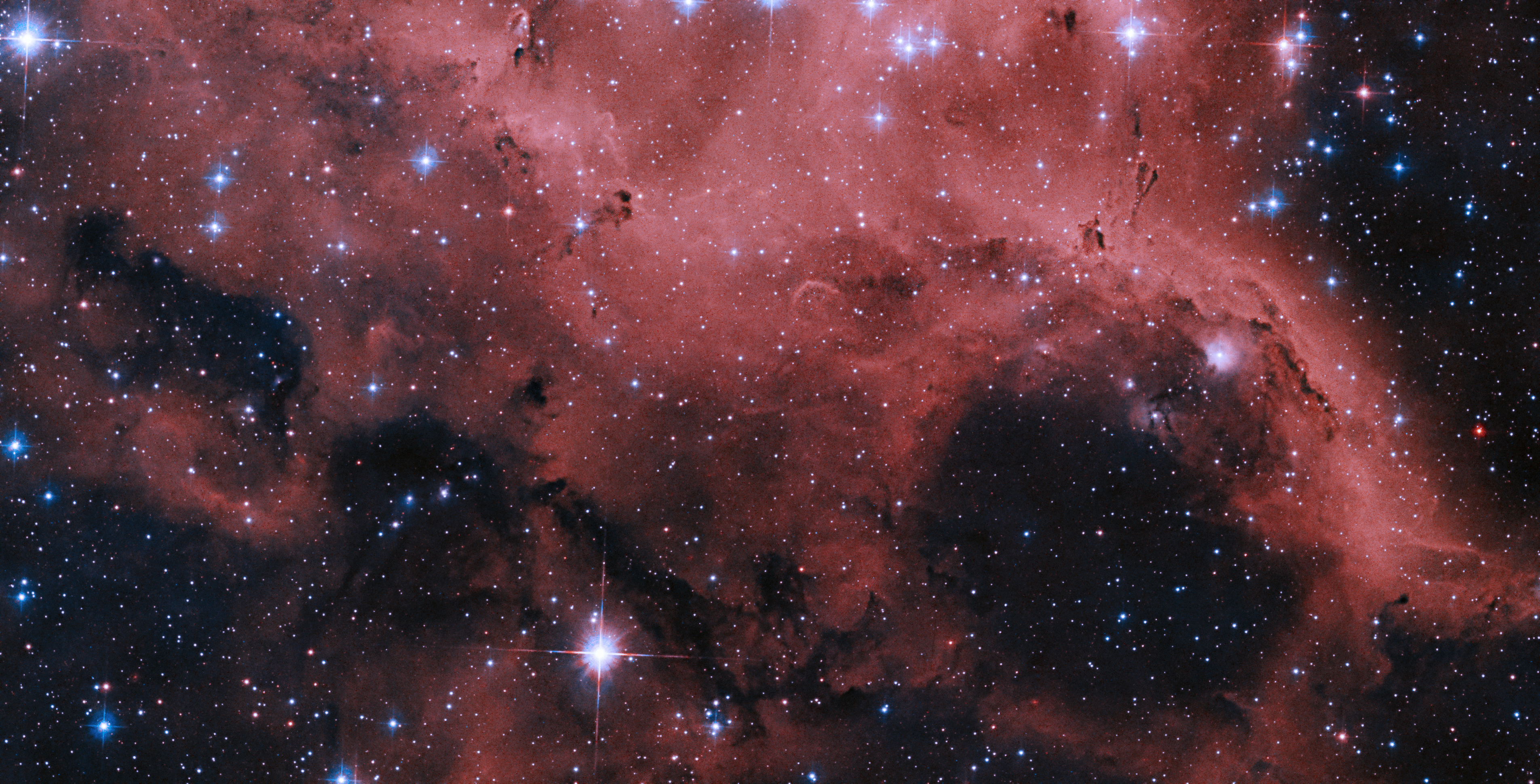
    Glowing clouds of pink and red gas and dust fill the image, along with several stars – foreground stars shine with diffraction spikes, and more distant stars fill the background.
    NASA, ESA, and J. M. Apellaniz (Centro de Astrobiologia (CSIC/INTA Inst. Nac. de Tec. Aero.); Image Processing: Gladys Kober (NASA/Catholic University of America)

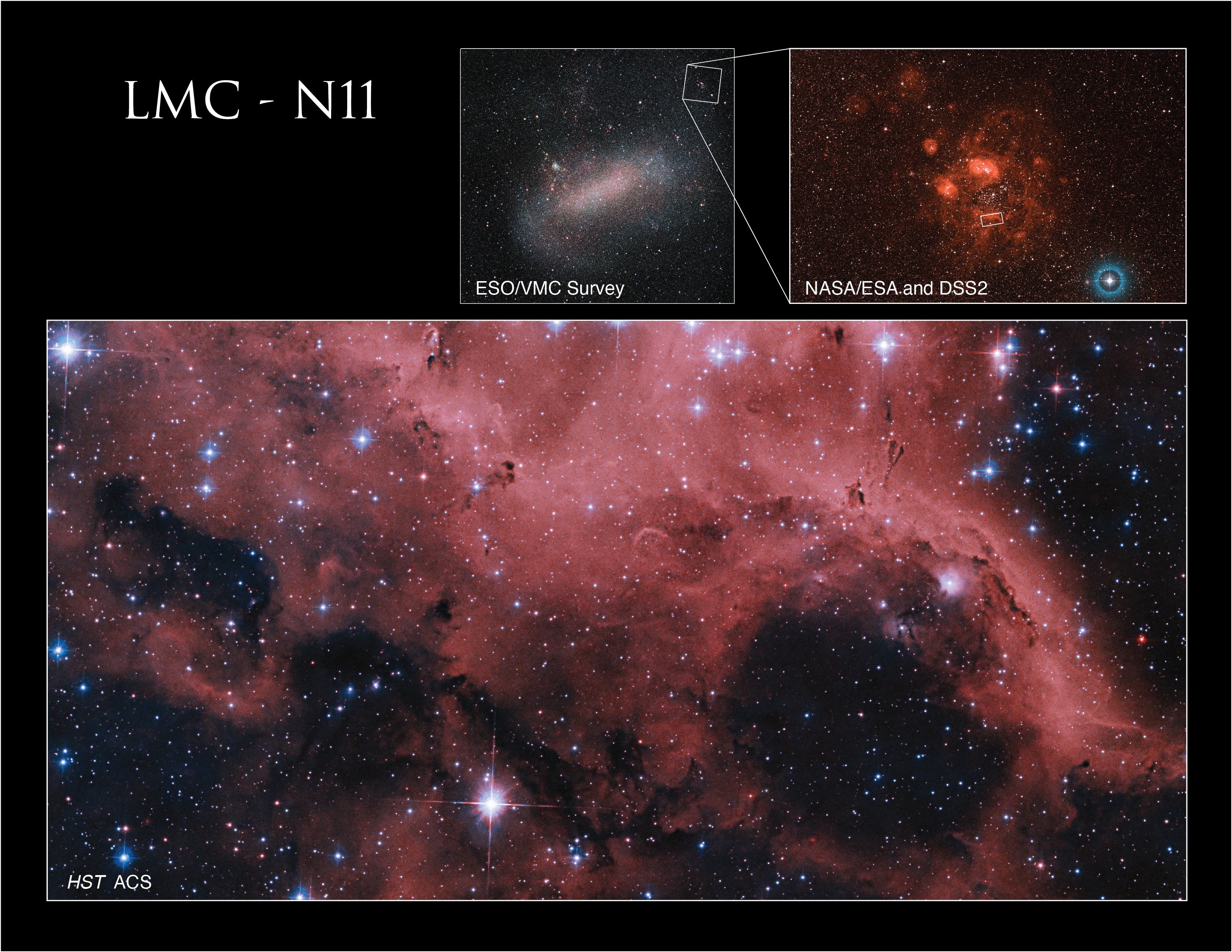
    A bubbling region of stars both old and new lies some 160,000 light-years away in the constellation Dorado. This complex cluster of emission nebulae is known as N11, and was discovered by American astronomer and NASA astronaut Karl Gordon Henize in 1956. NASA’s Hubble Space Telescope brings a new image of the cluster in the Large Magellanic Cloud (LMC), a nearby dwarf galaxy orbiting the Milky Way.

    The bottom half of the image shows N11. Glowing clouds of pink and red gas and dust fill the image, along with several stars – foreground stars shine with diffraction spikes, and more distant stars fill the background. Above it to the right, a smaller image shows a starry region of space with orange tendrils of gas and dust with a white rectangle designating the portion that shows N11. To its left, another small image shows a wide view of a diffuse galaxy with a white rectangle designating the portion that shows N11. To its left, white text reads “LMC - N11”.

    About 1,000 light-years across, N11’s sprawling filaments weave stellar matter in and out of each other like sparkling candy floss. These cotton-spun clouds of gas are ionized by a burgeoning host of young and massive stars, giving the complex a cherry-pink appearance. Throughout N11, colossal cavities burst from the fog. These bubbles formed as a result of the vigorous emergence and death of stars contained in the nebulae. Their stellar winds and supernovae carved the surrounding area into shells of gas and dust.

    N11’s stellar activity caught the attention of many astronomers, as it is one of the largest and most energetic regions in the LMC. To investigate the distribution of stars in N11, scientists used Hubble’s Advanced Camera for Surveys, taking advantage of its sensitivity and excellent wide-field resolution. The cluster houses a wide array of stars for Hubble to examine, including one area that has stopped forming stars, and another that continues to form them. Hubble’s unique capabilities allowed astronomers to comprehensively study the diversity of stars in the N11 complex, and map the differences between each region.

    Explore More

    Media Contact:

    Claire Andreoli
    NASA’s Goddard Space Flight CenterGreenbelt, MD
    claire.andreoli@nasa.gov

  • Kansas Students to Hear from NASA Astronauts Aboard Station

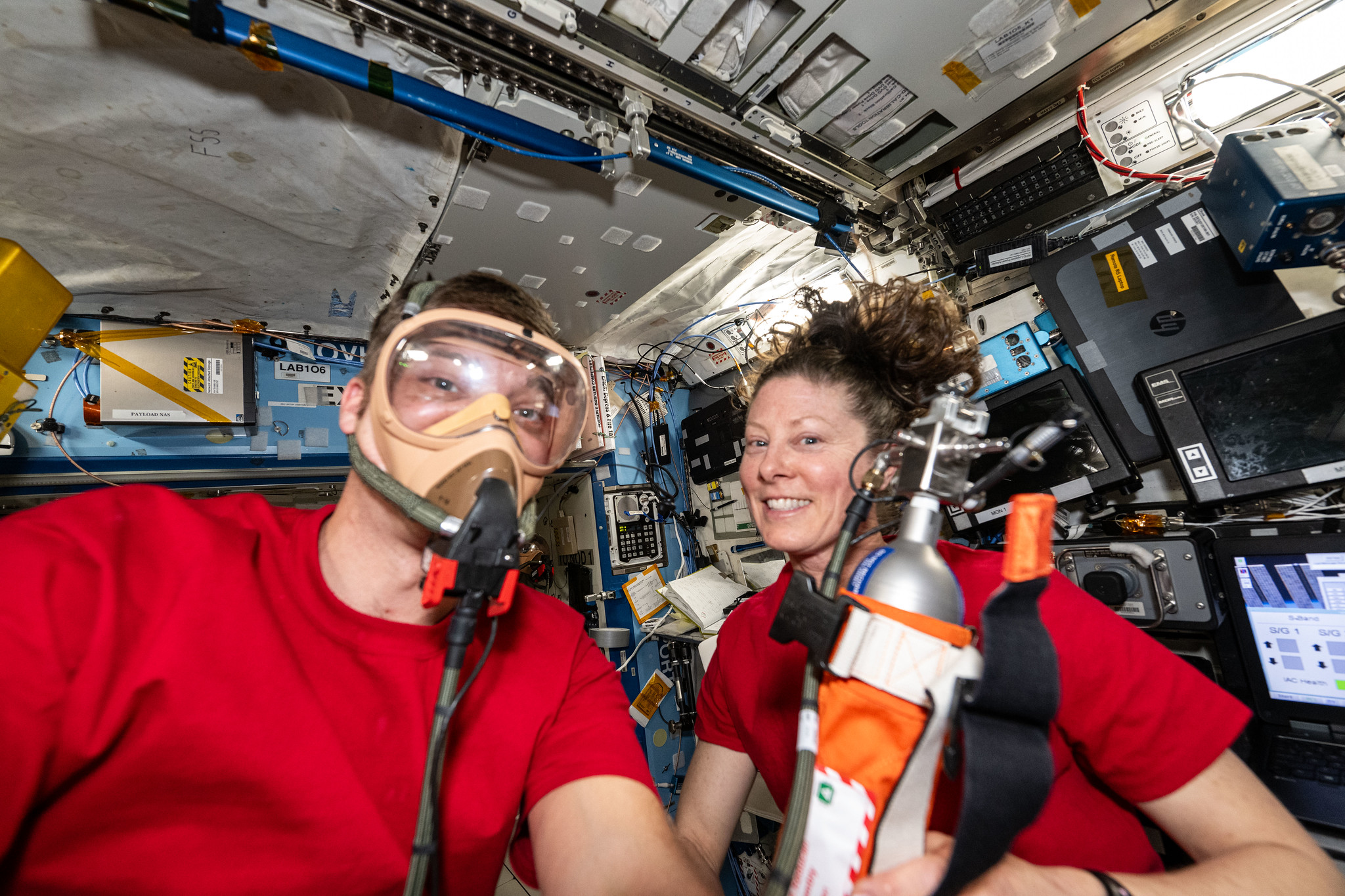
    Expedition 71 Flight Engineers Matthew Dominick and Tracy C. Dyson, both NASA astronauts, pose for a fun portrait as Dominick tests portable breathing gear aboard the International Space Station’s Destiny laboratory module. (Credit: NASA)

    Students from Topeka, Kansas, will have the opportunity Wednesday, Aug. 21, to have NASA astronauts Matthew Dominick and Tracy C. Dyson answer their prerecorded questions aboard the International Space Station.

    The 20-minute space-to-Earth call with students from Mose J. Whitson Elementary, Most Pure Heart Catholic School, and Aviation Explorers Post 8, will stream live at 10:30 a.m. EDT Aug. 21, on NASA+, NASA Television, the NASA app, and the agency’s website. Learn how to stream NASA TV through various platforms, including social media.

    Media interested in covering the event must RSVP no later than 5 p.m. on Monday, Aug. 19, by contacting Aaron Gray at agray@tps501.org or 785-295-2900.

    In preparation for the event, students from Whitson Elementary joined high school members of Aviation Explorers Post 8 for a local airport control tower tour and a pre-flight inspection demonstration. The Lawrence Amateur Astronomy Club, University of Kansas graduate students, and other astronomy enthusiasts provided presentations for the Whitson Starry Night Astronomy Title I family night. On the day of the event more than five schools from across the community will tune in.

    For more than 23 years, astronauts have continuously lived and worked aboard the space station, testing technologies, performing science, and developing skills needed to explore farther from Earth. Astronauts aboard the orbiting laboratory communicate with NASA’s Mission Control Center in Houston 24 hours a day through SCaN (Space Communications and Navigation) Near Space Network.

    Important research and technology investigations taking place aboard the International Space Station benefit people on Earth and lays the groundwork for other agency missions. As part of NASA’s Artemis campaign, the agency will send astronauts to the Moon to prepare for future human exploration of Mars; inspiring Artemis Generation explorers and ensuring the United States will continue to lead in space exploration and discovery.

    See videos and lesson plans highlighting space station research at:

    https://www.nasa.gov/stemonstation

    -end-

    Abbey Donaldson / Gerelle Dodson
    Headquarters, Washington
    202-358-1600
    Abbey.a.donaldson@nasa.gov / gerelle.q.dodson@nasa.gov

    Sandra Jones 
    Johnson Space Center, Houston
    281-483-5111
    sandra.p.jones@nasa.gov

  • Hubble Rings in a New Galactic View

    An almost circular galaxy fills the image. It has a glowing bar stretching across its core; from the ends of the bar, thin spiral arms wrap around the galaxy to form a closed disk. The arms are fuzzy from the dust and stars they contain. The galaxy is on a black, mostly empty background. A few foreground stars with cross-shaped diffraction spikes can be seen, as well as some distant galaxies in the background.]
    This NASA/ESA Hubble Space Telescope image reveals the galaxy LEDA 857074.
    ESA/Hubble & NASA, I. Chilingari

    The subject of this NASA/ESA Hubble Space Telescope image is situated in the Perseus Cluster, also known as Abell 426, 320 million light-years from Earth. It’s a barred spiral galaxy known as MCG+07-07-072, seen here among a number of photobombing stars that are much closer to Earth than it is.

    MCG+07-07-072 has quite an unusual shape for a spiral galaxy, with thin arms emerging from the ends of its barred core to draw a near-circle around its disk. It is classified as an SBc(r) galaxy: the c denotes that its two spiral arms are loosely wound, each only performing a half-turn around the galaxy, and the (r) is for the ring-like structure they create.

    Rings in galaxies come in quite a few forms, from merely uncommon, to rare and scientifically important! Lenticular galaxies are a type that sit between elliptical and spiral galaxies. They feature a large disk, unlike an elliptical galaxy, but lack any spiral arms. Lenticular means lens-shaped, and these galaxies often feature ring-like shapes in their disks.

    Meanwhile, the classification of “ring galaxy” is reserved for peculiar galaxies with a round ring of gas and star formation, much like spiral arms look, but completely disconnected from the galactic nucleus — or even without any visible nucleus! They’re thought to be formed in galactic collisions. Finally, there are the famous gravitational lenses, where the ring is in fact a distorted image of a distant, background galaxy, formed by the ‘lens’ galaxy bending light around it. Ring-shaped images, called Einstein rings, only form when the lensing and imaged galaxies are perfectly aligned.

    Explore More

    Media Contact:

    Claire Andreoli
    NASA’s Goddard Space Flight CenterGreenbelt, MD
    claire.andreoli@nasa.gov

  • Mental Well-Being in Space

    4 min read

    Preparations for Next Moonwalk Simulations Underway (and Underwater)

    Science in Space: August 2024

    Life on the International Space Station is quite different from life on the ground. Crew members experience multiple sunrises and sunsets each day, spend their time in a confined space, have packed schedules, and deal with microgravity.

    These and other conditions during spaceflight can negatively affect the performance and well-being of crew members. Many studies on the space station work to characterize and understand those effects and others try out new technologies and practices to help counter them.

    Light Up My Life

    A current investigation from ESA (European Space Agency), Circadian Light tests a new lighting system to help astronauts maintain a more normal daily or circadian rhythm. An LED panel automatically and gradually changes the light spectrum and varies from day to day to better mimic natural conditions on Earth. The study seeks insight into this system’s effect on circadian rhythm regulation, sleep, stress, and overall well-being of crew members. The findings also could reveal ways to improve lighting for shift workers and those in extreme or remote environments.

    A rectangular white light about the size of a computer monitor is attached to the quilt-like ceiling at the top of this image. A blue and white sleeping bag is visible on the right of the image and on the left, a blue brick-sized power box is connected to the light with a cord.
    Circadian Light experiment installed inside a crew cabin
    ESA

    Daily Rhythms

    An earlier ESA investigation, Circadian Rhythms, examined how daily rhythms change during long-duration spaceflight and its non-24-hour cycles of light and dark. This understanding could support countermeasures to improve performance and health on future missions.

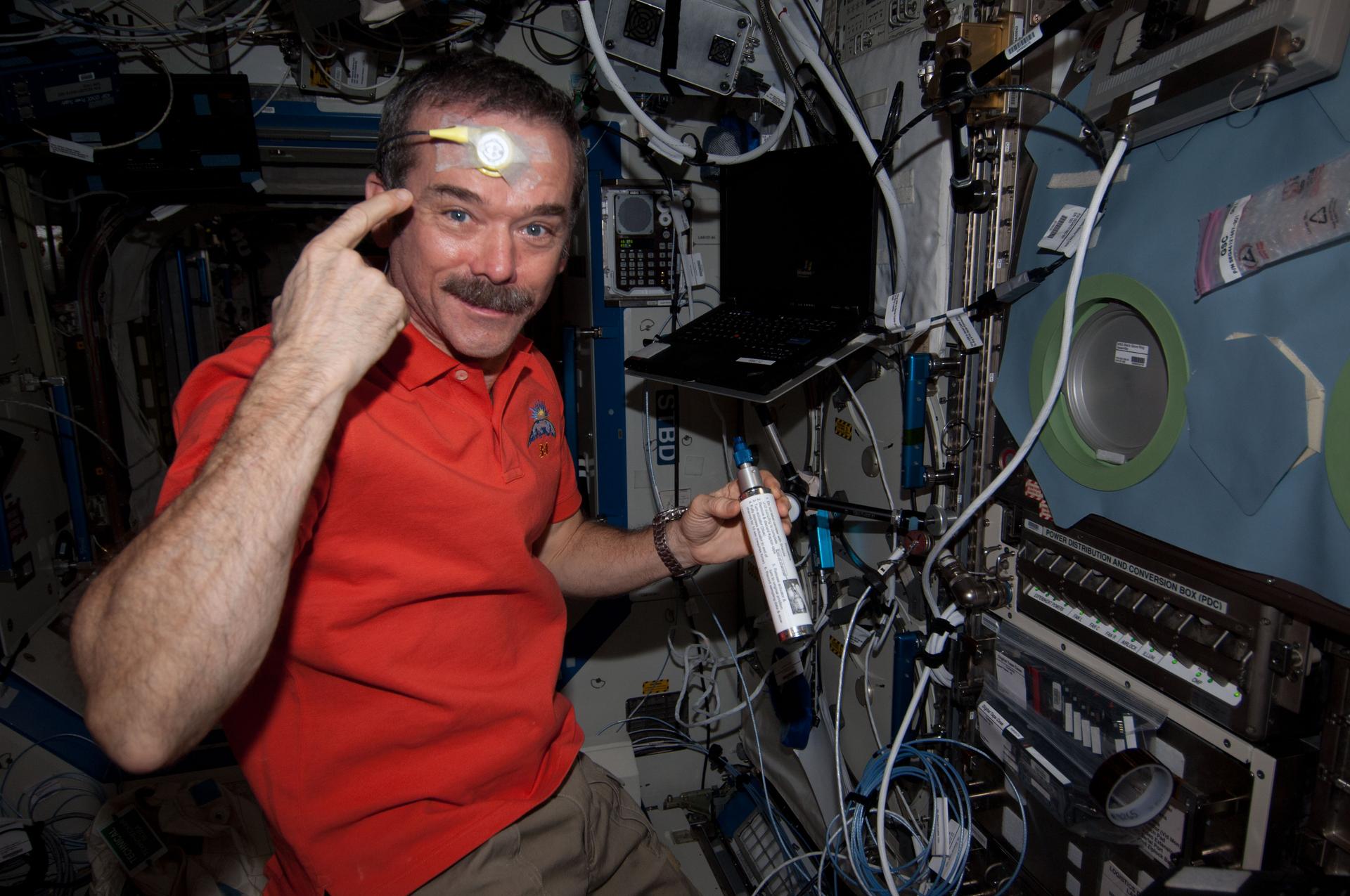
    A well-established way to determine circadian rhythms is by continuously recording core body temperature, but methods to do so can be invasive and inconvenient. For this investigation, researchers developed non-invasive skin sensor technology for measuring body core temperature over extended periods of time.

    Hadfield is wearing an orange polo shirt and khaki pants and holding a silver canister with a white label and blue tip in his left hand. With his right hand, he is pointing to a round yellow sensor taped to his forehead. There is a laptop over his left shoulder and multiple cords, wires, and switches on the wall in front of him.
    CSA astronaut Chris Hadfield is wearing a forehead sensor for the Circadian Rhythms experiment.
    NASA

    Astronaut, Phone Home

    Missions to the Moon or Mars will experience delays in communications with Earth – as much as 30 minutes each way from Mars. The Comm Delay Assessment investigation looked at how such delays might affect crew members handling medical and other emergencies to help psychologists develop ways to manage the stress of completing these critical tasks without immediate advice from Earth. Results showed that the space station could provide a platform to test communications delay countermeasures. The research also confirmed that communication delays increased individual stress and frustration and reduced task efficiency and teamwork, and suggested that enhanced training, teamwork, and technology could mitigate or prevent these problems.

    This is Your Brain in Space

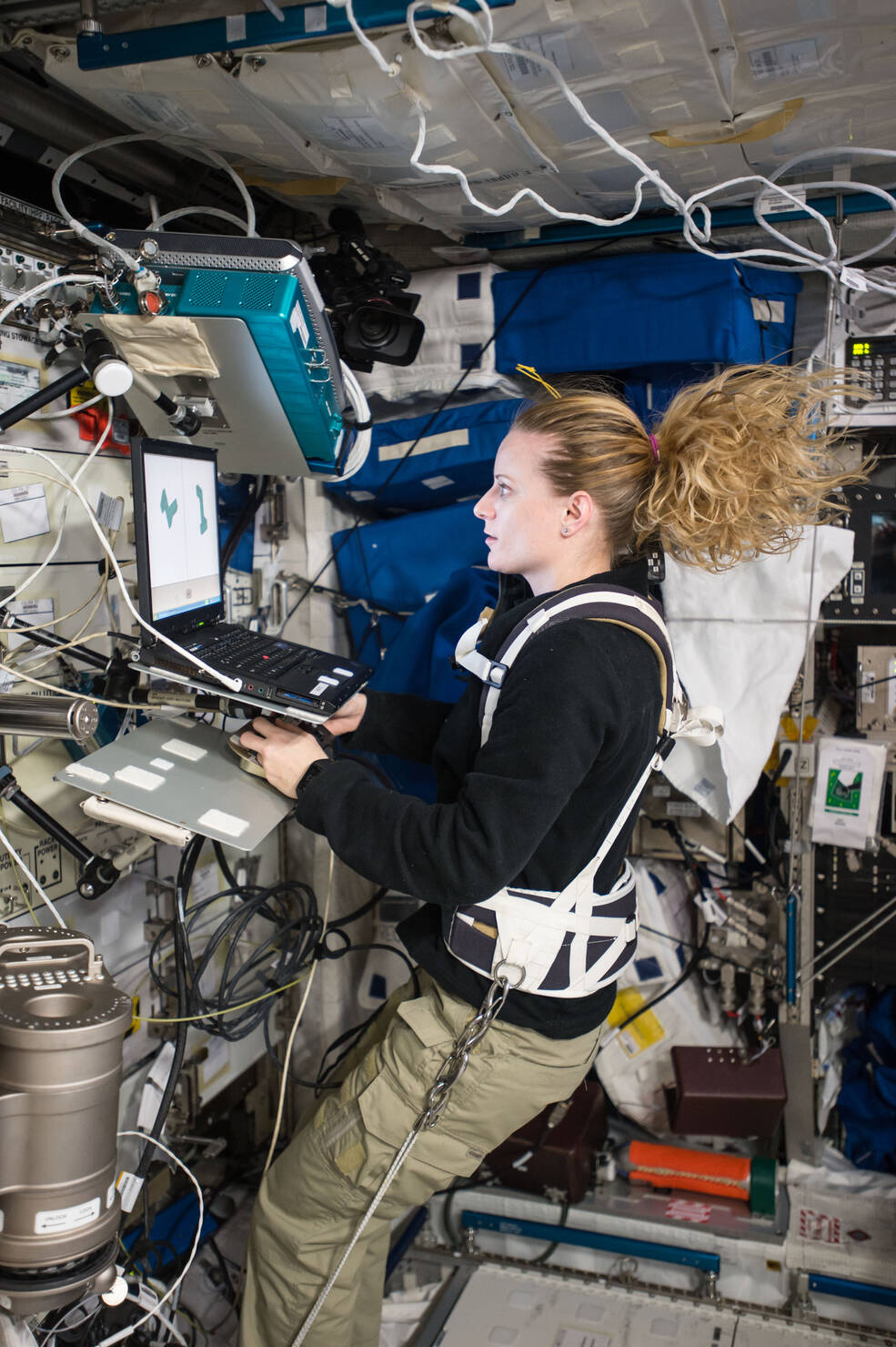
    NeuroMapping studied changes to brain structure and function, motor control, and multi-tasking abilities during spaceflight and measured how long it took crew members to recover after a mission. Results published from this work include a study that found no effect on spatial working memory from spaceflight but that did identify significant changes in brain connectivity. Another paper reported substantial increases in brain volume that increased with mission duration and with longer intervals between missions. The researchers suggest that intervals of less than 3 years between missions may not be sufficient for full recovery.

    Rubins, wearing a black shirt and khaki pants, with her hair in a ponytail floating above her head and a harness around her upper body that tethers her to the surface beneath her, works a controller in front of a laptop. There are blue storage bags behind her and other equipment and cords on the wall in front of her.
    NASA Astronaut Kate Rubins performs operations for the NeuroMapping investigation.
    NASA

    Dear Diary

    For the Journals investigation, crew members wrote daily entries that researchers analyzed to identify issues related to well-being. The study provided the first quantitative data for ranking the behavioral issues associated with spending lengthy time in space. Most journal entries dealt with ten categories: work, outside communications, adjustment, group interaction, recreation/leisure, equipment, events, organization/management, sleep, and food. The report provided insight into how these factors affect human performance and included recommendations to help crews prepare for spaceflight and to improve living and working in space.

    Don’t Throw Away This Shot

    Crew members on the space station take photographs of their home planet for Crew Earth Observations (CEO). These images record how humans and natural events change Earth over time and support a wealth of research on the ground, including studies of urban growth, natural systems such as coral reefs and icebergs, land use, and ocean events. Over time, researchers realized that taking these photographs also improves the mental well-being of crew members. Many of them spend much of their free time shooting from the station’s cupola.

    Almost like Being There

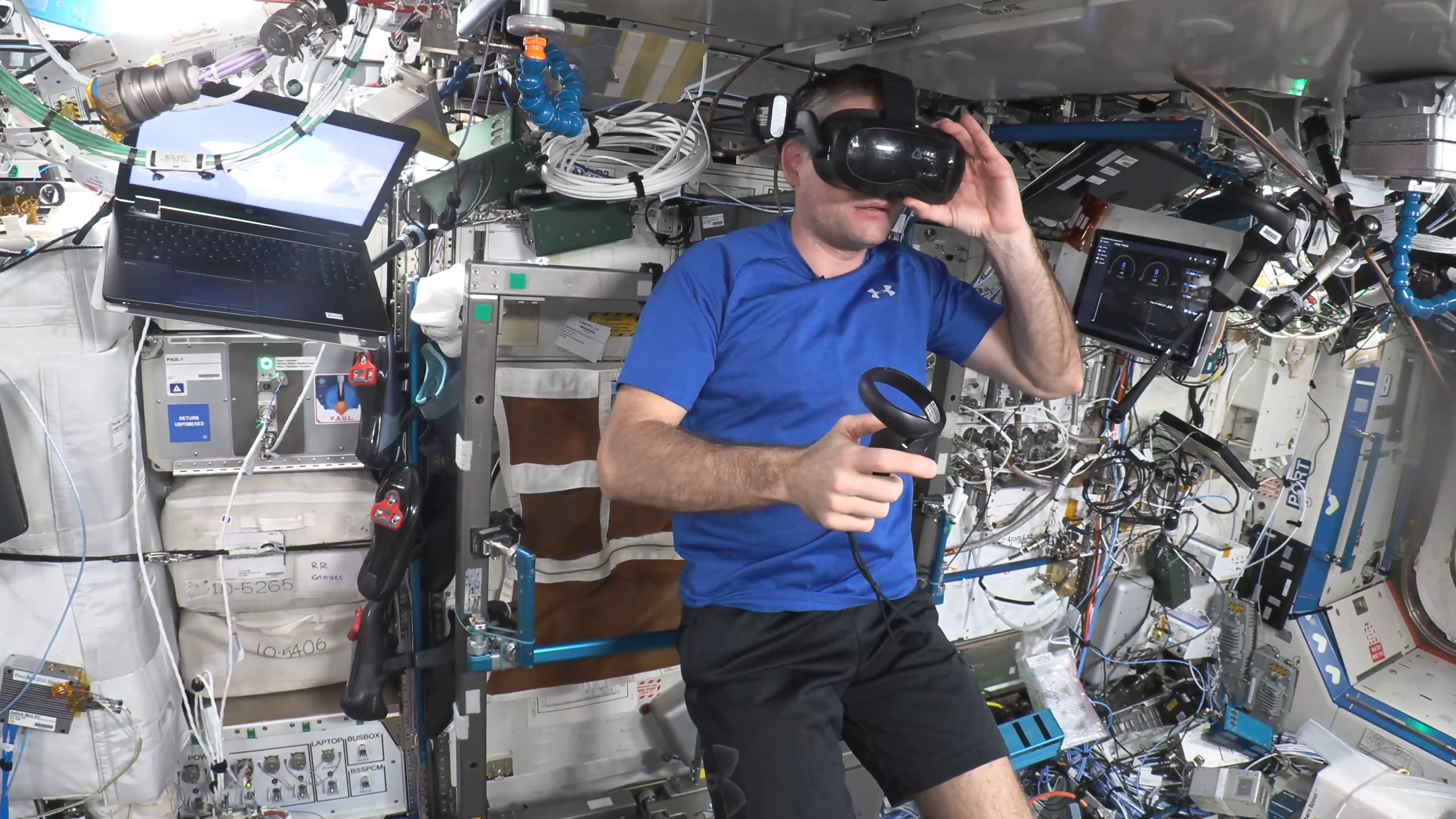
    ESA’s VR Mental Care tests the use of virtual reality (VR) technology to provide mental relaxation and better general mental health for astronauts during their missions. Participating crew members use a headset to view 360-degree, high-quality video and sound scenarios and fill out questionnaires about the experience. In addition to helping astronauts, this tool could be used to deal with psychological issues such as stress, anxiety, and post-traumatic stress disorder on Earth.

    Mogenson, in a blue t-shirt and black shorts, is wearing a black VR headset and adjusting it with his left hand and holding a controller in his right hand. There is a laptop screen on either side of him and multiple cords and cables on the station wall behind him.
    ESA astronaut Andreas Mogenson wears a VR headset.
    ESA

    Melissa Gaskill

    International Space Station Research Communications Team

    NASA’s Johnson Space Center

    Search this database of scientific experiments to learn more about those mentioned in this article.

  • The Summer Triangle’s Hidden Treasures

    4 Min Read

    The Summer Triangle’s Hidden Treasures

    The Dumbbell Nebula pumps out infrared light in this image from NASA's Spitzer Space Telescope with green in the center, orange in the middle and red on the outer layer.

    The ‘Dumbbell nebula,’ also known as Messier 27, pumps out infrared light in this image from NASA’s Spitzer Space Telescope. Planetary nebulae are now known to be the remains of stars that once looked a lot like our sun.

    Credits:
    NASA/JPL-Caltech/Harvard-Smithsonian CfA

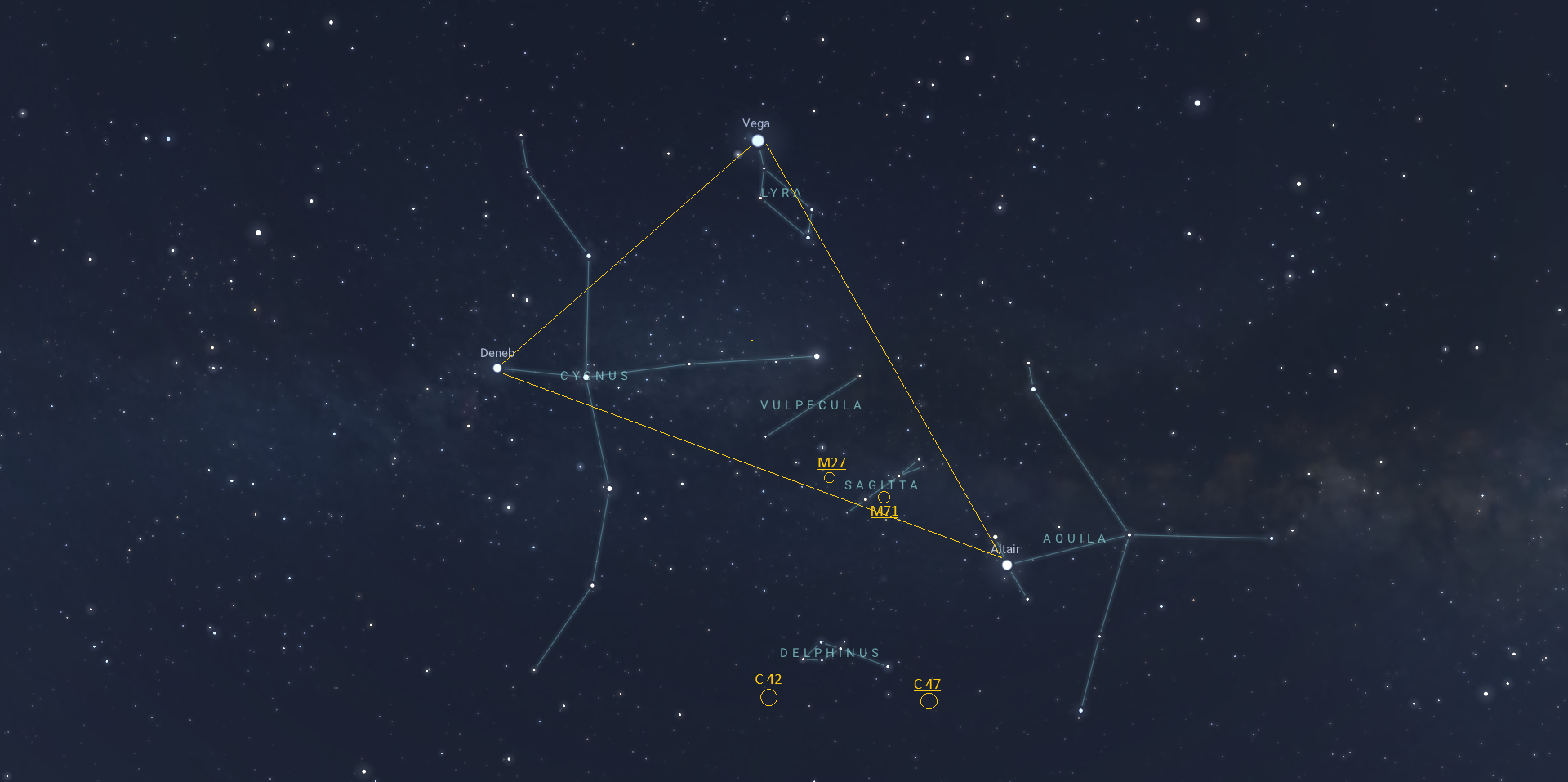
    August skies bring the lovely Summer Triangle asterism into prime position after nightfall for observers in the Northern Hemisphere. Its position high in the sky may make it difficult for some to observe its member stars comfortably, since looking straight up while standing can be hard on one’s neck! While that isn’t much of a problem for those that just want to quickly spot its brightest stars and member constellations, this difficulty can prevent folks from seeing some of the lesser known and dimmer star patterns scattered around its informal borders. The solution? Lie down on the ground with a comfortable blanket or mat or grab a lawn or gravity chair and sit luxuriously while facing up. You’ll quickly spot the major constellations about the Summer Triangle’s three corner stars: Lyra with bright star Vega, Cygnus with brilliant star Deneb, and Aquila with its blazing star, Altair. As you get comfortable and your eyes adjust, you’ll soon find yourself able to spot a few constellations hidden in plain sight in the region around the Summer Triangle: Vulpecula the Fox, Sagitta the Arrow, and Delphinus the Dolphin! You could call these the Summer Triangle’s “hidden treasures” – and they are hidden in plain sight for those that know where to look!

    Image of the constellations Cygnus, Lyra, Aquila, Vulpecula, Sagitta, and Delphinus in the night sky.
    Mid-August offers views of the Summer Triangle with stars Deneb, Vega and Altair in the constellations Cygnus, Lyra, Aquila respectively. Constellations Vulpecula, Sagitta, and Delphinus are also visible, along with some of jewels – namely Messier 27, Messier 71, Caldwell 42 and Caldwell 47.
    Stellarium Web

    Vulpecula the Fox is located near the middle of the Summer Triangle, and is relatively small, like its namesake. Despite its size, it features the largest planetary nebula in our skies: M27, aka the Dumbbell Nebula! It’s visible in binoculars as a fuzzy “star” and when seen through telescopes, its distinctive shape can be observed more readily – especially with larger telescopes. Planetary nebulae, named such because their round fuzzy appearances were initially thought to resemble the disc of a planet by early telescopic observers, form when stars similar to our Sun begin to die. The star will expand into a massive red giant, and its gases drift off into space, forming a nebula. Eventually the star collapses into a white dwarf – as seen with M27 – and eventually the colorful shell of gases will dissipate throughout the galaxy, leaving behind a solitary, tiny, dense, white dwarf star. You are getting a peek into our Sun’s far-distant future when you observe this object!

    Several stars shine against black space.
    This spectacular NASA/ESA Hubble Space Telescope image shows a bright scattering of stars in the small constellation of Sagitta (the Arrow). This is the centre of the globular cluster Messier 71, a great ball of ancient stars on the edge of our galaxy around 13 000 light-years from Earth. M71 is around 27 light-years across. Globular clusters are like galactic suburbs, pockets of stars that exist on the edge of major galaxies. These clusters are tightly bound together by their gravitational attraction, hence their spherical shape and their name: globulus means “little sphere” in Latin. Around 150 such globular clusters are known to exist around our Milky Way, each one of them containing several hundred thousand stars. Messier 71 has been known for a long time, having been first spotted in the mid eighteenth century by Swiss astronomer Jean-Philippe de Cheseaux. Cheseaux discovered a number of nebulae in his career, and also spent much time studying religion: one posthumously published work attempted to derive the exact date of Christ’s crucifixion from astronomical events noted in the Bible. Despite being a familiar object, Messier 71’s precise nature was disputed until recently. Was it simply an open cluster, a loosely bound group of stars? This was for many years the dominant view. But in the 1970s, astronomers came to the view that it is in fact a relatively sparse globular cluster. The stars in Messier 71, as is usual in such clusters, are relatively old, at around 9 to 10 billion years, and consequently are low in elements other than hydrogen and helium. This picture was created from images taken with the Wide Field Channel of the Advanced Camera for Surveys on Hubble. It is a combination of images taken through yellow (F606W — coloured blue) and near-infrared (F814W — coloured red) filters. The exposure times were 304 s and 324 s respectively. The field of view is about 3.4 arcminutes across.
    ESA/Hubble and NASA

    Sagitta the Arrow is even smaller than Vulpecula – it’s the third smallest constellation in the sky! Located between the stars of Vulpecula and Aquila the Eagle, Sagitta’s stars resemble its namesake arrow. It too contains an interesting deep-sky object: M71, an unusually small and young globular cluster whose lack of a strong central core has long confused and intrigued astronomers. Your own views very likely won’t be as sharp or close as this. However, this photo does show the cluster’s lack of a bright, concentrated core, which led astronomers until fairly recently to classify this unusual cluster as an “open cluster” rather than as a “globular cluster.” Studies in the 1970s proved it to be a globular cluster after all  – though an unusually young and small one! It’s visible in binoculars, and a larger telescope will enable you to separate its stars a bit more easily than most globulars; you’ll certainly see why it was thought to be an open cluster!

    Delicate Delphinus the Dolphin appears to dive in and out of the Milky Way near Aquilla and Sagitta! Many stargazers identify Delphinus as a herald of the fainter water constellations, rising in the east after sunset as fall approaches. The starry dolphin appears to leap out of the great celestial ocean, announcing the arrival of more wonderful sights later in the evening. With a large telescope and dark skies, you can pick out globular clusters Caldwell 42 and Caldwell 47.

    Want to hunt for more treasures? You’ll need a treasure map, and the Night Sky Network’s “Trip Around the Triangle” handout is the perfect guide for your quest!

    Originally posted by Dave Prosper: August 2022

    Last Updated by Kat Troche: April 2024

  • NASA Invites Media to Event with Scientists, Research Plane in Alaska

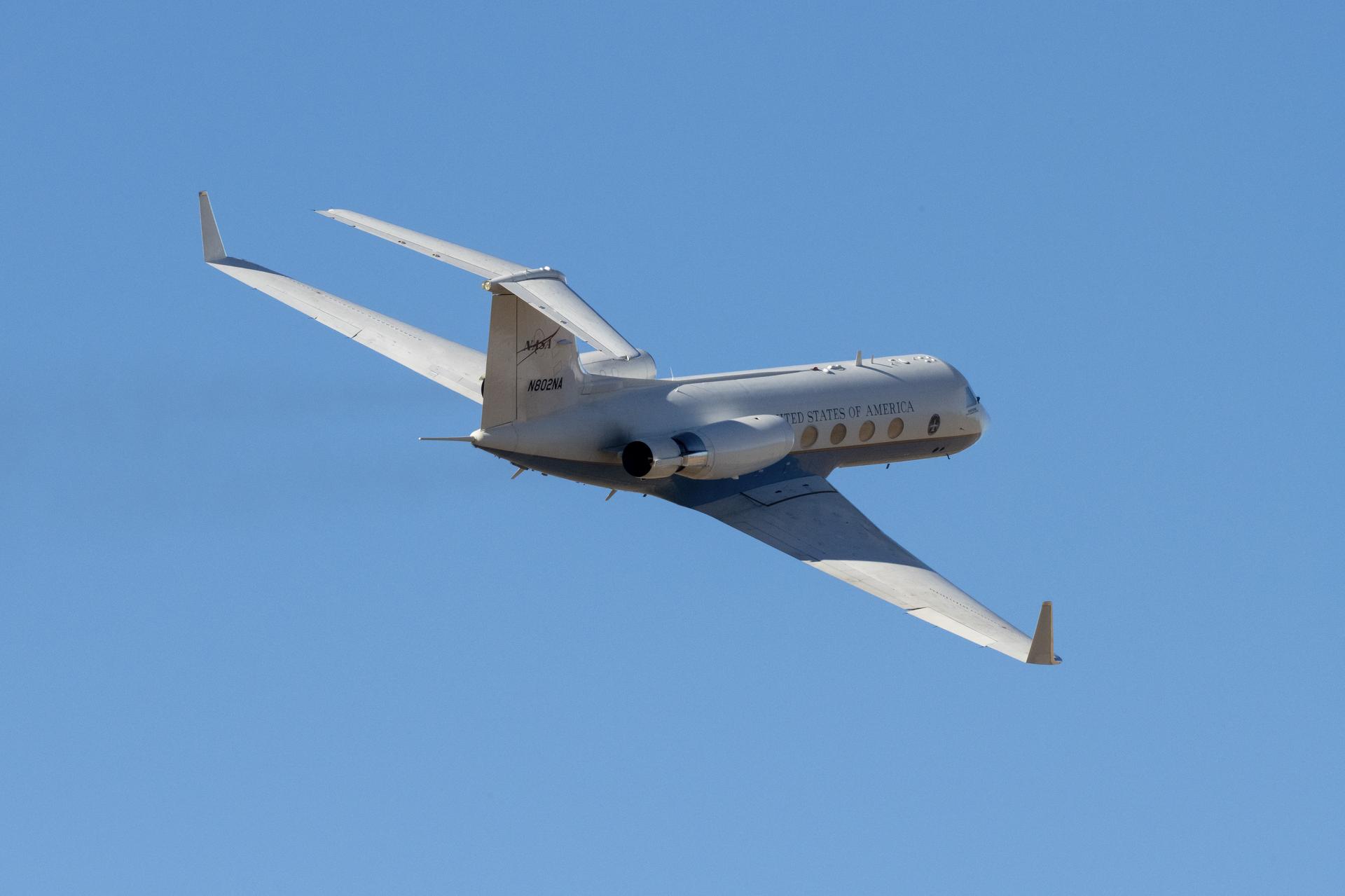
    The NASA C-20A (Gulfstream III), shown here in a file photo, is an aircraft that has been structurally modified and instrumented by NASA’s Armstrong Flight Research Center in Edwards, Calif., to serve as a versatile, collaborative research platform for the Earth science community and other researchers.
    NASA/Jim Ross

    NASA invites media to view a research aircraft and interview scientists in Fairbanks, Alaska, on Thursday, Aug. 22, prior to flights of the agency’s Arctic-Boreal Vulnerability Experiment (ABoVE), which seeks a better understanding of the sensitivity of northern ecosystems and communities to climate change.

    Media also will have the opportunity to tour NASA’s C-20A, a modified Gulfstream III aircraft from the agency’s Armstrong Flight Research Center in Edwards, California, and meet scientists and instrument team members using ABoVE’s radar instrument from NASA’s Jet Propulsion Laboratory in Southern California. Media are welcome to film researchers on the ground as they communicate with the airborne team.   

    Weather permitting, the ABoVE media availability will take place from 3:30 p.m. to 5:30 p.m. AKDT at the Omni Logistics aircraft hangar, 6302 Old Airport Road, Fairbanks. Media interested in participating should contact Dr. Elizabeth Hoy, senior support scientist, at elizabeth.hoy@nasa.gov prior to the event. NASA’s media accreditation policy is online.

    view from inside the cockpit of a NASA research aircraft; two people operate numerous controls while a green landscape is visible through the windows
    With the help of research aircraft, NASA’s Arctic-Boreal Vulnerability Experiment (ABoVE) has sought better understanding of the sensitivity of northern ecosystems and communities to climate change for nearly a decade. This cockpit view was captured during a 2022 ABoVE flight.
    NASA/Katie Jepson

    Climate change in the Arctic and boreal regions is unfolding faster than anywhere else on Earth, resulting in reduced Arctic Sea ice, thawing of permafrost soils, decomposition of long-frozen organic matter, widespread changes to lakes, rivers, coastlines, and alterations of ecosystem structure and function.

    Nearly a decade of ABoVE flights has enabled accurate comparisons over time of permafrost, thermokarst, and boreal forests. The 2024 ABoVE field campaign covers Alaska and western Canada. It is coordinated through NASA’s Terrestrial Ecology Program. 

    For more information on ABoVE, visit:

    https://above.nasa.gov

    -end-

    Rob Garner
    Goddard Space Flight Center, Greenbelt, Md.
    301-286-5687
    rob.garner@nasa.gov

    Details

    Last Updated

    Aug 14, 2024

    Editor
    Rob Garner
    Contact
    Rob Garner
    Location
    Goddard Space Flight Center

  • NASA Funds Research Projects Advancing STEM Career Development

    Image of the NASA logo
    Credit: NASA

    NASA has awarded $6 million to 20 teams from emerging research institutions across the United States supporting projects that offer career development opportunities for science, technology, engineering, and mathematics (STEM) students.

    This is the third round of seed funding awarded through the agency’s MOSAICS (Mentoring and Opportunities in STEM with Academic Institutions for Community Success) program, formerly the Science Mission Directorate Bridge Program. The program seeks to expand access to NASA research opportunities in the science and engineering disciplines, as well as to NASA’s workforce.

    “The STEM workforce continues to grow, and today’s students, studying at a variety of higher-education institutions — community colleges, primarily undergraduate institutions, and minority-serving institutions — are the STEM workforce of tomorrow, who will work to solve some of our biggest challenges at home while answering some of our biggest questions about our universe,” said Padi Boyd, director of MOSAICS at NASA Headquarters in Washington. “Exposing today’s students to the incredibly inspiring and cutting-edge discoveries made through NASA’s space science people and resources ensures that these students get the training they need to persist in STEM careers, while fostering enduring collaborations between NASA researchers and faculty at a wide range of institutions.”

    NASA’s Science Mission Directorate MOSAICS program funds research projects building relationships between college faculty and researchers at the agency while providing mentorship and training for students in STEM disciplines. The projects support teams at academic institutions that historically have not been part of the agency’s research enterprise — including Hispanic-serving institutions, historically Black colleges and universities, Asian American and Native American Pacific Islander-serving institutions, and primarily undergraduate institutions.

    The program previously awarded seed funding to 11 teams in February and 13 teams in April. This third cohort brings the total number of projects funded to 44 teams at 36 academic institutions in 21 U.S. states and territories, including Washington and Puerto Rico, in collaboration with seven NASA centers. A new opportunity to apply for seed funding is now open until March 28, 2025.

    The following projects were selected as the third cohort to receive seed funding:

    “Bridging Fundamental Ice Chemistry Studies and Ocean World Explorations”
    Principal investigator: Chris Arumainayagam, Wellesley College, Massachusetts
    NASA center: NASA’s Jet Propulsion Laboratory (JPL), Southern California

    “Planetary Analog Field Science Experiences for Undergraduates: Advancing Fundamental Research and Testing Field Instrument Operations”
    Principal investigator: Alice Baldridge, Saint Mary’s College of California
    NASA center: NASA’s Goddard Space Flight Center, Greenbelt, Maryland

    “Building an FSU-JPL Partnership to Advance Science Productivity Through Applications of Deep Learning”
    Principal investigator: Sambit Bhattacharya, Fayetteville State University, North Carolina
    NASA center: NASA JPL

    “CSTAT: Establishing Center for Safe and Trustworthy Autonomous Technologies”
    Principal investigator: Moitrayee Chatterjee, New Jersey City University
    NASA center: NASA Goddard

    “Development of Biomechanics Simulation Tool for Muscle Mechanics in Reduced Gravity to Enhance Astronaut Mission Readiness”
    Principal investigator: Ji Chen, University of the District of Columbia
    NASA center: NASA’s Johnson Space Center, Houston

    “NASA Next Level”
    Principal investigator: Teresa Ciardi, Santa Clarita Community College District, California
    NASA center: NASA JPL

    “Controlled Assembly of Amphiphilic Janus Particles in Polymer Matrix for Novel 3D Printing Applications in Space
    Principal investigator: Ubaldo Cordova-Figueroa, Recinto Universitario Mayaguez
    NASA center: NASA’s Glenn Research Center, Cleveland

    “Development of a Non-Invasive Sweat Biosensor for Traumatic Brain Injury Compatible With In-Space Manufacturing to Monitor the Health of Astronauts”
    Principal investigator: Lisandro Cunci, University of Puerto Rico, Rio Pedras
    NASA center: NASA’s Ames Research Center, Silicon Valley, California

    “Examining Climate Impacts of Cirrus Clouds Through Past, Present, and Future NASA Airborne Campaigns”
    Principal investigator: Minghui Diao, San Jose State University Research Foundation, California
    NASA center: NASA Ames

    “CSUN-JPL Collaboration to Study Ocean Fronts Using Big Data and Open Science Structures in Coastal North America”
    Principal investigator: Mario Giraldo, California State University, Northridge
    NASA center: NASA JPL

    “Accelerating Electric Propulsion Development for Planetary Science Missions With Optical Plasma Diagnostics”
    Principal investigator: Nathaniel Hicks, University of Alaska, Anchorage
    NASA center: NASA JPL

    “Advancing Students Through Research Opportunities in Los Angeles (ASTRO-LA)”
    Principal investigator: Margaret Lazzarini, California State University, Los Angeles
    NASA center: NASA JPL

    “Bridging Toward a More Inclusive Learning Environment Through Gamma-ray Burst Studies With Machine Learning and Citizen Science”
    Principal investigator: Amy Lien, University of Tampa, Florida
    NASA center: NASA Goddard

    “Hampton University STEM Experience With NASA Langley Research Center: Polarimetry for Aerosol Characterization”
    Principal investigator: Robert Loughman, Hampton University, Virginia
    NASA center: NASA’s Langley Research Center, Hampton, Virginia

    “Aerocapture Analysis and Development for Uranus and Neptune Planetary Missions”
    Principal investigator: Ping Lu, San Diego State University
    NASA center: NASA Langley

    “Pathways from Undergraduate Research to the Habitable Worlds Observatory”
    Principal investigator: Ben Ovryn, New York Institute of Technology
    NASA center: NASA Goddard

    “Point-Diffraction Interferometer for Digital Holography”
    Principal investigator: James Scire, New York Institute of Technology
    NASA center: NASA Goddard

    “From Sunbeams to Career Dreams: Illuminating Pathways for NMSU Students in Solar-Terrestrial Physics in Partnership With NASA GSFC”
    Principal investigator: Juie Shetye, New Mexico State University
    NASA center: NASA Goddard

    “CONNECT-SBG: Collaborative Nexus for Networking, Education, and Career Training in Surface Biology and Geology”
    Principal investigator: Gabriela Shirkey, Chapman University, California
    NASA center: NASA JPL

    “Multiplexed Phytohormone and Nitrate Sensors for Real-Time Analysis of Plant Responses to Pathogenic Stress in Spaceflight-Like Conditions”
    Principal investigator: Shawana Tabassum, University of Texas, Tyler
    NASA center: NASA’s Kennedy Space Center, Florida

    Learn more about the MOSAICS program at:

    https://science.nasa.gov/researchers/smd-bridge-program

    -end-

    Alise Fisher
    Headquarters, Washington
    202-358-2546
    alise.m.fisher@nasa.gov

  • NASA’s Perseverance Rover to Begin Long Climb Up Martian Crater Rim

    5 min read

    Preparations for Next Moonwalk Simulations Underway (and Underwater)

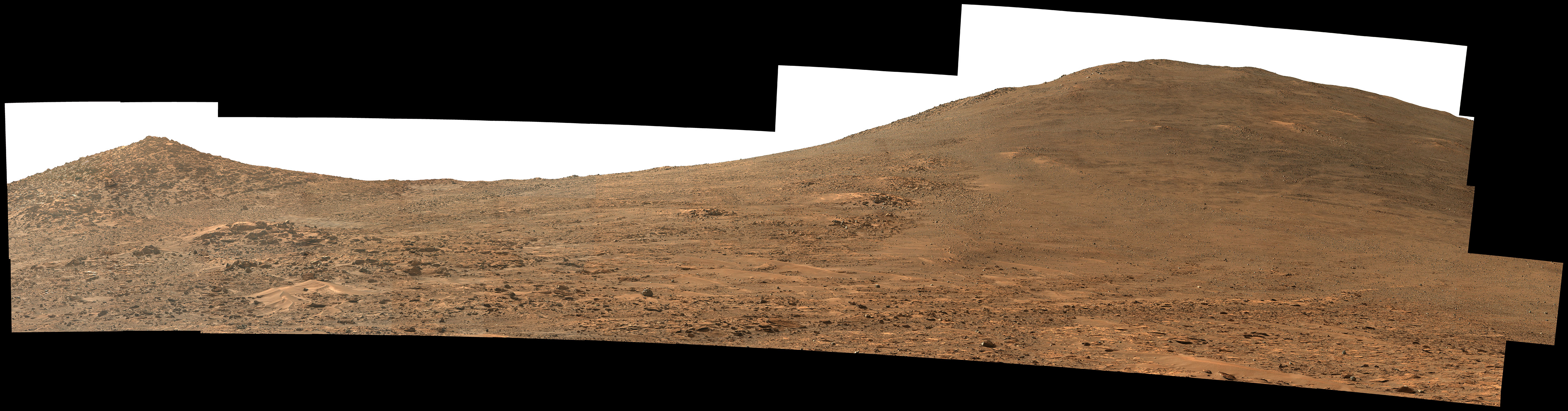
    This panorama shows the area NASA’s Perseverance Mars rover will climb in coming months
    This panorama shows the area NASA’s Perseverance Mars rover will climb in coming months to crest Jezero Crater’s rim. It is made up of 59 images taken by the rover’s Mastcam-Z on Aug. 4.
    NASA/JPL-Caltech/ASU/MSSS

    After 2½ years exploring Jezero Crater’s floor and river delta, the rover will ascend to an area where it will search for more discoveries that could rewrite Mars’ history.

    NASA’s Perseverance Mars rover will soon begin a monthslong ascent up the western rim of Jezero Crater that is likely to include some of the steepest and most challenging terrain the rover has encountered to date. Scheduled to start the week of Aug. 19, the climb will mark the kickoff of the mission’s new science campaign — its fifth since the rover landed in the crater on Feb. 18, 2021.

    “Perseverance has completed four science campaigns, collected 22 rock cores, and traveled over 18 unpaved miles,” said Perseverance project manager Art Thompson of NASA’s Jet Propulsion Laboratory in Southern California. “As we start the Crater Rim Campaign, our rover is in excellent condition, and the team is raring to see what’s on the roof of this place.”

    Two of the priority regions the science team wants to study at the top of the crater are nicknamed “Pico Turquino” and “Witch Hazel Hill.” Imagery from NASA’s Mars orbiters indicates that Pico Turquino contains ancient fractures that may have been caused by hydrothermal activity in the distant past.

    Rover looking back at the “Bright Angel” area
    One of the navigation cameras aboard NASA’s Perseverance Mars rover captured this view looking back at the “Bright Angel” area on July 30, the 1,224th Martian day, or sol, of the mission.
    NASA/JPL-Caltech

    Orbital views of Witch Hazel show layered materials that likely date from a time when Mars had a very different climate than today. Those views have revealed light-toned bedrock similar to what was found at “Bright Angel,” the area where Perseverance recently discovered and sampled the “Cheyava Falls” rock, which exhibits chemical signatures and structures that could possibly have been formed by life billions of years ago when the area contained running water.

    It’s Sedimentary

    During the river delta exploration phase of the mission, the rover collected the only sedimentary rock ever sampled from a planet other than Earth. Sedimentary rocks are important because they form when particles of various sizes are transported by water and deposited into a standing body of water; on Earth, liquid water is one of the most important requirements for life as we know it.  

    A study published Wednesday, Aug. 14, in AGU Advances chronicles the 10 rock cores gathered from sedimentary rocks in an ancient Martian delta, a fan-shaped collection of rocks and sediment that formed billions of years ago at the convergence of a river and a crater lake.

    The core samples collected at the fan front are the oldest, whereas the rocks cored at the fan top are likely the youngest, produced when flowing water deposited sediment in the western fan.

    “Among these rock cores are likely the oldest materials sampled from any known environment that was potentially habitable,” said Tanja Bosak, a geobiologist at the Massachusetts Institute of Technology in Cambridge and member of Perseverance’s science team. “When we bring them back to Earth, they can tell us so much about when, why, and for how long Mars contained liquid water and whether some organic, prebiotic, and potentially even biological evolution may have taken place on that planet.”

    This map shows the route NASA’s Perseverance Mars rover
    This map shows the route NASA’s Perseverance Mars rover will take (in blue) as it climbs the western rim of Jezero Crater, first reaching “Dox Castle,” then investigating the “Pico Turquino” area before approaching “Witch Hazel Hill.”
    NASA/JPL-Caltech/University of Arizona

    Onward to the Crater Rim

    As scientifically intriguing as the samples have been so far, the mission expects many more discoveries to come.

    “Our samples are already an incredibly scientifically compelling collection, but the crater rim promises to provide even more samples that will have significant implications for our understanding of Martian geologic history,” said Eleni Ravanis, a University of Hawaiì at Mānoa scientist on Perseverance’s Mastcam-Z instrument team and one of the Crater Rim Campaign science leads. “This is because we expect to investigate rocks from the most ancient crust of Mars. These rocks formed from a wealth of different processes, and some represent potentially habitable ancient environments that have never been examined up close before.”

    Reaching the top of the crater won’t be easy. To get there, Perseverance will rely on its auto-navigation capabilities as it follows a route that rover planners designed to minimize hazards while still giving the science team plenty to investigate. Encountering slopes of up to 23 degrees on the journey (rover drivers avoid terrain that would tilt Perseverance more than 30 degrees), the rover will have gained about 1,000 feet (300 meters) in elevation by the time it summits the crater’s rim at a location the science team has dubbed “Aurora Park.”

    Then, perched hundreds of meters above a crater floor stretching 28 miles (45 kilometers) across, Perseverance can begin the next leg of its adventure.

    More Mission Information

    A key objective of Perseverance’s mission on Mars is astrobiology, including caching samples that may contain signs of ancient microbial life. The rover will characterize the planet’s geology and past climate, to help pave the way for human exploration of the Red Planet and as the first mission to collect and cache Martian rock and regolith.

    NASA’s Mars Sample Return Program, in cooperation with ESA (European Space Agency), is designed to send spacecraft to Mars to collect these sealed samples from the surface and return them to Earth for in-depth analysis.

    The Mars 2020 Perseverance mission is part of NASA’s Moon to Mars exploration approach, which includes Artemis missions to the Moon that will help prepare for human exploration of the Red Planet.

    NASA’s Jet Propulsion Laboratory, which is managed for the agency by Caltech, built and manages operations of the Perseverance rover.

    For more about Perseverance:

    science.nasa.gov/mission/mars-2020-perseverance

    News Media Contacts

    DC Agle
    Jet Propulsion Laboratory, Pasadena, Calif.
    818-393-9011
    agle@jpl.nasa.gov

    Alise Fisher / Erin Morton
    NASA Headquarters, Washington
    202-358-1600
    alise.m.fisher@nasa.gov / erin.morton@nasa.gov

    2024-107

  • Xiaoyi Li Engineers Instruments and the Teams that Get Them Done

    Name: Xiaoyi Li

    Title: Instrument Systems Engineer (ISE) of Venus Atmospheric Structure Investigation (VASI) for the Deep Atmosphere Venus Investigation of Noble gases, Chemistry, and Imaging (DAVINCI) and Deputy ISE of Comprehensive Auroral Precipitation Experiment (CAPE) instrument for the Geospace Dynamics Constellation (GDC) mission

    Formal Job Classification: Instrument Systems Engineer

    Organization: Instrument/Payload Systems Engineering Branch, Engineering Directorate (Code 592)

    Xiaoyi Li in a shirt with NASA's logo and
    Xiaoyi Li is an instrument systems engineer at NASA’s Goddard Space Flight Center in Greenbelt, Md. “My role involves not only managing technical tasks but also blending a variety of technical skills and personalities,” she said. “Understanding of the technical connections between different components is essential to ensure the integrated systems meet requirements. In addition, helping to cultivate collaboration and synthesize diverse expertise is vital. I find the process of learning about and achieving integration of different personalities within the team particularly rewarding.”
    Photo Courtesy Xiaoyi Li

    What do you do and what is most interesting about your role here at Goddard?

    I have two roles. As the instrument systems engineer of VASI, I lead the technical team to develop a sensor suite for this component of NASA’s upcoming DAVINCI mission to Venus. I am also the deputy instrument systems engineer of CAPE where I assist the lead for developing the CAPE instrument for the Geospace Dynamics Constellation mission. The most intriguing aspect of my job is to collaborate with two talented and diverse technical teams, learn from team members, and come up with solutions to resolve technical challenges within budget and schedule.

    What is your educational background?

    I received a bachelor’s degree in mechanical engineering from Tongji University in Shanghai, China. I furthered my education at the University of New South Wales, Australia, where I earned a master’s in mechanical engineering. After I moved to the U.S., I received a Ph.D. in mechanical engineering from the University of Central Florida in Orlando. My doctorate was funded by a NASA grant to design, build and test a spaceflight cryocooler.

    Why did you become a mechanical engineer?

    I grew up in an engineering family. My mother was a chemical engineer. My father was an architect and structural engineer. I grew up watching them build large factories. While I would like to think I would have become an engineer without their influence, growing up with such incredible role models gave me access to, and an understanding of engineering disciplines that I never really considered any other profession.

    What brought you to Goddard?

    Upon completing my Ph.D. in 2005, I started out as a mission analyst for launch service programs at NASA’s Kennedy Space Center in Florida. In 2009, I began working as a thermal engineer for NASA’s Wallops Flight Facility in Virginia. In 2010, I came across a position that brought me back to my Ph.D. days and I couldn’t pass up the opportunity. I joined the Cryogenics and Fluids Branch at Goddard.

    What did you do at Goddard before your current position?

    I contributed to multiple engineering and science studies, proposals, and projects as a cryogenics engineer. Notably, I served as the principal investigator for two IRAD studies. One of the studies was submitted to the Patent Office and later was granted a new patent. Additionally, I was a co-inventor for another patent. Prior to joining my current group, I held the position of instrument cryogenics lead for the Roman Space Telescope. I served as the associate branch head in my current organization before devoting full time as an instrument systems engineer.

    What are your main responsibilities as the instrument systems engineer for CAPE and VASI?

    As the deputy instrument systems engineer for CAPE, my main responsibility is to assist the lead to coordinate multiple technical teams. The main focus is to work with the mechanical, electrical, thermal, structural, and other engineers to build electron/ion analyzers. For the VASI instrument, which has a smaller team, I take a more direct role in organizing and coordinating the technical work. This position allows me to engage in hands-on engineering tasks, which is extremely gratifying being able to get “my hands dirty.”

    My role involves not only managing technical tasks but also blending a variety of technical skills and personalities. Understanding of the technical connections between different components is essential to ensure the integrated systems meet requirements. In addition, helping to cultivate collaboration and synthesize diverse expertise is vital. I find the process of learning about and achieving integration of different personalities within the team particularly rewarding.

    How do you coordinate between all the different systems and personalities?

    My experience includes over eight years in leadership roles, supported by extensive training and a robust technical background. This includes a one-year detail assignment in Goddard’s Science Mission Directorate. In this role, I facilitate collaboration within the engineering team, as well as between the engineers and the scientists to ensure that the instrument meets scientific objectives while adhering to well established engineering best practices and principles. Additionally, I empower our subject matter experts to pursue their innovative ideas while guiding them toward a unified direction through a shared vision. Although individual approaches may vary, we are all committed to the collective goal of a successful mission.

    Who were your mentors and what did they advise?

    I am grateful for the guidance of two mentors who have been instrumental in my development. Mr. Dave Everett, a systems engineer by trade and the current head of our branch, has been my technical mentor. He taught me, among many other things, the importance of understanding the overall system. Ms. Maria So, my leadership mentor, is a former senior executive service (SES) member at Goddard. As a fellow Chinese woman and engineer, her influence has been profound. She has guided me and acted as a sounding board for some very exciting but challenging decisions these past years. She also taught me the importance of seeing the bigger picture and the critical organizational leadership role to systems engineering, which has shaped my approach to leadership.

    In turn, I apply these teachings and ideas when I informally mentor the younger engineers on my team. I encourage them to tackle problems independently by providing the necessary background knowledge and allowing them the autonomy to make decisions. I guide them when needed, but I believe in balance and the importance of learning through one’s own mistakes.

    two women standing in an auditorium
    Li with her leadership mentor, Maria So, at a Goddard “Taste of Asia” event celebrating Asian American, Native Hawaiian and Pacific Islander Heritage Month. “Her influence has been profound,” Li said. “She has guided me and acted as a sounding board for some very exciting but challenging decisions these past years. She also taught me the importance of seeing the bigger picture and the critical organizational leadership role to systems engineering, which has shaped my approach to leadership.”
    Photo courtesy Xiaoyi Li

    What is your involvement with the Asian American Native Hawaiian and Pacific Islander Employee Resource Group (AANHPI)?

    I have been actively involved with the group, and I recently served as co-chair for three years. Our group is dedicated to advocating for the wellness of the Asian American community within Goddard. Our group also addresses any concerns from the community members by reporting directly to Goddard senior management. In addition, we foster a sense of community and support among members through community events including our annual “Taste of Asia and the Pacific Islands” lunch event at Goddard.

    What do you do for fun?

    I enjoy cooking a variety of cuisines, including Chinese and Thai (which I learned in Australia), as well as classic American dishes. My favorite culinary challenge is a rib roast using suis vide method, which involves 18 hours of slow cooking before finishing it in the oven! Additionally, I enjoy playing video games with my family and friends, which is a great way to relax and connect.

    By Elizabeth M. Jarrell
    NASA’s Goddard Space Flight Center, Greenbelt, Md.

    A banner graphic with a group of people smiling and the text

    Conversations With Goddard is a collection of Q&A profiles highlighting the breadth and depth of NASA’s Goddard Space Flight Center’s talented and diverse workforce. The Conversations have been published twice a month on average since May 2011. Read past editions on Goddard’s “Our People” webpage.

    Details

    Last Updated

    Aug 14, 2024

    Editor
    Rob Garner
    Contact
    Rob Garner
    Location
    Goddard Space Flight Center