Tag: JAXA

  • [ISS / Japanese Experiment Module (KIBO)] Result of the high-altitude drop test of a simulated small return capsule to establish return technology

    Result of the high-altitude drop test of a simulated small return capsule to establish return technology

    Last Updated: November 10, 2015

    JAXA is developing a small return capsule that can be carried aboard the H-II Transfer Vehicle (HTV) KOUNOTORI, aiming to devise return capsule technologies and increase cargo return opportunities for precious samples obtained through space experiments on the ISS, so as to maximize the results of space utilization.

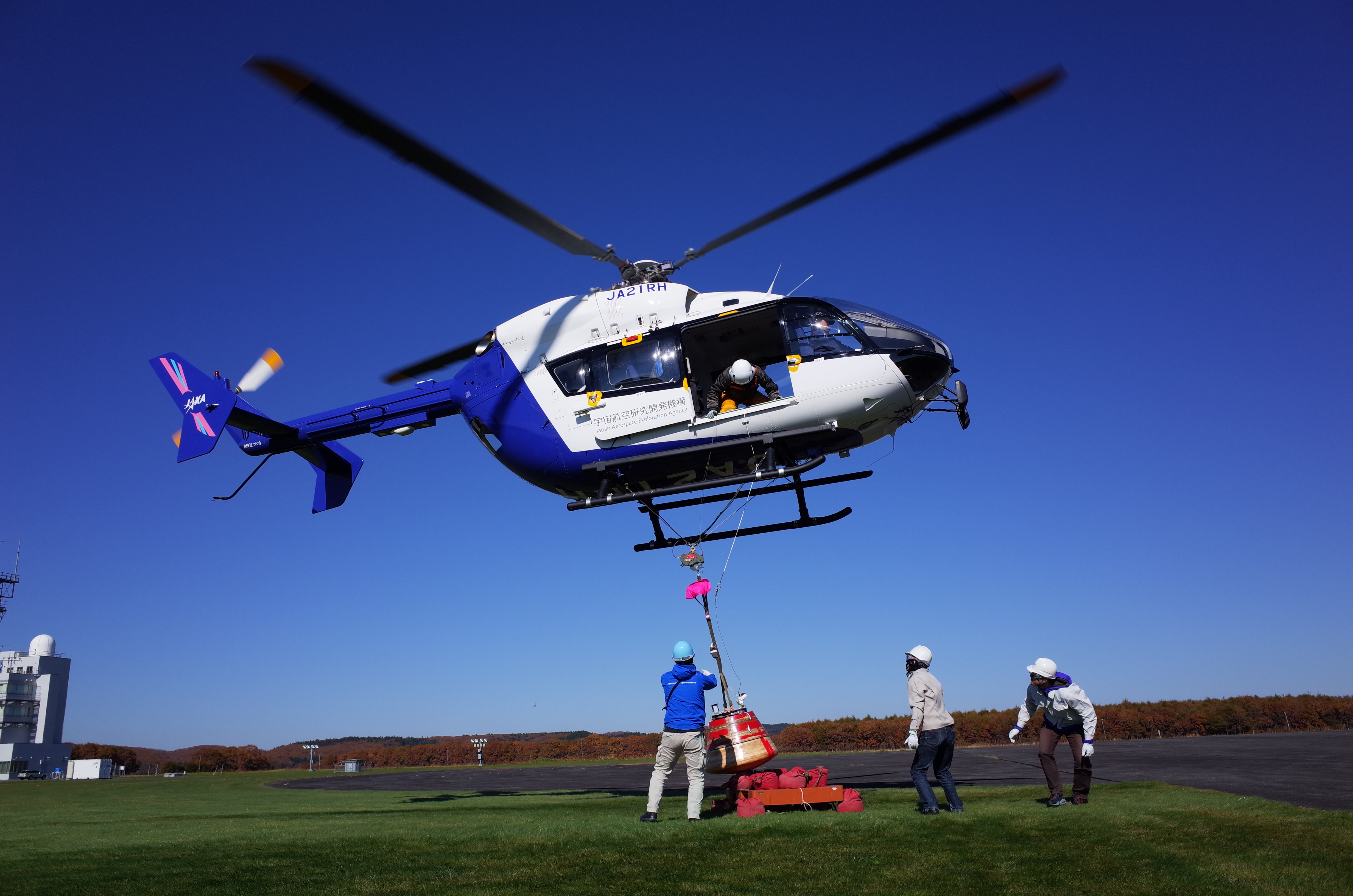
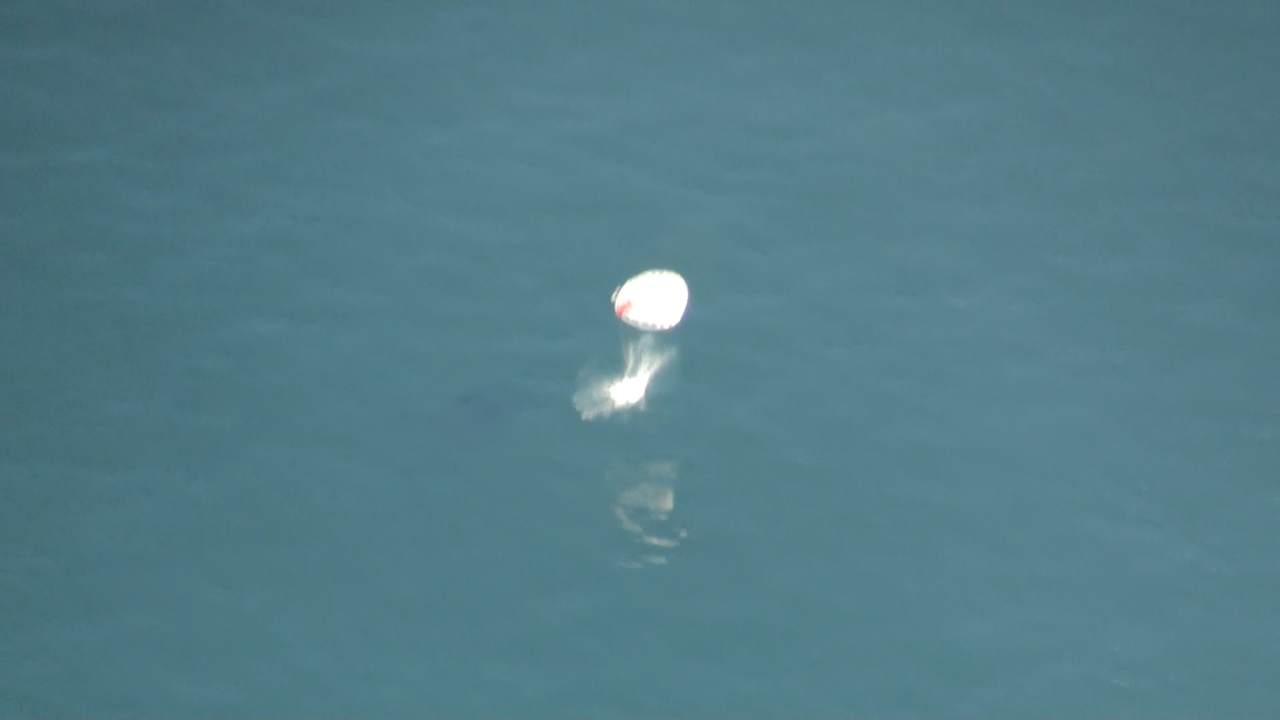
    As part of this technology development, a high-altitude drop test of a simulated small return capsule was conducted off the coast of Taiki-cho, Hokkaido on October 22, 2015. At about 10:46 a.m., the return capsule was released from a helicopter at an altitude of 2 km and splashed down in the ocean three minutes later.

    The parachute and other equipment worked normally, and the test ended without any trouble. The data obtained will be analyzed to realize completion of the small return capsule.

    Overview of the drop test

    • To release a small return capsule at an altitude of 2 km off the coast of Taiki-cho, Hokkaido.
    • The test aims to obtain data on the critical functions of return capsules, such as parachute deployment during descending and buoyancy bag activation after the capsule’s splashdown, descending capsule velocity, impact load when the parachute opens, and impact load when the capsule hits the water.
    • This test data will be reflected in the design of the parachute mechanism and in the overall capsule design. The ultimate goal is to establish cargo return technology using KOUNOTORI.

    Images of the drop test

    October 20 (two days before drop test)

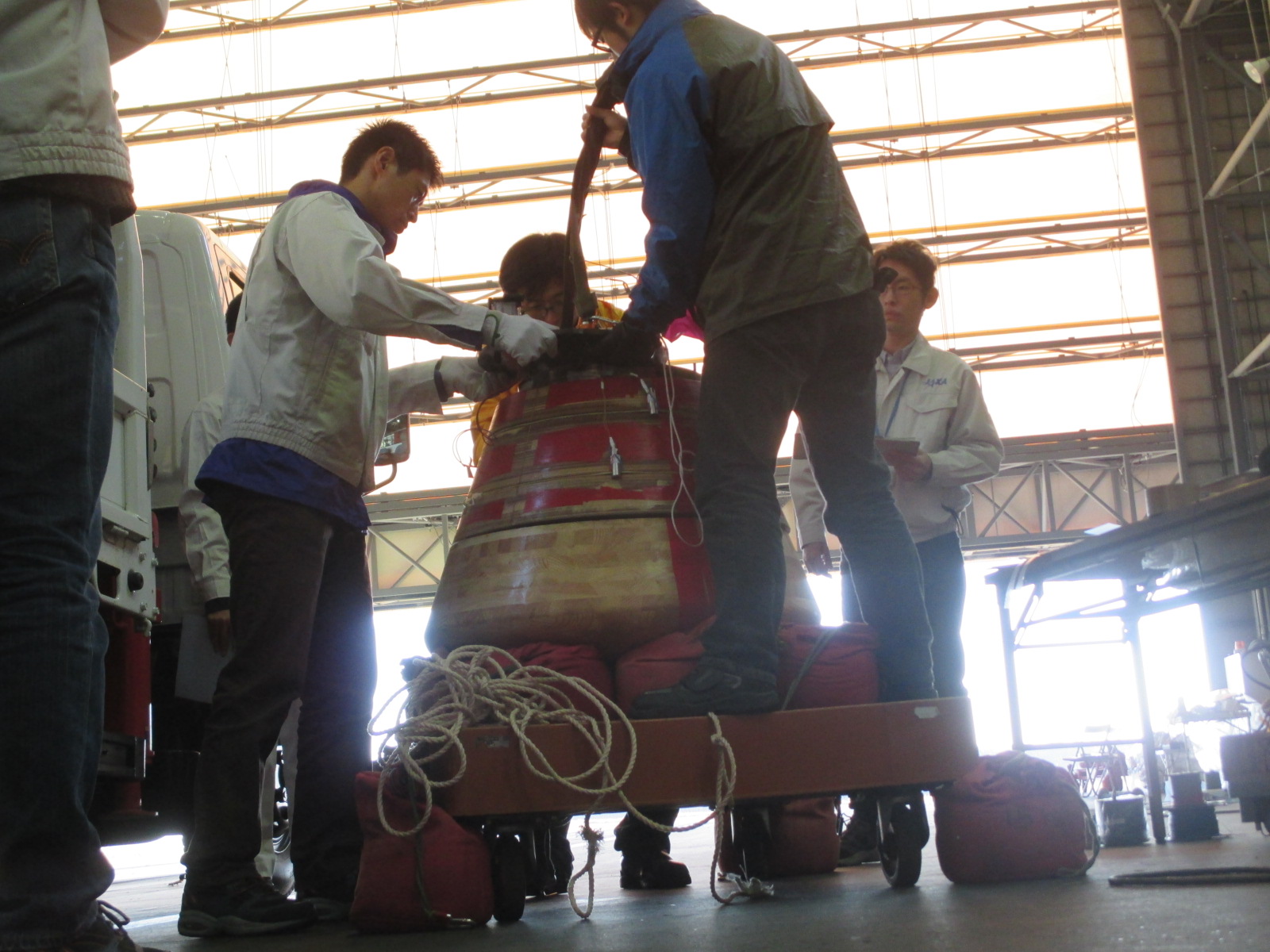
    Capsule preparation

    Capsule preparation

    Capsule preparation

    Capsule preparation

    October 22 (The test day)

    Final preparation (Taiki Aerospace Research Field in Hokkaido)

    Final preparation (Taiki Aerospace Research Field in Hokkaido)

    Final preparation (Taiki Aerospace Research Field in Hokkaido)

    Final preparation (Taiki Aerospace Research Field in Hokkaido)

    Lifting the capsule (Taiki Aerospace Research Field)

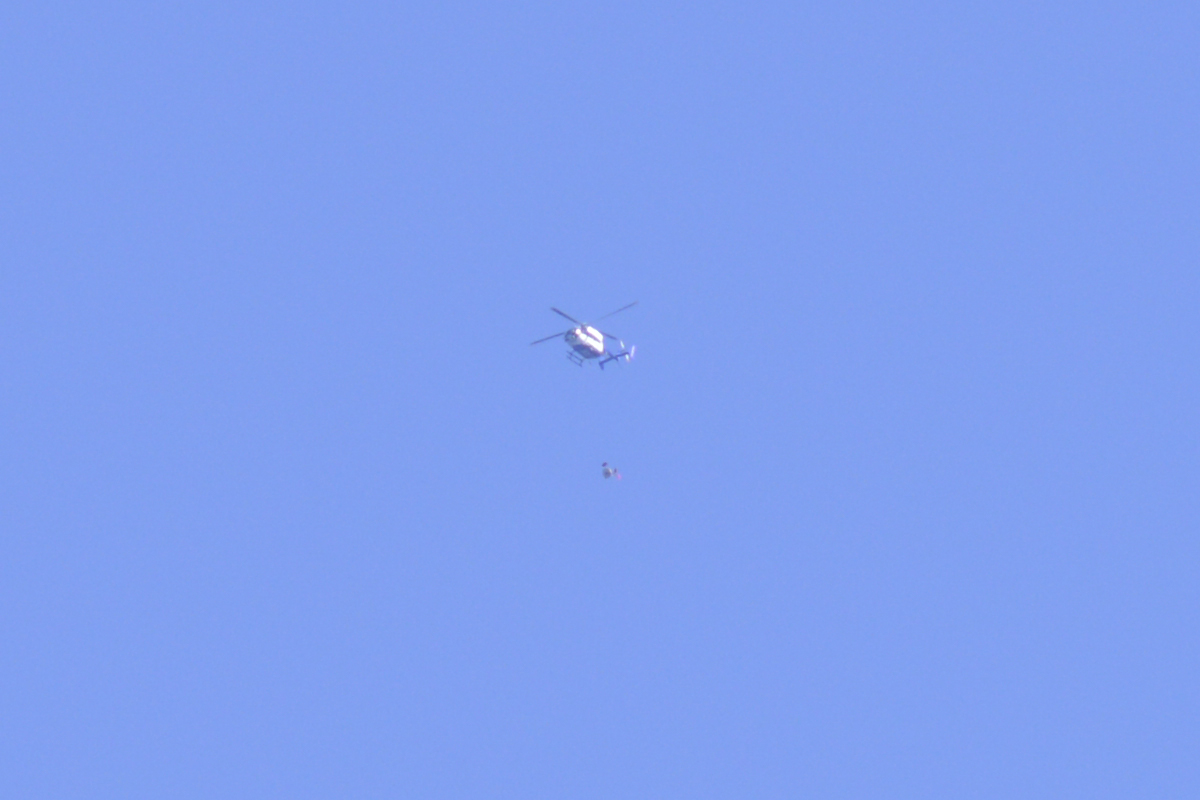
    Capsule dropped from helicopter

    Capsule dropped from helicopter

    Capsule descending with parachute

    Capsule descending with parachute

    Splashdown

    Splashdown

    Collecting the capsule

    Collecting the capsule

    (All photos courtesy of JAXA)

    *All times are Japan Standard Time (JST)

    This entry passed through the Full-Text RSS service – if this is your content and you’re reading it on someone else’s site, please read the FAQ at fivefilters.org/content-only/faq.php#publishers.

  • [Project Topics] AKATSUKI: Second attempt to enter Venus orbit

    One of the five cameras aboard the Venus Climate Orbiter “PLANET-C” is the “IR2,” whose observation target is infrared rays that are about two micron in wavelength. It aims to measure the high-temperature atmosphere of Venus under thick clouds, its movement, and distribution of its trace components. In other words, the IR2 is a camera that can see through the real surface of Venus. The IR2 is made of materials suitable for infrared ray observations (manufactured by Nikon) and its photo-taking device (element) which is equivalent to a CCD in a digital camera is made of Platinum Silicide (PtSi) element (manufactured by Mitsubishi Electric.)

    The PtSi element is one million pixels (1024 x 1024). We are very proud of its high performance, which is far superior to commercially sold digital cameras or video cameras. It can work stably in the harsh environment of space with an excellent ability to capture both dark and bright objects (dynamic range) and a very high accuracy of measurement (linearity.) Currently, one million pixels is the highest level for this type of camera.

    The PtSi detector shown in the photo is a trial piece. The one million pixel (1024 x 1024) light receiving surface is about 17 mm x 17 mm in size and attached to the IC package. We have already acquired satisfactory results for this element through a cooling evaluation test. In May 2006, we began to manufacture the prototype and flight model elements by slightly modifying the design of the trial piece.

    The “IR2” and the other onboard infrared camera, “IR1,” are the main cameras of the orbiter. Although the two cameras target different observation wavelength ranges, their elements are almost the same. In addition to the lenses and elements, the camera unit itself, equipped with a cooling device for both the IR1 and the IR2, is developed by a Japanese precision equipment manufacturer (Sumitomo Heavy Industries, Ltd.) thus they are being developed 100% domestically.

    It is not easy for Japan to challenge the space development field by itself, as Japan lags behind Western countries. Still, we believe that we can accumulate knowledge through the challenge to sophisticate our own advanced technologies and promote our cutting-edge space science. Therefore both the engineers and scientists are working together for this development.

    This entry passed through the Full-Text RSS service – if this is your content and you’re reading it on someone else’s site, please read the FAQ at fivefilters.org/content-only/faq.php#publishers.

  • [Satellites and Spacecraft] Support messages welcomed for AKATSUKI’s second bid to be injected into Venus' orbit on December 7

    Support messages welcomed for AKATSUKI’s second bid to be injected into Venus’ orbit on December 7

    The Venus Climate Orbiter “AKATSUKI” will be maneuvered again for the second time to try to be injected into the Venus orbit on December 7, 2015. The orbit of the AKATSUKI has been controlled in preparation for meeting Venus this winter. Since December 2010, the orbiter has passed the perihelion nine times. The chance this time will be the last opportunity.
    JAXA is welcoming support messages from you to the AKATSUKI itself, project personnel, and the mission. Your support is very much appreciated!

    * You can send a message through Twitter. Please tweet with the hashtag #akatsuki.

    Note: Your message may not be posted depending on the content. Thank you for your understanding.

    Post Your Comments

    This entry passed through the Full-Text RSS service – if this is your content and you’re reading it on someone else’s site, please read the FAQ at fivefilters.org/content-only/faq.php#publishers.

  • [Satellites and Spacecraft] Hayabusa2 set for Earth swing-by! Your support messages welcomed.

    Topics List

    Nov. 2, 2015 Updated
    Hayabusa2 set for Earth swing-by! Your support messages welcomed.

    The Asteroid Explorer “Hayabusa2” will fly near the Earth to perform an Earth swing-by utilizing the Earth’s gravity on Dec. 3 (Thur.) for its orbit control.
    The Hayabusa2, which soared into space on Dec. 3, 2014, will coincidentally come close to the Earth on Dec. 3 (Thur.), 2015, to conduct the Earth swing-by. The explorer will fly closest to the Earth at around 7:07 p.m. on that day (Japan Standard Time).
    After the swing-by, the Hayabusa2 will head to its target asteroid “Ryugu”. Your support for the mission will be very welcomed. We are waiting for your support messages to the explorer itself, project personnel, and the overall mission.

    Hayabusa2 set for Earth swing-by! Your support messages welcomed.

    Oct. 5, 2015 Updated
    “Ryugu” was selected as name of Hayabusa2 target asteroid

    Asteroid 1999 JU3, a target of the Asteroid Explorer “Hayabusa2,” was named “Ryugu”.
    One major reason for the selection was that, in the Japanese ancient story “Urashima Taro”, the main character, Taro Urashima, brought back a casket from the Dragon’s palace, or the “Ryugu” Castle, at the bottom of the ocean, and the theme of “bringing back a treasure” is common as the Hayabusa2 will also bring back a capsule with samples. It was selected among 7,336 entries.
    The Lincoln Near Earth Asteroid Research (LINEAR) Team of the United States, which discovered 1999 JU3, proposed the suggested name of “Ryugu” to the International Asteroid Union (IAU), and it was finalized by being listed on the Minor Planet Names: Alphabetical List of the IAU Minor Planet Center.
    Thank you very much to so many of you who took part in the naming campaign.

    “Ryugu” was selected as name of Hayabusa2 target asteroid

    Sep. 2, 2015 Updated
    Hayabusa2 additional ion engine operation for Earth swing-by

    On Sept. 1 (Tue.) and 2 (Wed.), the ion engine of the Hayabusa2 was additionally operated in order to increase the orbit control accuracy for the Earth swing-by.
    The additional jet emission was completed as scheduled, and the ion engine was operated for about 12 hours in total.
    We will analyze telemetry data (data sent from the explorer to indicate its condition) in detail to confirm the status of the engine during the operation and orbit control before and after the emission.
    Figure: Positional relation of Hayabusa2, the Earth, the Sun, and Asteroid 1999JU3 (Schematic as of Sept. 1, 2015)

    Hayabusa2 additional ion engine operation for Earth swing-by

    Jul. 22, 2015 Updated
    Naming Proposal Campaign: Become a godparent of asteroid “1999 JU3”, destination of Hayabusa2!

    JAXA is holding a naming proposal campaign to christen the asteroid “1999 JU3″,which the Hayabusa2 is scheduled to visit in June or July 2018. Why don’t you try to become a godparent of the asteroid?
    The application period is from 1:30 p.m. on July 22 thru 11:59 p.m. on August 31 (Japan Standard Time.)

    August 31, 2015 at 11:59 p.m. (Japan Standard Time). (Extended from 10:00)

    Jun. 8, 2015 Updated
    Hayabusa2 second ion engine continuous operation completed

    The Hayabusa2 has been continuously operating its ion engine for the second time since June 2, and successfully completed its operations at 0:25 a.m. on June 7 (Japan Standard Time.) The second continuous operation lasted for 102 hours as scheduled.
    The Hayabusa2 performed the ion engine continuous operation in preparation for the Earth swing-by planned in December, and the total hours of the first and second operations (409 hours and 102 hours respectively) reached 511 hours.
    The ion engine operation may be conducted again if needs arise for subtle orbit change after carefully examining the second operation result.

    Hayabusa2 second ion engine continuous operation completed

    Apr. 10, 2015 Updated
    Baton pass to new Hayabusa2 project manager

    The Hayabusa2 is stably flying in space. The new fiscal year has just started in Japan, and JAXA is taking a new step as we became a National Research and Development Agency from the previous independent administrative agency. The Hayabusa2 project is also taking a fresh step with a new team, including handing the baton over to a new project manager. All members of the project are engaged in the mission with a fresh mindset.

    Message from New Project Manager Yuichi Tsuda

    The Hayabusa2 is stably flying since its launch and smoothly continuing it interplanetary cruising. I can, therefore, take over the mission at the best condition from my predecessor, former Project Manager Hitoshi Kuninaka, who led the development of the project. With many operation experts joining the new team, we would like to successfully send the Hayabusa2 to the asteroid 1999JU3, and have it come home safely.
    The Hayabusa2 mission is challenging an unexplored field. We would like to contribute to enhancing the value of technology, science and space exploration through our accomplishments in traveling through the solar system in this six-year mission.

    Message from Former Project Manager Hitoshi Kuninaka

    As the development phase is over, Hayabusa2’s deep space exploration has started.
    At the beginning of this fiscal year, a multiple number of our project members including myself were subject to personnel changes. Our team worked well with good team spirit to tackle and overcome various obstacles and difficulties. Therefore, I felt a bit disappointed to see part of the team was shuffled. Having said that, those who remain in the team as well as the leaving members vow to work hard and do our best using our expertise in space projects no matter what department we are assigned to. Your continued support for the Hayabusa2 is very much appreciated.

    Photo: left: New Project Manager Yuichi Tsuda, right: Former Project Manager Hitoshi Kuninaka

    Baton pass to new Hayabusa2 project manager

    Mar. 5, 2015 Updated
    Hayabusa2 initial functional confirmation completed and moved to cruising phase to asteroid

    The Asteroid Explorer “Hayabusa2,” launched on Dec. 3, 2014, completed its initial functional confirmation period of about three months. The explorer was moving to the cruising phase on March 3 while heading to the asteroid “1999 JU3.”
    The Hayabusa2 is in good health. It will be under preparatory operation including speed increase by continuous operation of the ion engines for an Earth swing-by scheduled in Nov. or Dec., 2015.

    Hayabusa2 initial functional confirmation completed and moved to cruising phase to asteroid

    Feb. 3, 2015 Updated
    Hayabusa2 in great shape – Initial functional confirmation going smoothly

    The Hayabusa2, launched on Dec. 3, 2014 (JST), is now undergoing the initial functional confirmation. Basic operations and performance of onboard instruments and ground systems have been tested one by one as of the end of January.
    Here are some major examples of what we confirmed.

    1. Ion engine test operation (one unit at a time)
      Four ion engines were being operated one by one. A thrust of 7-10 mN was generated on the orbit for the first time.
    2. Establishing communication by Ka band communication equipment (Between Jan. 5 to 10, 2015)
      Communication was successful between the Hayabusa2 and NASA DSN stations to establish deep-space Ka-band communication for the first time for a Japanese space explorer. Ka-band communication will be used to send observation data during the mission for the Hayabusa2 to stay near the asteroid.
    3. Ion engine can autonomously operate for 24 hours.
      Long duration of autonomous operation (*1) with two or three ion engines was tested, and 24-hour continuous operation was attained.
      The maximum thrust was confirmed to be about 28 mN, which is the expected value.

    The explorer is currently in good shape.
    We will further confirm the coordinated function of multiple instruments of the Hayabusa2, and plan to move to the cruise operation phase (*2) sometime in March.

    *1 The autonomous operation is automatic control of an engine without instructions from the ground.
    *2 The mode of full-scale navigation operation toward the asteroid through acceleration and orbit control by ion engine thrust.

    Hayabusa2 in great shape – Initial functional confirmation going smoothly

    Dec. 5, 2014 Updated
    Hayabusa2 flying smoothly!

    JAXA confirmed the completion of a sequence of the important operations for the “Hayabusa2” mission. With this confirmation, the critical operation phase* of the Hayabusa2 was completed.
    The explorer is now in a stable condition.

    We would like to express our sincere appreciation to all parties and personnel concerned for their support and cooperation with the Hayabusa2 launch and tracking control operations.
    In addition, we would also like to ask for your continued cooperation and support for the long-term Hayabusa2 space exploration mission.

    Please send your support messages for the mission! (you can send a message from Hayabusa2 Project page or tweet with hashtag #hayabusa2).

    Hayabusa2 flying smoothly!

    Dec. 3, 2014 Updated
    “Hayabusa2” successfully launched!

    H-IIA F26 with the Asteroid Explorer “Hayabusa2” onboard launched at 1:22:04 p.m. on Dec 3, 2014 (JST) from the Tanegashima Space Center.
    The rocket flew smoothly, and, at about approximately one hour, 47 minutes and 21 seconds after liftoff, “Hayabusa2” was separated from the H-IIA F26. We will update you with the latest information on the “Hayabusa2” on the project page.
    Please send your support messages for the mission! (you can send a message from Hayabusa2 Project page or tweet with hashtag #hayabusa2).

    Nov. 30, 2014 Updated
    “Hayabusa2” Launch rescheduled to 1:22:04 p.m. on December 3 (Mon.) 2014

    Mitsubishi Heavy Industries, Ltd. and JAXA have decided to postpone the launch of “Hayabusa2” and piggyback payloads by the H-IIA F26 to 1:22:04 p.m. on Dec 3 (Wed. JST).

    The live launch report will begin at 12:25 p.m. on December 3 (Mon. , JST). The report will be broadcast through the Internet.
    Please send your support messages for the mission! (you can send a message from Hayabusa2 Project page or tweet with hashtag #hayabusa2).

    We decided to postpone as a result of the go/no go decision meeting today which carefully checked the weather forecast and found that strong wind exceeding the weather restrictions was projected around the launch pad at the scheduled launch time on the previous schedule launch day of Dec. 1 (Mon.), 2014.
    *The launch may be delayed further depending on weather conditions and other factors.

    Nov. 29, 2014 Updated
    “Hayabusa2” Launch rescheduled to 1:22:43 p.m. on December 1 (Mon.) 2014

    The launch of the Asteroid Explorer “Hayabusa2” and three micro piggyback payloads by the H-IIA Launch Vehicle No. 26 was rescheduled at 1:22:43 p.m. on December 1 (Mon. Japan Standard Time, JST) after carefully studying the weather conditions.
    Accordingly, the live launch report will begin at 12:25 p.m. on December 1 (Mon. , JST). The report will be broadcast through the Internet.
    Please send your support messages for the mission, or tweet it including the hashtag #hayabusa2.

    Nov. 28, 2014 Updated
    Hayabusa2 launch postponement

    H-IIA Launch Vehicle No.26 with the Asteroid Explorer “Hayabusa2” onboard has been rescheduled as clouds including a freezing layer that exceeds the restrictions for suitable weather are forecast to be generated at around the scheduled launch time on November 30 (Sun.), 2014 (Japan Standard Time.)
    The new launch day will be announced as soon as it is determined.

    Hayabusa2 launch postponement

    Nov. 27, 2014 Updated
    New movie “Ready to Face New Challenges -Hayabusa2- “

    The new video clip titled “Ready to Face New Challenges -Hayabusa2- ” was uploaded to the YouTube.
    It has been four years since the Hayabusa’s dramatic return from space,bringing back the world’s first samples from an asteroid. To further clarify the mystery of the origin and evolution of human beings, the Hayabusa2 is leaving for space. This video explains the special features and significance of the Hayabusa2 mission in an easy and simple manner.

    Nov. 4, 2014 Updated
    “Hayabusa2″ Launch Live Broadcast (by H-IIA F26)

    JAXA will broadcast a live report of the Asteroid Explorer Hayabusa2’s launch by the H-IIA Launch Vehicle No.26 (H-IIA F26) from the Tanegashima Space Center. The report will cover launch events from the liftoff to the payload separation from the launch vehicle.

    Program summary

    The broadcast program consists of two parts. The first half mainly focuses on launch events prior to and after liftoff. Then the latter half covers events before and after the Hayabusa2’s separation from the launch vehicle.

    *Please be aware that the time schedule of the program is subject to change due to progress of the launch operations.

    Program contents

    Part I
    Prior and after liftoff of H-IIA F26/Hayabusa2

    • Introduction of the Hayabusa2 mission including a VTR of its preparation operation
    • Introduction of piggyback payloads
    • Live launch report from the control room

    *The scheduled launch time is 1:24 p.m.

    Part I broadcast day and time
    12:30 p.m. thru 1:45 p.m. (75 minutes) on Nov. 30 (Sun.)

    • Prior to and after the Hayabusa2’s separation from the launch vehicle

    * Images of piggyback payloads’ separation will NOT be broadcast.
    * Hayabusa2’s separation is scheduled to take place one hour and 47 minutes after liftoff.

    Part II broadcast day and time
    3:00 p.m. to 3:30 p.m. (30 minutes) on Nov. 30 (Sun.)

    Internet live broadcast

    JAXA will distribute our live report through the following Internet channels.

    * The copyright of the live broadcast belongs to JAXA.
    * Please be aware that a slight time lag up to a few minutes may occur due to the Internet’s characteristics.

    We are welcoming support messages at the special site. Please send your messages for the mission, or tweet it. To tweet on Twitter, please attach the hashtag, #hayabusa2.
    Click the following link to send a message to JAXA.

    “Hayabusa2

    Sep. 30, 2014 Updated
    New voyager to travel deep into space! Hayabusa2 to be launched on Nov. 30

    The launch date and time for the H-IIA Launch Vehicle No. 26 (H-IIA F26) with the Asteroid Explorer “Hayabusa2” onboard was decided to be at 1:24:48 p.m. on November 30 (Sunday), 2014 (Japan Standard Time)*.
    Launch site is Yoshinobu Launch Complex at the Tanegashima Space Center.
    * Launch time will be set for each launch day if the launch is delayed.

    The latest information about “Hayabusa2” and its launch preparation status will be updated on the “Hayabusa2” project page.
    We welcome your support message for the Hayabusa2.
    Please send your support messages for the mission, or tweet it including the hashtag #hayabusa2.

    New voyager to travel deep into space! Hayabusa2 to be launched on Nov. 30

    Sep. 5, 2014 Updated
    Hayabusa2 revealed to the media

    The Asteroid Explorer “Hayabusa2” was shown to the media at Sagamihara Campus on August 31, 2014.

    The Hayabusa2 is the successor of the Hayabusa, which captured sample particles from an asteroid and returned to the Earth in 2010. By capitalizing on the experience of the Hayabusa, the Hayabusa2 aims at acquiring samples and bringing them back from the C-type asteroid “1999JU3” to elucidate the origin and evolution of the solar system and material for life.

    “I am bracing for the new voyage of the Hayabusa2.” said Project Manager Kuninaka.
    The Hayabusa2 will be transferred to the Tanegashima Space Center for its launch in this winter after its final check there.

    Hayabusa2 revealed to the media

    Nov. 20, 2013 Updated
    Hayabusa2 Small Carry-on Impactor undergoes test

    Hayabusa2’s Small Carry-on Impactor (SCI) underwent a test in October, 2013.
    The SCI is a device to create an artificial crater of the asteroid 1999JU3, which the Hayabusa 2 will travel toward. By making and observing an artificial crater, we can acquire data not only about the surface but also about the inside of the asteroid. In addition, by sampling near the crater, we can collect inside samples of the asteroid.
    Hayabusa2 applies a method to throw a metal projectile against the asteroid with high speed to create an artificial crater. Through the test this time, we confirmed the accelerating part of the projectile while aiming to verify if its speed, configuration, and thrown direction precision met the design when the pyrotechnics, which were comparable to those of actual ones for the flight, were ignited to set off the projectile.
    The test results were very impressive as the speed and configuration were almost as designed, and the direction precision was also good as the SCI precisely hit a target that was 100 meters away. We were able to successfully complete the performance confirmation test of the SCI pyrotechnic part.

    Hayabusa2 SCI test [JAXA Digital Archives]

    Hayabusa2 Small Carry-on Impactor undergoes test

    Jul. 17, 2013 Updated
    Campaign extended till August 9 (Fri.)!
    – Let’s attach your name and message to Hayabusa2 –

    JAXA has been conducting a campaign to attach names and messages of Hayabusa2 mission supporters from all over the world to the space probe! We would love to share this superb moment and feeling of achievement with you through this campaign.

    We would like to express our sincere appreciation to all of you who joined the campaign since it began on April 10 till today. Also we appreciate your cooperation for registering or sending your names and messages on time. Thank you very much.

    As we read the support messages for the Hayabusa2, we strongly felt that we would like to support this mission by being united with more of you.
    Luckily, the Hayabusa2 manufacturing schedule has allowed us to extend the campaign period!

    We are looking forward to hearing from more of you as an individual and/or as a community such as a family, a school or a company, and/or with your friends!

    With the Hayabusa2
    Let’s go to asteroid 1999 JU3, and return to Earth

    Jun. 14, 2013 Updated
    Hayabusa2 completes first integration test

    All processes of the Hayabusa2’s first integration test since January this year were completed on June 7. The test aimed at installing all onboard devices onto the satellite structure and confirming interfaces among them. During the mass property measurement, the last process of the integration test, the “Hayabusa2” exposed its full shape for the first time with all devices for the test installed.
    We will remove each device from the main body of the Hayabusa2, then the devices will be given their final touches. They will be tested again and assembled again to the explorer for the next-phase test. All the project team members will do our best as we have done to steadily implement the Hayabusa2 project.

    Mar. 29, 2013 Updated
    Hayabusa2 can carry your names and messages to space

    JAXA is holding a campaign to record your names, messages and illustrations onboard the asteroid probe Hayabusa2.
    Hayabusa2 is scheduled to be launched by the H-IIA launch vehicle in FY2014, then arrive at an asteroid in 2018 and investigate it for about one and half years, before returning to the earth in 2020.
    The campaign will start from April 10. We welcome your participation!

    Dec. 27, 2012 Updated
    Hayabusa2 revealed before the first integration test

    On Dec. 26, the Hayabusa2 was revealed at the Sagamihara Campus. As its design was completed this spring, the Hayabusa2 will soon undergo the first integration test to confirm the interfaces among onboard devices as well as between the devices and the explorer’s bus after assembling them onto the bus. Also, the flight models of the Hayabusa2’s main body and solar array paddles have already been manufactured, thus those models will be verified through a vibration test. In addition, the exposed environment for the onboard devices will also be measured. JAXA is developing the Hayabusa2 to be ready for its launch in FY2014.

    This entry passed through the Full-Text RSS service – if this is your content and you’re reading it on someone else’s site, please read the FAQ at fivefilters.org/content-only/faq.php#publishers.

  • [Project Topics] Release of the JAXA Realtime Rainfall Watch

    Topics List

    Nov. 2, 2015 Updated
    Release of the JAXA Realtime Rainfall Watch

    Earth Observation Research Center (EORC) of Japan Aerospace Exploration Agency (JAXA) has developed GSMaP realtime version (GSMaP_NOW) providing rainfall information of current hour, and released those information through a new webpage “JAXA Realtime Rainfall Watch”.
    While GSMaP near-real-time version (GSMaP_NRT) is provided with 4-hour data latency, which consists of 3-hour for data gathering and 1-hour for processing, GSMaP_NOW is provided in quasi-realtime and updated every half-hour. For example, hourly GSMaP_NOW image and data during 0930Z and 1029Z is available at around 1030Z through the web site.

    Release of the JAXA Realtime Rainfall Watch

    Sep. 2, 2014 Updated
    GPM providing 3D precipitation data

    Data acquired by the GPM Core Observatory, the JAXA/NASA joint development mission, has been provided to the public since Sept. 2.
    The observatory was subjected to calibration operations to improve its data accuracy, and as the operations were completed, the acquired “GPM products”are now available for public users through the online Earth observation satellite data provision system called “Global Portal System,” or“G-Portal.”
    GPM products contribute to more accurate understanding of global precipitation including rain and snow to be utilized for improving weather forecast precision and prediction of typhoon paths through data assimilation among world meteorological organizations including the Japan Meteorological Agency. They are also expected to be useful for preparations for floods in Asian countries.

    GPM providing 3D precipitation data

    Mar. 25, 2014 Updated
    First Images Available from JAXA-NASA Global Rain and Snowfall Satellite

    JAXA and the NASA have released the first images captured by their newest Earth-observing satellite, GPM Core Observatory, which launched into space Feb. 28 (JST).

    The images show precipitation falling inside a March 10 cyclone over the northwest Pacific Ocean, east of Japan. The data were collected by the GPM Core Observatory’s two instruments: JAXA’s Dual-frequency Precipitation Radar (DPR), which imaged a three-dimensional cross-section of the storm; and, NASA’s GPM Microwave Imager (GMI), which observed precipitation across a broad swath.

    First Images Available from JAXA-NASA Global Rain and Snowfall Satellite

    Feb. 28, 2014 Updated
    Successful launch of H-IIA F23 with GPM core ovservatory aboard!

    The launch of the H-IIA Launch Vehicle No. 23 with the core observatory for the Global Precipitation Measurement mission aboard was successfully performed at 3:37 a.m. on February 28 (Fri.) 2014 (JST).
    The launch vehicle flew normally and separated the GPM core observatory at about 15 minutes and 57 seconds after liftoff. The GPM core observatory will conduct critical phase operations.
    We await your support messages!

    Successful launch of H-IIA F23 with GPM core ovservatory aboard!

    Jan. 17, 2014 Updated
    GPM core observatory revealed to the media

    On January 17 (Fri.), the GPM core observatory was shown to the media in the Spacecraft Test and Assembly Building 2 (STA2) at the Tanegashima Space Center (TNSC).
    The observatory was transported to the TNSC from the U.S. on Nov. 27, and its launch preparations at the launch site will continue ahead of its departure to space sometime between 3:07 a.m. and 5:07 a.m. on February 28 by the H-IIA Launch Vehicle No. 23.
    Updated information about the preparation status in a timely manner is available on the GPM/DPR special site. Your continued support is appreciated!

    GPM core observatory revealed to the media

    Dec. 26, 2013 Updated
    Launch date set for GPM/DPR on H-IIA F23! Special site now available!

    The launch date and time for the H-IIA Launch Vehicle No. 23 (H-IIA F23) withThe core observatory for the Global Precipitation Measurement mission onboard was decided to be at around 3:07 a.m. thru 5:07 a.m. (JST) on February 28 (Fri.,) 2014.
    We opened a special site for the GPM/DPR, please have a look!

    Nov. 29, 2013 Updated
    GPM core observatory arrived at TNSC!

    The core observatory for the Global Precipitation Measurement mission, which arrived at Kitakyushu Airport at 12:28 p.m. on Nov. 24 (Sun.) from the NASA Goddard Space Flight Center, was then transported via sea and land to the Spacecraft Test and Assembly Building 2 at the Tanegashima Space Center at 2:24 a.m. on the 27th (Wed.)
    The observatory arrived at Shimama Port in Tanegashima by cargo ship on the evening of the 26th, then its transportation to the TNSC begun at midnight. A skilled transportation team slowly and carefully moved the observatory to the center at a speed of about 15 km/hour.

    Nov. 25, 2013 Updated
    GPM core observatory jointly developed by JAXA and NASA arrived in Japan!

    The core observatory for the Global Precipitation Measurement (GPM) mission arrived at Kitakyushu Airport in Japan from the NASA Goddard Space Flight Center in the U.S.A. about 12:28 p.m. on Nov. 24 (Sun.) The GPM core observatory was jointly developed by JAXA and NASA. After arrival at the airport, the satellite was then transported to the Tanegashima Space Center by cargo ship for launch by the H-IIA Launch Vehicle. Its arrival here was originally scheduled for the 22nd, but it was delayed for two days due to bad weather in Alaska, where the cargo plane stopped for refueling.

    The GPM mission is a joint international project to observe global precipitation conditions quite frequently and accurately by combining the core observatory and a consternation of some eight satellites. The GPM mission will begin on a full scale when the core observatory, which came to Japan today, is launched, and it will become useful in many ways for our daily life including global-scale water resource control, damage mitigation for water-related disasters such as typhoons and floods, and weather forecasting accuracy improvement.

    The Dual-frequency Precipitation Radar (DPR) aboard the GPM core observatory developed by JAXA is one of the cutting-edge observation devices developed in Japan. It enables three-dimensional observations of rain with high sensitivity.

    Apr. 9, 2013 Updated
    Global Precipitation Measurement Live Event Ask JAXA and NASA!

    The Global Precipitation Measurement (GPM) main satellite has been jointly developed by JAXA and NASA, and is scheduled to be launched in JFY 2013.
    To facilitate a greater understanding on this mission, NASA will hold a live event where NASA and JAXA project managers and researchers will answer your questions. The questions will be asked through Twitter. You can send questions from Japan with the hashtag “#askJAXA”. Your participation is very welcomed! (Image: NASA/Goddard Space Flight Center Conceptual Image Lab)

    [Event Information]
    You can watch the live broadcast on NASA TV in English.

    Live broadcast NASA TV Educational Channel
    NASA Cherry Blossom Social – GSFC * (Education Channel)
    Broadcast schedule From 11:00 p.m. on April 12 (Fri.) to 0:30 a.m. on April 13 (Sat.) (Japan Standard Time)
    Or
    From 10:00 a.m. to 11:30 a.m. on April 12 (Fri.) (Eastern Daylight Time)
    Event Host NASA

    [How to ask questions]

    • Follow JAXA twitter account “@satellite_jaxa”.
    • Questions will be accepted during the live broadcast. Tweet your question about GPM or DPR with the hashtag “#askJAXA”. Questions can be in the Japanese language.
    • The questions that are addressed during the live event will also be published in Japanese on JAXA’s Satellite Applications Mission Directorate I Twitter :: (@satellite_jaxa).
    • Please be aware that we may not be able to answer all questions due to time constraints.

    [Other remarks]

    • If you do not have a Twitter account, please get one before participating in the event.
    • If you have any inquiries about Twitter, please directly ask them to the Twitter site. JAXA cannot answer such inquiries.

    Jun. 6, 2012 Updated
    The integration of the DPR was successfully completed

    The integration of the Dual-frequency Precipitation Radar (DPR) onto the Global Precipitation Measurement (GPM) Core Observatory was successfully completed in May 2012.

    This DPR is expected to be much more versatile than the TRMM precipitation radar (also provided by JAXA) and these two are the only radar instruments currently dedicated to precipitation measurements from space. The data obtained by the DPR along with that of the NASA GPM Microwave Imager (GMI), also flown on the Core Spacecraft, will be used as a calibration standard for rainfall estimation from the GPM constellation satellites. The GPM mission will enable global measurement of precipitation every three hours.


    Two box- type instruments are DPR (C)NASA

    Silver colored instrument on upper side is GMI made by NASA (C)NASA

    Apr. 2, 2012 Updated
    DPR Delivered to NASA

    Dual-frequency Precipitation Radar (DPR) that will be installed on the core satellite of the Global Precipitation Measurement (GPM) mission was delivered to NASA’s Goddard Space Flight Center (GSFC), Greenbelt, MD on March 30.
    Following installation of the DPR on the GPM Core Spacecraft, NASA will perform the spacecraft system testing at GSFC, and then be shipped to Japan for launch by the H-IIA launch vehicle in FY2013.
    This DPR is expected to be much more versatile than the TRMM precipitation radar (also provided by JAXA) and these two are the only radar instruments currently dedicated to precipitation measurements from space. The data obtained by the DPR along with that of the NASA GPM Microwave Imager (GMI), also flown on the Core Spacecraft, will be used as a calibration standard for rainfall estimation from the GPM constellation satellites. The GPM mission will enable global measurement of precipitation every three hours.
    (Top photo: DPR arrived at NASA Goddard Space Center / Bottom: Signing ceremony for delivery / Photos by NASA)

    Feb. 10, 2012 Updated
    Dual-frequency precipitation radar (DPR) released to the media

    On Feb. 9, JAXA unveiled the dual frequency precipitation radar (DPR), which will be onboard the main satellite for the Global Precipitation Measurement (GPM) project.
    A press conference was also held on the same day, and project personnel not only from JAXA, but also from the National Institute of Information and Communications Technology (NICT) and NASA explained the outline of the DPR and GPM main satellite. They also described possible contributions from the GPM project to research elucidating climate and water circulation changes, improving weather forecast accuracy, and use in damage preparation caused by water and wind such as floods.
    The DPR will be transferred to NASA to be aboard the GPM main satellite, then the satellite will be launched by the H-IIA Launch Vehicle from the Tanegashima Space Center.

    Sep. 7, 2011 Updated
    Logo for GPM dual-frequency precipitation radar selected

    JAXA has decided on the logo mark for the dual-frequency precipitation radar (DPR) aboard the main satellite of the Global Precipitation Measurement (GPM) project.
    As an international program, the GPM project has been led by Japan and the U.S. to observe global precipitation (such as rain and snow). JAXA is developing the DPR with the National Institute of Information and Communications Technology (NICT.)
    The DPR, a high-performance precipitation measurement device, will be aboard the GPM main satellite to be launched by the H-IIA launch vehicle. Once it arrives in space, the radar is expected to contribute to compiling a high-precision global precipitation map.
    The DPR, which has been tested at the Tsukuba Space Center, will be transported to a NASA facility to be combined with the part developed by NASA.

    Jun. 30, 2011 Updated
    Integration test of the dual-frequency precipitation radar with KuPR and KaPR

    The dual-frequency precipitation radar (DPR) for the Global Precipitation Measurement (GPM) project has been under development. The DPR will be loaded onto the main satellite of the GPM project, which aims to broaden observation coverage to a higher latitude compared to the Tropical Rainfall Measuring Mission. The DPR is equipped with two different frequency radars of Ku-band and Ka-band (KuPR and KaPR,) and it can observe light rain, pouring rain and snow simultaneously.
    KuPR-KaPR co-operation test on May 25th, using a protoflight model, confirmed combined operations of the two radars which consist of the DPR at the electromagnetic shield room for the electromagnetic compatibility test in the Satellite Test Building Radiometer Ion Test Laboratory at the Tsukuba Space Center.

    Aug. 3, 2009 Updated
    Memorandum of Understanding with NASA for cooperation in GPM Project

    JAXA and NASA signed a Memorandum of Understanding (MOU) on development and operation activities for the Global Precipitation Measurement (GPM) project to measure precipitation (such as rain and snow) using a multiple number of satellites on July 31, 2009 (Japan Standard Time). With this MOU, the two organizations will further deepen the cooperative relationship and exercise comprehensive leadership utilizing the research and development ability and personnel of the two parties.

    Mar. 18, 2009 Updated
    Vibration test of the DPR thermal/structural models

    Development of the Dual-frequency Precipitation Radar (DPR), which will be installed in the Global Precipitation Measurement (GPM) satellite, has been underway. The DPR is composed of two radars with two different frequencies (KuPR and KaPR) to precisely measure light rain, heavy rain and snow at the same time. We are carrying out environment tests using the DPR thermal and structural models at the Tsukuba Space Center. The photo shows the vibration test on the Ku-band radar model.

    Oct. 17, 2008 Updated
    Testing the KuPR Radar Engineering Model

    Development of the Dual-frequency Precipitation Radar (DPR) that will be installed in the Global Precipitation Measurement (GPM) satellite has been underway. The DPR is composed of two antennas with two different frequencies (KuPR and KaPR) to precisely measure light rain, heavy rain and snow at the same time. We are carrying out the antenna pattern measurement and radar operation verification for the Ku band radar by using its engineering model at the Radio Test Building at the TKSC.

    Apr. 30, 2002 Updated

    The Global Precipitation Measurement (GPM) concept was based on TRMM`s achievements, and this concept is currently being studied. The GPM satellites consist of a TRMM-type primary satellite that carries a radar and a microwave radiometer and a fleet of constellation satellites that carry microwave radiometers. The primary satellite plans to go to higher latitudes than TRMM to extend the coverage. The constellation satellites will measure precipitation frequently and globally. GPM is currently planned to start operating in 2007-2008 timeframe. The primary satellite is planned to carry a Dual-frequency Precipitation Radar (DPR) and a microwave radiometer. The combination of these two instruments will improve the accuracy of rainfall measurement and also realize snowfall observation, especially at higher latitudes. The 2nd GPM International Planning Workshop will be held from 20th (Mon.) through 22nd (Wed.) May 2002 at the Shinagawa Prince Hotel in Tokyo. The National Space Development Agency of Japan (NASDA), the Communications Research Laboratory (CRL) and the U.S. National Aeronautics and Space Administration (NASA) will co-host this workshop. Please see more details here.

    The 2nd GPM International Planning Workshop

    This entry passed through the Full-Text RSS service – if this is your content and you’re reading it on someone else’s site, please read the FAQ at fivefilters.org/content-only/faq.php#publishers.

  • [Earth Observation Research Center (EORC)] Seen from Space – Release of the JAXA Realtime Rainfall Watch

    Earth Observation Research Center (EORC) of Japan Aerospace Exploration Agency (JAXA) has developed GSMaP* realtime version (GSMaP_NOW) providing current rainfall information over the JMA’s geostationary satellite “Himawari” observation area, and released those information through a new webpage “JAXA Realtime Rainfall Watch” (Figure 1).

    GSMaP (Global Satellite Mapping of Precipitation) is a satellite-based global rainfall map that combines rainfall estimates by multi microwave radiometers and estimates of movement of rainy areas by geostationary satellites’ Infrared imagers. JAXA has provided images and data of the GSMaP near-real-time version 4-hour after observation through the web site “JAXA Global Rainfall Watch”. GSMaP is also one of the JAXA standard products of the Global Precipitation Measurement (GPM) mission since September 2014.
    GSMaP near-real-time version (GSMaP_NRT) spends 3-hour for satellite data collection and 1-hour for data processing, so it enables to provide data 4-hour after observation. This processing scheme was set as trade-off between collection of more observation data to assure data accuracy and shorter data latency to expand data utilization capability. However, as number of the GSMaP_NRT user increases, it is about 1,600 registered users as of September 2015, and application fields of GSMaP_NRT expands, there are more requests from meteorological agencies in Asian countries and flood alert communities to shorten data latency of GSMaP_NRT.
    To response these requests, we developed GSMaP_NOW product, which estimate “quasi-realtime” rainfall information, by shortening data collection period to half-hour and extrapolating rainfall map half-hour toward future direction by using cloud moving vector from IR imager of the geostationary satellite. Since we can only use data that is available within half-hour, input data is GPM/GMI, GCOM-W/AMSR2 direct receiving data, NOAA and MetOp’s AMSU direct receiving data, and IR imager data onboard the geostationary satellite “Himawari-8”. GSMaP_NOW provides hourly rainfall in 0.1 degree grid and updated half-hourly. For example, hourly GSMaP_NOW image and data during 0930Z and 1029Z is available at around 1030Z through the web site.
    Since GSMaP_NOW uses less passive microwave radiometer data as input compared to that of GSMaP_NRT, its data accuracy tends to be worse qualitatively. Verification of GSMaP_NOW with JMA’s gauge-calibrated radar analysis (Radar-AMeDAS) in daily and 0.25-degree grid basis shows result that RMSE and correlation coefficient are 0.20 mm/h and 0.59, respectively, for the period from October 3 to 20, 2015. For the same period, those of GSMaP_NRT are 0.19 mm/h and 0.65, and accuracy of GSMaP_NOW is almost comparable to or slightly less than that of GSMaP_NRT.
    This quasi-realtime capability will provide possibility to operational users to apply the GSMaP_NOW data in their rainfall monitoring more rapidly, flood alert in smaller river basins lead time from raining to flood is shorter. Extension of GSMaP_NOW from “Himawari” area to the other geostationary satellites’ observation areas is also under consideration for future improvements.


    Explanation of the Images:

    (Fig.1)

    Satellite: Global Precipitation Measurement (GPM) Core Observatory
    Global Change Observation Mission – Water “SHIZUKU” (GCOM-W)
    MetOP Satellite series
    NOAA Satellite series
    Himawari-8
    Sensor: GPM Microwave Imager(GMI)
    Advanced Microwave Scanning Radiometer 2(AMSR2)
    Advanced Microwave Sounding Unit/Microwave Humidity Sounder(AMSU/MHS)
    Advanced Microwave Sounding Unit/Microwave Humidity Sounder(AMSU/MHS)
    Advanced Himawari Imager(AHI)
    Date: 09:00-09:59JST on Nov. 02, 2015
    00:00-00:59UTC on Nov. 02, 2015

    Related Sites:

    This entry passed through the Full-Text RSS service – if this is your content and you’re reading it on someone else’s site, please read the FAQ at fivefilters.org/content-only/faq.php#publishers.

  • [Aeronautical Technology Directorate] [PR brochure] JAXA Aeronautics Magazine "FLIGHT PATH" No.9/10

    Featuring hot topics at the Aeronautical Technology Directorate, our quarterly magazine “FLIGHT PATH” introduces JAXA’s R&D activities in aeronautical field with plain articles.
    (English version issued twice a year in March and October)

    Latest issue: No.9/10 | 2015 AUTUMN

    Main contents

    Feature Stories

    • JAXA Aeronautics at the heart of “all-Japan” R&D landscape
    • D-SEND#2 Successful flight
    • Flight system technology for making aircraft safer and more familiar

    Research and development

    • Supporting Japan’s aircraft engine technology with JAXA’s engine test facilities and measurement technologies
    • JAXA’s electric aircraft!

    “FLIGHT PATH” back numbers

    Archives

    This entry passed through the Full-Text RSS service – if this is your content and you’re reading it on someone else’s site, please read the FAQ at fivefilters.org/content-only/faq.php#publishers.

  • [Institute of Space and Astronautical Science (ISAS)] ACT-ISAS Team Wins the “America’s Cup” of Rocket Science

    NASA’s Jet Propulsion Laboratory (JPL) announced the winner of the 8th edition of the Global Trajectory Optimization Competition (GTOC), and ACT-ISAS team won this year’s first place. The ACT-ISAS team was born as collaboration between ESA (European Space Agency) and ISAS (Institute of Space and Astronautical Science of Japan), including former ESA’s Advanced Concepts Team (ACT) members now working at ISAS.

    The competition is also known as the America’s Cup of rocket science for its prestige and its rules on the organization. The Global Trajectory Optimization Competition is an event taking place every one-two years over roughly one month during which the best aerospace engineers and mathematicians world wide challenge themselves to solve a “nearly-impossible” problem of interplanetary trajectory design.

    The problem needs to be related to interplanetary trajectory design and its complexity high enough to ensure a clear competition winner.

    The problem is released by the winning team of the previous edition which this time was JPL.

    The challenge for this time is to observe objects from the given 420 of radio sources as many as possible in the best condition: Each observation is carried out when the normal direction of a virtual surface created by the three spacecraft directs towards the specific target and the surface area at the observation is used as an index of the observation condition. The spacecraft would observe the sources using an astronomical technique called ‘very-long-baseline interferometry (VLBI)’ – by precisely combining their separate observations through long-distance formation-flying they can acquire an equivalent imaging resolution to a single giant radio telescope.

    In order to achieve this they have to be lined up along a plane and pointed at the radio source, and to save scarce propellant, lunar gravity assists and low-thrust propulsion had to be used to perform each manoeuvre.

    Thirty-six teams registered for this edition of the competition, including teams from the United States, China, Europe, Brazil and India (team list). Seventeen teams returned a solution which had to be validated and ranked during the summer. Full rankings can be downloaded here (http://sophia.estec.esa.int/gtoc_portal/?page_id=560).

    “It is an outstanding team achievement”, remarked Dario Izzo leading the team and ACT scientific coordinator. “Within one month of intense computation, we had to develop and test several new mission analysis techniques in order to propose our best design. It is remarkable that our team was composed of experts not only of mission analysis but also artificial intelligence, applied mathematics and fundamental physics. This eclectic mix was crucial in obtaining our result.”

    “The GTOC is not just a competition, it’s a commitment to dedicate your time and effort with your teammates to tackle a new problem.”, Chit Hong Yam, one of the ACT-ISAS team members described.” It’s not just about winning or losing, it’s a challenge to push yourself to the limit to reinvent the wheel. “

    Stefano Campagnola (International Top Young Fellow, ISAS) says, “The growing number of space exploration missions are enabled by advanced techniques in astrodynamics. GTOC is pushing the boundaries of this field, and we are honored to be in the frontline of this international community.”

    Details on the techniques developed by all participating teams will be presented in February during a JPL-organized workshop in the United States. It will then be up to the ACT-ISAS team to organize the next edition of the Global Trajectory Optimization Competition.

    [embedded content]

    This entry passed through the Full-Text RSS service – if this is your content and you’re reading it on someone else’s site, please read the FAQ at fivefilters.org/content-only/faq.php#publishers.

  • [ISS / Japanese Experiment Module (KIBO)] Kibo-ABC Member Countries' News: Indonesia and Japan

    Kibo-ABC Member Countries’ News: Indonesia and Japan

    Last Updated: October 26, 2015

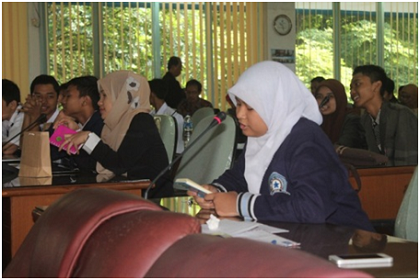
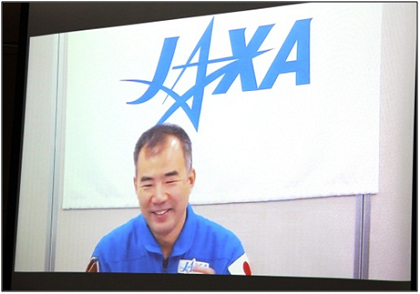
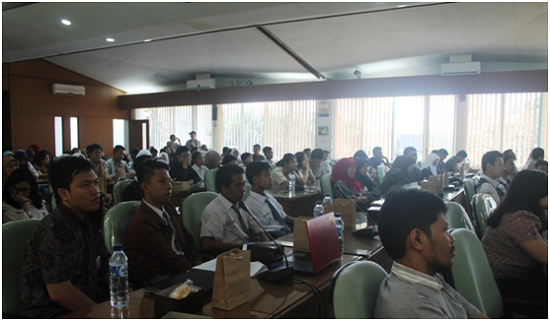
    Indonesian Youth talked with Astronaut Soichi Noguchi in the communication event of Space Science Festival in Bandung, Indonesia

    The communication event with JAXA astronaut Soichi Noguchi, has been held as a part of Space Science Festival in Indonesia, organized by National Institute of Aeronautics and Space, Indonesia (LAPAN).

    They connected with him from Auditorium room in LAPAN Space science center in Bandung, where 170 participants including 115 students gathered. This communication was held using the video conference system, and the audiences were excited to see JAXA astronaut in live video for the first time.

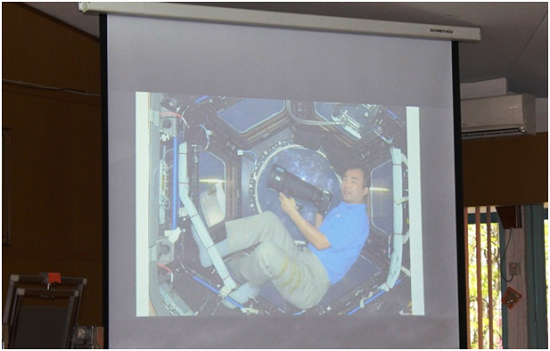
    Astronaut Noguchi started his talk with the greeting to participants by Indonesian language “Selamat pagi”, meaning “good morning”. He explained his experience in his two missions on ISS, showing some pictures taken while he was on-board ISS. He also gave information of Kibo-ABC/Kibo utilization collaboration activity of LAPAN and JAXA.

    Students had chance to ask him questions after the lecture. Students asked him questions mainly in English, where some students who tried to use Japanese to talk with him. Many questions were answered, including questions such as ‘what is your favorite space food?’, ‘how the earth looked like when seen from space?’ and ‘how did you feel when you got back to the earth?’ Astronaut Noguchi insisted on how beautiful the earth is seen from the space and the photos cannot tell its beauty enough, thus you need to go to space to see it with your own eyes. He also mentioned that he “felt home” when he came back to the earth, but on the very next day he missed the space and wanted to go back there.

    The last question from the student was ‘what are the requirements to become an astronaut?’ and astronaut Noguchi answered, ‘it requires a lot of aspect to become an astronaut, such as majoring scientific field in university, being physically fit and also ability of using multi-languages. But the most important thing is to have a strong motivation for exploring into space.’

    click to enlarge
    click to enlarge

    Space Science Festival is an annual event organized by LAPAN to celebrate World Space Week (worldspaceweek.org). The event encourages students to learn more about space science and astronomy, and also promotes space experiments for better utilization of space technology.

    For further information, please visit LAPAN’s website: http://pussainsa.lapan.go.id/fsa

    This entry passed through the Full-Text RSS service – if this is your content and you’re reading it on someone else’s site, please read the FAQ at fivefilters.org/content-only/faq.php#publishers.

  • [Event] [PEOIC2015] Innovative Earth Observation for Society and Policy

    Satellite Earth observations can provide valuable data and information for understanding the interconnections on a global scale between nature and society. There is a pressing need to better understand whether present and future satellite technologies and systems are meeting this expectation to contribute to policy, society and economy.

    This international seminar will invite international experts on science, policy and the social and economic benefits of satellite observation from academia, space agencies, international organisations and industry to discuss the possibility of objectively evaluating the impact of satellite observations on environmental policy, society and economy. The seminar aims to provide feedback on new technological innovations for the next generation of satellite observation, as well as recommendations for future models and missions to contribute to global needs.

    It is being organised as part of the Policy and Earth Observation Innovation Cycle (PEOIC) project, which is being jointly implemented by the National Institute of Information and Communications Technology (NICT), Keio University, the Institute for Global Environmental Strategies (IGES) and the Japan Aerospace Exploration Agency (JAXA). The PEOIC project is under the Japan Science and Technology Agency (JST) Research Institute of Science and Technology for Society (RISTEX).

    This entry passed through the Full-Text RSS service – if this is your content and you’re reading it on someone else’s site, please read the FAQ at fivefilters.org/content-only/faq.php#publishers.

  • [ISS / Japanese Experiment Module (KIBO)] Japanese and Brazilian CubeSats deployed from Kibo

    Japanese and Brazilian CubeSats deployed from Kibo

    Last Updated: October 22, 2015

    photo

    Astronaut Kimiya Yui announces the success of S-CUBE deployment (Credit: JAXA)

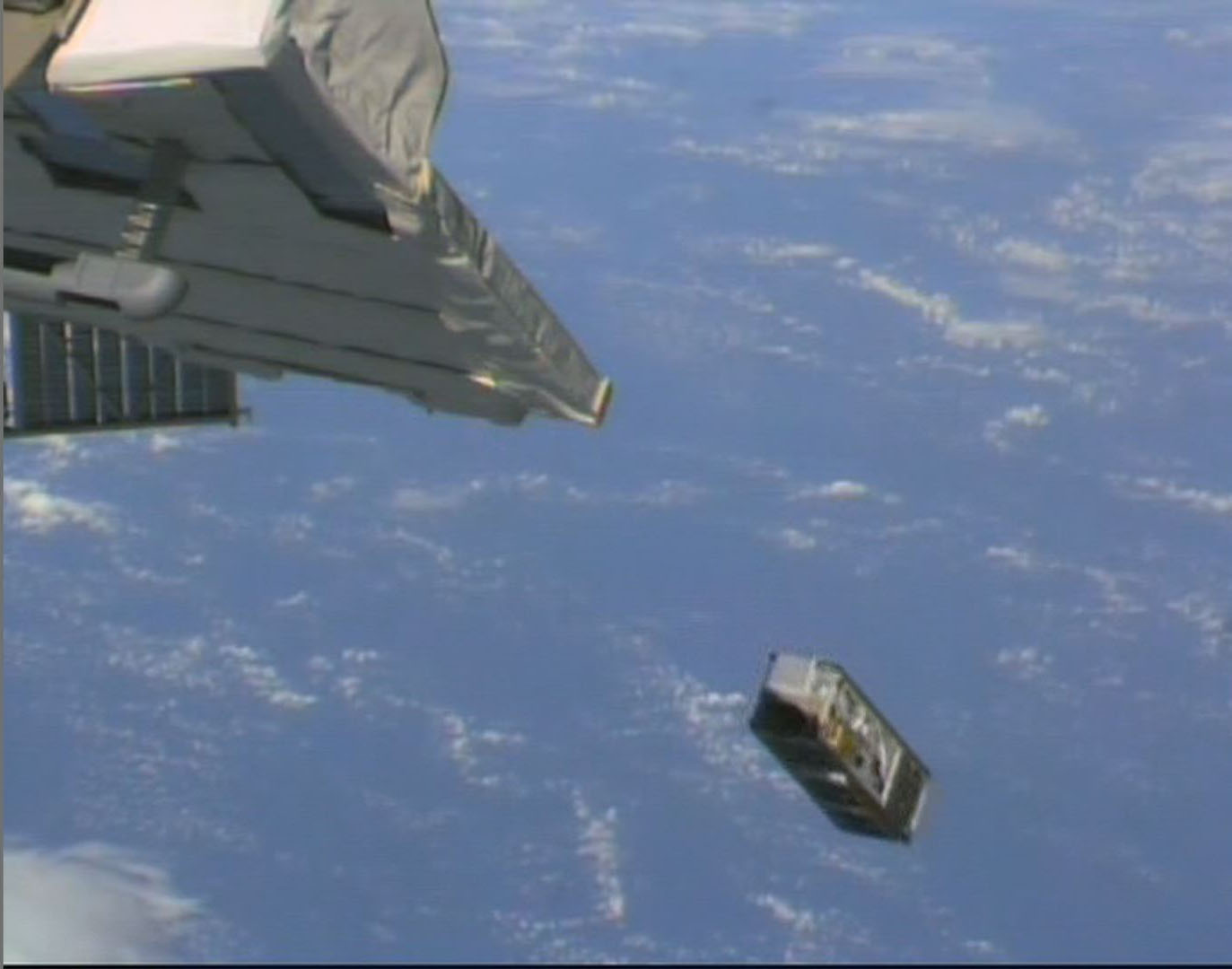
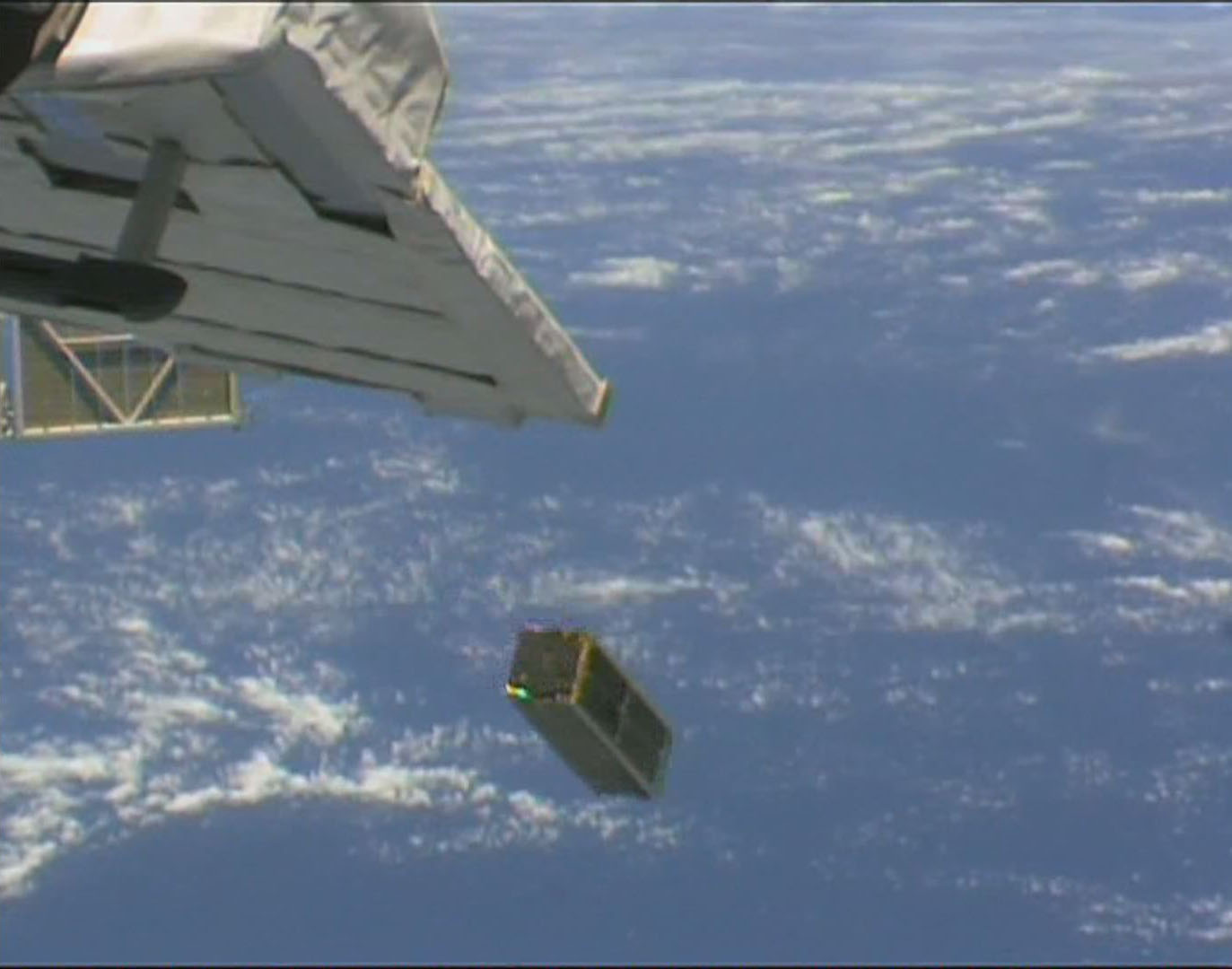
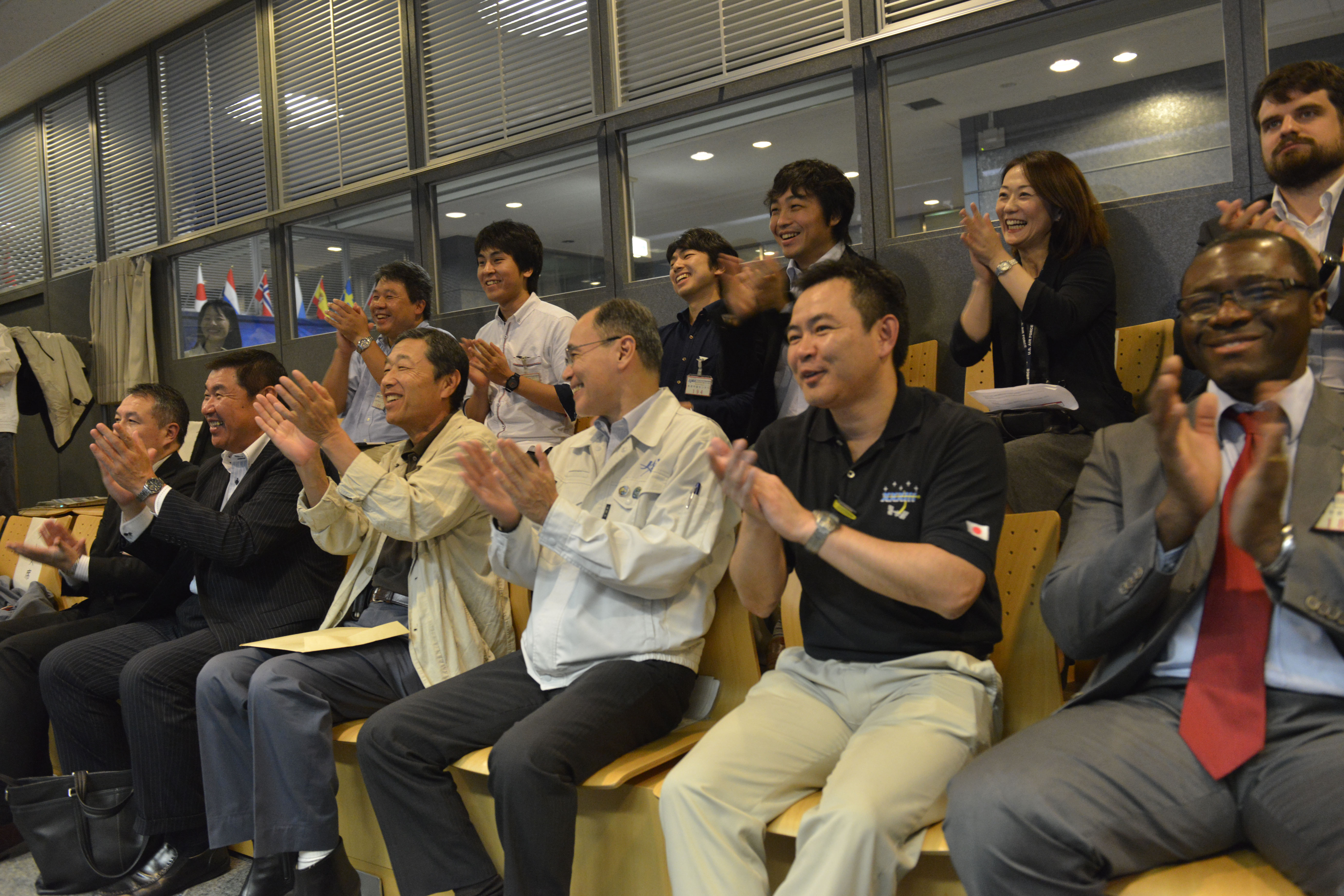
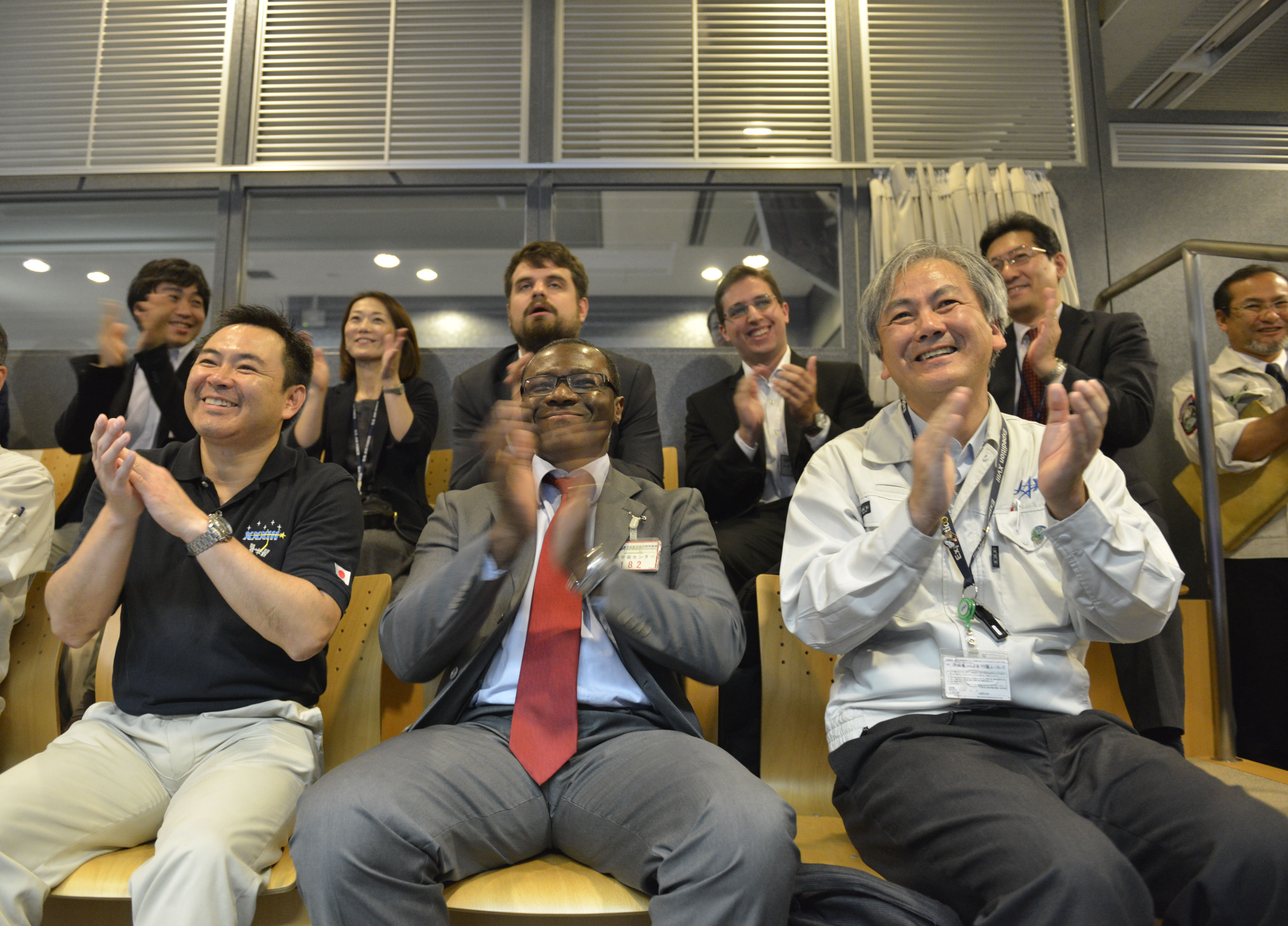
    On September 17, 2015, two CubeSats — SERPENS developed by the University of Brasilia (UnB) and S-CUBE of the Chiba Institute of Technology — were successfully deployed from the Japanese Experiment Module (“Kibo”).

    First, at 9:02, p.m., S-CUBE was deployed via command operation by Astronaut Kimiya Yui aboard the International Space Station (ISS). Then at 9:12 p.m., SERPENS was deployed under command of the JAXA Flight Control Team (JFCT) at the Tsukuba Space Center (TKSC).

    Deployment of S-CUBE (Credit: JAXA/NASA)

    Deployment of S-CUBE (Credit: JAXA/NASA)

    Deployment of SERPENS (Credit: JAXA/NASA)

    Deployment of SERPENS (Credit: JAXA/NASA)

    This series of deployment marks the fourth (12th satellite) deployment using the JEM Small Satellite Orbital Deployer (J-SSOD), and 90 satellites in total have been deployed from Kibo.

    Click to enlarge

    At the TKSC, representatives of the Chiba Institute of Technology and JAXA applauding the successful deployment (Credit: JAXA)

    Click to enlarge

    At the TKSC, representatives of the University of Brasilia and JAXA applauding the successful deployment (Credit: JAXA)

    Developed by JAXA for deploying satellites designed in compliance with the CubeSat design specification (10 cubic cm), J-SSOD is a mechanism that transfers satellites from Kibo’s airlock to the space environment and then releases them into orbit.

    SERPENS and S-CUBE are both 3U-sized micro satellites (10 cm×10 cm×30 cm)and were delivered aboard the H-II Transfer Vehicle (HTV) KOUNOTORI5.

    There are now more opportunities for CubeSat deployment from Kibo. And various projects are ongoing, such as AOBA-VELOX-Ⅲ (of Singapore and Kyushu Institute of Technology) and a 50-kg-level CubeSat PHL-MICROSAT (jointly developed by the Philippines, Tohoku University, and Hokkaido University).

    Since September 8, 2015, JAXA has collaborated with the UNITED NATIONS Office for Outer Space Affairs (UNOOSA) in order to provide opportunities for CubeSat deployment. In particular, JAXA and UNOOSA will strive to offer opportunities for CubeSat deployment from Kibo to developing nations, so as to contribute to their advancement of space and related technologies.

    UNITED NATIONS Office for Outer Space Affairs
    JEM Small Satellite Orbital Deployer (J-SSOD)

    断りの無い限り、日時は日本時間です。

    *All times are Japan Standard Time (JST)

    This entry passed through the Full-Text RSS service – if this is your content and you’re reading it on someone else’s site, please read the FAQ at fivefilters.org/content-only/faq.php#publishers.

  • [ISS / Japanese Experiment Module (KIBO)] Protein crystals grown in Kibo have returned to the ground (JAXA PCG experiment)

    Protein crystals grown in Kibo have returned to the ground (JAXA PCG experiment)

    Last Updated: October 16, 2015

    Samples of the protein crystals for the JAXA PCG experiment launched alongside Astronaut Kimiya Yui aboard the Soyuz TMA-17M spacecraft (43S) on July 23 have completed growth in space and were returned to Earth on September 12. The samples later arrived in Japan on September 14 for analysis.

    Regarding this protein crystal growth experiment (JAXA PCG), Yui tweeted, “This experiment grows high quality protein crystals in microgravity. The samples were launched into space with me, and I handled them very gently as if the crystals were babies. The samples were then returned to Earth onboard Soyuz ahead of me for analysis. This experiment is expected to yield valuable results such as the development of new medicine.”

    Follow Astronaut Yui’s Twitter

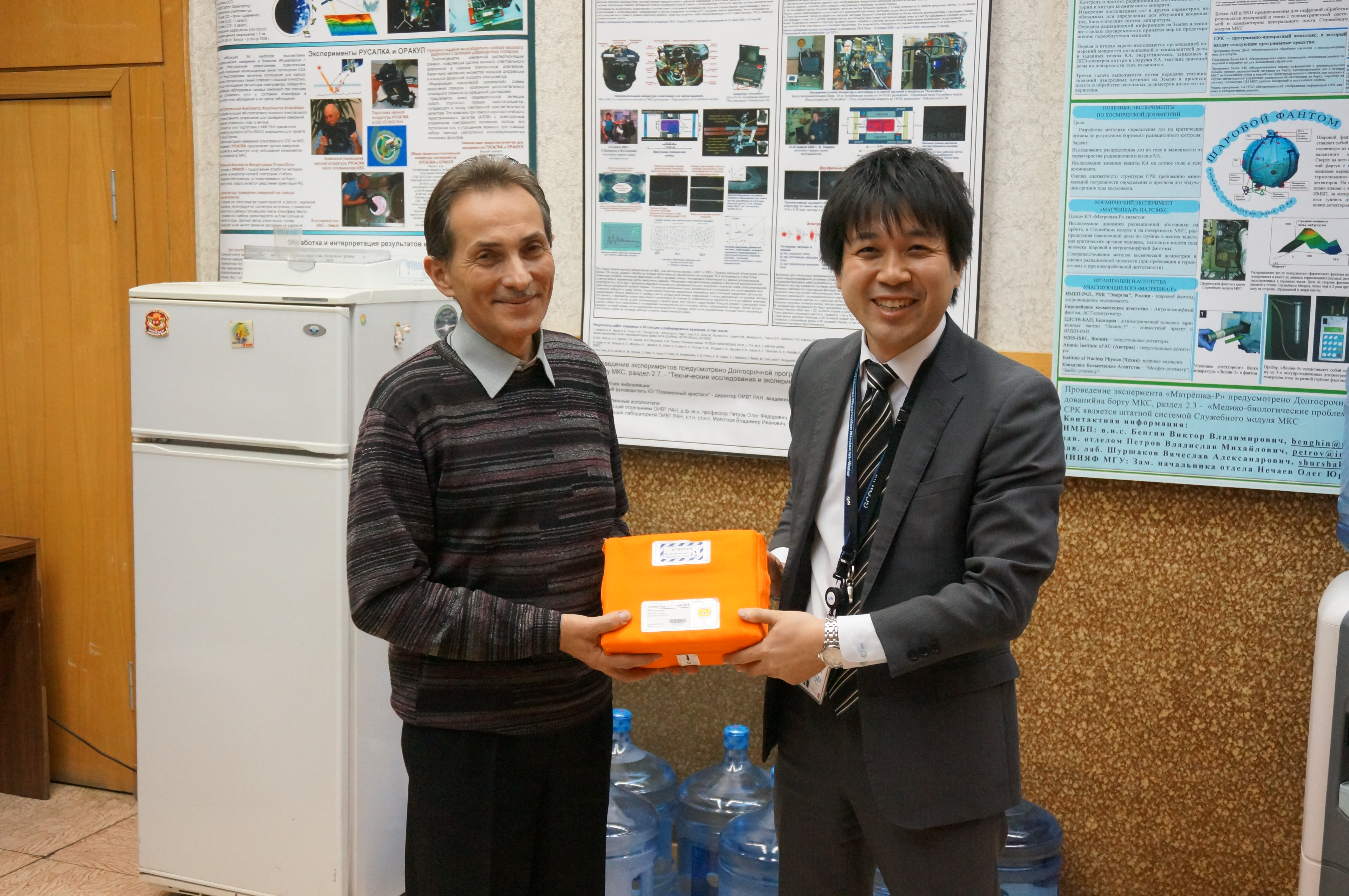
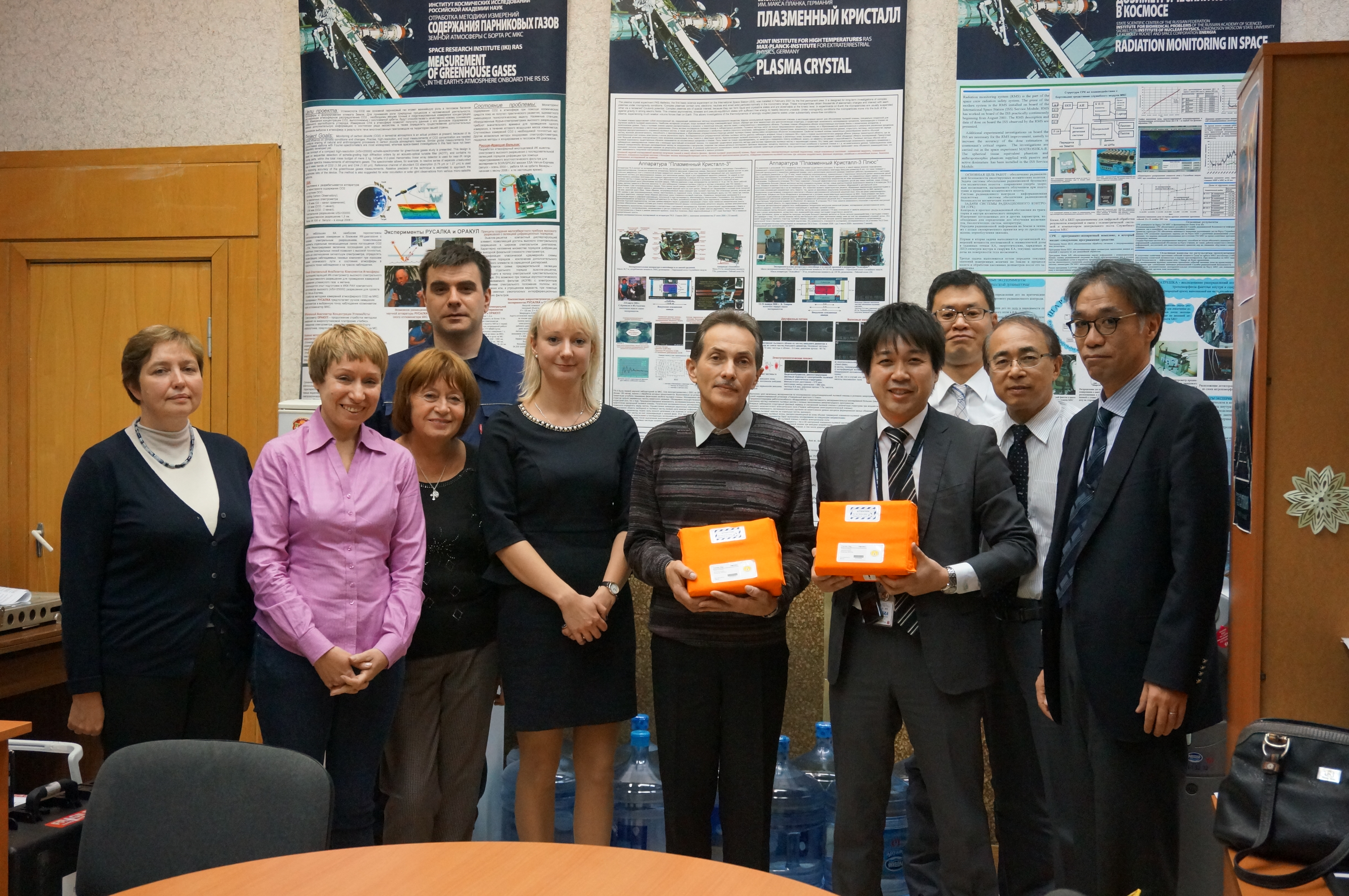
    Returned protein crystals were handed over to JAXA at a facility of a cooperative research institute in Russia.

    Click to enlarge

    Sample handover in Russia (Left: Dr. Igor Srokin, technical manager of RKK Energia)

    Click to enlarge

    A group photo of the experiment staff (Leftmost: Dr. Valeria Prudkoglyad, mission scientist of the Central Research Institute of Machine Building)

    A group photo of the experiment staff

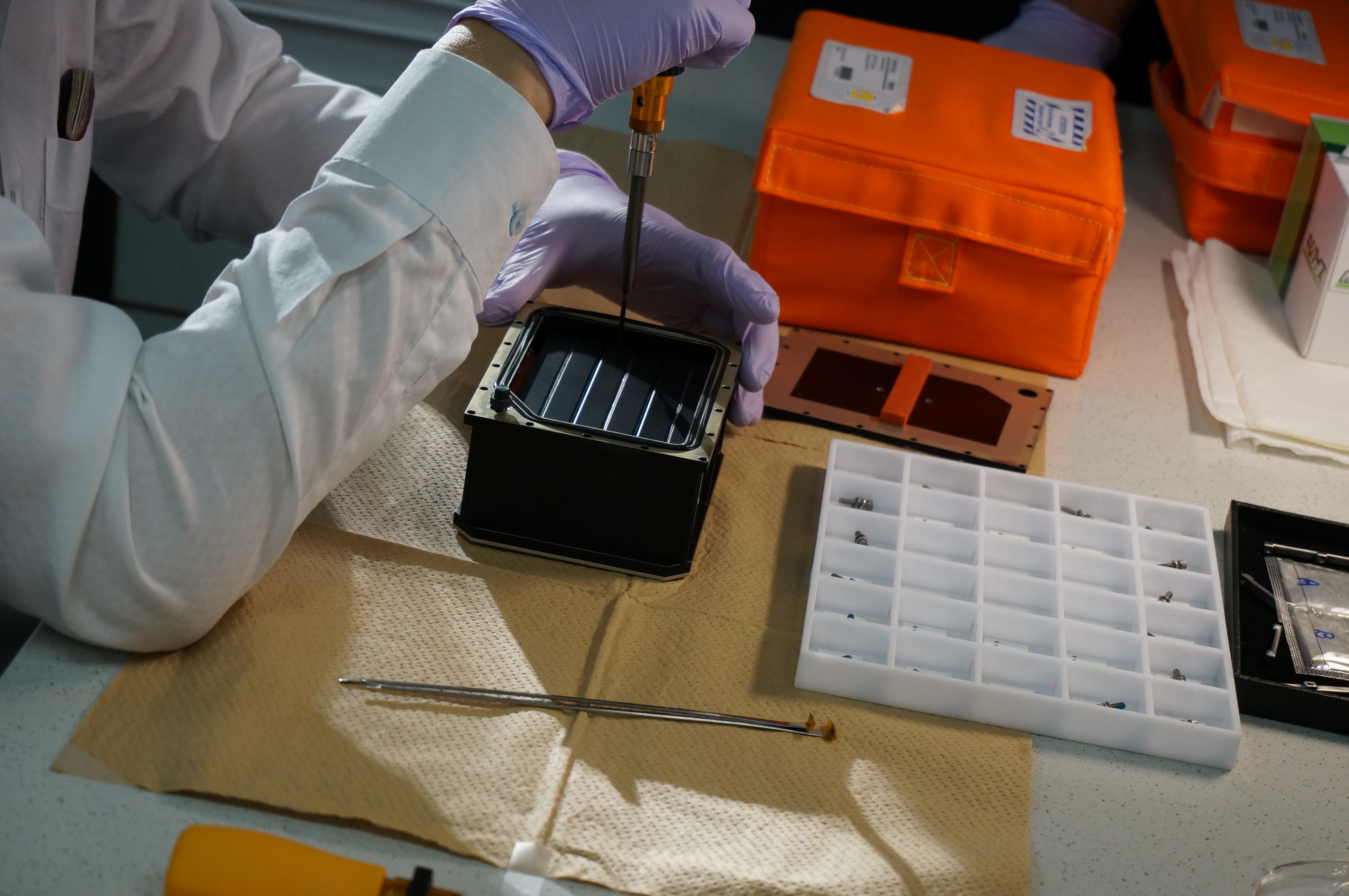
    Taking samples out

    Click to enlarge

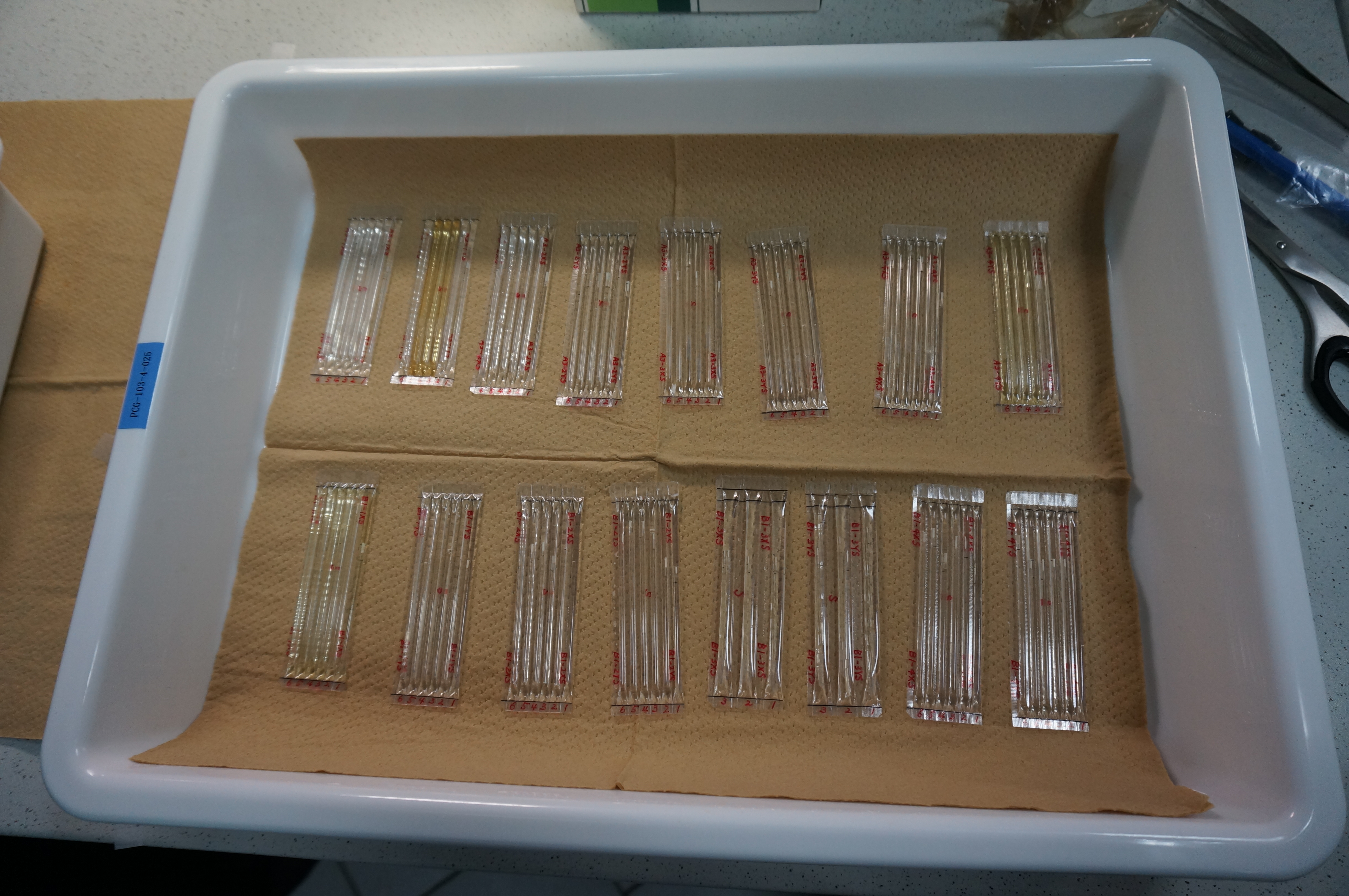
    Gel-Tube cartridge containing crystallization capillaries

    Microscope images of protein crystals grown on Kibo (a flash report)

    Protein crystals returned from the International Space Station (ISS) on September 12 were immediately retrieved and viewed under a microscope on September 15, in order to determine their condition. These obtained samples will be handed over to researchers for analysis at synchrotron radiation facilities (such as SPring-8).

    Here we introduce some microscope images of the JAXA-sponsored protein crystals.

    1. Creation of artificial red cells (substitutes for blood transfusion) for human beings and pet animals
    Principal Investigator (PI): Prof. Teruyuki Komatsu, Faculty of Science and Engineering, Chuo University

    【Overview】

    In 2013, the group headed by Professor Komatsu of Chuo University developed a candidate protein for artificial red cells that can be created by altering naturally occurring proteins. The team now intends to obtain detailed structural data by conducting a space experiment to validate safety and efficacy for commercialization.

    Through the space experiment, the team obtained bigger crystals than those created on the ground and expects to acquire better data (see image below.)

    The results of this research may lead to the development of artificial blood that can be stored for a long term, and which could resolve the shortage of donated blood in the event of a large-scale disaster or due to a reduced birth rate.

    Crystals of candidate protein for artificial blood

    Crystals obtained via the ground study

    Crystals obtained via the ground study
    (© Chuo University/JAXA)

    arrow
    Crystals grown in space (microscope image)

    Crystals grown in space
    (microscope image)
    (© Chuo University/JAXA)

    2. Development of probes for the detection and removal of human iPS cells
    PI: Tomomi Kubota, Senior Researcher, National Institute of Advanced Industrial Science and Technology (AIST)

    【Overview】

    The AIST team developed a probe* that selectively isolates anaplastic human iPS and ES cells without affecting the growth and life of differentiated somatic cells.

    *Probe: A substance used to detect specific molecules or cells.

    There are high expectations for human iPS and ES cells to be used in regeneration medicine; however, differentiating all human iPS and ES cells to the intended cells is currently quite difficult. A certain number of anaplastic cells are included in the transplanted cells and could cause a tumor afterward. The probe was developed to remove such anaplastic iPS and ES cells.

    This probe visualizes live human iPS cells to remove anaplastic iPS cells for transplant, and is expected to accelerate the application of iPS cells to regeneration medicine.

    Crystals obtained this time show a different shape than those grown on the ground. Favorable data acquisition is expected (see image below).

    This research aims to closely study the structural data of crystals obtained in space and investigate how the probes and cells are combined, which will result in the creation of a high-precision probe useful for the quality control of human iPS cells.

    Protein crystals specifically respond to human iPS cells

    Crystals obtained via the ground study

    Crystals obtained via the ground study
    (© AIST/JAXA)

    arrow
    Crystals grown in space (microscope image)

    Crystals grown in space
    (microscope image)
    (© AIST/JAXA)

    3. Development of antibacterial drugs for multidrug-resistant bacteria and periodontal disease
    Yasumitsu Sakamoto, Assistant Professor, Iwate Medical University School of Pharmacy

    【Overview】
    Through space experiments the team has studied the 3D conformation and mechanisms of the substrate binding of peptide-degrading enzymes that are important for the growth of multidrug-resistant bacteria and periodontal disease bacteria.

    Crystals obtained this time show a different shape than those grown on the ground. Favorable data acquisition is expected (see image below).

    To seek for a drug candidate and conduct rational development, the group aims to clarify the 3D conformationa of a complex combined with a candidate inhibitor.

    Hopefully the result will to lead to the development of a new antibacterial drug for multi-drug resistant bacteria, a cause of nosocomial infections, and also a drug for periodontal disease.

    Crystals of peptide-degrading enzymes important for the treatment of periodontal disease

    Crystals obtained via the ground study

    Crystals obtained via the ground study
    (© Iwate Medical University/JAXA)

    arrow
    <img src="http://iss.jaxa.jp/kiboexp/news/images/150917_pcg06.jpg" width="200" height="143" alt="Crystals grown in space
    (microscope image)” />

    Crystals grown in space
    (microscope image)
    (© Iwate Medical University/JAXA)

    *All times are Japan Standard Time (JST)

    This entry passed through the Full-Text RSS service – if this is your content and you’re reading it on someone else’s site, please read the FAQ at fivefilters.org/content-only/faq.php#publishers.
  • [JAXA President Monthly Press Conference] JAXA President Monthly Regular Press Conference September 2015

    JAXA President Monthly Regular Press Conference

    Date and time: From 11:00 – 11:45 a.m. on Sept. 10 (Thu.), 2015
    Venue: JAXA Tokyo Office Presentation Room (B1 floor)
    MC: Shigeki Kamigaichi, JAXA Public Affairs Department Director

    The recently launched “KOUNOTORI5” (HTV5) carried a small satellite of the Chiba Institute of Technology and one from Brazil. I would like to announce the date of their deployment from the “Kibo”. It was set for Sept. 17, 2015. Astronaut Yui is one of the members who are in charge of the deployment.

    A rough estimate for the JFY 2016 budget request was proposed by the Ministry of Education Culture, Sports, Science and Technology (MEXT). Regarding JAXA, there are four major pillars: a next-generation engineering test satellite, advanced radar satellite, new cargo supplier to the International Space Station (ISS) (temporarily called “HTV-X”), and small moon landing demonstrator.

    Astronaut Norishige Kanai was selected as the seventh Japanese astronaut to stay at the ISS for a prolonged period. Prime Minister Shinzo Abe announced the decision during a “VIP call” with Astronaut Yui at the ISS on Aug. 26. We expect that Astronaut Kanai will play an active role based on his special knowledge as a medical doctor to generate achievements in the area of space medicine and life science experiments. The Japanese government is also expecting productive results for its health and medicine study as part of its science and technology promotion policy. We informed the government that the Kibo project places emphasis on biomedicine and drug discovery research. I hope that our activities for the Kibo will fulfill objectives and expectations while stimulating interest in science among the young generations. Astronaut Kanai is scheduled to stay at the ISS in the winter of 2017.

    On this Tuesday (Sept. 8), MEXT Minister Hakubun Shimomura announced at a press conference after the Cabinet meeting that JAXA signed an agreement of cooperation with the United Nations Office for Outer Space Affairs (UNOOSA) on Sept. 8 for the deployment of small satellites from the Kibo. We will utilize our space technology to improve space development and the utilization capabilities of developing countries under cooperation with the U.N. For JAXA, promoting and providing an opportunity of small satellite deployment through the U.N. means international contributions for maximizing the achievements of the Kibo.

    We held a press conference and issued a press release on July 27 about the second phase test of the “Drop test for the Simplified Evaluation of Non-symmetrically Distributed sonic boom” Project (D-SEND#2). The test was held at the Esrange Space Center in Sweden on July 24, and it successfully performed supersonic flight and measured the sonic boom. For the verification of design technology for reducing the sonic boom, we are still conducting an analysis. We plan to provide data on our project to the Super Sonic Task Group of the International Civil Aviation Organization to be held in Montreal, Canada, at the end of October.

    This entry passed through the Full-Text RSS service – if this is your content and you’re reading it on someone else’s site, please read the FAQ at fivefilters.org/content-only/faq.php#publishers.