JAXA Astronaut Activity Report, September, 2015
Last Updated: December 17, 2015
This is JAXA’s Japanese astronaut activity report for September, 2015.
Astronaut Takuya Onishi continues training for his ISS long-duration stay
Astronaut Takuya Onishi, a crew member for the Expedition 48/49 mission to the International Space Station (ISS), underwent training for a long-duration mission at the NASA Johnson Space Center in the U.S. during the first half of September, followed in the second half by training at the European Astronaut Centre (EAC) of the European Space Agency (ESA) in Cologne, Germany.

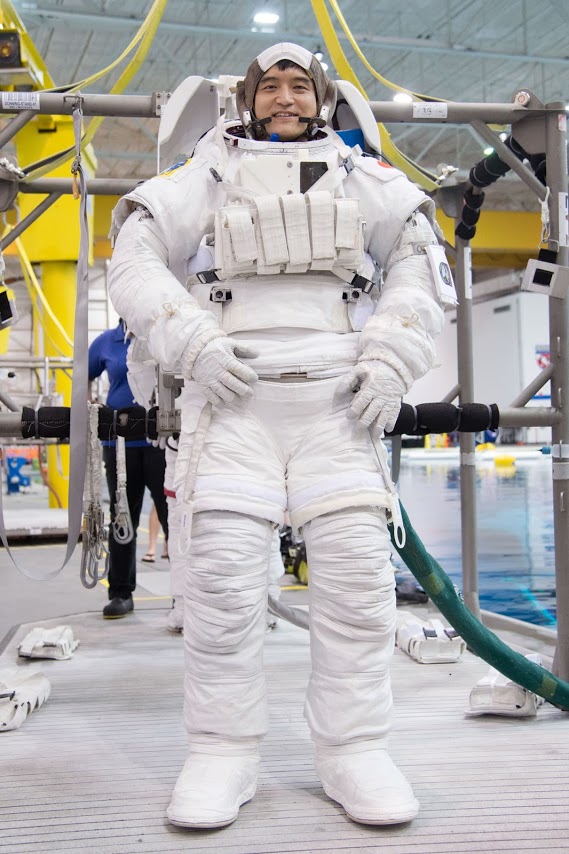
Onishi donning the EMU (Photo courtesy of Takuya Onishi)
At the JSC, a series of training was conducted on experiments, medical data acquisition, emergency response, and Extravehicular Activity (EVA).
Training for EVA this time was conducted in case of experiencing decompression sickness (the bends).
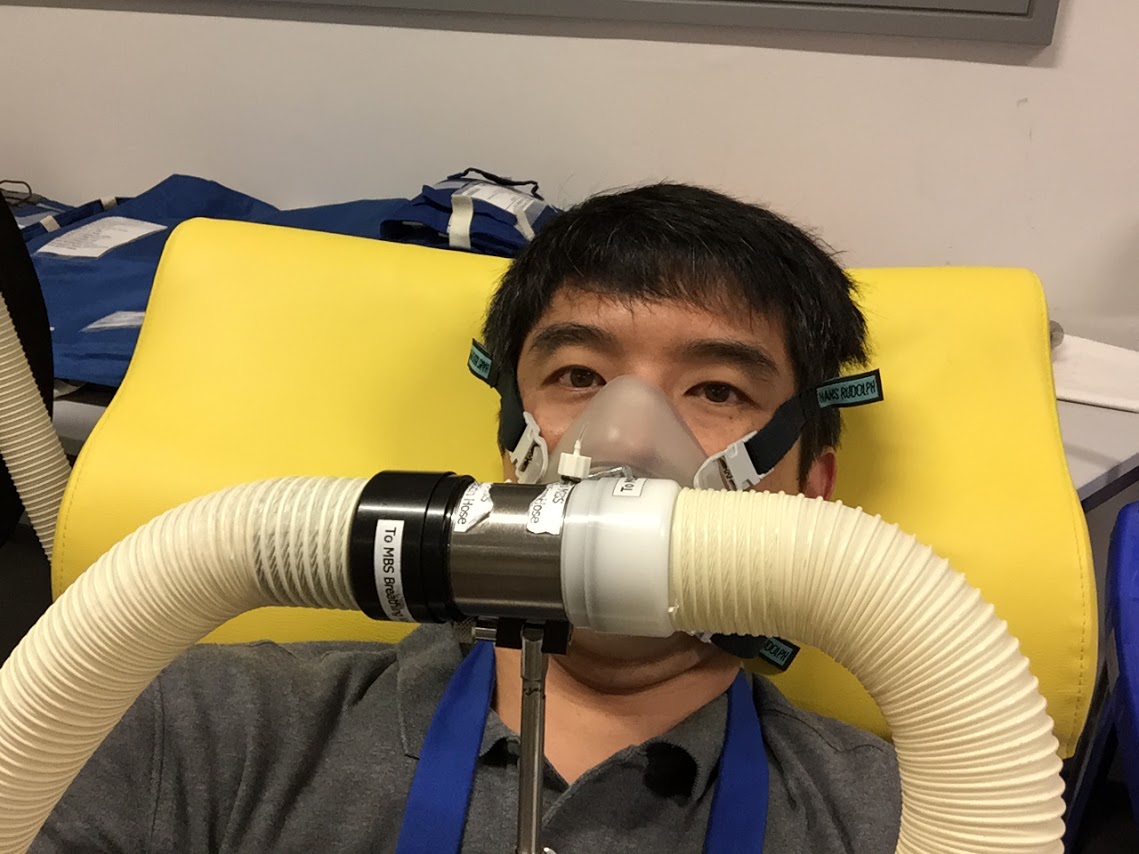
In order to perform EVA, the internal atmospheric pressure of the Extravehicular Mobility Unit (EMU) must be lowered to 0.3 atm of pure oxygen. In preparation for lowering atmospheric pressure from 1 to 0.3, the astronauts exercise beforehand while wearing oxygen masks to excrete nitrogen, and then take several steps before and while donning the EMU to reduce the risk of getting the bends.
The general treatment for decompression sickness is to place the person in a small chamber, pressurize and fill it with concentrated oxygen so that nitrogen bubbles are excreted in the body, and then slowly return the chamber to 1 atm. Since oxygen is precious in the ISS, the EMU is used as the treatment chamber. This time Onishi learned how to configure the EMU to use it as such a chamber.

Measuring oxygen intake and CO2 discharge as part of metabolic rate assessment (Photo courtesy of Takuya Onishi)
The purposes of training at ESA were to practice ESA-sponsored experiments and become qualified as a “specialist” for ESA’s Columbus module.
As one of ESA’s experiments, Onishi obtained his baseline data for an experiment called “Energy” (an astronaut’s energy requirements for long-term space flight).
The “Energy” experiment examines how energy metabolic rates in space differ from those on the ground. The research will help provide appropriate amounts and kinds of foods to keep astronauts healthy for successful future missions. Onishi ate certain space foods and measured the amount of taken and consumed energy.
Other training covered maintenance operations and failure responses in the Columbus module.
JAXA astronauts support the HTV5 mission

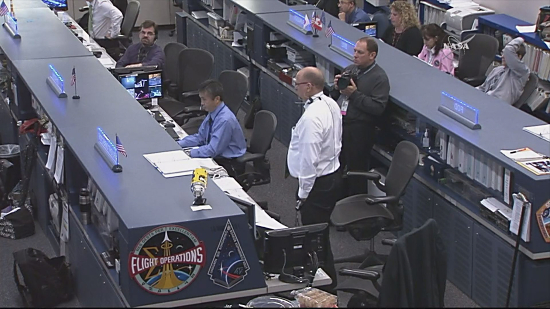
Astronaut Wakata on duty at NASA MCC during KOUNOTORI5 releasing operations (Credit: JAXA/NASA)
At around 5:33 a.m., on September 30 (JST), the H-II Transfer Vehicle (HTV) “KOUNOTORI5” reentered the atmosphere, completing its 42-day mission.
In addition to participating in KOUNOTORI5’s capture and berthing operations, JAXA astronauts played an important role in its unberthing operations as well.
Astronaut Kimiya Yui onboard the ISS closed the KOUNOTORI5’s hatch, and then SSRMS operations controlled from the ground unberthed KOUNOTORI5 from the Harmony (Node 2). Yui then maneuvered the SSRMS and released KOUNOTORI5.
On the ground, Astronaut Koichi Wakata served as lead Capsule Communicator (CAPCOM: lead ground communicator with the ISS) to support onboard astronauts in conducting system and SSRMS operations.
Astronaut Kimiya Yui’s activities aboard the ISS

Onboard joint press conference (Credit: JAXA/NASA)
On September 8, Astronaut Kimiya Yui attended a press conference lasting about 45 minutes.
All crew members including two short-time visitors gathered in the Destiny module for the press conference, and then answered questions from the mass media from U.S., Russia, Japan, and Europe.
In answering questions from the Japanese press, Yui discussed the importance of conducting space experiments, described life onboard the ISS, and gave a message for his hometown.

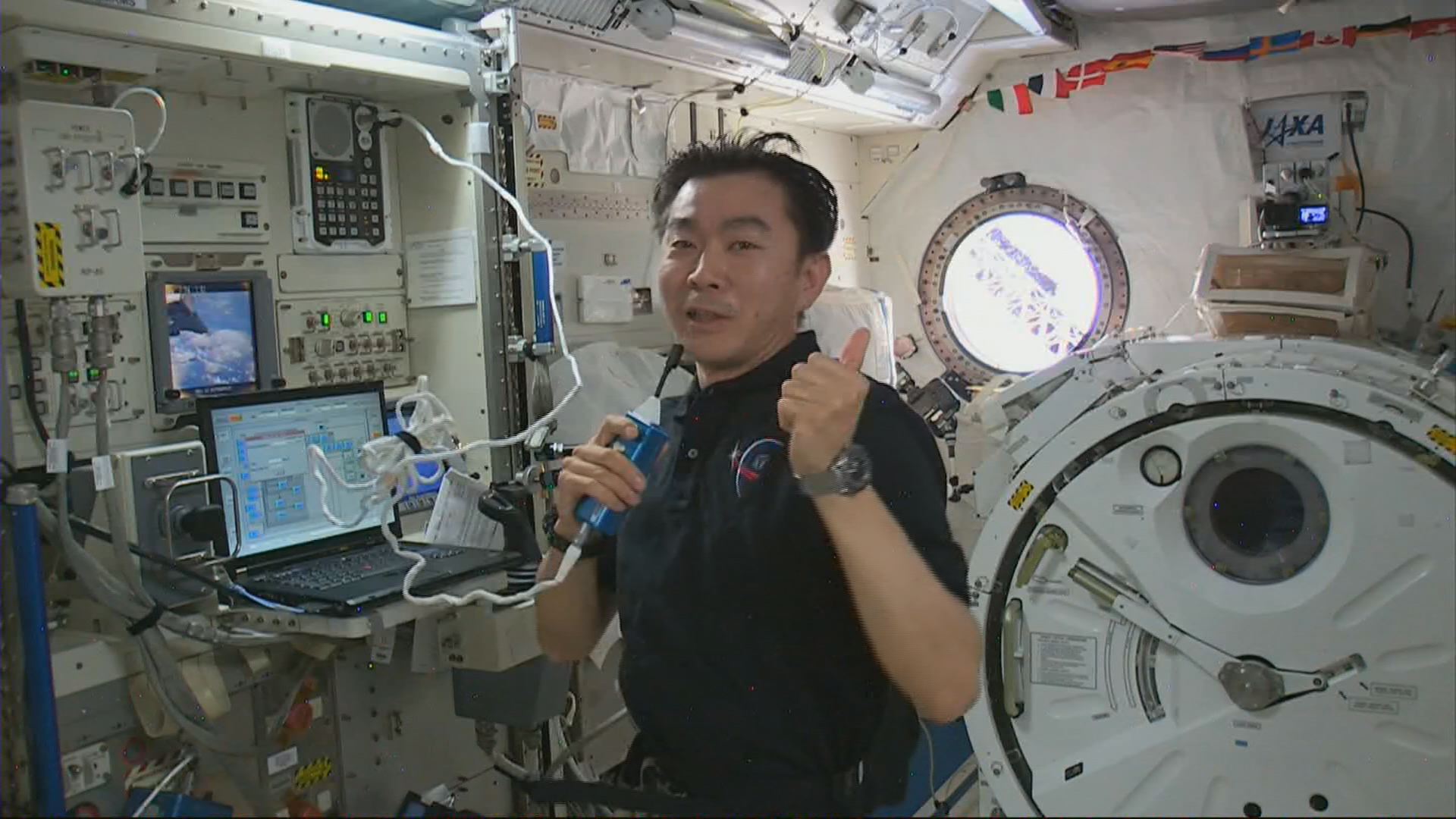
Astronaut Kimiya Yui announces the success of S-CUBE deployment (Credit: JAXA)
On September 17, two CubeSats — SERPENS developed by the University of Brasilia (UnB) and meteorite observation satellite S-CUBE of the Chiba Institute of Technology — were successfully deployed using the JEM Small Satellite Orbital Deployer (J-SSOD).
First, S-CUBE was deployed via command operation by Yui. Then, SERPENS was deployed under command of the JAXA Flight Control Team (JFCT) at the Tsukuba Space Center (TKSC).
Astronaut Akihiko Hoshide at the TKSC, gave some insights to the representatives of Brazil and Chiba Institute of Technology.

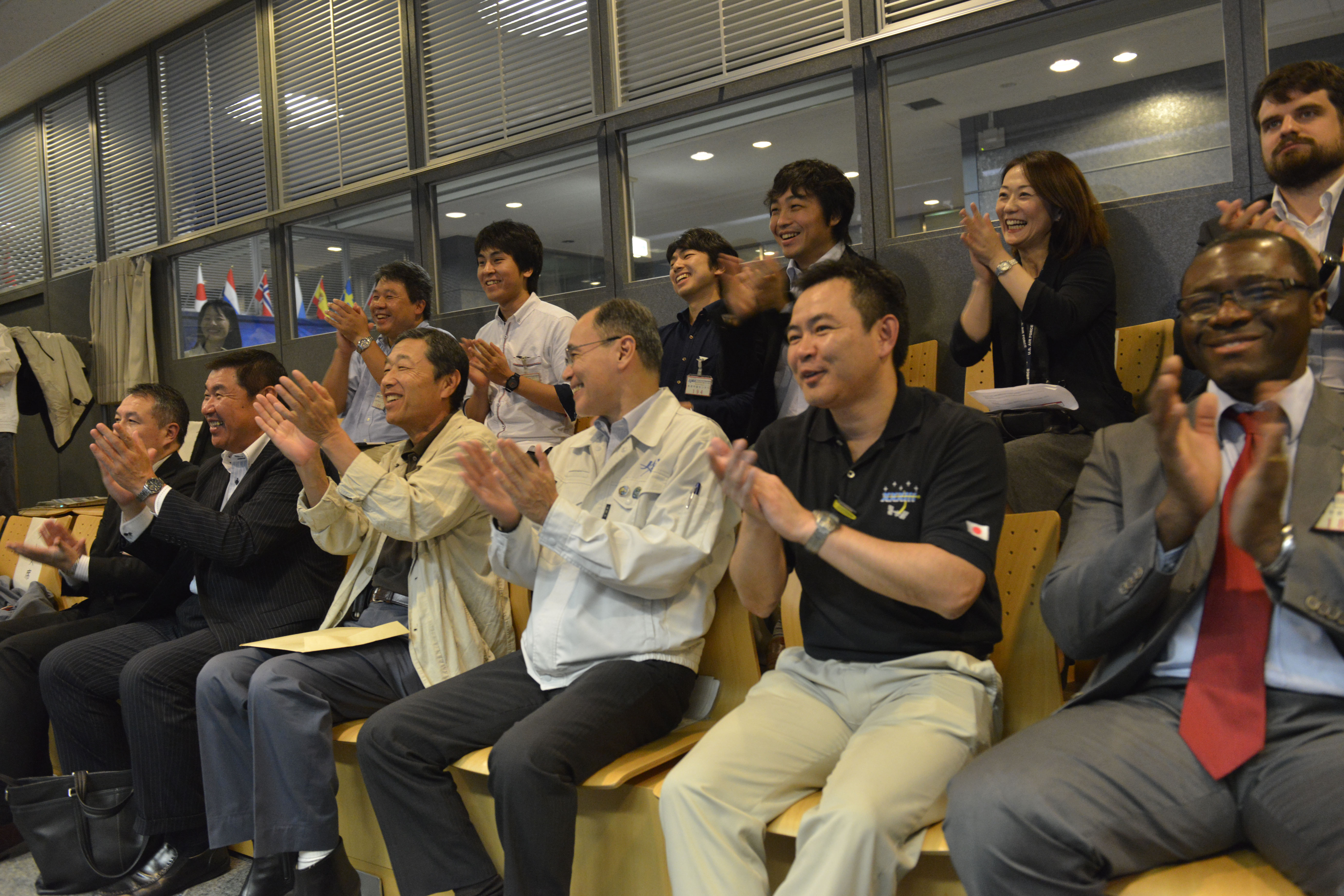
Representatives of Brazil, Chiba Institute of Technology and JAXA at the TKSC applauding the successful deployment, with Hoshide in the first row, second from the right (Credit: JAXA)
Hoshide experienced the deployment of two CubeSats for the technology demonstration mission during his Expedition 32/33 in 2012.
SERPENS and S-CUBE are both 3U-sized micro satellites (10 cm×10 cm×30 cm) that were delivered aboard the H-II Transfer Vehicle (HTV) KOUNOTORI5.
The 28th Association of Space Explorers’ Planetary Congress

Noguchi giving a presentation (Credit: JAXA)
The 28th Association of Space Explorers (ASE) Planetary Congress was held from September 20-27 (local time) in Stockholm, Sweden.
ASE is the only international organization consisting of astronauts and cosmonauts from many countries, and holds a Planetary Congress almost every year.
As the president of ASE, Noguchi made a speech at the opening ceremony and served as chairperson or deputy chairperson for some sessions. Astronauts Koichi Wakata and Chiaki Mukai also attended the event. Noguchi and Mukai made presentations at the technical sessions.
This entry passed through the Full-Text RSS service – if this is your content and you’re reading it on someone else’s site, please read the FAQ at fivefilters.org/content-only/faq.php#publishers.