
The European Space Agency (ESA) brings public and ESA-wide recognition of the outstanding performance of European companies working in the frame of ESA programmes and projects.
The European Space Agency (ESA) brings public and ESA-wide recognition of the outstanding performance of European companies working in the frame of ESA programmes and projects.

Smile has passed its qualification and flight acceptance review, meaning that it meets all requirements for launch. The launch window has been set for 8 April to 7 May 2026.

Video:
01:00:00
The press conference, at the European Astronaut Centre in Cologne, Germany, follows the signing of contracts between Thales Alenia Space Italy, UK and France, OHB system AG (Germany) and Nammo (UK) for the ESA’s lunar lander programme Argonaut.
The programme is a key part of ESA’s lunar strategy and will support future robotic and crewed missions, contributing to international efforts to establish a long-term human presence on the Moon.

Today, the European Space Agency’s Argonaut lunar lander programme welcomes new members to its growing family. At ESA’s European Astronaut Centre (EAC) near Cologne, Germany, Thales Alenia Space Italy – the prime contractor for Argonaut’s first lander – signed agreements with Thales Alenia Space in France, OHB in Germany, and Thales Alenia Space and Nammo in the United Kingdom.

On 17 December 2025, two Galileo satellites will be launched by Arianespace on Ariane 6 from Europe’s Spaceport in French Guiana. This 14th operational launch in the Galileo programme will improve the precision, availability and robustness of the Galileo system. These satellites will benefit the billions of people who use Galileo daily via their smartphone as well as key sectors such as critical infrastructure, autonomous driving, air traffic, maritime, agriculture, emergency services and rescue operations.

Astronomers recently discovered the 40 000th near-Earth asteroid! These space rocks range from a few metres to a few kilometres in size and are on orbits that bring them relatively close to Earth. Each new discovery is both a reminder of our planet’s vulnerability and a testament to how far the field of planetary defence has advanced in just a few decades.

Researchers using the NASA/ESA/CSA James Webb Space Telescope have confirmed an actively growing supermassive black hole within a galaxy just 570 million years after the Big Bang. Part of a class of small, very distant galaxies that have mystified astronomers, CANUCS-LRD-z8.6 represents a vital piece of this puzzle and challenges existing theories about the formation of galaxies and black holes in the early Universe. The discovery connects early black holes with the luminous quasars we observe today.

NGC 1068, a relatively nearby spiral galaxy, appears in this image released on July 23, 2025.

The European Space Agency’s HydroGNSS, a twin-satellite mission to gather data on Earth’s water cycle, is scheduled to launch on 19 November at 19:18 CET (10:18 Pacific Time). Live coverage of the launch will be shown on ESA Web TV.
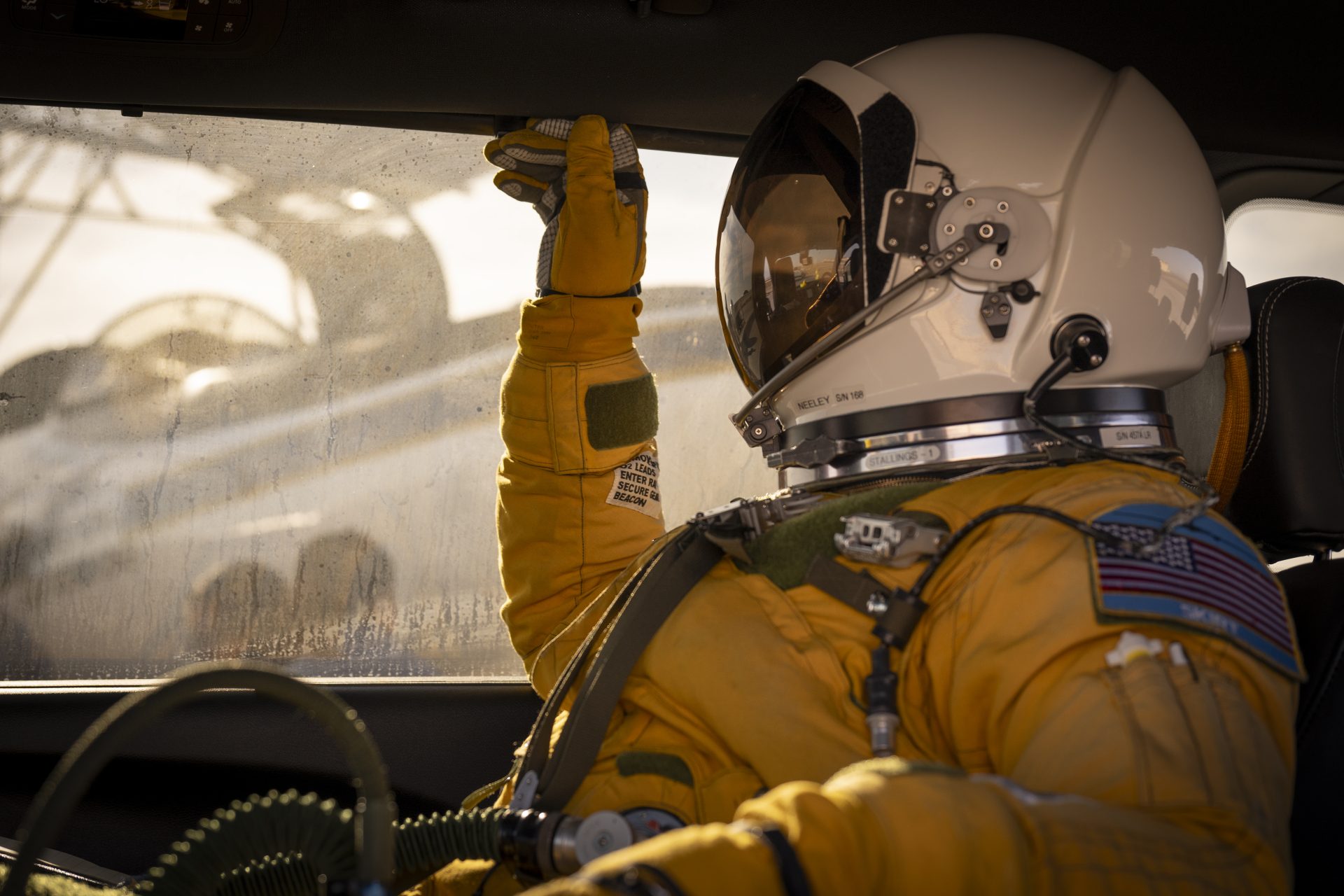
NASA ER-2 pilot Kirt Stallings waits inside the transport vehicle at Edwards, California, on Thursday, Aug. 21, 2025, moments before boarding NASA’s Armstrong Flight Research Center’s ER-2 aircraft for a high-altitude mission supporting the Geological Earth Mapping Experiment (GEMx). Through the vehicle window, the aircraft can be seen being readied for flight.

For decades, the Amazon rainforest has quietly absorbed vast quantities of human-generated carbon dioxide, helping to slow the pace of climate change. Recent evidence, however, suggests that this vital natural buffer may be weakening – though uncertainties remain.
To help close this critical knowledge gap, European and Brazilian researchers have gathered deep in the Amazon to carry out an ambitious European Space Agency-funded field campaign.

Video:
00:02:09
Copernicus Sentinel-6B was launched on 17 November 2025, ready to continue a decades-long mission to track the height of the planet’s seas – a key measure of climate change. The satellite was carried into orbit on a Falcon 9 rocket from the Vandenberg Space Force Base in California, US.
Sentinel-6B follows in the footsteps of its predecessor, Sentinel-6 Michael Freilich, which was launched in 2020. The mission is the reference radar altimetry mission that continues the vital record of sea-surface height measurements until at least 2030.
Copernicus Sentinel-6 has become the gold standard reference mission to monitor and record sea-level rise. The mission’s main instrument is the Poseidon-4 dual-frequency (C-band and Ku-band) radar altimeter. Developed by ESA, the altimeter measures sea-surface height. It also captures the height of ‘significant’ waves as well as wind speed to support operational oceanography.
