
Image:
This image from Copernicus Sentinel-1 shows circular agricultural structures near Tabarjal, in the barren desert of northern Saudi Arabia.
Tag: image
-
Earth from Space: Circles in the desert
-
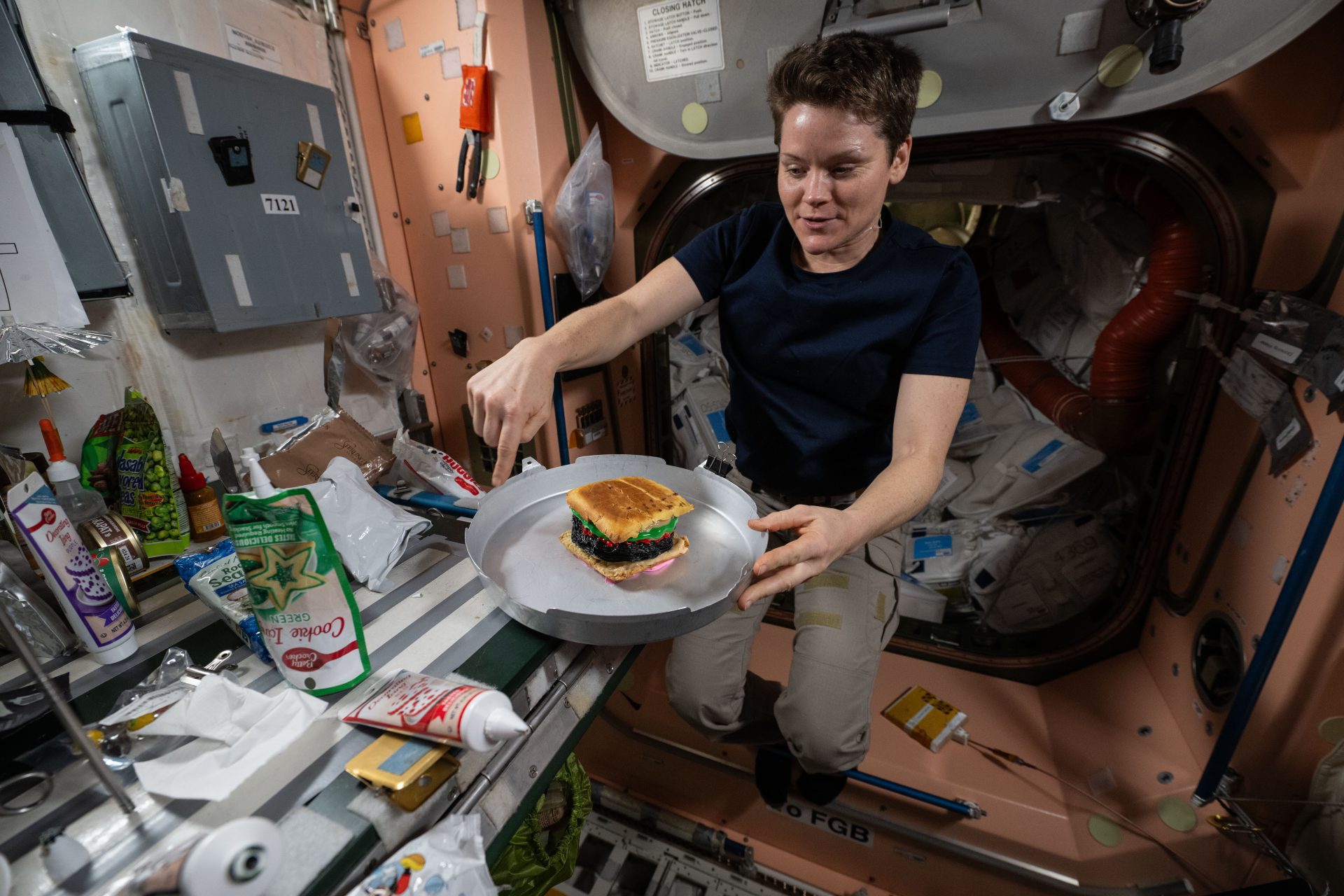
Space Station Crew Celebrates Milestone
NASA astronaut and Expedition 73 Flight Engineer Anne McClain shows off a hamburger-shaped cake to celebrate 200 cumulative days in space for JAXA (Japan Aerospace Exploration Agency) astronaut Takuya Onishi (out of frame) since his first spaceflight as an Expedition 48-49 Flight Engineer in 2016.
-
Vigil: ESA’s space weather reporter in deep space

Video:
00:01:51Space weather ‘reporter’ Vigil will be the world’s first space weather mission to be permanently positioned at Lagrange point 5, a unique vantage point that allows us to see solar activity days before it reaches Earth. ESA’s Vigil mission will be a dedicated operational space weather mission, sending data 24/7 from deep space.
Vigil’s tools as a space weather reporter at its unique location in deep space will drastically improve forecasting abilities. From there, Vigil can see ‘around the corner’ of the Sun and observe activity on the surface of the Sun days before it rotates into view from Earth. It can also watch the Sun-Earth line side-on, giving an earlier and clearer picture of coronal mass ejections (CMEs) heading toward Earth.
Radiation, plasma and particles flung towards Earth by the Sun can pose a very real risk to critical infrastructure our society relies on. This includes satellites for navigation, communications and banking services as well as power grids and radio communication on the ground.
A report by Lloyd’s of London estimates that a severe space weather event, caused by such an outburst of solar activity, could cost the global economy 2.4 trillion dollars over five years.
ESA’s response to this growing threat is Vigil, a cornerstone mission of the Agency’s Space Safety Programme, planned for launch in 2031. Vigil’s data will give us drastically improved early warnings and forecasts, which in turn help protect satellites, astronauts and critical infrastructure on the ground that we all depend on.
Click here for the subtitled version of the video.
Click here to access the related broadcast quality video material.
-
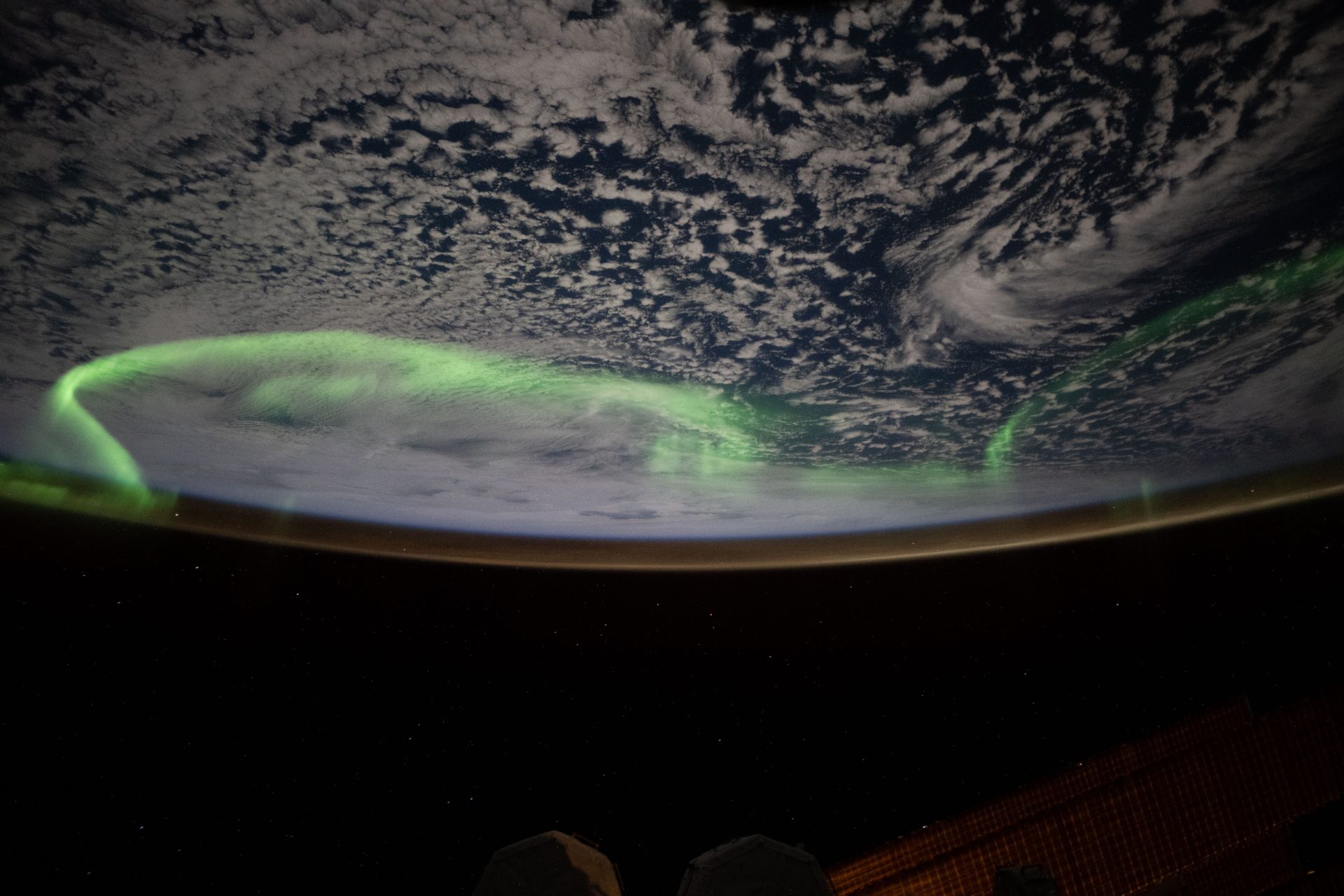
Aurora Australis
The aurora australis arcs above a partly cloudy Indian Ocean in this photograph from the International Space Station as it orbited 269 miles above in between Australia and Antarctica on June 12, 2025.
-
Earth views from Cupola during Ignis mission

Video:
00:00:40View of Earth as seen by ESA project astronaut Sławosz Uznański-Wiśniewski inside the seven-windowed cupola, the International Space Station’s “window to the world”.
The European Space Agency-built Cupola is the favourite place of many astronauts on the International Space Station. It serves not only as a unique photo spot, but also for observing robotic activities of the Canadian Space Agency’s robotic arm Canadarm2, arriving spacecraft and spacewalks.
Sławosz was launched to the International Space Station on the Dragon spacecraft as part of Axiom Mission 4 on 25 June 2025. The 20-day mission on board is known as Ignis.
During the Ignis mission, Sławosz conducted 13 experiments proposed by Polish companies and institutions and developed in collaboration with ESA, along with three additional ESA-led experiments. These covered a broad range of areas including human research, materials science, biology, biotechnology and technology demonstrations.The Ax-4 mission marks the second commercial human spaceflight for an ESA project astronaut. Ignis was sponsored by the Polish government and supported by ESA, the Polish Ministry of Economic Development and Technology (MRiT) and the Polish Space Agency (POLSA).
-
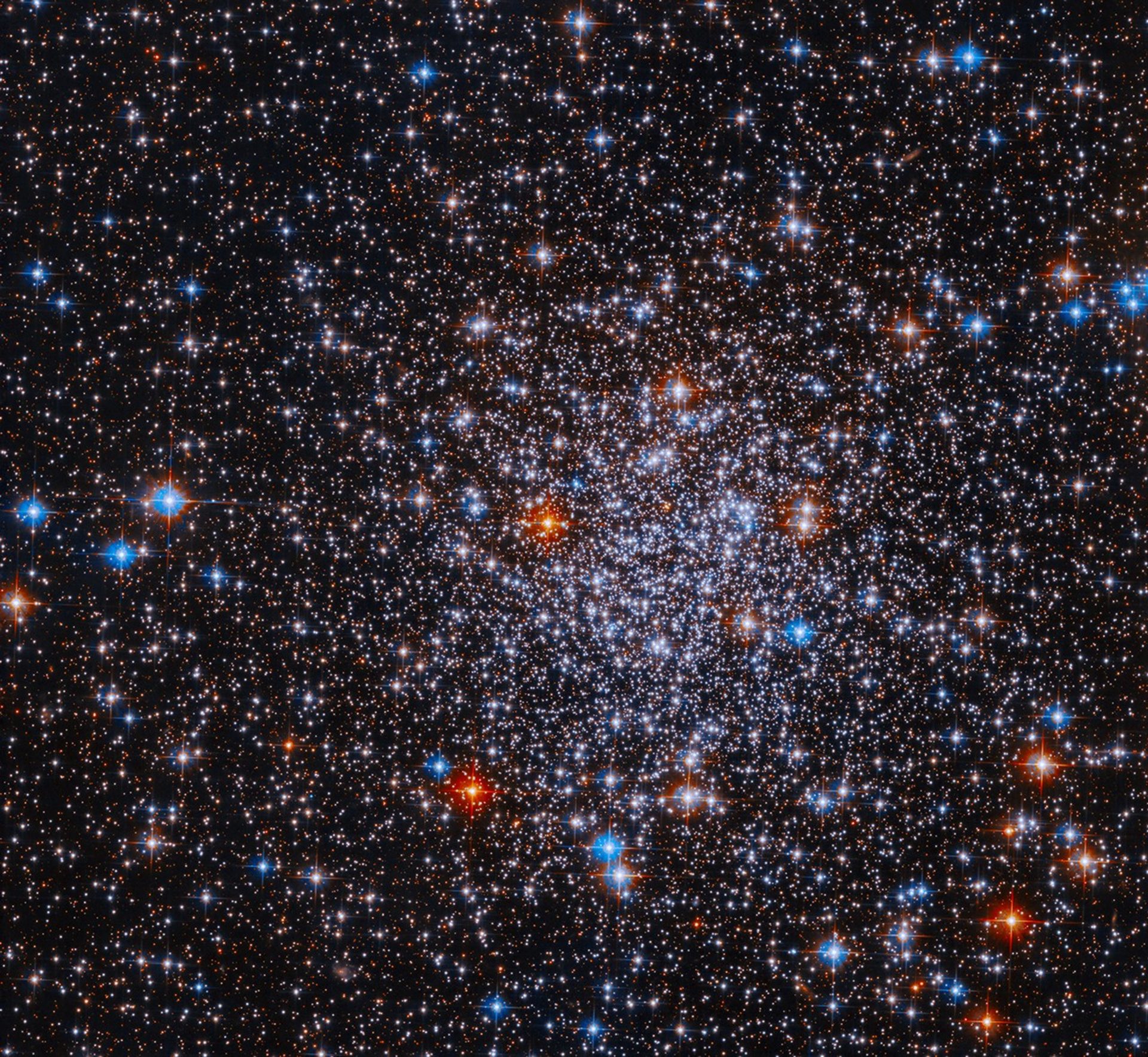
Hubble Observations Give “Missing” Globular Cluster Time to Shine
This NASA Hubble Space Telescope image features a dense and dazzling array of blazing stars that form globular cluster ESO 591-12.
-
Φsat-2 begins science phase for AI Earth images

Φsat-2, a miniature satellite, has completed its commissioning and has begun delivery of science data, using algorithms to efficiently process and compress Earth observation images, as well as detect wildfires, ships, marine pollution and more.
-
Smile passes gruelling set of tests

All its parts have been built and put together. It has been wrapped in shiny gold insulating foil. Its launch is getting closer. But the Smile spacecraft had one major phase to pass before it could be certified ready for space – and it involved testing, testing and yet more testing.
-
Testing, testing, testing – Let’s Smile (episode 3)

Video:
00:07:25Smile is a brand-new space mission currently in the making. It will study how Earth responds to the solar wind and solar storms.
At the European Space Agency’s technical heart in the Netherlands, engineers have spent the last four months carrying out ‘spacecraft environment testing’ – putting Smile through its paces to make sure it is ready for the shaky rocket launch, the vacuum of space and the extreme temperatures it will face in orbit around Earth.
Now all complete, Smile is one step closer to launch in 2026.
This video provides a glimpse into the testing process. It is the third episode in a series of short videos, and includes interviews with David Agnolon (ESA Smile Project Manager), Chris Runciman (ESA Smile System Engineer), Laura Malena Lottes (ESA Smile Mechanical Engineer), Benjamin Vanoutryve (ESA Smile AIT/AIV and Launcher Interface Principal Engineer), Li Jing (CAS Smile Project Manager), He Tau (CAS Smile Mechanical Engineer) and Zhu Xiaofei (CAS Smile Thermal Engineer).
Smile (the Solar wind Magnetosphere Ionosphere Link Explorer) is a joint mission between the European Space Agency and the Chinese Academy of Sciences. Smile is due to launch on a European Vega-C rocket in 2026. Follow the latest mission news via esa.int/smile.
Access the related broadcast quality video material
Access the other episodes of ‘Let’s Smile’
Completing the spacecraft – Let’s Smile (episode 2)
-
Ignis mission highlights

After 20 days in space, ESA project astronaut Sławosz Uznański-Wiśniewski and his Axiom Mission 4 (Ax-4) crewmates returned safely to Earth today, 15 July 2025.
-
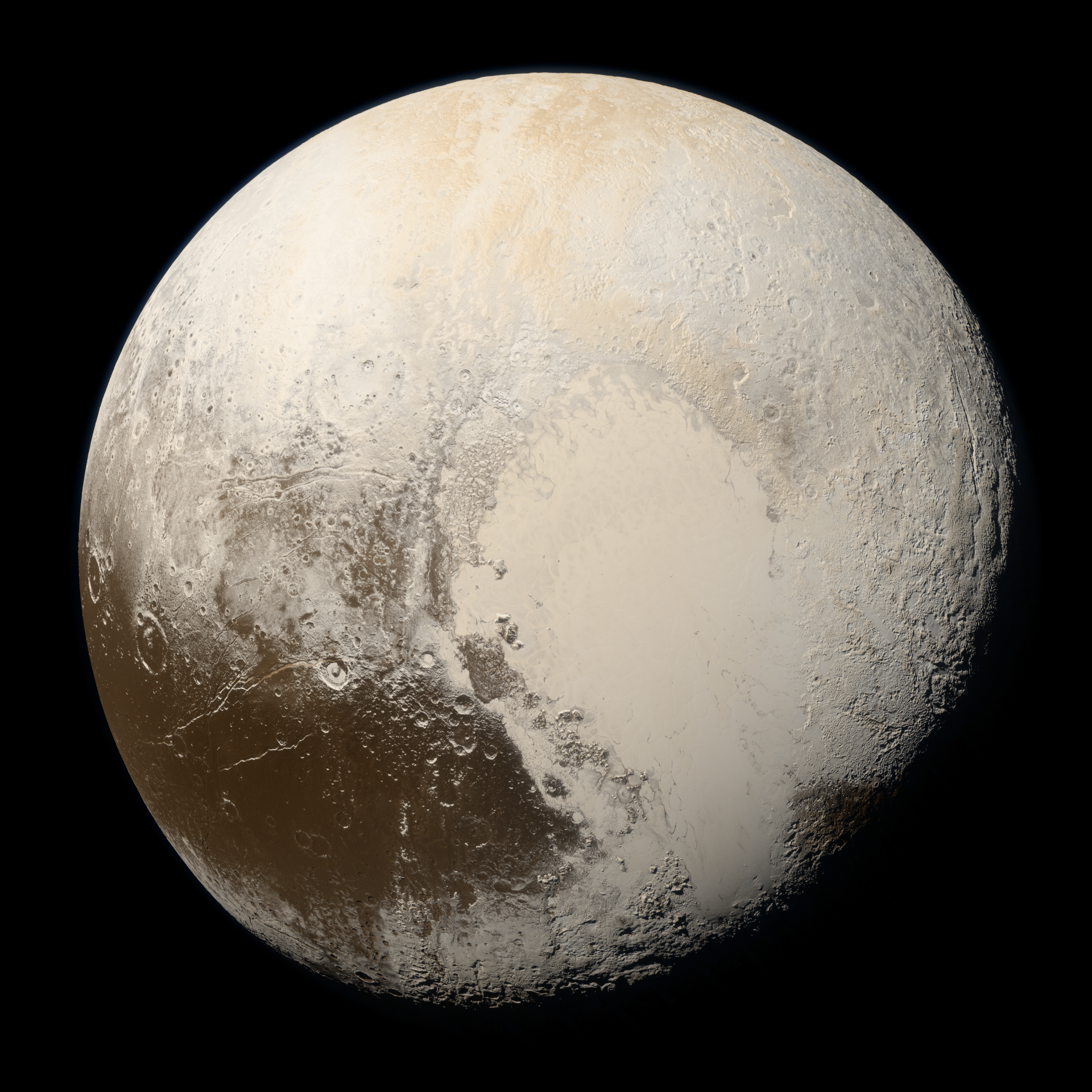
10 Years Ago: NASA’s New Horizons Captures Pluto’s Heart
This is the most accurate natural color image of Pluto taken by NASA’s New Horizons spacecraft in 2015.
-
You can’t judge a star by its protoplanetary disc

Image:This image tells the story of redemption for one lonely star. The young star MP Mus (PDS 66) was thought to be all alone in the Universe, surrounded by nothing but a featureless band of gas and dust called a protoplanetary disc. In most cases, the material inside a protoplanetary disc condenses to form new planets around the star, leaving large gaps where the gas and dust used to be. These features are seen in almost every disc – but not in MP Mus’s.
When astronomers first observed it with the Atacama Large Millimeter/submillimeter Array (ALMA), they saw a smooth, planet-free disc, shown here in the right image. The team, led by Álvaro Ribas, an astronomer at the University of Cambridge, UK, gave this star another chance and re-observed it with ALMA at longer wavelengths that peer even deeper into the protoplanetary disc than before. These new observations, shown in the left image, revealed a gap and a ring that had been obscured in previous observations, suggesting that MP Mus might have company after all.
Meanwhile, another piece of the puzzle was being revealed in Germany as Miguel Vioque, an astronomer at the European Southern Observatory, studied this same star with the European Space Agency’s (ESA’s) Gaia mission. Vioque noticed something suspicious – the star was wobbling. A bit of gravitational detective work, together with insights from the new disc structures revealed by ALMA, showed that this motion could be explained by the presence of a gas giant exoplanet.
Both teams presented their joint results in a new paper published in Nature Astronomy. In what they describe as “a beautiful merging of two groups approaching the same object from different angles”, they show that MP Mus isn’t so boring after all.
[Image description: This is an observation from the ALMA telescope, showing two versions (side-by-side) of a protoplanetary disc. Both discs are bright, glowing yellow-orange objects with a diffused halo against a dark background. The right disc is more smooth and blurry looking. The left disc shows more detail, for example gaps and rings within it.]
-
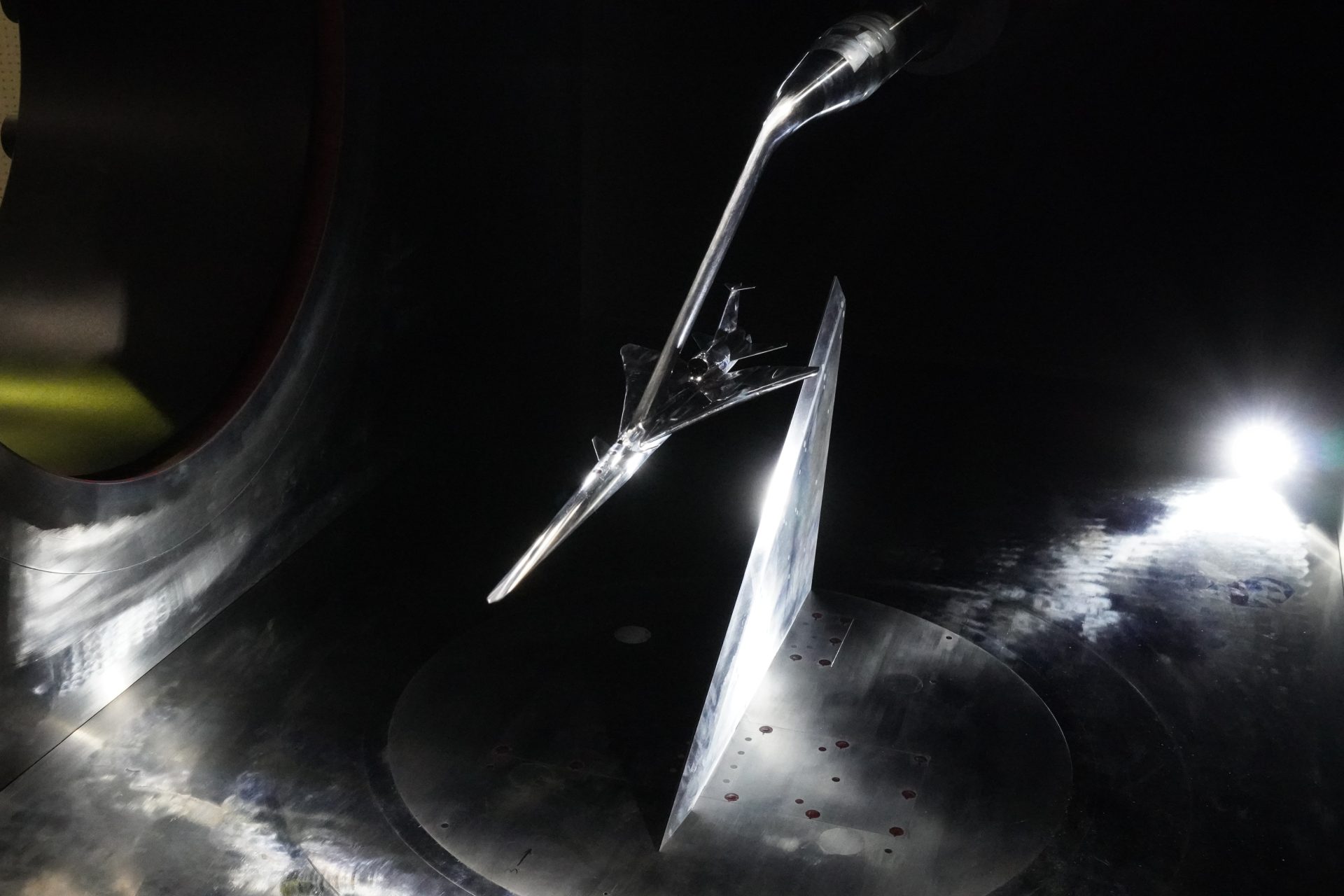
Putting the X-59 to the Test
Researchers from NASA and the Japanese Aerospace Exploration Agency (JAXA) recently tested a scale model of the X-59 experimental aircraft in a supersonic wind tunnel located in Chofu, Japan, to assess the noise audible underneath the aircraft. The test was an important milestone for NASA’s one-of-a-kind X-59, which is designed to fly faster than the speed of sound without causing a loud sonic boom.