Image:
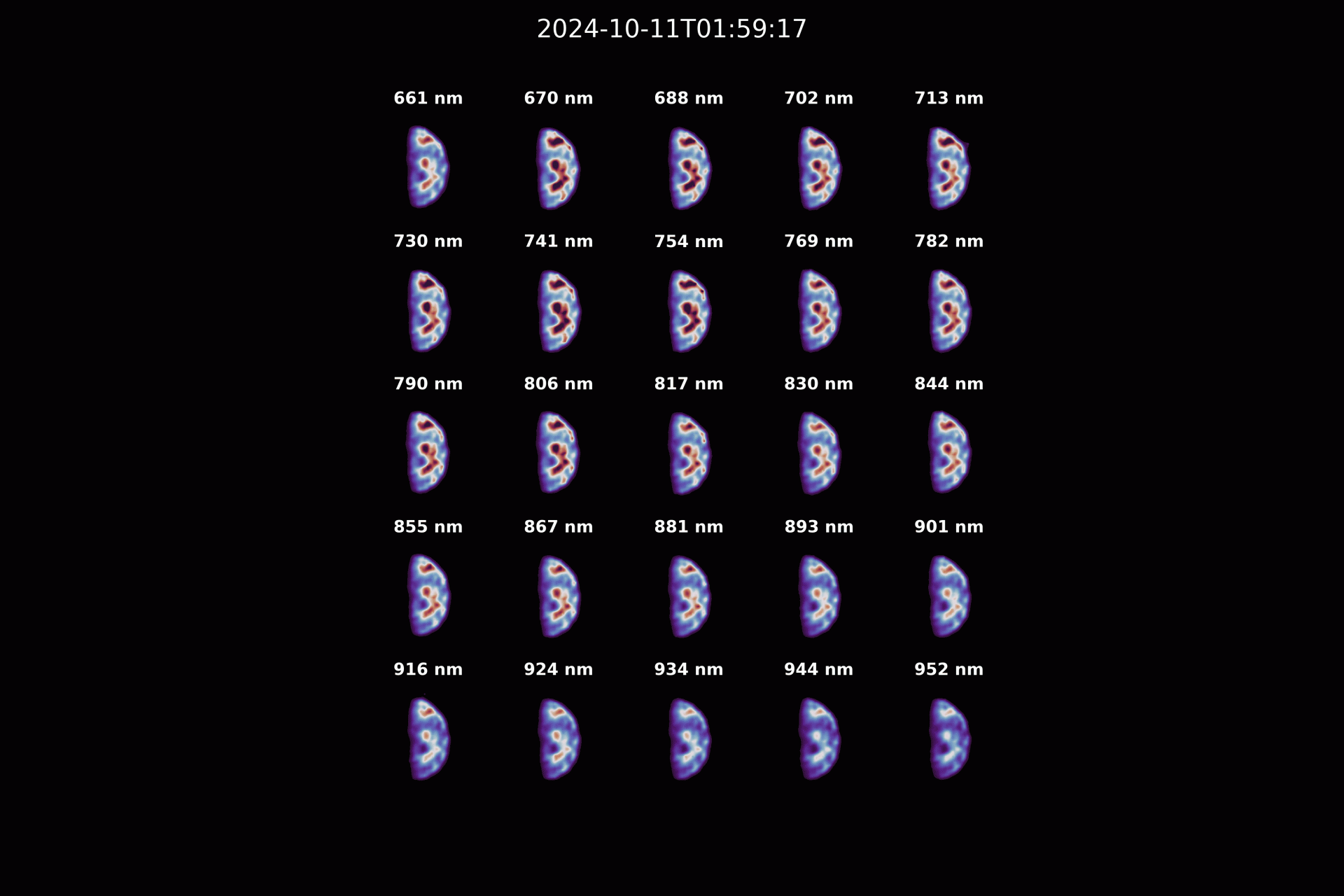
Spooky Earths seen by Hera’s HyperScout
Tag: ESA
-
Europe says farewell to eclipse-making Proba-3

ESA’s solar eclipse-making Proba-3 mission is about to leave Europe, to head to its launch site in India. The mission’s two spacecraft – which will manoeuvre precisely in Earth orbit so that one casts a shadow onto the other – have departed the facilities of Redwire Space in Kruibeke, Belgium. The pair will be flown to the Satish Dhawan Space Centre, near Chennai, for the launch campaign to begin.
-
Valencia flood disaster

Image:
Spain is suffering its worst flood in decades after torrential rains struck the eastern province of Valencia. These satellite images vividly illustrate the dramatic transformation of the landscape. -
Happy Heraween!

Video:
00:00:23Robots in disguise: our Hera asteroid detective plus her CubeSat buddies – Milani the rock decoder and Juventas the radar visionary – dressed up for Halloween!
To see them out of costume, watch our The Incredible Adventures of the Hera Mission series!
-
Ariel takes shape and first shake

Image:The construction phase of ESA’s Ariel mission has started at Airbus Defence and Space in Toulouse (France) with the assembly of the spacecraft’s structural model. This marks a significant step forward for this mission designed to meticulously inspect the atmospheres of a thousand exoplanets and uncover their nature.
In the image we see Ariel’s structural model coming together at the Airbus facilities. This model replicates the mechanical framework of the spacecraft and the mass of its various units for a first round of tough testing.
The Ariel’s structural model consists of two main components: a flight-like replica of the service module (bottom right) and a simplified mechanical mock-up of the payload module (top right). This assembly mimics the structure of the flight spacecraft, where the science instruments make up the payload while the service module houses the essential components for the functioning of the spacecraft, such as the propulsion, and the power and communication systems.
The goal for the end of the year is to complete the mechanical test campaign of the spacecraft’s structural model. This will ensure that Ariel’s design is up-to-spec and can withstand the mechanical strains expected during launch.
The testing phase will include vibration and acoustic test campaigns. During vibration tests the model will be progressively shaken at different strengths on a vibrating table, or ‘the shaker’. During acoustic tests, it will be placed in a reverberating chamber and ‘bombarded’ with very intense noise, like it will encounter during launch.
This model will also be used to assess how the loads are distributed and to perform a first ‘separation and shock’ test using the same mounting system as will be used to mount the spacecraft on the Ariane 6.
When ready, Ariel will be launched by an Ariane 6.2 rocket and journey to the second Lagrangian Point from where it will carry out its uniquely detailed studies of remote worlds.
Image description: A collage of three photographs that show the assembly of the model of a spacecraft in a large white hall. The first image on the left shows the entire model, with a person next to it who is nearly equal in height. The second image on the upper right zooms in on the top part of the mock science instrument: a circular fan-like structure with a big rectangular silver box on top. The third image on the lower right focuses on the bottom of the model, which looks like a large round silver box.
-
ESA Astronaut Reserve training kicks off at EAC

Image:
ESA Astronaut Reserve training kicks off at EAC -
Hera asteroid mission’s CubeSat passengers signal home

The two CubeSat passengers aboard ESA’s Hera mission for planetary defence have exchanged their first signals with Earth, confirming their nominal status. The pair were switched on to check out all their systems, marking the first operation of ESA CubeSats in deep space.
-
Paxi explores wind

Video:
00:04:21English Paxi explores wind
Learn about wind, what causes it and how and why we study it in the latest Paxi adventure
Spanish Paxi explora el viento
Aprende sobre el viento, qué lo provoca y cómo y por qué lo estudiamos en la última aventura de Paxi.
Romanian Paxi explorează vântul
Aflați despre vânt, ce îl provoacă și cum și de ce îl studiem în cea mai recentă aventură Paxi.
Portuguese Paxi explora o vento
Aprende sobre o vento, o que o provoca e como e porquê o estudamos na mais recente aventura Paxi.
Polish Paxi bada wiatr
Dowiedz się więcej o wietrze, jego przyczynach oraz o tym, jak i dlaczego go badamy w najnowszej przygodzie Paxi.
Norwegian Paxi utforsker vind
Lær mer om vind, hva som forårsaker den og hvordan og hvorfor vi studerer den i det nyeste Paxi-eventyret.
Italian Paxi osserva il vento
Imparate a conoscere il vento, le sue cause e come e perché lo studiamo nell’ultima avventura di Paxi.
Greek Ο Πάξι εξερευνά τον άνεμο
Μάθετε για τον άνεμο, τι τον προκαλεί και πώς και γιατί τον μελετάμε στην τελευταία περιπέτεια του Paxi.
German Paxi erforscht den Wind
Erfahren Sie im neuesten Paxi-Abenteuer mehr über Wind, seine Ursachen und wie und warum wir ihn untersuchen.
French Paxi te fait découvrir le vent
Découvrez le vent, ce qui le provoque et comment et pourquoi nous l’étudions dans la dernière aventure de Paxi.
Swedish Paxi utforskar vind
Lär dig mer om vind, vad som orsakar den och hur och varför vi studerar den i det senaste Paxi-äventyret.
Dutch Paxi onderzoekt wind
Leer meer over wind, wat het veroorzaakt en hoe en waarom we het bestuderen in het nieuwste Paxi-avontuur.
Danish Paxi udforsker vind
Lær om vind, hvad der forårsager den, og hvordan og hvorfor vi studerer den i det seneste Paxi-eventyr.
Czech Paxi zkoumá vítr
V nejnovějším dobrodružství Paxi se dozvíte, co vítr způsobuje, jak a proč ho studujeme.
Finnish Paxi tutkii tuulta
Tutustu tuuleen, sen syihin sekä siihen, miten ja miksi sitä tutkitaan uusimmassa Paxi-seikkailussa.
Estonian Paxi avastab tuult
Tutvu tuulega, selle põhjustega ning sellega, kuidas ja miks me seda uurime Paxi viimases seikluses.
-
Setting the course in space: highlights from IAC 2024

Video:
00:06:03From 14 to 18 October 2024, the International Astronautical Congress (IAC) returned for its 75th edition, and ESA took on a front-centre role, from presenting Europe’s future space ambitions and showcasing major steps towards them, to addressing global challenges alongside other world space leaders. Held at the Milano Congress Centre (MiCo), the largest conference venue in Europe, the event brought together more than 11 000 experts from industry, research institutions, and space agencies worldwide. The first four days featured a comprehensive programme of events and presentations for professionals and stakeholders, while the final day was open to the public.
-
Week in images: 21-25 October 2024

Week in images: 21-25 October 2024
Discover our week through the lens
-
Thin cool surface skin boosts ocean’s carbon uptake

New research, partially funded by ESA, reveals that the cool ‘ocean skin’ allows oceans to absorb more atmospheric carbon dioxide than previously thought. These findings could enhance global carbon assessments, shaping more effective emission-reduction policies.
-
Seven ways navigation tech contributes to sustainability

What does satellite navigation have to do with sustainable development? Quite a lot, in fact. Satnav and other positioning, navigation and timing (PNT) technologies provide critical data that support green solutions across numerous sectors. From enabling smart mobility to optimising energy grids and facilitating precision farming, the potential for PNT to drive sustainability is immense.
-
Earth from Space: Northern Ohio

Image:
This Copernicus Sentinel-2 image showcases the rich agricultural landscape of northern Ohio in the mid-western of the United States.