
Week in images: 11-15 November 2024
Discover our week through the lens
Week in images: 11-15 November 2024
Discover our week through the lens

Image:
These two images acquired by Copernicus Sentinel-2 highlight how the mission can help distinguish between clouds and snow.

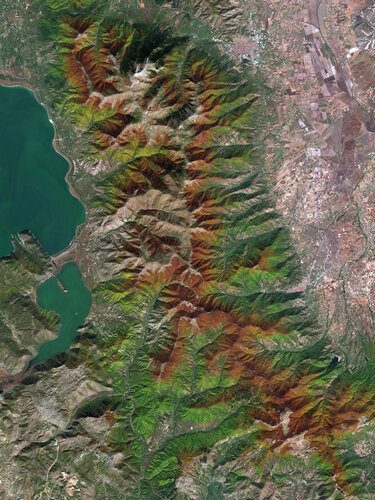
Today, the European Space Agency signed six contracts that will help position Greece as a key player in the field of Earth observation.

Video:
00:06:45
Smile is the Solar wind Magnetosphere Ionosphere Link Explorer, a brand-new space mission currently in the making. It will study space weather and the interaction between the solar wind and Earth’s environment.
Unique about Smile is that it will take the first X-ray images and videos of the solar wind slamming into Earth’s protective magnetic bubble, and its complementary ultraviolet images will provide the longest-ever continuous look at the northern lights.
In this first of several short videos, David Agnolon (Smile Project Manager) and Philippe Escoubet (Smile Project Scientist) talk about the why and the how of Smile. You’ll see scenes of the building and testing of the spacecraft’s payload module by Airbus in Madrid, including the installation of one of the European instruments, the Soft X-ray Imager from the University of Leicester.
Smile is a 50–50 collaboration between the European Space Agency (ESA) and the Chinese Academy of Sciences (CAS). ESA provides the payload module of the spacecraft, which carries three of the four science instruments, and the Vega-C rocket which will launch Smile to space. CAS provides the platform module hosting the fourth science instrument, as well as the service and propulsion modules.

ESA is taking a significant step towards creating a more digitally inclusive Europe through a new partnership that will bring internet access to the hardest-to-reach areas. Reliable connectivity has become essential in today’s digital age, yet for many Europeans in rural villages, mountainous regions, and small islands, dependable internet access remains out of reach.

A new European Space Agency-backed study shows that the extreme heatwaves of 2023, which fuelled huge wildfires and severe droughts, also undermined the land’s capacity to soak up atmospheric carbon. This diminished carbon uptake drove atmospheric carbon dioxide levels to new highs, intensifying concerns about accelerating climate change.

Video:
00:09:09
On 12 November 2014, after a ten-year journey through the Solar System and over 500 million kilometres from home, Rosetta’s lander Philae made space exploration history by touching down on a comet for the first time. On the occasion of the tenth anniversary of this extraordinary feat, we celebrate by taking a look back over the mission’s highlights.
Rosetta was an ESA mission with contributions from its Member States and NASA. It studied Comet 67P/Churyumov-Gerasimenko for over two years, including delivering lander Philae to the comet’s surface. Philae was provided by a consortium led by DLR, MPS, CNES and ASI.
read the article Philae’s extraordinary comet landing relived.

On 12 November 2014, after a ten year journey through the Solar System and over 500 million kilometres from home, Rosetta’s lander Philae made space exploration history by touching down on a comet for the first time. On the occasion of the tenth anniversary of this extraordinary feat, we celebrate Philae’s impressive achievements at Comet 67P/Churyumov-Gerasimenko.
Week in images: 04-08 November 2024
Discover our week through the lens
This compilation of images, captured by the Copernicus Sentinel-2 mission, showcases the characteristic hues of autumn in different European countries.
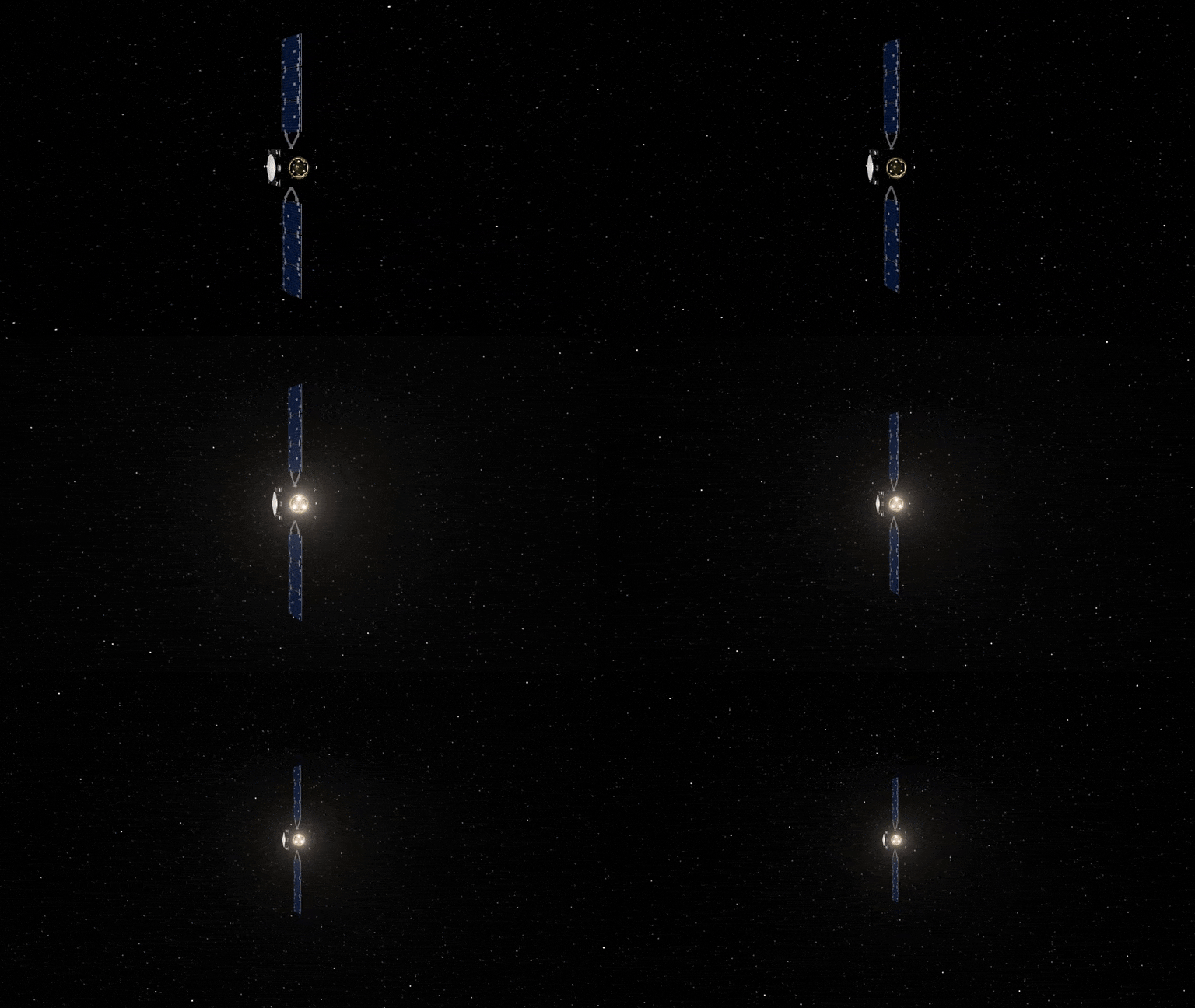
ESA’s Hera mission has completed the first critical manoeuvre on its journey to the Didymos binary asteroid system since launch on 7 October.

