Category: Solar system

http://www.nasa.gov/rss/dyn/solar_system.rss

  • Tracing the Origin and Energization of Plasma inthe Heliosphere

    5 Min Read

    Tracing the Origin and Energization of Plasma inthe Heliosphere

    An artist’s depiction of dark starry background with the Sun in the upper right corner, the Earth in the center, and a circular spacecraft in the bottom left corner. Gold lines stream away from the Sun on all directions, colliding with Earth.

    Credits:
    Stephen Alvey, University of Michigan

    PROJECT:

    Solar Wind Pickup Ion Composition Energy Spectrometer (SPICES)

    SNAPSHOT:

    SPICES is a new sensor that will help scientists discover where matter originates and how it is energized throughout the solar system

    An artist’s depiction of dark starry background with the Sun in the upper right corner, the Earth in the center, and a circular spacecraft in the bottom left corner. Gold lines stream away from the Sun on all directions, colliding with Earth.
    SPICES will measure plasma in space and trace its origin back to the Sun, planetary atmospheres, comet tails, and interstellar space.
    Credits: Stephen Alvey, University of Michigan

    Imagine that you have a secret decoder ring that you can use to decipher a secret message with important clues about things around you: where they came from, why they are there, and what will become of them in the future. Now imagine that the secret decoder ring is actually a sensor that can be flown in space to unravel secrets about the matter in the solar system. Where did this matter originate, how did it become energized, and how could it impact humans living on Earth and traveling in space? SPICES is like a decoder ring for the plasma (gas consisting of electrically charged particles) in the solar system. It has the potential to reveal important information about how the Sun behaves and interacts with planets and their atmospheres, and how the solar system is impacted by its own motion through interstellar space. 

    The universe is mostly made of hydrogen, but the elements that make up life as well as the planets, comets, and many other celestial bodies are heavier than hydrogen. In fact, these heavier elements, although not as abundant, can hold the key to understanding how numerous processes in the universe work. In our solar system, these “heavy elements”—which are called “heavy ions” when they are electrically charged—can help us trace plasma to its origin at planets, comets, the Sun and solar atmosphere, and even to interstellar space. 

    Heavy ions are an important piece of the puzzle that describes how the solar system supports and sustains life. They also play a role in large eruptions on the Sun that cause solar storms. For example, solar flares that emit vast amounts of X-rays are mostly due to excitation of heavy ions on the Sun. Being able to predict and prepare for solar storms is important to keep humans and robotics safe on space missions. SPICES will enable us to better understand how these solar storms form by giving scientists information about how eruptions on the Sun occur and how they accelerate plasma. With this information, scientists can better predict when and how severe solar storms will be. 

    SPICES is designed to measure the chemical makeup of electrically charged streams of particles (also called wind) that blow in space. SPICES will measure the solar wind—the wind that blows away from the Sun, including the wind that results from the most severe solar storms. It will also measure neutral wind that blows into the solar system from interstellar space and becomes charged as it encounters the Sun, and wind that blows off planetary surfaces and out of planetary atmospheres. Measuring the chemical composition of these streams of particles can help us understand how the solar system was created, its behavior today, and how it will behave in the future. 

    SPICES is optimized to detect less common heavy ions—like low-charge ions and isotopes—that are not well measured by current spaceborne sensors. The SPICES design incorporates a novel and state-of-the-art method of boosting the energy of incoming ions so that their fingerprints can be more clearly identified, allowing the abundance and variability of these rare species to be accurately measured. Some of these rarer species are only found inside solar storms and can change how these storms interact with Earth’s space environment. 

    But boosting the energy of these incoming ions is challenging; it must be done safely, without putting the SPICES electronics or other instruments at risk, and without heating the sensor up too much.  The methods used on SPICES to boost the ion energy are based on traditional methods, but the new design can boost the ion energy 60% higher than prior space sensors by stepping up the energy one stage at a time to reach the maximum level desired. The design also incorporates a protective bubble to shield electronics and other onboard systems from the high energy ions generated by SPICES.  SPICES will soon be ready to fly on upcoming missions that study the global behavior of the Sun, planetary atmospheres, monitor space weather, or fly out to the edges of the solar system into interstellar space. 

    This engineering challenge is being tackled by engineers at the University of Michigan Space Physics Research Laboratory, with contributions from Southwest Research Institute in Texas.  The sensor’s original design was a result of collaboration of scientists at the University of Michigan including Dr. George Gloeckler, one of the pioneers of space-based ion mass spectrometers; Professor Susan Lepri; Dr. Jason Gilbert; and Associate Professor Jim Raines. 

    PROJECT LEAD:

    Professor Susan Lepri, The University of Michigan

    SPONSORING ORGANIZATION

    Heliophysics Strategic Technology Office (HESTO)

  • NASA’s Roman Mission Gears Up for a Torrent of Future Data

    NASA’s Nancy Grace Roman Space Telescope team is exploring ways to support community efforts that will prepare for the deluge of data the mission will return. Recently selected infrastructure teams will serve a vital role in the preliminary work by creating simulations, scouting the skies with other telescopes, calibrating Roman’s components, and much more.

    Their work will complement additional efforts by other teams and individuals around the world, who will join forces to maximize Roman’s scientific potential. The goal is to ensure that, when the mission launches by May 2027, scientists will already have the tools they need to uncover billions of cosmic objects and help untangle mysteries like dark energy.

    “We’re harnessing the science community at large to lay a foundation, so when we get to launch we’ll be able to do powerful science right out of the gate,” said Julie McEnery, Roman’s senior project scientist at NASA’s Goddard Space Flight Center in Greenbelt, Maryland. “There’s a lot of exciting work to do, and many different ways for scientists to get involved.”

    Thousands of tiny red dots speckle a black background like spilled salt. Additional yellow blobs that are slightly larger and appear more like galaxies, are overlaid on top and a few areas appear to bloom outward and slightly warp. Then even more galaxies, this time yellow and white, are overlaid over that, and the other areas
    This animation shows a simulation of the type of science that astronomers will be able to do with future deep field observations from NASA’s Nancy Grace Roman Space Telescope. The gravity of intervening galaxy clusters and dark matter can lens the light from farther objects, warping their appearance as shown in the animation. By studying the distorted light, astronomers can study elusive dark matter, which can only be measured indirectly through its gravitational effects on visible matter. As a bonus, this lensing also makes it easier to see the most distant galaxies whose light they magnify. Simulations like this one help astronomers understand what Roman’s future observations could tell us about the universe, and provide useful data to validate data analysis techniques.
    Credit: Caltech-IPAC/R. Hurt

    Simulations lie at the heart of the preparatory efforts. They enable scientists to test algorithms, estimate Roman’s scientific return, and fine-tune observing strategies so that we’ll learn as much as possible about the universe.

    Teams will be able to sprinkle different cosmic phenomena through a simulated dataset and then run machine learning algorithms to see how well they can automatically find the phenomena. Developing fast and efficient ways to identify underlying patterns will be vital given Roman’s enormous data collection rate. The mission is expected to amass 20,000 terabytes (20 petabytes) of observations containing trillions of individual measurements of stars and galaxies over the course of its five-year primary mission.

    “The preparatory work is complex, partly because everything Roman will do is quite interconnected,” McEnery said. “Each observation is going to be used by multiple teams for very different science cases, so we’re creating an environment that makes it as easy as possible for scientists to collaborate.”

    Some scientists will conduct precursor observations using other telescopes, including NASA’s Hubble Space Telescope, the Keck Observatory in Hawaii, and Japan’s PRIME (Prime-focus Infrared Microlensing Experiment) located in the South African Astronomical Observatory in Sutherland. These observations will help astronomers optimize Roman’s observing plan by identifying the best individual targets and regions of space for Roman and better understand the data the mission is expected to deliver.

    Some teams will explore how they might combine data from different observatories and use multiple telescopes in tandem. For example, using PRIME and Roman together would help astronomers learn more about objects found via warped space-time. And Roman scientists will be able to lean on archived Hubble data to look back in time and see where cosmic objects were and how they were behaving, building a more complete history of the objects astronomers will use Roman to study. Roman will also identify interesting targets that observatories such as NASA’s James Webb Space Telescope can zoom in on for more detailed studies.

    A series of images showing wispy stellar streams surrounding eight individual galaxies. Light and dark are reversed so that the background is gray-white and the galaxies appear as black blobs. Extending out from each like tentacles are streams of stars.
    This series of images shows how astronomers find stellar streams by reversing the light and dark, similar to negative images, but stretched to highlight the faint streams. Color images of each of the nearby galaxies featured are superposed to scale to highlight the easily visible disk. Galaxies are surrounded by enormous halos of hot gas sprinkled with sporadic stars, seen as the shadowy regions that encase each galaxy here. NASA’s upcoming Nancy Grace Roman Space Telescope is expected to improve on these observations by resolving individual stars to understand each stream’s stellar populations and see stellar streams of various sizes in even more galaxies.
    Credit: Carlin et al. (2016), based on images from Martínez-Delgado et al. (2008, 2010)

    It will take many teams working in parallel to plan for each Roman science case. “Scientists can take something Roman will explore, like wispy streams of stars that extend far beyond the apparent edges of many galaxies, and consider all of the things needed to study them really well,” said Dominic Benford, Roman’s program scientist at NASA Headquarters in Washington, D.C. “That could include algorithms for dim objects, developing ways to measure star positions very precisely, understanding how detector effects could influence the observations and knowing how to correct for them, coming up with the most effective strategy to image stellar streams, and much more.”

    One group is developing processing and analysis software for Roman’s Coronagraph Instrument. This instrument will demonstrate several cutting-edge technologies that could help astronomers directly image planets beyond our solar system. This team will also simulate different objects and planetary systems the Coronagraph could unveil, from dusty disks surrounding stars to old, cold worlds similar to Jupiter.

    The mission’s science centers are gearing up to manage Roman’s data pipeline and archive and establishing systems to plan and execute observations. As part of a separate, upcoming effort, they will convene a survey definition team that will take in all of the preparatory information scientists are generating now and all the interests from the broader astronomical community to determine Roman’s optimal observation plans in detail.

    “The team is looking forward to coordinating and funneling all the preliminary work,” McEnery said. “It’s a challenging but also exciting opportunity to set the stage for Roman and ensure each of its future observations will contribute to a wealth of scientific discoveries.”

    The Nancy Grace Roman Space Telescope is managed at NASA’s Goddard Space Flight Center in Greenbelt, Maryland, with participation by NASA’s Jet Propulsion Laboratory and Caltech/IPAC in Southern California, the Space Telescope Science Institute in Baltimore, and a science team comprising scientists from various research institutions. The primary industrial partners are Ball Aerospace and Technologies Corporation in Boulder, Colorado; L3Harris Technologies in Melbourne, Florida; and Teledyne Scientific & Imaging in Thousand Oaks, California.

    By Ashley Balzer
    NASA’s Goddard Space Flight Center, Greenbelt, Md.

    Media contact:

    Claire Andreoli
    NASA’s Goddard Space Flight Center, Greenbelt, Md.
    301-286-1940

  • Five Tips for Photographing the Annular Solar Eclipse on Oct. 14

    3 min read

    Five Tips for Photographing the Annular Solar Eclipse on Oct. 14

    A woman, seen from the torso up, stands on a beach. She is wearing white solar viewing glasses and has a camera strap around her neck.
    Sarah Baker views the partial solar eclipse as the sun rises, Thursday, June 10, 2021, at Lewes Beach in Delaware.
    NASA/Aubrey Gemignani

    An annular solar eclipse is crossing the Americas on Oct. 14, 2023. This astronomical event is a perfect opportunity to capture unforgettable images of the Moon “taking a bite” out of the Sun or creating a “ring of fire” effect in the sky. Whether you’re an amateur photographer or a selfie master, try out these tips for photographing the eclipse. 

    #1 – Safety First

    To take images as the Sun is being eclipsed, you’ll need to use a special solar filter to protect your camera, just as you’ll need a pair of eclipse glasses to protect your own eyes. 

    Having a few other pieces of equipment can also come in handy during the eclipse. Using a tripod can help you stabilize the camera and avoid taking blurry images during the low lighting. Additionally, using a delayed shutter release timer will allow you to snap shots without jiggling the camera.

    #2 – Any Camera Is a Good Camera

    Taking a stunning photo has more to do with the photographer than the camera. Whether you have a high-end DSLR, or a camera phone, you can take great photos during the eclipse; after all, the best piece of equipment you can have is a good eye and a vision for the image you want to create. If you don’t have a telephoto zoom lens, focus on taking landscape shots, which capture the changing environment.

    Trees line the landscape. On the right, a camera sits on a tripod. Two hands hold either side of the camera.
    A safe solar filter must be used in front of a camera lens whenever photographing an annular solar eclipse or a partial solar eclipse. Putting the camera on a tripod will help stabilize the view and produce clearer photos.
    Danny B. Thomas

    #3 – Look Up, Down, All Around

    While the Sun is the most commanding element of an eclipse, remember to look around you. As the Moon slips in front of the Sun, the landscape will be bathed in long shadows, creating eerie lighting across the landscape. Light filtering through the overlapping leaves of trees create natural pinholes, which will also create mini eclipse replicas on the ground. Everywhere you can point your camera can yield exceptional imagery, so be sure to compose some wide-angle photos that can capture your eclipse experience.

    NASA photographer Bill Ingalls recommends focusing on the human experience of watching the eclipse. “The real pictures are going to be of the people around you pointing, gawking, and watching it,” Ingalls noted. “Those are going to be some great moments to capture to show the emotion of the whole thing.”

    #4 – Practice

    Be sure you know the capabilities of your camera before eclipse day. Most cameras, and even many camera phones, have adjustable exposures, which can help you darken or lighten your image during the tricky eclipse lighting. Make sure you know how to manually focus the camera for crisp shots.

    For DSLR cameras, the best way to determine the correct exposure is to test settings on the uneclipsed Sun beforehand. Using a fixed aperture of f/8 to f/16, try shutter speeds between 1/1000 to 1/4 second to find the optimal setting, which you can then use to take images during the partial or annular stages of the eclipse.

    #5 – Share!

    Share your eclipse experience with friends and family afterwards. Tag @NASA to connect your photos on social media to those taken around the country and share them with NASA. 

    While you’re out perfecting your perfect eclipse shot, don’t forget to stop and look at the eclipse with your own eyes. Just remember to wear your solar viewing glasses (or “eclipse glasses”) throughout the entire eclipse!

    Details

    Last Updated

    Oct 10, 2023

  • Evolution Space to Produce and Test Solid Rocket Motors at NASA Stennis

    3 min read

    Evolution Space to Produce and Test Solid Rocket Motors at NASA Stennis

    NASA’s Stennis Space Center near Bay St. Louis, Mississippi, joined with Evolution Space on Oct. 10 to announce plans for the aerospace company to establish production and testing operations for solid rocket motors onsite.

    “This is another great addition to south Mississippi’s commercial space engagement,” Center Director Dr. Rick Gilbrech said. “Evolution Space gains access to critical NASA Stennis infrastructure and expertise as it continues to build its propulsion capabilities. In turn, we continue frontline work with commercial companies as we support NASA’s commitment to increase access to space and grow our federal city. We look forward to working with Evolution Space.”

    The announcement grants access for Evolution Space to establish its Minor Scale Propulsion Center, while also opening the door to a larger future presence at the center. It also marks the first time in NASA Stennis’ 62-year history to support production and testing of solid rocket motors, and continues the center’s efforts to maximize use of its unique location, operating model, and propulsion infrastructure and capabilities by commercial aerospace companies and others.

    “By partnering with NASA, we are able to rapidly stand up a facility which will add considerable capability to the US solid rocket motor industrial base,” said Manny Ballestero, a U.S. Army veteran and Evolution Space vice president of production and development. “We look forward to the future of our partnership as we continue to expand our presence at Stennis.”

    Under the arrangement, Evolution Space gains access to previously vacant NASA Stennis facilities to mix, cast, and store propellants. The company’s production facility is expected to be operational by spring 2024. It also will use the E-3 Test Complex at NASA Stennis to conduct solid rocket motor hot fires onsite for the first time. Evolution Space will provide all equipment, components, and electrical systems needed for a blended team of company and NASA personnel to test the motors.

    “Evolution Space is moving fast and scaling with purpose,” added Josh Marino, U.S. Navy veteran and vice president of operations at Evolution Space. “We see our collaboration with the NASA Stennis propulsion center as a strategic expansion to help meet the growing demands of both the commercial and defense sectors.”

    The news represents the latest collaboration between NASA Stennis and a commercial aerospace company. The nation’s largest propulsion test site, NASA Stennis features a secure setting and 125,000-acre acoustical buffer zone that enables 365/24/7 operations and testing. Historically, the site has supported propulsion projects that use liquid fuels and oxidizers as propellants. For solid rocket motors, fuel and oxidizer are mixed together into a solid propellant.

    “This is an exciting agreement for NASA Stennis,” said Duane Armstrong, manager of the NASA Stennis Strategic Business Development Office. “It is yet another demonstration of the value of the center and its ability to support a range of commercial aerospace companies.”

    For information about Stennis Space Center, visit: www.nasa.gov/centers/stennis/.

    C. Lacy Thompson
    Stennis Space Center, Bay St. Louis, Mississippi
    228-363-5499
    calvin.l.thompson@nasa.gov

    Details

    Last Updated

    Oct 10, 2023

    Editor

    Contact

    Location

    Stennis Space Center

    Related Terms

  • Hubble Examines Entrancing Galaxy in Eridanus

    2 min read

    Hubble Examines Entrancing Galaxy in Eridanus

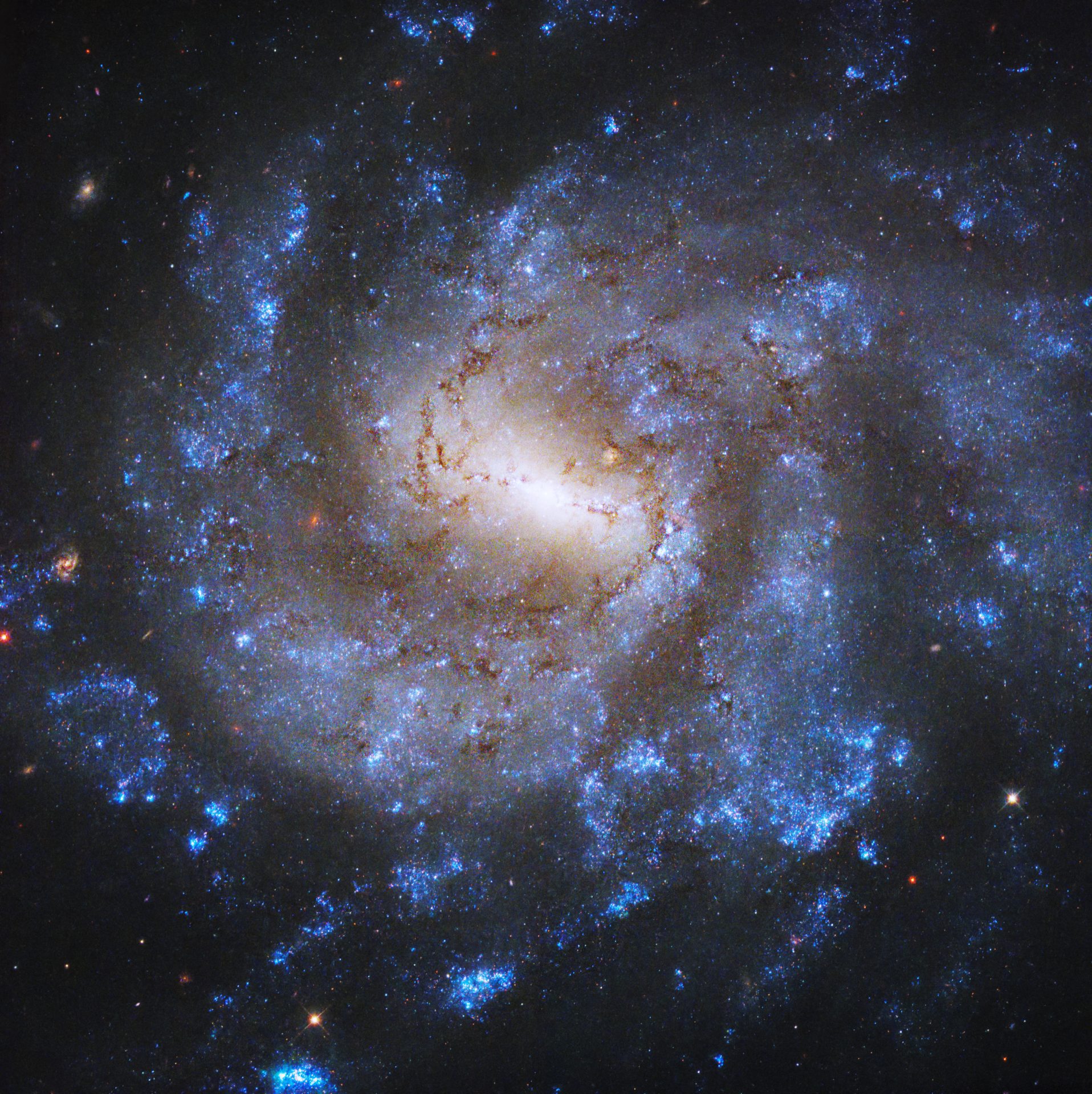
    A face-on spiral galaxy with bright, blue-white spiral arms and dark, reddish-brown dust lanes. A bright-white bar of stars extends through the center of the galaxy. Small, more distant, reddish galaxies are visible in the background.
    NASA’s Hubble Space Telescope’s view of NGC 685 in the constellation Eridanus, the River.
    NASA, ESA, and J. Lee (Space Telescope Science Institute); Processing: Gladys Kober (NASA/Catholic University of America)

    Hubble is sharing a brand new galaxy image every day through October 7, 2023!
    Visit our website daily, or follow along on X, Facebook, and Instagram.

    NGC 685 takes center stage amid faintly twinkling stars on an inky black background. This galaxy is clearly a barred spiral galaxy with its bright center bar and patchy, curving arms. It is about 58 million light-years away in the constellation Eridanus. NGC 685 lies south of the celestial equator and is visible from the southern hemisphere at certain times of the year.

    British astronomer John Herschel discovered NGC 685 in 1834, and early observers noted its apparent roundness. The whole galaxy is about 60,000 light-years across – a little more than half the size of our Milky Way. The patches of bright blue along the galaxy’s arms are star clusters, groups of stars held together by their mutual gravitational attraction. Wisps of dark red near the central bar depict interstellar gas and dust, the matter from which stars form. About two-thirds of all spiral galaxies have a central bar like NGC 685. Its intense glow comes from many stars concentrated in a relatively small area.

    NASA’s Hubble Space Telescope took this image as part of a scientific effort to study star cluster formation and evolution. Hubble’s ultraviolet capabilities are well-suited to this task, since young stars shine brightly at ultraviolet wavelengths. An average-sized galaxy like NGC 685 can have around 100 million stars, which is on the low end.

    Media Contact:

    Claire Andreoli
    NASA’s Goddard Space Flight CenterGreenbelt, MD
    claire.andreoli@nasa.gov

  • Astronaut Loral O’Hara is pictured trimming her hair

    NASA astronaut and Expedition 70 Flight Engineer Loral O'Hara is pictured trimming her hair aboard the International Space Station.
    iss070e000663 (Sept. 30, 2023) — NASA astronaut and Expedition 70 Flight Engineer Loral O’Hara is pictured trimming her hair aboard the International Space Station.
    NASA
  • Astronaut Jasmin Moghbeli works on exercise hardware

    NASA astronaut and Expedition 70 Flight Engineer Jasmin Moghbeli replaces cables on the advanced resistive exercise device inside the International Space Station's Tranquility module.
    iss070e001594 (Oct. 2, 2023) — NASA astronaut and Expedition 70 Flight Engineer Jasmin Moghbeli replaces cables on the advanced resistive exercise device inside the International Space Station’s Tranquility module.
    NASA
  • Astronaut Andreas Mogensen is pictured with a new exercise cycle

    ESA (European Space Agency) astronaut and Expedition 70 Commander Andreas Mogensen is pictured with the International Space Station's new exercise cycle after it was installed in the Destiny laboratory module.
    iss070e001677 (Oct. 3, 2023) — ESA (European Space Agency) astronaut and Expedition 70 Commander Andreas Mogensen is pictured with the International Space Station’s new exercise cycle after it was installed in the Destiny laboratory module.
    NASA
  • Astronaut Satoshi Furukawa works in the Kibo laboratory module

    JAXA (Japan Aerospace Exploration Agency) astronaut and Expedition 70 Flight Engineer Satoshi Furukawa loads camera and light hardware into the Kibo laboratory module's airlock that will be installed outside the International Space Station.
    iss070e002150 (Oct. 5, 2023) — JAXA (Japan Aerospace Exploration Agency) astronaut and Expedition 70 Flight Engineer Satoshi Furukawa loads camera and light hardware into the Kibo laboratory module’s airlock that will be installed outside the International Space Station.
    NASA
  • Astronaut Loral O’Hara shows off spacewalking tools

    NASA astronaut and Expedition 70 Flight Engineer Loral O'Hara shows off tools she will use during a spacewalk to swab surfaces on the International Space Station and collect potential microbe samples for analysis.
    iss070e002159_alt (Sept. 30, 2023) — NASA astronaut and Expedition 70 Flight Engineer Loral O’Hara shows off tools she will use during a spacewalk to swab surfaces on the International Space Station and collect potential microbe samples for analysis.
    NASA
  • The cities of Khartoum and Omdurman in Sudan

    The cities of Khartoum and Omdurman in Sudan are pictured from the International Space Station as it orbited 258 miles above the African nation.
    iss070e002191 (Oct. 6, 2023) — The cities of Khartoum and Omdurman in Sudan are pictured from the International Space Station as it orbited 258 miles above the African nation.
    NASA
  • The cities of Khartoum and Omdurman in Sudan are pictured from the International Space Station as it orbited 258 miles above the African nation.
    iss070e002272 (Oct. 6, 2023) — The Jibāl Hawlad mountain range, near the Red Sea, is pictured in the African nation of Sudan as the International Space Station orbited 258 miles above.
    NASA
  • NASA’s Global Science Hackathon Attracts Thousands of Participants

    NASA's 2023 Space Apps Challenge
    NASA

    More than 50,000 participants have registered for the 2023 NASA Space Apps Challenge Saturday, Oct. 7, to Sunday, Oct. 8, which is the largest annual worldwide hackathon.

    During the two-day event, participants form teams and use software development, engineering, art, storytelling, science, and other skills to solve science-related challenges written by NASA personnel. Teams can be in-person at local events held around the world, or participate virtually.

    This year’s theme celebrates the benefits and successes created through sharing open data: Explore Open Science Together.

    “NASA has a 60-year legacy of pushing the limits of how science is used to understand our universe,” said Nicola Fox, associate administrator for science at NASA Headquarters in Washington. “This year’s Space Apps challenge supports one of our key goals to expand those limits: Spark a culture that ensures and insists our data is easily accessible for everyone. Open science produces research that is transparent, reproducible, and replicable – while increasing diversity and inclusion.”  

    The Space Apps Challenge experience provides a platform to network locally and globally, develop new skills, and identify pathways to pursue academic and professional opportunities.

    Here is a list of hackathon activities online:

    • Follow activities on Space Apps X, Space Apps Facebook, and Space Apps Instagram accounts. Use #SpaceApps on social posts.
    • 5 p.m. EDT on Friday: “Welcome to Space Apps” kick-off video premieres on the Space Apps YouTube page
    • 2:30 a.m. EDT on Sunday: Instagram Live on the Space Apps account featuring four local events from around the world (Italy, Australia, and two from across the United States)

    Once the hackathon concludes, projects are submitted for judging to NASA and other space agency experts. Participants compete for one of 10 global awards. Winners are expected to be announced in January 2024, followed by a winners’ celebration in June.

    Thirteen space agencies, as well as community partners and volunteers from around the world, collaborate with NASA to host a successful hackathon. Since its inception in 2021, the challenge has engaged more than 260,000 registrants from nearly 200 countries/territories around the world to build innovative solutions to challenges faced on Earth and in space. There is no cost to participate.

    Learn more about NASA’s Space Apps Challenge online:

    https://www.spaceappschallenge.org/2023/challenges/