iss070e002586 (Oct. 7, 2023) — Southern Italy (to the right of the image) meets Sicily (to the left), the largest island in the Mediterranean Sea and one of 20 Italian regions. At its closest point, Sicily resides only 2 miles (~3.2km) from mainland, the two connected by the Strait of Messina. From 260 miles above, the International Space Station offers a unique vantage point of where the two regions meet.
Cyclists compete during the bicycle portion of “Racin’ the Station.”
Credits: NASA/Mick Speer
Marshall Presents Small Business Awards for 2023
NASA’s Marshall Space Flight Center honored top contractors, subcontractors, teams, and individuals of fiscal year 2023 at the 36th meeting of the Marshall Small Business Alliance.
David Brock, small business specialist at Marshall Space Flight Center, welcomes attendees of the 36th Marshall Small Business Alliance meeting and 17th Industry & Advocate Awards.
NASA/Mick Speer
The event took place Sept. 21 at the U.S. Space & Rocket Center’s Davidson Center for Space Exploration. Around 600 participants from industry and government gathered to network, learn about business opportunities, and recognize outstanding achievements in support of NASA’s mission and the small business community.
“Marshall is an engine of opportunity for its community and beyond,” said David Brock, small business specialist in Marshall’s Office of Procurement.
Leah Fox, program specilaist for Marshall’s Center Operations talks with an attendee of the 36th Marshall Small Business Alliance Meeting.
NASA/Mick Speer
Marshall’s Industry & Advocate Awards are presented annually and reflect leadership in business community and sustained achievement in service to NASA’s mission.
This year’s award recipients are:
Small Business Prime Contractor of the Year
Victory Solutions Inc.
Small Business Subcontractor of the Year
Waterfront Technical Services
Large Business Prime Contractor of the Year
Jacobs Space Exploration Group
Small Business Mentor-Protégé of the Year Award
Jacobs/CH2M and K.S. Ware
Procurement Person of the Year
Dana Justice, Marshall Office of Procurement
Program Team of the Year
2023 Small Business Action Team, Marshall Office of Procurement
Michelle Anzalone, Ashley Cox, Stephanie Darnell, John David Eagan, Dana Justice, and Josh Wilbourn
Small Business Technical Advisor of the Year
Chip Jones, Marshall Science & Technology Office
Small Business Technical Person of the Year
Karen Lawler, Marshall Office of the Chief Financial Officer
John Cannaday, director of Marshall’s Office of Procurement, gives opening remarks at the 36th Small Business Alliance Meeting and Industry & Advocacy Awards.
NASA/Mick Speer
NASA civil service employees nominate eligible individuals and organizations for awards. A panel of NASA procurement and technical officials evaluates each nominee’s business practices, innovative processes, adoption of new technologies and their overall contributions to NASA’s mission and the agency’s Small Business Program.
Award recipients in the following categories become candidates for agency-level Small Business Industry and Advocate Awards:
Large and Small Business Prime Contractors of the Year
Small Business Subcontractor of the Year
Procurement Team or Person
Technical, Small Business Technical Coordinator/Technical Advisor
Program Person or Team of the Year
Learn more about Marshall’s small business initiatives.
NASA Announces Teams for 2024 Student Launch Challenge
NASA has announced the 70 teams representing 24 states and Puerto Rico selected to compete in the 2024 Student Launch Challenge.
The annual competition – one of NASA’s nine Artemis Student Challenges – requires middle/high school and college/university students to design, build, and fly a high-powered amateur rocket and scientific payload.
Students from the AIAA Orange Country Section team of Irvine, California, display their rocket to news media and the public during Rocket Fair – an annual showcase event of NASA’s Student Launch competition April 2023.
NASA
The nine-month-long challenge will culminate with on-site events April 10-14, 2024, with final launches April 13 at Bragg Farms in Toney, Alabama, just minutes north of NASA’s Marshall Space Flight Center. Teams are not required to travel for their final launch, having the option to launch from a qualified. Details are outlined in the Student Launch Handbook.
Each year NASA implements a new payload challenge to reflect relevant missions. This year’s payload challenge is inspired by the Artemis missions, which seek to land the first woman and first person of color on the Moon.
Students will design a SAIL (STEMnaut Atmosphere Independent Lander) payload. It must deploy mid-air, safely return to the ground without using a parachute, and be reusable to launch the same day without repairs or modifications. The payload will contain a crew of four STEMnauts, non-living objects representing astronauts. Students will choose metrics to determine the endurance of the lander, considering acceptable descent and landing parameters.
University/college teams are required to meet the 2024 payload requirements set by NASA, but middle/high school teams have the option to tackle the same challenge or design their own payload experiment.
Student teams and attendees of NASA’s 2023 Student Launch competition observe a rocket take flight near NASA’s Marshall Space Flight Center.
NASA
Student teams will undergo detailed reviews by NASA personnel to ensure the safety and feasibility of their rocket and payload designs. All teams must declare their rocket’s targeted altitude for final launch day during a preliminary design review. The team closest to their target will win the Altitude Award, just one of multiple awards presented to deserving teams at the end of the competition. Other awards include overall winner, vehicle design, experiment design, social media presence, and more.
In addition to the engineering and science side of the competition, students must also participate in outreach efforts such as engaging with local schools and maintaining effective social media accounts. Student Launch is an all-encompassing challenge and aims to prepare the next generation for the professional world of space exploration.
The competition is managed by Marshall’s Office of STEM Engagement (OSTEM). Additional funding and support are provided by NASA’s OSTEM via the Next Gen STEM project, NASA’s Space Operations Mission Directorate, Northrup Grumman, National Space Club Huntsville, American Institute of Aeronautics and Astronautics, National Association of Rocketry, Relativity Space, and Bastion Technologies.
Racers Run, Bike, Run to Beat the Space Station in Annual Duathlon
On the morning of Sept. 30, 160 athletes ran and biked across NASA’s Marshall Space Flight Center and Redstone Arsenal in a race to beat the International Space Station. The annual “Racin’ the Station” duathlon is a run-bike-run event where participants try to complete the course faster than it takes the space station to complete one Earth orbit, which is every 91 minutes, 12 seconds.
Organizers track the starting location of the space station at the race start, and a costumed pacer keeps up with the station time on the course as a visual marker for participants to stay ahead of. Before the race, organizers drew a to-scale Space Launch System Block 1 rocket in chalk onto the Activities Building parking lot near the race transition area. The race began in 2012, and this year was the 11th running (the event did not occur in 2020 due to the pandemic).
Racers competed to beat the International Space Station in the annual “Racin’ the Station” duathlon Sept. 30 at Marshall Space Flight Center. The goal of the race is to complete the course faster than the station takes to complete one Earth orbit, or just over 90 minutes.
Credits: NASA/Mick Speer
“Racin’ the Station” is not just an athletic event,” said race director and Marshall engineer Kent Criswell. “I try to also focus on educating the community about what Marshall is doing. For example, the water aid station on the run course – I call it the ECLSS (Environmental Control and Life Support System) station, but I also assure them that the water is not recycled urine from astronauts! It is a great event for any geek in the southeast — people drive all the way from Birmingham and Nashville to compete.”
The event began at 7:50 a.m. with an opening ceremony in Marshall’s Activities Building, where racers got pumped up watching the Metallica/NASA “Fuel” video for Artemis II. With the weather slowly warming, the field took off at 8:15 a.m., with a model rocket launch as the starting signal. The “station pacer” this year was dressed as Star-Lord, a superhero character appearing in the comic book and film series “Guardians of the Galaxy.”
Cyclists compete during the bicycle portion of “Racin’ the Station.”
Credits: NASA/Mick Speer
The course is three legs: a 3.14 km run, followed by a 23 km bicycle ride, and another 3.14 km run, with the start and finish line at Marshall’s Wellness Center. Race organizers arranged the distances to coincide with the number pi, approximately 3.14.
Participants can complete the entire race as an individual, or as a relay team. Eighteen teams and 124 individual racers competed, and 92 of those beat the station this year.
Runners compete in one of the two 3.14 km runs in “Racin’ the Station.”
NASA/Mick Speer
The event is organized by the Team Rocket Triathlon Club in Huntsville and by the Marshall Association, a professional employee service organization at the Marshall Center whose members include civil service employees, retirees, and contractors.
For details on the race, including course maps and distances, visit the Racin’ the Station Duathlon website. Race results can be found here.
NASA is targeting no earlier than Oct. 12 for the launch of its Psyche spacecraft on a 2.2-billion-mile journey to study a metal-rich asteroid of the same name. The mission is featured in “This Week @ NASA,” a weekly video program broadcast on NASA-TV and posted online.
The Psyche asteroid lies in the outer portion of the main asteroid belt between Mars and Jupiter, and may be able to tell us more about the formation of rocky planets like Earth. This is NASA’s first mission to study an asteroid that has more metal than rock or ice.
Watch live coverage of the Oct. 12 Psyche launch beginning at 8:30 a.m. on NASA TV.
Psyche is the 14th planetary exploration mission in NASA’s Discovery program, which is managed for the agency by NASA’s Marshall Space Flight Center. Read more about Marshall’s role in the Psyche mission.
View this and previous episodes at “This Week @NASA” on NASA’s YouTube page.
On Oct. 14, 2023, and April 8, 2024, the entire United States and millions around the world will be able to view a solar eclipse.
A map showing where the Moon’s shadow will cross the U.S. during the 2023 annular solar eclipse and 2024 total solar eclipse.
Credits: NASA SVS
There are three different kinds of solar eclipses: total, annular, and partial. When the Moon is far from the Earth, its size is too small to completely cover the Sun, thus an annular eclipse is observed, like what is expected on Oct. 14. When the Moon is close to the Earth, its larger size completely covers the Sun, causing a total eclipse, which will occur on April 8, 2024. A partial eclipse occurs when the Earth, Moon, and Sun are not perfectly aligned so only a part of the Sun will appear to be covered, giving it a crescent shape. During a total or annular solar eclipse, people outside the totality/annularity paths will see a partial solar eclipse.
From left to right, this image shows a total solar eclipse, annular solar eclipse, and partial solar eclipse.
NASA
Mitzi Adams, NASA Marshall Space Flight Center Heliophysics and Planetary Science branch assistant chief, shares her observations during the five total eclipses she has experienced. “It is like nothing you’ve ever experienced before. It’s sort of like somebody puts a bowl on top of Earth right above where you’re standing. In the middle of the day, it gets darker, but you can still see light around the rim.” Adams explains. “You can essentially observe a sunrise or sunset. The temperatures cool. The wind picks up. The birds may go to roost, or the coyotes may howl.”
During an annular eclipse like the one coming up on Oct. 14, even with the sun covered up to 90%, the sky remains fairly bright. Those in the path of annularity will have a chance to observe the famed “ring of fire” effect, but it is important to manage your expectations and to remember that solar viewing glasses will be needed during the event’s entirety.
Bill Cooke, NASA’s Meteoroid Environment Office lead and eclipse enthusiast, says he is most looking forward to the 2024 total eclipse because totality, when the sun is covered 100%, will last much longer than the last total eclipse in 2017 – up to nearly four and a half minutes.
In any of the upcoming eclipse events, in our technology-fueled world, you may also experience some electronic changes as the moon moves across Earth and the ionosphere cools.
The ionosphere forms the boundary between the Earth’s lower atmosphere – where we live and breathe – and the vacuum of space. It is formed when particles are charged, or ionized, by solar radiation. A total solar eclipse effectively “turns off” the ionosphere’s primary charging mechanism, mimicking nighttime conditions, so the many communications signals passing through the ionosphere could be disrupted.
GPS signals could produce location errors. Radio waves could change, sometimes even allowing Ham Radio operators to send or receive transmissions over longer distances.
The ionosphere is also home to many NASA satellites, including the International Space Station.
Experiencing an eclipse is one way that everyone can participate in NASA Science. Depending on your access to different types of technology (phones, laptops, telescopes), there are several NASA Citizen Science projects you can participate in that relate to the Sun’s corona and the effects of the Moon’s shadow on Earth’s upper atmosphere.
NASA’s Bennu Asteroid Sample Contains Carbon, Water
Initial studies of the 4.5-billion-year-old asteroid Bennu sample collected in space and brought to Earth by NASA show evidence of high-carbon content and water, which together could indicate the building blocks of life on Earth may be found in the rock. NASA made the news Oct. 11 from its Johnson Space Center where leadership and scientists showed off the asteroid material for the first time since it landed in September.
This finding was part of a preliminary assessment of NASA’s OSIRIS-REx (Origins, Spectral Interpretation, Resource Identification and Security – Regolith Explorer) science team.
A view of the outside of the OSIRIS-REx sample collector. Sample material from asteroid Bennu can be seen on the middle right. Scientists have found evidence of both carbon and water in initial analysis of this material. The bulk of the sample is located inside.
Photo: NASA/Erika Blumenfeld & Joseph Aebersold
“The OSIRIS-REx sample is the biggest carbon-rich asteroid sample ever delivered to Earth and will help scientists investigate the origins of life on our own planet for generations to come,” said NASA Administrator Bill Nelson. “Almost everything we do at NASA seeks to answer questions about who we are and where we come from. NASA missions like OSIRIS-REx will improve our understanding of asteroids that could threaten Earth while giving us a glimpse into what lies beyond. The sample has made it back to Earth, but there is still so much science to come – science like we’ve never seen before.”
Although more work is needed to understand the nature of the carbon compounds found, the initial discovery bodes well for future analyses of the asteroid sample. The secrets held within the rocks and dust from the asteroid will be studied for decades to come, offering insights into how our solar system was formed, how the precursor materials to life may have been seeded on Earth, and what precautions need to be taken to avoid asteroid collisions with our home planet.
The goal of the OSIRIS-REx sample collection was 60 grams of asteroid material. Curation experts at NASA Johnson, working in new clean rooms built especially for the mission, have spent 10 days so far carefully disassembling the sample return hardware to obtain a glimpse at the bulk sample within. When the science canister lid was first opened, scientists discovered bonus asteroid material covering the outside of the collector head, canister lid, and base. There was so much extra material it slowed down the careful process of collecting and containing the primary sample.
“Our labs were ready for whatever Bennu had in store for us,” said Vanessa Wyche, director, NASA Johnson. “We’ve had scientists and engineers working side-by-side for years to develop specialized gloveboxes and tools to keep the asteroid material pristine and to curate the samples so researchers now and decades from now can study this precious gift from the cosmos.”
Within the first two weeks, scientists performed “quick-look” analyses of that initial material, collecting images from a scanning electron microscope, infrared measurements, X-ray diffraction, and chemical element analysis. X-ray computed tomography was also used to produce a 3D computer model of one of the particles, highlighting its diverse interior. This early glimpse provided the evidence of abundant carbon and water in the sample.
“As we peer into the ancient secrets preserved within the dust and rocks of asteroid Bennu, we are unlocking a time capsule that offers us profound insights into the origins of our solar system,” said Dante Lauretta, OSIRIS-REx principal investigator, University of Arizona, Tucson. “The bounty of carbon-rich material and the abundant presence of water-bearing clay minerals are just the tip of the cosmic iceberg. These discoveries, made possible through years of dedicated collaboration and cutting-edge science, propel us on a journey to understand not only our celestial neighborhood but also the potential for life’s beginnings. With each revelation from Bennu, we draw closer to unraveling the mysteries of our cosmic heritage.”
For the next two years, the mission’s science team will continue characterizing the samples and conduct the analysis needed to meet the mission’s science goals. NASA will preserve at least 70% of the sample at Johnson for further research by scientists worldwide, including future generations of scientists. As part of OSIRIS-REx’s science program, a cohort of more than 200 scientists around the world will explore the regolith’s properties, including researchers from many U.S. institutions, NASA partners JAXA (Japan Aerospace Exploration Agency), CSA (Canadian Space Agency), and other scientists from around the world. Additional samples will also be loaned later this fall to the Smithsonian Institution, Space Center Houston, and the University of Arizona for public display.
NASA’s Goddard Space Flight Center provides overall mission management, systems engineering, and the safety and mission assurance for OSIRIS-REx. Lauretta, the principal investigator, leads the science team and the mission’s science observation planning and data processing. Lockheed Martin Space in Littleton, Colorado, built the spacecraft, provided flight operations, and was responsible for capsule recovery. Goddard and KinetX Aerospace were responsible for navigating the OSIRIS-REx spacecraft. Curation for OSIRIS-REx, including processing the sample when it arrived on Earth, is taking place at NASA Johnson.
OSIRIS-REx is the third mission in NASA’s New Frontiers Program, managed by NASA’s Marshall Space Flight Center for the Science Mission Directorate at NASA Headquarters. Read more about Marshall’s role in OSIRIS-REx.
One of the greatest strengths of NASA’s James Webb Space Telescope is its ability to give astronomers detailed views of areas where new stars are being born. The latest example, showcased in a new image from Webb’s MIRI (Mid-Infrared Instrument), is NGC 346 – the brightest and largest star-forming region in the SMC (Small Magellanic Cloud).
The SMC is a satellite galaxy of the Milky Way, visible to the unaided eye in the southern constellation Tucana. This small companion galaxy is more primeval than the Milky Way in that it possesses fewer heavy elements, which are forged in stars through nuclear fusion and supernova explosions, compared to our own galaxy.
This new infrared image of NGC 346 from NASA’s James Webb Space Telescope’s Mid-Infrared Instrument (MIRI) traces emission from cool gas and dust. In this image blue represents silicates and sooty chemical molecules known as polycyclic aromatic hydrocarbons, or PAHs.
NASA, ESA, CSA, STScI, N. Habel (JPL). Image Processing: P. Kavanagh (Maynooth University).
Since cosmic dust is formed from heavy elements like silicon and oxygen, scientists expected the SMC to lack significant amounts of dust. However the new MIRI image, as well as a previous image of NGC 346 from Webb’s Near-Infrared Camera released in January, show ample dust within this region.
In this representative-color image, blue tendrils trace emission from material that includes dusty silicates and sooty chemical molecules known as polycyclic aromatic hydrocarbons, or PAHs. More diffuse red emission shines from warm dust heated by the brightest and most massive stars in the heart of the region. An arc at the center left may be a reflection of light from the star near the arc’s center. (Similar, fainter arcs appear associated with stars at lower left and upper right.) Lastly, bright patches and filaments mark areas with abundant numbers of protostars. The research team looked for the reddest stars, and found 1,001 pinpoint sources of light, most of them young stars still embedded in their dusty cocoons.
By combining Webb data in both the near-infrared and mid-infrared, astronomers are able to take a fuller census of the stars and protostars within this dynamic region. The results have implications for our understanding of galaxies that existed billions of years ago, during an era in the universe known as “cosmic noon,” when star formation was at its peak and heavy element concentrations were lower, as seen in the SMC.
The James Webb Space Telescope is the world’s premier space science observatory. Webb is solving mysteries in our solar system, looking beyond to distant worlds around other stars, and probing the mysterious structures and origins of our universe and our place in it. Webb is an international program led by NASA with its partners, ESA (European Space Agency) and the Canadian Space Agency. Several NASA centers contributed to the project, including NASA’s Marshall Space Flight Center.
iss070e002205 (Oct. 5, 2023) — Four Expedition 70 crew members pose for a fun portrait inside their crew quarters aboard the International Space Station’s Harmony module. Clockwise from bottom are, NASA astronaut Jasmin Moghbeli; ESA (European Space Agency) astronaut Andreas Mogensen; JAXA (Japan Aerospace Exploration Agency) astronaut Satoshi Furukawa; and NASA astronaut Loral O’Hara.
iss070e002210 (Oct. 5, 2023) — Expedition 70 Commander Andreas Mogensen of ESA (European Space Agency) stabilizes himself in the microgravity environment and practices chest compressions, or cardiopulmonary resuscitation (CPR), inside the International Space Station’s Destiny laboratory module. In back, Flight Engineer Satoshi Furukawa of JAXA (Japan Aerospace Exploration Agency) observes the regularly scheduled emergency training session.
iss070e002303 (Oct. 6, 2023) — The Caspian Sea and cities and towns on the coast of northern Iran are pictured from the International Space Station as it orbited 259 miles above.
iss070e002420 (Oct. 4, 2023) — NASA astronaut Jasmin Moghbeli (center) assists astronauts Andreas Mogensen (left) from ESA (European Space Agency) and Loral O’Hara (right) from NASA as they try on their spacesuits and test the suits’ components aboard the International Space Station’s Quest airlock in preparation for an upcoming spacewalk.
iss070e002430 (Oct. 4, 2023) — NASA astronaut Jasmin Moghbeli (center) assists astronauts Andreas Mogensen (left) from ESA (European Space Agency) and Loral O’Hara (right) from NASA as they try on their spacesuits and test the suits’ components aboard the International Space Station’s Quest airlock in preparation for an upcoming spacewalk.
NASA’s Ames Research Center in California’s Silicon Valley will host a media briefing at 10 a.m. PDT on Monday, Oct. 16, announcing a new interdisciplinary initiative.
The project will enable academia, private industry, and government to identify and develop innovative technologies across aeronautics, quantum computing, climate studies, social sciences, and more.
Eugene Tu, NASA Ames center director, will speak at the briefing. U.S. Congresswomen Anna Eshoo and Zoe Lofgren also will give remarks. Media will have the opportunity to interview speakers directly following the event.
Media interested in attending the briefing must RSVP by 4 p.m. PDT Friday, Oct. 13, to the NASA Ames Office of Communications by email at arc-dl-newsroom@mail.nasa.gov or by phone at 650-604-4789. A media resource reel is available upon request.
Learn more about Ames’ world-class research and development in aeronautics, science, and exploration technology at:
NASA, ESA, Space Telescope Science Institute/J. Lee; Processing: NASA/Catholic University of America/Gladys Kober
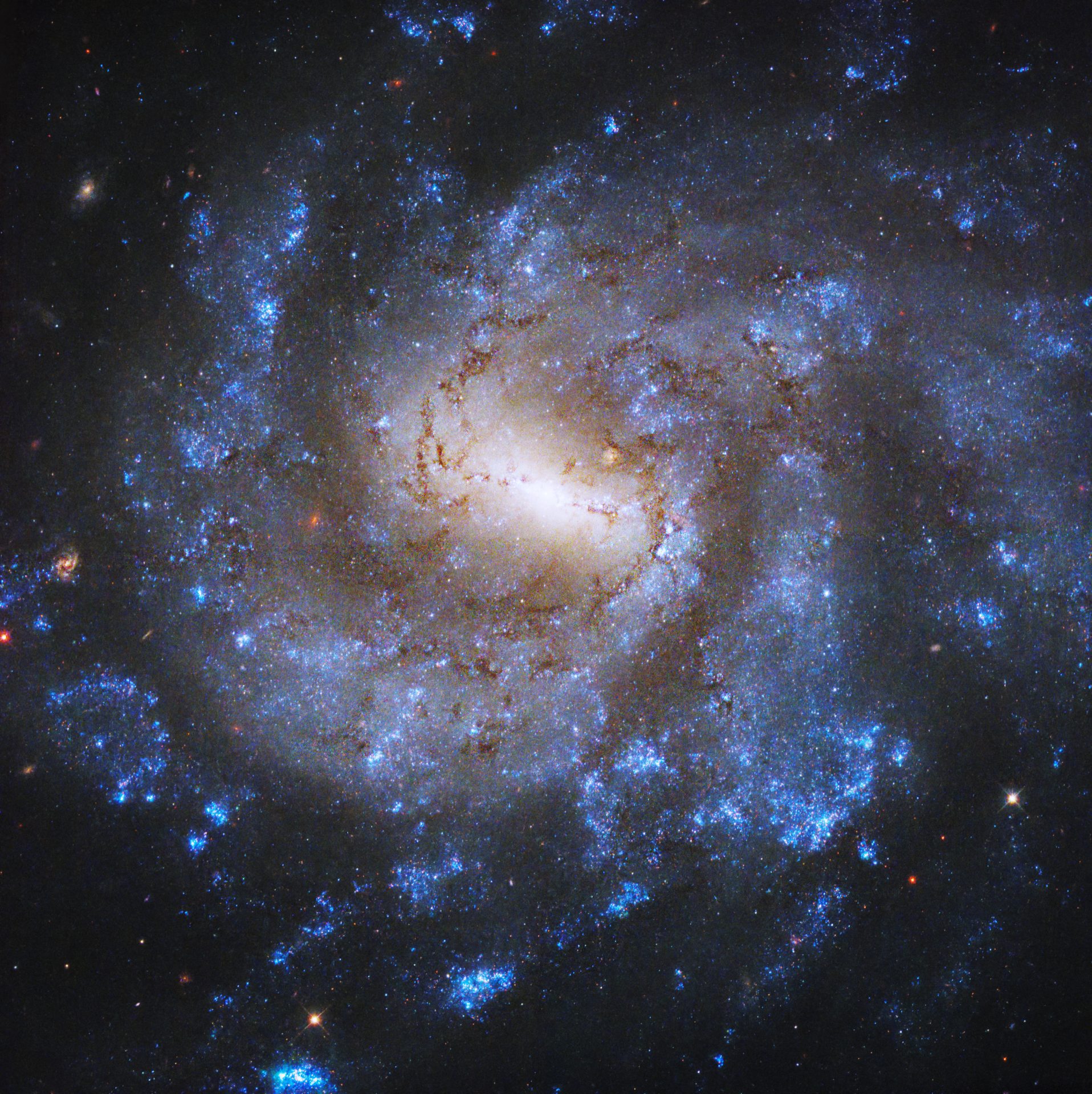
It’s easy to get swept up in the swirling starry arms of this intermediate spiral galaxy, NGC 4654, in the constellation Virgo. The galaxy has a bright center and is labeled “intermediate” because it has characteristics of both unbarred and barred spirals. NGC 4654 is just north of the celestial equator, making it visible from the northern hemisphere and most of the southern hemisphere. The galaxy is around 55 million light-years from Earth.
NGC 4654 is one of many Virgo Cluster galaxies that have an asymmetric distribution of stars and of neutral hydrogen gas. Astronomers reason that NGC 4654 may be experiencing a process called “ram pressure stripping,” where the gravitational pull of the Virgo galaxy cluster puts pressure on NGC 4654 as it moves through a superheated plasma made largely of hydrogen called the “intracluster medium.” This pressure feels like a gust of wind – think of a biker feeling wind even on a still day – that strips NGC 4654 of its gas. This process produced a long, thin tail of hydrogen gas on the galaxy’s southeastern side. Most galaxies that experienced ram pressure stripping hold very little cold gas, halting the galaxy’s ability to form new stars, since stars generate from dense gas. However, NGC 4654 has star formation rates consistent with other galaxies of its size.
NGC 4654 also had an interaction with the companion galaxy NGC 4639 about 500 million years ago. The gravity of NGC 4639 stripped NGC 4654’s gas along its edge, limiting star formation in that region and causing the asymmetrical distribution of the galaxy’s stars.
Scientists study galaxies like NGC 4654 to examine the connection between young stars and the cold gas from which they form. NASA’s Hubble Space Telescope took this image in visible, ultraviolet, and infrared light.
A SpaceX Falcon Heavy rocket with the Psyche spacecraft onboard is seen at Launch Complex 39A as preparations continue for the Psyche mission, Wednesday, Oct. 11, 2023, at NASA’s Kennedy Space Center in Florida. NASA’s Psyche spacecraft will travel to a metal-rich asteroid by the same name orbiting the Sun between Mars and Jupiter to study its composition. The spacecraft also carries the agency’s Deep Space Optical Communications technology demonstration, which will test laser communications beyond the Moon.
NASA/Aubrey Gemignani
The spacecraft is targeting an Oct. 12 liftoff atop a Falcon Heavy rocket. Its destination, a metal-rich asteroid, may tell us more about how planets form.
In less than 24 hours, NASA’s Psyche spacecraft is slated to launch from the agency’s Kennedy Space Center in Florida. With its sights set on a mysterious asteroid of the same name, Psyche is NASA’s first scientific mission to be launched on a SpaceX Falcon Heavy rocket.
Launch is set for 10:16 a.m. EDT on Thursday, Oct. 12, with additional opportunities identified each day through Oct. 25. Each opportunity is instantaneous, meaning there is only one exact time per day when launch can occur.
“The team has worked tirelessly to prepare the spacecraft for its journey to a one-of-a-kind asteroid,” said Henry Stone, Psyche’s project manager at NASA’s Jet Propulsion Laboratory in Southern California. “All spacecraft systems, science instruments, and software have been integrated and extensively tested, and the spacecraft is fully configured for flight. We look forward to the launch and – more importantly – to accomplishing the mission’s objectives, marking yet another historic voyage of scientific discovery.”
The orbiter’s solar arrays are folded and stowed for launch. All systems have been tested and re-tested many times, along with the payload of three science instruments. Loaded with 2,392 pounds (1,085 kilograms) of the neutral gas xenon – the propellant that will get Psyche to the asteroid belt – the spacecraft sits inside the launch vehicle’s cone-shaped payload fairing, which protects it from aerodynamic pressure and heat during launch. The spacecraft and fairing have been mated to the SpaceX Falcon Heavy, which is poised for takeoff from Kennedy Space Center’s historic Launch Complex 39A.
Integrated onto the spacecraft is a technology demonstration called Deep Space Optical Communications (DSOC). DSOC will test high-data-rate laser communications – which could be used by future NASA missions – beyond the Moon for the first time. The tech demo will not relay Psyche mission data.
Launch Sequences
The rocket has two stages and two side boosters. After the side boosters separate and return to land, the core stage will be expended into the Atlantic Ocean. Then the second stage of the rocket, which will help Psyche escape Earth’s gravity, will fire its engine.
Once the rocket is out of Earth’s atmosphere, about four minutes after launch, the fairing will separate from its ride and split into two halves, which are jettisoned back to Earth. The spacecraft will then separate from the upper stage about an hour after launch. Soon after, it will deploy its twin solar arrays, one at a time, and direct them at the Sun. At this point, the spacecraft is in a planned “safe mode” (a precautionary standby status), with the Sun illuminating the deployed solar panels, and will begin to direct the low-gain antenna toward Earth for communications.
It could take up to two hours after separation from the rocket before the first signal is received.
Once stable communications have been established, mission controllers will begin to reconfigure the spacecraft into its planned operating mode. The ensuing three months of initial checkout include a commissioning phase to confirm that all hardware and software is operating as expected, including the electric thrusters. Starting about five months after launch, the thrusters will fire, one at a time, during long stretches of the trajectory to get to the asteroid.
Psyche’s efficient solar electric propulsion system works by accelerating and expelling charged atoms, or ions, of the neutral gas xenon – creating a thrust that will gently push the spacecraft on a journey of nearly six years and about 2.2 billion miles (3.6 billion kilometers) to the asteroid Psyche in the main asteroid belt between Mars and Jupiter.
Along the way, in May 2026, the spacecraft will fly by Mars and use the Red Planet’s gravity to slingshot itself toward Psyche, saving propellant while gaining speed and changing direction.
After the spacecraft reaches the asteroid in 2029, it will spend about 26 months in orbit, gathering images and other data.
Scientists believe Psyche could be part of the core of a planetesimal – an early planetary building block – and composed of a mixture of rock and iron-nickel metal. The metal will not be mined; it will be studied to give researchers a better idea of what makes up Earth’s core and how rocky planets formed in our solar system. Humans can’t bore a path to our planet’s core – or the cores of the other rocky planets – so visiting Psyche could provide a one-of-a-kind window into the violent history of collisions and accumulation of matter that created planets like our own.
More About the Mission
Arizona State University leads the Psyche mission. A division of Caltech in Pasadena, JPL is responsible for the mission’s overall management, system engineering, integration and test, and mission operations. Maxar Technologies in Palo Alto, California, provided the high-power solar electric propulsion spacecraft chassis.
JPL manages DSOC for the Technology Demonstration Missions program within NASA’s Space Technology Mission Directorate and the Space Communications and Navigation program within the Space Operations Mission Directorate.
NASA’s Launch Services Program, based at Kennedy Space Center, is responsible for the insight and approval of the launch vehicle and manages the launch service for the Psyche mission. LSP certified the SpaceX Falcon Heavy rocket for use with the agency’s most complex and highest priority missions in early 2023 at the conclusion of a 2 ½-year effort.
Psyche is the 14th mission selected as part of NASA’s Discovery Program, managed by the agency’s Marshall Space Flight Center in Huntsville, Alabama.
NASA’s DSOC is composed of a flight laser transceiver attached to Psyche and a ground system that will send and receive laser signals. Clockwise from top left: the Psyche spacecraft with DSOC attached, flight laser transceiver, downlink ground station at Palomar, and downlink detector.
NASA/JPL-Caltech
Slated to launch on Oct. 12 with the Psyche mission, DSOC will demonstrate technologies enabling the agency to transmit higher data rates from deep space.
NASA’s pioneering Deep Space Optical Communications (DSOC) experiment will be the first demonstration of laser, or optical, communications from as far away as Mars. Launching with NASA’s Psyche mission to a metal-rich asteroid of the same name on Thursday, Oct. 12, DSOC will test key technologies designed to enable future missions to transmit denser science data and even stream video from the Red Planet.
Here are five things to know about this cutting-edge technology demonstration:
1. DSOC is the first time NASA will test how lasers could increase data transmission from deep space.
Until now, NASA has used only radio waves to communicate with missions that travel beyond the Moon. Much like fiber optics replacing old telephone lines on Earth as demand for data grows, going from radio communications to optical communications will allow increased data rates throughout the solar system, with 10 to 100 times the capacity of state-of-the-art systems currently used by spacecraft. This will better enable future human and robotic exploration missions, along with supporting higher-resolution science instruments.
Learn more about how DSOC will be used to test high-bandwidth data transmission beyond the Moon for the first time – and how it could transform deep space exploration. Credit: NASA/JPL-Caltech
2. The tech demo involves equipment both in space and on Earth.
The DSOC flight laser transceiver is an experiment attached to NASA’s Psyche spacecraft, but Psyche relies on traditional radio communications for mission operations. The laser transceiver features both a near-infrared laser transmitter to send high-rate data to Earth and a sensitive photon-counting camera to receive a laser beam sent from Earth. But the transceiver is just one part of the technology demonstration.
There is no dedicated infrastructure on Earth for deep space optical communications, so for the purposes of DSOC, two ground telescopes have been updated to communicate with the flight laser transceiver. NASA’s Jet Propulsion Laboratory in Southern California will host the operations team, and a high-power near-infrared laser transmitter has been integrated with the Optical Communications Telescope Laboratory at JPL’s Table Mountain facility near Wrightwood, California. The transmitter will deliver a modulated laser signal to DSOC’s flight transceiver and serve as a beacon, or pointing reference, so that the returned laser beam can be accurately aimed back to Earth.
Data sent from the flight transceiver will be collected by the 200-inch (5.1-meter) Hale Telescope at Caltech’s Palomar Observatory in San Diego County, California, which has been equipped with a special superconducting high-efficiency detector array.
3. DSOC will encounter unique challenges.
DSOC is intended to demonstrate high-rate transmission of data of distances up to 240 million miles (390 million kilometers) – more than twice the distance between the Sun and Earth – during the first two years of Psyche’s six-year journey to the asteroid belt.
The farther Psyche travels from our planet, the fainter the laser photon signal will become, making it increasingly challenging to decode the data. As an additional challenge, the photons will take longer to reach their destination, creating a lag of over 20 minutes at the tech demo’s farthest distance. Because the positions of Earth and the spacecraft will be constantly changing as the photons travel, the DSOC ground and flight systems will need to compensate, pointing to where the ground receiver (at Palomar) and flight transceiver (on Psyche) will be when the photons arrive.
4. Cutting-edge technologies will work together to make sure the lasers are on target and high-bandwidth data is received from deep space.
The flight laser transceiver and ground-based laser transmitter will need to point with great precision. Reaching their targets will be akin to hitting a dime from a mile away while the dime is moving. So the transceiver needs to be isolated from the spacecraft vibrations, which would otherwise nudge the laser beam off target. Initially, Psyche will aim the flight transceiver in the direction of Earth while autonomous systems on the flight transceiver assisted by the Table Mountain uplink beacon laser will control the pointing of the downlink laser signal to Palomar Observatory.
Integrated onto the Hale Telescope is a cryogenically cooled superconducting nanowire photon-counting array receiver, developed by JPL. The instrument is equipped with high-speed electronics for recording the time of arrival of single photons so that the signal can be decoded. The DSOC team even developed new signal-processing techniques to squeeze information out of the weak laser signals that will have been transmitted over tens to hundreds of millions of miles.
This is a close-up of the downlink detector prototype that was used to develop the detector attached to DSOC’s receiving ground station at Palomar. The active area – at the center of the dark square – measures about 0.0126 inches (0.32 millimeters) across. It can detect a billion photons per second.
NASA/JPL-Caltech
5. This is NASA’s latest optical communications project.
In 2013, NASA’s Lunar Laser Communications Demonstration tested record-breaking uplink and downlink data rates between Earth and the Moon. In 2021, NASA’s Laser Communications Relay Demonstration launched to test high-bandwidth optical communications relay capabilities from geostationary orbit so that spacecraft don’t require a direct line of sight with Earth to communicate. And last year, NASA’s TeraByte InfraRed Delivery system downlinked the highest-ever data rate from a satellite in low-Earth orbit to a ground-based receiver.
DSOC is taking optical communications into deep space, paving the way for high-bandwidth communications beyond the Moon and 1,000 times farther than any optical communications test to date. If it succeeds, the technology could lead to high-data rate communications with streaming, high-definition imagery that will help support humanity’s next giant leap: when NASA sends astronauts to Mars.
More About the Mission
DSOC is the latest in a series of optical communication demonstrations funded by NASA’s Technology Demonstration Missions (TDM) program and the agency’s Space Communications and Navigation (SCaN) program. JPL, a division of Caltech in Pasadena, California, manages DSOC for TDM within NASA’s Space Technology Mission Directorate and SCaN within the agency’s Space Operations Mission Directorate.
The Psyche mission is led by Arizona State University. JPL is responsible for the mission’s overall management, system engineering, integration and test, and mission operations. Psyche is the 14th mission selected as part of NASA’s Discovery Program, managed by the agency’s Marshall Space Flight Center in Huntsville, Alabama. NASA’s Launch Services Program, based at the agency’s Kennedy Space Center, is managing the launch service. Maxar Technologies in Palo Alto, California, provided the high-power solar electric propulsion spacecraft chassis.
This new infrared image of NGC 346 from NASA’s James Webb Space Telescope’s Mid-Infrared Instrument (MIRI) traces emission from cool gas and dust. In this image blue represents silicates and sooty chemical molecules known as polycyclic aromatic hydrocarbons, or PAHs. More diffuse red emission shines from warm dust heated by the brightest and most massive stars in the heart of the region. Bright patches and filaments mark areas with abundant numbers of protostars. This image includes 7.7-micron light shown in blue, 10 microns in cyan, 11.3 microns in green, 15 microns in yellow, and 21 microns in red (770W, 1000W, 1130W, 1500W, and 2100W filters, respectively).
Credit: NASA, ESA, CSA, STScI, N. Habel (JPL). Image Processing: P. Kavanagh (Maynooth University).
Filaments of dust and gas festoon this star-forming region in a new infrared image from MIRI.
One of the greatest strengths of NASA’s James Webb Space Telescope is its ability to give astronomers detailed views of areas where new stars are being born. The latest example, showcased here in a new image from Webb’s Mid-Infrared Instrument (MIRI), is NGC 346 – the brightest and largest star-forming region in the Small Magellanic Cloud.
The Small Magellanic Cloud (SMC) is a satellite galaxy of the Milky Way, visible to the unaided eye in the southern constellation Tucana. This small companion galaxy is more primeval than the Milky Way in that it possesses fewer heavy elements, which are forged in stars through nuclear fusion and supernova explosions, compared to our own galaxy.
Since cosmic dust is formed from heavy elements like silicon and oxygen, scientists expected the SMC to lack significant amounts of dust. However the new MIRI image, as well as a previous image of NGC 346 from Webb’s Near-Infrared Camera released in January, show ample dust within this region.
In this representative-color image, blue tendrils trace emission from material that includes dusty silicates and sooty chemical molecules known as polycyclic aromatic hydrocarbons, or PAHs. More diffuse red emission shines from warm dust heated by the brightest and most massive stars in the heart of the region. An arc at the center left may be a reflection of light from the star near the arc’s center. (Similar, fainter arcs appear associated with stars at lower left and upper right.) Lastly, bright patches and filaments mark areas with abundant numbers of protostars. The research team looked for the reddest stars, and found 1,001 pinpoint sources of light, most of them young stars still embedded in their dusty cocoons.
By combining Webb data in both the near-infrared and mid-infrared, astronomers are able to take a fuller census of the stars and protostars within this dynamic region. The results have implications for our understanding of galaxies that existed billions of years ago, during an era in the universe known as “cosmic noon,” when star formation was at its peak and heavy element concentrations were lower, as seen in the SMC.The James Webb Space Telescope is the world’s premier space science observatory.
Webb is solving mysteries in our solar system, looking beyond to distant worlds around other stars, and probing the mysterious structures and origins of our universe and our place in it. Webb is an international program led by NASA with its partners, ESA (European Space Agency) and the Canadian Space Agency.
This website uses cookies to improve your experience. We'll assume you're ok with this, but you can opt-out if you wish.AcceptRead More
Privacy & Cookies Policy
Privacy Overview
This website uses cookies to improve your experience while you navigate through the website. Out of these, the cookies that are categorized as necessary are stored on your browser as they are essential for the working of basic functionalities of the website. We also use third-party cookies that help us analyze and understand how you use this website. These cookies will be stored in your browser only with your consent. You also have the option to opt-out of these cookies. But opting out of some of these cookies may affect your browsing experience.
Necessary cookies are absolutely essential for the website to function properly. This category only includes cookies that ensures basic functionalities and security features of the website. These cookies do not store any personal information.
Any cookies that may not be particularly necessary for the website to function and is used specifically to collect user personal data via analytics, ads, other embedded contents are termed as non-necessary cookies. It is mandatory to procure user consent prior to running these cookies on your website.