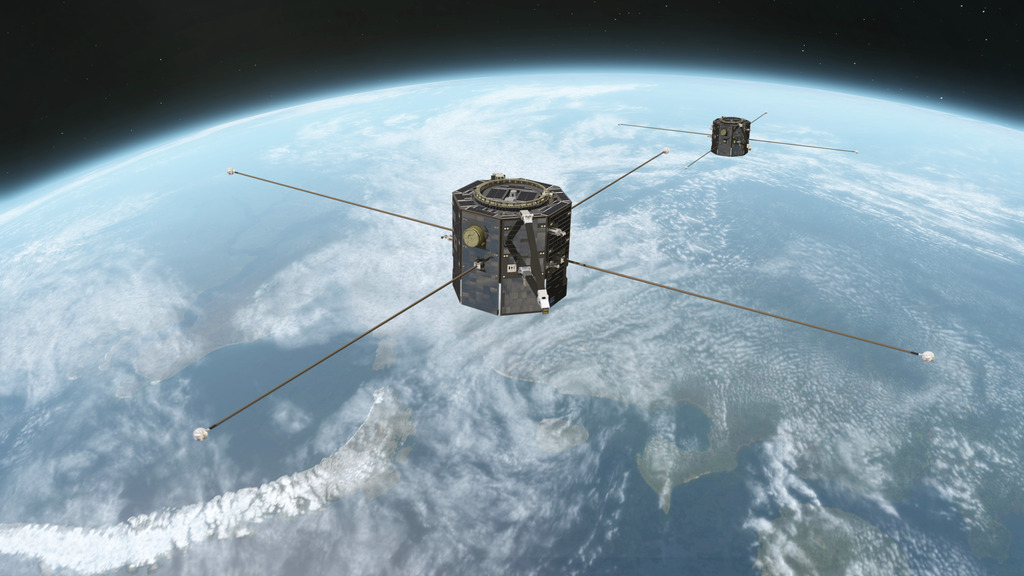
The TRACERS (Tandem Reconnection and Cusp Electrodynamics Reconnaissance Satellites) mission will help scientists understand an explosive process called magnetic reconnection and its effects in Earth’s atmosphere.
Credit: University of Iowa/Andy Kale
NASA will hold a media teleconference at 11 a.m. EDT on Thursday, July 17, to share information about the agency’s upcoming Tandem Reconnection and Cusp Electrodynamics Reconnaissance Satellites, or TRACERS, mission, which is targeted to launch no earlier than late July.
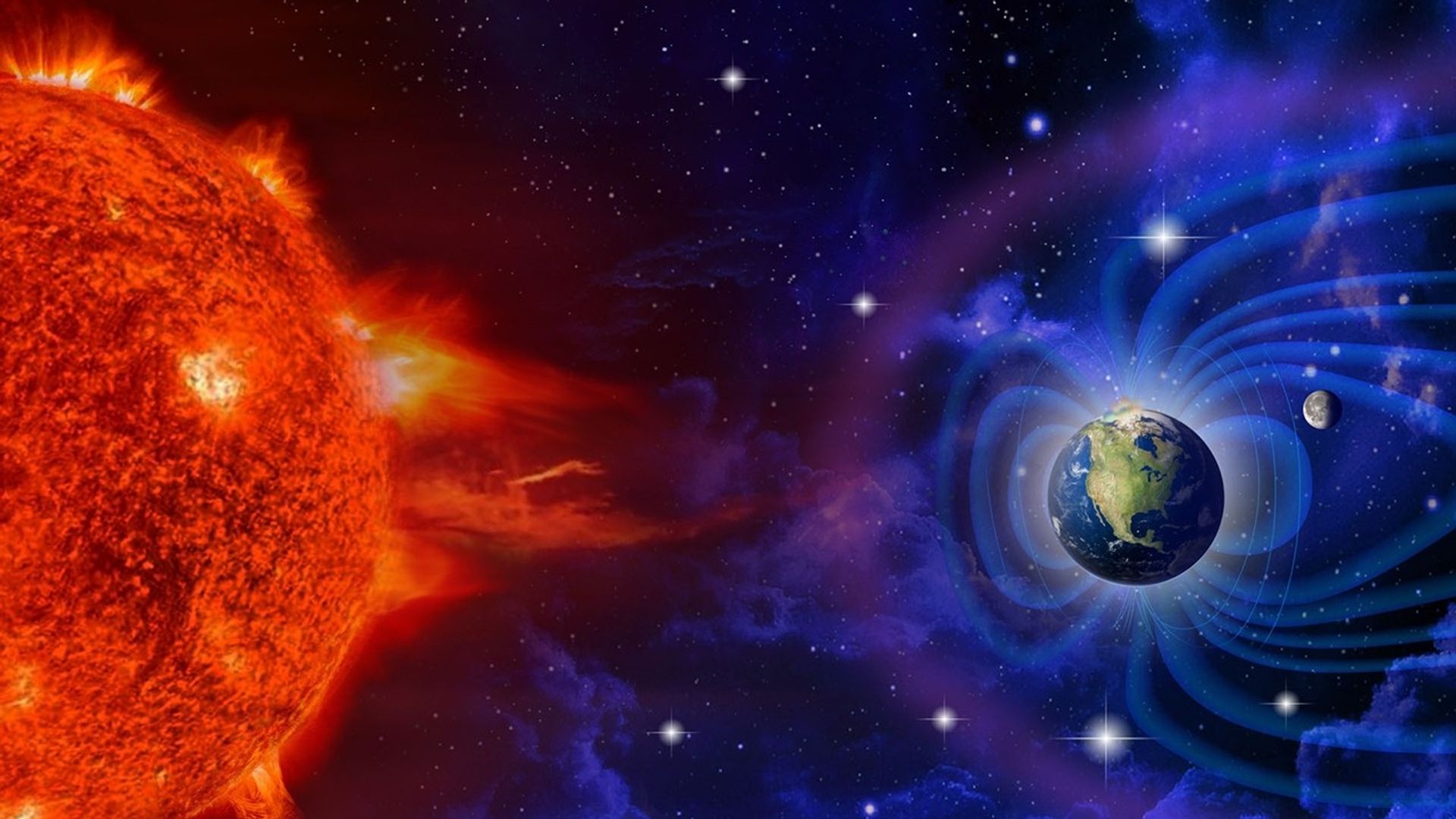
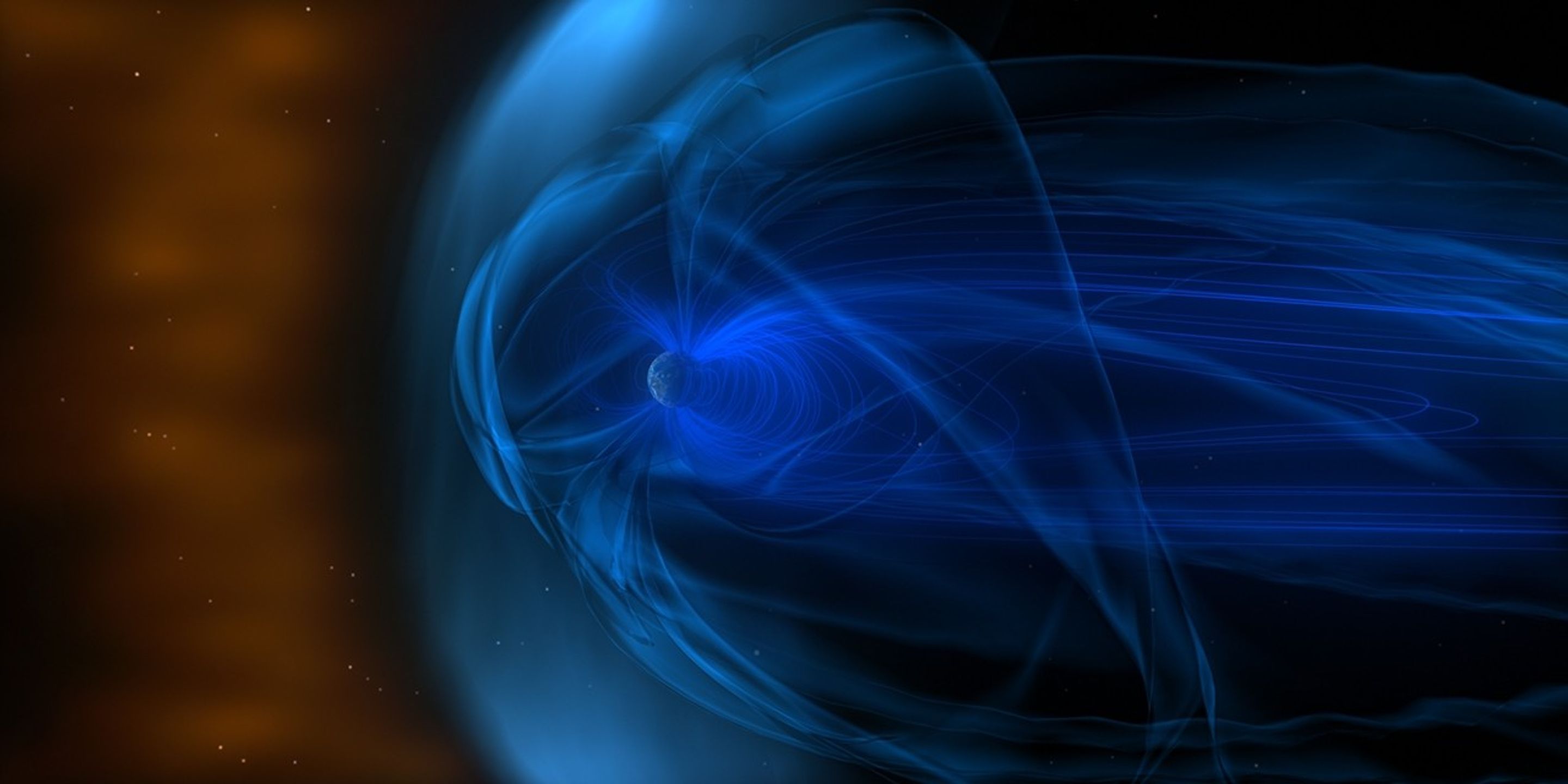
The TRACERS mission is a pair of twin satellites that will study how Earth’s magnetic shield — the magnetosphere — protects our planet from the supersonic stream of material from the Sun called solar wind. As they fly pole to pole in a Sun-synchronous orbit, the two TRACERS spacecraft will measure how magnetic explosions send these solar wind particles zooming down into Earth’s atmosphere — and how these explosions shape the space weather that impacts our satellites, technology, and astronauts.
Also launching on this flight will be three additional NASA-funded payloads. The Athena EPIC (Economical Payload Integration Cost) SmallSat, led by NASA’s Langley Research Center in Hampton, Virginia, is designed to demonstrate an innovative, configurable way to put remote-sensing instruments into orbit faster and more affordably. The Polylingual Experimental Terminal technology demonstration, managed by the agency’s SCaN (Space Communications and Navigation) program, will showcase new technology that empowers missions to roam between communications networks in space, like cell phones roam between providers on Earth. Finally, the Relativistic Electron Atmospheric Loss (REAL) CubeSat, led by Dartmouth College in Hanover, New Hampshire, will use space as a laboratory to understand how high-energy particles within the bands of radiation that surround Earth are naturally scattered into the atmosphere, aiding the development of methods for removing these damaging particles to better protect satellites and the critical ground systems they support.
Audio of the teleconference will stream live on the agency’s website at:
Joe Westlake, division director, Heliophysics, NASA Headquarters
Kory Priestley, principal investigator, Athena EPIC, NASA Langley
Greg Heckler, deputy program manager for capability development, SCaN, NASA Headquarters
David Miles, principal investigator for TRACERS, University of Iowa
Robyn Millan, REAL principal investigator, Dartmouth College
To participate in the media teleconference, media must RSVP no later than 10 a.m. on July 17 to Sarah Frazier at: sarah.frazier@nasa.gov. NASA’s media accreditation policy is available online.
The TRACERS mission will launch on a SpaceX Falcon 9 rocket from Space Launch Complex 4 East at Vandenberg Space Force Base in California.
This mission is led by David Miles at the University of Iowa with support from the Southwest Research Institute in San Antonio. NASA’s Heliophysics Explorers Program Office at the agency’s Goddard Space Flight Center in Greenbelt, Maryland, manages the mission for the agency’s HeliophysicsDivision at NASA Headquarters in Washington. The University of Iowa, Southwest Research Institute, University of California, Los Angeles, and University of California, Berkeley, all lead instruments on TRACERS that will study changes in the Earth’s magnetic field and electric field. NASA’s Launch Services Program, based at the agency’s Kennedy Space Center in Florida, manages the Venture-class Acquisition of Dedicated and Rideshare contract.
NASA’s Parker Solar Probe Snaps Closest-Ever Images to Sun
KEY POINTS
NASA’s Parker Solar Probe has taken the closest ever images to the Sun, captured just 3.8 million miles from the solar surface.
The new close-up images show features in the solar wind, the constant stream of electrically charged subatomic particles released by the Sun that rage across the solar system at speeds exceeding 1 million miles an hour.
These images, and other data, are helping scientists understand the mysteries of the solar wind, which is essential to understanding its effects at Earth.
On its record-breaking pass by the Sun late last year, NASA’s Parker Solar Probe captured stunning new images from within the Sun’s atmosphere. These newly released images — taken closer to the Sun than we’ve ever been before — are helping scientists better understand the Sun’s influence across the solar system, including events that can affect Earth.
“Parker Solar Probe has once again transported us into the dynamic atmosphere of our closest star,” said Nicky Fox, associate administrator, Science Mission Directorate at NASA Headquarters in Washington. “We are witnessing where space weather threats to Earth begin, with our eyes, not just with models. This new data will help us vastly improve our space weather predictions to ensure the safety of our astronauts and the protection of our technology here on Earth and throughout the solar system.”
Parker Solar Probe started its closest approach to the Sun on Dec. 24, 2024, flying just 3.8 million miles from the solar surface. As it skimmed through the Sun’s outer atmosphere, called the corona, in the days around the perihelion, it collected data with an array of scientific instruments, including the Wide-Field Imager for Solar Probe, or WISPR.
Parker Solar Probe has revolutionized our understanding of the solar wind thanks to the spacecraft’s many passes through the Sun’s outer atmosphere. Credit: NASA’s Goddard Space Flight Center/Joy Ng
The new WISPR images reveal the corona and solar wind, a constant stream of electrically charged particles from the Sun that rage across the solar system. The solar wind expands throughout of the solar system with wide-ranging effects. Together with outbursts of material and magnetic currents from the Sun, it helps generate auroras, strip planetary atmospheres, and induce electric currents that can overwhelm power grids and affect communications at Earth. Understanding the impact of solar wind starts with understanding its origins at the Sun.
The WISPR images give scientists a closer look at what happens to the solar wind shortly after it is released from the corona. The images show the important boundary where the Sun’s magnetic field direction switches from northward to southward, called the heliospheric current sheet. It also captures the collision of multiple coronal mass ejections, or CMEs — large outbursts of charged particles that are a key driver of space weather — for the first time in high resolution.
“In these images, we’re seeing the CMEs basically piling up on top of one another,” said Angelos Vourlidas, the WISPR instrument scientist at the Johns Hopkins Applied Physics Laboratory, which designed, built, and operates the spacecraft in Laurel, Maryland. “We’re using this to figure out how the CMEs merge together, which can be important for space weather.”
This video, made from images taken by Parker Solar Probe’s WISPR instrument during its record-breaking flyby of the Sun on Dec. 25, 2024, shows the solar wind racing out from the Sun’s outer atmosphere, the corona.
NASA/Johns Hopkins APL/Naval Research Lab
When CMEs collide, their trajectory can change, making it harder to predict where they’ll end up. Their merger can also accelerate charged particles and mix magnetic fields, which makes the CMEs’ effects potentially more dangerous to astronauts and satellites in space and technology on the ground. Parker Solar Probe’s close-up view helps scientists better prepare for such space weather effects at Earth and beyond.
Zooming in on Solar Wind’s Origins
The solar wind was first theorized by preeminent heliophysicist Eugene Parker in 1958. His theories about the solar wind, which were met with criticism at the time, revolutionized how we see our solar system. Prior to Parker Solar Probe’s launch in 2018, NASA and its international partners led missions like Mariner 2, Helios, Ulysses, Wind, and ACE that helped scientists understand the origins of the solar wind — but from a distance. Parker Solar Probe, named in honor of the late scientist, is filling in the gaps of our understanding much closer to the Sun.
At Earth, the solar wind is mostly a consistent breeze, but Parker Solar Probe found it’s anything but at the Sun. When the spacecraft reached within 14.7 million miles from the Sun, it encountered zig-zagging magnetic fields — a feature known as switchbacks. Using Parker Solar Probe’s data, scientists discovered that these switchbacks, which came in clumps, were more common than expected.
When Parker Solar Probe first crossed into the corona about 8 million miles from the Sun’s surface in 2021, it noticed the boundary of the corona was uneven and more complex than previously thought.
As it got even closer, Parker Solar Probe helped scientists pinpoint the origin of switchbacks at patches on the visible surface of the Sun where magnetic funnels form. In 2024 scientists announced that the fast solar wind — one of two main classes of the solar wind — is in part powered by these switchbacks, adding to a 50-year-old mystery.
However, it would take a closer view to understand the slow solar wind, which travels at just 220 miles per second, half the speed of the fast solar wind.
“The big unknown has been: how is the solar wind generated, and how does it manage to escape the Sun’s immense gravitational pull?” said Nour Rawafi, the project scientist for Parker Solar Probe at the Johns Hopkins Applied Physics Laboratory. “Understanding this continuous flow of particles, particularly the slow solar wind, is a major challenge, especially given the diversity in the properties of these streams — but with Parker Solar Probe, we’re closer than ever to uncovering their origins and how they evolve.”
Understanding Slow Solar Wind
The slow solar wind, which is twice as dense and more variable than fast solar wind, is important to study because its interplay with the fast solar wind can create moderately strong solar storm conditions at Earth sometimes rivaling those from CMEs.
This artist’s concept shows a representative state of Earth’s magnetic bubble immersed in the slow solar wind, which averages some 180 to 300 miles per second.
NASA’s Goddard Space Flight Center Conceptual Image Lab
Prior to Parker Solar Probe, distant observations suggested there are actually two varieties of slow solar wind, distinguished by the orientation or variability of their magnetic fields. One type of slow solar wind, called Alfvénic, has small-scale switchbacks. The second type, called non-Alfvénic, doesn’t show these variations in its magnetic field.
As it spiraled closer to the Sun, Parker Solar Probe confirmed there are indeed two types. Its close-up views are also helping scientists differentiate the origins of the two types, which scientists believe are unique. The non-Alfvénic wind may come off features called helmet streamers — large loops connecting active regions where some particles can heat up enough to escape — whereas Alfvénic wind might originate near coronal holes, or dark, cool regions in the corona.
In its current orbit, bringing the spacecraft just 3.8 million miles from the Sun, Parker Solar Probe will continue to gather additional data during its upcoming passes through the corona to help scientists confirm the slow solar wind’s origins. The next pass comes Sept. 15, 2025.
“We don’t have a final consensus yet, but we have a whole lot of new intriguing data,” said Adam Szabo, Parker Solar Probe mission scientist at NASA’s Goddard Space Flight Center in Greenbelt, Maryland.
By Mara Johnson-Groh NASA’s Goddard Space Flight Center, Greenbelt, Md.
Preparations for Next Moonwalk Simulations Underway (and Underwater)
NASA instruments and aircraft are helping identify potential sources of critical minerals across vast swaths of California, Nevada, and other Western states. Pilots gear up to reach altitudes about twice as high as those of a cruising passenger jet.
NASA
NASA and the U.S. Geological Survey have been mapping the planets since Apollo. One team is searching closer to home for minerals critical to national security and the economy.
If not for the Joshua trees, the tan hills of Cuprite, Nevada, would resemble Mars. Scalded and chemically altered by water from deep underground, the rocks here are earthly analogs for understanding ancient Martian geology. The hills are also rich with minerals. They’ve lured prospectors for more than 100 years and made Cuprite an ideal place to test NASA technology designed to map the minerals, craters, crusts, and ices of our solar system.
Sensors that discovered lunar water, charted Saturn’s moons, even investigated ground zero in New York City were all tested and calibrated at Cuprite, said Robert Green, a senior research scientist at NASA’s Jet Propulsion Laboratory in Southern California. He’s honed instruments in Nevada for decades.
One of Green’s latest projects is to find and map rocky surfaces in the American West that could contain minerals crucial to the nation’s economy and security. Currently, the U.S. is dependent on imports of 50 critical minerals, which include lithium and rare earth elements used in everything from rechargeable batteries to medicine.
Scientists from the U.S. Geological Survey (USGS) are searching nationwide for domestic sources. NASA is contributing to this effort with high-altitude aircraft and sensors capable of detecting the molecular fingerprints of minerals across vast, treeless expanses in wavelengths of light not visible to human eyes.
The hills of Cuprite, Nevada, appear pink and tan to the eye (top image) but they shine with mica, gypsum, and alunite among other types of minerals when imaged spectroscopically (lower image). NASA sensors used to study Earth and other rocky worlds have been tested there.
USGS/Ray Kokaly
The collaboration is called GEMx, the Geological Earth Mapping Experiment, and it’s likely the largest airborne spectroscopic survey in U.S. history. Since 2023, scientists working on GEMx have charted more than 190,000 square miles (500,000 square kilometers) of North American soil.
Mapping Partnership Started During Apollo
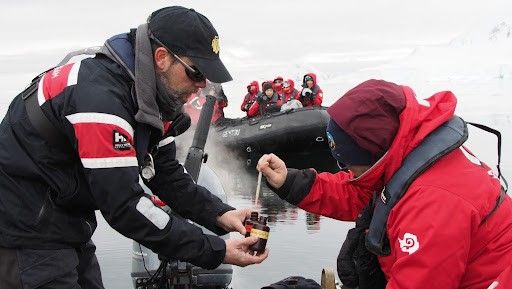
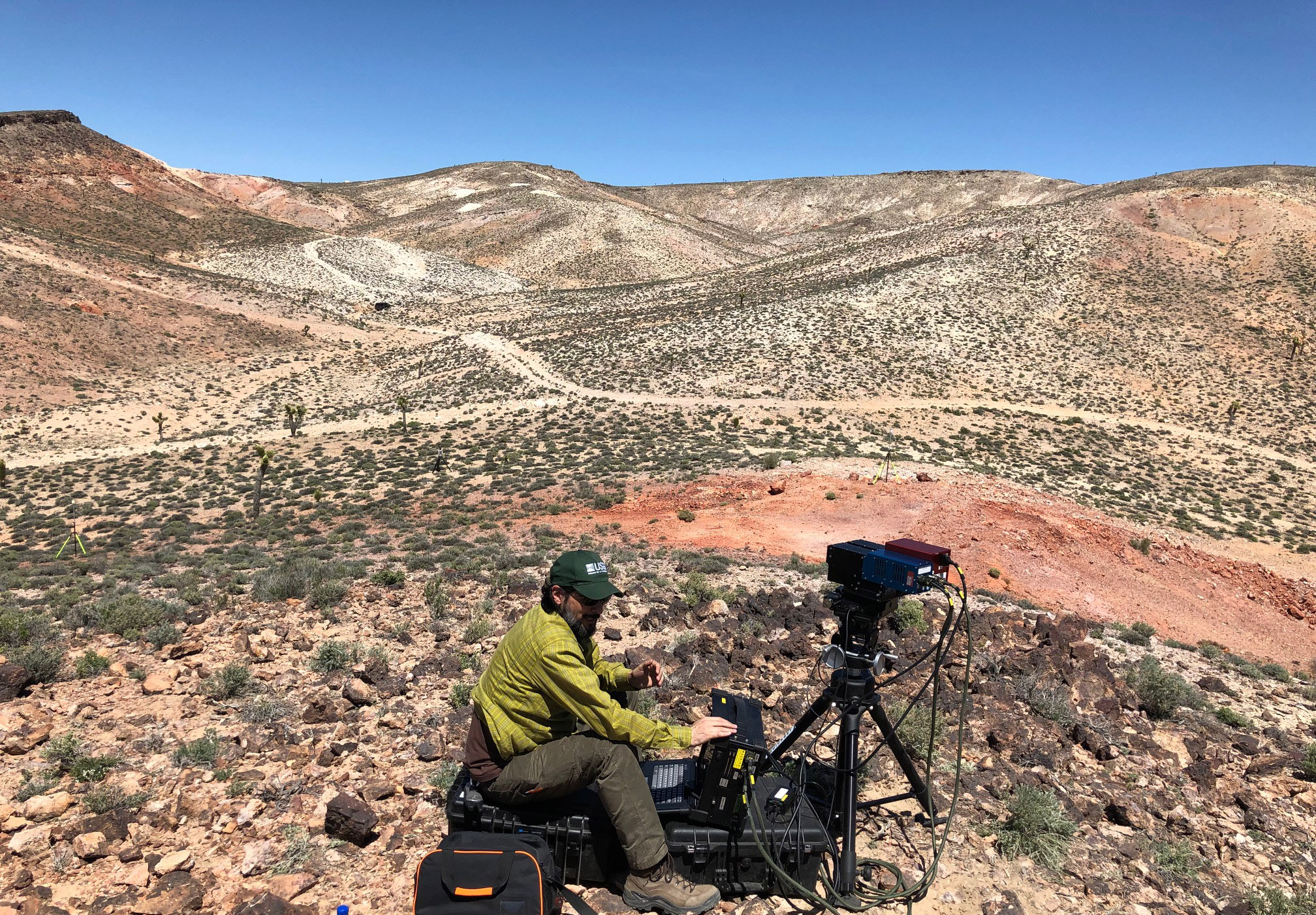
As NASA instruments fly in aircraft 60,000 feet (18,000 meters) overhead, Todd Hoefen, a geophysicist, and his colleagues from USGS work below. The samples of rock they test and collect in the field are crucial to ensuring that the airborne observations match reality on the ground and are not skewed by the intervening atmosphere.
The GEMx mission marks the latest in a long history of partnerships between NASA and USGS. The two agencies have worked together to map rocky worlds — and keep astronauts and rovers safe — since the early days of the space race.
For example, geologic maps of the Moon made in the early 1960s at the USGS Astrogeology Science Center in Flagstaff, Arizona, helped Apollo mission planners select safe and scientifically promising sites for the six crewed landings that occurred from 1969 to 1972. Before stepping onto the lunar surface, NASA’s Moon-bound astronauts traveled to Flagstaff to practice fieldwork with USGS geologists. A version of those Apollo boot camps continues today with astronauts and scientists involved in NASA’s Artemis mission.
Geophysicist Raymond Kokaly, who leads the GEMx campaign for USGS, is pictured here conducting ground-based hyperspectral imaging of rock in Cuprite, Nevada, in April 2019.
USGS/Todd Hoefen
Rainbows and Rocks
To detect minerals and other compounds on the surfaces of rocky bodies across the solar system, including Earth, scientists use a technology pioneered by JPL in the 1980s called imaging spectroscopy. One of the original imaging spectrometers built by Robert Green and his team is central to the GEMx campaign in the Western U.S.
About the size and weight of a minifridge and built to fly on planes, the instrument is called AVIRIS-Classic, short for Airborne Visible/Infrared Imaging Spectrometer. Like all imaging spectrometers, it takes advantage of the fact that every molecule reflects and absorbs light in a unique pattern, like a fingerprint. Spectrometers detect these molecular fingerprints in the light bouncing off or emitted from a sample or a surface.
In the case of GEMx, that’s sunlight shimmering off different kinds of rocks.
Compared to a standard digital camera, which “sees” three color channels (red, green, and blue), imaging spectrometers can see more than 200 channels, including infrared wavelengths of light that are invisible to the human eye.
NASA spectrometers have orbited or flown by every major rocky body in our solar system. They’ve helped scientists investigate methane lakes on Titan, Saturn’s largest moon, and study Pluto’s thin atmosphere. One JPL-built spectrometer is currently en route to Europa, an icy moon of Jupiter, to help search for chemical ingredients necessary to support life.
“One of the cool things about NASA is that we develop technology to look out at the solar system and beyond, but we also turn around and look back down,” said Ben Phillips, a longtime NASA program manager who led GEMx until he retired in 2025.
The Newest Instrument
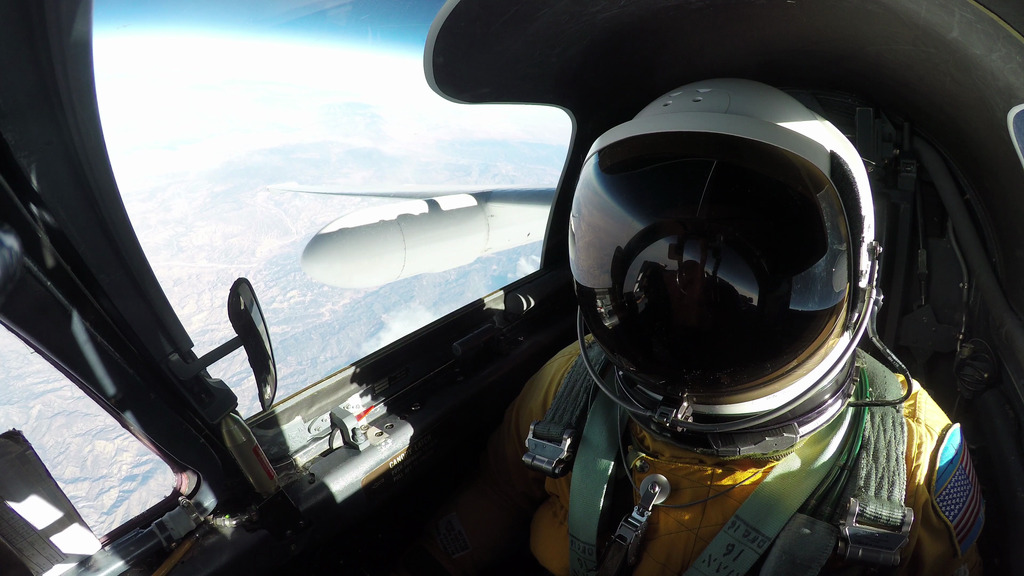
More than 200 hours of GEMx flights are scheduled through fall 2025. Scientists will process and validate the data, with the first USGS mineral maps to follow. During these flights, an ER-2 research aircraft from NASA’s Armstrong Flight Research Center in Edwards, California, will cruise over the Western U.S. at altitudes twice as high as a passenger jet flies.
At such high altitudes, pilot Dean Neeley must wear a spacesuit similar to those used by astronauts. He flies solo in the cramped cockpit but will be accompanied by state-of-the-art NASA instruments. In the belly of the plane rides AVIRIS-Classic, which will be retiring soon after more than three decades in service. Carefully packed in the plane’s nose is its successor: AVIRIS-5, taking flight for the first time in 2025.
Together, the two instruments provide 10 times the performance of the older spectrometer alone, but even by itself AVIRIS-5 marks a leap forward. It can sample areas ranging from about 30 feet (10 meters) to less than a foot (30 centimeters).
“The newest generation of AVIRIS will more than live up to the original,” Green said.
More About GEMx
The GEMx research project will last four years and is funded by the USGS Earth Mapping Resources Initiative. The initiative will capitalize on both the technology developed by NASA for spectroscopic imaging, as well as the agency’s expertise in analyzing the datasets and extracting critical mineral information from them.
Preparations for Next Moonwalk Simulations Underway (and Underwater)
The high-altitude WB-57 aircraft departed July 8, 2025, from Ellington Field in Houston, Texas, headed to the Texas Hill Country. The aircraft will use the DyNAMITE (Day/Night Airborne Motion Imager for Terrestrial Environments) sensor system to take video mosaics of the area to assist with the emergency response effort.
Photo Credit: NASA/Morgan Gridley
In response to recent flooding near Kerrville, Texas, NASA deployed two aircraft to assist state and local authorities in ongoing recovery operations.
The aircraft are part of the response from NASA’s Disasters Response Coordination System, which is activated to support emergency response for the flooding and is working closely with the Texas Division of Emergency Management, the Federal Emergency Management Agency (FEMA), and the humanitarian groups Save the Children and GiveDirectly.
Persistent cloud-cover has made it difficult to obtain clear satellite imagery, so the Disasters Program coordinated with NASA’s Airborne Science Program at NASA’s Johnson Space Flight Center in Houston to conduct a series of flights to gather observations of the impacted regions. NASA is sharing these data directly with emergency response teams to inform their search and rescue efforts and aid decision-making and resource allocation.
The high-altitude WB-57 aircraft operated by NASA Johnson departed from Ellington Field on July 8 to conduct aerial surveys. The aircraft is equipped with the DyNAMITE (Day/Night Airborne Motion Imager for Terrestrial Environments) sensor.
The DyNAMITE sensor views the Guadalupe River and several miles of the surrounding area, providing high-resolution imagery critical to assessing damage and supporting coordination of ground-based recovery efforts. This system enables real-time collection and analysis of data, enhancing situational awareness and accelerating emergency response times.
In addition, the agency’s Uninhabited Aerial Vehicle Synthetic Aperture Radar (UAVSAR) is flying out of NASA’s Armstrong Flight Research Center in Edwards, California, aboard a Gulfstream III. Managed by the agency’s Jet Propulsion Laboratory in Southern California, the UAVSAR team is planning to collect observations over the Guadalupe, San Gabriel, and Colorado river basins Wednesday, Thursday, and Friday. Because UAVSAR can penetrate vegetation to spot water that optical sensors are unable to detect, the team’s goal is to characterize the extent of flooding to help with understanding the amount of damage within communities.
Flights are being coordinated with FEMA, the Texas Division of Emergency Management, and local responders to ensure data is quickly delivered to those making decisions on the ground. Imagery collected will be sent to NASA’s Disaster Response Coordination System.
Additionally, the Disasters Program, which is part of NASA’s Earth Science Division, is working to produce maps and data to assess the location and severity of flooding in the region and damage to buildings and infrastructure. These data are being shared on the NASA Disasters Mapping Portal as they become available.
Smarter Searching: NASA AI Makes Science Data Easier to Find
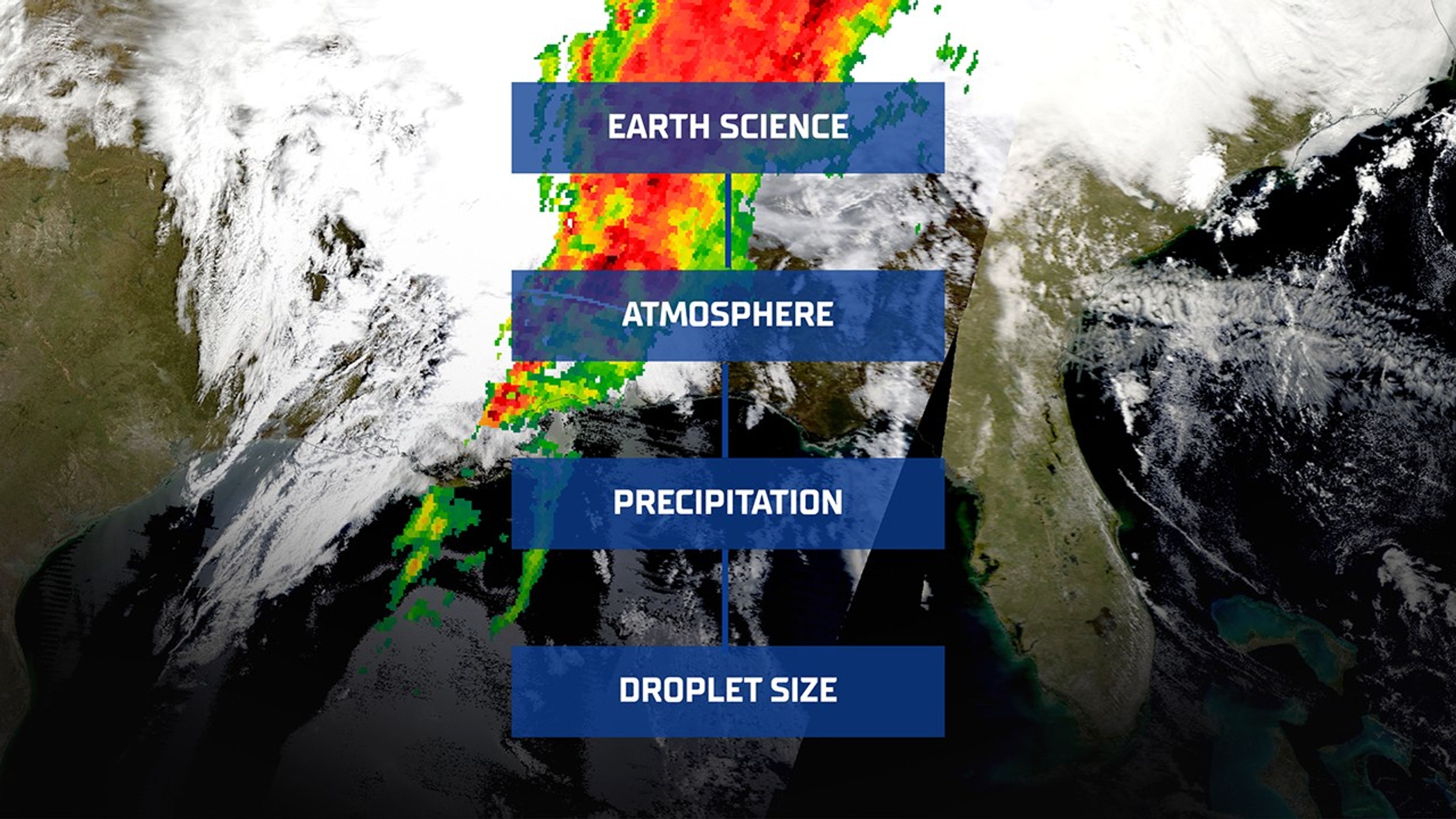
Image snapshot taken from NASA Worldview of NASA’s Global Precipitation Measurement (GPM) mission on March 15, 2025 showing heavy rain across the southeastern U.S. with an overlay of the GCMD Keyword Recommender for Earth Science, Atmosphere, Precipitation, Droplet Size.
NASA Worldview
Imagine shopping for a new pair of running shoes online. If each seller described them differently—one calling them “sneakers,” another “trainers,” and someone else “footwear for exercise”—you’d quickly feel lost in a sea of mismatched terminology. Fortunately, most online stores use standardized categories and filters, so you can click through a simple path: Women’s > Shoes > Running Shoes—and quickly find what you need.
Now, scale that problem to scientific research. Instead of sneakers, think “aerosol optical depth” or “sea surface temperature.” Instead of a handful of retailers, it is thousands of researchers, instruments, and data providers. Without a common language for describing data, finding relevant Earth science datasets would be like trying to locate a needle in a haystack, blindfolded.
That’s why NASA created the Global Change Master Directory (GCMD), a standardized vocabulary that helps scientists tag their datasets in a consistent and searchable way. But as science evolves, so does the challenge of keeping metadata organized and discoverable.
To meet that challenge, NASA’s Office of Data Science and Informatics (ODSI) at the agency’s Marshall Space Flight Center (MSFC) in Huntsville, Alabama, developed the GCMD Keyword Recommender (GKR): a smart tool designed to help data providers and curators assign the right keywords, automatically.
Smarter Tagging, Accelerated Discovery
The upgraded GKR model isn’t just a technical improvement; it’s a leap forward in how we organize and access scientific knowledge. By automatically recommending precise, standardized keywords, the model reduces the burden on human curators while ensuring metadata quality remains high. This makes it easier for researchers, students, and the public to find exactly the datasets they need.
It also sets the stage for broader applications. The techniques used in GKR, like applying focal loss to rare-label classification problems and adapting pre-trained transformers to specialized domains, can benefit fields well beyond Earth science.
Metadata Matchmaker
The newly upgraded GKR model tackles a massive challenge in information science known as extreme multi-label classification. That’s a mouthful, but the concept is straightforward: Instead of predicting just one label, the model must choose many, sometimes dozens, from a set of thousands. Each dataset may need to be tagged with multiple, nuanced descriptors pulled from a controlled vocabulary.
Think of it like trying to identify all the animals in a photograph. If there’s just a dog, it’s easy. But if there’s a dog, a bird, a raccoon hiding behind a bush, and a unicorn that only shows up in 0.1% of your training photos, the task becomes far more difficult. That’s what GKR is up against: tagging complex datasets with precision, even when examples of some keywords are scarce.
And the problem is only growing. The new version of GKR now considers more than 3,200 keywords, up from about 430 in its earlier iteration. That’s a sevenfold increase in vocabulary complexity, and a major leap in what the model needs to learn and predict.
To handle this scale, the GKR team didn’t just add more data; they built a more capable model from the ground up. At the heart of the upgrade is INDUS, an advanced language model trained on a staggering 66 billion words drawn from scientific literature across disciplines—Earth science, biological sciences, astronomy, and more.
NASA ODSI’s GCMD Keyword Recommender AI model automatically tags scientific datasets with the help of INDUS, a large language model trained on NASA scientific publications across the disciplines of astrophysics, biological and physical sciences, Earth science, heliophysics, and planetary science.
NASA
“We’re at the frontier of cutting-edge artificial intelligence and machine learning for science,” said Sajil Awale, a member of the NASA ODSI AI team at MSFC. “This problem domain is interesting, and challenging, because it’s an extreme classification problem where the model needs to differentiate even very similar keywords/tags based on small variations of context. It’s exciting to see how we have leveraged INDUS to build this GKR model because it is designed and trained for scientific domains. There are opportunities to improve INDUS for future uses.”
This means that the new GKR isn’t just guessing based on word similarities; it understands the context in which keywords appear. It’s the difference between a model knowing that “precipitation” might relate to weather versus recognizing when it means a climate variable in satellite data.
And while the older model was trained on only 2,000 metadata records, the new version had access to a much richer dataset of more than 43,000 records from NASA’s Common Metadata Repository. That increased exposure helps the model make more accurate predictions.
The Common Metadata Repository is the backend behind the following data search and discovery services:
One of the biggest hurdles in a task like this is class imbalance. Some keywords appear frequently; others might show up just a handful of times. Traditional machine learning approaches, like cross-entropy loss, which was used initially to train the model, tend to favor the easy, common labels, and neglect the rare ones.
To solve this, NASA’s team turned to focal loss, a strategy that reduces the model’s attention to obvious examples and shifts focus toward the harder, underrepresented cases.
The result? A model that performs better across the board, especially on the keywords that matter most to specialists searching for niche datasets.
From Metadata to Mission
Ultimately, science depends not only on collecting data, but on making that data usable and discoverable. The updated GKR tool is a quiet but critical part of that mission. By bringing powerful AI to the task of metadata tagging, it helps ensure that the flood of Earth observation data pouring in from satellites and instruments around the globe doesn’t get lost in translation.
In a world awash with data, tools like GKR help researchers find the signal in the noise and turn information into insight.
Beyond powering GKR, the INDUS large language model is also enabling innovation across other NASA SMD projects. For example, INDUS supports the Science Discovery Engine by helping automate metadata curation and improving the relevancy ranking of search results.The diverse applications reflect INDUS’s growing role as a foundational AI capability for SMD.
The INDUS large language model is funded by the Office of the Chief Science Data Officer within NASA’s Science Mission Directorate at NASA Headquarters in Washington. The Office of the Chief Science Data Officer advances scientific discovery through innovative applications and partnerships in data science, advanced analytics, and artificial intelligence.
This illustration shows the parts of a space shuttle orbiter. About the same size and weight as a DC-9 aircraft, the orbiter contains the pressurized crew compartment (which can normally carry up to seven crew members), the cargo bay, and the three main engines mounted on its aft end.
NASA
This 2001 illustration labels important parts of a space shuttle orbiter. The orbiter was the heart and brains of the space shuttle and served as the crew transport vehicle that carried astronauts to and from space. The space shuttle was comprised of the orbiter, the main engines, the external tank, and the solid rocket boosters. The space shuttle was the world’s first reusable spacecraft and the first spacecraft in history that could carry large satellites both to and from orbit.
As Hubble marks three and a half decades of scientific breakthroughs and technical resilience, the “Hubble at 35 Years” symposium offers a platform to reflect on the mission’s historical, operational, and scientific legacy. Hubble’s trajectory—from early challenges to becoming a symbol of American scientific ingenuity—presents valuable lessons in innovation, collaboration, and crisis response. Bringing together scientists, engineers, and historians at NASA Headquarters ensures that this legacy informs current and future mission planning, including operations for the James Webb Space Telescope, Roman Space Telescope, and other next-generation observatories. The symposium not only honors Hubble’s transformative contributions but also reinforces NASA’s commitment to learning from the past to shape a more effective and ambitious future for space science.
Hubble at 35 Years
Lessons Learned in Scientific Discovery and NASA Flagship Mission Operations
October 16–17, 2025 James Webb Auditorium, NASA HQ, Washington, D.C.
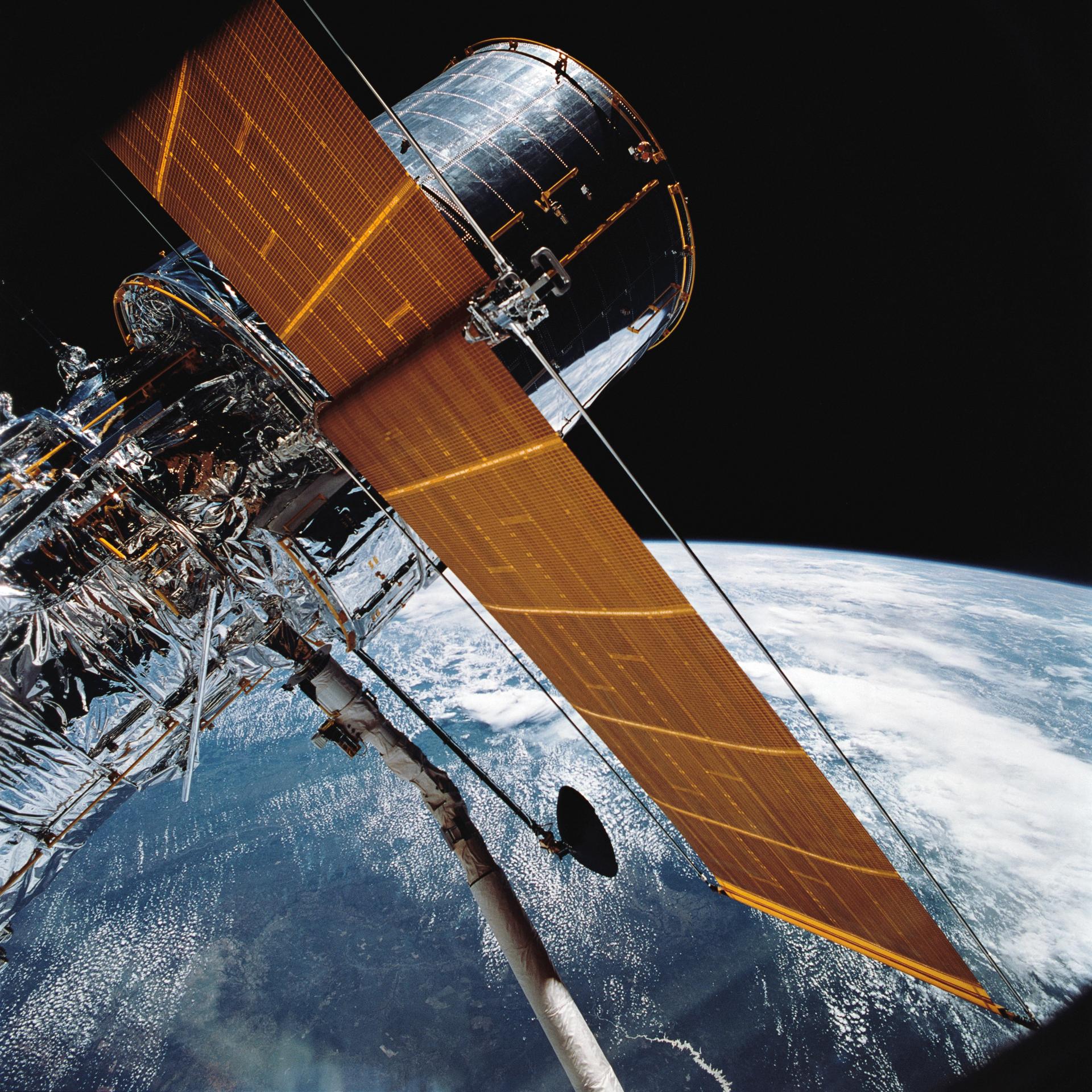
The giant Hubble Space Telescope (HST) can be seen as it is suspended in space by Discovery’s Remote Manipulator System (RMS) following the deployment of part of its solar panels and antennae on April 25, 1990.
NASA
The story of the Hubble Space Telescope confirms its place as the most transformative and significant astronomical observatory in history. Once called “the eighth wonder of the world” by a former NASA administrator, Hubble’s development since its genesis in the early 1970s and its launch, repair, and ultimate impact since 1990 provide ample opportunity to apply insights from its legacy. Scientists and engineers associated with groundbreaking discoveries have always operated within contexts shaped by forces including the government, private industry, the military, and the public at large. The purpose of this symposium is to explore the insights from Hubble’s past and draw connections that can inform the development of mission work today and for the future.
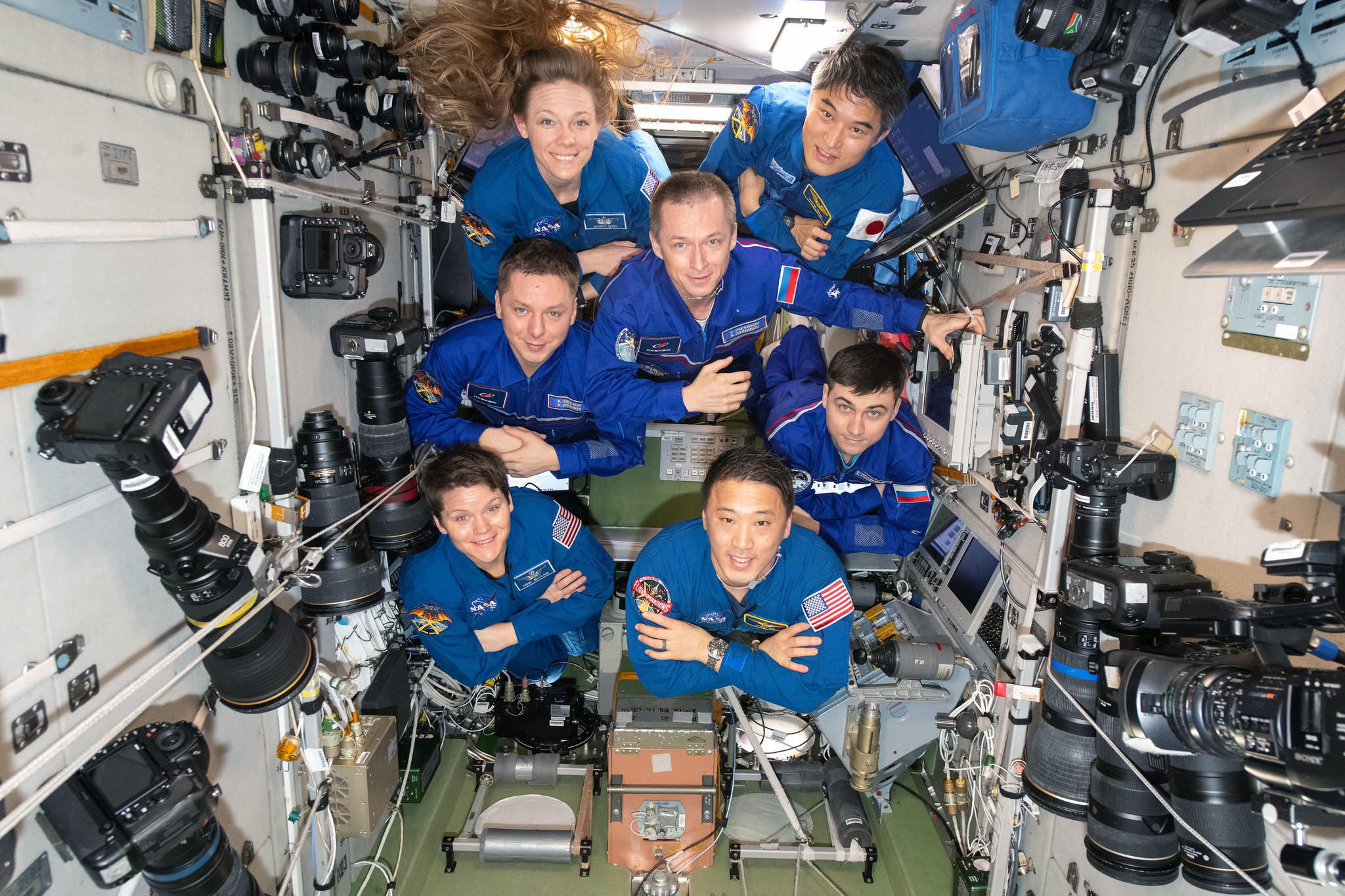
The seven-member Expedition 73 crew poses for a portrait inside the International Space Station’s Zvezda service module.
Credit: NASA
Students in Big Pine Key, Florida, will have the chance to have NASA astronauts aboard the International Space Station answer their prerecorded questions.
At 10:05 a.m. EDT on Monday, July 14, NASA astronaut Nicole Ayers and JAXA (Japan Aerospace Exploration Agency) astronaut Takuya Onishi will answer questions submitted by students.
The event is hosted by the Seacamp Association of Big Pine Key, Florida, which provides immersive science lessons for youth interested in discovering the sea. The event will be attended by local Monroe County students, as well as national and international campers ages 10-17 years old. The goal of the event is to help students make connections between astronauts training in space and scientists working in the sea.
Media interested in covering the event must RSVP by 5 p.m. EDT, Friday, July 11, to Judy Gregoire at: 305-872-2331 or email at: info@seacamp.org.
For nearly 25 years, astronauts have continuously lived and worked aboard the space station, testing technologies, performing science, and developing skills needed to explore farther from Earth. Astronauts aboard the orbiting laboratory communicate with NASA’s Mission Control Center in Houston 24 hours a day through SCaN’s (Space Communications and Navigation) Near Space Network.
Important research and technology investigations taking place aboard the space station benefit people on Earth and lay the groundwork for other agency missions. As part of NASA’s Artemis campaign, the agency will send astronauts to the Moon to prepare for future human exploration of Mars; inspiring Golden Age explorers and ensuring the United States continues to lead in space exploration and discovery.
See videos of astronauts aboard the space station at:
Listen to this audio excerpt from Joe Pavicic, Artemis operations project engineer
0:00 / 0:00
Your browser does not support the audio element.
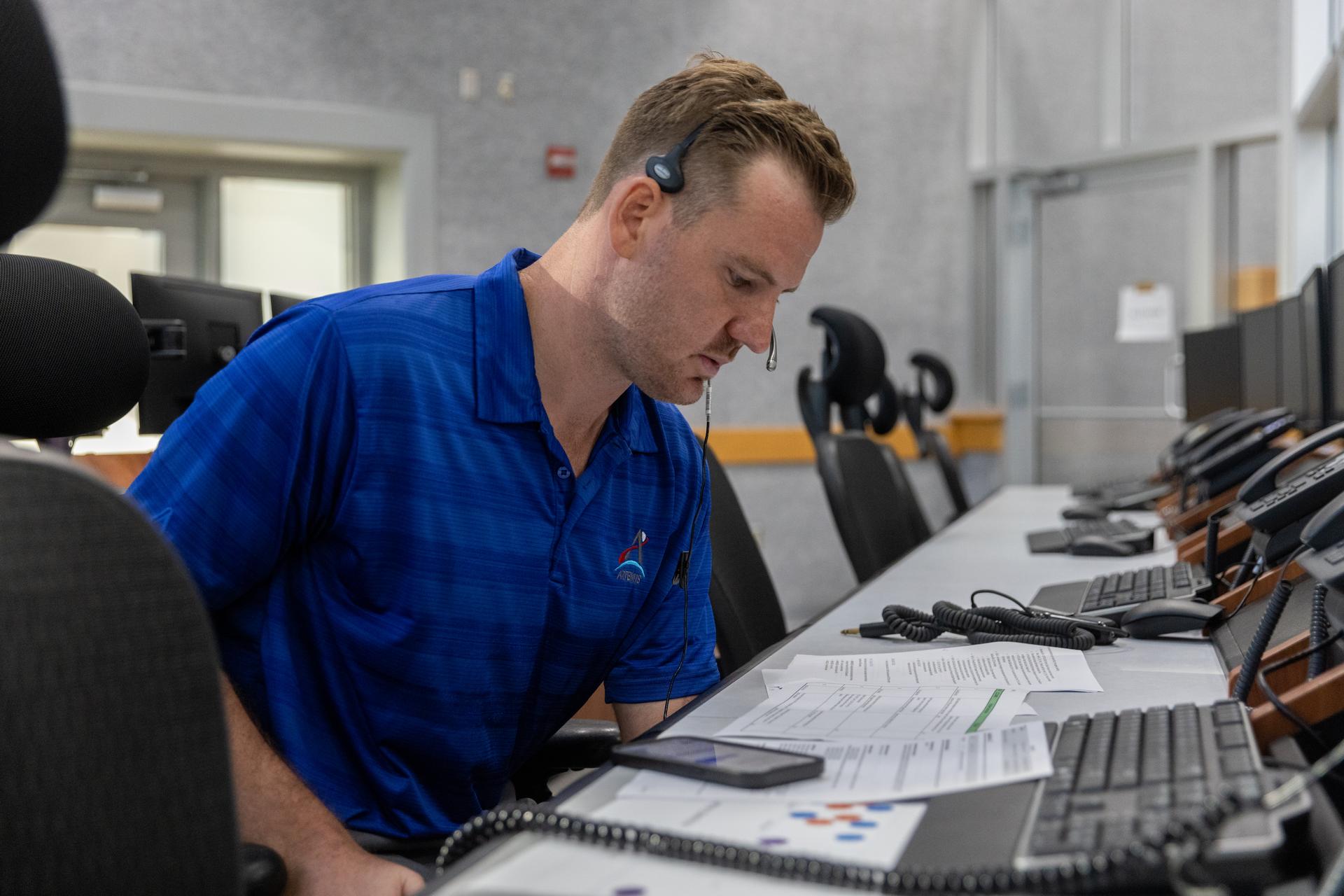
Joe Pavicic will never forget when he told the Artemis launch director teams were NO-GO for launch.
Before Artemis I lifted off from NASA’s Kennedy Space Center in Florida in November 2022, the launch team made multiple launch attempts the months prior.
“During a previous Artemis I launch attempt, there was an issue with engine three,” said Pavicic, operations project engineer who worked on the engines console during Artemis I. “One sensor was showing that it wasn’t seeing liquid hydrogen through it. It was showing that it was at ambient temperature.”
And I had to tell the launch director, ‘We can’t get there today with the current criteria that we have. My recommendation is a NO-GO.’
Joe pavicic
Operations Project Engineer
Prior to engine ignition, launch team controllers must first chill the engines before the cryogenic liquid propellant fuels and lifts the SLS (Space Launch System) rocket and Orion spacecraft into the heavens and onward to the Moon. Chilling the engines ensures the hardware doesn’t get damaged when exposed to the super-cooled liquid hydrogen at -423 degrees Fahrenheit.
NASA/Kim Shiflett
“We tried everything we could think of,” Pavicic recalls. “Any procedure we could try, we tried it, and we just never saw those rates that we should have.”
Thus, Pavicic, who is originally from West Palm Beach and studied aerospace engineering at Embry Riddle Aeronautical University in Daytona Beach, Florida, went back to the drawing board with the rest of his team, working days and nights rewriting procedures and learning new lessons about the engines and sensors until they were finally able to get to a successful launch.
“I just remember after I said, ‘NO-GO,’ I felt like all these people came to watch the launch, all my family, and I’m like, ‘I’m the guy,’ but I told myself, ‘I’m not going to be the one to say this for the next launch attempt. I’m going to do what I can to get us there.’
joe pavicic
Operations Project Engineer
NASA successfully launched and flew the Artemis I mission and now, Pavicic is working as one of the operations project engineers, continuing to help the launch team develop new launch commit criteria and procedures within the launch countdown ahead of Artemis II, the first crewed Artemis mission, which will send four astronauts around the Moon and back in 10 days next year.
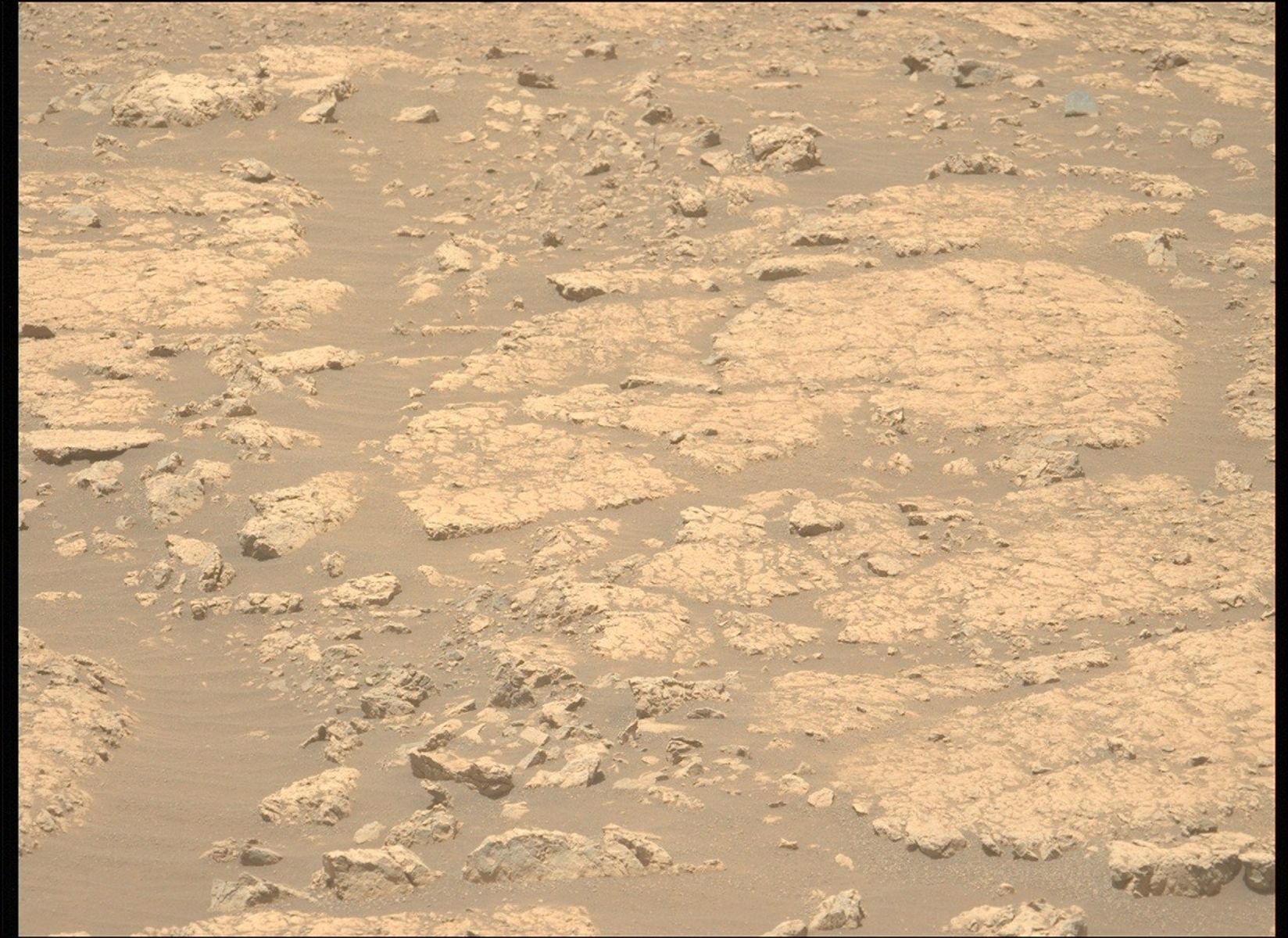
NASA’s Mars Perseverance rover acquired this image showing the target “Jigging Cove,” named by Make-A-Wish participant Madeline, located in the center of the image. Perseverance used its Left Mastcam-Z camera, one of a pair of cameras located high on the rover’s mast, to capture the image on June 27, 2025 (Sol 1547, or Martian day 1,547 of the Mars 2020 mission) at the local mean solar time of 11:26:04.
NASA/JPL-Caltech/ASU
Written by Eleanor Moreland, Ph.D. Student Collaborator at Rice University
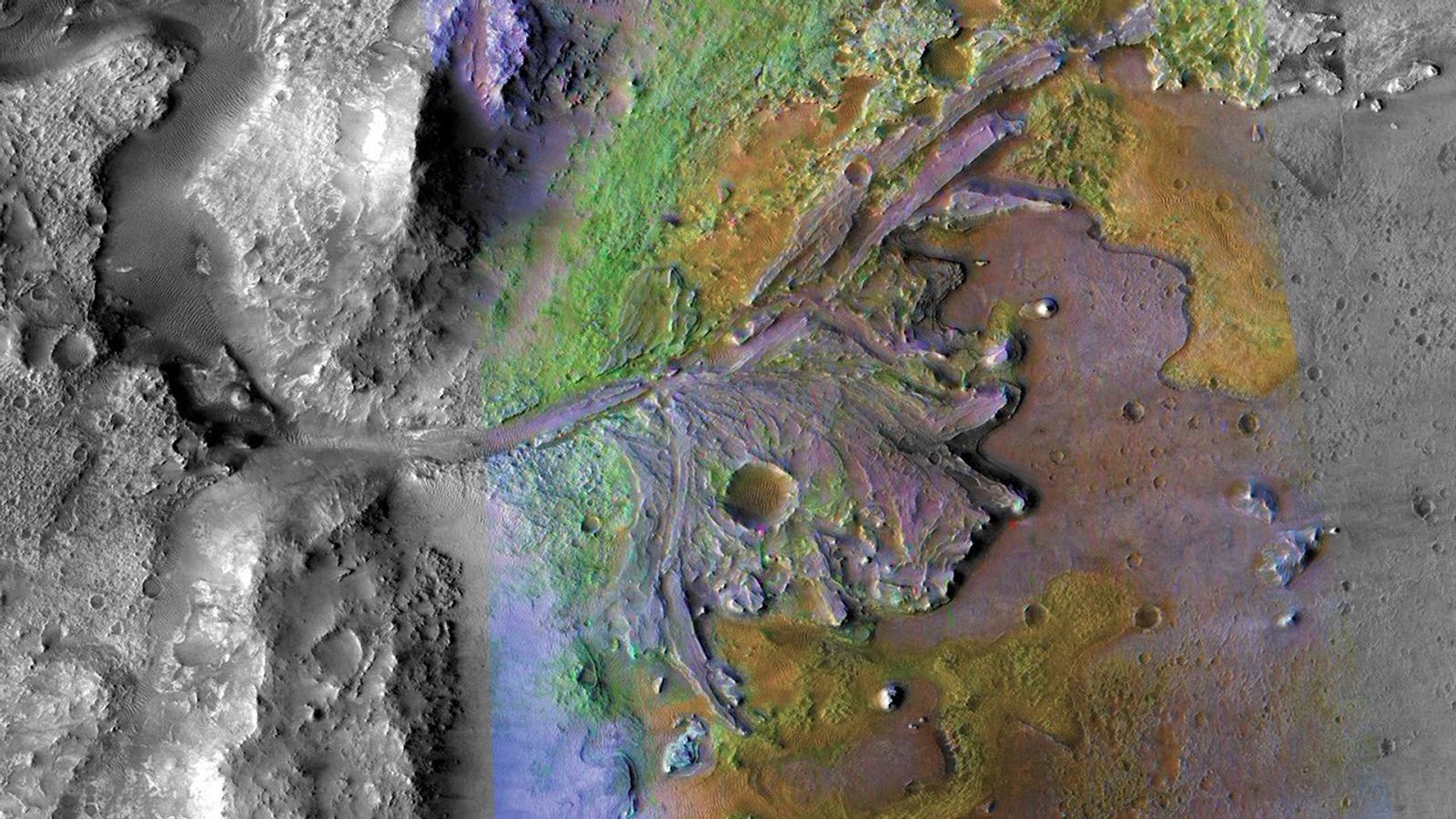
For the past month and a half, Perseverance has been exploring the Krokodillen plateau in search of clay-bearing rocks. An earlier blog discussed that these rocks could hold clues to Mars’ watery past, and Perseverance has been exploring multiple potential locations to find a suitable target to sample. When a coring target could not be found at the previous outcrop, the Science Team decided to return to the “Main Topsail” locality. In a single drive to this area, Perseverance drove 411.7 meters (1,350.7 feet, or just over a quarter mile) — the longest driving distance ever accomplished by a robotic vehicle on another planet. Go, Percy, go!
Back in the region near “Main Topsail” and “Salmon Point,” the team attempted to abrade and sample the clay-bearing rocks at a few different targets. These rocks, however, are proving very breakable and difficult to sample and abrade. Perseverance has experienced challenging fine-grained rocks before, such as during the fan front campaign inside Jezero crater. In that scenario and this one, the Science and Engineering teams work together diligently to find the highest priority targets and find rocks that could withstand the abrasion and coring processes. In this case, the team has decided to return to the site of a previous abrasion, “Strong Island,” to sample the rock we have already abraded and analyzed. This abrasion showed the strong clay signature the team is looking to sample, and we will make another coring attempt this week.
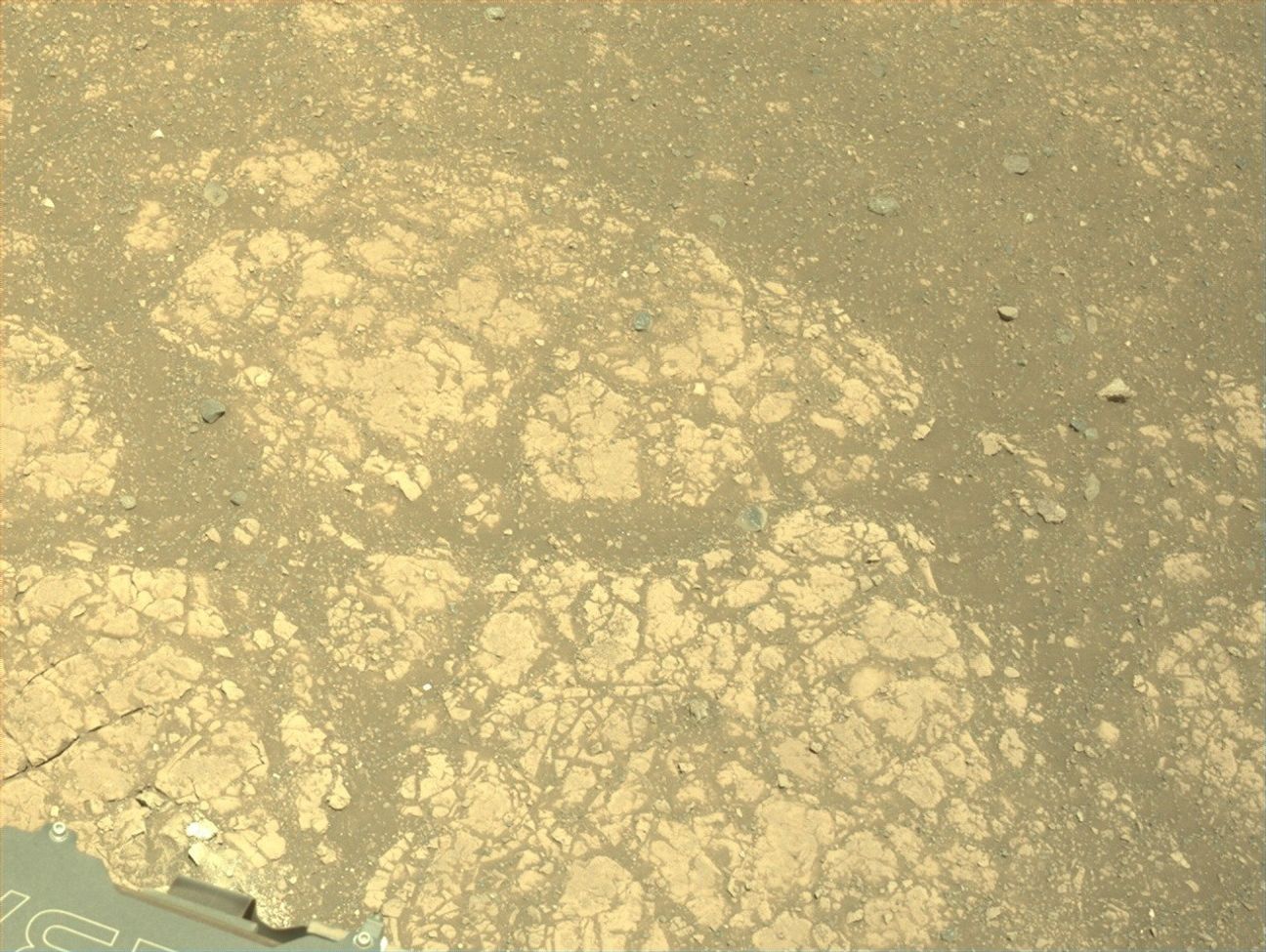
NASA’s Mars Perseverance rover acquired this image of the target “Gallants,” named by Make-A-Wish participant Joshua, located in the lower left quadrant of the image. Perseverance used its onboard Left Navigation Camera (Navcam), which is located high on the rover’s mast and aids in driving, to capture the image on July 1, 2025 (Sol 1551 or Martian day 1,551 of the Mars 2020 mission), at the local mean solar time of 13:10:08.
NASA/JPL-Caltech
This past week, the Perseverance team hosted two very special visitors, Madeline and Joshua, and had the unique honor of fulfilling their wishes through the Make-A-Wish foundation. During their visits to JPL, Madeline and Joshua were named honorary Mars 2020 Operations Team Members. They visited the test rovers in the JPL Mars Yard, watched data arrive from the rover with the Perseverance operations team, and attended a rover planning meeting, collaborating with the science and engineering team members on campus. Madeline and Joshua will forever be connected to the Mars 2020 mission, as each selected the name of one of our planning targets. Madeline’s target, “Jigging Cove,” was a target for Mastcam-Z and SuperCam “all techniques” analysis, including LIBS, VISIR, and RMI. Joshua’s selection, “Gallants,” will be used for the next coring target. Carrying forward the resilience shown by Madeline and Joshua, Perseverance will attempt to sample this clay-rich bedrock before continuing the investigation along the Jezero crater rim.
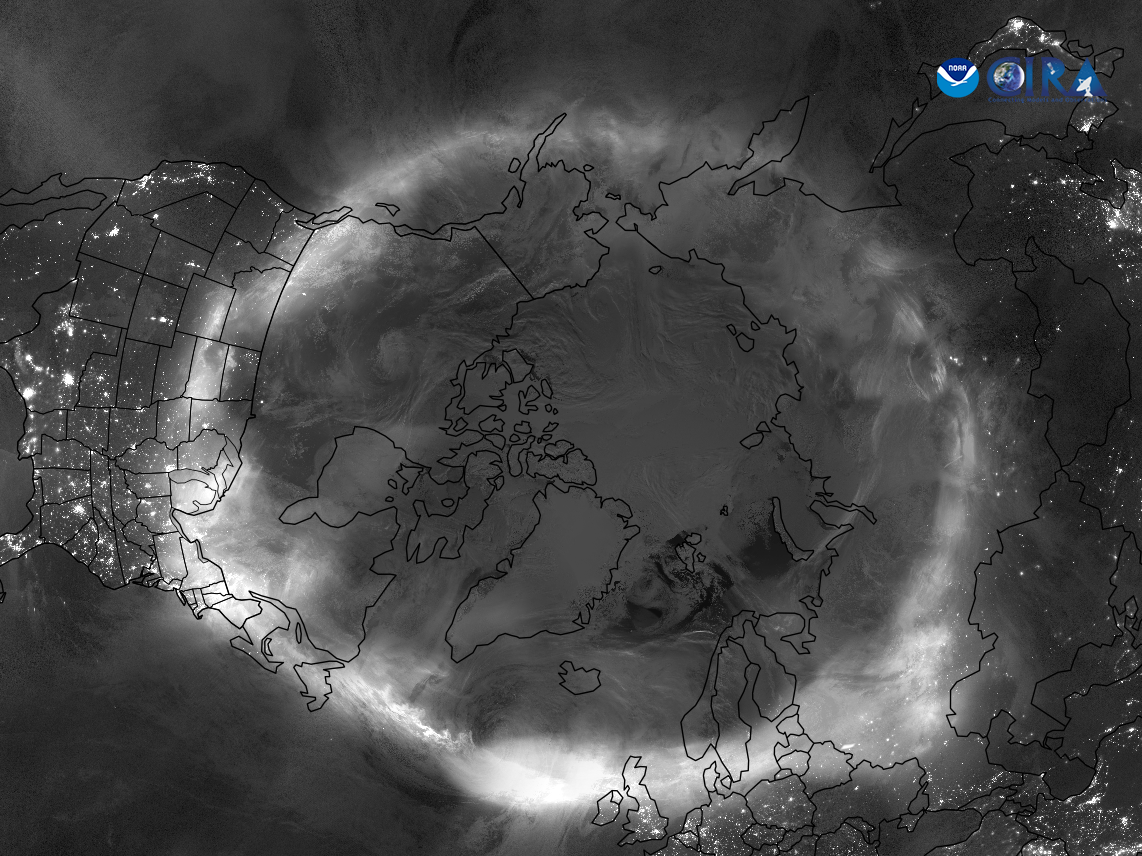
A satellite image showing the extent of the Northern Lights during part of the Mother’s Day 2024 solar storms.
Credits: NOAA
One year ago, solar storms lit up the night sky. Why?
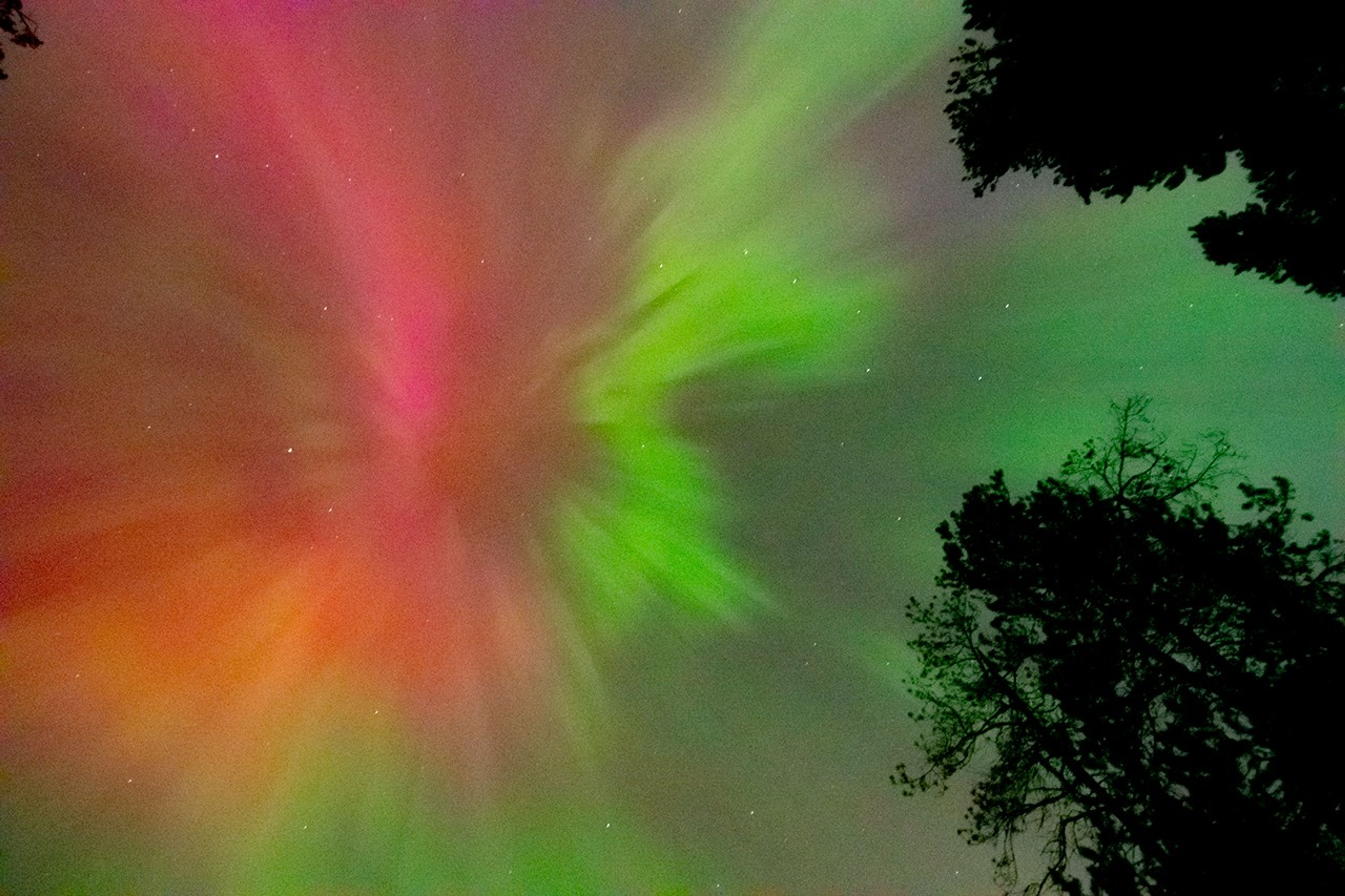
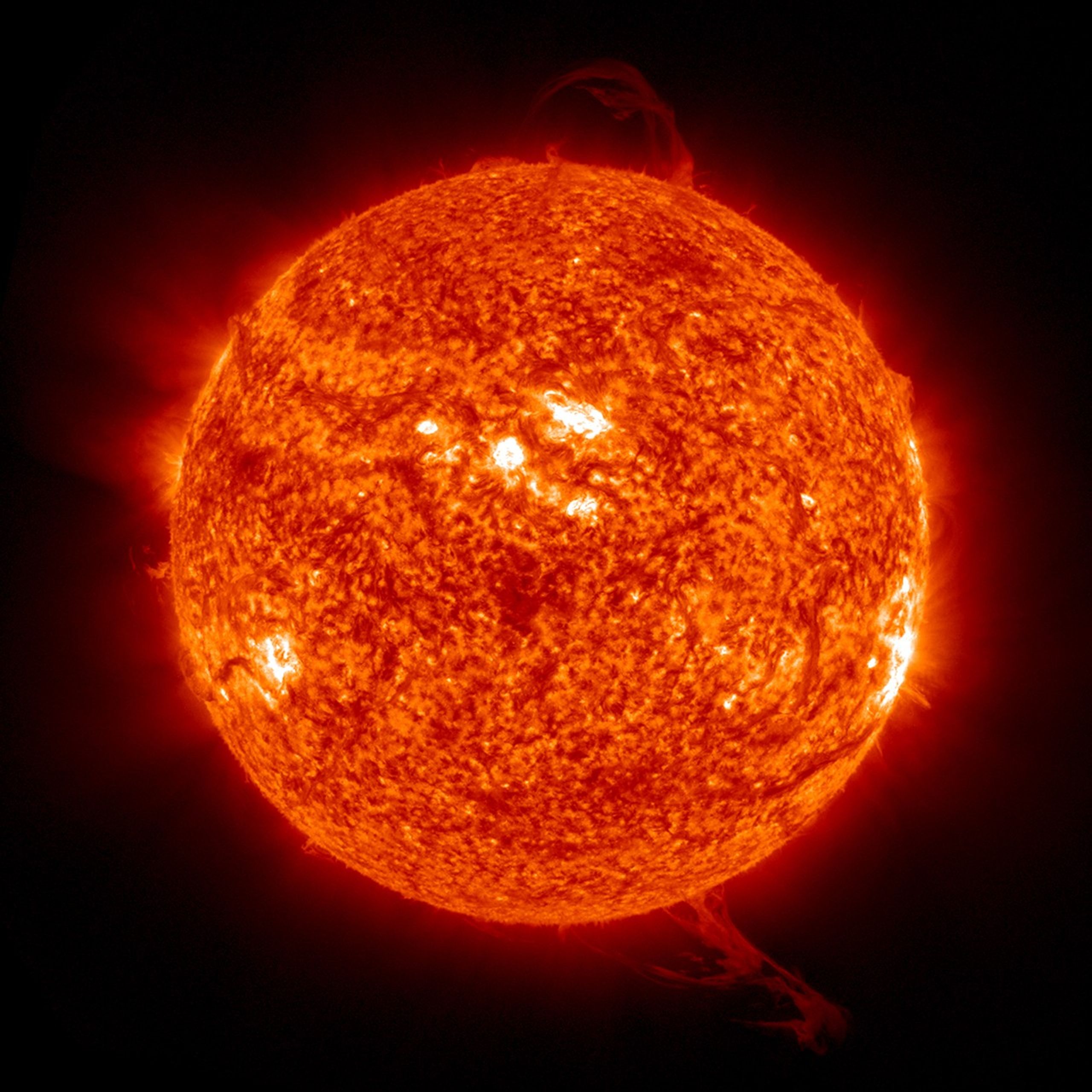
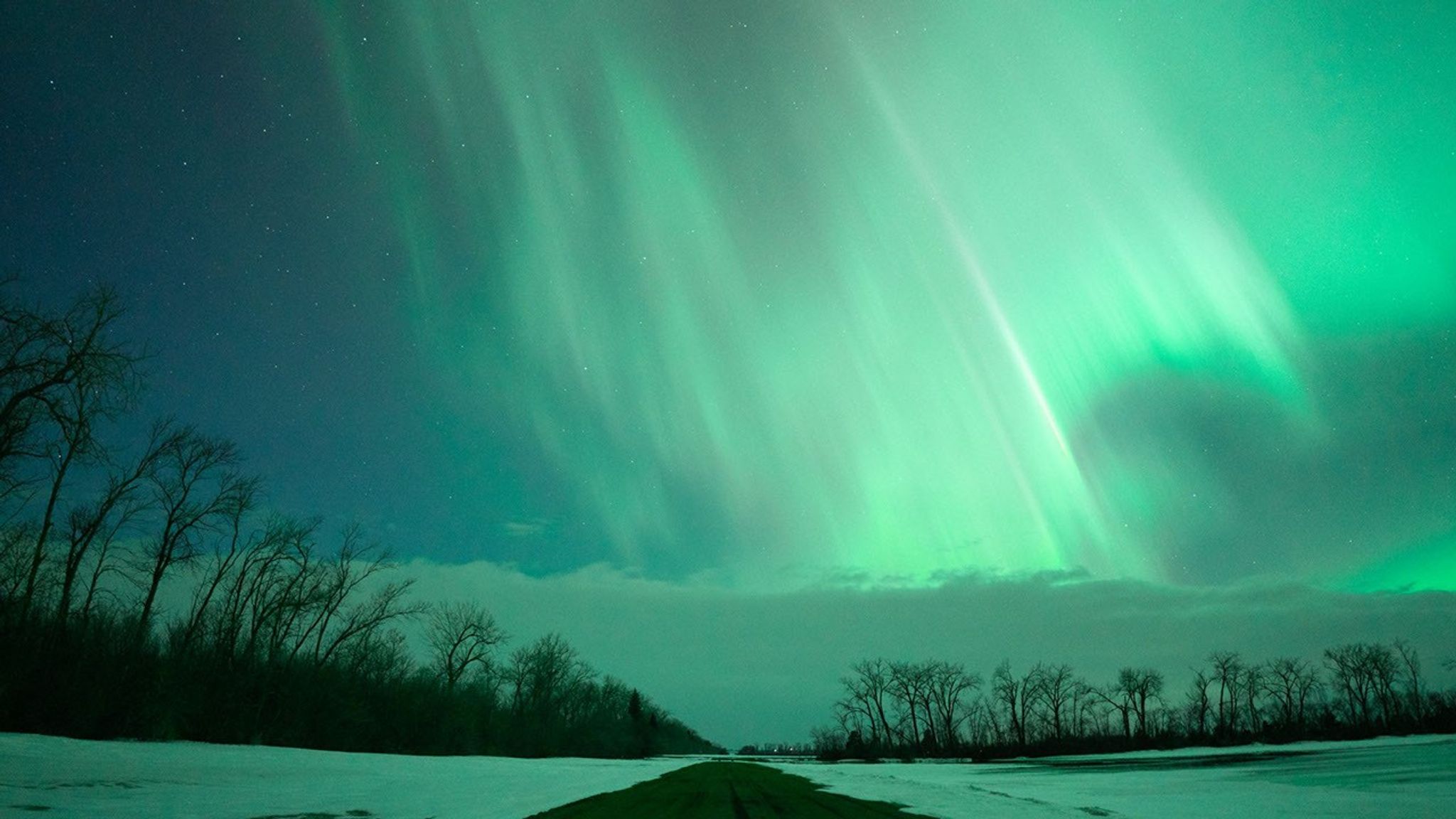
The Sun is 93 million miles away from Earth, on average. Even though it’s far away, we can still see and feel its effects here. One of the most beautiful effects are the auroras – colorful lights that dance across the sky near the North and South Poles. These are also called the Northern and Southern Lights. They happen when tiny particles from the Sun hit gas molecules in our atmosphere and give off energy.
Sometimes the Sun becomes very active and sends out a lot more energy than normal. When this happens, we can see auroras in places much farther from the poles than normal. In May 2024, around Mother’s Day, the Sun sent powerful solar storms in the direction of Earth. These storms were also called the Gannon Storms, named after Jennifer Gannon, a scientist who studied space weather. The Northern Lights could be seen as far south as Puerto Rico, Hawaii, Mexico, Jamaica, and the Bahamas. The Southern Lights were also visible as far north as South Africa and New Zealand.
Aurora Borealis seen from British Columbia, Canada on May 10, 2024.
NASA/Mara Johnson-Groh
Scientists who study the Sun and its effects on our solar system work in a field called heliophysics. Their studies of the Sun have shown that it goes through cycles of being more active and less active. Each one of these cycles lasts about 11 years, but can be anywhere from 8 to 14 years long. This is called the Solar Cycle.
The middle of each cycle is called Solar Maximum. During this time, the Sun has more dark spots (called sunspots) and creates more space weather events. The big storms in May 2024 happened during the Solar Maximum for Solar Cycle 25.
On May 8 and 9, 2024, an active area on the Sun called AR3664 shot out powerful solar flares and several huge bursts of energy called coronal mass ejections (CMEs). These CMEs headed straight for Earth. The first CME pushed aside the normal solar wind, making a clear path for the others to reach us faster. When all this energy hit our atmosphere, it created auroras much farther from the poles than usual. It was like the Sun gave the auroras a huge power boost!
Eruptions of Solar material into space as seen on May 7 (right) and May 8 (left), 2024. These types of eruptions often come just before a larger Coronal Mass Ejection (CME), including the ones which caused the Mother’s Day solar storms.
NASA/SDO
Auroras are beautiful to watch, but the space weather that creates them can also cause problems. Space weather can mess up radio signals, power grids, GPS systems, and satellites. During the May 2024 storms, GPS systems used by farmers were disrupted. Many farmers use GPS to guide their self-driving tractors. Since this happened during peak planting season, it may have cost billions of dollars in lost profit.
Because space weather can cause so many problems, scientists at NASA and around the world watch the Sun closely to predict when these events will happen. You can help too! Join local science projects at schools, teach others about the Sun, and help make observations in your area. All of this helps us to learn more about the Sun and how it affects our planet.
Here are some resources to connect you to the Sun and auroras
Lesson Plans & Educator Guides
Magnetic Mysteries: Sun-Earth Interactions
A 5E lesson for high school students to investigate the question of what causes aurora by using Helioviewer to examine solar activity.
Aurora Research and Heliophysics
Learn about aurora, how they form, and the different phases they go through, as well as heliophysics missions that study them.
How Earth’s Magnetic Field Causes Auroras
A 5E middle school lesson where students explore why our planet has a magnetic field (and other planets don’t) and what it is like.
Interactive Resources
Magnetic Earth
Introductory activity where users learn about the magnetic field that surrounds Earth and its role in creating the Northern Lights.
NOAA Aurora 30-Minute Forecast
An interactive aurora map for both hemispheres which allows users to predict the likelihood of auroras at different latitudes.
Webinars and Slide Decks
Space Weather Basics
A slide deck (41 slides) that offers an elementary introduction to the basic features of space weather and its interactions with Earth’s magnetosphere and various technologies.
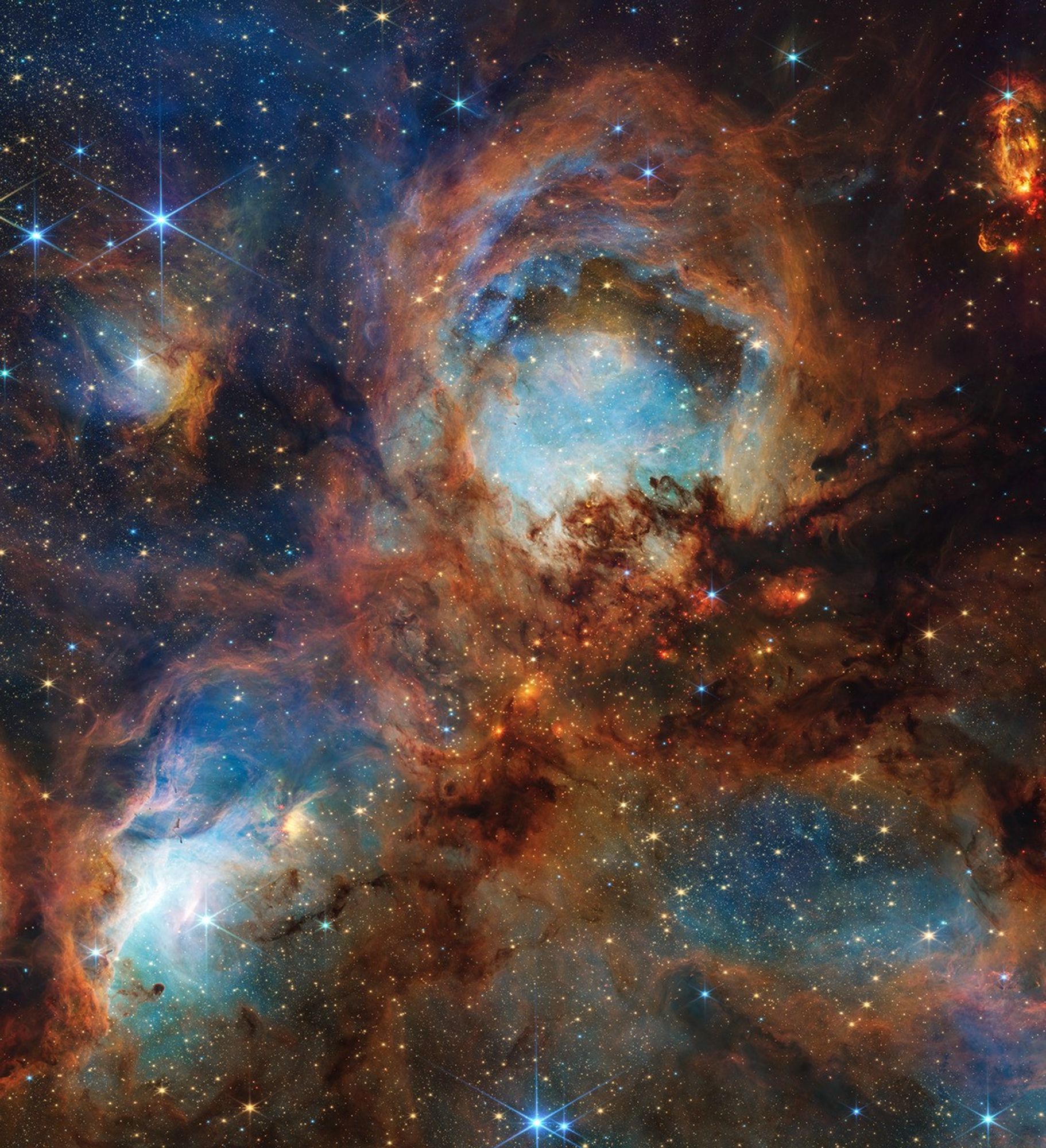
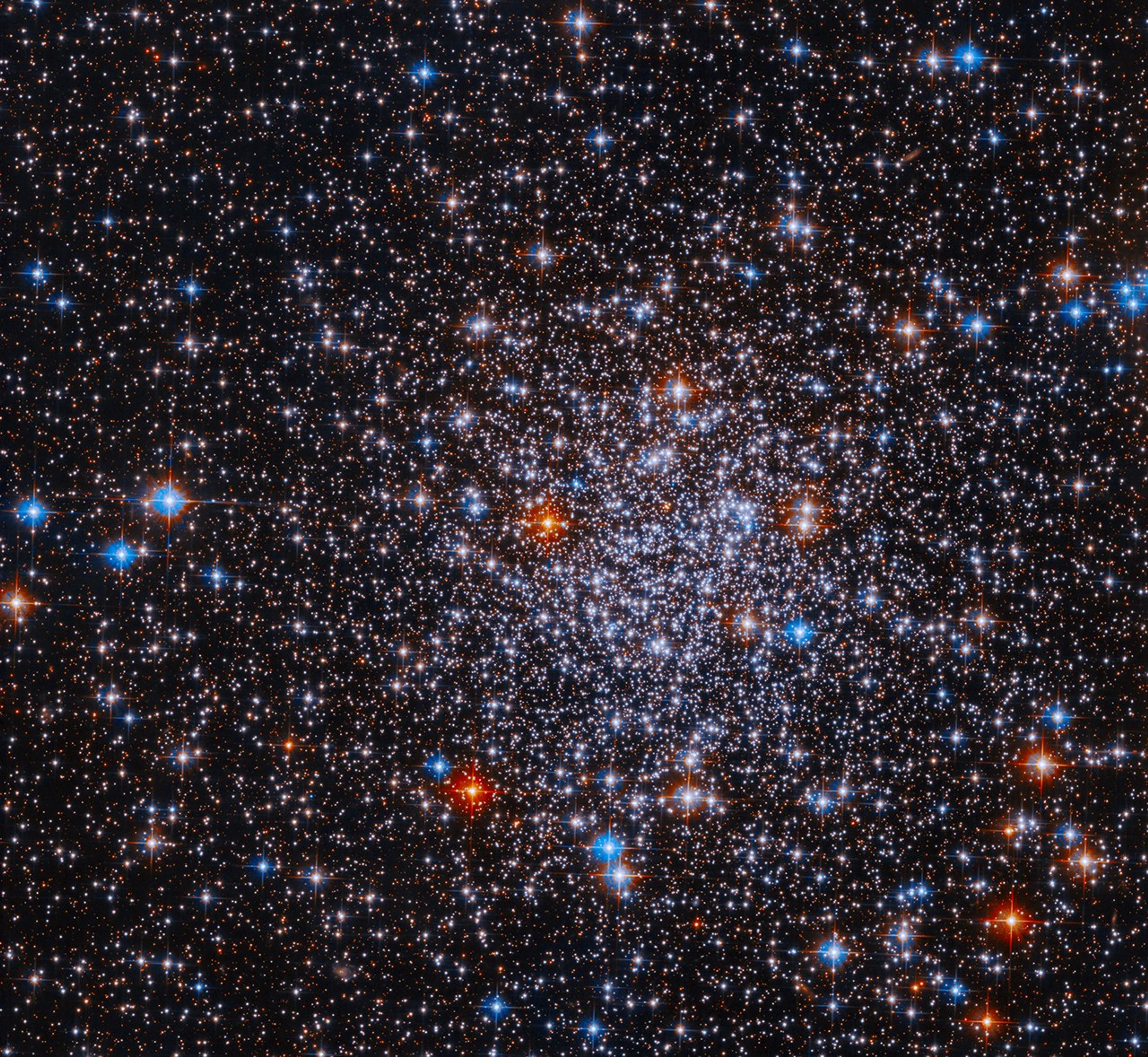
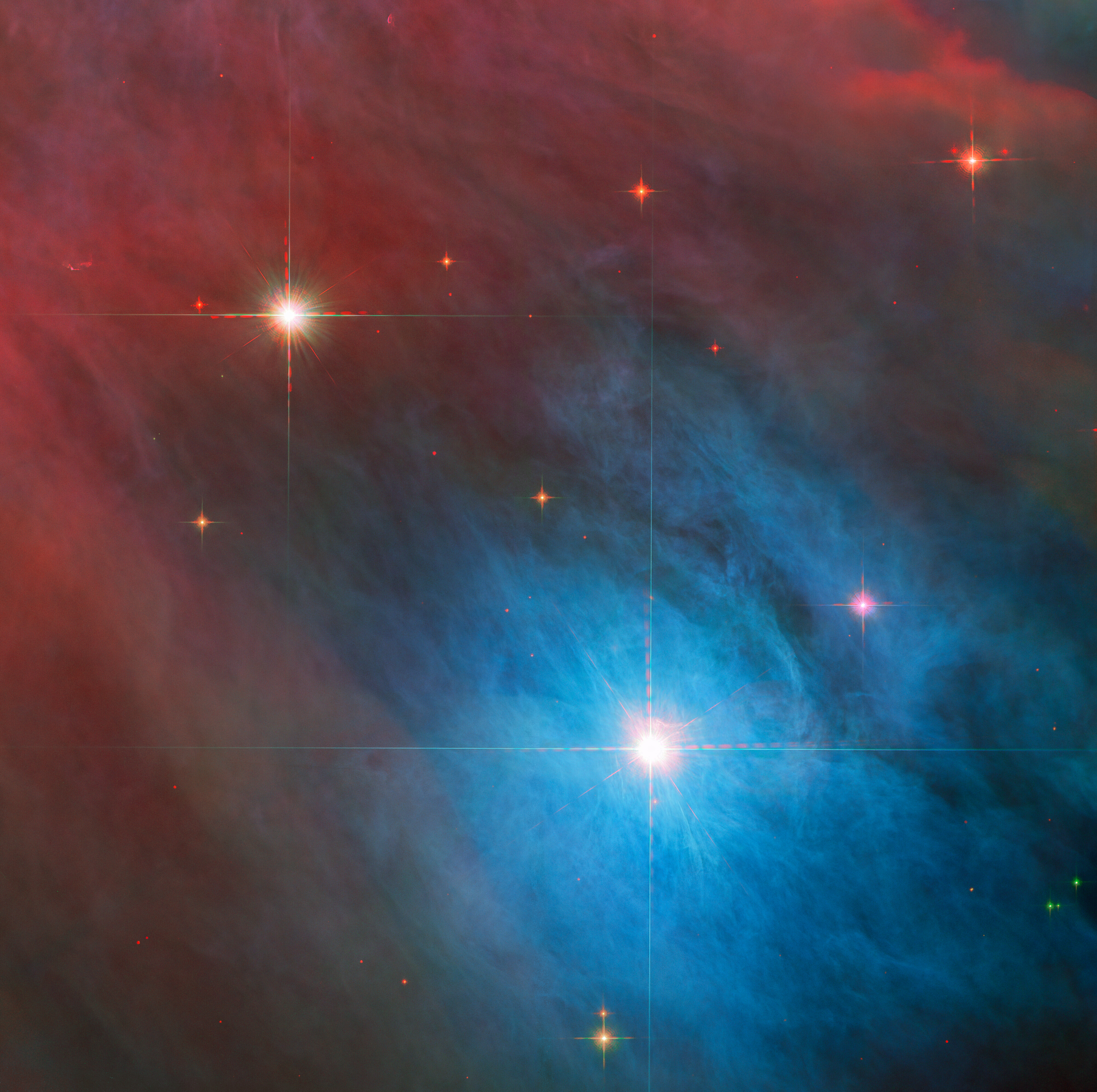
NASA’s Hubble Space Telescope captured a bright variable star, V 372 Orionis, and its companion in this festive image in this image released on Jan. 27, 2023. The pair lie in the Orion Nebula, a colossal region of star formation roughly 1,450 light-years from Earth.
V 372 Orionis is a particular type of variable star known as an Orion Variable. These young stars experience some tempestuous moods and growing pains, which are visible to astronomers as irregular variations in luminosity. Orion Variables are often associated with diffuse nebulae, and V 372 Orionis is no exception; the patchy gas and dust of the Orion Nebula pervade this scene.
Text credit:European Space Agency (ESA)
Image credit: ESA/Hubble & NASA, J. Bally, M. Robberto
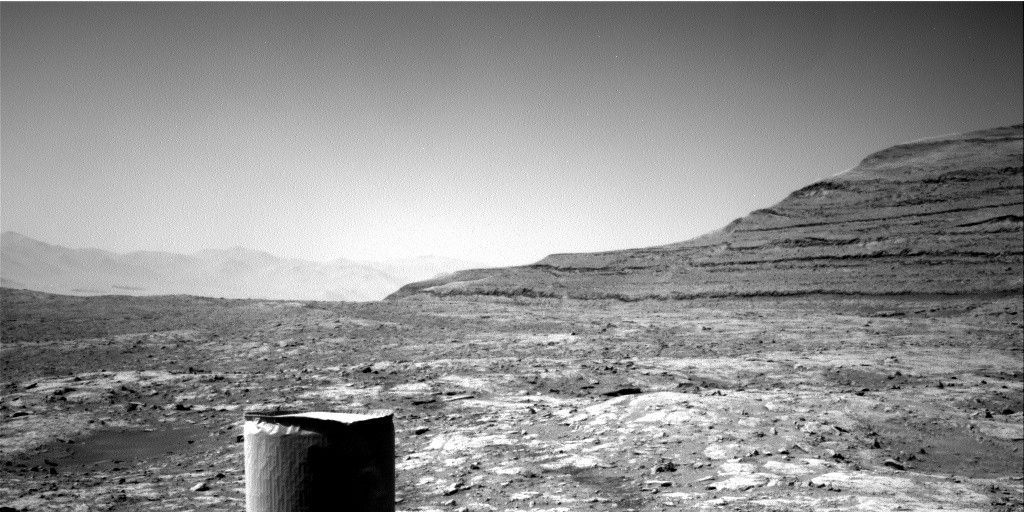
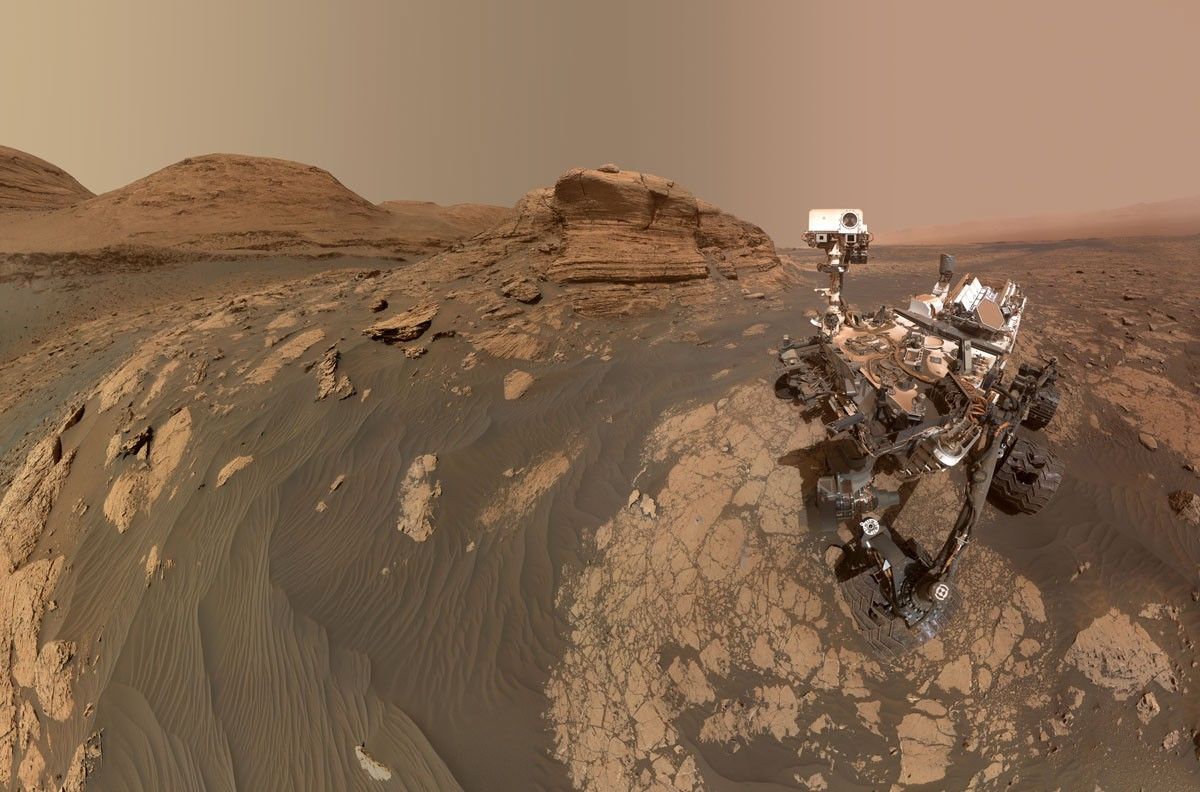
Navcam view of the ~3 ft high ridge that marks the eastern side of Volcán Peña Blanca. The ridge is currently about 35 ft away from the rover, and the team used images like this during today’s planning to decide the exact location for Curiosity’s approach.
NASA/JPL-Caltech
Written by Abigail Fraeman, Deputy Project Scientist at NASA’s Jet Propulsion Laboratory
Earth planning date: Thursday, July 3, 2025
The team was delighted this morning to learn that Wednesday’s drive had completed flawlessly, placing us in a stable position facing a ~3 foot high ridge located ~35 feet away. This ridge is the eastern edge of a feature the team has informally named “Volcán Peña Blanca.” This feature certainly looked intriguing in orbital images, but once we saw Curiosity’s pictures of it from the ground, we decided it was cool enough to spend the time to investigate it closer. The images from the ground show a lot more detail than is visible in orbit, including clear sedimentary structures exposed along the ridge face which could provide important clues about how the rocks in the boxwork-bearing terrain were initially deposited – dunes? Rivers? Lakes? The team picked their favorite spot to approach the ridge and take a closer look during Wednesday’s planning, so Curiosity made a sharp right turn to take us in that direction. Using today’s images, we refined our plan for the exact location to approach and planned a drive to take us there, setting us up for contact science on Monday.
We had the opportunity to plan four sols today, to cover the U.S. 4th of July holiday weekend, so there was lots of time for activities besides the drive. Curiosity is currently sitting right in front of some light toned rocks, including one we gave the evocative name “Huellas de Dinosaurios.” It’s extremely unlikely we’ll see dinosaur footprints in the rock, but we will get the chance to investigate it with APXS, MAHLI, and ChemCam. We also have a pair of ChemCam only targets on a more typical bedrock target named “Amboro” and some pebbles named “Tunari.” Mastcam will take a high resolution of mosaic covering Volcán Peña Blanca, some nearby rocks named “Laguna Verde,” a small light colored rock named “Suruto,” and various patterns in the ground. Two ChemCam RMI mosaics of features in the distant Mishe Mokwa face and environment monitoring activities round out the plan.
This website uses cookies to improve your experience. We'll assume you're ok with this, but you can opt-out if you wish.AcceptRead More
Privacy & Cookies Policy
Privacy Overview
This website uses cookies to improve your experience while you navigate through the website. Out of these, the cookies that are categorized as necessary are stored on your browser as they are essential for the working of basic functionalities of the website. We also use third-party cookies that help us analyze and understand how you use this website. These cookies will be stored in your browser only with your consent. You also have the option to opt-out of these cookies. But opting out of some of these cookies may affect your browsing experience.
Necessary cookies are absolutely essential for the website to function properly. This category only includes cookies that ensures basic functionalities and security features of the website. These cookies do not store any personal information.
Any cookies that may not be particularly necessary for the website to function and is used specifically to collect user personal data via analytics, ads, other embedded contents are termed as non-necessary cookies. It is mandatory to procure user consent prior to running these cookies on your website.