Category: Aeronautics

http://www.nasa.gov/rss/dyn/aeronautics.rss

  • NASA’s Modern History Makers: Adabelle Narvaez-Bostwick

    Adabelle Narvaez-Bostwick poses inside NASA Glenn’s Icing Research Tunnel. She is smiling, wearing a blue suit, and standing in front of a large, tan fan.
    Meet one of NASA’s Modern History Makers, Adabelle Narvaez-Bostwick, chief engineer for aeronautics at NASA’s Glenn Research Center. She’s supporting NASA’s work to make flight faster, cleaner, safer, and quieter.
    NASA/Bridget Caswell

    Adabelle Narvaez-Bostwick has worked in the same building at NASA’s Glenn Research Center in Cleveland for 35 years, and the chief engineer for aeronautics has no plans on going anywhere else.

    “I always dreamt of working at NASA; the rest is history,” she said. “I ended up here and haven’t left since.”

    The seeds of that dream were planted while Narvaez-Bostwick was growing up in Puerto Rico. While studying electrical engineering in college, Narvaez-Bostwick discovered NASA’s work, reading extensively about how the space program led to technologies that improved people’s quality of life.

    During university, however, Narvaez-Bostwick wasn’t just learning the technical aspects of STEM.

    “I needed to learn a second language,” she said. “I wanted to be as bilingual as possible, so I taught myself English.”

    She deliberately signed up for classes in English instead of Spanish, toting around a dictionary to look up unfamiliar words.

    Despite learning a new language, facing doubts from her peers, being one of the few women in her classes, and being the first one in her family planning to leave the island for a career, she pushed herself to get a foot in the door at NASA.

    “I wanted to be a part of that world,” Narvaez-Bostwick said. “I was inspired by the fact of challenging myself to say, ‘I can do this, and I will do it.’”

    After NASA visited Puerto Rico to recruit new employees, the agency offered the budding engineering student a co-op at NASA’s Langley Research Center in Hampton, Virginia. Upon graduation, Narvaez-Bostwick accepted a full-time position at Glenn. Contributing to projects that spanned spaceflight systems to aeronautics, she ended up loving the center.

    “My favorite part of Glenn is the community, the way we work together, the way we relate to each other,” she said. “It makes you feel like coming to work is also being part of a bigger family.”

    The turning point in her professional career, Narvaez-Bostwick says, is when she had the opportunity to be chief engineer for the upper stage simulator that Glenn was developing for NASA’s Ares I-X test rocket. Now, as chief engineer for aeronautics, she oversees Glenn’s whole portfolio of aeronautics projects.

    “We’re hoping to get to a place where commercial aircraft are safer, more sustainable, and more efficient,” she said.

    Narvaez-Bostwick provides technical management guidance for NASA’s Electrified Powertrain Flight Demonstration (EPFD), Hybrid Thermally Efficient Core (HyTEC), and Transformational Tools and Technologies (TTT) projects, and more. She helps teams set up effective processes for their work while balancing costs, schedules, and risks.

    “There’s a lot to learn and a lot that needs to happen to make these projects successful,” she said. “Every project is unique; every person in the project is unique.”

    Narvaez-Bostwick says that diversity in background and technical expertise is a plus, and it’s important to recognize that mission success depends on everyone’s contributions.

    “We have a lot of great people that come from many different places; it makes your team so much better,” she said. “My vision for the people I lead is to see them work toward the same goals, like an orchestra – having them all playing together for great music and rhythm.”

    Despite having such a dynamic job, Bostwick doesn’t get overwhelmed, she says. She’s a systems thinker and strives to get out of her comfort zone.

    “I love the complexity; challenges motivate me,” she said. “I need to feel uncomfortable – that’s how we grow and learn.”

    Besides seeing the projects she oversees come to fruition, Narvaez-Bostwick’s biggest goal going forward is to support the next generation of NASA recruits the way she feels she’s been supported in her career.

    “I want to be that person now to help mentor others, help them to grow, push them to do what I believe they can do,” she said.

    Narvaez-Bostwick says she is glad she’s never backed down from the challenges she’s faced and is excited to keep pushing NASA’s aeronautics missions forward from Glenn’s Building 86.

    “Nothing is impossible,” she said. “A lot of people laughed in my face when I said, ‘I’m going to work for NASA one day.’ But here I am, and I’m not the only one.”

    NASA is in a Golden Era of aeronautics and space exploration. In partnership with commercial and private businesses, NASA is currently making history with significant missions such as Artemis, Quesst, and electrified aviation. The NASA’s Modern History Makers series highlights members of NASA Glenn’s workforce who make these remarkable missions possible.

    Top image: Adabelle Narvaez-Bostwick stands inside NASA Glenn’s Icing Research Tunnel. Credits: NASA/Bridget Caswell

    Ellen Bausback

    NASA’s Glenn Research Center

  • Forget Movie Magic, NASA Armstrong has the Real Thing

    3 min read

    Forget Movie Magic, NASA Armstrong has the Real Thing

    This movie shows NASA’s X-43A demonstrating supersonic-combustion ramjet (scramjet) propulsion during two of its record-setting flights in 2004. Both flights, the first on Mar. 27 and the second on Nov. 16, 2004, demonstrated sustained thrust from the X-43A’s air-breathing scramjet engine, the first at nearly 5,000 mph, the second at nearly 7,000 mph, or almost 10 times the speed of sound. Credits: NASA

    Early in the blockbuster movie “Top Gun: Maverick,” U.S. Navy Captain Pete “Maverick” Mitchell takes the secret hypersonic “Darkstar” airplane on an unauthorized flight test. After using jet engines to power past Mach 3, roughly 2,300 mph, Maverick says he is transitioning to scramjet, and the Darkstar rockets to over Mach 10, about 7,600 mph. The heat at that speed causes Darkstar to come apart and the next time we see Maverick he is walking into a diner, having successfully ejected from the aircraft.

    But what’s Hollywood and what’s real? Is flight at Mach 10 even possible? In the movie, Maverick is dubbed “the fastest man alive,” but who was the real fastest man alive? The answers to these questions have ties to NASA’s Armstrong Flight Research Center in Edwards, California.

    Is Mach 10 possible in the atmosphere? Yes. Spacecraft, such as the now retired Space Shuttle, reached 17,500 mph (nearly Mach 25) re-entering Earth’s atmosphere. In terms of aircraft, NASA’s uncrewed X-43A came closest to achieving Mach 10, hitting Mach 9.68 during a flight on Nov. 16, 2004. The flight research and testing was handled by NASA Armstrong.

    Children walk around the Darkstar prop made for the Top Gun: Maverick. The prop was on display at the 2022 Aerospace Valley Open House, Air Show, & STEM Expo in Edwards, California.
    Children walk around the Darkstar prop made for the Top Gun: Maverick. The prop was on display at the 2022 Aerospace Valley Open House, Air Show, & STEM Expo in Edwards, California.
    U.S. Air Force

    The 12-foot-long X-43A was powered by an experimental scramjet engine, the type of engine mentioned in the movie. A scramjet draws oxygen for combustion from the atmosphere rather than carrying it like a rocket. The scramjet powered the X-43 for about 10 seconds, hitting speeds of 6,600 mph and temperatures of 3600 degrees Fahrenheit. The flight ended as planned, in the ocean.

    “These demonstrations proved the viability of scramjet engine technology in a ‘real world’ flight environment and were the result of over 40 years of high-speed propulsion research within NASA,” Paul Reukaut, deputy project manager for X-43A flight research and testing, said after the record-setting flights.

    As for the “real” fastest man title, that honor still goes to William J. “Pete” Knight, who flew the X-15A-2 to a speed of 4,520 mph (Mach 6.7) on Oct. 3, 1967. Knight came close to having a fate like Maverick’s. During his record-setting flight, the X-15 was carrying a dummy scramjet engine underneath the fuselage. At high speeds, intersecting shockwaves from the scramjet and pylon had created roiling turbulent flows generating temperatures exceeding 2,800 degrees. The heat melted the dummy scramjet away and damaged the aircraft’s frame, ventral tail, pressurization lines, and electrical wiring. It never flew again.

    X-15A-2 with ablative coating and external tanks installed parked in front of hangar.
    X-15A-2 with ablative coating and external tanks installed parked in front of hangar. In June 1967, the X-15A-2 rocket-powered research aircraft received a full-scale ablative coating to protect the craft from the high temperatures associated with hypersonic flight (above Mach 5). This coating would help the aircraft reach the record speed of 4,520 mph (Mach 6.7).
    NASA

    The X-15 program was a joint NASA/Air Force/Navy effort aimed at exploring the areas of high aerodynamic heating rates, stability and control, physiological phenomena, and other problems relating to hypersonic flight. 

    Hypersonic refers to flight at speeds greater than five times the speed of sound, which is roughly 3,800 mph depending on altitude and atmospheric conditions. Hypersonic also refers to an object, such as an airplane, moving so fast that it starts to change the chemistry of the air around it, breaking apart air molecules, and creating scorching heat.

    The success of programs like X-15 and X-43 laid the groundwork for future hypersonic, both for national defense and commercial markets.

  • NASA Concludes Wind Study

    2 min read

    NASA Concludes Wind Study

    A remotely piloted drone takes off for a wind study mission.
    The Dryden Remotely Operated Integrated Drone 2 (DROID 2) aircraft flies by the former space shuttle hangar at NASA’s Armstrong Flight Research Center in Edwards, California, as part of the Advanced Exploration of Reliable Operation at Low Altitudes: Meteorology, Simulation, and Technology campaign. The focus was to study wind to provide data for safe takeoff and landing of future air taxis.
    NASA/Steve Freeman

    A NASA wind study aimed at enhancing air taxi safety on takeoff and landing is complete at NASA’s Armstrong Flight Research Center in Edwards, California.

    The center’s Dryden Remotely Operated Integrated Drone (DROID 2), a fixed wing aircraft, Aug. 31 completed the last flights for the Advanced Exploration of Reliable Operation at Low Altitudes: Meteorology, Simulation and Technology campaign.

    The aircraft acted as a wind sensor as part of NASA’s multifaceted, multi-center approach to fill knowledge gaps and resolve wind and weather unknowns that could hinder flights under the agency’s Advanced Air Mobility (AAM) mission.

    Three men work to secure the wing on a remotely piloted drone and prepare for flight.
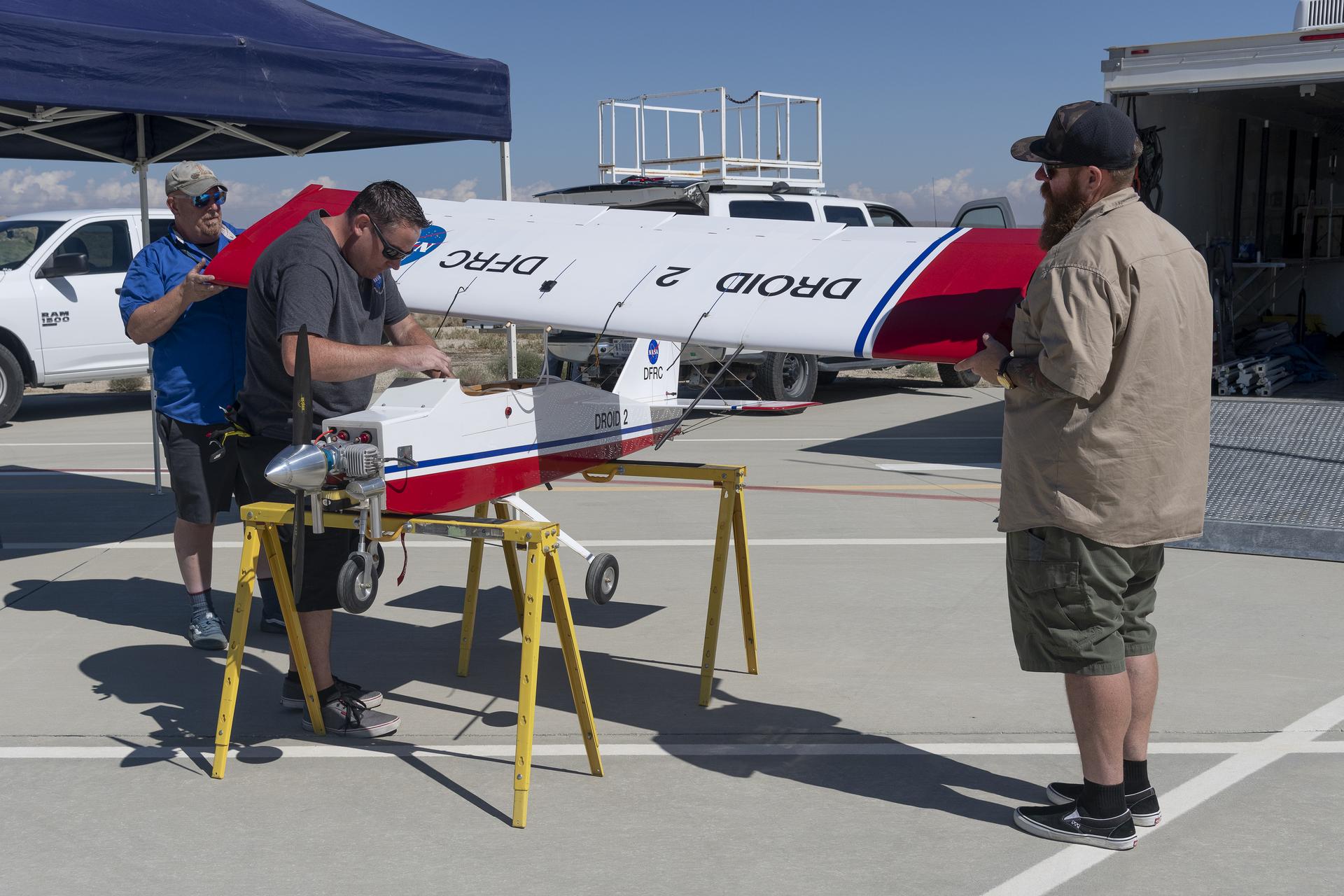
    Robert u0022Redu0022 Jensen, Justin Link, and Justin Hall prepare the DROID 2 (Dryden Remotely Operated Integrated Drone 2) for the Advanced Exploration of Reliable Operation at Low Altitudes: Meteorology, Simulation, and Technology campaign flights. The weather study was at NASA’s Armstrong Flight Research Center in Edwards, California. The focus was to study wind to provide data for safe takeoff and landing of future air taxis.
    NASA/Steve Freeman

    The remotely piloted DROID 2, with its 10-foot wingspan, flew repeated passes at different predetermined altitudes, said Justin Hall, one of the aircraft pilots.

    “We are covering a large area with a lawn mower pattern,” Hall said. “We started flying high and worked our way down to the test altitudes. Once we were comfortable with the flight plan, we started at the lowest altitude and worked our way up.”

    John Melton, one of four principal investigators for the project, is from NASA’s Ames Research Center in California’s Silicon Valley, where he guides the modeling efforts that will use the wind data.

    A man pushes a remotely piloted drone into position to take off.
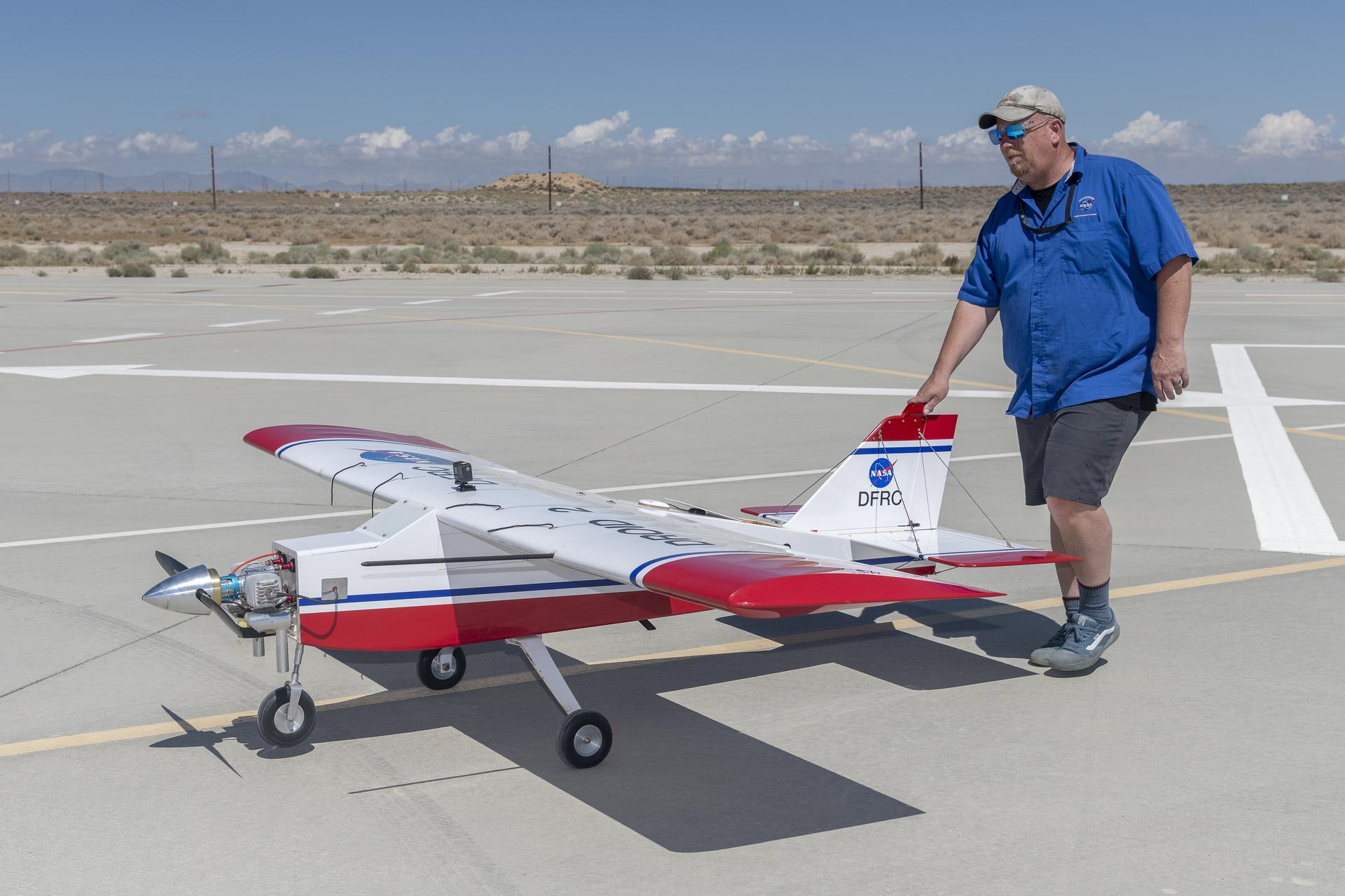
    Robert u0022Redu0022 Jensen positions the DROID 2 (Dryden Remotely Operated Integrated Drone) aircraft before a flight for the Advanced Exploration of Reliable Operation at Low Altitudes: Meteorology, Simulation, and Technology campaign. The weather study was at NASA’s Armstrong Flight Research Center in Edwards, California. The focus was to study wind to provide data for safe takeoff and landing of future air taxis.
    NASA/Steve Freeman

    “The data will be used to create digital models and computer simulations of the winds in the test area including the effects of the terrain and many of the surrounding buildings,” Melton said. “The data collected here at Armstrong will help us to improve our ability to replicate the low altitude winds with both our computer simulations and our experimental water and wind tunnel facilities.”

    The data gathered at NASA Armstrong also will be used for training novel machine learning models that have shown promise for making rapid and accurate estimations of the winds in vehicle landing zones that might be impacted by nearby buildings. 

    The combination of data from the aircraft and the array of ground instruments will also be used to develop new onboard processes that allow the vehicles to act as high-precision wind sensors and to share that data with other nearby vehicles.

    The wind campaign is part of NASA’s Convergent Aeronautics Solutions project under its Transformative Aeronautics Concepts Program, which invests in ideas that lead to solutions for aviation and that impact safety, environmental and community impact, and the global growth in air traffic.

    More photos are here.

    A remotely piloted drone flies past a building and a 140-foot instrumented tower to collect wind data.
    The DROID 2 (Dryden Remotely Operated Integrated Drone 2) flies by a 140-foot instrumented tower and the former space shuttle hangar at NASA’s Armstrong Flight Research Center in Edwards, California, as part of the Advanced Exploration of Reliable Operation at Low Altitudes: Meteorology, Simulation, and Technology campaign. The focus was to study wind to provide data for safe takeoff and landing of future air taxis.
    NASA/Steve Freeman

  • NASA to Showcase Revolutionary Aero Tech at Aviation Day Event

    NASA to Showcase Revolutionary Aero Tech at Aviation Day Event

  • NASA to Showcase Revolutionary Aero Tech at Aviation Day Event

    NASA’s Glenn Research Center in Cleveland will showcase the agency’s efforts to revolutionize air travel at a free event on Wednesday, Sept. 13. NASA Aviation Day will be open to the public and take place from 8:30 a.m. to 5:30 p.m. at the I-X Center.

    This event will showcase a variety of aviation projects underway at Glenn and other NASA centers, including the Quesst mission with the X-59, electrified aircraft propulsion and other sustainable aviation technologies, and new ways to move people and cargo using advanced aircraft systems. 

    “NASA’s research in aeronautics provides benefits for all humanity,” NASA Glenn Aeronautics Research Director Tim McCartney said. “This event is an opportunity for us to share what NASA is doing to lead the way with sustainable aviation technologies and how we’re partnering with industry to accomplish the aviation community’s climate change agenda to achieve net-zero carbon emissions by 2050.”  

    A concept illustration of NASAs X-66A aircraft. It resembles a passenger jet and is painted red, white, and blue. It has a NASA meatball on its tail and is flying through the clouds.
    A concept illustration of NASA’s X-66A aircraft. u003cstrongu003eCredits: NASAu003c/strongu003e

    Attendees will have the opportunity to explore innovative NASA-developed technology and hardware, as well as experience NASA Glenn capabilities firsthand through interactive displays. K-12 students will also be able to participate in STEM activities. 

    The event aims to connect with members of the public, including business professionals. NASA Glenn Technology Transfer Program representatives will be available to discuss opportunities for businesses and startups to license patented NASA technologies. 

    NASA Glenn’s Pilatus PC-12 aircraft will also be on display during the event. The PC-12 and its crew are conducting research that will help pave the way for a safe and mobile future where air taxis and drones can occupy airspace with airliners and other aircraft.

    Panel sessions will provide an overview of NASA’s mission to advance future commercial air travel through ultra-efficient airliners, improved airspace safety, high-speed flight, and advanced air mobility. The event also will highlight how businesses, entrepreneurs, and college students can access NASA technologies through educational and business partnership opportunities.

    NASA Aviation Day is part of the 2023 Energy & Mobility Conference and Expo, a NASA-supported event that brings together professionals from around the globe to focus on advancing the energy and mobility sectors with modern technology.

    Top image: A concept illustration of NASA’s X-59 research aircraft. Credit: Lockheed Martin.

    -end-

    Brian Newbacher
    Glenn Research Center, Cleveland
    216-433-5644 
    brian.t.newbacher@nasa.gov

  • New Aerospace Communications Facility Enables Ambitious NASA Missions

    4 min read

    New Aerospace Communications Facility Enables Ambitious NASA Missions

    A view of NASA Glenn’s new Aerospace Communications Facility in the evening.
    A view of NASA Glenn’s new Aerospace Communications Facility in the evening.
    Credits: NASA/Sara Lowthian-Hanna

    For the first time in 30 years, NASA’s Glenn Research Center in Cleveland opened the doors to a brand-new mission-focused facility that will support the agency’s Artemis and Advanced Air Mobility missions. On Aug. 30, NASA management and local officials cut the ribbon to the Aerospace Communications Facility (ACF), a new building designed for advanced radio frequency (RF) and optical communication technology research and development.
    The ACF brings together more than 80 researchers, currently located in seven separate buildings across Glenn’s main campus, to one cutting-edge 54,000-square-foot building. It houses 25 research laboratories, several collaboration spaces, a large RF-shielded high bay space, and both rooftop and ground-based antennae fields.

    “The facility gives us a lot of opportunities to integrate these labs together in new and unique ways,” said Dr. James Nessel, chief of NASA Glenn’s Advanced High Frequency Branch. “For example, there are fiber-optic lines running throughout the entire building. So, we can easily set up a system in one space and communicate with another without physically having to move the two systems together.” 

    People wearing professional clothing and military uniforms walk past an interior wall with a graphic on it that says, Aerospace Communications Facility, ACF. Surrounding the words are illustrations of a plane and a satellite.
    The Aerospace Communications Facility was designed for advanced radio frequency and optical communication technology research and development.
    Credits: NASA/Sara Lowthian-Hanna

    The new facility further enables the development and testing of cognitive communications systems, which will use artificial intelligence and machine learning to optimize future networks in low-Earth orbit and deep space.

    “I’m really looking forward to having a common research network that can be shared across projects,” said Dr. Rachel Dudukovich, cognitive networking lead for NASA Glenn’s Cognitive Communications project. “We will be able to share software and test equipment among projects and have areas where we can visually display the real-time decision-making process of our cognitive engine.”

    Key features of the structure allow researchers to pursue new tests and measurements of various types of communication, including RF, cellular, optical, and quantum. The high-bay space is built from conductive concrete and lined with RF-absorbing panels, creating a quiet, controlled environment with no external influence from outside signals.

    “This new building is helping us realize innovative capabilities we’ve been developing for several years now,” said Nessel. “We call it the MATRICS.”

    Like the movie it’s named after, MATRICS — short for Multiple Asset Testbed for Research and Innovative Communications Systems — simulates the experience of being on another world: the lunar surface. The Moon has unique features, like lunar dust, rough terrain, mountains, and craters, and researchers are uncertain exactly how communications systems would function in that environment. The MATRICS uses high-fidelity models, simulations, and physical hardware connections to simulate RF conditions on the Moon, allowing researchers to test communications hardware developed both in-house and commercially.

    Eight officials pose in front of NASA Glenns new Aerospace Communications Facility and hold onto a red ribbon, held up on either side by robotic arms. The person in the middle holds oversized red scissors and begins to cut the ribbon.
    NASA management and local officials cut the ribbon to the center’s new Aerospace Communications Facility.
    Credits: NASA/Sara Lowthian-Hanna

    The facility will also host the new Quantum Metrology Laboratory, where quantum information scientist Dr. Evan Katz and his colleagues will study the use of quantum physics to transmit and protect information. In quantum communication, information is embedded and sent through a photon, or a single element of light. Using photons to transmit information provides unique benefits, such as security on a fundamental quantum-physics level.

    “This lab offers much more space than the previous one and allows more researchers to come together and work in parallel,” said Katz. “When performing quantum measurements, we need to be careful about vibrations or noise coming from surroundings. In our new laboratory, the floors are vibration-isolated, meaning terrestrial disturbances won’t impact our testing.”

    The ACF was designed by Ross Barney Architects and built by The Austin Company with NASA missions in mind. The facility not only to gives Glenn researchers the space and equipment they need for current missions, but future ones as well, including efforts to combat climate change.

    Intended to be an example of responsible environmental stewardship, the structure is Leadership in Energy and Environmental Design (LEED) Gold certified. Its design includes environmentally friendly features like natural daylight throughout the building, low volatile organic compound-emitting materials, sustainably harvested wood, and water- and energy-saving fixtures and appliances. The facility will use at least 30% less water and 30% less energy than a comparable building. Eleven percent of construction materials contain recycled content, and 11% of materials were made locally, within 500 miles of Glenn. Additionally, there is bicycle storage and preferred parking for fuel-efficient vehicles outside the building to promote the use of alternative transportation.

    Completion of the ACF is one more step forward in NASA Glenn’s Facility Master Plan, which is a multiyear effort to revitalize the central campus and renovate or replace World War II-era buildings.

    Jacqueline Minerd 
    NASA’s Glenn Research Center
  • NASA Has Helped Hush Aircraft Engine Noise for Decades

    4 min read

    NASA Has Helped Hush Aircraft Engine Noise for Decades

    Modern jet engines are loud, but they used to be much louder. NASA’s Glenn Research Center has been at the forefront of the nation’s efforts to reduce aircraft engine noise for over 70 years. During this time, the center has built an array of test facilities to carry out this work, culminating in the Aero-Acoustic Propulsion Laboratory (AAPL), a world-class noise-reduction research facility.

    The AAPL, referred to as “the dome,” contains multiple test rigs enclosed in a large, echo-free chamber. The unique 130-foot diameter and 65-foot-high hemispherical structure stands out on Glenn’s campus. Its triangular sections make it appear like a golf ball rising from the ground. The interior is covered in spiky, fiberglass sound-dampening wedges and an overhead array of microphones that capture engine noise data.

    A white, half-dome shaped building with triangular sections on its exterior is illuminated at nighttime on NASA Glenns campus. Through the facilitys open door, test rigs can be seen inside.
    The Aero-Acoustic Propulsion Laboratory in October 1991, shortly after the dome was completed. The Nozzle Acoustic Test Rig is to the left and the Powered Lift Facility is to the right.
    Credits: NASA/Quentin Schwinn

    Jet propulsion has been a cornerstone of NASA Glenn’s research since the center’s establishment as a National Advisory Committee for Aeronautics (NACA) laboratory in the early 1940s. The lab’s improvements to the nation’s first generations of turbojet engines contributed to making the first jet airliners possible in the mid-1950s.

    Jet aircraft are much louder than their piston-engine counterparts, though, and communities near airports complained about the increased noise. The center began studying its causes in the early 1950s. Since it is difficult to evaluate noise in the wind tunnels and test chambers normally used to test engines, Glenn researchers mounted engines on simple steel stands near the lab’s hangar and placed microphones around them to measure noise levels.

    A black-and-white image of a metal frame holding up a jet engine outside at NASA Glenn. A researcher inspects the frame, sitting below the engine.
    A General Electric J-47 installed on a thrust rig outside NASA Glenn’s hangar in 1954. It was being used to test the effectiveness of a screen behind the nozzle to reduce on-the-ground noise at airports.
    Credits: NASA/Bill Bowles

    Researchers found that the primary source of noise was not the mechanical elements of engines, but the mixing of the cold atmosphere with their narrow, high-speed stream of hot exhaust gases. In response, researchers tested unique nozzle and ejector designs and worked to balance sound-reducing hardware’s effects on engine performance and weight.

    The introduction of turbofan engines, which offered increased efficiency and lowered noise levels, proved to be a breakthrough in the 1960s. But with more airliners, new Federal Aviation Agency standards, and an increased interest in vertical and short-takeoff and landing (V/STOL) aircraft, continued noise reduction research was needed.

    In the late 1960s and early ’70s, NASA Glenn constructed a new, more robust array of outdoor test stands at sites across campus to study fan noise, including three rigs at the site of the current APPL. The Powered Lift Facility (PLF) was added to the site in 1986 to provide data on V/STOL concepts. Complaints from the local community about the PLF’s noise levels, however, led to the suspension of testing in 1989.

    Metal hardware, pipes, and machinery for the Powered Lift Facility, pictured outside on NASA Glenns campus.
    The Powered Lift Facility as it appeared in November 1989 after operations were suspended due to complaints about the noise from nearby residents. Credits:
    NASA/Angela Coyne

    In 1990, NASA initiated the High-Speed Research (HSR) program to develop technologies for supersonic transportation, so Glenn started designing the Nozzle Acoustic Test Rig (NATR), a 53-inch diameter wind tunnel that could test acoustic and aerodynamic performance of nozzles. This testing was inherently loud, so the center decided to construct a structure to cover both the PLF and NATR.

    An overhead shot of construction equipment and partially built triangular frame segments for the dome for NASA Glenns Aero-Acoustic Propulsion facility.
    Construction of the geodesic dome over the Powered Lift Facility in January 1991.
    Credits: NASA/Marvin Smith

    The new facility was completed in 1991 and named the Aero-Acoustic Propulsion Laboratory (AAPL). Its geodesic dome not only prevents noise from exiting the facility, but also protects against outside sounds and weather.

    A Learjet engine nozzle peeks out from NASA Glenns Nozzle Acoustic Test Rig, a cylinder surrounded by tan wedges. The walls of the Aero-Acoustic Propulsion Facility, also covered in wedges, glow blue in the background.
    Testing of a Learjet engine nozzle in the Nozzle Acoustic Test Rig in 2018.
    Credits: NASA/Rami Daud

    The NATR has become the center’s workhorse for acoustic testing. In addition to the HSR program, the NATR also performed testing for the Advanced Subsonic Technology program and conducted the first successful test of a chevron nozzle in 1997.

    The Advanced Noise Control Fan (ANCF) rig and the Small Hot Jet Acoustic Rig (SHJAR) were added in the mid-1990s and 2000, respectively. Researchers used the ANCF to study acoustic liners and fan noise, and the SHJAR was more economical to operate for smaller tests than the NATR.

    In the early 2000s, the AAPL was outfitted with a new acoustic arena that allows simultaneous testing on multiple rigs and the measurement of flyby and sideline noise. Use of the PLF declined over the years, and it was eventually decommissioned in 2007. The ANCF was removed in 2021 to create space for the DGEN AeroPropulsion Research Turbofan (DART) rig, a small-scale engine testbed useful for a variety of research.

    The DGEN AeroPropulsion Research Turbofan test rig is illuminated by lights inside of NASA Glenns Aero-Acoustic Propulsion Laboratory. The walls of the facility, covered in wedges, glow blue in the background.
    The DGEN AeroPropulsion Research Turbofan (DART) test rig includes a DGEN 308 turbofan engine that is used to conduct an array of research prior to testing with full-scale turbofan engines.
    Credits: NASA/Bridget Caswell

    The AAPL continues to play a key role in NASA’s testing efforts. Researchers are comparing noise data collected from scale-model nozzles inside the facility to data from Learjet 25 flight tests. This work may improve researchers’ ability to predict takeoff noise for future supersonic commercial aircraft.

    Robert S. Arrighi
    NASA’s Glenn Research Center

  • NASA to Host X-57 Maxwell Project Update

    NASA will hold a media teleconference to discuss its X-57 Maxwell all-electric aircraft project at 12 p.m. EDT on Friday, June 23.

  • Next Generation Experimental Aircraft Becomes NASA’s Newest X-Plane

    NASA and Boeing said Monday the aircraft produced through the agency’s Sustainable Flight Demonstrator project has been designated by the U.S. Air Force as the X-66A.

  • NASA Plans Coverage of Roscosmos Spacewalks at Space Station

    NASA will provide live coverage as two Roscosmos cosmonauts conduct a series of spacewalks in April and May outside the International Space Station to relocate hardware from the Rassvet module to the new Nauka multipurpose laboratory module.

  • NASA, Boeing to Host Media Briefing, Provide Starliner Update

    NASA and Boeing will host a media teleconference at 2 p.m. EDT Wednesday, March 29, to provide an update on the Crew Flight Test (CFT) of the CST-100 Starliner spacecraft to the International Space Station.

  • NASA Awardees to Develop Sustainable Aviation Composite Tech

    NASA has issued $50 million in awards to 14 organizations to develop manufacturing processes and advanced composite materials for aircraft structures. These green technologies hold the potential to help reduce aviation carbon emissions.

  • NASA Names University Teams to Take on Aeronautics Research Challenges

    NASA has selected four teams of university faculty and students to solve key challenges facing the future of air travel as part of the agency’s University Leadership Initiative.