Preparations for Next Moonwalk Simulations Underway (and Underwater)
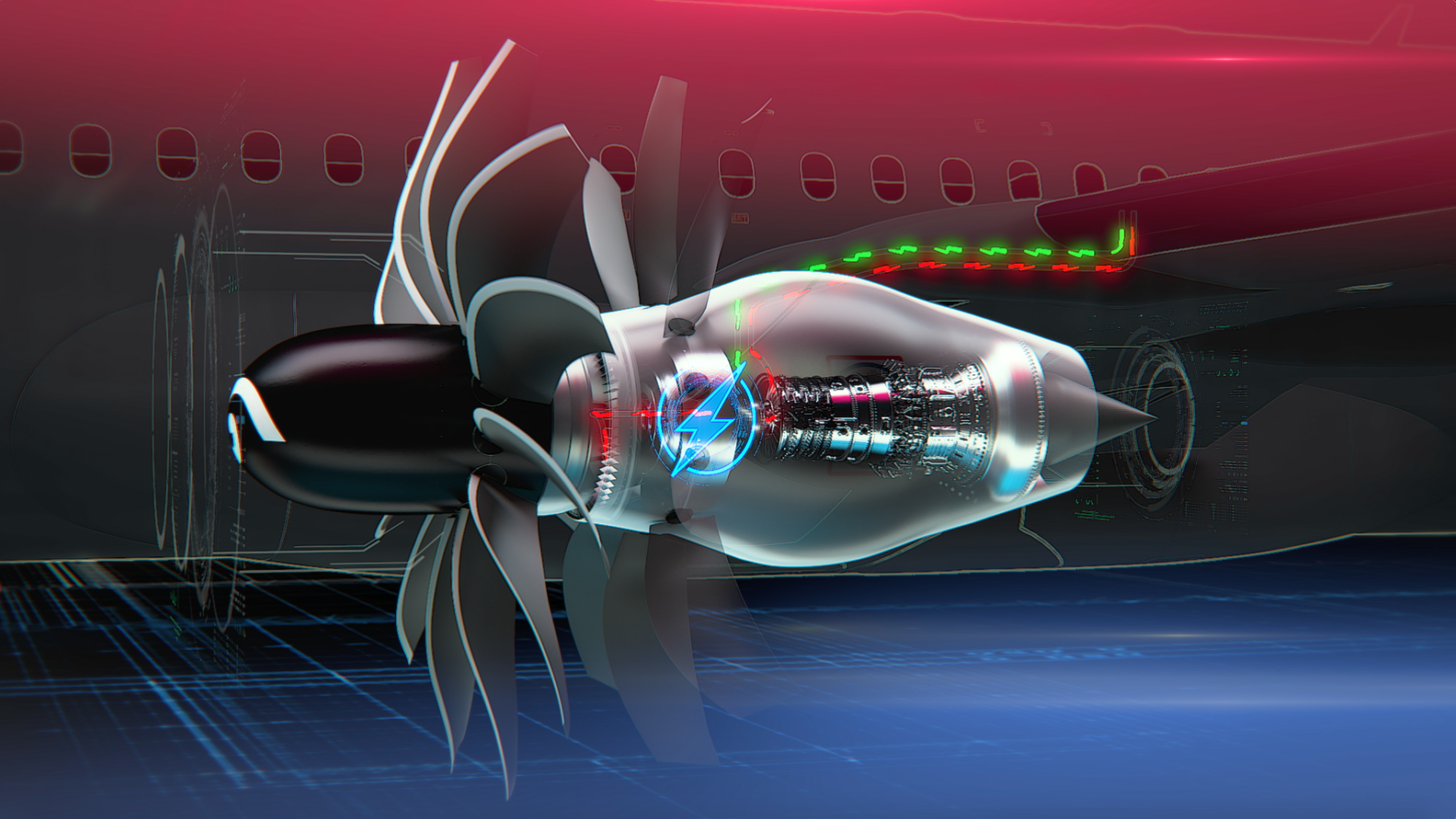
This artist concept shows a NASA-developed small-core jet engine installed in General Electric Aerospace’s CFM RISE jet engine design. The more fuel-efficient small core powers a large open turbofan, which also helps increase efficiency. The effort is part of NASA’s Sustainable Flight National Partnership to help inform the next generation of ultra-efficient airliners.
GE Aerospace
Hybrid-electric cars have been a staple of the road for many years now.
Soon that same idea of a part-electric-, part-gas-powered engine may find its way into the skies propelling a future jet airliner.
NASA is working in tandem with industry partner GE Aerospace on designing and building just such an engine, one that burns much less fuel by including new components to help electrically power the engine.
In this hybrid jet engine, a fuel-burning core powers the engine and is assisted by electric motors. The motors produce electric power, which is fed back into the engine itself—therefore reducing how much fuel is needed to power the engine in the first place.
It really opens the door for more sustainable aviation even beyond the 2030s.
It represents a major step forward in jet engine technology.
This jet engine would be the first ever mild hybrid-electric jet engine. A “mild hybrid” engine can be powered partially by electrical machines operating both as motors and generators.
“This will be the first mild hybrid-electric engine and could lead to the first production engine for narrow-body airliners that’s hybrid electric,” said Anthony Nerone, who leads the HyTEC project from NASA’s Glenn Research Center in Cleveland. “It really opens the door for more sustainable aviation even beyond the 2030s.”
The hybrid-electric technology envisioned by NASA and GE Aerospace also could be powered by a new small jet engine core.
A major HyTEC project goal is to design and demonstrate a jet engine that has a smaller core but produces about the same amount of thrust as engines being flown today on single-aisle aircraft.
At the same time, the smaller core technology aims to reduce fuel burn and emissions by an estimated 5 to 10%.
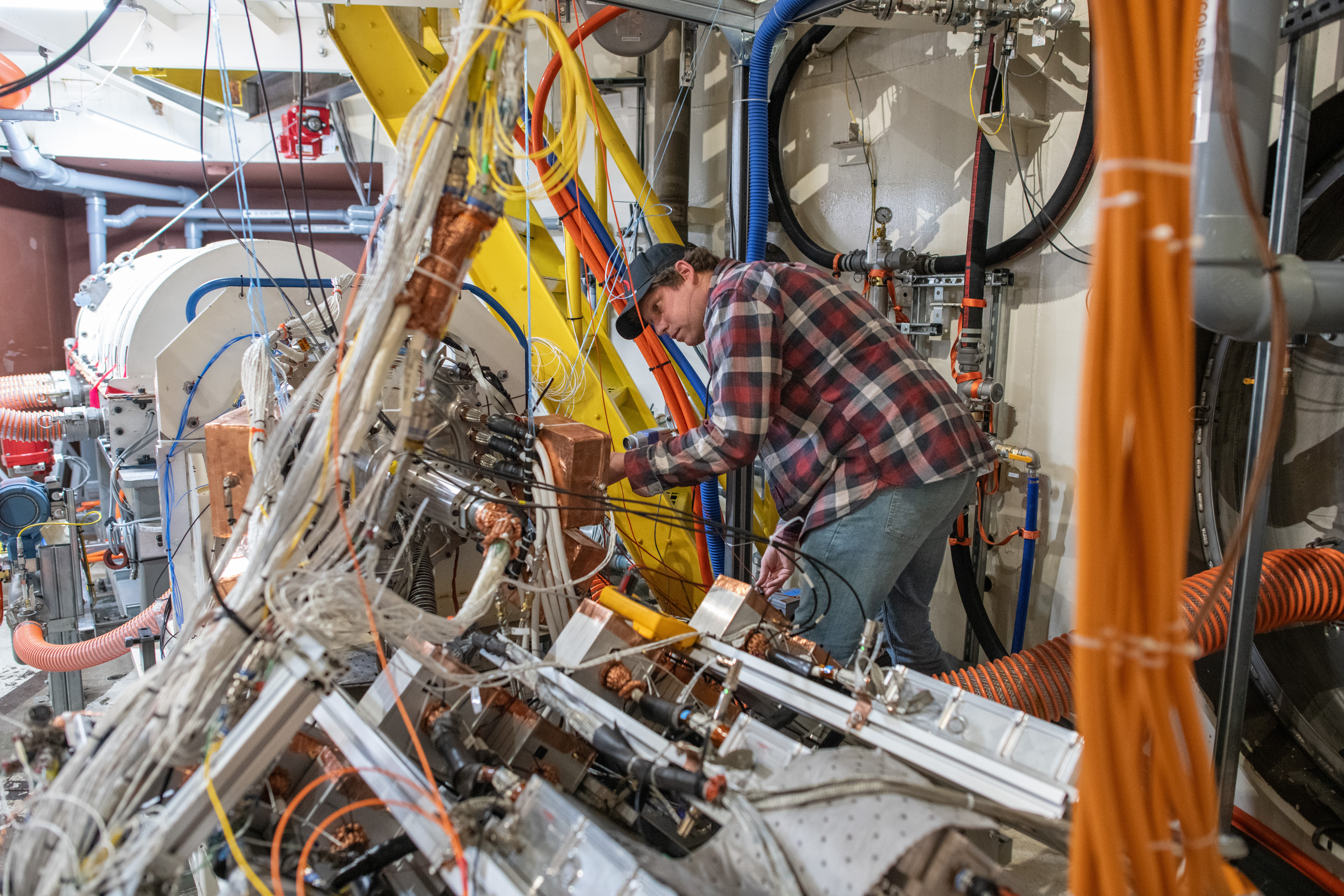
Michael Presby, a research materials engineer at NASA’s Glenn Research Center in Cleveland, adjusts an infrared thermal imaging camera used to monitor the temperature profile of a NASA-developed, high-temperature environmental barrier coating deposited on a ceramic matrix composite in support of the agency’s HyTEC project. The composite’s environmental barrier coating surface temperature is 3,000 degrees Fahrenheit.
NASA / Bridget Caswell
How Does It Work?
A GE Aerospace Passport engine is being modified with hybrid electric components for testing.
“Today’s jet engines are not really hybrid electric,” Nerone said. “They have generators powering things like lights, radios, TV screens, and that kind of stuff. But not anything that can power the engines.”
The challenge is figuring out the best times to use the electric motors.
“Later this year, we are doing some testing with GE Aerospace to research which phases of flight we can get the most fuel savings,” Nerone said.
Embedded electric motor-generators will optimize engine performance by creating a system that can work with or without energy storage like batteries. This could help accelerate the introduction of hybrid-electric technologies for commercial aviation prior to energy storage solutions being fully matured.
“Together with NASA, GE Aerospace is doing critical research and development that could help make hybrid-electric commercial flight possible,” said Arjan Hegeman, general manager of future of flight technologies at GE Aerospace.
The technologies related to HyTEC are among those GE Aerospace is working to mature and advance under CFM International’s Revolutionary Innovation for Sustainable Engines (RISE) program. CFM is a joint venture between GE Aerospace and Safran Aircraft Engines. CFM RISE, which debuted in 2021, encompasses a suite of technologies including advanced engine architectures and hybrid electric systems aimed at being compatible with 100% Sustainable Aviation Fuel.
HyTEC, part of NASA’s Advanced Air Vehicles Program, is a key area of NASA’s Sustainable Flight National Partnership, which is collaborating with government, industry, and academic partners to address the U.S. goal of net-zero greenhouse gas emissions in aviation by the year 2050.
About the Author
John Gould
Aeronautics Research Mission Directorate
John Gould is a member of NASA Aeronautics’ Strategic Communications team at NASA Headquarters in Washington, DC. He is dedicated to public service and NASA’s leading role in scientific exploration. Prior to working for NASA Aeronautics, he was a spaceflight historian and writer, having a lifelong passion for space and aviation.
Preparations for Next Moonwalk Simulations Underway (and Underwater)
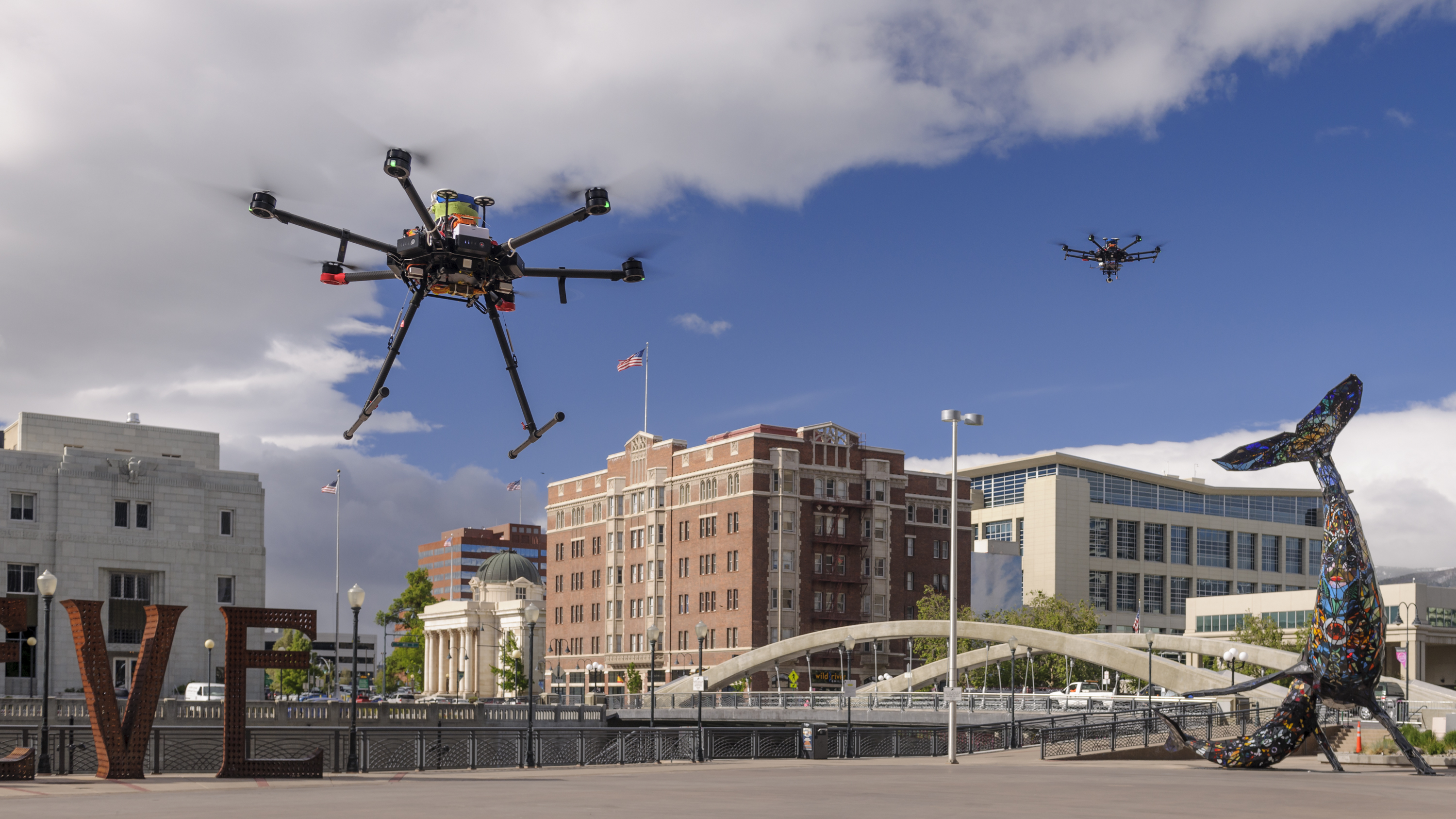
Drones in flight in downtown Reno, Nevada, during shakedown tests for NASA’s Unmanned Aircraft Systems Traffic Management project, or UTM. The final phase of flight tests, known as Technical Capability Level 4, ran from May through August 2019 and studied how the UTM system can integrate drones into urban areas.
NASA/Dominic Hart
NASA recently gathered representatives from the Federal Aviation Administration (FAA), police and fire departments, and commercial industry to figure out how to take an important step for public safety drones: allowing them to fly past where their operators can see them.
Currently, most drone operations are limited to areas known as “visual line of sight” for safety purposes. However, engineers and researchers are developing the infrastructure to allow drones to operate beyond this point. As the FAA works to authorize these types of flights, NASA is helping ensure these operations are safe and efficient.
This work from NASA and the FAA could have significant commercial applications – including drone deliveries – but at their June meeting, the agencies were focused on public safety drones used for search-and-rescue, accident scene reconstruction, and situational awareness during fires and other emergencies. Researchers need to figure out how drones on public safety missions can operate safely beyond visual line of sight – and do so in airspace shared with drones on commercial missions.
Hosted by NASA’s Ames Research Center in California’s Silicon Valley, the meeting took place in Arlington, Texas City Hall. Attendees included members of the FAA, the Department of Homeland Security, the Texas Department of Public Safety, the Arlington local police and fire departments, and representatives of the Dallas-Fort Worth International Airport. The group’s discussion included the special considerations needed for public safety drone operations beyond visual line of sight. And they identified at least one significant challenge: how to ensure that public safety drones have priority when operating in the same airspace with commercial drones.
NASA researchers provided feedback from this session to the FAA, commercial drone operators, and service providers. Input from the public safety meeting will support the FAA’s evaluation of commercial drone flights beyond visual line of sight, which the agency is currently conducting in the Dallas-Fort Worth area. Data from these operations will inform FAA rulemaking.
NASA’s work is led by its Uncrewed Aircraft Systems Traffic Management System Beyond Visual Line of Sight effort, which falls under the Air Traffic Management Exploration project. This subproject directly supports NASA’s Advanced Air Mobility mission. Advanced Air Mobility aims to transform our communities by bringing the movement of people and goods off the ground, on demand, and into the sky.
‘Current’ Events: NASA and USGS Find a New Way to Measure River Flows
The River Observing System (RiOS) tracking the motion of water surface features from above a section of the Sacramento River in Northern California in 2023.
Credits: NASA/USGS/Joe Adams and Chris Gazoorian
A team of scientists and engineers at NASA and the U.S. Geological Survey (USGS) collaborated to see if a small piloted drone, equipped with a specialized payload, could help create detailed maps of how fast water is flowing. Rivers supply fresh water to our communities and farms, provide homes for a variety of creatures, transport people and goods, and generate electricity. But river flows can also carry pollutants downstream or suddenly surge, posing dangers to people, wildlife, and property. As NASA continues its ongoing commitment to better understand our home planet, researchers are working to answer the question of how do we stay in-the-know about where and how quickly river flows change?
NASA and USGS scientists have teamed up to create an instrument package – about the size of a gallon of milk – called the River Observing System (RiOS). It features thermal and visible cameras for tracking the motion of water surface features, a laser to measure altitude, navigation sensors, an onboard computer, and a wireless communications system. In 2023, researchers took RiOS into the field for testing along a section of the Sacramento River in Northern California, and plan to return for a third and final field test in the fall of 2024.
The River Observing System (RiOS) tracking the motion of water surface features from above a section of the Sacramento River in Northern California in 2023.
“Deploying RiOS above a river to evaluate the system’s performance in a real-world setting is incredibly important,” said Carl Legleiter, USGS principal investigator of the joint NASA-USGS StreamFlow project. “During these test flights we demonstrated that the onboard payload can be used to make calculations – do the analysis – in nearly real-time, while the drone is flying above the river. This was one of our top-tier goals: to enable minimal latency between the time we acquire images and when we have detailed information on current speeds and flow patterns within the river.”
To realize this vision for onboard computing, the team uses open-source software, combined with their own code, to produce maps of water surface velocities, or flow field, from a series of images taken over time.
“You might think that we need to be able to see discrete, physical objects – like sticks or silt or other debris as they move downstream – to estimate the flow velocity, but that’s not always the case, nor is it always possible,” said Legleiter. “Using a highly-sensitive infrared camera, we instead detect the movement of subtle differences in the temperature of water carried downstream.”
Those same tiny temperature differences also appear wherever there are undulations – like at the boundary between the air and the water or ice below. Knowing this, NASA members of the StreamFlow team used this phenomenon to their advantage when developing methods for possible future landed planetary missions to navigate at distant and hard-to-see environments, including Europa, the icy moon orbiting Jupiter.
Our technology can precisely track the static surface of icy terrain while flying over it, or a moving surface, like water, while hovering above it to keep the spacecraft safe while gathering valuable data
uland wong
Co-investigator and NASA lead of the StreamFlow Project
“Icy surfaces present challenging visual conditions such as lack of contrast,” said Uland Wong, co-investigator and NASA lead of the StreamFlow project at NASA’s Ames Research Center in California’s Silicon Valley. “Our technology can precisely track the static surface of icy terrain while flying over it, or a moving surface, like water, while hovering above it to keep the spacecraft safe while gathering valuable data.”
To prepare for the Sacramento River field tests, the NASA team built a robotics simulator to run thousands of virtual drone flights over the Sacramento River test site using flow fields modeled by USGS. These simulations are helping the team create intelligent software capable of selecting the best routes for the drone to fly and ensuring efficient use of limited battery power.
The next step in the partnership is for NASA to develop techniques for making the system more autonomous. The researchers want to use calculations of river flows – performed onboard in real time – to guide where the drone should fly next.
“Does the drone drop down to get better resolution data about a particular location or stay high and capture a wide-angle view,” posed Wong. “If it identifies areas that are flowing particularly fast or slow, could the drone more quickly detect areas of flooding?”
The USGS currently operates an extensive network of thousands of automated stream gauges and fixed cameras installed on bridges and riverbanks to monitor river flows in real-time across the country.
“Drones could enable us to make measurements in so many more areas, potentially allowing our network to be larger, more robust, and safer for our technicians to monitor and maintain,” said Paul Kinzel, StreamFlow co-investigator at USGS. “Drones could help keep our people and equipment out of harm’s way in addition to telling us how the environment is changing over time in as many locations as possible.”
A drone with the StreamFlow thermal mapping payload flying above the Sacramento River in Northern California.
NASA/Massimo Vespignani
For more information about how NASA improves life on Earth through climate and technological innovations, visit:
The StreamFlow project is a collaboration between researchers with the USGS’s Hydrologic Remote Sensing Branch, Unmanned Aircraft Systems engineers with the USGS National Innovation Center, and scientists in the Intelligent Robotics Group at NASA Ames. The Streamflow payload concept was demonstrated through research initially seeded by a grant from the USGS National Innovation Center and is now supported by NASA’s Advanced Information Systems Technology program, which is managed by the agency’s Earth Science Technology Office. The field tests were conducted in collaboration with the National Oceanographic and Atmospheric Administration (NOAA) Southwest Fisheries Science Center, which helped collect direct field measurements of the river’s flow velocity and granted access to the field site, which is owned by the Nature Conservancy.
Preparations for Next Moonwalk Simulations Underway (and Underwater)
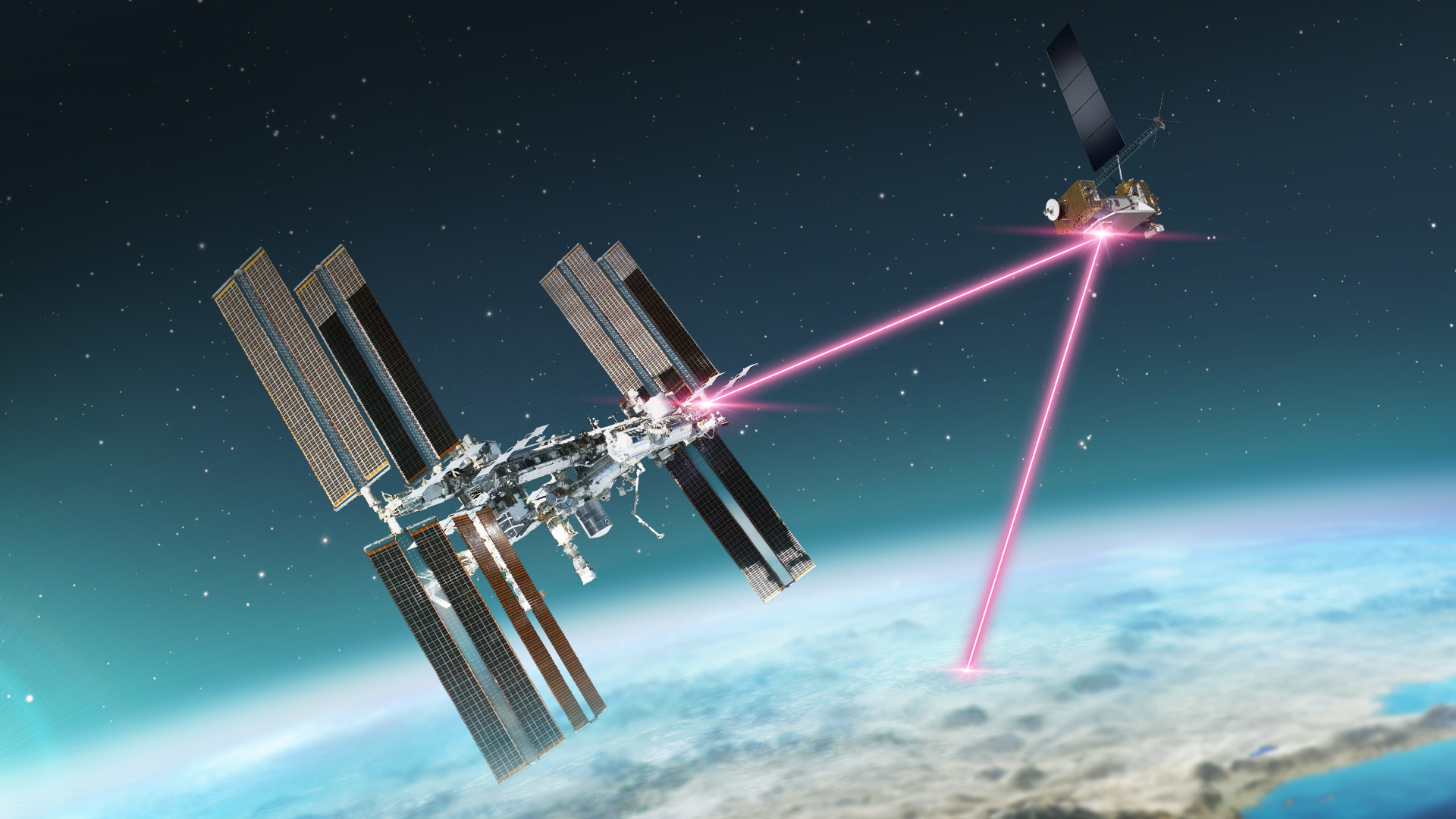
A graphic representation of a laser communications relay between the International Space Station, the Laser Communications Relay Demonstration spacecraft, and the Earth.
Credit: NASA/Dave Ryan
A team at NASA’s Glenn Research Center in Cleveland streamed 4K video footage from an aircraft to the International Space Station and back for the first time using optical, or laser, communications. The feat was part of a series of tests on new technology that could provide live video coverage of astronauts on the Moon during the Artemis missions.
Historically, NASA has relied on radio waves to send information to and from space. Laser communications use infrared light to transmit 10 to 100 times more data faster than radio frequency systems.
From left to right, Kurt Blankenship, research aircraft pilot, Adam Wroblewski, instrument operator, and Shaun McKeehan, High-Rate Delay Tolerant Networking software developer, wait outside the PC-12 aircraft, preparing to take flight.
Credit: NASA/Sara Lowthian-Hanna
Working with the Air Force Research Laboratory and NASA’s Small Business Innovation Research program, Glenn engineers temporarily installed a portable laser terminal on the belly of a Pilatus PC-12 aircraft. They then flew over Lake Erie sending data from the aircraft to an optical ground station in Cleveland. From there, it was sent over an Earth-based network to NASA’s White Sands Test Facility in Las Cruces, New Mexico, where scientists used infrared light signals to send the data.
The signals traveled 22,000 miles away from Earth to NASA’s Laser Communications Relay Demonstration (LCRD), an orbiting experimental platform. The LCRD then relayed the signals to the ILLUMA-T (Integrated LCRD LEO User Modem and Amplifier Terminal) payload mounted on the orbiting laboratory, which then sent data back to Earth. During the experiments, High-Rate Delay Tolerant Networking (HDTN), a new system developed at Glenn, helped the signal penetrate cloud coverage more effectively.
4K video footage was routed from the PC-12 aircraft to an optical ground station in Cleveland. From there, it was sent over an Earth-based network to NASA’s White Sands Test Facility in Las Cruces, New Mexico. The signals were then sent to NASA’s Laser Communications Relay Demonstration spacecraft and relayed to the ILLUMA-T payload on the International Space Station.
Video Credit: NASA/Morgan Johnson
“These experiments are a tremendous accomplishment,” said Dr. Daniel Raible, principal investigator for the HDTN project at Glenn. “We can now build upon the success of streaming 4K HD videos to and from the space station to provide future capabilities, like HD videoconferencing, for our Artemis astronauts, which will be important for crew health and activity coordination.”
Mechanical Engineer Jeff Pollack finalizes his design for the integration of the laser communications terminal into the PC-12 research aircraft.
Credit: NASA/Sara Lowthian-Hanna
After each flight test, the team continuously improved the functionality of their technology. Aeronautics testing of space technology often finds issues more effectively than ground testing, while remaining more cost-effective than space testing. Proving success in a simulated space environment is key to moving new technology from a laboratory into the production phase.
“Teams at Glenn ensure new ideas are not stuck in a lab, but actually flown in the relevant environment to ensure this technology can be matured to improve the lives of all of us,” said James Demers, chief of aircraft operations at Glenn.
The flights were part of an agency initiative to stream high-bandwidth video and other data from deep space, enabling future human missions beyond low Earth orbit. As NASA continues to develop advanced science instruments to capture high-definition data on the Moon and beyond, the agency’s Space Communications and Navigation, or SCaN, program embraces laser communications to send large amounts of information back to Earth.
The optical system temporarily installed on the belly of the PC-12 aircraft has proven to be a very reliable high-performance system to communicate with prototype flight instrumentation and evaluate emerging technologies to enhance high-bandwidth systems.
Credit: NASA/Sara Lowthian-Hanna
While the ILLUMA-T payload is no longer installed on the space station, researchers will continue to test 4K video streaming capabilities from the PC-12 aircraft through the remainder of July, with the goal of developing the technologies needed to stream humanity’s return to the lunar surface through Artemis.
Preparations for Next Moonwalk Simulations Underway (and Underwater)
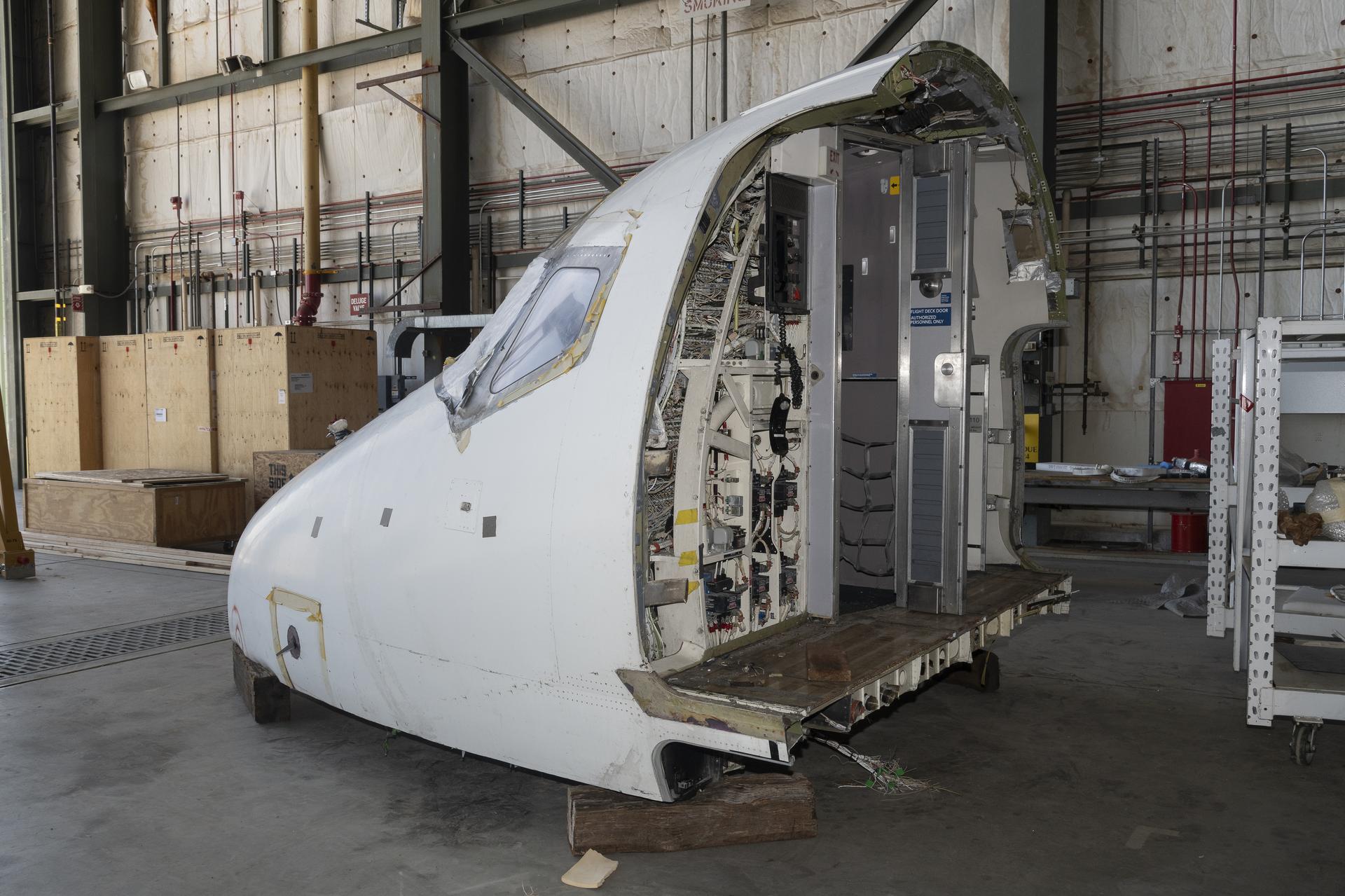
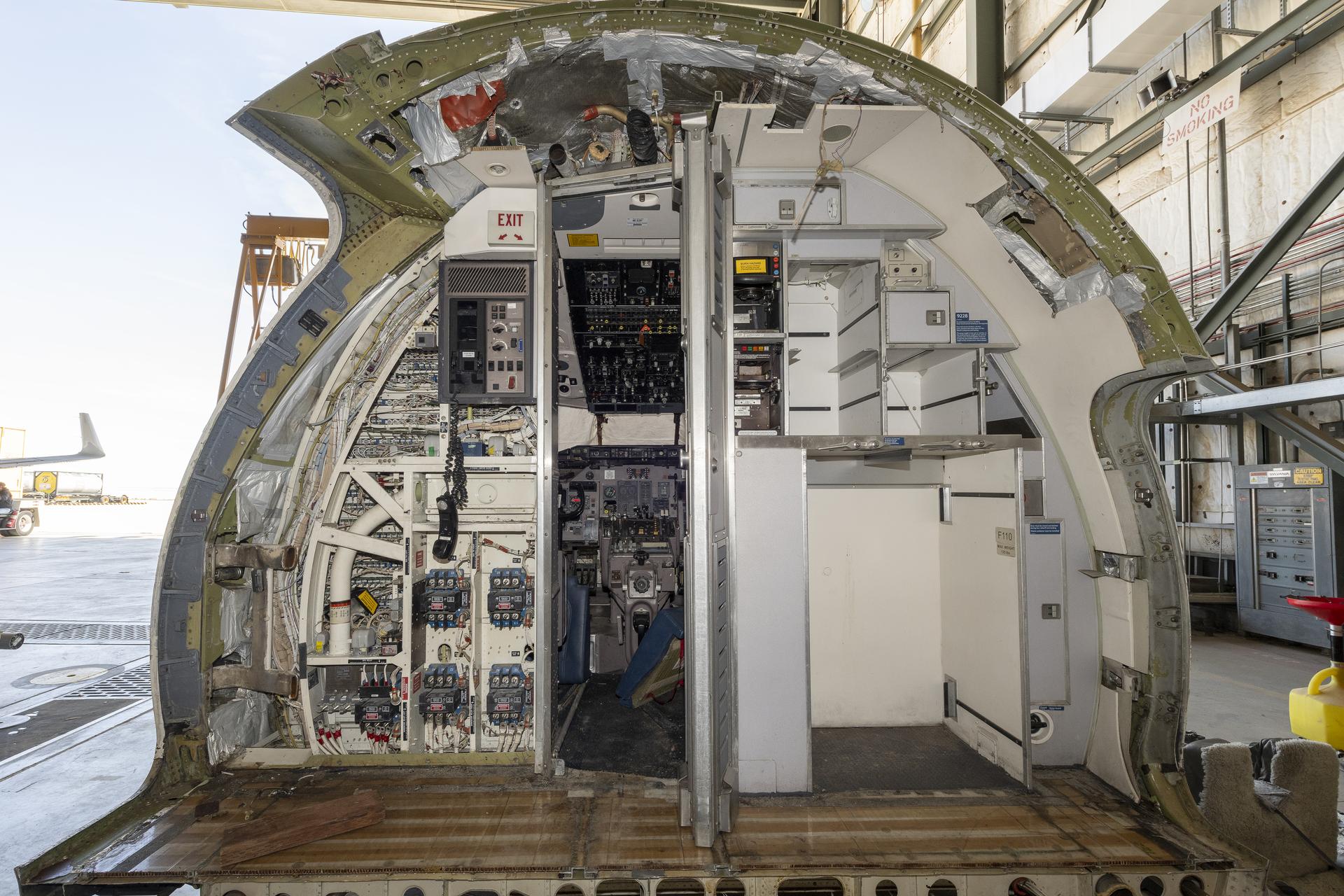
The cockpit of an old MD-90 aircraft arrived at NASA’s Armstrong Flight Research Center in Edwards, California, in March 2024. Parts will be used to build a simulator for NASA’s X-66, the demonstration aircraft for the Sustainable Flight Demonstrator project.
NASA/Steve Freeman
NASA’s X-66 aircraft, the centerpiece of its Sustainable Flight Demonstrator project, is taking the term “sustainable” to heart by reusing an old MD-90 cockpit as a base for its new X-66 simulator.
When airplanes are retired, they often wind up in “boneyards” — storage fields where they spend years being picked over for parts by manufacturers, researchers, engineers, and designers. That’s where the X-66 team found their new X-66 simulator cockpit, before sending it to NASA’s Armstrong Flight Research Center in Edwards, California.
The project will catalog, clean, and disassemble the MD-90 cockpit to use for the simulator. This is where the Simulation Engineering Branch at NASA Armstrong steps in. The team develops high-fidelity engineering simulators that allow pilots and engineers to run real-life scenarios in a safe environment.
The cockpit of an old MD-90 aircraft arrived at NASA’s Armstrong Flight Research Center in Edwards, California, in March 2024. Parts will be used to build a simulator for NASA’s X-66, the demonstration aircraft for the Sustainable Flight Demonstrator project.
NASA/Steve Freeman
As with any X-plane, a simulator allows researchers to test unknowns without risking the pilot’s safety or the aircraft’s structural integrity. A simulator also affords the team the ability to work out design challenges during the build of the aircraft, ensuring that the final product is as efficient as possible.
To assemble the X-66, the project team will use the airframe from another MD-90, shortening it, installing new engines, and replacing the wing assemblies with a truss-braced wing design.
The Sustainable Flight Demonstrator project is NASA’s effort to develop more efficient airframes as the nation moves toward sustainable aviation. In addition to the X-66’s revolutionary wing design, the project team will work with industry, academia, and other government organizations to identify, select, and mature sustainable airframe technologies.
The project seeks to inform the next generation of single-aisle airliner, the workhorse of commercial aviation fleets around the world. Boeing and NASA are partnering to develop the experimental demonstrator aircraft.
Preparations for Next Moonwalk Simulations Underway (and Underwater)
Danielle Koch, an aerospace engineer at NASA’s Glenn Research Center in Cleveland, was honored by the Girl Scouts of North East Ohio as a 2024 Woman of Distinction. She accepted the award during a ceremony on May 16.
Credit: Girl Scouts of North East Ohio/Andrew Jordan
You’d think a NASA aerospace engineer who spends her days inside a giant dome researching how to make plane engines quieter and spacecraft systems more efficient would have a pretty booked schedule. Still, advocacy and mentoring, especially for women and girls in STEM, is something Danielle Koch always tries to say yes to.
For decades, Koch has tutored students, volunteered as a mentor for engineering challenges, and engaged Pre-K through Ph.D. classes with stories from her career at NASA’s Glenn Research Center in Cleveland. Koch also works to recruit women and others from underrepresented groups to the field and find ways to remove barriers to their advancement.
For her efforts, Koch was recently recognized by the Girl Scouts of North East Ohio as a 2024 Woman of Distinction. The award, presented to Koch during a ceremony on May 16, celebrates women whose leadership contributes to the community, providing girls with positive role models. Koch says that diverse people and programs have similarly shaped her own career path.
“None of this is anything I’ve done myself; there are huge groups of people who are making change and making things better for all of us,” Koch said. “Every story I tell about me being a woman at NASA is really a story about them.”
Danielle Koch (right) is an aerospace engineer in the Acoustics Branch at NASA’s Glenn Research Center in Cleveland, where she works to make flight quieter and spacecraft systems more efficient.
Credit: NASA/Jef Janis
A Pittsburgh native and graduate of Case Western Reserve University, Koch began her career as a test engineer at NASA Glenn in 1990 as the only woman in her work group. While there were women around her, Koch says she did not see many senior-level female engineers or scientists “working ahead of her.” With determination and the “rock-solid” support of colleagues, family, and friends, Koch forged ahead, becoming a research aerospace engineer in NASA Glenn’s Acoustics Branch in 1998.
“She’s somebody that goes above and beyond almost all of the time, while using her knowledge and career to bring others up to her level,” said John Lucero, Koch’s supervisor and the chief of the Acoustics Branch at NASA Glenn.
Koch realized the landscape around her was evolving in 2016 when she sat down in one of NASA Glenn’s biggest conference rooms for the center’s annual Women Ignite workshop. It was the first time she’d seen the space entirely filled with women.
“It was striking,” Koch said. “Learning from each other and being visible to each other, it’s so huge.”
Koch points to insights gleaned from these workshops — which are focused on networking, skill-building, and empowerment — as propelling her forward, along with the center’s Women in STEM Leadership Development Program, launched to help the women of NASA Glenn connect and grow as leaders.
NASA Glenn Research Center aerospace engineer Danielle Koch gives a tour of the Aero-Acoustic Propulsion Laboratory to a group of students in 2017.
Credit: NASA/Marvin Smith
Koch also spotlights the value of the Women at Glenn employee resource group, which organizes events and panels, shares job and volunteer opportunities, and provides a platform for addressing issues in the workplace.
“The employee resource group offers a great sense of community for women at the center,” said Women at Glenn co-chair and aerospace engineer Christine Pastor-Barsi. “When you feel like you’re unique, it’s good to know that there are others out there like you, even if you don’t always see them in the room.”
Koch says she’ll continue working as a mentor in the community and advocating for the diverse range of people who choose to take the leap into the STEM fields.
“It’s difficult to be the only one that’s visibly different in a room; it changes the way you communicate, the way you’re perceived,” Koch said. “It’s really important to reach out to people who are different from us and invite them to consider engineering as a career. We all benefit when we work with someone who’s different from ourselves.”
Get Involved + More Resources
Learn about the Girls in STEM program at NASA Glenn, designed to inspire middle school students’ interest in STEM fields. The event features women working in STEM fields at NASA Glenn, an engaging STEM activity, and tours of NASA Glenn facilities.
Continue celebrating International Women in Engineering Day with more inspiring stories of Women at NASA.
Phil Korpeck, a magniX test engineer, sets up a magni650 electric engine in preparation for a series of simulated altitude tests. These tests took place in April 2024 inside NASA’s Electric Aircraft Testbed facility.
NASA/Sara Lowthian-Hanna
At a simulated 27,500 feet inside an altitude chamber at NASA’s Electric Aircraft Testbed (NEAT) facility, engineers at magniX recently demonstrated the capabilities of a battery-powered engine that could help turn hybrid electric flight into a reality.
EPFD brings together expertise from NASA and various industry partners to test the feasibility of hybrid electric propulsion for future commercial aircraft.
NEAT, housed within NASA’s Neil Armstrong Test Facility in Sandusky, Ohio, offers a unique testing environment that simulates the effects of high altitudes without leaving the ground.
This capability allows researchers to safely evaluate the performance of electrified aircraft propulsion systems and components under realistic flight conditions.
“The testing at NEAT is critical for high-power electrified aircraft propulsion technologies because many of the potential problems that a design might encounter only present themselves at higher altitudes,” said Brad French, lead systems engineer for NASA EPFD. “We do our best to analyze machines through sea-level testing, but nothing compares to actually putting them in the environments they will experience on wing and directly observing how they behave.”
Progress on the Ground
At higher altitudes, electrified aircraft propulsion systems will be exposed to thinner air and greater temperature shifts that could negatively impact performance.
The initial round of tests focused on investigating the effects of temperature and high voltage on the electric engine when operating at flight levels.
Researchers conducted partial discharge tests, which examine the strength of the system’s electrical insulation, to help minimize risks of failure that might occur due to excess stress on the components.
They also investigated the engine’s thermal management system to better understand how heat is safely and effectively transferred throughout the machine.
At a control room in NASA’s Electric Aircraft Testbed facility, NASA electrical lead Mark Worley, right, technical lead Nuha Nawash, and software engineer Joseph Staudt, left, monitor altitude testing telemetry via video monitors in April 2024.
NASA/Jef Janis
“The development of new technologies is a methodical and incremental process,” French said. “By testing these systems in a controlled environment, we can verify that they operate safely and as expected, or isolate and solve any problems before they pose a significant risk.”
Gearing Up for Hybrid Electric Flight Tests
Under EPFD, magniX is retrofitting a De Havilland Dash 7 aircraft with a new hybrid electric propulsion system that combines traditional turbo-propellor engines with electric motors.
The company recently completed baseline flight testing of the Dash 7 in Moses Lake, Washington, surveying the state of the aircraft prior to modification.
Data gathered from these flight tests will help the team compare fuel savings and performance boosts with the new electrified system.
With baseline flight tests complete, magniX will begin modifying the aircraft in preparation for hybrid electric flight tests planned for 2026.
Baseline flight testing of magniX’s De Havilland Dash 7 aircraft in Moses Lake, Washington during April 2024 prior to hybrid electric system modifications.
magniX
In the meantime, the next phase of ground tests at NEAT is slated for the summer of 2024 and will evaluate these systems under more extreme flight conditions, including higher power levels and temperatures.
Each round of testing will provide more insight that will eventually help identify new standards and regulations required for future electrified aircraft.
In addition to magniX, NASA works with GE Aerospace to explore other design configurations and approaches for hybridizing commercial aircraft. GE also completed altitude tests of their hybrid electric propulsion system at NEAT in 2022.
NASA, with GE and magniX, are accelerating the development and introduction of electrified aircraft propulsion technologies through NEAT while gathering a rich archive of scientific data.
This will help inform advanced electrified aircraft propulsion system concepts and formulate new research areas and technologies to enable a sustainable aviation future.
NASA Administrator Bill Nelson delivers remarks during an event with Department of Health and Human Services Secretary Xavier Becerra to highlight how the agencies are making progress toward President Joe Biden and First Lady Jill Biden’s Cancer Moonshot initiative, Thursday, March 21, 2024, in the Earth Information Center at the Mary W. Jackson NASA Headquarters building in Washington. NASA is working with agencies and researchers across the federal government to help cut the nation’s cancer death rate by at least 50% in the next 25 years, a goal of the Cancer Moonshot Initiative.
Credit: NASA/Keegan Barber
During an event at NASA Headquarters in Washington Thursday, NASA Administrator Bill Nelson and U.S. Department of Health and Human Services (HHS) Secretary Xavier Becerra united to note progress their respective agencies are making in space and on Earth toward President Biden and First Lady Jill Biden’s Cancer Moonshot initiative.
“We go to space not just to explore the stars, but to improve life here on Earth,” said Nelson. “In that microgravity environment, NASA is studying cancer growth—and the effect of cancer treatments— much faster than we can on Earth. I am grateful for President Biden’s leadership as we continue to make moonshot after moonshot to end cancer as we know it.”
Also participating in the event was Dr. W. Kimryn Rathmell, director of the National Cancer Institute, as well as NASA astronauts Stephen Bowen and Frank Rubio, both of whom each recently served extended science missions 250 miles off the Earth aboard the International Space Station where they conducted cancer-related research.
As the second leading cause of death in the United States, the President and First Lady’s Cancer Moonshot is a national effort to end cancer. Nelson noted several related experiments space station astronauts have conducted aboard the orbital laboratory for the benefit of all including protein crystal growth, nanoparticle drug delivery, tissue engineering, and stem cell research.
In addition to $2.9 billion across HHS in the President’s fiscal year 2025 budget proposal, Becerra discussed his agency’s capabilities to accelerate progress toward the President’s moonshot goals.
“Eliminating cancer as we know it is a goal that unifies the country,” said Becerra. “We all know someone, and most of us love someone, who has battled this terrible disease. As we did during the race to the Moon, we believe our technology and scientific community are capable of making the impossible a reality when it comes to ending cancer as we know it.”
The backdrop for the event was NASA’s Earth Information Center, which provides access to NASA satellites and other data to see how our planet is changing.
NASA is working with HHS and researchers across the federal government to help cut the nation’s cancer death rate by at least 50% in the next 25 years, a goal of the Cancer Moonshot Initiative.
Preparations for Next Moonwalk Simulations Underway (and Underwater)
Artist’s concept of the X-66 aircraft that Boeing will produce through NASA’s Sustainable Flight Demonstrator project.
As NASA and Boeing enter the early stages of producing the X-66, the first X-plane specifically focused on helping the United States achieve net-zero aviation emissions by 2050, the team is already picturing what the aircraft will look like soaring above the clouds.
A new rendering of the X-66 from Boeing demonstrates the aircraft’s signature extra-long, thin wings stabilized by diagonal struts, known as the Transonic Truss-Braced Wing concept. When combined with other advancements in propulsion systems, materials, and systems architecture, this configuration could result in up to 30% less fuel consumption and reduced emissions when compared with today’s best-in-class aircraft.
Under the Sustainable Flight Demonstrator project, Boeing will work with NASA to build, test, and fly the full-scale X-66 demonstrator aircraft. The project seeks to inform a new generation of more sustainable single-aisle aircraft – the workhorse of passenger airlines around the world. Boeing transported the MD-90 aircraft that will be turned into the X-66 to its Palmdale, California facility last year, and has removed its engines as the modifications started.
The X-66 is a key part of NASA’s Sustainable Flight National Partnership, through which the agency seeks to protect the environment, grow the U.S. economy, and provide new innovations for the traveling public.
Preparations for Next Moonwalk Simulations Underway (and Underwater)
February 28–April 30, 2024
Challenge Theme
Responding to Natural Disasters with New Aviation
A natural disaster is a type of severe weather with the potential to pose significant threat to human health and safety. Natural disasters, especially wildfires, affect everyone around the world. Some are affected directly and others indirectly. NASA’s Advanced Capabilities for Emergency Response Operations (ACERO) project is helping to improve wildfire coordination and operations using drones and advanced technologies. Wildfires are not the only natural disasters that affect human life, animal life, and the environment. Learn more about NASA’s ACERO project.
NASAs Advanced Air Mobility mission focuses on, in part, the drone technology needed to gather data about how these automated aircraft can help air travel be more accessible, safe, and affordable. Smaller aircraft such as cargo-carrying drones and passenger-carrying air taxis will have the capability to serve hard-to-reach urban and rural locations. The ACERO project researches the use of this technology to help with preventing a natural disaster, mitigating during a natural disaster situation, and rebuilding after a natural disaster has occurred.
The 2024 Dream with Us design challenge is asking for your help with ideas that will be shared with NASA’s ACERO project and others to design or improve current systems and technologiesresponding to natural disasters with new aviation such as drones and air taxis. Designs and improvements will focus on these areas:
(1) help reduce natural disaster risks
(2) help mitigate the situation during a natural disaster, and/or
(3) help rebuild after a natural disaster has occurred.
Drone technology can have hundreds of uses and we want you to dream of ways they can help with natural disasters. Since these new technologies will affect future generations, part of the challenge asks you to tell younger audiences why your drone’s work is important to them.
Challenge Description
Students ages 13 – 18 are invited to join with NASA Aeronautics and help us improve the ways we help with natural disasters by adding new aviation capabilities. Put together your dream team of 2 – 4 teammates and create a new design or improve current capabilities of unmanned aerial vehicles (UAVs) to:
prevent risks that cause natural disasters
mitigate the situation during a disaster and/or
rebuild after a natural disaster has occurred
and create a campaign that shows elementary-aged kids why this is important.
Build a presentation for a team of NASA experts that explains how your drone helps in one or all three of these areas. Create a campaign that teaches kids about this disaster and the work of your UAV.
You will have access to STEM activities and resources that can be used to help your team create your project. Winning teams and their school will get the chance to meet a NASA expert to share how they contribute to current aeronautics challenges. Winning designs may also be shared on our social media platforms and more.
Ages
For students ages 13 – 18.
Project submission A is for teams of students ages 13 – 15. Project submission B is for teams of students ages 16 – 18 (for teams with multiple ages, the submission category will be based on the oldest member of the team). STEM activities for grades K – 12 will be available regardless of design challenge participation.
The 2024 Dream with Us Design Challenge opened February 28, 2024. The submission period begins March 1, 2024, and concludes on April 30, 2024, at 11:59 pm EDT. Schools, organizations, and community groups should communicate to parents and guardians that submissions are limited to one entry per team. Entries must be submitted through the submission link on the Dream with Us Design Challenge webpage: https://www.nasa.gov/dream-with-us/. If you are an educator sponsor who would like to submit a student team’s entry on their behalf, you may do so. However, you will need signed permission forms from all parents or legal guardians that agree to the terms and requirements listed below and on the submission form.
Eligibility
Contest is open to all children ages 13-18 who are attending public, private, parochial, and home schools in the United States of America and children of U.S. military members stationed overseas. There will be two separate judging categories: one for participants ages 13 to 15 and one for participants ages 16 to 18.
Requirements
All submissions must be the original work of the students.
Students must be currently enrolled in grades 6 – 12.
The challenge is limited to one entry per team.
Teams must include 2 – 4 student members.
Signed submission forms must be completed by parents or legal guardians for each participant.
Challenge submission presentations may include any of the following:
PowerPoint-type presentation
Typed, written plan
Video
Brochure
Flyer
Infographic
Commercial
Website
Other
*Please note that any videos, commercials, websites, or similar will be submitted via a link you provide that we will need to be able to access.
Regardless of how else you choose to communicate your idea, you must also include a PowerPoint-type presentation that details how your drone can help prevent, mitigate during, and/or help rebuild after a natural disaster has occurred and detail how you will share this message with kids.
Presentation Requirements
Every presentation will have two categories: technical and creative. Both categories must be included for consideration. The presentation must include the following information:
Technical Category
Which natural disaster you have chosen to address?
Why did you choose this natural disaster? Why is it important to you?
What are the cause and effects of this natural disaster?
Details of one or more of the following:
How your drone helps to prevent disaster risks?
How your drone assists emergency personnel during a disaster?
How your drone helps rebuild after a disaster has occurred?
(OR) How does your drone do all three?
Details about your drone
Image of the drone
Specifications and labeled parts of the drone
How is it new or an improvement to current systems and/or technologies? Compare dream design to current designs.
Can this drone help with other natural disasters?
If yes, explain how.
If no, explain why not.
Creative Category
Create a campaign that will reach elementary-aged kids. The campaign must include the following information.
Tell kids what your drone does.
How it helps the disaster you are focusing on?
Why this is important?
How would you teach kids about this?
Create one or more of the following to illustrate your message to kids.
Image
Infographic
Brochure
Mascot
Video
Cartoon/Comic strip
Website
Other
Images or artwork
Submitted as a high-resolution image of original artwork.
Submitted in .jpg or .png format (minimum of 2,400 pixel on the longest edge).
BONUS (It is optional to include the following information)
Explain synergistic technologies (team and work relationships – advantages and disadvantages).
Submitting Entries
All entries will be submitted through the gateway link found here and on the Dream with Us Design Challenge webpage. All entries must include the following:
Signed permission form completed by parent or legal guardian of each student.
Educators must include signed forms (completed by parent or legal guardian) for each student.
Written description must not exceed 150 words.
Written work and presentation submitted in a PDF format. PDFs are limited to 10 MB.
Artwork must be submitted as high-resolution images of the original artwork in .jpg or .png format (minimum of 2,400 pixels on the longest edge).
Any included videos must be uploaded to YouTube with a “watch URL” link shared during submission.
Judging & Criteria
Entries will be evaluated based on impact, practicality, originality, and how well the idea is communicated. Contest officials will select the top submissions and present them to a panel of five judges. Those judges will make selections based on the above-mentioned criteria to determine which projects will be recognized.
Recognition
All participants will receive a code that allows them to earn an “endorsement stamp” in the NASA Aeronautics Flight Log, which is available at https://www3.nasa.gov/flightlog/. In addition, select projects will be chosen to be highlighted and showcased through NASA social media, on our website, and in other locations as appropriate. Certificates and other recognition for select projects will also be made available. The selected project creators will be contacted individually using the email provided during registration and winners will be publicly announced on the Dream with Us Design Challenge webpage no later than June 1, 2024. Thank you for participating in the Dream with Us Design Challenge!
Challenge Topic Descriptions
Types of Natural Disasters
A natural disaster is a type of severe weather with the potential to pose significant threat to human health and safety.
Floods
Condition that occurs when water overflows over its natural or artificial barriers and accumulates over low-lying areas
Form from severe thunderstorms leading to a clash between moist, warm air and cold, dry air and develop extremely strong horizontal winds that swirl around their center.
Types of Drones or Unmanned Aerial Vehicles (UAVs)
A drone is an uncrewed/unmanned aerial vehicle (UAV) used to perform jobs with a drone pilot using a remote control or autonomously, without a pilot or a remote control. Small drones can be used for observation, mapping, or package delivery, while larger air taxis will have the capability to transport people. Uncrewed/unmanned aircraft systems is the term that emphasizes drones as a system. Click on this link for more information about uncrewed/unmanned aircraft systems.https://ntrs.nasa.gov/api/citations/20170011510/downloads/20170011510.pdf
Multicopters
Small UAV that uses multiple propellers to fly. Using Newton’s 3rd law: the propellers action pushes air downward causing an upward force (lift) reaction against gravity causing the quadcopter to move up. The number of propellers names the copter: 4 propellers = Quadcopter, 6 propellers = Hexacopter, and so on.
A Dream with Us virtual educator professional development will be scheduled for March 2024. Educators can also request a virtual professional development session to better understand the Dream with Us Design Challenge and how to apply. Educators may also request a virtual student session for a classroom/group to better understand the challenge, learn the requirements for applying, and ask questions. Request a virtual student or educator session at aeroSTEM@nasa.onmicrosoft.com. Please be sure to include valid contact information (name, email, phone, etc.) and the type of session(s) you are requesting.
Questions
Do you have additional questions about the Dream with Us Design Challenge? Reach out to the NASA Aeronautics STEM team at aeroSTEM@nasa.onmicrosoft.com.
Preparations for Next Moonwalk Simulations Underway (and Underwater)
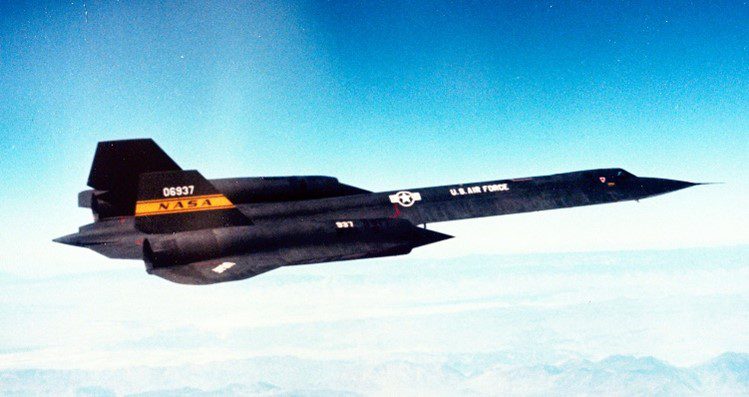
NASA pilots flew this YF-12C aircraft from 1971 and 1978 to perform airspeed calibrations and collect propulsion system data at numerous flight conditions.
Credit: NASA
Supersonic flight became a reality in October 1947, when the Bell X-1 rocket plane broke the sound barrier. NASA’s Lewis Research Center in Cleveland (now, NASA Glenn), which had served as the agency’s aeropropulsion leader since it was established in the 1940s, subsequently helped NASA advance the technology needed to make longer supersonic flights possible.
A host of military aircraft capable of reaching supersonic speeds followed the Bell X-1. In the 1960s, Lockheed’s family of Blackbirds (the original A-12, the YF-12 interceptor, and the SR-71 reconnaissance vehicle) became the world’s first aircraft able to cruise at supersonic speeds for extended periods. However, the expansion of this capability to larger transport aircraft was difficult, in large part due to the lack of data collected about propulsion systems during longer supersonic flights.
To solve problems that weren’t found during design-phase testing of these aircraft and to advance crucial technology, like the supersonic mixed-compression inlet, the military loaned two retired YF-12s to the Dryden Flight Research Center (today, NASA Armstrong) in 1969 as part of a collaborative NASA/Air Force effort. They planned to compare data from YF-12 flights to data collected in wind tunnels at NASA’s Ames, Langley, and Lewis Research Centers.
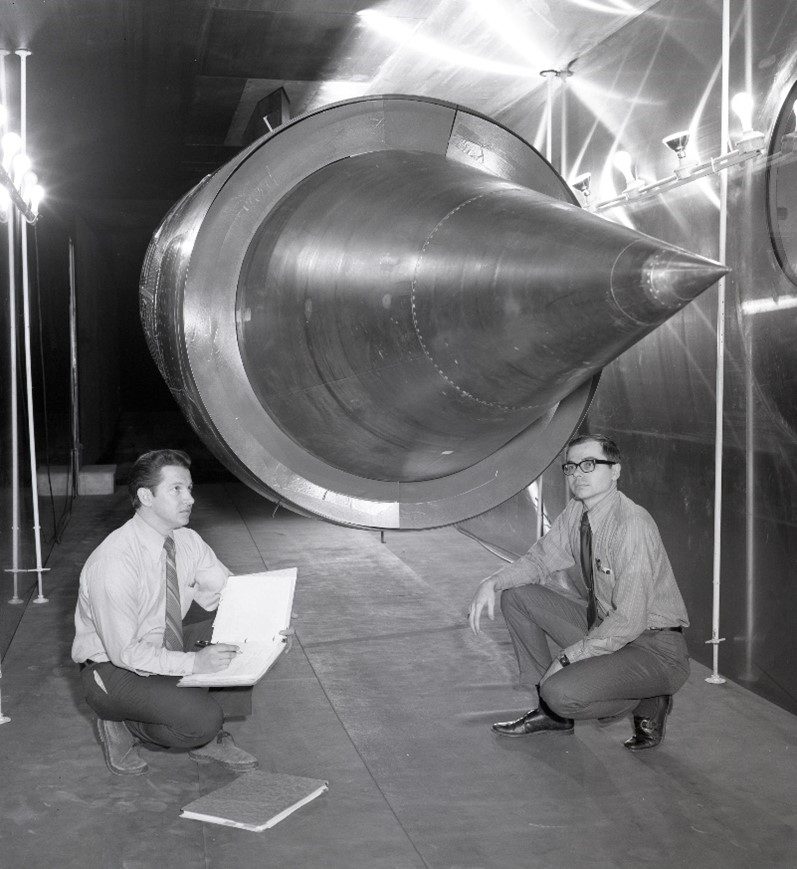
Bobby Sanders (left) and Robert Coltrin check a full-scale YF-12 flight inlet prior to a February 1972 test run in the NASA Lewis Research Center (now NASA Glenn) 10×10 Supersonic Wind Tunnel. Although the 5-foot 9-inch diameter inlet was large for the test section, no problems arose
Credit: NASA/Martin Brown
Lewis’ researchers had studied supersonic inlets in wind tunnels since the early 1950s and were in the midst of an extensive evaluation of supersonic nozzles and inlets using an F-106 Delta Dart. In this new effort, Lewis was responsible for testing a full-scale YF-12 inlet in the center’s 10×10 Supersonic Wind Tunnel and analyzing a 32,500-pound thrust Pratt & Whitney J58 engine in the Propulsion Systems Laboratory (PSL).
Although mixed-compression inlets, which allowed the engines to operate as turbojets at subsonic speeds and as ramjets at higher Mach numbers, were highly efficient, their design left the engines vulnerable to flow disturbances that often caused “unstarts.” Unstarts produced instantaneous drag that could stall the engine or cause the aircraft to quickly roll or yaw. Lewis researchers tested an actual inlet from a crashed SR-71, which they installed into the 10×10 in November 1971.
Over the next year, researchers collected aerodynamic data under different conditions in the wind tunnel. They also tested a new inlet control system patented by Lewis engineers Bobby Sanders and Glenn Mitchell that used mechanical valves to protect the aircraft against unstarts. It was the first time the system was tested on a full-scale piece of hardware.
Researchers also studied the relationships between the airframe, inlet, engine, and control system during normal flight conditions and when experiencing realistic flow disturbances.
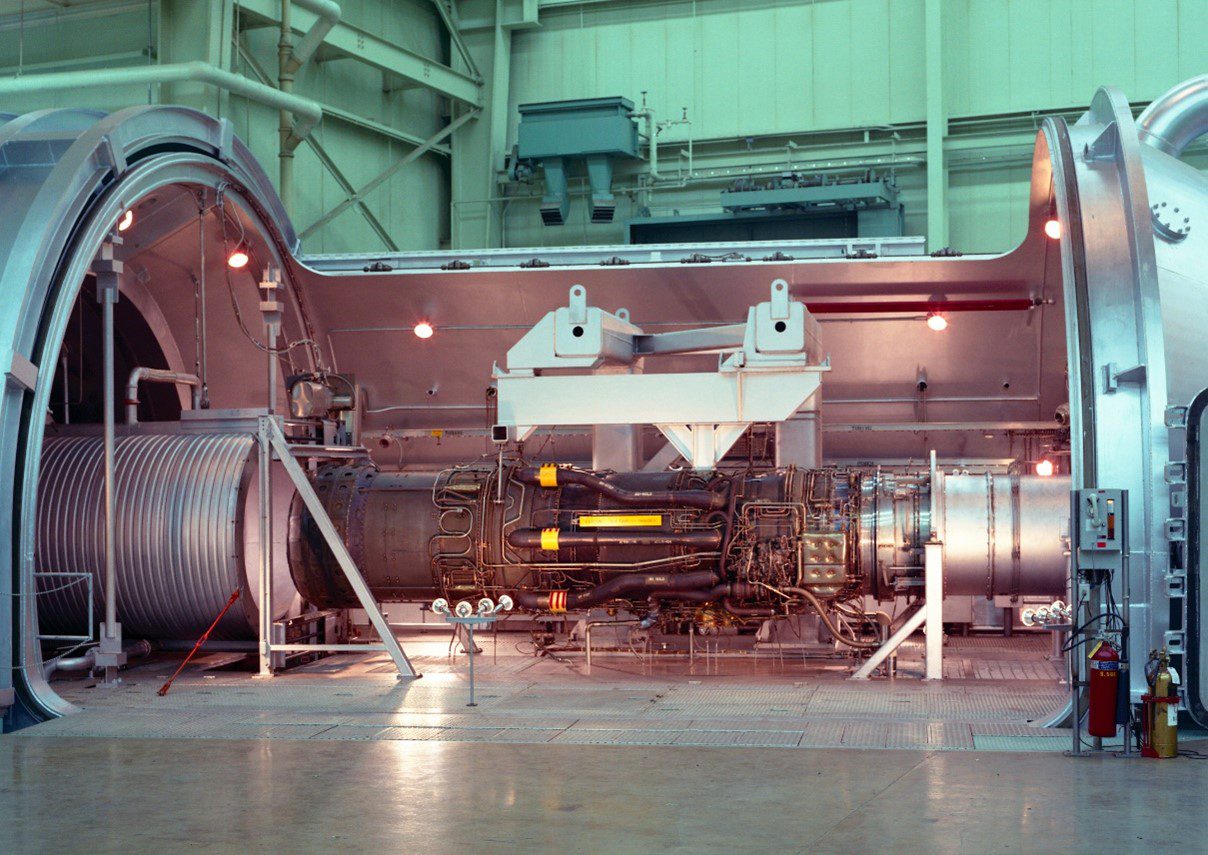
A Pratt & Whitney J58 engine installed in the NASA Lewis Research Center (now, NASA Glenn) Propulsion Systems Laboratory No. 4 facility in November 1973. The center’s technicians had to take great precautions to protect the instrumentation and control systems from the engine’s 1000-degree-Fahrenheit surface temperatures during the testing.
Credit: NASA/Martin Brown
In the summer of 1973, a full-scale J-58 engine became the first hardware tested in Lewis’ new PSL second altitude chamber. For the next year, researchers captured data under normal conditions and while using mesh inlet screens to simulate in-flight air-flow distortions.
The PSL tests also measured the engine’s emissions as part of a larger effort to determine the high-altitude emissions levels of potential supersonic transports.
While the YF-12 program was terminated in 1979 as the agency’s aeronautical priorities shifted, a year’s worth of ground testing had already been completed in NASA’s wind tunnels and the YF-12s had completed nearly 300 research flights. The program had expanded to include the development of high-temperature instrumentation, airframe pressure and flow mapping, thermal loads, and the inlet control system.
NASA engineers demonstrated that small-scale models could be successfully used to design full-scale supersonic inlets, while the flight data was used to better understand the effect of subscale models and tunnel interference on data. Perhaps most importantly, the program at Lewis led to a digital control system that improved the response of the supersonic inlet to flow disturbances, which nearly eliminated engine restarts.
Many of the program’s concepts were integrated into the SR-71’s design in the early 1980s and have contributed to NASA’s continuing efforts over the decades to achieve a supersonic transport aircraft.
NASA Deputy Associate Administrator Casey Swails views a demonstration on screen in the Airspace Operations Laboratory at NASA’s Ames Research Center in California’s Silicon Valley. Researchers presented the diverse, long-running efforts in aeronautics at Ames that have helped lay the foundation for agency work related to wildfire response.
Michael Falkowski, program manager for the Applied Sciences Wildland Fire program at NASA Headquarters presented wildfire efforts happening under NASA’s Science Mission Directorate, such as the FireSense project, led out of Ames.
The importance of collaborations within NASA and with partner agencies was also highlighted. Wildfires are complex phenomena and tackling their challenges will require the work of many, for the benefit of all.
NASA Deputy Associate Administrator Casey Swails, left, and Jeff Homola, NASA research engineer, discuss aeronautics projects at Ames that support the agency’s work to optimize wildfire response efforts in collaboration with its partners.
Preparations for Next Moonwalk Simulations Underway (and Underwater)
Students who pursue careers in these areas, among many others, could contribute to transforming aviation by developing and deploying Advanced Air Mobility solutions to the challenges of 21st century flight.
NASA / Lillian Gipson
NASA Aeronautics has released a new STEM toolkit focusing on Advanced Air Mobility for educators and students of all ages.
The toolkit, comprised of numerous educational activities, is a free resource for anyone who is interested in learning more about the Advanced Air Mobility mission’s goal of enabling the use of drones and other new aircraft in our skies.
Students can engage with the principles of Advanced Air Mobility in a variety of ways – including hands-on activities on topics such as coding, math, energy, the environment, and more. It is one of three STEM toolkits focusing on NASA’s aeronautics research – the others being Sustainable Aviation and the Quesst mission.
The Advanced Air Mobility STEM toolkit provides excellent, cross-curricular ways to learn about the scientific concepts behind drone flight…
April Lanotte
NASA Aeronautics STEM Lead
“The Advanced Air Mobility STEM toolkit provides excellent, cross-curricular ways to learn about the scientific concepts behind drone flight without even needing to have a drone,” said April Lanotte, NASA Aeronautics’ lead for STEM integration. “The toolkit has something for people of all ages in all types of educational environments.”
For example, one activity in the toolkit involves creating an art poster to explore and highlight original ideas for drone safety and the safe use of drones.
Zach Roberts completes a pre-flight check of a drone during Scalable Traffic Management for Emergency Response Operations, or STEReO, testing at the Disaster Assistance and Rescue Team, or DART, training facility, NA303.
NASA
An activity named Robotic Search and Rescue has students interact with real-world uses for drones – in this case, emergency response operations. As part of the activity, a team of students create and test their own responses to challenges first responders may face.
In another activity, students engage in cooperative game play to simulate a drone navigating around obstacles to deliver their lunch to school. The simulation engages students in computational thinking, problem solving, and real-world application of mathematics.
What’s more, many of these activities are aligned with national standards to meet educational requirements in the classroom. The toolkit also includes levelled readers, videos, and e-books, and is updated regularly with new material.
“It’s really a living toolkit. Advanced Air Mobility is a constantly evolving field, so we’re always adding new things to keep up with it,” said Lanotte. “Not just related to drones themselves, but also the infrastructure, coding, and other engineering challenges needed to support those vehicles in the future.”
The Advanced Air Mobility toolkit, along with the rest of NASA Aeronautics’ comprehensive STEM resources, is available on the Aeronautics STEM webpage.
This website uses cookies to improve your experience. We'll assume you're ok with this, but you can opt-out if you wish.AcceptRead More
Privacy & Cookies Policy
Privacy Overview
This website uses cookies to improve your experience while you navigate through the website. Out of these, the cookies that are categorized as necessary are stored on your browser as they are essential for the working of basic functionalities of the website. We also use third-party cookies that help us analyze and understand how you use this website. These cookies will be stored in your browser only with your consent. You also have the option to opt-out of these cookies. But opting out of some of these cookies may affect your browsing experience.
Necessary cookies are absolutely essential for the website to function properly. This category only includes cookies that ensures basic functionalities and security features of the website. These cookies do not store any personal information.
Any cookies that may not be particularly necessary for the website to function and is used specifically to collect user personal data via analytics, ads, other embedded contents are termed as non-necessary cookies. It is mandatory to procure user consent prior to running these cookies on your website.