Category: Science

http://www.esa.int/rssfeed/Our_Activities/Space_Science

  • Webb & Hubble confirm Universe’s expansion rate

    NGC 5468 – Cepheid host galaxy

    Webb measurements shed new light on a decade-long mystery.

    The rate at which the Universe is expanding, known as the Hubble constant, is one of the fundamental parameters for understanding the evolution and ultimate fate of the cosmos. However, a persistent difference, called the Hubble Tension, is seen between the value of the constant measured with a wide range of independent distance indicators and its value predicted from the afterglow of the Big Bang. The NASA/ESA/CSA James Webb Space Telescope has confirmed that the Hubble Space Telescope’s keen eye was right all along, erasing any lingering doubt about Hubble’s measurements.

  • Webb: galaxy mergers solve early Universe mystery

    One of the key missions of the NASA/ESA/CSA James Webb Space Telescope is to probe the early Universe. Now, the unmatched resolution and sensitivity of Webb’s NIRCam instrument have revealed, for the first time, what lies in the local environment of galaxies in the very early Universe.

    This has solved one of the most puzzling mysteries in astronomy – why astronomers detect light from hydrogen atoms that should have been entirely blocked by the pristine gas that formed after the Big Bang. 

  • Webb discovers dusty cat’s tail in Beta Pictoris system

    Beta Pictoris, a young planetary system located just 63 light-years away, continues to intrigue scientists even after decades of in-depth study. It possesses the first dust disc imaged around another star – a disc of debris produced by collisions between asteroids, comets, and planetesimals. 

  • Galactic Chloé – the Gaia mission


    Video:
    00:12:29

    For Gaia’s 10-year anniversary, ESA champion Galactic Chloé and the ESA Gaia team are very happy to collaborate to tell the space mission’s story. From paper calculations, to the launch, and to her third data release last year, discover three of the mission’s most surprising discoveries and celebrate with us Gaia’s birthday with this video produced by Galactic Studios! 

    Discover the video on Youtube 

  • Webb rings in the holidays with the ringed planet Uranus

    The NASA/ESA/CSA James Webb Space Telescope recently trained its sights on weird and enigmatic Uranus, an ice giant that orbits on its side. What Webb found is a dynamic world with rings, moons, storms, and other atmospheric features – including a seasonal polar cap. The image expands upon a two-colour version released earlier this year, adding additional wavelength coverage for a more detailed look.

  • A prominent protostar in Perseus


    Image:

    This new Picture of the Month from the NASA/ESA/CSA James Webb Space Telescope reveals intricate details of the Herbig Haro object 797 (HH 797). Herbig-Haro objects are luminous regions surrounding newborn stars (known as protostars), and are formed when stellar winds or jets of gas spewing from these newborn stars form shockwaves colliding with nearby gas and dust at high speeds. HH 797, which dominates the lower half of this image, is located close to the young open star cluster IC 348, which is located near the eastern edge of the Perseus dark cloud complex. The bright infrared objects in the upper portion of the image are thought to host two further protostars.

    This image was captured with Webb’s Near-InfraRed Camera (NIRCam). Infrared imaging is powerful in studying newborn stars and their outflows, because the youngest stars are invariably still embedded within the gas and dust from which they are formed. The infrared emission of the star’s outflows penetrates the obscuring gas and dust, making Herbig-Haro objects ideal for observation with Webb’s sensitive infrared instruments. Molecules excited by the turbulent conditions, including molecular hydrogen and carbon monoxide, emit infrared light that Webb can collect to visualise the structure of the outflows. NIRCam is particularly good at observing the hot (thousands of degree Celsius) molecules that are excited as a result of shocks.

    Using ground-based observations, researchers have previously found that the for cold molecular gas associated with HH 797, most of the red-shifted gas (moving away from us) is found to the south (bottom right), while the blue-shifted gas (moving towards us) is to the north (bottom left). A gradient was also found across the outflow, such that at a given distance from the young central star, the velocity of the gas near the eastern edge of the jet is more red-shifted than that of the gas on the western edge. Astronomers in the past thought this was due to the outflow’s rotation. In this higher resolution Webb image, however, we can see that what was thought to be one outflow is in fact made up of two almost parallel outflows with their own separate series of shocks (which explains the velocity asymmetries). The source, located in the small dark region (bottom right of centre), and already known from previous observations, is therefore not a single but a double star. Each star is producing its own dramatic outflow. Other outflows are also seen in this image, including one from the protostar in the top right of centre along with its illuminated cavity walls.

    HH 797 resides directly north of HH 211 (separated by approximately 30 arcseconds), which was the feature of a Webb image release in September 2023.

    [Image Description: In the lower half of the image is a narrow, horizontal nebula that stretches from edge to edge. It is brightly coloured with more variety on its right side. In the upper half there is a glowing point with multi-coloured light radiating from it in all directions. A bright star with long diffraction spikes lies along the right edge, and a few smaller stars are spread around. The background is covered in a thin haze.]

    Release on esawebb.org

  • ‘The making of Juice’: the story behind the film

    Still from the film

    One giant planet. Three icy moons. An eight-year journey. One special spacecraft.

    Building a mission to Jupiter took years of planning and thousands of people. Now that Juice is finally en route to its destination, our documentary ‘The making of Juice’ takes a look behind the scenes at the development and testing of the spacecraft in the three years leading up to launch. We hear from Juice Project Manager, Giuseppe Sarri, about how and why the film was made.

  • Webb, Hubble combine to create most colourful view of Universe

    Webb, Hubble combine to create most colourful view of Universe
    Image:
    Webb, Hubble combine to create most colourful view of Universe

  • Final three for ESA’s next medium science mission

    The space science community has narrowed down the shortlist for ESA’s next ‘medium’ mission to three finalists: M-Matisse, Plasma Observatory and Theseus. Following further study, one will be selected for implementation as the newest addition to ESA’s space science mission fleet.

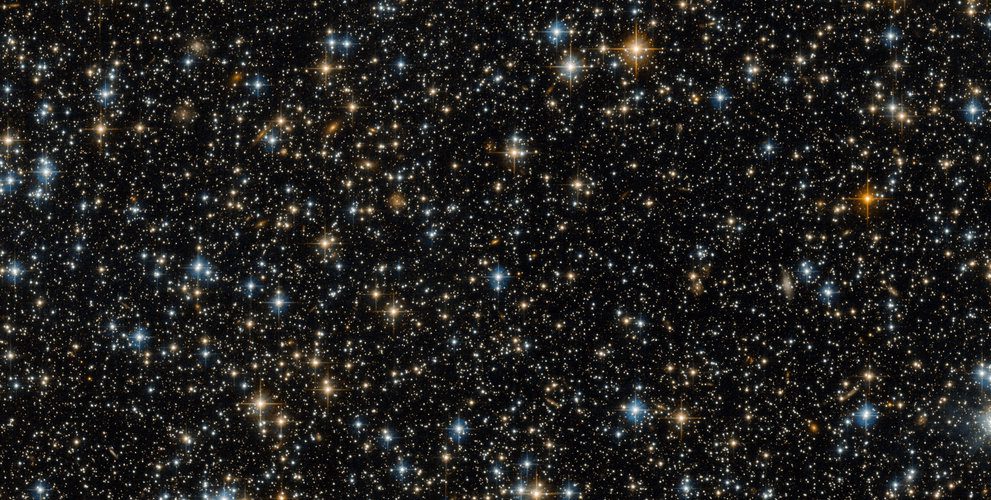
  • Euclid’s view of globular cluster NGC 6397

    Euclid’s view of globular cluster NGC 6397

    This sparkly image shows Euclid’s view on a globular cluster called NGC 6397. Globular clusters are collections of hundreds of thousands of stars held together by gravity.