
Image:
Research Fellows in space science 2024
Category: Science
http://www.esa.int/rssfeed/Our_Activities/Space_Science
-
Webb captures iconic Horsehead Nebula in unprecedented detail

The NASA/ESA/CSA James Webb Space Telescope has captured the sharpest infrared images to date of one of the most distinctive objects in our skies, the Horsehead Nebula. These observations show a part of the iconic nebula in a whole new light, capturing its complexity with unprecedented spatial resolution.
-
Dead star lights up nearby galaxy
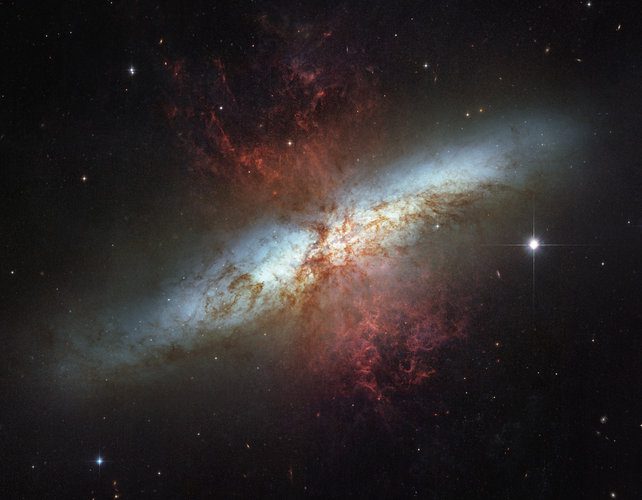
While ESA’s Integral was observing the sky, it suddenly spotted a burst of gamma-rays coming from the nearby galaxy M82. Only a few hours later, ESA’s XMM-Newton searched for an afterglow from the explosion but found none. Astronomers realised that the burst must have been an extra-galactic flare from a magnetar, a young neutron star with an exceptionally strong magnetic field.
-
Sailing among the stars – Gaia's role in discovering distant worlds

Have you ever looked up at the night sky and wondered if there are other planets out there beyond our Solar System?
-
Estonia pioneers instrument for Comet Interceptor mission through Prodex

An ESA programme called Prodex has enabled Estonian researchers and industry to join an international mission to intercept and examine a comet entering the inner Solar System for the first time.
-
Proba-2 sees the Moon eclipse the Sun

Video:
00:00:31ESA’s Proba-2 captured two partial solar eclipses on 8 April 2024.
A solar eclipse occurs when the Moon passes between Earth and the Sun, totally or partially blocking the Sun from Earth’s point of view. On 8 April, lucky viewers across North America witnessed the Moon blocking out the Sun in its entirety for a few minutes, while those north and south of the ‘total eclipse path’ witnessed a partial eclipse.
Throughout the eclipse period, the Moon crossed Proba-2’s field of view twice, appearing as a partial solar eclipse. The satellite flies around 700 km above Earth’s surface in what is called a Sun-synchronous orbit, each orbit lasting around 100 minutes.
The video was produced from images taken by Proba-2’s SWAP telescope, which observes the Sun in extreme ultraviolet light. At these wavelengths, the turbulent nature of the Sun’s surface and corona – the Sun’s extended atmosphere – become visible. These measurements have to be made from space, because Earth’s atmosphere doesn’t allow such short wavelengths of light to pass through.
A total solar eclipse provides a unique opportunity to see the Sun’s corona from Earth’s surface, using visible light. As the Moon blocks most of the Sun’s bright light, the faint corona can be discerned. By comparing the SWAP ultraviolet images to what is seen by (visible light) telescopes on Earth, we can learn about the temperature and behaviour of different structures in the corona.
Other solar missions also made the most of the unique measurement opportunities provided by the eclipse. For example, ESA’s Solar Orbiter was positioned close to the Sun and at a 90-degree angle from Earth’s view throughout the eclipse. This allowed it to complement Earth-based observations by monitoring the Sun’s corona side-on, including any solar eruptions pointing in Earth’s direction.
-
Euclid mission team honoured with Space Foundation Award

Image:The Euclid mission team was awarded this year’s Space Achievement Award by the Space Foundation, a non-profit organisation founded in 1983 to foster collaboration across the global space community. ESA Director General, Josef Aschbacher (centre), and ESA Director of Science, Carole Mundell (right), collected the prize at the Space Symposium in Colorado Springs, USA, on 8 April at 18:00 MDT (9 April at 2:00 CEST).
The Space Foundation recognised the partnership between ESA and the Euclid Consortium for their forward-thinking approach to global collaboration and team work to advance humankind’s understanding of the Universe.
Euclid is a scientific endeavour involving more than 300 institutes from 13 European countries and the USA, Canada and Japan. It has been made possible by the the work and dedication of more than 3500 people and thanks to the expertise of 80 companies from 21 countries.
Euclid’s quest is to uncover the nature of two mysterious components of our Universe: dark matter and dark energy. The mission will chart how the Universe has expanded and how large-scale structure is distributed across space and time. To achieve these ambitious goals, the space telescope will create the largest, most accurate 3D map of the Universe ever produced across 10 billion years of cosmic time.
Euclid is a European mission, built and operated by ESA, with contributions from NASA. The Euclid Consortium is responsible for providing the scientific instruments and scientific data analysis. ESA selected Thales Alenia Space as prime contractor for the construction of the satellite and its service module, with Airbus Defence and Space chosen to develop the payload module, including the telescope. NASA provided the detectors of the Near-Infrared Spectrometer and Photometer, NISP. Euclid is a medium-class mission in ESA’s Cosmic Vision Programme.
Image source: Space Foundation
-
Webb probes galaxy teeming with newborn stars

The NASA/ESA/CSA James Webb Space Telescope has set its sights on the starburst galaxy Messier 82 (M82), a small but mighty environment that features rapid star formation. By looking closer with Webb’s sensitive infrared capabilities, a team of scientists is getting to the very core of the galaxy, gaining a better understanding of how it is forming stars and how this extreme activity is affecting the galaxy as a whole.
-
Mars Express celebrates 25 000 orbits

ESA’s Mars Express recently looped around Mars for the 25 000th time – and the orbiter has captured yet another spectacular view of the Red Planet to mark the occasion.
-
Euclid's sight restored

A newly devised procedure to de-ice Euclid‘s optics has performed significantly better than hoped. Light coming in to the visible ‘VIS’ instrument from distant stars was gradually decreasing due small amounts of water ice building up on its optics. Mission teams spent months devising a procedure to heat up individual mirrors in the instrument’s complex optical system, without interfering with the finely tuned mission’s calibration or potentially causing further contamination. After the very first mirror was warmed by just 34 degrees, Euclid’s sight was restored.
-
Gaia unravels the ancient threads of the Milky Way

ESA’s Gaia space telescope has further disentangled the history of our galaxy, discovering two surprising streams of stars that formed and wove together over 12 billion years ago.

