
Since 13 September, ESA’s Mars Express has been observing the evolution of an elongated cloud formation hovering in the vicinity of the 20 km-high Arsia Mons volcano, close to the planet’s equator.
Since 13 September, ESA’s Mars Express has been observing the evolution of an elongated cloud formation hovering in the vicinity of the 20 km-high Arsia Mons volcano, close to the planet’s equator.
Three CubeSats successfully deployed from “Kibo”!
Last Updated:
October 26, 2018
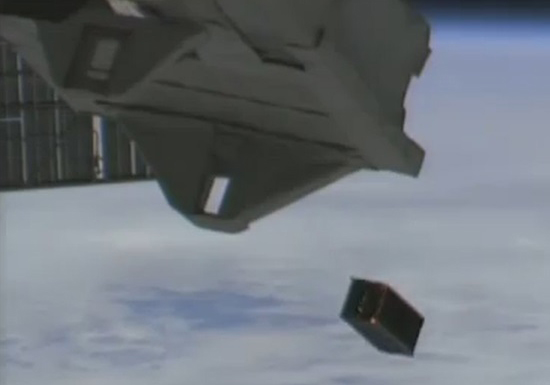
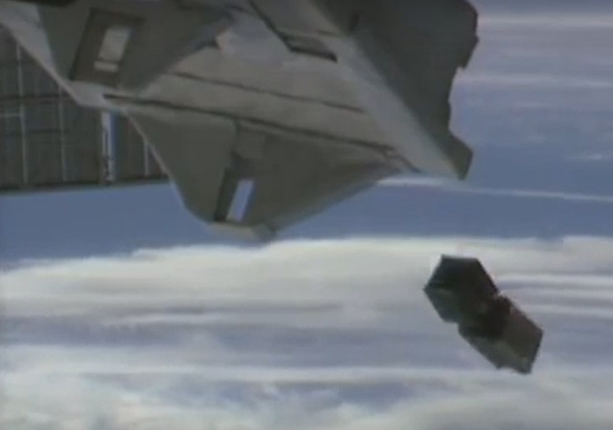
Three ultra-small satellites (“CubeSats”) were successfully deployed on October 6, 2018 from the Japanese Experiment Module “Kibo”: “SPATIUM-I” of Nanyang Technological University (Singapore)/Kyushu Institute of Technology (Japan), “RSP-00” of Ryman Sat Spaces General Incorporated Association and “STARS-Me” of Shizuoka University (Japan).
 |
 |
|
The pictures show how the CubeSats were deployed (Credit: JAXA/NASA) |
|

The people concerned with the projects in joy at the successful deployments of the CubeSats (Credit: JAXA)

[Name of satellite]
SPATIUM-I [Size: 2U]
[Organizations]
Nanyang Technological University (Singapore)/Kyushu Institute of Technology (Japan)
[Mission]
A demonstration of technologies in view of a chip-scale atomic clock to be mounted on CubeSat and measurement/3D mapping of the densities of electrons in the ionosphere.

[Name of satellite]
RSP-00 [Size: 1U]
[Organizations]
Ryman Sat Spaces General Incorporated Association
[Mission]
Picture-taking and a demonstration of technologies of to-the-Earth transmission with a camera mounted on CubeSat, and operation tests of new high-rate radio equipment.

[Name of satellite]
STARS-Me [Size: 2U]
[Organizations]
Shizuoka University
[Mission]
A small-scale demonstration of an orbital elevator and a demonstration evaluation of a configuration of two CubeSats and a climber (moving mechanism).
*All times are Japan Standard Time (JST)

Operations image of the week: Estrack engineers Lucy Santana and Daniel Firre in ESA’s Main Control Room during the launch of the ESA/JAXA mission to Mercury — BepiColombo

On Sept. 25, 2018, Parker Solar Probe captured a view of Earth as it sped toward the first Venus gravity assist of the mission. Earth is the bright, round object visible in the right side of this image.

Technology image of the week: ESA’s exoplanet-characterising Cheops undergoing testing in the Maxwell chamber, which recreates the infinite void of space

With air quality a serious environmental health problem, the Copernicus Sentinel-5P satellite is tasked with mapping air pollutants around the entire globe every day. This new mission has been providing data on carbon monoxide, nitrogen dioxide and ozone since July and now other polluting nasties such as sulphur dioxide and formaldehyde have joined the list of data products available to monitor the air we breathe.

Watch the press conference following an Intermediate Ministerial Meeting in Spain, starts 14:15 GMT on 25 October

Newborn Stars Blow Bubbles in the Cat’s Paw Nebula

Human and robotic exploration image of the week: The European Service Module of the Orion spacecraft is ready for shipment to the US

On October 22, 1968, 50 years ago, the Apollo 7 crew splashed down in the Gulf of Mexico.

A stunning early morning launch lifted the ESA/JAXA BepiColombo spacecraft into space on Saturday, 20 October. This marked the start of intensive, round-the-clock flight control activities to ensure the mission’s health and functioning in the harsh environment of space.
Utilization of Electrostatic Levitation Furnace (ELF) has been started to obtain thermophysical properties of high-temperature melts
Last Updated:
October 23, 2018
|

|
|
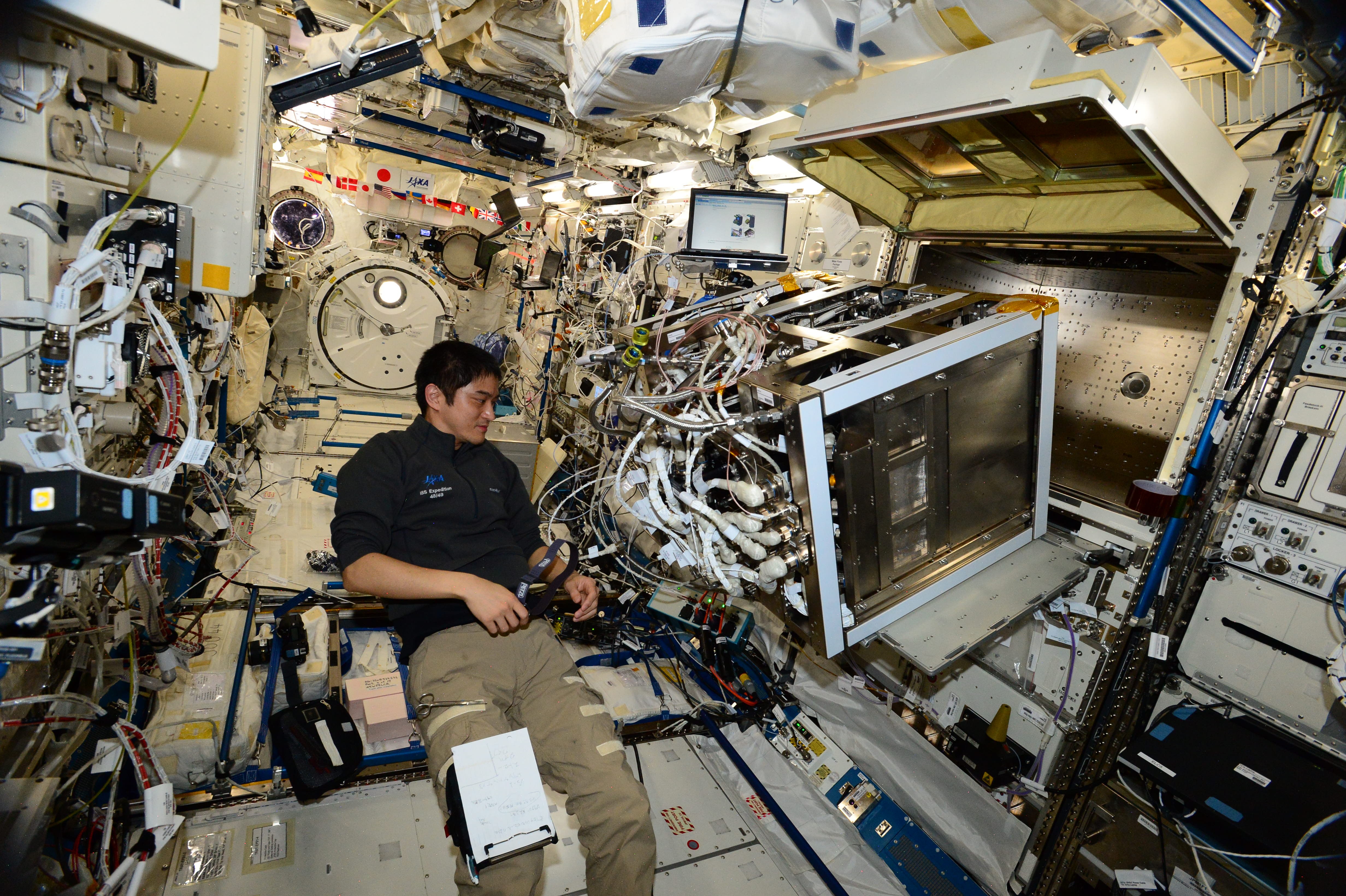
Electrostatic Levitation Furnace (ELF) attached to the Multi-purpose Small Payload Rack 2 (MSPR-2) (Credit: JAXA/NASA) |
The logo of the ELF Mission |
The checkout of the Electrostatic Levitation Furnace (ELF) installed in the Japanese Experiment Module (JEM) “Kibo”/International Space Station (ISS) has been completed and the experiments proposed from users have been started. The ELF is an experiment device which electrostatically levitates small samples (diameter=2 mm) and heats them. Refractory materials (melting points of up to 3000℃) can be melted in this furnace to measure their thermophysical properties without crucibles.
Fig.1 shows how the experiment on aluminum oxide was going during the checkout phase of the ELF.
Still Image

Fig.1
A molten aluminum oxide sample (central bright sphere) levitating in the midst of six electrodes (photo taken in July 2017)(Credit: JAXA)
Video
Video(mp4: 5.84 MB) taken during the experiments
(Fig.1 corresponds to the top left of the four-square indication)(Credit: JAXA)
High power lasers were used to melt stably levitated aluminum oxide sample (melting point=2054℃). The images of molten aluminum oxide were analyzed to determine the volumes of the samples. Their densities were calculated from their masses measured after recovery on the Earth. The obtained data were compared with the ones in the literature to verify the validity of the data with the ELF (Fig.2).

Fig.2 Density of molten aluminum oxide as a function of temperature
(Credit: Tamaru, H. et.al., Microgravity Sci. Technol. doi.org/10.1007/s12217-018-9631-8)
At present, a research team headed by Dr. Masahito Watanabe, professor at Gakushuin University is conducting an experiment using the ELF, “the thermophysical properties of high-temperature melting materials and interface phenomena: a basic study on ore refining process based on electrostatic levitation method.” Experiments planned for the years to come include the “clarification of the origin of the fragility of high-temperature molten oxides in view of development of non-equilibrium oxide with unprecedented functions,” an experiment headed by Dr. Shinji Kohara, Principal Researcher at the National Institute for Materials Science.
The results of the Checkout of the ELF and the experimental results were published in the on-line issue of the international journal “Microgravity Science and Technology” on June 16, 2018.
Journal:Microgravity Science and Technology
Article:Status of the Electrostatic Levitation Furnace (ELF) in the ISS-KIBO
Services related to paid utilization of the ELF are available. If you have interest in the matter, send an e-mail to
Z-KIBO-PROMOTION[at]ml.jaxa.jp.
The demand situation depends on the target material. (When an e-mail is prepared, replace [at] with @.)
*All times are Japan Standard Time (JST)

Space Science Image of the Week: BepiColombo’s solar arrays and antennas are captured in the spacecraft’s first images from space