Author: jappe

  • Results of Protein Crystal Growth experiment in Kibo (Flash report)

    Results of Protein Crystal Growth experiment in Kibo (Flash report)

    Last Updated:
    November 1, 2018

    The protein crystals acquired in the High-Quality Protein Crystal Growth (PCG) experiment during Astronaut Kanai’s stay on the International Space Station (ISS) were brought back to Earth by the Dragon SpX-14 spacecraft on May 6, 2018. The crystals were handed over to the researchers and are currently undergoing various analyses including data collections at synchrotron facilities such as SPring-8 and Photon Factory. Here is a brief report of a part of the experiment results.

    AoMan134A, a protein derived from aspergillus was discovered by the research team headed by Assistant Professor Motoyuki Shimizu from Meijo University. It is a hydrolase, which plays a key part in degrading mannans, polysaccharides found in legume seed and cell wall of softwood. Mannans constitute a part of the common natural biomass, and Ao134A is expected to contribute to industrial utilization of softwood biomass.

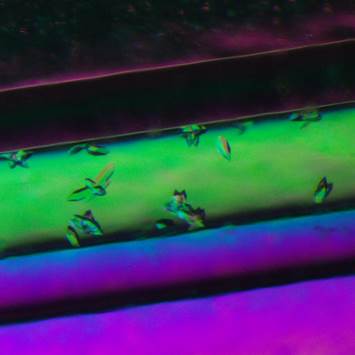
    The experiment in space of this session has brought about larger crystals of AoMan134A (see photos below). Ground-based experiments only had given the maximum resolution of 2.5Å, while the crystals in this space experiment diffracted up to a 1.5Åresolution. The data helped to determine the precise structure of the AoMan134A for the first time. The team from Meijo University is currently working on mutant enzymes having altered functions. JAXA is determined to provide more results of PCG experiments to academic researchers and institutes of the private sector, hoping to make contributions in this field.
    Click Here to visit the website (Japanese) of the Laboratory of Applied Microbiology, Meijo University.

    写真: Click to enlarge 写真: Click to enlarge

    Protein crystals produced in ground-based experiments
    (Credit: Meijo University/JAXA)

    Protein crystal produced in space
    (Credit: Meijo University/JAXA)

    *All times are Japan Standard Time (JST)

    Let’s block ads! (Why?)

  • Darkness of space


    Technology image of the week: What’s that in the dark? Vision-based navigation for space under test in ESA’s GRALS chamber

  • The power of three


    With the third MetOp satellite set for liftoff on 7 November, this video highlights how it is used for weather forecasting and how it will orbit along with its predecessors

  • NASA Retires Kepler Space Telescope, Passes Planet-Hunting Torch

    After nine years in deep space collecting data that indicate our sky to be filled with billions of hidden planets – more planets even than stars – NASA’s Kepler space telescope has run out of fuel needed for further science operations.

  • Into the dark


    The geology analogue course Pangaea continues for its third leg in Lanzarote

  • NASA to Hold Media Call on Status of Kepler Space Telescope Today

    NASA is hosting a media teleconference on the status of the Kepler space telescope today, Oct. 30, at 3 p.m. EDT.

  • Goodbye Europe, hello Moon: European Module ships soon

    The European Service Module that will power and propel the Orion spacecraft on its first mission around the Moon will ship early next week from Bremen to the United States. It will take off in an Antonov An-124 aircraft in the early hours of 5 November and arrive at Kennedy Space Center in Florida, US on 6 November.

    Designed and manufactured in Italy and Germany, the powerful workhorse is Europe’s contribution to humanity’s return to the Moon. 

  • Top Science Results from the Kepler Mission

    Top Science Results from the Kepler Mission

  • Kepler By the Numbers – Mission Statistics

    The Kepler space telescope is done with its work collecting astounding science data showing there are more planets than stars in our galaxy. Here’s a round-up of what Kepler has achieved.

  • NASA’s First Planet Hunter, the Kepler Space Telescope: 2009-2018

    NASA’s Kepler space telescope spent nine years in space, collecting an unprecedented dataset for science that has revolutionized our understanding of our place in the cosmos. It found our galaxy teeming with planets — more planets even than the stars — and stunned the world with many other first-of-a-kind discoveries.

  • A New View of Our Starry Night

    After nine years in deep space collecting data that revealed our night sky to be filled with billions of hidden planets – more planets even than stars – NASA’s Kepler space telescope has run out of fuel needed for further science operations.

  • John Glenn Returns to Space on the STS-95 Mission

    John Glenn Returns to Space on the STS-95 Mission

    Senator John Glenn during water survival training for the STS-95 mission at the Neutral Buoyancy Laboratory. On Oct. 29, 1998, space shuttle Discovery launched with Senator Glenn aboard, as he returned to space for the first time since his 1962 flight.

  • Preparing MetOp-C


    MetOp-C will soon be launched from French Guiana. ESA’s Stéfane Carlier talks about how this mission provides the continuity of information for weather forecasting and climate research