ESA at the International Astronautical Congress in Bremen, 1-5 October 2018.
Author: jappe
-
Comet landscape

Space Science Image of the Week: An evocative image of Rosetta’s comet to recall the end of its trailblazing mission two years ago -
Reflecting on Europe’s commanding role in space

ESA astronaut Alexander Gerst will take over the role of International Space Station commander from NASA astronaut Drew Feustel 3 October. This marks the start of expedition 57 and second half of Alexander’s Horizons mission.
With both Alexander and ESA astronaut Luca Parmitano set to command the International Space Station within the next 12 months, ESA astronaut Frank De Winne shares what it was like to be the first European in command.
-
Kepler Put Into Sleep Mode As Telescope’s Pointing Performance Degrades
NASA’s Kepler team has received data showing that the spacecraft’s ability to point precisely has degraded. In order to preserve high-value science data collected during its latest observation campaign, the Kepler team has placed the spacecraft in a stable, no-fuel-use sleep mode.
-

Apollo 7 Crew Trains to Test Technology for Missions to the Moon
This Aug. 5 1968 image was taken aboard the MV Retriever in the Gulf of Mexico, where the Apollo 7 crew, Walter Schirra, Walter Cunningham and Donn Eisele practiced water egress procedures in preparation for the October 1968 mission.
-
See the future at ESA’s IAC Start-up Space Zone

From Lego-style satellites that plug together to robot avatars for lunar exploration, satellite maps for Arctic navigation to a DNA-analysing ‘tricorder’: next week 24 of planet Earth’s top start-ups will showcase their cutting-edge ideas for space and beyond at the International Astronautical Congress in Germany.
-
Beyond

ESA astronaut Luca Parmitano reflects on his International Space Station mission name and logo -
Transfer of the Exposed Pallet (EP) begins
Transfer of the Exposed Pallet (EP) begins
Last Updated: September 29, 2018
The Exposed Pallet (EP) with the new ISS battery Orbital Replacement Units (ORUs) onboard was pulled out from the Unpressurized Logistics Carrier (ULC) of KOUNOTORI7 on September 29 , at 5:27 a.m.
The EP will be transferred and temporarily placed on the designated location of an ISS truss.
*All times are Japan Standard Time (JST. UTC + 9 hours)
-

Astronaut Michael Lopez-Alegria Works on Constructing the International Space Station
During National Hispanic Heritage Month, we’re celebrating the contributions of the brilliant Hispanic women and men of NASA. In this Feb. 2007 photo, astronaut Michael E. Lopez-Alegria, Expedition 14 commander, participates in a 6-hour, 40-minute spacewalk as construction continues on the International Space Station.
-
Kibo-ABC Members and Students from Philippines Participated in the Special Lecture of the "Double Layered Liquid Ball" Experiment
Kibo-ABC Members and Students from Philippines Participated in the Special Lecture of the “Double Layered Liquid Ball” Experiment
Last Updated: September 28, 2018


Dr. Matsumoto (Credit: JAXA)
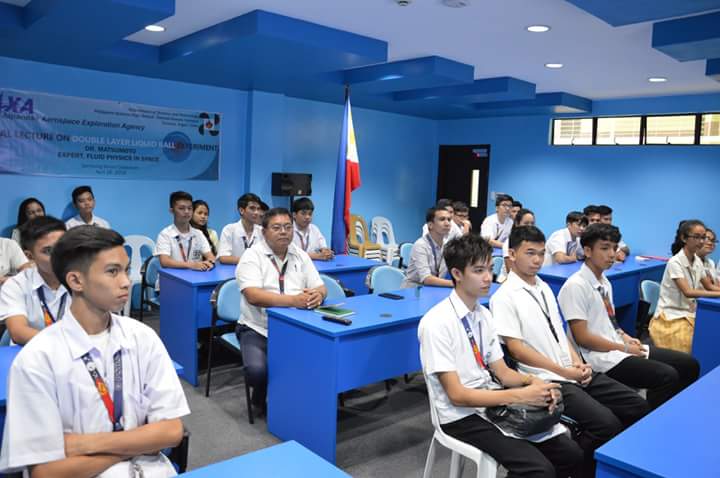
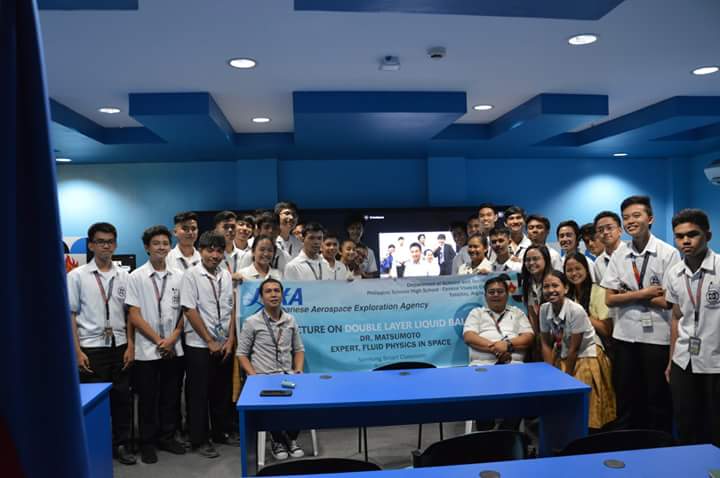
Dr. Satoshi Matsumoto joined the Kibo-ABC regular monthly web conference on April 26th. He gave a special lecture on the “Double Layered Liquid Ball” experiment which was carried out as part of JAXA astronaut Norishge Kanai’s Asian Try Zero-G 2018 in February 2018. Approximately 30 students–the proposers of this experiment along with their classmates–from Philippine Science High School Central Visayas Campus joined the lecture and had an enriching experience through a lively discussion with Dr. Matsumoto.
Dr. Matsumoto is a specialist of fluid physics experiments in space. From March 2018 for half a year he is also assigned as a JAXA Increment Manager, and is in charge of managing the entire Kibo operations including onboard utilizations to maximize outcomes. He started the lecture by introducing the International Space Station and Kibo experiment facilities such as Ryutai Rack, which is the experiment rack for fluid physics experiments.

The classroom of Philippine Science High School Visayas Campus (Credit: PSHSVC)
After that he explained the “Law of Universal Gravitation” and “Why does the Micro Gravity occur in the International Space Station” as background knowledge for understanding the nature of the micro gravity experiments.
To have the students understand the results of the “Double Layered Liquid Ball” experiment, he explained “Surface and Interfacial Tension” as fundamental factors of the experiment.After that, participants reviewed a movie of the onboard experiment results performed by Dr. Kanai, who tried to make a double layered liquid ball with “Silicone Oil (transparent)” and “Water (blue)”. During the first run, he injected water (blue) into a silicone oil ball. As a result, the double layered liquid ball was successfully formed. (See figure 1)
During the next run he did the opposite: he injected silicone oil into a water ball. Unlike in the first run, the silicone oil moved away from the center, and the silicone oil covered the water ball. (See figure 2)


Fig.1 Water injected into the Silicone Oil ball
(Credit: JAXA)Fig.2 Silicone oil injected into the water ball
(Credit: JAXA)The students listened eagerly to the lecture, which was helpful for a deep understanding of physical phenomena of the liquid ball behaviour under micro-gravity. They are developing their own report about the result of this ATZ-G experiment.
During his closing remarks, Dr. Matsumoto quoted a message from Astronaut Kanai: “Please keep asking questions and continue making questions. Sometimes no one can answer your question, but it’s OK. Because eventually you can try experiments and find the answer to your original question yourself.”
Major Questions and Answers
Q: What happens if the two liquids are miscible?
A: Miscible liquids may easily contact each other. After that, the mixture becomes a uniform consistency slowly. Complete mixing is not easy. For example, when you put sugar in coffee, you need to stir it vigorously with a spoon.
Q: Are frictional forces present, considering that friction is typically based on the normal force?
The frictional force comes from the viscosity of the liquid. When the liquid changes its shape, shear stress arises. Please imagine moving your hand in the air and in the water. You will probably feel more friction in the water.

The students of Philippine Science High School Visayas Campus (Credit: ???)
-
River discharge

As the Radar Altimetry Symposium continues in the Azores, Angelica Tarpanelli joins ESA web TV to explain how river discharge affects our oceans and how this is measured