A look back on the celebration of 50 years of ESRIN,
ESA’s establishment in Italy
Author: jappe
-
50 years of ESA in Italy
-
Construction of Europe's exoplanet hunter Plato begins

The construction of ESA’s Plato mission to find and study planets beyond our Solar System will be led by Germany’s OHB System AG as prime contractor, marking the start of the full industrial phase of the project.
-
Explore the Moon and Earth’s climate with two new ESA school projects!

In the beginning of the World Space Week, ESA is proud to present two new school challenges: Climate Detectives and Moon Camp.
-
Astronomers Find First Evidence of Possible Moon Outside Our Solar System
Using NASA’s Hubble and Kepler space telescopes, astronomers have uncovered tantalizing evidence of what could be the first discovery of a moon orbiting a planet outside our solar system.
-

The Creativity of Mother Nature
International Space Station Commander Alexander Gerst has a better view of our home planet than most.
-
Live from IAC 2018

Watch a call with Alexander Gerst on the Space Station, live from the IAC public day. Starts 13:30 CEST. -
MASCOT lands safely on asteroid Ryugu(DLR Press Release)

Focus: Space, explorartion
The near-Earth asteroid Ryugu, located approximately 300 million kilometres from Earth, has a new inhabitant: On 3 October 2018, the Mobile Asteroid Surface Scout (MASCOT) landed on the asteroid and began to work. The lander successfully separated from the Japanese Hayabusa2 space probe at 03:58 CEST. The 16 hours in which the lander will conduct measurements on the asteroid’s surface have begun for the international team of engineers and scientists. The day before, the Japanese Space Agency’s Hayabusa2 began its descent towards Ryugu. MASCOT was ejected at an altitude of 51 metres and descended in free fall – slower than an earthly pedestrian – to its destination, the asteroid. The relief about the successful separation and subsequent confirmation of the landing was clearly noticeable In the MASCOT Control Centre at the German Aerospace Center (Deutsches Zentrum für Luft- und Raumfahrt; DLR) as well as in the adjoining room: “It could not have gone better,” explained MASCOT project manager Tra-Mi Ho from the DLR Institute of Space Systems. “From the lander’s telemetry, we were able to see that it separated from the mothercraft, and made contact with the asteroid surface approximately 20 minutes later.” The team is now in contact with the lander.
The moment of separation was one of the risks of the mission: If MASCOT had not successfully separated from Hayabusa2 as planned and often tested, the lander’s team would hardly have had the opportunity to solve this problem. But everything went smoothly: Already during the descent on the asteroid, the camera switched MASCAM on and took 20 pictures, which are now stored on board the Japanese space probe. “The camera worked perfectly,” says Ralf Jaumann, DLR planetary scientist and scientific director of the camera instrument. “The team’s first images of the camera are therefore safe.” The magnetometer team was also able to recognise in the data sent by MASCOT that the MASMAG instrument had switched on and performed measurements prior to the separation. “The measurements show the relatively weak field of the solar wind and the very strong magnetic disturbances caused by the spacecraft,” explains Karl-Heinz Glaßmeier from the Technical University of Braunschweig. “At the moment of the separation, we expected a clear decrease of the interference field – and we were able to recognise this clearly.”
MASCOT came to rest on the surface approximately 20 minutes after the separation. Now, the team is analysing the data that MASCOT is sending to Earth to understand the events occurring on the asteroid Ryugu. The lander should now be on the asteroid’s surface, in the correct position thanks to its swing arm, and have started to conduct measurements independently. There are four instruments on board: a DLR camera and radiometer, an infrared spectrometer from the Institut d’Astrophysique Spatiale and a magnetometer from the TU Braunschweig. Once MASCOT has performed all planned measurements, it is expected to hop to another measuring location. This is the first time that scientists will receive data from different locations on an asteroid. “With MASCOT, we have the unique opportunity to study the Solar System’s most primordial material directly on an asteroid,” emphasises DLR planetary researcher Ralf Jaumann. With the data acquired by MASCOT and the samples that Hayabusa2 brings to Earth from Ryugu in 2020, scientists will not only learn more about asteroids, but more about the formation of the Solar System. “Asteroids are very primordial celestial bodies.”
About the Hayabusa2 mission and MASCOT
Hayabusa2 is a Japanese space agency (Japan Aerospace Exploration Agency; JAXA) mission to the near-Earth asteroid Ryugu. The German-French lander MASCOT on board Hayabusa2 was developed by the German Aerospace Center (Deutsches Zentrum für Luft- und Raumfahrt; DLR) and built in close cooperation with the French space agency CNES (Centre National d’Etudes Spatiales). DLR, the Institut d’Astrophysique Spatiale and the Technical University of Braunschweig have contributed the scientific experiments on board MASCOT. The MASCOT lander and its experiments are operated and controlled by DLR with support from CNES and in constant interaction with the Hayabusa2 team.
The DLR Institute of Space Systems in Bremen was responsible for developing and testing the lander together with CNES. The DLR Institute of Composite Structures and Adaptive Systems in Braunschweig was responsible for the stable structure of the lander. The DLR Robotics and Mechatronics Center in Oberpfaffenhofen developed the swing arm that allows MASCOT to hop on the asteroid. Das DLR Institute of Planetary Research in Berlin contributed the MASCAM camera and the MARA radiometer. The asteroid lander is monitored and operated from the MASCOT Control Center in the Microgravity User Support Center (MUSC) at the DLR site in Cologne.
-
NASA Drone Traffic Management Researcher Selected for Federal Award
NASA Drone Traffic Management Researcher Selected for Federal Award
-
Perfection

Human and robotic exploration image of the week: ESA-sponsored medical doctor Carmen Possnig at Concordia research station in Antarctica -

Astronaut Ricky Arnold Works With a Student-Designed Experiment
International Space Station astronaut and former teacher Ricky Arnold works with a student-designed experiment using NanoRacks commercial science hardware.
-
Gaia spots stars flying between galaxies

A team of astronomers using the latest set of data from ESA’s Gaia mission to look for high-velocity stars being kicked out of the Milky Way were surprised to find stars instead sprinting inwards – perhaps from another galaxy.
-
UNOOSA and JAXA open Fourth Round of KiboCUBE!
UNOOSA and JAXA open Fourth Round of KiboCUBE!
Last Updated:
October 2, 2018Japan Aerospace Exploration Agency (JAXA) and the United Nations Office for Outer Space Affairs (UNOOSA) is pleased to announce the opening of the fourth round of KiboCUBE.
KiboCUBE: Fourth Round 1) Application Application Submission 31 January, 2019 Eligibility Criteria Entities located in developing countries that are member states of the United Nations (please refer to the “Announcement of Opportunity” for further details. Deployment Deployment expected by September 2020, subject to the ISS operational requirements and progress of the CubeSat development. 2) Selection Selection and notification of applicants 30 April, 2019
Maximum of two entities (1U CubeSat per entity) will be selected.Please refer to the following website for further details regarding the applications for the KiboCUBE fourth round (“Announcement of Opportunity”). The application due date is January 31. We look forward to receiving many applicants and contributing to the capacity building of your country!
Application details:
Reference 1
KiboCUBE programme is a collaboration programme between JAXA and UNOOSA to offer developing countries the opportunity to deploy small satellites from the Japanese Experiment Module “Kibo” on the International Space Station (ISS).
Reference 2
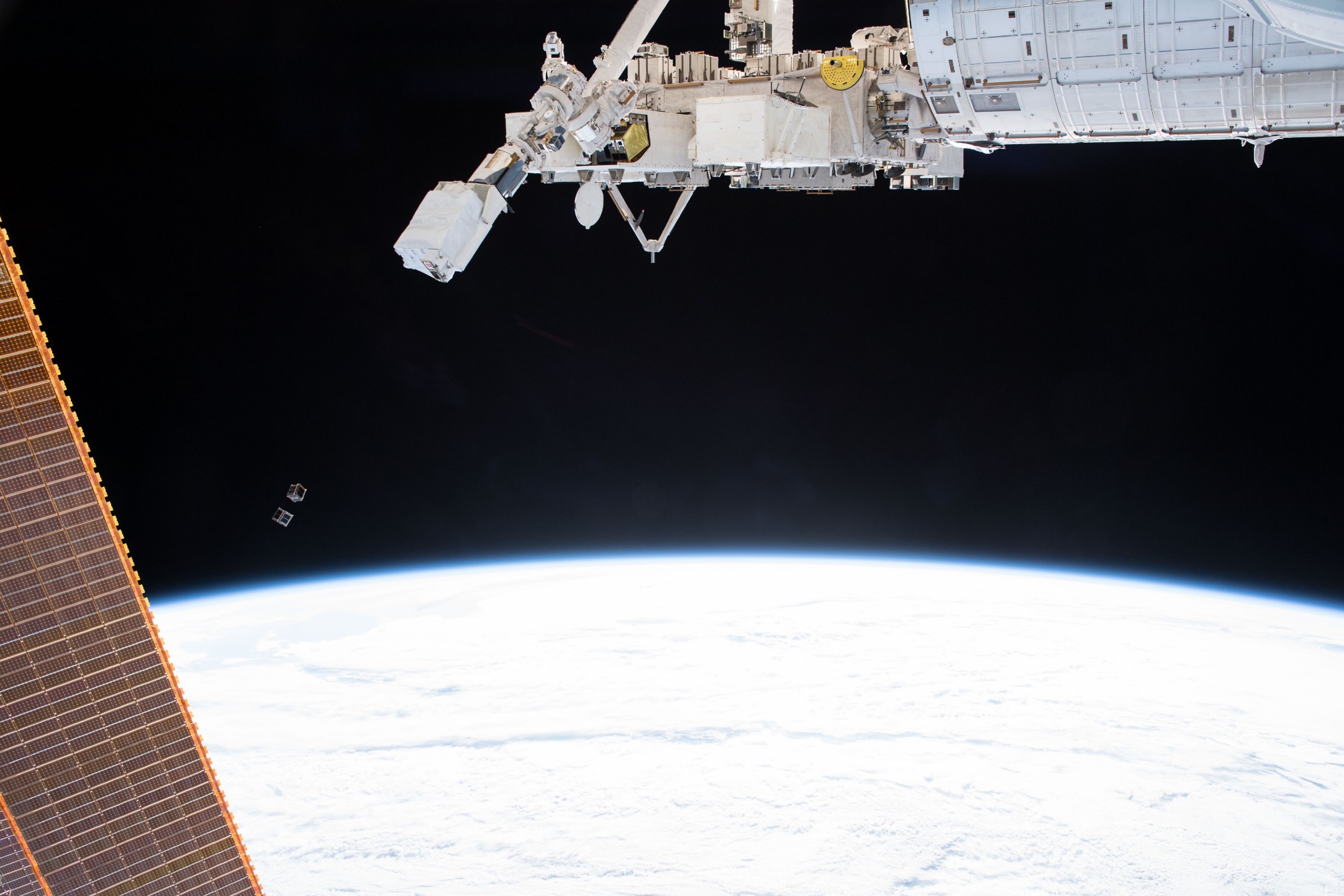
A team from the University of Nairobi (Kenya) was granted e for the 1st round of KiboCUBE, and the satellite was deployed from Kibo in May, 2018.
A team from Universidad del Valle de Guatemala (Guatemala) was granted for the second round of KiboCUBE, and the satellite is scheduled to be deployed in JFY 2018.
A team from Mauritius Research Council (Mauritius) and a team from Surya University (Indonesia) was granted for the third round of KiboCUBE. The satellites are scheduled to be deployed in JFY 2019.

Successful deployment of 1KUNS-PF (Kenyan Satellite, selected as first round of KiboCUBE) from Kibo in May, 2018 (Credit: JAXA)

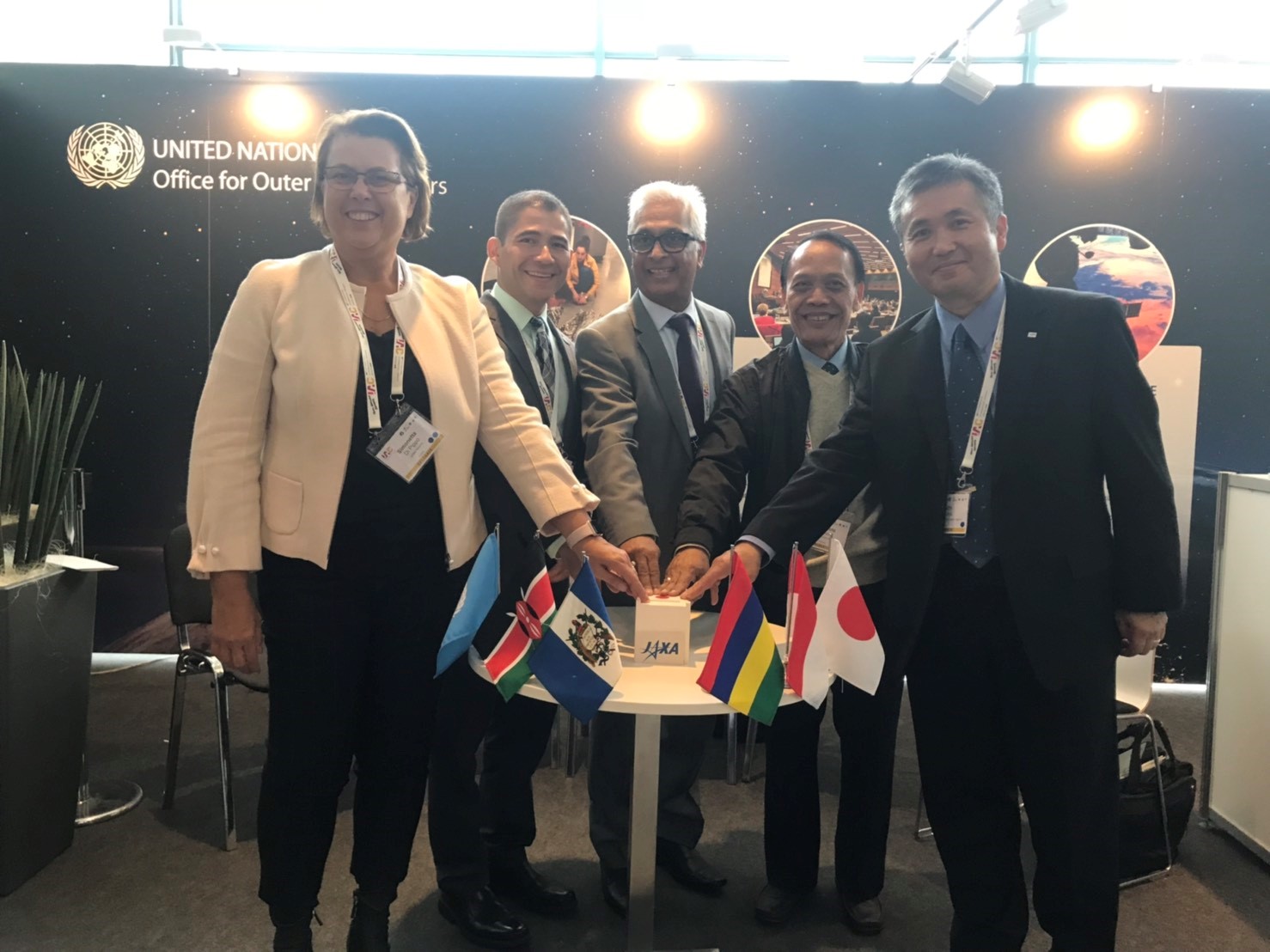
Media Briefing at IAC 2018 in Bremen, Germany on October 1st, 2018. Representatives from the selected entities for second and third round of KiboCUBE gathered for the media briefing.
(from left) Ms. Simonetta DiPippo, UNOOSA; Mr. Luis Zea, Universidad del Valle de Guatemala; Dr. Arjoon Suddhoo, Mauritius Research Council; Mr. Sunartoto Gunadi, Surya University of Indonesia; Dr. Koichi Wakata, JAXA (Credit: JAXA)*All times are Japan Standard Time (JST)
-

Aeronautics: NASA's First 'A'
Aeronautics, the first A of the NASA acronym, has always been a part of the agency.