Scientists were excited to discover clear skies on a relatively small planet, about the size of Neptune, using the combined power of NASA’s Hubble, Spitzer and Kepler space telescopes. The view from this planet — were it possible to fly a spaceship into its gaseous layers — is illustrated at right.
Tag: space
-
Best Astronomy Binoculars (Editors' Choice)
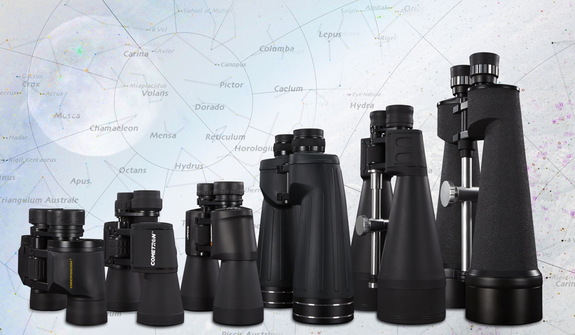
Most people have two eyes. Humans evolved to use them together (not all animals do). People form a continuous, stereoscopic panorama movie of the world within in their minds. With your two eyes tilted upward on a clear night, there’s nothing standing between you and the universe. The easiest way to enhance your enjoyment of the night sky is to paint your brain with two channels of stronger starlight with a pair of binoculars. Even if you live in — or near — a large, light-polluted city, you may be surprised at how much astronomical detail you’ll see through the right binoculars!
Our editors have looked at the spectrum of current binocular offerings. Thanks to computer-aided design and manufacturing, there have never been more high-quality choices at reasonable prices. Sadly, there’s also a bunch of junk out there masquerading as fine stargazing instrumentation. We’ve selected a few that we think will work for most skywatchers.
There was a lot to consider: magnification versus mass, field of view, prism type, optical quality (“sharpness”), light transmission, age of the user (to match “exit pupil” size, which changes as we grow older), shock resistance, waterproofing and more. To choose binoculars for yourself, check out our Buyer’s Guide: How to Choose Binoculars for Stargazing.
The best binoculars for you
“Small” astronomy binoculars would probably be considered “medium” for bird watching, sports observation and other terrestrial purposes. This comes about as a consequence of optics (prism type and objective size, mostly). “Large” binoculars are difficult to use for terrestrial applications and have a narrow field of view. They begin to approach telescope quality in magnification, resolution and optical characteristics.
Most of our Editors’ Choicesfor stargazing binoculars here are under $300. You can pay more than 10 times that for enormous binocular telescopes used by elite enthusiasts on special mounts! You’ll also pay more for ruggedized (“mil spec,” or military standard) binoculars, many of which suspend their prisms on shock mounts to keep the optics in precise alignment.
Also, our Editors’ Choices use Porro prism optics. Compact binoculars usually employ “roof” prisms, which can be cast more cheaply, but whose quality can vary widely. [There’s much more about Porro prisms in our Buyer’s Guide.]
We think your needs are best served by reviewing in three categories.
- Small, highly portable binoculars can be hand-held for viewing ease.
- Medium binoculars offer higher powers of magnification, but still can be hand-held, if firmly braced.
- Large binoculars have bigger “objective” lenses but must be mounted on a tripod or counterweighted arm for stability.
Here’s a detailed look at our Editor’s Choice selections for stargazing binoculars:
Best Small Binoculars
<img class=”pure-img” big-src=”http://www.space.com/images/i/000/042/973/original/Oberwerk-Mariner-8×40-editors-choice.jpg?1414079125?interpolation=lanczos-none&downsize=*:1400″ src=”http://www.space.com/images/i/000/042/973/i01/Oberwerk-Mariner-8×40-editors-choice.jpg?1414079125?interpolation=lanczos-none&downsize=192:*” alt=”Oberwerk’s Mariner 8×40 binoculars have won the Space.com Editors’ Choice award for Best Small Binoculars for Astronomy. BUY the Oberwerk Mariner 8×40 binoculars >>>“/>
Credit: Space.com/Jeremy Lips
Editor’s Choice: Oberwerk Mariner 8×40 (Cost: $150)
Oberwerk in German means “above work.” The brand does indeed perform high-level optical work, perfect for looking at objects above, as well as on the ground or water. Founder Kevin Busarow’s Mariner series is not his top of the line, but it benefits greatly from engineering developed for his pricier models. The Oberwerk 8×40’s treat your eyes to an extremely wide field, at very high contrast, with razor-sharp focus; they are superb for observing the broad starscapes of the Milky Way. Just 5.5 inches (14 cm) from front to back and 6.5 inches wide (16.5 cm), the Mariners are compact and rugged enough to be your favorite “grab and go binoculars.” But at 37 ounces, they may be more than a small person wants to carry for a long time.
Runner-Up: Celestron Cometron 7×50 (Cost: $30)
Yes, you read that price correctly! These Celestron lightweight, wide-field binoculars bring honest quality at a remarkably low price point. The compromise comes in the optics, particularly the prism’s glass type (you might see a little more chromatic aberration around the edges of the moon, and the exit pupil isn’t a nice, round circle). Optimized for “almost infinitely distant” celestial objects, these Cometrons won’t focus closer than about 30 feet (9.1 meters). But that’s fine for most sports and other outdoor use. If you’re gift-buying for multiple young astronomers – or you want an inexpensive second set for yourself – these binoculars could be your answer. Just maybe remind those young folks to be a little careful around water; Celestron claims only that the Cometrons are “water resistant,” not waterproof.
Honorable Mention: Swarovski Habicht 8×30 (Cost: $1,050)
From the legendary Austrian firm of Swarovski Optik, these “bins” are perfect. Really. Very sharp. Very lightweight. Very wide field. Very versatile. And very expensive! Our editors would have picked them if we could have afforded them.
Editor’s Note: These binoculars are not widely available. We suggest this very similar instrument:
Honorable Mention: Nikon Aculon 7×50 (Cost: $110)
Nikon‘s legendary optical quality and the large, 7mm exit pupil diameter make these appropriate as a gift for younger skywatchers.
Best Medium Binoculars
<img class=”pure-img” big-src=”http://www.space.com/images/i/000/042/974/original/Celestron-Skymaster-8×56-G01.jpg?1414079931?interpolation=lanczos-none&downsize=*:1400″ src=”http://www.space.com/images/i/000/042/974/i01/Celestron-Skymaster-8×56-G01.jpg?1414079931?interpolation=lanczos-none&downsize=192:*” alt=”Celestron’s SkyMaster 8×56 binoculars have won Space.com’s Editors’ Choice award for Best Medium Binoculars for Astronomy. BUY the Celestron SkyMaster 8×56 binoculars >>> “/>Credit: Space.com/Jeremy Lips
Editor’s Choice: Celestron SkyMaster 8×56 (Cost: $210)
A solid, chunky-feeling set of quality prisms and lenses makes these binoculars a pleasant, 38oz. handful. A medium wide 5.8 degrees filed of view and large 7mm exit pupil brings you gently into a sweet sky of bright, though perhaps not totally brilliant, stars. Fully dressed in a rubber wetsuit, these SkyMasters are waterproof. Feel free to take them boating or birding on a moist morning. Their optical tubes were blown out with dry nitrogen at the factory, then sealed. So you can expect them not to fog up, at least not from the inside. Celestron’s strap-mounting points on the Skymaster 8×56 are recessed, so they don’t bother your thumbs, but that location makes them hard to fasten.
Runner-Up: Oberwerk Ultra 15×70 (Cost: $380)
The most rugged pair we evaluated, these 15x70s are optically outstanding. Seen through the Ultra’s exquisitely multi-coated glass, you may find yourself falling in love with the sky all over again. Oberwerk’s method of suspending their BAK4 glass Porro prisms offers greater shock-resistance than most competitors’ designs. While more costly than some comparable binoculars, they deliver superior value. Our only complaint is with their mass: At 5.5 lbs., these guys are heavy! You can hand-hold them for a short while, if you’re lying down. But they are best placed on a tripod, or on a counterweighted arm, unless you like shaky squiggles where your point-source stars are supposed to be. Like most truly big binoculars, the eyepieces focus independently; there’s no center focus wheel. These “binos” are for true astronomers.
Honorable Mention: Vixen Ascot 10×50 (Cost:$165)
These quirky binoculars present you with an extremely wide field. But they are not crash-worthy – don’t drop them in the dark – nor are they waterproof, and the focus knob is not conveniently located. So care is needed if you opt for these Vixen optics.
Best Large Binoculars
Editors’ Choice: Celestron SkyMaster 25×100 (Cost: $300)
<img class=”pure-img” big-src=”http://www.space.com/images/i/000/043/116/original/Celestron-Skymaster-25×100-G01.jpg?1414164204?interpolation=lanczos-none&downsize=*:1400″ src=”http://www.space.com/images/i/000/043/116/i01/Celestron-Skymaster-25×100-G01.jpg?1414164204?interpolation=lanczos-none&downsize=192:*” alt=”Celestron’s SkyMaster 25×100 binoculars have won the Space.com Editors’ Choice award for Best Large Binoculars for Astronomy. BUY the Celestron SkyMaster 25×100 binoculars >>>“/>Credit: Space.com/Jeremy Lips
Don’t even think about hand-holding this 156-ounce beast! The SkyMaster 25×100 is really a pair of side-by-side 100mm short-tube refractor telescopes. Factor the cost of a sturdy tripod into your purchase decision, if you want to go this big. The monster Celestron comes with a sturdy support spar for mounting. Its properly multi-coated optics will haul in surprising detail from the sky. Just make sure your skies are dark; with this much magnification, light pollution can render your images dingy. As with many in the giant and super-giant class of binoculars, the oculars (non-removable eyepieces) focus separately, each rotating through an unusually long 450 degrees. Getting to critical focus can be challenging, but the view is worth it. You can resolve a bit of detail on face of the new moon (lit by “Earthshine”) and pick out cloud bands on Jupiter; tha’s pretty astonishing for binoculars.
Runner-Up: Orion Astronomy 20×80 (Cost: $150)
These big Orions distinguish themselves by price point; they’re an excellent value. You could pay 10 times more for the comparably sized Steiners Military Observer 20×80 binoculars! Yes, the Orions are more delicate, a bit less bright and not quite as sharp. But they do offer amazingly high contrast; you’ll catch significant detail in galaxies, comets and other “fuzzies.” Unusually among such big rigs, the Astronomy 20×80 uses a center focus ring and one “diopter” (rather than independently focusing oculars); if you’re graduating from smaller binoculars, which commonly use that approach, this may be a comfort. These binoculars are almost lightweight enough to hold them by hand. But don’t do that, at least not for long periods. And don’t drop them. They will go out of alignment if handled roughly.
Honorable Mention: Barska Cosmos 25×100 (Cost: $230)
They are not pretty, but you’re in the dark, right? Built around a tripod-mountable truss tube, these Barskas equilibrate to temperature quickly and give you decent viewing at rational cost. They make for a cheaper version of our Editors’ Choice Celestron SkyMasters.
Editor’s Note: These binoculars are not widely available. We suggest this very similar instrument:
Honorable Mention: Steiner Observer 20×80 (Cost: $1,500)
Not at all a practical cost choice for a beginning stargazer, but you can dream, can’t you? These Steiner binoculars are essentially military optics “plowshared” for peaceful celestial observing.
Why we chose NOT to review certain types
Image stabilized?
Binoculars with active internal image stabilization are a growing breed. Most use battery-powered gyroscope/accelerometer-driven dynamic optical elements. We have left this type out of our evaluation because they are highly specialized and pricey ($1,250 and up). But if you are considering active stabilization, you can apply the same judgment methods detailed in our Buyer’s Guide.
Comes with a camera?
A few binoculars are sold with built-in cameras. That seems like a good idea. But it isn’t, at least not for skywatching. Other than Earth’s moon, objects in the night sky are stingy with their photons. It takes a lengthy, rock-steady time exposure to collect enough light for a respectable image. By all means, consider these binocular-camera combos for snapping Facebook shots of little Jenny on the soccer field. But stay away from them for astronomy.
Mega monster-sized?
Take your new binoculars out under the night sky on clear nights, and you will fall in love with the universe. You will crave more ancient light from those distant suns. That may translate into a strong desire for bigger stereo-light buckets.
Caution: The next level up is a quantum jump of at least one financial order of magnitude. But if you have the disposable income and frequent access to dark skies, you may want to go REALLY big. Binocular telescopes in this class can feature interchangeable matching eyepieces, individually focusing oculars, more than 30x magnification and sturdy special-purpose tripods. Amateurs using these elite-level stereoscopes have discovered several prominent comets.
Enjoy your universe
If you are new to lens-assisted stargazing, you’ll find excellent enhanced views among the binocular choices above. To get in deeper and to understand how we picked the ones we did, jump to our Buyer’s Guide: How to Choose Binoculars for Sky Watching.
You have just taken the first step to lighting up your brain with star fire. May the photons be with you. Always.
Stunning Celestial Sights, Winter 2016
Below is a list of stunning night sky features to look out for this winter, from our skywatching expert Joe Rao.
The Pleiades – Also known as the “Seven Sisters,” the Pleiades are considered by many to be the most beautiful open star cluster in the sky. On a clear, dark night, stargazers will initially see the Pleiades — located in the shoulder of Taurus, the bull — as a shimmering patch of light. Upon scrutiny, however, observers should be able to see at least six stars of the Pleiades with the naked eye. Some people with acute vision can count as many as 18 stars with their bare eyes alone. But overall, the Pleiades are composed of more than 500 stars and are situated 410 light-years away. As viewed from Earth, the cluster covers an area of the sky four times the size of the full moon. In binoculars, the cluster resembles a handful of tiny, blue diamonds of various brightnesses, strewn on a background of black velvet. Good telescopes will bring out nebulosity around the brighter members of the Pleiades, particularly the star Merope. These are clouds of gas glowing feebly with the starlight they reflect.
The Hyades –The Hyades make up a V-shaped open cluster of stars, marking the face of Taurus, the bull. But because the cluster is more than 2.5 times closer to us (at 150 light-years away) than the Pleiades, even when we look at them with the unaided eye, the stars appear to be spread out. The late intrepid sky observer Walter Scott Houston described the Hyades as “bright with piercing sparkle.” Henry Neely, who lectured at New York’s Hayden Planetarium in the 1940s and ’50s, regarded the Hyades as even more beautiful than the Pleiades. “It is well worth the while to beg, borrow or steal a pair of binoculars to view them — my own particular favorite among all the binocular regions of the heavens,” he said. Indeed, in binoculars, the Hyades fill the field of view in a perfect V formation. But most amazing is that the brightest star — the orange-red Aldebaran, which marks the bull’s fiery eye — is merely an innocent bystander. The star is located 67 light-years away, less than half as close as members of the Hyades cluster. But thanks to the illusion of perspective, it appears to complete the lower arm of the V — one of the most distinctive of all the star patterns in the sky.
A trio of star clusters– North of Taurus is the constellation Auriga, the charioteer, which depicts one of two distinct shapes depending on how it is viewed. If you include the star El Nath, the brighter of the two stars that mark the tips of the bull’s horns, you see a pentagon. However, if El Nath is left out, Auriga becomes a kite. It’s also home to the sixth-brightest star in the sky, the brilliant yellow-white Capella. Located in Auriga are three pretty star clusters: M36, M37 and M38, which are easy binocular targets. M37 is an exceptional open star cluster, almost the size of the full moon in the sky. It has been described as a “magnificent object … the whole field being strewed as if it were sparkling gold dust.” M38 has an unusual shape, forming an “oblique cross with a pair of large stars in each arm” and one at the center; others say it resembles an inverted Greek letter “pi.” This whole region is attractive in binoculars, including nearby M36, another fine cluster that includes a double star (two stars orbiting tightly around each other).
M41 in Canis Major –The constellation Canis Major, the big dog, is marked prominently by the most dazzling star in the sky, Sirius, the dog star. Situated several degrees below Sirius is another beautiful star cluster known as M41. It’s a scattered cluster, barely visible to the unaided eye. But when viewed in binoculars, these stars can be seen dividing into groups and curves, with a distinctly reddish star near the middle.
Winter Milky Way – Winter skywatchers can take a pair of binoculars and sweep up and down the band of the Milky Way galaxy. Start from just east of Canis Major and Sirius, go up to between the ruddy star Betelgeuse in Orion and the feet of Gemini, swing past the horn tips of Taurus, and move on through Auriga and up into the lopsided letter K of Perseus. You’ll run across innumerable star fields and clusters; it’s nearly impossible to know where to stop!
Joe Rao serves as an instructor and guest lecturer at New York’s Hayden Planetarium. He writes about astronomy for Natural History magazine, the Farmer’s Almanac and other publications, and he is also an on-camera meteorologist for News 12 Westchester, New York.
Follow us @Spacedotcom, Facebook and Google+.
-
Unveiling Venus

Highlights from ESA’s Venus Express, following end of routine science observations after eight years orbiting the veiled planet -
Eclipse Glossary: Solar Eclipses, Lunar Eclipses and Their Terms
By Elizabeth Howell, Space.com Contributor | September 18, 2015 09:00am ET
Editor’s note: To find out more about the rare supermoon lunar eclipse of Sept. 27-28 and how to see it, visit: Supermoon Lunar Eclipse 2015: Full ‘Blood Moon’ Coverage. Such an event won’t happen again until 2033.
Eclipses occur when the sun or moon, depending on the situation, is obscured. Sometimes these eclipses are total and sometimes they are partial.
Astronomers use many terms to describe what happens during an eclipse, and this glossary shows some of the more common things they say. This glossary is based upon descriptions from NASA and the Canadian Space Agency.
Annular eclipse: A “ring of fire” solar eclipse that happens when the moon’s size (as seen from Earth) is not quite big enough to cover the entire sun. This happens when the moon is at apogee, or the closest approach to Earth in its orbit.
Contacts: The four points of contact that happen during an eclipse. First contact takes place when the partial phase of the eclipse begins. Second contact takes place when a total or annular phase begins. Third contact takes place when the total or annular phase ends. Fourth contact takes place when the partial phase ends.
Corona: The tenuous upper atmosphere of the sun that is usually only visible if you use special filters while observing the sun. During a solar eclipse, however, the corona is visible because the moon blots the sun’s disc out from the perspective of Earth.
 Photographer CJ Armitage of Brisbane, Australia captured this stunning view of the sunset solar eclipse on April 29, 2014 during the first solar eclipse of the year. A partial solar eclipse was visible from most of Australia during the event, with an annular solar eclipse occurring over a remote area in Antarctica.
Credit: CJ ArmitageEclipse magnitude: During a solar eclipse, this describes the fraction of the sun’s diameter obscured by the moon at the moment of greatest eclipse.
Eclipse obscuration: During a solar eclipse, this describes the fraction of the sun’s area obscured by the moon at the moment of greatest eclipse.
Eye safety: The only time that the sun can be viewed safely with the naked eye is during a total eclipse, when the moon completely covers the disk of the sun. It is never safe to look at a partial or annular eclipse, or the partial phases of a total solar eclipse, without the proper equipment and techniques. The safest wayto view a solar eclipse is to construct a pinhole camera or pinhole mirror. Acceptable filters include aluminized Mylar or shade 14 arc-welder’s glass. Unacceptable filters include sunglasses, old color film negatives, black-and-white film that contains no silver, photographic neutral-density filters and polarizing filters. [Video: Safely View an Eclipse]
 Astrophotographer Jake Gillespie sent in an image of the total lunar eclipse and Mars taken from Tucson, Arizona, on April 15, 2014.
Credit: Jake GillespieHybrid eclipse: When a solar eclipse appears as annular and total, depending on where you’re standing along its track. “In most cases, hybrid eclipses begin as annular, transform into total, and then revert back to annular before the end of their track,” NASA wrote. “In rare instances, a hybrid eclipse may begin annular and end total, or vice versa.”
Lunar eclipse: When the moon passes into the Earth’s shadow. The moon appears to turn red because light from Earth’s atmosphere — showing all the sunrises and sunsets at once — reflects back on to the moon.
Partial eclipse: When the moon and the sun (solar eclipse), or the moon and the Earth (lunar eclipse), are not perfectly aligned and only part of the moon or sun is obscured during the eclipse.
Penumbra: The lighter, outer part of a shadow seen during an eclipse. Sometimes an eclipse takes place with the penumbra only, meaning that the eclipse is partial only.
Saros cycle: A cycle describing how often and when solar and lunar eclipses happen. The cycle lasts about 18 years and describes the relative geometry of the moon, sun and Earth with regard to eclipses. It was first known by ancient Babylonian astronomers.
 Astrophotographer Teale Britstra sent in this photo of the partial lunar eclipse photo taken in Brisbane, Australia on April 29, 2014. Britstra mentions in an email to Space.com that they experienced a maximum eclipse of around 24% right at sunset.
Credit: Teale BritstraSolar eclipse: When the moon passes between the sun and Earth, blotting out some or all of the light from the sun.
Totality: The zone from Earth where a lunar or solar eclipse is visible. In general, lunar eclipses are visible anywhere where the sky is dark and clear. Solar eclipses are only visible in a very small area on the Earth. Total solar eclipses can last as long as 7 minutes and 32 seconds.
Umbra: The central, darker part of a shadow seen during an eclipse. If the umbra covers the moon or sun from Earth’s perspective, a total eclipse occurs.
Learn more about eclipses
Related articles:
Related galleries:
Related Infographics:
Related Video:
-
'Blood Moons' Explained: What Causes a Lunar Eclipse Tetrad? (Infographic)
by Karl Tate, SPACE.com Infographics Artist | September 18, 2015 09:29am ET
Editor’s note: To find out more about the rare supermoon lunar eclipse of Sept. 27-28 and how to see it, visit: Supermoon Lunar Eclipse 2015: Full ‘Blood Moon’ Coverage. Such an event won’t happen again until 2033.
The word “eclipse” means to obscure. When the moon passes between the Earth and the sun, it’s called a solar eclipse. When the Earth passes between the sun and the moon, it is a lunar eclipse.
The Earth casts its shadow far out into space, beyond the orbit of the moon. Once in a while the moon passes through the shadow, and an eclipse occurs. [Amazing Total Lunar Eclipse Photos]
Four Blood Moons: Total Lunar Eclipse Series Not a Sign of Apocalypse
Lunar eclipses occur in pairs with solar eclipses, two weeks apart. This is because the Earth, sun and moon must be aligned for an eclipse to occur, and the alignment can only happen twice during the moon’s month-long orbit.
A lunar eclipse lasts for hours as the moon slowly orbits through the Earth’s shadow.
If the moon passes through the edge of Earth’s shadow, it’s called a partial eclipse. Passage through the dense center of the shadow is a total lunar eclipse.
Four Blood Moons: A Tetrad Of Lunar Eclipses Explained | Video
A sequence of four total lunar eclipses including no partial eclipses is called a tetrad. In 2014-2015, four lunar eclipses will occur. This sequence features eclipses on April 15, 2014; Oct. 8, 2014; April 4, 2015 and Sept. 27, 2015.
Earth’s shadow is red at the edges for the same reason a sunset is red: When sunlight is scattered by passing through Earth’s atmosphere, the other colors of the spectrum are removed.
In a solar eclipse, the moon casts its shadow on Earth. The darkest part of the moon’s shadow – the umbra — is no more than 166 miles wide (267 kilometers) on the surface of the Earth.
Because the orbit of the moon is tilted relative to the orbit of Earth, eclipses can’t happen at every new and full moon. The shadow cones pass “above” or “below” the moon and Earth most of the time. Only at two points during the year do the sun, Earth and moon line up properly to allow for eclipses.
A lunar eclipse is visible to anyone who can see the moon, which usually means half of the Earth at a time. In a total solar eclipse, the moon’s shadow passes directly over only a narrow strip on the Earth’s surface. Observers in a larger area can see the sun partially eclipsed.
Follow us @Spacedotcom, Facebook and Google+.
-
What Is the Big Bang Theory?

A 2013 map of the background radiation left over from the Big Bang, taken by the ESA’s Planck spacecraft, captured the oldest light in the universe. This information helps astronomers determine the age of the universe.
Credit: ESA and the Planck Collaboration.The Big Bang Theory is the leading explanation about how the universe began. At its simplest, it talks about the universe as we know it starting with a small singularity, then inflating over the next 13.8 billion years to the cosmos that we know today.
Because current instruments don’t allow astronomers to peer back at the universe’s birth, much of what we understand about the Big Bang Theory comes from mathematical theory and models. Astronomers can, however, see the “echo” of the expansion through a phenomenon known as the cosmic microwave background.
The phrase “Big Bang Theory” has been popular among astrophysicists for decades, but it hit the mainstream in 2007 when a comedy show with the same name premiered on CBS. The show follows the home and academic life of several researchers (including an astrophysicist).
The first second, and the birth of light
In the first second after the universe began, the surrounding temperature was about 10 billion degrees Fahrenheit (5.5 billion Celsius), according to NASA. The cosmos contained a vast array of fundamental particles such as neutrons, electrons and protons. These decayed or combined as the universe got cooler.
This early soup would have been impossible to look at, because light could not carry inside of it. “The free electrons would have caused light (photons) to scatter the way sunlight scatters from the water droplets in clouds,” NASA stated. Over time, however, the free electrons met up with nuclei and created neutral atoms. This allowed light to shine through about 380,000 years after the Big Bang.
This early light — sometimes called the “afterglow” of the Big Bang — is more properly known as the cosmic microwave background (CMB). It was first predicted by Ralph Alpher and other scientists in 1948, but was found only by accident almost 20 years later. [Images: Peering Back to the Big Bang & Early Universe]
Arno Penzias and Robert Wilson, both of Bell Telephone Laboratories in Murray Hill, New Jersey, were building a radio receiver in 1965 and picking up higher-than-expected temperatures, according to NASA. At first, they thought the anomaly was due to pigeons and their dung, but even after cleaning up the mess and killing pigeons that tried to roost inside the antenna, the anomaly persisted.
Simultaneously, a Princeton University team (led by Robert Dicke) was trying to find evidence of the CMB, and realized that Penzias and Wilson had stumbled upon it. The teams each published papers in the Astrophysical Journal in 1965.
Determining the age of the universe
The cosmic microwave background has been observed on many missions. One of the most famous space-faring missions was NASA’s Cosmic Background Explorer (COBE) satellite, which mapped the sky in the 1990s.
Several other missions have followed in COBE’s footsteps, such as the BOOMERanG experiment (Balloon Observations of Millimetric Extragalactic Radiation and Geophysics), NASA’s Wilkinson Microwave Anisotropy Probe (WMAP) and the European Space Agency’s Planck satellite.
Planck’s observations, released in 2013, mapped the background in unprecedented detail and revealed that the universe was older than previously thought: 13.82 billion years old, rather than 13.7 billion years old. [Related: How Old is the Universe?]
The maps give rise to new mysteries, however, such as why the Southern Hemisphere appears slightly redder (warmer) than the Northern Hemisphere. The Big Bang Theory says that the CMB would be mostly the same, no matter where you look.
Examining the CMB also gives astronomers clues as to the composition of the universe. Researchers think most of the cosmos is made up of matter and energy that cannot be “sensed” with conventional instruments, leading to the names dark matter and dark energy. Only 5 percent of the universe is made up of matter such as planets, stars and galaxies.
 This graphic shows a timeline of the universe based on the Big Bang theory and inflation models.
Credit: NASA/WMAPGravitational waves controversy
While astronomers could see the universe’s beginnings, they’ve also been seeking out proof of its rapid inflation. Theory says that in the first second after the universe was born, our cosmos ballooned faster than the speed of light. That, by the way, does not violate Albert Einstein’s speed limit since he said that light is the maximum anything can travel within the universe. That did not apply to the inflation of the universe itself.
In 2014, astronomers said they had found evidence in the CMB concerning “B-modes,” a sort of polarization generated as the universe got bigger and created gravitational waves. The team spotted evidence of this using an Antarctic telescope called “Background Imaging of Cosmic Extragalactic Polarization”, or BICEP2.
“We’re very confident that the signal that we’re seeing is real, and it’s on the sky,” lead researcher John Kovac, of the Harvard-Smithsonian Center for Astrophysics, told Space.com in March 2014.
But by June, the same team said that their findings could have been altered by galactic dust getting in the way of their field of view.
“The basic takeaway has not changed; we have high confidence in our results,” Kovac said in a press conference reported by the New York Times. “New information from Planck makes it look like pre-Planckian predictions of dust were too low,” he added.
The results from Planck were put online in pre-published form in September. By January 2015, researchers from both teams working together “confirmed that the Bicep signal was mostly, if not all, stardust,” the New York Times said in another article.
Faster inflation, multiverses and charting the start
The universe is not only expanding, but getting faster as it inflates. This means that with time, nobody will be able to spot other galaxies from Earth, or any other vantage point within our galaxy.
“We will see distant galaxies moving away from us, but their speed is increasing with time,” Harvard University astronomer Avi Loeb said in a March 2014 Space.com article.
“So, if you wait long enough, eventually, a distant galaxy will reach the speed of light. What that means is that even light won’t be able to bridge the gap that’s being opened between that galaxy and us. There’s no way for extraterrestrials on that galaxy to communicate with us, to send any signals that will reach us, once their galaxy is moving faster than light relative to us.”
Some physicists also suggest that the universe we experience is just one of many. In the “multiverse” model, different universes would coexist with each other like bubbles lying side by side. The theory suggests that in that first big push of inflation, different parts of space-time grew at different rates. This could have carved off different sections — different universes — with potentially different laws of physics.
“It’s hard to build models of inflation that don’t lead to a multiverse,” Alan Guth, a theoretical physicist at the Massachusetts Institute of Technology, said during a news conference in March 2014 concerning the gravitational waves discovery. (Guth is not affiliated with that study.)
“It’s not impossible, so I think there’s still certainly research that needs to be done. But most models of inflation do lead to a multiverse, and evidence for inflation will be pushing us in the direction of taking [the idea of a] multiverse seriously.”
While we can understand how the universe we see came to be, it’s possible that the Big Bang was not the first inflationary period the universe experienced. Some scientists believe we live in a cosmos that goes through regular cycles of inflation and deflation, and that we just happen to be living in one of these phases.
EDITOR’S RECOMMENDATIONS
-
Photos: Dwarf Planet Ceres, the Solar System's Largest Asteroid
The dwarf planet Ceres, the largest asteroid in the solar system, is round and may contain more fresh water than the entire Earth. NASA’s Dawn spacecraft has been exploring Ceres since 2015. See more views of Ceres in this SPACE.com gallery. HERE:This image of Ceres as seen by NASA’s Dawn spacecraft shows how the dwarf planet would appear to human eyes. This image, released Nov. 18, 2016, was created using images from Dawn captured in 2015 that were then color adjusted by scientists at the German Aerospace Center in Berlin.Read the Full Story.
-
Join the adventure

Follow news, updates and real-time reporting on ESA’s comet mission via the Rosetta blog -
India's First Mars Mission in Pictures (Gallery)
<div data-cycle-pager-template=”
” readability=”31.5″>
Aurorae Choas
Aurorae Chaos, Pyrrhae Chaos and other regions of Mars captured by the Mars Orbiter camera.
<div data-cycle-pager-template=”
” readability=”31″>
Valles Marineris
Canyon walls clearly show in this image of Valles Marineris.
<div data-cycle-pager-template=”
” readability=”31″>
Valles Marineris – Large Canyon
Valles Marineris is the largest canyon system on Mars.
<div data-cycle-pager-template=”
” readability=”31″>
Mangala Valles
Evidence of floods in the Mangala Valles region begin at the Sabis Valles region.
<div data-cycle-pager-template=”
” readability=”31″>
Mangala Fossa
Mangala Fossa reveals its parallel faults.
<div data-cycle-pager-template=”
” readability=”31″>
Máadim Vallis
A section of Máadim Vallis clearly shows impact craters.
<div data-cycle-pager-template=”
” readability=”31″>
Thaumasia Planum
A wrinkle ridge in the Thaumasia Planum regions result from compressional stress.
<div data-cycle-pager-template=”
” readability=”31.5″>
Pital Crater
On April 23, 2015 the MCC snapped an image of Pital Crater.
<div data-cycle-pager-template=”
” readability=”31″>
Tyrrhenus Mons
Tyrrhenus Mons on Mars through the lens of the Mars Color Camera.
<div data-cycle-pager-template=”
” readability=”31″>
Hesperia Planum
The MCC imaged part of the Hesperia Planum.
<div data-cycle-pager-template=”
” readability=”31″>
Coma Sola Crater Region
The Mars Color Camera on India’s Mars Orbiter imaged the Coma Sola Crater Region.
<div data-cycle-pager-template=”
” readability=”31.5″>
Impact Crater
Southwest of Huygens crater, India’s Mars Orbiter imaged this large impact crater.
<div data-cycle-pager-template=”
” readability=”31″>
Details of an Impact Crater
The MCC captured these detailed images of an impact crater southwest of Huygens crater.
<div data-cycle-pager-template=”
” readability=”31″>
Gale Crater
Gale Crater on Mars seen by the Mars Color Camera.
<div data-cycle-pager-template=”
” readability=”31.5″>
Tharsis Tholus
This is Tharsis Tholus, a shield volcano on Mars.
<div data-cycle-pager-template=”
” readability=”31″>
Henry Crater
The MCC imaged Henry Crater.
<div data-cycle-pager-template=”
” readability=”31″>
Arabia Terra
The Mars Orbiter captured the area surrounding Arabia Terra.
<div data-cycle-pager-template=”
” readability=”31″>
Olympus Mons
The Mars Orbiter’s Color Camera imaged Olympus Mons from above.
<div data-cycle-pager-template=”
” readability=”31″>
Full Disc of Mars
MOM returned this full disc image of Mars to Earth.
<div data-cycle-pager-template=”
” readability=”32.5″>
Mars Terrain
The Mars Color Camera also captured this snapshot of Mars from a distance of 26,300 km on December 30, 2015.
<div data-cycle-pager-template=”
” readability=”31″>
Mars
A large region of Mars as imaged by the Mars Color Camera.
<div data-cycle-pager-template=”
” readability=”31.5″>
Thymiamata
Thymiamata, one of the brightest desert regions of Mars.
<div data-cycle-pager-template=”
” readability=”31″>
Valles Marineris
Valles Marineris as seen by the Mars Color Camera.
<div data-cycle-pager-template=”
” readability=”32″>
Olympus Mons
Olympus Mons, a large shield volcano on Mars, imaged in 3D.
<div data-cycle-pager-template=”
” readability=”31″>
Mars Snapshot
The Mars Color Camera took this snapshot of a large region of the Red Planet.
<div data-cycle-pager-template=”
” readability=”31″>
Arena Dorsum Region
The MCC shot the Arena Dorsum Region of Mars with both Cassini and Huygens in the image.
<div data-cycle-pager-template=”
” readability=”31″>
Mars Global Mosaic
Mars Color Camera snapped the imaged used to create this mosaic of Mars.
<div data-cycle-pager-template=”
” readability=”31″>
Mars Global Mosaic
A mosaic of Mars from another angle.
<div data-cycle-pager-template=”
” readability=”31.5″>
Another View
India’s Mars Orbiter returned a third view of Mars, in a global mosaic.
<div data-cycle-pager-template=”
” readability=”32″>
Danielson and Kalocsa
Two craters on Mars, Danielson and Kalocsa, were imaged by the Mars Color Camera.
<div data-cycle-pager-template=”
” readability=”31″>
Masurksy and Sagan
The Mars Orbiter used the Mars Color Camera to image the Maurksy and Sagan craters on Mars.
<div data-cycle-pager-template=”
” readability=”32″>
Another First
On November 19, 2013, the Mars Orbiter imaged Earth for the first time using the Mars Color Camera.
<div data-cycle-pager-template=”
” readability=”31.5″>
In Silhouette
Mars provides the backdrop to Phobos, one of two natural satellites of the Red Planet.
<div data-cycle-pager-template=”
” readability=”31.5″>
Eos Chaos
The Mars Color Camera captured the Eos Chaos area which is part of the Valles Marineris Canyon on Mars.
<div data-cycle-pager-template=”
” readability=”32″>
Arsia Mons
Arsia Mons, a large volcano on Mars, imaged in 3D.
<div data-cycle-pager-template=”
” readability=”32″>
India’s Mars Orbiter Mission Reaches Mars
This celebratory image from the Indian Space Research Organisation hails the Sept. 24, 2014 arrival (Indian Standard Time) of the Mangalyaan spacecraft in orbit around Mars.
<div data-cycle-pager-template=”
” readability=”31.5″>
India Mars Orbiter Mission Art
An artist’s depiction of India’s Mars Orbiter Mission, the country’s first interplanetary trek.
<div data-cycle-pager-template=”
” readability=”32″>
Indian Mars Orbiter’s First View of Earth
This photo of Earth was the first photo from India’s Mars Orbiter Mission and captured on Nov. 19, 2013. It shows India and the surrounding region from Earth orbit.
<div data-cycle-pager-template=”
” readability=”34″>
Panaromic View of First Launch Pad with PSLV-C25 During Launch Rehearsal
India’s first interplanetary probe, Mars Orbiter Spacecraft onboard a PSLV-C25 launch vehicle (XL version) will launch on November 5, 2013, from Satish Dhawan Space Centre SHAR, Sriharikota. Here the rocket undergoes launch testing.
<div data-cycle-pager-template=”
” readability=”34″>
Panaromic View of PSLV-C25
India’s first interplanetary probe, Mars Orbiter Spacecraft onboard a PSLV-C25 launch vehicle (XL version) will launch on November 5, 2013, from Satish Dhawan Space Centre SHAR, Sriharikota. Here the rocket undergoes launch testing.
<div data-cycle-pager-template=”
” readability=”31″>
Mars Orbiter Mission Trajectory Design (Infographic)
This infographic details India’s Mars Orbiter Mission trajectory design.
<div data-cycle-pager-template=”
” readability=”34.5″>
PSLV-C25 Post Four-Stage Integration
This photo shows PSLV-C25 after integration of all its four stages at Mobile Service Tower. India’s Mars Orbiter mission is slated to launch from Satish Dhawan Space Center (SDSC), Shriharikota, India, 100 kilometers north of Chennai on Oct. 28, 2013. Mars Orbiter Mission is India’s first interplanetary mission to planet Mars with an orbiter craft designed to orbit Mars in an elliptical orbit.
<div data-cycle-pager-template=”
” readability=”32.5″>
India Mars Orbiter Mission
An artist’s illustration of India’s Mars Orbiter Mission spacecraft, the country’s first Mars-bound probe, which is due to launch toward the Red Planet in Fall 2013.
<div data-cycle-pager-template=”
” readability=”33.5″>
India’s Mars Orbiter Mission Readied for Launch
PSLV-C25 rocket with heat shield closed. India’s first interplanetary probe, Mars Orbiter Spacecraft was prepared for launch on November 5, 2013, from Satish Dhawan Space Centre SHAR, Sriharikota.
<div data-cycle-pager-template=”
” readability=”34.5″>
PSLV-C25 Integration at Mobile Service Tower
This photo shows PSLV-C25 in its third and fourth stages of being placed on top of the second stage at the Mobile Service Tower. India’s Mars Orbiter mission is slated to launch from Satish Dhawan Space Center (SDSC), Shriharikota, India, 100 kilometers north of Chennai on Oct. 28, 2013. Mars Orbiter Mission is India’s first interplanetary mission to planet Mars with an orbiter craft designed to orbit Mars in an elliptical orbit.
<div data-cycle-pager-template=”
” readability=”34″>
PSLV-C25 Third and Fourth Stages of Vehicle Integration
This photo shows hoisting of the third and fourth stages of PSLV-C25 during vehicle integration at the Mobile Service Tower. India’s Mars Orbiter mission is slated to launch from Satish Dhawan Space Center (SDSC), Shriharikota, India, 100 kilometers north of Chennai on Oct. 28, 2013.
<div data-cycle-pager-template=”
” readability=”34.5″>
PSLV-C25 at Fourth Stage of Vehicle Integration
This photo shows PSLV-C25 at its fourth stage of being hoisted during its integration at the Mobile Service Tower. India’s Mars Orbiter mission is slated to launch from Satish Dhawan Space Center (SDSC), Shriharikota, India, 100 kilometers north of Chennai on Oct. 28, 2013. Mars Orbiter Mission is India’s first interplanetary mission to planet Mars with an orbiter craft designed to orbit Mars in an elliptical orbit.
<div data-cycle-pager-template=”
” readability=”34.5″>
PSLV-C25 at First and Second Stages
This photo shows PSLV-C25 at its first and second stages of being hoisted during its integration at the Mobile Service Tower. India’s Mars Orbiter mission is slated to launch from Satish Dhawan Space Center (SDSC), Shriharikota, India, 100 kilometers north of Chennai on Oct. 28, 2013. Mars Orbiter Mission is India’s first interplanetary mission to planet Mars with an orbiter craft designed to orbit Mars in an elliptical orbit.
<div data-cycle-pager-template=”
” readability=”34.5″>
PSLV-C25 at Second Stage
This photo shows hoisting of PSLV-C25 at its second stage in the Mobile Service Tower. The Mars Orbiter mission is slated to launch from Satish Dhawan Space Center (SDSC), Shriharikota, India, 100 kilometers north of Chennai on Oct. 28, 2013. Mars Orbiter Mission is India’s first interplanetary mission to planet Mars with an orbiter craft designed to orbit Mars in an elliptical orbit.
<div data-cycle-pager-template=”
” readability=”34″>
PSLV-C25 at First Stage
This photo shows PSLV-C25 during the first stage of integration at Mobile Service Tower. India’s Mars Orbiter mission is slated to launch from Satish Dhawan Space Center (SDSC), Shriharikota, India, 100 kilometers north of Chennai on Oct. 28, 2013.
<div data-cycle-pager-template=”
” readability=”34.5″>
PSLV-C25 Hoisted
This photo shows hoisting of an interstage of PSLV-C25 during vehicle integration. India’s Mars Orbiter mission is slated to launch from Satish Dhawan Space Center (SDSC), Shriharikota, India, 100 kilometers north of Chennai on Oct. 28, 2013. Mars Orbiter Mission is India’s first interplanetary mission to planet Mars with an orbiter craft designed to orbit Mars in an elliptical orbit.
<div data-cycle-pager-template=”
” readability=”31.5″>
PSLV-C25 Lowered into Position
This photo shows one of the strap-ons of PSLV-C25 as it is being lowered to its position during vehicle integration.
<div data-cycle-pager-template=”
” readability=”34.5″>
PSLV-C25 Lowered During Vehicle Integration
This photo shows one of the strap-ons of PSLV-C25 being lowered to its transporter during vehicle integration. India’s Mars Orbiter mission is slated to launch from Satish Dhawan Space Center (SDSC), Shriharikota, India, 100 kilometers north of Chennai on Oct. 28, 2013. Mars Orbiter Mission is India’s first interplanetary mission to planet Mars with an orbiter craft designed to orbit Mars in an elliptical orbit.
<div data-cycle-pager-template=”
” readability=”31.5″>
PSLV-C25 Prep
This photo shows preparation of one of the strap-ons before its integration with PSLV-C25 during the first stage.
<div data-cycle-pager-template=”
” readability=”31.5″>
PSLV-C25 First Stage Segments Join
This photo shows the joining of two segments of PSLV-C25 during its first stage at the Mobile Service Tower.
<div data-cycle-pager-template=”
” readability=”34.5″>
PSLV-C25 First Stage Integration
This photo shows hoisting of one of the segments of PSLV-C25 during the first stage of vehicle integration. The India Mars Orbiter mission is slated to launch from Satish Dhawan Space Center (SDSC), Shriharikota, India, 100 kilometers north of Chennai on Oct. 28, 2013. Mars Orbiter Mission is India’s first interplanetary mission to planet Mars with an orbiter craft designed to orbit Mars in an elliptical orbit.
<div data-cycle-pager-template=”
” readability=”34.5″>
PSLV-C25 Two-Segment First Stage Integration
This photo shows two segments of PSLV-C25 during its first stage of being joined in Mobile Service Tower. India’s Mars Orbiter mission is slated to launch from Satish Dhawan Space Center (SDSC), Shriharikota, India, 100 kilometers north of Chennai on Oct. 28, 2013. Mars Orbiter Mission is India’s first interplanetary mission to planet Mars with an orbiter craft designed to orbit Mars in an elliptical orbit.
<div data-cycle-pager-template=”
” readability=”34.5″>
PSLV-C25 Nozzle Placement
This photo shows PSLV-C25 during its first stage of the nozzle end segment being placed on the launch pedestal at Mobile Service Tower. India’s Mars Orbiter mission is slated to launch from Satish Dhawan Space Center (SDSC), Shriharikota, India, 100 kilometers north of Chennai on Oct. 28, 2013. Mars Orbiter Mission is India’s first interplanetary mission to planet Mars with an orbiter craft designed to orbit Mars in an elliptical orbit.
<div data-cycle-pager-template=”
” readability=”33″>
Mars Orbiter Mission Spacecraft Pre Test Launch Prep
This image shows Mars Orbiter Mission spacecraft being prepared for a prelaunch test at Satish Dhawan Space Center (SDSC), Shriharikota, India, 100 kilometers north of Chennai.
<div data-cycle-pager-template=”
” readability=”34.5″>
Mars Orbiter Mission Spacecraft Testing
This image shows the Mars Orbiter Mission Spacecraft undergoing EMI/EMC testing at ISITE ISAC in Bangalore, India. The Mars Orbiter mission is slated to launch from Satish Dhawan Space Center (SDSC), Shriharikota, India, 100 kilometers north of Chennai on Oct. 28, 2013.
<div data-cycle-pager-template=”
” readability=”34.5″>
Mars Orbiter Mission Spacecraft Vibration Test Prep
The Mars Orbiter Mission Spacecraft is being prepared in this image for a vibration test at ISITE ISAC Bangalore, India. The Mars Orbiter mission is slated to launch from Satish Dhawan Space Center (SDSC), Shriharikota, India, 100 kilometers north of Chennai on Oct. 28, 2013.
<div data-cycle-pager-template=”
” readability=”31.5″>
Mars Orbiter Mission Spacecraft Acoustic Test
The Mars Orbiter Mission Spacecraft is undergoing an acoustic test at ISITE ISAC Bangalore, India.
<div data-cycle-pager-template=”
” readability=”34″>
Mars Orbiter Mission Spacecraft Antenna Testing
This photo shows Mars Orbiter Mission Spacecraft antenna undergoing a test at Comprehensive Antenna Test Facility. India Mars Orbiter mission is slated to launch from Satish Dhawan Space Center (SDSC), Shriharikota, India, 100 kilometers north of Chennai on Oct. 28, 2013.
<div data-cycle-pager-template=”
” readability=”34″>
Mars Orbiter Mission Spacecraft Thermo Vacuum Test
This photo shows the Mars Orbiter Mission Spacecraft as it is being loaded for a thermo vacuum test in the Large Space Simulation Chamber. India’s Mars Orbiter mission is slated to launch from Satish Dhawan Space Center (SDSC), Shriharikota, India, 100 kilometers north of Chennai on Oct. 28, 2013.
<div data-cycle-pager-template=”
” readability=”34.5″>
Testing the Mars Orbiter Mission Spacecraft
The Mars Orbiter Mission Spacecraft undergoes testing in this image. India’s Mars Orbiter mission is slated to launch from Satish Dhawan Space Center (SDSC), Shriharikota, India, 100 kilometers north of Chennai on Oct. 28, 2013. Mars Orbiter Mission is India’s first interplanetary mission to planet Mars with an orbiter craft designed to orbit Mars in an elliptical orbit.
<div data-cycle-pager-template=”
” readability=”34″>
Mars Orbiter Mission Spacecraft Undergoes Testing
This image shows the Mars Orbiter Mission Spacecraft as it undergoes pre-launch testing. India Mars Orbiter mission is slated to launch from Satish Dhawan Space Center (SDSC), Shriharikota, India, 100 kilometers north of Chennai on Oct. 28, 2013.
<div data-cycle-pager-template=”
” readability=”34″>
Mars Orbiter Testing
India’s Mars Orbiter Mission Spacecraft undergoes pre-launch testing. The mission is slated to launch from Satish Dhawan Space Center (SDSC), Shriharikota, India, 100 kilometers north of Chennai on Oct. 28, 2013.
<div data-cycle-pager-template=”
” readability=”34″>
Mars Orbiter Spacecraft Undergoes Pre Launch Tests
Scientists test India’s Mars Orbiter Mission Spacecraft in this image. The mission is slated to launch from Satish Dhawan Space Center (SDSC), Shriharikota, India, 100 kilometers north of Chennai on Oct. 28, 2013.
<div data-cycle-pager-template=”
” readability=”34.5″>
Mars Orbiter Spacecraft Moved for Testing
Scientists move India’s Mars Orbiter Mission Spacecraft for testing. The mission is slated to launch from Satish Dhawan Space Center (SDSC), Shriharikota, India, 100 kilometers north of Chennai on Oct. 28, 2013. Mars Orbiter Mission is India’s first interplanetary mission to planet Mars with an orbiter craft designed to orbit Mars in an elliptical orbit.
<div data-cycle-pager-template=”
” readability=”34.5″>
Mars Orbiter Spacecraft Integration
Scientists integrate India’s Mars Orbiter Mission Spacecraft. The mission is slated to launch from Satish Dhawan Space Center (SDSC), Shriharikota, India, 100 kilometers north of Chennai on Oct. 28, 2013. Mars Orbiter Mission is India’s first interplanetary mission to planet Mars with an orbiter craft designed to orbit Mars in an elliptical orbit.
<div data-cycle-pager-template=”
” readability=”34.5″>
Mars Orbiter Mission Payloads (Infographic)
This infographic details India’s Mars Orbiter Mission payloads. The mission is slated to launch from Satish Dhawan Space Center (SDSC), Shriharikota, India, 100 kilometers north of Chennai on Oct. 28, 2013. Mars Orbiter Mission is India’s first interplanetary mission to planet Mars with an orbiter craft designed to orbit Mars in an elliptical orbit.
<div data-cycle-pager-template=”
” readability=”34″>
Full View of PSLV-C25 on First Launch Pad
India’s first interplanetary probe, Mars Orbiter Spacecraft onboard a PSLV-C25 launch vehicle (XL version) will launch on November 5, 2013, from Satish Dhawan Space Centre SHAR, Sriharikota. Here the rocket undergoes launch testing.
<div data-cycle-pager-template=”
” readability=”34″>
PSLV-C25 Undergoing Launch Rehearsal
India’s first interplanetary probe, Mars Orbiter Spacecraft onboard a PSLV-C25 launch vehicle (XL version) will launch on November 5, 2013, from Satish Dhawan Space Centre SHAR, Sriharikota. Here the rocket undergoes launch testing.
<div data-cycle-pager-template=”
” readability=”34″>
India’s Mars Orbiter Mission Readied for Launch
Mars Orbiter Mission Spacecraft is being integrated to the 4th stage of PSLV-C25. India’s first interplanetary probe, Mars Orbiter Spacecraft was prepared for launch on November 5, 2013, from Satish Dhawan Space Centre SHAR, Sriharikota.
<div data-cycle-pager-template=”
” readability=”32.5″>
Valles Marineris Higher Resolution Image
The central part of Valles Marineris on Mars was imaged on Jan. 28, 2015, by India’s Mars Orbiter Spacecraft.
<div data-cycle-pager-template=”
” readability=”31.5″>
Valles Mariners Seen by MOM
Valles Marineris canyon on Mars was imaged by India’s Mars Orbiter Mission on Dec. 5, 2014.
<div data-cycle-pager-template=”
” readability=”32″>
Arsia Mons with Water Vapor Clouds
India’s Mars Orbiter Mission imaged Arsia Mons region on Jan. 4, 2014. Water vapor clouds are seen left of the volcanic mountain.
<div data-cycle-pager-template=”
” readability=”32.5″>
Wind Streaks on Mars
India’s Mars Orbiter Mission imaged the Kinkora crater (right) on Feb. 16, 2015. WInd streaks are seen throughout the image, lined up in a NW to SE direction.
<div data-cycle-pager-template=”
” readability=”32.5″>
Superimposed Impact Craters on Mars
India’s Mars Orbiter Mission imaged superimposed craters on Feb. 19, 2015. WInd streaks are seen throughout the image, lined up in a NW to SE direction.
<div data-cycle-pager-template=”
” readability=”31.5″>
3-Dimensional View of Valles Marineris
The Mars Colour Camera on India’s Mars Orbiter Mission provided data for this 3-dimensional view of Valles Marineris.
-
Main Sequence Stars: Definition & Life Cycle
by Nola Taylor Redd, SPACE.com Contributor | May 05, 2015 11:02pm ET

This Hubble Space Telescope image shows Sirius A, the brightest star in our nighttime sky, along with its faint, tiny stellar companion, Sirius B. Astronomers overexposed the image of Sirius A so that the dim Sirius B (tiny dot at lower left) could be seen. The cross-shaped diffraction spikes and concentric rings around Sirius A, and the small ring around Sirius B, are artifacts produced within the telescope’s imaging system. The two stars revolve around each other every 50 years. Sirius A, only 8.6 light-years from Earth, is the fifth closest star system known.
Credit: NASA, H.E. Bond and E. Nelan (Space Telescope Science Institute, Baltimore, Md.); M. Barstow and M. Burleigh (University of Leicester, U.K.); and J.B. Holberg (University of Arizona)Main sequence stars fuse hydrogen atoms to form helium atoms in their cores. About 90 percent of the stars in the universe, including the sun, are main sequence stars. These stars can range from about a tenth of the mass of the sun to up to 200 times as massive.
Stars start their lives as clouds of dust and gas. Gravity draws these clouds together. A small protostar forms, powered by the collapsing material. Protostars often form in densely packed clouds of gas and can be challenging to detect.
“Nature doesn’t form stars in isolation,” Mark Morris, of the University of California at Los Angeles (UCLS), said in a statement. “It forms them in clusters, out of natal clouds that collapse under their own gravity.”
Smaller bodies — with less than 0.08 the sun’s mass — cannot reach the stage of nuclear fusion at their core. Instead, they become brown dwarfs, stars that never twinkle. But if the body has sufficient mass, the collapsing gas and dust burns hotter, eventually reaching temperatures sufficient to fuse hydrogen into helium. The star turns on and becomes a main sequence star, powered by hydrogen fusion. Fusion produces an outward pressure that balances with the inward pressure caused by gravity, stabilizing the star.
How long a main sequence star lives depends on how massive it is. A higher-mass star may have more material, but it burns through it faster due to higher core temperatures caused by greater gravitational forces. While the sun will spend about 10 billion years on the main sequence, a star 10 times as massive will stick around for only 20 million years. A red dwarf, which is half as massive as the sun, can last 80 to 100 billion years, which is far longer than the age of the universe. (This long lifetime is one reason red dwarfs are considered to be good sources for planets hosting life, because they are stable for such a long time.)
Star Quiz: Test Your Stellar Smarts

0 of 10 questions complete
Bright shining star
In the early 20th century, astronomers realized that the mass of a star is related to its luminosity, or how much light it produces. These are both related to the stellar temperature. Stars 10 times as massive as the sun shine more than a thousand times as much.
The mass and luminosity of a star also relate to its color. More massive stars are hotter and bluer, while less massive stars are cooler and have a reddish appearance. The sun falls in between the spectrum, given it a more yellowish appearance.
This understanding lead to the creation of a plot known as the Hertzsprung-Russell (H-R) diagram, a graph of stars based on their brightness and color (which in turn shows their temperature). Most stars lie on a line known as the “main sequence,” which runs from the top left (where hot stars are brighter) to the bottom right (where cool stars tend to be dimmer). [Video: Constructing the Hertzsprung-Russell Diagram (Hubble site)]
When the stars go out
Eventually, a main sequence star burns through the hydrogen in its core, reaching the end of its life cycle. At this point, it leaves the main sequence.
Stars smaller than a quarter the mass of the sun collapse directly into white dwarfs. White dwarfs no longer burn fusion at their center, but they still radiate heat. Eventually, white dwarfs should cool into black dwarfs, but black dwarfs are only theoretical; the universe is not old enough for the first white dwarfs to sufficiently cool and make the transition.
Larger stars find their outer layers collapsing inward until temperatures are hot enough to fuse helium into carbon. Then the pressure of fusion provides an outward thrust that expands the star several times larger than its original size, forming a red giant. The new star is far dimmer than it was as a main sequence star. Eventually, the sun will form a red giant, but don’t worry — it won’t happen for a while yet.
“Some five billion years from now, after the sun has become a red giant and burned the Earth to a cinder, it will eject its own beautiful nebula and then fade away as a white dwarf star,” Howard Bond, of Space Telescope Science Institute in Maryland, said in a statement.
If the original star had up to 10 times the mass of the sun, it burns through its material within 100 million years and collapses into a super-dense white dwarf. More massive stars explode in a violent supernova death, spewing the heavier elements formed in their core across the galaxy. The remaining core can form a neutron star, a compact object that can come in a variety of forms.
The long lifetime of red dwarfs means that even those formed shortly after the Big Bang still exist today. Eventually, however, these low-mass bodies will burn through their hydrogen. They will grow dimmer and cooler, and eventually the lights will go out.
Additional resources
-
New NASA Kepler Mission Data Q&A

On May 28, 2013, NASA’s Kepler mission delivered new data to the NASA Exoplanet Archive.
-
Kepler Mission Manager Update

Following the apparent failure of reaction wheel 4, engineers were successful at transitioning the spacecraft to Point Rest State.
-
Kepler Mission Manager Update

At our semi-weekly contact on Tuesday, May 14, 2013, we found the Kepler spacecraft once again in safe mode.