Tag: space

  • Earth Germs on Spacecraft: A Push for New Protections

    Viking's View of Mars Image
    A global view of Mars created using images taken by NASA’s Viking mission.
    Credit: NASA/JPL

    New strategies are required to make sure hitchhiking Earth microbes don’t contanimate Mars and other alien worlds, researchers say.

    Today’s spacecraft feature sensitive gear that may not be able to withstand the treatment that sterilized previous Mars explorers such as NASA’s Viking landers, said Penelope Boston, co-founder of the National Cave and Karst Research Institute in New Mexico.

    “Things have changed,” Boston said at the Astrobiology Science Conference in Chicago in June. “Now we have materials and electronics not meant to be cleaned in the way we need for planetary protection.” [‪The Search for Life on Mars: A Photo Timeline]

    Boston called for new technology, including more planetary protection-compatible materials and electronics.

    “There’s a lot in the engineering world that has not made the transition to the aerospace environment,” she said.

    The Viking way

    In 1976, NASA included an experiment on board its Viking landersthat hunted for signs of metabolic activity in the Martian soil. But the findings were ambiguous, and the debate has continued over the past four decades as to whether or not the experiment detected evidence of Mars life.

    One thing that people seem to agree on, however, is that the Viking experiment was not tainted by Earth organisms that the spacecraft might have introduced.

    “It has not been alleged to my knowledge that this is a problem with biological containment from Earth,” John Rummel, of East Carolina University in Greenville, North Carolina, said at the conference. Rummel served for nearly a decade as NASA’s planetary protection officer. “People were very confident that what they were doing was sampling Mars and not sampling Earth contamination.”

    The Viking spacecraft underwent extensive testing, including extreme heating of its interior surfaces.

    “It was a smart design by people who weren’t afraid of thermal testing,” Rummel said.

    Finding inspiration in other fields

    People are more afraid of thermal testing today, because today’s instruments are more sensitive to heat. But the oil industry operates sensitive equipment at high temperatures, suggesting that heat can still be used to clean spacecraft effectively, Rummel said.

    Field exploration in extreme environments here on Earth could also provide inspiration, said Boston, who serves with Rummel on NASA’s Planetary Protection Subcommittee.

    For example, Boston studies organismsthat live in caves and must take great pains to ensure that her samples aren’t contaminated by material from the surface.

    And in some cases, keeping samples free of contamination isn’t just good science; it’s a matter of life and death for the humans involved as well. Underground pockets are sometimes filled with poisonous gas, Boston said, forcing scientists to wear suits that are completely sealed off from the environment.

    Some of the practices involved in organism containment here on Earth overlap with ideas for keeping samples from other worlds clean. But more needs to be done, Boston said.

    “We need to make that overlap much bigger,” she said. “We have to learn to combine these, and we have to do that very soon.”

    Reducing the risk of contamination as much as possible should be a big priority for the people planning NASA’s sample-collecting Mars 2020 rover and other future missions, Boston and Rummel stressed.

    “It’s expensive to implement planetary-protection measures,” Rummel said. “But not as expensive as going to Mars and wading around in your old microbes.”

    Follow Nola Taylor Redd on Twitter @NolaTRedd. Follow us @Spacedotcom, Facebook or Google+. Originally published on Space.com.

  • Gas Giants: Facts About the Outer Planets

    The planets of the solar system as depicted by a NASA computer illustration. Orbits and sizes are not shown to scale.
    The planets of the solar system as depicted by a NASA computer illustration. Orbits and sizes are not shown to scale.
    Credit: NASA

    A gas giant is a large planet composed mostly of gases, such as hydrogen and helium, with a relatively small rocky core. The gas giants of our solar system are Jupiter, Saturn, Uranus and Neptune. These four large planets, also called jovian planets after Jupiter, reside in the outer part of the solar system past the orbits of Mars and the asteroid belt. Jupiter and Saturn are substantially larger than Uranus and Neptune, revealing that the pairs of planets have a somewhat different composition.

    Although there are only four large planets in our own solar system, astronomers have discovered thousands outside of it, particularly using NASA’s Kepler space telescope. These exoplanets (as they are called) are being examined to learn more about how our solar system came to be.

    Basic facts

    Jupiter is the largest planet in our solar system. It has a radius almost 11 times the size of Earth. It has 50 known moons and 17 waiting to be confirmed, according to NASA. The planet is mostly made of hydrogen and helium surrounding a dense core of rocks and ice, with most of its bulk likely made up of liquid metallic hydrogen, which creates a huge magnetic field. Jupiter is visible with the naked eye and was known by the ancients. Its atmosphere consists mostly of hydrogen, helium, ammonia, and methane. [Related: Planet Jupiter: Facts About Its Size, Moons and Red Spot]

    Saturn is about nine times Earth’s radius and is characterized by large rings; their formation circumstances are unknown. It has 53 known moons and nine more awaiting confirmation, according to NASA. Like Jupiter, it is mostly made up of hydrogen and helium that surround a dense core and was also tracked by ancient cultures. Its atmosphere is similar to Jupiter’s. [Related: Planet Saturn: Facts About Saturn’s Rings, Moons & Size]

    Uranus has a radius about four times that of Earth’s. It is the only planet tilted on its side, and it also rotates backward relative to every planet but Venus, implying a huge collision disrupted it long ago. The planet has 27 moons, and its atmosphere is made up of hydrogen, helium and methane, according to NASA. It was discovered by William Herschel in 1781. [Related: Planet Uranus: Facts About Its Name, Moons & Orbit]

    Neptune also has a radius about four times that of Earth’s. Like Uranus, its atmosphere is mostly made up of hydrogen, helium and methane. It has 13 confirmed moons and an additional one awaiting confirmation, according to NASA. It was discovered by several people in 1846. [Related: Planet Neptune: Facts About Its Orbit, Moons & Rings]

    Formation and similarities

    It is believed that the giants first formed as rocky and icy planets similar to terrestrial planets. However, the size of the cores allowed these planets (particularly Jupiter and Saturn) to grab hydrogen and helium out of the gas cloud from which the sun was condensing, before the sun formed and blew most of the gas away. 

    Since Uranus and Neptune are smaller and have bigger orbits, it was harder for them to collect hydrogen and helium as efficiently as Jupiter and Saturn. This likely explains why they are smaller than those two planets. On a percentage basis, their atmospheres are more “polluted” with heavier elements such as methane and ammonia because they are so much smaller.

    Scientists have discovered thousands of exoplanets. Many of these happen to be “hot Jupiters,” or massive gas giants that are extremely close to their parent stars. For this reason, scientists speculate that the planets may have moved back and forth in their orbits before settling into their current configuration. But how much they moved is still a subject of debate.

    There are dozens of moons around the giant planets. Many formed at the same time as their parent planets, which is implied if the planets rotate in the same direction as the planet close to the equator (such as the huge Jovian moons Io, Europa, Ganymede and Callisto.) But there are exceptions. 

    One moon of Neptune, Triton, orbits the planet opposite to the direction Neptune spins — implying that Triton was captured, perhaps by Neptune’s once larger atmosphere, as it passed by. And there are many tiny moons in the solar system that rotate far from the equator, of their planets, implying that they were also snagged by the immense gravitational pull.

    Current research

    Each of these planets also have complex atmospheres and in many cases, giant storms. The Great Red Spot on Jupiter, for example, has been known for 400 years and is shrinking for reasons that are poorly understood. According to Mark Marley, an astrophysicist at the NASA Ames Research Institute, we need more long-term monitoring programs of gas giant atmospheres to better understand the nature of these storms.

    While the Cassini mission is active at Saturn right now, NASA is also preparing for the 2016 arrival of Juno — a Jupiter-bound spacecraft that will measure the planet’s interior in detail for the first time by measuring the planet’s gravity field. Astronomers are also looking for “seismic waves,” similar to what propagates through the Earth during earthquakes. “It would be really great if we could detect those for the giant planets, measure these waves that travel through the inside of the planet. It would give us a picture of the cross section,” Marley told Space.com.

    Super-Earths

    In the past five years or so, scientists have found a multitude of “super-Earths” (planets between the size of Earth and Neptune) in other solar systems. Because this class of planets doesn’t exist in our own solar system, there are many questions as to whether they are more like small giant planets or big terrestrial planets.

    More exoplanet discoveries will be attempted in the coming years with the Transiting Exoplanet Survey Satellite to launch in 2017, the James Webb Space Telescope (set to launch in 2018) and the Wide-Field Infrared Survey Telescope (WFIRST), which could launch no earlier than 2024 if approved.

    Additional resources

    EDITOR’S RECOMMENDATIONS

  • [Project Topics] KOUNOTORI5 captured and berthed at the ISS

    Topics List

    Aug. 25, 2015 Updated
    KOUNOTORI5 captured and berthed at the ISS

    The “KOUNOTORI5” launched by the H-IIB F5 on Aug. 19 (Wed. Japan Standard Time) was captured by the robotic arm of the International Space Station (ISS), which was maneuvered by Astronaut Kimiya Yui, at 7:29 p.m. on August 24 (Mon. JST). The HTV5 was then successfully berthed at the ISS at 2:28 a.m. on August 25 (Tue. JST).
    The internal cargo as well as external cargo, such as CALET, on the KOUNOTORI5 will be unloaded by the onboard crew. (Photo: NASA TV)

    KOUNOTORI5 captured and berthed at the ISS

    Aug. 19, 2015 Updated
    KOUNOTORI5 successfully launched by H-IIB F5!

    The KOUNOTORI5, a regular cargo transporter to space, was launched by the H-IIB Launch Vehicle No.5 (H-IIB F5) at 8:50:49 p.m. on August 19 (Wed.) 2015 (Japan Standard Time, JST) from the Tanegashima Space Center. The launch vehicle flew smoothly, and, at about 14 minutes and 54 seconds after liftoff, the separation of the KOUNOTORI5 was confirmed.
    The KOUNOTORI5 will fly near the International Space Station, and Astronaut Yui will maneuver the robotic arm to capture it. We plan to broadcast his performance through the Internet from around 7:05 p.m. on Aug. 24 (Mon.) Please don’t miss it!

    KOUNOTORI5 successfully launched by H-IIB F5!

    Aug. 17, 2015 Updated
    KOUNOTORI5 launch rescheduled to 8:50:49 p.m. on August 19 (Wed.) 2015

    The KOUNOTORI5(HTV5)/H-IIB F5 launch was postponed to 8:50:49 p.m. on August 19 due to adverse weather.
    Accordingly, the live launch report will begin at 8:00 p.m. on August 19 (Wed. , JST). The report will be broadcast through the Internet.
    Please send your support messages for the mission, or tweet it including the hashtag #HTV5.

    KOUNOTORI5 launch rescheduled to 8:50:49 p.m. on August 19 (Wed.) 2015

    Aug. 16, 2015 Updated
    KOUNOTORI5 launch postponed to Aug. 19 (Wed., JST)

    The launch date of the H-IIB Launch Vehicle No. 5 carrying the KOUNOTORI5 has been postponed as unfavorable weather is forecasted. The launch was originally scheduled for August 17. The live broadcast of the launch will also be put off accordingly.
    Your support messages are very much welcome through Twitter (Hashtag “#HTV5”) or via the following website.

    KOUNOTORI5 launch postponed to Aug. 19 (Wed., JST)

    Aug. 15, 2015 Updated
    New launch date and time of KOUNOTORI5/H-IIB F5 decided

    Aug. 14, 2015 Updated
    KOUNOTORI5 launch postponed to Aug. 17 (Mon., JST)

    The launch date of the H-IIB Launch Vehicle No. 5 carrying the KOUNOTORI5 has been postponed as unfavorable weather is forecasted. The launch was originally scheduled for August 16. The live broadcast of the launch will also be put off accordingly.
    Your support messages are very much welcome through Twitter (Hashtag “#HTV5”) or via the following website.

    KOUNOTORI5 launch postponed to Aug. 17 (Mon., JST)

    Jul. 21, 2015 Updated
    Dates set for capturing the KOUNOTORI5 and its berthing with ISS Astronaut Yui to be in charge of operation

    After international coordination, the dates for capturing the KOUNOTORI5, a cargo transporter to the International Space Station (ISS), and its berthing have been respectively set as August 20 (Thu.) and 21 (Fri.) The KOUNOTORI5 is scheduled to be launched on August 16 (Sun.) from the Tahegashima Space Center.
    It was also decided that Astronaut Kimiya Yui will manipulate the ISS robotic arm to capture the KOUNOTORI2.

    Dates set for capturing the KOUNOTORI5 and its berthing with ISS Astronaut Yui to be in charge of operation

    Jul. 10, 2015 Updated
    KOUNOTORI5 and operation simulation training opened to the press

    On July 1, the KOUNOTORI5, a cargo transporter to the ISS, was revealed to the media at the Tanegashima Space Center. The mission was also explained there.
    From the evening of July 9 to the morning of the 10th, simulation training for the KOUNOTORI5 operation and control was held in the KOUNOTORI operation room at the Tsukuba Space Center, and part of it was also open to the press. This training was a last opportunity for a joint session between JAXA and NASA before the KOUNOTORI5 launch. On the NASA side, Astronaut Wakata participated in the training as a CAPCOM (capsule/spacecraft communicator).

    KOUNOTORI5 and operation simulation training opened to the press

    Jun. 9, 2015 Updated
    Launch day set for KOUNOTORI5/H-IIB F5!

    The launch date and time for the H-IIB Launch Vehicle No. 5 (H-IIB F5) with the H-II Transfer Vehicle “KOUNOTORI5” (HTV5) onboard was set for around 10:01 p.m. on August 16 (Sun.), 2015 (Japan Standard Time).
    The H-IIB F5 has already been transported to the TNSC, and it is now being assembled there.
    * Launch time will be determined by the updated orbit of the ISS.

    Launch day set for KOUNOTORI5/H-IIB F5!

    Sep. 7, 2013 Updated
    KOUNOTORI4 completed its mission with re-entry!

    The KOUNOTORI4 (HTV4, a cargo transporter to the International Space Station) left the ISS on Sept. 5 and re-entered the atmosphere at 3:37 p.m. on Sept. 7 (Japan Standard Time.)
    The KOUNOTORI 4 successfully achieved its mission of taking cargo to the ISS, then completed all its tasks over about 36 days.
    We would like to send our sincere appreciation to all of you who have been supporting the KOUNOTORI project.

    KOUNOTORI4 completed its mission with re-entry!

    Sep. 3, 2013 Updated
    Re-entry date and time for KOUNOTORI4 decided

    Schedules of departure from the International Space Station (ISS) and of re-entry to the atmosphere for the H-II Transfer Vehicle “KOUNOTORI 4” (HTV4) are determined as follows.

    Departure from the ISS:
    September 5, 2013 / 1:00 a.m.(Japanese Standard Time, JST)*
    Re-entry to the atmosphere:
    September 7, 2013 / 3:36 p.m.(JST)*

    * The time may vary according to the actual operation.

    Aug. 10, 2013 Updated
    KOUNOTORI4 berthed at ISS!

    The KOUNOTORI4 (HTV4, a cargo transporter to the International Space Station) was captured by the ISS robotic arm at 8:22 p.m. on August 9 (Japan Standard Time) and berthed at the ISS at 3:38 a.m. on August 10 (JST). The KOUNOTORI4 was launched by the H-IIB Launch Vehicle No.4 on August 4. ISS astronauts will take cargo out from the Pressurized and Unpressurized Logistic Carriers into the ISS.

    Aug. 9, 2013 Updated
    Live broadcast of KOUNOTORI4 trip to ISS!

    The KOUNOTORI3 (HTV4, the cargo transporter to the International Space Station) launched on August 4 has been traveling to the ISS while adjusting its altitude. Between the evening on August 9 and early on the morning of August 10, the KOUNOTORI4 will make a final approach and berth at the ISS. JAXA will provide a live broadcast of its final access, capture, and berthing.
    The KOUNOTORI4’s approach and the ISS’s capture of the vehicle by the robotic arm is scheduled for about one hour from 7:40 p.m. on the 9th (Japan Standard Time.) Then the telecast of its berthing will last for about one hour from 22:00 p.m. on the 9th (JST.)
    Please don’t miss the broadcast!
    (Photo: The KOUNOTORI3 approaching the ISS, JAXA/NASA)

    Aug. 4, 2013 Updated
    Launch Success of KOUNOTORI4/H-IIB F4

    The H-IIB Launch Vehicle No. 4 with the KOUNOTORI4 (HTV4, a cargo transporter to the International Space Station) onboard lifted off from the Tanegashima Space Center at4:48:46 a.m. on August 4 (Sun., Japan Standard Time.)
    The launch vehicle flew smoothly, and at 14 minutes and 59 seconds after liftoff, the KOUNOTORI4 separation was confirmed.
    The KOUNOTORI4 will gradually go closer to the International Space Station, and it will be berthed at the ISS. We will broadcast the berthing on our website, so don’t miss it!

    Jun. 19, 2013 Updated
    KOUNOTORI4 revealed at TNSC

    On June 19, the H-II Transfer Vehicle (HTV, a cargo transporter to the International Space Station) “KOUNOTORI4” was shown to the media at the Tanegashima Space Center (TNSC.)
    The KOUNOTORI4 will be launched by the H-IIB Launch Vehicle No. 4 on Aug. 4 from the TNSC. It will carry various goods to the ISS including food and water for astronauts, as well as experiment devices and materials for the Japanese Experiment Module “Kibo.” Launch preparations continue for the KOUNOTORI4.

    May 21, 2013 Updated
    KOUNOTORI4/H-IIB F4 launch schedule decided!

    The H-IIB Launch Vehicle No. 4 (H-IIB F4) carrying the H-II Transfer Vehicle (HTV4, a cargo transporter to the International Space Station) will be launched on August 4 (Sunday, Japan Standard Time.) The launch time will be around 4:48 a.m. (JST.) It will be blasted off from the Yoshinobu Launch Complex at the Tanegahsima Space Center. Why don’t you take this opportunity to come to Tanegahima to witness the liftoff at hand!

    Sep. 14, 2012 Updated
    KOUNOTORI3 completed its mission with re-entry!

    The KOUNOTORI3 (HTV3, a cargo transporter to the International Space Station) left the ISS on Sept. 13 and re-entered the atmosphere at 2:27 p.m. on Sept. 14 (Japan Standard Time.)
    The KOUNOTORI 3 successfully achieved its mission of taking cargo to the ISS, then completed all its tasks over about 56 days.
    We would like to send our sincere appreciation to all of you who have been supporting the KOUNOTORI project.

    Sep. 11, 2012 Updated
    KOUNOTORI3 departure and re-entry live report!

    The H-II Transfer Vehicle “KOUNOTORI3” (HTV3,a cargo transporter to the International Space Station) will leave from the ISS at around 0:50 a.m. on Sept. 13 (Japan Standard Time, all the following dates and time are JST,) and will re-enter the atmosphere at around 2:24 p.m. on Sept. 14.
    JAXA will offer a live report of its departure from the ISS from 0:20 a.m. on the 13th (Thu.), then a live scene of the HTV operation room at the time of its re-entry from 1:45 p.m. on the 14th (Fri.) through the Internet. Please do not miss the footage!

    Sep. 7, 2012 Updated
    Re-entry date and time for KOUNOTORI3 decided

    The re-entry schedule for the KOUNOTORI3 was set as follows after extended mooring at the International Space Station due to an additional extravascular activity.

    Departure from the ISS:
    September 13, 2012 / 0:50 a.m.(Japanese Standard Time, JST)*
    Re-entry to the atmosphere:
    September 14, 2012 / 2:24 p.m.(JST)*

    * The time is subject to change due to actual operational status.

    The KOUNOTORI3 will carry a re-entry data recorder, the i-Ball, which was developed in cooperation between the public and private sectors to acquire atmosphere re-entry data as well as scenes of KOUNOTORI3’s destruction.

    Jul. 28, 2012 Updated
    KOUNOTORI3 berthed at ISS!

    The KOUNOTORI3 (HTV3, a cargo transporter to the International Space Station) was captured by the ISS robotic arm at 9:23 p.m. on July 27 (Japan Standard Time) and berthed at the ISS at 2:31 a.m. on July 28. The KOUNOTORI3 was launched by the H-IIB Launch Vehicle No.3 on July 21. ISS astronauts will take cargo out from the Pressurized and Unpressurized Logistic Carriers into the ISS.
    (Photo: The KOUNOTORI3 to a Common Berthing Mechanism at the nadir port of Harmony, JAXA/NASA)

    Jul. 21, 2012 Updated
    Launch Success of KOUNOTORI3/H-IIB F3

    The H-IIB Launch Vehicle No. 3 with the KOUNOTORI3 (HTV3, a cargo transporter to the International Space Station) onboard lifted off from the Tanegashima Space Center at 11:06:18 on July 21 (Sat., Japan Standard Time.)
    The launch vehicle flew smoothly, and at 14 minutes and 53 seconds after liftoff, the KOUNOTORI3 separation was confirmed.
    The KOUNOTORI3 will gradually go closer to the International Space Station, and it will be berthed at the ISS. We will broadcast the berthing on our website, so don’t miss it!

    Jun. 21, 2012 Updated
    KOUNOTORI3/H-IIB F3 Special Site now open!

    JAXA will launch the KOUNOTORI3 (a cargo transporter to the International Space Station, ISS) by H-IIB Launch vehicle No.3 on July 21 from the Tanegashima Space Center. We have opened the KOUNOTORI3/H-IIB F3 Special Site to be ready for the launch.
    Please check the special site for more information. We have also started welcoming your support messages, so please send them to us!

    Jun. 7, 2012 Updated
    KOUNOTORI3 revealed to the media at TNSC

    On June 1 (Fri.), the H-II Transfer Vehicle “KOUNOTORI3” (HTV3, a cargo transporter to the International Space Station) was revealed to the media at the Spacecraft and Fairing Assembly Building 2 at the Tanegashima Space Center. The KOUNOTORI3 will be packed with food and daily necessities for astronauts aboard the ISS, test equipment for aquatic organisms, and other experiment devices including a small satellite, then will be launched by the H-IIB Launch Vehicle No. 3 at 11:18 a.m. on July 21, 2012 (Japan Standard Time.) The KOUNOTORI is currently under preparations for its journey to space.

    Mar. 21, 2012 Updated
    KOUNOTORI3/H-IIB F3 launch schedule decided!

    The launch date and time for the H-IIB Launch Vehicle No. 3 (H-IIB F3) with the H-II Transfer Vehicle “KOUNOTORI3” (HTV3), a cargo transporter to the International Space Station, has been set to be at around 11:18 a.m. on July 21 (Sat.), 2012 (Japan Standard Time.) The launch preparation operation for the KOUNOTORI is smoothly in progress at the Tanegashima Space Center.

    Mar. 30, 2011 Updated
    KOUNOTORI2 re-entered the atmosphere to complete its mission!

    The KOUNOTORI2 (HTV2, a cargo transporter to the International Space Station,) which left the ISS at around 0:46 a.m. on March 29 (Japan Standard Time,) re-entered the atmosphere at around 12:09 p.m. on March 30 (JST.)
    The KOUNOTORI2 successfully completed its role to transport materials to the ISS, then re-entered the Earth’s atmosphere to complete its mission of approximately 67 days.
    Thank you very much for supporting the KOUNOTORI2 and H-IIB Launch Vehicle No.2 missions.

    Mar. 29, 2011 Updated
    KOUNOTORI2 left ISS!

    The KOUNOTORI2 (HTV2, a cargo transporter to the ISS) was detached from the International Space Station (ISS) using the ISS robotic arm at 10:29 p.m. on March 28 (Japan Standard time,) and it emitted a jet to leave the ISS after being transported to the release point at 0:46 a.m. on the 30th.
    The KOUNOTORI2 will re-enter the Earth’s atmosphere at around 12:09 on March 30. From some areas, you can see the KOUNOTORI2 flying around the Earth between the 29th and the 30th. Also, please witness the scene of the HTV operation and control room when it re-enters the atmosphere through the live Internet broadcast, which will begin at 11:30 a.m. on the 30th.

    Mar. 25, 2011 Updated
    KOUNOTORI2 leaving ISS on the 29th! Live broadcast scheduled

    The KOUNOTORI2 (HTV2, a cargo transporter to the International Space Station) will depart from the ISS with used material loaded on March 29 (Japan Standard Time,) and will be slated for re-entry to the atmosphere on the 30th (JST.) JAXA will broadcast a live Internet report of the KOUNOTORI departure from the ISS from 0:00 a.m. on the 29th (JST,) then its re-entry to the atmosphere from 11:30 a.m. on the 30th (JST.) Please watch the events through the Internet!

    Mar. 22, 2011 Updated
    KOUNOTORI2 to leave ISS

    The departure date of the KOUNOTORI2 (HTV2, a cargo transporter to the ISS), which is loaded with used materials, from the International Space Station (ISS) has been decided.
    The KOUNOTORI2 will leave the ISS at around 0:45 a.m. on March 29 (Japan Standard Time) after completing its role at the ISS. After departure, it will be burned when it re-enters the atmosphere at around 12:10 p.m. on March 30. Following its combustion, its mission will be accomplished.
    We will broadcast a live report of the departure and re-entry of the KOUNOTORI2. More details will be posted on our website. (Photo by NASA)

    Mar. 11, 2011 Updated
    KOUNOTORI2 relocation to the earth-facing port completed

    At 8:49 p.m. on March 10 (Japan Standard Time), the KOUNOTORI2 (HTV2, a cargo transporter to the International Space Station) began to be moved from the zenith port to the earth-facing port using the robotic arm of the International Space Station. At 3:55 a.m. on the 11th (JST,) KOUNOTORI2’s electric and communication systems were connected to the ISS to complete the relocation. After being loaded with used items, the KOUNOTORI2 will re-enter the atmosphere to be burned.

    Mar. 9, 2011 Updated
    KOUNOTORI2 to return to earth-facing port from March 10

    The KOUNOTORI2 (HTV2, a cargo transporter to the International Space Station), will move back to the earth-facing port of the Harmony (Node 2) from its zenith port now that the Space Shuttle Discovery left the ISS to go home on March 7 (Japan Standard Time.) The relocation is scheduled to be performed on the 10th and 11th (JST.) More cargo will be taken out of the KOUNOTORI2, then, after being packed with used materials, the KOUNOTORI2 will re-enter the atmosphere.
    (Photo by NASA)

    Feb. 21, 2011 Updated
    KOUNOTORI2 relocation to the zenith port completed

    As part of preparations for the Space Shuttle Discovery’ s docking with the International Space Station (ISS,) the KOUNOTORI2 , or the HTV2, a cargo transporter to the ISS, was moved from the earth-facing port of the Harmony (Node 2) to its zenith port. This was the first time to perform such a relocation. The KOUNOTORI2 was successfully transported at 1:45 a.m. on Feb. 19 (Japan Standard Time,) and the electric cables were connected with the Harmony at 4:26 a.m. (JST) to complete its relocation.

    Jan. 28, 2011 Updated
    KOUNOTORI2 berthing at ISS

    The KOUNOTORI2, or the HTV2, a cargo transporter to the International Space Station (ISS) launched by the H-IIB Launch Vehicle No.2, was captured by the ISS robotic arm at around 8:41 p.m. on January 27 (Japan Standard Time,) and, at around 3:34 a.m. on the 28th (JST,) the KOUNOTORI berthed at the ISS. Cargo in the Pressurized Section will be transported to the ISS by the ISS astronauts followed by cargo in unpressurized areas.

    Jan. 22, 2011 Updated
    KOUNOTORI2/H-IIB F2 successfully launched

    The H-IIB Launch Vehicle No. 2 with the KOUNOTORI2 (HTV2, a cargo transporter to the International Space Station, ISS) onboard was launched from the Tanegashima Space Center at 2:37:57 p.m. on January 22 (Sat., Japan Standard Time.) The launch vehicle flew smoothly, and, at about 15 minutes and 13 seconds after liftoff, the separation of the KOUNOTORI2 was confirmed.
    The KOUNOTORI2 will fly to the ISS, then, on Jan. 28 (Fri., JST,) it is slated for berthing with the ISS.

    Dec. 14, 2010 Updated
    KOUNOTORI2 system checkup completed

    At the Tanegashima Space Center, all parts of the H-II Transfer Vehicle “KOUNOTORI2” (HTV2) were integrated electrically and mechanically in the end of October. Throughout November, the assembled KOUNOTORI2 has been checked as one system to confirm that no problem was found in the vehicle.
    After a thorough inspection, propellants were loaded onto the KOUNOTORI2 tanks, and currently the tank pressure is being adjusted. Preparation for launch is smoothly progressing.
    The final launch preparation including battery charge and loading onto the H-IIA Launch Vehicle No.2 will now be carried out for the KOUNOTORI2.

    Dec. 1, 2010 Updated
    KOUNOTORI2 control and operation simulation revealed to the press

    On November 30, JAXA showed part of the control and operation simulation of the KOUNOTORI2 to the media at the Tsukuba Space Center. The KOUNOTORI2 (HTV2) is a cargo transfer vehicle to the International Space Station (ISS.)
    The purpose of the simulation was to train and improve operators’ skills. It takes about 20 hours with NASA to simulate events, from the KOUNOTORI2’s arrival at around 12-km beneath the ISS, to its gradual approach to the ISS, to the capture of the KOUNOTORI2 by the ISS robotic arm, and then the docking of the KOUNOTORI2.

    Nov. 26, 2010 Updated
    KOUNOTORI2 shown to the Press at TNSC

    On Nov. 25, the H-II Transfer Vehicle “KOUNOTORI”2 (a cargo transporter to the International Space Station) was revealed to the media at the Spacecraft and Fairing Assembly Building No. 2 at the Tanegashima Space Center. We are engaging in preparation for the launch of the KOUNOTORI2 including propellant loading and mating with the launch vehicle.
    JAXA provides updated information about the KOUNOTORI2 and H-IIB Launch Vehicle No.2 at the special site. Your support messages are welcome there, too.

    Nov. 11, 2010 Updated
    HTV nickname selected & special site open!

    “KOUNOTORI” (meaning “a white stork” in English) was chosen as the nickname of the H-II Transfer Vehicle (HTV, a cargo transfer vehicle to the International Space Station.)
    During a month-long nickname campaign, we received 17,236 suggestions.
    Among them, “KOUNOTORI” was selected because a white stork carries an image of conveying an important thing (a baby, happiness, and other joyful things); therefore, it precisely expresses the mission to transport essential materials to the ISS.
    The KOUNOTORI2 is scheduled to be launched by the H-IIB Launch Vehicle No. 2 (H-IIB F2) at around 3:29 p.m. (Japan Standard Time) on January 20 (Thu.), 2011.
    Taking this opportunity of selecting the nickname, we would also like to open the “KOUNOTORI2/H-IIB F2 Special Site.” We will provide you with updated information about the project including a column by project personnel and launch related matters. Please enjoy the site!
    * Launch time will be determined by the updated orbit of the ISS.

    Nov. 10, 2010 Updated
    Launch day set for HTV2/H-IIB F2!

    The launch date and time for the H-IIB Launch Vehicle No. 2 (H-IIB F2) with the H-II Transfer Vehicle (HTV2) onboard was set for around 3:29 p.m. on January 20 (Thu.), 2011 (Japan Standard Time). The HTV2 is a cargo transporter to the International Space Station (ISS.) The integration of all modules of the HTV2 was completed at the Tanegashima Space Center (TNSC), and it will enter the final launch preparation phase. The H-IIB F2 has already been transported to the TNSC, and it is now being assembled there.
    * Launch time will be determined by the updated orbit of the ISS.

    Nov. 2, 2010 Updated
    HTV2: all modules connected, moved to final launch preparations

    (Left) All HTV2 modules are being connected (Center) Integrated HTV2 (front side) (Right) Integrated HTV2 (back side) (Images by JAXA)

    On Oct. 29, we completed connecting all modules of the second H-II Transfer Vehicle (HTV2, a cargo transporter to the International Space Station) electrically and mechanically at the Second Spacecraft and Fairing Assembly Building (SFA2) at the Tanegashima Space Center. The HTV2 is now in its configuration for launch.
    After a comprehensive check on the integrated HTV2, it will go through final launch preparations including propellant loading and fairing encapsulation. The HTV2 is scheduled to be launched in the winter launch period of Japan Fiscal Year 2010.

    Oct. 13, 2010 Updated
    Full assembly started for the second HTV

    The assembly operation for all modules of the second H-II Transfer Vehicle (HTV, the cargo transporter to the International Space Station) started on October 6 at the second Spacecraft and Fairing Assembly Building (SFA2) at the Tanegashima Space Center. Prior to full assembly, in mid September, cargo to the ISS was loaded onto the Pressurized and Unpressurized Carriers.

    Apr. 7, 2010 Updated
    Development of HTV/H-IIB received Japan industry technology/MEXT award

    JAXA was selected as one of 12 organizations to receive the Ministry of Education, Culture, Sports, Science and Technology award at the 39th Japan industry technology awards for its development of the HTV and H-IIB launch vehicle.
    The Japan industry technology awards are presented by Nikkan Kogyo Shimbun Ltd. (Business and Technology Daily News, Japan) to encourage development of original and unique technology that contributes to the promotion of industry. The news company bestows the awards to development projects of distinctive large-scale technological systems.

    Feb. 10, 2010 Updated
    HTV Project Team awarded for research

    Since 2005, the National Institute of Science Technology Policy (NISTEP) of the Ministry of Education, Culture, Sports, Science and Technology (MEXT) has been choosing researchers who have made significant contributions to science and technology every year to praise their efforts. In 2009, the demonstration flight of the H-II Transfer Vehicle (HTV, a cargo transporter to the International Space Station) was highly evaluated, and on February 9, Mr. Torano, HTV Project Manager, Mr. Koyari, Sub-project Manager, and Mr. Sasaki, Functional Manager, received a memento of the selection.

    Nov. 2, 2009 Updated
    HTV re-entered the atmosphere, mission completed

    The H-II Transfer Vehicle (HTV) Demonstration Flight, which departed from the International Space Station (ISS) on October 31, re-entered the atmosphere at around 6:26 a.m. on November 2.
    The HTV successfully completed its cargo transportation operations to the ISS, and accomplished all its missions in about 52 days following the re-entry today.

    Oct. 31, 2009 Updated
    HTV released from ISS

    The H-II Transfer Vehicle (HTV) Demonstration Flight, which completed its cargo transportation mission at the International Space Station (ISS), was unberthed from the ISS by its robotic arm (SSRMS) at 0:02 a.m. on October 31 (Japan Standard Time, the following dates and times are JST.) The HTV departed from the ISS at 2:32 a.m. on the 31st. The HTV will leave the ISS orbit, and is scheduled to re-enter the Earth’s atmosphere at around 6:25 a.m. on November 2 (Mon.)
    You may be able to see the HTV just prior to re-entry from Okinawa at around 6:13 a.m. on the 2nd if the deorbit process goes smoothly and the weather cooperates. (Photo by NASA)

    Oct. 27, 2009 Updated
    Internet Live Report: HTV leaving ISS on Oct. 31 (Sat)

    The H-II Transfer Vehicle (HTV) Demonstration Flight, which is currently berthed at the International Space Station (ISS), is scheduled to depart from the ISS at 2:30 a.m. on Oct. 31 (Sat) (Japan Standard Time, all the following days and times are in JST.) The HTV will be unberthed from the ISS by the ISS robotic arm (SSRMS) late at night on Oct. 30 (Fri) after its hatch to the ISS is closed at dawn of Oct. 30, then depart from the ISS. If everything goes smoothly, the HTV will re-enter the Earth’s atmosphere around 6:25 a.m. on Nov. 2 (Mon).

    We will broadcast a live report of the HTV unberthing and departure from the ISS through the Internet from 11:45 p.m. on Oct. 30 (Fri) and from 2:15 a.m. on Oct. 31 (Sat) respectively. (Sorry, the live reports are broadcasted only in the Japanese language.) Please enjoy the HTV live reports over the weekend!
    The live broadcast time schedule has changed due to the delay of the HTV departure.

    Oct. 21, 2009 Updated
    The HTV PLC unloading operations completed, trash loading continues

    HTV-1, being berthed to the ISS, is operating nominally. The Small Fine Arm (SFA) of the Kibo Remote Manipulator System (JEMRMS), packed in a Cargo Transfer Bag (CTB) and delivered to the ISS, was transferred from the HTV Pressurized Logistics Carrier (PLC) to Kibo on October 4. The Pressurized Stowage Resupply Rack (PSRR), also delivered on the HTV-1, was transferred to Kibo’s Experiment Logistics Module-Pressurized Section (ELM-PS) on October 14. All the cargo transfer operation from the HTV PLC to the ISS was completed on October 20.
    Aboard the ISS, trash loading into the HTV PLC is currently underway. With this trash stow activity completed, the HTV-1 will depart from the ISS, and enter the atmosphere early next month.
    Photo (provided by NASA): Astronaut Robert Thirsk taking cargo out from the HTV Pressurized Carrier.

    Oct. 14, 2009 Updated
    HTV operations running smoothly, cargo unloading continues

    Cargo unloading operations continued from the Pressurized Logistics Carrier of the H-II Transfer Vehicle (HTV) Demonstration Flight berthed at the International Space Station (ISS). On Oct. 4, the Small Fine Arm (SFA) of the Kibo’s Robotic Arm was moved to the ISS. The SFA was transported to the ISS as it was still packed in the Cargo Transfer Bag. One unit of the Pressurized Stowage Resupply Rack will be transferred to the ISS on the 14th.
    Photo (provided by NASA): Astronaut Nicole Stott taking cargo out from the HTV Pressurized Carrier.

    Sep. 26, 2009 Updated
    Exposed Pallet stored back in HTV

    The Exposed Pallet of the H-II Transfer Vehicle (HTV) Demonstration Flight was retrieved and stored back in the HTV Unpressurized Carrier at 10:20 p.m. on Sept. 25 (Japan Standard Time) by the robotic arms of the Kibo and the International Space Station (SSRMS) after its two cargoes, the experiment devices in the unpressurized environment, had been installed in the Kibo’s Exposed Facility.
    Cargo in the HTV Pressurized Carrier will now be unloaded by the astronauts aboard the ISS. After the unloading, used material and equipment on the ISS will be packed into the Pressurized Carrier. The HTV will depart from the ISS in mid-November to re-enter the atmosphere. (The detailed schedule will be decided based on the ISS/HTV operational status.) (Photo by NASA)

    Sep. 25, 2009 Updated
    Two experiment devices installed onto Kibo Exposed Facility

    On Sept. 24 and 25 (Japan Standard Time), two experiment devices that were shipped by the H-II Transfer Vehicle (HTV) Demonstration Flight were unloaded from the HTV Exposed Pallet and installed onto the Exposed Facility of the Japanese Experiment Module “Kibo.”
    The two devices are the “Superconducting Submilimeter-Wave Limb-Emission Sounder (SMILES)” and the “Hyperspectral Imager for the Coastal Ocean (HICO) & Remote Atmospheric & Ionospheric Detection System (RAIDS) Experimental Payload (HREP.)” The HREP and the SMILES were mounted at 8:15 p.m. on the 24th and 1:12 a.m on the 25th respectively. (Photo by NASA)

    Sep. 24, 2009 Updated
    HTV Exposed Pallet attached to the Kibo Exposed Facility

    At 6:06 p.m. on Sept. 23rd (Japan Standard Time, JST), the Exposed Pallet was taken out from the H-II Transfer Vehicle (HTV) Demonstration Flight, which is now berthed at the International Space Station (ISS). The Pallet was then attached onto the Exposed Facility of the Japanese Experiment Module “Kibo” at 11:33 p.m. (JST). The experiment devices on the Pallet will be moved to be installed onto the Kibo’s Exposed Facility. (Photo by NASA)

    Sep. 18, 2009 Updated
    HTV Demonstration Flight successfully berthed at ISS

    The H-II Transfer Vehicle (HTV) Demonstration Flight, launched by the H-IIB Launch Vehicle Test Flight at 2:01 a.m. on Sept. 11 (Japan Standard Time, JST,) took almost one week to approach the International Space Station (ISS) and arrived at the Berthing Point 10 meters below the ISS at 4:27 a.m. on the 18th (JST, following times are all JST.) At 4:51 a.m., the HTV was captured by the ISS robotic arm (Space Station Remote Manipulator System, SSRMS) manipulated by the ISS crew, and it was installed onto the Common Berthing Mechanism (CBM) on the lower side (earth side) of the Harmony (Node 2) at 7:26 a.m. At 10:49 a.m., electric and communication lines were connected, and the HTV was successfully berthed at the ISS.

    Sep. 15, 2009 Updated
    Live reports of the HTV final approach to the ISS on Sept. 18 (Fri.)

    The H-II Transfer Vehicle (HTV) Demonstration Flight, which was launched by the H-IIB Launch Vehicle at 2:01:46 a.m. on September 11 (Fri.) has been smoothly flying on its scheduled course. Its final approach to the International Space Station (ISS) was approved at the ISS Mission Management Team (IMMT) meeting on Sept. 15, thus, from the 16th, the altitude of the HTV will be maneuvered to gradually approach the ISS. The HTV is scheduled to be berthed at the ISS on Sept. 18 (Fri.)
    JAXA will broadcast the live reports of the ISS robotic arm capturing the HTV from 4:00 a.m., and the berthing of the HTV at the ISS from 7:00 a.m. They are early in the morning, but don’t miss them!

    Sep. 11, 2009 Updated
    HTV/H-IIB Successfully Launched!!

    The Japan Aerospace Exploration Agency (JAXA) launched the H-II Transfer Vehicle (HTV) Demonstration Flight aboard the H-IIB Launch Vehicle Test Flight (H-IIB TF1) at 2:01:46 a.m. on September 11, 2009 (Japan Standard Time, JST) from the Tanegashima Space Center. The launch vehicle flew smoothly, and, at about 15 minutes and 6 seconds after liftoff, the separation of the HTV Demonstration Flight was confirmed.

    The HTV will gradually approach the International Space Station (ISS) and berth at the ISS on the 18th (Friday, JST.)

    Aug. 31, 2009 Updated
    HTV moved to the VAB! Final launch preparation phase

    On August 30, the encapsulated HTV Demonstration Flight was transported to the Vehicle Assembly Building (VAB.) It will be loaded onto the H-IIB Launch Vehicle to be ready for the launch on September 11. We published a promotion movie of the HTV/H-IIB mission. Please watch it before witnessing the actual launch!

    Aug. 24, 2009 Updated
    HTV encapsulated

    On August 21, the H-II Transfer Vehicle (HTV) Demonstration Flight was mated with the Payload Attach Fitting (PAF) at the Spacecraft and Fairing Assembly Building #2.
    On the 23rd, the HTV on the PAF was encapsulated by the payload fairing, which covers the payload to protect it from air resistance, friction and the acoustic vibrations of launch. The fairing for the HTV is a 5S-H type and is about 5 meters in diameter and about 15 meters in length. It was developed for the HTV launch.
    The encapsulated HTV Demonstration Flight will be transported to the Vehicle Assembly Building (VAB) and loaded onto the H-IIB Launch Vehicle Test Flight.

    Jul. 9, 2009 Updated
    HTV opened to the press at TNSC

    On July 9, the H-II Transfer Vehicle (HTV, a cargo transporter to the International Space Station) was opened to the press at the Spacecraft and Fairing Assembly Building #2 (SFA2) at the Tanegashima Space Center (TNSC.)
    We are providing updated information on the HTV and H-IIB at the HTV/H-IIB Special Site.

    Jul. 8, 2009 Updated
    HTV/H-IIB launch date decided! Special site opened

    The H-IIB Launch Vehicle Test Flight with the H-II Transfer Vehicle (HTV, a cargo transporter to the International Space Station) will be launched at 2:04 a.m. on September 11 (Fri.). (*)
    The HTV has been fully assembled at the Tanegashima Space Center, and it will be under final launch preparations including comprehensive checkout and propellant loading to be ready for launch.
    The ground comprehensive test for the H-IIB Launch Vehicle using the Ground Test Vehicle (the GTV test) is scheduled on the 11th.
    Please check the updated information on the HTV and H-IIB at the “HTV/H-IIB Special Site,” which was opened today. We hope you enjoy the site.
    (*) Time will be determined by the updated orbit of the International Space Station (ISS.)

    Jun. 30, 2009 Updated
    Preparations for the HTV Demonstration Flight going smoothly at TNSC

    Preparations for the Demonstration Flight of the H-II Transfer Vehicle (HTV) are underway at the Tanegashima Space Center (TNSC).
    At dawn on April 23, the HTV arrived at the TNSC and was moved into the Spacecraft and Fairing Assembly Building #2 for a post-transportation inspection on each element of the vehicle.
    Payloads to be shipped to the International Space Station (ISS) by the HTV were then loaded onto the HTV’s Pressurized Logistic Carrier and Unpressurized Logistic Carrier.

    In the Pressurized Logistic Carrier, life-related supplies, such as food and clothes, which were packed in the Cargo Transfer Bag (CTB) and other experiment materials were stored on the HTV Re-supply Rack (HRR) of the Carrier. In the Unpressurized Logistic Carrier, the Superconducting Submilimeter-Wave Limb-Emission Sounder (SMILES,) which is an experiment device for the Kibo’s Exposed Facility, and NASA experimental equipment were loaded onto the Exposed Pallet of the Carrier.

    After completing the payload loading, the two carriers were mated.
    On June 24, all HTV modules including the Avionics Module and Propulsion Module were connected.
    The HTV demonstration flight is now fully assembled, and will start final launch preparations such as a comprehensive vehicle inspection and propellant loading.

    Apr. 24, 2009 Updated
    HTV arrives at TNSC

    At dawn on April 23, the First H-II Transfer Vehicle (HTV) was transported from Shimama Port at Tanegashima to the Tanegashima Space Center (TNSC.) The HTV left the Tsukuba Space Center on April 17. The Pressurized Logistic Carrier, Unpressurized Logistic Carrier, the Avionics Module, and the Propulsion Module were detached for the transportation, thus they will be assembled after arrival. A final functional checkup will be held prior to the launch.

    Apr. 17, 2009 Updated
    HTV left for the TNSC

    The first H-II Transfer Vehicle (HTV), or the HTV Technology Demonstrator, left the Tsukuba Space Center at dawn on April 17, 2009, for the Tanegashima Space Center (TNSC.) After arrival, the HTV will be assembled and checked for launch by the H-IIB Launch Vehicle, which is now under testing.


    The first HTV leaving the TKSC (Unpressurized Logistics Carrier, Avionics Module, and Plopulsion Module)

    The first HTV arrived at Tsuchiura Port
    (Unpressurized Logistics Carrier)

    Dec. 26, 2008 Updated
    HTV open to the press

    On Dec. 25, 2008, JAXA revealed the maiden H-II Transfer Vehicle (HTV), an unmanned supply transfer vehicle that will fly to the International Space Station (ISS), to the press at the Tsukuba Space Center (TKSC.) It was the first press conference since assembling all the modules of the first HTV.

    At the press conference, the HTV and its launch by the H-IIB Launch Vehicle were explained by HTV Project Manager Yoshihiko Torano and H-IIB Launch Vehicle Project Manger Tomihisa Nakamura. The Superconducting Submilimeter-Wave Limb-Emission Sounder (SMILES,) which will be transported to the ISS by the first HTV, was also introduced by Professor Masato Shiotani of the Research Institute for Sustainable Humanosphere of Kyoto University. The SMILES is one of the experiment devices that will be installed onto the Exposed Facility of the Japanese Experiment Module “Kibo.”

    Also at the press conference, the first HTV and the SMILES undergoing an all-vehicle functional test were shown to the media at the Spacecraft Integration and Test Building at the TKSC. The modules of the cargo section (“Pressurized Carrier” and “Unpressurized Carrier,”) “Avionics Module” and “Propulsion Module” were assembled for the test. The “Exposed Pallet” loaded with a dummy cargo for the test and the SMILES were also displayed.

    We will conduct comprehensive functional tests with the mechanically and electrically integrated HTV, such as conductivity verification of the pipes and electric system, and other compatibility tests. The HTV is then scheduled to be transported to the Tanegashima Space Center in April, 2009, at the earliest, and be launched by the H-IIB Launch Vehicle in the summer launch season of 2009 or later.

    Dec. 18, 2008 Updated
    All flight modules assembled for first time for inaugural HTV flight

    On Dec. 12, all the parts of the H-II Transfer Vehicle (HTV,) the supply transfer vehicle to the International Space Station, were assembled for an all-vehicle functional test ahead of its first flight. They are the “Logistic Carrier Pressurized Section,” the cargo section of the “Un-pressurized Carrier,” the “Exposed Pallet,” the “Avionics Module” and the “Propellant Module.” This was the first time that all the modules were assembled. The size of the assembled HTV was about the same size as the Pressurized Module of the Japanese Experiment Module “Kibo.” The HTV will be the largest payload that JAXA has ever launched.

    During the all-vehicle functional test, all the modules are mechanically and electrically connected to verify their function as one piece of the vehicle such as proper pipe routing and electric conductivity.

    The first HTV is scheduled to be launched by the H-IIB Launch Vehicle in September 2009 at the earliest.

    Aug. 28, 2008 Updated
    Thermal Vacuum Test for first flight of HTV

    A thermal vacuum test on the first flight vehicle of the H-II Transfer Vehicle (HTV) has been carried out at the Spacecraft Integration and Test Building at the Tsukuba Space Center.
    The purpose of the test is to evaluate the thermal design of the structure and to verify its endurance in the harsh environment of space by simulating the vacuum and thermal environment in space.
    Thermal vacuum tests for the Pressurized Carrier and Unpressurized Carrier have already been completed, and the main part with the Avionics Module and Propulsion Module combined is now in the 13-meter diameter space chamber for testing.
    The test will be completed in early September before the acoustic test and functional test are performed. After all the test results are reviewed to make sure that no problem is left unsolved, the vehicle will be transported to the Tanegashima Space Center for final launch preparations.

    (Photo: The main part of the HTV (Avionics Module and Propulsion Module) moved into the 13-meter diameter space chamber)

    Apr. 18, 2008 Updated
    The first model HTV (Technology Demonstration Model) was shown to the press

    On April 17, 2008, a press review was held for the first model H-II Transfer Vehicle (HTV) (Technology Demonstration Model), which is an unmanned cargo transfer spacecraft to the International Space Station. On display separately were the Pressurized Logistics Carrier for supply transportation, the Avionics Module for vehicle body control and the Propulsion Module which carries the propulsion system. When the HTV is completed and fully equipped, it will be the largest spacecraft in Japan with a length of 10 meters and a weight of 16.5 tons. After going through performance tests like the Thermal Vacuum Test and Acoustic Test, the first model HTV is scheduled for launch from Tanegashima on the H-IIB Launch Vehicle No. 1 (Test Model) in the summer of 2009.

    Jul. 2, 2007 Updated
    Proximity Communication System (PROX) undergoes testing

    Tests are currently being performed on the Proximity Communication System (PROX) at NASA’s Kennedy Space Center (KSC).

    The PROX system will be installed in the Japanese Experiment Module “Kibo” to communicate between the H-II Transfer Vehicle (HTV) and transmit and receive data between the International Space Station (ISS). It will also measure the relative distance and speed between the ISS and the HTV in order to support the HTV’s rendezvous with the ISS.

    Since last year, tests on the PROX and a compatibility test for the PROX/rack had been carried out before it went through a pre-shipping examination and was shipped out to the U.S. in January 2007. After performing several tests like the JEM/PROX compatibility test, it will be installed in the Experiment Logistics Module Pressurized Section (ELM-PS) and is scheduled for launch on Assembly Flight 1J/A at the end of February 2008.

    Photo1 : A general view of the PROX (Bottom right is the PROX before shipping at Tsukuba Space Center).
    Photo2 : A scene from a test on the PROX at the Kennedy Space Center.
    Photo3 : A crew review scene performed by astronaut Furukawa (taken from behind the PROX rack.)

    Jun. 26, 2006 Updated
    Prototype HTV unveiled to press at Tsukuba Space Center

    On June 23, a prototype of the H-II Transfer Vehicle (HTV) was unveiled to the press at the Tsukuba Space Center (TKSC.) The HTV is an unmanned orbital carrier to the International Space Station (ISS.) It is equipped with both the function of a “manned cargo carrier” for ISS crews to actually embark and carry out supportive work on it and the function of an “inter-orbital carrier” to perform “inter-orbit transportation to a selected attitude,” “rendezvous flights to the ISS,” and “re-entry” to aim to acquire the necessary technology for autonomous activities in space.

    The prototype will be used for various environment tests to make sure it can bear the extreme temperatures in space and acoustic and vibration environment at the time of launch. Through the tests, the project team will verify basic design data, and incorporate test results into future development.

    Outline of the HTV project

    Length about 10 m (including thruster)
    Diameter about 4.4 m
    Mass about 10.5 ton (excluding cargo)
    Loading capacity (for supply) about 6 tons
    Loading capacity (for waste) about 6 tons
    • Target orbit: ISS orbit
      Altitude: 350 to 460 km
      Inclination: about 51.6 degrees
    • Mission hours
      Solo flight: about 100 hours
      Stand-by: more than a week
      Docked with the ISS: about 30 days

    May 28, 2004 Updated
    Debris protection function was verified by shooting aluminum balls at the HTV at 6 km per second.

    Each module of the Space Station including the Japan Experiment Module has a “debris bumper” for protecting itself from losing its functions by colliding with space debris.
    The level of protection depends on the location (position) of each module and the probability of collision. Many technological ideas are incorporated to achieve the required protection effect, such as making the distance between the debris bumper and the pressurized wall longer.
    Solar array panels around the HTV have been considered to be part of the protective walls, but they needed to be verified.
    The verification was performed by a high-speed collision test using a HTV mockup. Aluminum balls of various sizes were shot at the protective walls at a speed of 6 km per second. After the test, the pressurized wall behind the protective walls was checked for holes. As a result, the solar array panels and the panel structure (an aluminum honeycomb structure) were verified to be effective for protection, and necessary data were also acquired for the further debris protection design assessment for the HTV.

    Upper Photo: A mockup for the verification (The thick wall on the right is a solar array panel.)
    Lower Photo:A solar panel from the back after the verification.

    Upper Photo: A mockup for the verification (The thick wall on the right is a solar array panel.)/Lower Photo:A solar panel from the back after the verification.;

    Mar. 28, 2003 Updated
    Manufacturing “Thermal Structural Test Models ” for Tests in the Next Fiscal Year

    HTV is about four meters in diameter and a bit shorter than 10 meters in length. In other words, its size can be explained as a container that could accommodate a sightseeing bus. In the process of developing HTV, therefore, it is divided into four modules namely Logistic Carrier Pressurized section, Logistic Carrier Un-Pressurized section, Avionics module, and Propulsion module. Thermal structural test models are being manufactured for each module. A thermal structural test model is a mimic model to test it in simulated harsh launch and space environments for checking acoustic condition, vibration, shock at separation and endurance in the space.

    The main structure is in conical semi-monocoque structure based on a launch vehicle design, and four modules will be assembled at the final fabrication phase and be tested for evaluating comprehensive strength and stiffness.

    Furthermore, tests for evaluating strength, pressure, acoustic data, shock, and heat balance, and acquisition of resonance frequency will be carried out to collect data for specifying environmental conditions of onboard loads and to find environmental characteristics data. The series of these tests will start in the next fiscal year.

    Upper Photo: Structural Thermal Test Model for Main Structure
    Lower Photo: Thermal Structural Test Model for Propulsion System “Helium Gas Supply Sub-Module”

    Oct. 5, 2001 Updated

    After HTV’s arrival to International Space Station (ISS), Exposed Pallet is taken out of HTV, and cargoes are replaced by robotic arm. This Exposed Pallet has rollers on its sides to minimize the friction and to keep the position accurately when it is brought back to HTV.
    A series of roller rotation slip tests was conducted from August to September 2001. The rollers are made of plastic to reduce the weight and they have solid lubricant on their surfaces. This combination of plastic and solid lubricant is rare. The purpose of this test is to confirm the manufacturing process and to collect the basic data of friction in the various environments (hot, cold, vacuum, air) and the wearing life.
    In addition, by conducting the test with the full-size model, the friction data closer to the actual operation were collected. The data will be applied not only for the HTV design and robotics analysis but also the future satellite programs and space equipment.

    Upper Photo: Setup for the rotation test in vacuum heat chamber
    Lower Photo: Setup for the full-size roller test

    Jun. 29, 2001 Updated

    Post Development Review of HTV Pressurized Carrier Aft Dome
    NASDA conducted additional preliminary design review (delta-PDR) with lots of participant from NASA and CSA (including ISS program manager) at Tsukuba Space Center as following schedule.
    Pre-Board Meeting : May 15th and 16th, 2001
    Board Meeting : May 18th, 2001
    We focused on two kinds of items in this review panel. One was a kind of additional items which were not reviewed in PDR held in 1999 (e.g.Un-pressurized carrier / Exposed pallet, GPS receivers in JEM, Crew operation panel, etc.) and another was a kind of items which had been changed the design from PDR (e.g. Solar power generation system, Approaching trajectory, etc.).
    Prior to holding the review panel, NASDA delivered review documents toward NASA, CSA and ESA and received a thousand of “Review Item Disposition Sheets (RID)” on these documents. We determined all dispositions for these RIDs after the discussions within three weeks. NASDA/NASA/CSA founded a few issues related to the ISS safety in this review panel and we determined to give high priority to these issues.

    Photo: HTV Delta-PDR Pre-Board Panel

    Feb. 19, 2001 Updated

    Post Development Review of HTV Pressurized Carrier Aft Dome A pressurized carrier equipped in HTV was designed based on the JEM Experiment Logistics Module Pressurized Section (ELM-PS). NASDA determined to use a newly designed integral molded structure for the Aft Dome of pressurized carrier to reduce the weight of 260 kg and the similar structure has already been used by the propellant tanks of Launch vehicles. Similar to H-IIA rocket, MAN-Technologie in Germany took the charge of the development under the supervision of Mitsubishi Heavy Industries LTD. Through this development, MAN-Technologie cleared the manufacturing problems such as thickness, welding, strength, etc., and completed them successfully. The photo shows a manufacturing sample that will be used for following engineering tests in Japan. After this review, NASDA will start manufacturing of the Flight Model and mass production.

    Photo: Aft Dome Structure for HTV Pressurized Carrier Engineering Test

    Dec. 8, 2000 Updated

    Succeeding to the previous tests conducted from April 18 to 20, 2000, NASDA/NASA/CSA conducted a series of real-time HTV capturing operation tests with expanded SSRMS conditions, evaluators, and facility by following schedule.
    Date: Nov. 8th to Nov. 10th, 2000
    Place: Canadian Space Agency Headquarter in Saint-Hubert, Quebec, CANADA
    In this series of tests, Astronaut Doi and other four astronauts executed total of up to 120 simulation- run cases with MOTS (MSS Operations and Training Simulator) in CSA, the facility with more complicated and numerous equipments. Just like previous tests, Astronauts evaluated the operability, by controlling SSRMS and executing capturing operation with free drifting HTV within predefined time. Though the results are still under investigation, the operation time was improved by re-designed operation sequence based on the experience in last tests.
    Photo (Upper): Astronaut Doi trying to capture Photo (Lower): CSA members supporting

    Nov. 9, 2000 Updated

    When crew enters HTV pressurized carrier berthed to ISS, it is necessary to circulate atmosphere in pressured cabin. The fan system for air circulation should meet several requirements such as large flow rate, low noise, lightweight, compact size, and high durability for severe environment during launch. Because each HTV mission period is relatively short, NASDA plans to develop a new air circulation fan system that is appropriate to HTV requirements.
    NASDA is conducting a series of development tests with this new fan system in Shinko-Denki Co. The purpose of tests is to ensure the silent and low vibration design with multi-stage/coaxial concept and new blade/housing shape. NASDA will then review the test results and reflect them to the final fan design.

    Photo: Test Setup

    Oct. 6, 2000 Updated

    The Pre-Shipping Review (PSR) for 28 R-1E thrusters, that will be used for HTV attitude control was held by Primex Space Systems Co. in the United States. These thrusters will be delivered to Ishikawajima-Harima Heavy Industries Co. Then after used in System Firing Test (SFT) in which NASDA confirms the Propulsion-system performance, they will be installed to the first HTV.
    The same thrusters have been used in Space Shuttle for attitude control and they will be installed in Propulsion Module of International Space Station.

    Photo: 28 sets of R-1E thruster (Offered by Primex Space Systems Co.)

    Jul. 7, 2000 Updated

    HTV has two carrier sections, one is a pressurized section which carries the logistics to ISS pressurized section and another is an un-pressurized section which carries experiment devices in ISS exposed section. The exposed experiment devices will be taken out from un-pressurized section with exposed pallet by ISS manipulator (SSRMS).
    From April 10 to June 8, NASDA had conducted Breadboard test in Mizuho facility of Ishikawajima-Harima Heavy Industries Ltd. for Paraffin Actuator that will be used for separation mechanism between exposed pallet and experiment devices. The Paraffin Actuator drives the output pin using phenomena of increasing of volume when paraffin changes its phases from solid to liquid and this attracts attention as a shock-less separation mechanism. In this series of tests, NASDA conducted a nominal driving test, environmental (vacuum/high temperature/low temperature) driving tests and a data-gathering test. NASDA obtained several data and the results will be used to improve the design of HCAM (HTV Cargo Attachment Mechanism).

    May 26, 2000 Updated

    HTV will perform autonomous rendezvous flight to the ISS, however, in the final operation, HTV will be captured by ISS manipulator system (SSRMS) controlled by ISS crew and be berthed to the ISS. Such operation is a peculiar requirement for HTV and we must confirm that it can be certainly captured by ISS crew within the limited time.
    To investigate the feasibility of this operation, a series of SSRMS capturing simulation test was conducted at MD-R (MacDonald Dettwiler Space and Advanced Robotics Limited) in Brampton City, Ontario, Canada from April 18 through 20. Besides four astronauts including Mr. Takao Doi, engineers from NASDA, CSA, and NASA had joined this test.
    In this simulation test, astronauts evaluated by controlling SSRMS and executing capturing operation in computer simulator: MDSF-RT (Manipulator Development and Simulation Facility in Real-Time) which HTV dynamics data from NASDA had been already input. Though details of the result are still under investigation, astronauts judged that this operation is feasible difficulty and it seemed that there are not any critical issues.

    Photo: HTV Capture Real-Time Crew Evaluation (offered by MD-R)

    Apr. 21, 2000 Updated

    In this month, NASA held the following safety review panel toconfirm the HTV safeness regarding to the International Space Station.
    HTV Safety Review Panel (Phase 1): March 13th to March 17th at Johnson Space Center in Houston.
    NASA holds the Safety Review Panel to all segments that compose the ISS and all approaching vehicles in rendezvousing to the ISS. Especially, HTV, which is the first newly designed transfer vehicle, turned out to be reviewed first in this panel. In this review panel, NASA and NASDA members had an animated discussion focused not only upon the hardware safety for the transfer vehicles such as logistics carrier and propulsion system but also upon the safety of flight-plan for rendezvous to the ISS. As a result, NASA confirmed the feasible of the HTV safety design and approved NASDA to progress the next design phase.

    Photo: Safety Review Panel Members

    Jan. 31, 2000 Updated

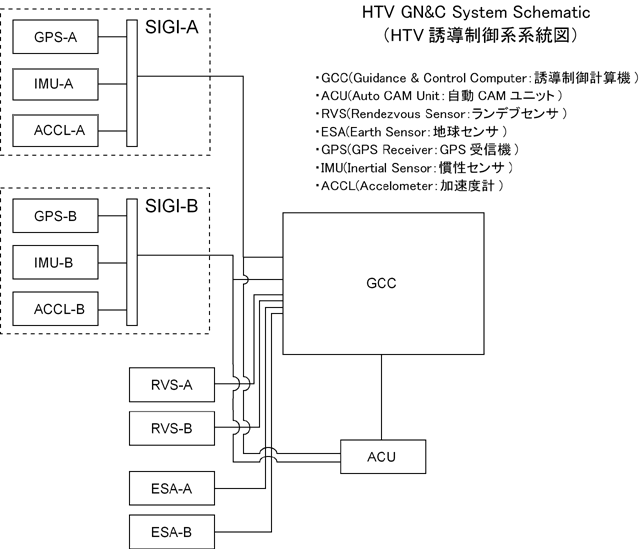
    PDR (Preliminary Design Review) for SIGI (Space Integrated GPSR/IMU) which is most important sensor of HTV Guidance and Navigation System was conducted at Honeywell co. in Tampa, Florida in United States from Dec. 9 to 10.
    In addition to accelerometers and ring laser gyros for control of HTV attitude/maneuver, this sensor unifies GPS receiver for navigation into one package.
    SIGI is also used in International Space Station to measure the attitude, and H764, the base of SIGI, are used in many aircraft.

    Figure: HTV Guidance and Control Schematic

    Dec. 17, 1999 Updated

    PDR (Preliminary Design Review) for Rendezvous Sensor which to be used during the HTV final approach was conducted at Daimler Chrysler Jena-Optronik in Jena, Germany from Nov.15 to 18. This sensor will also be used for ATV(Autonomous Transfer Vehicle) being developed by ESA.
    We expect a cost reduction / risk decrease become possible by this joint supply of NASDA-ESA.

    The figure: rendezous sensor function during final approach

    Nov. 19, 1999 Updated

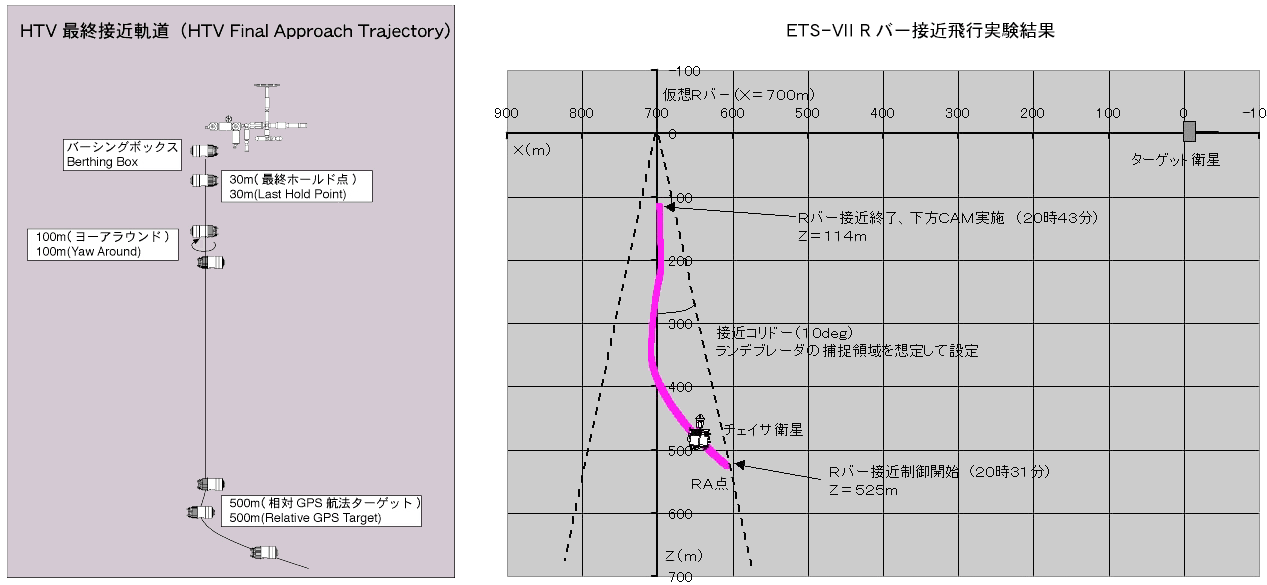
    NASDA conducted the Approach/Release (Rendezvous) Flight Technology Test on the ETS-VII, which has close relation to the HTV rendezvous technology from Oct. 26 to 27.
    During the test, ETS-VII tried the R-bar approach which simulates the HTV final approach trajectory to the ISS. HIKOBOSHI satellite regarded as HTV, approached to the virtual R-bar formed by ORIHIME, using the algorithm developed for HTV. As a result, HIKOBOSHI raised the appropriate orbit within the expected corridor determined for rendezvous sensor and successfully finished at the 114 meters close.
    We are now analyzing the data obtained from this experiment. It will greatly contribute to the establishment of all HTV flight algorithm.

    Sep. 17, 1999 Updated

    NASDA held two major review meetings. One was the HTV Phase 1 Safety Review, which examined the HTV design from the point of safety. The another was HTV Preliminary Design Review (PDR), which examined the HTV design from the point of technique.
    The safety review meeting was held from August 18 to 20. The safety design of HTV was generally confirmed. After some additional study, HTV project will take a NASA safety review.
    The HTV PDR meeting was held by NASDA from August 23 to September 3. Approximately forty NASA, European Space Agency (ESA), and Canadian Space Agency (CSA) people attended the meeting and examined the HTV design. As the result of review, design of HTV was confirmed to be adequate. Therefore, the production of HTV Engineering Model (EM) and the progress to detailed design phase were admitted.

    Jul. 26, 1999 Updated

    The documents for PDR (Preliminary Design Review), which will be conducted from July 15th to September 3rd have been released. These documents have also been sent to NASA, CSA, and ESA in the end of June.
    We will continue to coordinate with reviewers of both NASDA and other organizations on matters which they point out until PDR Main Board.
    At the same time, the documents for Phase 1 Safety Review have been released.

    This entry passed through the Full-Text RSS service – if this is your content and you’re reading it on someone else’s site, please read the FAQ at fivefilters.org/content-only/faq.php#publishers.

  • '8 Days or Bust' +50: Gemini 5 Made History with 1st Crew Mission Patch

    Astronauts Gordon Cooper (left) and Charles Conrad are seen in the Gemini 5 spacecraft just before launching on their “8 Days or Bust” mission in 1965. The crew was the first to design and wear a mission patch, as shown.
    Credit: NASA/Museum of Flight/collectSPACE.com

    Fifty years ago on Monday (Aug. 24), two NASA astronauts were more than one-third of the way through what was destined to be the world’s longest space mission at the time.

    Gordon Cooper and Charles “Pete” Conrad, seated snugly in the U.S. space agency’s third-manned Gemini capsule, had launched atop a Titan II rocket from Cape Canaveral on Aug. 21, 1965. Cooper, who two years earlier had flown on the longest of NASA’s one-man Mercury missions, was now the first person to fly into orbit twice.

    Half a century ago Monday at 1:39 a.m. EDT (0639 GMT), Cooper set a new American record for the most time spent in space, surpassing the 97 hours and 56 minutes logged by the all-rookie Gemini 4 crew two months earlier. And he still had more than 125 hours to go before he and Conrad were slated to return to Earth. [Project Gemini: How NASA’s 2-Man Missions Worked]

    The “space twins,” as the press had dubbed the two-man Gemini 5 crew at the time, had a slew of experiments and engineering tests to conduct, including the first flight of a power-providing fuel cell onboard a crewed spacecraft and conducting the first precision maneuvers to evaluate new rendezvous technology and techniques.

    The Gemini 5 mission’s planned length was more than just an attempt at a record but a test itself, designed to show that astronauts could survive the time needed for a trip to the moon and back.

    Cooper and Conrad chose to underline that particular goal while setting yet another American first in space. 

    Astronauts Gordon Cooper (foreground) and Charles Conrad are pictured in the Gemini 5 spacecraft moments before the hatches were closed for launch on Aug. 21, 1965.

    Astronauts Gordon Cooper (foreground) and Charles Conrad are pictured in the Gemini 5 spacecraft moments before the hatches were closed for launch on Aug. 21, 1965.
    Credit: NASA

    “8 Days or Bust”

    Sewn to the right chest of each of their spacesuits was a cloth emblem depicting a Conestoga wagon. Embroidered in red lettering was their mission designation (“Gemini 5”) and their names. And hidden under a thin piece of hastily-added cloth was the inscription, “8 Days or Bust.”

    Cooper and Conrad were sporting the first-ever astronaut-designed space mission patch.

    Two years earlier, unbeknownst to anyone at the time, the first woman to launch into space also wore a cloth patch. But cosmonaut Valentina Tereshkova’s embroidered doverepresenting her Vostok 6 mission had been designed and sewn to her inner suit without her prior knowledge.

    That the Gemini 5 crew had a mission patch was their own doing.

    On his Mercury flight, Cooper had been permitted to name his spacecraft, choosing to christen it “Faith 7.” But by his next assignment, NASA had decided to do away with the names. Cooper though, still wanted to find some means of putting a personal touch on his and Conrad’s mission, so he took inspiration from his experience in the Air Force.

    “Several months before mission, I mentioned to Pete that I’d never been in a military organization that didn’t have its own patch,” Cooper recounted in “Leap of Faith,” his 2000 memoirs. “We decided right then and there that we were at least going to have a patch for our flight.”

    And so they set about designing the first “Cooper patch,” as a NASA memo nicknamed it and all the future mission patches to come. Cooper and Conrad picked the covered wagon to represent the pioneering nature of the flight, and came up with the slogan to inscribe across it.

    And that is where the patch almost ran into trouble. What would happen if they had to come home early?

    “If you don’t make [it to] eight days, I don’t want the press having a field day about the mission being a bust,” Cooper recalled NASA Administrator James Webb responding just a day before the scheduled launch of Gemini 5.

    So Cooper’s and Conrad’s patches quickly had a piece of canvas hand sewn over the slogan, in essence making it a real covered wagon.

    Not a bust

    Despite intermittent problems with the fuel cell and having to cancel performing some of the experiments, Gemini 5 was a success, setting a new mission duration record of 7 days, 22 hours and 55 minutes. It was the first time that the U.S. surpassed its space race rival, the Soviet Union for the longest spaceflight.

    Gemini 5 was Cooper’s last launch, but Conrad went on to fly another Gemini flight before becoming the third man to walk on the moon in November 1969.

    Apollo 12 lasted more than 10 days, but perhaps as a nod to the path set by his first flight, Conrad flew a Gemini 5 patch to the moon. That patch, with its “8 Days or Bust” slogan exposed, is now newly on public display in Seattle as part of The Museum of Flight’s new exhibit dedicated to Gemini 5.

    The month-long exhibition located in the museum’s lobby, also includes a Gemini spacesuit outer layer (or oversuit), a pair of Gemini gloves and a one-fourth cutaway model of the two-man space capsule.

    As for other artifacts from the 1965 record-setting mission, the spacecraft itself is displayed at Space Center Houston in Texas and both spacesuits are preserved in storage at the Smithsonian National Air and Space Museum’s Steven F. Udvar-Hazy Center in Virginia.

    Cooper and Conrad retained the “8 Days or Bust” patches off their suits. Although both men have since passed, their legacy lives on with every mission patch that launches to space.

    See the note astronaut Charles Conrad wrote on the back of the Gemini 5 patch he flew to the moon at collectSPACE.com.

    Follow collectSPACE.com on Facebook and on Twitter at @collectSPACE. Copyright 2015 collectSPACE.com. All rights reserved.

  • Sun Unleashes Medium-Strength Solar Flare (Photo)

    SDO Photo of Solar Flare, Aug. 24, 2015
    NASA’s Solar Dynamics Observatory captured this image of an M5.6 solar flare (visible in the lower-center region of the sun) on Aug. 24, 2015.
    Credit: NASA/SDO

    The sun fired off a midlevel solar flare early this morning (Aug. 24) while a NASA satellite watched.

    The space agency’s Solar Dynamics Observatory (SDO) captured an image of the flare, which erupted at 3:33 a.m. EDT (0733 GMT) this morning from an Earth-facing sunspot known as Active Region 2403.

    Space-weather researchers classify strong flares into three categories — C, M or X. X flares are 10 times more powerful than M flares, which in turn are 10 times more intense than C eruptions. This morning’s outburst registered as an M5.6, NASA scientists said. (An M5 flare is five times more powerful than an M1.) [The Biggest Solar Storms of 2015 in Photos]

    Solar flares are bursts of high-energy radiation that cannot get through Earth’s atmosphere to affect people on the ground. However, extremely powerful flares can have impacts higher up, triggering temporary radio blackouts and radiation storms that could endanger orbiting astronauts.

    Flares are often accompanied by explosions of superheated solar plasma called coronal mass ejections (CMEs). Potent CMEs that hit Earth can spawn geomagnetic storms powerful enough to disrupt radio signals, GPS communications and power grids. CMEs also often supercharge the beautiful auroral displays known as the northern and southern lights.

    It’s unclear at the moment if this morning’s eruption produced a CME, said researchers with the Space Weather Prediction Center (SWPC), which is run by the United States’ National Oceanic and Atmospheric Administration.

    SWPC scientists said they’ll know more after they analyze data from the Solar and Heliospheric Observatory (SOHO), a sun-studying spacecraft operated jointly by NASA and the European Space Agency.

    Solar Quiz: How Well Do You Know Our Sun?

    Many of us take the sun for granted, giving it little thought until it scorches our skin or gets in our eyes. But our star is a fascinating and complex object, a gigantic fusion reactor that gives us life. How much do you know about the sun?

    This image, captured by NASA's Solar Dynamics Observatory (SDO) on March 10, 2012, shows an active region on the sun, seen as the bright spot to the right. Designated AR 1429, the spot has so far produced three X-class flares and numerous M-class flares.

    0 of 10 questions complete

    Solar Quiz: How Well Do You Know Our Sun?

    Many of us take the sun for granted, giving it little thought until it scorches our skin or gets in our eyes. But our star is a fascinating and complex object, a gigantic fusion reactor that gives us life. How much do you know about the sun?

    Start Quiz
    This image, captured by NASA's Solar Dynamics Observatory (SDO) on March 10, 2012, shows an active region on the sun, seen as the bright spot to the right. Designated AR 1429, the spot has so far produced three X-class flares and numerous M-class flares.

    0 of questions complete

    “Although this flare is bigger than we have seen in some time, it was very impulsive and lacked typical radio signatures that are often associated with CMEs,” SWPC researchers wrote in an update today. “We will update as additional data becomes available.”

    Skywatchers were treated to enhanced auroras over the weekend, thanks to a stream of solar particles, and more sky shows could be in the offiing. Two small CMEs that erupted several days ago could hit the planet today, SWPC scientists said.

    Editor’s note: If you capture a photo of stunning auroras in the night sky from recent solar activity and would like to share them with Space.com, send images and comments in to managing editor Tariq Malik at: spacephotos@space.com

    Follow Mike Wall on Twitter @michaeldwall and Google+. Follow us @Spacedotcom, Facebook or Google+. Originally published on Space.com.

  • Japanese Cargo Ship Delivers Mice, Booze and More to Space Station

    The Japanese cargo ship HTV-5 arrived at the International Space Station on Aug. 24, 2015. Astronaut Kimiya Yui of Japan posted this photo of the spacecraft after capturing it by robotic arm.
    The Japanese cargo ship HTV-5 arrived at the International Space Station on Aug. 24, 2015. Astronaut Kimiya Yui of Japan posted this photo of the spacecraft after capturing it by robotic arm.
    Credit: Kimiya Yui / Japan Aerospace Exploration Agency via Twitter

    A robotic Japanese cargo ship made a special delivery to the International Space Station on Sunday (Aug. 24), ending a four-day trek to ferry tons of food, supplies — and even some mice and (experimental) liquor — to the orbiting lab.

    The H-II Transfer Vehicle, called HTV-5, arrived at the space station at 6:55 a.m. EDT (1055 GMT), when it was captured via a robotic arm by astronauts inside the space station. The Japan Aerospace Exploration Agency (JAXA) launched the HTV-5 cargo ship on Wednesday (Aug. 19).

    “HTV-5 capture was successful!” wrote space station astronaut Kimiya Yui of Japan, who piloted the robotic arm along with NASA astronaut Kjell Lindgren, on Twitter after grappling the spacecraft. “Thank you all for your support and hard work.”  [Japan’s HTV Spaceship Fleet in Pictures]

    After Yui and Lindgren’s capture of the HTV-5 spacecraft, flight controllers at NASA’s Mission Control Center in Houston were expected to use the station’s robotic arm to remotely park the cargo ship at an available docking port. 

    JAXA’s HTV spacecraft are known in Japan as Kounotori, which is Japanese for “White Stork.” The HTV-5 spacecraft is carrying about 9,500 lbs. (4,309 kilograms) of supplies and science gear for the space station crew.

    That cargo haul includes:

    • A small cache of whiskey, tequila and Midori, which are being sent to see how microgravity affects the “mellowness” of their tastes after one or two years in space. The experiment was developed by the Tokyo-based Suntory Global Innovation Center.
    • A tiny crew of 12 mice, which are part of an experiment studying the effects of weightlessness during long space missions. The mice are housed in compartments that can switch between microgravity and Earth gravity as part of that study.
    • Equipment for NASA’s twins study, which is tracking Scott Kelly on the space station and his identical twin brother, Mark Kelly, on Earth. Scott is currently spending a full year on the International Space Station, while Mark, as the control subject, remains on Earth. Russian cosmonaut Mikhail Kornienko is also spending a year on the station with Scott as part of that extreme-duration flight.
    • A new CALorimetric Electron Telescope delivered by HTV-5 will seek dark matter and examine cosmic rays from the space station, away from the distorting effect of Earth’s atmosphere. With the telescope’s high-resolution data, researchers will learn more about the makeup of the galaxy and the risks cosmic rays pose to astronauts.
    • A variety of small satellites, including 14 Earth-watching Dove cubesat satellites, which will be used for Earth observation. Other cubesats include a trio built to test communications systems for global aircraft tracking and the student-built AAUSAT5, designed to test ship beacon signal technology.  
    • A new NanoRacks External Platform(NREP) to be attached on the porchlike external facility of the Japanese Kibo module. The NREP is designed to serve as a sort of base for future experiments sent to the station.

    Like its name suggests, HTV-5 is the fifth Japanese HTV spacecraft to ferry supplies to the space station. These spacecraft are cylindrical vehicles that measure 33 feet (10 meters) long and 13 feet (4 m) wide. HTV spacecraft are also disposable: Once the HTV-5 mission is complete, the vehicle will be detached from the station and travel to burn up in Earth’s atmosphere.

    Japan’s HVT spacecraft are part of an international fleet of robotic cargo ships serving the astronauts on the International Space Station. Russia launches unmanned Progress cargo ships to the space station, with NASA contracting resupply services to the private companies SpaceX and Orbital ATK. The European Space Agency has also provided five cargo missions using its huge Automated Transfer Vehicle.

    The space station is currently home to six astronauts, representing the United States, Russia and Japan.

    Email Sarah Lewin at slewin@space.com or follow her @SarahExplains. Follow us @Spacedotcom, Facebook and Google+. Original article on Space.com.

  • Best Space Photos of the Week – August 22, 2015

    A middle-aged clutch of stars shines in many colors in a new view of deep space by a telescope in Chile. The stars in the image are from an open star cluster…Read More » called IC 4651, which lies in the Milky Way about 3,000 light-years from Earth. Astronomers used the La Silla Observatory in Chile, part of the European Southern Observatory, to capture the sparkly view. [Read the full story.]    Less «

  • Chance Lightning Storm Illuminates Brilliant Milky Way Vista (Photo)

    A lightning storm illuminated the Arizona sky in this stunning skywatcher image of the Milky Way.

    Photographer Stephen Ippolito took this image from Bell Rock in Sedona, Arizona on Aug. 9. “I received a lot of help from mother nature for this image,” he told Space.com in an email. “As you can see, Bell Rock is illuminated. It is illuminated because there was a massive lightning storm many miles behind me that was illuminating the entire sky, and when the lightning struck, the entire Bell Rock area would be illuminated.”

    Ippolito lit in the foreground of the image with a color corrected LED light. [See More Stunning Photos of the Milky Way]

    The Milky Way galaxy is a barred spiral galaxy with roughly 400 billion stars, including our sun. The stars, along with gas and dust, appear like a band of light in the sky from Earth. The galaxy stretches between 100,000 to 120,000 light-years in diameter. At the center of our galaxy lies a gigantic black hole billions of times the size of the sun.  

    To see more amazing night sky photos submitted by SPACE.com readers, visit our astrophotography archive.

    Editor’s note: If you have an amazing night sky photo you’d like to share for a possible story or image gallery, please contact SPACE.com Managing Editor Tariq Malik at spacephotos@space.com.

    Follow SPACE.com on Twitter @Spacedotcom. We’re also on Facebook and Google+.

  • A Day in Space? For Scott Kelly, It's Work, TV (But No Laundry!)

    Scott Kelly Talks to Journalist Katie Couric
    Aboard the International Space Station, astronaut Scott Kelly talks to journalist Katie Couric on Aug. 19, 2015.
    Credit: Yahoo News Video

    What’s it like to live in space? It’s a question that never seems to get old, as demonstrated in a series of interviews this week with astronaut Scott Kelly, who is spending a year aboard the International Space Station.

    TV interviewers Larry King, host of the show “Larry King Now,” and Katie Couric, a global news anchor for Yahoo, both spoke with Kelly this week, and both wanted to know the same thing: What’s a normal day like in space? For people on the ground, there seems to be a persistent fascination with the mundane details of space life, such as how astronauts wash their clothes (they don’t), what they do for fun (watch TV and read books), and how well they get along with the other crewmembers (very well). The full interviews can be seen in the video above.

    Kelly is one of two participants in NASA’s One-Year Mission, the first instance of American astronauts spending almost an entire calendar year in orbit. The mission, which is nearing its midpoint, is meant to test the effects of long-term spaceflight on the human body — information that will prove crucial if humanity ever wants to make the journey to Mars. [The Human Body in Space: 6 Weird Facts]

    “What do you do all day long, Scott? Can you give us sort of the typical ‘Day in the Life’ on the International Space Station?” Couric asked Kelly when they spoke via satellite yesterday (Aug. 19).

    “All the days are different, which makes it pretty interesting,” Kelly replied. Some days are entirely dedicated to science experiments, he said. During his time on the orbiting laboratory, he and his crewmates will conduct more than 400 science experiments.

    “Sometimes you’re fixing things,” Kelly said. “The carbon-dioxide removal system was a piece of hardware we had worked on a few months ago that was pretty extensive. On Monday, we have a Japanese cargo ship coming, so we’ll be grabbing that.  So it’s a combination of science, maintenance and general housekeeping. And then occasionally robotics activities or a spacewalk you might get to do.”

    Both Couric and King asked Kelly about how he unwinds from all that work. Kelly said he and the other five crewmembers typically get together and watch a movie on the weekends. Meanwhile, Kelly said he and NASA astronaut Kjell Lindgren are re-watching the TV series “Breaking Bad,” and have introduced Japanese astronaut Kimiya Yui to the show as well.

    Couric also mentioned that the actress, Julia Louis-Dreyfus, tweeted at Kelly and asked if he was watching her show, “Veep,” on HBO. Kelly said he liked the show very much, but was not watching it on the station. However, the station is apparently carrying every season of “Seinfeld,” (in which Dreyfus was a main character), which Kelly said he has watched.

    And what about even more mundane activities, like doing laundry?

    “So, we don’t do laundry because that requires a lot of water and water’s at a premium up here. Plus, it’d be pretty complicated, I think, to make a space washer, although I guess you could do it,” Kelly replied. “So we generally throw our clothes out. I think I’ve been wearing this pair of pants for about two months. I won’t tell you how long I’ve been wearing the other things,” he joked, to which Couric laughed and replied, “Thank you.”

    Astronaut Scott Kelly and Fruit in Space

    Astronaut Scott Kelly enjoys fresh fruit on Day 100 of his one-year trip aboard the International Space Station. This week Kelly talked with reporters about what life is like in orbit.
    Credit: NASA

    Kelly also told Couric that he seems to dream more while he’s in orbit. He’d been asked about space dreaming while on previous missions, and at the beginning of the current mission he started writing his dreams down, but stopped because it took too much time, he said.

    “It seems like in the beginning of my flight the space dreams were rare. And now, almost 150 days into it, the Earth dreams are more of the rare ones,” he said.

    Astronauts have embarked on incredible adventures, like walking on the moon or repairing the Hubble Space Telescope, but even the mundane details of life in space prove captivating  to people on the ground, who can only dream about what it’s like up there.  

    Follow Calla Cofield @callacofieldFollow us @Spacedotcom, Facebook and Google+. Original article on Space.com.

  • US-China Space Freeze May Thaw with Historic New Experiment

    International Space Station (ISS)
    For the first time, the International Space Station (ISS) will house a Chinese experiment. The research is to be on board the ISS next year.
    Credit: NASA

    A Chinese experiment is being readied for launch toward the International Space Station (ISS) in what could be the forerunner of a larger space-cooperation agenda between the United States and China.

    NanoRacks, a Houston-based company that helps commercial companies make use of the space station, has signed a historic agreement with the Beijing Institute of Technology to fly Chinese DNA research to the orbiting outpost next year. No commercial Chinese payload has ever flown to the orbiting lab before.

    Space-policy experts said they viewed the agreement as a significant step in shaping possible future joint work by the two spacefaring nations. [Latest News About China’s Space Program]

    Cooperation prohibited

    Over the past few years, the law has prohibited NASA and the White House Office of Science and Technology Policy (OSTP) from cooperating with China on space activities.

    That prohibition was originally signed into NASA-funding appropriations bills by Republican Congressman Frank Wolf (Virginia), who chaired the House Appropriations Commerce-Justice-Science subcommittee before retiring last year.

    The final law that Wolf put in place — P.L. 113-235, the Consolidated and Further Continuing Appropriations Act, 2015, which is in effect today — states that no funds may be spent by NASA or OSTP to “develop, design, plan, promulgate, implement or execute a bilateral policy, program, order or contract of any kind to participate, collaborate or coordinate bilaterally in any way with China or any Chinese-owned company unless such activities are specifically authorized by law after the date of enactment of this act.”

    However, the new NanoRacks deal is a commercial arrangement, and experts consider it legal.

    Obeying the rules

    Jeffrey Manber, NanoRacks’ managing director, told Space.comthat he’s delighted to be working with China on getting the nation’s experiment on board the ISS.

    “We’re excited to have a world-class organization that is contributing to our collective knowledge about what happens long term with the immune system during space travel,” Manber said, adding that a recent visit to the Beijing Institute of Technology’s School of Life Science left him extremely impressed.

    “They are not a lab that dabbles in space. … This is a life sciences research group focused on what we can learn from microgravity,” Manber said. [‪The Human Body in Space: 6 Weird Facts]

    Manber said NanoRacks worked very hard to obey the rules of the Wolf amendment.

    “The White House has informed us that the agreement conforms to the Wolf amendment,” Manber said.

    DNA mismatching

    The Chinese experiment headed for the ISS investigates how the space environment affects DNA, which serves as the genetic material for life as we know it. (Some viruses rely on a molecule called RNA, but scientists argue about whether or not viruses are truly “alive.”)

    Chinese Experiment Payload on ISS

    Chinese researchers are readying a payload to be taken to the International Space Station next year. The experiment is designed to determine if space radiation and microgravity cause gene mutation.
    Credit: Beijing Institute of Technology

    Making use of a 7-lb. (3 kilograms) device to be housed on the ISS, the Chinese research seeks to determine if space radiation and microgravity cause mutations. The research will focus on mutations to genes encoding antibodies, parts of the immune system that identify foreign objects.

    A prior experiment flew aboard China’s uncrewed Shenzhou 8 spacecraft, which launched in October 2011. Shenzhou 8 docked autonomously with China’s Tiangong 1 space module, then returned safely to Earth in mid-November 2011. [‪Gallery: Tiangong 1, China’s First Space Laboratory]

    The Beijing Institute of Technology’s School of Life Science often publishes its results in Western scientific journals and interacts with the European research community and multiple U.S. universities.

    Prudent discussions

    “This [ISS] project underwent a succession of prudent discussions and careful deliberations before we reached the agreement,” said Deng Yulin, dean of the School of Life Science.

     “The results will answer some very important questions on life sciences,” Deng said, according to an Aug. 8 story in China’s state-run newspaper China Daily.

    “There has been no official cooperation in the space field between China and the U.S. for a long time, so I hope this project enables us to explore cooperation methods between the two space powers,” Deng added.

    The NanoRacks contract, valued at $200,000, includes delivery of the Chinese experiment to the U.S. side of the ISS via a SpaceX Dragon cargo spacecraft. The experiment will then be placed within the Japanese Kibo module for a planned 15 days.

    Deng told China Daily that NanoRacks offered his institute “very favorable terms,” including the payment schedule.

    The project is a commercial one that serves only scientific purposes, he added. “My university is an educational entity, and the project is a business activity, so I don’t think it will violate the U.S. law,” Deng said.

    Rational action

    The NanoRacks agreement with the Chinese spurred reactions from several space-policy experts, such as Joan Johnson-Freese, a professor of national security affairs at the Naval War College in Newport, Rhode Island.

    “Past U.S. policy of trying to isolate Chinese space activities, toward [the goal of] influencing, or pushing, China to change its policies — in areas from human rights to the development of anti-satellite capabilities — hasn’t worked and in some cases has been overtly counterproductive to U.S. interests,” Johnson-Freese said.

    As a result, Johnson-Freese told Space.com, “changing our approach in ways that do not involve technology transfer seems a rational action.”

    It is in U.S. interests to better understand how China’s decision-making process works, to have China act as a responsible player in space and to have a group within China advocate for nonaggressive policy toward the United States in space, Johnson-Freese said.

    Lone holdout

    “Given that the rest of the world is working with China in space, being the lone holdout has not worked in our favor in any of those areas,” Johnson-Freese said. “Hopefully, this experiment on the ISS will be a positive step forward toward all of those goals.”

    She noted that her views do not necessarily represent those of the Naval War College, the Department of the Navy or the Department of Defense.

    “I see this [China/NanoRacks agreement] as a commercial arrangement that has potential scientific benefits and [that] complies with existing laws and regulations,” said Scott Pace, director of the Space Policy Institute at George Washington University in Washington, D.C.

    “Whether it’s a precedent for future activities remains to be seen,” Pace told Space.com.

    Space-cooperation dialogue

    Statements by U.S. politicians show that there may be an interesting “chess playing” factor in America’s dealings with China.

    Kerry with with Chinese Vice Premier Wang Yang

    Secretary of State John Kerry shakes hands with Chinese Vice Premier Wang Yang at the conclusion of the U.S.-China Strategic and Economic Dialogue/Consultation on People-to-People Exchange at the U.S. Department of State in Washington, DC., on June 24, 2015.
    Credit: U.S. State Department

    Some U.S. lawmakers have said they don’t want the Russians to have a clear, open field with the Chinese. Better to have the U.S. engaged in working space deals with China, they say — but how best to evolve and work with China within the Wolf amendment?

    As for future U.S.-China space relations, the first “U.S.-China Civil Space Cooperation Dialogue” is slated to take place in China before the end of October.

    Last June, the United States and China decided to establish regular bilateral, government-to-government consultations on civil space cooperation.

    That agreement came out of the seventh round of the U.S.-China Strategic and Economic Dialogue, held June 22-24 in Washington, D.C, with Secretary of State John Kerry taking active part in the discussions. The two sides held in-depth talks on major bilateral, regional and global issues.

    More than 70 important outcomes resulted from the dialogue, including a number of space items.

    Aside from putting in place a “Civil Space Cooperation Dialogue,” the two sides also decided to have exchanges on other space matters, including satellite-collision avoidance, weather monitoring and climate research.

    The agreement signed by Kerry reflects State Department activities with China, which are not prohibited by law.

    Leonard David has been reporting on the space industry for more than five decades. He is former director of research for the National Commission on Space and is co-author of Buzz Aldrin’s 2013 book “Mission to Mars – My Vision for Space Exploration” published by National Geographic with a new updated paperback version released in May 2015. Follow us @Spacedotcom, Facebook or Google+. Originally published on Space.com.

  • Wormhole Created in Lab Makes Invisible Magnetic Field

    magnetic wormhole
    A new device can cloak a magnetic field so that it invisible from the outside. Here, a picture of how the wormhole would work.
    Credit: Jordi Prat-Camps and Universitat Autònoma de Barcelona

    Ripped from the pages of a sci-fi novel, physicists have crafted a wormhole that tunnels a magnetic field through space.

    “This device can transmit the magnetic field from one point in space to another point, through a path that is magnetically invisible,” said study co-author Jordi Prat-Camps, a doctoral candidate in physics at the Autonomous University of Barcelona in Spain. “From a magnetic point of view, this device acts like a wormhole, as if the magnetic field was transferred through an extra special dimension.” 

    The idea of a wormhole comes from Albert Einstein’s theories. In 1935, Einstein and colleague Nathan Rosen realized that the general theory of relativity allowed for the existence of bridges that could link two different points in space-time. Theoretically these Einstein-Rosen bridges, or wormholes, could allow something to tunnel instantly between great distances (though the tunnels in this theory are extremely tiny, so ordinarily wouldn’t fit a space traveler). So far, no one has found evidence that space-time wormholes actually exist. [Science Fact or Fiction? The Plausibility of 10 Sci-Fi Concepts]

    The new wormhole isn’t a space-time wormhole per se, but is instead a realization of a futuristic “invisibility cloak” first proposed in 2007 in the journal Physical Review Letters. This type of wormhole would hide electromagnetic waves from view from the outside. The trouble was, to make the method work for light required materials that are extremely impractical and difficult to work with, Prat said.

    Magnetic wormhole

    But it turned out the materials to make a magnetic wormhole already exist and are much simpler to come by. In particular, superconductors, which can carry high levels of current, or charged particles, expel magnetic field lines from their interiors, essentially bending or distorting these lines. This essentially allows the magnetic field to do something different from its surrounding 3D environment, which is the first step in concealing the disturbance in a magnetic field.

    So the team designed a three-layer object, consisting of two concentric spheres with an interior spiral-cylinder. The interior layer essentially transmitted a magnetic field from one end to the other, while the other two layers acted to conceal the field’s existence.

    The inner cylinder was made of a ferromagnetic mu-metal. Ferromagnetic materials exhibit the strongest form of magnetism, while mu-metals are highly permeable and are often used for shielding electronic devices.

    A thin shell made up of a high-temperature superconducting material called yttrium barium copper oxide lined the inner cylinder, bending the magnetic field that traveled through the interior.

    magnetic wormhole device

    A new device has created a magnetic wormhole, in which a magnetic field enters one end and seems to pop out of nowhere on the other side.
    Credit: Jordi Prat-Camps and Universitat Autònoma de Barcelona

    The final shell was made of another mu-metal, but composed of 150 pieces cut and placed to perfectly cancel out the bending of the magnetic field by the superconducting shell. The whole device was placed in a liquid-nitrogen bath (high-temperature superconductors require the low temperatures of liquid nitrogen to work).

    Normally, magnetic field lines radiate out from a certain location and decay over time, but the presence of the magnetic field should be detectable from points all around it. However, the new magnetic wormhole funnels the magnetic field from one side of the cylinder to another so that it is “invisible” while in transit, seeming to pop out of nowhere on the exit side of the tube, the researchers report today (Aug. 20) in the journal Scientific Reports.

    “From a magnetic point of view, you have the magnetic field from the magnet disappearing at one end of the wormhole and appearing again at the other end of the wormhole,” Prat told Live Science.

    Broader applications

    There’s no way to know if similar magnetic wormholes lurk in space, but the technology could have applications on Earth, Prat said. For instance, magnetic resonance imaging (MRI) machines use a giant magnet and require people to be in a tightly enclosed central tube for diagnostic imaging.

    But if a device could funnel a magnetic field from one spot to the other, it would be possible to take pictures of the body with the strong magnet placed far away, freeing people from the claustrophobic environment of an MRI machine, Prat said.

    To do that, the researchers would need to modify the shape of their magnetic wormhole device. A sphere is the simplest shape to model, but a cylindrical outer shell would be the most useful, Prat said.

    “If you want to apply this to medical techniques or medical equipment, for sure you will be interested in directing toward any given direction,” Prat said. “A spherical shape is not the most practical geometry.”

    Follow Tia Ghose on Twitter and Google+. Follow Live Science @livescience, Facebook & Google+. Original article on Live Science.

  • Curiosity Low-Angle Self-Portrait at 'Buckskin' Drilling Site on Mount Sharp

    Curiosity Low-Angle Self-Portrait at 'Buckskin' Drilling Site on Mount Sharp

    This low-angle self-portrait of NASA’s Curiosity Mars rover shows the vehicle above the “Buckskin” rock target, where the mission collected its seventh drilled sample.

  • No Asteroid Is Threatening to Hit Earth Next Month, NASA Says

    There’s no reason to fear a devastating asteroid strike next month, NASA experts say.

    For the last few months, rumors have circulated on the Internet that a big asteroid will slam into Earth near Puerto Rico between Sept. 15 and Sept. 28, wreaking widespread destruction throughout coastal regions of the United States, Mexico, the Caribbean, Central America and northern South America.

    Don’t believe the hype.

    “There is no scientific basis — not one shred of evidence — that an asteroid or any other celestial object will impact Earth on those dates,” Paul Chodas, manager of NASA’s Near-Earth Object office at the Jet Propulsion Laboratory in Pasadena, California, said in a statement. “If there were any object large enough to do that type of destruction in September, we would have seen something of it by now.”

    Astronomers based at the Near-Earth Object office and other institutions around the world use a variety of telescopes to hunt for potentially hazardous asteroids and comets, and they haven’t observed anything that poses a serious threat to Earth for the foreseeable future, NASA officials said.

    “Again, there is no existing evidence that an asteroid or any other celestial object is on a trajectory that will impact Earth,” Chodas stressed. “In fact, not a single one of the known objects has any credible chance of hitting our planet over the next century.”

    Experts such as Chodas must increasingly wade into the Internet’s murky waters to debunk the myths swirling there.

    In 2011, for example, rumors grew that the harmless comet Elenin was a “doomsday” object that would inflict severe damage upon the Earth. And some conspiracy theorists claimed that a cosmic impact would wipe out humanity on Dec. 21, 2012, the day that one cycle of the Mayan long-count calendar came to an end.

    Asteroid Basics: A Space Rock Quiz

    Asteroids are fascinating for lots of reasons. They contain a variety of valuable resources and slam into our planet on a regular basis, occasionally snuffing out most of Earth’s lifeforms. How much do you know about space rocks?

    Earth Causes Asteroid-Quakes

    0 of 10 questions complete

    Asteroid Basics: A Space Rock Quiz

    Asteroids are fascinating for lots of reasons. They contain a variety of valuable resources and slam into our planet on a regular basis, occasionally snuffing out most of Earth’s lifeforms. How much do you know about space rocks?

    Start Quiz
    Earth Causes Asteroid-Quakes

    0 of questions complete

    Just this year, fears were raised about the near-Earth asteroids 2004 BL86 and 2014 YB35, which flew harmlessly past the planet in January and March, respectively — just as NASA scientists had predicted the asteroids would.

    All of this is not to claim that Earth won’t get hit by a cosmic object next month. The planet is pelted by dust and chunks of space rock all the time, but almost all of this material is so small that it burns up harmlessly in Earth’s atmosphere.

    Follow Mike Wall on Twitter @michaeldwall and Google+. Follow us @Spacedotcom, Facebook or Google+. Originally published on Space.com.