Tag: NASA

  • Registration Opens for 2025 NASA International Space Apps Challenge

    3 min read

    Preparations for Next Moonwalk Simulations Underway (and Underwater)

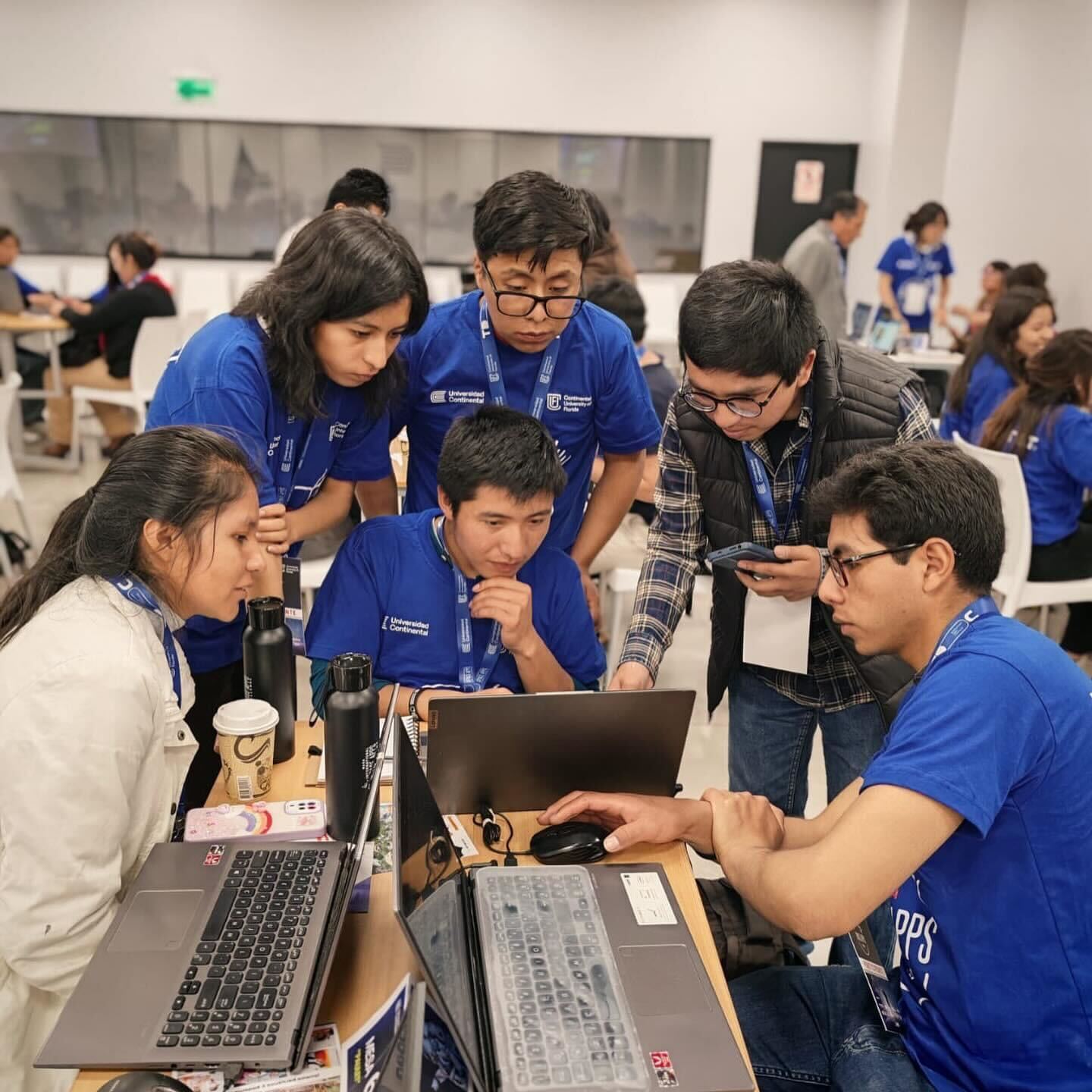
    Six people look at a laptop computer in a classroom setting. Four wear blue t-shirts, one wears a white jacket, and one wears a plaid shirt with a black vest.
    A team works together on their project during the 2024 NASA Space Apps Challenge event in in Arequipa, Peru. Teams have two days to respond to the challenges and submit their project for the chance to win one of 10 global awards.

    Lee esta historia en español aquí

    NASA invites innovators of all ages to register for the NASA Space Apps Challenge, held on Oct. 4-5. The 2025 theme is Learn, Launch, Lead, and participants will work alongside a vibrant community of scientists, technologists, and storytellers at more than 450 events worldwide. Participants can expect to learn skills to succeed in STEM fields, launch ideas that transform NASA’s open data into actionable tools, and lead their communities in driving technological innovation.
     
    During the NASA Space Apps Challenge, participants in the U.S. and around the world gather at hundreds of in-person and virtual events to address challenges authored by subject matter experts across NASA divisions. These challenges range in complexity and topic, tasking participants with everything from creating machine learning models and leveraging artificial intelligence, to improving access to NASA research, to designing sustainable recycling systems for Mars, and to developing tools to evaluate local air quality here on Earth.
     
    Dr. Yoseline Angel Lopez, a former space apps challenge winner and now an assistant research scientist at NASA’s Goddard Spaceflight Center in Greenbelt, Maryland, can attest that the opportunity to Learn, Launch, Lead goes far beyond the hackathon.   
     
    “The NASA Space Apps Challenge gave me and my team a meaningful opportunity to apply science to real-world problems and gain validation from NASA scientists and industry experts,” said Angel.
     
    In 2021, her team’s winning web-app prototype was adopted by Colombia’s Ministry of Agriculture, connecting smallholder farmers with local buyers. The platform also supported agricultural land-use monitoring using satellite imagery.
     
    After the hackathon, project submissions are judged by NASA and space agency experts. Winners are selected for one of 10 global awards.
     
    “Participating in the hackathon is exciting on its own. But when your project can lead to greater opportunities and make a difference in your community, that’s a dream come true,” said Angel. She will return to the 2025 hackathon as a NASA subject matter expert and challenge author, giving a Golden Age of innovators the opportunity to make a difference in their communities through the use of data from NASA and 14 space agency partners.
     
    This year’s partners include: Bahrain Space Agency; Brazilian Space Agency; CSA (Canadian Space Agency); ESA (European Space Agency); ISRO (Indian Space Research Organisation); Italian Space Agency; JAXA (Japan Aerospace Exploration Agency); Mohammed Bin Rashid Space Centre of the United Arab Emirates; National Space Activities Commission of Argentina;  Paraguayan Space Agency; South African National Space Agency; Spanish Space Agency; Turkish Space Agency; and the UK Space Agency.
     
    NASA Space Apps is funded by NASA’s Earth Science Division through a contract with Booz Allen Hamilton, Mindgrub, and SecondMuse.
     
    We invite you to register for the 2025 NASA Space Apps Challenge and choose a virtual or in-person event near you at:

    https://www.spaceappschallenge.org

    Find videos about Space Apps at:

    youtube.com/c/NASASpaceAppsChallenge

    Social Media

    Stay up to date with #SpaceApps by following these accounts:

  • NASA Program Builds Bridge From Military to Civilian Careers for Johnson Team Members

    Of all the possible entry points to NASA, the agency’s SkillBridge Program has been instrumental in helping servicemembers transition from the military and into civilian careers. Offered in partnership with the Department of Defense (DoD), the program enables individuals to spend their final months of military service working with a NASA office or organization. SkillBridge fellows work anywhere from 90 to 180 days, contributing their unique skillsets to the agency while building their network and knowledge.

    The Johnson Space Center in Houston hosted NASA’s first SkillBridge fellow in 2019, paving the way for dozens of others to follow. SkillBridge participants are not guaranteed a job offer at the end of their fellowship, but many have gone on to accept full-time positions with NASA. About 25 of those former fellows currently work at Johnson, filling roles as varied as their military experiences.

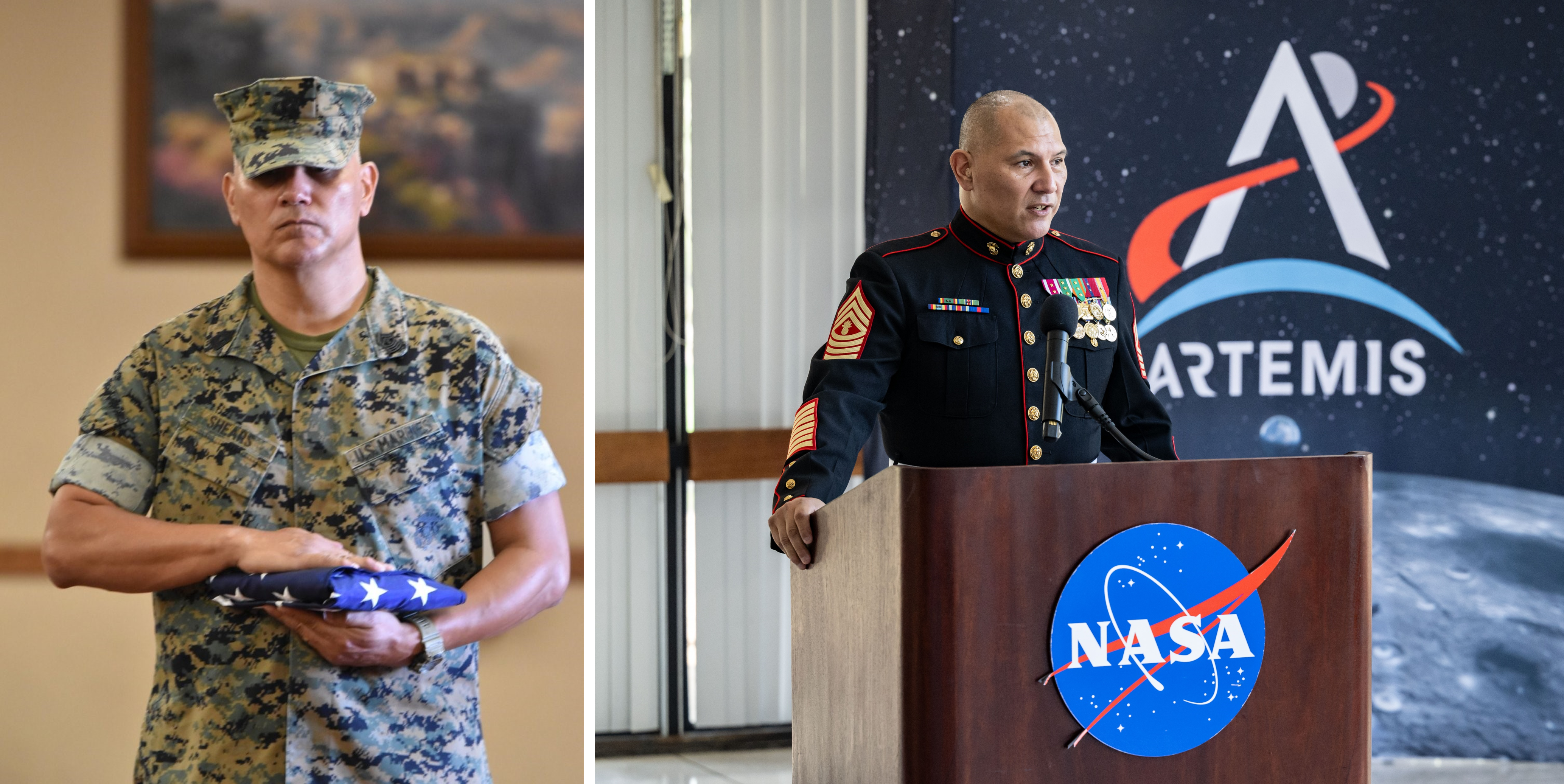
    Side-by-side photos of Miguel Shears show him during his military service and during his SkillBridge fellowship at Johnson Space Center.
    Miguel Shears during his military service (left) and his SkillBridge fellowship at Johnson Space Center.
    Images courtesy of Miguel Shears

    Miguel Shears retired from the Marine Corps in November 2023. He ended his 30 years of service as the administration, academics, and operations chief for the Marine Corps University in Quantico, Virginia, where he was also an adjunct professor. Shears completed a SkillBridge fellowship with FOD in the summer and fall of 2023, supporting the instructional systems design team. He was hired as a full-time employee upon his military retirement and currently serves as an instructional systems designer for the Instructor Training Module, Mentorship Module, and Spaceflight Academy. He conducts training needs analysis for FOD, as well.

    Side-by-side images show Johnson Space Center employee Ever Zavala in a military airplane cockpit and the Mission Control Center.
    Ever Zavala as a flight test engineer in the U.S. Air Force (left) and as a capsule communicator in the Mission Control Center at Johnson Space Center.
    Images courtesy of Ever Zavala

    Ever Zavala was very familiar with Johnson before becoming a SkillBridge fellow. He spent the last three of his nearly 24-year Air Force career serving as the deputy director of the DoD Human Spaceflight Payloads Office at Johnson. His team oversaw the development, integration, launch, and operation of payloads hosting DoD experiments on small satellites and the International Space Station. He also became a certified capsule communicator, or capcom, in December 2022, and was the lead capcom for SpaceX’s 28th commercial resupply services mission to the orbiting laboratory.

    Zavala’s SkillBridge fellowship was in Johnson’s Astronaut Office, where he worked as a capcom, capcom instructor, and an integration engineer supporting the Extravehicular Activity and Human Surface Mobility Program. He was involved in developing a training needs analysis and agency simulators for the human landing system, among other projects.

    He officially joined the center team as a full-time contractor in August 2024. He is currently a flight operations safety officer within the Flight Operations Directorate (FOD) and continues to serve as a part-time capcom.

    Side-by-side photos of Johnson Space Center employee Carl Johnson show him during a tour of the center with his wife, and working on some electrical components during his SkillBridge fellowship.
    Carl Johnson with his wife during his first visit to Johnson Space Center (left) and completing some electrical work as part of his SkillBridge fellowship.
    Images courtesy of Carl Johnson

    Carl Johnson thanks his wife for helping him find a path to NASA. While she was a Pathways intern — and his girlfriend at the time — she gave him a tour of the center that inspired him to join the agency when he was ready to leave the Army. She helped connect him to one of the center’s SkillBridge coordinators and the rest is history.

    Johnson was selected for a SkillBridge fellowship in the Dynamic System Test Branch. From February to June 2023, he supported development of the lunar terrain vehicle ground test unit and contributed to the Active Response Gravity Offload System (ARGOS), which simulates reduced gravity for astronaut training.

    Johnson officially joined the center team as an electrical engineer in the Engineering Directorate’s Software, Robotics, and Simulation Division in September 2023. He is currently developing a new ARGOS spacewalk simulator and training as an operator and test director for another ARGOS system. 

    Johnson holds an electrical engineering degree from the United States Military Academy. He was on active duty in the Army for 10 years and concluded his military career as an instructor and small group leader for the Engineer Captains Career Course. In that role, he was responsible for instructing, mentoring, and preparing the next generation of engineer captains.

    Black man wearing a military-green flight suit stands in front of an American flag.
    Kevin Quinn during his Navy service.
    Image courtesy of Kevin Quinn

    Kevin Quinn served in the Navy for 22 years. His last role was maintenance senior chief with Air Test and Evaluation Squadron 31, known as “the Dust Devils.” Quinn managed the operations and maintenance of 33 aircraft, ensuring their readiness for complex missions and contributing to developmental flight tests and search and rescue missions. He applied that experience to his SkillBridge fellowship in quality assurance at Ellington Field in 2024. Quinn worked to enhance flight safety and astronaut training across various aircraft, including the T-38, WB-57, and the Super Guppy. He has continued contributing to those projects since being hired as a full-time quality assurance employee in 2025.

    A bald Asian man wearing an Air Force dress uniform stands in front of an American flag.
    Andrew Ulat during his Air Force career.
    Image courtesy of Andrew Ulat

    Andrew Ulat retired from the Air Force after serving for 21 years as an intercontinental ballistic missile launch control officer and strategic operations advisor. His last role in the military was as a director of staff at the Air Command and Staff College at Maxwell Air Force Base in Montgomery, Alabama. There he served as a graduate-level instructor teaching international security concepts to mid-level officers and civilian counterparts from all branches of the military and various federal agencies. 

    Ulat started his SkillBridge fellowship as an integration engineer in Johnson’s X-Lab, supporting avionics, power, and software integration for the Gateway lunar space station. Ulat transitioned directly from his fellowship into a similar full-time position at Johnson in May 2024.

    Side-by-side pictures of Ariel Vargas show him receiving an award during his military service and in his official NASA employee portrait.
    Ariel Vargas receives a commendation during his Army service (left) and in his official NASA portrait.

    Ariel Vargas transitioned to NASA after serving for five years in the Army. His last role in the military was as a signal officer, which involved leading teams managing secure communications and network operations in dynamic and mission-critical environments in the Middle East and the United States.

    Vargas completed his SkillBridge fellowship in November 2023, supporting Johnson’s Office of the Chief Information Officer (OCIO). During his fellowship, he led a center-wide wireless augmentation project that modernized Johnson’s connectivity.

    He became a full-time civil servant in May 2024 and currently serves as the business operations and partnerships lead within OCIO, supporting a digital transformation initiative. In this role, he leads efforts to streamline internal business operations, manage strategic partnerships, and drive cross-functional collaboration.

    My time in the military taught me the value of service, leadership, and adaptability—qualities that I now apply daily in support of NASA’s mission,” Vargas said. “I’m proud to be part of the Johnson team and hope my story can inspire other service members considering the SkillBridge pathway.”
  • NASA Invites Media to Marshall’s 65th Anniversary Celebration July 19

    2 min read

    Preparations for Next Moonwalk Simulations Underway (and Underwater)

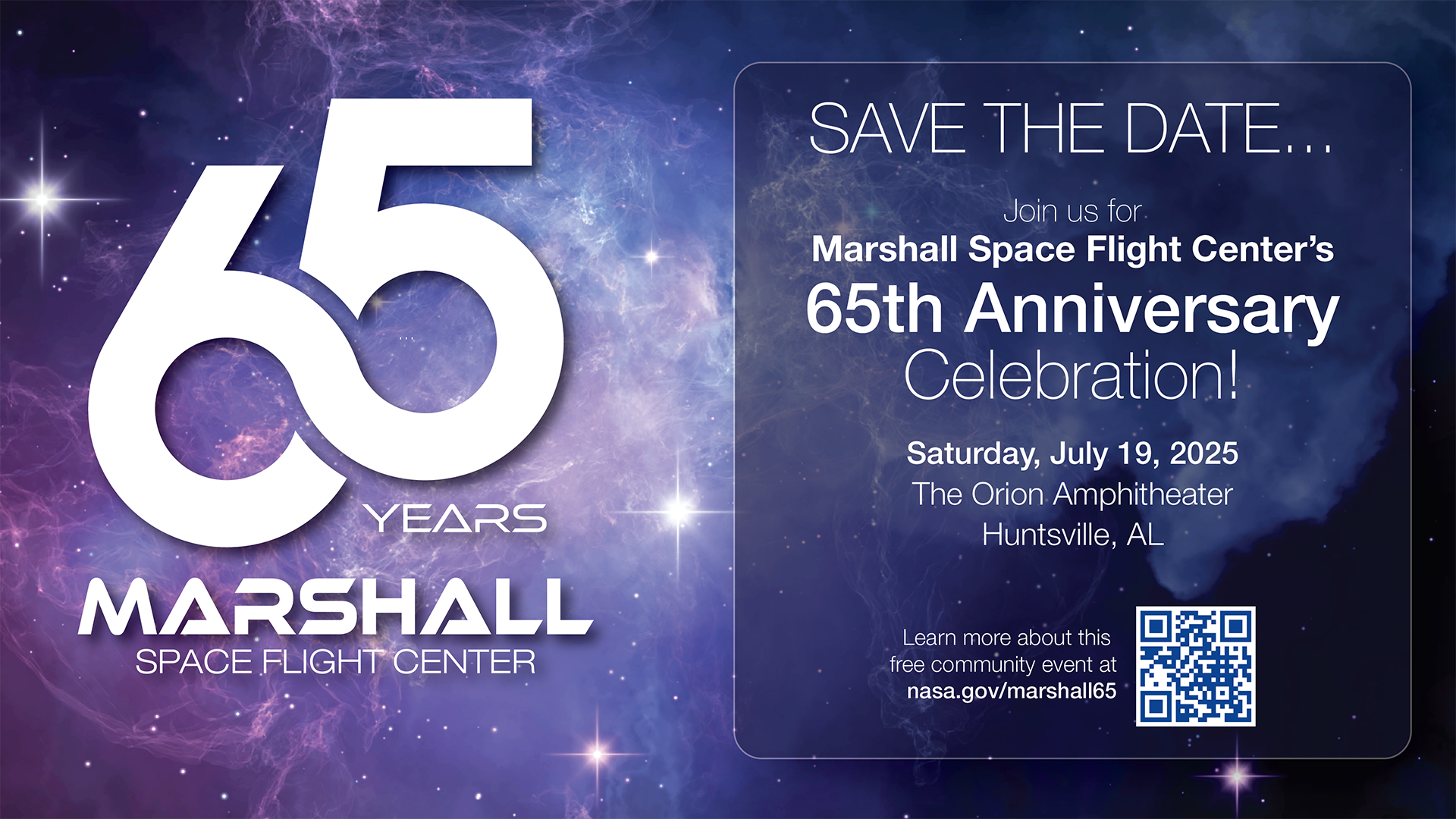
    An invitation to the Marshall 65 event.
    NASA

    NASA’s Marshall Space Flight Center will host astronauts for a media opportunity as the center celebrates its 65th anniversary during a free, community event on Saturday, July 19, from noon to 5 p.m. CDT at The Orion Amphitheater in Huntsville, Alabama.

    Marshall, along with its partners and collaborators, will fill the amphitheater with space exhibits, music, food vendors, and hands-on activities for all ages. The summer celebration will mark 65 years of innovation and exploration, not only for Marshall, but for Huntsville and other North Alabama communities.

    The event will kick off with a program at 12:30 p.m. led by Joseph Pelfrey, director of NASA Marshall, and will include a presentation from some of the Expedition 72 crew members who recently returned from their mission after dedicating more than 1,000 combined hours to scientific research and technology demonstrations aboard the International Space Station. The crew will share their experiences in space with the community.

    The official portrait of the International Space Station's Expedition 72 crew. At the top (from left) are Roscosmos cosmonaut and Flight Engineer Alexey Ovchinin, NASA astronaut and space station Commander Suni Williams, and NASA astronaut and Flight Engineer Butch Wilmore. In the middle row are Roscosmos cosmonaut and Flight Engineer Ivan Vagner and NASA astronaut and Flight Engineer Don Pettit. In the bottom row are Roscosmos cosmonaut and Flight Engineer Aleksandr Gorbunov and NASA astronaut and Flight Engineer Nick Hague.
    The official portrait of the International Space Station’s Expedition 72 crew. At the top (from left) are Roscosmos cosmonaut and Flight Engineer Alexey Ovchinin, NASA astronaut and space station Commander Suni Williams, and NASA astronaut and Flight Engineer Butch Wilmore. In the middle row are Roscosmos cosmonaut and Flight Engineer Ivan Vagner and NASA astronaut and Flight Engineer Don Pettit. In the bottom row are Roscosmos cosmonaut and Flight Engineer Aleksandr Gorbunov and NASA astronaut and Flight Engineer Nick Hague.
    NASA/Bill Stafford and Robert Markowitz

    Media are invited to attend the event and participate in a news conference with the astronauts after the presentation but must confirm their attendance by 4:30 p.m., Thursday, July 17, to Lance D. Davis – lance.d.davis@nasa.gov – in Marshall’s Office of Communications.

    Media should arrive at the front entrance of The Orion Amphitheater by 11:45 a.m., Saturday, July 19, to be escorted by the Office of Communications.

    Founded July 1, 1960, in Huntsville, Marshall has shaped or supported nearly every facet of the nation’s ongoing mission of space exploration and discovery, solving the most complex, technical flight challenges, and contributing to science to improve life and protect resources around the world.

    Learn more about Marshall’s 65th anniversary celebration at:

    https://www.nasa.gov/marshall65/

    Lance D. Davis
    Marshall Space Flight Center, Huntsville, Ala. 
    256-640-9065 
    lance.d.davis@nasa.gov

    Details

    Last Updated

    Jul 16, 2025

    Editor
    Beth Ridgeway

  • Summer Triangle Corner: Vega

    3 min read

    Summer Triangle Corner: Vega

    If you live in the Northern Hemisphere and look up during July evenings, you’ll see the brilliant star Vega shining overhead. Did you know that Vega is one of the most studied stars in our skies? As one of the brightest summer stars, Vega has fascinated astronomers for thousands of years.

    Vega is the brightest star in the small Greek constellation of Lyra, the harp. It’s also one of the three points of the large “Summer Triangle” asterism, making Vega one of the easiest stars to find for novice stargazers. Ancient humans from 14,000 years ago likely knew Vega for another reason: it was the Earth’s northern pole star! Compare Vega’s current position with that of the current north star, Polaris, and you can see how much the direction of Earth’s axis changes over thousands of years. This slow movement of axial rotation is called precession, and in 12,000 years, Vega will return to the northern pole star position.

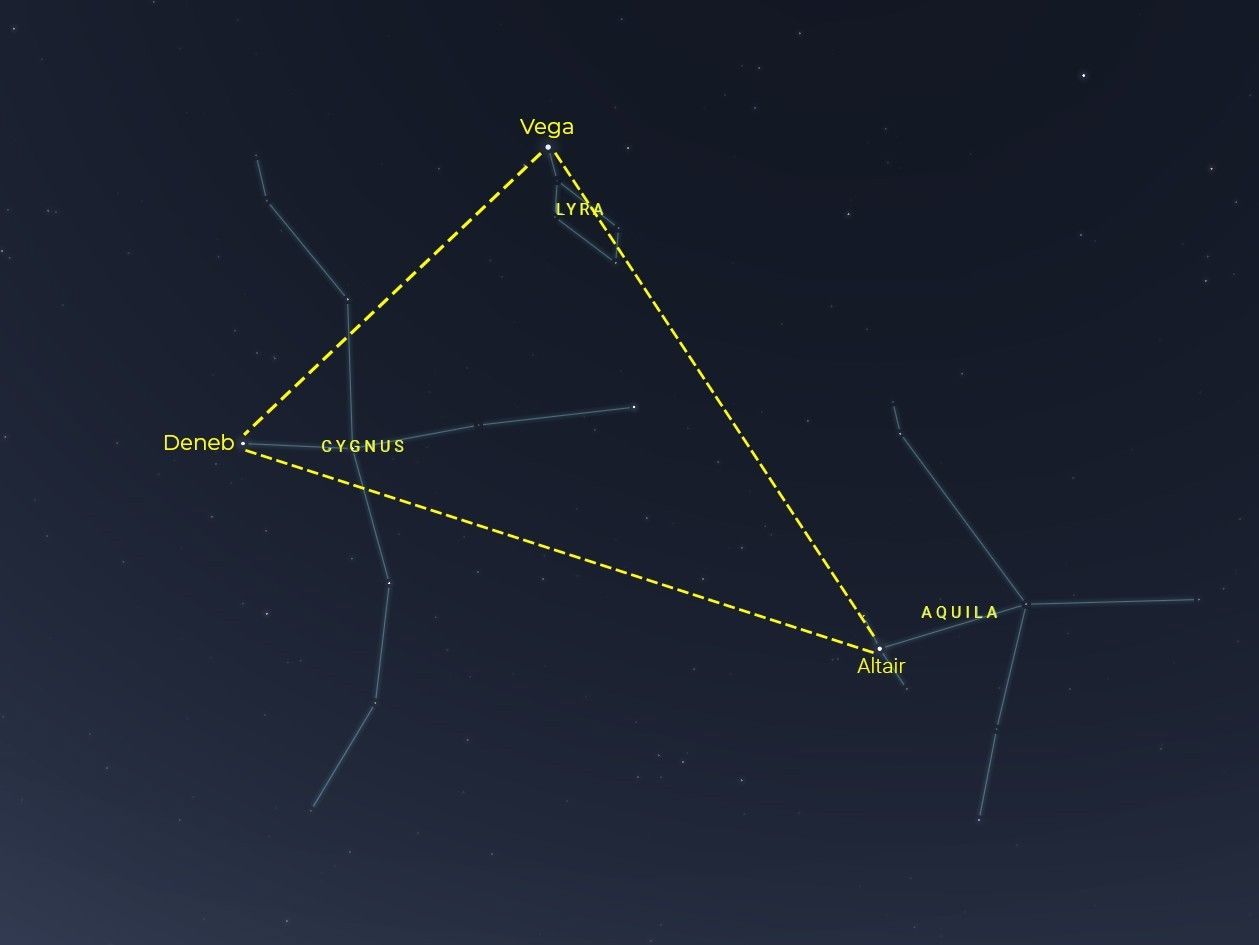
    The star map of the asterism known as the Summer Triangle. This asterism is made up of three stars: Vega in the Lyra constellation, Altair in the Aquila constellation, and Deneb in the Cygnus constellation. These three stars are connected by a dotted yellow line to outline the shape of the triangle. The constellation shapes are mapped with blue lines.
    A map of the asterism known as the Summer Triangle. This asterism is made up of three stars: Vega in the Lyra constellation, Altair in the Aquila constellation, and Deneb in the Cygnus constellation.
    Stellarium Web

    Bright Vega has been observed closely since the beginning of modern astronomy and even helped to set the standard for the current magnitude scale used to categorize the brightness of stars. Polaris and Vega have something else in common, besides being once and future pole stars: their brightness varies over time, making them variable stars. Variable stars’ light can change for many different reasons. Dust, smaller stars, or even planets may block the light we see from the star. Or the star itself might be unstable with active sunspots, expansions, or eruptions changing its brightness. Most stars are so far away that we only record the change in light, and can’t see their surface.

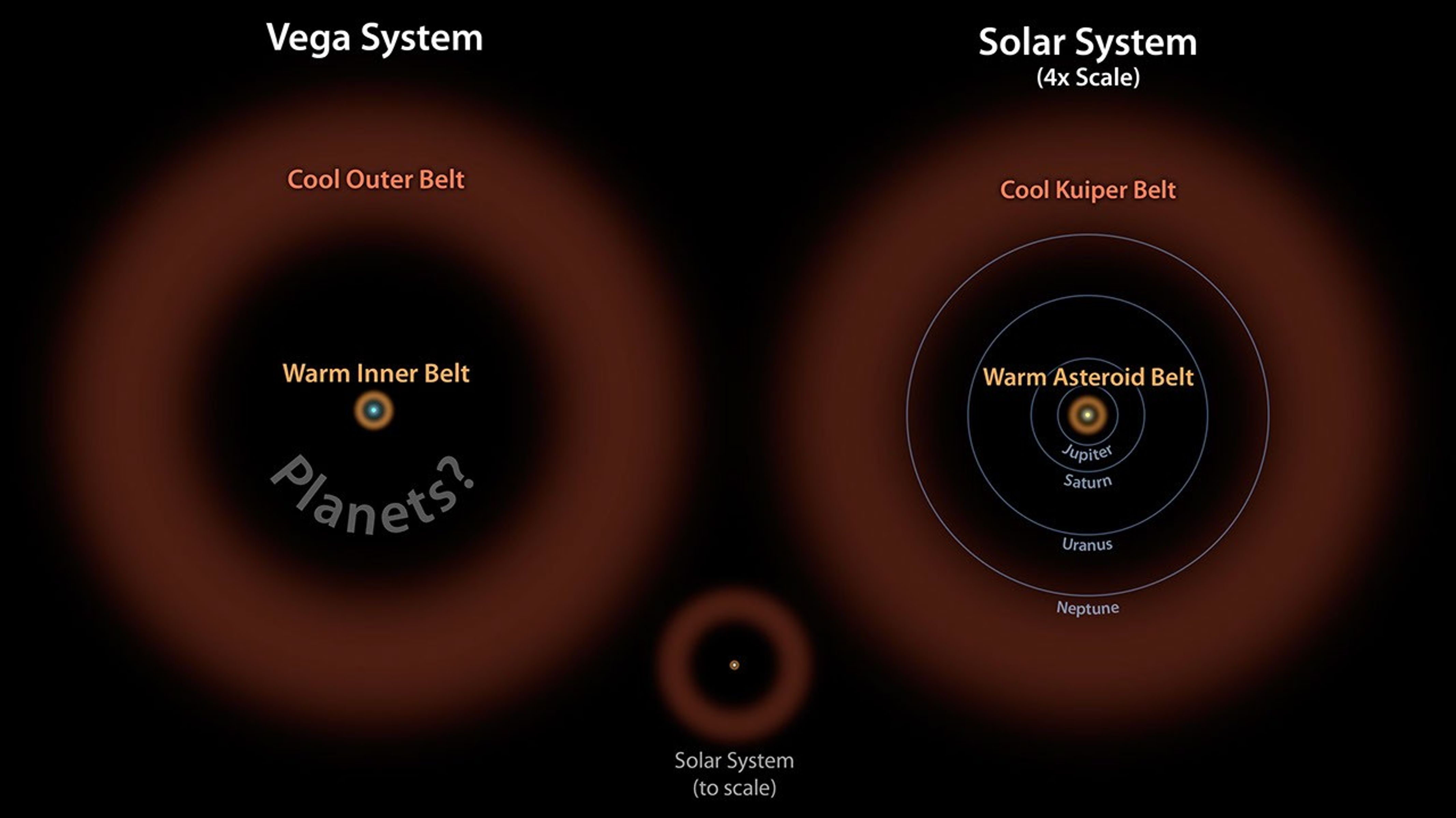
    In this diagram, the Vega system, which was already known to have a cooler outer belt of comets (orange), is compared to our solar system with its asteroid and Kuiper belts. The ring of warm, rocky debris was detected using NASA's Spitzer Space Telescope.
    Astronomers have discovered what appears to be a large asteroid belt around the bright star Vega, as illustrated here at left in brown. The ring of warm, rocky debris was detected using NASA’s Spitzer Space Telescope, and the European Space Agency’s Herschel Space Observatory, in which NASA plays an important role.
    NASA/JPL-Caltech

    NASA’s TESS satellite has ultra-sensitive light sensors primed to look for the tiny dimming of starlight caused by transits of extrasolar planets. Their sensitivity also allowed TESS to observe much smaller pulsations in a certain type of variable star’s light than previously observed. These observations of Delta Scuti variable stars will help astronomers model their complex interiors and make sense of their distinct, seemingly chaotic pulsations. This is a major contribution towards the field of astroseismology: the study of stellar interiors via observations of how sound waves “sing” as they travel through stars. The findings may help settle the debate over what kind of variable star Vega is. Find more details on this research, including a sonification demo that lets you “hear” the heartbeat of one of these stars, at: bit.ly/DeltaScutiTESS
     
    In 2024, the James Webb Space Telescope revisited the Vega system to reveal a 100-billion-mile-wide disk of dust around this star. While the debris disk is confirmed, there is no evidence of planets as of today.

    Originally posted by Dave Prosper: June 2020
    Last Updated by Kat Troche: July 2025

  • NASA to Preview Advanced US-India Radar Mission Ahead of Launch

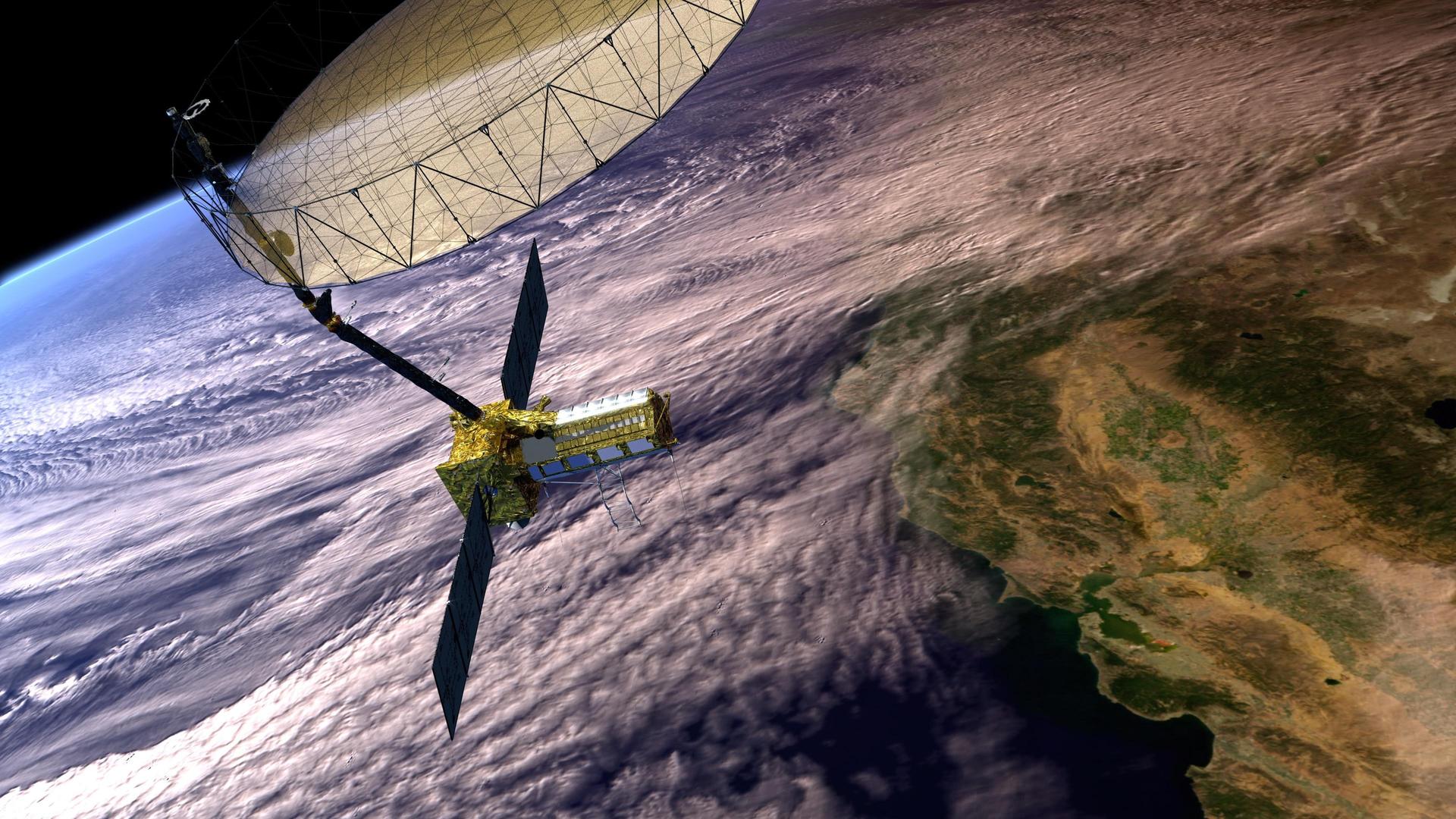
    A satellite with gold metallic accents orbits the cloudy Earth.
    A collaboration between NASA and the Indian Space Research Organisation, NISAR will use synthetic aperture radar to monitor nearly all the planet’s land- and ice-covered surfaces twice every 12 days.
    Credit: NASA

    NASA will host a news conference at 12 p.m. EDT Monday, July 21, to discuss the upcoming NISAR (NASA-ISRO Synthetic Aperture Radar) mission.

    The Earth-observing satellite, a first-of-its-kind collaboration between NASA and ISRO (Indian Space Research Organisation), carries an advanced radar system that will help protect communities by providing a dynamic, three-dimensional view of Earth in unprecedented detail and detecting the movement of land and ice surfaces down to the centimeter.

    The NISAR mission will lift off from ISRO’s Satish Dhawan Space Centre in Sriharikota, on India’s southeastern coast. Launch is targeted for no earlier than late July.

    NASA’s Jet Propulsion Laboratory in Southern California will stream the briefing live on its X, Facebook, and YouTube channels. Learn how to watch NASA content through a variety of platforms, including social media.

    Participants in the news conference include:

    • Nicky Fox, associate administrator, Science Mission Directorate, NASA Headquarters
    • Karen St. Germain, director, Earth Science Division, NASA Headquarters
    • Wendy Edelstein, deputy project manager, NISAR, NASA JPL
    • Paul Rosen, project scientist, NISAR, NASA JPL

    To ask questions by phone, members of the media must RSVP no later than two hours before the start of the event to: rexana.v.vizza@jpl.nasa.gov. NASA’s media accreditation policy is available online. Questions can be asked on social media during the briefing using #AskNISAR.

    With its two radar instruments — an S-band system provided by ISRO and an L-band system provided by NASA — NISAR will use a technique known as synthetic aperture radar (SAR) to scan nearly all the planet’s land and ice surfaces twice every 12 days. Each system’s signal is sensitive to different sizes of features on Earth’s surface, and each specializes in measuring different attributes, such as moisture content, surface roughness, and motion.

    These capabilities will help scientists better understand processes involved in natural hazards and catastrophic events, such as earthquakes, volcanic eruptions, land subsidence, and landslides.

    Additionally, NISAR’s cloud penetrating ability will aid urgent responses to communities during weather disasters such as hurricanes, storm surge, and flooding. The detailed maps the mission creates also will provide information on both gradual and sudden changes occurring on Earth’s land and ice surfaces.

    Managed by Caltech for NASA, JPL leads the U.S. component of the NISAR project and provided the L-band SAR. NASA JPL also provided the radar reflector antenna, the deployable boom, a high-rate communication subsystem for science data, GPS receivers, a solid-state recorder, and payload data subsystem. NASA’s Goddard Space Flight Center in Greenbelt, Maryland, manages the Near Space Network, which will receive NISAR’s L-band data.

    Multiple ISRO centers have contributed to NISAR. The Space Applications Centre is providing the mission’s S-band SAR. The U R Rao Satellite Centre provided the spacecraft bus. The rocket is from Vikram Sarabhai Space Centre, launch services are through Satish Dhawan Space Centre, and satellite mission operations are by the ISRO Telemetry Tracking and Command Network. The National Remote Sensing Centre is responsible for S-band data reception, operational products generation, and dissemination.

    To learn more about NISAR, visit:

    https://nisar.jpl.nasa.gov

    -end-

    Karen Fox / Elizabeth Vlock
    Headquarters, Washington
    202-358-1600
    karen.c.fox@nasa.gov / elizabeth.a.vlock@nasa.gov

    Andrew Wang / Scott Hulme
    Jet Propulsion Laboratory, Pasadena, Calif.
    626-379-6874 / 818-653-9131
    andrew.wang@jpl.nasa.gov / scott.d.hulme@jpl.nasa.gov

  • NASA’s Chandra Finds Baby Exoplanet is Shrinking

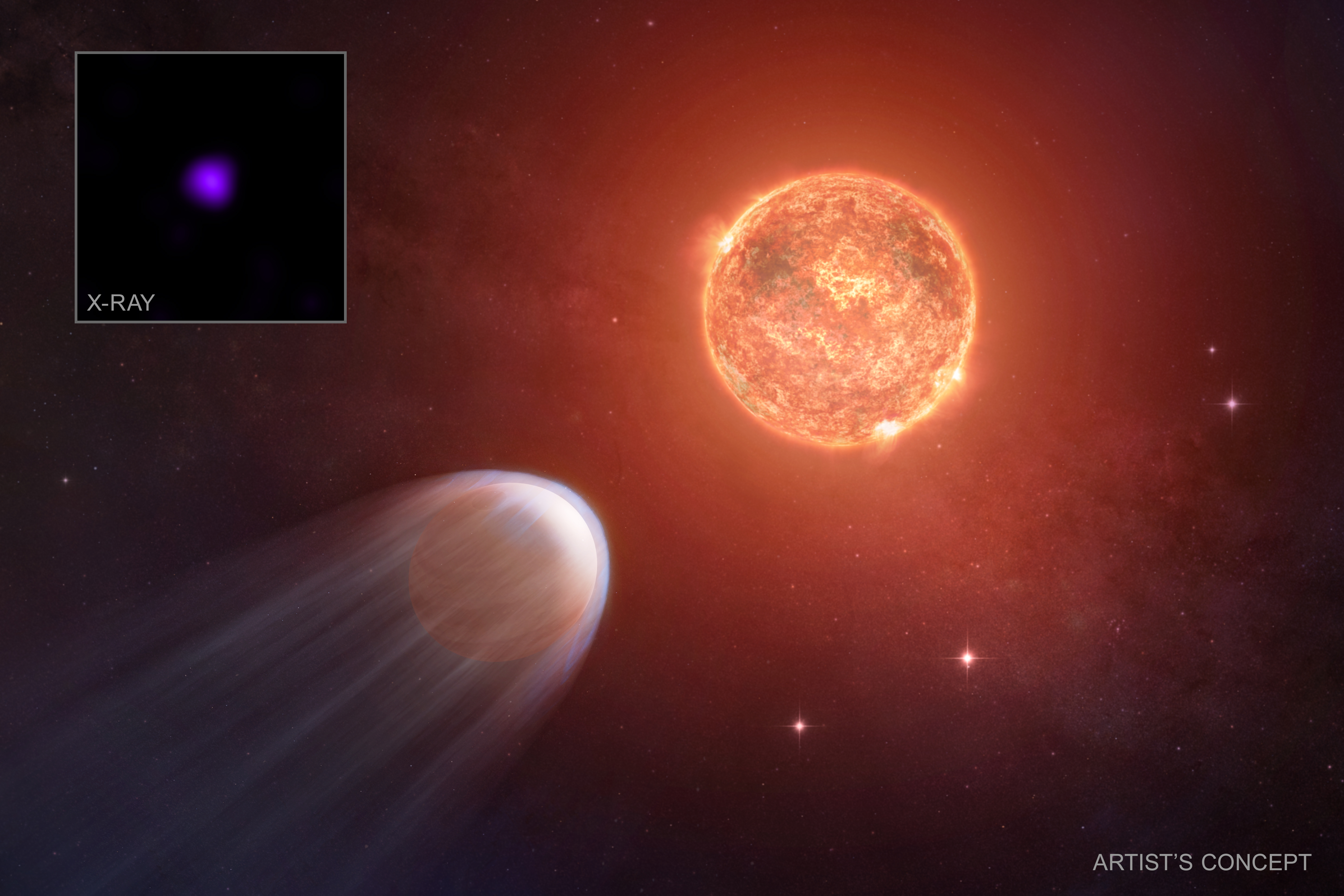
    This release features an artist's illustration of a Jupiter-sized planet closely orbiting a faint red star. An inset image, showing the star in X-ray light from Chandra, is superimposed on top of the illustration at our upper left corner.
    X-ray: NASA/CXC/RIT/A. Varga et al.; Illustration: NASA/CXC/SAO/M. Weiss; Image Processing: NASA/CXC/SAO/N. Wolk

    star is unleashing a barrage of X-rays that is causing a closely-orbiting, young planet to wither away an astonishing rate, according to a new study using data from NASA’s Chandra X-ray Observatory and described in our latest press release. A team of researchers has determined that this planet will go from the size of Jupiter down to a small, barren world.

    This graphic provides a visual representation of what astronomers think is happening around the star (known as TOI 1227) and a planet that is orbiting it at a fraction the distance between Mercury and the Sun. This “baby” planet, called TOI 1227 b, is just about 8 million years old, about a thousand times younger than our Sun. The main panel is an artist’s concept that shows the Jupiter-sized planet (lower left) around TOI 1227, which is a faint red star. Powerful X-rays from the star’s surface are tearing away the atmosphere of the planet, represented by the blue tail. The star’s X-rays may eventually completely remove the atmosphere.

    The team used new Chandra data — seen in the inset — to measure the amounts of X-rays from TOI 1227 that are striking the planet. Using computer models of the effects of these X-rays, they concluded they will have a transformative effect, rapidly stripping away the planet’s atmosphere. They estimate that the planet is losing a mass equivalent to a full Earth’s atmosphere about every 200 years.

    The researchers used different sets of data to estimate the age of TOI 1227 b. One method exploits measurements of how TOI 1227 b’s host star moves through space in comparison to nearby populations of stars with known ages. A second method compared the brightness and surface temperature of the star with theoretical models of evolving stars. The very young age of TOI 1227 b makes it the second youngest planet ever to be observed passing in front of its host star (a so-called transit). Previously the planet had been estimated by others to be about 11 million years old.

    Of all the exoplanets astronomers have found with ages less than 50 million years, TOI 1227 b stands out for having the longest year and the host planet with the lowest mass. These properties, and the high dose of X-rays it is receiving, make it an outstanding target for future observations.

    A paper describing these results has been accepted publication in The Astrophysical Journal and a preprint is available here. The authors of the paper are Attila Varga (Rochester Institute of Technology), Joel Kastner (Rochester Institute of Technology), Alexander Binks (University of Tubingen, Germany), Hans Moritz Guenther (Massachusetts Institute of Technology), and Simon J. Murphy (University of New South Wales Canberra in Australia).

    NASA’s Marshall Space Flight Center in Huntsville, Alabama, manages the Chandra program. The Smithsonian Astrophysical Observatory’s Chandra X-ray Center controls science operations from Cambridge, Massachusetts, and flight operations from Burlington, Massachusetts.

    Learn more about the Chandra X-ray Observatory and its mission here:

    https://www.nasa.gov/chandra

    https://chandra.si.edu

    Visual Description

    This release features an artist’s illustration of a Jupiter-sized planet closely orbiting a faint red star. An inset image, showing the star in X-ray light from Chandra, is superimposed on top of the illustration at our upper left corner.

    At our upper right, the red star is illustrated as a ball made of intense fire. The planet, slightly smaller than the star, is shown at our lower left. Powerful X-rays from the star are tearing away the atmosphere of the planet, causing wisps of material to flow away from the planet’s surface in the opposite direction from the star. This gives the planet a slight resemblance to a comet, complete with a tail.

    X-ray data from Chandra, presented in the inset image, shows the star as a small purple orb on a black background. Astronomers used the Chandra data to measure the amount of X-rays striking the planet from the star. They estimate that the planet is losing a mass equivalent to a full Earth’s atmosphere about every 200 years, causing it to ultimately shrink from the size of Jupiter down to a small, barren world.

    News Media Contact

    Megan Watzke
    Chandra X-ray Center
    Cambridge, Mass.
    617-496-7998
    mwatzke@cfa.harvard.edu

    Corinne Beckinger
    Marshall Space Flight Center, Huntsville, Alabama
    256-544-0034
    corinne.m.beckinger@nasa.gov

  • NASA Software Catalog Puts Agency Solutions at Innovators’ Fingertips

    Andy Burroughs (left) and Paul Friz in the roles of air taxi pilots running through air taxi integration simulations focusing on urban air space at NASA’s Langley Research in Hampton, Virginia on Sept. 25, 2024.
    Andy Burroughs (left) and Paul Friz in the roles of air taxi pilots running through air taxi integration simulations focusing on urban air space at NASA’s Langley Research in Hampton, Virginia on Sept. 25, 2024.
    Credit: NASA

    NASA’s latest open Software Catalog, released Wednesday, offers more than 1,200 downloadable codes developed by agency engineers that could enable faster solutions to energize the space economy and stimulate American ingenuity. The catalog is part of NASA’s effort to place advanced technologies, including agency software, into the hands of businesses, researchers, and entrepreneurs to foster economic growth and innovation.

    Agency developers will provide more information about the Software Catalog, the only repository of its kind in the federal government, during NASA’s summer software webinar series beginning Tuesday, July 22.

    “NASA has droves of talented experts creating software to automate elements of agency missions,” said Dan Lockney, program executive, Technology Transfer at NASA Headquarters in Washington. “The resulting efficiency benefits humankind, and its public value increases exponentially when the agency provides access to those software programs for companies, enabling them to save time and money, improve commercial offerings, and build their businesses.”

    The four webinars accompanying this year’s NASA Software Catalog feature developers of popular programs for mission planning, systems design, propulsion analysis, and more, each consisting of a presentation followed by a live question-and-answer session.

    Programs offered in NASA’s 2025-2026 Software Catalog are grouped into 15 categories that may be useful for organizations working with spacecraft and aircraft. For example, the Vehicle Management category includes a tool for designing satellite constellations and a software library for minimizing public safety risks around expendable launch vehicles. The Aeronautics section includes several programs that are widely used by industry for creating, modifying, and analyzing aircraft designs.

    Although the categories have specific themes, the codes are meant to be useful to various innovators. Companies can use aircraft programs NASA wrote to design cars, trucks, and countless other products. The catalog’s Business Systems and Project Management section includes software for estimating project costs, building and assessing complex schedules, and uncovering root causes of mishaps. Other popular programs support 3D rendering for simulation and virtual reality, bring hyper-accuracy to GPS tracking, and analyze electrical power system architectures.

    NASA released its first Software Catalog more than a decade ago in 2013, and since then, the agency’s annual rate of software downloads has skyrocketed, reaching up to 5,722 downloads in a single year.

    The Software Catalog is a product of NASA’s Technology Transfer program, managed by the agency’s Space Technology Mission Directorate. NASA routinely makes improvements to the Software Catalog website, ensuring the process is fast and easy. Access restrictions apply to some software that may be limited to use by U.S. citizens or for U.S. government purposes only.

    View and learn more about NASA’s Software Catalog by visiting:

    https://software.nasa.gov

    -end-

    Jasmine Hopkins
    Headquarters, Washington
    321-432-4624
    jasmine.s.hopkins@nasa.gov   

  • Aurora Australis

    Aurora Australis

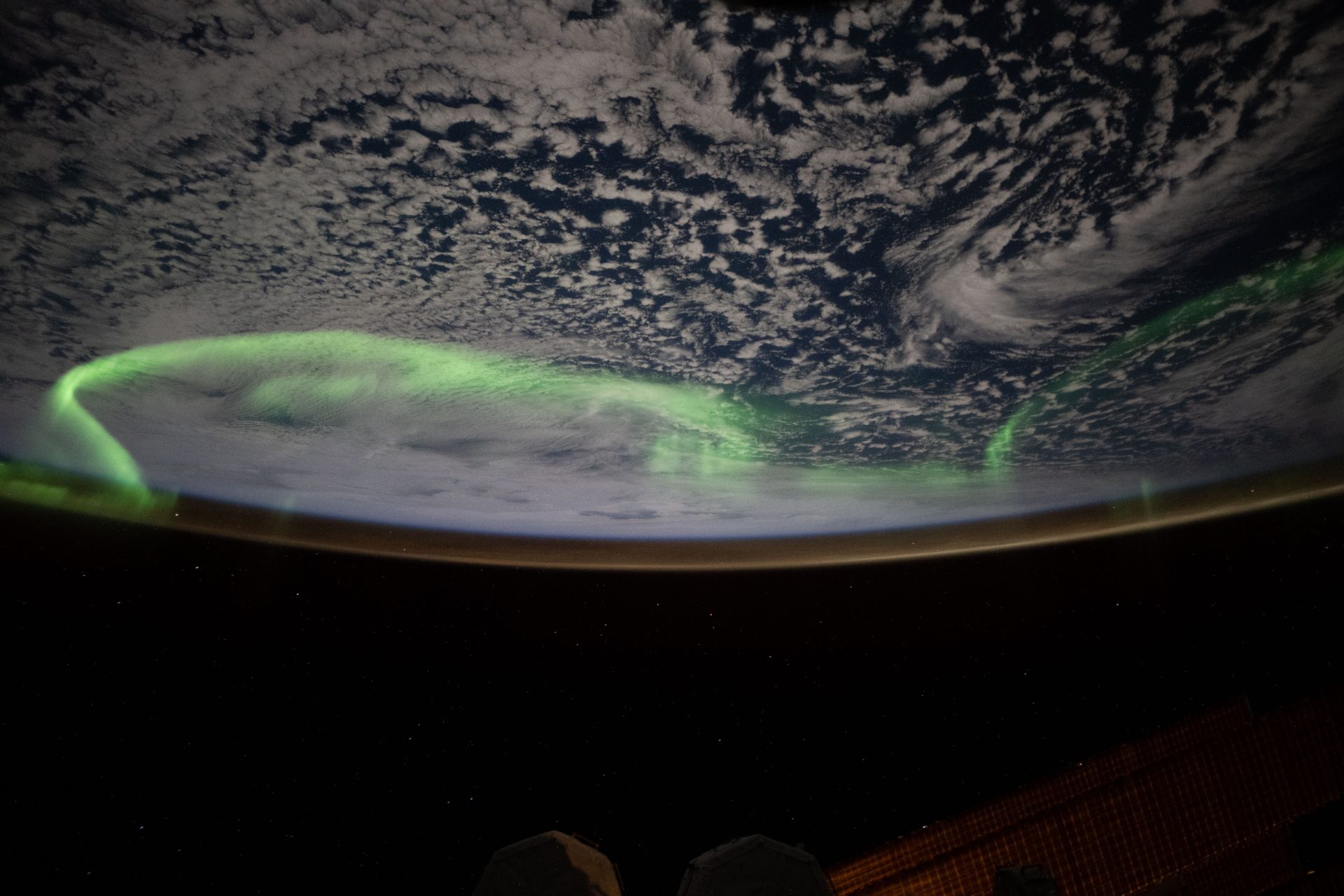
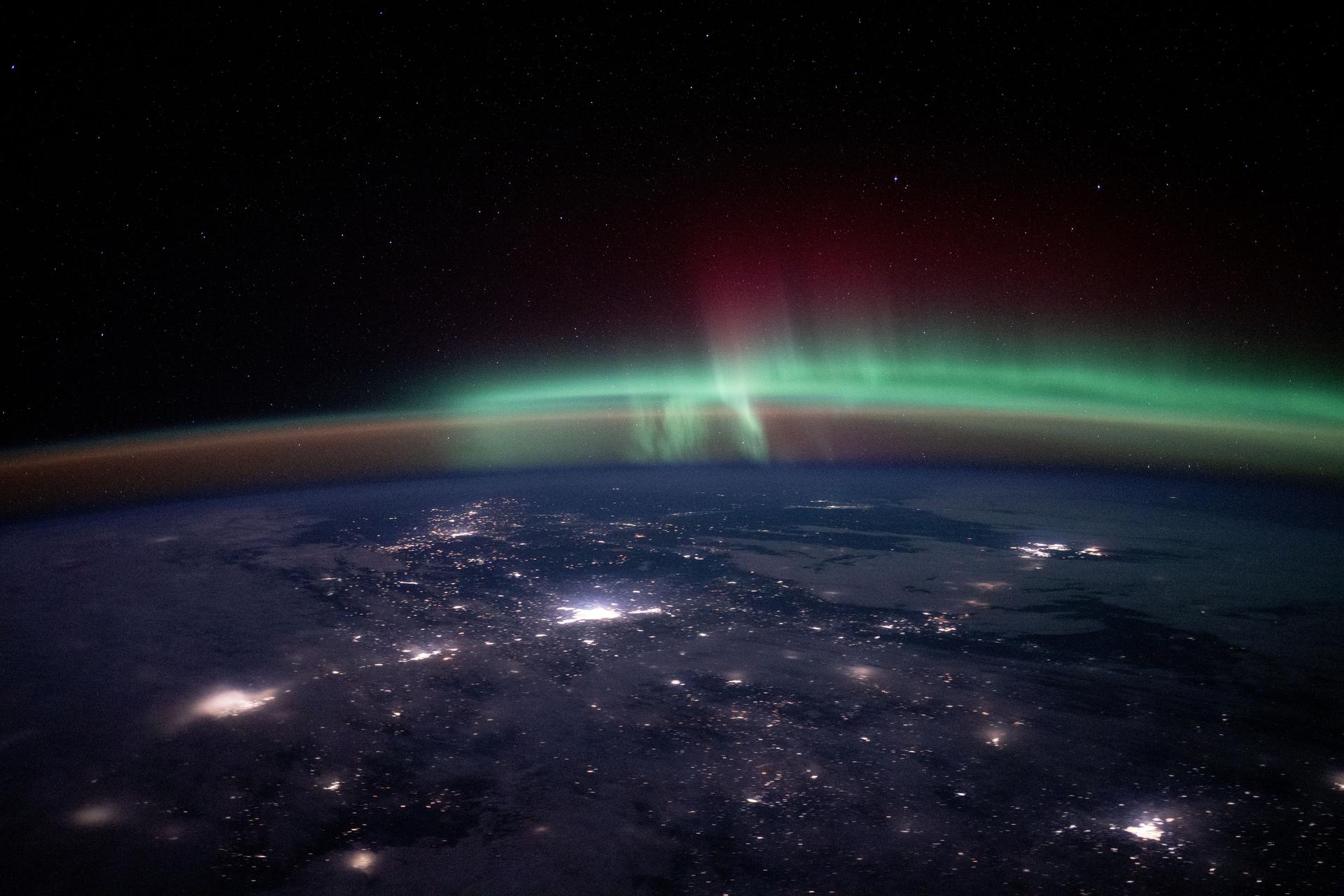
    The aurora australis arcs above a partly cloudy Indian Ocean in this photograph from the International Space Station as it orbited 269 miles above in between Australia and Antarctica on June 12, 2025.

  • Aurora Australis

    The
    NASA/Nichole Ayers

    The aurora australis arcs above a partly cloudy Indian Ocean in this photograph from the International Space Station as it orbited 269 miles above in between Australia and Antarctica on June 12, 2025.

    Astronauts aboard the space station take photos using handheld digital cameras, usually through windows in the station’s cupola, for Crew Earth Observations. Crew members have produced hundreds of thousands of images of the Moon and Earth’s land, oceans, and atmosphere.

    Image credit: NASA/Nichole Ayers

  • NASA Sees Key Progress on Starlab Commercial Space Station

    An artist’s concept of the Starlab commercial space station.
    Starlab

    As NASA continues its transition toward a commercial low Earth orbit marketplace, an agency-supported commercial space station, Starlab, recently completed five development and design milestones. Starlab’s planned design consists of a service module and a habitat that will be launched to orbit on a single flight.

    The milestones, part of a NASA Space Act Agreement awarded in 2021, focused on reviews of Starlab’s preliminary design and safety, as well as spacecraft mockup and procurement plans. Each milestone provides NASA insight into the company’s development progress.

    “As we work toward the future of low Earth orbit, these milestones demonstrate Starlab’s dedication to building a commercial space station that can support human life and advance scientific research,” said Angela Hart, program manager for NASA’s Commercial Low Earth Orbit Development Program at the agency’s Johnson Space Center in Houston. “Both the insight shared by Starlab and the expertise shared by NASA are critical to future mission success.”

    Starlab recently completed a preliminary design and safety review of its station’s architecture and systems. The company now will begin detailed design and hardware development, culminating in a critical design review later this year. Critical design reviews are an important step in a station’s development, assessing design maturity before proceeding with fabrication and assembly.

    An artist’s concept of the Starlab commercial space station.
    Starlab

    Starlab also has begun construction of a full-scale, high-fidelity mockup of the station. The mockup, which will be housed in the Space Vehicle Mockup Facility at NASA Johnson, will be used for human-in-the-loop testing, during which participants perform day-in-the-life walkthroughs and evaluate the interior design, crew training, procedure development, hardware checks, and in-flight issue resolution.

    In addition, Starlab completed reviews of the system design architecture, procurement plan, and Northrop Grumman Cygnus spacecraft docking system design. In 2023, Northrop Grumman teamed up with Starlab to provide cargo logistics services and engineering consultation to support the commercial space station. These reviews included design configuration updates of solar arrays, docking ports, crew quarters, and more.

    NASA supports the design and development of multiple commercial space stations through funded and unfunded agreements. Following the design and development phase, NASA plans to procure services from one or more companies as part of its strategy to become one of many customers for low Earth orbit stations.

    Learn more about commercial space stations at:

    www.nasa.gov/commercialspacestations

  • NASA Citizen Science and Your Career: Stories of Exoplanet Watch Volunteers

    3 min read

    NASA Citizen Science and Your Career: Stories of Exoplanet Watch Volunteers

    Doing NASA Science brings many rewards. But can taking part in NASA citizen science help your career? To find out, we asked participants in NASA’s Exoplanet Watch project about their experiences. In this project, amateur astronomers work together with professionals to track planets around other stars.

    First, we heard from professional software programmers. Right away, one of them told us about getting a new job through connections made in the project.

    “I decided to create the exoplanet plugin, [for citizen science] since it was quite a lot of manual work to check which transits were available for your location. The exoplanet plugin and its users got me in contact with the Stellar group… Through this group, I got into contact with a company called OurSky and started working for them… the point is, I created a couple of plugins for free and eventually got a job at an awesome company.”
    Another participant talked about honing their skills and growing their confidence through Exoplanet Watch.

    “There were a few years when I wasn’t actively coding. However, Exoplanet Watch rekindled that spark…. Participating in Exoplanet Watch even gave me the confidence to prepare again for a technical interview at Meta—despite having been thoroughly defeated the first time I tried.”

    Teachers and teaching faculty told us how Exoplanet Watch gives them the ability to better convey what scientific research is all about – and how the project motivates students! 

    Exoplanet Watch makes it easy for undergraduate students to gain experience in data science and Python, which are absolutely necessary for graduate school and many industry jobs.

    Experience with this collaborative work is a vital piece of the workforce development of our students who are seeking advanced STEM-related careers or ongoing education in STEM (Science, Technology, Engineering, & Mathematics) fields after graduation… Exoplanet Watch, in this way, is directly training NASA’s STEM workforce of tomorrow by allowing CUNY (The City University of New York) students to achieve the science goals that would otherwise be much more difficult without its resources.”

    One aspiring academic shared how her participation on the science team side of the project has given her research and mentorship experience that strengthens her resume. 

    “I ended up joining the EpW team to contribute my expertise in stellar variability… My involvement with Exoplanet Watch has provided me with invaluable experience in mentoring a broad range of astronomy enthusiasts and working in a collaborative environment with people from around the world. … Being able to train others, interact in a team environment, and work independently are all critical skills in any work environment, but these specific experiences have also been incredibly valuable towards building my portfolio as I search for faculty positions around the USA.”

    There are no guarantees, of course. What you get out of NASA citizen science depends on what you put in. But there is certainly magic to be found in the Exoplanet Watch project.  As one student said:

    “Help will always be found at Hogwarts, to those who need it.” Exoplanet Watch was definitely Hogwarts for me in my career as an astronomer!”

    For more information about NASA and your career, check out NASA’s Surprisingly STEM series highlighting exciting and unexpected jobs at NASA, or come to NASA Career Day, a virtual event for students and educators. Participants must register by September 4, 2025. The interactive platform will be open from September 15-19, with live panels and events taking place on September 18.

    Man standing next to a large red telescope on an outdoor observatory platform at sunset.

    Exoplanet Watch volunteer Bryan Martin

    Credit: Bryan Martin

  • Ejection Mechanism Design for the SPEED Test Architecture Challenge

    The The Stratospheric Projectile Entry Experiment on Dynamics (SPEED), a two-stage stratospheric drop test architecture, is currently under development to bridge the state-of-the-art gap that many NASA flagship missions require to reduce system risk and enable more optimized designs via margin reduction. To do this, a two-stage vehicle will drop from a high-altitude balloon and use the first stage (an LV-Haack cone aeroshell) to accelerate the sub-scale test model to supersonic conditions. The onboard avionics will then release the test model into freestream flow at the proper altitude in Earth’s atmosphere for dynamic Mach scaling to the full-scale flight trajectory. SPEED leverages low-cost methods of manufacturing such as 3D printing and laser/water-jet cutting to enable 8 or more two-stage vehicles to be dropped in a single test, making the science-to-dollar density much higher than any current ground-test facility NASA has at its disposal. The goal is to develop a robust ejection system that can reliably introduce the test models into supersonic flow with a tight variance on initial condition perturbation. The separation system must be capable of handling a range of initial angle-of-attacks, keep the test model secure in the first stage during take-off and descent, and eject the test model in such a way that it does not linger behind the first stage and be affected by the resulting wake. As current ejection system designs are conceptual, complex, and untested, NASA is looking for alternative ideas that can be incorporated into the design of their next iteration of SPEED flight vehicles to increase system reliability. We are challenging the public to design innovative concepts for a separation mechanism that can be used to assess NASA and commercial reentry vehicle stability.

    Award: $7,000 in total prizes

    Open Date: July 14, 2025

    Close Date: September 8, 2025

    For more information, visit: https://grabcad.com/challenges/ejection-mechanism-design-for-the-speed-test-architecture

  • NASA Funds Early Career Employee Research

    Portrait of Sylvie Crowell with an American flag and NASA flag partially shown behind her.
    Sylvie Crowell
    Credit: NASA 

    Sylvie Crowell, a materials researcher at NASA’s Glenn Research Center in Cleveland, has received a NASA Early Career Initiative (ECI) award for a research proposal titled “Lunar Dust Reduction through Electrostatic Adhesion Mitigation (L-DREAM).” The research focuses on developing a passive lunar dust mitigation coating for solar cells and thermal control surfaces. 

    Operated under the NASA Space Technology Mission Directorate, the award will fund Crowell’s research in fiscal year 2026, beginning Oct. 1, 2025.  

    NASA’s ECI is a unique opportunity for the best and brightest of NASA’s early career researchers to lead hands-on technology development projects. The initiative aims to invigorate NASA’s technological base and best practices by partnering early career NASA leaders with external innovators.