Tag: Kepler

  • A Beacon to Space

    A faint beam stretches up and to the left from the open dome of a laboratory into the sky. The building and surrounding trees are mostly in shadow. The sky is a deep blue with multicolored stars visible; the bottom of the sky where it meets the landscape fades from blue to pink.
    NASA/JPL-Caltech

    In this infrared photograph taken on June 2, 2025, the Optical Communications Telescope Laboratory at NASA’s Jet Propulsion Laboratory’s Table Mountain Facility near Wrightwood, California, beams its eight-laser beacon to the Deep Space Optical Communications (DSOC) flight laser transceiver aboard NASA’s Psyche spacecraft. At the time, when Psyche was about 143 million miles (230 million kilometers) from Earth.

    Managed by JPL, DSOC successfully demonstrated that data encoded in laser photons could be reliably transmitted, received, and then decoded after traveling millions of miles from Earth out to Mars distances. Nearly two years after launching aboard the agency’s Psyche mission in 2023, the demonstration completed its 65th and final “pass” on Sept. 2, 2025, sending a laser signal to Psyche and receiving the return signal from 218 million miles (350 million kilometers) away.

    Text credit: Ian J. O’Neill

    Image credit: NASA/JPL-Caltech

  • Hubble Images Celestial Cigar’s Smoldering Heart

    2 min read

    Hubble Images Celestial Cigar’s Smoldering Heart

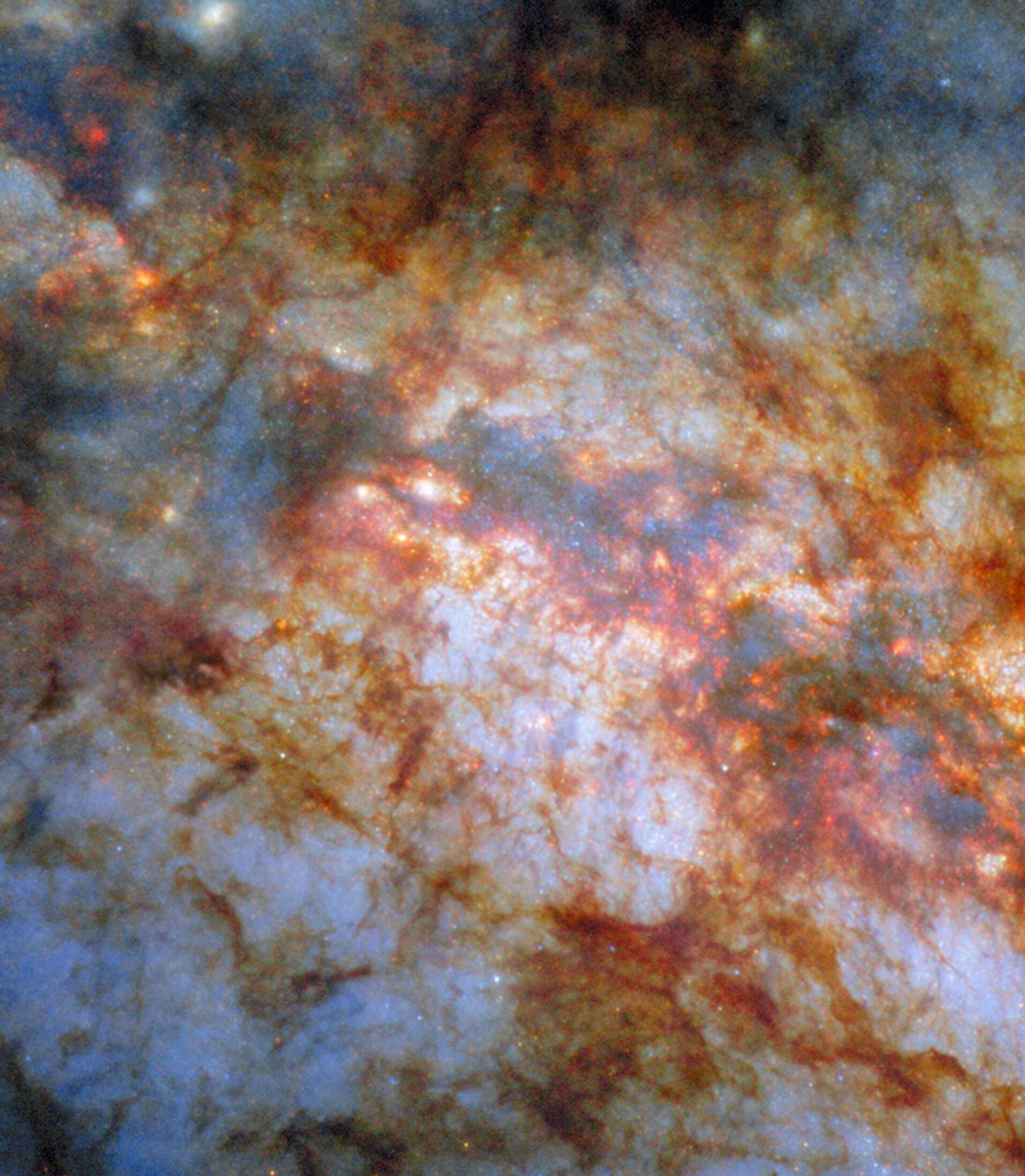
    A close-in view of the center of galaxy M82. Bright, bluish light radiating from the center is due to stars actively forming there. A thick lane of gas, black in the center and red around the edges, crosses the center and blocks much of the light. Thinner strands and clumps of reddish dust cover much of the rest of the view.
    This NASA/ESA Hubble Space Telescope image features the central region of spiral galaxy Messier 82.
    ESA/Hubble & NASA, W. D. Vacca

    This NASA/ESA Hubble Space Telescope image reveals new details in Messier 82 (M82), home to brilliant stars whose light is shaded by sculptural clouds made of clumps and streaks of dust and gas. This image features the star-powered heart of the galaxy, located just 12 million light-years away in the constellation Ursa Major (the Great Bear). Popularly known as the Cigar Galaxy, M82 is considered a nearby galaxy.

    It’s no surprise that M82 is packed with stars. The galaxy forms stars 10 times faster than the Milky Way. Astronomers call it a starburst galaxy. The intense starbirth period that grips this galaxy gave rise to super star clusters in the galaxy’s heart. Each of these super star clusters holds hundreds of thousands of stars and is more luminous than a typical star cluster. Researchers used Hubble to home in on these massive clusters and reveal how they form and evolve.

    Hubble’s previous views of the galaxy captured ultraviolet and visible light in 2012 and near-infrared and visible light in 2006 to celebrate Hubble’s 16th anniversary. NASA’s Chandra X-ray Observatory and Spitzer Space Telescope also imaged this starburst galaxy. Combining the visible and near-infrared light Hubble data with Chandra’s x-ray and Spitzer’s deeper infrared view provides a detailed look at the galaxy’s stars, along with the dust and gas from which stars form. More recently the NASA/ESA/CSA James Webb Space Telescope turned its eye toward the galaxy, producing infrared images in 2024 and earlier this year. These multiple views at different wavelengths of light provide us with a more accurate and complete picture of this galaxy so that we can better understand its environment. Each of these NASA observatories delivers unique and complementary information about the galaxy’s physical processes. Combining their data yields insights that enhance our understanding in a way that no single observatory could accomplish alone. This image features something not seen in previously released Hubble images of the galaxy:  data from the High Resolution Channel of the Advanced Camera for Surveys.

    Explore More

    Media Contact:

    Claire Andreoli (claire.andreoli@nasa.gov)
    NASA’s Goddard Space Flight CenterGreenbelt, MD

  • From Supercomputers to Wind Tunnels: NASA’s Road to Artemis II

    5 Min Read

    From Supercomputers to Wind Tunnels: NASA’s Road to Artemis II

    Of the many roads leading to successful Artemis missions, one is paved with high-tech computing chips called superchips. Along the way, a partnership between NASA wind tunnel engineers, data visualization scientists, and software developers verified a quick, cost-effective solution to improve NASA’s SLS (Space Launch System) rocket for the upcoming Artemis II mission. This will be the first crewed flight of the SLS rocket and Orion spacecraft, on an approximately 10-day journey around the Moon.  

    A high-speed network connection between high-end computing resources at the NASA Advanced Supercomputing facility and the Unitary Plan Wind Tunnel, both located at NASA’s Ames Research Center in California’s Silicon Valley, is enabling a collaboration to improve the rocket for the Artemis II mission. During the Artemis I test flight, the SLS rocket experienced higher-than-expected vibrations near the solid rocket booster attach points, caused by unsteady airflow between the gap.

    One solution proposed for Artemis II was adding four strakes. A strake is a thin, fin-like structure commonly used on aircraft to improve unsteady airflow and stability. Adding them to the core stage minimizes the vibration of components.

    The strake solution comes from previous tests in the Unitary Plan Wind Tunnel, where NASA engineers applied an Unsteady Pressure Sensitive Paint (uPSP) technique to SLS models. The paint measures changes over time in aerodynamic pressures on air and spacecraft.

    This supercomputer simulation peers down at a close-up of the SLS rocket during ascent. The force of friction is represented in greens, yellows, and blues. A six-foot-long strake flanking each booster’s forward connection point on the SLS intertank smooths vibrations induced by airflow, represented by purples, yellows, and reds. The white streams represent a contour plot of density magnitude, highlighting the change of density in the air.
    Credit: NASA/NAS/Gerrit-Daniel Stich, Michael Barad, Timothy Sandstrom, Derek Dalle

    It is sprayed onto test models, and high-speed cameras capture video of the fluctuating brightness of the paint, which corresponds to the local pressure fluctuations on the model. Capturing rapid changes in pressure across large areas of the SLS model helps engineers understand the fast-changing environment. The data is streamed to the NASA Advanced Supercomputing facility via a high-speed network connection.

    “This technique lets us see wind tunnel data in much finer detail than ever before. With that extra clarity, engineers can create more accurate models of how rockets and spacecraft respond to stress, helping design stronger, safer, and more efficient structures,” said Thomas Steva, lead engineer, SLS sub-division in the Aerodynamics Branch at NASA’s Marshall Space Flight Center in Huntsville, Alabama.

    For the SLS configuration with the strakes, the wind tunnel team applied the paint to a scale model of the rocket. Once the camera data streamed to the supercomputing facility, a team of visualization and data analysis experts displayed the results on the hyperwall visualization system, giving the SLS team an unprecedented look at the effect of the strakes on the vehicle’s performance. Teams were able to interact with and analyze the paint data.

    NASA’s high-end computing capability and facilities, paired with unique facilities at Ames, give us the ability to increase productivity by shortening timelines, reducing costs, and strengthening designs in ways that directly support safe human spaceflight.

    Kevin Murphy

    Kevin Murphy

    NASA’s Chief Science Data Officer

    “NASA’s high-end computing capability and facilities, paired with unique facilities at Ames, give us the ability to increase productivity by shortening timelines, reducing costs, and strengthening designs in ways that directly support safe human spaceflight,” said Kevin Murphy, NASA’s chief science data officer and lead for the agency’s High-End Computing Capability portfolio at NASA Headquarters in Washington. “We’re actively using this capability to help ensure Artemis II is ready for launch.”

    Leveraging the high-speed connection between the Unitary Plan Wind Tunnel and NASA Advanced Supercomputing facility reduces the typical data processing time from weeks to just hours.

    For years, the NASA Advancing Supercomputing Division’s in-house Launch, Ascent, and Vehicle Aerodynamics software has helped play a role in designing and certifying the various SLS vehicle configurations.

    “Being able to work with the hyperwall and the visualization team allows for in-person, rapid engagement with data, and we can make near-real-time tweaks to the processing,” said Lara Lash, an aerospace engineering researcher in the Experimental Aero-Physics Branch at NASA Ames who leads the uPSP work.

    This video shows two simulations of the SLS (Space Launch System) rocket using NASA’s Launch Ascent and Vehicle Aerodynamics solver. For the Artemis II test flight, a pair of six-foot-long strakes will be added to the core stage of SLS that will smooth vibrations induced by airflow during ascent. The top simulation is without strakes while the bottom shows the airflow with strakes. The green and yellow colors on the rocket’s surface show how the airflow scrapes against the rocket’s skin. The white and gray areas show changes in air density between the boosters and core stage, with the brightest regions marking shock waves. The strakes reduce vibrations and improves the safety of the integrated vehicle.
    NASA/NAS/Gerrit-Daniel Stich, Michael Barad, Timothy Sandstrom, Derek Dalle

    This time, NASA Advanced Supercomputing researchers used the Cabeus supercomputer, which is the agency’s largest GPU-based computing cluster containing 350 NVIDIA superchip nodes. The supercomputer produced a series of complex computational fluid dynamic simulations that helped explain the underlying physics of the strake addition and filled in gaps between areas where the wind tunnel cameras and sensors couldn’t reach.

    This truly was a joint effort across multiple teams.

    “The beauty of the strake solution is that we were able to add strakes to improve unsteady aerodynamics, and associated vibration levels of components in the intertank,” said Kristin Morgan, who manages the strake implementation effort for the SLS at Marshall.

    A team from Boeing is currently installing the strakes on the rocket at NASA’s Kennedy Space Center in Florida and are targeting October 2025 to complete installation.

    Through Artemis, NASA will send astronauts to explore the Moon for scientific discovery, economic benefits, and build the foundation for the first crewed missions to Mars.

    To learn more about Artemis, visit:

    https://www.nasa.gov/artemis

    News Media Contact

    Jonathan Deal
    Marshall Space Flight Center, Huntsville, Ala. 
    256.544.0034
    jonathan.e.deal@nasa.gov

    Details

    Last Updated

    Sep 18, 2025

    Editor
    Lee Mohon
    Contact
    Jonathan Deal

  • NASA’s Deep Space Communications Demo Exceeds Project Expectations

    5 min read

    Preparations for Next Moonwalk Simulations Underway (and Underwater)

    Infrared photograph, the Optical Communications Telescope Laboratory at JPL’s Table Mountain Facility
    In this infrared photograph, the Optical Communications Telescope Laboratory at JPL’s Table Mountain Facility near Wrightwood, California, beams its eight-laser beacon to the Deep Space Optical Communications flight laser transceiver aboard NASA’s Psyche spacecraft.
    NASA/JPL-Caltech

    The project has exceeded all of its technical goals after two years, setting up the foundations of high-speed communications for NASA’s future human missions to Mars.

    NASA’s Deep Space Optical Communications technology successfully showed that data encoded in lasers could be reliably transmitted, received, and decoded after traveling millions of miles from Earth at distances comparable to Mars. Nearly two years after launching aboard the agency’s Psyche mission in 2023, the technology demonstration recently completed its 65th and final pass, sending a laser signal to Psyche and receiving the return signal, from 218 million miles away. 

    “NASA is setting America on the path to Mars, and advancing laser communications technologies brings us one step closer to streaming high-definition video and delivering valuable data from the Martian surface faster than ever before,” said acting NASA Administrator Sean Duffy. “Technology unlocks discovery, and we are committed to testing and proving the capabilities needed to enable the Golden Age of exploration.”

    This video details how the Deep Space Optical Communications experiment broke records and how the technology demonstration could pave the way for future high-bandwidth data transmission out to Mars distances and beyond. NASA/JPL-Caltech

    Record-breaking technology

    Just a month after launch, the Deep Space Optical Communications demonstration proved it could send a signal back to Earth it established a link with the optical terminal aboard the Psyche spacecraft.

    “NASA Technology tests hardware in the harsh environment of space to understand its limits and prove its capabilities,” said Clayton Turner, associate administrator, Space Technology Mission Directorate at NASA Headquarters in Washington. “Over two years, this technology surpassed our expectations, demonstrating data rates comparable to those of household broadband internet and sending engineering and test data to Earth from record-breaking distances.”

    On Dec. 11, 2023, the demonstration achieved a historic first by streaming an ultra-high-definition video to Earth from over 19 million miles away (about 80 times the distance between Earth and the Moon), at the system’s maximum bitrate of 267 megabits per second. The project also surpassed optical communications distance records on Dec. 3, 2024, when it downlinked Psyche data from 307 million miles away (farther than the average distance between Earth and Mars). In total, the experiment’s ground terminals received 13.6 terabits of data from Psyche.

    How it works

    Managed by NASA’s Jet Propulsion Laboratory (JPL) in Southern California, the experiment consists of a flight laser transceiver mounted on the Psyche spacecraft, along with two ground stations to receive and send data from Earth. A powerful 3-kilowatt uplink laser at JPL’s Table Mountain Facility transmitted a laser beacon to Psyche, helping the transceiver determine where to aim the optical communications laser back to Earth.

    Both Psyche and Earth are moving through space at tremendous speeds, and they are so distant from each other that the laser signal — which travels at the speed of light — can take several minutes to reach its destination. By using the precise pointing required from the ground and flight laser transmitters to close the communication link, teams at NASA proved that optical communications can be done to support future missions throughout the solar system.

    Another element of the experiment included detecting and decoding a faint signal after the laser traveled millions of miles. The project enlisted a 200-inch telescope at Caltech’s Palomar Observatory in San Diego County as its primary downlink station, which provided enough light-collecting area to collect the faintest photons. Those photons were then directed to a high-efficiency detector array at the observatory, where the information encoded in the photons could be processed.   

    “We faced many challenges, from weather events that shuttered our ground stations to wildfires in Southern California that impacted our team members,” said Abi Biswas, Deep Space Optical Communications project technologist and supervisor at JPL. “But we persevered, and I am proud that our team embraced the weekly routine of optically transmitting and receiving data from Psyche. We constantly improved performance and added capabilities to get used to this novel kind of deep space communication, stretching the technology to its limits.”

    Brilliant new era

    In another test, data was downlinked to an experimental radio frequency-optical “hybrid” antenna at the Deep Space Network’s Goldstone complex near Barstow, California. The antenna was retrofitted with an array of seven mirrors, totaling 3 feet in diameter, enabling the antenna to receive radio frequency and optical signals from Psyche simultaneously.

    The project also used Caltech’s Palomar Observatory and a smaller 1-meter telescope at Table Mountain to receive the same signal from Psyche. Known as “arraying,” this is commonly done with radio antennas to better receive weak signals and build redundancy into the system.

    “As space exploration continues to evolve, so do our data transfer needs,” said Kevin Coggins, deputy associate administrator, NASA’s SCaN (Space Communications and Navigation) program at the agency’s headquarters. “Future space missions will require astronauts to send high-resolution images and instrument data from the Moon and Mars back to Earth. Bolstering our capabilities of traditional radio frequency communications with the power and benefits of optical communications will allow NASA to meet these new requirements.”

    This demonstration is the latest in a series of optical communication experiments funded by the Space Technology Mission Directorate’s Technology Demonstration Missions Program managed at NASA’s Marshall Space Flight Center in Huntsville, Alabama, and the agency’s SCaN program within the Space Operations Mission Directorate. The Psyche mission is led by Arizona State University. Lindy Elkins-Tanton of the University of California, Berkeley is the principal investigator. NASA JPL, managed by Caltech in Pasadena, California, is responsible for the mission’s overall management.

    To learn more about the laser communications demo, visit:

    https://www.jpl.nasa.gov/missions/deep-space-optical-communications-dsoc/

    News Media Contact

    Ian J. O’Neill
    Jet Propulsion Laboratory, Pasadena, Calif.
    818-354-2649
    ian.j.oneill@jpl.nasa.gov

    2025-120

  • NASA Gateways to Blue Skies 2026 Competition

    The commercial aviation industry is a crucial component of the U.S. economy, playing a vital role in transporting people, intermediate/final goods, and driving demand for various goods and services nationwide. This network enhances the quality of life for the whole country and facilitates business interactions within and globally, boosting productivity and prosperity. However, the industry faces numerous challenges, particularly the need to reduce rising operational costs in a growing market to accommodate increased demand in air travel, e-commerce, and cargo sectors. Issues such as aging aircraft and components, technological advancements, and staffing shortages further complicate these challenges, hindering efforts to balance passenger safety with operational efficiency. To address these challenges, the industry needs to swiftly innovate and implement more efficient and resilient aircraft maintenance practices, including the adoption of new technologies. In the 2026 Gateways to Blue Skies Competition, teams will conceptualize novel aviation maintenance advancements that can be implemented by 2035 or sooner with the goal of improving efficiency, safety, and/or costs for the industry. Teams are encouraged to consider high-potential technologies and systems that aren’t currently mainstream or highly regarded as becoming mainstream in the future, imagining beyond the status quo.

    Award: $72,000 in total prizes

    Open Date: Phase 1 – September 18, 2025; Phase 2 – March 13, 2026

    Close Date: Phase 1 – February 16, 2026; Phase 2- May 15, 2026

    For more information, visit: https://blueskies.nianet.org/competition/

  • NASA’s Chandra Finds Black Hole With Tremendous Growth

    An artist's concept of a supermassive black hole, a surrounding disk of material falling towards the black hole and a jet containing particles moving away at close to the speed of light. This black hole represents a recently-discovered quasar powered by a black hole. New Chandra observations indicate that the black hole is growing at a rate that exceeds the usual limit for black holes, called the Eddington Limit. Credit: NASA/CXC/SAO/M. Weiss
    An artist’s concept of a supermassive black hole, a surrounding disk of material falling towards the black hole and a jet containing particles moving away at close to the speed of light. This black hole represents a recently-discovered quasar powered by a black hole. New Chandra observations indicate that the black hole is growing at a rate that exceeds the usual limit for black holes, called the Eddington Limit. Credit: NASA/CXC/SAO/M. Weiss
    X-ray: NASA/CXC/INAF-Brera/L. Ighina et al.; Illustration: NASA/CXC/SAO/M. Weiss; Image Processing: NASA/CXC/SAO/N. Wolk

    A black hole is growing at one of the fastest rates ever recorded, according to a team of astronomers. This discovery from NASA’s Chandra X-ray Observatory may help explain how some black holes can reach enormous masses relatively quickly after the big bang.

    The black hole weighs about a billion times the mass of the Sun and is located about 12.8 billion light-years from Earth, meaning that astronomers are seeing it only 920 million years after the universe began. It is producing more X-rays than any other black hole seen in the first billion years of the universe.

    The black hole is powering what scientists call a quasar, an extremely bright object that outshines entire galaxies. The power source of this glowing monster is large amounts of matter funneling around and entering the black hole.

    While the same team discovered it two years ago, it took observations from Chandra in 2023 to discover what sets this quasar, RACS J0320-35, apart. The X-ray data reveal that this black hole appears to be growing at a rate that exceeds the normal limit for these objects.

    “It was a bit shocking to see this black hole growing by leaps and bounds,” said Luca Ighina of the Center for Astrophysics | Harvard & Smithsonian in Cambridge, Massachusetts, who led the study.

    When matter is pulled toward a black hole it is heated and produces intense radiation over a broad spectrum, including X-rays and optical light. This radiation creates pressure on the infalling material. When the rate of infalling matter reaches a critical value, the radiation pressure balances the black hole’s gravity, and matter cannot normally fall inwards any more rapidly. That maximum is referred to as the Eddington limit.

    Scientists think that black holes growing more slowly than the Eddington limit need to be born with masses of about 10,000 Suns or more so they can reach a billion solar masses within a billion years after the big bang — as has been observed in RACS J0320-35. A black hole with such a high birth mass could directly result from an exotic process: the collapse of a huge cloud of dense gas containing unusually low amounts of elements heavier than helium, conditions that may be extremely rare.

    If RACS J0320-35 is indeed growing at a high rate — estimated at 2.4 times the Eddington limit — and has done so for a sustained amount of time, its black hole could have started out in a more conventional way, with a mass less than a hundred Suns, caused by the implosion of a massive star.

    “By knowing the mass of the black hole and working out how quickly it’s growing, we’re able to work backward to estimate how massive it could have been at birth,” said co-author Alberto Moretti of INAF-Osservatorio Astronomico di Brera in Italy. “With this calculation we can now test different ideas on how black holes are born.”

    To figure out how fast this black hole is growing (between 300 and 3,000 Suns per year), the researchers compared theoretical models with the X-ray signature, or spectrum, from Chandra, which gives the amounts of X-rays at different energies. They found the Chandra spectrum closely matched what they expected from models of a black hole growing faster than the Eddington limit. Data from optical and infrared light also supports the interpretation that this black hole is packing on weight faster than the Eddington limit allows.

    “How did the universe create the first generation of black holes?” said co-author Thomas of Connor, also of the Center for Astrophysics. “This remains one of the biggest questions in astrophysics and this one object is helping us chase down the answer.”

    Another scientific mystery addressed by this result concerns the cause of jets of particles that move away from some black holes at close to the speed of light, as seen in RACS J0320-35. Jets like this are rare for quasars, which may mean that the rapid rate of growth of the black hole is somehow contributing to the creation of these jets.

    The quasar was previously discovered as part of a radio telescope survey using the Australian Square Kilometer Array Pathfinder, combined with optical data from the Dark Energy Camera, an instrument mounted on the Victor M. Blanco 4-meter Telescope at the Cerro Tololo Inter-American Observatory in Chile. The U.S. National Science Foundation National Optical-Infrared Astronomy Research Laboratory’s Gemini-South Telescope on Cerro Pachon, Chile was used to obtain the accurate distance of RACS J0320-35.

    A paper describing these results has been accepted for publication in The Astrophysical Journal and is available here.

    NASA’s Marshall Space Flight Center in Huntsville, Alabama, manages the Chandra program. The Smithsonian Astrophysical Observatory’s Chandra X-ray Center controls science operations from Cambridge, and flight operations from Burlington, Massachusetts.

    Learn more about the Chandra X-ray Observatory and its mission here:

    https://www.nasa.gov/chandra

    https://chandra.si.edu

    Visual Description

    This release features a quasar located 12.8 billion light-years from Earth, presented as an artist’s illustration and an X-ray image from NASA’s Chandra X-ray Observatory.

    In the artist’s illustration, the quasar, RACS J0320-35, sits at our upper left, filling the left side of the image. It resembles a spiraling, motion-blurred disk of orange, red, and yellow streaks. At the center of the disk, surrounded by a glowing, sparking, brilliant yellow light, is a black egg shape. This is a black hole, one of the fastest-growing black holes ever detected. The black hole is also shown in a small Chandra X-ray image inset at our upper right. In that depiction, the black hole appears as a white dot with an outer ring of neon purple.

    The artist’s illustration also highlights a jet of particles blasting away from the black hole at the center of the quasar. The streaked silver beam starts at the core of the distant quasar, near our upper left, and shoots down toward our lower right. The blurry beam of energetic particles appears to widen as it draws closer and exits the image.

    News Media Contact

    Megan Watzke
    Chandra X-ray Center
    Cambridge, Mass.
    617-496-7998
    mwatzke@cfa.harvard.edu

    Corinne Beckinger
    Marshall Space Flight Center, Huntsville, Alabama
    256-544-0034
    corinne.m.beckinger@nasa.gov

  • Building a Lunar Network: Johnson Tests Wireless Technologies for the Moon 

    2 Min Read

    Building a Lunar Network: Johnson Tests Wireless Technologies for the Moon 

    A group of people stand together at a test site in the desert, with wide open terrain and craters in the background.

    From left, Johnson Exploration Wireless Laboratory (JEWL) Software Lead William Dell; Lunar 3GPP Principal Investigator Raymond Wagner; JEWL intern Harlan Phillips; and JEWL Lab Manager Chatwin Lansdowne.

    Credits:
    Nevada Space Proving Grounds (NSPG)

    NASA engineers are strapping on backpacks loaded with radios, cameras, and antennas to test technology that might someday keep explorers connected on the lunar surface. Their mission: test how astronauts on the Moon will stay connected during Artemis spacewalks using 3GPP (LTE/4G and 5G) and Wi-Fi technologies. 

    It’s exciting to bring lunar spacewalks into the 21st century with the immersive, high-definition experience that will make people feel like they’re right there with the astronauts.

    Raymond Wagner

    Raymond Wagner

    NASA’s Lunar 3GPP Project Principal Investigator

    A person walks with a prototype backpack in the Nevada desert.
    A NASA engineer tests a backpack-mounted wireless communications system in the Nevada desert, simulating how astronauts will stay connected during Artemis lunar spacewalks.
    NSPG

    With Artemis, NASA will establish a long-term presence at the Moon, opening more of the lunar surface to exploration than ever before. This growth of lunar activity will require astronauts to communicate seamlessly with each other and with science teams back on Earth.  

    “We’re working out what the software that uses these networks needs to look like,” said Raymond Wagner, principal investigator in NASA’s Lunar 3GPP project and member of Johnson Space Center’s Exploration Wireless Laboratory (JEWL) in Houston. “We’re prototyping it with commercial off-the-shelf hardware and open-source software to show what pieces are needed and how they interact.” 

    A person walks with a prototype backpack in the Nevada desert.
    Carrying a prototype wireless network pack, a NASA engineer helps test wireless 4G and 5G technologies that could one day keep Artemis astronauts connected on the Moon.
    NSPG

    The next big step comes with Artemis III, which will land a crew on the Moon and carry a 4G/LTE demonstration to stream video and audio from the astronauts on the lunar surface. 

     The vision goes further. “Right now the lander or rover will host the network,” Wagner said. “But if we go to the Moon to stay, we may eventually want actual cell towers. The spacesuit itself is already becoming the astronaut’s cell phone, and rovers could act as mobile hotspots. Altogether, these will be the building blocks of communication on the Moon.” 

    Four people wearing prototype backpack communication systems cross a street at Johnson Space Center in Houston.
    Team members from NASA’s Avionics Systems Laboratory at Johnson Space Center in Houston.
    NASA/Sumer Loggins

    Back at Johnson, teams are simulating lunar spacewalks, streaming video, audio, and telemetry over a private 5G network to a mock mission control. The work helps engineers refine how future systems will perform in challenging environments. Craters, lunar regolith, and other terrain features all affect how radio signals travel — lessons that will also carry over to Mars. 

    For Wagner, the project is about shaping how humanity experiences the next era of exploration. “We’re aiming for true HD on the Moon,” he said. “It’s going to be pretty mind-blowing.” 

    About the Author

    Sumer Loggins

    Sumer Loggins

    Details

    Last Updated

    Sep 18, 2025

  • NASA Artemis II Moon Rocket Ready to Fly Crew

    NASA’s Artemis II SLS (Space Launch System) rocket poised to send four astronauts from Earth on a journey around the Moon next year may appear identical to the Artemis I SLS rocket. On closer inspection, though, engineers have upgraded the agency’s Moon rocket inside and out to improve performance, reliability, and safety.

    SLS flew a picture perfect first mission on the Artemis I test flight, meeting or exceeding parameters for performance, attitude control, and structural stability to an accuracy of tenths or hundredths of a percent as it sent an uncrewed Orion thousands of miles beyond the Moon. It also returned volumes of invaluable flight data for SLS engineers to analyze to drive improvements.


    Image shows orange rocket stage with two large solid rocket boosters stacked alongside on March 23.
    Teams with NASA’s Exploration Ground Systems integrate the SLS (Space Launch System) Moon rocket with the solid rocket boosters onto mobile launcher 1 inside High Bay 3 of the Vehicle Assembly Building at NASA’s Kennedy Space Center in March 2025. Artemis II is the first crewed test flight under NASA’s Artemis campaign and is another step toward missions on the lunar surface and helping the agency prepare for future human missions to Mars.
    NASA/Frank Michaux

    For Artemis II, the major sections of SLS remain unchanged – a central core stage, four RS-25 main engines, two five-segment solid rocket boosters, the ICPS (interim cryogenic propulsion stage), a launch vehicle stage adapter to hold the ICPS, and an Orion stage adapter connecting SLS to the Orion spacecraft. The difference is in the details.

    “While we’re proud of our Artemis I performance, which validated our overall design, we’ve looked at how SLS can give our crews a better ride,” said John Honeycutt, NASA’s SLS Program manager. “Some of our changes respond to specific Artemis II mission requirements while others reflect ongoing analysis and testing, as well as lessons learned from Artemis I.”

    Engineers have outfitted the ICPS with optical targets that will serve as visual cues to the astronauts aboard Orion as they manually pilot Orion around the upper stage and practice maneuvers to inform docking operations for Artemis III.

    The Artemis II rocket includes an improved navigation system compared to Artemis I.  Its communications capability also has been improved by repositioning antennas on the rocket to ensure continuous communications with NASA ground stations and the U.S. Space Force’s Space Launch Delta 45 which controls launches along the Eastern Range.

    An emergency detection system on the ICPS allows the rocket to sense and respond to problems and notify the crew. The flight safety system adds a time delay to the self-destruct system to allow time for Orion’s escape system to pull the capsule to safety in event of an abort.

    The separation motors that push the solid rocket booster away after the elements are no longer needed were angled an additional 15 degrees to increase separation clearance as the rest of the rocket speeds by.

    Additionally, SLS will jettison the spent boosters four seconds earlier during Artemis II ascent than occurred during Artemis I. Dropping the boosters several seconds closer to the end of their burn will give engineers flight data to correlate with projections that shedding the boosters several seconds sooner will yield approximately 1,600 pounds of payload to Earth orbit for future SLS flights.

    Engineers have incorporated additional improvements based on lessons learned from Artemis I. During the Artemis I test flight the SLS rocket experienced higher-than-expected vibrations near the solid rocket booster attachment points that was caused by unsteady airflow.

    To steady the airflow, a pair of six-foot-long strakes flanking each booster’s forward connection points on the SLS intertank will smooth vibrations induced by airflow during ascent, and the rocket’s electronics system was requalified to endure higher levels of vibrations.

    Engineers updated the core stage power distribution control unit, mounted in the intertank, which controls power to the rocket’s other electronics and protects against electrical hazards.

    These improvements have led to an enhanced rocket to support crew as part of NASA’s Golden Age of innovation and exploration.

    The approximately 10-day Artemis II test flight is the first crewed flight under NASA’s Artemis campaign. It is another step toward new U.S.-crewed missions on the Moon’s surface that will help the agency prepare to send the first astronauts – Americans – to Mars.

    https://www.nasa.gov/artemis

    News Media Contact

    Jonathan Deal
    Marshall Space Flight Center, Huntsville, Ala. 
    256.631.9126
    jonathan.e.deal@nasa.gov

    Details

    Last Updated

    Sep 17, 2025

    Editor
    Lee Mohon
    Contact
    Jonathan Deal

  • NASA’s Tally of Planets Outside Our Solar System Reaches 6,000

    6 min read

    Preparations for Next Moonwalk Simulations Underway (and Underwater)

    It’s been 30 years since the discovery of the first planet around another star like our Sun. With every new discovery, scientists move closer to answering whether there are other planets like Earth that could host life as we know it. NASA/JPL-Caltech

    The milestone highlights the accelerating rate of discoveries, just over three decades since the first exoplanets were found.

    The official number of exoplanets — planets outside our solar system — tracked by NASA has reached 6,000. Confirmed planets are added to the count on a rolling basis by scientists from around the world, so no single planet is considered the 6,000th entry. The number is monitored by NASA’s Exoplanet Science Institute (NExScI), based at Caltech’s IPAC in Pasadena, California. There are more than 8,000 additional candidate planets awaiting confirmation, with NASA leading the world in searching for life in the universe.

    “This milestone represents decades of cosmic exploration driven by NASA space telescopes — exploration that has completely changed the way humanity views the night sky,” said Shawn Domagal-Goldman, acting director, Astrophysics Division, NASA Headquarters in Washington. “Step by step, from discovery to characterization, NASA missions have built the foundation to answering a fundamental question: Are we alone? Now, with our upcoming Nancy Grace Roman Space Telescope and Habitable Worlds Observatory, America will lead the next giant leap — studying worlds like our own around stars like our Sun. This is American ingenuity, and a promise of discovery that unites us all.”

    Artist’s concept, from small, rocky worlds and gas giants
    Scientists have found thousands of exoplanets (planets outside our solar system) throughout the galaxy. Most can be studied only indirectly, but scientists know they vary widely, as depicted in this artist’s concept, from small, rocky worlds and gas giants to water-rich planets and those as hot as stars.
    NASA’s Goddard Space Flight Center

    The milestone comes 30 years after the first exoplanet was discovered around a star similar to our Sun, in 1995. (Prior to that, a few planets had been identified around stars that had burned all their fuel and collapsed.) Although researchers think there are billions of planets in the Milky Way galaxy, finding them remains a challenge. In addition to discovering many individual planets with fascinating characteristics as the total number of known exoplanets climbs, scientists are able to see how the general planet population compares to the planets of our own solar system.

    For example, while our solar system hosts an equal number of rocky and giant planets, rocky planets appear to be more common in the universe. Researchers have also found a range of planets entirely different from those in our solar system. There are Jupiter-size planets that orbit closer to their parent star than Mercury orbits the Sun; planets that orbit two stars, no stars, and dead stars; planets covered in lava; some with the density of Styrofoam; and others with clouds made of gemstones.

    “Each of the different types of planets we discover gives us information about the conditions under which planets can form and, ultimately, how common planets like Earth might be, and where we should be looking for them,” said Dawn Gelino, head of NASA’s Exoplanet Exploration Program (ExEP), located at the agency’s Jet Propulsion Laboratory in Southern California. “If we want to find out if we’re alone in the universe, all of this knowledge is essential.” 

    Searching for other worlds

    Fewer than 100 exoplanets have been directly imaged, because most planets are so faint they get lost in the light from their parent star. The other four methods of planet detection are indirect. With the transit method, for instance, astronomers look for a star to dim for a short period as an orbiting planet passes in front of it.

    To account for the possibility that something other than an exoplanet is responsible for a particular signal, most exoplanet candidates must be confirmed by follow-up observations, often using an additional telescope, and that takes time. That’s why there is a long list of candidates in the NASA Exoplanet Archive (hosted by NExScI) waiting to be confirmed.

    “We really need the whole community working together if we want to maximize our investments in these missions that are churning out exoplanets candidates,” said Aurora Kesseli, the deputy science lead for the NASA Exoplanet Archive at IPAC. “A big part of what we do at NExScI is build tools that help the community go out and turn candidate planets into confirmed planets.”

    The rate of exoplanet discoveries has accelerated in recent years (the database reached 5,000 confirmed exoplanets just three years ago), and this trend seems likely to continue. Kesseli and her colleagues anticipate receiving thousands of additional exoplanet candidates from the ESA (European Space Agency) Gaia mission, which finds planets through a technique called astrometry, and NASA’s upcoming Nancy Grace Roman Space Telescope, which will discover thousands of new exoplanets primarily through a technique called gravitational microlensing.

    Artists concept of various exoplanet missions
    Many telescopes contribute to the search for and study of exoplanets, including some in space (artists concepts shown here) and on the ground. Doing the work are organizations around the world, including ESA (European Space Agency), CSA (Canadian Space Agency), and NSF (National Science Foundation).
    NASA/JPL-Caltech

    Future exoplanets

    At NASA, the future of exoplanet science will emphasize finding rocky planets similar to Earth and studying their atmospheres for biosignatures — any characteristic, element, molecule, substance, or feature that can be used as evidence of past or present life. NASA’s James Webb Space Telescope has already analyzed the chemistry of over 100 exoplanet atmospheres.

    But studying the atmospheres of planets the size and temperature of Earth will require new technology. Specifically, scientists need better tools to block the glare of the star a planet orbits. And in the case of an Earth-like planet, the glare would be significant: The Sun is about 10 billion times brighter than Earth — which would be more than enough to drown out our home planet’s light if viewed by a distant observer.

    NASA has two main initiatives to try overcoming this hurdle. The Roman telescope will carry a technology demonstration instrument called the Roman Coronagraph that will test new technologies for blocking starlight and making faint planets visible. At its peak performance, the coronagraph should be able to directly image a planet the size and temperature of Jupiter orbiting a star like our Sun, and at a similar distance from that star. With its microlensing survey and coronagraphic observations, Roman will reveal new details about the diversity of planetary systems, showing how common solar systems like our own may be across the galaxy.

    Additional advances in coronagraph technology will be needed to build a coronagraph that can detect a planet like Earth. NASA is working on a concept for such a mission, currently named the Habitable Worlds Observatory.

    More about ExEP, NExScI 

    NASA’s Exoplanet Exploration Program is responsible for implementing the agency’s plans for the discovery and understanding of planetary systems around nearby stars. It acts as a focal point for exoplanet science and technology and integrates cohesive strategies for future discoveries. The science operations and analysis center for ExEP is NExScI, based at IPAC, a science and data center for astrophysics and planetary science at Caltech. JPL is managed by Caltech for NASA.

    /

    News Media Contact

    Calla Cofield
    Jet Propulsion Laboratory, Pasadena, Calif.
    626-808-2469
    calla.e.cofield@jpl.nasa.gov

    2025-119

  • NASA Rideshares Integrated Ahead of Launch

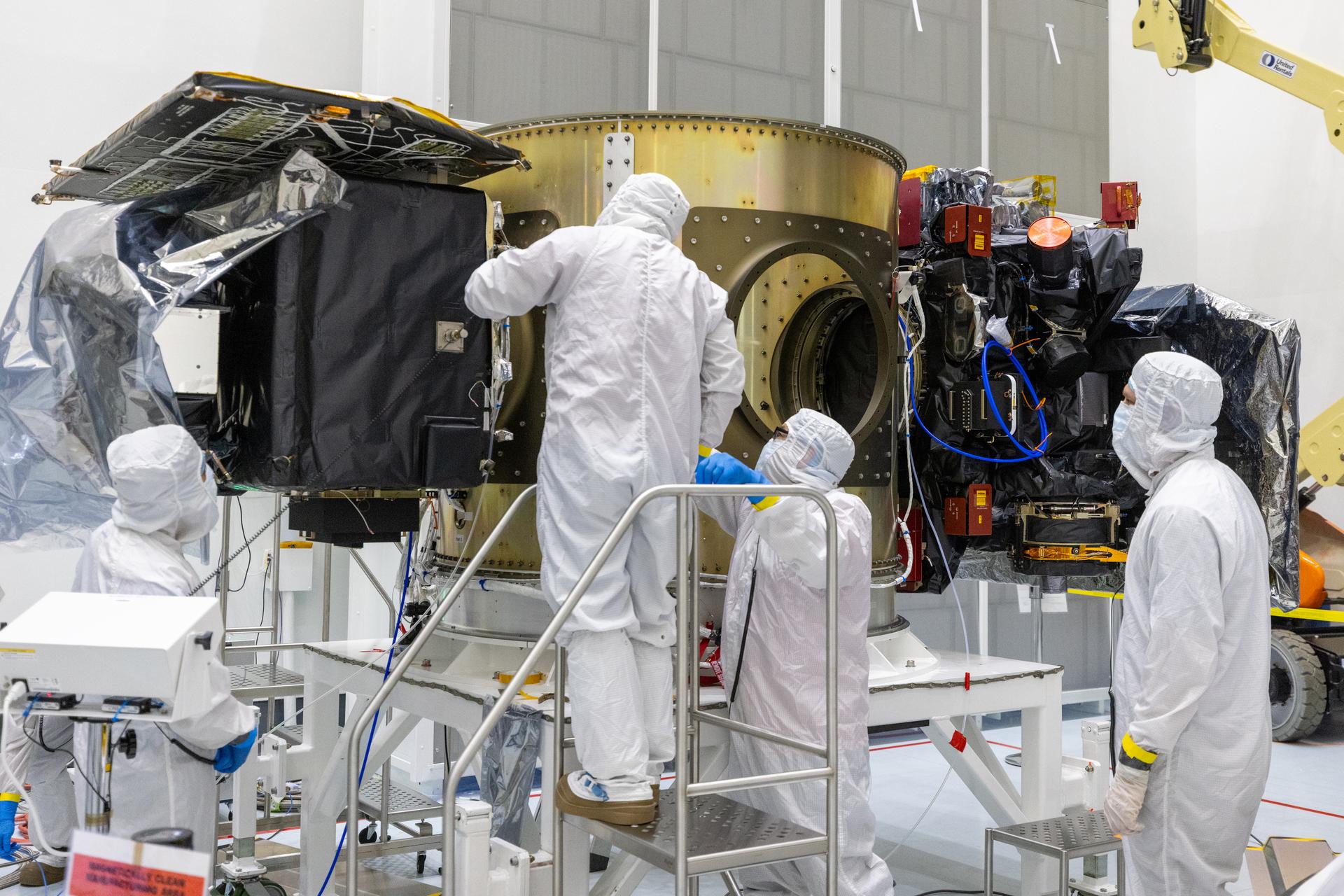
    Image shows four people wearing white protective suits, commonly known as bunny suits, standing around NASA’s Carruthers Geocorona Observatory and the National Oceanic and Atmospheric Administration’s (NOAA) Space Weather Follow-On Lagrange 1 (SWFO-L1) satellite spacecraft's set to launch with NASA's IMAP (Interstellar Mapping and Acceleration Probe) observatory at NASA's Kennedy Space Center in Florida.

    Technicians completed integrating NASA’s Carruthers Geocorona Observatory and the National Oceanic and Atmospheric Administration’s (NOAA) Space Weather Follow-On Lagrange 1 (SWFO-L1) satellite to an Evolved Expendable Launch Vehicle Secondary Payload Adapter ring at the Astrotech Space Operations Facility near NASA’s Kennedy Space Center in Florida on Sept. 4.

    Integrating the rideshares to the ring precedes the next prelaunch launch milestone: attaching NASA’s IMAP (Interstellar Mapping and Acceleration Probe) heliosphere mapping observatory to a payload adapter that connects to the ring. This configuration allows all three spacecraft to launch atop a single SpaceX Falcon 9 rocket, maximizing efficiency by sharing the ride to space.

    The Carruthers observatory will capture light from Earth’s geocorona, the part of the outer atmosphere that emits ultraviolet light. The observations will advance our understanding of space weather, planetary atmospheric evolution, and the long-term history of water on Earth.

    The SWFO-L1 satellite will keep a watchful eye on the Sun and the near-Earth environment for space weather activity. It is the first NOAA satellite designed specifically for and fully dedicated to continuous space weather observations. It will serve as an early warning beacon for destructive space weather events that could impact our technological dependent infrastructure and industries.

    The spacecraft will launch together aboard a SpaceX Falcon 9 rocket no earlier than 7:32 a.m. EDT on Tuesday, Sept. 23, from Launch Complex 39A at NASA Kennedy.

    Image credit: NASA/Frank Michaux

  • Arctic Sea Ice Reaches Annual Low

    4 min read

    Preparations for Next Moonwalk Simulations Underway (and Underwater)

    Daily images of ice cover in the Arctic Ocean (left) and around Antarctica reveal sea ice formation and melting at the poles over the course of two years (Sept 14, 2023 to Sept. 13, 2025).
    Trent Schindler/NASA’s Scientific Visualization Studio

    With the end of summer approaching in the Northern Hemisphere, the extent of sea ice in the Arctic shrank to its annual minimum on Sept. 10, according to NASA and the National Snow and Ice Data Center. The total sea ice coverage was tied with 2008 for the 10th-lowest on record at 1.78 million square miles (4.60 million square kilometers). In the Southern Hemisphere, where winter is ending, Antarctic ice is still accumulating but remains relatively low compared to ice levels recorded before 2016.

    The areas of ice covering the oceans at the poles fluctuate through the seasons. Ice accumulates as seawater freezes during colder months and melts away during the warmer months. But the ice never quite disappears entirely at the poles. In the Arctic Ocean, the area the ice covers typically reaches its yearly minimum in September. Since scientists at NASA and the National Oceanic and Atmospheric Administration (NOAA) began tracking sea ice at the poles in 1978, sea ice extent has generally been declining as global temperatures have risen. 

    “While this year’s Arctic sea ice area did not set a record low, it’s consistent with the downward trend,” said Nathan Kurtz, chief of the Cryospheric Sciences Laboratory at NASA’s Goddard Space Flight Center in Greenbelt, Maryland.

    Arctic ice reached its lowest recorded extent in 2012. Ice scientist Walt Meier of the National Snow and Ice Data Center at the University of Colorado, Boulder, attributes that record low to a combination of a warming atmosphere and unusual weather patterns. This year, the annual decline in ice initially resembled the changes in 2012. Although the melting tapered off in early August, it wasn’t enough to change the year-over-year downward trend. “For the past 19 years, the minimum ice coverage in the Arctic Ocean has fallen below the levels prior to 2007,” Meier said. “That continues in 2025.” 

    Antarctic sea ice nearing annual maximum

    As ice in the Arctic reaches its annual minimum, sea ice around the Antarctic is approaching its annual maximum. Until recently, ice in the ocean around the Southern pole has been more resilient than sea ice in the North, with maximum coverage increasing slightly in the years before 2015. “This year looks lower than average,” Kurtz said. “But the Antarctic system as a whole is more complicated,” which makes predicting and understanding sea ice trends in the Antarctic more difficult. 

    It’s not yet clear whether lower ice coverage in the Antarctic will persist, Meier said. “For now, we’re keeping an eye on it” to see if the lower sea ice levels around the South Pole are here to stay or only part of a passing phase. 

    A history of tracking global ice 

    For nearly five decades, NASA and NOAA have relied on a variety of satellites to build a continuous sea ice record, beginning with the NASA Nimbus-7 satellite (1978–1987) and continuing with the Special Sensor Microwave/Imager and the Special Sensor Microwave Imager Sounder on Defense Meteorological Satellite Program satellites that began in 1987. The Advanced Microwave Scanning Radiometer–for EOS on NASA’s Aqua satellite also contributed data from 2002 to 2011. Scientists have extended data collection with the 2012 launch of the Advanced Microwave Scanning Radiometer 2 aboard a JAXA (Japan Aerospace Exploration Agency) satellite.

    With the launch of ICESat-2 in 2018, NASA has added the continuous observation of ice thickness to its recording. The ICESat-2 satellite measures ice height by recording the time it takes for laser light from the satellite to reflect from the surface and travel back to detectors on board.

    “We’ve hit 47 years of continuous monitoring of the global sea ice extent from satellites,” said Angela Bliss, assistant chief of NASA’s Cryospheric Sciences Laboratory. “This data record is one of the longest, most consistent satellite data records in existence, where every single day we have a look at the sea ice in the Arctic and the Antarctic.”

    By James Riordon
    NASA Goddard Space Flight Center

    Media contact: Elizabeth Vlock
    NASA Headquarters

    Details

    Last Updated

    Sep 17, 2025

    Location
    NASA Goddard Space Flight Center

  • Space Station Science

    An astronaut smiles at the camera while she works at a glovebox on the International Space Station. Her hands are inside the glove box. She is wearing a black headset.
    NASA/Jonny Kim

    NASA astronaut Zena Cardman processes bone cell samples inside the Kibo laboratory module’s Life Science Glovebox on Aug. 28, 2025, as part of an experiment that tests how microgravity affects bone-forming and bone-degrading cells and explore potential ways to prevent bone loss. This research could help protect astronauts on future long-duration missions to the Moon and Mars, while also advancing treatments for millions of people on Earth who suffer from osteoporosis.

    Image credit: NASA/Jonny Kim

  • NASA’s IMAP Mission to Study Boundaries of Our Home in Space

    6 min read

    NASA’s IMAP Mission to Study Boundaries of Our Home in Space

    Summary

    • NASA’s new Interstellar Mapping and Acceleration Probe, or IMAP, will launch no earlier than Tuesday, Sept. 23 to study the heliosphere, a giant shield created by the Sun.
    • The mission will chart the heliosphere’s boundaries to help us better understand the protection it offers life on Earth and how it changes with the Sun’s activity.
    • The IMAP mission will also provide near real-time measurements of the solar wind, data that can be used to improve models predicting the impacts of space weather ranging from power-line disruptions to loss of satellites, to the health of voyaging astronauts.

    Space is a dangerous place — one that NASA continues to explore for the benefit of all. It’s filled with radiation and high-energy particles that can damage DNA and circuit boards alike. Yet life endures in our solar system in part because of the heliosphere, a giant bubble created by the Sun that extends far beyond Neptune’s orbit.

    With NASA’s new Interstellar Mapping and Acceleration Probe, or IMAP, launching no earlier than Tuesday, Sept. 23, humanity is set to get a better look at the heliosphere than ever before. The mission will chart the boundaries of the heliosphere to help us better understand the protection it offers and how it changes with the Sun’s activity. The IMAP mission will also provide near real-time measurements of space weather conditions essential for the Artemis campaign and deep space travel. 

    “With IMAP, we’ll push forward the boundaries of knowledge and understanding of our place not only in the solar system, but our place in the galaxy as a whole,” said Patrick Koehn, IMAP program scientist at NASA Headquarters in Washington. “As humanity expands and explores beyond Earth, missions like IMAP will add new pieces of the space weather puzzle that fills the space between Parker Solar Probe at the Sun and the Voyagers beyond the heliopause.”

    Download this video from NASA’s Scientific Visualization Studio.

    Domain of Sun

    The heliosphere is created by the constant outflow of material and magnetic fields from the Sun called the solar wind. As the solar system moves through the Milky Way, the solar wind’s interaction with interstellar material carves out the bubble of the heliosphere. Studying the heliosphere helps scientists understand our home in space and how it came to be habitable.

    As a modern-day celestial cartographer, IMAP will map the boundary of our heliosphere and study how the heliosphere interacts with the local galactic neighborhood beyond. It will chart the vast range of particles, dust, ultraviolet light, and magnetic fields in interplanetary space, to investigate the energization of charged particles from the Sun and their interaction with interstellar space.

    The IMAP mission builds on NASA’s Voyager and IBEX (Interstellar Boundary Explorer) missions. In 2012 and 2018, the twin Voyager spacecraft became the first human-made objects to cross the heliosphere’s boundary and send back measurements from interstellar space. It gave scientists a snapshot of what the boundary looked like and where it was in two specific locations. While IBEX has been mapping the heliosphere, it has left many questions unanswered. With 30 times higher resolution and faster imaging, IMAP will help fill in the unknowns about the heliosphere.

    Energetic neutral atoms: atomic messengers from our heliosphere’s edge

    Of IMAP’s 10 instruments, three will investigate the boundaries of the heliosphere by collecting energetic neutral atoms, or ENAs. Many ENAs originate as positively charged particles released by the Sun but after racing across the solar system, these particles run into particles in interstellar space. In this collision, some of those positively charged particles become neutral, and an energetic neutral atom is born. The interaction also redirects the new ENAs, and some ricochet back toward the Sun.

    Charged particles are forced to follow magnetic field lines, but ENAs travel in a straight line, unaffected by the twists, turns, and turbulences in the magnetic fields that permeate space and shape the boundary of the heliosphere. This means scientists can track where these atomic messengers came from and study distant regions of space from afar. The IMAP mission will use the ENAs it collects near Earth to trace back their origins and construct maps of the boundaries of the heliosphere, which would otherwise be invisible from such a distance.

    “With its comprehensive state-of-the-art suite of instruments, IMAP will advance our understanding of two fundamental questions of how particles are energized and transported throughout the heliosphere and how the heliosphere itself interacts with our galaxy,” said Shri Kanekal, IMAP mission scientist at NASA’s Goddard Space Flight Center in Greenbelt, Maryland.

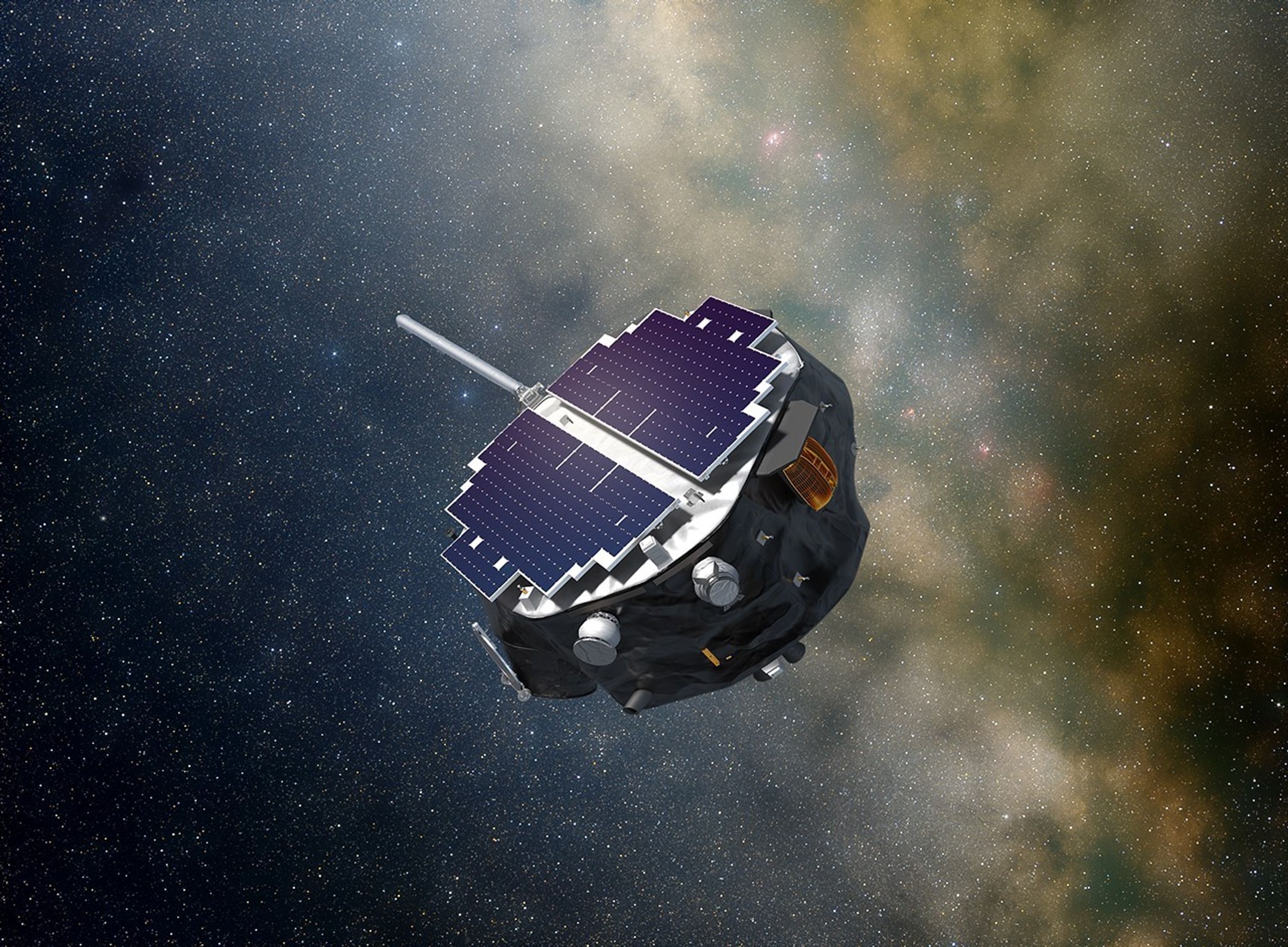
    A circular spacecraft floats in space with stars and dust visible in the background.
    The IMAP mission will study the heliosphere, our home in space.
    NASA/Princeton University/Patrick McPike

    Space weather: monitoring solar wind

    The IMAP mission will also support near real-time observations of the solar wind and energetic solar particles, which can produce hazardous conditions in the space environment near Earth. From its location at Lagrange Point 1, about 1 million miles from Earth toward the Sun, IMAP will provide around a half hour’s warning of dangerous particles headed toward our planet. The mission’s data will help with the development of models that can predict the impacts of space weather ranging from power-line disruptions to loss of satellites.

    “The IMAP mission will provide very important information for deep space travel, where astronauts will be directly exposed to the dangers of the solar wind,” said David McComas, IMAP principal investigator at Princeton University.

    Cosmic dust: hints of the galaxy beyond

    In addition to measuring ENAs and solar wind particles, IMAP will also make direct measurements of interstellar dust — clumps of particles originating outside of the solar system that are smaller than a grain of sand. This space dust is largely composed of rocky or carbon-rich grains leftover from the aftermath of supernova explosions. 

    The specific elemental composition of this space dust is a postmark for where it comes from in the galaxy. Studying cosmic dust can provide insight into the compositions of stars from far outside our solar system. It will also help scientists significantly advance what we know about these basic cosmic building materials and provide information on what the material between stars is made of.

    David McComas leads the mission with an international team of 27 partner institutions. APL is managing the development phase and building the spacecraft, and it will operate the mission. IMAP is the fifth mission in NASA’s Solar Terrestrial Probes Program portfolio. The Explorers and Heliophysics Projects Division at NASA Goddard manages the STP Program for the agency’s Heliophysics Division of NASA’s Science Mission Directorate. NASA’s Launch Services Program, based at NASA’s Kennedy Space Center in Florida, manages the launch service for the mission.

    By Mara Johnson-Groh
    NASA’s Goddard Space Flight Center, Greenbelt, Md.