Tag: Kepler

  • Meet NASA’s Artemis II Moon Mission Masterminds

    Teams at NASA’s Kennedy Space Center in Florida participate in the first joint integrated launch countdown simulation for Artemis I inside Firing Room 1 of the Launch Control Center on July 8, 2021. Seen at the top of the room is Charlie Blackwell-Thompson (right), launch director.
    Credit: NASA/Ben Smegelsky

    As four astronauts venture around the Moon on NASA’s Artemis II test flight in 2026, many people will support the journey from here on Earth. Teams directing operations from the ground include the mission management team, launch control team, flight control team, and the landing and recovery team, each with additional support personnel who are experts in every individual system and subsystem. The teams have managed every aspect of the test flight and ensure NASA is prepared to send humans beyond our atmosphere and into a new Golden Age of innovation and exploration.

    Mission management team

    Reviews of mission status and risk assessments are conducted by the mission management team, a group of 15 core members and additional advisors. Amit Kshatriya, NASA’s deputy associate administrator, Moon to Mars Program, will serve as the mission management team chair for the test flight.

    Two days prior to launch, the mission management team will assemble to review mission risks and address any lingering preflight concerns. With more than 20 years of human spaceflight experience, Kshatriya will conduct polls at key decision points, providing direction for the relevant operations team. If circumstances during the flight go beyond established decision criteria or flight rules outlined ahead of the mission, the team will assess the situation based on the information available and decide how to respond. 

    Matt Ramsey, serving as the Artemis II mission manager, will oversee all elements of mission preparedness prior to the mission management team assembly two days before launch and serve as deputy mission management team chair throughout the mission. With more than two decades of experience at NASA, Ramsey managed the SLS (Space Launch System) Engineering Support Center for Artemis I. 

    Launch control team

    The launch control team coordinates launch operations from NASA’s Kennedy Space Center in Florida. Charlie Blackwell-Thompson serves as the agency’s Artemis launch director, responsible for integrating and coordinating launch operations for the SLS, Orion, and Exploration Ground Systems Programs, including developing and implementing plans for countdown, troubleshooting, and timing.

    Two days before liftoff, when the countdown for launch begins, Blackwell-Thompson’s team will begin preparations for launch from their console positions in Firing Room 1 in Kennedy’s Launch Control Center. On the day of launch, Blackwell-Thompson and her team will manage countdown progress, propellent loading, and launch commit criteria. The criteria include standards for systems involved in launch, and the team will monitor the rocket until it lifts off from the launchpad.

    Rick Henfling, flight director, monitors systems in the Flight Control Center at NASA’s Johnson Space Center in Houston.
    Credit: NASA

    Flight control team

    From solid rocket booster ignition until the crew is safely extracted from the Orion capsule following splashdown in the Pacific Ocean at the end of their mission, the flight control team oversees operations from the Mission Control Center at NASA’s Johnson Space Center in Houston. Multiple flight directors will take turns leading the team throughout the 10-day mission to support operations around the clock. Jeff Radigan, bringing more than 20 years of International Space Station experience to Artemis II, will serve as lead flight director for the mission. The work for this role begins well in advance of the mission with building mission timelines; developing flight rules and procedures; leading the flight control team through simulations that prepare them for the flight test; and then helping them carry out the plan.

    On launch day, the ascent flight control team will be led by Judd Frieling, an Artemis I flight director who also supported more than 20 shuttle missions as a flight controller. Frieling is responsible for overseeing the crew’s ascent to space, including performance of SLS core stage engines, solid rocket boosters, and propulsion systems from the moment of launch until the separation of Orion from the Interim Cryogenic Propulsion Stage. As Orion is propelled toward the Moon, guidance of operations will pass to the next flight director.

    At the opposite end of the mission, Rick Henfling will take the lead for Orion’s return to Earth and splashdown. Orion will reenter Earth’s atmosphere at roughly 25,000 mph to about 20 mph for a parachute-assisted splashdown. Drawing from a background supporting space shuttle ascent, entry, and abort operations and 10 years as a space station flight director, Henfling and the team will monitor weather forecasts for landing, watch over Orion’s systems through the dynamic entry phase, and to ensure the spacecraft is safely shutdown before handing over operations to the recovery team.

    At any point during the mission, a single voice will speak to the crew in space on behalf of all members of the flight control team: the capsule communicator, or CapCom. The CapCom ensures the crew in space receives clear and concise communication from the teams supporting them on the ground. NASA astronaut Stan Love will serve as the lead CapCom for Artemis II. Love flew aboard STS-122 mission and has acted as CapCom for more than a dozen space station expeditions. He is also part of the astronaut office’s Rapid Prototyping Lab, which played a key role in development of Orion’s displays and controls.

    Landing, recovery team

    Retrieval of the crew and Orion crew module will be in the hands of the landing and recovery team, led by Lili Villarreal. The team will depart San Diego on a Department of Defense ship, and head to the vicinity of the landing site several days before splashdown for final preparations alongside the U.S. Navy and DOD.

    The recovery team is made up of personnel operating from the ship, land, and air to recover both astronauts and the capsule. Decision-making authority during the recovery phase of mission operations belongs to Villarreal, who served as deputy flow director for Artemis I and worked in the operations division for the space station.

    The success of Artemis II will pave the way for the next phase of the agency’s campaign, landing on the lunar South Pole region on Artemis III. These teams, along with the four crew members and countless NASA engineers, scientists, and personnel, are driving humanity’s exploration on the Moon, Mars, and beyond.

  • NASA Seeks Volunteers to Track Artemis II Mission

    2 Min Read

    NASA Seeks Volunteers to Track Artemis II Mission

    On the 19th day of the Artemis I mission, the Moon grows larger in frame as Orion prepares for the return powered flyby on Dec. 5, when it will pass approximately 79 miles above the lunar surface.

    On the 19th day of the Artemis I mission, Dec. 4, 2022, a camera mounted on the Orion spacecraft captured the Moon just in frame.

    Credits:
    NASA

    NASA seeks volunteers to passively track the Artemis II Orion spacecraft as the crewed mission travels to the Moon and back to Earth.

    The Artemis II test flight, a launch of the agency’s SLS (Space Launch System) rocket and Orion spacecraft, will send NASA astronauts Reid Wiseman, Victor Glover, and Christina Koch, along with CSA (Canadian Space Agency) astronaut Jeremy Hansen, on an approximately 10-day mission around the Moon.

    The mission, targeted for no later than April 2026, will rely on NASA’s Near Space Network and Deep Space Network for primary communications and tracking support throughout its launch, orbit, and reentry. However, with a growing focus on commercialization, NASA wants to further understand industry’s tracking capabilities.  

    This collaboration opportunity builds upon a previous request released by NASA’s SCaN (Space Communication and Navigation) Program during the Artemis I mission, where ten volunteers successfully tracked the uncrewed Orion spacecraft in 2022 on its journey thousands of miles beyond the Moon and back.

    During the Artemis I mission, participants – ranging from international space agencies, academic institutions, commercial companies, nonprofits, and private citizens – attempted to receive Orion’s signal and use their respective ground antennas to track and measure changes in the radio waves transmitted by Orion.

    This data will help inform our transition to a commercial-first approach, ultimately strengthening the infrastructure needed to support long-term Moon to Mars objectives.

    Kevin Coggins

    Kevin Coggins

    Deputy Associate Administrator for SCaN

    “By offering this opportunity to the broader aerospace community, we can identify available tracking capabilities outside the government,” said Kevin Coggins, NASA’s deputy associate administrator for SCaN at NASA Headquarters in Washington. “This data will help inform our transition to a commercial-first approach, ultimately strengthening the infrastructure needed to support Artemis missions and our long-term Moon to Mars objectives.” 

    Responses are due by 5 p.m. EDT on Monday, Oct. 27.

    NASA’s SCaN Program serves as the management office for the agency’s space communications and navigation systems. More than 100 NASA and non-NASA missions rely on SCaN’s two networks, the Near Space Network and the Deep Space Network, to support astronauts aboard the International Space Station and future Artemis missions, monitor Earth’s weather, support lunar exploration, and uncover the solar system and beyond.
    Artemis II will help confirm the systems and hardware needed for human deep space exploration. This mission is the first crewed flight under NASA’s Artemis campaign and is another step toward new U.S.-crewed missions on the Moon’s surface that will help the agency prepare to send American astronauts to Mars.

    Details

    Last Updated

    Aug 27, 2025

    Editor
    Goddard Digital Team
    Contact
    Joshua A. Finch
    Location
    Goddard Space Flight Center

  • Inside NASA’s New Orion Mission Evaluation Room for Artemis II 

    3 Min Read

    Inside NASA’s New Orion Mission Evaluation Room for Artemis II 

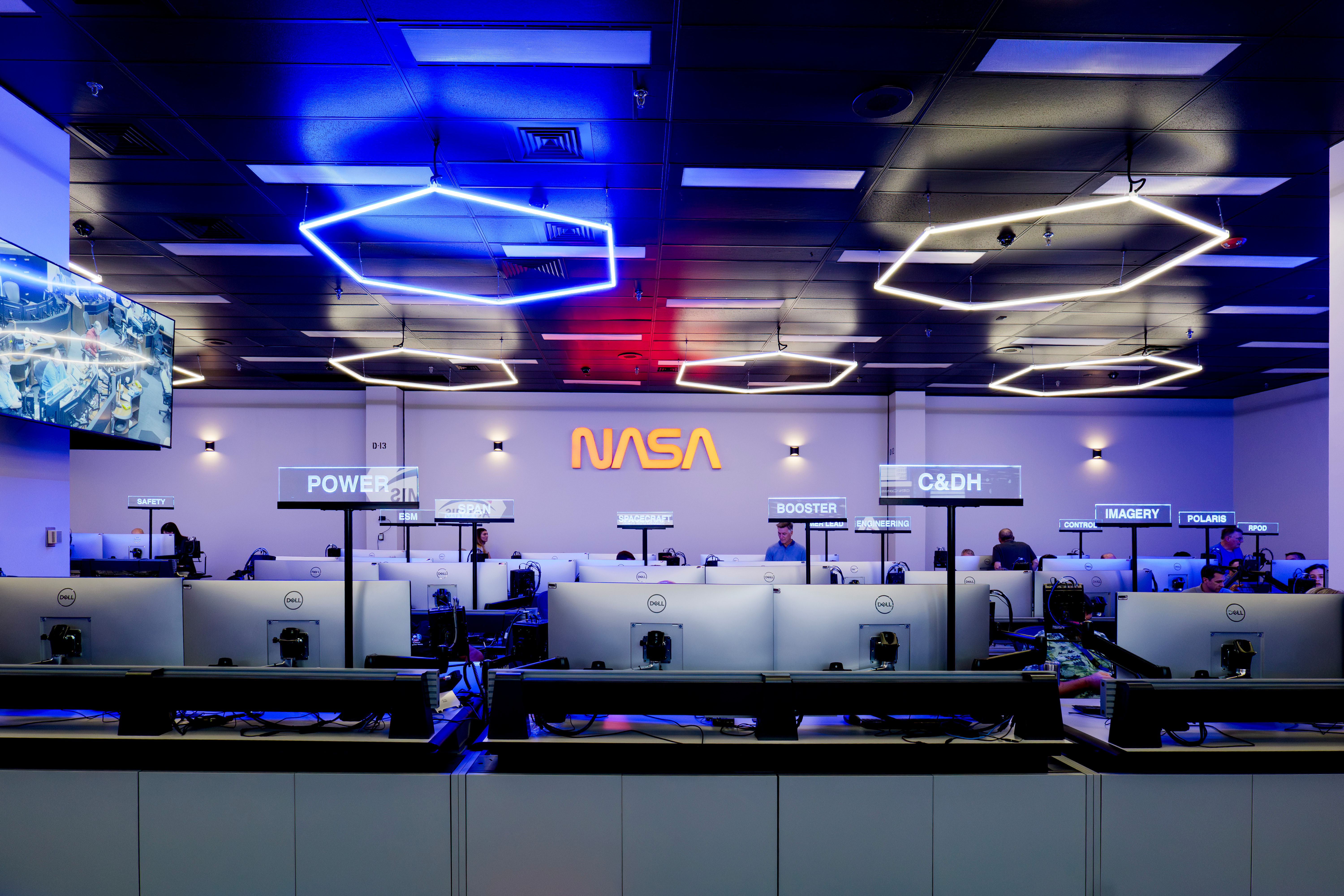
    As NASA’s Orion spacecraft is carrying crew around the Moon on the Artemis II mission, a team of expert engineers in the Mission Control Center at NASA’s Johnson Space Center in Houston will be meticulously monitoring the spacecraft along its journey. They’ll be operating from a new space in the mission control complex built to host the Orion Mission Evaluation Room (MER). Through the success of Orion and the Artemis missions, NASA will return humanity to the Moon and prepare to land an American on the surface of Mars.

    Inside the Mission Evaluation Room, dozens of engineers will be monitoring the spacecraft and collecting data, while the flight control team located in mission control’s White Flight Control Room is simultaneously operating and sending commands to Orion during the flight. The flight control team will rely on the engineering expertise of the evaluation room to help with unexpected spacecraft behaviors that may arise during the mission and help analyze Orion’s performance data.

    The new Orion Mission Evaluation Room inside the Mission Control Center at NASA’s Johnson Space Center in Houston.
    NASA/Rad Sinyak

    The Mission Evaluation Room team is made up of engineers from NASA, Lockheed Martin, ESA (European Space Agency), and Airbus who bring deep, expert knowledge of the spacecraft’s subsystems and functions to the mission. These functions are represented across 24 consoles, usually staffed by two engineers in their respective discipline, often hosting additional support personnel during planned dynamic phases of the mission or test objectives.

    “The operations team is flying the spacecraft, but they are relying on the Mission Evaluation Room’s reachback engineering capability from the NASA, industry, and international Orion team that has designed, built, and tested this spacecraft.”

    Trey PerrymAn

    Trey PerrymAn

    Lead for Orion Mission and Integration Systems at NASA Johnson

    Perryman guides the Artemis II Orion Mission Evaluation Room alongside Jen Madsen, deputy manager for Orion’s Avionics, Power, and Software.

    With crew aboard, Orion will put more systems to the test, requiring more expertise to monitor new systems not previously flown. To support these needs, and safe, successful flights of Orion to the Moon, NASA officially opened the all-new facility in mission control to host the Orion Mission Evaluation Room on Aug. 15.

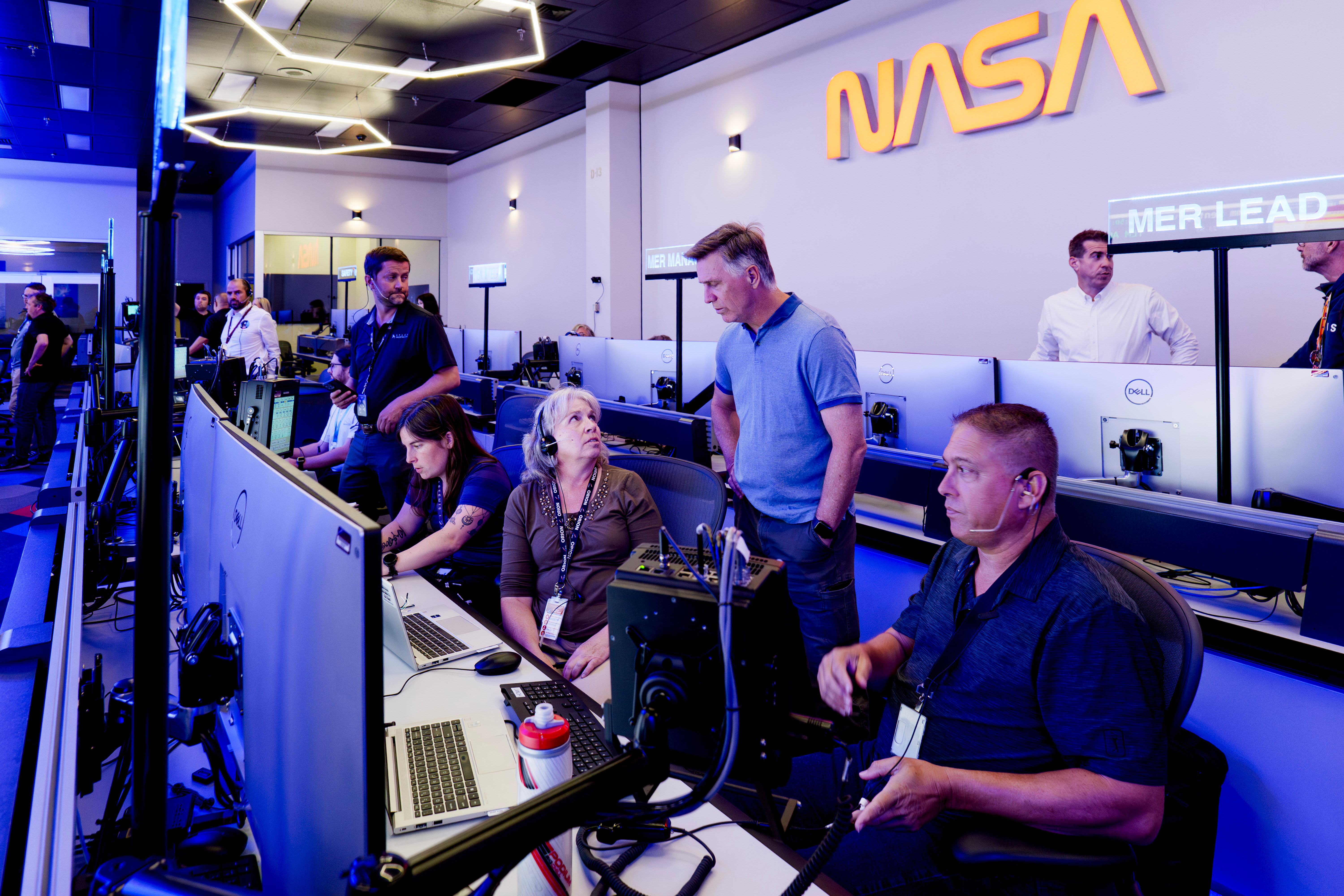
    The Orion Mission Evaluation Room team works during an Artemis II mission simulation on Aug. 19, 2025, from the new space inside the Mission Control Center at NASA’s Johnson Space Center in Houston.
    NASA/Rad Sinyak

    During Artemis II, the evaluation room will operate in three daily shifts, beginning about 48 hours prior to liftoff. The room is staffed around the clock throughout the nearly 10 day mission, up until the spacecraft has been safely secured inside the U.S. Navy ship that will recover it after splashdown.

    Another key function of the evaluation room is collecting and analyzing the large amount of data Orion will produce during the flight, which will help inform the room’s team on the spacecraft’s performance.

    “Data collection is hugely significant,” Perryman said. “We’ll do an analysis and assessment of all the data we’ve collected, and compare it against what we were expecting from the spacecraft. While a lot of that data comparison will take place during the mission, we’ll also do deeper analysis after the mission is over to see what we learned.”

    The Orion Mission Evaluation Room team works during an Artemis II mission simulation on Aug. 19, 2025, from the new space inside the Mission Control Center at NASA’s Johnson Space Center in Houston.
    NASA/Rad Sinyak

    If unplanned situations arise during the mission, the Mission Evaluation Room has additional layers of ability to support any specific need that presents itself.  This includes various engineering support from different NASA centers, Lockheed Martin’s Integrated Test Lab, ESA’s European Space Research and Technology Center, and more.

    “It’s been amazing to have helped design and build Orion from the beginning – and now, we’ll be able to see the culmination of all those years of work in this new Mission Evaluation Room.”

    Jen Madsen

    Jen Madsen

    Deputy Manager for Orion’s Avionics, Power, and Software

    “We’ll see our spacecraft carrying our crew to the Moon on these screens and still be continuously learning about all of its capabilities,” said Madsen.

    The Artemis II test flight will send NASA astronauts Reid Wiseman, Victor Glover, and Christina Koch, and CSA (Canadian Space Agency) astronaut Jeremy Hansen around the Moon and return them safely back home. This first crewed flight under NASA’s Artemis campaign will set the stage for NASA to return Americans to the lunar surface and help the agency and its commercial and international partners prepare for future human missions to Mars.

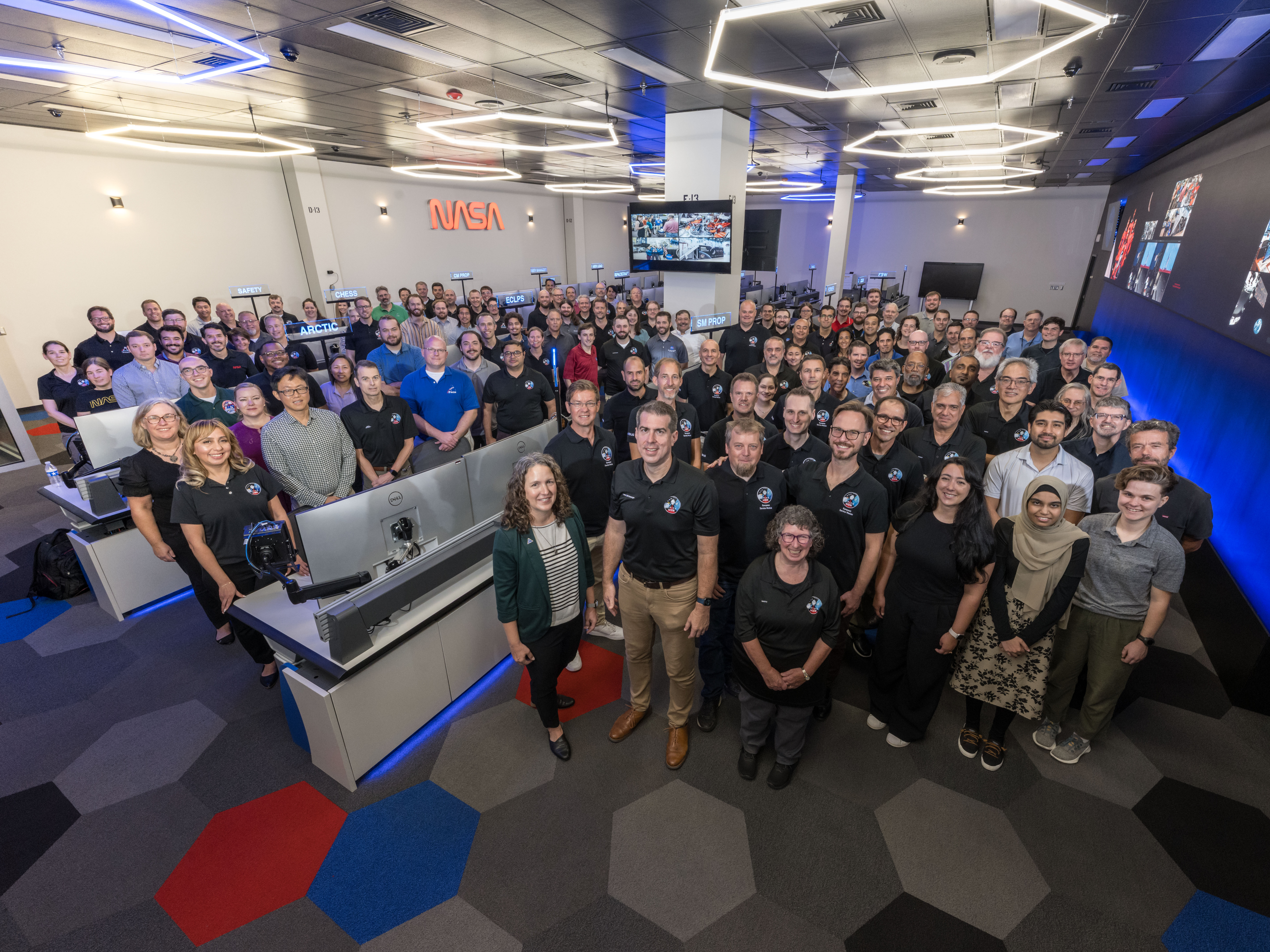
    The Orion Mission Evaluation Room Team gathers for a group photo on Aug. 18, 2025.
    NASA/Josh Valcarcel
  • Reaching Out

    A blue and purple nebula that looks like a human hand reaching up. Above the hand is a bright red and gold area. Gold spots dot the black background of space all around and behind the nebula.
    Near the center of this image from NASA’s Chandra X-ray Observatory lies the pulsar B1509-58, a rapidly spinning neutron star that is only about 12 miles in diameter. This tiny object is responsible for producing an intricate nebula that resembles a human hand with a palm and extended fingers pointing to the upper right.
    X-ray: NASA/CXC/Univ. of Hong Kong/S. Zhang et al.; Radio: ATNF/CSIRO/ATCA; H-alpha: UK STFC/Royal Observatory Edinburgh; Image Processing: NASA/CXC/SAO/N. Wolk

    This image released on Aug. 20, 2025, combines new radio data from the Australia Telescope Compact Array with X-ray data from NASA’s Chandra X-ray Observatory. Chandra first released an image of this pulsar and its surrounding hand-shaped nebula in 2009. The new data provides a fresh view of this exploded star and its environment, which could help scientists understand its peculiar properties and shape.

    Image credit: X-ray: NASA/CXC/Univ. of Hong Kong/S. Zhang et al.; Radio: ATNF/CSIRO/ATCA; H-alpha: UK STFC/Royal Observatory Edinburgh; Image Processing: NASA/CXC/SAO/N. Wolk

  • NASA Stennis Provides Ideal Setting for Range Operations

    Think of NASA’s Stennis Space Center, and one likely thinks of rocket propulsion testing. The site has a long history of testing to support the nation’s space efforts, including the current Artemis program to send astronauts to the Moon to prepare for future human exploration of Mars.

    However, NASA Stennis also is working to become a key supporter of more terrestrial exploration. Indeed, in terms of unmanned range operations, NASA Stennis has it all – layers of restricted airspace, a closed canal system, and acres upon acres of protected terrain.

    The NASA site near Bay St. Louis, Mississippi, is an ideal location for all types of air, marine, and ground testing, said Range Operations Manager Jason Peterson. “My job is to understand the customer, and their requirements and limitations, to help them succeed,” he added. “What makes NASA Stennis unique is our federally protected area for users to operate.”

    The need to learn about unmanned systems, such as drones or underwater vehicles, in a safe environment is growing as technology advances. Think of it like learning to drive a car in a parking lot before hitting the road.

    NASA Stennis has already begun leveraging these capabilities. In 2024, the center established an agreement with Skydweller Aero Inc. to utilize restricted airspace for flight testing of autonomous, solar-powered aircraft. This first-of-its-kind agreement paves the way for future collaborations as NASA Stennis expands its customer-based operations beyond onsite tenants.

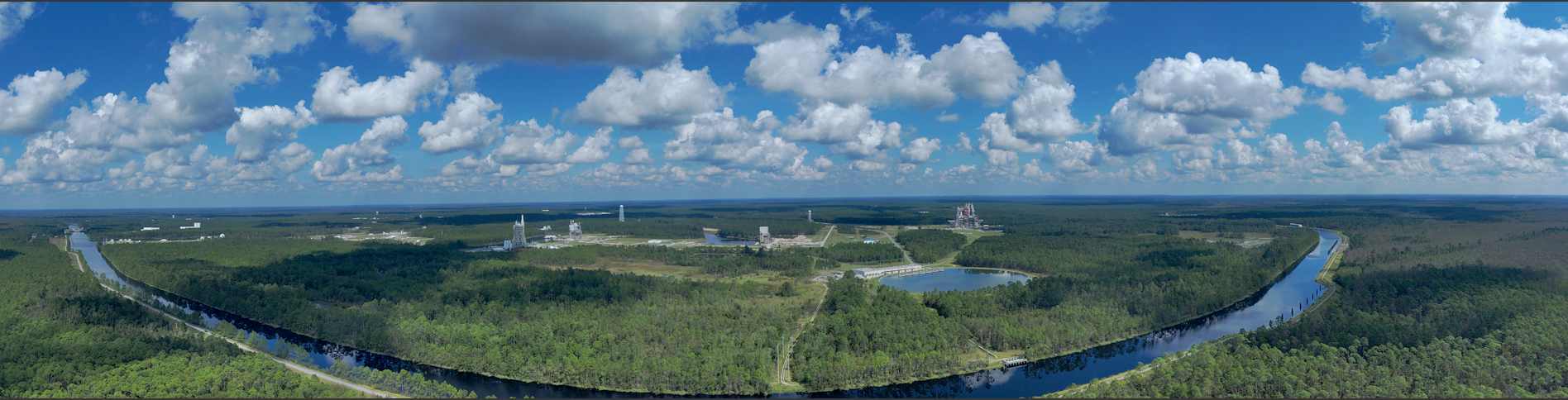
    panoramic view of the NASA Stennis test complex and canal system
    An unmanned aerial system provides a panoramic view of the NASA Stennis test complex and canal system.
    NASA

    Look to the Sky

    NASA Stennis has its own protected airspace, similar to how airports control the skies around them. The Federal Aviation Administration (FAA) first established this restricted airspace in 1966 and expanded it in 2016 to support both NASA missions and U.S. Department of Defense operations.

    NASA Stennis is one of only two non-military restricted airspaces in the nation. It operates two main airspace zones – a propulsion testing area extending from ground level up to 12,000 feet for safely testing rocket engines without interfering with regular air traffic, and an aircraft operations zone covering 100 square miles up to 6,000 feet, with 15 dedicated acres for drone launch and recovery.

    NASA Stennis staff provide comprehensive support including safety reviews, coordination between aircraft operators and FAA air traffic controllers, and constant communication with range safety personnel to ensure all operations are conducted safely.

    Marine Operations

    The centerpiece of the NASA Stennis marine range is its extensive 7.5-mile canal system, protected by a lock-and-dam system that connects to Pearl River tributaries. This network accommodates various marine platforms including traditional watercraft, autonomous underwater vehicles, remotely operated vehicles, unmanned surface vessels, and aerial drones requiring water landing capabilities.

    The controlled environment provides protection from adverse weather and interference, making it ideal for testing sensitive or proprietary technologies. The facility is particularly valuable for emerging technologies in autonomous systems, sensor integration, and multi-domain operations where air, surface, and underwater platforms operate in coordination.

    Ground Level

    NASA Stennis facilities are located on 13,800 acres of fenced-in property, surrounded by an additional 125,000 acres of protected land known as the acoustical buffer zone. This area was established primarily through permanent lease to allow testing of large rocket hardware without disturbing area residents and is closely monitored without permanent habitable structures.

    “The location helps reduce hazards to the public when testing new technology,” Peterson said. “With supporting infrastructure for office space, storage, or manufacturing, this makes NASA Stennis a great place to test, train, operate, and even manufacture.”

    The NASA Stennis federal city already hosts more than 50 federal, state, academic, public, and private aerospace, technology, and research organizations, with room for more. All tenants share operating costs while pursuing individual missions.

    ‘Open for Business’

    NASA Stennis leaders are keenly aware of the opportunity such unique capabilities afford. The center’s 2024-2028 strategic plan states NASA Stennis will leverage these unique capabilities to support testing and operation of uncrewed systems.

    Leaders are working to identify opportunities to maximize site capabilities and develop an effective business model. “NASA Stennis is open for business, and we want to provide a user-friendly range for operators to test vehicles by creating an environment that is safe, cost-effective, and focused on mission success,” Peterson said.

    For information about range operations at NASA’s Stennis Space Center, visit:
    Range and Airspace Operations – NASA

    For information about Stennis Space Center, visit:
    https://www.nasa.gov/stennis

    Details

    Last Updated

    Aug 25, 2025

    Editor
    NASA Stennis Communications
    Contact
    C. Lacy Thompson
    Location
    Stennis Space Center

    Related Terms

  • NASA Test Deploys Roman Space Telescope Solar Panels, ‘Visor’

    Credit: NASA’s Goddard Space Flight Center; Music Credit: “History in Motion” by Fred Dubois [SACEM], Koka Media [SACEM], Universal Publishing Production Music France [SACEM], and Universal Production Music.

    On Aug. 7 and 8, NASA’s Nancy Grace Roman Space Telescope team assessed the observatory’s solar panels and a visor-like sunshade called the deployable aperture cover — two components that will be stowed for launch and unfold in space. Engineers confirmed their successful operation during a closely monitored sequence in simulated space-like conditions. On the first day, Roman’s four outer solar panels were deployed one at a time, each unfolding over 30 seconds with 30-second pauses between them. The visor followed in a separate test the next day. These assessments help ensure Roman will perform as expected in space. Roman is slated to launch no later than May 2027, with the team working toward a potential early launch as soon as fall 2026.

    Details

    Last Updated

    Aug 26, 2025

    Editor
    Ashley Balzer
    Contact
    Ashley Balzer

  • Curiosity Blog, Sols 4638-4640: Imaging Extravaganza Atop a Ridge

    3 min read

    Curiosity Blog, Sols 4638-4640: Imaging Extravaganza Atop a Ridge

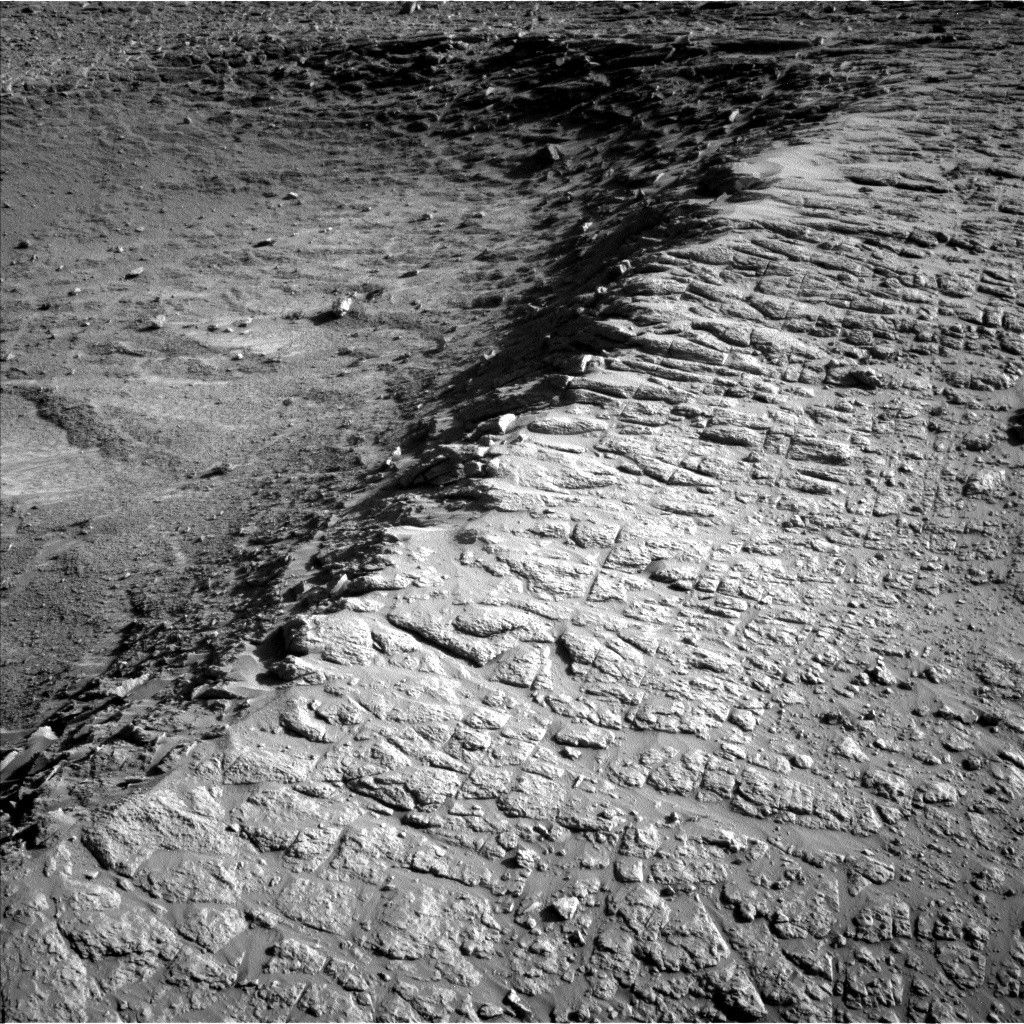
    A grayscale photo from the Martian surface shows rough terrain covered in small rocks, divided across the middle of the image by a ridge running from the lower left corner of the frame to the upper right corner. The ground to the right of the ridge is relatively flat, while to the left it falls away from the ridge into a depression. The entire scene is light to medium gray, except for a very dark shadow along the left side of the ridge.
    NASA’s Mars rover Curiosity acquired this image on Aug. 21, 2025, looking across the ridge that the rover is currently parked near the edge of, looking down into the “Thumb” region that mission planners hope to be exploring next week. Curiosity captured this image using its Left Navigation Camera on Sol 4636, or Martian day 4,636 of the MArs Science Laboratory mission, at 16:09:13 UTC.
    NASA/JPL-Caltech

    Written by Conor Hayes, Graduate Student at York University

    Earth planning date: Friday, Aug. 22, 2025

    Curiosity is continuing its winding path through the mysterious boxwork structures that have been a major focus of the last several months of the mission. After driving away from “Río Frío,” we are now parked on top of a ridge overlooking a topographic depression that we’ve nicknamed the “Thumb.” The image on this post shows that ridge running along the “thumb’s” edge. Our goal today is to characterize this ridge before we drive down into the Thumb.

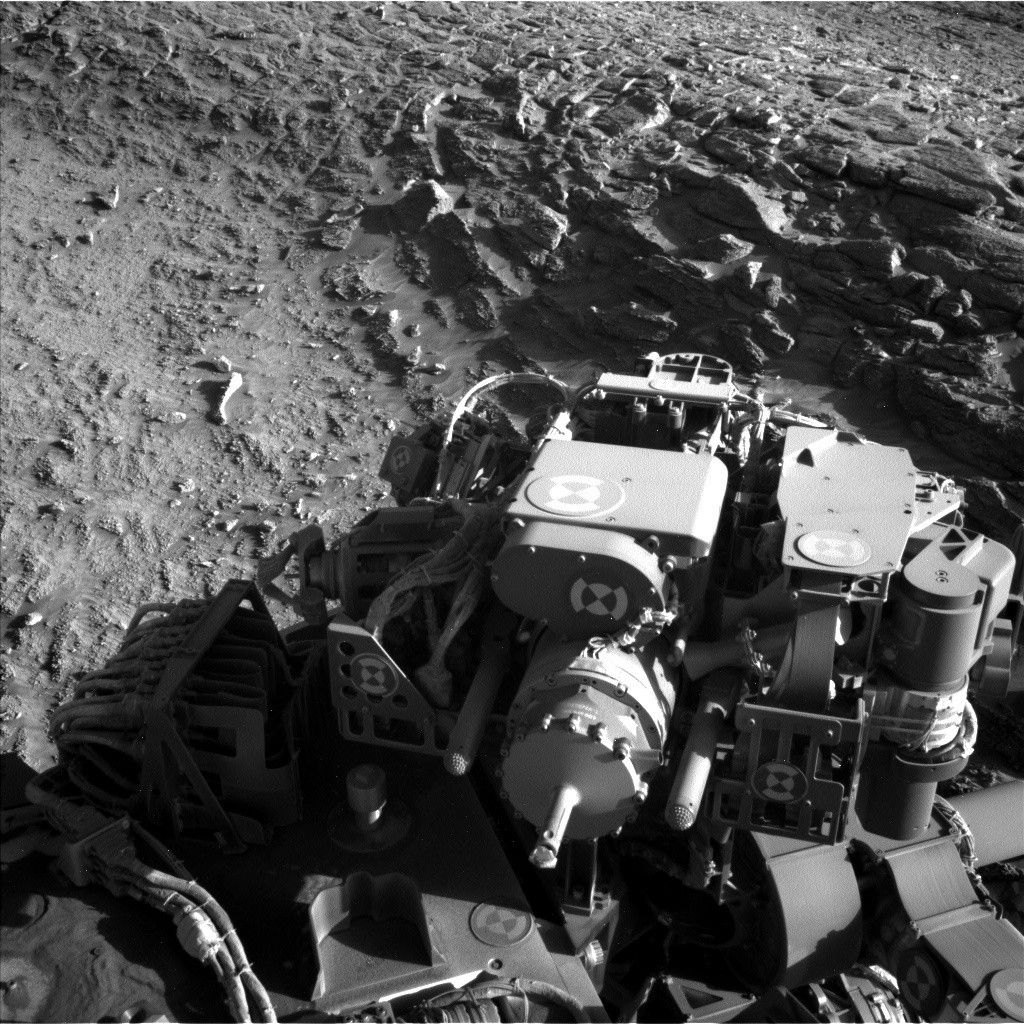
    Because we had a lot of power and three sols available to play around with, this weekend plan is packed with a lot of good science. The boxwork structures in our immediate vicinity get a lot of attention, with Mastcam images planned of the targets “Wallatiri,” “Wallatiri 2,” “Mojo,” “Samaipata,” “Fort Samaipata,” and “Río Lluta,” as well as a nearby trough. ChemCam will be taking LIBS measurements of both Samaipata and Fort Saaipata as well. Samaipata gets even more attention from MAHLI, in addition to the targets “Vitichi” and “Tartagalita,” both of which will also be observed by APXS. 

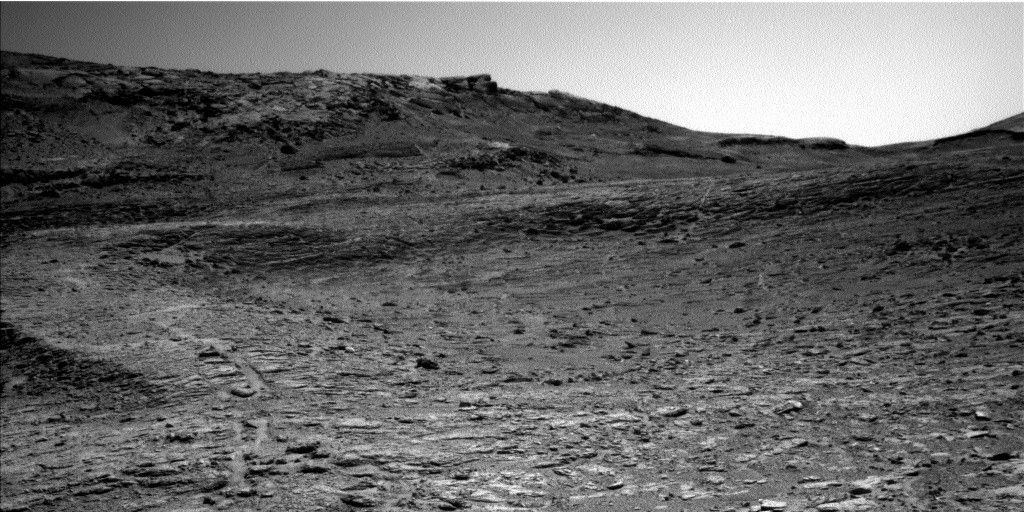
    The boxwork structures don’t get all of the fun today, though. In addition to all of the boxwork observations, Mastcam will be documenting the ChemCam AEGIS target from Monday’s plan, and will also be doing some more imaging of the “Mishe Mokwa” butte. The highlight of Mastcam’s work in this plan (at least in my opinion) is the large 44-image mosaic of the north crater rim, taking advantage of the particularly low dust content of the atmosphere at this time of year. ChemCam will be taking several RMI images of Mishe Mokwa and a distant outcrop at “Dragones” that we will be driving towards over the next several months, as well as the usual post-drive AEGIS.

    Rounding out this plan is a collection of observations of the atmosphere. In addition to typical DAN, REMS, and RAD activities, Curiosity’s Navcams will be put to work with a dust-devil movie, dust-devil survey, five cloud movies, and two line-of-sight observations of the north crater rim. Mastcam also gets involved in the environmental fun with a tau to track the amount of dust in the air.

    Even with all of these activities, we decided that we aren’t yet done with this area. The drive in today’s plan is a short bump of about 2 meters (about 6.6 feet), so we’re all looking forward to continuing our investigation of this ridge on Monday.

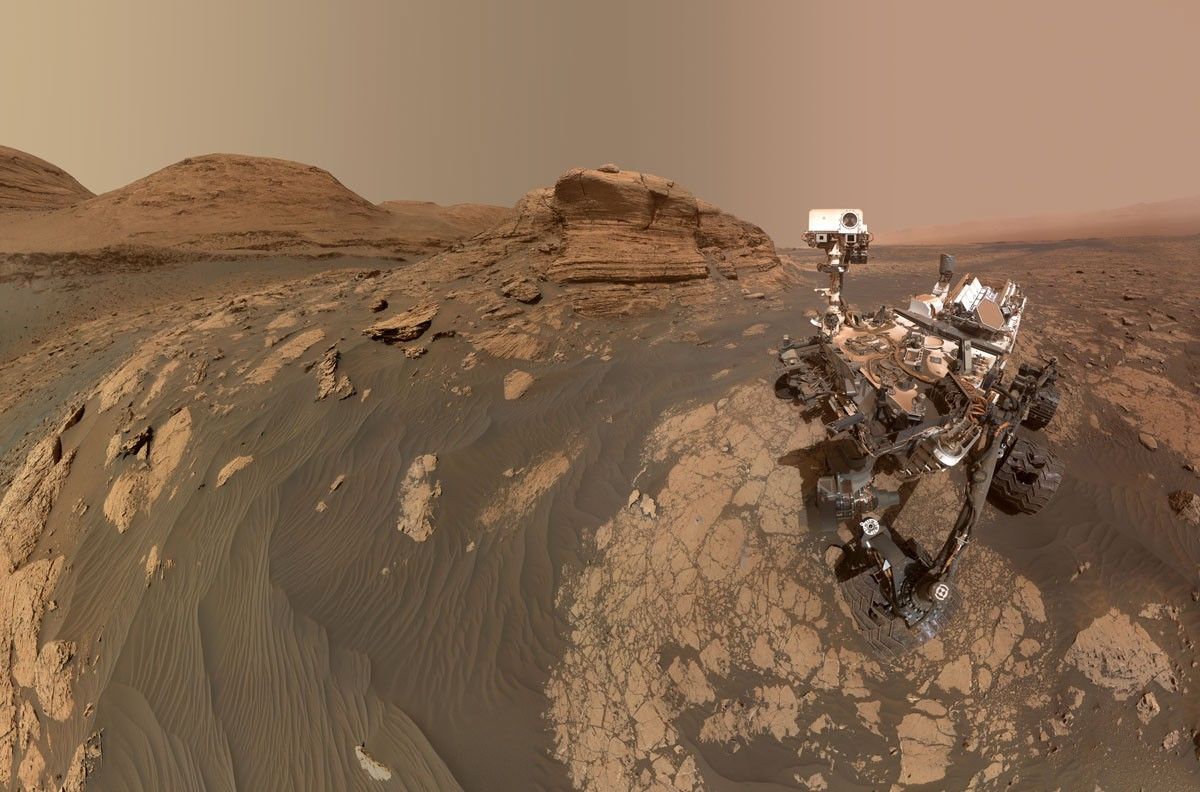
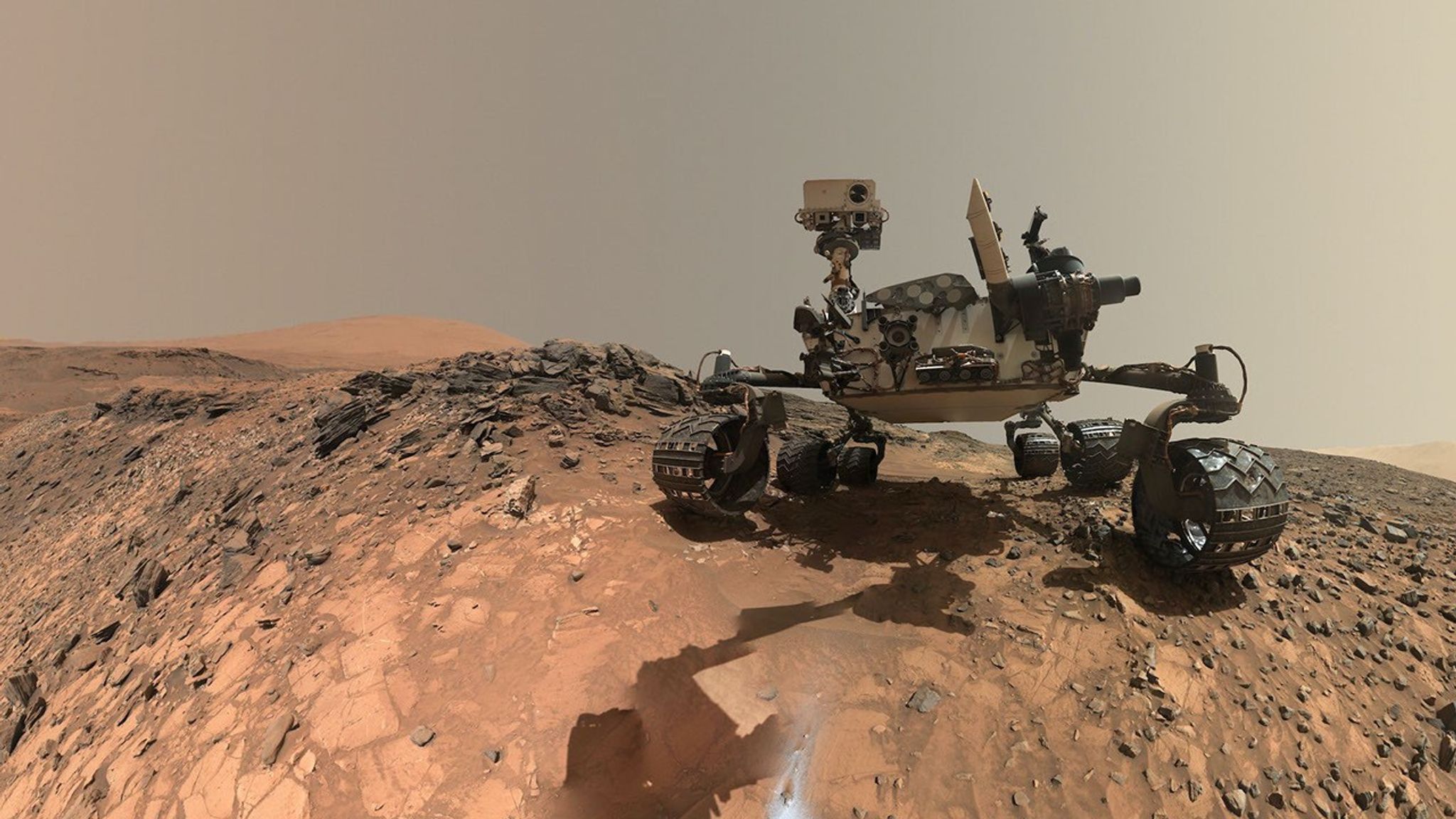
    A rover sits on the hilly, orange Martian surface beneath a flat grey sky, surrounded by chunks of rock.
    NASA’s Mars rover Curiosity at the base of Mount Sharp
    NASA/JPL-Caltech/MSSS

    Details

    Last Updated

    Aug 26, 2025

    Related Terms

  • From NASA Citizen Scientist to Astronaut Training: An Interview with Benedetta Facini

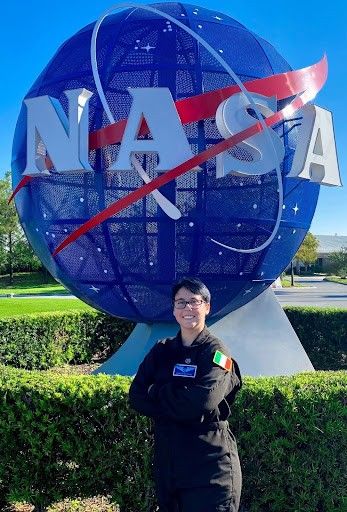
    Titans Space Industries, a commercial space company, selected a new cohort of astronaut candidates this spring – and among them is NASA citizen scientist, Benedetta Facini. She has participated in not one, but many NASA citizen science projects: Cloudspotting on Mars, Active Asteroids, Daily Minor Planet, GLOBE, Exoasteroids and International Astronomical Collaboration (IASC). We asked her a few questions about her work with NASA and her path to becoming an astronaut candidate.

    A person wearing a black NASA flight suit stands smiling with arms crossed in front of the large blue NASA globe sculpture. The Irish flag patch is visible on their sleeve, and the sky is clear and blue in the background.
    Benedetta Facini visiting Kennedy Space Center in 2023
    Credit: B.F.

    Q: How did you learn about NASA Citizen Science?

    A: Through colleagues and social media, I often came across people talking about Citizen Science, and this immediately caught my curiosity. I did some online research on the subject, and I asked some colleagues already involved in it. Finally, I managed to find the way to participate by exploring the programs offered by NASA Citizen Science, which impressed me with their variety.

    Q: What would you say you have gained from working on these NASA projects?

    A: Curiosity in discovering new things and a lot of patience: many projects indeed require attention and, as mentioned, patience. I was pleased to discover that even NASA relies on “ordinary people” to carry out research, giving them the opportunity to learn new things using simple tools.

    I also gained hands-on experience in analyzing real data and identifying celestial objects to contribute to real research efforts. My favorite part was to learn to recognize the pattern of clouds in data collected by the Mars Climate Sounder on the Mars Reconnaissance Orbiter.

    I have learned the importance of international collaboration: I know many citizen scientists now, and interacting with them teaches me a lot every day. 

    Q. What do you do when you’re not working on citizen science?

    A: I am a student and a science communicator. I share my knowledge and enthusiasm through social media, schools, webinars around the world, and space festivals across Italy where I have the opportunity to engage with a wide audience, from young students to adults.

    Recently, I achieved a major milestone: I was selected as an Astronaut Candidate by the commercial space company, Titans Space Industries. I am thrilled to soon begin the basic training, which marks the first step toward realizing my dream of becoming an astronaut and contributing directly to human spaceflight and scientific research.

    Q. What do you need to do to become an astronaut?

    A: Gain as much experience as possible. During astronaut selection, not only academic achievements are evaluated, but also professional and personal experiences.

    Every skill can be useful during the selection process: the ability to work in a team, which is essential during space missions; survival skills; experience as a diver, skydiver, or pilot; knowledge of other languages; and the ability to adapt to different situations.

    I would also like to debunk a myth: you don’t need to be Einstein and fit as an Olympic level athlete; you just need to be good at what you do and be healthy.

    Q: How has citizen science helped you with your career?

    A: Citizen Science was very helpful for my career as a science communicator, as it gave me the opportunity to show people that anyone can contribute to the space sector. At the same time, it has allowed me to become a mentor and a point of reference for many students (mainly with the IASC project).

    The hands-on experience I gained in analyzing real data was also very helpful for my academic career, too. I had never had real data to work with before, and this experience proved extremely valuable for the practical courses in my physics degree program.

    Q. Do you have any advice you’d like to share for other citizen scientists or for people who want to become astronauts?

    A: For other citizen scientists my advice is to stay curious and persistent.

    Don’t be afraid to ask for help and interact with other colleagues because the goal of the NASA Citizen Science program is international collaboration and every small contribution can make a difference.

    For aspiring astronauts, my advice is to gain as much experience as possible. Academic results are important but hands-on skills, teamwork, adaptability, and real experiences are also important.

    Stay passionate and never lose your curiosity; the astronaut path is challenging; don’t give up after an eventual first rejection. You will always meet people trying to make you change your mind and your dream, even people from your family, but don’t stop in front of obstacles. The greatest regret is knowing you didn’t try to make your dream come true.

    Quoting my inspiration, Italian astronaut Paolo Nespoli: “You need to have the ability and the courage to dream of impossible things. Everyone can dream of things that are possible. Dream of something impossible, one of those things that, when you say it out loud, people look at you and say: “Sure, study hard and you’ll make it,” but deep down no one really believes it. Those are the impossible things that are worth trying to do!”

    Q: Thank you for sharing your story with us! Is there anything else you would like to add?

    A: I would like to thank the team behind NASA Citizen Science.

    These projects play a crucial role in keeping students’ passion for science alive and guiding them toward a potential career in this field.

    Knowing that I have contributed to helping scientists is incredibly motivating and encourages me and students around the world to keep going, stay curious, and continue pursuing our path in the science field.
    The opportunity to participate in these projects while learning is inspiring and it reinforces the idea that everyone, regardless of their background, can make a real impact in the scientific community.

    Details

    Last Updated

    Aug 25, 2025

  • NASA’s X-59 at Sunrise

    NASA’s X-59 quiet supersonic research aircraft is seen on the ramp at sunrise with its canopy open. Orange and gold light filters through the clouds behind the aircraft, highlighting the aircraft’s shape. Several ground crew members are visible around the aircraft, along with support carts. A vertical light pole with a coiled cable can be seen in the foreground.
    Lockheed Martin Corporation

    NASA’s X-59 quiet supersonic research aircraft sits on the ramp at sunrise before ground tests at Lockheed Martin’s Skunk Works facility in Palmdale, California, on July 18, 2025. Following completion of low-speed taxi tests in July 2025 in Palmdale, California, medium- and high-speed taxi tests mark the final steps before the aircraft takes to the skies for the first time.

    The X-59 is the centerpiece of NASA’s Quesst mission, which aims to demonstrate quiet supersonic flight by reducing the loud sonic boom to a quieter “thump.” Proving the X-plane’s airworthiness is the first step on the path to gathering data in support of the mission. The flight data will help inform U.S. and international regulators as they consider new noise standards for supersonic commercial flight over land. 

    Image Credit: Lockheed Martin Corporation

  • Washington State Student Wins 2025 NASA Art Contest

    4 Min Read

    Washington State Student Wins 2025 NASA Art Contest

    A child seated on the roof of a barn, their arm draped around a dog, watching a space shuttle blast off in the distance. The two are joined by three extraterrestrial beings that also watch in awe.

    “My Wonders with You” by Dahyun Jung, 2025 NASA Student Art Contest grand prize winner

    Credits:
    NASA/Dahyun Jung

    A Washington state high school student with a passion for art, space exploration, and a curiosity about the possibility of life on other planets earned the grand prize for the 2025 NASA Student Art Contest.

    Dahyun Jung’s winning piece, titled “My Wonders with You,” shows a child seated on the roof of a barn, their arm draped around a dog, watching a space shuttle blast off in the distance. The two are joined by three extraterrestrial beings that also watch in awe. Jung was a high school senior during the submission period for the 2025 competition, which was December 1 through December 31, 2024. The theme for the 2025 art contest was “Our Wonder Changes the World.”

    A child seated on the roof of a barn, their arm draped around a dog, watching a space shuttle blast off in the distance. The two are joined by three extraterrestrial beings that also watch in awe.
    “My Wonders with You” by Dahyun Jung, 2025 NASA Student Art Contest grand prize winner
    Credit: NASA/Dahyun Jung
    NASA/Dahyun Jung

    “The theme immediately sparked memories of the moment I first saw a NASA spacecraft launch into space,” Jung said. “That experience filled me with awe and endless questions—especially about how aliens might view our efforts to explore the cosmos. I began imagining what future space missions might look like if we ever made contact with extraterrestrial life. That was the moment everything clicked—the exact moment when imaginations started to fill up the tiny world in my head. I knew exactly what I wanted to draw!”

    Jung said art and crafting have been a special part of her life since childhood. She enjoys using a variety of materials to create everything from drawings and paintings to keychains and crochet dolls.

    “I’ve always loved drawing, but it was in middle school that I really began to delve into it more deeply,” Jung said. “I see everything that passes through my hands as a form of art.”

    I see everything that passes through my hands as a form of art.

    Dahyun Jung

    Dahyun Jung

    2025 NASA Student Art Contest grand prize winner

    Inside a habitat of some kind, a young person and their companion rodent, both in spacesuits, appear to be looking out of a window. Outside, on a planet that is presumably Mars, another person in a spacesuit appears to be watering a small garden. There is an animal — probably a cat — in the garden.
    “A Marsbulous Future” by Chloe Ji, 2025 NASA Student Art Contest First Place Winner, 1st Grade Division
    Credit: NASA/Chloe Ji
    NASA/Chloe Ji

    Jung was one of more than 2,300 kindergarten through 12th grade students from across the United States and its territories who participated in the 2025 art contest, a record-breaking number. Kristina Cors, art contest coordinator at NASA’s Langley Research Center in Hampton, Virginia, said, “This contest gives the students a way to connect their passion for art with science, technology, engineering, and mathematics (STEM) and hopefully inspires them to continue exploring those connections throughout their lives.”

    Jung is no stranger to the art contest. She said she first participated in 2022.

    “Returning to the contest in 2025 felt both nostalgic and thrilling as I came back with improved techniques, more experience, and a fresh new idea that fit this year’s theme,” she said.

    Jung used Procreate, a digital illustration and painting app, to create her award-winning work.

    “For this piece, I used my customized brush in Procreate,” Jung said. “The biggest merit of using a digital platform for drawing is the variety of textured brushes they offer. They allowed me to vividly illustrate various elements—like the sky, the rocket’s exhaust plume, hair, and roof—each with its own texture and detail.”

    Dahyun Jung, grand prize winner of the 2025 NASA Student Art Contest, holds her winning piece “My Wonders with You.”
    Dahyun Jung, grand prize winner of the 2025 NASA Student Art Contest, holds her winning piece “My Wonders with You.”
    Credit: NASA/Dahyun Jung
    NASA/Dahyun Jung

    Jung’s artwork brought to life her own enthusiasm regarding NASA’s work advancing space exploration, aeronautics, and science.

    “I’ve always been fascinated by NASA’s commitment to pushing boundaries—especially in space exploration,” Jung said. “Space feels like an undiscovered world, full of endless possibilities, but only a few have had the chance to access it. In many ways, NASA’s work mirrors how I always push creative boundaries in my own art. I’ve always dreamed of traveling to space, and it’s that sense of wonder that inspired my piece.”

    Jung said she hopes her artwork can help to inspire awe and stir imagination in others.

    A person sits at a desk, back to the viewer, illuminated by a laptop monitor. There's a toolkit on the desk as well. Outside the window, a comet streaks by a large celestial body.
    “Changing the World” by Jane Lee, 2025 NASA Student Art Contest First Place Winner, 8th Grade Division
    Credit: NASA/Jane Lee
    NASA/Jane Lee

    “I want my artwork to be the starting point of all wonders—a spark that takes people back to their childhood, when dreams were bold and limitless,” Jung said. “I hope it rekindles that sense of passion, whatever it may be, and encourages others to dare to dream again.

    To view a complete list of winners by grade, please click here.

    To view all 2025 art contest entries, please click here.

    Brittny McGraw
    NASA Langley Research Center

    About the Author

    Joe Atkinson

    Public Affairs Officer, NASA Langley Research Center

    Details

    Last Updated

    Aug 25, 2025

  • NASA Science, Cargo Launch on 33rd SpaceX Resupply Mission to Station

    NASA’s SpaceX 33rd commercial resupply mission successfully launched to deliver supplies and science investigations to the International Space Station from Space Launch Complex 40 at Cape Canaveral Space Force Station in Florida on Aug. 24, 2025.
    Credit: NASA

    Following a successful launch of NASA’s SpaceX 33rd commercial resupply mission, new scientific experiments and cargo for the agency are bound for the International Space Station.

    The SpaceX Dragon spacecraft, carrying more than 5,000 pounds of supplies to the orbiting laboratory, lifted off at 2:45 a.m. EDT on Sunday, on the company’s Falcon 9 rocket from Space Launch Complex 40 at Cape Canaveral Space Force Station in Florida.

    “Commercial resupply missions to the International Space Station deliver science that helps prove technologies for Artemis lunar missions and beyond,” said acting NASA Administrator Sean Duffy. “This flight will test 3D printing metal parts and bioprinting tissue in microgravity – technology that could give astronauts tools and medical support on future Moon and Mars missions.”

    Live coverage of the spacecraft’s arrival will begin at 6 a.m., Monday, Aug. 25, on NASA+, Netflix, Amazon Prime, and more. Learn how to watch NASA content through a variety of platforms, including social media.

    The spacecraft is scheduled to dock autonomously at approximately 7:30 a.m. to the forward port of the space station’s Harmony module.

    In addition to food, supplies, and equipment for the crew, Dragon will deliver several experiments, including bone-forming stem cells for studying bone loss prevention and materials, to 3D print medical implants that could advance treatments for nerve damage on Earth. Dragon also will deliver bioprinted liver tissue to study blood vessel development in microgravity, as well as supplies to 3D print metal cubes in space.

    These are just a sample of the hundreds of biology and biotechnology, physical sciences, Earth and space science investigations conducted aboard the orbiting laboratory. This research benefits people on Earth while laying the groundwork for other agency deep space missions. As part of NASA’s Artemis campaign, the agency will send astronauts to the Moon to prepare for future human exploration of Mars, inspiring the world through discovery in a new Golden Age of innovation and exploration.

    During the mission, Dragon also will perform a reboost demonstration of station to maintain its current altitude. The hardware, located in the trunk of Dragon, contains an independent propellant system separate from the spacecraft to fuel two Draco engines using existing hardware and propellant system design. The boost kit will help sustain the orbiting lab’s altitude starting in September with a series of burns planned periodically throughout the fall of 2025. During NASA’s SpaceX 31st commercial resupply services mission on Nov. 8, 2024, the Dragon spacecraft performed its first demonstration of these capabilities.

    The Dragon spacecraft is scheduled to remain at the space station until December, when it will depart the orbiting laboratory and return to Earth with research and cargo, splashing down off the coast of California.

    Learn more about the International Space Station at:

    https://www.nasa.gov/international-space-station

    -end-

    Joshua Finch
    Headquarters, Washington
    202-358-1100
    joshua.a.finch@nasa.gov

    Steven Siceloff
    Kennedy Space Center, Fla.
    321-876-2468
    steven.p.siceloff@nasa.gov

    Sandra Jones / Joseph Zakrzewski
    Johnson Space Center, Houston
    281-483-5111
    sandra.p.jones@nasa.gov / joseph.a.zakrzewski@nasa.gov

    Details

    Last Updated

    Aug 24, 2025

    Editor
    Jessica Taveau

  • NASA Tests Tools to Assess Drone Safety Over Cities

    2 min read

    Preparations for Next Moonwalk Simulations Underway (and Underwater)

    Two men stand in an office looking at four smaller computer screens and one larger computer screen. There is a tan desk in the foreground housing two computer monitors and a small grey drone. In the background stands a man in a white polo shirt facing two other computer monitors on a desk. Behind this set up is a large TV monitor with a man standing with his arm reached out in front. The man is wearing a black polo shorts and tan shorts as well as white tennis shoes. The screen shows a map and different pieces of software working in unison.
    ResilienX employees Angelo Niforatos, left, and Ryan Pleskach, right, overview the NASA safety tools integrated into the company’s commercial system, July 11, 2025, at the ResilienX Headquarters in Syracuse, New York.
    Credit: ResilienX

    A future with advanced air mobility aircraft populating the skies will require the U.S. to implement enhanced preflight planning that can mitigate potential risks well before takeoff – and NASA is working to develop the tools to make that happen. 

    Preflight planning is critical to ensuring safety in the complex, high-risk environments of the future airspace. Timely, predictive, and up-to-date risk assessment within a single platform makes it much easier for drone or air taxi operators to check flight plans for high-risk concerns.  

    NASA is working on tools to deliver those services, and in June, the agency and aviation safety company ResilienX Inc. demonstrated how these tools can be integrated into commercial systems.  

    During a series of tests conducted at ResilienX’s facility in Syracuse, New York, researchers used NASA services that allowed flight operators to submit flight plans prior to departure, obtain risk assessment results, and then decide whether to proceed with flights or change their flight plans and re-assess risks. Allowing operators to perform these tasks quickly reduces the safety risk to flight passengers as well as humans on the ground. 

    The three NASA-developed services are intended to assess unique risks associated with highly automated aircraft flying at low altitudes over cities.  

    The partnership was managed under a Phase III NASA Small Business Innovation Research (SBIR) contract, which is an extension of prior work to assess weather-related risks. This collaboration is already leading to direct technology transfer of safety systems into ResilienX’s platform. The partnership is also intended to provide indirect benefits for ResilienX partners and customers, such as the U.S. Air Force and regional operators, helping to advance the overall safety of future airspace operations.  

    This work is led by NASA’s System-Wide Safety project under the Airspace Operations and Safety program in support of the agency’s Advanced Air Mobility mission. The mission seeks to deliver data, findings, and recommendations to guide the industry’s development of future air taxis and drones. 

  • La NASA revela los finalistas del concurso de diseño de la mascota lunar de Artemis II

    4 Min Read

    La NASA revela los finalistas del concurso de diseño de la mascota lunar de Artemis II

    The Artemis II crew stands in front of the Orion spacecraft. They are wearing orange spacesuits without helmets. Orion is silver-colored and reflective. There is a round railing surrounding the spacecraft. There is also a group of people wearing blue jumpsuits, hairnets, and gloves standing behind Orion; they are members of the Artemis II closeout crew.

    Read this story in English here.

    La NASA ya tiene 25 finalistas para el diseño del indicador de gravedad cero de Artemis II que volará con la tripulación de esta misión alrededor de la Luna y de regreso a la Tierra el próximo año.

    Los astronautas Reid Wiseman, Victor Glover y Christina Koch de la NASA, y el astronauta de la CSA (Agencia Espacial Canadiense) Jeremy Hansen pronto seleccionarán uno de los diseños finalistas para que les acompañe dentro de la nave espacial Orion como su mascota lunar.

    “El indicador de gravedad cero de Artemis II será especial para la tripulación”, dijo Reid Wiseman, comandante de Artemis II. “En una nave espacial llena de equipos y herramientas complejas que mantienen viva a la tripulación en el espacio profundo, el indicador es una forma amigable y útil de resaltar el elemento humano que es tan crítico para nuestra exploración del universo. Nuestra tripulación está entusiasmada con estos diseños provenientes de muchos lugares del mundo y esperamos con interés llevar al ganador con nosotros en este viaje”.

    Un indicador de gravedad cero es un pequeño peluche que típicamente viaja con la tripulación para indicar visualmente el momento en que llegan al espacio. Durante los primeros ocho minutos después del despegue, la tripulación y el indicador, que estará situado cerca de ellos, seguirán siendo presionados contra sus asientos por la gravedad y la fuerza de la subida al espacio. Cuando se apaguen los motores principales de la etapa central del cohete Sistema de Lanzamiento Espacial (SLS, por sus siglas en inglés), se eliminarán las restricciones de la gravedad, pero la tripulación seguirá atada de manera segura a sus asientos: la capacidad de flotar de su indicador de gravedad cero será la evidencia de que han llegado al espacio.

    Artemis II será la primera misión en la que el público haya participado en la creación de la mascota de la tripulación.

    Estos diseños, con ideas que abarcan desde versiones lunares de criaturas terrestres hasta visiones creativas sobre la exploración y el descubrimiento, fueron seleccionados entre más de 2.600 propuestas procedentes de más de 50 países, e incluyen diseños de estudiantes desde primaria a secundaria. Los finalistas representan a 10 países, entre los que están Estados Unidos, Canadá, Colombia, Finlandia, Francia, Alemania, Japón, Perú, Singapur y Gales.

    Mira aquí los diseños finalistas:

    En marzo, la NASA anunció que buscaba propuestas de creadores de todo el mundo para el diseño de un indicador de gravedad cero que volaría a bordo de Artemis II, la primera misión tripulada de la campaña Artemis de la NASA. Se pidió a los creadores que presentaran ideas que representaran la importancia de Artemis, la misión, o la exploración y el descubrimiento, y que cumplieran con requisitos específicos de tamaño y materiales. La empresa de crowdsourcing (colaboración abierta) Freelancer sirvió como facilitadora del concurso en nombre de la NASA, a través del Laboratorio de Campeonatos de la NASA, el cual es gestionado por la Dirección de Misiones de Tecnología Espacial de la agencia.

    Una vez que la tripulación haya seleccionado un diseño final, el Laboratorio de Mantas Térmicas de la NASA lo fabricará para el vuelo. El indicador estará amarrado dentro de Orion antes del lanzamiento.

    La misión, que tendrá alrededor de 10 días de duración, es otro paso adelante hacia misiones en la superficie lunar y sirve como preparación para futuras misiones tripuladas a Marte de la agencia.

    Mediante Artemis II, la NASA enviará astronautas a explorar la Luna para llevar a cabo descubrimientos científicos, obtener beneficios económicos y sentar las bases para las primeras misiones tripuladas a Marte.