Category: Solar system

http://www.nasa.gov/rss/dyn/solar_system.rss

  • NASA Seeks Feedback on Requirements for New Commercial Space Stations

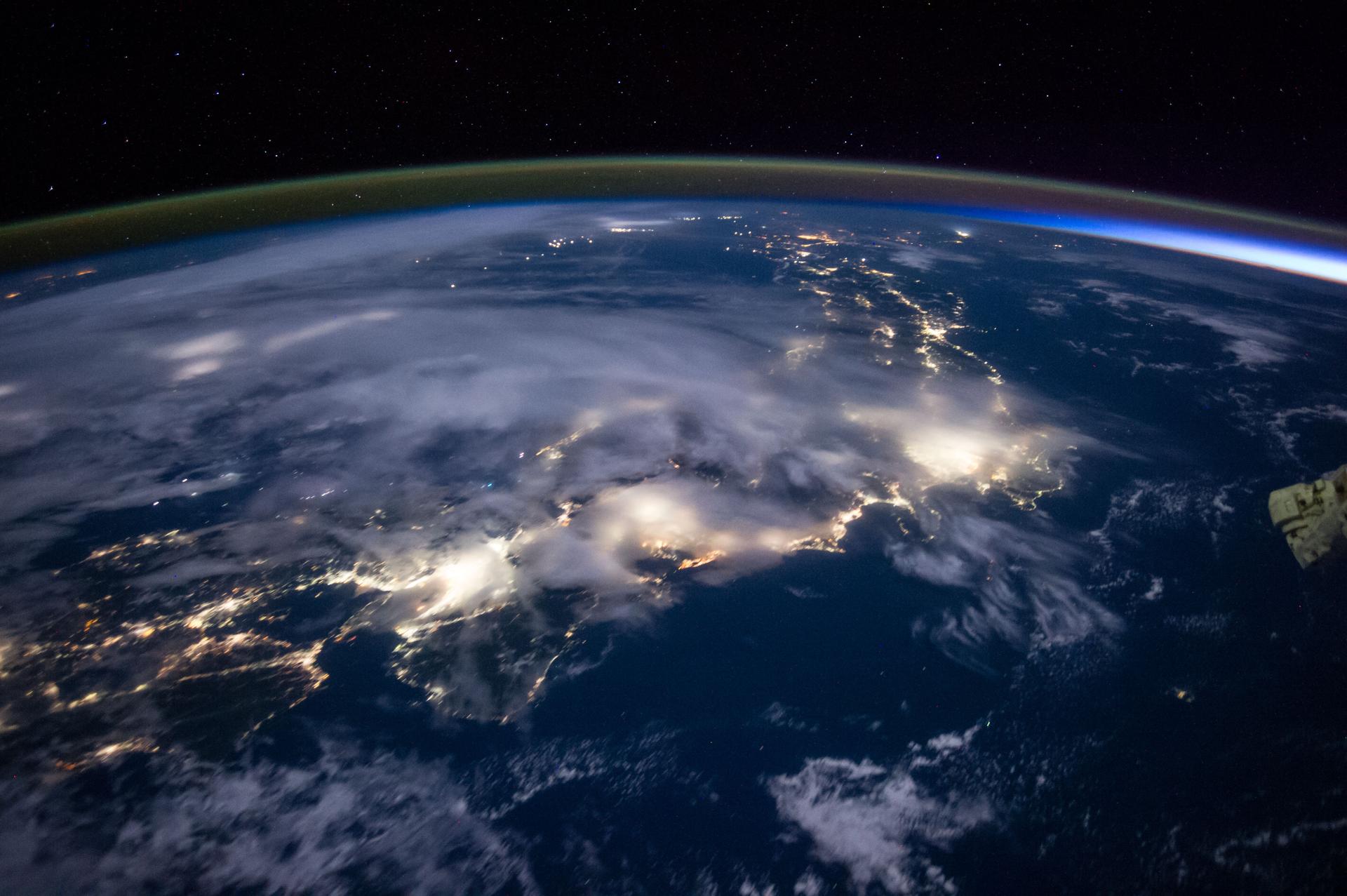
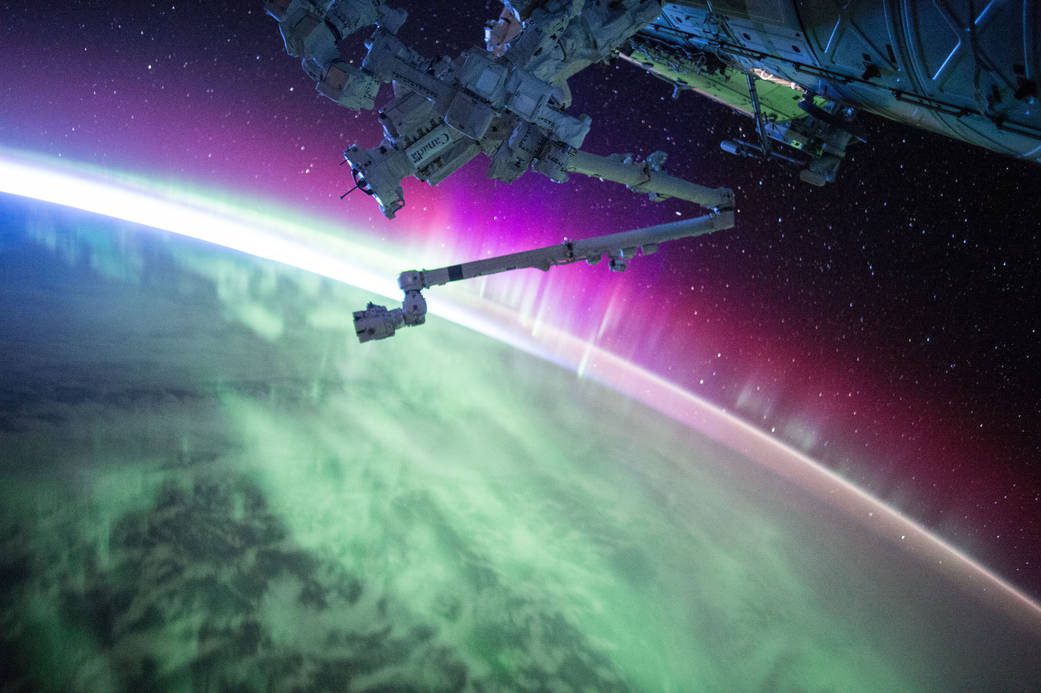
    Green auroras dancing along Earth's atmosphere at night. View of city lights on Earth and the Moon in the background.
    NASA astronaut Scott Kelly took this majestic image of the Earth at night highlighting the green and red hues of an Aurora.
    NASA

    NASA is asking American companies to provide input on the agency’s requirements for end-to-end services as part of the Commercial Low-Earth Orbit Development Program.

    In the future, the agency plans to transition its operations in low Earth orbit to commercially owned and operated destinations to ensure continued access and presence in space for research, technology development, and international collaboration after the planned retirement of the International Space Station.

    Through a request for information (RFI), NASA is seeking feedback from industry as the agency refines its anticipated requirements for new commercial space destinations. The requirements will help industry understand NASA’s human-rating standards that will be used by the agency to certify that the new systems meet NASA expectations for low Earth orbit operations and transportation. An industry briefing day is scheduled to take place Tuesday Oct. 12, with responses to the RFI due Wednesday, Nov. 17.

    “This RFI is a significant next step in transitioning low Earth orbit operations to the private sector, allowing NASA to be one of many customers for services” says Phil McAlister, director of commercial spaceflight at NASA Headquarters in Washington, D.C. “These requirements will be the foundation upon which the companies can design safe systems. But the requirements have to work for companies as well. Thus, we are seeking industry feedback on these draft requirements to ensure that the Commercial LEO destinations will be safe, reliable, and cost effective.”

    The agency is currently supporting the development of several new stations and destination concepts through both funded and unfunded agreements. However, a company does not need to have a current agreement with NASA in order to provide feedback via the RFI or to bid on future procurements to provide low Earth orbit services to the agency.

    “We’ve seen a tremendous amount of innovation and effort from industry thus far in developing their station designs,” says Angela Hart, manager of the Commercial Low Earth Orbit Development program at NASA’s Johnson Space Center in Houston. “We are working in lockstep with multiple companies to help guide them in a way that sets them up for success to meet our requirements. However, it’s crucial that we open feedback to as wide of an audience as possible. The more commercial stations that are successfully operating in low Earth orbit, the greater likelihood that we can continue to drive down costs and encourage innovation in this new commercial space industry.”

    NASA previously sought industry input in 2022 and early 2023, and has hosted two industry days on the agency’s assumptions and expectations for crew and technical requirements to guide companies’ technical and business plans. The feedback from industry will continue to inform the agency’s future commercial services strategy for low Earth orbit destinations.

    NASA’s goal is to enable a strong commercial marketplace in low Earth orbit where NASA is one of many customers for private industry. This strategy will provide services the government needs safely, at a lower cost, and enables the agency to focus on its Artemis missions to the Moon in preparation for Mars, while continuing to use low Earth orbit as a training and proving ground for those deep space missions.

    Information about how to attend the industry briefing day is contained in the RFI on SAM.gov. The dates for industry day and responses due are subject to change pending a government shutdown resolution and will be updated on SAM.gov when available. For more information about NASA’s commercial space strategy, visit:

    https://www.nasa.gov/humans-in-space/commercial-space/

    By Rebecca Turkington
    Johnson Space Center, Houston
    rebecca.turkington@nasa.gov
  • Brilliant Minds for Pure Blue Skies

    Welcome, passionate innovators and bold visionaries, to an extraordinary quest to redefine the future of aviation, to bring forth a world where the skies are clear, and the flights are green. The challenge at hand is not just a call to reimagine aircraft but an invitation to unleash your creativity in scripting an environmentally-conscious success story for the ages. Picture this – the year is 2050. A dark, smoky haze shrouds the flightline, casting a shadow of uncertainty on the future of our planet. The world watches as aircraft crisscross the skies, leaving trails of emissions in their wake, fueling a looming climate crisis. Yet, amid this grim reality, a new hope emerges: YOU! We are asking for your brilliant minds to come together and transform the aviation industry, wielding innovative technologies that save the planet from the grips of an environmental catastrophe. The skies are your canvas, and the spotlight is on you.

    Award: $30,000 in total prizes

    Open Date: September 28, 2023

    Close Date: December 14, 2023

    For more information, visit: https://www.herox.com/PureBlueSkies

  • Space Tech Catalyst Prize

    Space Tech Catalyst Prize logo

    The NASA Space Tech Catalyst Prize will recognize U.S. individuals and/or organizations that share effective best practices for how they support underrepresented and diverse space technology innovators, researchers, technologists, and entrepreneurs. The prize competition’s primary goals are: (1) Showcase effective strategies and approaches for developing the capacity and skill sets of these groups, enhancing their ability to succeed, (2) Expand the outreach and engagement efforts of the NASA ESIP portfolio, ensuring a diverse and inclusive pool of applicants for future funding opportunities, and (3) Recognize the efforts of those who support and nurture underrepresented and diverse individuals and organizations in the space technology sector.

    Award: $500,000 in total prizes

    Open Date: September 29, 2023

    Close Date: February 22, 2024

    For more information, visit: https://www.spacetechcatalystprize.org/

  • Discovery Alert: The Planet that Shouldn’t Be There

    3 min read

    Discovery Alert: The Planet that Shouldn’t Be There

    Artist’s rendering of planet 8 Ursae Minoris b – also known as “Halla” – amid the field of debris after a violent merger of two stars. The planet might have survived the merger, but also might be an entirely new planet formed from the debris.
    W. M. Keck Observatory/Adam Makarenko

    By Pat Brennan

    NASA’s Exoplanet Exploration Program

    The discovery: A large planet is somehow orbiting a star that should have destroyed it.

    Key facts: Planet 8 Ursae Minoris b orbits a star some 530 light-years away that is in its death throes. A swollen red giant, the star would have been expected to expand beyond the planet’s orbit before receding to its present (still giant) size. In other words, the star would have engulfed and ripped apart any planets orbiting closely around it. Yet the planet remains in a stable, nearly circular orbit. The discovery of this seemingly impossible situation, relying on precise measurements using NASA’s Transiting Exoplanet Survey Satellite (TESS), shows that planet formation – and destruction – are likely far more intricate and unpredictable than many scientists might have thought.

    Details: As stars like our Sun approach the ends of their lives, they begin to exhaust their nuclear fuel. They become red giants, expanding to their maximum size. If that happened in this case, the star would have grown outward from its center to 0.7 astronomical units – that is, about three-quarters the distance from Earth to the Sun. It would have swallowed and destroyed any nearby orbiting planets in the process. But planet b, a large gaseous world, sits at about 0.5 astronomical units, or AU. Because the planet could not have survived engulfment, Marc Hon, the lead author of a recent paper on the discovery, instead proposes two other possibilities: The planet is really the survivor of a merger between two stars, or it’s a new planet – formed out of the debris left behind by that merger.

    The first scenario begins with two stars about the size of our Sun in close orbit around each other, the planet orbiting both. One of the stars “evolves” a bit faster than the other, going through its red giant phase, casting off its outer layers and turning into a white dwarf – the tiny but high-mass remnant of a star. The other just reaches the red giant stage before the two collide; what remains is the red giant we see today. This merger, however, stops the red giant from expanding further, sparing the orbiting planet from destruction. In the second scenario, the violent merger of the two stars ejects an abundance of dust and gas, which forms a disk around the remaining red giant. This “protoplanetary” disk provides the raw material for a new planet to coalesce. It’s a kind of late-stage second life for a planetary system – though the star still is nearing its end.

    Fun facts: How can astronomers infer such a chaotic series of events from present-day observations? It all comes down to well understood stellar physics. Planet-hunting TESS also can be used to observe the jitters and quakes on distant stars, and these follow known patterns during the red-giant phase. (Tracking such oscillations in stars is known as “asteroseismology.”) The pattern of oscillations on 8 Ursae Minoris, the discovery team found, match those of red giants at a late, helium-burning stage – not one that is still expanding as it burns hydrogen. So it isn’t that the star is still growing and hasn’t yet reached the planet. The crisis has come and gone, but the planet somehow continues to exist.

    The discoverers: The paper describing the TESS result, “A close-in giant planet escapes engulfment by its star,” was published in the journal Nature in June 2023 by an international science team led by astronomer Marc Hon of the University of Hawaii.

  • NASA Selects Four Small Explorer Mission Concept Studies

    NASA meatball logo
    NASA logo
    Credits: NASA

    NASA has selected four small explorer missions to conduct concept studies. These studies aim to expand knowledge of the dynamics of the Sun and related phenomena, such as coronal mass ejections, aurora, and solar wind to better understand the Sun-Earth connection.

    Any missions selected to move forward after the concept studies are conducted will join the current heliophysics mission fleet, which not only provides deeper insight into the mechanics of our universe, but also offers critical information to help protect astronauts, satellites, and communications signals, and helps enable space exploration. 

    “These four mission concept studies were selected because they address compelling science questions and could greatly impact the field of heliophysics,” said Nicky Fox, the associate administrator for science at NASA Headquarters in Washington. “These mission proposals are exciting because they build upon and complement the science of our current mission fleet, have the potential for broad impact and could provide new and deeper insight into the solar atmosphere and space weather.”

    CINEMA

    The Cross-scale Investigation of Earth’s Magnetotail and Aurora (CINEMA) mission would work to understand the structure and evolution of Earth’s plasma sheet – a long sheet of denser space plasma in the magnetic fields flowing behind Earth, known as the magnetotail — using a constellation of nine CubeSats flown in sun-synchronous, low Earth orbit.  The primary purpose of this mission is to study the role of plasma sheet structure, as well as how Earth’s magnetic fields transfer heat  and change over time at multiple scales. CINEMA will complement current heliophysics missions, such as the THEMIS (Time History of Events and Macroscale Interactions during Substorms), MMS (Magnetospheric Multiscale) mission, and the planned Geospace Dynamics Constellation mission. The principal investigator for the CINEMA mission concept study is Robyn Millan from Dartmouth College, in Hanover, New Hampshire.

    CMEx

    The Chromospheric Magnetism Explorer (CMEx) mission would  attempt to understand the magnetic nature of solar eruptions and identify the magnetic sources of the solar wind. CMEx proposes to obtain the first continuous observations of the solar magnetic field in the chromosphere – the layer of solar atmosphere directly above the photosphere or visible surface of the Sun. These observations would improve our understanding of how the magnetic field on the Sun’s surface connects to the interplanetary magnetic field. The principal investigator for this mission concept study is Holly Gilbert from the National Center for Atmospheric Research in Boulder, Colorado.

    EUV CME and Coronal Connectivity Observatory

    The Extreme ultraviolet Coronal Mass Ejection and Coronal Connectivity Observatory (ECCCO) consists of a single spacecraft with two instruments, a wide-field extreme ultra-violet imager and a unique imaging EUV spectrograph. ECCCO’s observations would contribute to understanding the middle corona, the dynamics of eruptive events leaving the Sun, and the conditions that produce the outward streaming solar wind. The mission would address fundamental questions about where the mass and energy flow linking the Sun to the outer corona and heliosphere originate ECCCO’s concept study principal investigator is Katharine Reeves from the Smithsonian Astrophysical Observatory, in Cambridge, Massachusetts.

    MAAX

    The primary objective of the Magnetospheric Auroral Asymmetry Explorer (MAAX) mission would be to improve our understanding of how electrodynamic coupling between Earth’s magnetosphere and ionosphere regulates auroral energy flow. The mission would use two identical spacecraft equipped with dual-wavelength ultraviolet imagers to provide global imaging of northern and southern aurora. The principal investigator for the MAAX concept study is Michael Liemohn from the University of Michigan in Ann Arbor.

    “These mission concept study selections provide so much promise to ongoing heliophysics research,” said Peg Luce, acting Heliophysics division director at NASA Headquarters. “The potential to gain new insights and answer longstanding questions in the field while building on the research and technology of our current and legacy missions is incredible..”

    Funding and management oversight for these mission concept studies is provided by the Heliophysics Explorers Program, managed by the Explorers Program Office at NASA’s Goddard Space Flight Center in Greenbelt, Maryland.

    For more information on NASA heliophysics missions, visit:

    https://science.nasa.gov/heliophysics

    -end-

    Denise Hill

    Headquarters, Washington

    202-308-2071

    denise.hill@nasa.gov

    Details

    Last Updated

    Sep 29, 2023

  • Near-Earth Asteroids as of September 2023

    1 min read

    Near-Earth Asteroids as of September 2023

    September 2023

    Labeled infographic highlighting to-date near-Earth asteroid data from NASA’s Planetary Defense Coordination Office.
    Near-Earth Asteroids: Planetary Defense by the Numbers – February 2023

    Each month, NASA’s Planetary Defense Coordination Office releases a monthly update featuring the most recent figures on NASA’s planetary defense efforts, near-Earth object close approaches, and other timely facts about comets and asteroids that could pose an impact hazard with Earth. Here is the what we’ve found for September. 

  • NASA Invites Media to Upcoming SpaceX Resupply Launch to Space Station

    The SpaceX Falcon 9 rocket with the Dragon capsule atop is raised to the vertical position on June 2, 2021, at Launch Complex 39A at NASA’s Kennedy Space Center in Florida, in preparation for the company’s 22nd Commercial Resupply Services mission for NASA to the International Space Station.
    SpaceX

    Media accreditation is open for SpaceX’s 29th commercial resupply mission for NASA to the International Space Station.

    Liftoff of the SpaceX Dragon cargo spacecraft on the company’s Falcon 9 rocket is targeted no earlier than Wednesday, Nov. 1, from Launch Complex 39A at NASA’s Kennedy Space Center in Florida.

    Media prelaunch and launch activities will take place at NASA Kennedy. Attendance for this launch is open to U.S. citizens. The application deadline for U.S. media is 11:59 p.m. EDT Wednesday, Oct. 18.

    All accreditation requests should be submitted online at:

    https://media.ksc.nasa.gov

    Credentialed media will receive a confirmation email upon approval. NASA’s media accreditation policy is available here. For questions about accreditation, or to request special logistical needs, please email ksc-media-accreditat@mail.nasa.gov. For other questions, please contact Kennedy’s newsroom at: 321-867-2468.

    Para obtener información sobre cobertura en español en el Centro Espacial Kennedy o si desea solicitar entrevistas en español, comuníquese con Antonia Jaramillo at: antonia.jaramillobotero@nasa.gov or 321-501-8425.

    SpaceX’s Dragon will deliver new science investigations, food, supplies, and equipment to the international crew. The research includes work to understand interactions between weather on Earth and space, and laser communications. NASA’s Atmospheric Waves Experiment (AWE) will study atmospheric gravity waves –powerful waves formed by weather disturbances on Earth such as strong thunderstorms or brewing hurricanes – to understand the flow of energy through Earth’s upper atmosphere and space. Another experiment – Integrated Laser Communications Relay Demonstration Low-Earth-Orbit User Modem and Amplifier Terminal – (ILLUMA-T) aims to test high data rate laser communications from the space station to Earth. This will complete NASA’s first two-way, end-to-end laser relay system by sending high-resolution data to the agency’s Laser Communications Relay Demonstration, which launched in December 2021.

    Other investigations that will launch with the resupply mission include ESA’s (European Space Agency) Aquamembrane-3, which will test water filtration using proteins found in nature for water recycling and recovery, and Plant Habitat-06, which will evaluate the effects of spaceflight on plant defense responses using multiple genotypes of tomato.

    Commercial resupply by U.S. companies significantly increases NASA’s ability to conduct more investigations aboard the orbiting laboratory. These investigations lead to new technologies, medical treatments, and products that improve life on Earth. Other U.S. government agencies, private industry, and academic and research institutions can also conduct microgravity research through the agency’s partnership with the International Space Station National Laboratory.

    Humans have occupied the space station continuously since November 2000. In that time, 273 people and a variety of international and commercial spacecraft have visited the orbital outpost. It remains the springboard to NASA’s next great leap in exploration, including future missions to the Moon under Artemis, and ultimately, human exploration of Mars.

    For more information about commercial resupply missions, visit:

    https://www.nasa.gov/commercialresupply

    -end-

    Lora Bleacher / Julian Coltre
    Headquarters, Washington
    202-358-1100
    lora.v.bleacher@nasa.gov / julian.n.coltre@nasa.gov

    Stephanie Plucinsky / Steven Siceloff
    Kennedy Space Center, Fla.
    321-876-2468
    stephanie.n.plucinsky@nasa.gov / steven.p.siceloff@nasa.gov

    Sandra Jones
    Johnson Space Center, Houston
    281-483-5111
    sandra.p.jones@nasa.gov

  • NASA Announces Launch Services for Pair of Space Weather Satellites

    NASA meatball logo
    NASA logo
    Credit: NASA

    NASA has selected SpaceX of Hawthorne, California, and its Falcon 9 rocket to provide the launch service for the agency’s TRACERS (Tandem Reconnection and Cusp Electrodynamics Reconnaissance Satellites) mission, a pair of small satellites that will study space weather and how the Sun’s energy affects Earth’s magnetic environment, or magnetosphere

    TRACERS will be an important addition to NASA’s heliophysics fleet and aims to answer long-standing questions critical to understanding the Sun-Earth system. The spinning satellites will study how solar wind, the continuous stream of ionized particles escaping the Sun and pouring out to space, interacts with the region around Earth dominated by our planet’s magnetic field. This interaction, or magnetic reconnection, is an intense transfer of energy that can happen when two magnetic fields meet, which could potentially impact operations with crew and sensitive satellites. TRACERS is led by the University of Iowa with partners at the Southwest Research Institute in San Antonio, and Millennium Space Systems in El Segundo, California.

    NASA’s Launch Services Program, based out of the agency’s Kennedy Space Center in Florida, in partnership with NASA’s Heliophysics Small Explorers program, announces the launch service as part of the agency’s VADR (Venture-Class Acquisition of Dedicated and Rideshare) launch services contract.

    Learn more about NASA’s TRACERS mission online:

    https://blogs.nasa.gov/tracers/

    -end-

    Joshua Finch
    Headquarters, Washington
    202-358-1100
    joshua.a.finch@nasa.gov

    Leejay Lockhart / Laura Aguiar
    Kennedy Space Center, Florida
    321-747-8310 / 321-593-6245
    leejay.lockhart@nasa.gov / laura.aguiar@nasa.gov

    Details

    Last Updated

    Sep 29, 2023

    Editor

    Jennifer M. Dooren

  • To Study Atmosphere, NASA Rockets Will Fly into Oct. Eclipse’s Shadow

    5 min read

    To Study Atmosphere, NASA Rockets Will Fly into Oct. Eclipse’s Shadow

    A NASA sounding rocket mission will launch three rockets during the 2023 annular eclipse in October to study how the sudden drop in sunlight affects our upper atmosphere.

    On Oct. 14, 2023, viewers of an annular solar eclipse in the Americas will experience the Sun dimming to 10% its normal brightness, leaving only a bright “ring of fire” of sunlight as the Moon eclipses the Sun. Those in the vicinity of the White Sands Missile Range in New Mexico, however, might also notice sudden bright streaks across the sky: trails of scientific rockets, hurtling toward the eclipse’s shadow.

    A NASA sounding rocket mission will launch three rockets to study how the sudden drop in sunlight affects our upper atmosphere. The mission, known as Atmospheric Perturbations around the Eclipse Path or APEP, is led by Aroh Barjatya, a professor of engineering physics at Embry-Riddle Aeronautical University in Daytona Beach, Florida, where he directs the Space and Atmospheric Instrumentation Lab.

    Some 50 miles up and beyond, the air itself becomes electric. Scientists call this atmospheric layer the ionosphere because it is where the UV component of sunlight can pry electrons away from atoms to form a sea of high-flying ions and electrons. The Sun’s constant energy keeps these mutually attracted particles separated throughout the day. But as the Sun dips below the horizon, many recombine into neutral atoms for the night, only to part ways again at sunrise.

    During a solar eclipse, the sunlight vanishes and reappears over a small part of the landscape almost at once. In a flash, ionospheric temperature and density drop, then rise again, sending waves rippling through the ionosphere.

    “If you think of the ionosphere as a pond with some gentle ripples on it, the eclipse is like a motorboat that suddenly rips through the water,” Barjatya said. “It creates a wake immediately underneath and behind it, and then the water level momentarily goes up as it rushes back in.”

    The animation shows the changes in the number of electrons (total electron content or TEC) in the ionosphere over the US during the 2017 eclipse. Overlaid on the measurements are the contours that represent location of the outer shadow of the eclipse as it moves across the sky.
    Credit: Mrak, S., Semeter, J., Drob, D., & Huba, J. D. (2018). Direct EUV/X-Ray Modulation of the Ionosphere During the August 2017 Total Solar Eclipse. Geophysical Research Letters, 45(9), 3820-3828. https://doi.org/10.1029/2017GL076771

    During the 2017 total solar eclipse visible across North America, instruments many hundreds of miles outside the eclipse’s path detected atmospheric changes. So did critical infrastructure like GPS and communications satellites that we rely on every day.

    “All satellite communications go through the ionosphere before they reach Earth,” Barjatya said. “As we become more dependent on space-based assets, we need to understand and model all perturbations in the ionosphere.”

    A man in a blue jumpsuit leans over a table displaying three metal cylindrical capsules
    Aroh Barjatya, of Embry-Riddle Aeronautic University in Daytona Beach, Florida, leads the APEP mission. Here, Barjatya inspects the subpayloads, which will eject from the rocket mid-flight. The subpayloads carry the plasma density, neutral density, and magnetic field sensors.
    Credit: NASA’s Wallops Flight Facility/Berit Bland
    Mechanical technician John Peterson of NASA’s Wallops Flight Facility and Barjatya check the six booms carrying the sensitive science sensors after a successful spin deployment testing.
    Credit: NASA’s Wallops Flight Facility/Berit Bland
    Three men stand over a rocket laid down on a table in front of them. Two in the foreground are adjusting a gold-colored metal rod protruding from the end of the rocket.
    Mechanical technician John Peterson of NASA’s Wallops Flight Facility and Barjatya check the six booms carrying the sensitive science sensors after a successful spin deployment testing.
    Credit: NASA’s Wallops Flight Facility/Berit Bland

    To this end, Barjatya designed the APEP mission, choosing the acronym because it is also the name of the serpent deity from ancient Egyptian mythology, nemesis of the Sun deity Ra. It was said that Apep pursued Ra and every so often nearly consumed him, resulting in an eclipse.

    The APEP team plans to launch three rockets in succession – one about 35 minutes before local peak eclipse, one during peak eclipse, and one 35 minutes after. They will fly just outside the path of annularity, where the Moon passes directly in front of the Sun. Each rocket will deploy four small scientific instruments that will measure changes in electric and magnetic fields, density, and temperature. If they are successful, these will be the first simultaneous measurements taken from multiple locations in the ionosphere during a solar eclipse.

    Barjatya chose sounding rockets to answer the team’s science questions because they can pinpoint and measure specific regions of space with high fidelity. They can also measure changes that happen at different altitudes as the suborbital rocket ascends and falls back to Earth. The APEP rockets will take measurements between 45 and 200 miles (70 to 325 kilometers) above the ground along their trajectory.

    “Rockets are the best way to look at the vertical dimension at the smallest possible spatial scales,” said Barjatya. “They can wait to launch at just the right moment and explore the lower altitudes where satellites can’t fly.”

    While the in-situ rocket instruments are all being built by Embry-Riddle and Dartmouth College in New Hampshire, a host of ground-based observations will also support the mission. Co-investigators from the Air Force Research Laboratory at Kirtland Air Force Base in Albuquerque, New Mexico, will collect ionospheric density and neutral wind measurements. Co-investigators from the Massachusetts Institute of Technology’s Haystack Observatory in Westford, Massachusetts, will run their radar to measure ionospheric perturbations farther away from the eclipse path. Finally, a team of students from Embry-Riddle will deploy high-altitude balloons (reaching 100,000 feet) every 20 minutes to measure weather changes as the eclipse passes by. All of these measurements will aid ionosphere modeling efforts led by scientists at the University of Colorado Boulder and Embry-Riddle.

    This won’t be the only APEP launch. The APEP rockets launched in New Mexico will be recovered and then relaunched from NASA’s Wallops Flight Facility in Virginia, on April 8, 2024, when a total solar eclipse will cross the U.S. from Texas to Maine. The April launches are farther from the eclipse path than for the October annular eclipse, but will present an opportunity to measure just how widespread the effects of an eclipse are.

    Illustrated map of the United States shows the paths of two eclipses in 2024. Both cross the same spot in Texas, near San Antonio.
    This map details the path the Moon’s shadow will take as it crosses the contiguous U.S. during the annular solar eclipse on Oct. 14, 2023, and total solar eclipse on April 8, 2024.
    Credit: NASA/Scientific Visualization Studio/Michala Garrison; eclipse calculations by Ernie Wright

    After these two eclipses, the next total solar eclipse over the contiguous U.S. is not until 2044, and the next annular eclipse is not until 2046. “We have to make hay while the Sun shines … or, I suppose for eclipse science, while it doesn’t,” Barjatya joked. “In all seriousness though, this data set will reveal the widespread effects that eclipses have on the ionosphere at the smallest spatial scales.”

    APEP mission fact sheet
    Learn more about the upcoming eclipses

  • To Study Atmosphere, NASA Rockets Will Fly into Oct. Eclipse’s Shadow

    5 min read

    To Study Atmosphere, NASA Rockets Will Fly into Oct. Eclipse’s Shadow

    On Oct. 14, 2023, viewers of an annular solar eclipse in the Americas will experience the Sun dimming to 10% its normal brightness, leaving only a bright “ring of fire” of sunlight as the Moon eclipses the Sun. Those in the vicinity of the White Sands Missile Range in New Mexico, however, might also notice sudden bright streaks across the sky: trails of scientific rockets, hurtling toward the eclipse’s shadow.

    A NASA sounding rocket mission will launch three rockets to study how the sudden drop in sunlight affects our upper atmosphere. The mission, known as Atmospheric Perturbations around the Eclipse Path or APEP, is led by Aroh Barjatya, a professor of engineering physics at Embry-Riddle Aeronautical University in Daytona Beach, Florida, where he directs the Space and Atmospheric Instrumentation Lab.

    Some 50 miles up and beyond, the air itself becomes electric. Scientists call this atmospheric layer the ionosphere because it is where the UV component of sunlight can pry electrons away from atoms to form a sea of high-flying ions and electrons. The Sun’s constant energy keeps these mutually attracted particles separated throughout the day. But as the Sun dips below the horizon, many recombine into neutral atoms for the night, only to part ways again at sunrise.

    During a solar eclipse, the sunlight vanishes and reappears over a small part of the landscape almost at once. In a flash, ionospheric temperature and density drop, then rise again, sending waves rippling through the ionosphere.

    “If you think of the ionosphere as a pond with some gentle ripples on it, the eclipse is like a motorboat that suddenly rips through the water,” Barjatya said. “It creates a wake immediately underneath and behind it, and then the water level momentarily goes up as it rushes back in.”

    The animation shows the changes in the number of electrons (total electron content or TEC) in the ionosphere over the US during the 2017 eclipse. Overlaid on the measurements are the contours that represent location of the outer shadow of the eclipse as it moves across the sky.
    Credit: Mrak, S., Semeter, J., Drob, D., & Huba, J. D. (2018). Direct EUV/X-Ray Modulation of the Ionosphere During the August 2017 Total Solar Eclipse. Geophysical Research Letters, 45(9), 3820-3828. https://doi.org/10.1029/2017GL076771

    During the 2017 total solar eclipse visible across North America, instruments many hundreds of miles outside the eclipse’s path detected atmospheric changes. So did critical infrastructure like GPS and communications satellites that we rely on every day.

    “All satellite communications go through the ionosphere before they reach Earth,” Barjatya said. “As we become more dependent on space-based assets, we need to understand and model all perturbations in the ionosphere.”

    A man in a blue jumpsuit leans over a table displaying three metal cylindrical capsules
    Aroh Barjatya, of Embry-Riddle Aeronautic University in Daytona Beach, Florida, leads the APEP mission. Here, Barjatya inspects the subpayloads, which will eject from the rocket mid-flight. The subpayloads carry the plasma density, neutral density, and magnetic field sensors.
    Credit: NASA’s Wallops Flight Facility/Berit Bland
    Mechanical technician John Peterson of NASA’s Wallops Flight Facility and Barjatya check the six booms carrying the sensitive science sensors after a successful spin deployment testing.
    Credit: NASA’s Wallops Flight Facility/Berit Bland
    Three men stand over a rocket laid down on a table in front of them. Two in the foreground are adjusting a gold-colored metal rod protruding from the end of the rocket.
    Mechanical technician John Peterson of NASA’s Wallops Flight Facility and Barjatya check the six booms carrying the sensitive science sensors after a successful spin deployment testing.
    Credit: NASA’s Wallops Flight Facility/Berit Bland

    To this end, Barjatya designed the APEP mission, choosing the acronym because it is also the name of the serpent deity from ancient Egyptian mythology, nemesis of the Sun deity Ra. It was said that Apep pursued Ra and every so often nearly consumed him, resulting in an eclipse.

    The APEP team plans to launch three rockets in succession – one about 35 minutes before local peak eclipse, one during peak eclipse, and one 35 minutes after. They will fly just outside the path of annularity, where the Moon passes directly in front of the Sun. Each rocket will deploy four small scientific instruments that will measure changes in electric and magnetic fields, density, and temperature. If they are successful, these will be the first simultaneous measurements taken from multiple locations in the ionosphere during a solar eclipse.

    Barjatya chose sounding rockets to answer the team’s science questions because they can pinpoint and measure specific regions of space with high fidelity. They can also measure changes that happen at different altitudes as the suborbital rocket ascends and falls back to Earth. The APEP rockets will take measurements between 45 and 200 miles (70 to 325 kilometers) above the ground along their trajectory.

    “Rockets are the best way to look at the vertical dimension at the smallest possible spatial scales,” said Barjatya. “They can wait to launch at just the right moment and explore the lower altitudes where satellites can’t fly.”

    While the in-situ rocket instruments are all being built by Embry-Riddle and Dartmouth College in New Hampshire, a host of ground-based observations will also support the mission. Co-investigators from the Air Force Research Laboratory at Kirtland Air Force Base in Albuquerque, New Mexico, will collect ionospheric density and neutral wind measurements. Co-investigators from the Massachusetts Institute of Technology’s Haystack Observatory in Westford, Massachusetts, will run their radar to measure ionospheric perturbations farther away from the eclipse path. Finally, a team of students from Embry-Riddle will deploy high-altitude balloons (reaching 100,000 feet) every 20 minutes to measure weather changes as the eclipse passes by. All of these measurements will aid ionosphere modeling efforts led by scientists at the University of Colorado Boulder and Embry-Riddle.

    This won’t be the only APEP launch. The APEP rockets launched in New Mexico will be recovered and then relaunched from NASA’s Wallops Flight Facility in Virginia, on April 8, 2024, when a total solar eclipse will cross the U.S. from Texas to Maine. The April launches are farther from the eclipse path than for the October annular eclipse, but will present an opportunity to measure just how widespread the effects of an eclipse are.

    Illustrated map of the United States shows the paths of two eclipses in 2024. Both cross the same spot in Texas, near San Antonio.
    This map details the path the Moon’s shadow will take as it crosses the contiguous U.S. during the annular solar eclipse on Oct. 14, 2023, and total solar eclipse on April 8, 2024.
    Credit: NASA/Scientific Visualization Studio/Michala Garrison; eclipse calculations by Ernie Wright

    After these two eclipses, the next total solar eclipse over the contiguous U.S. is not until 2044, and the next annular eclipse is not until 2046. “We have to make hay while the Sun shines … or, I suppose for eclipse science, while it doesn’t,” Barjatya joked. “In all seriousness though, this data set will reveal the widespread effects that eclipses have on the ionosphere at the smallest spatial scales.”

    About the Author

    Miles Hatfield

    Miles Hatfield

  • Honoring Hispanic Heritage Month: Patriot Construction Supports NASA Ames Research Center

    In celebration of National Hispanic Heritage Month, the NASA Office of Small Business Programs (OSBP) is highlighting the contributions made by Hispanic-owned businesses to NASA’s mission. Through collaborative efforts, Patriot Construction, Inc. has played a pivotal role in the enhancement and maintenance of NASA’s Ames Research Center in California. They have worked on the N244 Seismic Risk Reduction, Restore Reliability of Main Switchboard for Agency Telecom Gateway N254, Historic Preservation of Building 025 Phase 2 of 2, and the N258 Hyperwall Room Remodeling. 

    Unitary Plan Wind Tunnel
    This outdoor display of the Unitary Plan Wind Tunnel (UPWT), on DeFrance Ave at Ames Research Center, was updated in August 2023. The display will inform the visiting public of the contributions this National Historic Landmark has made to the Nation’s aeronautical research.

    The projects Patriot have been involved in, Buildings N244, N254, N258 are critical buildings to NASA missions. The Restore Reliability of Main Switchboard for Agency Telecom Gateway N254 project is an upgrade to their main switchboard. This building is an essential 24/7 operation that holds the Security Operations Center (SOC) which is the nerve center for detection and monitoring of security incidents for the Agency.  

    The N258 Hyperwall Room Remodeling is a dedicated space equipped with a hyperwall, accessible to all users NASA Supercomputer users. The Supercomputer is available to every mission directorate in NASA. Additionally, the hyperwall significantly increases efficiency, allowing wind tunnel personnel to conduct analyses more quickly. 

    The Historic Preservation of Building 025 Phase 2 of 2 is a historical building which NASA is restoring to make it ready for occupancy. Building 025 has not received maintenance since the Navy’s departure in 1998. In accordance with the National Historic Preservation Act (NHPA), NASA, as a federal agency, has a responsibility to preserve and maintain the historical integrity of all properties under its jurisdiction. The N244 Seismic Risk Reduction project is a proactive initiative aimed at ensuring the safety of all personnel within building N244 during earthquakes.

    As we honor hispanic heritage, Patriot’s partnership with NASA exemplifies the incredible achievements that can be realized when diverse talents unite in pursuit of technological advancement.

    Editor: Maliya Malik, NASA Office Of Small Business Programs Intern

  • NASA’s New Horizons to Continue Exploring Outer Solar System

    3 min read

    NASA’s New Horizons to Continue Exploring Outer Solar System

    New Horizons in space

    NASA has announced an updated plan to continue New Horizons’ mission of exploration of the outer solar system. 

    Beginning in fiscal year 2025, New Horizons will focus on gathering unique heliophysics data, which can be readily obtained during an extended, low-activity mode of operations. 

    While the science community is not currently aware of any reachable Kuiper Belt object, this new path allows for the possibility of using the spacecraft for a future close flyby of such an object, should one be identified. It also will enable the spacecraft to preserve fuel and reduce operational complexity while a search is conducted for a compelling flyby candidate. 

    “The New Horizons mission has a unique position in our solar system to answer important questions about our heliosphere and provide extraordinary opportunities for multidisciplinary science for NASA and the scientific community,” said Nicola Fox, associate administrator for NASA’s Science Mission Directorate in Washington. “The agency decided that it was best to extend operations for New Horizons until the spacecraft exits the Kuiper Belt, which is expected in 2028 through 2029.” 

    This new, extended mission will be primarily funded by NASA’s Planetary Science Division and jointly managed by NASA’s Heliophysics and Planetary Science Divisions.

    NASA will assess the budget impact of continuing the New Horizons mission so far beyond its original plan of exploration. As a starting point, funding within the New Frontiers program (including science research and data analysis) will be rebalanced to accommodate extended New Horizons operations, and future projects may be impacted.

    Launched on January 18, 2006, NASA’s New Horizons spacecraft has helped scientists understand worlds at the edge of our solar system by visiting the dwarf planet Pluto (its primary mission) and then venturing farther out for a flyby of the Kuiper belt object Arrokoth, a double-lobed relic of the formation of our solar system, and other more remote observations of similar bodies.  

    The Johns Hopkins University Applied Physics Laboratory in Laurel, Maryland, designed, built and operates the New Horizons spacecraft, and manages the mission for NASA’s Science Mission Directorate. The Marshall Space Flight Center Planetary Management Office provides the NASA oversight for the New Horizons. Southwest Research Institute, based in San Antonio, directs the mission via Principal Investigator Stern, and leads the science team, payload operations and encounter science planning. New Horizons is part of the New Frontiers Program managed by NASA’s Marshall Space Flight Center in Huntsville, Alabama.

    Details

    Last Updated

    Sep 29, 2023

    Editor

    Tricia Talbert

  • Science in Space: Week of Sept. 29, 2023 – Fire Safety in Space

    Crew members aboard the International Space Station conducted a variety of scientific investigations during the week ending Sept. 29, 2023, including FLARE.

    This JAXA (Japan Aerospace Exploration Agency) investigation explores the flammability of materials in microgravity. Current tests of materials that are used in crewed spacecraft do not consider gravity, which significantly affects combustion phenomena. The ability for flames to spread over solid materials, for example, is affected by the forces of buoyancy, which are absent in microgravity. Removing the effects of buoyancy by conducting combustion experiments in microgravity also gives researchers a better understanding of specific flame behaviors.

    male astronaut setting up hardware for a combustion experiment
    JAXA astronaut Satoshi Furukawa sets up hardware for the FLARE investigation.
    NASA

    Other investigations on the space station have examined the behavior, spread, and growth of fire. This work helps guide selection of spacecraft cabin materials, improve understanding of early fire growth behavior, validate models used to determine material flammability, and identify optimal fire suppression techniques. Developing ways to prevent and extinguish fire is of critical importance to the safety of crew members and vehicles in space and in confined spaces such as aircraft on Earth. These settings limit the options for suppressing fires and can be difficult to evacuate from.

    Burning and Suppression of Solids (BASS) was one of the first investigations to examine how to extinguish a variety of fuels burning in microgravity. Putting out fires in space must consider the geometry of the flame and characteristics of the materials and methods used to extinguish it, as those used on the ground could be ineffective or even make the flame worse. Analysis of 59 BASS burn tests provided data on heat flow, flame size, effects of fuel mixture flow, and other important parameters.

    BASS-II examined the burning and extinction characteristics of a variety of fuel samples to test the hypothesis that materials burn as well if not better in microgravity than in normal gravity, given adequate ventilation and identical conditions such as pressure, oxygen concentration, and temperature. A number of papers have been published based on results from BASS-II, with findings including a report on the differences between flame spread and fuel regression and comparison of flame spread rates.

    blue flame burning during combustion experiment
    Image of a flame burning during the BASS experiments on extinguishing burning fuels.
    NASA

    Solid Fuel Ignition and Extinction – Growth and Extinction Limit (SoFIE-GEL), a research collaboration between NASA and Roscosmos, analyzes how the temperature of a fuel affects material flammability. Researchers report that experimental observations agree with trends predicted by the models. This investigation is the first in a series using the SoFIE insert for the station’s Combustion Integrated Rack.

    Astronaut Samantha Cristoforetti reconfigures combustion research components
    ESA (European Space Agency) astronaut Samantha Cristoforetti works on the SoFIE-GEL investigation of materials flammability.
    NASA

    Saffire is a series of experiments conducted aboard uncrewed Cygnus cargo spacecraft after they depart the station. Using these cargo vehicles provides distance from the crewed station and enables tests of larger fires. Results have shown that a flame spreading over thin fabrics in microgravity reaches a steady spread rate and a limiting length, which can be used to establish the rate of heat release in a spacecraft, and found that reducing pressure slows down the flame spread.

    green fabric burns from left to right with particles of ash on the left and a flame line in the center
    A sample of fabric burns inside an uncrewed Cygnus cargo craft for the Saffire-IV experiment.
    NASA

    Confined Combustion, sponsored by the ISS National Lab, examines the behavior of flame spread in confined spaces of different shapes. Confinement has been shown to have significant effects on fire characteristics and hazards. Researchers report specifics on interactions between a flame and its surrounding walls and the fate of the flame, such as growth or extinction. These data provide guidance for design of structures and fire safety codes and response in space and on Earth. Other results suggest that confinement can increase or decrease solid fuel flammability depending on conditions. Researchers also demonstrated that color pyrometry – capturing flame emission simultaneously at three broad spectral bands – can determine the temperature of a flame without disrupting its spread.

    Flame studies help keep crews in space and people on Earth safe. This research also can lead to more efficient combustion, reducing impurities and producing greener and more efficient flames for uses on Earth such as heating and transportation.