
Find out how our three new space explorers, Bepi, Mio and MTM, have been preparing for their epic adventure to Mercury
Category: Science
http://www.esa.int/rssfeed/Our_Activities/Space_Science
-
To the launch pad!
-
Call for Media: BepiColombo launch to Mercury
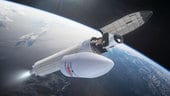
The BepiColombo mission to Mercury is scheduled to launch aboard an Ariane 5 from Europe’s Spaceport in Kourou, French Guiana at 01:45 GMT (03:45 CEST) on 20 October 2018. Representatives of traditional and social media are invited to apply for accreditation to follow the launch live from ESA’s mission control centre in Darmstadt, Germany.
-
Stack complete

The three spacecraft of the BepiColombo mission to Mercury are stacked together in launch configuration -
Frosted crater

Space Science Image of the Week: Bright carbon dioxide ice clings to the walls of a crater in the south polar region of Mars -
A smart crater

Space Science Image of the Week: ESA’s Moon-orbiting SMART-1 probe ended its mission on the Moon 12 years ago today, but its final resting place was only seen last year -
Footprints of water

Space Science Image of the Week: These crisscrossed lines trace the footprints of the Mars Express radar investigation that points to buried water -
Worth the wait

A taste of the transformative science that the James Webb Space Telescope will enable, from chasing down the Universe’s first galaxies to characterising exoplanets in solar systems beyond our own -
Spotlight on BepiColombo

Final inspections for the Mercury Transfer Module’s solar arrays before being stowed for launch -
Spinning-top asteroids, from Rosetta to Hayabusa2 – and maybe Hera

As Japan’s Hayabusa2 drew closer to its target Ryugu asteroid, a strange new planetoid came into view – but one with a somewhat familiar shape. This distinct ‘spinning top’ asteroid class has been seen repeatedly in recent years, and might give a foretaste of things to come for ESA’s proposed Hera mission.
-
Multi-messenger science

ESA’s Integral satellite joined an international collaboration to find first evidence of the source of high-energy neutrinos: a flaring active galaxy or ‘blazar’ -
Cosmic Lens

Hubble proves Einstein correct on galactic scales, using a ‘cosmic magnifying lens’ to make the most precise test of general relativity yet outside the Milky Way

