Week in images: 28 October – 01 November 2024
Discover our week through the lens
http://www.esa.int/rssfeed/Our_Activities/Space_News
Week in images: 28 October – 01 November 2024
Discover our week through the lens

The Space Resources Challenge was launched last week, an opportunity for innovators to pioneer the technologies that will help humankind live and work sustainably on the Moon.

Image:
The icy landscape of Ross Island in Antarctica is featured in this Copernicus Sentinel-2 image from 3 February 2024, during the austral summer.

The 2025 ESA internship opportunities are now live! Positions are open in a wide range of fields, including engineering, science, IT, natural and social sciences, business, economics, and administrative services. This is your chance to launch your career in the extraordinary world of space exploration—don’t miss out on this incredible opportunity to gain hands-on experience with one of the world’s leading space organisations!

When disaster strikes, maintaining communication is critical. Yet, terrestrial (ground) networks are often compromised, leaving civilians stranded and first responders without access to vital information. Limited bandwidth can severely delay crisis management efforts, potentially costing lives. Recent events around the world, including devastating floods and wildfires, underscore the increasing relevance and urgency for advanced disaster response technology.
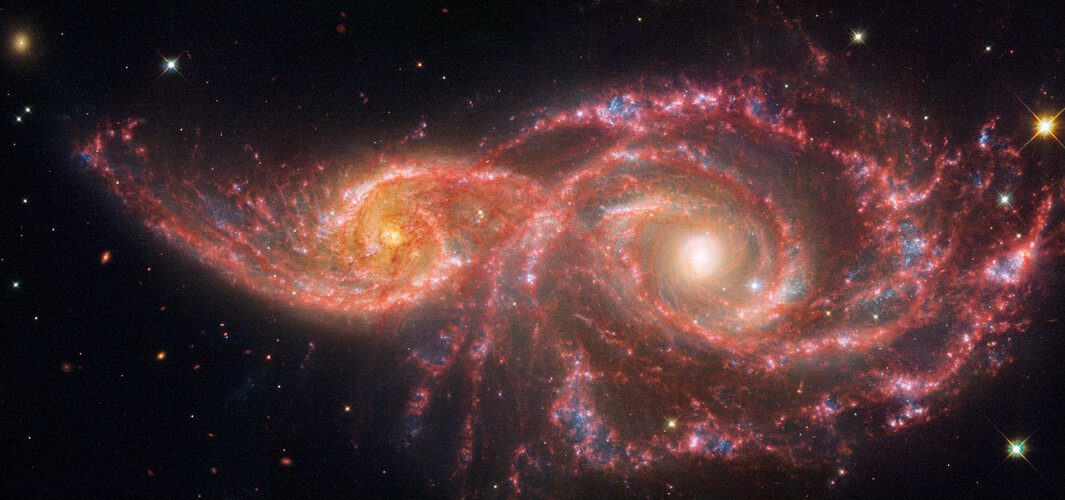
Stare deeply at these galaxies. They appear as if blood is pumping through the top of a flesh-free face. The long, ghastly ‘stare’ of their searing eye-like cores shines out into the supreme cosmic darkness.

ESA’s solar eclipse-making Proba-3 mission is about to leave Europe, to head to its launch site in India. The mission’s two spacecraft – which will manoeuvre precisely in Earth orbit so that one casts a shadow onto the other – have departed the facilities of Redwire Space in Kruibeke, Belgium. The pair will be flown to the Satish Dhawan Space Centre, near Chennai, for the launch campaign to begin.

Image:
Spain is suffering its worst flood in decades after torrential rains struck the eastern province of Valencia. These satellite images vividly illustrate the dramatic transformation of the landscape.

Video:
00:00:23
Robots in disguise: our Hera asteroid detective plus her CubeSat buddies – Milani the rock decoder and Juventas the radar visionary – dressed up for Halloween!
To see them out of costume, watch our The Incredible Adventures of the Hera Mission series!

Image:
The construction phase of ESA’s Ariel mission has started at Airbus Defence and Space in Toulouse (France) with the assembly of the spacecraft’s structural model. This marks a significant step forward for this mission designed to meticulously inspect the atmospheres of a thousand exoplanets and uncover their nature.
In the image we see Ariel’s structural model coming together at the Airbus facilities. This model replicates the mechanical framework of the spacecraft and the mass of its various units for a first round of tough testing.
The Ariel’s structural model consists of two main components: a flight-like replica of the service module (bottom right) and a simplified mechanical mock-up of the payload module (top right). This assembly mimics the structure of the flight spacecraft, where the science instruments make up the payload while the service module houses the essential components for the functioning of the spacecraft, such as the propulsion, and the power and communication systems.
The goal for the end of the year is to complete the mechanical test campaign of the spacecraft’s structural model. This will ensure that Ariel’s design is up-to-spec and can withstand the mechanical strains expected during launch.
The testing phase will include vibration and acoustic test campaigns. During vibration tests the model will be progressively shaken at different strengths on a vibrating table, or ‘the shaker’. During acoustic tests, it will be placed in a reverberating chamber and ‘bombarded’ with very intense noise, like it will encounter during launch.
This model will also be used to assess how the loads are distributed and to perform a first ‘separation and shock’ test using the same mounting system as will be used to mount the spacecraft on the Ariane 6.
When ready, Ariel will be launched by an Ariane 6.2 rocket and journey to the second Lagrangian Point from where it will carry out its uniquely detailed studies of remote worlds.
Image description: A collage of three photographs that show the assembly of the model of a spacecraft in a large white hall. The first image on the left shows the entire model, with a person next to it who is nearly equal in height. The second image on the upper right zooms in on the top part of the mock science instrument: a circular fan-like structure with a big rectangular silver box on top. The third image on the lower right focuses on the bottom of the model, which looks like a large round silver box.

Image:
ESA Astronaut Reserve training kicks off at EAC

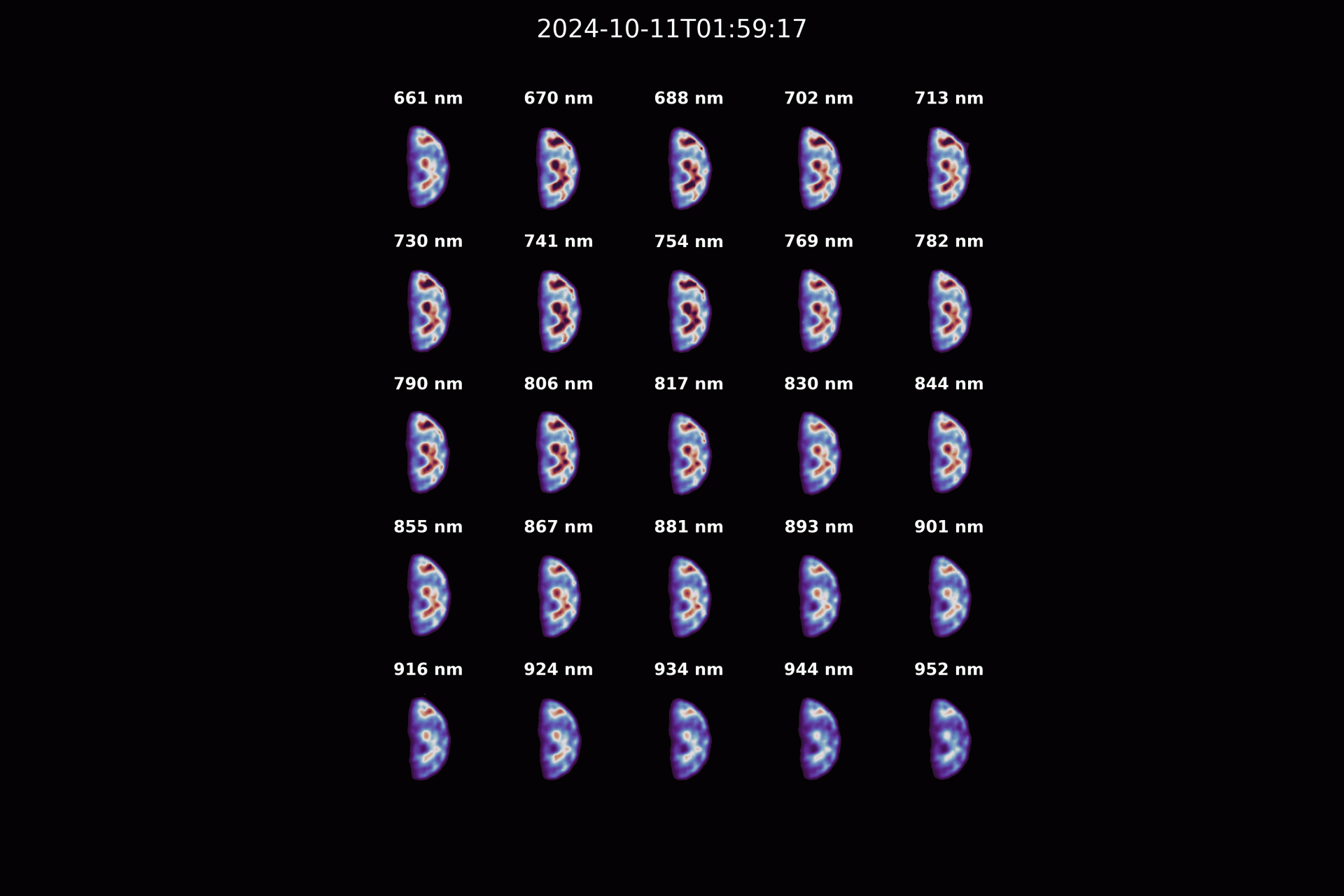
The two CubeSat passengers aboard ESA’s Hera mission for planetary defence have exchanged their first signals with Earth, confirming their nominal status. The pair were switched on to check out all their systems, marking the first operation of ESA CubeSats in deep space.