Author: jappe

  • Air Force's X-37B Space Plane Launching Secret Mission Today: Watch Live

    Editor’s Update for 11:30 am ET: The Air Force’s X-37B space plane has successfully launched on its fourth mission. Read our latest story: US Air Force Launches X-37B Space Plane on 4th Mystery Mission

    The United States Air Force’s X-37B space plane and a tiny solar-sailing spacecraft will launch into orbit today, and you can watch the liftoff live.

    The unmanned X-37B spacecraft is scheduled to blast off atop a United Launch Alliance Atlas V rocket today (May 20) from Florida’s Cape Canaveral Air Force Station, during a four-hour launch window that opens at 10:45 a.m. EDT (1445 GMT).

    You can watch the launch webcast live via United Launch Alliance, or via Space.com partner Spaceflight,Now. Coverage begins at 10:45 a.m. EDT (1445 GMT), with the launch window extending through 2:45 p.m. EDT (1845 GMT). Space.com will carry Spaceflight Now’s launch feed here.

    The U.S. Air Force's fourth X-37 space plane mystery mission will launch into space atop an Atlas V rocket on May 20, 2015 from Cape Canaveral Air Force Station. It is the fourth secret mission for the classified military space plane program.

    The U.S. Air Force’s fourth X-37 space plane mystery mission will launch into space atop an Atlas V rocket on May 20, 2015 from Cape Canaveral Air Force Station. It is the fourth secret mission for the classified military space plane program.
    Credit: United Launch Alliance

    Features of the X-37B spaceplane.

    The Atlas V is also carrying 10 tiny “cubesats” to orbit, including one called LightSail, which was developed by the nonprofit Planetary Society. LightSail aims to test key technologies ahead of a more involved solar-sailing mission using another cubesat in Earth orbit next year.

    Today’s launch marks the fourth space mission — known as Orbital Test Vehicle 4 (OTV-4) — for the reusable X-37B space plane, which looks a bit like NASA’s now-retired space shuttle. The X-37B is much smaller, however; two of these robotic space planes could fit inside the shuttle’s payload bay.

    Details about the X-37B’s activities are classified, as are most of its payloads, so it’s unclear what the space plane will be doing on orbit or how long it will be aloft. But Air Force officials have long maintained that the vehicle is not a space weapon, stressing that it simply tests technologies for reusable spacecraft and future missions.

    The Air Force owns two X-37B vehicles, both of which were built by Boeing’s Phantom Works division. The two space planes had combined to fly three missions before today. Those prior flights launched in April 2010, March 2011 and December 2012, and lasted for 225, 469 and 675 days, respectively. 

    LightSail, meanwhile, is scheduled to deploy its 344-square-foot (32 square meters) sail 28 days from now. Atmospheric drag will pull the cubesat back down to Earth two to 10 days after this occurs, Planetary Society representatives say, but the brief mission should show how well LightSail’s attitude-control and sail-deployment systems work.

    Follow Mike Wall on Twitter @michaeldwall and Google+. Follow us @Spacedotcom, Facebook or Google+. Originally published on Space.com.

  • Magnetic Orion


    Planck portrays stellar birth and magnetic turbulence in the Orion Molecular Cloud

  • Strange Signal from Space May Solve One of Science's Greatest Mysteries

    Fermi Gamma-ray Space Telescope
    An artist’s depiction of the Fermi Gamma-ray Space Telescope (FGST) in orbit.
    Credit: NASA

    A clue to one of the biggest questions in cosmology — why regular matter, rather than antimatter, survived to fill the universe — may have been found in data from a NASA space telescope.

    A new study suggests that gamma-rays (high-energy light) detected by the Fermi Gamma-ray Space Telescope show signs of the existence of a magnetic field that originated mere nanoseconds after the Big Bang. In addition, the researchers on the new study speculate that the magnetic field carries evidence of the fact that there is far more matter than antimatter in our universe.

    The detection of the signal in the Fermi data is currently too weak to be claimed as a “discovery,” and no other solid evidence of an early-universe magnetic field exists. But if the signal bears out and the researchers’ speculations withstand scrutiny, the work could help scientists understand why the observable universe is made primarily of matter and not antimatter. [The Gamma Ray Universe: Photos by the Fermi Telescope]

    Matter vs. antimatter

    It’s easy to take matter for granted. The stuff that makes up our planet and everything on it — as well as our sun and all the other visible objects in the universe — never seems to be at risk of disappearing in an instant. But around the time our universe was born, there may have been just such an instant — a moment when matter won out and something called antimatter did not.

    Cosmologists think the universe started with equal parts matter and antimatter; when matter and antimatter collide with great force, they annihilate each other. So, what happened to most of the antimatter (it still exists in the universe, but in very small quantities)? Why did matter dominate? It’s one of the biggest questions plaguing modern science.

    Tanmay Vachaspati, a professor of physics at Arizona State University and his colleagues think they have found a clue to this mystery. They say that a signal in the Fermi gamma-ray data suggests an overwhelming production of matter, but not antimatter, in the early universe. They detailed their findings in a paper published online today (May 14) in the journal Monthly Notices of the Royal Astronomical Society.

    A universal magnetic field

    The team claims to have identified a sort of “twisting” of the gamma rays that the Fermi telescope detects, and the researchers say the detection of this twisted gamma-ray signal is verified in their paper.

    Vachaspati and his colleagues’ interpretation of what that signal means boils down to this: The twisted gamma-rays are evidence of a magnetic field that has been present in the universe since less than a second after the Big Bang. This magnetic field has a left-hand orientation, and that is evidence of the overwhelming production of matter in the early universe, as antimatter would have produced a right-hand orientation, they said. [Most Amazing Gamma Ray Sources in the Universe]

    There are many particle-physics events that must occur for this magnetic field to leave an imprint on the gamma-rays, the researchers .

    Scientists don’t know for sure if this kind of “primordial” magnetic field exists in our universe. There have been magnetic fields observed in some galaxies and galaxy clusters that could be magnifications of a magnetic field that already existed in the universe, and to demonstrate that it exists would be a fascinating discovery, scientists say.

    The discovery of this left-hand signal was first reported by Vachaspati and colleagues in a paper published in 2014.

    “We were kind of cautious, and we didn’t want to make a big deal of it, because we thought maybe the signal would go away with more data or more analysis,” Vachaspati said. “And then, in [the new paper], we used more data and did other kinds of analysis. And the signal is still there.”

    But the signal may not be a “discovery” quite yet.

    In analyzing statistical data from instruments like the Fermi telescope, there is always a chance that a signal could arise purely by chance. The odds of this occurring are measured by a value called sigma. A result with 1 sigma has roughly 1-in-3 odds of arising purely by chance (not a very good bet).

    The signal detected by Vachaspati and colleagues has a 3-sigma uncertainty, or about 0.3 percent odds that it has appeared purely by chance. This may seem good, but in particle physics, most signals are not officially called a “discovery” until they have a 5-sigma value (1-in-2-million chance that the signal is a purely random fluctuation).

    Tonia Venters, a researcher at NASA Goddard Space Flight Center who works with Fermi telescope data, said it’s important to practice caution.

    “Our field has seen many results at [2- and 3-sigma] significances come and go, so we tend to be rather skeptical when faced with even a 3-sigma result (0.3% probability of occurring by chance),” Venters told Space.com in an email. “To us, a 3-sigma result is interesting enough to wait for more data, but not enough to generate much excitement.”

    It should be noted that there are other ways to judge the validity of a signal, and sigma is not always the best metric to use. However, it often serves as a good way to quickly evaluate the strength of a result. Vachaspati said he puts more weight on the fact that certain predictions made about the signal in the first paper were confirmed in the new analysis.

    The next step, Vachaspati said, is to continue to look for the signal in more Fermi telescope data. The collaboration is expected to release new data this year. He will discuss the work with colleagues from around the world at a monthlong conference on cosmological magnetic fields this June and July.

    “I think the most important part is that we’re seeing a suspicious signal in the data, and then the rest is kind of one step at a time,” Vachaspati said. “We think the most likely candidate for why this is happening is the magnetic field. And then, if it is the magnetic field, then it seems most likely to me it’s going to be this matter-antimatter asymmetry.

    “But people have different ideas, so that part becomes more theoretical,” he added. “The interesting thing is that there seems to be a signal.”

    Follow Calla Cofield @callacofield.Follow us @Spacedotcom, Facebook and Google+. Original article on Space.com.

  • Rare Quasar Quartet Is the First of Its Kind Ever Seen

    View of Four Quasars
    This image shows a rare view of four quasars, indicated by white arrows, found together by astronomers using the Keck Observatory in Hawaii. The bright galactic nuclei are embedded in a giant nebula of cool, dense gas visible in the image as a blue haze.
    Credit: Hennawi & Arrigoni-Battaia, MPIA

    A giant nebula in the early universe hits the jackpot when it comes to rare, bright objects known as quasars, boasting four within surprisingly close proximity to one another. The first known quasar quartet lies in a cloud of cool gas that could provide a clue to the objects’ unusual closeness.

    “Multiple-quasar systems are rare, because quasars themselves are rare,” Joseph Hennawi, of the Max Planck Institute for Astronomy in Germany, told Space.com by email.

    “The typical distance between any two quasars is about 100 million light-years, whereas we found four quasars within 700,000 light-years of each other,” he said. “The … probability of that occurring is extremely small — about 1 in 10 million odds.” [The Strangest Things in Space]

    Quadruple quasar

    The center of every galaxy boasts a supermassive black hole millions of times the mass of the sun. Material swirling around the rim of the black hole travels near the speed of light, emitting an enormous amount of energy before it is consumed. If the supply is large enough, it enters the quasar phase of its evolution, far outshining its parent galaxy to become one of the brightest objects in the universe.

    But the lives of quasars are extremely brief; according to Hennawi, a quasar shines somewhere between 10 million to 100 million years in the 10-billion-year lifetime of a galaxy. This makes the objects extremely rare and hard to find. Discovering four so close together came as something of a shock.

    Hennawi and his colleagues were studying 29 quasars in search of a nebula of cool hydrogen gas, known as Lyman-α (Lyman-alpha) nebulae, surrounding them. The bright light of a quasar can illuminate the gas around it, helping astronomers to better understand the properties of the gas.

    Selecting one likely candidate, the team trained a Keck telescope in Hawaii on the object, and found one of the largest and brightest Lyman-α nebulae yet discovered. Inside the cloud of gas, the researchers identified not one but four tightly packed quasars, all lying surprisingly close together.

    Nearly 500,000 quasars have been identified so far, but scientists know of only about a hundred binary quasars. Two triple quasar systems have been found since 2007. This, however, is the first known quadruple-quasar system.

    The research is published online today (May 14) in the journal Science.

    Hitting the ‘Jackpot Nebula’

    While it is possible that the researchers simply lucked out — indeed, they dubbed the cool dense cloud of gas the “Jackpot Nebula” — Hennawi said it is more likely that the discovery reveals more about how quasars might form.

    “The primary significance of the quadruple-quasar system is the extremely low probability of a discovery like this occurring by chance, according to our current understanding of the abundance of quasars,” Hennawi said.

    “We thus either have to conclude that we got really lucky — 1 in 10 million [odds] — or that quasar activity is much more likely to occur in certain environments. That, in turn, could be an important piece of the puzzle for understanding what makes a galaxy turn on as a quasar.”

    The nebula that’s home to the four quasars sits within a protocluster, a forerunner of a galaxy cluster like those that exist today. The light took about 10 billion years to reach scientists today, so they are seeing the protocluster as it existed in the early universe (which is only about 13.7 billion years old).

    The protocluster itself is somewhat unusual, containing up to 20 times more galaxies than other already-dense objects of the same type. It also contains a giant nebula of cool gas that Hennawi said is at odds with current theories of how protoclusters should form. These unusual clouds, which have been seen in other protoclusters, may have something to do with the formation of the quadruple-quasar system.

    The quartet itself is one of the few quasar systems to reside in a protocluster; a handful of rare quasars and at least one known typical quasars can also be found in protoclusters and are almost always associated with Lyman-α clouds of gas.

    “We speculate that the likelihood of quasar activity may be highly enhanced in this object because of the massive amount of cool, dense gas, which would be related to fueling the quasars,” Hennawi said.

    Although the quadruple quasar sits in a dense group of galaxies, Hennawi says that there is no sign that previously discovered multi-quasar systems lie in extreme environments. However, the environments of these systems have not been characterized that well. Of the handful of giant nebulae found around quasars, several are related to multiple-quasar systems.

    “We were searching for giant nebulae associated with massive amounts of cool gas, and then basically stumbled upon this quadruple quasar,” Hennawi said. “Since discovering a quadruple quasar is so unlikely, we conclude that giant nebulae of cool gas, protoclusters and quasar activity are all interrelated somehow.”

    He said that the next step is to try to find more of these giant emission clouds by searching for them around individual quasars, something that the new results suggest is easier than previously thought.

    “One important result of our study is that we showed that about 10 percent of all the bright quasars in the distant universe have these giant nebulae around them,” Hennawi said.

    “If we go out and find a sample of 10 to 20 giant nebulae, we can determine how often they are associated with multiple quasars [and] how often they trace protoclusters, and [we can] also study other properties.”

    Follow us @Spacedotcom, Facebook and Google+. Original article on Space.com.

  • Andromeda Galaxy Is Surrounded by a Supersized Gas Halo

    Andromeda Galaxy by Comolli
    The Andromeda Galaxy, shown here, may be much larger than astronomers previously thought. Astrophotographer Lorenzo Comolli took this photo Nov. 16, 2012, from Bogli, Italy.
    Credit: Lorenzo Comolli

    One of the Milky Way’s closest galactic neighbors is surrounded by a much bigger halo of gas than previously thought, new observations from the Hubble Space Telescope reveal.

    The halo of the Andromeda Galaxy — the nearest spiral galaxy to the Milky Way — is about six times larger and 1,000 times more massive than measured before, the new observations show. It is so large that if the halo were visible from Earth, it would be 100 times the diameter of the full moon — or about the size of two basketballs held at arm’s length.

    “Halos are the gaseous atmospheres of galaxies,” said lead researcher Nicholas Lehner, a physicist at the University of Notre Dame, in Indiana, in a statement from NASA. “The properties of these gaseous halos control the rate at which stars form in galaxies, according to models of galaxy formation.” [Amazing Photos of the Andromeda Galaxy]

    Hubble Probes Andromeda Galaxy Halo

    A halo of gas surrounds the Andromeda galaxy, new observations show, giving the galaxy a diameter of roughly 2 million miles.
    Credit: NASA

    Scientists spotted the dark halo by looking at bright objects that are behind the gas and seeing how the light changes. Specifically, they used quasars, or galaxies with huge black holes at their cores that are extremely bright despite being far away.

    As the light leaves the quasar, some of the gas in the halo absorbs the light and makes the quasar appear darker. This is most apparent when it is observed in ultraviolet light (short wavelengths of light). Measuring the dip in brightness allows astronomers to figure out the amount of gas in front of the quasar.

    Because ultraviolet light is absorbed by Earth’s atmosphere, the Hubble telescope was ideally placed to see the changes in brightness because it orbits above the planet.

    A previous program by Hubble, called the Hubble Cosmic Origins Spectrograph (COS)-Halos program, observed 44 galaxies far away and saw halos. Andromeda, however, is the first close-up galaxy where a halo has been observed.

    The authors of the new research say large-scale simulations of galaxies suggest the halo is the same age as the rest of Andromeda, which lies 2.5 million light-years away from Earth. Additionally, the halo is full of elements that are heavier than hydrogen and helium. This indicates at least some of the gas comes from supernovas, explosions of old stars that fused hydrogen and helium into heavier elements through their lifetimes.

    As for our own galaxy — the Milky Way — it’s possible that it also hosts a halo, but that it’s invisible from Earth. “It’s a case of not being able to see the forest for the trees,” the NASA statement said.. If our galaxy does have a halo, it’s possible that it is starting to merge with that of Andromeda’s. Our two galaxies are expected to merge into one galaxy starting in roughly 4 billion years.

    Follow Elizabeth Howell @howellspace, or follow us @Spacedotcom, Facebook and Google+. Original article on Space.com.

  • [International Space Station / Japanese Experiment Module (KIBO)] JAXA Astronaut Activity Report, February 2015

    JAXA Astronaut Activity Report, February, 2015

    Last Updated: May 11, 2015

    This is JAXA’s Japanese astronaut activity report for February, 2015.

    Astronaut Kimiya Yui continues training for his upcoming long-duration ISS mission

    Astronaut Kimiya Yui, who was assigned as a crew member for the Expedition 44/45 mission to the International Space Station (ISS), underwent training for this long-duration mission at the NASA Johnson Space Center (JSC) at the beginning of February, followed by training at the GCTC for the rest of the month.

    At the JSC, training was held for Extravehicular Activity (EVA) and the Space Station Remote Manipulator System (SSRMS). During EVA training in the large pool in the Neutral Buoyancy Laboratory (NBL) where a mock-up of the H-II Transfer Vehicle (HTV) “KOUNOTORI” is submerged, Yui donned a submersible Extravehicular Mobility Unit (EMU) and dived into the water. Yui experienced a scenario where a payload loaded on the KOUNOTORI’s Exposed Pallet (EP) had to be removed by conducting unscheduled EVA.

    Using a Virtual Reality (VR) system, Yui and his crewmate Kjell Lindgren also trained together to master how an EVA member and a SSRMS operations member tie up to proceed with EVA tasks. During the training, Yui was in charge of SSRMS operations and confirmed the procedure for supporting the crew’s EVA operations.

    Enlarged photo

    Yui and his crewmates training in the Soyuz simulator (Photo courtesy of JAXA and the GCTC)

    The training in Russia was focused on flight simulation aboard the Soyuz spacecraft. Alongside Soyuz commander Oleg Kononenko and Astronaut Lindgren, Yui practiced each stage of operations ranging from launch and docking with the ISS, to returning to Earth after undocking from the ISS. They rehearsed operations in manual control mode that is used as backup in case automated control mode fails, as well as responses to sudden depressurization during a flight. For the ISS Russian segment, Yui’s training covered proper responses to such emergencies as an outbreak of fire and sudden depressurization.

    Astronaut Takuya Onishi undergoes survival training in Russia

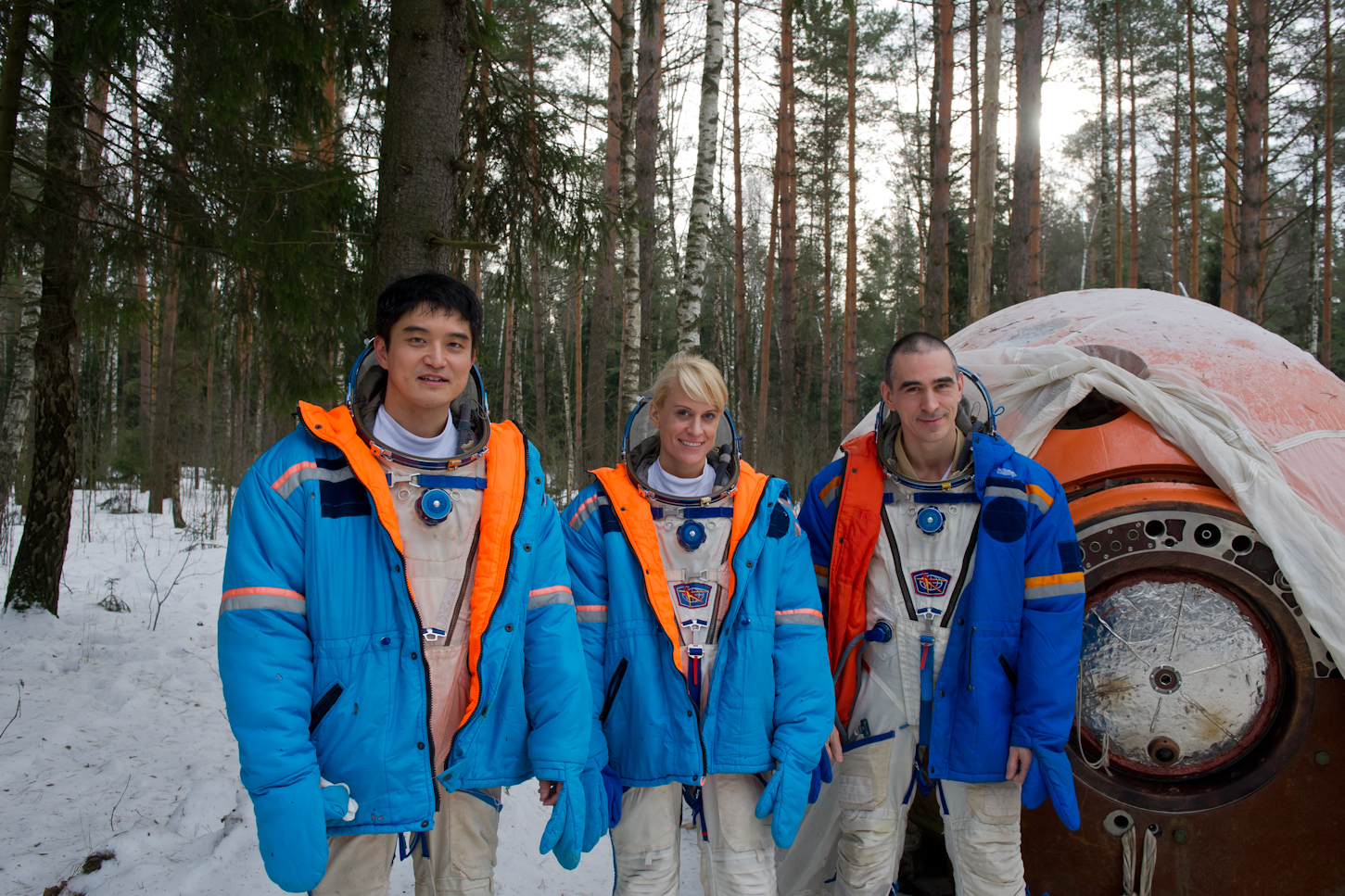
    Astronaut Takuya Onishi, a crew member for the ISS Expedition 48/49 mission, underwent training at Russia’s Gagarin Cosmonaut Training Center (GCTC) during the first half of February, followed by training at the NASA Johnson Space Center (JSC) for the latter half of the month.

    Enlarge photo

    Survival training participants from left: Onishi, Rubins, and Ivanishin (Photo courtesy of JAXA and the GCTC)

    Enlarge photo

    Onishi making a fire (Photo courtesy of JAXA and the GCTC)

    Enlarge photo

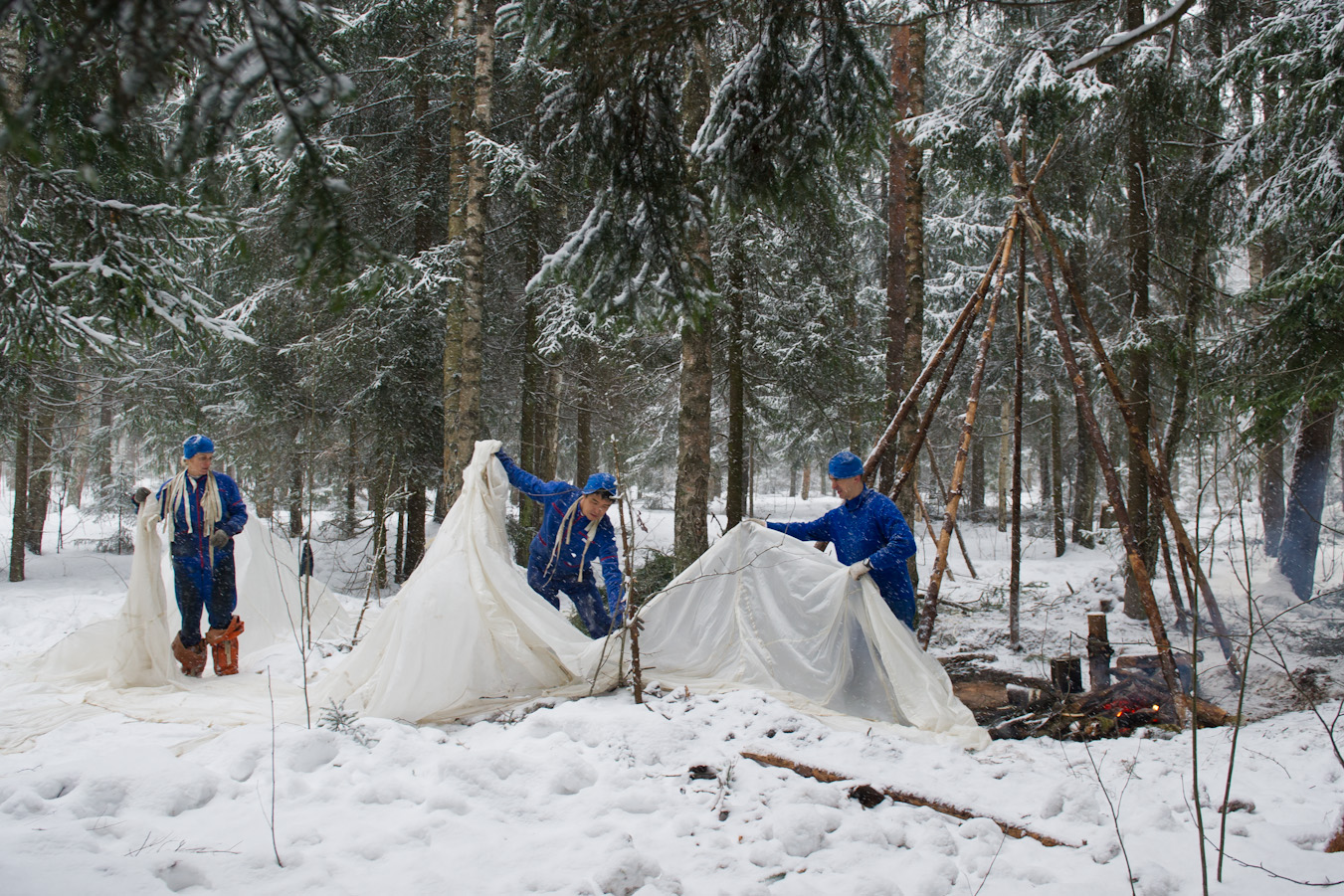
    The trio setting up a shelter (Photo courtesy of JAXA and the GCTC)

    In Russia, Onishi participated in survival training under an assumed case of the Soyuz spacecraft being forced to make an emergency landing on a snow-covered mountain or in a snowfield. This on-site training is intended to help participants learn survival skills by cooperating with each other. Onishi spent outdoor life in sub-zero temperatures with two other participants: Russian Cosmonaut Anatoly Ivanishin and NASA Astronaut Kathleen Rubins, who will fly together with Onishi aboard the Soyuz spacecraft.

    The training was held for two nights and three days because two or three days may be required to conduct search and rescue operations in case the Soyuz spacecraft is forced to touch down at an unpredictable location. In the beginning, they changed from Sokol spacesuits to snowsuits aboard the Soyuz spacecraft. Then they selected a camping location and set up a shelter using the spacecraft’s parachute and hewn wood. The trio made a fire with the wood they collected, and then took turns tending the fire at night.

    The training included a simulated case of one crew member being injured. They practiced how to treat the injured crew member. They also ignited flares to signal a rescue team by following the specified procedure.

    In addition to undergoing survival training, the participants conducted simulated operations of the Soyuz spacecraft for the first time as a trio among all 46S crew members. Atmospheric reentry operations were also simulated under a hypergravity condition generated by a huge centrifuge accelerator, which recreated the gravity that Onishi would experience during this stage. For the Russian segment, Onishi confirmed the maintenance procedure of the Russian toilet as part of life support system training.

    At the JSC, Onishi was trained for overall ISS operations. In the ISS mock-up, Onishi and the other two crew members participated in an emergency response simulation that included cases of fire, sudden depressurization, and air contamination, and responded to each scenario in accordance with the specified procedures.

    Onishi also learned the duties of the Crew Medical Officer (CMO) to be performed in orbit, including medical-checkup and first-aid procedures.

    Onishi’s other training included capturing the H-II Transfer Vehicle (HTV) “KOUNOTORI” by using the Space Station Remote Manipulator System (SSRMS), engaging in simulated daily tasks according to a normal daily schedule on the ISS, and practicing image and video management onboard the ISS.

    Astronauts Soichi Noguchi and Akihiko Hoshide underwent flight piloting training

    Astronauts Soichi Noguchi and Akihiko Hoshide underwent about one week of flight training at Oita airport aboard the Hawker Beechcraft Baron G58 owned by Honda Airways.

    This training is intended to maintain and improve one’s multitasking ability–a qualification required of astronauts.

    Before the flight, Noguchi and Hoshide used a flight simulator to familiarize themselves with flying, and attended lectures on meteorology and flight plans. They also confirmed the procedure for preflight inspection and actually inspected the plane to be flown.

    During the flight training, Noguchi and Hoshide piloted the aircraft by only using the information shown on instrumentation to determine the aircraft’s attitude, height, position, and course, performed an aborted landing (go-around), and operated the aircraft in response to irregular conditions.

    Astronaut Satoshi Furukawa undergoes robotic arm training

    Enlarge photo

    During SSRMS operations training, Furukawa was joined by Wakata at the JSC (Credit: JAXA/NASA)

    Astronaut Satoshi Furukawa underwent robotic arm training from mid-January to February 6 at the NASA JSC, in order to refresh and further improve his skills.

    Using a robotic arm simulator, Furukawa performed SSRMS operations to support the EVA crew and capture unmanned supply vehicles such as KOUNOTORI. During this training, Astronaut Koichi Wakata–a leading expert on robotic arm operations–took the opportunity to join Furukawa and give him advice.

    JAXA astronauts participate in the opening event of Great Britain’s “Innovation is GREAT” campaign

    On February 27, the opening event of the “Innovation is GREAT” campaign organized by the British embassy was held in Roppongi, Tokyo. This yearlong campaign conducted by Japan and Great Britain is intended to promote their bilateral partnership, which includes fostering cooperation in the field of space development. His Royal Highness Prince William, Duke of Cambridge, who was visiting Japan at the time, delivered the opening remarks.

    For this campaign, Yui and British Astronaut Timothy Peake of the European Space Agency (ESA), who will stay on the ISS this year, each sent a video message.

    In his video message, Yui discussed that along with Peake, he wished that activities on the ISS would lead to innovation. Yui and Peake are fellow astronauts who were both selected as astronaut candidates in 2009, and have undergone the 16th NASA Extreme Environment Mission Operations (NEEMO) together. Following the commencement of Yui’s ISS stay in May, Peake will begin his ISS stay from November. In the video, Yui also gave several words of encouragement to Peake and mentioned that he would securely hand over the baton of ISS operations.

    Astronaut Soichi Noguchi had attended the event along with Prince William, and gave a Japanese traditional performance to celebrate the start of the campaign. During a talk session, they discussed the significance of the campaign. The event included a presentation given by British researchers and space industry representatives.

    Astronaut Chiaki Mukai receives the Legion of Honour

    Enlarge photo

    At the Ceremony: Mukai (left) and French Ambassador Thierry Dana (right)

    Astronaut Chiaki Mukai was conferred the National Order of the Legion of Honour (or Legion d’Honneur in French), Chevalier, from France. On February 3, French Ambassador Thierry Dana presented her with a decoration medal.

    This entry passed through the Full-Text RSS service – if this is your content and you’re reading it on someone else’s site, please read the FAQ at fivefilters.org/content-only/faq.php#publishers.

  • NASA Vehicle Changes Everything About Driving | Video

    Credit: NASA/JSC

  • 'Venus Zone' Narrows Search for Habitable Exoplanets

     Nearby Earth-like planet
    An artistic representation of the exoplanet Gliese 832c as compared with Earth. The large planet may be Earth-like, or it could have a dense atmosphere and a closer relationship to Venus.
    Credit: PHL, University of Puerto Rico, Arecibo

    Long before the hunt began to find Earth lookalikes around other stars, one planet in the solar system had already been named Earth’s twin.

    With its similar size and mass, Venus measures very close to Earth, with one major yet significant difference: Its thick atmosphere makes temperatures on the planet hot enough to melt lead, and therefore most certainly too hot to sustain life.

    In order to weed out Venus-like planets from those that would be more habitable, several scientists, including planetary scientist Stephen Kaneof San Francisco State University, proposed the establishment of a “Venus zone” around stars, a region where the atmosphere could be consumed by a runaway greenhouse effect that superheats its planets. [Photos of Venus, the Mysterious Planet Next Door]

    “We’re specifically trying to make it clear that size is no indication of habitability,” Kane told Astrobiology Magazine.

    In other words, just because a planet is roughly the size of Earth, instead of, say, Jupiter, doesn’t guarantee the conditions are right for life to evolve.

    Defining the ‘Venus zone’

    The region around a star where liquid water can exist on a planet’s surface is known as the habitable zone. But just because liquid water can exist doesn’t mean that it does. Finding out the conditions on a planet often requires follow-up observations to initial discoveries, but limitations on observation time and equipment mean prioritizing which planets should be the first to be studied in-depth.

    “The primary purpose of the habitable zone is target selection,” said Kane.

     Venus zone

    Despite being similar sizes, Earth (right half) and Venus (left half) have different surface conditions, a fact that has implications in the search for an Earth-like exoplanet.
    Credit: NASA/JPL-Caltech/Ames

    Kane serves as the chair of NASA’s Kepler Telescope’s Habitable Zone working group, which seeks to utilize all available data from NASA’s Kepler mission, along with any follow-up observations, to provide the most robust list of habitable-zone planets discovered by the telescope. The aim is to better understand how common Earth-size planets are in the habitable zones of other stars. To date, the telescope has identified more than 4,100 planetary candidates.

    The Venus zone would similarly serve as a target-selection tool. Scientists hoping to find the next Earth-like planet perform follow-up searches on planetary candidates in the habitable zone; the establishment of a Venus zone would narrow down the inner edge of potential habitability.

    A planet within the Venus zone may form an ocean at some point in its history. Indeed, Venus is thought to have harbored wateron its surface until approximately one billion years ago, at which point it lost its liquid.

    Kane and his team labeled the point at which a planet would lose its oceansdue to energy from its star as the outer edge of the Venus zone, and the inner boundary of the habitable zone. Losing liquid water would inhibit the carbon cycle of a planet, allowing more to build up in the atmosphere. Rising carbon levels would kick off a runaway greenhouse effect that would heat the planet.

    The runaway greenhouse effect for a planet can be avoided if it experiences significant atmospheric loss. As the atmosphere escapes into space, it prevents the carbon from building up and superheating the planet. This loss of atmosphere establishes the inner edge of the Venus zone. [8 Ways Global Warming Is Already Changing the World]

    Kane presented his research at the January meeting of the American Astronomical Society in Seattle. The work was also published in Astrophysical Journal Letters.

    Finding exo-Venus

    The majority of the new planetary candidates discovered in recent years has come from NASA’s Kepler telescope. Studying planetary atmospheres, however, continues to be a challenge, one that requires advanced telescopes and the right kind of stars. This situation may change in the future.

    Venus Zone graphic

    This graphic shows the location of the ‘Venus zone,’ the area around a star in which planets are likely to have an atmosphere more like Venus than Earth.
    Credit: Chester Harman, Pennsylvania State University

    “At the moment, we lack enough planets around bright stars, and we lack the resources,” Kane said. “Resources means James Webb.”

    Set to launch in 2018, NASA’s James Webb Space Telescopewill be able to search for and study planets around distant stars. At the same time, the agenTransiting Exoplanet Survey Satellite, or TESS, will map exoplanets around the brightest stars in the sky after its 2017 launch.

    “James Webb combined with TESSwill really change the game,” Kane said.

    Because TESS searches for transiting planets — planets that are observed as they cross their star’s face from the telescope’s perspective — it will be more sensitive to those that orbit closer to their sun.

    “TESS will see a lot more exo-Venuses than it will exo-Earths,” planetary atmospheric scientist James Kasting, of Penn State University, told Astrobiology Magazine in an email. “These are the planets to rule out in the search of the more interesting exo-Earths.”

    Alien Planet Quiz: Are You an Exoplanet Expert?

    Astronomers have confirmed more than 800 planets beyond our own solar system, and the discoveries keep rolling in. How much do you know about these exotic worlds?

    Artist's conception of alien planets Kepler-36b and c

    0 of 10 questions complete

    Alien Planet Quiz: Are You an Exoplanet Expert?

    Astronomers have confirmed more than 800 planets beyond our own solar system, and the discoveries keep rolling in. How much do you know about these exotic worlds?

    Start Quiz
    Artist's conception of alien planets Kepler-36b and c

    0 of questions complete

    At the same time, studying more exo-Venuses will help to narrow down the line between the Venus zone and the habitable zone, helping scientists to pinpoint which Earth-size planets are Earth twins, and which bear a stronger resemblance to Venus.

    “Once we can observe these exo-Venuses and exo-Earths, we’ll be able to determine more accurately the boundary between them,” Kasting said. “Right now, that boundary is based entirely on theoretical climate models, which may not be very accurate under these distinctly non-Earth-like conditions.”

    Until then, scientists may have to deal with Venus twins posing as Earth analogues in the samples obtained by Kepler. Kane and his team identified 43 potential Venus analogs, and think that even more exist.

    “I suspect a lot of Venus contamination in our sample,” Kane said.

    This story was provided by Astrobiology Magazine, a web-based publication sponsored by the NASA astrobiology program. Follow Space.com @Spacedotcom, Facebook and Google+.

  • Cinco de Mayo Meteor Shower Rains Halley's Comet Bits on Earth: Watch It Tonight

    Halley's Comet in 1986
    This photograph of Halley’s Comet was taken Jan. 13, 1986, by James W. Young, resident astronomer of JPL’s Table Mountain Observatory in the San Bernardino Mountains, using a 24-inch reflective telescope. Debris from Halley’s Comet produces the Eta Aquarids meteor shower each May. Credit: NASA/JPL
    Credit: NASA/JPL

    When asked to name a comet, most people will remember Halley’s. Tonight (May 5), the Eta Aquarid meteor shower, produced by debris from Halley’s Comet, will peak in the night sky, and you can watch live coverage of this Cinco de Mayo meteor shower online.

    Late tonight (May 5) and during the early morning hours tomorrow (May 6), skywatchers will have a chance of sighting a few pieces of Halley’s Comet – “comet litter,” if you will – zipping through our atmosphere in the form of meteors. The online Slooh community observatory will host a free webcast of the shower starting at 8 p.m. EDT (0000 GMT) that will stream live at: http://www.slooh.com

    You can also watch the Eta Aquarid webcast live on Space.com, courtesy of Slooh. 

    When and Where to Watch

    Learn why famous meteor showers like the Perseids and Leonids occur every year.

    Learn why famous meteor showers like the Perseids and Leonids occur every year [See the Full Infographic Here].
    Credit: Karl Tate, SPACE.com contributor

    The Eta Aquarid meteor shower is predicted to peak on the night of May 5 and into the early morning hours of May 6. Under ideal conditions (a dark, moonless sky) about 40 of these very swift meteors can be seen per hour. The shower appears at about one-quarter peak strength for about three or four days before and after May 6. [See some amazing Eta Aquarid meteor shower photos]

    There are, however, two drawbacks if you plan to watch for these meteors this year. First, there is the moon, which was full on Sunday. Although it is now waning (losing illumination), it will still be a bright gibbous phase on the peak morning and will likely “muscle in” on the fainter meteor streaks by brightening the early morning sky with its light.

    The other obstacle — at least for those watching from north of the equator — is that the radiant (the emanation point of these meteors) is at the “Water Jar” of the constellation Aquarius, which comes above the southeast horizon around 3 a.m. local daylight time, and never gets very high as seen from north temperate latitudes, so the actual observed rates are usually much lower than the oft-quoted 40 per hour. In North America, typical rates are 10 meteors per hour at 26-degrees north latitude, half this at 35-degrees latitude and practically zero north of 40 degrees.

    Catch an Earthgrazer

    For most skywatchers, the best hope is catching a glimpse of a meteor emerging from the radiant that will skim the atmosphere horizontally — much like a bug skimming the side window of an automobile. Meteor watchers call such shooting stars “Earthgrazers.” They leave colorful, long-lasting trails.

    “These meteors are extremely long,” said Robert Lunsford, of the International Meteor Organization. “They tend to hug the horizon rather than shooting overhead where most cameras are aimed.”

    Bill Cooke, a member of the Space Environments team at the Marshall Space Flight Center, said, “Earthgrazers are rarely numerous. But even if you only see a few, you’re likely to remember them.”

    Meteor Shower Quiz: How Well Do You Know ‘Shooting …

    Meteor showers can be awesome night sky sights, but how well do you know your shooting star facts? Find out here and good luck!

    False-color image of a rare early Quadrantid, captured by a NASA meteor camera in 2010.

    0 of 10 questions complete

    Meteor Shower Quiz: How Well Do You Know ‘Shooting …

    Meteor showers can be awesome night sky sights, but how well do you know your shooting star facts? Find out here and good luck!

    Start Quiz
    False-color image of a rare early Quadrantid, captured by a NASA meteor camera in 2010.

    0 of questions complete

    Comet Crumbs

    If you do catch sight of tonight’s meteor shower, keep in mind that you’ll likely be seeing the incandescent streak produced by material that originated from the nucleus of Halley’s Comet. When these tiny bits of comet collide with Earth, friction with our atmosphere raises them to a white heat and produces the effect popularly referred to as “shooting stars.”

    So it is, that the shooting stars that we have come to call the Eta Aquarids are really an encounter with the traces of a famous visitor from the depths of space and from the dawn of creation.

    Halley’s Comet travels around the sun in an elliptical orbit that takes it beyond the orbit of Neptune and as close to the sun as inside the orbit of Venus; a trek that takes roughly 75 years to complete. Halley made its last visit to the sun in 1986 and will return to the vicinity of the sun and Earth in summer 2061. 

    I’d love to be around to greet Halley when it returns, but that’s not likely to happen. You see, I was 30 years old at its last appearance; I’ll stick to my vitamins and do a lot of good wishing, but . . . well, you do the math. It’s possible, not probable.

    And yet, during these next few mornings, both you and I will have a chance of sighting a few pieces of Halley zipping through our atmosphere in the form of meteors.

    The orbit of Halley’s Comet closely approaches the Earth’s orbit at two places. One point is in the middle to latter part of October, producing a meteor display known as the Orionids. The other point comes in the early part of May, producing the Eta Aquarids.

    Editor’s note: If you snap a photo of an Eta Aqaurid meteor tonight and you’d like to share it with Space.com for a story or image gallery, send images and comments in to: spacephotos@space.com.

    Joe Rao serves as an instructor and guest lecturer at New York’s Hayden Planetarium. He writes about astronomy for Natural History magazine, the Farmer’s Almanac and other publications, and he is also an on-camera meteorologist for News 12 Westchester, N.Y. Follow us @Spacedotcom, Facebook and Google+. Original article on Space.com.

  • Week In Images


    Our week through the lens:
    27 April – 1 May 2015

  • What Is DARPA?

    DARPA is an agency of the U.S. military that tests and develops new technologies.

  • Newborn Star Erupts After Binging on Gas and Dust

    A young star in Orion’s dusty nebula roughly 1,400 light-years away has erupted after munching down gas and dust.

  • Citizen Scientists Discover Five New Supernovas

    Over 400,000 volunteer citizen scientists have helped to identify over 2 million new celestial objects and five new supernovas in a wealth of data collected by the SkyMapper telescope.