ESA is working to make Europe more resilient to ‘space weather’ and its effects on really vital things we all use every day, like satellites and power grids
Author: jappe
-
Wary of solar hazards
-

The Frozen Wild Dnieper River
Curling snow drifts are magnified by the terrain around the 1,400 mile Dnieper River, flowing from Russia to the Black Sea in this image from the International Space Station on Feb. 9th, 2017.
-
Holes in the Sun

Operations image of the week: ESA’s Proba-2 mission detects ‘holes’ in the Sun’s corona, which emit high-speed solar wind that can affect satellites orbiting Earth -
Discussing a hot topic

This week marks the biggest annual event in the space weather calender — European Space Weather Week. Find out what space weather is, its hazards, and what ESA is doing about it, in the latest from ESA Web TV -
Windy with a chance of magnetic storms – space weather science with Cluster

Space weather is no abstract concept – it may happen in space, but its effects on Earth can be significant. To help better forecast these effects, ESA’s Cluster mission, a quartet of spacecraft that was launched in 2000, is currently working to understand how our planet is connected to its magnetic environment, and unravelling the complex relationship between the Earth and its parent star.
-
NASA Updates Media Invitation to Observe Quiet Supersonic Flight Series Operations
NASA has updated the date for the media day event at which journalists are invited to learn about the agency’s Quiet Supersonic Flights 2018 campaign.
-

Recovery of the Test Orion Capsule in the Pacific Ocean
On Nov. 1, 2018, the USS John P. Murtha recovered the test version of the Orion capsule at sunset in the Pacific Ocean. This is one in a series of tests that will verify and validate procedures and hardware that will be used to recover the Orion spacecraft after it splashes down in the Pacific Ocean following deep space exploration missions.
-
Keeping watch

ESA’s future Lagrange mission will keep watch our our dynamic Sun, providing early warning of potentially harmful solar activity before it affects satellites in orbit or power grids on ground -
Point of impact

Technology image of the week: ESA’s technology-testing Proba-V minisatellite images the location of the impact that doomed the dinosaurs 66 million years ago -
Malaysian Samples Handed Over to JAXA, Exposure Experiments on ExHAM starts next spring
Malaysian Samples Handed Over to JAXA, Exposure Experiments on ExHAM starts next spring
Last Updated: November 8, 2018
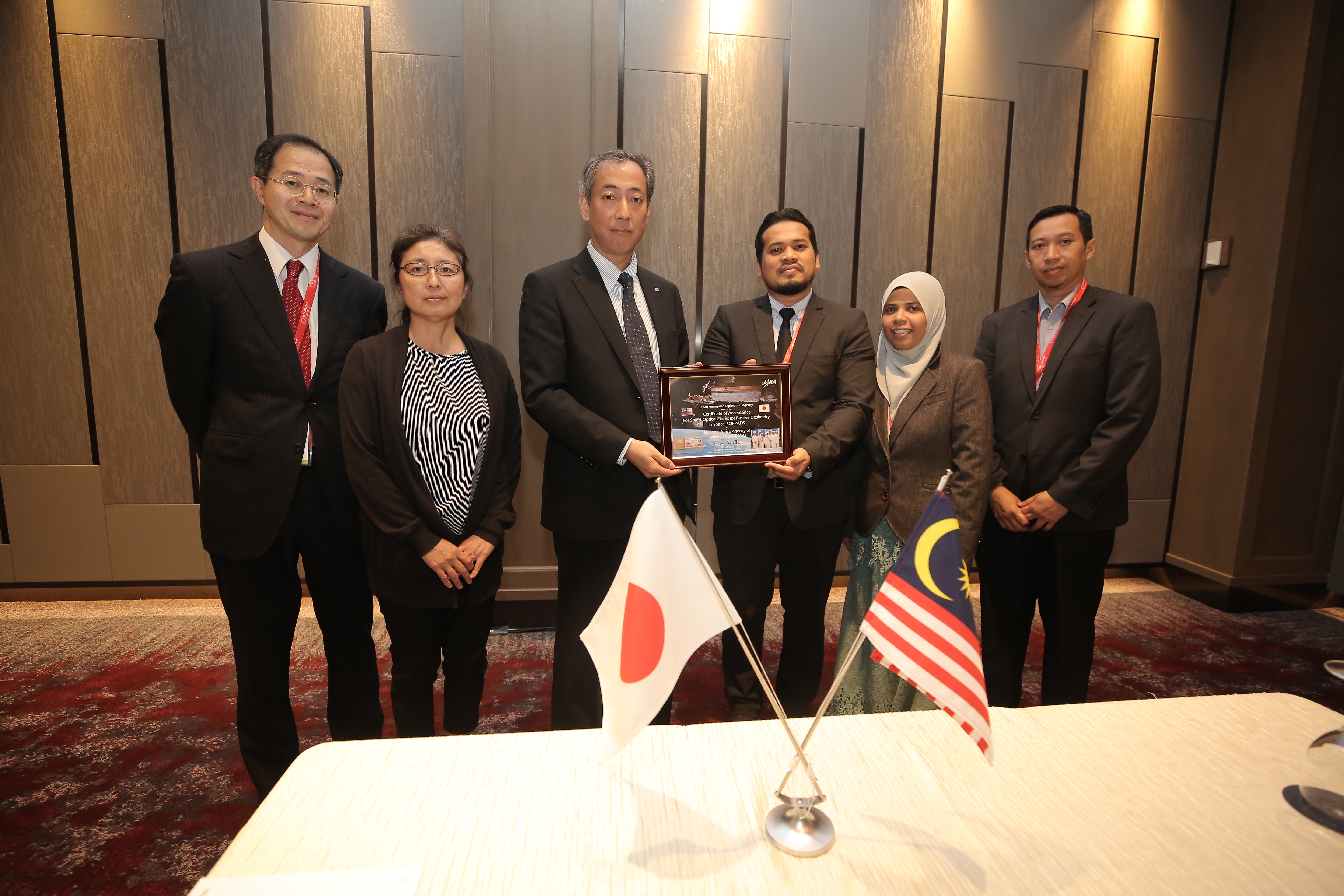
On November 2, 2018, Dr. Noramaliza Mohd Noor, a senior lecturer of Universiti Putra Malaysia, handed over samples of the Material Exposure Experiment to JAXA at the Tsukuba Space Center, while the researchers, ground operators and other stakeholders to the experiment were observing the sample inspection. The samples will be prepared for launch to the International Space Station (ISS) early next year.
The sample handover is based on the agreement of Kibo utilization for long-term material exposure experiment using Exposed Experiment Handrail Attachment Mechanism (ExHAM) on Kibo Exposed Facility, along with inner vehicle experiment in Kibo pressurized module using Passive Dosimeter for Life-science Experiments in Space (PADLES). In October 2018, JAXA and Universiti Putra Malaysia (UPM) finalized this agreement.
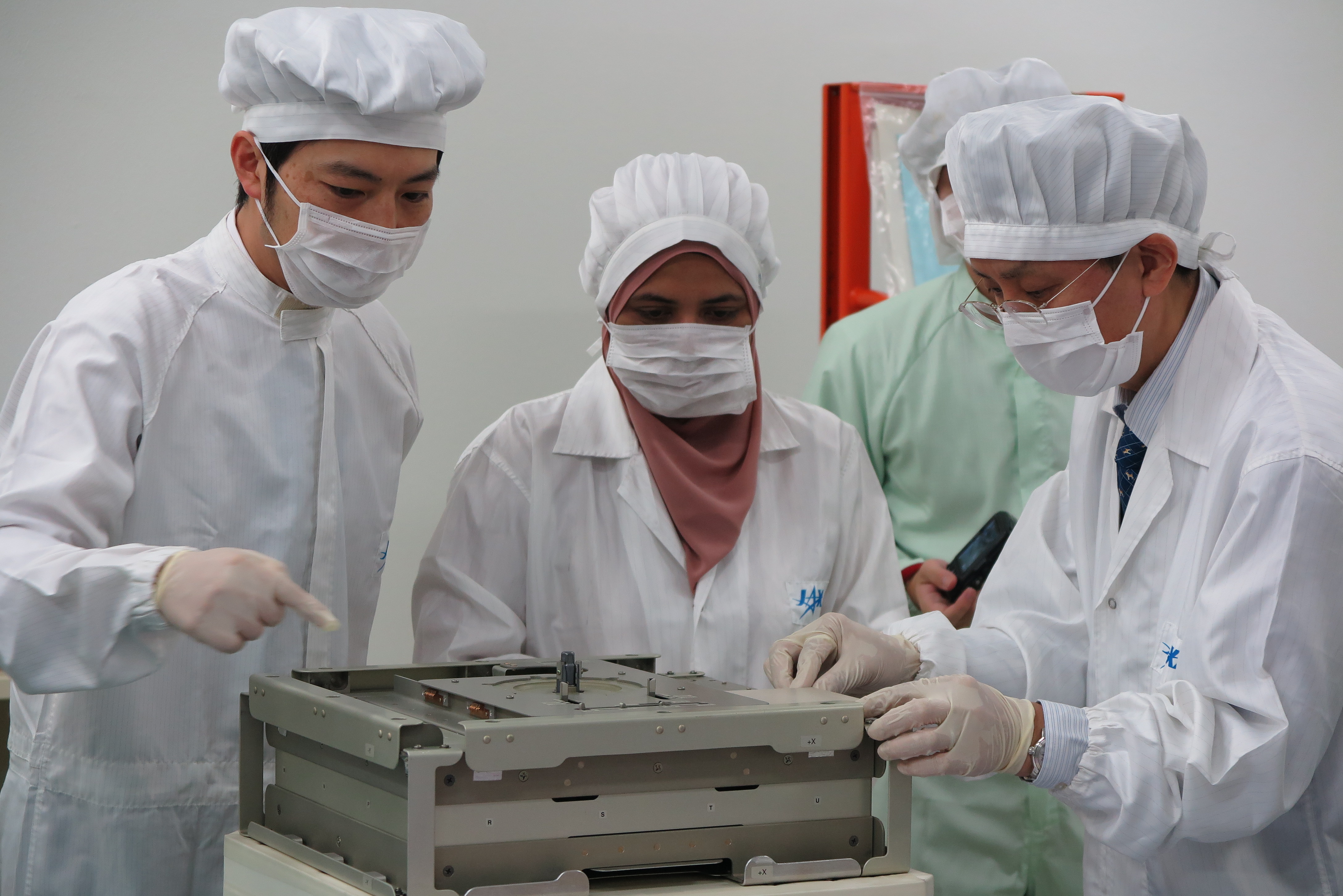
On November 2, two researchers of UPM hand-carried the samples to the Tsukuba Space Center, then a sample was attached to the ExHAM’s mockup.

Fit check attaching to the ExHAM mockup, November 2, 2018 (Credit: JAXA)

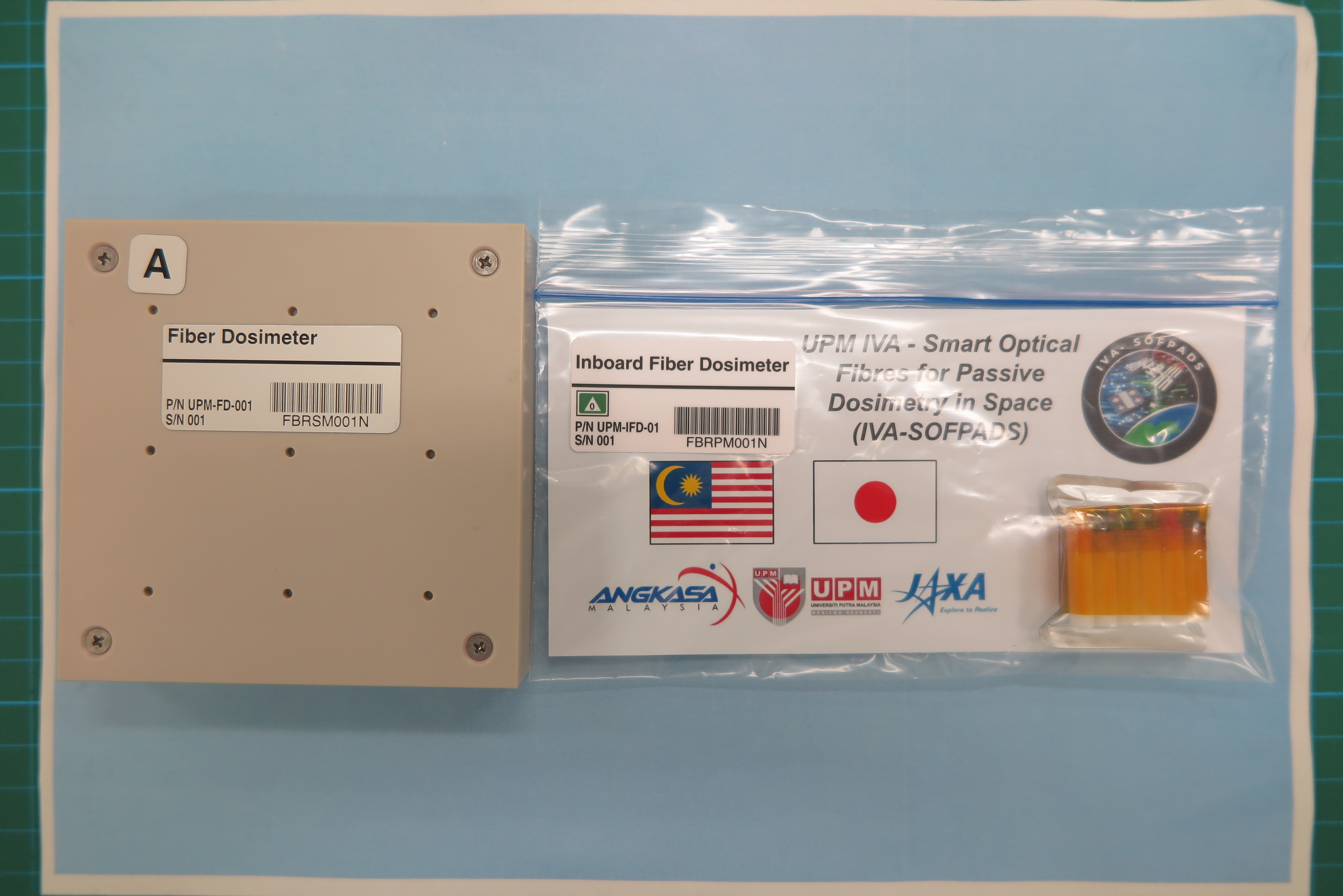
Prepared flight samples of UPM, November 2, 2018 (Credit: JAXA)

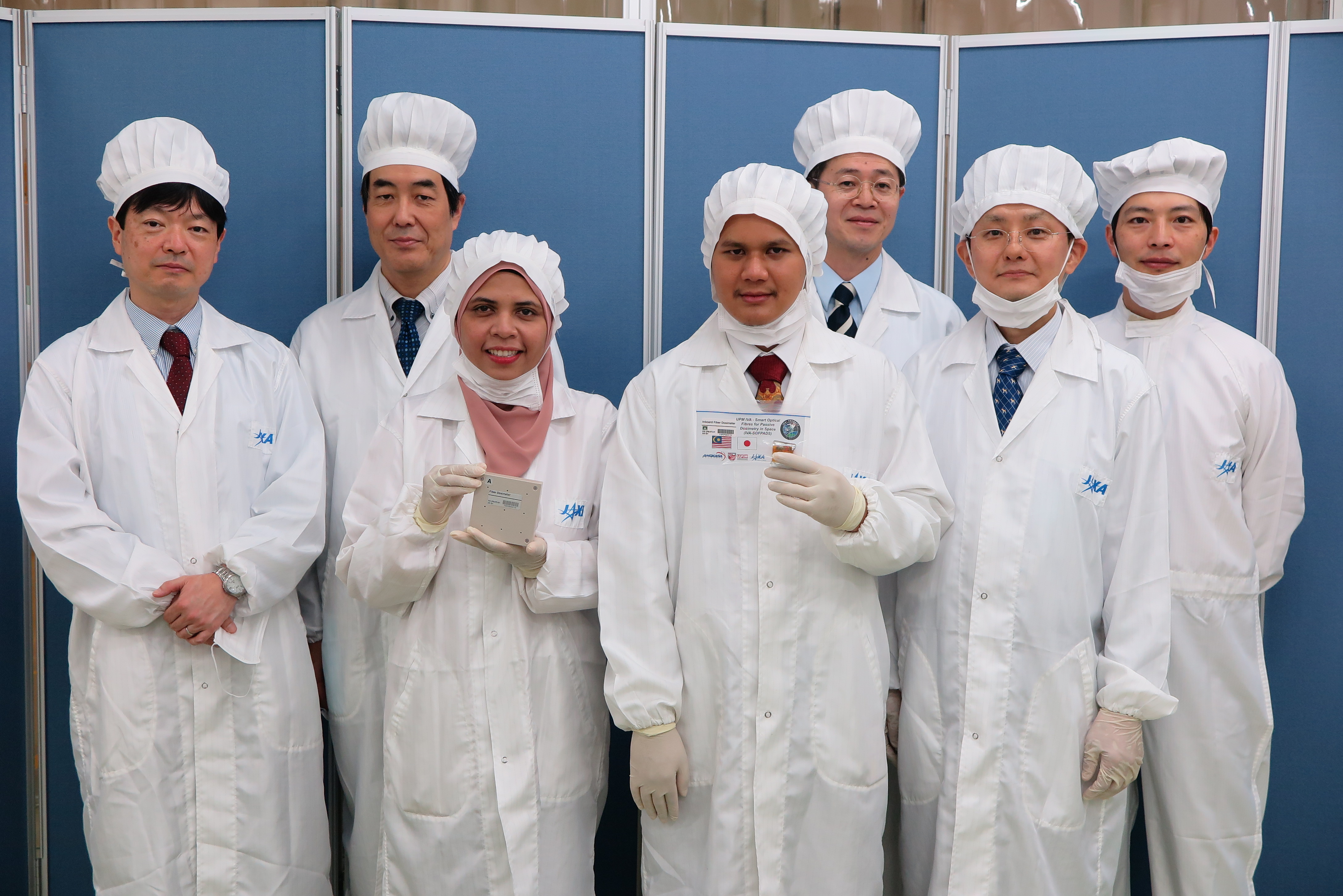
With samples handed over, November 2, 2018 (Credit: JAXA
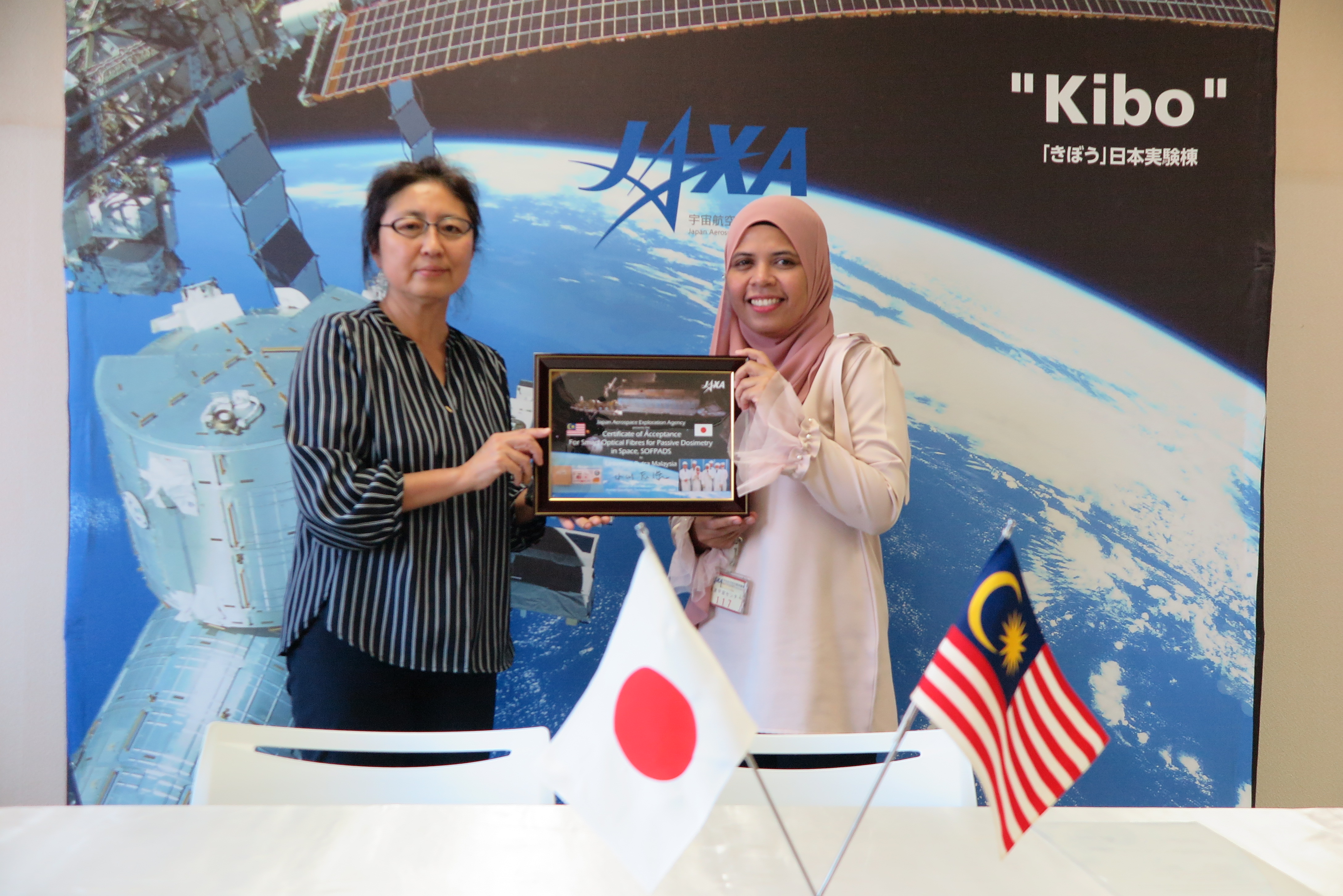
After all verifications were completed, the director of JAXA, Ms. Shiho Ogawa presented the certificate of acceptance to Dr. Noor. The samples will be shipped to the United States for delivery to ISS in February 2018.

Ms. Shiho Ogawa, Director of JEM Utilization Center, JAXA and Dr. Noramaliza Mohd Noor, Senior lecturer of UPM, with the certificate of acceptance, November 2, 2018 (Credit: JAXA)
During the APRSAF-25 sessions were held in Singapore this year, on November 7, the JAXA President Yamakawa praised the start of Kibo utilization cooperation with Malaysia, among relevant parties of ANGKASA and UPM.

At APRSAF-25, with the certificate of acceptance, November 7, 2018 (Credit: JAXA)
The experiment was proposed by the researchers of UPM to demonstrate utilization of the Smart Optical Fibres for Passive Dosimetry in Space (SOFPADS), which has been organizing under the leadership of the National Space Agency of Malaysia (ANGKASA). The passive dosimeter of optical fibres will be exposed in space under various conditions and stored afterward in the Kibo module with the JAXA Passive Dosimeter for Life-Science Experiments in Space (PADLES) for comparative analysis. After sample return to Earth, Malaysian researchers will verify the usability of the passive dosimeter in space.
JAXA, who acts as only one of the ISS partners in Asian region, expects that the collaboration of Kibo utilization with Malaysia will contribute to development of space technologies in the Asia and promote a mutually beneficial relationship among the Asian space agencies.
-
KOUNOTORI7 Leaves the ISS
KOUNOTORI7 Leaves the ISS
Last Updated: November 8, 2018

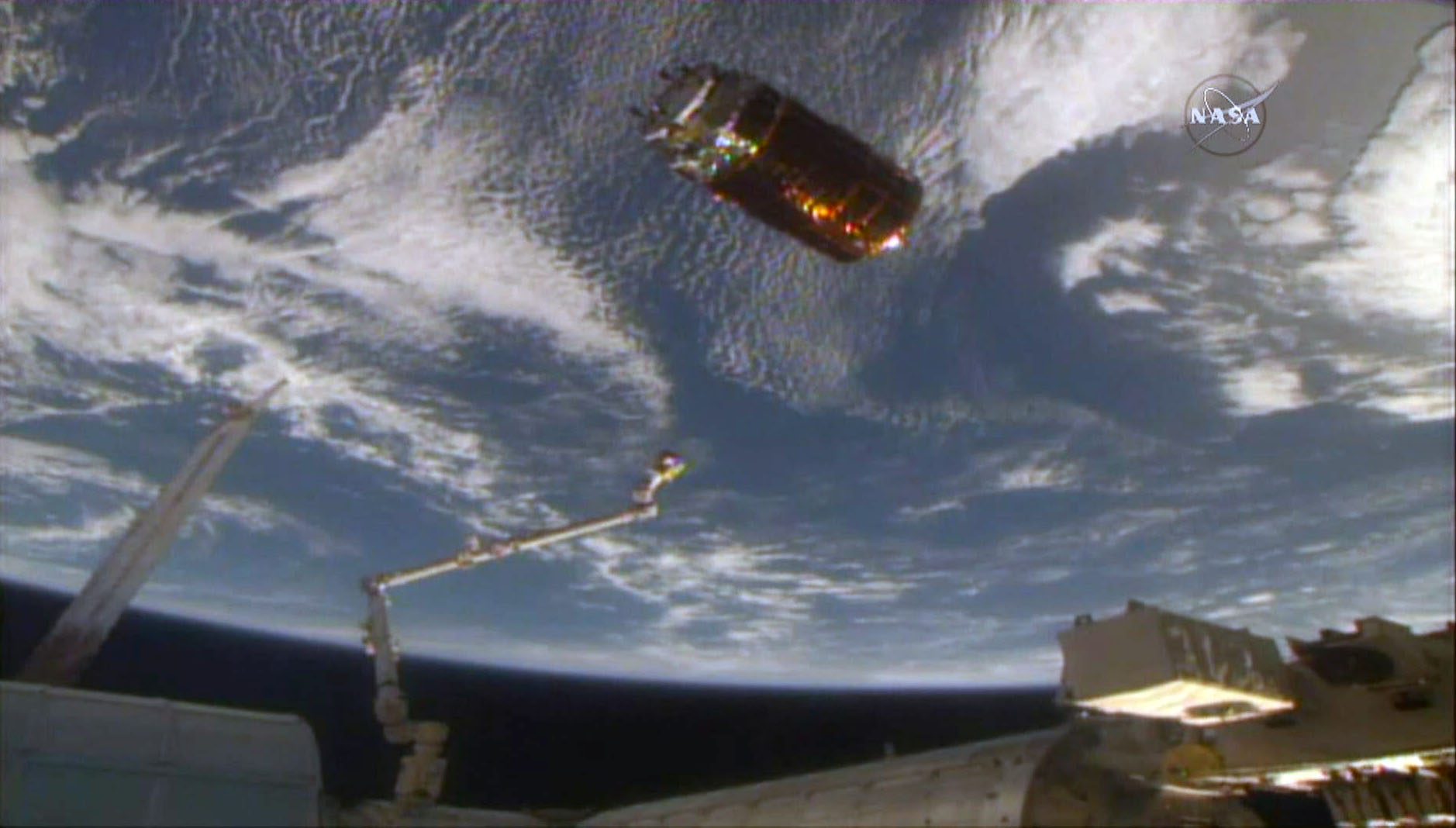
KOUNOTORI7 being released by the SSRMS (Credit: JAXA/NASA)
Captured by the Space Station Remote Manipulator System (SSRMS), KOUNOTORI7(HTV7) was moved to the releasing point below the station and released into orbit at 01:50 a.m., November 8.
After the HTV7 release, between the ISS, HTV Flight Control Room at Tsukuba Space Center, and Jonson Space Center (JSC) Mission Control Center had a following
nice conversation.- ESA Astronaut Alexander Gerst :
“arigatou gozaimasu” (Thank you very much) from ISS Expedition 57 crew、and “kio tsukete” (take care.) - HTV FD (Flight Director) Ms. Nakano:
“arigatou gozaimasu”(Thank you very much) from HTV FD. - JSC CAPCOM:
“utsukushii fune arigatou gozaimashita” (Thank you very much for beautiful ship) “soshite sayonara”(and goodbye.)
*All times are Japan Standard Time (JST. UTC + 9 hours)
- ESA Astronaut Alexander Gerst :
-
ESA’s gravity-mapper reveals relics of ancient continents under Antarctic ice

It was five years ago this month that ESA’s GOCE gravity-mapping satellite finally gave way to gravity, but its results are still yielding buried treasure – giving a new view of the remnants of lost continents hidden deep under the ice sheet of Antarctica.
-
Touch down: European module arrives at Kennedy Space Center

After a 24-hour journey from Bremen, Germany with stops in Hamburg and Portsmouth, USA, the European Service Module landed yesterday at Kennedy Space Center in Florida.